RESEARCH PAPER

Protective Effects of Angelica sinensis by-Product on Pellet Feed and Its Effects on Growth and Hypoxic Stress in Crucian Carp

  • HUANG Xiaolan , 1 ,
  • WANG Miaomiao 1 ,
  • LIU Haijing 1 ,
  • YANG Qihui 2 ,
  • ZHANG Huilan 1 ,
  • CHEN Houhong 1 ,
  • LI Jie 1 ,
  • XU Jing 1 ,
  • CHEN Gangfu 1 ,
  • LI Huatao , 1, *
Expand
  • 1 Fishes Conservation and Utilization in the Upper Reaches of the Yangtze River Key Laboratory of Sichuan Province, College of Life Sciences, Neijiang Normal University, Neijiang 641100, China
  • 2 College of Fisheries, Guangdong Ocean University, Zhanjiang 524088, China
*professor, E-mail:

Received date: 2024-07-12

  Online published: 2025-02-16

Abstract

The purpose of this study was to investigate the protective roles of Angelica sinensis by-product (AP) on pellet feed and its effects on growth and hypoxia stress in fish. Firstly, seven experimental diets were formulated by adding AP to the basal diet to provide a final concentration of 0 (control), 1.0%, 2.0%, 4.0%, 8.0%, 16.0% and 32.0%, respectively, and make it into 1.5 mm pellet feed. Then, 420 crucian carp [Carassais auratus gibebio, body weight of (5.67±0.07) g] were selected and randomly divided into 7 groups, with 3 replicates in each group and 20 fish in each replicate. Seven groups were fed with diets containing different levels of AP for 60 days. The results showed that AP at the addition level of 16.0% increased the moisture content (P<0.05), and at the addition levels of 4.0% to 16.0%, 1.0% to 8.0% and 8.0% to 32.0% reduced hardness, powder rate and mildew growth in pellet feed, respectively (P<0.05). Dietary AP at the addition levels of 2.0% to 8.0%, 2.0% to 8.0%, 8.0% to 16.0%, 8.0% to 32.0%, 8.0%, 2.0% to 16.0%, 1.0% to 16.0%, 8.0% to 32.0%, 2.0% to 32.0%, 4.0% to 32.0%, 2.0% to 8.0%, 8.0%, 1.0% to 32.0% and 2.0% to 32.0% increased the weight gain rate (WGR), special growth rate, feed efficiency, durative time (DT) after hypoxia, hematocrit, red blood cell count and hemoglobin content in the blood, the activities of superoxide dismutase (SOD) and catalase and the content of reduced glutathione (GSH) in red blood cells and the activities of SOD, glutathione peroxidase and glutathione reductase and the content of GSH in gills (P<0.05), respectively. Meanwhile, dietary AP at the addition levels of 8.0% to 32.0%, 1.0% to 16.0%, 8.0%, 4.0% to 8.0%, 2.0% to 32.0%, 4.0% to 16.0%, 2.0% to 32.0% and 4.0% to 32.0% reduced the oxygen consumption rate (OCR) after hypoxia, mean corpuscular volume in the blood, the levels of superoxide anions ($O_{2}^{-}$), hydrogen peroxide and methemoglobin in red blood cells as well as $O_{2}^{-}$, hydroxyl radicals and malondialdehyde in gills of crucian carp (P<0.05), respectively. These results indicate that AP improve the solidity and has anti-mold and water retention effects in pellet feed. Dietary AP increase the growth performance, hypoxia tolerance, and antioxidant capacity in gills and red blood cells of fish. According to the broken-line regression analysis based on WGR, the appropriate and highest addition levels of AP are estimated to be 8.08% and 23.07% in diets, respectively. The broken-line regression analysis based on DT and OCR show that the appropriate addition levels of AP to improve hypoxia tolerance in fish are 7.62% and 7.85% in diets. The improvement of hypoxia tolerance in fish by AP may be closely related to its reduction of aerobic metabolism and increase in the number of red blood cells and Hb content in blood as well as the antioxidant capacity in gills and red blood cells of fish. In summary, AP has a protective effect on pellet feed and can improve the growth and hypoxia tolerance in fish.

Cite this article

HUANG Xiaolan , WANG Miaomiao , LIU Haijing , YANG Qihui , ZHANG Huilan , CHEN Houhong , LI Jie , XU Jing , CHEN Gangfu , LI Huatao . Protective Effects of Angelica sinensis by-Product on Pellet Feed and Its Effects on Growth and Hypoxic Stress in Crucian Carp[J]. Chinese Journal of Animal Nutrition, 2025 , 37(2) : 1173 -1187 . DOI: 10.12418/CJAN2025.102

当归(Angelica sinensis)在我国种植历史悠久,目前主要产自甘肃,其次为云南、四川、湖北等,是国内需求量和产量最大的药用植物之一[1]。据不完全统计,在2020年我国当归种植面积已达75万亩 (1亩=0.066 7 hm2),产量达8.13万t[2-3]。当归在采收和加工过程中,需要经历采掘、晾晒、堆垛、扎把、梳捋、搭架、烘烤、切片等环节,在此过程中产生了大量残次和品相差的当归以及当归侧根和须等副产物[4],其药用价值低,利用十分有限。利用当归副产物(Angelica sinensis by-product, AP)作为鱼饲料的功能性原料或者替代饲料中价值较高的其他原料,开发其饲料利用价值,增加其新用途,变废为宝,提高其经济和社会效益,具有十分重要的意义。
目前,我国一般要求硬颗粒饲料的水分含量在12%以下[5],但当前普遍使用的干压制粒工艺,使其水分含量一般在9%~11%,显著低于国标的要求[6]。饲料水分含量过低,会使制粒能耗升高和环模磨损加快;同时会使饲料中淀粉糊化度不够和颗粒中的粉化率升高[7],从而导致颗粒饲料成品率降低和适口性下降[6]。饲料水分含量过低还会使颗粒入水后溶失速度加快[8],从而降低鱼的采食率;以及使颗粒硬度升高[9],在被快速采食的过程中损伤鱼的消化道。粉料在投喂过程中容易以粉尘的形式散失掉[10];进入水体中的粉料也会因颗粒太小,而与颗粒溶失的成分一样很少被鱼类采食,容易导致水质的恶化[11]。自然界中霉菌分布广泛,种类繁多,而且大多数霉菌都能引起饲料的发霉变质[12]。饲料中水分含量越高,其发生霉变的几率就越大;尤其是水产饲料,因湿热的养殖环境,发生霉变的机率更大[13]。霉变能破坏饲料中的营养成分,产生有毒物质,从而使其适口性变差、动物生长缓慢,甚至中毒死亡[12]。因此,目前在饲料中添加保水剂和防霉剂已是普遍现象。保水剂和防霉剂的成分一般为有机酸类化合物[9],如丙酸钙、双乙酸钠、山梨酸钠、苯甲酸钠等[12]。但这些物质一般为化学合成物,有的价格较贵,有的具有腐蚀性和刺激性,适口性差,甚至有毒,并在动物产品中残留[14],其安全性一直受到质疑。因此,开发新型天然的饲料保水剂和防霉剂具有重要意义。我国药用植物资源丰富,已有报道显示,茴香、花椒、水翁皮具有较好的防霉效果[14]。也已有研究表明,陈皮、藿香、艾叶对饲料中的霉菌具有抑制作用[12]。然而,目前有关当归及其副产物对颗粒饲料水分含量、粉化率和霉变的影响,鲜见研究报道。
我国现行《饲料原料目录》规定了包括当归在内的117种药食同源植物或其特定部位经干燥粉碎后获得的产品属于饲料原料,并规定当归为伞形科当归属植物当归的干燥根[15]。历代中医认为,当归对人具有补血活血、调经止痛、润燥通便之功效[16]。现代药学研究表明,当归富含藁本内酯、阿魏酸、多糖、黄酮类等成分,具有抗菌、抗炎、抗氧化、增强免疫等作用[17]。已有报道显示,含有当归的复合中草药促进了罗非鱼[18]、黄颡鱼[19]和红笛鲷[20]的生长。然而,也有研究表明,投喂添加1%的当归饲料对黄颡鱼的生长并无显著的促进作用[21]。鱼类的生长与水体中的溶解氧(DO)含量密切相关;水体缺氧也是导致鱼体应激的常见因素[22]。已有报道显示,投喂1‰的当归复合中草药浸提液提高了泥鳅的抗缺氧能力[23]。然而,另一报道却显示,投喂1‰当归浸提液对泥鳅的抗缺氧能力有减弱作用[24]。投喂同一植物对不同鱼类品种的生长和抗缺氧能力的影响可能存在较大差异。因此,有关当归对鱼生长和耐缺氧能力的影响及其在饲料中的适宜添加量和最大添加量有待进一步研究。
根据以前的研究,我们推测造成当归对鱼的作用存在争议的原因可能与其添加量太低和单一水平的试验设计有关。因此,本研究通过在饲料中添加不同水平的AP,测定颗粒饲料的硬度、水分含量、粉化率和霉菌含量等指标,评估其对颗粒饲料的作用;投喂鲫(Carassais auratus gibebio)后,测定鱼生长和缺氧应激以及组织器官生化指标,评估其对鱼的作用和在饲料中的适宜和最大添加量,为将AP作为功能性饲料原料在水产动物养殖中的应用提供理论依据。

1 材料与方法

1.1 试验材料

1.1.1 采购与处理
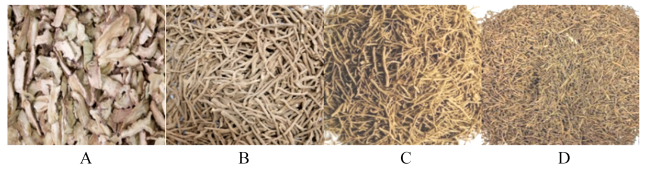
课题组于2021年1—2月从甘肃省渭源县会川世鸿中药材农民专业合作社购得整根全当归1 kg和AP共计9 kg (分3次采购,3 kg/次,价格为8~12元/kg)。购入后,先对AP进行了手工分拣、过筛清理和称重。方法如下:先整体在50 ℃鼓风干燥,然后手工检出当归头和身,称重并切片;剩余物过4目筛,并对筛上物进行手工分拣和称重(直径>0.5 cm为粗尾);将筛下物过8目筛,并对筛上物进行手工分拣和称重(0.5 cm>直径>0.2 cm为细尾);再将筛下物过18目筛,并将筛上物称重(直径<0.2 cm为当归须);筛下物称重(为泥沙等)。最后对以上各分拣物进行淘洗,烘干备用。当归副产物各部分见图1
图1 当归副产物中当归的头身(片,A)、粗尾(B)、细尾(C)和须(D)的图片

Fig.1 Pictures of head and body (thin piece,A), coarse tail (B), slender tail (C) and beard (D) in Angelica sinensis by-product

1.1.2 AP各部分活性成分的测定

将AP的各部分和全当归分别粉碎过100目筛。用高效液相色谱仪(HPLC)参照文献[25]报道的方法,测定其藁本内酯、阿魏酸和儿茶素的含量。

1.2 AP对颗粒饲料保护作用的评估

1.2.1 AP养分含量的测定

将干燥AP各部分混合粉碎,过100目筛,其水分、粗蛋白质、粗脂肪、粗纤维和粗灰分含量的测定分别参照GB/T 6435—2014、GB/T 6432—2018、GB/T 6433—2006、GB/T 6434—2022和
GB/T 6438—2007。无氮浸出物(%)=干物质-(粗蛋白质+粗脂肪+粗纤维+粗灰分)。AP的养分含量见表1
表1 当归副产物的养分含量(干物质基础)

Table 1 Contents of nutrients in Angelica sinensis by-products (DM basis) %

项目Items 含量Contents
干物质DM 92.54±1.34
粗蛋白质CP 14.90±0.83
粗脂肪EE 2.58±0.17
粗纤维CF 5.15±0.33
粗灰分Ash 5.69±0.40
无氮浸出物NFE 56.41±2.33

数据以3个重复的平均值±标准差表示。

Values were means±SD of 3 replicates.

1.2.2 试验饲料的配制

基础饲料以鱼粉、花生粕、玉米蛋白粉和菜籽粕为蛋白质源,鱼油和玉米油为脂肪源,其饲粮营养水平参照SC/T 1076—2004。通过替代部分面粉和少量玉米蛋白粉,在基础饲料中分别添加0(对照)、1.0%、2.0%、4.0%、8.0%、16.0%和32.0%的AP,配制成7种试验饲料,并参照文献[26]的方法,制成粒径为1.5 mm的颗粒饲料。试验饲料组成及营养水平见表2。试验饲料营养水平的测定参照1.2.1。
表2 试验饲料组成及营养水平(风干基础)

Table 2 Composition and nutrient levels of experimental diets (air-dry basis) %

项目
Items
AP添加水平Additive levels of AP/%
0(对照) 1.0 2.0 4.0 8.0 16.0 32.0
原料Ingredients
鱼粉Fish meal 21.00 21.00 21.00 21.00 21.00 21.00 21.00
花生粕Peanut meal 17.00 17.00 17.00 17.00 17.00 17.00 17.00
玉米蛋白粉Corn protein meal 12.00 12.00 12.00 11.80 11.50 11.00 10.00
菜籽粕Rapeseed meal 6.00 6.00 6.00 6.00 6.00 6.00 6.00
面粉Wheat flour 38.00 37.00 36.00 34.20 30.50 23.00 8.10
当归副产物AP 1.00 2.00 4.00 8.00 16.00 32.00
DL-蛋氨酸DL-Met 0.60 0.60 0.60 0.60 0.60 0.60 0.60
赖氨酸Lys 0.50 0.50 0.50 0.50 0.50 0.50 0.50
苏氨酸Thr 0.60 0.60 0.60 0.60 0.60 0.60 0.60
二磷酸氢钙Ca(H2PO4)2 0.60 0.60 0.60 0.60 0.60 0.60 0.60
鱼油Fish oil 1.10 1.10 1.10 1.10 1.10 1.10 1.10
玉米油Corn oil 0.60 0.60 0.60 0.60 0.60 0.60 0.50
维生素预混料Vitamin premix1) 1.00 1.00 1.00 1.00 1.00 1.00 1.00
矿物质预混料Mineral premix2) 1.00 1.00 1.00 1.00 1.00 1.00 1.00
合计Total 100.00 100.00 100.00 100.00 100.00 100.00 100.00
营养水平Nutrient levels3)
干物质DM 92.84 93.03 92.98 92.77 93.10 92.87 92.92
粗蛋白质CP 34.36 34.47 34.49 34.44 34.35 34.43 34.51
粗脂肪EE 5.33 5.27 5.37 5.38 5.42 5.45 5.43
粗灰分Ash 6.14 6.20 5.93 5.97 6.17 6.23 6.06

1)每千克维生素预混料含有 Per kg of vitamin premix contained:VA 0.80 g,VD3 0.48 g,DL-α-生育酚乙酸酯 DL-α-tocopherol acetate 20.00 g,VK3 0.43 g,VB1 0.11 g,核黄素 riboflavin 0.63 g,盐酸吡哆醇 pyridoxine HCl 0.92 g,VB12 0.10 g,抗坏血酸乙酸酯 ascorbyl acetate 7.16 g,D-泛酸钙 D-calcium pantothenate 2.73 g,烟酸 niacin 2.82 g,D-生物素 D-biotin 5.00 g,内消旋肌醇 meso-inositol 52.33 g,叶酸 folic acid 0.52 g。

2)每千克矿物质预混料含有 Per kg of mineral premix contained:FeSO4·7H2O (20% Fe) 69.70 g,CuSO4·5H2O (25% Cu) 1.20 g,ZnSO4·7H2O (23% Zn) 21.64 g,MnSO4·H2O (32% Mn) 4.09 g,Na2SeO3·5H2O (1% Se) 2.50 g,KI (4% I) 2.90 g,CaCO3 897.98 g。

3)营养水平均为实测值。Nutrient levels were all measured values.

1.2.3 试验饲料的处理

在烘干之前,每组取10 g湿颗粒饲料分别置于同等大小的称样皿内,同时在60 ℃环境下持续风干24 h,用于水分含量的测定。其余饲料风干后,按文献[27]的方法,每组取颗粒饲料50 g,分别置于100 mL烧杯内,模拟饲料的储存条件,密封避光放置于20~28 ℃环境下;持续12周后,用于测定饲料霉菌生长的情况。剩余饲料用于测定颗粒硬度和粉化率。

1.2.4 颗粒饲料水分含量、粉化率、硬度及霉菌生长的测定

风干颗粒饲料的水分含量测定采用卤素快速水分测定仪(MD-610A型,厦门米德电子科技有限公司)测定。霉菌生长情况的检测采用平板法,具体方法如下:准确量取纯净水15 mL和饲料颗粒15 g,迅速放入100 mm玻璃培养皿,混匀、摊平并稍压实,盖上皿盖。在25 ℃下培养4 d后观察和记录霉菌的生长情况,以霉菌在平板里的生长面积判断饲料中霉菌的含量。饲料颗粒的硬度采用硬度计(GWJ-1型,浙江托普仪器有限公司)测定[28];粉化率的测定采用GB/T 16765—1997推荐的方法。以上测定每组3个重复。饲料体外指标测完后,放入密封袋,抽真空并置于-20 ℃冰箱中保存,用于接下来的饲养试验。

1.3 动物试验

动物试验的伦理批准编号为JM2019-10,审批机构名称为内江师范学院实验动物中心。

1.3.1 试验设计及饲养管理

鲫苗购自于四川省内江市东兴区永安镇。在以下实验室环境下驯化:温度为(22.0±1.0) ℃;水源为自来水,水质符合《生活饮用水卫生标准》(GB 5749—2006),通过连续曝气至无氯,保持DO>6 mg/L、pH为7.8±0.3、氨氮含量<0.4 mg/L、亚硝酸盐含量<0.05 mg/L;每天换水并保持自然光周期[29]。每隔2 d用水银温度计监测水温和多参数水质分析仪[Octadem W-Ⅱ型,奥克丹(无锡)科技有限公司]监测水质参数各1次。
从驯化系统中选择体重为(5.67±0.07) g的鱼苗420尾,随机分为7组,每组3个重复,每个重复20尾鱼。每个重复均放养于一个相同大小的长方体鱼箱内,共计21个,其长宽高分别为55 cm×32 cm×40 cm。在7组中,对照组投喂基础饲料,其余6组分别投喂添加1.0%、2.0%、4.0%、8.0%、16.0%和32.0% AP的饲料。每天投喂4次,每次投喂30 min后观察箱底剩料量,以确保每次投喂鱼苗均能吃饱;收集剩料并干燥后称重,用于校正鱼苗的实际摄食量(FI)。持续投喂60 d后进行采样。

1.3.2 生长性能的测定

投喂结束后,对每个鱼箱内的鱼进行计数和称重,利用其FI、初数与末数和初重与末重,计算其成活率(SR)、增重率(WGR)、特定生长率(SGR)和饲料效率(FE)。计算公式如下:
FI(g/尾)=[饲料投喂量(g)-剩料量(g)]/鱼末数;
SR(%)=100×(鱼末数/鱼初数);
WGR(%)=100×[鱼末重(g/尾)-鱼初重(g/尾)]/鱼初重(g/尾);
SGR(%/d)=100×(ln鱼末重-ln鱼初重)/试验天数;
FE(%)=100×(鱼末重-鱼初重)/FI。

1.3.3 样品采集与处理

采样前先禁食24 h,每组的每个重复取样10尾鱼。鱼被氨基甲酸乙酯麻醉后,用肝素化注射器进行尾静脉采血,直至采完死亡。通过1 000×g离心5 min (4 ℃),从血液中分离红细胞和血浆,用以测定血液学和生化指标。采用文献[29]所描述的方法测定红细胞数量(RBC),并测定红细胞压积(Hct)和血红蛋白浓度(HbC),其他指标计算公式如下:
平均红细胞血红蛋白含量(MCH, pg/cell)=HbC/RBC;
平均红细胞体积(MCV, fL/cell)=Hct/RBC;
平均红细胞血红蛋白浓度(MCHC, g/L)=HbC/Hct。
将红细胞置于-80 ℃保存,用以检测红细胞中超氧阴离子( O 2 -)、过氧化氢(H2O2)、高铁血红蛋白(Met-Hb)和还原型谷胱甘肽(GSH)含量以及超氧化物歧化酶(SOD)和过氧化氢酶 (CAT)活性。
采血完成后,将鱼迅速放于冰上,鳃被快速移出,并保存于-80 ℃,用以测定鳃中 O 2 -、羟基自由基(·OH)、丙二醛(MDA)和GSH的含量以及SOD、谷胱甘肽过氧化物酶(GPx)和谷胱甘肽还原酶(GR)活性。在测定前,先将鳃组织在室温下解冻,待其融化后立即放于冰上,用解剖剪将其剪碎,然后加入9倍重量的预冷生理盐水,并用手持式高速匀浆机(FJ200-SH,中国上海)对混合液匀浆,最后把匀浆液在3 000×g (4 ℃)下离心10 min,并取上清液作为测定样品。

1.3.4 缺氧试验

饲养试验结束后,每个鱼箱选鱼5尾称重,用于缺氧试验。氧消耗率(OCR)的测定采用文献[22]报道的方法。具体方法如下:将120 L自来水持续爆气充氧24 h,使其DO达到饱和状态。将44倍鱼体重(BW)的饱和溶氧水(WV)轻轻移至一小口瓶(透明塑料材质,底径16 cm,高35 cm,口径5.0 cm,容量4.5 L)中,迅速放入5尾鱼,立即用便携式溶解氧测定仪(雷磁JPBJ-608型,上海仪电科学仪器股份有限公司)测定瓶中水的初溶氧浓度(IDO)。随后排空瓶内空气,立即封闭瓶口,并开始计时。当5条鱼中的4条鱼失去平衡时,停止计时。立即测定瓶中水的终溶氧浓度(FDO)。然后迅速将鱼转移至饱和溶氧水中进行复氧。计时器显示时间为持续时间(DT)。按以下公式计算每1 h和1 g鱼体的OCR:
OCR=[(IDO-FDO)×WV]/(DT×BW)。

1.3.5 红细胞和鳃中生化指标的测定

SOD、CAT、GPx和GR活性以及组织蛋白、Hb、 O 2 -、H2O2、·OH、Met-Hb、MDA和GSH含量的测定采用试剂盒,详细的操作参照试剂盒说明书的描述。以上试剂盒均购自南京建成生物工程研究所。

1.4 数据统计与分析

试验测得的数据以平均值±标准差(means±SD)表示。使用SPSS 22.0统计软件进行单因素方差分析(one-way ANOVA),并用Duncan氏法进行多重比较,P<0.05为差异显著。

2 结果与分析

2.1 AP活性成分含量

表3可知,AP中含有5.27%的当归头身、18.18%的当归粗尾、57.04%的当归细尾、8.95%的当归须,其余为石子泥沙等杂质,其总获得率为89.45%,占全当归的90.84%。AP不同部位的藁本内酯的含量从高到低依次为当归粗尾、当归细尾、当归须、当归头身,其合计含量为2.01%,占全当归的80.73%;阿魏酸的含量从高到低依次为当归粗尾、当归细尾、当归须和当归头身,其合计含量为0.17%,占全当归的85.70%;儿茶素的含量从高到低依次为当归头身、当归细尾、当归粗尾、当归须,其合计含量为0.24%,占全当归的58.70%。
表3 当归副产物中头身、粗尾、细尾和须以及全当归的获得率及其活性成分的含量

Table 3 Yield rate and contents of active ingredients of head and body, coarse tail, slender tail and beard in AP and Angelica sinensis %

项目
Items
获得率
Yield rate
藁本内酯
Ligustilide
阿魏酸
Ferulic acid
儿茶素
Catechin
头身Head and body 5.27 0.79 0.08 0.42
粗尾Coarse tail 18.18 2.63 0.22 0.26
细尾Slender tail 57.04 2.29 0.19 0.26
须Beard 8.95 2.04 0.16 0.24
合计Total 89.45 2.01 0.17 0.24
全当归Angelica sinensis 98.47 2.49 0.20 0.41
AP占全当归的百分率Percentage of AP in Angelica sinensis 90.84 80.73 85.70 58.70

表中数据重复测定3次,结果相同。

The data in the table has been measured three times with the same results.

2.2 AP颗粒饲料的水分含量、硬度和粉化率

表4可知,AP组颗粒饲料水分含量呈现先升高后降低的趋势,在16.0%添加量时显著高于对照组(P<0.05),并达到最高值。AP组颗粒饲料的硬度和粉化率则呈现先降低后升高的趋势,二者分别在4.0%~16.0%和1.0%~8.0%添加量时显著低于对照组(P<0.05),并均在4.0%添加量时达到最低。
表4 添加不同水平AP颗粒饲料的水分含量、硬度和粉化率

Table 4 Moisture content, hardness and powder rate of pelleted feed containing graded levels of Angelica sinensis by-products (n=3)

组别Groups 水分Moisture/% 硬度Hardness/kg 粉化率Powder rate/%
0(对照) 6.25±0.50a 2.14±0.08b 1.66±0.12d
1.0%AP 6.50±1.00a 2.11±0.15b 1.10±0.12bc
2.0% AP 6.75±0.50a 2.08±0.13ab 0.92±0.08b
4.0% AP 7.25±0.50ab 1.90±0.09a 0.64±0.08a
8.0% AP 7.25±0.50ab 1.92±0.07a 1.20±0.16c
16.0% AP 8.00±0.00b 1.93±0.20a 1.28±0.16cd
32.0% AP 7.25±0.50ab 2.04±0.11ab 1.50±0.12d

同列数据肩标不同小写字母表示差异显著(P<0.05)。下表同。

In the same column, values with different small letter superscripts mean significant difference (P<0.05). The same as below.

2.3 AP颗粒饲料的霉菌生长情况

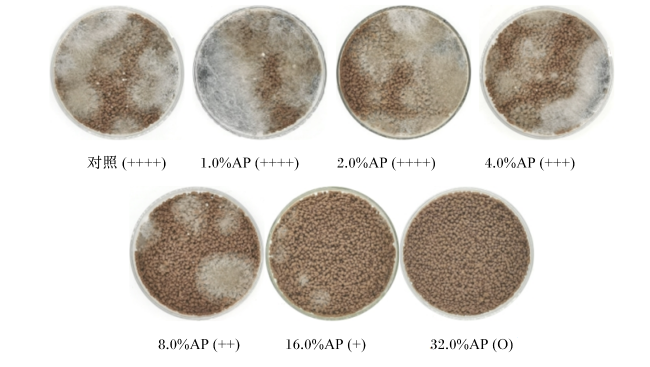
图2表5可知,与对照组相比,AP组颗粒饲料的霉菌生长面积随着AP添加量的提高而逐渐降低。8.0%AP组颗粒饲料的霉菌生长面积显著低于对照组(P<0.05);32.0%AP组颗粒饲料的霉菌生长面积为0.00,也显著低于对照组(P<0.05)。
图2 添加不同水平AP颗粒饲料的霉菌生长图片

“+++++”表示霉菌布满了整个平板,“++++”表示霉菌分布于大部分平板,“+++”表示霉菌分布于约1/2的平板,“++”表示霉菌分布于平板的一小部分,“+”表示平板内仅有零星的霉菌生长,“O”表示平板内无霉菌的生长。

Fig.2 Pictures of mildew growth in pellet feed containing graded levels of Angelica sinensis by-products

“+++++” represents that mildew covers the whole plate, “++++” represents that mildew covers the most of the plate, “+++” represents that mildew covers about the half of the plate, “++” represents that mildew covers a small portion of the plate, “+” represents only sporadic growth of mildew in the plate, “O” represents no the growth of mildew in the plate.

表5 添加不同水平AP颗粒饲料的霉菌生长情况

Table 5 Growth of mildew in pelleted feed containing graded levels of Angelica sinensis by-products

组别
Groups
霉菌生长面积
Growth area of mold
0(对照) 3.33±0.58d
1.0%AP 4.00±0.00e
2.0% AP 3.33±0.58d
4.0% AP 3.33±0.58d
8.0% AP 2.00±0.00c
16.0% AP 1.00±0.00b
32.0% AP 0.00±0.00a

霉菌生长面积以“+”的个数表示。

The growth area of mold was represented by the number of “+”.

2.4 添加不同水平的AP对鲫生长性能的影响

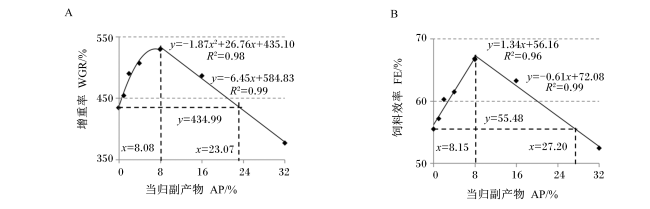
表6可知,与对照组相比,AP组鲫的FBW、WGR、SGR、FI和FE呈现先升高后降低的趋势。鲫的FBW、WGR、SGR和FE在8.0%AP组时达最高;FI在4.0%AP组时达到最高。鲫的WGR和FE折线回归分析显示(图3),AP在饲料中的适宜添加水平分别为8.08%和8.15%,最大添加水平分别为23.07%和27.20%。
表6 添加不同水平的AP对鲫生长性能的影响

Table 6 Effects of dietary different levels of AP on growth performance of crucian carp (n=3)

组别
Groups
初重
IBW/(g/尾)
末重
FBW/(g/尾)
增重率
WGR/%
特定生长率
SGR/(%/d)
摄食量
FI/(g/尾)
饲料效率
FE/%
0(对照) 5.68±0.08a 30.37±1.03b 434.99±25.75b 2.79±0.08b 44.49±1.23bc 55.48±1.05ab
1.0%AP 5.67±0.09a 31.46±1.14bc 454.78±14.49bc 2.86±0.04bc 45.18±1.35bc 57.16±3.91abc
2.0% AP 5.68±0.07a 33.53±1.21cd 490.56±17.97cd 2.96±0.05cd 46.22±1.11c 60.25±1.89bcd
4.0% AP 5.66±0.07a 34.38±1.99d 507.41±32.40d 3.01±0.09cd 46.71±1.01c 61.45±2.90bcd
8.0% AP 5.65±0.08a 35.63±1.64d 530.08±21.26d 3.07±0.06d 44.95±1.38bc 66.66±1.52d
16.0% AP 5.65±0.09a 33.13±1.93bcd 486.40±42.80bcd 2.95±0.12bcd 43.51±1.31b 63.10±3.15cd
32.0% AP 5.67±0.07a 27.05±1.57a 376.90±30.03a 2.60±0.10a 40.95±2.05a 52.27±4.20a
图3 不同水平AP与鲫增重率和饲料效率的折线回归分析

Fig.3 Broken-line regression analysis of weight gain rate and feed efficiency for crucian carp and different levels of Angelica sinensis by-product (n=3)

2.5 添加不同水平的AP对鲫耐缺氧能力的影响

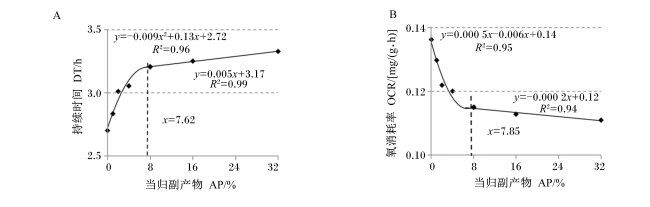
表7可知,AP组的鲫耐缺氧DT随AP添加水平的提高而逐渐升高,而OCR则随AP添加水平的提高而逐渐下降,二者均在8.0%~32.0%添加水平时与对照组有显著差异(P<0.05)。根据鲫的DT和OCR折线回归分析(图4),AP提高鱼耐缺氧能力的适宜添加水平分别为7.62%和7.85%。
表7 添加不同水平的AP对鲫耐缺氧能力的影响

Table 7 Effects of dietary different levels of AP on hypoxia tolerance of crucian carp (n=3)

组别
Groups
体重
BW/(g/尾)
水体积
WV/(L/瓶)
初溶氧
IDO/(mg/L)
持续时间
DT/h
末溶氧
FDO/(mg/L)
氧消耗率
OCR/[mg/(g·h)]
0(对照) 91.17±6.75a 4.08±0.28a 8.47±0.03a 2.70±0.20a 0.29±0.08a 0.14±0.01c
1.0%AP 89.00±4.36a 3.98±0.17a 8.47±0.03a 2.83±0.32ab 0.34±0.07a 0.13±0.01bc
2.0% AP 88.33±7.97a 3.95±0.33a 8.47±0.03a 3.01±0.17abc 0.30±0.10a 0.12±0.01abc
4.0% AP 90.50±8.32a 4.05±0.35a 8.47±0.03a 3.05±0.27abc 0.33±0.02a 0.12±0.01abc
8.0% AP 92.33±8.55a 4.13±0.36a 8.47±0.03a 3.20±0.09bc 0.25±0.06a 0.12±0.00ab
16.0% AP 93.00±7.21a 4.16±0.30a 8.47±0.03a 3.25±0.24bc 0.31±0.05a 0.11±0.01ab
32.0% AP 90.33±6.79a 4.04±0.28a 8.47±0.03a 3.33±0.25c 0.25±0.03a 0.11±0.01a
图4 不同水平AP与鲫缺氧持续时间和氧消耗率的折线回归分析

Fig.4 Broken-line regression analysis of durative time and oxygen consumption rate for crucian carp and different levels of Angelica sinensis by-product (n=3)

2.6 添加不同水平的AP对鲫血液指标的影响

表8可知,与对照组相比,Hct、RBC、HbC和MCHC随AP添加水平的提高而逐渐升高,Hct在8.0%AP组最高,RBC、HbC和MCHC在4.0%AP组最高,而后又随之降低;MCV随AP添加水平的提高而逐渐降低,在4.0%AP组最低,而后又随之升高。与对照组相比,AP组MCH无显著变化(P>0.05)。
表8 添加不同水平的AP对鲫血液指标的影响

Table 8 Effects of dietary different levels of AP on blood indicators of crucian carp (n=3)

组别
Groups
红细胞比容
Hct/%
红细胞数量
RBC/(×1012个/L)
血红蛋
白含量
HbC/(g/L)
平均红细
胞体积
MCV/(fl/cell)
平均红细胞
血红蛋白含量
MCH/(pg/cell)
平均红细胞
血红蛋白浓度
MCHC/(g/L)
0(对照) 38.03±1.23a 2.00±0.10a 81.38±1.06a 190.24±10.11c 40.71±1.64a 214.13±5.56ab
1.0%AP 39.11±2.70ab 2.25±0.10ab 87.64±2.03b 174.10±6.86ab 39.10±2.51a 224.98±20.13ab
2.0% AP 39.44±1.26ab 2.37±0.12bc 88.86±4.25b 166.46±7.91ab 37.57±3.60a 225.65±17.37ab
4.0% AP 41.43±1.33ab 2.61±0.19c 98.91±3.82c 159.06±8.85a 37.97±2.23a 238.94±13.08b
8.0% AP 42.52±1.68b 2.57±0.19c 98.42±2.50c 165.45±6.34ab 38.32±1.90a 231.59±5.17ab
16.0% AP 41.48±2.80ab 2.42±0.11bc 90.58±2.45b 171.39±10.83ab 37.48±2.65a 219.07±17.17ab
32.0% AP 39.34±1.64ab 2.18±0.12ab 81.63±3.84a 180.89±6.75bc 37.56±2.46a 207.52±5.74a

2.7 添加不同水平的AP对鲫红细胞生化指标的影响

表9可知,当AP的添加水平分别为8.0%~32.0%、2.0%~32.0%和4.0%~32.0%时,鲫红细胞SOD和CAT活性以及GSH含量显著高于对照组(P<0.05),三者均在8.0%添加水平时达到最高; O 2 -和H2O2含量随AP添加水平的提高而逐渐降低,分别在8.0%AP组和4.0%AP组最低,而后又随之升高。Met-Hb含量随着AP添加水平的提高而逐渐降低,在32.0%AP组最低。
表9 添加不同水平的AP对鲫红细胞生化指标的影响

Table 9 Effects of dietary different levels of AP on biochemical indicators in red blood cells of crucian carp (n=3)

组别
Groups
超氧阴离子
O 2 -/(U/g prot)
过氧化氢
H2O2/
(μmol/g prot)
高铁血
红蛋白
Met-Hb/(g/L)
超氧化
物歧化酶
SOD/
(U/mg prot)
过氧化氢酶
CAT/
(U/mg prot)
还原型
谷胱甘肽
GSH/
(μmol/g prot)
0(对照) 30.16±1.67b 52.84±2.44b 15.09±0.86c 91.01±5.08a 5.92±0.36a 4.33±0.37a
1.0% AP 30.22±1.23b 48.34±3.60ab 14.73±0.84bc 100.80±7.46ab 6.18±0.47ab 5.04±0.33a
2.0% AP 28.65±1.69ab 48.45±4.36ab 13.33±0.86ab 99.64±7.76ab 7.04±0.47bc 4.91±0.33a
4.0% AP 28.71±2.10ab 46.53±1.48a 12.63±1.21a 101.14±6.25ab 6.92±0.44bc 5.73±0.30b
8.0% AP 26.34±1.33a 46.63±2.35a 12.93±0.84a 105.76±8.86b 7.90±0.72c 6.65±0.30c
16.0% AP 28.92±1.67ab 49.63±4.08ab 12.33±0.70a 110.31±7.46b 7.41±0.65c 5.96±0.46bc
32.0% AP 29.97±1.77b 53.31±2.94b 11.98±0.72a 109.38±7.22b 7.37±0.39c 6.02±0.28bc

2.8 添加不同水平的AP对鲫鳃生化指标的影响

表10可知,鲫鳃中的 O 2 -、·OH和MDA含量随着AP添加水平的提高而逐渐降低,当AP的添加水平分别为4.0%~16.0%、2.0%~32.0%和4.0%~32.0%时,三者的含量显著低于对照组(P<0.05),并分别在16.0%、8.0%和16.0%添加水平时达到最低。鳃中SOD、GPx和GR活性及GSH含量随着AP添加水平的提高呈现先升高后降低的变化趋势,当AP的添加水平分别为2.0%~8.0%、8.0%、2.0%~32.0%和1.0%~32.0%时,三者的含量显著高于对照组 (P<0.05),并分别在8.0%、8.0%、16.0%和8.0%添加水平时达到最高。
表10 添加不同水平的AP对鲫鳃生化指标的影响

Table 10 Effects of dietary different levels of AP on biochemical indicators in gills of crucian carp (n=3)

组别
Groups
超氧
阴离子
O 2 -/
(U/g prot)
羟基
自由基
·OH/
(U/mg prot)
丙二醛
MDA/
(nmol/mg prot)
超氧化
物歧化酶
SOD/
(U/mg prot)
谷胱甘肽
过氧化物酶
GPx/
(U/mg prot)
还原型谷
胱甘肽
GSH/
(mg/g prot)
谷胱甘肽
还原酶
GR/
(U/g prot)
0(对照) 22.19±1.20b 19.32±1.53b 10.09±0.58b 18.07±0.99a 96.53±7.19a 8.47±0.59a 12.50±0.65a
1.0% AP 21.82±1.30b 18.30±1.57ab 9.47±0.67b 19.82±1.11abc 101.44±6.75a 9.69±0.47b 14.21±0.59ab
2.0% AP 20.14±0.87ab 16.92±1.19a 9.54±0.65b 20.41±0.85bc 99.75±8.12a 10.43±0.73bc 14.46±1.19bc
4.0% AP 19.17±1.51a 17.09±1.12a 8.18±0.43a 20.34±1.15bc 108.25±5.81ab 10.54±0.72bc 14.89±1.22bcd
8.0% AP 19.26±1.06a 16.42±1.08a 7.84±0.61a 21.74±1.08c 116.45±6.40b 11.58±0.51c 15.67±1.19bcd
16.0% AP 18.94±0.82a 16.53±0.71a 7.24±0.36a 18.91±1.23ab 105.75±8.66ab 10.86±0.71bc 16.53±0.82d
32.0% AP 20.19±1.27ab 16.67±0.86a 7.62±0.45a 19.07±1.24ab 106.80±3.91ab 10.74±0.79bc 16.28±0.97cd

3 讨论

3.1 AP对颗粒饲料具有保护作用

饲料的粉化率能直观反映颗粒的坚实度和耐磨性,粉化率过高将提高颗粒粉碎导致的质量损失[30];饲料的硬度则指颗粒对外压力所致变形的抵挡能力,硬度过高不利于动物对饲料的采食和消化[31]。颗粒饲料水分含量过低,一方面对生产企业造成了不必要的经济损失,同时能导致颗粒饲料的硬度和粉化率提高。本研究结果表明,AP提高了颗粒饲料的水分含量,降低了其硬度和粉化率。AP对颗粒饲料水分含量、粉化率和硬度的影响可能与其所含的成分有关。在本研究中,AP的无氮浸出物含量高达56.41%。已有报道显示,当归中富含多糖[32];植物多糖具有优越的吸附性、保水性及黏结性[33]。因此,AP对颗粒饲料水分含量的提高以及对其硬度和粉化率降低的原因可能是由于其多糖含量的丰富。饲料发霉将导致其营养成分的破坏,并产生有毒有害物质;饲料水分含量的提高将易于霉菌的生长[34]。本研究结果表明,AP降低了颗粒饲料的霉菌生长面积。此结果与李谷才等[35]关于当归中的黄酮类提取物抑制了黑曲霉和青霉生长的研究报道结果一致。然而,有关当归对颗粒饲料水分含量、粉化率和硬度的影响未见报道。本研究结果表明,AP提高了颗粒饲料的坚实度,对颗粒饲料具有显著的保水和防霉作用。

3.2 AP提高了鲫的生长性能

已有报道显示,饲料中添加当归提高了瓦氏黄颡鱼的WGR,但与空白组相比差异不显著[21]。本研究结果表明,饲料中添加AP显著提高了鲫的WGR、SGR和FE。此结果与饲料中添加当归乙酸乙酯提取物提高了鲤的生长和饲料利用率的报道[26]结果一致。本研究结果表明,饲料中添加AP提高了鱼的生长性能。基于鲫WGR的折线回归分析显示,AP在鱼饲料中的适宜添加水平为8.08%,最高添加水平为23.07%。然而,目前将AP作为原料或功能性成分在水产动物饲料中应用的情况并不多见。其原因可能和其他天然植物一样存在粗纤维等无效成分含量高、含有各种抗营养因子以及对不同种类鱼的生长影响差异较大等问题有关[22]。已有研究表明,当归多糖提高了卵形鲳鲹的抗氧化能力和免疫功能[36],增强了石斑鱼的细胞防御反应和抗病力[37]。可见,植物提取技术可能是解决AP在水产动物养殖中高效应用的重要途径,但其需要的详细技术方法还有待进一步研究。

3.3 AP提高了鲫的耐缺氧能力

水体中的DO含量与鱼的生长密切相关[22]。在淡水养殖环境中,DO含量的季节性和日波动较大,鱼体经常经历缺氧/再复氧的情况[22]。据报道,缺氧能导致鱼生长性能的下降[38]。OCR是反映动物有氧代谢状态的重要指标[39]。本研究发现,AP提高了鲫的缺氧DT,降低了其OCR。此结果与Long等[40]关于当归乙酸乙酯提取物延长了鲤的缺氧DT和降低了其OCR的报道结果一致。本研究结果表明,饲料中添加AP提高了鱼的耐缺氧能力,降低了其有氧代谢。已有报道显示,代谢率的降低是支撑动物在低氧条件下存活的重要原因[22]。因此,AP可能通过降低鱼的有氧代谢来提高其耐缺氧能力。
在动物血液中,红细胞对氧气的运输主要依托血红蛋白来完成,动物体运输氧的能力与其血液中的红细胞数量和Hb含量密切相关[41]。Hct、RBC和HbC是重要的血液学指标,能够间接反映鱼体红细胞的生理功能[42]。本研究发现,饲料中添加AP提高了鲫血液的Hct、HbC和RBC,降低了其MCV。此结果与当归乙酸乙酯提取物提高了鲤的Hct、HbC和RBC的报道结果[29,40]一致。本研究结果表明,AP提高了鱼血液中的红细胞数量和Hb含量。MCV的降低表示单个红细胞体积的降低,一般预示血液中幼稚红细胞比例的提高,即造血功能的增强[22,29]。因此,AP可能通过提高鱼的造血功能,提高鱼血液中红细胞的数量和Hb含量,从而提高了鱼的耐缺氧能力。

3.4 AP提高了鱼鳃和红细胞的抗氧化能力

鱼类的鳃是重要的呼吸器官,鳃中含有大量的红细胞[43],其正常功能与其氧化-抗氧化状态存在密切关系[29]。红细胞在运输氧的过程中,Hb发送自氧化不断产生 O 2 -和Met-Hb,而失去结合或运输氧的功能[44] O 2 -能发生歧化产生H2O2,H2O2能与血红素Fe2+反应产生·OH[45]。这些活性氧(ROS)能氧化细胞内的脂质、蛋白质和核酸等物质,导致细胞的功能损伤[45]。MDA是动物组织细胞脂质氧化反应的终产物,能够间接地反映细胞脂质受ROS破坏的程度[46]。本研究发现,饲喂添加AP的饲料降低了鲫鳃和红细胞的 O 2 -、Met-Hb、H2O2、·OH和MDA含量。此结果与当归乙酸乙酯提取物降低了鲤鳃细胞 O 2 -、·OH和MDA含量以及红细胞 O 2 -、H2O2、Met-Hb和MDA含量的报道结果[29,40]一致。本研究结果表明,AP能够减少鱼鳃和红细胞中ROS的产生和脂质氧化。
鱼细胞含有抗氧化防御系统,具有清除细胞内ROS和抑制细胞成分氧化的作用[47]。清除细胞内ROS的酶性抗氧化剂主要有SOD、GPx和CAT,非酶抗氧化剂主要为GSH[48]。SOD能将 O 2 -转化为H2O2[49];CAT能促使H2O2分解为H2O和O2[50];GPx能以GSH作为底物降解过氧化物[51]。GSH具有直接清除细胞内ROS和防止红细胞膜脂和血红素被氧化的作用[44]。GR能将氧化型GSH(GSSG)转化为还原型GSH,使其保持抗氧化的活性[52]。在通常状态下,酶性和非酶抗氧化剂组成了机体内的抗氧化防御系统,协同维持组织细胞的氧化-抗氧化平衡,这对细胞适应不同生长环境和发挥正常生理功能至关重要[53]。本研究结果显示,AP提高了鲫鳃和红细胞中GSH含量以及CAT、GPx、GR和SOD活性。此结果与当归乙酸乙酯提取物提高了鲤鳃SOD、CAT、GPx和GR活性及GSH含量以及红细胞CAT活性和GSH含量的报道结果[29,40]一致。本研究结果表明,AP能够提高鲫鳃和红细胞酶性抗氧化剂活性和非酶抗氧化剂含量,并以此降低组织细胞ROS的产生和细胞成分的氧化。

4 结论

综上所述,添加AP提高了颗粒饲料的坚实度以及防霉和保水功能,因而对颗粒饲料具有保护作用;饲料中添加AP提高了鱼的生长性能和耐缺氧能力。鲫的WGR折线回归分析显示,AP在饲料中的适宜添加水平为8.08%,最高添加水平为23.07%。鲫的DT和OCR折线回归分析显示,AP提高鱼耐缺氧能力的适宜添加水平分别为7.62%和7.85%。
[1]
孙红梅, 张本刚, 齐耀东, 等. 当归药材资源调查与分析[J]. 中国农学通报, 2009, 25(23):437-441.

SUN H M, ZHANG B G, QI Y D, et al. Survey and analysis on the resource of Angelica sinensis[J]. Chinese Agricultural Science Bulletin, 2009, 25(23):437-441. (in Chinese)

[2]
陈学文, 刘养卉. 岷县当归产量影响因素的灰色关联分析——基于面板数据的实证研究[J]. 中国林业经济, 2022(1):80-84.

CHEN X W, LIU Y H. Grey relational analysis of the factors affecting the yield of angelica in Minxian county——empirical research based on panel data[J]. China Forestry Economy, 2022(1):80-84. (in Chinese)

[3]
姚琴, 陈海生, 赵剑锋. 岷县当归产业发展困境及对策探究[J]. 广东蚕业, 2022, 56(3):129-132.

YAO Q, CHEN H S, ZHAO J F. Research on the development dilemma and countermeasures of angelica sinensis industry in min county[J]. Guangdong Canye, 2022, 56(3):129-132. (in Chinese)

[4]
李波, 强正泽, 李成义. 当归干燥加工的历史沿革[J]. 中国中药杂志, 2019, 44(6):1278-1283.

LI B, QIANG Z Z, LI C Y. Study on history of processing and drying of Angelicae sinensis[J]. China Journal of Chinese Materia Medica, 2019, 44(6):1278-1283. (in Chinese)

[5]
刘学良. 颗粒饲料含水量的调控[J]. 养殖技术顾问, 2001(9):20.

LIU X L. Regulation of the water content of pellet feed[J]. Modern Animal Husbandry Science & Technology, 2001(9):20. (in Chinese)

[6]
岳增华, 王玉峰. 饲料保水及在生产过程中的水分控制[J]. 饲料与畜牧, 2013(1):18-20.

YUE Z H, WANG Y F. Feed water retention and moisture control during the production process[J]. Feed and Animal Husbandry, 2013(1):18-20. (in Chinese)

[7]
贺磊, 秀梅. 控制颗粒饲料粉化率的措施[J]. 江西饲料, 2019(5):11-12.

HE L, XIU M. Measures to control the chalking rate of pellet feeds[J]. Grain Oil and Feed Technology, 2019(5):11-12. (in Chinese)

[8]
李兆新, 翟毓秀, 王唯芬. 对虾配合饲料水中稳定性的影响因素及其测定方法[J]. 海洋水产研究, 2000, 21(3):49-53.

LI Z X, ZHAI Y X, WANG W F. A Summery of influencing factors and testing methods on shrimp formulated diet stability in water[J]. Marine Fisheries Research, 2000, 21(3):49-53. (in Chinese)

[9]
吴耀忠. 饲料保水剂——Novus赛非司(Surf.Ace)在生产中使用效果实例分析[J]. 山西饲料, 2012(2):31-32,36.

WU Y Z. Examples of the effectiveness of Novus Surf.Ace in feed water retention in production[J]. Shanxi Feed, 2012(2):31-32,36. (in Chinese)

[10]
周根来, 张海俊. 影响颗粒饲料含粉率的因素及其控制[J]. 中国畜牧兽医, 2010, 37(5):37-40.

ZHOU G L, ZHANG H J. Main factors affecting powder percentage of pelleted feed and its control[J]. China Animal Husbandry & Veterinary Medicine, 2010, 37(5):37-40. (in Chinese)

[11]
叶继丹, 关瑞章. 水产配合饲料入水后的散失率及其水体COD值的变化[J]. 中国饲料, 2008(4):28-29.

YE J D, GUAN R Z. The losing rate of aquatic compound feed and the water COD changes after the addition of feed into the water[J]. China Feed, 2008(4):28-29. (in Chinese)

[12]
唐瑶, 陈洋. 常见饲料防霉剂的应用及前景展望[J]. 湖南饲料, 2014(6):29-31.

TANG Y, CHEN Y. Application and prospect of common feed mould inhibitors[J]. Hunan Feed, 2014(6):29-31. (in Chinese)

[13]
董爱华. 饲料防霉剂在水产饲料中应用及防霉效果评估方法[J]. 饲料与畜牧, 2012(3):47-48.

DONG A H. Application of feed mould inhibitors in aquafeed and assessment method of mould inhibition effect[J]. Feed and Animal Husbandry, 2012(3):47-48. (in Chinese)

[14]
房兴堂. 饲料防霉剂防霉效果检测与天然防霉剂开发[J]. 养殖与饲料, 2006(5):22-24.

FANG X T. Detection of antimould effect of feed antimould agent and development of natural antimould agent[J]. Animals Breeding and Feed, 2006(5):22-24. (in Chinese)

[15]
中华人民共和国农业部. 中华人民共和国农业部公告第1773号《饲料原料目录[EB/OL].(2012-06-01)[2024-06-30]. http://www.moa.gov.cn/gk/zcfg/nybgz/201206/t20120614_2758749.htm.

Ministry of Agriculture of the People’s Republic of China. Announcement of the ministry of agriculture of the people’s republic of China No.1773 “catalogue of feed raw materials”[EB/OL].(2012-06-01)[2024-06-30]. http://www.moa.gov.cn/gk/zcfg/nybgz/201206/t20120614_2758749.htm. (in Chinese)

[16]
国家药典委员会. 中华人民共和国药典:2015年版一部[M]. 北京: 中国医药科技出版社, 2015:484-485.

Chinese Pharmacopoeia Commission. Pharmacopoeia of the people’s republic of China:the first part of the 2015 edition[M]. Beijing: China Medical Science and Technology Press, 2009:484-485. (in Chinese)

[17]
禹娟红. 当归用作饲料添加剂的研究进展[J]. 中兽医学杂志, 2016(5):87-90.

YU J H. Research progress of Angelica sinensis as feed additive[J]. Chinese Journal of Traditional Veterinary Science, 2016(5):87-90. (in Chinese)

[18]
汤菊芬, 吴灶和, 简纪常, 等. 复方中草药对罗非鱼生长及肌肉成分的影响[J]. 饲料工业, 2009, 30(16):19-21.

TANG J F, WU Z H, JIAN J C, et al. Effects of Chinese herbal formula off the growth performance and meat quality of tilapia[J]. Feed Industry, 2009, 30(16):19-21. (in Chinese)

[19]
王吉桥, 祁彩霞, 程爱香, 等. 黄芪、熟地和山楂等中草药对黄颡鱼生长和消化的影响[J]. 水产学杂志, 2008, 21(1):34-41.

WANG J Q, QI C X, CHENG A X, et al. Effects of dietary Radix Astragali,radix polygoni multiflori and Fructus Crataegi on growth and digestibility in juvenile yellow catfish (Pelteobagrus fulvidraco)[J]. Chinese Journal of Fisheries, 2008, 21(1):34-41. (in Chinese)

[20]
陆志款, 简纪常, 吴和, 等. 一种复方中草药饲料添加剂在红笛鲷网箱养殖中的应用[J]. 广东海洋大学学报, 2008, 28(4):59-64.

LU Z K, JIAN J C, WU H, et al. The application of Chinese herbal feed additives in net-cage culture of Lutjanus sanguineus[J]. Journal of Guangdong Ocean University, 2008, 28(4):59-64. (in Chinese)

[21]
唐黎, 李辉, 王吉桥, 等. 中草药对瓦氏黄颡鱼生长影响的研究[J]. 河北渔业, 2010(11):1-3.

TANG L, LI H, WANG J Q, et al. Effects of herbs to the groth of the yellow catfish Pseudobagrus vachelli[J]. Hebei Fisheries, 2010(11):1-3. (in Chinese)

[22]
LI H T, LU L, WU M, et al. The effects of dietary extract of mulberry leaf on growth performance,hypoxia-reoxygenation stress and biochemical parameters in various organs of fish[J]. Aquaculture Reports, 2020, 18:100494.

[23]
韩杰, 高军泰, 徐志林. 中草药混合浸提液对泥鳅抗缺氧能力的影响[J]. 科学养鱼, 2010(2):46.

HAN J, GAO J T, XU Z L. Effect of Chinese herbal medicine mixed extract on anti-hypoxia ability of loach[J]. Scientific Fish Farming, 2010(2):46. (in Chinese)

[24]
韩杰, 徐志林, 高军泰, 等. 三种中草药当归、黄芪、五味子浸提液对泥鳅抗缺氧能力的影响[J]. 饲料工业, 2009, 30(12):31-32.

HAN J, XU Z L, GAO J T, et al. Effects of extracts of three Chinese herbal medicines Angelica sinensis,Astragalus membranaceus and Schisandra chinensis on anti-hypoxia ability of Misgurnus anguillicaudatus[J]. Feed Industry, 2009, 30(12):31-32. (in Chinese)

[25]
LI H T, MA Y T, LIU Y, et al. Integrated biomarker parameters response to the toxic effects of high stocking density,CuSO4,and trichlorfon on fish and protective role mediated by Angelica sinensis extract[J]. Fish Physiology and Biochemistry, 2020, 46(5):1679-1698.

[26]
LI H T, YANG D D, LI Z H, et al. Effects of Angelica sinensis extracts on lipid oxidation in fish feeds and growth performance of juvenile Jian carp (Cyprinus carpio var.Jian)[J]. Animal Nutrition, 2019, 5(1):109-114.

[27]
LI H T, TANG S Y, DU W H, et al. The effects of ethoxyquin and Angelica sinensis extracts on lipid oxidation in fish feeds and growth,digestive and absorptive capacities and antioxidant status in juvenile red carp (Cyprinus carpio var. xingguonensis):a comparative study[J]. Fish Physiology and Biochemistry, 2019, 45(1):43-61.

[28]
李华涛. 水产动物饲料实验检测与评价[M]. 长春: 吉林科学技术出版社, 2021.

LI H T. Detection and evaluation of aquatic animal feed experiment[M]. Changchun: Jilin Science and Technology Publishing House, 2021. (in Chinese)

[29]
LI H T, WU M, WANG J, et al. Protective role of Angelica sinensis extract on trichlorfon-induced oxidative damage and apoptosis in gills and erythrocytes of fish[J]. Aquaculture, 2020, 519:734895.

[30]
肖文渊, 陶正纲, 张正荣. 有效控制颗粒饲料的粉化率[J]. 西昌学院学报(自然科学版), 2007, 21(3):37-38.

XIAO W Y, TAO Z G, ZHANG Z R. Effective control of the powder ratio of pellets[J]. Journal of Xichang College(Natural Science Edition), 2007, 21(3):37-38. (in Chinese)

[31]
杨俊成, 于庆龙, 秦玉昌, 等. 饲料物理性能指标的测定方法[J]. 中国饲料, 2000(17):23-24.

YANG J C, YU Q L, QIN Y C, et al. Determination method of physical properties of fee[J]. China Feed, 2000(17):23-24. (in Chinese)

[32]
WU Y C, HSIEH C L. Pharmacological effects of Radix Angelica sinensis (Danggui) on cerebral infarction[J]. Chinese Medicine, 2011, 6:32.

[33]
金迪, 梁英, 孙工兵, 等. 植物多糖提取技术的研究进展[J]. 黑龙江八一农垦大学学报, 2011, 23(5):76-79.

JIN D, LIANG Y, SUN G B, et al. Research progresses on extracting techniques of plant polysaccharide[J]. Journal of Heilongjiang Bayi Agricultural University, 2011, 23(5):76-79. (in Chinese)

[34]
徐子伟, 张国海, 刘敏华, 等. 包装类型对饲料防霉效果的影响[J]. 饲料研究, 1991(5):12-14.

XU Z W, ZHANG G H, LIU M H, et al. Effect of packaging types on mildew-proof effect of feed[J]. Feed Research, 1991(5):12-14. (in Chinese)

[35]
李谷才, 魏文亭, 高堂杰, 等. 当归总黄酮提取及其体外抑菌活性研究[J]. 时珍国医国药, 2011, 22(2):310-311.

LI G C, WEI W T, GAO T J, et al. Study on extraction of total flavonoids from Angelica sinensis and its anti-bacterial activity in vitro[J]. Lishizhen Medicine and Materia Medica Research, 2011, 22(2):310-311. (in Chinese)

[36]
谭连杰, 林黑着, 黄忠, 等. 当归多糖对卵形鲳鲹生长性能、抗氧化能力、血清免疫和血清生化指标的影响[J]. 南方水产科学, 2018, 14(4):72-79.

TAN L J, LIN H Z, HUANG Z, et al. Effect of dietary angelica polysaccharide (AP) on growth performance,antioxidant capacity,serum immune and serum biochemical indices of juvenile golden pompano (Trachinotus ovatus)[J]. South China Fisheries Science, 2018, 14(4):72-79. (in Chinese)

[37]
WANG Q K, CHEN C X, GUO Y J, et al. Dietary polysaccharide from Angelica sinensis enhanced cellular defence responses and disease resistance of grouper Epinephelus malabaricus[J]. Aquaculture International, 2011, 19(5):945-956.

[38]
BRAUN N, DE LIMA R L, MORAES B, et al. Survival, growth and biochemical parameters of silver catfish,Rhamdia quelen (Quoy & Gaimard,1824),juveniles exposed to different dissolved oxygen levels[J]. Aquaculture Research, 2006, 37(15):1524-1531.

[39]
LI H T, LIU H J, WU S Y, et al. Effects of ferulic acid on respiratory metabolism,oxidative lesions, and apoptotic parameters in gills and red blood cells of carp (Cyprinus carpio Var. Jian) response to copper[J]. Antioxidants, 2024, 13(3):314.

[40]
LONG J, YANG P Y, LIU Y H, et al. The extract of Angelica sinensis inhibits hypoxia-reoxygenation and copper-induced oxidative lesions and apoptosis in branchiae and red blood corpuscles of fish[J]. Veterinary Sciences, 2024, 11(1):1.

[41]
周贤君, 彭坤辉, 梁正其, 等. 青田田鱼血液学初步研究[J]. 凯里学院学报, 2010, 28(3):50-51.

ZHOU X J, PENG K H, LIANG Z Q, et al. The pilot study of haematology for Bowl Jiang Cai carp[J]. Journal of Kaili University, 2010, 28(3):50-51. (in Chinese)

[42]
侯海锋, 李茜, 张少华, 等. 当归对鸡血液指标的影响研究[J]. 中国家禽, 2007, 29(23):21-23,26.

HOU H F, LI Q, ZHANG S H, et al. Effect of Tang-kuei decoction on blood index in chicken[J]. China Poultry, 2007, 29(23):21-23,26. (in Chinese)

[43]
EVANS D H, PIERMARINI P M, CHOE K P. The multifunctional fish gill:dominant site of gas exchange,osmoregulation,acid-base regulation,and excretion of nitrogenous waste[J]. Physiological Reviews, 2005, 85(1):97-177.

[44]
JOHNSON R M, GOYETTE G J, RAVINDRANATH Y, et al. Hemoglobin autoxidation and regulation of endogenous H2O2 levels in erythrocytes[J]. Free Radical Biology & Medicine, 2005, 39(11):1407-1417.

[45]
CIMEN M Y B. Free radical metabolism in human erythrocytes[J]. Clinica Chimica Acta, 2008, 390(1/2):1-11.

[46]
KONG X F, WU G Y, LIAO Y P, et al. Effects of Chinese herbal ultra-fine powder as a dietary additive on growth performance,serum metabolites and intestinal health in early-weaned piglets[J]. Livestock Science, 2007, 108(1/2/3):272-275.

[47]
LI H T, LU L, ZHANG R M, et al. The extracts of Angelica sinensis inhibit lipid oxidation in fish erythrocytes and improve growth,digestive,absorptive and antioxidant capacity in juvenile Jian carp (Cyprinus carpio var.Jian)[J]. Aquaculture Nutrition, 2019, 25(1):119-133.

[48]
MASELLA R, DI BENEDETTO R, VARÌ R, et al. Novel mechanisms of natural antioxidant compounds in biological systems:involvement of glutathione and glutathione-related enzymes[J]. The Journal of Nutritional Biochemistry, 2005, 16(10):577-586.

[49]
高雯欣. 两种多环芳烃对孔石莼的生物毒性及氧化胁迫研究[D]. 硕士学位论文. 哈尔滨: 哈尔滨工业大学, 2010.

GAO W X. Biologicle toxicity and oxidative stress of two kinds of polycyclic aromatic hydrocarbons on Ulva pertusa[D]. Master’s Thesis.Harbin:Harbin Institute of Technology, 2010. (in Chinese)

[50]
JANNUZZI A T, KARA M, ALPERTUNGA B. Celastrol ameliorates acetaminophen-induced oxidative stress and cytotoxicity in HepG2 cells[J]. Human & Experimental Toxicology, 2018, 37(7):742-751.

[51]
LIN Y H, SHIAU S Y. Mutual sparing of dietary requirements for alpha-tocopherol and selenium in grouper, Epinephelus malabaricus[J]. Aquaculture, 2009, 294(3/4):242-245.

[52]
JIANG W D, FENG L, LIU Y, et al. Myo-inositol prevents oxidative damage,inhibits oxygen radical generation and increases antioxidant enzyme activities of juvenile Jian carp (Cyprinus carpio var.Jian)[J]. Aquaculture Research, 2009, 40:1770-1776.

[53]
闫飞. 具有协同作用的抗氧化模拟酶的研究[D]. 博士学位论文. 长春: 吉林大学, 2010.

YAN F. Antioxidant enzyme minics with synergism[D]. Ph.D.Thesis. Changchun: Jilin University, 2010. (in Chinese)

Outlines

/