REVIEW

Research Progress on Influencing Factors of Metabolism and Thermogenesis of Brown Adipose Tissue

  • ZHANG Chongzhi , 1, 2, 3 ,
  • GUO Youhua 4 ,
  • YANG Jinli 4 ,
  • SUN Haizhou , 1, 2, 3, *
Expand
  • 1 Institute of Animal Nutrition and Feed, Inner Mongolia Academy of Agricultural & Animal Husbandry Sciences, Hohhot 010031, China
  • 2 Key Laboratory of Grass-Feeding Animal Nutrition Science, Department of Science and Technology of Inner Mongolia Autonomous Region, Hohhot 010031, China
  • 3 Key Laboratory of Grass-Feeding Livestock Healthy Breeding and Livestock Product Quality Control (Co-Construction by Ministry and Province), Ministry of Agriculture and Rural Affairs, Hohhot 010031, China
  • 4 College of Animal Science, Inner Mongolia Agricultural University, Hohhot 010018, China
*professor, E-mail:

Received date: 2024-07-30

  Online published: 2025-02-16

Abstract

Brown adipose tissue is primarily distributed in the scapular region, around the kidneys and deep in the neck of young animals, its structure and function differ from those of white adipose tissue. White adipose tissue is the main tissue for storing energy, while brown adipose tissue is the main tissue responsible for heat production and energy consumption. Brown adipose tissue has shown to be important in combatting obesity and metabolic disorders like diabetes, with its structure and function influenced by various factors. Several studies also indicate that the thermogenic properties of brown adipose tissue enhance cold resistance in livestock during winter. This article reviews the sources and functions of brown adipose tissue, as well as the research progress on the effects of cold stress, feeding rhythms, circadian rhythms, feed additives and hormones on brown adipose tissue, providing theoretical references for future related research.

Cite this article

ZHANG Chongzhi , GUO Youhua , YANG Jinli , SUN Haizhou . Research Progress on Influencing Factors of Metabolism and Thermogenesis of Brown Adipose Tissue[J]. Chinese Journal of Animal Nutrition, 2025 , 37(2) : 701 -708 . DOI: 10.12418/CJAN2025.060

动物机体内的脂肪组织有3种,分别为白色脂肪组织(white adipose tissue,WAT)、棕色脂肪组织(brown adipose tissue,BAT)和米色脂肪组织(beige adipose tissue,Beige),它们分布在身体的不同位置,在细胞形态、生理功能上也有所不同。其中,WAT在动物体内分布最多,在皮下、内脏器官等周围都有分布,能够作为内分泌器官作用于效应器官来调节机体的能量代谢[1];同时还能以甘油三酯的形式储存机体摄取的富余能量。与WAT相比,BAT在体内分布相对较少,其作用主要是产热以及在寒冷环境中维持体温,消耗机体摄入的过剩能量,维持能量平衡[2]。研究发现,BAT在肥胖和Ⅱ型糖尿病的治疗上有显著作用,能够改善肥胖和葡萄糖平衡[3]。本文总结了BAT代谢及产热影响因素的研究进展,为后续有关BAT的研究提供理论依据。

1 BAT

1.1 BAT的分布及来源

BAT主要分布在锁骨、肩胛骨、肾周等处[4],该组织细胞表面有肾上腺素受体,细胞中央有圆形的核,细胞内分散着大量小脂滴,含有大量线粒体。与WAT储存能量的功能不同,BAT能够表达解偶联蛋白1(uncoupling protein 1,UCP1)。研究表明,BAT起源于中胚层前体细胞,早在动物胚胎发育中期就已经形成[5]。前体细胞在特定转录因子的调控下即可进一步分化为BAT。UCP1是BAT的特异性表达基因,在BAT的产热中发挥关键作用。以UCP1为主的BAT标志基因的过表达是白色脂肪棕色化的显著标志,其表达增高是白色脂肪棕色化的关键。此外,白色脂肪棕色化的过程还涉及到一系列的转录调控因子,其中包括过氧化物酶体增殖物激活受体γ辅激活子-1α(peroxisome proliferator-activated receptor γ coactivator-1α,PGC-1α)和PR结构域蛋白16(PR domain-containing 16,PRDM16),它们发挥了核心的调控作用,多数的调控通路均直接或间接地通过这些转录因子来发挥作用[6]

1.2 BAT的功能

BAT的主要功能是产热,产热活动时能够通过消耗体内脂肪进而在改善和治疗肥胖中起到一定的作用。BAT的产热依赖于UCP1,且UCP1只存在于BAT细胞的线粒体内膜中,冷刺激能够激活UCP1,进一步引起线粒体氧化呼吸和ATP解偶联,从而使大量能量以热能的形式散发,经由血管输送到机体各部分。而且经UCP1维持的质子梯度能够在不受ATP限制的情况下,加速线粒体的氧化呼吸产热[7-8]。视神经交叉上核(suprachiasmatic nucleus,SCN)输入的昼夜信号也能够作用于BAT上,形成BAT在葡萄糖摄入和能量消耗方面的节律变化[9]
BAT的影响因素及功能见图1。其中,温度和年龄是影响BAT的主要因素,营养和其他因素(比如激素、进食节律等)都会对BAT的功能具有一定影响。
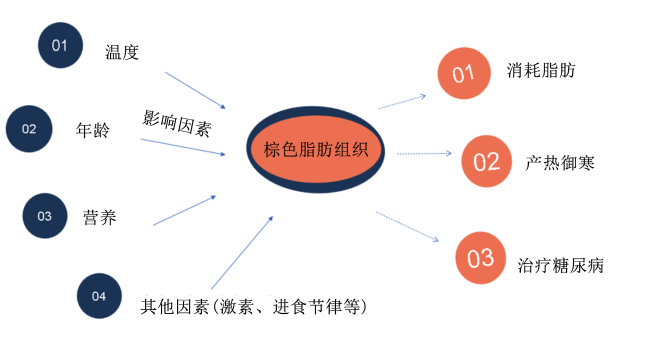
图1 BAT的影响因素及功能

Fig.1 Influencing factors and functions of BAT

有研究发现,BAT中UCP1对畜禽生长性能和营养价值方面产生了影响。Zheng等[10]通过基因组编辑技术将UCP1基因敲入到猪WAT当中,发现在没有改变其他条件下,UCP1的异位表达也能够降低动物机体全身的脂肪沉积,同时提高了胴体瘦肉率和仔猪御寒的能力。BAT作为产热组织,能够在冬季寒冷环境条件下提高动物机体产热,提高抗寒能力,进而增加冬季出生羔羊的存活率[11]

2 BAT影响因素的研究进展

2.1 冷刺激/冷应激对BAT的影响

当机体受到寒冷刺激时,会引发皮下白色脂肪细胞亚群的棕色化,进而增强产热能力用以保持体温,并通过促进脂肪分解来减轻体重[12]。BAT丰富的线粒体是关键的细胞器,由于其负责细胞呼吸并供应能量,可以减少氧化产物的积累,具有抗氧化作用。因此,BAT对于机体防寒有重要的作用。此外,当β-肾上腺素能受体被刺激或暴露于寒冷环境中时,WAT可通过棕色化过程转变成与BAT功能相似的组织,即Beige。Beige起源于WAT,但产生的热量类似于BAT。
冷刺激时,UCP1被激活,能够促进棕色脂肪细胞线粒体的呼吸和产热[13]。磷脂酰乙醇胺(phosphatidylethanolamine,PE)是一种定位于线粒体内膜上的响应温度变化的“变阻器”,当机体受到冷刺激时,PE含量显著增加,进而直接增强UCP1的活性,上调UCP1进行产热[14]。在寒冷环境中,体内去甲肾上腺素释放增加,导致棕色脂肪细胞的增殖和产热作用的激活,从而促使脂肪组织发生棕色化[15]。寒冷暴露还能增加高脂饮食小鼠的皮下白色脂肪组织(inguinal white adipose tissue,iWAT)和BAT中特定蛋白(如UCP1、PRDM16、PGC-1α)的表达,这些蛋白的表达能够激活BAT的功能,显著提高产热能力,减少WAT的过度堆积,对于治疗肥胖的研究有重要作用[16]。Khani等[17]研究发现,冷诱导表达的腺苷酸环化酶3(adenyl cyclase 3,AC3)在BAT中起到调节作用。Verkerke等[18]研究发现,冷暴露后BAT活性的增强也与支链氨基酸(branched chain amino acid,BCAA)氮源代谢物合成的增加有关。
在冬季,一些哺乳动物为了能顺利越冬,会间歇性地放弃维持高体温,以冬眠的方式减少能量的支出[19]。在冬眠时,机体会多次利用BAT来度过寒冷的冬天,线粒体的解偶联呼吸是冬眠期间BAT产热的主要来源[20]

2.2 生物钟及生物钟基因与昼夜节律对BAT的影响

2.2.1 生物钟及生物钟基因

生物体的生理反应都遵循着一定周期的节律行为,这个周期的长度受到环境自然光照的影响,一般为24 h,这种昼夜节律叫做生物钟[21-22]。机体通过生物钟,根据环境变化来调节自身的行为[23]。生物钟系统参与了生命体大多数的生理过程,外界环境光刺激能够被机体视网膜接收,并进一步地将光信号传导到SCN和外周器官中,进而参与机体的代谢调节[24]。生物钟基因可以分为核心生物钟基因和钟控基因(clock controlled genes,CCG),其中核心生物钟基因主要有ClockBmal1、Period(Per1、Per2、Per3)和Cryptochrome(Cry1、Cry2)等[25]

2.2.2 生物钟及核心生物钟基因对BAT的影响

机体大多数组织中都存在生物钟基因,BAT中也同样存在。许多生物钟基因能够通过编码转录因子进而影响BAT的形成和发育。Bmal1作为生物钟系统的核心生物钟基因,与昼夜节律和BAT细胞的分化有一定的联系。Bmal1基因缺失的棕色前脂肪细胞和间充质前体细胞可以进一步分化成BAT细胞,且缺少Bmal1基因的小鼠BAT的生成和产热也增加[26]。Hepler等[27]研究发现,经高脂饲料饲喂后的脂肪细胞特异性Bmal1转基因小鼠的体重增长受到影响,机体的耗氧量增加。
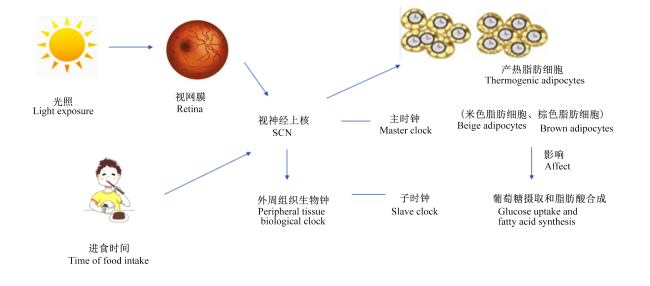
生物钟调控Beige和BAT的分子机制见图2,是总结Peng等[28]的研究所作,主要描述了光照和食物摄入的时间对生热脂肪细胞(包括BAT细胞和Beige细胞)生物钟调控的分子机制。光照周期的异常、时钟基因的突变或工作时间和时差的变化等因素,都会引起昼夜节律紊乱,进而导致生热脂肪的昼夜节律失调,影响BAT的代谢。
图2 生物钟调控Beige和BAT的分子机制

Fig 2 Molecular mechanisms of circadian clock regulation of Beige and BAT

李志豪[29]研究表明,SCN可能对BAT的产热能力具有负调控作用,而对WAT的分解具有正调控作用,脂肪组织中存在昼夜节律。高扬等[30]研究表明,大鼠昼夜节律紊乱后,Bmal1蛋白表达下降,且有氧运动会启动UCP1,促进白色脂肪发生褐变,进而改善因为昼夜节律紊乱引起的大鼠脂肪堆积现象。

2.2.3 进食节律、昼夜节律及限制饲喂对BAT的影响

研究表明,动物机体昼夜节律的调节和代谢受到营养水平、摄食时间和周期等因素的影响,动物夜间的基础代谢低,且很多消化器官在夜间的机能有所下降[31]。动物肠道内的生物钟系统在调控机体营养物质代谢和吸收方面具有一定的节律性[32-33]。因此,利用机体的节律性可以对其进行动态精准饲喂,有助于提高动物的生产性能。沈嘉伟[34]研究发现,光照可能与饮食诱导的产热共同影响BAT的能量代谢,结果说明了光暗环境是调控BAT产热的环境因素之一。
昼夜颠倒进食会引起脂肪组织昼夜节律异常,进而对脂肪代谢有影响[35]。陈江慧[36]对雌鼠和雄鼠的进食进行干预,发现在白天限制性采食的条件下,雄鼠BAT中Bmal1的基因表达昼夜节律有更强的相位迁移效应,而雌鼠无显著影响。Chi等[37]研究表明,限时饲喂小鼠能够通过恢复肠道激素分泌节律以及BAT产热,进而改善因昼夜节律紊乱引起的代谢异常。Munoz等[38]研究表明,对脂肪特异性胰岛素受体敲除的小鼠进行14 d低蛋白质饲粮饲喂,能够改善胰岛素抵抗并能使血糖正常化,这种代谢的改善与BAT有关,BAT激活并增加全身能量消耗。Ojha等[39]研究发现,在母羊妊娠后期时进行限饲,会显著减低其胎儿体内脂肪中UCP1蛋白的含量,从而对BAT的产热作用产生影响。

2.3 饲料添加剂对BAT的影响

Petrovic等[40]研究发现,添加过氧化物酶体增殖物激活受体γ(peroxisome proliferator-activated receptor γ,PPARγ)激动剂罗格列酮,能促进UCP1基因在细胞的重要子集中表达,为这些细胞提供产热能力。Su等[41]研究表明,在饲料中添加胍基乙酸(guanidineacetic acid,GAA)可以有效地改善高脂饮食(high fat diet,HFD)诱导的iWAT肥大,能够促进iWAT向BAT褐变。吴宝升等[42]研究表明,饲粮中添加精氨酸会影响羊胎儿期及出生期BAT的生长发育,母羊灌注精氨酸显著增加胎儿褐色脂肪的沉积和羔羊的出生重。除了添加精氨酸外,有研究发现在母羊妊娠后期饲粮中添加2%多不饱和脂肪酸时,BAT的UCP1的mRNA表达水平明显升高[43]。Viana等[44]的试验结果显示,补充白藜芦醇的动物WAT发生了PRDM16、UCP1的mRNA表达,证明了白藜芦醇在调节BAT的产热方面有一定作用。王立[45]研究发现,外源添加缬氨酸能够有利于小鼠脂肪合成基因的表达,通过影响BAT多个通路中的基因表达,进而影响脂质代谢。

2.4 激素对BAT的影响

甲状腺及甲状腺激素也会对BAT有一定的影响,方勤圆等[46]研究发现,切除妊娠后期母羊胎儿的甲状腺时,胎儿的肾周BAT中UCP1的mRNA表达水平下降,产热活性降低。Harris等[47]通过检测和分析发现,甲状腺缺陷的胎儿BAT中部分基因表达受到抑制,从而影响UCP1蛋白和mRNA的表达,进而影响UCP1的产热功能。Blondin等[48]研究发现,在啮齿动物中,生殖激素与BAT的氧化代谢有关,雌激素的流失会降低BAT的活性,绝经后BAT的氧化代谢和葡萄糖摄取较低。
瘦素主要是由WAT细胞分泌的一种蛋白质激素,能够作用于下丘脑的代谢调节中枢。考虑到瘦素在脂肪代谢中的作用,以及BAT作为能量消耗的重要组织,可以合理推测瘦素可能间接或直接地影响BAT的功能,同时也有相关研究证实瘦素与BAT有一定联系。例如,有研究表明瘦素通过刺激交感神经系统来激活BAT,从而增加能量消耗[49]。在这一过程中,瘦素可能作用于BAT中的相关受体或信号通路,尽管这些受体或信号通路不一定直接位于BAT细胞内,但瘦素的作用确实与BAT的功能密切相关。Yuen等[50]在母羊妊娠后期将瘦素和生理盐水分别静脉注射到胎羊中,发现注射瘦素的胎羊中UCP1含量相对更高。此外,褪黑素在昼夜节律的调节中起着重要作用,褪黑素能够抑制绵羊BAT前体细胞的增殖,并且能有效地促进其细胞的分化能力[51]

3 小结与展望

BAT在调节能量代谢和维持体温稳定中扮演着关键角色。随着肥胖和相关代谢疾病成为全球性健康问题,研究者们对BAT的功能和调控机制表现出了浓厚的兴趣。近年来,围绕着BAT的研究逐渐增多,其中包括一些有关冷应激、生物钟基因、昼夜节律以及饲料添加剂和激素等影响因素的研究。未来的研究可以进一步探索BAT功能的调控网络,尤其是生物钟基因与信号通路之间的交互作用对BAT的影响。同时,也可以关注如何利用进食节律、适度的冷刺激和合理使用激素或饲料添加剂来优化BAT的功能,为畜牧业养殖提供帮助。
[1]
李晴晴, 杨芝春. 脂肪组织生物学研究进展[J]. 中南医学科学杂志, 2016, 44(5):579-585.

LI Q Q, YANG Z C. Research progress in adipose tissue biology[J]. Medical Science Journal of Central South China, 2016, 44(5):579-585. (in Chinese)

[2]
姚旋, 张颖, 单仕芳, 等. 褐色脂肪组织研究的最新进展和科学意义[J]. 中国细胞生物学学报, 2011, 33(3):227-236.

YAO X, ZHANG Y, SHAN S F, et al. Recent progress in the study of brown adipose tissue and its scientific significance[J]. Chinese Journal of Cell Biology, 2011, 33(3):227-236. (in Chinese)

[3]
SHARABI K, LIN H, TAVARES C D J, et al. Selective chemical inhibition of PGC-1α gluconeogenic activity ameliorates type 2 diabetes[J]. Cell, 2017, 169(1):148-160.e15.

DOI PMID

[4]
杨吉刚, 袁磊磊, 阚英, 等. 棕色脂肪组织在体内的分布及FDG PET/CT扫描中的影响因素[J]. 临床和实验医学杂志, 2013, 12(24):2030-2033.

YANG J G, YUAN L L, KAN Y, et al. Distribution of brown adipose tissue in vivo and influencing factors in FDG PET/CT scan[J]. Journal of Clinical and Experimental Medicine, 2013, 12(24):2030-2033. (in Chinese)

[5]
傅晓华, 徐维海, 裘胜春, 等. 棕色脂肪组织及其与多囊卵巢综合征关系的研究进展[J]. 浙江大学学报(医学版), 2017, 46(3):315-320.

FU X H, XU W H, QIU S C, et al. Research progress on the relationship of brown adipose tissue with polycystic ovary syndrome[J]. Journal of Zhejiang University(Medical Sciences), 2017, 46(3):315-320. (in Chinese)

[6]
单天禹, 赵娜, 李庆伟, 等. 白色脂肪棕色化在治疗肥胖中的研究进展[J]. 辽宁中医药大学学报, 2024, 26(8):194-199.

SHAN T Y, ZHAO N, LI Q W, et al. Research progress of white fat browning in the treatment of obesity[J]. Journal of Liaoning University of Traditional Chinese Medicine, 2024, 26(8):194-199. (in Chinese)

[7]
BARTELT A, HEEREN J. Adipose tissue browning and metabolic health[J]. Nature Reviews.Endocrinology, 2014, 10(1):24-36.

[8]
刘向东, 李戡, 刘文忠, 等. 棕色脂肪和米黄色脂肪研究进展[J]. 动物医学进展, 2015(10):95-99.

LIU X D, LI K, LIU W Z, et al. Progress on brown adipose tissue and beige adipose tissue[J]. Progress in Veterinary Medicine, 2015(10):95-99. (in Chinese)

[9]
吴昌华, 袁子豪, 张金, 等. 生物钟、棕色脂肪组织对动脉粥样硬化的影响[J]. 广东医科大学学报, 2020, 38(5):518-521.

WU C H, YUAN Z H, ZHANG J, et al. Effects of biological clock and brown adipose tissue on atherosclerosis[J]. Journal of Guangdong Medical College, 2020, 38(5):518-521. (in Chinese)

[10]
ZHENG Q T, LIN J, HUANG J J, et al. Reconstitution of UCP1 using CRISPR/Cas9 in the white adipose tissue of pigs decreases fat deposition and improves thermogenic capacity[J]. Proceedings of the National Academy of Sciences of the United States of America, 2017, 114(45):E9474-E9482.

[11]
张艳梅, 金海, 李长青. 褐色脂肪组织发育规律及生热作用研究进展[J]. 动物营养学报, 2021, 33(10):5416-5423.

DOI

ZHANG Y M, JIN H, LI C Q. Research progress of ontogeny and thermogenesis of brown adipose tissue[J]. Chinese Journal of Animal Nutrition, 2021, 33(10):5416-5423. (in Chinese)

[12]
HERZ C T, KIEFER F W. Adipose tissue browning in mice and humans[J]. Journal of Endocrinology, 2019, 241(3):R97-R109.

[13]
王伟, 卢春凤, 宋伦. 生物钟对脂肪组织功能调节作用的研究进展[J]. 军事医学, 2020, 44(2):147-152.

WANG W, LU C F, SONG L. Role of circadian clock in regulating the metabolism function of adipose tissue[J]. Military Medical Sciences, 2020, 44(2):147-152. (in Chinese)

[14]
JOHNSON J M, PETERLIN A D, BALDERAS E, et al. Mitochondrial phosphatidylethanolamine modulates UCP1 to promote brown adipose thermogenesis[J]. Science Advances, 2023, 9(8):eade7864.

[15]
LEE D B, KIM D W, YOON S, et al. CXCL5 secreted from macrophages during cold exposure mediates white adipose tissue browning[J]. Journal of Lipid Research, 2021, 62:100117.

[16]
LI T T, BAI H, YANG L, et al. Cold exposure induces browning of bovine subcutaneous white fat in vivo and in vitro[J]. Journal of Thermal Biology, 2023, 112:103446.

[17]
KHANI S, TOPEL H, KARDINAL R, et al. Cold-induced expression of a truncated adenylyl cyclase 3 acts as rheostat to brown fat function[J]. Nature Metabolism, 2024, 6(6):1053-1075.

DOI PMID

[18]
VERKERKE A R P, WANG D D, YOSHIDA N, et al. BCAA-nitrogen flux in brown fat controls metabolic health Independent of thermogenesis[J]. Cell, 2024, 187(10):2359-2374.e18.

DOI PMID

[19]
MOHR S M, BAGRIANTSEV S N, GRACHEVA E O. Cellular,molecular,and physiological adaptations of hibernation:the solution to environmental challenges[J]. Annual Review of Cell and Developmental Biology, 2020, 36:315-338.

[20]
尚正文, 杨明, 王德华, 等. 冬眠动物体温调节机制:褐色脂肪组织的作用[J]. 兽类学报, 2023(5):608-619.

DOI

SHANG Z W, YANG M, WANG D H, et al. The roles of brown adipose tissue in thermoregulatory mechanisms of hibernators[J]. Acta Theriologica Sinica, 2023(5):608-619. (in Chinese)

DOI

[21]
张春华, 张崇志, 金鹿, 等. 生物钟生理功能及影响因素的研究进展[J]. 畜牧与饲料科学, 2021, 42(4):67-73,123.

ZHANG C H, ZHANG C Z, JIN L, et al. Research advances on physiological functions and influencing factors of circadian clock[J]. Animal Husbandry and Feed Science, 2021, 42(4):67-73,123. (in Chinese)

[22]
张崇志, 孙海洲, 李胜利, 等. 生物钟系统在动物营养和代谢中的调控作用[J]. 家畜生态学报, 2016, 37(3):1-8.

ZHANG C Z, SUN H Z, LI S L, et al. The role of the circadian clock system in animal nutrition and metabolism[J]. Acta Ecologae Animalis Domastici, 2016, 37(3):1-8. (in Chinese)

[23]
TAHARA Y, SHIBATA S. Entrainment of the mouse circadian clock:effects of stress,exercise,and nutrition[J]. Free Radical Biology & Medicine, 2018, 119:129-138.

[24]
AGGARWAL A, COSTA M J, RIVERO-GUTIÉRREZ B, et al. The circadian clock regulates adipogenesis by a per3 crosstalk pathway to Klf15[J]. Cell Reports, 2017, 21(9):2367-2375.

DOI PMID

[25]
杨瑾, 徐志峰, 苏嘉, 等. 生物钟基因与心血管疾病的研究进展[J]. 中华心血管病杂志, 2020, 48(7):610-615.

YANG J, XU Z F, SU J, et al. Research progress on the circadian clock regulation in cardiovascular system and association between circadian clock regulation and cardiovascular diseases[J]. Chinese Journal of Cardiology, 2020, 48(7):610-615. (in Chinese)

[26]
NAM D, GUO B Y, CHATTERJEE S, et al. The adipocyte clock controls brown adipogenesis through the TGF-β and BMP signaling pathways[J]. Journal of Cell Science, 2015, 128(9):1835-1847.

DOI PMID

[27]
HEPLER C, WEIDEMANN B J, WALDECK N J, et al. Time-restricted feeding mitigates obesity through adipocyte thermogenesis[J]. Science, 2022, 378(6617):276-284.

DOI PMID

[28]
PENG X M, CHEN Y. The emerging role of circadian rhythms in the development and function of thermogenic fat[J]. Frontiers in Endocrinology, 2023, 14:1175845.

[29]
李志豪. 小鼠视交叉神经上核在低温限时进食下对脂肪代谢的影响[D]. 硕士学位论文. 苏州: 苏州大学, 2024.

LI Z H. Effects of suprachiasmatic nucleus on adipose metabolism under time-restricted feeding at low temperature in mice[D]. Master’s Thesis. Suzhou: Soochow University, 2024. (in Chinese)

[30]
高扬, 杨婷婷, 于亮. 时钟基因Bmal1:白色脂肪棕色化的重要调控点[J]. 中国运动医学杂志, 2023, 42(6):493-500.

GAO Y, YANG T T, YU L. Clock gene Bmal1:an important regulatory point for browning of white fats[J]. Chinese Journal of Sports Medicine, 2023, 42(6):493-500. (in Chinese)

[31]
ROMON M, EDME J L, BOULENGUEZ C, et al. Circadian variation of diet-induced thermogenesis[J]. The American Journal of Clinical Nutrition, 1993, 57(4):476-480.

[32]
MARCHEVA B, RAMSEY K M, PEEK C B, et al. Circadian clocks and metabolism[J]. Handbook of Experimental Pharmacology, 2013, 217:127-155.

[33]
HUSSAIN M M. Regulation of intestinal lipid absorption by clock genes[J]. Annual Review of Nutrition, 2014, 34:357-375.

DOI PMID

[34]
沈嘉伟. 光调控血糖代谢和棕色脂肪产热的神经机制研究[D]. 博士学位论文. 合肥: 中国科学技术大学, 2023.

SHEN J W. The neural mechanisms of light-regulated glucose metabolism and brown adipose tissue thermogenesis[D]. Ph.D.Thesis. Hefei: University of Science and Technology of China, 2023. (in Chinese)

[35]
吴礼邦. 昼夜颠倒进食对高脂肥胖小鼠脂肪组织脂代谢及节律的研究[D]. 硕士学位论文. 武汉: 武汉轻工大学, 2022

WU L B. Study on lipid metabolism and rhythm ofadipose tissue in high-fat obese mice by eating in reverse day and night[D]. Master’s Thesis. Wuhan: Wuhan Polytechnic University, 2022. (in Chinese)

[36]
陈江慧. 进食节律调节棕色脂肪与骨骼肌生物钟的作用机制研究[D]. 硕士学位论文. 重庆: 重庆医科大学, 2022.

CHEN J H. Feeding rhythm entrains circadian metabolism genesbut not the circadianclockin brown adipose tissue and gastrocnemius[D]. Master’s Thesis. Chongqing: Chongqing Medical University, 2022. (in Chinese)

[37]
CHI S S, ZHANG T Y, PAN Y, et al. Time-restricted feeding alleviates metabolic implications of circadian disruption by regulating gut hormone release and brown fat activation[J]. Food & Function, 2023, 14(23):10443-10458.

[38]
MUNOZ M D, ZAMUDIO A, MCCANN M, et al. Activation of brown adipose tissue by a low-protein diet ameliorates hyperglycemia in a diabetic lipodystrophy mouse model[J]. Scientific Reports, 2023, 13(1):11808.

DOI PMID

[39]
OJHA S, ROBINSON L, YAZDANI M, et al. Brown adipose tissue genes in pericardial adipose tissue of newborn sheep are downregulated by maternal nutrient restriction in late gestation[J]. Pediatric Research, 2013, 74(3):246-251.

DOI PMID

[40]
PETROVIC N, WALDEN T B, SHABALINA I G, et al. Chronic peroxisome proliferator-activated receptor gamma (PPARgamma) activation of epididymally derived white adipocyte cultures reveals a population of thermogenically competent,UCP1-containing adipocytes molecularly distinct from classic brown adipocytes[J]. The Journal of Biological Chemistry, 2010, 285(10):7153-7164.

[41]
SU Y, LI X R, ZHAO J M, et al. Guanidinoacetic acid ameliorates hepatic steatosis and inflammation and promotes white adipose tissue browning in middle-aged mice with high-fat-diet-induced obesity[J]. Food & Function, 2024, 15(8):4515-4526.

[42]
吴宝升, 张崇志, 桑丹, 等. 日粮中添加NCG对妊娠前期鄂尔多斯细毛羊子宫内膜层及胎儿发育的影响[J]. 家畜生态学报, 2020, 41(7):52-58.

WU B S, ZHANG C Z, SANG D, et al. Effects of different NCG levels of diet on maternal endometrium and fetal development during pre-pregnancy of ordos fine wool sheep[J]. Acta Ecologae Animalis Domastici, 2020, 41(7):52-58. (in Chinese)

[43]
CHEN C Y, CARSTENS G E, GILBERT C D, et al. Dietary supplementation of high levels of saturated and monounsaturated fatty acids to ewes during late gestation reduces thermogenesis in newborn lambs by depressing fatty acid oxidation in perirenal brown adipose tissue[J]. The Journal of Nutrition, 2007, 137(1):43-48.

[44]
VIANA F S, PEREIRA J A, CRESPO T S, et al. Oral supplementation with resveratrol improves hormonal profile and increases expression of genes associated with thermogenesis in oophorectomy mice[J]. Molecular and Cellular Endocrinology, 2024, 591:112268.

[45]
王立. 外源缬氨酸影响小鼠脂肪沉积的机制研究[D]. 硕士学位论文. 荆州: 长江大学, 2023.

WANG L. Mechanism of the effect of exogenous valine on fat deposition in mice[D]. Master’s Thesis. Jingzhou: Yangtz University, 2023. (in Chinese)

[46]
方勤圆, 付绍印, 王标, 等. 绵羊褐色脂肪活性影响因素的研究进展[J]. 中国畜牧兽医, 2023, 50(3):1059-1067.

DOI

FANG Q Y, FU S Y, WANG B, et al. Research progress on influencing factors of brown fat activity in sheep[J]. China Animal Husbandry & Veterinary Medicine, 2023, 50(3):1059-1067. (in Chinese)

[47]
HARRIS S E, DE BLASIO M J, ZHAO X H, et al. Thyroid deficiency before birth alters the adipose transcriptome to promote overgrowth of white adipose tissue and impair thermogenic capacity[J]. Thyroid, 2020, 30(6):794-805.

DOI PMID

[48]
BLONDIN D P, HAMAN F, SWIBAS T M, et al. Brown adipose tissue metabolism in women is dependent on ovarian status[J]. American Journal of Physiology-Endocrinology and Metabolism, 2024, 326(5):E588-E601.

[49]
JIANG L, SU H R, WU X Y, et al. Leptin receptor-expressing neuron Sh2b1 supports sympathetic nervous system and protects against obesity and metabolic disease[J]. Nature Communications, 2020, 11(1):1517.

DOI PMID

[50]
YUEN B S J, OWENS P C, MUHLHAUSLER B S, et al. Leptin alters the structural and functional characteristics of adipose tissue before birth[J]. FASEB Journal:Official Publication of the Federation of American Societies for Experimental Biology, 2003, 17(9):1102-1104.

[51]
高旭阳. 褪黑素通过激活AMPKα1调控绵羊棕色脂肪前体细胞的分化[D]. 硕士学位论文. 晋中: 山西农业大学, 2022.

GAO X Y. Melatonin regulates the differentiation of brownadipose precursor cells by activating AMPKα1[D]. Master’s Thesis. Jinzhong: Shanxi Agricultural University, 2022. (in Chinese)

Outlines

/