REVIEW

Biological Function of Siraitia grosvenorii Extract and Its Application Prospect in Alleviating Respiratory Diseases in Livestock and Poultry

  • DENG Ziwei , 1 ,
  • HU Ruizhi 1 ,
  • WU Shusong 1 ,
  • YUAN Xupeng , 2, *
Expand
  • 1 College of Animal Science and Technology, Hunan Agricultural University, Changsha 410128, China
  • 2 College of Animal Science and Technology, Hunan Biological and Electromechanical Polytechnic, Changsha 410128, China
*engineer, E-mail:

Received date: 2024-07-30

  Online published: 2025-02-16

Abstract

In the process of large-scale farming, respiratory diseases are an important cause of decreased growth performance, increased mortality and increased farming costs of livestock and poultry, and have become one of the pain points in the industry. Siraitia grosvenorii is a traditional Chinese medicine with the efficacy of clearing the lungs and improving the pharynx, resolving phlegm and relieving cough, and moistening the intestines and laxative effect, and studies have shown that the Siraitia grosvenorii extracts have the potential efficacy of alleviating respiratory diseases of livestock and poultry, as they have the effects of anti-inflammatory, antioxidant and promoting the immune function. This paper summarizes the main active ingredients, physiological functions, mechanism of action of Siraitia grosvenorii extracts and its research progress in alleviating respiratory diseases in livestock and poultry, with a view to providing reference for the application of Siraitia grosvenorii extracts in livestock and poultry production.

Cite this article

DENG Ziwei , HU Ruizhi , WU Shusong , YUAN Xupeng . Biological Function of Siraitia grosvenorii Extract and Its Application Prospect in Alleviating Respiratory Diseases in Livestock and Poultry[J]. Chinese Journal of Animal Nutrition, 2025 , 37(2) : 847 -857 . DOI: 10.12418/CJAN2025.074

现代集约化养殖过程中,畜禽饲养密度大,在畜禽生产过程中会产生大量的颗粒物(particulate matter,PM),导致舍内粉尘颗粒和有害气体蓄积[1]。饲料粉尘、有毒有害气体等因素易造成呼吸道感染,直接影响畜禽生长发育与健康,对畜禽生产造成严重的损失[2]。因此,如何解决集约化饲养下畜禽生长过程中呼吸道疾病高发问题成为现阶段养殖业中至关重要的问题之一。
罗汉果(Siraitia grosvenorii)是葫芦科、罗汉果属草本类植物,被誉为“东方神果”、“神仙果”,因其块根形似罗汉而得名。罗汉果在国内种植面积已超过10万亩(1亩≈666.67 m2),产量超5万t,主产于广西永福、临桂等县。罗汉果性凉味甘,有清肺利咽、化痰止咳、润肠通便的功效,常用于治疗咳嗽、咽炎、哮喘等呼吸系统疾病[3]。罗汉果中有效活性成分主要有三萜类化合物、黄酮类化合物、氨基酸和多糖等。从罗汉果中提取出了富含三萜类化合物的天然活性物质——罗汉果甜苷(mogroside)[4-5],具有很强的抗炎、抗氧化、调节固有免疫作用等。但是,罗汉果大部分活性成分的作用机理尚不明确,限制了其合理利用。本文基于前期有关罗汉果提取物的研究,综述了罗汉果提取物的主要活性成分及其抗炎、抗氧化和调节免疫功能,为筛选罗汉果提取物活性成分并明确相关作用机理提供新的思路,同时为罗汉果在畜禽饲粮中的合理利用提供理论依据。

1 罗汉果的有效活性成分

罗汉果的主要有效活性成分有三萜类化合物、黄酮类化合物和多糖类化合物等。Li等[6]总结了罗汉果的主要活性成分(表1)。在罗汉果中分离出多种化合物,其中包括2种多糖类化合物、8种黄酮类化合物和18种三萜类化合物[7]。Lee[8]首次使用水提法提取出罗汉果苷。Takemoto等[9]通过分离纯化罗汉果苷并首次确定了其化学结构。根据活性物质极性差异,采用乙醇提取法测得罗汉果鲜果内三萜类化合物含量为3.40%~3.60%[10],采用酶解-溶剂提取法测得罗汉果鲜果内黄酮类化合物含量为0.76%~6.92%[11],采用水提法测得罗汉果干果内多糖类化合物含量为(14.55±0.10)%[12]
表1 罗汉果的主要活性成分

Table 1 Main bioactive compounds of Siraitia grosvenorii

项目
Items
化学物质登记号
CAS No.
活性物质
Bioactive compounds
参考文献
Reference
三萜类化合物
Triterpenoid compounds
88930-15-8 罗汉果醇Mogrol [13]
88901-46-6 罗汉果甜苷ⅠA MogrosideⅠA [14]
88901-39-7 罗汉果甜苷ⅠE1 Mogroside ⅠE1 [15]
88901-44-4 罗汉果甜苷ⅡA1 Mogroside ⅡA1 [16]
88901-43-3 罗汉果甜苷ⅡA2 Mogroside ⅡA2 [17-18]
88901-38-6 罗汉果甜苷ⅡE Mogroside ⅡE [19]
88901-42-2 罗汉果甜苷ⅢA1 Mogroside ⅢA1 [20]
88901-37-5 罗汉果甜苷ⅢE Mogroside ⅢE [6]
89590-95-4 罗汉果甜苷Ⅳ Mogroside Ⅳ [21-22]
88901-41-1 罗汉果甜苷ⅣA Mogroside ⅣA [6]
88915-64-4 罗汉果甜苷ⅣE Mogroside ⅣE [6,22]
942615-25-0 罗汉果甜苷ⅡB Mogroside ⅡB [6]
130567-83-8 罗汉果甜苷Ⅲ Mogroside Ⅲ [7]
88901-36-4 罗汉果甜苷Ⅴ Mogroside Ⅴ [7,23]
89590-98-7 罗汉果甜苷Ⅵ Mogroside Ⅵ [24]
126105-12-2 翅子罗汉果Ⅰ Siamenoside Ⅰ [7,25]
916593-21-0 光果木鳖皂苷Ⅰ Grosmomoside Ⅰ [26]
1126032-65-2 异-罗汉果皂苷Ⅴ Iso-mogroside Ⅴ [27]
黄酮类化合物
Flavonoid compounds
520-18-3 山奈酚Kaempferol [28]
482-38-2 山奈苷Kaempferitrin [29-30]
156980-60-8 罗汉果黄素Grosvenorine [22]
482-39-3 阿福豆苷Afzelin [22,31]
20196-89-8 山柰酚7-O-L-吡喃鼠李糖苷
Kaempferol 7-O-L-rhamnopyranoside
[22]
117-39-5 槲皮素Quercetin [32]
20196-89-8 山柰酚-7-O-鼠李糖苷
Kaempferol-7-O-rhamnoside
[22]
528-43-8 厚朴酚Magnolol [22]
25615-14-9 山柰酚-3,7-二-O-葡萄糖苷
Kaempferol 3,7-di-O-rhamnoside
[22]
多糖类化合物
Polysaccharide compounds
罗汉果多糖-1 SGP-1 [33]
罗汉果多糖-2 SGP-2 [33]

1.1 三萜类化合物

从罗汉果中分离的三萜类化合物主要包括罗汉果醇、罗汉果甜苷。这些化合物具有罗汉果苷元结构,连接着不同数目的葡萄糖单元,葡萄糖单元数目越多,对应的甜度越高[22]。罗汉果甜苷是罗汉果提取物中应用最广泛的成分,采用比色测定法测得罗汉果干粉中的罗汉果甜苷含量为3.88%[34]。研究发现,罗汉果甜苷和罗汉果提取物可通过调控核黄素代谢和谷胱甘肽途径,改善炎症和氧化应激[35]

1.2 黄酮类化合物

黄酮类化合物主要由2个具有酚羟基的苯环和中间的不饱和碳原子作为基本骨架连接而成。罗汉果黄酮中主要成分是山奈酚和槲皮素苷元,通过测定不同部位总黄酮含量,发现在果实、叶、茎和花中都含有黄酮类化合物,其总黄酮含量由高到低依次为:叶(3.718%)>茎(1.688%)>根(0.129%)[36]。研究表明,山奈酚具有较强的抗炎、抗氧化能力,主要通过清除过量的活性氧(reactive oxygen species,ROS)并将内在抗氧化酶活性维持于正常水平,发挥抗氧化作用[37]。研究发现,在采用卵清蛋白(ovalbumin,OVA)构建的哮喘小鼠中,山奈酚通过干扰核因子-κB(nuclear factor-kappa B,NF-κB)信号通路有效改善了过敏和气道炎症性疾病[38]

1.3 多糖类化合物

多糖是由多个糖苷键结合的糖链,由至少超过10个单糖组成的聚合糖高分子碳水化合物,是罗汉果提取物的重要活性成分之一。不同大小的罗汉果中多糖类化合物含量在2.88%~5.65%,其中果肉中多糖类化合物含量最高,种子中多糖类化合物含量最低[39]。研究发现,随着罗汉果中多糖类化合物含量的增加,羟基自由基清除率呈上升趋势,高达81.38%;1,1-二苯基-2-三硝基苯肼自由基的清除率可达到89.12%[40]

2 罗汉果提取物的生理功能

2.1 抗炎作用

罗汉果提取物中富含的三萜类化合物和黄酮类化合物具有极强的抗炎作用,可缓解机体的炎症反应。Cao等[41]研究发现,在采用四氯化碳(carbon tetrachloride,CCl4)诱导的肝纤维化小鼠模型中,灌胃罗汉果甜苷ⅣE可显著减轻CCl4诱导的炎症浸润、肝纤维化和促炎细胞因子释放,灌胃25 mg/kg BW的罗汉果甜苷IVE显著抑制了CCl4诱导的白细胞介素-1β(interleukin-1β,IL-1β)和白细胞介素-6(interleukin-6,IL-6)等炎症因子的升高。Shi等[42]研究发现,在采用脂多糖(lipopolysaccharide,LPS)构建的小鼠急性肺损伤模型中,口服罗汉果甜苷Ⅴ可以减轻LPS刺激的肺部损伤,口服5和10 mg/kg BW的罗汉果甜苷Ⅴ可显著降低肺部IL-1β、IL-6、肿瘤坏死因子-α(tumor necrosis factor-α,TNF-α)等炎症因子分泌,减少环氧合酶-2(cyclooxygenase-2,COX-2)、诱导性一氧化氮合成酶(induce nitric-oxide synthase,iNOS)的表达。Song等[43]研究发现,在采用OVA构建的哮喘小鼠中,灌胃罗汉果甜苷Ⅴ可以减轻因OVA诱导所引起的气道炎症反应,灌胃10 mg/kg BW的罗汉果甜苷Ⅴ可显著降低支气管肺泡灌洗液(bronchoalveolar lavage fluid,BALF)中白细胞介素-4(interleukin-4,IL-4)、白细胞介素-5(interleukin-5,IL-5)和白细胞介素-13(interleukin-13,IL-13)等炎症因子的分泌。上述研究表明,罗汉果提取物中的三萜类物质在呼吸道疾病模型中表现出极强的抗炎作用,可有效缓解呼吸道疾病引起的炎症反应。
高密度饲养下引起的空气中的PM主要通过Toll样受体(Toll-like receptor,TLR)-丝裂原活化蛋白激酶(mitogen activated protein kinase,MAPK)-NF-κB信号通路诱导呼吸道炎症反应。PM直接激活TLR信号通路,从而激活下游炎症信号通路[44-45]。细颗粒物(PM2.5,≤2.5 μm的PM)直接作用TLR2/4,激活MAPK信号通路中细胞外调节激酶(extracellular regulated protein kinase,ERK)1/2和P38丝裂原活化蛋白激酶(mitogen-activated protein kinase,MAPK)的磷酸化,进一步激活下游NF-κB中P65 MAPK磷酸化入核,促进炎症因子转录[46]。此外,长期处于高PM环境会导致其在肺部大量蓄积,进而诱导肺泡巨噬细胞生成过量ROS,直接激活MAPK信号通路,诱发肺部的炎症反应[47]。罗汉果苷主要通过介导MAPK和腺苷酸活化蛋白激酶(adenosine activated protein kinase,AMPK)信号通路,缓解肺部炎症[48]。研究表明,罗汉果甜苷ⅢE能显著抑制TLR4和髓样分化因子88(recombinant myeloid differentiation factor 88,MyD88)mRNA的表达,并抑制了其下游MAPK信号通路的表达[49]。此外,罗汉果甜苷ⅢE通过促进AMPK的磷酸化,抑制TLR4和MyD88的激活,阻断TLR4/MyD88/NF-κB的信号通路传导,抑制肺部炎症的产生[48]

2.2 抗氧化作用

罗汉果提取物中的黄酮类化合物和罗汉果甜苷具有极强的抗氧化作用。谢一锋[50]研究发现,在采用力竭性运动的小鼠模型中,罗汉果提取物中的黄酮类化合物能显著提高超氧化物歧化酶(superoxide dismutase,SOD)、过氧化氢酶(catalase,CAT)和谷胱甘肽过氧化物酶(glutathione peroxidase,GSH-Px)活性,显著降低丙二醛(malondialdehyde,MDA)含量,阻止脂质过氧化,清除小鼠剧烈运动所产生的内源性ROS。Lu等[51]研究发现,在采用高温构建的热应激小鼠模型中,添加罗汉果甜苷V可以减轻热应激所引起的肠道损伤,添加600 mg/kg罗汉果甜苷V恢复了SOD、GSH-Px和CAT等抗氧化酶活性,能够改善炎症和氧化应激所导致的肠道损伤。姚绩伟等[52]研究发现,在采用运动耐力构建的小鼠力竭模型中,罗汉果提取液能够提高小鼠运动至力竭的时间,并有效促进机体血红蛋白的合成与肝脏组织中SOD、GSH-Px活性的升高及血乳酸的清除,提高机体的抗氧化能力。
PM2.5可直接诱导肺脏组织发生氧化应激损伤,直接导致抗氧化酶表达降低,引起中性粒细胞炎性浸润,蛋白酶分泌增加,产生大量氧化中间产物,造成肺部组织细胞凋亡[53]。此外,PM2.5可间接影响肺泡巨噬细胞吞噬功能,并诱导炎症的发生[54]。罗汉果提取物中富含黄酮类化合物和罗汉果甜苷,首先,黄酮类化合物具有酚羟基结构,可以与自由基反应生成稳定的半醌式自由基,直接淬灭氧自由基;其次,黄酮类化合物和罗汉果甜苷可抑制Kelch样环氧氯丙烷关联蛋白1(Kelch-like epichlorohydrin-associated protein 1,Keap1)的表达,通过激活Keap1/核因子红细胞2相关因子2(nuclear factor erythroid 2-related factor 2,Nrf2)/抗氧化反应元件信号通路(antioxidant response element,ARE)信号通路,缓解妊娠期糖尿病大鼠的氧化应激损伤[55]

2.3 调节固有免疫功能

罗汉果提取物中的多糖类化合物具有提高机体免疫功能的作用。在机体处于正常生理状态时,罗汉果可以促进机体免疫器官发育,提高机体固有免疫功能。李俊等[56]研究发现,在采用罗汉果多糖(Siraitia grosvenorii polysaccharide,SGP)构建的对照试验中,灌胃罗汉果多糖能够显著提升小鼠免疫功能,灌胃200 mg/kg BW的罗汉果多糖能够显著增加小鼠胸腺、脾脏等免疫器官的重量,提高小鼠腹腔巨噬细胞吞噬功能,促进血清溶血素形成,增加淋巴细胞的转化率及免疫器官指数。王密等[57]研究发现,在采用不同剂量罗汉果组与对照组的比较试验中,灌胃罗汉果提升了小鼠免疫功能,连续10 d灌胃50 mg/kg BW的罗汉果能提高外周血酸性-醋酸萘酯酶阳性淋巴细胞的百分率和E花环形成率,提高特异性细胞免疫和体液免疫功能。和卫宾[58]研究发现,在力竭性运动的大鼠模型中,灌胃罗汉果提取物能提高机体免疫功能,连续21 d灌胃200 mg/kg的罗汉果提取物能增加大鼠体重,促进大鼠的身体发育和成熟度,增加免疫器官重量,提高免疫器官生长发育,改变脾脏内部结构形态,增加免疫细胞数量和血清溶血素含量。
在机体免疫机能受到抑制的状态下,罗汉果可激活机体免疫反应。张海全等[59]研究发现,在采用20 mg/kg环磷酰胺构建的小鼠免疫抑制模型中,灌胃罗汉果多糖能明显增强环磷酰胺所致免疫抑制小鼠的免疫功能,连续14 d灌胃50、100 mg/kg的罗汉果多糖显著增加了免疫球蛋白M(immunoglobulin M,IgM)、免疫球蛋白G(immunoglobulin G,IgG)、白细胞介素-2(interleukin-2,IL-2)、IL-4、IL-6、TNF-α的含量,显著增强了T淋巴细胞和B淋巴细胞增殖能力。王勤等[60]研究发现,在采用20 mg/kg环磷酰胺建立的小鼠免疫抑制模型中,灌胃罗汉果甜苷能恢复免疫抑制小鼠的免疫功能,连续10 d灌胃0.75、1.50 g/kg BW的罗汉果甜苷能显著提高免疫抑制小鼠的巨噬细胞和T细胞的增殖作用,并对环磷酰胺导致的免疫抑制小鼠有一定程度的抵抗作用。
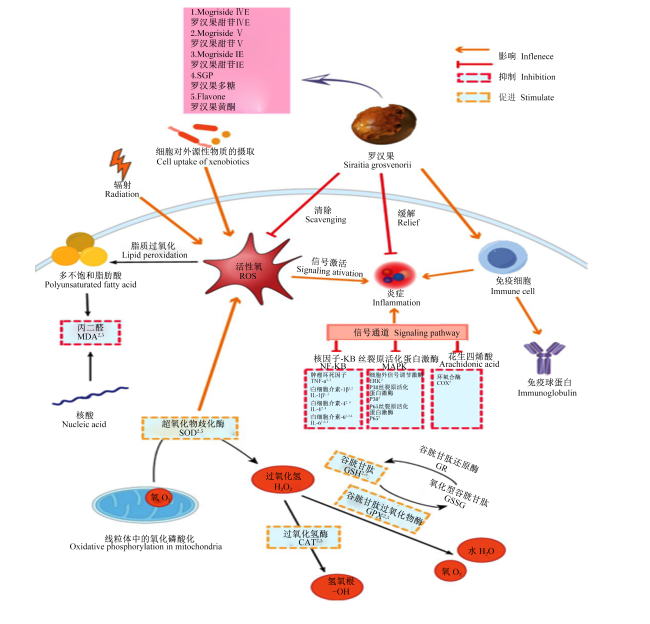
综上所述,罗汉果提取物的生理功能主要体现在2个方面:首先,它通过强大的抗氧化能力清除体内过量的过氧化物,从而抑制由其引发的炎症反应;其次,它能够调节体内炎症相关因子的水平,从而减轻炎症损伤。此外,它还有助于增强免疫细胞的活性。罗汉果提取物的抗氧化、抗炎和免疫机制见图1[41-43,45-48,51,57,61-63]
图1 罗汉果提取物的抗氧化、抗炎和调节免疫机制

Fig.1 Mechanisms of antioxidant, anti-inflammatory and immune regulation by Siraitia grosvenorii extracts[41-43,45-48,51,57,61-63]

3 罗汉果提取物缓解畜禽呼吸道疾病的应用前景

随着我国畜禽养殖业的集约化和规模化,由于养殖密度过高,舍内气体流通不畅,畜禽粪便蓄积过多,使粪便有机物厌氧分解,导致氨气(ammonia,NH3)、硫化氢(hydrogen sulfide,H2S)等有害气体和PM产生[64]。随着饲养密度的增大,畜牛舍中二氧化碳(carbon dioxide,CO2)和氨气浓度呈上升趋势,且有害气体浓度与单位面积内饲喂的家畜数量呈正相关[65]。养殖环境中的高硫化氢浓度会增加保育猪血清中ROS和MDA含量,并降低抗氧化酶CAT和GPX活性,导致氧化应激损伤的产生[66]。环境控制仓中持续通入硫化氢(0~3周龄4 mg/m3,4~6周龄20 mg/m3)即可造成罗斯308肉鸡气管的上皮细胞脱落,气管部分纤毛缺失,并导致炎性细胞浸润[67]。而猪舍硫化氢浓度达到20 mg/kg后不仅会引起肺部炎症、呼吸道疾病和细胞死亡,还会直接导致断奶仔猪生长性能降低[68]。氨气暴露促进猪气管组织中MDA和ROS的产生,抑制抗氧化酶SOD、GSH-Px活性和谷胱甘肽(GSH)含量,导致猪气管组织发生氧化应激,直接导致气管上皮细胞脱落,淋巴细胞浸润,气管细胞膜破裂,核仁消失,内质网肿胀、扩张,纤毛倒伏、排列混乱以及黏液附着[69]
罗汉果提取物富含多种生物活性物质,作为饲料添加剂具有提高动物免疫力、抗炎、抗氧化等作用,从而提高畜禽的生长速度。罗汉果提取可通过抑制炎症因子分泌,缓解肉鸡呼吸道炎症的发生,间接改善肉鸡生长性能[70]。罗汉果提取物能显著减轻浓氨水诱发的小鼠咳嗽反应,延长二氧化硫诱发小鼠咳嗽的潜伏期,显著增加排痰量,起到化痰止咳的作用[71]。Shen等[62]研究发现,在PM2.5诱导的猪肺泡巨噬细胞(3D4/21细胞)的炎症模型中,添加罗汉果甜苷V能够通过减轻NF-κB、p65磷酸化和NOD样受体热蛋白结构域相关蛋白3(NOD-like receptor protein 3,NLRP3)的表达,减轻3D4/21细胞炎症的发生。在LPS诱导的肉鸡肺损伤模型中,基础饲粮中添加罗汉果提取物能够显著抑制促炎细胞因子IL-1βIL-6的表达,还可以增加肺部有益细菌的丰度,减少炎症相关细菌的丰度,改善肺部炎症[70]。环境控制舱内硫化氢浓度升高,会降低断奶仔猪机体免疫球蛋白含量,导致免疫功能降低,并引发呼吸道炎症;而添加罗汉果提取物可显著提升免疫球蛋白含量,提高免疫功能,对缓解呼吸道炎症和提高仔猪生长性能有积极作用[72]。综上所述,罗汉果提取物中富含的生物活性物质可以直接抑制其炎症因子分泌和通过调节信号通路来抑制炎症反应;通过减少氧化应激损伤和增强自身免疫功能,减少畜禽呼吸道疾病的产生。

4 小结

随着畜禽养殖集约化和规模化,舍内畜禽养殖密度过大,远超过其承载量,导致大量有毒有害气体的排放得不到有效和及时处理,使得畜禽患呼吸道疾病的几率大大增加,严重影响了动物生产与健康。因此,如何防治畜禽呼吸道疾病已成为当前畜禽养殖业的研究重点之一。
作为一种历史悠久的传统中药,罗汉果提取物具有多种生物学功能,如抗炎、抗氧化和免疫调节功能,这使得其具备减少畜禽呼吸道疾病的发生和发展的潜力。然而,罗汉果提取物缓解畜禽呼吸道疾病的研究还处于早期阶段,仍有几个关键问题仍需要解决:1)罗汉果提取物缓解呼吸道疾病的主要成分和其作用机制和相关靶点还不明确;2)不同提取方法所获得的罗汉果提取物针对呼吸道疾病的作用效果和作用机制是否有差异;3)针对不同动物不同生长阶段,罗汉果提取物对呼吸道疾病治疗或预防的最佳剂量还未明确;4)如何提高罗汉果提取物的生物活性和靶向性也需要进一步的验证。综上所述,系统深入研究罗汉果提取物缓解畜禽呼吸道疾病的主要成分、作用机制,提高其靶向性和生物活性,针对不同动物制定相应防治策略等,仍是未来的重要研究方向。这对罗汉果提取物的开发和利用以及对呼吸道疾病的防治具有重大意义。
[1]
URBAIN B, PROUVOST J F, BEERENS D, et al. Chronic exposure of pigs to airborne dust and endotoxins in an environmental chamber:technical note[J]. Veterinary Research, 1996, 27(6):569-578.

[2]
AL-HOMIDAN H A, ROBERTSON J F. Effect of litter type and stocking density on ammonia,dust concentrations and broiler performance[J]. British Poultry Science,2003,44:S7-S8.

[3]
李典鹏, 张厚瑞. 广西特产植物罗汉果的研究与应用[J]. 广西植物, 2000, 20(3):270-276.

LI D P, ZHANG H R. Studies and uses of Chinese medicine Luohanguo—a special local product of Guangxi[J]. Guihaia, 2000, 20(3):270-276. (in Chinese)

[4]
王霆, 黄志江, 蒋毅珉, 等. 罗汉果甜苷的生物活性研究[J]. 中草药, 1999, 30(12):914-915.

WANG T, HUANG Z J, JIANG Y M, et al. Studies on the pharmacological profile of mogrosides[J]. Chinese Traditional and Herbal Drugs, 1999, 30(12):914-915. (in Chinese)

[5]
PAWAR R S, KRYNITSKY A J, RADER J I. Sweeteners from plants-with emphasis on Stevia rebaudiana (Bertoni) and Siraitia grosvenorii (Swingle)[J]. Analytical and Bioanalytical Chemistry, 2013, 405:4397-4407.

[6]
LI C, LIN L M, SUI F, et al. Chemistry and pharmacology of Siraitia grosvenorii:a review[J]. Chinese Journal of Natural Medicines, 2014, 12(2):89-102.

[7]
GONG X, CHEN N M A, REN K, et al. The fruits of Siraitia grosvenorii:a review of a Chinese food-medicine[J]. Frontiers in Pharmacology, 2019, 10:1400.

[8]
LEE C. Intense sweetener from Lo Han Kuo (Momordica grosvenori)[J]. Experientia, 1975, 31(5):533-534.

[9]
TAKEMOTO T, ARIHARA S, NAKAJIMA T, et al. Studies on the constituents of fructus Momordicae Ⅲ. Structure of mogrosides[J]. Yakugaku Zasshi, 1983, 103(11):1167-1173.

[10]
马少妹, 袁爱群, 李济权, 等. 超声波强化乙醇提取罗汉果甜苷[J]. 沈阳药科大学学报, 2006, 23(5):316-319.

MA S M, YUAN A Q, LI J Q, et al. Studies on ultrasonic enhanced extraction technology of mogroside[J]. Journal of Shenyang Pharmaceutical University, 2006, 23(5):316-319. (in Chinese)

[11]
王邕, 黎海彬, 白先放, 等. 酶解-溶剂法提取罗汉果中黄酮类物质的研究[J]. 食品科技, 2006, 31(7):125-127.

WANG Y, LI H B, BAI X F, et al. Study on enzyme-solvent extraction process for flavonoid from Grosvenor momordica[J]. Food Science and Technology, 2006, 31(7):125-127. (in Chinese)

[12]
张立娟. 罗汉果多糖的提取、结构分析及抗氧化活性研究[D]. 硕士学位论文. 天津: 天津科技大学, 2019.

ZHANG L J. Extracting,structure analysis and antioxidant activity of a polysaccharide from Siraitia grosvenorii[D]. Master’s Thesis.Tianjin:Tianjin University of Science and Technology, 2019. (in Chinese)

[13]
WANG H, MENG G L, ZHANG C T, et al. Mogrol attenuates lipopolysaccharide (LPS)-induced memory impairment and neuroinflammatory responses in mice[J]. Journal of Asian Natural Products Research, 2020, 22(9):864-878.

DOI PMID

[14]
UKIYA M, AKIHISA T, TOKUDA H, et al. Inhibitory effects of cucurbitane glycosides and other triterpenoids from the fruit of Momordica grosvenori on Epstein-Barr virus early antigen induced by tumor promoter 12-O-tetradecanoylphorbol-13-acetate[J]. Journal of Agricultural and Food Chemistry, 2002, 50(23):6710-6715.

[15]
张宏, 李啸红. 罗汉果化学成分研究进展[J]. 安徽农业科学, 2011, 39(8):4555-4556,4559.

ZHANG H, LI X H. Research progress on chemical compositions of Fructus momordicae[J]. Journal of Anhui Agricultural Sciences, 2011, 39(8):4555-4556,4559. (in Chinese)

[16]
AKIHISA T, HAYAKAWA Y, TOKUDA H, et al. Cucurbitane glycosides from the fruits of Siraitia grosvenorii and their inhibitory effects on Epstein-Barr virus activation[J]. Journal of Natural Products, 2007, 70(5):783-788.

[17]
LIU H S, WANG C C, QI X Y, et al. Antiglycation and antioxidant activities of mogroside extract from Siraitia grosvenorii (Swingle) fruits[J]. Journal of Food Science and Technology, 2018, 55(5):1880-1888.

[18]
LI F, YANG F M, LIU X, et al. Cucurbitane glycosides from the fruit of Siraitia grosvenori and their effects on glucose uptake in human HepG2 cells in vitro[J]. Food Chemistry, 2017, 228:567-573.

[19]
LI D P, IKEDA T, MATSUOKA N, et al. Cucurbitane glycosides from unripe fruits of Lo Han Kuo (Siraitia grosvenori)[J]. Chemical & Pharmaceutical Bulletin, 2006, 54(10):1425-1428.

[20]
李春, 林丽美, 罗明, 等. 罗汉果中1个新的天然皂苷[J]. 中国中药杂志, 2011, 36(6):721-724.

LI C, LIN L M, LUO M, et al. A new natural saponin from fruits of Siraitia grosvenorii[J]. China Journal of Chinese Materia Medica, 2011, 36(6):721-724. (in Chinese)

[21]
SUZUKI Y A, MURATA Y, INUI H, et al. Triterpene glycosides of Siraitia grosvenori inhibit rat intestinal maltase and suppress the rise in blood glucose level after a single oral administration of maltose in rats[J]. Journal of Agricultural and Food Chemistry, 2005, 53(8):2941-2946.

[22]
WU J A, JIAN Y Q, WANG H Z, et al. A review of the phytochemistry and pharmacology of the fruit of Siraitia grosvenorii (Swingle):a traditional Chinese medicinal food[J]. Molecules, 2022, 27(19):6618.

[23]
ITKIN M, DAVIDOVICH-RIKANATI R, COHEN S, et al. The biosynthetic pathway of the nonsugar,high-intensity sweetener mogroside V from Siraitia grosvenorii[J]. Proceedings of the National Academy of Sciences of the United States of America, 2016, 113(47):E7619-E7628.

[24]
ZHU Y M, PAN L C, ZHANG L J, et al. Chemical structure and antioxidant activity of a polysaccharide from Siraitia grosvenorii[J]. International Journal of Biological Macromolecules, 2020, 165(Pt B):1900-1910.

[25]
杨秀伟. 罗汉果中新的天然皂苷[J]. 中草药, 2008(6):810-814.

YANG X W. New natural saponins from Siraitia grosvenorii[J]. Chinese Traditional and Herbal Drugs, 2008(6):810-814.

[26]
杨秀伟, 张建业, 钱忠明. 罗汉果中一新葫芦烷型三萜皂苷——光果木鳖皂苷Ⅰ[J]. 中草药, 2005, 36(9):1285-1290.

YANG X W, ZHANG J Y, QIAN Z M. Grosmomoside I,a new cucurbitane triterpenoid glycoside from fruits of Momordica grosvenori[J]. Chinese Traditional and Herbal Drugs, 2005, 36(9):1285-1290. (in Chinese)

[27]
JIA Z H, YANG X G. A minor,sweet cucurbitane glycoside from Siraitia grosvenorii[J]. Natural Product Communications, 2009, 4(6):769-772.

[28]
黎霜, 王恒山, 张桂勇. 罗汉果种子油化学成分研究[J]. 广西医学, 2003, 25(5):850-852.

LI S, WANG H S, ZHANG G Y. Study on the chemical composition of seed oil of Luo Han Guo[J]. Guangxi Medical Journal, 2003, 25(5):850-852. (in Chinese)

[29]
斯建勇, 陈迪华. 鲜罗汉果中黄酮甙的含量及结构测定[J]. 药学学报, 1994, 29(2):158-160.

SI J Y, CHEN D H. Isolation and structure determination of flavonol glycosides from the fresh fruits of Siraitia grosvenori[J]. Acta Pharmaceutica Sinica, 1994, 29(2):158-160. (in Chinese)

[30]
PATEL D K. Pharmacological activities and therapeutic potential of kaempferitrin in medicine for the treatment of human disorders:a review of medicinal importance and health benefits[J]. Cardiovascular & Hematological Disorders Drug Targets, 2021, 21(2):104-114.

[31]
RADZIEJEWSKA I, SUPRUNIUK K, CZARNOMYSY R, et al. Anti-cancer potential of afzelin towards AGS gastric cancer cells[J]. Pharmaceuticals (Basel,Switzerland), 2021, 14(10):973.

[32]
PAN Y M, WEI L X, ZHU Z R, et al. Processing of Siraitia grosvenori’ leaves:extraction of antioxidant substances[J]. Biomass and Bioenergy, 2012, 36:419-426.

[33]
李俊, 陈海燕, 邓胜平, 等. 罗汉果多糖的分离纯化及分析[J]. 化学世界, 2005, 46(5):277-280.

LI J, CHEN H Y, DENG S P, et al. Study on the extracting technology of polysaccharides from Siraitia grosvenorii[J]. Chemical World, 2005, 46(5):277-280. (in Chinese)

[34]
黎海彬, 张敏, 王邕, 等. 罗汉果中三萜皂苷的含量测定[J]. 食品科学, 2006, 27(6):171-173.

LI H B, ZHANG M, WANG Y, et al. Colorimetric determination of triterpenoid saponin in Luohanguo[J]. Food Science, 2006, 27(6):171-173. (in Chinese)

[35]
LIU Y S, WANG J, DOU T, et al. The liver metabolic features of mogroside V compared to Siraitia grosvenorii fruit extract in allergic pneumonia mice[J]. Molecular Immunology, 2022, 145:80-87.

[36]
陈全斌, 罗星晔, 梁国秋, 等. 同期罗汉果植株不同部位黄酮含量测试研究[J]. 广西轻工业, 2007, 23(10):1-2.

CHEN Q B, LUO X Y, LIANG G Q, et al. A study on the flavonoid content of different parts of Luo Han Guo plants tested in the same period of time[J]. Guangxi Journal of Light Industry, 2007, 23(10):1-2. (in Chinese)

[37]
ALMATROUDI A, ALLEMAILEM K S, ALWANIAN W M, et al. Effects and mechanisms of kaempferol in the management of cancers through modulation of inflammation and signal transduction pathways[J]. International Journal of Molecular Sciences, 2023, 24(10):8630.

[38]
GONG J H, SHIN D, HAN S Y, et al. Kaempferol suppresses eosionphil infiltration and airway inflammation in airway epithelial cells and in mice with allergic asthma[J]. The Journal of Nutrition, 2012, 142(1):47-56.

[39]
李琦, 肖聪. 罗汉果糖类成分的含量测定[C]// 中华中医药学会第九届中药鉴定学术会议. 建德: 中华中医药学会中药鉴定分会, 2008:573-577.

LI Q, XIAO C. Determination of sugar components of Luo Han Guo[C]// The 9th academic conference on Traditional Chinese Medicine Identification of the Chinese Medical Association. Jiande: Chinese Medicine Identification Branch of the Chinese Medical Association, 2008:563-567. (in Chinese)

[40]
GONG P, GUO Y X, CHEN X F, et al. Structural characteristics,antioxidant and hypoglycemic activities of polysaccharide from Siraitia grosvenorii[J]. Molecules, 2022, 27(13):4192.

[41]
CAO F Y, ZHANG Y F, LI W G, et al. Mogroside IVE attenuates experimental liver fibrosis in mice and inhibits HSC activation through downregulating TLR4-mediated pathways[J]. International Immunopharmacology, 2018, 55:183-192.

DOI PMID

[42]
SHI D F, ZHENG M Z, WANG Y M, et al. Protective effects and mechanisms of mogroside V on LPS-induced acute lung injury in mice[J]. Le Pharmacien Biologiste, 2014, 52(6):729-734.

[43]
SONG J L, QIAN B, PAN C L, et al. Protective activity of mogroside V against ovalbumin-induced experimental allergic asthma in Kunming mice[J]. Journal of Food Biochemistry, 2019, 43(9):e12973.

[44]
HE M, ICHINOSE T, REN Y H, et al. PM2.5-rich dust collected from the air in Fukuoka,Kyushu,Japan,can exacerbate murine lung eosinophilia[J]. Inhalation Toxicology, 2015, 27(6):287-299.

[45]
HE M, ICHINOSE T, YOSHIDA Y, et al. Urban PM2.5 exacerbates allergic inflammation in the murine lung via a TLR2/TLR4/MyD88-signaling pathway[J]. Scientific Reports, 2017, 7(1):11027.

[46]
DAI P Y, SHEN D, SHEN J K, et al. The roles of Nrf2 and autophagy in modulating inflammation mediated by TLR4-NFκB in A549 cell exposed to layer house particulate matter 2.5 (PM2.5)[J]. Chemosphere, 2019, 235:1134-1145.

[47]
FENG S L, GAO D, LIAO F, et al. The health effects of ambient PM2.5 and potential mechanisms[J]. Ecotoxicology and Environmental Safety, 2016, 128:67-74.

[48]
TAO L J, CAO F Y, XU G H, et al. Mogroside IIIE attenuates LPS-induced acute lung injury in mice partly through regulation of the TLR4/MAPK/NF-κB axis via AMPK activation[J]. Phytotherapy Research, 2017, 31(7):1097-1106.

DOI PMID

[49]
TAO L J, YANG J Y, CAO F Y, et al. Mogroside IIIE,a novel anti-fibrotic compound,reduces pulmonary fibrosis through Toll-like receptor 4 pathways[J]. The Journal of Pharmacology and Experimental Therapeutics, 2017, 361(2):268-279.

[50]
谢一锋. 罗汉果叶黄酮对力竭性运动大鼠心肌线粒体的影响[J]. 科技资讯, 2018, 16(12):227-228.

XIE Y F. Effects of leaf flavonoids of Luo Han Guo on myocardial mitochondria of exhaustive exercise rats[J]. Science & Technology Information, 2018, 16(12):227-228. (in Chinese)

[51]
LU R H, HU J H, LIU X X, et al. Mogroside-rich extract from Siraitia grosvenorii fruits protects against heat stress-induced intestinal damage by ameliorating oxidative stress and inflammation in mice[J]. Food & Function, 2023, 14(2):1238-1247.

[52]
姚绩伟, 唐晖, 周亮, 等. 罗汉果提取液对小鼠运动耐力及肝组织抗氧化损伤的影响[J]. 中国运动医学杂志, 2008, 27(2):221-223.

YAO J W, TANG H, ZHOU L, et al. Effect of Luo Han Guo extract on exercise tolerance and antioxidant damage in liver tissue of mice[J]. Chinese Journal of Sports Medicine, 2008, 27(2):221-223. (in Chinese)

[53]
易建华, 吴晓芳, 王丽云, 等. PM2.5对呼吸系统疾病的影响及其机制的研究进展[J]. 西安交通大学学报(医学版), 2019, 40(1):167-172.

YI J H, WU X F, WANG L Y, et al. Mechanisms and effects of PM2.5 on diseases of respiratory system:latest findings[J]. Journal of Xi’an Jiaotong University (Medical Sciences), 2019, 40(1):167-172. (in Chinese)

[54]
舒娟, 刘晓菊, 褚旭, 等. 细颗粒物对慢性阻塞性肺疾病小鼠肺泡巨噬细胞吞噬功能的影响[J]. 中华医学杂志, 2016, 96(4):301-305.

SHU J, LIU X J, CHU X, et al. Effects of PM2.5 on phagocytic function of alveolar macrophages in chronic obstructive pulmonary disease mice[J]. National Medical Journal of China, 2016, 96(4):301-305. (in Chinese)

[55]
于万芹, 杜晓娜, 刘巧敏, 等. 罗汉果皂苷对妊娠糖尿病大鼠氧化应激损伤影响[J]. 中国临床药理学杂志, 2019, 35(21):2723-2727.

YU W Q, DU X N, LIU Q M, et al. Effects of Momordica grosvenori saponin on oxidative stress injury in gestational diabetic rats[J]. The Chinese Journal of Clinical Pharmacology, 2019, 35(21):2723-2727. (in Chinese)

[56]
李俊, 黄艳, 廖日权, 等. 罗汉果多糖对小鼠免疫功能的影响[J]. 中国药理学通报, 2008, 24(9):1237-1240.

LI J, HUANG Y, LIAO R Q, et al. Effect of Siraitia grosvenorii polysaccharide on immunity of mice[J]. Chinese Pharmacological Bulletin, 2008, 24(9):1237-1240. (in Chinese)

[57]
王密, 宋志军, 柯美珍, 等. 不同剂量的罗汉果对大鼠免疫功能的影响[J]. 广西医科大学学报, 1994(4):408-410.

WANG M, SONG Z J, KE M Z, et al. Effects of different doses of Momordica grosvenori Swingle on the immune function of rats[J]. Acta Academiae Medicinae Guangxi, 1994(4):408-410. (in Chinese)

[58]
和卫宾. 罗汉果叶黄酮对力竭性运动大鼠免疫功能的影响[D]. 硕士学位论文.桂林.广西师范大学, 2013..

HE W B. The immunity impact of flabones in Siraitia grosvenorii leaf on exhaustive exercise[D]. Master’s Thesis.Guilin:Guangxi Normal University, 2013. (in Chinese)

[59]
张海全, 黄勤英, 郑广进, 等. 罗汉果多糖对环磷酰胺所致的免疫抑制小鼠免疫功能的影响[J]. 广西植物, 2019, 39(11):1573-1582.

ZHANG H Q, HUANG Q Y, ZHENG G J, et al. Effects of Siraitia grosvenorii polysaccharides on immune function in immunosuppressed mice induced by cyclophosphamide[J]. Guihaia, 2019, 39(11):1573-1582. (in Chinese)

[60]
王勤, 王坤, 戴盛明, 等. 罗汉果甜甙对小鼠细胞免疫功能的调节作用[J]. 中药材, 2001, 24(11):811-812.

WANG Q, WANG K, DAI S M, et al. Regulation on the immunological effect of mogrosides in the mice[J]. Journal of Chinese medicinal materials, 2001, 24(11):811-812. (in Chinese)

[61]
SUNG Y Y, KIM M, YUK H J, et al. Siraitia grosvenorii extract attenuates airway inflammation in a mouse model of respiratory disease induced by particulate matter 10 plus diesel exhaust particles[J]. Nutrients, 2023, 15(19):4140.

[62]
SHEN J K, SHEN D, TANG Q, et al. Mogroside V exerts anti-inflammatory effects on fine particulate matter-induced inflammation in porcine alveolar macrophages[J]. Toxicology in Vitro, 2022, 80:105326.

[63]
XIAO J, HUANG K, LIN H, et al. Mogroside ⅡE inhibits digestive enzymes via suppression of interleukin 9/interleukin 9 receptor signaling in acute pancreatitis[J]. Frontiers in Pharmacology, 2020, 11:859.

[64]
粟清乐, 黄大洪. 猪呼吸道疾病的发生原因与防控方法[J]. 今日畜牧兽医, 2024, 40(6):28-30.

SU Q L, HUANG D H. Causes of pig respiratory diseases and methods of prevention and control[J]. Today Animal Husbandry and Veterinary Medicine, 2024, 40(6):28-30. (in Chinese)

[65]
陈昭辉, 刘玉欢, 吴中红, 等. 饲养密度对饲养环境及肉牛生产性能的影响[J]. 农业工程学报, 2017, 33(19):229-235.

CHEN Z H, LIU Y H, WU Z H, et al. Effect of stocking density on breeding environment and production performance of beef cattle[J]. Transactions of the Chinese Society of Agricultural Engineering, 2017, 33(19):229-235. (in Chinese)

[66]
陈磊, 刘真, 谢彦娇, 等. H2S暴露对保育猪氧化还原状态及硫化氢代谢的影响[J]. 畜牧兽医学报, 2022, 53(9):3052-3062.

DOI

CHEN L, LIU Z, XIE Y J, et al. Effects of H2S exposure on redox status and hydrogen sulfide metabolism in nursery pigs[J]. Acta Veterinaria et Zootechnica Sinica, 2022, 53(9):3052-3062. (in Chinese)

DOI

[67]
陈梦豪. H2S暴露通过lncRNA3037/miR-15a调控BCL2与A20诱导鸡气管细胞凋亡与程序性坏死的研究[D]. 硕士学位论文. 哈尔滨: 东北农业大学, 2019.

CHEN M H. LncRNA3037/miR-15a contributes to H2S-induced apoptosis and necroptosis by targeting BCL2 and A20 in chicken trachea[D]. Master’s Thesis.Harbin:Northeast Agricultural University, 2019. (in Chinese)

[68]
LIU Z, FU Q, TANG S L, et al. Proteomics analysis of lung reveals inflammation and cell death induced by atmospheric H2S exposure in pig[J]. Environmental Research, 2020, 191:110204.

[69]
王欢. L-硒代蛋氨酸对氨气诱导猪气管炎症损伤的保护效应研究[D]. 硕士学位论文. 哈尔滨: 东北农业大学, 2022.

WANG H. Protective effect of L-selenomethionine on ammonia-induced trachea inflammatory injury in pigs[D]. Master’s Thesis.Harbin:Northeast Agricultural University, 2022. (in Chinese)

[70]
LI Y, SHEN D, WANG K, et al. Mogroside V ameliorates broiler pulmonary inflammation via modulating lung microbiota and rectifying Th17/Treg dysregulation in lipopolysaccharides-induced lung injury[J]. Poultry Science, 2023, 102(12):103138.

[71]
周欣欣, 宋俊生. 罗汉果及罗汉果提取物药理作用的研究[J]. 中医药学刊, 2004, 22(9):1723-1724.

ZHOU X X, SONG J S. Studies on the pharmacological effects of Luo Han Guo and Luo Han Guo extracts[J]. Chinese Archives of Traditional Chinese Medicine, 2004, 22(9):1723-1724. (in Chinese)

[72]
陈小风, 崔嘉, 杨新宇, 等. 硫化氢对断奶仔猪生长性能及免疫性能的影响[J]. 中国兽医学报, 2020, 40(9):1796-1802.

CHEN X F, CUI J, YANG X Y, et al. Effects of hydrogen sulfide on growth performance and immune performance of weaned piglets[J]. Chinese Journal of Veterinary Science, 2020, 40(9):1796-1802. (in Chinese)

Outlines

/