RESEARCH PAPER

Effects of Combinations of Starch and Protein with Different Digestibility on Growth Performance and Serum Urea Nitrogen Contents of Weaned Piglets

  • ZHU Qi ,
  • ZHANG Ge ,
  • ZHANG Zeyu ,
  • ZHAO Jinbiao , *
Expand
  • State Key Laboratory of Animal Nutrition and Feeding, Collage of Animal Science and Technology, China Agricultural University, Beijing 100193, China
*professor, E-mail:

Received date: 2024-08-05

  Online published: 2025-02-16

Abstract

The study was conducted to evaluate the protein and starch digestibility of common feed ingredients for weaned piglets by in vitro bionic digestion technique and determine the effects of starch and protein feed combinations with different digestibilities on the growth performance, diarrhea rate and serum urea nitrogen content of weaned piglets. In experiment 1, the digestion conditions of stomach and small intestine of weaned piglets were simulated by enzyme hydrolysis in vitro, and the digestibilities of corn, extruded corn, soybean meal, peeled soybean meal, wheat protein meal and potato protein meal were measured at 9 digestion time points 0, 30, 60, 90, 120, 150, 180, 210, 240 min in small intestine in vitro, with 6 replicates per group. In experiment 2, 144 weaned piglets were randomly divided into 4 groups and fed rapid digestible starch+rapid digestible protein, rapid digestible starch+slow digestible protein, slow digestible starch+rapid digestible protein, and slow digestible starch+slow digestible protein diets, respectively. The piglet feeding trial was conducted for a total of 28 days, and each dietary group consisted of six replicates with six piglets per replicate. The results showed that at the 8 digestion time points of 30, 60, 90, 120, 150, 180, 210 and 240 min, the in vitro digestibility of starch in corn was significantly lower than that of extruded corn (P<0.05), and the protein digestibility of potato protein meal was significantly lower than that of soybean meal, peeled soybean meal and wheat protein meal (P<0.05). The protein digestibility of soybean meal at 30, 60 and 120 min was significantly lower than that of peeled soybean meal and wheat protein meal (P<0.05). There was no significant difference between in vitro digestibility of soybean meal and peeled soybean meal at 0 min (P>0.05), and no significant difference between 90 and 150 min protein digestibility and wheat protein meal (P>0.05). There was no significant difference in the in vitro digestibility of protein at 180, 210 and 240 min compared with that of soybean meal and wheat protein meal (P>0.05). The average daily gain of weaned piglets in slow digestion starch+slow digestion protein group was significantly higher than that in slow digestion starch+rapid digestion protein group (P<0.05), and the serum urea nitrogen content on day 14 was significantly lower than that in rapid digestion starch+rapid digestion protein group (P<0.05). However, the diarrhea rate on days 15 to 28 and days 1 to 28 was significantly higher than that in rapid digestible starch+rapid digestible protein group and slow digestible starch+rapid digestible protein group (P<0.05). In summary, the digestibility of starch and protein in weaned piglet diets affects growth performance and nitrogen utilization. Therefore, formulating feeds based on digestion speed carbon and nitrogen in feed ingredients can promote the development of pig precision nutrition.

Cite this article

ZHU Qi , ZHANG Ge , ZHANG Zeyu , ZHAO Jinbiao . Effects of Combinations of Starch and Protein with Different Digestibility on Growth Performance and Serum Urea Nitrogen Contents of Weaned Piglets[J]. Chinese Journal of Animal Nutrition, 2025 , 37(2) : 893 -905 . DOI: 10.12418/CJAN2025.078

我国饲料资源紧缺,通过营养调控措施提高畜禽对饲粮淀粉及蛋白质的利用效率迫在眉睫[1]。能量和蛋白质饲料原料营养价值的精准评价以及饲粮精准配制是碳氮营养素高效利用的基础。当前,不同饲料原料营养价值的评价主要包括有效能和标准回肠末端氨基酸消化率等营养参数的测定[2]。然而,原料有效能和可消化氨基酸含量及其猪营养需要量等参数仅仅是静态值,不能反映出饲粮碳氮营养素在猪肠道内消化与利用的动态变化规律。
已有研究表明,饲粮碳氮营养素消化速率影响淀粉的供能效率与蛋白质的转化沉积效率[3-4]。根据消化速率不同,可将淀粉分为快速消化淀粉(RDS)、慢速消化淀粉(SDS)[5],蛋白质分为快速消化蛋白质(RDP)、慢速消化蛋白质(SDP)[6]。不同消化速率淀粉导致血清葡萄糖含量变化规律存在很大差异[7],影响机体胰岛素分泌与糖利用相关酶活性;不同消化速率的蛋白质导致血浆内氨基酸和小肽含量变化规律不同,进而影响体蛋白质代谢与氨基酸氧化[8]。肉鸡饲养前期提高快速消化淀粉的添加比例以及饲养后期提高慢速消化淀粉添加比例能够提高其生长性能[9]。与饲喂慢速消化蛋白质饲粮相比,快速消化蛋白质饲粮可以显著提高肉鸡日增重[10]。通过调整氨基酸在消化道内的释放模式能够促进动物对饲粮蛋白质的合理利用[11]。动物机体对葡萄糖和氨基酸的吸收机制相似,主要包括Na+协助的主动转运和易化扩散2种方式[12]。两者在肠道内的吸收可能存在竞争关系[13]。因此,淀粉与蛋白质之间的消化吸收速率需匹配[14],当血液中葡萄糖与肽和氨基酸同时达到适宜含量时,可以提高机体对能量和蛋白质的利用效率[15]。前人相关研究主要关注不同消化速率的淀粉或者蛋白质对畜禽生长性能的影响。目前,基于消化速率差异研究淀粉与蛋白质组合对仔猪生长性能差异的相关研究较少。因此,本试验通过体外仿生酶解技术测定了玉米和膨化玉米的淀粉以及豆粕、去皮豆粕、小麦蛋白粉和土豆蛋白粉的蛋白质体外消化9个时间点的降解率,并以上述原料配制不同消化速率的淀粉与蛋白质组合饲粮,比较饲喂不同消化速率淀粉与蛋白质组合饲粮的断奶仔猪生长性能差异,旨在研究提高仔猪生长性能和氮素利用效率的营养调控措施,为生产实践提供理论指导。

1 材料与方法

1.1 试验材料

本试验中使用的玉米、膨化玉米、豆粕、去皮豆粕、小麦蛋白粉和土豆蛋白粉均来自广东海大集团股份有限公司,其化学成分组成见表1
表1 仔猪常见饲料原料化学成分组成(饲喂基础)

Table 1 Chemical composition of common feed ingredients for piglets (as-fed basis) %

项目
Items
玉米
Corn
膨化玉米
Extruded corn
豆粕
Soybean meal
去皮豆粕
Peeled soybean
meal
小麦蛋白粉
Wheat protein
meal
土豆蛋白粉
Potato protein
meal
总能GE/(MJ/kg) 16.21 17.04 17.36 17.62 20.87 21.25
干物质DM 87.56 92.12 89.37 89.65 90.46 90.14
淀粉Starch 61.73 64.34 5.36
粗蛋白质Crude protein 8.02 8.31 43.48 47.31 67.64 78.90
粗脂肪EE 3.25 3.43 0.97 0.64 1.75 1.52
中性洗涤纤维NDF 11.52 9.63 12.97 12.14 10.75 3.45
酸性洗涤纤维ADF 2.36 2.46 5.93 4.89 3.16 0.83
粗灰分Ash 1.15 1.32 5.37 5.06 1.43 1.26

由于豆粕、去皮豆粕、土豆蛋白粉淀粉含量较低,—表示该项指标未进行检测。

Due to the low starch contents of soybean meal, peeled soybean meal and potato protein meal, — indicates that this indicator was not tested.

1.2 体外试验

本试验中使用的玉米、膨化玉米、豆粕、去皮豆粕、小麦蛋白粉和土豆蛋白粉粉碎后过60目筛,每个原料称取1 g置于体外仿生消化体系中,每个原料设置6个重复。体外消化试验分为胃、肠2个阶段,每个阶段设置空白对照用于数据酶校正处理,从肠消化阶段开始取样,记录样品中葡萄糖或氨基酸的释放情况。
胃阶段:将样品粉碎至40目后,取0.5 g至50 mL离心管中,39 ℃预热10 min,加入10 mL胃蛋白酶溶液[取50 mg胃蛋白酶(P-7000, Sigma-Aldrich)与50 mg瓜尔豆胶(G9310, Solarbio),加入到10 mL用稀盐酸调节后pH为3.5的磷酸缓冲溶液中制成]及0.25 mL氯霉素溶液[取0.5 g氯霉素(C8050, Solarbio)加入至100 mL乙醇中制成]混匀,39 ℃、3 000×g连续恒温振荡孵育悬液120 min,中间不取样。
肠阶段:模拟胃阶段消化完成后,加入10 mL提前预热好的0.048 mol/L氢氧化钠溶液调节pH至中性,混匀后作为小肠阶段0 min取样。加入5 mL胰酶混合液[取0.7 mg胰酶(P7545, Sigma-Aldrich)、0.5 mg淀粉葡萄糖苷酶(A7095, Sigma-Aldrich)、3 mg转化酶(I4504, Sigma-Aldrich)溶解于5 mL pH为6.8的磷酸缓冲溶液中制成]混匀,39 ℃、3 000×g连续恒温振荡孵育,分别在小肠阶段0、30、60、90、120、150、180、210和240 min取样,取样前混匀离心管。

1.3 饲养试验

1.3.1 试验设计

本试验操作方法通过了中国农业大学动物福利与伦理审查委员会(北京)的批准(编号:CAU AW3176043302-1-1)。
动物试验在中国农业大学动物试验基地(河北,承德市)完成。选取144头初始体重为(7.42±0.36) kg的杜长大三元杂交断奶仔猪,采用双因素交叉分析试验设计,随机分为4组,每组6个重复,每个重复6头仔猪(3公3母)。本试验断奶仔猪饲养时间共28 d。基于上述体外试验不同仿生消化时间点的淀粉和蛋白质消化速率结果,本试验将体外小肠消化30 min定义为可消化淀粉或蛋白质,结合本试验室测定的前期饲粮中膨化全脂大豆、鱼粉、棉籽蛋白和低蛋白质乳清粉快速和慢速消化蛋白质含量,通过添加不同比例玉米、膨化玉米、豆粕、去皮豆粕、小麦蛋白粉和土豆蛋白粉配制快速消化淀粉+快速消化蛋白质、慢速消化淀粉+快速消化蛋白质、快速消化淀粉+慢速消化蛋白质、慢速消化淀粉+慢速消化蛋白质4种饲粮。饲粮组成及营养水平见表2。通过添加大豆油和晶体氨基酸保证4种饲粮消化能和可消化氨基酸含量一致。饲粮营养成分满足《猪营养需要量》(2020)[16]推荐的7~25 kg生长猪对营养物质的需要量。
表2 饲粮组成及营养水平(饲喂基础)

Table 2 Composition and nutrient levels of diets (as-fed basis) %

项目
Items
饲粮Diets
快速消化淀粉+
快速消化蛋白质
RDS+RDP
慢速消化淀粉+
快速消化蛋白质
SDS+RDP
快速消化淀粉+
慢速消化蛋白质
RDS+SDP
慢速消化淀粉+
慢速消化蛋白质
SDS+SDP
原料Ingredients
玉米Corn 35.26 63.59 34.65 66.29
膨化玉米Extruded corn 30.00 30.00
豆粕Soybean meal 10.00 10.00
去皮豆粕Peeled soybean meal 10.00 10.00
膨化全脂大豆Extruded full-fat soy 5.00 5.00 5.00 5.00
鱼粉Fish meal 2.00 2.00 2.00 2.00
乳清粉Whey powder 4.00 5.00 5.00 3.00
棉籽蛋白Cottonseed protein 2.00 2.00 2.00 2.00
土豆蛋白粉Potato protein powder 5.00 5.00
小麦蛋白粉Wheat protein powder 5.00 5.00
豆油Soybean oil 2.50 3.20 2.50 2.80
磷酸氢钙CaHPO4 1.34 1.28 1.32 1.36
石粉Limestone 0.90 0.92 0.93 0.93
氯化钠NaCl 0.30 0.30 0.30 0.30
L-赖氨酸盐酸盐L-Lys·HCl 0.80 0.79 0.51 0.53
DL-蛋氨酸DL-Met 0.10 0.12 0.08 0.08
L-苏氨酸L-Thr 0.25 0.25 0.16 0.16
L-色氨酸L-Trp 0.05 0.05 0.05 0.05
预混料Premix1) 0.50 0.50 0.50 0.50
合计Total 100.00 100.00 100.00 100.00
营养水平Nutrient levels2)
消化能DE/(MJ/kg) 14.77 14.63 14.72 14.71
粗蛋白质Crude protein 19.33 18.98 18.93 19.02
快速消化淀粉RDS 13.18 10.89 12.86 11.13
慢速消化淀粉SDS 28.16 28.63 27.83 29.79
总可消化淀粉TDS 41.34 39.52 40.69 40.92
快速消化蛋白质RDP 13.24 13.02 11.11 10.95
慢速消化蛋白质SDP 4.60 4.63 6.90 7.02
总可消化蛋白质TDP 17.84 17.65 18.01 17.97
可消化赖氨酸SID Lys 1.35 1.34 1.35 1.35
可消化蛋氨酸SID Met 0.40 0.40 0.40 0.40
可消化苏氨酸SID Thr 0.80 0.80 0.80 0.80
可消化色氨酸SID Trp 0.22 0.21 0.20 0.21
钙Ca 0.79 0.80 0.80 0.80
总磷TP 0.57 0.59 0.60 0.60

1)预混料为每千克饲粮提供 Premix provided the following per kilogram of diets:VA 12 000 IU,VD3 2 500 IU,VE 30 IU,VK3 3 mg,VB1 2.5 mg,VB2 4.0 mg,VB6 3.0 mg,VB12 12 μg,尼克酸 nicotinic acid 40 mg,硫胺素 thiamine 3 mg,核黄素 riboflavin 6 mg,泛酸 pantothenic acid l5 mg,叶酸 folic acid 0.7 mg,生物素 biotin 50 μg,Fe 90.0 mg,Cu 50.0 mg,Zn 50.0 mg,Mn 40 mg,I 0.35 mg,Se 0.3 mg。
2)DE、RDS、SDS、RDP、SDP、TDS、TDP和SID氨基酸为计算值,其中DE、SID氨基酸参考《猪营养需要量》(2020)计算而得,RDS、SDS、RDP、SDP、TDS、TDP参照本实验室常用饲料原料不同时间点的体外消化率计算而得。体外仿生消化 240 min降解的淀粉和蛋白质分别为TDS和TDP;体外仿生消化30 min 的淀粉和蛋白质含量与TDS和TDP 的比值定义为RDS和RDP,体外仿生消化30~240 min 的淀粉和蛋白质含量与TDS和TDP 的比值定义为SDS和SDP。The values of DE, RDS, SDS, RDP, SDP, TDS, TDP and SID amino acids were calculated, and the values of DE and SID amino acids were calculated according to the Nutrient Requirements of Swine (2020). RDS, SDS, RDP, SDP, TDS and TDP were obtained by referring to the in vitro digestibility of commonly used feed materials in our laboratory at different time points. The TDS and TDP were degraded after 240 min biomimetic digestion in vitro. The ratio of starch and protein contents to TDS and TDP during 30 min biomimetic digestion in vitro was defined as RDS and RDP. The ratio of starch and protein contents to TDS and TDP for 30 to 240 min biomimetic digestion in vitro was defined as SDS and SDP.

1.3.2 饲养管理

仔猪饲养试验在国家饲料工程技术研究中心丰宁动物试验基地(河北,承德市)暨中国农业大学丰宁实验站(承德九运农牧有限公司)开展。将仔猪分栏(1.5 m× 1.5 m× 1.0 m)饲养。饲粮形式为粉料,试验期间保证自由采食和饮水。保持猪舍通风和清洁,疫苗免疫和猪舍粪污处理遵守猪场防疫制度。每天观察并记录仔猪采食和腹泻等健康状况。试验期间舍内温度保持在(25±3) ℃,相对湿度控制在(60±2)%。

1.3.3 样品采集

断奶仔猪饲喂期间,在试验第1、14和28天分别空腹称量仔猪体重及饲粮消耗重量,计算平均日增重(ADG)、平均日采食量(ADFI)和料重比(F/G)。每栏选取1头健康仔猪,空腹前腔静脉采血5 mL,静置后3 000×g离心15 min采集血清,于-20 ℃保存待检,用于分析血清葡萄糖与尿素氮含量。

1.4 检测指标及测定方法

1.4.1 常规营养成分测定

饲料原料和体外仿生消化上清液中淀粉和蛋白质含量分别采用GB/T 20194—2018、GB/T 6432—2018方法测定。饲料原料中干物质、粗脂肪和粗灰分含量分别采用GB/T 6435—2014、GB/T 6433—2006 和GB/T 6438—2007方法测定。饲料原料中性洗涤纤维、酸性洗涤纤维含量通过纤维分析仪(ANKOM, 美国)按照GB/T 20806—2022和 NY/T 1459—2022所述的方法进行分析。总能使用国际推荐的ISO 9831:1998方法和Parr-6300型氧弹热量计(美国)进行测定。饲粮中钙含量采用GB/T 6436—2018方法进行测定;总磷含量采用GB/T 6437—2018方法进行测定。

1.4.2 血清葡萄糖、尿素氮含量测定

将所采集血液静置分层,离心收集血清,使用日立7600型全自动生化分析仪(日本)检测血清葡萄糖、尿素氮含量。

1.5 数据统计分析

以每个栏作为试验单位,使用SAS 9.2统计软件中的GLIMMIX模型,根据2 × 2双因子试验设计分析数据。统计模型包括蛋白质消化速率和淀粉消化速率对仔猪生长性能和血清指标影响的主效应及其互作效应,试验动物作为随机效应。使用LSMEANS方法计算饲粮处理组的平均值,用Tukey’s检验进行多重比较,P<0.05为差异显著,0.05≤P<0.10为具有差异显著的趋势。

2 结果

2.1 不同饲料原料体外消化试验

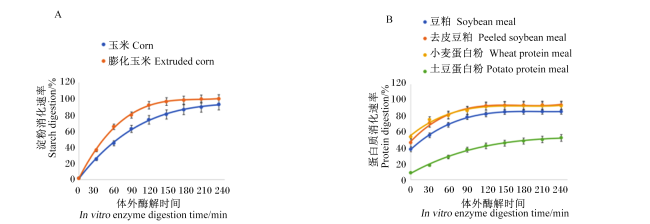
表3可知,玉米与膨化玉米的淀粉消化速率随体外消化时间的延长而增加,在模拟小肠消化初期消化速率最快,后期逐渐缓慢(图1),30、60、90、120、150、180、210、240 min 8个消化时间点膨化玉米的淀粉体外消化速率显著高于玉米(P<0.05)。豆粕、去皮豆粕、小麦蛋白粉、土豆蛋白粉的蛋白质消化速率随消化时间的延长而增加,在体外模拟小肠消化初期的消化速率最快,后期逐渐缓慢(图1),土豆蛋白粉在体外模拟胃和小肠消化阶段时蛋白质消化速率显著均低于豆粕、去皮豆粕和小麦蛋白粉(P<0.05)。豆粕在30、60、120 min的蛋白质体外消化速率显著低于去皮豆粕和小麦蛋白粉(P<0.05)。豆粕在0 min蛋白质体外消化速率与去皮豆粕差异不显著(P>0.05),90与150 min蛋白质体外消化速率与小麦蛋白粉差异不显著(P>0.05),180、210、240 min蛋白质体外消化速率与去皮豆粕和小麦蛋白粉二者相比差异不显著(P>0.05)。在本试验条件下,膨化玉米定性为快速消化淀粉,玉米定性为慢速消化淀粉;去皮豆粕和小麦蛋白粉定性为快速消化蛋白质,豆粕和土豆蛋白粉定性为慢速消化蛋白质。
表3 不同饲料原料体外仿生消化速率

Table 3 In vitro bionic digestibility of different feed ingredients %

时间点
Time
points/
min
淀粉消化速率
Starch digestibility
均值
标准误
SEM
P
P-value
蛋白质消化速率Protein digestibility 均值
标准误
SEM
P
P-value
豆粕
Soybean
meal
去皮豆粕
Peeled
soybean
meal
小麦蛋白粉
Wheat
protein
meal
土豆
蛋白粉
Potato
protein
meal
玉米
Corn
膨化玉米
Extruded
corn
0 1.53 1.36 0.21 0.53 38.16b 46.55ab 53.78a 8.64c 1.43 0.01
30 25.23b 36.38a 0.53 0.01 55.74b 71.09a 75.36a 18.13c 1.65 0.01
60 44.87b 65.32a 0.89 0.01 69.12b 81.23a 80.63a 28.48c 1.94 0.01
90 62.53b 79.72a 1.11 0.01 78.44b 87.35a 86.66ab 37.77c 2.23 0.01
120 73.85b 91.88a 1.28 0.01 82.26b 92.68a 91.74a 42.57c 2.34 0.01
150 80.57b 96.32a 1.52 0.01 85.04b 93.32a 92.75ab 46.04c 2.64 0.01
180 86.34b 98.12a 1.35 0.01 85.45a 93.54a 92.75a 48.58c 2.77 0.01
210 89.54b 99.43a 1.44 0.01 85.45a 93.73a 92.75a 50.42c 2.83 0.01
240 92.75b 99.76a 1.64 0.01 85.45a 93.73a 92.75a 52.56c 2.60 0.01

同行数据肩标不同小写字母表示差异显著(P<0.05)。下表同。

In the same row, values with different small letter superscripts mean significant difference (P<0.05). The same as below.

图1 不同饲料原料淀粉和蛋白质体外仿生消化速率变化规律

A:饲料原料在体外不同仿生消化时间点的淀粉消化速率 starch digestibility of feed ingredients at different in vitro bionic digestion time points;B:饲料原料在体外不同仿生消化时间点的蛋白质消化速率 protein digestibility of feed ingredients at different in vitro bionic digestion time points。

Fig.1 Regularity of in vitro bionic digestibility of starch and protein from different feed ingredients

2.2 生长性能试验

表4可知,慢速消化淀粉+慢速消化蛋白质组断奶仔猪的平均日增重显著高于慢速消化淀粉+快速消化蛋白质组(P<0.05),但是与其他2组差异不显著(P>0.05)。慢速消化淀粉+慢速消化蛋白质饲粮具有提高试验第28天断奶仔猪体重的趋势(0.05≤P<0.10)。然而,与快速消化淀粉+快速消化蛋白质组和慢速消化淀粉+快速消化蛋白质组相比,饲喂慢速消化淀粉+慢速消化蛋白质饲粮显著提高了试验第15~28天和第1~28天的断奶仔猪腹泻率(P<0.05)。
表4 不同消化速率的淀粉和蛋白质组合对断奶仔猪生长性能的影响

Table 4 Effects of combinations of starch and protein with different digestibility on growth performance of weaned piglets

项目
Items
组别Groups 均值
标准误
SEM
P
P-value
快速消化淀粉+
快速消化蛋白质
RDS+RDP
慢速消化淀粉+
快速消化蛋白质
SDS+RDP
快速消化淀粉+
慢速消化蛋白质
RDS+SDP
慢速消化淀粉+
慢速消化蛋白质
SDS+SDP
体重Body weight/kg
第1天Day 1 6.72 6.73 6.72 6.71 0.22 0.99
第14天Day 14 10.60 10.38 10.88 11.08 0.31 0.53
第28天Day 28 16.35 15.90 16.83 17.32 0.49 0.07
平均日采食量ADFI/(g/d)
第1~14天Days 1 to 14 432 413 458 473 17.89 0.21
第15~28天Days 15 to 28 675 661 688 714 19.21 0.36
第1~28天Days 1 to 28 554 537 573 596 19.05 0.33
平均日增重ADG/(g/d)
第1~14天Days 1 to 14 277ab 261b 297ab 312a 9.87 0.03
第15~28天Days 15 to 28 411ab 394b 425ab 446a 11.15 0.04
第1~28天Days 1 to 28 344ab 328b 361ab 379a 10.42 0.04
料重比F/G
第1~14天Days 1 to 14 1.56 1.58 1.54 1.52 0.02 0.85
第15~28天Days 15 to 28 1.65 1.68 1.62 1.60 0.03 0.89
第1~28天Days 1 to 28 1.61 1.64 1.59 1.57 0.02 0.88
腹泻率Diarrhea incidence/%
第1~14天Days 1 to 14 8.44 7.45 10.43 10.53 1.37 0.35
第15~28天Days 15 to 28 4.75b 5.02b 8.69a 9.32a 0.74 0.02
第1~28天Days 1 to 28 6.61b 6.23b 9.56a 9.93a 0.82 0.04
由双因子方差分析结果(表5)可知,本试验条件下,淀粉来源与蛋白质来源之间的互作对断奶仔猪的生长性能无显著影响(P>0.05)。然而,不同消化速率的蛋白质对于断奶仔猪第1~14天平均日增重和腹泻率的影响较显著(P<0.05),但是不同消化速率的淀粉对于断奶仔猪体重和生长性能无显著影响(P>0.05)。
表5 饲粮淀粉和蛋白质来源对断奶仔猪生长性能的影响

Table 5 Effects of dietary protein and starch sources on growth performance of weaned pigs

项目
Items
蛋白质来源
Protein source
淀粉来源
Starch source
均值
标准误
SEM
PP-value
蛋白质
Protein
淀粉
Starch
互作
Interaction
快速消化
蛋白质
RDP
慢速消化
蛋白质
SDP
快速消
化淀粉
RDS
慢速消
化淀粉
SDS
体重Body weight/kg
第1天Day 1 6.73 6.72 6.72 6.72 0.16 0.99 0.99 0.96
第14天Day 14 10.49 10.98 10.74 10.73 0.29 0.35 0.82 0.53
第28天Day 28 16.13 17.07 16.59 16.61 0.44 0.06 0.65 0.46
平均日采食量ADFI/(g/d)
第1~14天Days 1 to 14 422 467 445 443 15.23 0.08 0.63 0.43
第15~28天Days 15 to 28 668 701 682 688 18.53 0.36 0.72 0.61
第1~28天Days 1 to 28 545 584 564 567 17.42 0.27 0.68 0.57
平均日增重ADG/(g/d)
第1~14天Days 1 to 14 269 304 287 287 9.32 0.03 0.93 0.52
第15~28天Days 15 to 28 403 435 418 420 10.42 0.13 0.79 0.37
第1~28天Days 1 to 28 336 370 353 354 9.95 0.09 0.85 0.63
料重比F/G
第1~14天Days 1 to 14 1.57 1.54 1.55 1.55 0.02 0.82 0.95 0.42
第15~28天Days 15 to 28 1.66 1.61 1.64 1.64 0.03 0.76 0.93 0.18
第1~28天Days 1 to 28 1.62 1.58 1.60 1.61 0.02 0.79 0.95 0.31
腹泻率Diarrhea incidence/%
第1~14天Days 1 to 14 7.95 10.48 9.44 8.99 1.13 0.17 0.76 0.52
第15~28天Days 15 to 28 4.88 9.00 6.72 7.17 0.59 0.04 0.83 0.45
第1~28天Days 1 to 28 6.42 9.74 8.09 8.08 0.73 0.01 0.93 0.64
表6可知,第14天慢消化淀粉+慢消化蛋白质组仔猪血清尿素氮含量显著低于快速消化淀粉+快速消化蛋白质组(P<0.05),但是对于血清葡萄糖含量无显著影响(P>0.05)。
表6 不同消化速率的淀粉和蛋白质组合对断奶仔猪血清葡萄糖和尿素氮含量的影响

Table 6 Effects of combinations of starch and protein with different digestibility on serum glucose and urea nitrogen contents of weaned piglets

项目
Items
组别Groups 均值
标准误
SEM
P
P-value
快速消化淀粉+
快速消化蛋白质
RDS+RDP
慢速消化淀粉+
快速消化蛋白质
SDS+RDP
快速消化淀粉+
慢速消化蛋白质
RDS+SDP
慢速消化淀粉+
慢速消化蛋白质
SDS+SDP
葡萄糖Glucose/(mmol/L)
第14天Day 14 7.42 6.61 6.85 6.42 0.77 0.92
第28天Day 28 6.97 6.43 6.64 6.15 0.83 0.95
尿素氮Urea nitrogen/(mg/dL)
第14天Day 14 11.97a 11.04ab 8.32b 8.17b 0.92 0.02
第28天Day 28 10.02 10.89 6.32 6.53 1.36 0.06
由双因子方差分析结果(表7)可知,本试验条件下,淀粉来源与蛋白质来源之间的互作对断奶仔猪血清葡萄糖和尿素氮含量无显著影响(P>0.05)。不同消化速率的蛋白质显著影响断奶仔猪血清中尿素氮含量(P<0.05),而不同消化速率的淀粉对于血清葡萄糖和尿素氮含量均无显著影响(P>0.05)。
表7 饲粮淀粉和蛋白质来源对断奶仔猪血清葡萄糖和尿素氮含量的影响

Table 7 Effects of dietary protein and starch sources on serum glucose and urea nitrogen contents of weaned pigs

项目
Items
蛋白质来源
Protein source
淀粉来源
Starch source
均值
标准误
SEM
PP-value
蛋白质
Protein
淀粉
Starch
互作
Interaction
快速消化
蛋白质
RDP
慢速消化
蛋白质
SDP
快速消
化淀粉
RDS
慢速消
化淀粉
SDS
葡萄糖Glucose/(mmol/L)
第14天Day 14 7.02 6.64 7.14 6.52 0.63 0.64 0.42 0.73
第28天Day 28 6.70 6.40 6.81 6.29 0.72 0.73 0.38 0.57
尿素氮Urea nitrogen/(mg/dL)
第14天Day 14 11.51 8.25 10.15 9.61 0.86 0.01 0.72 0.53
第28天Day 28 10.46 6.43 8.17 8.71 1.12 0.02 0.66 0.61

3 讨论

体外消化试验结果表明,豆粕在0 min蛋白质体外消化速率与去皮豆粕差异不显著,90与150 min蛋白质体外消化速率与小麦蛋白粉差异不显著,180、210、240 min蛋白质体外消化速率与去皮豆粕和小麦蛋白粉二者相比差异不显著。玉米在30、60、90、120、150、180、210、240 min 8个消化时间点中淀粉的体外消化速率显著低于膨化玉米,土豆蛋白粉的蛋白质体外消化速率全程显著低于豆粕、去皮豆粕和小麦蛋白粉。豆粕在30、60、120 min时蛋白质体外消化速率显著低于去皮豆粕和小麦蛋白粉。因此,在本试验条件下,膨化玉米定性为快速消化淀粉,玉米定性为慢速消化淀粉;去皮豆粕和小麦蛋白粉定性为快速消化蛋白质,豆粕、土豆蛋白粉定性为慢速消化蛋白质。淀粉颗粒表面积、分子结构及结晶程度会显著影响其消化速率[17]。玉米作为猪饲粮中常见的能量饲料原料[18],已有研究报道其经膨化处理后淀粉颗粒大分子发生破碎,在高温下发生糊化[19],进而为消化酶提供更多作用位点,提高了淀粉消化速率,有效地降低了仔猪的腹泻率[20-21]。饲料原料中蛋白质消化速率受到其来源、加工工艺和空间结构影响[1]。豆粕中的氨基酸含量丰富且比例均衡[22],去皮豆粕通过分离出纤维组分进一步提高了蛋白质含量、必需氨基酸比例和有效能水平,并且降低了抗营养因子水平[23]。因此,去皮豆粕在干物质、蛋白质消化速率和有效能水平等方面优于带皮普通豆粕[24],进而能改善断奶仔猪的生长性能[25]。当前,尚未发现比较豆粕和去皮豆粕之间蛋白质消化速率的相关研究,而本研究结果表明,30、60、90、120、150 min 5个消化时间点豆粕体外蛋白质消化速率显著低于去皮豆粕。已有研究报道,饲粮蛋白质溶解度与其消化速率具有显著正相关,而小麦蛋白粉可溶性高,易于被动物消化[26]。另外,小麦蛋白粉中谷氨酰胺含量高,有助于保护仔猪小肠黏膜的结构及维持其功能,有利于降低仔猪腹泻率[27]。土豆蛋白粉是一种优质植物蛋白质[28]。唐春红等[29]研究表明,饲粮中添加适当水平土豆蛋白粉能够改善仔猪的生长性能。然而,土豆蛋白粉的溶解度受到环境温度影响大,超过40 ℃时土豆蛋白粉的蛋白质溶解度较差,从而降低了其消化率[30]。本研究结果表明,在本试验设计的9个消化时间点中,土豆蛋白粉的蛋白质体外消化速率显著低于豆粕、去皮豆粕和小麦蛋白粉,这表明土豆蛋白粉在酶解过程中释放的游离氨基酸较少,上述结果一方面是由于其蛋白质分子结构导致的,另一方面有可能是因为在本试验温度下(37 ℃)土豆蛋白粉的溶解度较低[31],导致蛋白质大分子未能与消化酶充分接触。本试验根据饲料原料体外淀粉和蛋白质消化速率将快速/慢速消化淀粉和蛋白质进行定量,体外小肠消化阶段30 min内消化的淀粉和蛋白质定义为快速消化淀粉和蛋白质,30~240 min内消化的淀粉和蛋白质定义为慢速消化淀粉和蛋白质,通过饲料原料组合配制不同含量的快速/慢速消化淀粉/蛋白质饲粮配方。与慢速消化蛋白质相比,快速消化蛋白质组在一定程度上降低了断奶仔猪平均日增重,这可能与快速消化蛋白质在体外仿生消化胃阶段中降解率较高有关,胃中蛋白质降解后导致大量游离氨基酸被释放,不能与葡萄糖同步吸收利用,进而导致氨基酸氧化分解以及仔猪血清中尿素氮含量升高。然而,上述科学假说需要进一步开展试验进行验证。另外,试验第1~14天、第15~28天及第1~28天慢速消化淀粉+慢速消化蛋白质组断奶仔猪平均日增重显著高于慢速消化淀粉+快速消化蛋白质组,但与另外2组差异不显著,第14天血清尿素氮含量显著低于快速消化淀粉+快速消化蛋白质组,与另外2组差异不显著。与此同时,试验第15~28天及第1~28天腹泻率显著高于快速消化淀粉+快速消化蛋白质组和慢速消化淀粉+快速消化蛋白质组。已有研究表明,消化道内葡萄糖持续稳定供给可以减少饲粮氨基酸的氧化供能[32-33],而且稳定的血清葡萄糖含量能够减弱肝脏对氨基酸的糖异生作用,提高机体对饲粮蛋白质的转化效率[34]。此外,慢速消化淀粉释放葡萄糖的速率较为缓慢,能够减少与氨基酸在肠道上皮转运的竞争性抑制,提高氨基酸的吸收效率[4]。另外一项研究已经证实,不同来源的饲粮淀粉通过调节葡萄糖在仔猪肠道内的释放速率进而影响肠上皮氨基酸转运载体的表达量,进而调节机体对游离氨基酸的吸收能力以及对饲粮蛋白质的利用效率[35]。本试验中,慢速消化淀粉+慢速消化蛋白质组仔猪生长性能与血清尿素氮含量的综合水平最好,与前人研究结果一致。上述研究结果可能是由于慢速消化淀粉能够稳定持续为机体提供葡萄糖供能,从而减少了饲粮蛋白质用于供能部分,使更多饲粮蛋白质用于合成机体蛋白质,提高仔猪对饲粮蛋白质的利用效率。上述猜想需要进一步开展科学研究进行验证。然而本试验也发现,慢速消化淀粉+慢速消化蛋白质组仔猪腹泻率偏高,这可能是因为一方面土豆蛋白粉等慢速消化蛋白质由于结构与溶解度等方面原因在仔猪小肠内消化不充分,从而进入后肠段被肠道微生物利用,导致肠道内有害微生物大量繁殖,容易引起仔猪腹泻。另一方面,本试验选取的膨化玉米(快速消化淀粉)比玉米(慢速消化淀粉)在仔猪肠道内能够提供更多消化酶的作用位点,小麦蛋白质粉(快速消化蛋白质)有利于维持仔猪肠道屏障功能,去皮豆粕(快速消化蛋白质)比豆粕(慢速消化蛋白质)减少了抗营养因子,能够降低对仔猪肠道的刺激。
综上所述,在本试验条件下,通过体外仿生消化技术定性的慢速消化蛋白质在一定程度上提高了仔猪断奶后平均日增重和蛋白质代谢效率,但是加剧了仔猪腹泻。另外,淀粉的消化速率对于试验期内断奶仔猪生长性能以及第14和28天的血清葡萄糖和尿素氮含量均无显著影响。已有研究表明,同种饲料原料中淀粉-蛋白质存在相互作用,改变淀粉消化性能[36]。然而,本试验中,不同消化速率的淀粉和蛋白质之间对于仔猪生长性能和血清指标的影响均无显著互作。关于不同消化速率间淀粉与蛋白质的相互作用对仔猪肠道内消化酶的接触效果、淀粉和蛋白质代谢等结果的影响仍需进行进一步探讨。

4 结论

玉米淀粉在30、60、90、120、150、180、210、240 min 8个消化时间点的体外消化速率显著低于膨化玉米,土豆蛋白粉的蛋白质体外消化速率显著低于豆粕、去皮豆粕和小麦蛋白粉。本试验条件下,蛋白质消化速率显著影响断奶仔猪平均日增重、腹泻率和血清尿素氮含量,但是淀粉消化速率对于仔猪生长性能、腹泻率和血清尿素氮含量无显著影响。慢速消化淀粉+慢速消化蛋白质饲粮在一定程度上提高了断奶仔猪的生长性能和氮利用效率,但是也伴随着腹泻问题。
[1]
赵金标, 李忠超, 刘岭. 水解羽毛粉作为生长猪蛋白质原料饲喂效果的研究[J]. 饲料研究, 2017(7):16-20.

ZHAO J B, LI Z C, LIU L. Research on the feeding effect of hydrolysed feather meal as a protein ingredient for growing pigs[J]. Feed Research, 2017(7):16-20. (in Chinese)

[2]
李华伟, 赵小刚, 谭碧娥, 等. 标准回肠可消化赖氨酸与净能比对猪生产性能的影响[J]. 动物营养学报, 2023, 35(8):4761-4766.

DOI

LI H W, ZHAO X G, TAN B E, et al. Effect of standard ileal digestible lysine to net energy ratio on performance of pigs[J]. Chinese Journal of Animal Nutrition, 2023, 35(8):4761-4766. (in Chinese)

DOI

[3]
LIU S Y, SELLE P H. A consideration of starch and protein digestive dynamics in chicken-meat production[J]. World’s Poultry Science Journal, 2015, 71(2):297-310.

[4]
MACELLINE S P, MCQUADE L R, MCLNERNEY B V, et al. Protein digestive dynamics of meat and bone meals in broiler chickens[J]. Animal Nutrition, 2020, 6(4):521-528.

DOI PMID

[5]
KEENAN M J, ZHOU J, HEGSTED M, et al. Role of resistant starch in improving gut health,adiposity,and insulin resistance[J]. Advances in Nutrition, 2015, 6(2):198-205.

[6]
TANG J E, MOORE D R, KUJBIDA G W, et al. Ingestion of whey hydrolysate, casein, or soy protein isolate:effects on mixed muscle protein synthesis at rest and following resistance exercise in young men[J]Journal of Applied Physiology, 2009, 107(3): 987-992.

[7]
张珍珍, 尹富贵, 黄菊, 等. 不同消化速率的淀粉对断奶仔猪脂肪代谢相关血清生化指标的影响[J]. 营养学报, 2010, 32(2):105-108,112.

ZHANG Z Z, YIN F G, HUANG J, et al. Effect of starches with different digestion rates on serum biochemical parameters of lipid metabolism in weaning pig[J]. Acta Nutrimenta Sinica, 2010, 32(2):105-108,112. (in Chinese)

[8]
BOIRIE Y, DANGIN M, GACHON P, et al. Slow and fast dietary proteins differently modulate postprandial protein accretion[J]. Proceedings of the National Academy of Sciences of the United States of America, 1997, 94(26):14930-14935.

DOI PMID

[9]
尹达菲, 雷钊, 王立群, 等. 不同消化速率淀粉与蛋白水平对肉鸡生产性能和氨基酸利用的影响[C]// 第八届全国畜牧兽医青年科技工作者学术研讨会论文集. 绍兴: 中国畜牧兽医学会, 2016:207.

YIN D F, LEI Z, WANG L Q, et al. Effect of different digestion rates of starch and protein levels on performance and amino acid utilization in broiler chickens[C]// Proceedings of the Eighth National Animal Husbandry and Veterinary Science and Technology Symposium for Young Scientists. Shaoxing: Chinese Animal Husbandry and Veterinary Medical Association, 2016:207. (in Chinese)

[10]
TRUONG H H, CHRYSTAL P V, MOSS A F, et al. Rapid protein disappearance rates along the small intestine advantage poultry performance and influence the post-enteral availability of amino acids[J]. The British Journal of Nutrition, 2017, 118(12):1031-1042.

DOI PMID

[11]
王进, 孙泽威. 生长猪不同蛋白源日粮必需氨基酸释放规律探讨[J]. 中国畜牧杂志, 2018, 54(7):59-65.

WANG J, SUN Z W. Study on the release kinetics of amino acids of different protein sources in growing pigs diets[J]. Chinese Journal of Animal Science, 2018, 54(7):59-65. (in Chinese)

[12]
张世海. 支链氨基酸调节仔猪肠道和肌肉中氨基酸及葡萄糖转运的研究[D]. 博士学位论文. 北京: 中国农业大学, 2016.

ZHANG S H. Branched-chain amino acids modulate amino acid and glucose transport in intestine and muscle of piglets[D]. Ph.D.Thesis. Beijing: China Agricultural University, 2016. (in Chinese)

[13]
WOODWARD A D, REGMI P R, GÄNZLE M G, et al. Slowly digestible starch influences mRNA abundance of glucose and short-chain fatty acid transporters in the porcine distal intestinal tract[J]. Journal of Animal Science, 2012,90 (Suppl.4):80-82.

[14]
WEIRDING R E. Kinetics of starch digestion and performance of broiler chickens[D]. Ph.D. Thesis. Wageningen: Wageningen University, 2002.

[15]
BAJAJ R, SINGH N, KAUR A, et al. Structural,morphological,functional and digestibility properties of starches from cereals,tubers and legumes:a comparative study[J]. Journal of Food Science and Technology, 2018, 55(9):3799-3808.

[16]
国家市场监督管理总局, 国家标准化管理委员会. 猪营养需要量:GB/T 39235—2020[S]. 北京: 中国标准出版社, 2020.

State Administration for Market Regulation, Standardization Administration of the People’s Republic of China. Nutrient requirements of swine:GB/T 39235—2020[S]. Beijing: Standards Press of China, 2020. (in Chinese)

[17]
尹富贵. 淀粉消化速率调控断奶仔猪营养代谢的机制研究[D]. 博士学位论文. 北京: 中国科学院大学, 2010.

YIN F G. Effect of dietary starch digestion rate on amino acids metabolism in weaned pig[D]. Ph.D.Thesis. Beijing: University of Chinese Academy of Sciences, 2010. (in Chinese)

[18]
赵金标, 周行健, 李佳, 等. 非常规饲料原料营养价值及其在生猪高效养殖中的应用策略[J]. 中国猪业, 2022, 17(2):17-23.

ZHAO J B, ZHOU H J, LI J, et al. Efficient applications of unconventional feed ingredients in swine production[J]. China Swine Industry, 2022, 17(2):17-23. (in Chinese)

[19]
黄璐. 不同水平膨化玉米对仔猪生长性能、养分消化率的影响[J]. 中国饲料, 2023(18):128-131.

HUANG L. Effects of different levels of expanded corn on growth performance and nutrient digestibility of fattening pigs[J]. China Feed, 2023(18):128-131. (in Chinese)

[20]
HOOVER R. The impact of heat-moisture treatment on molecular structures and properties of starches isolated from different botanical sources[J]. Critical Reviews in Food Science and Nutrition, 2010, 50(9):835-847.

DOI PMID

[21]
岳冬, 唐玲, 肖伟伟. 常用蛋白原料体外蛋白消化速率、肽含量和功能的研究[J]. 饲料研究, 2022, 45(7):94-99.

YUE D, TANG L, XIAO W W. Study on in vitro protein digestion rate, peptide content and function of common protein raw materials[J]. Feed Research, 2022, 45(7):94-99. (in Chinese)

[22]
赵金标, 宋孝明, 李忠超, 等. 棉籽浓缩蛋白替代大豆浓缩蛋白对仔猪生长性能、营养物质消化率、血清生化和抗氧化指标及粪便挥发性脂肪酸含量和微生物α多样性的影响[J]. 动物营养学报, 2023, 35(7):4256-4265.

DOI

ZHAO J B, SONG X M, LI Z C, et al. Effects of cottonseed protein concentrate on growth performance,nutrient digestibility,serum biochemical and antioxidant parameters and fecal volatile fatty acid contents and microbial α-diversity of piglets[J]. Chinese Journal of Animal Nutrition, 2023, 35(7):4256-4265. (in Chinese)

[23]
鲁春刚. 去皮豆粕的价值及其在畜牧业生产中的应用[J]. 北方牧业, 2011(5):25.

LU C G. Nutritional value and application in livestock production of peeled soybean meal[J]. Northern Pastoralism, 2011(5):25. (in Chinese)

[24]
康玉凡, 李德发, 邢建军, 等. 生长猪对去皮豆粕中氮和能量利用效率的研究[J]. 中国畜牧杂志, 2003, 39(2):24-26.

KANG Y F, LI D F, XING J J, et al. Study on the efficiency on energy and nitrogen utilization of peeled soybean meal in growing pig[J]. Chinese Journal of Animal Science, 2003, 39(2):24-26. (in Chinese)

[25]
胡文琴, 李永清, 程宗佳. 去皮豆粕在畜牧生产中的应用[J]. 今日畜牧兽医, 2005(12):41.

HU W Q, LI Y Q, CHENG Z J. Application of peeled soybean meal in livestock production[J]. Today Animal Husbandry and Veterinary Medicine, 2005(12):41. (in Chinese)

[26]
张飞, 吴海港. 小麦蛋白粉在饲料中的应用[J]. 中国饲料, 2012(17):30-32.

ZHANG F, WU H G. Wheat protein powder feed applications[J]. China Feed, 2012(17):30-32. (in Chinese)

[27]
全耀东, 尚秀国, 陈伟, 等. 谷氨酰胺的生理功能及其对断奶仔猪肠道健康的影响[J]. 动物营养学报, 2024, 36(7):4126-4135.

DOI

QUAN Y D, SHANG X G, CHEN W, et al. Physiological functions of glutamine and its effects on intestinal health of weaned piglets[J]. Chinese Journal of Animal Nutrition, 2024, 36(7):4126-4135. (in Chinese)

DOI

[28]
陈蓬凤, 蔡芳, 王少华, 等. 马铃薯蛋白营养价值评价及其热处理后的消化特性[J]. 食品与发酵工业, 2021, 47(19):168-173.

DOI

CHEN P F, CAI F, WANG S H, et al. Nutritional value of potato protein and its digestibility under heat treatment[J]. Food and Fermentation Industries, 2021, 47(19):168-173. (in Chinese)

DOI

[29]
唐春红, 余冰, 陈代文. 马铃薯蛋白粉对断奶仔猪的应用效果研究[J]. 养猪, 2007(1):1-4.

TANG C H, YU B, CHEN D W. Study of potato protein meal applicated in the diet for weaned piglets[J]. Swine Production, 2007(1):1-4. (in Chinese)

[30]
孙莹, 周斌, 王龙, 等. 马铃薯蛋白组成、性质及其改性应用研究进展[J]. 食品工业科技, 2024, 45(9):36-44.

SUN Y, ZHOU B, WANG L, et al. Research progress on composition,croperties and modification application of potato protein[J]. Science and Technology of Food Industry, 2024, 45(9):36-44. (in Chinese)

[31]
伍娟. 马铃薯蛋白水解物对小鼠结肠炎症的干预及其作用机制[D]. 博士学位论文. 镇江: 江苏大学, 2018.

WU J. Potato protein hydrolysate interferes with colon inflammation in mice and its mechanism[D]. Ph.D.Thesis. Zhenjiang: Jiangsu University, 2018. (in Chinese)

[32]
张楠, 王华凯, 马永喜. 蛋白质和淀粉的消化速率及程度对畜禽营养调控的研究进展[J]. 中国畜牧杂志, 2022, 58(5):20-25.

ZHANG N, WANG H K, MA Y X. Research progress on nutrition regulating of the rate and extent of protein and starch digestion[J]. Chinese Journal of Animal Science, 2022, 58(5):20-25. (in Chinese)

[33]
ZHOU J Y, WANG L, YANG L J, et al. Different dietary starch patterns in low-protein diets:effect on nitrogen efficiency,nutrient metabolism,and intestinal flora in growing pigs[J]. Journal of Animal Science and Biotechnology, 2022, 13(1):78.

[34]
WEURDING R E, VELDMAN A, VEEN W A, et al. In vitro starch digestion correlates well with rate and extent of starch digestion in broiler chickens[J]. The Journal of Nutrition, 2001, 131(9):2336-2342.

[35]
LI Z X, LI Y F, ZHAO Y F, et al. Effects of the kinetic pattern of dietary glucose release on nitrogen utilization,the portal amino acid profile,and nutrient transporter expression in intestinal enterocytes in piglets[J]. Journal of Animal Science and Biotechnology, 2024, 15(1):49.

[36]
YAN Y, ZHANG Y, BAI B, et al. Protein-starch interaction plays a key role in controlling starch digestion and postprandial glucose increases for moderately milled quinoa grains[J]. Journal of Cereal Science, 2024, 117:103928.

Outlines

/