RESEARCH PAPER

Effects of Dietary Betaine and Vitamin E on Growth Performance, Serum Biochemical Indices, Antioxidant Capacity and Intestinal Morphology of Yellow-Feathered Broilers under Heat Stress

  • CHEN Jinglong , 1 ,
  • GUO Changzheng 1 ,
  • LEI Chuangchuang 1 ,
  • ZHU Peiji 2 ,
  • SHI Shourong , 1, *
Expand
  • 1 Jiangsu Institute of Poultry Sciences, Yangzhou 225125, China
  • 2 Jiangsu Lihua Animal Husbandry Co., Ltd., Changzhou 213168, China
*professor, E-mail:

Received date: 2024-08-05

  Online published: 2025-02-16

Abstract

The present study aimed to explore the effects of dietary betaine and vitamin e on growth performance, serum biochemical indices, antioxidant capacity and intestinal morphology of yellow-feathered broilers under heat stress. A total of 180 male fast-type yellow-feathered broilers aged 35 days were randomly divided into 3 groups with 6 replicates per group and 10 broilers per replicate. The control group (CON group) and heat stress group (HS group) were fed a basal diet, and the betaine+vitamin E group (Bet+VE group) was fed the basal diet supplemented with 200 g/t betaine and 50 g/t vitamin E. After 1 week of pre-feeding, the HS and Bet+VE groups were subjected to cyclic heat stress treatment on the 8th day, and the control group was under normal temperature, the treatment were maintained for 2 weeks. The results showed that compared with CON group, the final body weight, average daily gain and average daily feed intake of HS group were significantly decreased (P<0.05), and the feed to gain ratio was significantly increased (P<0.05); the serum triglyceride content was significantly increased (P<0.05), and the serum potassium, immunoglobulin G (IgG) and immunoglobulin A (IgA) contents were significantly increased (P<0.05); the villus height in duodenum and jejunum was significantly decreased (P<0.05), the crypt depth in duodenum, jejunum and ileum was significantly increased (P<0.05), and the villus height/crypt depth in duodenum, jejunum and ileum was significantly decreased (P<0.05). Compared with HS group, the final body weight and average daily gain of Bet+VE group were significantly increased (P<0.05); the serum chlorine content was significantly decreased (P<0.05), and the serum IgG and IgA contents were significantly increased (P<0.05); the villus height in duodenum was significantly increased (P<0.05), the crypt depth in duodenum and ileum was significantly decreased (P<0.05), and the villus height/crypt depth in duodenum, jejunum and ileum was significantly increased (P<0.05). In summary, heat stress can lead to the decrease of growth performance and immunity, and damage the intestinal function; the addition of betaine and vitamin E to the diet can improve the growth performance of yellow-feathered broilers, and improve the intestinal damage caused by heat stress.

Cite this article

CHEN Jinglong , GUO Changzheng , LEI Chuangchuang , ZHU Peiji , SHI Shourong . Effects of Dietary Betaine and Vitamin E on Growth Performance, Serum Biochemical Indices, Antioxidant Capacity and Intestinal Morphology of Yellow-Feathered Broilers under Heat Stress[J]. Chinese Journal of Animal Nutrition, 2025 , 37(2) : 906 -916 . DOI: 10.12418/CJAN2025.079

随着全球气候变暖的加剧,温度对现代养殖业的影响也愈发重要。当动物机体产生的热量超过其向周围环境散热的能力时,就会发生热应激,而家禽对热应激特别敏感[1]。在现代集约化养殖中,由于饲养密度过大、夏季高温高湿环境、通风措施不完善、甚至供电紧张导致的鸡舍停电等都会导致热应激的发生[2]。热应激对家禽的影响是多方面的,表现为采食量和体增重降低、自由基增加导致氧化应激、家禽产品(鸡肉和鸡蛋)品质降低等[3]。家禽长期处于热应激状态不仅会影响生长性能,而且会增加呼吸道疾病和肠道疾病的发病率,给家禽生产带来巨大损失[4]。目前在家禽生产上,除改善饲养环境外,寻找安全有效的饲料营养策略更具性价比。
甜菜碱(betaine,Bet)又称三甲基甘氨酸,是一种重要的甲基供体,参与了大量的代谢途径,是机体生理活动必不可少的代谢物质[5]。大量研究指出,甜菜碱是家禽生产上的天然抗热应激添加剂。热应激会引发动物脱水以及家禽大量饮水导致的细胞渗透压变化,甜菜碱作为一种渗透压调节剂,有助于维持细胞完整性,稳定电解质离子平衡[6-7]。此外,还有研究表明甜菜碱能改善热应激肉鸡的生长性能,维持肠道微生物环境平衡,提高肠道酶活性,从而减轻热应激对肉鸡的危害[8-9]。Egbuniwe等[10]研究也指出,饲粮中添加250 mg/kg的甜菜碱可以降低热应激暴露下肉鸡的料重比,提高生长性能。
维生素E(vitamin E,VE)作为一种生物抗氧化剂,具有强还原性,可以有效清除机体自由基,抑制过氧化反应,从而保护细胞膜和细胞器免受氧化损伤。大量研究指出,饲粮中添加维生素E可以提高肉鸡生长性能和饲料转化率,改善肉品质[11-12]。此外,维生素E还能增强家禽的免疫机能,提高抵抗力。文杰等[13]研究报道,饲粮中添加80 mg/kg的维生素E可以提高肉鸡细胞免疫和体液免疫功能。因此,维生素E是家禽生产中不可或缺的重要维生素,在生长、免疫和抗应激等方面都发挥了积极的作用。
然而,饲粮中添加甜菜碱能否进一步提高维生素E的抗应激功能,目前研究较少。因此,本试验通过循环热应激模拟高温环境,研究饲粮中添加甜菜碱和维生素E对黄羽肉鸡生长性能、血清生化指标、抗氧化能力和肠道形态的影响,探索其对黄羽肉鸡热应激的保护作用及可能机制,为生产上改善热应激提供理论依据,以期促进肉鸡产业的绿色可持续发展。

1 材料与方法

1.1 伦理声明

本试验的所有程序均经中国江苏省家禽科学研究所动物伦理委员会批准,手术和采样程序也符合中国科学技术部《实验动物伦理审查准则》(2006)第398号和江苏省人民政府《实验动物管理和审查规定》(2008)第45号。

1.2 试验设计

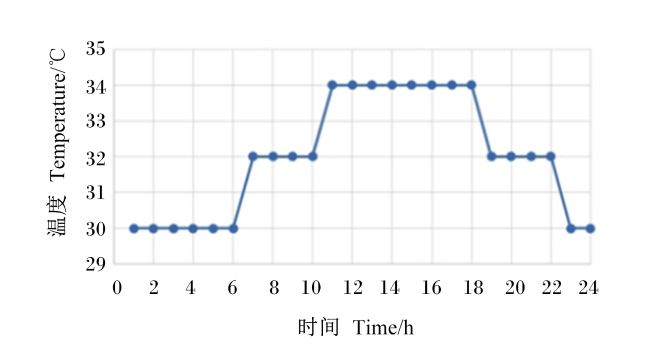
选择体重相近的180只35日龄雄性黄羽肉鸡,随机分为3个组,每组6个重复,每重复10只。对照组(CON组)和热应激组(HS组)饲喂基础饲粮,甜菜碱+维生素E(Bet+VE组)在基础饲粮中添加200 mg/kg的甜菜碱(甜菜碱盐酸盐,纯度≥98%)和50 mg/kg的维生素E(包膜维生素E,纯度≥95%)。预试期1周(35~41日龄,预试期饲粮中按正试期的比例添加甜菜碱和维生素E),正试期2周(42~56日龄)。各组进行1周的预饲喂后,第8天开始HS组和Bet+VE组进行循环热应激处理,设置程序为:00:00—06:00和20:00—00:00,(30±1) ℃,共10 h;06:00—10:00和16:00—20:00,(32±1)℃,共8 h;10:00—16:00,(34±1) ℃,共6 h,循环热应激程序设定见图1。对照组维持常温[(26±1) ℃]。各组持续处理2周。
图1 循环热应激程序设定

Fig.1 Cyclic heat stress program setting

1.3 基础饲粮和饲养管理

试验在动物营养代谢环控仓进行(北京库蓝科技有限公司),采用3层笼养,鸡笼规格为100 cm×80 cm×45 cm,期间自由采食和饮水,相对湿度维持在(60±5)%,定期清理粪便,24 h光照。期间记录采食量、体重和直肠温度等。基础饲粮参照《黄羽肉鸡营养需要量》(NY/T 3645—2020)配制并制粒,其组成及营养水平见表1
表1 基础饲粮组成及营养水平(风干基础)

Table 1 Composition and nutrient levels of the basal diet (air-dry basis) %

项目Items 含量Content
原料Ingredients
玉米Corn 69.37
豆粕Soybean meal 20.00
玉米蛋白粉Corn gluten meal 5.00
大豆油Soybean oil 3.03
石粉Limestone 0.96
磷酸氢钙CaHPO4 0.52
DL-蛋氨酸DL-Met 0.15
L-赖氨酸盐酸盐L-Lys·HCl 0.29
苏氨酸Thr 0.02
精氨酸Arg 0.01
植酸酶Phytase 0.02
氯化胆碱Choline chloride 0.10
微量元素预混料Trace mineral premix1) 0.20
维生素预混料Vitamin premix2) 0.03
氯化钠NaCl 0.30
合计Total 100.00
营养水平Nutrient levels3)
代谢能ME/(MJ/kg) 13.18
粗蛋白质CP 17.00
钙Ca 0.55
总磷TP 0.42
有效磷AP 0.22

1)微量元素预混料为每千克饲粮提供 Trace mineral premix provided the following per kg of the diet:Mn 60 mg,I 0.35 mg,Fe 25 mg,Cu 8 mg,Zn 50 mg。

2)维生素预混料为每千克饲粮提供 Vitamin premix provided the following per kg of the diet:VA 4 000 IU,VD3 1 600 IU,VK3 1.5 mg,VB1 1.0 mg,VB2 3.0 mg,VB6 3.0 mg,VB12 0.005 mg,泛酸 pantothenic acid 8.0 mg,烟酸 nicotinic acid 20 mg,叶酸 folic acid 20 mg。

3)代谢能和有效磷为计算值,参照NY/T 3645—2020;粗蛋白质、钙和总磷为实测值,分别参照GB/T 6432—2018、GB/T 6436—2018和GB/T 6437—2018。ME and AP were calculated values, referred to NY/T 3645—2020; CP, Ca and TP were measured values, referred to GB/T 6432—2018, GB/T 6436—2018 and GB/T 6437—2018, respectively.

1.4 样品采集及处理

试验结束时,每个重复按照平均体重选取试验鸡各1只,翅下静脉采集血液于促凝管中静置2 h,离心后收集血清,用于血清生化、免疫及抗氧化等指标检测;肉鸡处死后采集肝脏、肠道等器官,用于抗氧化指标和肠道形态检测。

1.5 指标测定

1.5.1 生长性能检测

分别于入舍前(35日龄)、正式试验第1天(42日龄)和热应激结束后(56日龄),每天07:00以每组每个重复为单位,称量所有鸡只重量,每次称量体重前均禁食12 h以上。从试验第1天开始,每天08:00统计每只鸡剩料量,每只鸡每天早上饲喂250 g饲料,并用前1天喂料量减去当天早上退料量即为每只鸡每日的采食量。每日记录鸡只死淘情况。计算试验期每只鸡的平均日增重、平均日采食量、平均料重比和死淘率。

1.5.2 直肠温度检测

正式试验开始后第1、4、7、10、14天14:00,从每个重复中随机选取1只鸡,使其保持安静,仰卧固定以避免移动,将温度计缓慢而轻柔地插入动物的肛门,以尽量减少应激,插入的深度为3~5 cm,保持8 s,待数字稳定,记录鸡只直肠温度。

1.5.3 血清生化和免疫指标

使用全自动血液生化分析仪测定血清谷丙转氨酶、谷草转氨酶、乳酸脱氢酶活性及白蛋白、葡萄糖、尿酸、总胆固醇、甘油三酯、高密度脂蛋白、低密度脂蛋白、钾、钠、氯、钙含量。使用酶联免疫吸附测定(ELISA)试剂盒(北京索莱宝科技有限公司)检测血清免疫球蛋白A(IgA)、免疫球蛋白G(IgG)、免疫球蛋白M(IgM)含量。

1.5.4 血清和肝脏抗氧化指标检测

采用试剂盒测定血清和肝脏丙二醛(MDA)含量及超氧化物歧化酶(SOD)、谷胱甘肽过氧化物酶(GSH-Px)活性,试剂盒购自南京建成生物研究所。

1.5.5 肠道形态

十二指肠、空肠和回肠组织经4%多聚甲醛固定后,制备成石蜡切片后经苏木精-伊红(HE)染色,观察测定每个组的绒毛高度、隐窝深度,计算绒毛高度/隐窝深度(V/C)。

1.6 数据统计与分析

数据经Excel 2013进行简单处理后,使用SPSS 20.0中t检验(CON组vs HS组和HS组vs Bet+VE组)进行统计分析,结果以平均值±标准差表示,P<0.05为显著差异。

2 结果与分析

2.1 饲粮中添加甜菜碱和维生素E对热应激黄羽肉鸡生长性能的影响

表2可知,与CON组相比,HS组终末体重、平均日增重和平均日采食量均显著降低(P<0.05),料重比显著升高(P<0.05)。与HS组相比,Bet+VE组终末体重和平均日增重显著升高(P<0.05),平均日采食量和料重比无显著差异(P>0.05)。
表2 饲粮中添加甜菜碱和维生素E对热应激黄羽肉鸡生长性能的影响

Table 2 Effects of dietary betaine and vitamin E on growth performance of yellow-feathered broilers under heat stress

项目
Items
组别Groups PP-value
CON HS Bet+VE P1 P2
初始体重IBW/g 1 341.19±124.55 1 247.64±106.83 1 255.92±123.37 0.68 0.88
终末体重FBW/g 2 271.44±133.30 1 909.80±167.53# 2 065.55±108.42* <0.01 0.03
平均日增重ADG/g 66.45±4.79 47.76±7.87# 56.55±8.14* <0.01 <0.01
平均日采食量ADFI/g 167.92±13.05 132.59±15.83# 144.69±16.16 <0.01 0.05
料重比F/G 2.42±0.10 2.80±0.28# 2.58±0.32 0.04 0.12
死淘率Mortality/% 0 13.33 0

#表示与CON组相比差异显著(P<0.05),*表示与HS组相比差异显著(P<0.05)。P1表示CON组vs HS组,P2表示HS组vs Bet+VE组。下表同。

# represented significant difference compared with the CON group (P<0.05), and * represented significant difference compared with the HS group (P<0.05). P1 represented CON group vs HS group, P2 represented HS group vs Bet+VE group. The same as below.

2.2 饲粮中添加甜菜碱和维生素E对热应激黄羽肉鸡直肠温度的影响

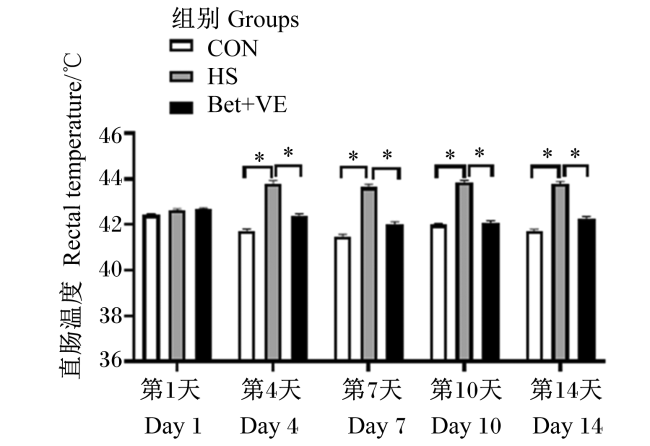
图2可知,与CON组相比,HS组第4、7、10和14天直肠温度显著升高(P<0.05)。与HS组相比,Bet+VE组第4、7、10和14天直肠温度显著降低(P<0.05)。
图2 饲粮中添加甜菜碱和维生素E对热应激黄羽肉鸡直肠温度的影响

数据柱标注*表示差异显著(P<0.05)。

Fig.2 Effects of dietary betaine and vitamin E on rectal temperature of yellow-feathered broilers under heat stress

Data column with * mean significant difference (P<0.05).

2.3 饲粮中添加甜菜碱和维生素E对热应激黄羽肉鸡血清生化和免疫指标的影响

表3可知,与CON组相比,HS组血清甘油三酯含量显著升高(P<0.05),血清钾含量显著降低(P<0.05)。与HS组相比,Bet+VE组血清氯含量显著降低(P<0.05)。
表3 饲粮中添加甜菜碱和维生素E对热应激黄羽肉鸡血清生化指标的影响

Table 3 Effects of dietary betaine and vitamin E on serum biochemical indices of yellow-feathered broilers under heat stress

项目
Items
组别Groups PP-value
CON HS Bet+VE P1 P2
白蛋白ALB/(g/L) 13.48±1.34 13.50±1.05 13.31±0.58 0.45 0.76
葡萄糖GLU/(mmol/L) 13.79±0.85 13.75±0.96 14.53±0.77 0.41 1.00
尿酸UA/(μmol/L) 332.33±54.67 296.36±65.86 313.25±71.71 0.98 0.70
甘油三酯TG/(mmol/L) 0.95±0.30 1.35±0.06# 1.50±0.28 0.02 0.19
总胆固醇TC/(mmol/L) 2.98±0.33 2.94±0.48 2.97±0.42 0.92 0.84
高密度脂蛋白HDL/(mmol/L) 1.74±0.18 1.78±0.13 1.69±0.31 0.79 0.54
低密度脂蛋白LDL/(mmol/L) 1.17±0.20 1.14±0.25 1.17±0.40 0.85 0.81
钾K/(mmol/L) 3.63±0.29 3.19±0.67# 3.17±0.54 0.02 0.96
钠Na/(mmol/L) 146.40±1.06 145.51±1.71 145.39±0.78 0.73 0.83
氯Cl/(mmol/L) 103.35±1.26 103.55±0.97 102.66±0.60* 0.46 0.03
钙Ca/(mmol/L) 1.28±0.04 1.28±0.03 1.29±0.06 0.82 0.82
表4可知,与CON组相比,HS组血清IgG和IgA含量显著降低(P<0.05)。与HS组相比,Bet+VE组血清IgG和IgA含量显著升高(P<0.05)。
表4 饲粮中添加甜菜碱和维生素E对热应激黄羽肉鸡血清免疫指标的影响

Table 4 Effects of dietary betaine and vitamin E on serum immune indices of yellow-feathered broilers under heat stress ng/mL

项目
Items
组别Groups PP-value
CON HS Bet+VE P1 P2
免疫球蛋白A IgA 2 769.95±445.62 1 386.77±439.93# 1 959.23±434.29* 0.02 0.03
免疫球蛋白G IgG 12.98±0.75 10.35±0.45# 16.31±0.32* <0.01 <0.01
免疫球蛋白M IgM 13.79±0.65 14.93±0.74 13.26±1.08 0.67 0.19

2.4 饲粮中添加甜菜碱和维生素E对热应激黄羽肉鸡血清和肝脏抗氧化指标的影响

表5可知,与CON组相比,HS组血清和肝脏抗氧化指标无显著差异(P>0.05)。与HS组相比,Bet+VE组血清和肝脏抗氧化指标无显著差异(P>0.05)。
表5 饲粮中添加甜菜碱和维生素E对热应激黄羽肉鸡血清和肝脏抗氧化指标的影响

Table 5 Effects of dietary betaine and vitamin E on serum and liver antioxidant indices of yellow-feathered broilers under heat stress

项目
Items
组别Groups PP-value
CON HS Bet+VE P1 P2
血清Serum
过氧化氢酶CAT/(U/mL) 4.23±0.90 6.16±3.28 5.82±2.06 0.09 0.81
谷胱甘肽过氧化物酶GSH-Px/(U/L) 1 459.48±87.70 1 521.78±361.81 1 613.99±374.62 0.67 0.59
超氧化物歧化酶SOD/(U/mL) 45.46±7.99 47.50±13.32 45.99±11.34 0.67 0.80
丙二醛MDA/(nmol/mL) 1.86±0.57 1.66±0.44 1.92±0.46 0.35 0.21
肝脏Liver
过氧化氢酶CAT/(U/mg prot) 1.23±0.19 1.26±0.32 1.53±0.17 0.82 0.07
谷胱甘肽过氧化物酶GSH-Px/(U/mg prot) 10.29±2.63 10.38±1.44 10.73±2.71 0.92 0.71
超氧化物歧化酶SOD/(U/mg prot) 23.88±4.07 23.95±4.64 25.78±5.97 0.97 0.45
丙二醛MDA/(nmol/mg prot) 0.50±0.12 0.44±0.14a 0.53±0.14 0.27 0.17

2.5 饲粮中添加甜菜碱和维生素E对热应激黄羽肉鸡肠道形态的影响

表6可知,与CON组相比,HS组十二指肠、空肠绒毛高度均显著降低(P<0.05),十二指肠、空肠、回肠隐窝深度均显著升高(P<0.05),十二指肠、空肠、回肠绒毛高度/隐窝深度均显著降低(P<0.05)。与HS组相比,Bet+VE组十二指肠绒毛高度显著升高(P<0.05),十二指肠、回肠隐窝深度均显著降低(P<0.05),十二指肠、空肠、回肠绒毛高度/隐窝深度均显著升高(P<0.05)。
表6 饲粮中添加甜菜碱和维生素E对热应激黄羽肉鸡肠道形态的影响

Table 6 Effects of dietary betaine and vitamin E on intestinal morphology of yellow-feathered broilers under heat stress

项目
Items
组别Groups PP-value
CON HS Bet+VE P1 P2
十二指肠
Duodenum
绒毛高度VH/μm 2 027.58±321.22 1 616.16±204.66# 1 989.83±298.63* 0.01 0.01
隐窝深度CD/μm 127.35±28.43 265.58±43.44# 179.08±42.59* <0.01 <0.01
绒毛高度/隐窝深度V/C 18.05±3.33 6.87±1.06# 13.38±4.22* <0.01 <0.01
空肠
Jejunum
绒毛高度VH/μm 1 803.73±173.34 1 236.13±159.43# 1 499.90±296.00 0.01 0.55
隐窝深度CD/μm 120.54±23.44 205.41±32.84# 166.45±83.06 <0.01 0.29
绒毛高度/隐窝深度V/C 16.06±2.43 6.20±0.94# 10.29±2.22* <0.01 <0.01
回肠
Ileum
绒毛高度VH/μm 1 040.61±102.99 929.38±168.37 929.66±209.08 0.35 0.57
隐窝深度CD/μm 82.48±43.41 177.82±27.34# 92.02±21.38* 0.04 <0.01
绒毛高度/隐窝深度V/C 15.26±4.02 5.27±0.62# 12.49±4.87* 0.04 0.03

3 讨论

3.1 饲粮中添加甜菜碱和维生素E对热应激黄羽肉鸡生长性能的影响

生长性能是反映肉鸡商业价值的重要指标,热应激是严重影响肉鸡产业的环境因素之一,缓解热应激对肉鸡产业具有重要意义。研究显示,鸡舍温度在24~30 ℃时,环境温度每升高1 ℃,肉鸡平均日采食量下降1.4%~1.6%;鸡舍温度在32~38 ℃时,环境温度每升高1 ℃,肉鸡平均日采食量下降3%[14]。热应激一方面可以通过降低肉鸡采食量降低肉鸡生长性能,另一方面还可通过影响肉鸡对饲料的消化吸收能力而降低肉鸡生长性能。蒋磊等[15]研究发现,与(23±1) ℃的常温饲养组相比,(32±1) ℃的热应激处理可显著降低肉鸡试验末体重、平均日采食量和平均日增重,显著提高料重比。郑雨萱等[16]研究结果也表明,与常温对照组相比,热应激可显著降低肉鸡平均日增重和平均日采食量,显著提高料重比。本研究结果显示,与CON组相比,HS组终末体重、平均日增重和平均日采食量均显著降低,料重比显著提高,与以上研究结果一致;本研究还发现,饲粮中添加甜菜碱和维生素E可显著提高热应激黄羽肉鸡的终末体重和平均日增重,但对平均日采食量和料重比无显著影响。
维生素E能够快速清除自由基,故适量添加维生素E可能对善应激条件下的肉鸡生长性能有改善作用。研究发现,饲粮中添加250 mg/kg的维生素E能够通过提高抗氧化能力来改善热应激状态下科宝和哈伯德肉鸡的生长性能[17-18]。而另一些研究却发现,饲粮中添加维生素E等抗氧化剂并不能改善热应激导致的肉鸡采食量和日增重下降的状况[19]。热应激抑制采食导致机体甲基供应不足,甜菜碱是甲基供体,添加甜菜碱在促进机体蛋白质合成的同时调节热应激状态下机体渗透压紊乱,提高饲料适口性,促进脂肪消化吸收分解,抑制脂肪合成,减少脂肪沉积,生产潜能得到释放[20-21]。贺绍君等[22]研究表明,饲粮中添加甜菜碱可提升热应激肉鸡生长性能,提高十二指肠消化酶活性,维持盲肠微生物平衡,从而减轻热应激对肉鸡的伤害。以上研究结果与本试验部分一致,维生素E和甜菜碱联合使用可能通过协同作用改善热应激黄羽肉鸡的代谢功能,缓解热应激对生长性能的负面影响。

3.2 饲粮中添加甜菜碱和维生素E对热应激黄羽肉鸡血清生化和免疫指标的影响

血清生化指标是反映动物体生理状态和健康状况等信息的重要指标。热应激可显著影响肉鸡血清生化指标。孙金芝等[23]研究发现,热应激可显著降低爱拔益加肉鸡血清甘油三酯和尿酸含量。张桂枝等[24]为探究热应激对817肉鸡血清生化指标的影响,将100只817肉鸡随机分为2组,分别在常温[(26±1) ℃]和热应激条件[(32±2) ℃]下饲养18 d,结果发现,与常温饲养相比,热应激条件下饲养显著提高了血清谷丙转氨酶、谷草转氨酶、乳酸脱氢酶、肌酸激酶活性及甘油三酯、葡萄糖含量。金永燕等[25]将科宝肉鸡分别在常温[(26±1) ℃]和热应激条件[(33±1) ℃]下饲养35和42 d,结果发现,35 d时,与常温条件下饲养相比,热应激条件下饲养的肉鸡血清葡萄糖、总胆固醇、高密度脂蛋白胆固醇、低密度脂蛋白胆固醇含量显著升高,总蛋白和白蛋白含量显著降低;42 d时,与常温条件下饲养相比,热应激条件下饲养的肉鸡仅血清葡萄糖含量显著升高。本研究发现,热应激显著提高了血清甘油三酯含量,显著降低了血清钾含量,这与前人的研究一致;但肝脏损伤相关指标无显著差异,这可能与鸡的品种与处理方式有关;而饲粮中添加甜菜碱和维生素E后,血清氯含量显著降低。热应激条件下,甜菜碱能够调节血液中酸碱平衡,降低细胞膜的渗透性,稳定细胞膜结构,是渗透压激变缓冲物质,可维持血液中电解质平衡。
血清免疫指标是肉鸡抵御外界侵害的重要指标,在肉鸡防御机能中发挥重要作用。目前许多研究都显示,热应激可导致肉鸡免疫功能受损。Roushdy等[26]将罗斯308肉鸡每天分别在(40±1) ℃下暴露4和6 h,对照组在热中性条件下全天饲养,进行为期21 d的试验,结果发现与对照组相比,热应激4和6 h时均可使血清免疫球蛋白(IgM、IgA、IgG)含量显著降低。Akinyemi等[27]将罗斯308肉鸡在(33±1) ℃下进行每天8 h的热应激暴露,结果发现,与热中性条件下相比,热应激可显著降低罗斯308肉鸡血清IgM和IgG含量。本研究结果显示,与CON组相比,HS组血清IgA和IgG含量显著降低,这与以往研究结果一致;而饲粮添加甜菜碱和维生素E后,血清IgG和IgA含量显著升高。研究表明,维生素E可以通过增强抗体产生、巨噬细胞活性和体液免疫对肉鸡免疫系统产生积极影响,应激状态下补充维生素E可以增强机体的免疫应答[28]。此外,占秀安[29]的研究也表明,饲粮中添加甜菜碱可以显著促进肉鸡免疫应答,提升血清IgM含量。甜菜碱可以促进蛋氨酸合成,提供甲基,加速蛋白质合成,这可能是甜菜碱促进免疫应答主要原因[30-32]。本研究中,饲粮中添加甜菜碱和维生素E可以协同调节热应激导致的免疫功能下降,提高血清IgG和IgA含量,与前人的研究结果一致。

3.3 饲粮中添加甜菜碱和维生素E对热应激黄羽肉鸡肠道形态的影响

家禽肠道上的肠绒毛可以有效增大吸收面积。高温环境不仅会影响家禽肠道绒毛高度、隐窝深度和绒毛高度/隐窝深度,而且还可破坏肠黏膜和绒毛完整性,影响家禽对营养物质的消化吸收能力[33-34]。Mitchell等[35]研究发现,暴露于热应激环境(35 ℃)2周后,肉鸡空肠绒毛高度显著低于22 ℃条件下饲养的肉鸡,绒毛高度的降低使得其表面积和体积也显著降低,最终影响肉鸡对营养物质的吸收。本研究结果发现,与CON组相比,HS组十二指肠和空肠绒毛高度显著降低,十二指肠、空肠和回肠隐窝深度显著升高,十二指肠、空肠和回肠绒毛高度/隐窝深度显著降低,与以往研究结果一致。Yousefi等[36]研究显示,饲粮中添加甜菜碱提高了热应激肉鸡的生长性能指标,血清总抗氧化能力以及十二指肠和空肠的绒毛高度/隐窝深度,改善了肠道健康。本研究发现,饲粮中添加甜菜碱和维生素E组显著降低了热应激黄羽肉鸡十二指肠和回肠隐窝深度,显著提高了十二指肠、空肠、回肠高度/隐窝深度,与以上研究结果一致。

3.4 饲粮中添加甜菜碱和维生素E对热应激黄羽肉鸡血清和肝脏抗氧化指标的影响

氧化应激是热应激引起器官损伤的直接方式,也是动物发生热应激的重要标志。大量研究表明,热应激会导致其抗氧化系统的破坏,抗氧化酶活性降低,活性氧(ROS)产生过多且无法及时清除,最终对机体造成损害[37-38]。本研究中,各组之间血清和肝脏抗氧化指标MDA含量及GSH-Px、SOD和CAT活性均无显著差异。机体的氧化还原系统对热应激的调控是一个动态变化的过程,当热应激强度较低、时间较短时,体内抗氧化酶活性显著降低;当热应激强度和时间增加时,机体则会代偿性激活抗氧化系统来清除过量生成的ROS[39]。Wang等[40]研究指出,当颗粒细胞暴露在40 ℃热应激条件下时,MDA含量升高,而GSH-Px和SOD活性下降;但当热应激温度提高到42 ℃时,MDA含量及GSH-Px和SOD活性与37 ℃的对照组无显著差异。另一项在海兰褐母鸡上的研究发现,热应激暴露7 d会导致下丘脑中血红素氧合酶-1(HO-1)和谷胱甘肽(GSH)基因表达升高,SOD2基因表达降低;而在热应激暴露14 d时,HO-1和GSH基因表达降低,SOD2基因表达无显著差异[41]。综上所述,本研究中各组之间血清和肝脏抗氧化指标无显著差异,可能是由于热应激强度和暴露时间所导致。

4 结论

热应激状态下,黄羽肉鸡生长性能降低,直肠温度升高,免疫功能下降,肠道功能受损;饲粮中添加甜菜碱和维生素E可以降低热应激引起的黄羽肉鸡体温升高,并能增加体重,提高免疫力,改善肠道损伤。
[1]
LIU L L, REN M Y, REN K, et al. Heat stress impacts on broiler performance:a systematic review and Meta-analysis[J]. Poultry Science, 2020, 99(11):6205-6211.

[2]
KHAN R U, NAZ S, ULLAH H, et al. Physiological dynamics in broiler chickens under heat stress and possible mitigation strategies[J]. Animal Biotechnology, 2023, 34(2):438-447.

[3]
JIMOH O A, DARAMOLA O T, OKIN-AMINU H O, et al. Performance,hemato-biochemical indices and oxidative stress markers of broiler chicken fed phytogenic during heat stress condition[J]. Journal of Animal Science and Technology, 2022, 64(5):970-984.

[4]
NANTO-HARA F, KIKUSATO M, OHWADA S, et al. Heat stress directly affects intestinal integrity in broiler chickens[J]. The Journal of Poultry Science, 2020, 57(4):284-290.

[5]
ALIREZAEI M, REZA GHEISARI H, REZA RANJBAR V, et al. Betaine:a promising antioxidant agent for enhancement of broiler meat quality[J]. British Poultry Science, 2012, 53(5):699-707.

[6]
SHADMEHR S, FATEMI TABATABAEI S R, HOSSEINIFAR S, et al. Attenuation of heat stress-induced spermatogenesis complications by betaine in mice[J]. Theriogenology, 2018, 106:117-126.

DOI PMID

[7]
UYANGA V A, OKE E O, AMEVOR F K, et al. Functional roles of taurine,L-theanine,L-citrulline,and betaine during heat stress in poultry[J]. Journal of Animal Science and Biotechnology, 2022, 13(1):23.

[8]
ALAGAWANY M, ELNESR S S, FARAG M R, et al. Betaine and related compounds:chemistry,metabolism and role in mitigating heat stress in poultry[J]. Journal of Thermal Biology, 2022, 104:103168.

[9]
ABU HAFSA S H, CENTODUCATI G, HASSAN A A, et al. Effects of dietary supplementations of vitamin C,organic selenium,betaine,and pomegranate peel on alleviating the effect of heat stress on growing rabbits[J]. Animals, 2024, 14(6):950.

[10]
EGBUNIWE I C, AYO J O, OCHEJA O B. Betaine and ascorbic acid modulate indoor behavior and some performance indicators of broiler chickens in response to hot-dry season[J]. Journal of Thermal Biology, 2018, 76:38-44.

DOI PMID

[11]
朱原, 周双. 多酚类和维生素E对热应激肉鸡抗氧化性能和肉质的影响[J]. 北方牧业, 2019(21):28.

ZHU Y, ZHOU S. The effects of polyphenols and vitamin E on antioxidant performance and meat quality of heat stressed broiler chickens[J]. BeiFang MuYe, 2019(21):28. (in Chinese)

[12]
王镇坤, 林松涛, 杜埜, 等. 维生素E对家禽免疫性能和热应激的影响研究进展[J]. 中国畜牧兽医文摘, 2017, 33(5):223.

WANG Z K, LIN S T, DU Y, et al. Research progress on the effects of vitamin E on immune performance and heat stress in poultry[J]. Chinese Abstracts of Animal Husbandry and Veterinary Medicine, 2017, 33(5):223. (in Chinese)

[13]
文杰, 林济华, 王和民. 日粮维生素E、抗坏血酸水平对肉仔鸡生长及免疫功能的影响[J]. 畜牧兽医学报, 1996(6):481-488.

WEN J, WANG H M, LIN J H. Effect of dietary vitamin E and ascorbic acid on the growth and immune function of the chicks[J]. Acta Veterinaria et Zootechnica Sinica, 1996(6):481-488. (in Chinese)

[14]
AIN BAZIZ H, GERAERT P A, PADILHA J C, et al. Chronic heat exposure enhances fat deposition and modifies muscle and fat partition in broiler carcasses[J]. Poultry Science, 1996, 75(4):505-513.

DOI PMID

[15]
蒋磊, 陈杰. 微生态制剂对热应激肉鸡生长性能和血清抗氧化功能的影响[J]. 洛阳师范学院学报, 2020, 39(8):21-25.

JIANG L, CHEN J. Effects of probiotics on growth performance and antioxidant function of heat-stressed broilers[J]. Journal of Luoyang Normal University, 2020, 39(8):21-25. (in Chinese)

[16]
郑雨萱, 黄嘉亮, 王翔, 等. 猴头菇多糖对热应激肉鸡生长性能、血液指标及物质代谢的影响[J]. 动物营养学报, 2023, 35(6):3708-3723.

DOI

ZHENG Y X, HUANG J L, WANG X, et al. Effects of hericium erinaceus polysaccharide on growth performance,blood indices and substance metabolism of broilers under heat stress[J]. Chinese Journal of Animal Nutrition, 2023, 35(6):3708-3723. (in Chinese)

[17]
REHMAN Z U, CHAND N, KHAN R U. The effect of vitamin E,L-carnitine,and ginger on production traits,immune response,and antioxidant status in two broiler strains exposed to chronic heat stress[J]. Environmental Science and Pollution Research International, 2017, 24(34):26851-26857.

[18]
ALBUQUERQUE D M N, LOPES J B, FERRAZ M S, et al. Vitamin E and organic selenium for broilers from 22 to 42 days old:performance and carcass traits[J]. Anais da Academia Brasileira de Ciencias, 2017, 89(2):1259-1268.

[19]
ZEFERINO C P, KOMIYAMA C M, PELÍCIA V C, et al. Carcass and meat quality traits of chickens fed diets concurrently supplemented with vitamins C and E under constant heat stress[J]. Animal, 2016, 10(1):163-171.

DOI PMID

[20]
WON S Y, HAN G P, KWON C H, et al. Effect of individual or combination of dietary betaine and glycine on productive performance,stress response,liver health,and intestinal barrier function in broiler chickens raised under heat stress conditions[J]. Poultry Science, 2023, 102(7):102771.

[21]
LIU W C, YUAN Y L, SUN C Y, et al. Effects of dietary betaine on growth performance,digestive function,carcass traits,and meat quality in indigenous yellow-feathered broilers under long-term heat stress[J]. Animals, 2019, 9(8):506.

[22]
贺绍君, 丁金雪, 李静, 等. 甜菜碱对慢性热应激肉鸡血清抗氧化功能的影响[J]. 安徽科技学院学报, 2017, 31(4):7-10.

HE S J, DING J X, LI J, et al. Effects of betaine on serum antioxidative function in broilers under chronic heat stress[J]. Journal of Anhui Science and Technology University, 2017, 31(4):7-10. (in Chinese)

[23]
孙金芝, 宋志刚, 朱启东, 等. 万寿菊提取物对热应激下肉鸡生长性能、屠宰性能、肉品质及血清生化指标的影响[J]. 动物营养学报, 2023, 35(10):6340-6348.

DOI

SUN J Z, SONG Z G, ZHU Q D, et al. Effects of marigold extract on growth performance,carcass performance,meat quality and serum biochemical indexes of broilers suffered from heat stress[J]. Chinese Journal of Animal Nutrition, 2023, 35(10):6340-6348. (in Chinese)

[24]
张桂枝, 李梦云, 靳双星. 发酵中药对热应激817肉鸡生长性能、血清生化指标及抗氧化功能的影响[J]. 中国畜牧杂志, 2022, 58(7):257-262.

ZHANG G Z, LI M Y, JIN S X. The effects of fermented traditional Chinese medicine on the growth performance,serum biochemical indicators,and antioxidant function of 817 broiler chickens under heat stress[J]. Chinese Journal of Animal Science, 2022, 58(7):257-262. (in Chinese)

[25]
金永燕, 李雪, 宋凯, 等. 硫辛酸对慢性热应激肉鸡血清生化指标的影响[J]. 安徽科技学院学报, 2021, 35(5):41-46.

JIN Y Y, LI X, SONG K, et al. Effects of lipoic acid on serum biochemical indexes of broilers exposed to chronic heat stress[J]. Journal of Anhui Science and Technology University, 2021, 35(5):41-46. (in Chinese)

[26]
ROUSHDY E M, ZAGLOOL A W, EL-TARABANY M S. Effects of chronic thermal stress on growth performance,carcass traits,antioxidant indices and the expression of HSP70,growth hormone and superoxide dismutase genes in two broiler strains[J]. Journal of Thermal Biology, 2018, 74:337-343.

[27]
AKINYEMI F, ADEWOLE D. Effects of brown seaweed products on growth performance,plasma biochemistry,immune response,and antioxidant capacity of broiler chickens challenged with heat stress[J]. Poultry Science, 2022, 101(12):102215.

[28]
ATTIA Y A, ABD EL-HAMID A E H E, ABEDALLA A A, et al. Laying performance,digestibility and plasma hormones in laying hens exposed to chronic heat stress as affected by betaine,vitamin C,and/or vitamin E supplementation[J]. SpringerPlus, 2016, 5(1):1619.

[29]
占秀安. 甜菜碱促进肉鸡生长的作用机理研究[J]. 浙江农业学报, 2000, 12(4):209.

ZHAN X A. Studies on growth promoting mechanism of betaine in broiler chickens[J]. Acta Agriculturae Zhejiangensis, 2000, 12(4):209. (in Chinese)

[30]
王晶晶. 热应激期间天然甜菜碱在动物营养上的作用[J]. 国外畜牧学(猪与禽), 2022, 42(3):4-6.

WANG J J. Natural betaine:a nutritional aid during heat stress[J]. Animal Science Abroad (Pigs and Poultry), 2022, 42(3):4-6. (in Chinese)

[31]
JEWELL D E, TAVENER S K, CREECH R, et al. Betaine and L-carnitine synergistically influence the metabolome and immune response in dogs[J]. Animals, 2024, 14(3):357.

[32]
YANG Z, YANG J J, ZHU P J, et al. Effects of betaine on growth performance,intestinal health,and immune response of goslings challenged with lipopolysaccharide[J]. Poultry Science, 2022, 101(11):102153.

[33]
ATTIA Y A, HASSAN R A, ADDEO N F, et al. Effects of Spirulina platensis and/or Allium sativum on antioxidant status,immune response,gut morphology,and intestinal Lactobacilli and coliforms of heat-stressed broiler chicken[J]. Veterinary Sciences, 2023, 10(12):678.

[34]
RUFF J, BARROS T L, TELLEZ G J, et al. Research note:evaluation of a heat stress model to induce gastrointestinal leakage in broiler chickens[J]. Poultry Science, 2020, 99(3):1687-1692.

[35]
MITCHELL M A, KETTLEWELL P J. Physiological stress and welfare of broiler chickens in transit:solutions not problems![J]. Poultry Science, 1998, 77(12):1803-1814.

[36]
YOUSEFI J, TAHERPOUR K, GHASEMI H A, et al. Effects of emulsifier,betaine,and L-carnitine on growth performance,immune response,gut morphology, and nutrient digestibility in broiler chickens exposed to cyclic heat stress[J]. British Poultry Science, 2023, 64(3):384-397.

[37]
SLIMEN I B, NAJAR T, GHRAM A, et al. Reactive oxygen species, heat stress and oxidative-induced mitochondrial damage.A review[J]. International Journal of Hyperthermia, 2014, 30(7):513-523.

[38]
FENG X Y, LI C Y, ZHANG H, et al. Heat-stress impacts on developing bovine oocytes:unraveling epigenetic changes,oxidative stress,and developmental resilience[J]. International Journal of Molecular Sciences, 2024, 25(9):4808.

[39]
ESPINOSA-DIEZ C, MIGUEL V, MENNERICH D, et al. Antioxidant responses and cellular adjustments to oxidative stress[J]. Redox Biology, 2015, 6:183-197.

[40]
WANG Y R, YANG C X, ELSHEIKH N A H, et al. HO-1 reduces heat stress-induced apoptosis in bovine granulosa cells by suppressing oxidative stress[J]. Aging, 2019, 11(15):5535-5547.

[41]
ZHAO Y L, ZHUANG Y, SHI Y, et al. Effects of N-acetyl-L-cysteine on heat stress-induced oxidative stress and inflammation in the hypothalamus of hens[J]. Journal of Thermal Biology, 2021, 98:102927.

Outlines

/