RESEARCH PAPER

Effects of in Ovo Injection of Lactobacillus rhamnosus on Growth Performance, Intestinal Health, Serum Biochemical Indices and Cecal Microflora of Yellow-Feathered Broilers at Early Stage

  • YU Xiao ,
  • YAO Jie * ,
  • SU Linjie ,
  • WU Yani ,
  • MA Yixuan ,
  • HUANG Yanling ,
  • WANG Xi , **
Expand
  • Key Laboratory of Animal Science of National Ethnic Affairs Commission, Key Laboratory of Qinghai-Tibetan Plateau Animal Genetic Resources Reservation and Utilization, College of Animal and Veterinary Sciences, Southwest Minzu University, Chengdu 610041, China
**lecturer, E-mail:

*Contributed equally

Received date: 2024-08-05

  Online published: 2025-02-16

Abstract

This experiment was conducted to investigate the effects of in ovo injection of Lactobacillus rhamnosus (LR) on growth performance, intestinal health, serum biochemical indices and cecal microflora of yellow-feathered broilers at early stage. A randomized complete block design was applied in this study. A total of 240 hatching eggs of yellow-feathered broilers with similar weight [(58.70±0.25) g]were randomly allocated in the same incubator with eight layers (layer served as block). Each layer contained 3 rows of eggs. On 18.5 day of incubation, hatching eggs were randomly injected 100 μL of phosphate buffer (control group), 100 μL of low dose LR (102 CFU, low-dose LR group), or 100 μL of high dose LR (104 CFU, high-dose LR group) at amnion. There were 8 replicates in each group and 10 eggs in each replicate. At hatch, the in ovo injected birds were transferred to corresponding cage according the block order and continually fed the same diet until 21 days of age. There were 8 replicates (cages) in each group and 9 to 10 birds in each replicate. The results showed as follows: 1) the body weight at 21 days of age and average daily gain from 1 to 21 days of age in both LR injected groups were significantly higher than those in the control group (P<0.05). 2) The duodenal, jejunal and ileal villus heights and villus widths at 21 days of age in the LR injected groups were significantly increased compared with the groups (P<0.05). 3) As compared to the control group, the contents of serum albumin and total protein in low- dose LR group were significantly increased (P<0.05). 4) 16S rRNA amplicon sequencing data indicated that in ovo injection of LR did not significantly affect cecal microbial α diversity (Shannon index, Simpson index, Chao index and Sobs index, P>0.05). However, the β diversity analysis indicated the cecal microbial structure changed significantly (P<0.05). Compared with the control group, the high dose LR injection significantly increased the relative abundance of UCG-005 (P<0.05), and the low dose LR injection significantly increased the relative abundance of Lachnoclostridium (P<0.05). In conclusion, in ovo injection of LR (102 to 104 CFU) can improve the early growth rate of yellow-feathered broilers by improving the intestinal morphology and increasing the proportion of intestinal beneficial bacteria.[Chinese Journal of Animal Nutrition, 2025, 37(2):938-949]

Cite this article

YU Xiao , YAO Jie , SU Linjie , WU Yani , MA Yixuan , HUANG Yanling , WANG Xi . Effects of in Ovo Injection of Lactobacillus rhamnosus on Growth Performance, Intestinal Health, Serum Biochemical Indices and Cecal Microflora of Yellow-Feathered Broilers at Early Stage[J]. Chinese Journal of Animal Nutrition, 2025 , 37(2) : 938 -949 . DOI: 10.12418/CJAN2025.082

益生菌可增强动物免疫力,调节肠道微生物,提高动物生产性能,因而广泛应用于畜禽生产[1]。鼠李糖乳杆菌(Lactobacillus rhamnosus,LR)具有黏附肠细胞[2]、抑制病原菌[3]、促进仔鸡早期生长[4]等功能,可作为潜在的家禽益生菌。Liu等[5]研究发现,饲粮添加108 CFU/kg的LR可提高肉鸡采食量、增强胫骨发育、提高增重。Fesseha等[6]从健康鸡肠道中分离出特定LR亚种,并且将不同剂量LR亚种饲喂肉仔鸡,发现第1周采食量显著增加,后4周采食量不变,且高剂量LR会降低饲料转化效率。Eglite等[7]研究发现,无菌肉鸡饲喂添加LR饲粮后,采食量和体重没有明显增加。这意味着LR可能是通过调节肉鸡早期肠道微生物来实现益生功能的,且添加剂量十分关键。一直以来,益生菌根据其耐热、耐高温、耐消化酶等抗逆性程度,可通过吸附、包被、制粒后喷涂等技术应用于肉鸡颗粒饲料,或者通过饮水添加使用[1]。近来,胚蛋注射(in ovo injection)为益生菌应用提出了新途径。胚蛋注射技术始于鸡胚疫苗注射,之后研究发现氨基酸、维生素、益生素、必需脂肪酸等营养物质可通过羊膜腔注射,提前进入鸡胚消化道,增强机体免疫力,调节肠道微生物,从而促进仔鸡出孵后的生长发育[8]。Pender等[9-10]研究发现,胚蛋注射复合乳酸菌不影响肉鸡孵化率,可降低1日龄仔鸡肠道炎症因子的表达,使得仔鸡在球虫感染情况下维持早期增重。本课题组前期试验发现,胚蛋注射106或108 CFU的LR,可帮助黄羽肉鸡在出孵后抵御艾美耳球虫感染,加快艾美耳球虫卵囊的排出,增加后期肠道乳酸菌的定植量[11]。然而,106 CFU的LR注射剂量却导致仔鸡肠道炎症因子表达量升高、魏氏梭菌和大肠杆菌的相对丰度升高[11]。综上所述,胚蛋注射LR可能实现益生菌早期定植,调节肠道微生物组成,促进肉仔鸡早期生长发育,但具体使用剂量仍需进一步探讨。本试验给胚蛋注射LR,研究其对黄羽肉鸡早期生长性能、肠道健康、血清生化指标和盲肠微生物区系的影响,旨在探究LR胚蛋注射适宜剂量,以提高黄羽肉鸡早期生长性能,并揭示卵内供给益生菌对黄羽肉仔鸡盲肠微生物组成的具体影响,为卵内营养供给的科学应用提供基础理论数据。

1 材料与方法

1.1 试验设计与管理

本试验于西南民族大学环境控制实验动物房进行,试验操作经西南民族大学学术道德与伦理委员会审批(批准号:SMU-202401003)。采用单因子完全随机区组设计,选取240枚蛋重[(58.70±0.25) g]相近的黄羽肉鸡种蛋,随机放置于同一孵化器中8层(区组),每层3排,每排1个重复,每个重复10枚蛋。每层鸡蛋以1排为试验单位,于18.5胚龄随机接受以下3种处理中的任一处理:接种100 μL的磷酸盐缓冲液(PBS)稀释液(作为对照)、100 μL的低剂量LR(102 CFU)、100 μL的高剂量LR(104 CFU)。此外,另有80枚种蛋作为不注射对照组。不注射对照组、对照组、低剂量LR组、高剂量LR组的平均孵化率分别为92.2%、92.1%、94.9%和93.4%,且无显著差异(P=0.889)。出孵后,对照组、低剂量LR组、高剂量LR组仔鸡按照区组顺序转入鸡笼,同个重复的蛋入同笼,继续饲喂相同的基础饲粮(商业粉碎料)至21日龄。每组8个重复(区组),每个重复9~10只鸡。基础饲粮营养水平满足NRC(1994)和黄羽肉鸡营养需要量(NY/T 3645—2020)推荐量,其组成及营养水平见表1。基础饲粮中粗蛋白质(GB/T 6432—2018)、钙(GB/T 6436—2018)、总磷(GB/T 6437—2018)、氨基酸含量(GB/T 18246—2019)均按照国家标准方法测定,代谢能根据NY/T 3645—2020中饲料原料代谢能和在配方中的占比计算。
表1 基础饲粮组成及营养水平(风干基础)

Table 1 Composition and nutrient levels of the basal diet (air-dry basis) %

项目Items 含量Content
原料Ingredients
玉米Corn 51.26
豆粕Soybean meal 41.34
大豆油Soybean oil 1.99
磷酸氢钙CaHPO4 2.43
氯化钠NaCl 0.33
石粉Limestone 1.30
氯化胆碱Choline chloride 0.19
L-赖氨酸盐酸盐L-Lys·HCl 0.11
DL-蛋氨酸DL-Met 0.32
L-苏氨酸L-Thr 0.13
预混料Premix1) 0.60
合计Total 100.00
营养水平Nutrient levels2)
代谢能ME/(MJ/kg) 13.03
粗蛋白质CP 23.09
钙Ca 1.10
总磷TP 0.81
赖氨酸Lys 1.26
蛋氨酸Met 0.63
苏氨酸Thr 0.86
蛋氨酸+胱氨酸Met+Cys 0.94

1)预混料为每千克饲粮提供The premix provided the following per kg of the diet:VA 19 000 IU,VD3 4 000 IU,VE 24 IU,VK3 2.0 mg,VB1 2.6 mg,VB2 1.12 mg,VB6 5.6 mg,VB12 0.02 mg,Mn 110 mg,Zn 100 mg,Fe 80 mg,Cu 10 mg,I 0.6 mg,Se 0.35 mg。

2)代谢能为计算值,其他为测定值。ME was a calculated value, whereas others were measured values.

1.2 胚蛋注射

胚蛋注射操作详情参照本课题组前期文章[11],简述如下:种蛋在18.5胚龄时转运至生物安全柜无菌环境中,大头端消毒擦拭;利用无菌凿针在气室开一直径1 mm微孔,再使用一次性无菌针头,按处理接种100 μL的LR(ATCC7469)工作液(0、103、105 CFU/mL)。使用热蜡封口,冷却后将种蛋放回孵化箱。

1.3 检测指标

1.3.1 生长性能指标

以每个重复(笼)为试验单位,统计喂料量、剩余量,在1和21日龄进行称重,计算平均日增重(ADG)、平均日采食量(ADFI)、料重比(F/G)。

1.3.2 血清生化指标

21日龄时,每个重复选取1只体重接近平均值的鸡,进行翅静脉采血,4 h凝血后,经过1 200×g离心10 min,收集上清,进行血清生化指标检测。采用试剂盒(南京建成生物工程研究所)测定血清总蛋白、白蛋白、甘油三酯、胆固醇、低密度脂蛋白胆固醇、高密度脂蛋白胆固醇及葡萄糖含量。

1.3.3 肠道形态指标

采血后的鸡只采用颈部脱臼安乐死,PBS轻柔冲洗肠段,并收集十二指肠、空肠、回肠肠段各3 cm左右,保存于10%甲醛溶液。双盲标记样本后,送至成都里来生物有限公司制作石蜡切片,采用阿利新蓝-过碘酸-雪夫染色(AB-PAS染色),在光学显微镜下测量绒毛高度、绒毛宽度、隐窝深度,计算绒隐比。每张切片选取5个完整视野进行测量。

1.3.4 空肠营养转运相关基因的相对表达量

利用一次性无菌玻片刮取空肠黏膜上皮,液氮速冻后,-80 ℃冻存待PCR测定。空肠营养转运相关基因的相对表达量测定参考本课题组前期文章[12]。以β-肌动蛋白(β-actin)为内参基因,利用2-ΔΔCt法检测小肠营养素转运蛋白相关基因的相对表达量,包括脂肪酸转运体基因脂肪酸转运蛋白4(FATP4),氨基酸和肽转运体基因B0系统中性氨基酸转运载体(B0AT)、碱性氨基酸转运载体1(CAT1)、小肽转运载体1(PepT1)及葡萄糖转运体基因葡萄糖转运蛋白5(GLUT5)、葡萄糖转运蛋白2(GLUT2)、钠-葡萄糖协同转运蛋白1(SGLT1),其引物见表2
表2 实时荧光定量PCR引物

Table 2 Primers for RT-qPCR

功能
Functions
基因名称
Gene names
登录号
Accession number
引物序列
Primer sequences
(5'—3')
产物大小
Product
size/bp
脂肪酸转运体
Fatty acid transporter
脂肪酸转运蛋白4
FATP4
XM_415504 F:ATACCTCTGGCACTACGGGAAT
R:CATACATCACATCATCGGGTCT
117
氨基酸、肽转运体
Amino acid and
peptide transporters
B0系统中性氨基酸转运载体
B0AT
XM_419056 F:TATCCTGGCTGGGTCTATGC
R:AGGCCTGTACGATCCCTTCT
125
碱性氨基酸转运载体1
CAT1
NM_001145490 F:CTCTTCTGCCCCTTCTTCCT
R:TGAGCATCCAGACTGCAAAC
102
小肽转运载体1
PepT1
NM_204365.2 F:TACGCATACTGTCACCATCA
R:TCCTGAGAACGGACTGTAAT
122
葡萄糖转运体
Glucose transporters
葡萄糖转运蛋白5
GLUT5
XM 040689119.1 F:CCTCAGCATAGTGTGTGTCATCATT
R:GGATCGGACTGGCTCCAA
62
钠-葡萄糖协同转运蛋白1
SGLT1
NM_001293240.1 F:GATGTGCGGATACCTGAAGC
R:AGGGATGCCAACATGACTGA
100
葡萄糖转运蛋白2
GLUT2
NM_207178.1 F:GAAGGTGGAGGAGGCCAAA
R:TTTCATCGGGTCACAGTTTCC
61
参比
Reference
β-肌动蛋白
β-actin
NM 205518 F:AACACCCACACCCCTGTGAT
R:TGAGTCAAGCGCCAAAAGAA
100

1.3.5 盲肠微生物区系

采集2 g左右盲肠内容物于冻存管,液氮速冻后-80 ℃保存,送至上海美吉生物医药科技有限公司,采用16S rRNA扩增子测序法测定黄羽肉鸡盲肠微生物多样性。选择16S rRNA V3~V4序列扩增,采用Illumina MiSeq平台进行测序,通过其云平台完成盲肠微生物多样性和组成分析。

1.4 数据统计分析

运用SAS 9.4统计软件中的一般线性模型(GLM)对生长性能、肠道形态、基因相对表达量、血清生化指标、α多样性指数及菌群相对丰度进行方差分析(ANOVA)。区组设定为随机因子,注射处理为固定因子。并采用Duncan氏法进行组间多重比较分析,结果以平均值和均值标准误(SEM)来表示。菌群β多样性利用Bray-Curtis距离矩阵进行非度量多维尺度(NMDS)分析和主坐标分析(PCoA),并基于线性判别分析(LDA)评分≥2进行LEfSe跨分类差异分析差异物种。P<0.01表示差异极显著,P<0.05表示差异显著,P>0.05表示差异不显著。

2 结果

2.1 胚蛋注射LR对1~21日龄黄羽肉鸡生长性能的影响

表3可知,高低剂量、低剂量LR组黄羽肉鸡21日龄体重均显著高于对照组(P<0.05);高剂量LR组黄羽肉鸡1~21日龄ADG显著高于对照组(P<0.05),低剂量LR组ADG又显著高于高剂量组(P<0.05)。
表3 胚蛋注射鼠李糖乳杆菌对1~21日龄黄羽肉鸡生长性能的影响

Table 3 Effects of in ovo injection of Lactobacillus rhamnosus on growth performance of yellow-feathered broilers from 1 to 21 days of age

项目
Items
组别Groups SEM P
P-value
对照
Control
低剂量LR
Low-dose LR
高剂量LR
High-dose LR
末重Final weight/g 401.92b 432.83a 421.19a 3.991 0.008
平均日采食量ADFI/g 28.18 30.86 25.45 1.487 0.073
平均日增重ADG/g 17.02c 18.50a 17.94b 0.181 <0.001
料重比F/G 1.65 1.67 1.42 0.241 0.080

同行数据肩标不同字母表示差异显著(P<0.05)。下表同。

Values in the same row with different letter superscripts mean significant difference (P<0.05). The same as below.

2.2 胚蛋注射LR对21日龄黄羽肉鸡肠道形态的影响

表4可知,与对照组相比,高低剂量、低剂量LR组十二指肠、空肠、回肠绒毛高度均显著提升(P<0.05);与对照组相比,低剂量LR组十二指肠绒毛宽度显著降低(P<0.05)、回肠绒毛宽度显著升高(P<0.05),高剂量LR组空肠、回肠绒毛宽度显著升高(P<0.05);与对照组相比,高剂量LR组十二指肠隐窝深度显著升高(P<0.05)。
表4 胚蛋注射鼠李糖乳杆菌对21日龄黄羽肉鸡肠道形态的影响

Table 4 Effects of in ovo injection of Lactobacillus rhamnosus on intestinal morphology of yellow-feathered broilers at 21 days of age

项目
Items
组别Groups SEM P
P-value
对照
Control
低剂量LR
Low-dose LR
高剂量LR
High-dose LR
十二指肠Duodenum
绒毛高度Villus height/μm 1 510.9b 1 709.3a 1 733.5a 45.58 0.002
绒毛宽度Villus width/μm 169.7a 139.0b 190.4a 10.76 0.006
隐窝深度Crypt depth/μm 131.1b 142.8ab 152.3a 5.88 0.046
绒隐比V/C 11.9 12.1 11.5 0.52 0.716
空肠Jejunum
绒毛高度Villus height/μm 1 044.5b 1 255.3a 1 269.2a 52.96 0.007
绒毛宽度Villus width/μm 155.0b 165.4ab 176.8a 5.37 0.022
隐窝深度Crypt depth/μm 139.4 142.1 151.7 6.35 0.354
绒隐比V/C 7.6 8.9 8.5 0.46 0.101
回肠Ileum
绒毛高度Villus height/μm 749.8b 925.0a 954.1a 20.46 <0.001
绒毛宽度Villus width/μm 132.0b 157.3a 155.9a 6.14 0.008
隐窝深度Crypt depth/μm 156.1 189.7 176.8 11.09 0.104
绒隐比V/C 5.0 5.1 5.7 0.35 0.330

2.3 胚蛋注射LR对21日龄黄羽肉鸡空肠营养转运相关基因相对表达量的影响

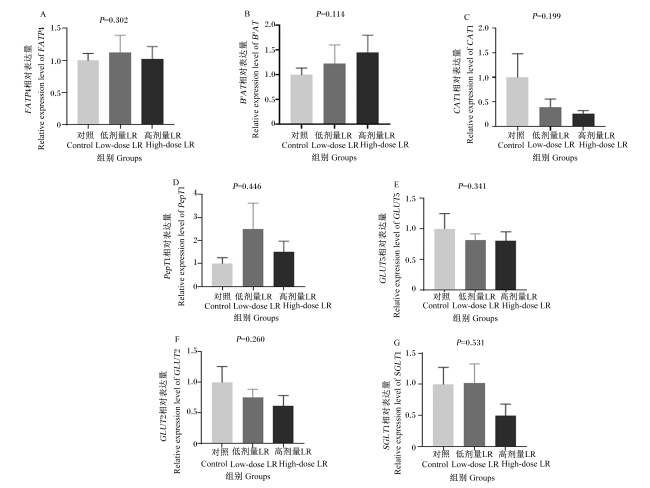
图1可知,胚蛋注射LR对空肠营养转运相关基因FATP4、B0ATCAT1、PepT1、GLUT5、GLUT2、SGLT1的相对表达量均无显著影响(P>0.05)。
图1 胚蛋注射鼠李糖乳杆菌对21日龄黄羽肉鸡空肠营养转运相关基因相对表达量的影响

Fig.1 Effects of in ovo injection of Lactobacillus rhamnosus on relative expression levels of nutrient transport-related genes in jejunum of yellow-feathered broilers at 21 days of age

2.4 胚蛋注射LR菌对21日龄黄羽肉鸡血清生化指标的影响

表5可知,与对照组相比,低剂量LR组血清白蛋白(15.62 g/L vs 19.35 g/L)和总蛋白含量(20.48 g/L vs 25.37 g/L)显著升高(P<0.05);血清葡萄糖、甘油三酯、胆固醇、高密度脂蛋白胆固醇、低密度脂蛋白胆固醇含量不受胚蛋注射LR的显著影响(P>0.05)。
表5 胚蛋注射鼠李糖乳杆菌对21日龄黄羽肉鸡血清生化指标的影响

Table 5 Effects of in ovo injection of Lactobacillus rhamnosus on serum biochemical indices of yellow-feathered broilers at 21 days of age

项目
Items
组别Groups SEM P
P-value
对照
Control
低剂量LR
Low-dose LR
高剂量LR
High-dose LR
白蛋白ALB/(g/L) 15.62b 19.35a 16.33ab 1.534 0.024
总蛋白TP/(g/L) 20.48b 25.37a 24.23ab 2.166 0.048
葡萄糖GLU/(mmol/L) 9.99 11.51 11.25 0.722 0.308
甘油三酯TG/(mmol/L) 0.93 0.85 1.16 0.140 0.290
胆固醇CHO/(mmol/L) 3.15 3.36 3.55 0.147 0.171
高密度脂蛋白胆固醇HDL-C/(mmol/L) 4.56 4.33 5.69 0.414 0.078
低密度脂蛋白胆固醇LDL-C/(mmol/L) 0.69 0.86 1.07 0.108 0.072

2.5 胚蛋注射LR对21日龄黄羽肉鸡盲肠微生物多样性的影响

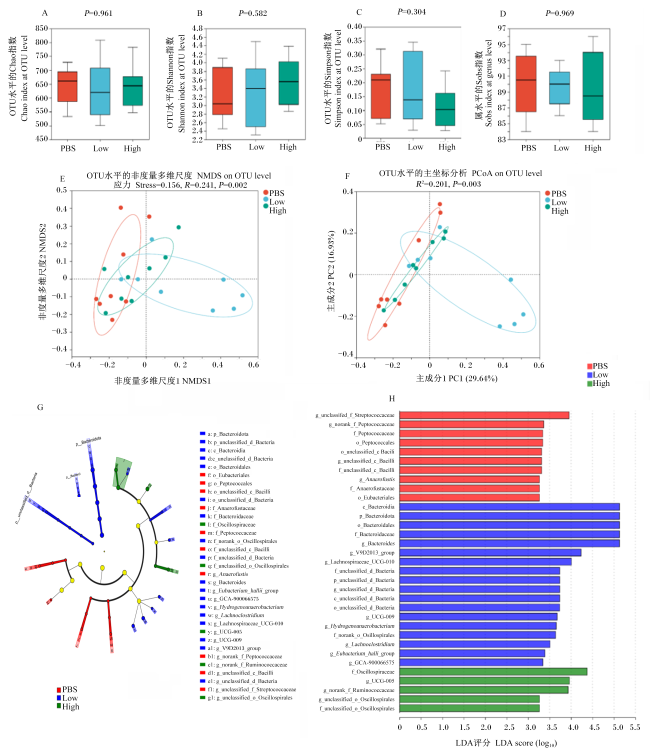
图2-A~D可知,胚蛋注射LR对黄羽肉鸡盲肠微生物α多样性指数中的Chao指数、Shannon指数、Simpson指数以及Sobs指数均无显著影响(P>0.05)。NMDS与PCoA聚类分析显示,盲肠微生物β多样性受到胚蛋注射LR的显著影响(P<0.05)。由图2-EF可知,相较对照组(红色),低剂量(蓝色)和高剂量(绿色)LR均显著改变了盲肠微生物群落组成。LEfSe多级物种差异判别分析(图2-GH)显示,对照组中差异微生物主要富集在链球菌科未分类属、消化球菌科未命名属、消化球菌科、消化球菌目、芽孢杆菌纲未分类目、芽孢杆菌纲未分类属、芽孢杆菌纲未分类科、厌氧棒形菌属、厌氧棒形菌科、真杆菌目中;低剂量LR组的差异微生物主要富集在拟杆菌纲、拟杆菌门、拟杆菌科、拟杆菌目、拟杆菌属、V9D2013群属、毛螺菌科UCG-010属、UCG-009属、氢厌氧杆菌属、颤螺杆菌目未命名科、蓝绿藻菌属、霍氏真杆菌属、GCA-900066575属中;高剂量LR组差异微生物主要富集在颤螺杆菌科、UCG-005属、瘤胃球菌科未命名属、颤螺菌目未分类属、颤螺菌目未分类科中。
图2 21日龄黄羽肉鸡盲肠微生物多样性与差异微生物分析

PBS:对照组 control group;Low:低剂量LR组 low-dose LR group;High:高剂量LR组 high-dose LR group。
图A~D:α多样性指数,包括OTU水平的Chao指数(图A)、Shannon指数(图B)、Simpson指数(图C)以及属水平的Sobs指数(图D)。图E和F:β多样性,包括基于微生物Bray-Curtis距离矩阵进行非度量多维尺度分析(图E)和主坐标分析(图F),并分别搭配ANOSIM和ADONIS组间差异性检验。图G和H:细菌不同分类水平的物种差异分析,包括LEfSe树状图(图G)和线性判别分析柱形图(图H)。树状图中不同颜色节点表示在对应组别中显著富集(P<0.05),淡黄色节点表示在不同分组中均无显著差异(P>0.05)。Figures A to D: α diversity indexes, including Chao index (figure A), Shannon index (figure B) and Simpson index (figure C) at OUT level and Sobs index at genus level (figure D). Figures E and F: β diversity, including non-metric multidimensional scaling analysis (figure E) and principal coordinate analysis (figure F) in according the microbial Bray_Curtis distance data, and ANOSIM and ADONIS analysis were used to test the difference between the two groups in figures E and F, respectively. Figures G and H: the analysis of species difference at different taxonomic levels of species, including tree diagram of LEfSe (figure G) and bar graph of LDA (figure H). The different color nodes in the tree diagram showed significant enrichment in the corresponding groups (P<0.05), while the light yellow nodes showed no significant difference in the different groups (P>0.05).
g_unclassified_f_Streptococcaceae:链球菌科未分类属;g_norank_f_Peptococcaceae:消化球菌科未命名属;f_Peptococcaceae:消化球菌科;o_Peptococcales:消化球菌目;o_unclassified_c_Bacilli:芽孢杆菌纲未分类目;g_unclassified_c_Bacilli:芽孢杆菌纲未分类属;f_unclassified_c_Bacilli:芽孢杆菌纲未分类科;g_Anaerofustis:厌氧棒形菌属;f_Anaerofustaceae:厌氧棒形菌科;o_Eubacteriales:真杆菌目;c_Bacteroidia:拟杆菌纲;p_Bacteroidota:拟杆菌门;o_Bacteroidales:拟杆菌目;f_Bacteroidaceae:拟杆菌科;g_Bacteroides:拟杆菌属;g_V9D2013_group:V9D2013群属;g_Lachnospiraceae_UCG-010:毛螺菌科UCG-010属;f_unclassified_d_Bacteria:细菌域未分类科;p_unclassified_d_Bacteria:细菌域未分类门;g_unclassified_d_Bacteria:细菌域未分类属;c_unclassified_d_Bacteria:细菌域未分类纲;o_unclassified_d_Bacteria:细菌域未分类目;g_UCG-009:UCG-009属;g_Hydrogenoanaerobacterium:氢厌氧杆菌属;g_norank_o_Oscillospirales:颤螺杆菌目未命名科;g_Lachnoclostridium:蓝绿藻菌属:g_Eubacterium_hallii_group:霍氏真杆菌属;g_GCA-900066575:GCA-900066575属;f_Oscillospiraceae:颤螺杆菌科;g_UCG-005:UCG-005属;g_norank_f_Rumiococcaceae:瘤胃球菌科未命名属;g_unclassified_o_Oscillospirales:颤螺菌目未分类属;f_unclassified_o_Oscillospirales:颤螺菌目未分类科。

Fig.2 Analysis of cecal microbial diversity and differential microbiota of yellow-feathered broilers at 21 days of age

2.6 胚蛋注射LR对黄羽肉鸡盲肠微生物组成的影响

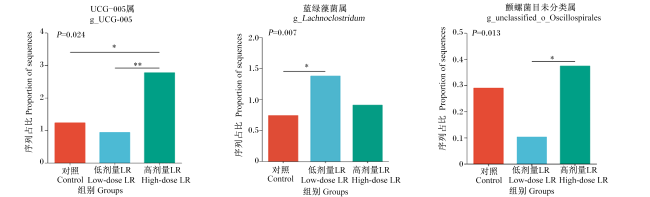
图3可知,21日龄黄羽肉鸡盲肠微生物中部分优势菌属(相对丰度>0.01%)受到胚蛋注射LR的显著影响(P<0.05)。与对照组相比,高剂量LR组UCG-005属相对丰度显著上升(P<0.05);与低剂量LR组相比,高剂量LR组UCG-005属相对丰度极显著上升(P<0.01)。与对照组相比,低剂量LR组蓝绿藻菌属相对丰度显著上升(P<0.05)。此外,相比低剂量LR组,高剂量LR组颤螺菌目未分类属相对丰度显著上升(P<0.05)。
图3 胚蛋注射鼠李糖乳杆菌对21日龄黄羽肉鸡盲肠微生物中部分优势菌属的影响

“*”表示差异显著(P<0.05),“**”表示差异极显著(P<0.01)。

Fig.3 Effects of in ovo injection of Lactobacillus rhamnosus on some dominant bacteria genera in cecal microbiota of yellow-feathered broilers at 21 days of age

“*” mean significant difference (P<0.05), and “**” mean extremely significant difference (P<0.01).

3 讨论

3.1 胚蛋注射LR对黄羽肉鸡早期生长性能的影响

本课题组前期发现,胚蛋注射106或108 CFU LR可帮助黄羽肉鸡抵御艾美耳球虫感染,增加后期肠道乳酸菌的定植量,然而106 CFU的注射剂量却导致仔鸡肠道炎症因子表达量升高、魏氏梭菌和大肠杆菌相对丰度升高[10]。本研究进一步探究LR最适胚蛋注射浓度,发现102或104 CFU LR均可以显著提高黄羽肉鸡1~21日龄的ADG,在一定程度上降低ADFI和F/G。这与胚蛋注射枯草芽孢杆菌[13]和双歧杆菌[14-15]的结果相似。
Shehata等[13]发现,胚蛋注射4×10⁵ CFU的枯草芽孢杆菌提高了白羽肉鸡的增重。El-Moneim等[14-15]发现,胚蛋注射107 CFU的双歧杆菌降低了科宝500白羽肉鸡的F/G。但Castañeda等[16]发现,胚蛋注射另外2种血清型芽孢枯草杆菌(ATCC 6051和8473)却并不能影响肉鸡1~21日龄的生长性能。这说明,胚蛋注射益生菌的促生长效果受到菌种类别、添加剂量、佐剂等具体因素的影响。此外,饲粮添加LR亦可提升肉鸡的日增重[5-6],但具体机制不一致。Liu等[5]和Fesseha等[6]均发现饲粮添加LR是通过增加肉鸡早期的采食量促进生长。而胚蛋注射LR可在鸡胚发育期间就开始促进肌肉发育。Muyyarikkandy等[4,17]指出,胚蛋注射NRRL B 442血清型LR可以增大鸡胚肌纤维横截面积和密度,且上调肌纤维生长因子生肌因子5(MYF5)、成肌分化因子(MYOD)、肌细胞生成素(MYOG)和生长因子胰岛素样生长因子-1(IGF-1)的表达量,从而提高肉仔鸡的初生重。本试验证明胚蛋注射LR可促进黄羽肉鸡早期增重,且一定程度减少饲料消耗量,但其促进肌肉发育的具体机理还需要进一步研究论证。

3.2 胚蛋注射LR对黄羽肉鸡早期肠道健康的影响

在未消耗更多饲料的基础上,胚蛋注射LR提高了黄羽肉鸡早期增重,这可能与LR改善其肠道结构的作用相关。本研究结果显示,尽管胚蛋注射LR未影响营养(氨基酸、葡萄糖、肽、脂肪酸)转运相关基因的表达量,也就是与营养吸收速率无关;然而,胚蛋注射LR增大了十二指肠、空肠、回肠的小肠绒毛高度,这可直接提高营养消化吸收的面积,提高了饲料利用率。此外,胚蛋注射LR的黄羽肉鸡小肠隐窝变浅、绒隐比升高,这意味着肠细胞更换速率上升,小肠吸收功能增强[18]
胚蛋注射益生菌对肠黏膜形态的改善在双歧杆菌[14-15]、枯草芽孢杆菌[13]、乳酸菌[9]、屎肠球菌[19]上也有报道。益生菌的细胞可以通过生成短链脂肪酸等次级代谢直接滋养肠细胞,或者通过和肠道共生菌互作而间接滋养肠细胞[1]。Ding等[20]报道,约翰逊氏乳杆菌和卷曲乳杆菌可以通过增强肠细胞增殖信号来促进肠绒毛生长。Xie等[21]从肉鸡黏膜Wnt/β-连环蛋白(β-catenin)信号通路上论证了罗伊特氏乳杆菌可以引发隐窝中多功能干细胞分化为杯状细胞。禽胚胎期肠细胞发育最为快速,隐窝中多功能干细胞分化潜力大[22]。此阶段的新生肠细胞可能对益生菌细胞的直接或间接刺激反应更为显著。本试验发现,在18.5胚龄通过羊膜腔注射LR,可能促进了黄羽肉鸡21日龄小肠绒毛的生长。

3.3 胚蛋注射LR对黄羽肉鸡早期血清生化指标的影响

血清生化指标提供了动物机体基本健康情况信息,受到多方面因素影响,如饮水量、健康水平、应激、饲粮类型、营养水平、性别、气候等[7]。一般而言,饲粮中持续添加益生菌有一定降低肉鸡血清中总胆固醇和甘油三酯的功能[7,23]。而本试验中,21日龄黄羽肉鸡血清胆固醇和甘油三酯含量不受胚蛋注射LR的影响,但血清中总蛋白、白蛋白、高密度脂蛋白胆固醇、低密度脂蛋白胆固醇含量随着LR注释剂量的增加有趋势升高。血清中总蛋白含量与动物机体营养水平、脂肪运送能力、免疫力等相关。胚蛋注射LR提高肉仔鸡增重同时,也提升了血清中总蛋白含量。

3.4 胚蛋注射LR对黄羽肉鸡早期盲肠微生物区系的影响

健康的禽肠道微生物在病原菌防御、免疫调节、肠道发育、饲料有效利用等方面有重要作用[24]。母鸡输卵管和泄殖腔中的微生物群可通过蛋清传递至鸡胚,形成鸡胚早期优势菌群[25]。鸡胚发育早期(3、12胚龄)微生物多样性单一、组成稳定,微生物多样性在19胚龄激增、分布组成发生显著变化[26]。新生雏鸡肠道微生物比胚胎期更加丰富,其中普拉梭菌属、布劳特氏菌属、粪球菌属等相对丰度显著上升,与卵黄中优势微生物群体重叠[27]。鸡胚在18~19胚龄发生“封门”——卵黄残余物将吸收入腹腔,悬系于空肠、回肠间,在7~10 d内缓慢吸收,最终形成卵黄遗迹。综上可知,鸡胚发育后期和雏鸡的肠道微生物组成和成熟多受到卵黄微生物群的影响。本试验在18.5胚龄通过羊膜腔注射LR,LR可调控胚胎、新生雏鸡的微生物群,从而促进黄羽肉鸡生长。
益生菌可以通过合成抑菌物质、竞争营养、竞争肠壁结合位点、调节pH等方式调节宿主内源微生物组成[28]。本研究显示,胚蛋注射LR并未改变21日龄黄羽肉鸡的肠道微生物多样性,却影响了微生物的具体分布和组成。肉鸡出孵后,可以通过饲料、饮水、设备、环境等接触更多菌种,从而使微生物多样性持续增加。以饲喂玉米-豆粕基础饲粮的科宝500白羽肉鸡为例,肠道微生物多样性于42日龄趋于稳定[29]。因此,黄羽肉鸡21日龄肠道微生物群可能仍处在发展中,其多样性未受到早期胚蛋注射益生菌的影响。然而,PCoA和NMDS聚类分析显示胚蛋注射LR的确影响了黄羽肉鸡肠道微生物群的分布和组成(β多样性)。雏鸡类似的微生物结构改变在胚蛋注射芽孢枯草杆菌试验中也有报道[13,17]。Gao等[29]发现,饲粮添加植物乳杆菌亦帮助白羽肉仔鸡形成稳定的肠道微生物群。为了同步孵化等措施,新生雏鸡可能在出壳后36~72 h才能接触饲料,造成健康菌群接种延迟,进而影响肌肉、免疫系统、肠道发育迟缓[30]。通过胚蛋注射益生菌等功能性添加剂可以实现微生物的早期编程(early-life programming),以帮助雏鸡在早期生长发育中避免菌群失调带来的代谢紊乱和炎症[31]
LEfSe分析进一步揭示了随着18.5胚龄LR供给剂量的升高,21日龄黄羽肉鸡肠道的优势菌群(相对丰度>0.01%)在发生变化。其中,胚蛋注射低剂量LR提高了蓝绿藻菌属相对丰度,高剂量LR提高了UCG-005属相对丰度。一直以来,蓝绿藻菌属和UCG-005属作为丁酸盐产生菌被视为有益菌群[31-32]。Cai等[31]发现,饲粮添加芽孢枯草杆菌可以通过提高肠道中蓝绿藻菌属的相对丰度促进肉鸡生长。在临床医学[33-34]和大鼠[35-36]试验中,益生菌可提高UCG-005属在肠道菌群占比已有报道。Yang等[32]发现,饲粮添加地衣芽孢杆菌和芽孢枯草杆菌混合益生菌可提高淮南麻黄鸡的生长速度,且肠道UCG-005属的相对丰度与体增重呈正相关。Wilson等[37]发现,胚蛋注射102 CFU的乳酸菌混合物(主要为唾液乳杆菌)将在10日龄时由未命名乳杆菌(10.36%)和罗伊氏乳杆菌(3.63%)替代了原鸡胚中优势菌唾液乳杆菌(由39.59%下降至0.09%),加速了菌群成熟。综上可知,胚蛋注射不同的益生菌对肉鸡早期肠道微生物组成均有不同程度的影响,而这种影响可以延续到肉鸡的生长期中。本试验中胚蛋注射102或104 CFU的LR均可以改善黄羽肉鸡21日龄的盲肠微生物群落结构,增加丁酸盐生成菌的占比。

4 结论

在孵化后期(18.5胚龄)时,胚蛋注射LR可以通过改善小肠绒毛形态、调节盲肠微生物组成和增加有益菌占比来提高黄羽肉鸡在早期生长阶段的增重,适宜注射剂量为102~104 CFU。
[1]
王茜, 黄霓裳, 李章云, 等. 益生菌在肉鸡生产和肠道健康的研究进展[J]. 西南民族大学学报(自然科学版), 2023, 49(1):10-17.

WANG Q, HUANG N C, LI Z Y, et al. Probiotics in broiler production and intestinal health:a review[J]. Journal of Southwest University for Nationalities (Natural Science Edition), 2023, 49(1):10-17. (in Chinese)

[2]
BOUZAINE T, DAUPHIN R D, THONART P, et al. Adherence and colonization properties of Lactobacillus rhamnosus TB1,a broiler chicken isolate[J]. Letters in Applied Microbiology, 2005, 40(5):391-396.

[3]
CHEN F, GAO S S, ZHU L Q, et al. Effects of dietary Lactobacillus rhamnosus CF supplementation on growth,meat quality,and microenvironment in specific pathogen-free chickens[J]. Poultry Science, 2018, 97(1):118-123.

[4]
MUYYARIKKANDY M S, MATHEW E, KUTTAPPAN D, et al. Research note:in ovo and in-feed probiotic supplementation improves layer embryo and pullet growth[J]. Poultry Science, 2023, 102(12):103092.

[5]
LIU F, KONG A A, FU P F, et al. Lactobacillus rhamnosus JYLR-005 prevents thiram-induced tibial dyschondroplasia by enhancing bone-related growth performance in chickens[J]. Probiotics and Antimicrobial Proteins, 2021, 13(1):19-31.

[6]
FESSEHA H, DEMLIE T, MATHEWOS M, et al. Effect of Lactobacillus species probiotics on growth performance of dual-purpose chicken[J]. Veterinary Medicin, 2021, 12:75-83.

[7]
EGLITE S, ILGAZA A, MANCEVICA L, et al. The effects of Lactobacillus farciminis and Lactobacillus rhamnosus on growth,blood biochemical,and meat quality indicators of specific pathogen-free broiler chickens[J]. Veterinary Medicine International, 2023, 6297068:9.

[8]
PEEBLES E D. In ovo applications in poultry:a review[J]. Poultry Science, 2018, 97(7):2322-2338.

[9]
PENDER C M, KIM S, POTTER T D, et al. In ovo supplementation of probiotics and its effects on performance and immune-related gene expression in broiler chicks[J]. Poultry Science, 2017, 96(5):1052-1062.

[10]
PENDER C M, KIM S, POTTER T D, et al. Effects of in ovo supplementation of probiotics on performance and immunocompetence of broiler chicks to an Eimeria challenge[J]. Beneficial Microbes, 2016, 7(5):699-705.

[11]
HUANG N, MA Y, CHAI J, et al. In ovo injection dosage of Lactobacillus rhamnosus on intestinal health and microbial composition of yellow broilers with or without Eimeria challenge[J]. Journal of Applied Poultry Research, 2024, 33(2):100411.

[12]
ZHANG L, WANG X, HUANG S, et al. Effects of dietary essential oil supplementation on growth performance,carcass yield,meat quality,and intestinal tight junctions of broilers with or without Eimeria challenge[J]. Poultry Science, 2023, 102(9):102874.

[13]
SHEHATA A M, PASWAN V K, ATTIA Y A, et al. In ovo inoculation of Bacillus subtilis and raffinose affects growth performance,cecal microbiota,volatile fatty acid,ileal morphology and gene expression,and sustainability of broiler chickens (Gallus gallus)[J]. Frontiers in Nutrition, 2022, 9:903847.

[14]
EL-MONEIM A M E A, ELBAZ A M, KHIDR R E S, et al. Effect of in ovo inoculation of Bifidobacterium spp. on growth performance,thyroid activity,ileum histomorphometry,and microbial enumeration of broilers[J]. Probiotics and Antimicrobial Proteins, 2020, 12(3):873-882.

[15]
EL-MONEIM A E M E A, EL-WARDANY I, ABU-TALEB A M, et al. Assessment of in ovo administration of Bifidobacterium bifidum and Bifidobacterium longum on performance,ileal histomorphometry,blood hematological,and biochemical parameters of broilers[J]. Probiotics and Antimicrobial Proteins, 2020, 12(2):439-450.

[16]
CASTAÑEDA C D, GAMBLE J N, WAMSLEY K G S, et al. In ovo administration of Bacillus subtilis serotypes effect hatchability,21-day performance,and intestinal microflora[J]. Poultry Science, 2021, 100(6):101125.

[17]
MUYYARIKKANDY M S, SCHLESINGER M, REN Y Y, et al. In ovo probiotic supplementation promotes muscle growth and development in broiler embryos[J]. Poultry Science, 2023, 102(7):102744.

[18]
WILSON F D, CUMMINGS T S, BARBOSA T M, et al. Comparison of two methods for determination of intestinal villus to crypt ratios and documentation of early age-associated ratio changes in broiler chickens[J]. Poultry Science, 2018, 97(5):1757-1761.

[19]
CASTAÑEDA C D, DITTOE D K, WAMSLEY K G S, et al. In ovo inoculation of an Enterococcus faecium-based product to enhance broiler hatchability,live performance,and intestinal morphology[J]. Poultry Science, 2020, 99(11):6163-6172.

[20]
DING C C, WU H X, CAO X Y, et al. Lactobacillus johnsonii 3-1 and Lactobacillus crispatus 7-4 promote the growth performance and ileum development and participate in lipid metabolism of broilers[J]. Food & Function, 2021, 12(24):12535-12549.

[21]
XIE S, ZHAO S Y, JIANG L, et al. Lactobacillus reuteri stimulates intestinal epithelial proliferation and induces differentiation into goblet cells in young chickens[J]. Journal of Agricultural and Food Chemistry, 2019, 67(49):13758-13766.

[22]
ZHAO D, FARNELL M B, KOGUT M H, et al. From crypts to enteroids:establishment and characterization of avian intestinal organoids[J]. Poultry Science, 2022, 101(3):101642.

[23]
GONG L, WANG B, MEI X, et al. Effects of three probiotic Bacillus on growth performance,digestive enzyme activities,antioxidative capacity,serum immunity,and biochemical parameters in broilers[J]. Journal of Animal Sciece, 2018, 89(11):1561-1571.

[24]
SHANG Y, KUMAR S, OAKLEY B, et al. Chicken gut microbiota:importance and detection technology[J]. Frontiers in Veterinary Science, 2018, 5:254.

[25]
LEE S, LA T M, LEE H J, et al. Characterization of microbial communities in the chicken oviduct and the origin of chicken embryo gut microbiota[J]. Scientific Reports, 2019, 9(1):6838.

DOI PMID

[26]
AKINYEMI F T, DING J M, ZHOU H, et al. Dynamic distribution of gut microbiota during embryonic development in chicken[J]. Poultry Science, 2020, 99(10):5079-5090.

DOI PMID

[27]
DING P, LIU H C, TONG Y Y, et al. Developmental change of yolk microbiota and its role on early colonization of intestinal microbiota in chicken embryo[J]. Animals, 2021, 12(1):16.

[28]
LIU X, MA Z H, WANG Y F, et al. Compound probiotics can improve intestinal health by affecting the gut microbiota of broilers[J]. Journal of Animal Science, 2023, 101:skad388.

[29]
GAO P F, MA C, SUN Z, et al. Feed-additive probiotics accelerate yet antibiotics delay intestinal microbiota maturation in broiler chicken[J]. Microbiome, 2017, 5(1):91.

DOI PMID

[30]
SHEHATA A M, PASWAN V K, ATTIA Y A, et al. Managing gut microbiota through in ovo nutrition influences early-life programming in broiler chickens[J]. Animals, 2021, 11(12):3491.

[31]
CAI Y L, XIAO C P, TIAN B, et al. Dietary probiotic based on a dual-strain B. subtilis improves immunity,intestinal health and growth performance of broiler chickens[J]. Journal of Animal Science, 2024, 102:skae183.

[32]
YANG J J, HUANG K H, WANG J, et al. Combined use of Bacillus subtilis yb-114,246 and Bacillus licheniformis yb-214,245 improves body growth performance of Chinese Huainan partridge shank chickens by enhancing intestinal digestive profiles[J]. Probiotics and Antimicrobial Proteins, 2021, 13(2):327-342.

[33]
KOMORNIAK N, KACZMARCZYK M, ŁONIEWSKI I, et al. Analysis of the efficacy of diet and short-term probiotic intervention on depressive symptoms in patients after bariatric surgery:a randomized double-blind placebo controlled pilot study[J]. Nutrients, 2023, 15(23):4905.

[34]
ZHU Y L, MA G N, REN W, et al. Effect of oral probiotics on clinical efficacy and intestinal flora in elderly severe pneumonia patients[J]. Medicine, 2023, 102(48):e36320.

[35]
LI S Y, HAN X B, LIU N Y, et al. Lactobacillus plantarum attenuates glucocorticoid-induced osteoporosis by altering the composition of rat gut microbiota and serum metabolic profile[J]. Frontiers in Immunology, 2023, 14:1285442.

[36]
GAO K, REN X L, CHEN C L, et al. Oral administration of Bifidobacterium longum WHH2270 ameliorates type 2 diabetes in rats[J]. Journal of Food Science, 2023, 88(9):3967-3983.

[37]
WILSON K M, RODRIGUES D R, BRIGGS W N, et al. Evaluation of the impact of in ovo administered bacteria on microbiome of chicks through 10 days of age[J]. Poultry Science, 2019, 98(11):5949-5960.

Outlines

/