RESEARCH PAPER

Effects of Fumaric Acid and Cinnamic Aldehyde and Their Combination on Growth Performance, Serum Biochemical and Antioxidant Indices and Intestinal Inflammatory Response of Weaned Piglets

  • LIU Yutong , 1 ,
  • YANG Guanhua 1 ,
  • WANG Luyao 1 ,
  • MA Xinyi 1 ,
  • QIAO Jiayun , 1, * ,
  • LI Haihua , 2, *
Expand
  • 1 Tianjin Key Laboratory of Conservation and Utilization of Animal Diversity, College of Life Sciences, Tianjin Normal University, Tianjin 300387, China
  • 2 Tianjin Key Laboratory of Agricultural Animal Breeding and Healthy Husbandry, College of Animal Science and Veterinary Medicine, Tianjin Agricultural University, Tianjin 300384, China
*QIAO Jiayun, professor, E-mail: ;
LI Haihua, associate professor, E-mail:

Received date: 2024-08-14

  Online published: 2025-03-13

Abstract

This experiment was conducted to investigate the effects of fumaric acid and cinnamic aldehyde and their combination on growth performance, serum biochemical and antioxidant indices and intestinal inflammatory response of weaned piglets. A total of 72 “Duroc×Landrace×Yorkshine” crossbred weaned piglets (half male and half female) of 28-day-old with an initial body weight of (7.79±0.48) kg were randomly divided into 4 groups with 6 replicates per group and 3 pigs per replicate, and raised in individual pens. Piglets in the control group (CON group) were fed a basal diet, and others in the experimental groups were fed the basal diet supplemented with 600 mg/kg fumaric acid (FA group), 400 mg/kg cinnamic aldehyde (CA group) and 600 mg/kg fumaric acid+400 mg/kg cinnamic aldehyde (combined supplemental group, FC group), respectively. The experiment lasted for 28 days. At 08:00 on the day after the experiment, 6 piglets in each group were injected with 200 μg/kg BW lipopolysaccharide (LPS) intraperitoneally. The results showed as follows: 1) compared with CON group, the final body weight, average daily gain (ADG) and average daily feed intake (ADFI) of weaned piglets in experimental groups were significantly increased (P<0.05), and the ratio of feed to gain (F/G) was significantly decreased (P<0.05). Meanwhile, the final body weight and ADG in FA and FC groups were significantly higher than those in CA group (P<0.05). 2) Compared with CON group, the serum malondialdehyde (MDA) content of weaned piglets in CA and FC groups was significantly decreased (P<0.05), and the serum catalase (CAT) activity was significantly increased (P<0.05). Meanwhile, the serum MDA content in FC group was significantly lower than that in FA and CA groups (P<0.05), and the serum CAT activity was significantly higher than that in FA and CA groups (P<0.05). 3) Compared with CON group, the serum contents of tumor necrosis factor-α (TNF-α) and interleukin-6 (IL-6) of weaned piglets in experimental groups were significantly decreased (P<0.05). Meanwhile, the serum TNF-α content in CA and FC groups was significantly lower than that in FA group (P<0.05). 4) Compared with CON+LPS group, the contents of TNF-α and IL-6 in jejunum of weaned piglets in experimental groups were significantly decreased (P<0.05), and the interleukin-10 (IL-10) content in jejunum was significantly increased (P<0.05); the transforming growth factor-β (TGF-β) content in jejunum in FA+LPS group was significantly increased (P<0.05). Meanwhile, the contents of TNF-α and IL-6 in jejunum in FC+LPS group were significantly lower than those in FA+LPS and CA+LPS groups (P<0.05). 5) Compared with CON+LPS group, the relative mRNA expression levels of Toll-like receptor 4 (TLR4), nuclear factor-κB (NF-κB), TNF-α and IL-6 in jejunum of weaned piglets in experimental groups were significantly decreased (P<0.05), and the mRNA relative expression levels of TGF-β and IL-10 in jejunum were significantly increased (P<0.05). In conclusion, dietary supplementation of fumaric acid and cinnamic aldehyde alone or in combination can improve the growth performance, antioxidant function and anti-inflammatory ability of weaned piglets, and the combined supplementation has a synergistic effect.

Cite this article

LIU Yutong , YANG Guanhua , WANG Luyao , MA Xinyi , QIAO Jiayun , LI Haihua . Effects of Fumaric Acid and Cinnamic Aldehyde and Their Combination on Growth Performance, Serum Biochemical and Antioxidant Indices and Intestinal Inflammatory Response of Weaned Piglets[J]. Chinese Journal of Animal Nutrition, 2025 , 37(3) : 1575 -1584 . DOI: 10.12418/CJAN2025.135

断奶是仔猪生长过程中的一个重要时间节点,断奶仔猪的免疫系统发育不完善,易受病原微生物的侵袭,导致机体肠道功能紊乱并引起腹泻,甚至死亡,严重影响仔猪的生长发育,给养殖业造成经济损失[1]。因此,在当前“禁抗”背景下,开发新型、绿色和高效的饲料添加剂提高仔猪生长性能和肠道健康已成为养殖业重要的研究方向[2]。近年来,有机酸和植物精油等绿色饲料添加剂已被证明可对畜禽发挥有益作用[3-4]
富马酸(fumaric acid,FA)和肉桂醛(cinnamic aldehyde,CA)是2种不同性质的饲料添加剂。富马酸学名为反丁烯二酸,是有机酸的主要代表,也是机体内三羧酸循环的重要中间产物,可在应激状态下紧急合成ATP,主要通过抗应激来发挥对动物的促生长效应,同时还可通过调节消化系统的酸碱平衡来辅助改善动物消化系统功能。肉桂醛是从肉桂等植物中所提取的一种丙烯醛衍生物,具有抑菌、抗炎、抗氧化及调节糖和脂代谢等多种生物学功能。肉桂醛在畜禽上的研究应用较多,被证明可激活抗氧化防御系统,显著缓解鼠伤寒沙门氏菌诱导的小鼠肝脏损伤,参与Toll样受体2(Toll-like receptor 2,TLR2)/Toll样受体4(Toll-like receptor 4,TLR4)-髓样分化因子88(myeloid differentiation factor 88,MyD88)信号通路的调节并降低促炎细胞因子和趋化因子的mRNA表达水平[5];肉桂醛还可提高育肥猪的生长性能、氧化稳定性、免疫功能和肉质[6]。研究表明,不同类型的植物精油和有机酸复配对改善动物健康具有协同增强效应,如肉桂醛与辛酸和月桂酸等有机酸联用均有积极的应用效果[7-8]。然而,肉桂醛与富马酸联用对断奶仔猪影响的报道尚不多见。因此,本试验探究了在正常饲养条件下富马酸和肉桂醛及其联合添加对断奶仔猪生长性能以及血清生化和抗氧化指标的影响;同时也探究了在脂多糖(lipopolysaccharide,LPS)攻毒条件下,富马酸和肉桂醛及其联合添加对断奶仔猪肠道炎症反应的影响及其可能的分子机制,以期为富马酸和肉桂醛在畜禽生产中的应用提供理论支撑。

1 材料与方法

1.1 试验材料

LPS来源于大肠杆菌O55:B5,购自Sigma公司。富马酸和肉桂醛均为市售产品,其中富马酸有效含量为99.5%,肉桂醛有效含量为80%以上。

1.2 试验设计

本试验于天津师范大学生命科学学院合作养殖基地进行,试验由天津师范大学伦理委员会批准,伦理批准编号为2024072402。试验选用健康状况良好、初始体重为(7.79±0.48) kg的28日龄“杜×长×大”杂交断奶仔猪72头(公母各占1/2),随机分为4组,每组6个重复,每个重复3头猪,单栏饲养。对照组(CON组)饲喂基础饲粮,试验组分别饲喂在基础饲粮的基础上添加600 mg/kg富马酸(富马酸组,FA组)、400 mg/kg肉桂醛(肉桂醛组,CA组)和600 mg/kg富马酸+400 mg/kg肉桂醛(联合添加组,FC组)的饲粮。试验期28 d。试验结束当天08:00,每组抽取6头仔猪腹腔内注射LPS(200 μg/kg BW),LPS剂量及浓度参考Li等[9]。基础饲粮按照NRC(2012)标准配制,其组成及营养水平见表1。饲粮粗蛋白质含量参照GB/T 6432—2018方法测定,总磷含量参照GB/T 6437—2018方法测定,钙含量参照GB/T 13885—2017方法测定,氨基酸含量参照GB/T 18246—2019方法测定,消化能参照NRC(2012)计算。
表1 基础饲粮组成及营养水平(风干基础)

Table 1 Composition and nutrient levels of the basal diet (air-dry basis) %

项目Items 含量Content
原料Ingredients
玉米Corn 63.20
豆粕Soybean meal 19.00
鱼粉Fish meal 4.80
乳清粉Whey powder 8.60
葡萄糖Glucose 1.00
酸化剂Acidifier 0.30
磷酸氢钙CaHPO4 0.60
石粉Limestone 0.70
食盐NaCl 0.30
L-赖氨酸盐酸盐L-Lys·HCl 0.30
DL-蛋氨酸DL-Met 0.10
L-色氨酸L-Try 0.10
预混料Premix1) 1.00
合计Total 100.00
营养水平Nutrient levels2)
消化能DE/(MJ/kg) 14.35
粗蛋白质CP 18.62
钙Ca 0.82
总磷TP 0.68
赖氨酸Lys 1.36
蛋氨酸Met 0.52
苏氨酸Thr 0.82
色氨酸Trp 0.23

1)预混料为每千克饲粮提供 The premix provided the following per kg of the diet:VA 12 500 IU,VD 1 250 IU,VE 125 IU,VB2 10 mg,VB12 90 μg,烟酸 niacin 35 mg,泛酸 pantothenate acid 48 mg,叶酸 folic acid 4.5 mg,生物素 biotin 0.25 mg,Fe 130 mg,Zn 180 mg,Cu 15 mg,Mn 30 mg,I 0.60 mg,Se 0.25 mg。

2)消化能为计算值,其余为实测值。DE was a calculated value, while the others were measured values.

1.3 饲养管理和样品采集

仔猪饲养在2.2 m×1.8 m的保育床上,地面为硬质塑料漏缝地板。所有猪只自由采食和饮水,猪舍温度控制在25~28 ℃。试验期间,每日观察仔猪的健康状况,其他饲养管理和免疫程序参考仔猪饲养商业推荐程序进行。
试验第28天,LPS攻毒4 h后,试验猪前腔静脉采血,采用真空促凝管收集血样,分装血清,-20 ℃保存待测。采血后肌肉注射戊巴比妥钠(50 mg/kg BW)处死仔猪,无菌条件下迅速打开腹腔,分离并采集5 cm空肠中段,采用磷酸缓冲液(PBS)冲洗后置于-80 ℃保存待测。

1.4 测定指标及方法

1.4.1 生长性能测定

分别于试验开始和结束当天08:00以重复为单位对试验猪进行空腹(禁食12 h)称重,计算平均日增重(ADG);试验期间每天记录每个重复试验猪的采食量,计算平均日采食量(ADFI),并根据断奶仔猪的ADFI和ADG计算料重比(F/G)。计算公式如下:
ADG=(末重-初重)/(试验天数×头数);
ADFI=总采食量/(试验天数×头数);
F/G=ADFI/ADG。

1.4.2 血清生化和抗氧化指标测定

血清生化指标谷草转氨酶(ALT)和谷丙转氨酶(AST)活性采用全自动生化分析仪测定;血清抗氧化指标过氧化氢酶(CAT)、超氧化物歧化酶(SOD)和谷胱甘肽过氧化物酶(GSH-Px)活性以及丙二醛(MDA)含量采用酶联免疫吸附测定(ELISA)试剂盒(南京建成生物工程研究所)测定,严格按照说明书操作。

1.4.3 血清和空肠炎症指标测定

血清和空肠中白细胞介素-6(IL-6)、白细胞介素-10(IL-10)、肿瘤坏死因子-α(TNF-α)、转化生长因子-β(TGF-β)含量采用ELISA试剂盒测定,所有操作均按照说明书进行。

1.4.4 空肠炎症相关基因表达测定

以磷酸甘油醛脱氢酶(GAPDH)为内参基因,采用实时荧光定量PCR(RT-qPCR)测定空肠中TLR4、核因子-κB(NF-κB)、TNF-αIL-6、TGF-βIL-10 mRNA相对表达量。相关引物设计、RNA提取及反转录、RT-qPCR反应条件以及相对定量2-△△Ct法的计算参照Qiao等[10]的方法。引物序列信息见表2
表2 引物序列信息

Table 2 Primer sequence information

基因名称
Gene names
引物序列
Primer sequences
(5'—3')
产物长度
Product
length/bp
退火温度
Annealing
temperature/℃
GenBank登录号
GenBank
accession number
Toll样受体4
TLR4
F:TTTCTTGCAGTGGGTCGAGG
R:GGAAGGTGAGAACTGACGCA
161 56 NM_001293316.1
核因子-κB
NF-κB
F:GGGGCGATGAGATCTTCCTG
R:CACGTCGGCTTGTGAAAAG
110 60 NM_001114281.1
肿瘤坏死因子-α
TNF-α
F:ACTCCTTCAGACCCCCTCAC
R:GCCACATTCCAGATGTCCCA
239 60 NM_214022.1
白细胞介素-6
IL-6
F:CTGCAGICACAGAACGAGTG
R:GACGGCATCAATCTCAGGTG
131 60 NC_010451.4
转化生长因子-β
TGF-β
F:AGGGCTACCATGCCAATTTCT
R:CGGGTTGTGCTGGTTGTACA
101 56 NM_214015.1
白细胞介素-10
IL-10
F:ACTCCTTCAGACCCCCTCAC
R:GCCACATTCCAGATGTCCCA
202 56 NM_214041.1
磷酸甘油醛脱氢酶
GAPDH
F:GCACAGTCAAGGCCGAGAAT
R:GCCTTCTCCATGGTGGTGAA
151 56 XM_036165840.1

1.5 数据统计分析

采用Excel 2013对试验数据进行初步处理,然后采用SPSS 21.0软件进行单因素方差分析(one-way ANOVA),并采用LSD法进行多重比较,同时采用GraphPad Prism 5软件进行图像处理及分析,试验结果以“平均值±标准差”形式表示,P<0.05表示差异显著。

2 结果

2.1 富马酸和肉桂醛及其联合添加对断奶仔猪生长性能的影响

表3可知,与CON组相比,各试验组断奶仔猪末重、ADG和ADFI均显著提高(P<0.05),F/G均显著降低(P<0.05);其中,FA组末重和ADG分别提高了10.99%和18.78%,CA组末重和ADG分别提高了7.61%和12.69%,FC组末重和ADG分别提高了11.38%和21.74%。此外,FA组和FC组断奶仔猪末重和ADG显著高于CA组(P<0.05),FC组ADFI显著高于FA组和CA组(P<0.05),FA组F/G显著低于CA组和FC组(P<0.05)。
表3 富马酸和肉桂醛及其联合添加对断奶仔猪生长性能的影响

Table 3 Effects of fumaric acid and cinnamic aldehyde and their combination on growth performance of weaned piglets

项目
Items
组别Groups P
P-value
CON FA CA FC
初重IBW/kg 7.82±0.45 7.75±0.36 7.77±0.39 7.80±0.42 0.848
末重FBW/kg 15.11±0.75c 16.77±0.62a 16.26±0.97b 16.83±0.85a 0.044
平均日增重ADG/g 267.53±12.62c 317.76±13.35a 301.48±13.52b 325.70±12.59a 0.031
平均日采食量ADFI/g 492.64±16.60c 559.23±15.61b 542.13±14.69b 584.13±14.44a 0.020
料重比F/G 1.84±0.02a 1.76±0.02c 1.79±0.03b 1.79±0.04b 0.014

同行数据肩标无字母或相同字母表示差异不显著(P>0.05),不同字母表示差异显著(P<0.05)。下表同。

In the same row, values with no letter or the same letter superscripts mean no significant difference (P>0.05), while with different letter superscripts mean significant difference (P<0.05). The same as below.

2.2 富马酸和肉桂醛及其联合添加对断奶仔猪血清生化和抗氧化指标的影响

表4可知,与CON组相比,各试验组断奶仔猪血清GSH-Px、SOD、AST和ALT活性均无显著差异(P>0.05);CA组和FC组血清MDA含量显著降低(P<0.05),血清CAT活性显著提高(P<0.05)。同时,FC组血清MDA含量显著低于FA组和CA组(P<0.05),血清CAT活性显著高于FA组和CA组(P<0.05)。
表4 富马酸和肉桂醛及其联合添加对断奶仔猪血清生化和抗氧化指标的影响

Table 4 Effects of fumaric acid and cinnamic aldehyde and their combination on serum biochemical and antioxidant indices of weaned piglets

项目
Items
组别Groups P
P-value
CON FA CA FC
丙二醛MDA/(nmol/mL) 4.04±1.42a 4.08±1.02a 3.28±0.94b 2.83±0.89c 0.042
谷胱甘肽过氧化物酶
GSH-Px/(U/mL)
615.42±70.15 623.38±63.36 639.52±68.33 633.65±65.50 0.075
超氧化物歧化酶SOD/(U/mL) 53.38±3.54 53.18±3.22 54.03±3.46 55.31±3.18 0.281
过氧化氢酶CAT/(U/mL) 81.91±5.17c 82.77±5.68c 90.19±5.40b 94.43±6.32a 0.039
谷丙转氨酶ALT/(U/L) 60.21±3.76 59.44±3.94 55.67±3.79 56.79±3.47 0.254
谷草转氨酶AST/(U/L) 70.69±4.42 70.60±4.41 67.82±4.94 66.56±4.46 0.175

2.3 富马酸和肉桂醛及其联合添加对断奶仔猪血清炎症指标的影响

表5可知,与CON组相比,各试验组断奶仔猪血清TNF-α和IL-6含量均显著降低(P<0.05)。此外,CA组和FC组血清TNF-α含量显著低于FA组(P<0.05)。
表5 富马酸和肉桂醛及其联合添加对断奶仔猪血清炎症指标的影响

Table 5 Effects of fumaric acid and cinnamic aldehyde and their combination on serum inflammatory indices of weaned piglets

项目
Items
组别Groups P
P-value
CON FA CA FC
肿瘤坏死因子-α TNF-α/(pg/mL) 41.20±3.42a 35.65±3.20b 31.15±3.04c 31.82±2.97c 0.034
转化生长因子-β TGF-β/(pg/mL) 57.79±4.05 59.85±4.34 59.45±4.01 58.92±3.85 0.225
白细胞介素-6 IL-6/(ng/L) 90.16±7.37a 82.18±6.80b 80.50±6.95b 79.06±6.18b 0.019
白细胞介素-10 IL-10/(ng/L) 6.09±1.03 6.15±1.06 6.10±1.33 6.13±1.57 0.442

2.4 富马酸和肉桂醛及其联合添加对LPS诱导断奶仔猪空肠炎症指标的影响

表6可知,与CON+LPS组相比,各试验组断奶仔猪空肠TNF-α和IL-6含量均显著降低(P<0.05),空肠IL-10含量均显著提高(P<0.05);FA+LPS组空肠TGF-β含量显著提高(P<0.05)。此外,FC+LPS组空肠TNF-α和IL-6含量显著低于FA+LPS组和CA+LPS组(P<0.05),FA+LPS组空肠TGF-β含量显著高于CA+LPS组和FC+LPS组(P<0.05)。
表6 富马酸和肉桂醛及其联合添加对LPS诱导断奶仔猪空肠炎症指标的影响

Table 6 Effects of fumaric acid and cinnamic aldehyde and their combination on jejunal inflammatory indices of weaned piglets induced by LPS

项目
Items
组别Groups P
P-value
CON+LPS FA+LPS CA+LPS FC+LPS
肿瘤坏死因子-α TNF-α/(pg/mL) 58.66±3.75a 51.42±3.88b 53.11±4.01b 48.70±3.09c 0.030
转化生长因子-β TGF-β/(pg/mL) 61.54±4.42b 66.25±4.69a 61.79±4.15b 62.42±4.63b 0.048
白细胞介素-6 IL-6/(ng/L) 106.46±9.45a 96.55±8.01b 98.46±8.19b 90.46±8.13c 0.027
白细胞介素-10 IL-10/(ng/L) 7.10±1.12b 7.84±1.38a 7.97±1.30a 8.01±1.34a 0.043

2.5 富马酸和肉桂醛及其联合添加对LPS诱导断奶仔猪空肠炎症相关基因表达的影响
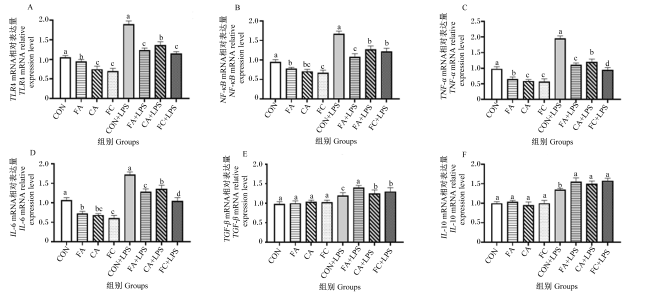
图1所示,与CON组相比,FA组、CA组和FC组断奶仔猪空肠TLR4、NF-κBTNF-αIL-6 mRNA相对表达量显著降低(P<0.05);其中,CA组和FC组空肠TLR4和TNF-α mRNA相对表达量显著低于FA组(P<0.05),FC组空肠NF-κB mRNA相对表达量显著低于FA组(P<0.05)。与CON组相比,CON+LPS组断奶仔猪空肠TLR4、NF-κBTNF-αIL-6、TGF-βIL-10 mRNA相对表达量明显提高。与CON+LPS组相比,FA+LPS组、CA+LPS组和FC+LPS组断奶仔猪空肠TLR4、NF-κBTNF-αIL-6 mRNA相对表达量均显著降低(P<0.05),空肠TGF-βIL-10 mRNA相对表达量均显著提高(P<0.05);其中,FA+LPS组空肠TLR4、NF-κBTNF-αIL-6 mRNA相对表达量显著低于CA+LPS组(P<0.05),空肠TGF-β mRNA相对表达量显著高于CA+LPS组和FC+LPS组(P<0.05)。
图1 富马酸和肉桂醛及其联合添加对LPS诱导断奶仔猪空肠炎症相关基因表达的影响

LPS攻毒和未攻毒组之间,数据柱标注不同字母表示差异显著(P<0.05)。

Fig.1 Effects of fumaric acid and cinnamic aldehyde and their combination on expression of genes related to inflammation in jejunum of weaned piglets induced by LPS

Among LPS challenged groups and unchallenged groups, value columns with different letters mean significant difference (P<0.05).

3 讨论

3.1 富马酸和肉桂醛及其联合添加对断奶仔猪生长性能的影响

断奶仔猪胃酸分泌不足,胃蛋白酶活性低,容易导致蛋白质消化率降低,生长性能下降。有机酸和植物精油由于理化性质及作用机理的不同,二者复配使用可能对提高动物生长性能有协同增效的作用。富马酸作为一种有机酸,可调节仔猪胃肠道pH,促进益生菌生长,并提高饲粮适口性。近年来,富马酸在畜禽上的应用研究较少,仅有少量研究证明其在抗应激方面具有良好的效果,且常与亚铁离子等金属离子组成有机化合物应用于仔猪,可提高仔猪生长性能,并预防仔猪发生贫血[11-12]。本研究结果表明,富马酸可显著提高断奶仔猪末重、ADG和ADFI,显著降低F/G,可能是由于富马酸可提高饲粮的适口性,同时可降低仔猪胃肠道内pH,从而激活胃蛋白酶原,刺激胃蛋白酶的分泌,提高断奶仔猪对蛋白质的消化率。肉桂醛是从肉桂中提取的一种植物精油,广泛存在于自然界中,对大肠杆菌、金黄色葡萄球菌等食源性致病菌具有良好的抑制作用[13]。研究表明,植物精油有助于维护仔猪肠道健康,提高仔猪生长性能和饲料转化率,并减少肠道疾病的发生,并且不会在肉品中残留,是一种非常安全的饲料添加剂[14]。Saied等[15]研究表明,饲粮添加肉桂醛可显著提高肉鸡末重、ADG和ADFI,并显著降低F/G。本研究结果显示,肉桂醛也可显著提高断奶仔猪末重、ADG和ADFI。此外,有研究报道,肉桂醛和柠檬酸联用可破坏病原菌的细胞结构,协同改善断奶仔猪生长性能,并调节仔猪肠道菌群结构[16]。本研究结果显示,饲粮添加富马酸和肉桂醛或其联合添加对断奶仔猪生长性能均有积极作用,且富马酸单独添加或与肉桂醛联合添加对断奶仔猪生长性能的提高效果优于肉桂醛单独添加,这表明富马酸与肉桂醛联用可对仔猪的生长性能起到协同增效的作用。

3.2 富马酸和肉桂醛及其联合添加对断奶仔猪血清生化和抗氧化指标的影响

体内氧化与抗氧化作用失衡会导致断奶仔猪发生氧化应激,氧化应激会导致细胞内脂质、蛋白质和DNA等生物分子受损,从而导致细胞功能紊乱,甚至引发疾病的发生[17]。机体的抗氧化酶系统包括SOD、CAT和GSH-Px等,是动物机体抵御氧化应激的第一道防线,可消除超氧化物和羟基自由基。SOD主要通过催化超氧阴离子自由基发生歧化反应,生成过氧化氢和氧气,从而清除体内的超氧阴离子自由基,保护细胞免受氧化应激的损害[18];GSH-Px是一种在机体内广泛存在的重要过氧化物分解酶,能够催化谷胱甘肽(GSH)变为氧化型谷胱甘肽(GSSG),使有毒的过氧化物还原成无毒的羟基化合物,同时促进过氧化氢的分解[19];CAT可将过氧化氢分解为无害的水和氧气,从而保护细胞免受过氧化氢的损害。MDA是脂质过氧化的最终产物,其含量可以反映机体脂质过氧化的程度,从而间接评估氧化应激水平,在氧化应激状态下,脂质过氧化反应会加剧,导致MDA含量升高[20]。SOD、GSH-Px、CAT和MDA常被用于评估组织或细胞中的氧化应激水平。本研究结果显示,FA组断奶仔猪血清GSH-Px、SOD、CAT活性及MDA含量与CON组相比均无显著差异;与CON组相比,CA组和FC组血清MDA含量显著降低,血清CAT活性显著提高,表明饲粮单独添加肉桂醛或与富马酸联合添加可提高断奶仔猪抗氧化能力。AST和ALT是重要的转氨酶,对蛋白质代谢有重要作用,存在于肝脏组织,当肝脏受到应激受损时,大量ALT和AST因细胞膜通透性增大而进入血清,其活性变化可直接反映动物肝脏的健康状况[21]。研究表明,肉桂醛可使健康育肥猪血清AST活性降低19.43%[22]。然而,本研究结果显示,单独添加富马酸和肉桂醛或两者联合添加对断奶仔猪血清ALT和AST活性均无显著影响,可能是由于本次试验中的断奶仔猪肝脏均处于健康状态,没有受到损伤或疾病影响,ALT和AST活性保持在正常范围内。

3.3 富马酸和肉桂醛及其联合添加对断奶仔猪血清炎症指标和空肠炎症反应的影响

天然免疫是机体防御病原体侵害的第一道防线,天然免疫系统中的模式识别受体(pattern recognition receptors,PRRs)能够识别外源病原体的病原体相关分子模式(pathogen-associated molecular patterns,PAMPs),启动免疫应答发挥免疫防御作用。LPS是革兰氏阴性细菌壁中的一种特有成分,由脂质和多糖构成,是PAMPs的一个重要组成部分。Toll样受体(Toll-like receptor,TLR)在天然免疫系统的激活中发挥着重要作用,是PRRs的一类,在TLR家族中,TLR4是介导LPS应答的主要受体[23]。当TLR4与LPS结合后,会触发细胞内信号转导通路如NF-κB信号通路的激活,使核因子-κB抑制蛋白(IκB,如IκBα)磷酸化和降解,从而使NF-κB从细胞质转位到细胞核,诱导促炎细胞因子[如TNF-α、白细胞介素-8(IL-8)和IL-6]的过量表达和释放,最终造成动物机体组织器官损伤[24]。近年来,多项研究表明,富马酸和肉桂醛具有良好的抑菌效果,可通过抑制炎症因子的产生、改善动物肠道健康等多种机制发挥抗炎作用。研究报道,富马酸不仅可以穿过微生物细胞膜,阻止DNA的合成,还可以阻断DNA回缩酶和拓扑异构酶Ⅳ的活性来阻止DNA复制;作为三羧酸循环有氧过程的重要组分,富马酸能调节机体内酶活性和参与能量代谢等一系列生化反应,当富马酸与病原菌核糖体相结合时,能够抑制病原菌蛋白质的合成,特别是通过抑制核糖体50S亚单位的形成,阻碍细菌蛋白质的生物合成,起到抑菌效果[25]。研究报道,肉桂醛可以抑制炎症因子的产生,如通过抑制核因子NF-κB的激活来降低一氧化氮的生成,进而减少炎症反应,调节p38丝裂原活化蛋白激酶和细胞周期蛋白B1这2种信号蛋白,破坏细胞周期G2/M期中磷酸化/去磷酸化作用,阻碍细胞周期G2/M期的进程,从而抑制炎症反应[26-27]。此外,有研究表明,肉桂醛能明显减少肿瘤的形成,延长患瘤小鼠的存活期[28]。在动物生产中,肉桂醛能够促进营养物质消化吸收、改善肠道健康,这可能与其抗炎作用相关,有助于维护肠道微生态平衡。研究表明,饲粮添加苯甲酸和精油可提高断奶仔猪肠道对LPS刺激的抵抗力[29],精油与有机酸联合应用可改善产肠毒素大肠杆菌F4(K88+)攻击断奶仔猪的肠道屏障功能、炎症反应和微生物区系,且联合使用有机酸和精油比单独补充更有效[30]。然而,富马酸和肉桂醛及其联合添加是否参与调节断奶仔猪肠道炎症反应仍未见报道。
本试验发现,与CON组相比,各试验组断奶仔猪血清TNF-α和IL-6含量显著降低;与CON+LPS组相比,FA+LPS组、CA+LPS组和FC+LPS组断奶仔猪血清TNF-α和IL-6含量显著降低。同时,与CON组相比,各试验组断奶仔猪回肠TLR4、NF-κBTNF-αIL-6 mRNA相对表达量显著降低;其中,CA组和FC组空肠TLR4和TNF-α mRNA相对表达量显著低于FA组,FC组空肠NF-κB mRNA相对表达量显著低于FA组。与CON+LPS组相比,FA+LPS组、CA+LPS组和FC+LPS组断奶仔猪空肠TLR4、NF-κBTNF-αIL-6 mRNA相对表达量均显著降低,空肠TGF-βIL-10 mRNA相对表达量均显著提高;其中,FA+LPS组空肠TLR4、NF-κBTNF-αIL-6 mRNA相对表达量显著低于CA+LPS组,空肠TGF-β mRNA相对表达量显著高于CA+LPS组和FC+LPS组。结果表明,饲粮添加富马酸和肉桂醛及二者联合添加可增强仔猪抗炎能力,并对LPS诱导的肠道炎症具有一定的缓解作用。

4 结论

① 富马酸和肉桂醛单独或联合添加对断奶仔猪生长性能、抗氧化功能和抗炎能力有积极影响,且与单独添加富马酸或肉桂醛相比,二者联合添加具有协同增效作用。
② 富马酸和肉桂醛可能是通过抑制TLR4/NF-κB信号通路来缓解LPS对断奶仔猪造成的炎性损伤。
[1]
TANG X P, XIONG K N, FANG R J, et al. Weaning stress and intestinal health of piglets:a review[J]. Frontiers in Immunology, 2022, 13:1042778.

[2]
RAFIQ K, TOFAZZAL HOSSAIN M, AHMED R, et al. Role of different growth enhancers as alternative to in-feed antibiotics in poultry industry[J]. Frontiers in Veterinary Science, 2021, 8:794588.

[3]
CAI L, ZHAO Y, CHEN W N, et al. Effect of an organic acid blend as an antibiotic alternative on growth performance,antioxidant capacity,intestinal barrier function,and fecal microbiota in weaned piglets[J]. Journal of Animal Science, 2024, 102:skae149.

[4]
WANG J, DENG L F, CHEN M X, et al. Phytogenic feed additives as natural antibiotic alternatives in animal health and production:a review of the literature of the last decade[J]. Animal Nutrition, 2024, 17:244-264.

[5]
WANG R J, LI S L, JIA H, et al. Protective effects of cinnamaldehyde on the inflammatory response,oxidative stress,and apoptosis in liver of Salmonella typhimurium-challenged mice[J]. Molecules, 2021, 26(8):2309.

[6]
LUO Q, LI N, ZHENG Z, et al. Dietary cinnamaldehyde supplementation improves the growth performance,oxidative stability,immune function,and meat quality in finishing pigs[J]. Livestock Science, 2020, 240:104221.

[7]
LYTE J M, ARSI K, CAPUTI V, et al. Inclusion of trans-cinnamaldehyde and caprylic acid in feed results in detectable concentrations in the chicken gut and reduces foodborne pathogen carriage[J]. Poultry Science, 2024, 103(2):103368.

[8]
LI L L, ZHU Y, ZHANG S S, et al. Effects of a mixture of glycerol monolaurate and cinnamaldehyde supplementation on laying performance,egg quality,and antioxidant status in laying hens[J]. Journal of the Science of Food and Agriculture, 2024, 104(4):2015-2022.

[9]
LI H H, LI Y P, ZHU Q, et al. Dietary supplementation with Clostridium butyricum helps to improve the intestinal barrier function of weaned piglets challenged with enterotoxigenic Escherichia coli K88[J]. Journal of Applied Microbiology, 2018, 125(4):964-975.

DOI PMID

[10]
QIAO J Y, SUN Z Y, LIANG D M, et al. Lactobacillus salivarius alleviates inflammation via NF-κB signaling in ETEC K88-induced IPEC-J2 cells[J]. Journal of Animal Science and Biotechnology, 2020, 11(1):76.

[11]
孙诗昂, 李冰, 邓亚飞, 等. 延胡索酸对循环热应激肉鸡生长性能、抗氧化功能和免疫功能的影响[J]. 动物营养学报, 2022, 34(7):4322-4330.

DOI

SUN S A, LI B, DENG Y F, et al. Effects of fumaric acid on growth performance,antioxidant function and immune function of broilers under cyclic heat stress[J]. Chinese Journal of Animal Nutrition, 2022, 34(7):4322-4330. (in Chinese)

[12]
CABALLERO VALCÁRCEL A M, MARTÍNEZ GRACIÁ C, MARTÍNEZ MIRÓ S, et al. Iron bioavailability of four iron sources used to fortify infant cereals,using anemic weaning pigs as a model[J]. European Journal of Nutrition, 2019, 58(5):1911-1922.

[13]
HE T F, WANG L H, NIU D B, et al. Cinnamaldehyde inhibit Escherichia coli associated with membrane disruption and oxidative damage[J]. Archives of Microbiology, 2019, 201(4):451-458.

[14]
HERNÁNDEZ-GARCÍA P A, ORZUNA-ORZUNA J F, GODINA-RODRÍGUEZ J E, et al. A Meta-analysis of essential oils as a dietary additive for weaned piglets:growth performance,antioxidant status,immune response,and intestinal morphology[J]. Research in Veterinary Science, 2024, 170:105181.

[15]
SAIED A M, ATTIA A I, EL-KHOLY M, et al. Effect of cinnamon oil supplementation into broiler chicken diets on growth,carcass traits,haemato-biochemical parameters,immune function,antioxidant status and caecal microbial count[J]. Journal of Animal and Feed Sciences, 2022, 31(1):21-33.

[16]
YANG C M, ZHANG L L, CAO G T, et al. Effects of dietary supplementation with essential oils and organic acids on the growth performance,immune system,fecal volatile fatty acids,and microflora community in weaned piglets[J]. Journal of Animal Science, 2019, 97(1):133-143.

[17]
NOVAIS A K, DESCHÊNE K, MARTEL-KENNES Y, et al. Weaning differentially affects mitochondrial function,oxidative stress,inflammation and apoptosis in normal and low birth weight piglets[J]. PLoS One, 2021, 16(2):e0247188.

[18]
NGUYEN N H, TRAN G B, NGUYEN C T. Anti-oxidative effects of superoxide dismutase 3 on inflammatory diseases[J]. Journal of Molecular Medicine (Berlin,Germany), 2020, 98(1):59-69.

[19]
DI GIACOMO C, MALFA G A, TOMASELLO B, et al. Natural compounds and glutathione: beyond mere antioxidants[J]. Antioxidants (Basel, Switzerland), 2023, 12(7):1445.

[20]
DE FREITAS CARVALHO M M, LAGE N N, DE SOUZA PAULINO A H, et al. Effects of açai on oxidative stress,ER stress,and inflammation-related parameters in mice with high fat diet-fed induced NAFLD[J]. Scientific Reports, 2019, 9(1):8107.

[21]
苑景达, 额日格力图, 任晓琪, 等. 冷应激对动物血清生化指标、抗氧化能力及免疫功能影响的研究进展[J]. 动物营养学报, 2023, 35(11):6967-6975.

YUAN J D, E R G L T, REN X Q, et al. Research progress on effects of cold stress on serum biochemical indexes,antioxidant capacity and immune function of animals[J]. Chinese Journal of Animal Nutrition, 2023, 35(11):6967-6975. (in Chinese)

[22]
吴东, 杨家军, 周学利, 等. 肉桂醛替代饲用抗生素对肥育猪生长性能、血清免疫指标及肠道菌群的影响[J]. 养猪, 2020(3):53-56.

WU D, YANG J J, ZHOU X L, et al. Effect of feed antibiotics replaced by cinnamaldehyde on growth performance,serum immune index and intestinal flora of finishing pig[J]. Swine Production, 2020(3):53-56. (in Chinese)

[23]
STIERSCHNEIDER A, WIESNER C. Shedding light on the molecular and regulatory mechanisms of TLR4 signaling in endothelial cells under physiological and inflamed conditions[J]. Frontiers in Immunology, 2023, 14:1264889.

[24]
MULERO M C, HUXFORD T, GHOSH G. NF-κB,IκB,and IKK:integral components of immune system signaling[J]. Advances in Experimental Medicine and Biology, 2019, 1172:226.

[25]
DAS R K, BRAR S K, VERMA M. Recent advances in the biomedical applications of fumaric acid and its ester derivatives:the multifaceted alternative therapeutics[J]. Pharmacological Reports, 2016, 68(2):404-414.

[26]
ZHANG L Q, ZHANG Z G, FU Y, et al. Trans-cinnamaldehyde improves memory impairment by blocking microglial activation through the destabilization of iNOS mRNA in mice challenged with lipopolysaccharide[J]. Neuropharmacology, 2016, 110(Pt A):503-518.

[27]
HWANG H, JEON H, OCK J, et al. 2’-hydroxycinnamaldehyde targets low-density lipoprotein receptor-related protein-1 to inhibit lipopolysaccharide-induced microglial activation[J]. Journal of Neuroimmunology, 2011, 230(1/2):52-64.

[28]
BAE W Y, CHOI J S, KIM J E, et al. Cinnamic aldehyde suppresses hypoxia-induced angiogenesis via inhibition of hypoxia-inducible factor-1α expression during tumor progression[J]. Biochemical Pharmacology, 2015, 98(1):41-50.

[29]
CUI C, WEI Y L, WANG Y B, et al. Dietary supplementation of benzoic acid and essential oils combination enhances intestinal resilience against LPS stimulation in weaned piglets[J]. Journal of Animal Science and Biotechnology, 2024, 15(1):4.

DOI PMID

[30]
JIMÉNEZ M J, BERRIOS R, STELZHAMMER S, et al. Ingestion of organic acids and cinnamaldehyde improves tissue homeostasis of piglets exposed to enterotoxic Escherichia coli (ETEC)[J]. Journal of Animal Science, 2020, 98(2):skaa012.

Outlines

/