RESEARCH PAPER

Effects of Dietary Crude Protein Level and Heat-Inactivated Lactic Acid Bacteria on Growth Performance, Nutrient Apparent Total Tract Digestibility, Antioxidant Ability, Immune Function and Fecal Microbial Composition of Weaned Piglets

  • ZHANG Ge , 1 ,
  • ZHANG Zeyu 1 ,
  • ZHAO Jinbiao 1 ,
  • LIU Ling , 1, 2, *
Expand
  • 1 State Key Laboratory of Animal Nutrition and Feeing, College of Animal Science and Technology, China Agricultural University, Beijing 100193, China
  • 2 China Agricultural Zhiyuan Management Consulting Co., Ltd., Beijing 100193, China
*senior engineer, E-mail:

Received date: 2024-09-10

  Online published: 2025-03-13

Abstract

This experiment was conducted to study the effects of dietary crude protein (CP) level and heat-inactivated lactic acid bacteria (HLAB) on growth performance, nutrient apparent total tract digestibility (ATTD), antioxidant ability, immune function and fecal microbial composition of weaned piglets. A total of 192 weaned piglets (Duroc×Landrace×Large White) with an initial body weight of (8.62±0.18) kg were randomly divided into 4 groups according to a 2×2 two-factor experimental design, each group included 6 replicates with 8 pigs per replicate. Pigs in 4 groups were fed high protein diet, high protein diet+HLAB, low protein diet, and low protein diet+HLAB, respectively. The experiment lasted for 30 days, including the early phase (1 to 15 days) and the late phase (16 to 30 days). The results showed that dietary CP level and HLAB had no significant interaction on growth performance, diarrhea rate, nutrient ATTD and serum antioxidant, immune and hormone indices of weaned piglets (P>0.05). The dietary high CP level significantly increased the average daily weight gain (ADG) in the early phase, ATTD of neutral detergent fiber (NDF) and serum malondialdehyde (MDA) content of weaned piglets (P<0.05), significantly decreased the ATTD of ether extract (EE) and activities of superoxide dismutase (SOD) and glutathione peroxidase (GSH-Px) in serum (P<0.05). Dietary HLAB significantly increased the ADG in the early phase and ATTD of gross energy (GE), organic matter (OM), CP and EE of weaned piglets (P<0.05), meanwhile, significantly increased the activities of SOD, GSH-Px and catalase (CAT) and contents of, insulin-like growth factor-1 (IGF-1) and insulin (INS) in serum (P<0.05), and significantly decreased the contents of MDA, interleukin-1β (IL-1β), interleukin-6 (IL-6), tumor necrosis factor-α (TNF-α) in serum and fecal microbial Ace and Chao indices (P<0.05). In summary, although the high CP level diet can improve the growth performance of weaned piglets, it reduced the body antioxidant ability. Dietary HLAB can improve the growth performance, nutrient ATTD, antioxidant and anti-inflammatory capacities of weaned piglets, and change the fecal microbial composition, thus alleviating the adverse effects of low CP level diets on weaned piglets.

Cite this article

ZHANG Ge , ZHANG Zeyu , ZHAO Jinbiao , LIU Ling . Effects of Dietary Crude Protein Level and Heat-Inactivated Lactic Acid Bacteria on Growth Performance, Nutrient Apparent Total Tract Digestibility, Antioxidant Ability, Immune Function and Fecal Microbial Composition of Weaned Piglets[J]. Chinese Journal of Animal Nutrition, 2025 , 37(3) : 1585 -1596 . DOI: 10.12418/CJAN2025.136

在减抗、替抗政策之下,蛋白质原料资源短缺问题也日益凸显。过去20年,中国的饲料粮需求不断增长,仅大豆的进口量的年均增长约10.2%,从1 300多万t增长到近10 000万t[1]。低蛋白质饲粮是在保证动物生产性能的前提下,根据畜禽实际需求和能量/蛋白质以及氨基酸平衡的理论,通过添加单体氨基酸达到降低饲粮粗蛋白质(crude protein,CP)水平的技术,这是现代动物营养学发展的必然结果[2]。断奶仔猪处于过渡期和快速生长期,蛋白质是其长期不可缺少的营养物质,并且仔猪对饲粮CP水平非常敏感[3]。有研究表明,较低的饲粮CP水平降低了小肠绒毛高度和隐窝深度,从而降低了仔猪的生长性能[4];而饲粮CP水平过高会导致大量未消化和利用的蛋白质进入肠道并发酵变质,破坏肠道菌群平衡,导致腹泻[5]
益生菌(probiotics)是一种活的微生物制剂,适当剂量下,可以通过占据肠道黏膜的结合位点或与致病菌竞争营养和生态位,对宿主的肠道健康和免疫力产生积极影响[6]。乳酸菌作为断奶仔猪肠道中的一种有益菌,能有效抑制沙门氏菌和大肠杆菌等病原菌[7]。其他常见的益生菌还包括屎肠球菌[8]、酵母菌[9]、芽孢杆菌(包括枯草芽孢杆菌、地衣芽孢杆菌和凝结芽孢杆菌等)[10-11]和肠杆菌等。除单一菌株,也有研究探讨了多复合型益生菌的效果[12]。益生菌通对肠道微生物菌群产生积极作用,可以通过测定肠道微生物多样性和丰富度来确定[13]。后生元(postbiotics)是非活性微生物或其成分的制剂,包括全部或部分灭活的细菌及其代谢副产物[6]。Ali等[14]认为,后生元比益生菌具有更多优势,如更容易通过肠道黏膜层,造成感染的风险更低,稳定性好、易于运输和储存。热灭活乳酸菌(heat-inactivated lactic acid bacteria,HLAB)是一种通过加热处理使乳酸菌灭活但仍然保持免疫调节功能的后生元[15]。目前,关于饲粮CP水平和HLAB对断奶仔猪的相互作用尚不明确。因此,本试验旨在探究饲粮CP水平和HLAB对断奶仔猪生长性能、营养物质表观全肠道消化率(apparent total tract digestibility,ATTD)、抗氧化能力、免疫功能和粪便微生物组成的影响,以及二者之间的交互作用,为低蛋白质饲粮及HLAB的应用提供理论依据。

1 材料与方法

1.1 伦理声明

本研究经中国农业大学实验动物福利与动物试验伦理审查委员会批准(批准文号:CAU AW50904202-1-3)。本研究动物试验于2023年6月在中国农业大学丰宁实验站(承德九运农牧有限公司)国家饲料工程技术研究中心动物试验基地完成,按照农业部饲料效价与安全监督检验测试中心(北京)的猪饲料营养价值评价技术规程进行所有试验操作。

1.2 试验设计与饲粮

本试验选用192头初始体重为(8.62±0.18) kg的“杜×长×大”健康去势公猪,采用2×2双因素设计,随机分成4组,每组6个重复,每个重复8头猪。各组分别饲喂高蛋白质饲粮(high protein diet,HPD)、高蛋白质饲粮+HLAB(high protein diet+HLAB,HPD+HLAB)、低蛋白质饲粮(low protein diet,LPD)、低蛋白质饲粮+HLAB(low protein diet+HLAB,LPD+HLAB)。试验期为30 d,前期为1~15 d,后期为16~30 d。各组饲粮中补充维生素和微量矿物质元素预混料以满足《猪营养需要量》(GB/T 39235—2020)[16]所推荐的值,且营养水平一致。试验饲粮组成及营养水平见表1
表1 试验饲粮组成及营养水平(饲喂基础)

Table 1 Composition and nutrient levels of diets (as-fed basis) %

项目
Items
饲粮Diets
HPD HPD+HLAB LPD LPD+HLAB
原料Ingredients
玉米Corn 58.64 57.74 59.68 58.78
豆粕Soybean meal 8.00 8.00 7.00 7.00
全脂膨化大豆Extruded full-fat soybean 12.00 12.00 12.00 12.00
鱼粉Fish meal 4.00 4.00 4.00 4.00
乳清粉Whey powder 5.00 5.00 5.00 5.00
大豆浓缩蛋白Soy protein concentrate 5.00 5.10 2.00 2.10
蔗糖Sugar 2.00 2.00 2.00 2.00
小麦麸皮Wheat bran 2.50 2.50
大豆油Soybean oil 1.95 2.25 2.10 2.40
石粉Limestone 0.78 0.78 0.78 0.78
磷酸氢钙CaHPO4 1.10 1.10 1.15 1.15
食盐NaCl 0.15 0.15 0.15 0.15
L-赖氨酸盐酸盐L-lysine-HCl 0.55 0.55 0.70 0.70
DL-蛋氨酸DL-methionine 0.09 0.09 0.11 0.11
L-苏氨酸L-threonine 0.20 0.20 0.27 0.27
L-色氨酸L-tryptophan 0.04 0.04 0.06 0.06
预混料Premix1) 0.50 0.50 0.50 0.50
热灭活乳酸菌HLAB 0.50 0.50
合计Total 100.00 100.00 100.00 100.00
营养水平Nutrient levels2)
粗蛋白质CP 19.75 19.81 17.72 17.69
代谢能ME/(MJ/kg) 14.61 14.61 14.61 14.61
总赖氨酸Total Lys 1.51 1.51 1.50 1.50
可消化赖氨酸SID lysine 1.34 1.35 1.34 1.34
可消化蛋氨酸SID methionine 0.39 0.39 0.39 0.38
可消化苏氨酸SID threonine 0.79 0.79 0.79 0.79
可消化色氨酸SID tryptophane 0.21 0.21 0.21 0.21
钙Calcium 0.80 0.80 0.80 0.80
总磷Total phosphorus 0.63 0.63 0.63 0.63

1)预混料为每千克饲粮提供 The premix provided the following per kg of diets:VA 12 000 IU,VD3 2 500 IU,VE 30 IU,VK3 3.0 mg,VB1 2.5 mg,VB2 4.0 mg,VB6 3.0 mg,VB12 12.0 μg,尼克酸 nicotinic acid 40.0 mg,硫胺素 thiamine 3.0 mg,核黄素 riboflavin 6.0 mg,D-泛酸 D-pantothenic acid 15.0 mg,叶酸 folic acid 0.7 mg,生物素 biotin 50.0 μg,Fe (as ferrous sulfate) 90.0 mg,Cu (as copper sulfate) 75.0 mg,Zn (as zinc sulfate) 75.0 mg,Mn (as manganese sulfate) 40.0 mg,I (as potassium iodide) 0.4 mg,Se (as sodium selenite) 0.3 mg。

2)粗蛋白质为实测值,其余为计算值。CP was a measured value, while the others were calculated values.

1.3 饲养管理

进猪前对猪舍进行全方位消杀,转猪前进行称重和分栏工作。舍内温度、湿度、通风强度和气体浓度由电脑系统自动化控制以满足仔猪对环境的需要。试验仔猪分栏饲养于1.5 m×2.1 m×0.6 m的高床圈舍,配备有漏缝地板,可调节式不锈钢料槽和鸭嘴式饮水器。所有组均采用粉料进行人工饲喂和计重,保证自由采食和饮水,并按猪场管理程序进行常规免疫和驱虫。

1.4 样品采集

试验开始前采集饲料样品,从每个栏中取500 g饲料样品并按照分组进行均匀混合。第27~29天,从每个猪圈的8头仔猪中收集300 g新鲜的粪便样本混合均匀后在65 ℃烘箱干燥72 h,然后自然回潮24 h。粪便和饲料样品用锤片式无筛粉碎机研磨,过1 mm筛后于-20 ℃保存。第29天,从每个栏中选择接近平均体重的仔猪,用无菌棉签进行直肠刺激收集新鲜粪样,液氮中速冻后于-80 ℃保存。第30天,从每个栏中选1头空腹12 h、体重接近平均值的仔猪,于08:00—09:30统一使用真空采血管进行前腔静脉穿刺采血,采血后室温静置60 min,3 000×g离心10 min后,收集上层血清后于-20 ℃保存。

1.5 指标测定

1.5.1 生长性能和腹泻率

在试验开始第1、15和30天,分别称量仔猪个体体重,以栏为单位记录每栏仔猪饲料采食量,并以栏为单位计算平均日增重(average daily gain,ADG)、平均日采食量(average daily feed intake,ADFI)和料重比(feed to gain ratio,F/G)。
参考Zhang等[17]使用粪便分级系统来确定腹泻情况,试验期间每天14:00逐头排查仔猪腹泻状况,观察仔猪肛门附近有无稀粪及红肿。评分等级:1,粪便坚硬或呈颗粒状;2,正常、松软成型粪便;3,部分成形、松软粪便;4,粪水未分离、半液体状粪便;5,水样粪便,粪水未分离。当仔猪粪便评分大于3时,则记为腹泻1次。腹泻率的计算公式如下:
腹泻率(%)=[仔猪腹泻头次/(仔猪头数×试验天数)×100]。

1.5.2 营养物质ATTD

采用内源指示剂法测定营养物质ATTD,以酸不溶灰分(acid-insoluble Ash,AIA)为指示剂,根据Liu等[18]的方法计算营养物质ATTD。
其中,饲粮和粪样分别检测干物质(dry matter,DM)、CP、粗脂肪(ether extract,EE)、中性洗涤纤维(neutral detergent fiber,NDF)、酸性洗涤纤维(acid detergent fiber,ADF)、粗灰分(Ash)、AIA含量及总能(gross energy,GE)。GE按照ISO 9831:1998的方法,使用氧弹热量计(Parr 6300,美国)进行测定;NDF和ADF含量按照GB/T 20806—2022[19]和NY/T 1459—2022[20]的方法,使用纤维分析仪(ANKOM,美国)进行测定;CP含量按照GB/T 6432—2018[21]的方法,使用凯氏定氮分析仪(FOSS,丹麦)进行测定;水分、Ash、EE和AIA含量分别按照GB/T 6435—2006[22]、GB/T 6438—2007[23]、GB/T 6433—2006[24]和GB/T 23742—2009[25]的方法进行测定。
有机物(organic matter,OM)含量=DM-Ash。

1.5.3 血清抗氧化、免疫和激素指标

血清谷胱甘肽过氧化物酶(glutathione peroxidase,GSH-Px)、过氧化氢酶(catalase,CAT)、超氧化物歧化酶(superoxide dismutase,SOD)活性和丙二醛(malondialdehyde,MDA)含量采用生化方法测定,操作步骤按照各试剂盒(南京建成生物工程研究所)说明书进行。血清白细胞介素-6(interleukin-6,IL-6)、白细胞介素-1β(interleukin-1β,IL-1β)、肿瘤坏死因子-α(tumor necrosis factor-α,TNF-α)、胰岛素生长因子-1(insulin-like growth factor-1,IGF-1)和胰岛素(insulin,INS)含量采用酶联免疫吸附测定(ELISA)试剂盒(南京建成生物工程研究所)检测,所有程序都按照试剂盒说明书进行。

1.5.4 粪便微生物组成

使用QIAamp粪便快速DNA迷你试剂盒(Qiagen,Hilden,德国)从粪便样本中提取总细菌基因组DNA。用通用引物341F(5'-ACTCCTACGGGAGGCAGCAG-3')和806R(5'-GGACTACHVGGGTWTCTAAT-3')扩增16S rRNA基因V3~V4区的条形码扩增子。扩增产物通过琼脂糖凝胶电泳检测,并使用AxyPrep DNA凝胶提取试剂盒(Oxygen Biosciences,Union City,美国)纯化。MiSeq文库构建及测序由上海美吉生物科技有限公司完成,后续分析在美吉生物云平台(上海美吉生物科技有限公司)进行

1.6 数据统计分析

生长性能、腹泻率、营养物质ATTD、血清指标和粪便微生物α多样性数据使用SAS 9.4软件的Cook’s距离图识别异常值,研究中未观察到异常值。每栏仔猪作为1个试验单位进行分析,采用双因素方差分析,包括试验因子(饲粮CP水平和HLAB)、它们的相互作用(饲粮CP水平×HLAB)和模型中的重复。粪便微生物β多样性采用主坐标分析(PCoA)和相似性分析(ANOSIM)等进行差异显著性检验,各组之间差异物种分析采用Kruskal-Wallis秩和检验。数据用平均值和均值标准误(SEM)表示,P<0.05表示差异显著,0.05≤P<0.10表示具有显著差异的趋势。

2 结果

2.1 饲粮CP水平和HLAB对断奶仔猪生长性能和腹泻率的影响

表2所示,饲粮CP水平和HLAB对断奶仔猪生长性能无显著交互作用(P>0.05)。饲粮高CP水平或添加HLAB均显著提高了断奶仔猪前期的ADG(P<0.05),并显著降低了前期的F/G(P<0.05)。在整个试验期间,饲粮CP水平和HLAB对断奶仔猪腹泻率没有显著影响(P>0.05)。
表2 饲粮CP水平和HLAB对断奶仔猪生长性能和腹泻率的影响

Table 2 Effects of dietary protein level and HLAB on growth performance and diarrhea rate of weaned piglets

项目
Items
粗蛋白质水平CP level 热灭活乳酸菌HLAB 均值
标准误
SEM
PP-value
高High 低Low + - 粗蛋白
质水平
CP level
热灭活
乳酸菌
HLAB
交互作用
Interaction
生长性能Growth performance
第1~15天Days 1 to 15
平均日增重ADG/(g/d) 413.53 371.94 411.46 374.01 9.71 0.02 0.04 0.70
平均日采食量ADFI/(g/d) 542.16 546.28 546.32 542.13 13.50 0.89 0.89 0.79
料重比F/G 1.31 1.48 1.33 1.46 0.04 0.01 0.04 0.85
第16~30天Days 16 to 30
平均日增重ADG/(g/d) 453.72 444.92 448.04 450.60 11.42 0.70 0.91 0.06
平均日采食量ADFI/(g/d) 724.83 744.01 727.78 741.06 23.16 0.70 0.79 0.65
料重比F/G 1.60 1.68 1.63 1.65 0.04 0.42 0.85 0.16
第1~30天Days 1 to 30
平均日增重ADG/(g/d) 433.62 408.43 429.75 412.31 8.11 0.11 0.26 0.10
平均日采食量ADFI/(g/d) 633.49 645.15 637.05 641.59 16.55 0.74 0.90 0.67
料重比F/G 1.46 1.59 1.48 1.56 0.03 0.06 0.21 0.35
腹泻率Diarrhea rate/%
第1~15天Days 1 to 15 1.88 2.82 2.59 2.10 0.42 0.29 0.58 0.96
第16~30天Days 16 to 30 2.61 4.28 2.93 3.96 0.66 0.23 0.45 0.66
第1~30天Days 1 to 30 2.18 3.38 2.60 2.96 0.45 0.21 0.70 0.70

+:添加 added;-:未添加 not added。下表同 the same as below。

2.2 饲粮CP水平和HLAB对断奶仔猪营养物质ATTD的影响

表3所示,饲粮CP水平和HLAB对断奶仔猪营养物质ATTD无显著交互作用(P>0.05)。饲粮高CP水平显著提高了ADF的ATTD(P<0.05),显著降低了EE的ATTD(P<0.05),有提高NDF的ATTD的趋势(P=0.06)。饲粮添加HLAB显著提高了GE、OM、CP和EE的ATTD(P<0.05),有提高DM的ATTD的趋势(P=0.06)。
表3 饲粮CP水平和HLAB对断奶仔猪营养物质ATTD的影响

Table 3 Effects of dietary CP level and HLAB on nutrient ATTD of weaned piglets %

项目
Items
粗蛋白质水平CP level 热灭活乳酸菌HLAB 均值
标准误
SEM
PP-value
高High 低Low + - 粗蛋白
质水平
CP level
热灭活
乳酸菌
HLAB
交互作用
Interaction
总能GE 83.27 83.26 83.88 82.66 0.30 0.99 0.04 0.70
干物质DM 83.61 83.54 84.06 83.10 0.25 0.88 0.06 0.47
有机物OM 86.42 86.26 86.98 85.71 0.25 0.73 0.01 0.92
粗蛋白质CP 77.94 76.62 80.16 74.41 0.80 0.24 <0.01 0.70
粗脂肪EE 54.09 60.25 64.42 49.91 2.00 0.02 <0.01 0.17
中性洗涤纤维NDF 52.88 50.06 50.50 52.45 0.76 0.06 0.19 0.46
酸性洗涤纤维ADF 47.62 42.08 45.08 44.63 0.95 <0.01 0.78 0.74

2.3 饲粮CP水平和HLAB对断奶仔猪血清抗氧化、免疫和激素指标的影响

表4所示,饲粮CP水平和HLAB对断奶仔猪血清抗氧化、免疫和激素指标无显著交互作用(P>0.05)。饲粮低CP水平显著降低了血清MDA和IL-6含量(P<0.05),显著提高了血清SOD和GSH-Px活性(P<0.05),有提高血清CAT活性的趋势(P=0.06)。饲粮添加HLAB显著降低了血清MDA、IL-1β、IL-6、TNF-α和INS含量(P<0.05),显著提高了血清SOD、GSH-Px、CAT活性和IGF-1含量(P<0.05)。
表4 饲粮CP水平和HLAB对断奶仔猪血清抗氧化、免疫和激素指标的影响

Table 4 Effects of dietary CP level and HLAB on serum antioxidant, immune and hormone indices of weaned piglets

项目
Items
粗蛋白质水平CP level 热灭活乳酸菌HLAB 均值
标准误
SEM
PP-value
高High 低Low + - 粗蛋白
质水平
CP level
热灭活
乳酸菌
HLAB
交互作用
Interaction
丙二醛MDA/(nmol/mL) 3.55 2.95 2.38 4.12 0.23 0.03 <0.01 0.89
超氧化物歧化酶
SOD/(U/mL)
79.88 88.07 95.30 72.65 2.87 0.01 <0.01 0.67
谷胱甘肽过氧化物酶
GSH-Px/(U/mL)
149.85 162.77 172.40 140.23 4.40 0.02 <0.01 0.53
过氧化氢酶CAT/(U/mL) 42.75 46.43 49.39 39.79 1.37 0.06 <0.01 0.45
白细胞介素-1β
IL-1β/(pg/mL)
26.54 24.42 20.27 30.69 1.38 0.24 <0.01 0.98
白细胞介素-6
IL-6/(pg/mL)
149.35 134.15 121.26 162.25 5.28 0.02 <0.01 0.97
肿瘤坏死因子-α
TNF-α/(pg/mL)
48.69 45.57 40.69 53.57 1.84 0.25 <0.01 0.92
胰岛素样生长因子-1
IGF-1/(ng/mL)
229.11 243.52 266.22 206.42 7.67 0.12 <0.01 0.78
胰岛素INS/(μIU/mL) 14.81 14.07 13.50 15.37 0.33 0.19 <0.01 0.87

2.4 饲粮CP水平和HLAB对断奶仔猪粪便微生物组成的影响

表5所示,饲粮CP水平和HLAB对断奶仔猪粪便微生物α多样性无显著交互作用(P>0.05)。饲粮CP水平对断奶仔猪粪便微生物α多样性没有显著影响(P>0.05)。饲粮添加HLAB显著降低了观察到的物种数及Ace和Chao指数(P<0.05)。
表5 饲粮CP水平和HLAB对断奶仔猪粪便微生物α多样性的影响

Table 5 Effects of dietary CP level and HLAB on fecal microbial α diversity of weaned piglets

项目
Items
粗蛋白质水平CP level 热灭活乳酸菌HLAB 均值
标准误
SEM
PP-value
高High 低Low + - 粗蛋白
质水平
CP level
热灭活
乳酸菌
HLAB
交互作用
Interaction
观察到的物种数
Observed species
510.23 542.18 452.48 599.93 20.82 0.28 <0.01 0.93
Shannon指数Shannon index 3.46 3.28 3.26 3.48 0.08 0.25 0.16 0.70
Simpson指数Simpson index 0.12 0.17 0.15 0.14 0.01 0.10 0.86 0.96
Ace指数Ace index 568.86 604.20 509.62 663.44 21.78 0.25 <0.01 0.94
Chao指数Chao index 566.16 598.32 506.46 658.03 32.08 0.29 <0.01 0.86
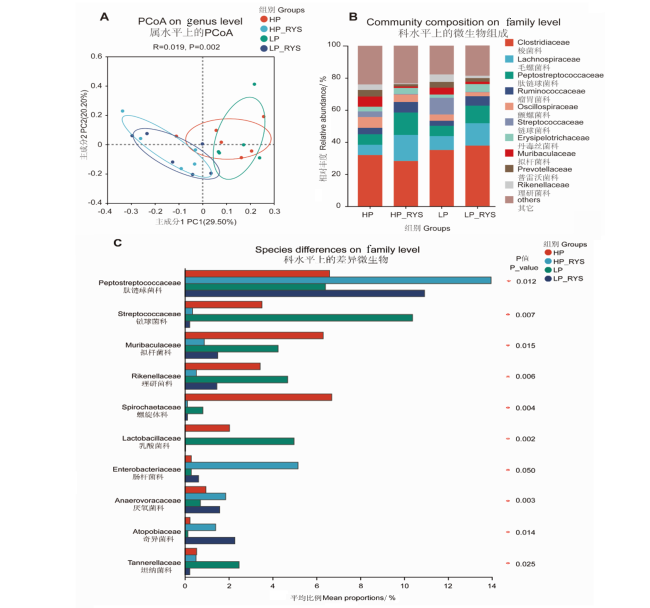
图1-A所示,饲粮添加HLAB使断奶仔猪粪便微生物β多样性表现出显著差异(P<0.05),添加HLAB与未添加HLAB有明显的区分。饲粮CP水平对断奶仔猪粪便微生物β多样性无显著影响(P>0.05)。如图1-B所示,在科水平上,相对丰度排名前3的物种包括梭菌科(Clostridiaceae)、毛螺菌科(Lachnospiraceae)和消化链球菌科(Peptostreptococcaceae)。如图1-C所示,科水平上物种差异检验结果表明,饲粮添加HLAB显著提高了消化链球菌科等的相对丰度(P<0.05),显著降低了链球菌科(Streptococcaceae)等的相对丰度(P<0.05)。
图1 饲粮CP水平和HLAB对断奶仔猪粪便微生物组成和结构的影响

Fig.1 Effects of dietary CP level and HLAB on fecal microbial composition and structure of weaned piglets

3 讨论

早期断奶的仔猪肠道微生物菌群容易发生紊乱,可能导致对内外源性病原体的抵抗力下降、消化能力减弱以及营养吸收能力降低。增加肠道中乳酸杆菌数量有助于恢复肠道菌群平衡,并对宿主营养利用产生积极影响,因为它们能够降低肠道pH,并可能增强有益酶的活性[26-27]。ADG和ADFI等指标反映了营养物质的消化和吸收能力,这些指标的提高暗示了乳酸菌对断奶仔猪的生长性能的潜在正面影响。Liu等[7]研究表明,在断奶仔猪饲粮中添加乳酸菌可显著提高断奶仔猪的ADG和ADFI。在本研究中,提高饲粮CP水平和添加HLAB均显著提高了低1~15天的ADG,并显著降低了F/G。此外,其他畜禽研究也证实了益生菌对生长性能的提升作用[28]。Zhu等[29]的荟萃分析显示,ADG与乳酸菌含量极显著正相关,表明添加乳酸菌能提高仔猪的ADG。提高饲粮的CP水平可以增加仔猪的生长性能,这点在很多研究中已经被证实[4,30-31],这本试验结果也是一致的。CP是仔猪饲粮的关键成分,对生长发育至关重要。然而,断奶时消化器官未完全发育,高CP可能引起不良反应,破坏肠道结构和功能。未完全消化的蛋白质进入后肠道发酵,可能导致生长性能下降和腹泻率升高[5]。本试验中,各组腹泻率均无显著差异,这可能与试验饲粮的氨基酸平衡有关。综上所述,断奶仔猪的饲粮中高CP水平和添加HLAB均能提高生长性能,基于经济因素考虑,在低CP饲粮中添加HLAB是较好的选择。
本研究中,饲粮CP水平的变化对CP的ATTD没有影响。低CP水平提高了EE的ATTD,降低了NDF和ADF的ATTD。EE的ATTD提高可能与胃肠激素分泌有关,郑自彬等[32]认为低CP水平饲粮通过促进胃肠激素的分泌能够有效抑制仔猪腹泻和提高胃肠蠕动。本试验中,HLAB提高了GE、DM、OM、CP和EE的ATTD。Lan等[33]在饲粮中添加乳杆菌发酵产物,结果表明DM、氮和GE的ATTD线性增加。LAB产生的乳酸会降低肠道pH,这有助于营养物质消化率的提高[34]。研究表明,动物机体消化和代谢所需要的酶类有35%是由肠道菌群产生[35]。肠道中乳酸杆菌数量的增加可能增加一些消化和代谢相关酶的活性,因此肠道生态系统的改善可能是提高营养物质消化率的另一个原因。另一项研究也表明,饲粮中添加复合乳酸菌(罗伊氏乳杆菌和植物乳杆菌复合体)提高了氮和GE的ATTD[12]。但是,Yu等[36]研究结果表明,饲粮中添加复合乳酸菌(乳杆菌、罗伊氏乳杆菌、嗜酸乳杆菌和发酵乳杆菌)对DM和GE的ATTD无显著影响。综上所述,乳酸菌对于猪营养物质消化率的影响可能与乳酸菌菌种、浓度以及猪的生长阶段有关。
血清MDA是衡量断奶仔猪氧化应激程度的重要指标,SOD和GSH-Px等抗氧化酶的活性在活性氧的代谢和解毒中起着至关重要的作用[37]。本研究表明,饲粮低CP水平和HLAB均能提高血清SOD和GSH-Px活性,显著降低血清MDA含量,这意味着仔猪的抗氧化应激能力的增强。促炎因子IL-1β、IL-6和炎性细胞因子TNF-α是机体炎症状态的重要指标,其在一定程度上反映仔猪的健康状态[38]。本试验中,饲粮低CP水平降低了血清IL-6含量,同时HLAB显著降低了血清IL-1β、IL-6和TNF-α含量,这表明饲粮低CP水平和添加HLAB均有降低仔猪发生炎症的可能。食糜的pH可以通过影响肠道病原菌来影响宿主的健康,肠道微生物产生的短链脂肪酸(short-chain fatty acid,SCFA)降低肠道pH可以抑制肠道内有害细菌的生长[39]。较高的饲粮CP水平可能加剧后肠道的蛋白质发酵而产生疾病,从而造成肠道的炎症。INS具有促进糖原、蛋白质和脂肪合成作用,而IGF-I能介导生长激素发挥促进生长作用[40]。乳酸菌通常被认为是有益菌,其可以竞争性抑制病原菌的生长从而对肠道微生物菌群产生积极影响[41]。因此,HLAB是否通过肠道微生物产生短链脂肪酸影响仔猪的INS和IGF-I从而影响生长激素水平,还有待于进一步的研究。
肠道微生物在抑制疾病和促进营养物质消化、吸收和代谢以及维持肠道形态完整性和免疫稳态方面发挥着重要作用[42]。α多样性指数能够反映微生物群落的丰富度和多样性,本试验中,饲粮CP水平对仔猪的粪便微生物α多样性和β多样性无显著影响,但HLAB降低了仔猪粪便微生物α多样性和β多样性。Luise等[43]分析表明,较高CP水平(20%)增加了肠黏膜损伤,并减少了乳酸菌的定植。同时,Ren等[3]研究表明,仔猪回肠和结肠的Chao指数随饲粮CP水平的升高而升高。这些结果与本试验的结果不同,饲粮中除CP以外的其余组分可能是造成不同结果的因素。饲粮中添加乳酸菌可以提高仔猪肠道中乳酸菌的含量,减少大肠杆菌的数量[7]。Tajima等[44]研究表明,乳酸菌发酵的液体饲料可以显著提高断奶仔猪粪便微生物的Shannon指数和Chao指数。这与本试验的结果是一致的,即饲粮添加HLAB可以增加粪便微生物的α多样性和β多样性,提示HLAB可能是通过改善肠道微生态从而发挥其益生作用。饲粮中添加HLAB增加一些有益菌如厌氧菌科(Anaerovoracaceae)的相对丰度,促进短链脂肪酸(如乙酸和丁酸)的产生,这些短链脂肪酸对维持肠道健康非常重要[45]。值得注意的是,饲粮中添加HLAB显著降低了粪便微生物中乳酸菌科(Lactobacillaceae)的相对丰度,这与之前的研究结果不同[7,12,46]。本试验中,对仔猪粪便微生物发挥作用的可能是乳酸菌的代谢物。Giahi等[47]研究发现,热灭活的益生菌及其代谢产物的作用几乎一致,而且其免疫调节功能不仅和剂量有关,而且也有菌种和菌株特异性。这一点与本试验的结果是一致的,HLAB和其他研究报道的LAB均通过影响肠道微生态进而影响机体免疫和消化机能。

4 结论

① 饲粮CP水平和HLAB在断奶仔猪生长性能、腹泻率、营养物质ATTD及血清抗氧化、免疫和激素指标上均不存在显著交互作用。
② 饲粮高CP水平提高了断奶仔猪前期的ADG,但降低了抗氧化能力。
③ 饲粮中添加HLAB影响了粪便微生物组成,改善了生长性能、营养物质ATTD、抗氧化能力和炎症因子水平。
④ 在本试验条件下,在断奶仔猪低CP饲粮中添加0.5%的HLAB更具有经济效益。
[1]
赵金标, 孙志强, 刘岭. 棉籽蛋白营养价值及其在仔猪饲粮中的应用前景[J]. 动物营养学报, 2023, 35(10):6121-6128.

DOI

ZHAO J B, SUN Z Q, LIU L. Nutritive value of cottonseed protein and its application prospect in piglets diet[J]. Chinese Journal of Animal Nutrition, 2023, 35(10):6121-6128. (in Chinese)

[2]
谯仕彦, 周俊言, 李晟铠, 等. 低蛋白质低豆粕多元化饲粮是养猪节粮增效的关键技术[J]. 动物营养学报, 2024, 36(6):3401-3412.

DOI

QIAO S Y, ZHOU J Y, LI S K, et al. Diversified diet with low protein and low soybean meal is a key technology for pigs industry to save feed and improve efficiency[J]. Chinese Journal of Animal Nutrition, 2024, 36(6):3401-3412. (in Chinese)

DOI

[3]
REN Z H, FAN H Y, DENG H D, et al. Effects of dietary protein level on small intestinal morphology,occludin protein,and bacterial diversity in weaned piglets[J]. Food Science & Nutrition, 2022, 10(7):2168-2201.

[4]
PENG X, HU L, LIU Y, et al. Effects of low-protein diets supplemented with indispensable amino acids on growth performance, intestinal morphology and immunological parameters in 13 to 35 kg pigs[J]. Animal, 2016, 10(11):1812-1820.

PMID

[5]
XIA J Y, FAN H Y, YANG J, et al. Research progress on diarrhoea and its mechanism in weaned piglets fed a high-protein diet[J]. Journal of Animal Physiology and Animal Nutrition, 2022, 106(6):1277-1287.

[6]
SALMINEN S, COLLADO M C, ENDO A, et al. The international scientific association of probiotics and prebiotics (ISAPP) consensus statement on the definition and scope of postbiotics[J]. Nature Reviews. Gastroenterology & Hepatology, 2021, 18(9):649-667.

[7]
LIU H, JI H F, ZHANG D Y, et al. Effects of Lactobacillus brevis preparation on growth performance, fecal microflora and serum profile in weaned pigs[J]. Livestock Science, 2015, 178:251-254.

[8]
SHI C, ZHANG Y, YIN Y, et al. Amino acid and phosphorus digestibility of fermented corn-soybean meal mixed feed with Bacillus subtilis and Enterococcus faecium fed to pigs[J]. Journal of Animal Science, 2017, 95(9):3996-4004.

[9]
MERCADO A J L, TRAN H, WEEDEN T, et al. PSII-18 impact of Saccharomyces cerevisiae Boulardii supplementation on nursery pig performance[J]. Journal of Animal Science, 2022, 100:136.

[10]
DUDDECK K A, PETERSEN T E, ADKINS H J, et al. Dose-dependent effects of supplementing a two-strain Bacillus subtilis probiotic on growth performance,blood parameters,fecal metabolites,and microbiome in nursery pigs[J]. Animals, 2024, 14(1):109.

[11]
FU R Q, CHEN D W, TIAN G, et al. Effect of dietary supplementation of Bacillus coagulans or yeast hydrolysates on growth performance,antioxidant activity,cytokines and intestinal microflora of growing-finishing pigs[J]. Animal Nutrition, 2019, 5(4):366-372.

[12]
ZHAO P Y, KIM I H. Effect of direct-fed microbial on growth performance,nutrient digestibility,fecal noxious gas emission,fecal microbial flora and diarrhea score in weanling pigs[J]. Animal Feed Science and Technology, 2015, 200:86-92.

[13]
PAJARILLO E A B, CHAE J P, BALOLONG M P, et al. Effects of probiotic Enterococcus faecium NCIMB 11181 administration on swine fecal microbiota diversity and composition using barcoded pyrosequencing[J]. Animal Feed Science and Technology, 2015, 201:80-88.

[14]
ALI M S, LEE E B, HSU W H, et al. Probiotics and postbiotics as an alternative to antibiotics: an emphasis on pigs[J]. Pathogens, 2023, 12(7):874.

[15]
MUÑOZ-ATIENZA E, ARAÚJO C, LLUCH N, et al. Different impact of heat-inactivated and viable lactic acid bacteria of aquatic origin on turbot (Scophthalmus maximus L.) head-kidney leucocytes[J]. Fish & Shellfish Immunology, 2015, 44(1):214-223.

[16]
国家市场监督管理总局, 国家标准化管理委员会. 猪营养需要量:GB/T 39235—2020[S]. 北京: 中国标准出版社, 2020.

State Administration for Market Regulation, National Standardization Administration. Nutrient requirements of swine:GB/T 39235—2020[S]. Beijing: Standards Press of China, 2020. (in Chinese)

[17]
ZHANG G, ZHAO J B, LIN G, et al. Effects of protein-chelated zinc combined with mannan-rich fraction to replace high-dose zinc oxide on growth performance,nutrient digestibility,and intestinal health in weaned piglets[J]. Animals, 2022, 12(23):3407.

[18]
LIU P, ZHAO J B, WANG W, et al. Dietary corn bran altered the diversity of microbial communities and cytokine production in weaned pigs[J]. Frontiers in Microbiology, 2018, 9:2090.

DOI PMID

[19]
国家市场监督管理总局, 国家标准化管理委员会. 饲料中中性洗涤纤维(NDF)的测定:GB/T 20806—2022[S]. 北京: 中国国家标准出版社, 2022.

State Administration for Market Regulation, National Standardization Administration. Determination of neutral detergent fiber (NDF) in feeds:GB/T 20806—2022[S]. Beijing: China National Standards Press, 2022. (in Chinese)

[20]
中华人民共和国农业农村部. 饲料中酸性洗涤纤维的测定:NY/T 1459—2022[S]. 北京: 中国农业出版社, 2022.

Ministry of Agriculture and Rural Affairs of the People’s Republic of China. Determination of acid detergent fiber (ADF) in feeds:NY/T 1459—2022[S]. Beijing: China Agriculture Press, 2022. (in Chinese)

[21]
国家市场监督管理总局, 中国国家标准化管理委员会. 饲料中粗蛋白的测定凯氏定氮法:GB/T 6432—2018[S]. 北京: 中国标准出版社, 2018.

State Administration for Market Regulation, China National Standardization Administration. Determination of crude protein in feeds-Kjeldahl method:GB/T 6432—2018[S]. Beijing: Standards Press of China, 2018. (in Chinese)

[22]
中华人民共和国国家质量监督检验检疫总局, 中国国家标准化管理委员会. 饲料中水分和其他挥发性物质含量的测定:GB/T 6435—2006[S]. 北京: 中国标准出版社, 2006.

General Administration of Quality Supervision,Inspection and Quarantine of the People’s Republic of China, China National Standardization Administration. Determination of moisture and other volatile mater content in feeds:GB/T 6435—2006[S]. Beijing: Standards Press of China, 2006. (in Chinese)

[23]
中华人民共和国国家质量监督检验检疫总局, 中国国家标准化管理委员会. 饲料中粗灰分的测定:GB/T 6438—2007[S]. 北京: 中国标准出版社, 2007.

General Administration of Quality Supervision,Inspection and Quarantine of the People’s Republic of China, China National Standardization Administration. Animal feeding stuffs-determination of crude ash:GB/T 6438—2007[S]. Beijing: Standards Press of China, 2007. (in Chinese)

[24]
中华人民共和国国家质量监督检验检疫总局, 中国国家标准化管理委员会. 饲料中粗脂肪的测定:GB/T 6433—2006[S]. 北京: 中国标准出版社, 2006.

General Administration of Quality Supervision,Inspection and Quarantine of the People’s Republic of China, China National Standardization Administration. Determination of crude fat in feeds:GB/T 6433—2006[S]. Beijing: Standards Press of China, 2006. (in Chinese)

[25]
中华人民共和国国家质量监督检验检疫总局, 中国国家标准化管理委员会. 饲料中盐酸不溶灰分的测定:GB/T 23742—2009[S]. 北京: 中国标准出版社, 2009.

General Administration of Quality Supervision,Inspection and Quarantine of the People’s Republic of China, China National Standardization Administration. Animal feeding stuffs-determination of ash insoluble in hydrochloric acid:GB/T 23742—2009[S]. Beijing: Standards Press of China, 2009. (in Chinese)

[26]
LEE S J, SHIN N H, OK J U, et al. Effects of dietary synbiotics from anaerobic microflora on growth performance,noxious gas emission and fecal pathogenic bacteria population in weaning pigs[J]. Asian-Australasian Journal of Animal Sciences, 2009, 22(8):1202-1208.

[27]
CANIBE N, MIETTINEN H, JENSEN B B. Effect of adding Lactobacillus plantarum or a formic acid containing-product to fermented liquid feed on gastrointestinal ecology and growth performance of piglets[J]. Livestock Science, 2008, 114(2/3):251-262.

[28]
YIN Y Y, LIAO Y Y, LI J, et al. Lactobacillus plantarum GX17 benefits growth performance and improves functions of intestinal barrier/intestinal flora among yellow-feathered broilers[J]. Frontiers in Immunology, 2023, 14:1195382.

[29]
ZHU C P, YAO J C, ZHU M N, et al. A meta-analysis of Lactobacillus-based probiotics for growth performance and intestinal morphology in piglets[J]. Frontiers in Veterinary Science, 2022, 9:1045965.

[30]
MARCHETTI R, FAETI V, GALLO M, et al. Protein content in the diet influences growth and diarrhea in weaning piglets[J]. Animals, 2023, 13(5):795.

[31]
HAN Y G, LEE G I, DO S H, et al. The effect of reduced crude protein on growth performance,nutrient digestibility,and meat quality in weaning to finishing pigs[J]. Animals, 2023, 13(12):1938.

[32]
郑自彬, 姜宇翔, 雷龙, 等. 适宜代谢葡萄糖下日粮蛋白水平对仔猪生长性能及营养物质消化率的影响[J]. 中国畜牧杂志, 2020, 56(9):163-165.

ZHENG Z B, JIANG Y X, LEI L, et al. Effect of dietary protein levels on piglets’ growth performance and the digestibility of nutrients under suitable metabolic glucose conditions[J]. Chinese Journal of Animal Science, 2020, 56(9):163-165. (in Chinese)

[33]
LAN R X, KOO J, KIM I. Effects of Lactobacillus acidophilus supplementation on growth performance,nutrient digestibility,fecal microbial and noxious gas emission in weaning pigs[J]. Journal of the Science of Food and Agriculture, 2017, 97(4):1310-1315.

[34]
CANIBE N, JENSEN B B. Fermented and nonfermented liquid feed to growing pigs:effect on aspects of gastrointestinal ecology and growth performance[J]. Journal of Animal Science, 2003, 81(8):2019-2031.

[35]
LI L Q, CHEN X, ZHU J, et al. Advances and challenges in interaction between heteroglycans and Bifidobacterium:utilization strategies,intestinal health and future perspectives[J]. Trends in Food Science & Technology, 2023, 134:112-122.

[36]
YU H F, WANG A N, LI X J, et al. Effect of viable Lactobacillus fermentum on the growth performance,nutrient digestibility and immunity of weaned pigs[J]. Journal of Animal and Feed Sciences, 2008, 17(1):61-69.

[37]
LI L X, WANG H K, ZHANG N, et al. Effects of α-glycerol monolaurate on intestinal morphology,nutrient digestibility,serum profiles,and gut microbiota in weaned piglets[J]. Journal of Animal Science, 2022, 100(3):skac046.

[38]
彭雄, 李想, 伍蓉蓉, 等. 复方刺五加散对母猪和哺乳仔猪血清生化、抗氧化和免疫指标的影响[J]. 动物营养学报, 2024, 36(5):2911-2923.

DOI

PENG X, LI X, WU R R, et al. Effects of compound Acanthopanax senticosus powder on serum biochemical,antioxidant and immune indexes of sows and suckling piglets[J]. Chinese Journal of Animal Nutrition, 2024, 36(5):2911-2923. (in Chinese)

[39]
WEN X L, LI W, ZHENG C T, et al. Fecal scores and microbial metabolites in weaned piglets fed different protein sources and levels[J]. Animal Nutrition, 2018, 4(1):31-36.

DOI PMID

[40]
周根来, 陶勇, 殷洁鑫, 等. 大麦虫粉对育肥猪生长性能、血清生化指标和激素水平的影响[J]. 动物营养学报, 2023, 35(7):4247-4255.

DOI

ZHOU G L, TAO Y, YIN J X, et al. Effects of Zophobas morio meal on growth performance,serum biochemical indices and hormone levels of finishing pigs[J]. Chinese Journal of Animal Nutrition, 2023, 35(7):4247-4255. (in Chinese)

[41]
ROSS G R, GUSILS C, OLISZEWSKI R, et al. Effects of probiotic administration in swine[J]. Journal of Bioscience and Bioengineering, 2010, 109(6):545-549.

DOI PMID

[42]
VALERIANO V D V, BALOLONG M P, KANG D K. Probiotic roles of Lactobacillus sp.in swine:insights from gut microbiota[J]. Journal of Applied Microbiology, 2017, 122(3):554-567.

[43]
LUISE D, CHALVON-DEMERSAY T, LAMBERT W, et al. Meta-analysis to evaluate the impact of the reduction of dietary crude protein on the gut health of post-weaning pigs[J]. Italian Journal of Animal Science, 2021, 20(1):1386-1397.

[44]
TAJIMA K, OHMORI H, AMINOV R I, et al. Fermented liquid feed enhances bacterial diversity in piglet intestine[J]. Anaerobe, 2010, 16(1):6-11.

DOI PMID

[45]
XU F H, CHENG Y, RUAN G C, et al. New pathway ameliorating ulcerative colitis:focus on Roseburia intestinalis and the gut-brain axis[J]. Therapeutic Advances in Gastroenterology, 2021, 14:17562848211004469.

[46]
SHIN D, CHANG S Y, BOGERE P, et al. Beneficial roles of probiotics on the modulation of gut microbiota and immune response in pigs[J]. PLoS One, 2019, 14(8):e0220843.

[47]
GIAHI L, ELMADFA I, HOSEINI M, et al. Heat-inactivated Lactobacillus rhamnosus and Lactobacillus delbrueckii induce efficient maturation and differential cytokine production in human monocyte derived dendritic cells[J]. Food and Agricultural Immunology, 2013, 24(1):95-109.

Outlines

/