RESEARCH PAPER

Effects of Different Fermentation Modes of Rapeseed Meal on Growth Performance, Serum Immunity Indexes, Hormone Levels and Fecal Microorganisms of Fattening Pigs

  • ZHANG Peng , 1, 2, 3 ,
  • YAO Youli 1, 2, 3 ,
  • WANG Yongben 1, 2, 3 ,
  • LU Boyu 1, 2, 3 ,
  • YANG Zhaoxin 1, 2, 3 ,
  • ZHANG Jianbo 1, 3, 4 ,
  • WU Guofang 1, 3, 4 ,
  • LUO Xuan 1, 3, 4 ,
  • WANG Lei , 1, 2, 3, *
Expand
  • 1 Academy of Animal Science and Veterinary, Qinghai University, Xining 810016, China
  • 2 Key Laboratory of Plateau Livestock Nutrition and Feed Science of Qinghai Province, Qinghai University, Xining 810016, China
  • 3 Plateau Livestock Genetic Resources Protection and Innovative Utilization Key Laboratory of Qinghai Province, Xining 810016, China
  • 4 Key Laboratory of Livestock and Poultry Genetics and Breeding on the Tibetan Plateau, Ministry of Agriculture and Rural Affairs, Xining 810016, China
*associate professor, E-mail:

Received date: 2024-08-23

  Online published: 2025-03-13

Abstract

The purpose of this experiment was to study the effects of different fermentation modes of rapeseed meal on the growth performance, serum immune indexes, hormone levels and fecal microorganisms of finishing pigs. A total of 72 healthy fattening pigs of the same month age and weighing about 15 kg were selected and randomly divided into 3 groups, with 4 replicates in each group and 6 pigs in each replicate. The control group (CK group) was fed a basal diet + 10% unfermented rapeseed meal, the probiotic fermentation group (FG group) was fed a basal diet+10% probiotic fermented rapeseed meal, and the bacterial enzyme synergistic fermentation group (MPG group) was fed a basal diet + 10% bacterial enzyme-co-fermented rapeseed meal. The experimental period was 60 days. The results showed that compared with the CK group, there were no significant differences in the initial weight, final weight, average daily gain, average daily feed intake and feed-to-gain ratio of fattening pigs in the FG group and MPG group (P>0.05). Serum immunoglobulin A (IgA), immunoglobulin G (IgG), immunoglobulin M (IgM), and interleukin-2 (IL-2 ) contents in the CK group was significantly higher than that in the CK group (P<0.05). The serum growth hormone and insulin contents in the FG and MPG groups were significantly higher than those in the CK group (P<0.05); the serum neuropeptide content in the MPG group was significantly higher than that in the FG and CK groups (P<0.05). Microbial flora analysis showed that feeding fermented feed significantly increased the Simpson index and Shannon index of fecal microorganisms (P<0.05), but on the 60th day, the relative abundances of Firmicutes and Lactobacillus were significantly increased (P<0.05). In summary, the replacement of part of the basal diet with probiotic fermented rapeseed meal and enzyme-co-fermented rapeseed meal does not affect the growth performance of fattening pigs, but can improve the immunity and hormone levels of fattening pigs and improve the intestinal flora structure of fattening pigs, promoting the colonization of beneficial bacteria. Considering the cost of fattening pig farming, rapeseed meal fermented with compound probiotics should be used.

Cite this article

ZHANG Peng , YAO Youli , WANG Yongben , LU Boyu , YANG Zhaoxin , ZHANG Jianbo , WU Guofang , LUO Xuan , WANG Lei . Effects of Different Fermentation Modes of Rapeseed Meal on Growth Performance, Serum Immunity Indexes, Hormone Levels and Fecal Microorganisms of Fattening Pigs[J]. Chinese Journal of Animal Nutrition, 2025 , 37(3) : 1660 -1672 . DOI: 10.12418/CJAN2025.141

随着养殖规模的日益扩大,对传统饲料原料的需求呈爆发式增长,其价格也随之水涨船高,给养殖企业和从业者带来沉重的经济负担。但这也促进了我国地方自有饲料资源的挖掘与利用,优化猪饲粮配比,实现降本增效成为生猪养殖业发展的重点。
菜籽粕是青海产量最大的农作物副产品,但膳食纤维含量较高,热值较低[1]。此外,它还含有大量抗营养因子,如硫代葡萄糖苷、单宁、芥子酸等[2],影响猪饲粮消化率。降低菜籽粕中抗营养物质的方法有多种,如烘烤、挤压、添加酶制剂或发酵剂预处理。其中发酵是成本最低的一种方式,在发酵过程中,微生物分解抗营养物质[3],诱导合成各种生物活性化合物,降低原料纤维的含量,并改变蛋白质氨基酸谱,从而提高猪生产参数[4]。马旭东等[5]研究发现,饲粮中添加0.6%的菌酶协同发酵绵马贯众能提高断奶仔猪生长性能,增强断奶仔猪抗氧化能力和免疫功能。张铮等[6]研究表明,乳酸菌发酵饲料对断奶仔猪肠道微生物组成有改善效果,但对生长性能和肠道形态学指标无显著影响。Gu等[7]研究表明,发酵棉籽粕替代豆粕可提高断奶仔猪生长性能、免疫和抗氧化性能以及营养物质消化率。毛江笛等[8]研究报道,菜籽粕混合发酵饲料替代豆粕对生长猪生长性能无负面影响,降低血清谷胱甘肽过氧化物酶活性,同时降低了饲料成本。菜籽粕发酵主要有复合菌剂+复合酶制剂协同发酵和复合菌剂单独发酵2种模式,但哪种模式发酵的菜籽粕更有利于猪的生长还未见报道。因此,本研究旨在探究不同发酵模式菜籽粕对育肥猪生长性能、血清免疫指标、激素水平及粪便微生物的影响,以期为发酵菜籽粕在猪生产中的应用提供依据。

1 材料与方法

1.1 试验材料

复合益生菌菌液:由青海省畜牧兽医科学院动物营养与饲料科学实验室研制,主要成分为鼠李糖乳杆菌YLW001(Lactobacillus rhamnosus YLW001,菌种保藏号CCTCC M 2018759)、乳酸片球菌YLW002(Pediococcus acidilactici YLW002,菌种保藏号CCTCC M 2018760)、干酪乳杆菌YLW003(Lactobacillus casei YLW003,菌种保藏号CCTCC M 2018761)、酿酒酵母菌JZ9(Saccharomyces cerevisiae JZ9,菌种保藏号CCTCC M 2020844)、毕赤酵母菌JZ10(Pichiapastoris JZ10,菌种保藏号CCTCC M 2020843)、马克斯克鲁维酵母菌MN29(Kluyveromyces marxianus MN29,菌种保藏号CCTCC M 2020845)。活菌数≥108 CFU/mL,比例为1∶1∶1∶1∶1∶1。
复合酶制剂主要成分:木聚糖酶(≥1 000 U/g)、β-葡聚糖酶(≥200 U/g)、β-甘露聚糖酶(≥500 U/g)、纤维素酶(≥500 U/g)。

1.2 发酵菜籽粕制备

将粉碎菜籽粕随机分为2份,益生菌发酵组接种5%复合益生菌菌液,菌酶协同发酵组接种5%复合益生菌菌液+1 g/kg复合酶制剂,分别加入等体积蒸馏水(水分含量50%)混合均匀,室温发酵10 d后备用。菜籽粕发酵前后营养成分见表1
表1 菜籽粕发酵前后营养成分

Table 1 Nutritional composition of rapeseed meal before and after fermentation %

项目
Items
原始菜籽粕
Raw rapeseed meal
益生菌发酵菜籽粕
Probiotic fermented rapeseed meal
菌酶协同发酵菜籽粕
Bacterial enzyme co-
fermented rapeseed meal
干物质DM 50.00±1.00 50.00±1.53 49.00±1.00
粗蛋白质CP 19.21±0.75 20.08±0.65 20.61±0.10
中性洗涤纤维NDF 8.20±0.17 7.63±0.15 7.60±0.17
酸性洗涤纤维ADF 6.40±0.26 5.83±0.12 6.77±0.12
可溶性糖SS 5.47±0.06 1.23±0.06 1.27±0.06

营养成分均为测定值。

Nutritional composition were measured values.

1.3 试验设计和饲养管理

所有试验方法和方案均经青海大学畜牧兽医科学院研究伦理委员会批准(批准号:2024-QHMKY-002)。选取相同月龄、体重[(15.58±1.91) kg]相近的育肥猪72头,随机分成3组,每组4个重复,每个重复6头猪,大圈饲养。对照组(CK组)饲喂10%未发酵菜籽粕(干物质基础)+90%基础饲粮,益生菌发酵组(FG组)饲喂10%复合益生菌发酵菜籽粕(干物质基础)+90%基础饲粮,菌酶协同发酵组(MPG组)饲喂10%菌酶协同发酵菜籽粕(干物质基础)+90%基础饲粮。基础饲粮参照猪NRC(2012)饲养标准配制,其组成及营养水平见表2。试验在青海省海东市乐都区某合作社进行,试验按照猪场免疫程序、驱虫制度和消毒管理制度进行。试验期60 d,其中预试期7 d,正试期53 d。定量饲喂,每日分别于08:00和17:30各饲喂1次,自由饮水。
表2 基础饲粮组成及营养水平(风干基础)

Table 2 Composition and nutrient levels of the basal diet (air-dry basis) %

项目Items 含量Content
原料Ingredients
玉米Corn 56.98
豆粕Soybean meal 26.53
棉籽粕Cottonseed meal 9.43
麸皮Bran 3.06
预混料Premix1) 4.00
合计Total 100.00
营养水平Nutrient levels2)
消化能DE/(MJ/kg) 11.80
粗蛋白质CP 19.56
钙Ca 0.49
总磷TP 0.53

1)预混料为每千克饲粮提供 Premix provided the following per kilogram of the diet: VA 6 000 IU, VD 2 000 IU, VE 30.00 mg, VK 31.50 mg, VB1 12.00 mg, VB4 25.00 mg, VB6 62.50 mg, VB12 0.20 mg, 烟酸 nicotinic acid 20.00 mg,泛酸钙 calcium pantothenate 13.00 mg, 叶酸 folic acid 0.35 mg, 生物素 biotin 0.30 mg, 胆碱 choline 300 mg, Fe 80 mg, Cu 15 mg, Zn 80 mg, Mn 20 mg, I 0.50 mg, Se 0.25 mg。

2)消化能根据《中国饲料成分及营养价值表(2023年第34版)》计算所得,其余为实测值。DE was calculated by Tables of Feed Composition and Nutritional Values in China (34th edition, 2023), while the others were measured values.

1.4 指标检测

1.4.1 营养成分测定

基础饲粮和菜籽粕发酵前后干物质含量采用烘干法(GB/T 6435—2014)测定,粗蛋白质含量采用凯氏定氮法(GB/T 6432—2018)测定,中性洗涤纤维含量参照GT/T 20806—2022的方法测定,酸性洗涤纤维含量参照NY/T 1459—2022的方法测定,可溶性糖含量参照GB/T 37493—2019的方法测定,钙含量参照GB/T 6436—2018的方法测定,总磷含量参照GB/T 6437—2018的方法测定。

1.4.2 生长性能测定

记录育肥猪始末重量与每日釆食量,计算平均日增重(ADG)、平均日采食量(ADFI)和料重比(F/G)。计算公式如下:
平均日增重=(试验终末体重-试验初始体重)/试验天数;
平均日采食量=(每日投料量之和-每日余料量之和)/总头数;
料重比=试验期总耗料量/总增重。

1.4.3 血清免疫指标及激素水平测定

试验结束,空腹抽取各组猪前腔静脉血5 mL,室温静置30 min,1 095×g、4 ℃离心15 min取上清检测血清免疫指标及激素水平。血清免疫指标包括:免疫球蛋白A(IgA)、免疫球蛋白G(IgG)、免疫球蛋白M(IgM)和白细胞介素-2(IL-2)。激素指标包括:生长激素、胰岛素和神经肽。以上指标均委托南京奥青生物技术有限公司检测。采用酶联免疫吸附测定(ELISA)试剂盒(南京奥青生物技术有限公司)通过全自动酶标仪(Synergy,美国)测定。

1.4.4 粪便微生物分析

试验第1、30、60天采集新鲜粪便,每组采集3头,存放于-80 ℃冰箱低温保存,用于后续16S测序分析。根据Ma等[9]推荐的方法从粪便样本中提取微生物总DNA,并用1%的琼脂凝胶验证DNA浓度和完整性。使用特异性引物341F(5'-CCTACGGGNGGCWGCAG-3')和805R(5'-GACTACHVGGGTATCTAATCC-3')对细菌V3~V4区域进行扩增,用1%的琼脂凝胶电泳纯化后建库,并质检。采用Illumina NovaSeq 6000测序平台(上海伟寰生物科技有限公司),测序策略为PE250双端测序。调用DADA2对原始数据去噪[10],获得Feature信息。对每个扩增子(ASV)序列作物种注释,得到对应的物种信息和基于物种的丰度分布情况;注释时使用QIIME2在silva-138-99[11]代表序列数据库训练分类器,再使用该分类器注释。基于ASV_table进行丰度和多样性分析。

1.5 数据统计分析

试验数据经Excel 2019初步整理后,采用SPSS 27.0软件中one-way ANOVA进行单因素方差分析,采用Duncan氏法进行多重比较,P>0.05表示差异不显著,P<0.05表示差异显著,P<0.01表示差异极显著。运用Origin 2021进行绘图,高通量测序数据在线上平台 https://cloud.apexbio.cn进行分析。

2 结果与分析

2.1 发酵菜籽粕对育肥猪生长性能的影响

表3可知,CK组、FG组和MPG组育肥猪的初始体重、终末体重、平均日增重、平均日采食量和料重比均无显著差异(P>0.05)。
表3 发酵菜籽粕对育肥猪生长性能的影响

Table 3 Effects of fermented rapeseed meal on growth performance of fattening pigs

项目
Items
组别Groups
CK FG MPG
初始体重Initial weight/kg 15.98±1.70 15.23±2.39 15.53±1.87
终末体重Final weight/kg 42.00±3.48 41.88±6.18 41.67±5.43
平均日增重ADG/kg 0.44±0.04 0.45±0.11 0.43±0.07
平均日采食量ADFI/kg 0.76±0.00 0.76±0.00 0.76±0.00
料重比F/G 1.77±0.16 1.78±0.36 1.79±0.28

同行数据肩标相同小写字母或无字母表示差异不显著(P>0.05),不同小写字母表示差异显著(P<0.05),不同大写字母表示差异极显著(P<0.01)。下表同。

In the same row, values with the same small letter or no letter superscripts mean no significant difference (P>0.05), while with different lowercase letter superscripts mean significant difference (P<0.05), and with different capital letter superscripts mean significant difference (P<0.01). The same as below.

2.2 发酵菜籽粕对育肥猪血清免疫指标及激素水平的影响

表4可知,FG组和MPG组血清中IgA、IgG、IgM、IL-2、生长激素和胰岛素含量显著高于CK组(P<0.05),MPG组血清中神经肽含量显著高于FG组和CK组(P<0.05)。
表4 发酵菜籽粕对育肥猪血清免疫指标及激素水平的影响

Table 4 Effects of fermented rapeseed meal on serum immune indexes and hormone levels of fattening pigs

项目
Items
组别Groups
CK FG MPG
免疫球蛋白A IgA/(mg/mL) 2.14±0.24b 3.07±0.19a 3.32±0.25a
免疫球蛋白G IgG/(mg/mL) 6.36±0.31b 9.41±0.33a 8.54±0.60a
免疫球蛋白M IgM/(mg/mL) 0.56±0.09b 1.12±0.09a 1.15±0.08a
白细胞介素-2 IL-2/(pg/mL) 64.53±7.96b 139.00±10.97a 133.41±7.93a
生长激素GH/(ng/mL) 6.22±0.75b 7.71±1.10a 7.74±0.95a
胰岛素Insulin/(mIU/L) 29.98±1.82b 45.22±1.65a 45.33±2.63a
神经肽Neuropeptide/(pg/mL) 206.93±13.73b 229.99±9.54b 282.50±16.31a

2.3 发酵菜籽粕对育肥猪粪便微生物的影响

2.3.1 育肥猪粪便微生物多样性分析
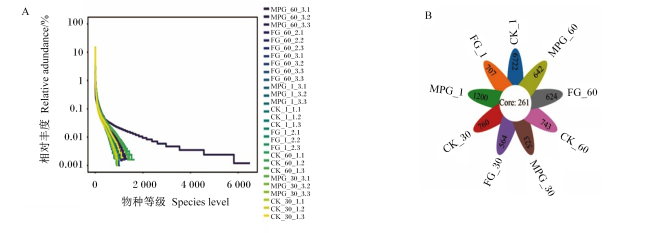
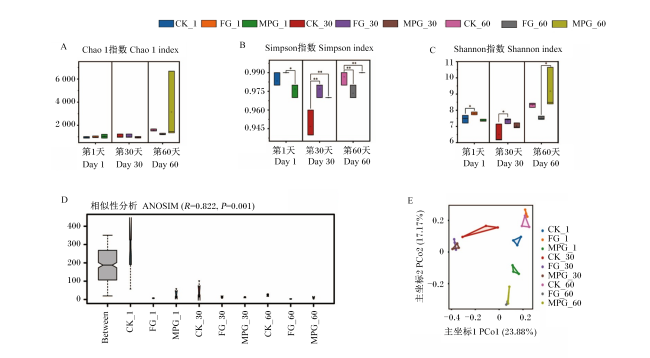
图1可知,以ASV数目为横坐标,相对丰度为纵坐标制作等级丰度曲线,由图1-A可知,曲线出现饱和趋势,且曲线相对平缓,表明本试验抽样充分,测序深度、均匀度及丰富度足够,测序结果真实可靠,可以进行后续分析。对育肥猪粪便进行16S测序分析,基于97%序列相似性进行ASV聚类,不同样品中细菌ASV的个数见图1-B,不同分组间共有的ASV为261个。Chao1指数在第1、30和60天各组间均无显著差异(P>0.05)。Simpson指数在第1天FG组显著高于MPG组(P<0.05),在第30天FG组和MPG组显著高于CK组(P<0.05),第60天FG组显著低于CK组(P<0.05),MPG组显著高于CK组(P<0.05)。Shannon指数在第1和30天FG组显著高于CK组(P<0.05),第60天MPG组显著高于FG组(P<0.05)(图2-A图2-B图2-C),说明发酵菜籽粕可以提高育肥猪粪便微生物多样性。Anosim非参数检验用来检验组间的差异是否显著大于组内差异,从而判断分组是否有意义。如图2-D所示,Anosim结果表明,第1、30和60天3组间的差异显著大于组内差异,分组具有意义。通过主坐标分析(PCoA)比较,结果见图2-E,FG_30与MPG_30、FG_60与MPG_60样品分布距离较近,粪便微生物结构差异较小。
图1 等级丰度曲线和韦恩图

A:等级丰度曲线 rank abundance curve;B:韦恩图 Venn graph。CK_1、FG_1和MPG_1分别代表第1天CK组、FG组和MPG组,CK_30、FG_30和MPG_30分别代表第30天CK组、FG组和MPG组,CK_60、FG_60和MPG_60分别代表第60天CK组、FG组和MPG组。下图同。CK_1, FG_1 and MPG_1 represent the CK group, FG group and MPG group on day 1, respectively; CK_30, FG_30 and MPG_30 represent the CK group, FG group and MPG group on day 30, respectively; CK_60, FG_60 and MPG_60 represent the CK group, FG group and MPG group on day 60, respectively. The same as below.

Fig.1 Rank abundance curve and Venn graph

图2 育肥猪粪便微生物多样性分析

A:Chao1指数Chao1 index;B:Simpson指数Simpson index;C:Shannon指数Shannon index;D:Anosim分析,0<R<1表示组间差异显著,-1<R<0表示组间差异不显著 Anosim analysis, 0<R<1 indicated a significant difference between groups, and -1<R<0 indicated no significant difference between groups. Between:组间;E: 主坐标分析图 PCoA chart.

*表示差异显著(P<0.05),**表示差异极显著(P<0.01),ns表示差异不显著(P>0.05)。下图同。* indicated a significant difference (P<0.05), ** indicated a highly significant difference (P<0.01), and ns indicated a non-significant difference (P>0.05). The same as below.

Fig.2 Analysis of fecal microorganism diversity of fattening pigs

2.3.2 育肥猪粪便微生物结构分析

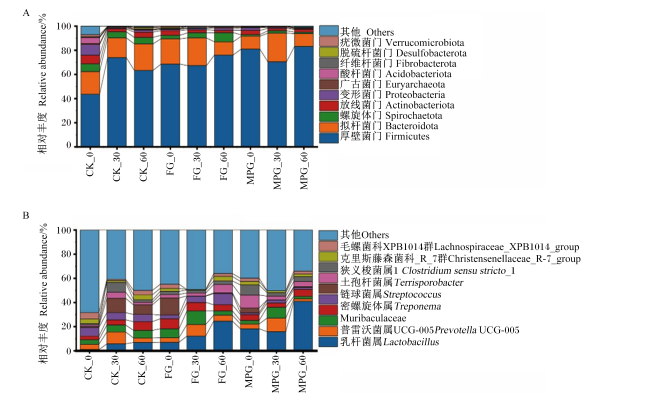
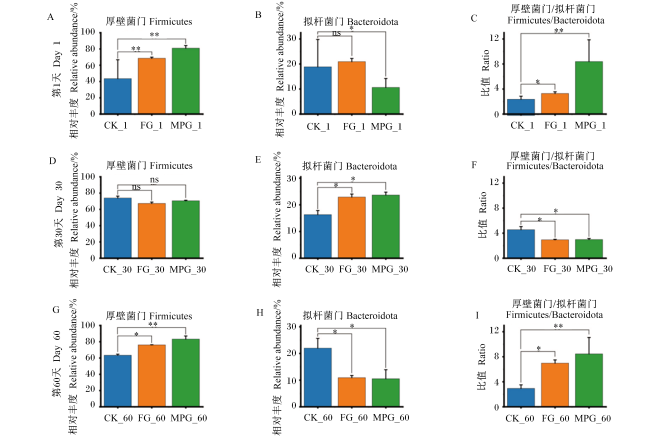
图3-A可以看出,在第1、30和60天时,3组粪便微生物存在差异,在门水平上,厚壁菌门(Firmicutes)和拟杆菌门(Bacteroidota)为优势菌门,在第1天时,CK组、FG组和MPG组Firmicutes相对丰度分别为43.59%、68.58%和81.01%,呈上升趋势,CK组和FG组Bacteroidota相对丰度显著高于MPG组(P<0.05),Firmicutes/Bacteroidota(F/B)值分别为2.37、3.29和8.39,呈上升趋势(图4-A图4-B图4-C)。在第30天时,CK组、FG组和MPG组Firmicutes相对丰度分别为73.96%、67.33%和70.54%,组间差异不显著(P>0.05),FG组和MPG组Bacteroidota相对丰度显著高于CK组(P<0.05),CK组F/B值显著高于FG组和MPG租(P<0.05,图4-D图4-E图4-F)。在第60天时,CK组、FG组和MPG组Firmicutes相对丰度分别为63.34%、76.09%和83.25%,呈上升趋势,CK组Bacteroidota相对丰度显著高于FG组和MPG组(P<0.05),CK组、FG组和MPG组F/B值分别为2.94、6.98和8.46,呈上升趋势(图4-G图4-H图4-I)。
图3 育肥猪粪便微生物组成

A:门水平丰富度图phylum level richness chart;B:属水平丰富度图 genus level richness chart。

Fig.3 Composition of fecal microorganism of fattening pigs

图4 厚壁菌门和拟杆菌门相对丰度及厚壁菌门与拟杆菌门比值

A、B和C:第1天各组Firmicutes、Bacteroidota相对丰度和F/B值 relative abundance of Firmicutes, Bacteroidota and F/B value for each group on day 1;D、E和F:第30天各组Firmicutes、Bacteroidota相对丰度和F/B值 relative abundance of Firmicutes, Bacteroidota and F/B value for each group on day 30;G、H和I:第60天各组Firmicutes、Bacteroidota相对丰度和F/B值 relative abundance of Firmicutes, Bacteroidota and F/B value for each group on day 60。

Fig.4 Relative abundance of Firmicutes and Bacteroidota and the ratio of Firmicutes to Bacteroidota

图3-B可知,在属水平上,乳杆菌属(Lactobacillus)为优势菌属,在第1天,CK组、FG组和MPG组Lactobacillus相对丰度分别为0.96%、5.74%、6.96%;在第30天,CK组、FG组和MPG组Lactobacillus相对丰度分别为7.05%、12.17%、24.58%;在第60天,CK组、FG组和MPG组Lactobacillus相对丰度分别为18.25%、15.87%、40.98%。

2.3.3 育肥猪粪便微生物组成差异分析

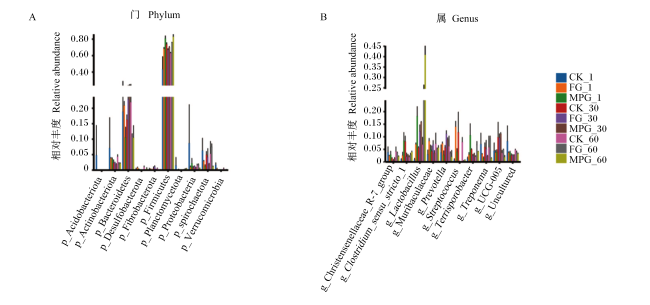
门水平组间显著差异物种分析结果显示,Firmicutes和Bacteroidota相对丰度最高,MPG组在第1和60天Bacteroidota相对丰度低于其余各组,Firmicutes相对丰度高于其余各组(图5-A);属水平组间显著差异物种分析显示(图5-B),第60天MPG组Lactobacillus的相对丰度高于其余各组。
图5 育肥猪粪便微生物组成差异

A:门水平物种差异图species difference map at phylum level;B:属水平物种差异图species difference map at genus level. Acidobacteriota:酸杆菌门;Actinobacteriota:放线菌门;Bacteroidetes:拟杆菌门;Desulfobacterota:脱硫杆菌目;Fibrobacterota:纤维杆菌门;Firmicutes:厚壁菌门;Planctomycetota:浮霉菌门;Proteobacteria:变形菌门;Spirochaetota:螺旋体门;Verrucomicrobia:疣微菌门;Christensenellaceae_R-7_group:克里斯滕森氏科R-7群;Clostridium_sensu_stricto_1:梭状芽孢杆菌属1;Lactobacillus:乳杆菌属;Prevotella:普雷沃氏菌属;Streptococcus:链球菌属;Terrisporobacter:特孢杆菌属;Treponema:密螺旋体属。

Fig.5 Differences in fecal microorganism composition of fattening pigs

3 讨论

3.1 发酵菜籽粕营养成分变化

发酵可以降低非常规饲料的纤维含量,增加粗蛋白质含量,改善非常规饲料营养品质[12]。本试验中,菜籽粕发酵参照姚有莉等[13]和曹燕妮等[14]的方法进行。试验结果表明,与原始菜籽粕和益生菌发酵菜籽粕相比,菌酶协同发酵菜籽粕有降低干物质含量的趋势。此外,与原始菜籽粕相比,益生菌发酵菜籽粕和菌酶协同发酵菜籽粕有升高粗蛋白质含量的趋势,降低中性洗涤纤维和可溶性糖含量的趋势,这与郝怡宁等[15]、吴正可等[16]和魏炳栋等[17]的研究结果相同。其中干物质含量降低的原因可能是酶在发酵过程中发挥了重要作用,能将菜籽粕中大分子物质分解为小分子物质,这些小分子物质更容易被微生物吸收利用。同时,在发酵条件下,部分小分子物质可能会进一步转化或挥发,进而导致干物质含量出现下降的趋势。中性洗涤纤维含量降低可能是益生菌产生一些纤维素酶、半纤维素酶,加之酶制剂中的复合酶能够分解菜籽粕中的纤维素和半纤维素,将其转化为可发酵的糖类物质,从而降低了中性洗涤纤维的含量。可溶性糖含量降低可能是发酵期间益生菌活性旺盛,消耗的可溶性糖较多。粗蛋白质含量升高可能是发酵过程中微生物产生蛋白酶将菜籽粕中的大分子蛋白质分解为小分子的肽和游离氨基酸,为微生物生长代谢提供合成自身蛋白质的原料,促进微生物蛋白合成,进而增加了粗蛋白质的含量。

3.2 发酵菜籽粕对猪生长性能的影响

研究表明,饼粕类饲料在经过益生菌发酵后,可显著降低非淀粉多糖等损害动物生长性能的抗营养因子水平[18],增加饲料适口性和营养价值[19],其中益生菌伴随发酵饲料进入机体后,还能够有效提高营养物质表观消化率,从而提高畜禽的生长性能[20]。Shi等[21]报道指出,与未发酵菜籽粕相比,饲喂发酵菜籽粕猪生长性能和营养物质消化率显著提高。Czech等[22]研究表明,在饲粮中添加8%发酵菜籽粕对断奶仔猪生长性能无不良影响。在本试验中,用不同发酵模式发酵的菜籽粕饲喂育肥猪对平均日增重、平均日采食量和料重比均无显著影响,说明用发酵后的菜籽粕可替代部分基础饲粮,从而降低养殖成本。

3.3 发酵菜籽粕对育肥猪血清免疫指标及激素水平的影响

非常规发酵饲料所含益生菌及其代谢产物可被机体识别为独立抗原刺激肠道黏膜、肠上皮细胞和相关免疫器官,促进T淋巴细胞和B淋巴细胞的增殖,从而增强机体免疫力[23-26]。Mizumachi等[24]研究表明,与非发酵液体饲料相比,发酵液体饲料饲喂断奶仔猪可显著提高血清IgM和IgG含量,从而提高机体免疫力。章红兵等[27]研究发现,与对照组相比,妊娠母猪饲粮中添加5%、10%和15%的生物发酵饲料均能提高血清IgA、IgG和IgM含量,这与本试验研究结果一致。本研究中,菌酶协同发酵菜籽粕可显著提高血清IgA、IgG和IgM含量,说明菌酶协同发酵菜籽粕对提高育肥猪的免疫功能具有一定的作用,其具体作用机制还有待进一步研究。但丁亚伟等[28]研究结果显示,各组之间羔羊血清IgA和IgM含量无显著差异,10%发酵饲料组羔羊血清IgG含量显著高于对照组,造成这一差异的原因可能是物种、发酵菌剂和年龄不同引起的。此外,IL-2对T淋巴细胞和B淋巴细胞有调节作用,可抑制促炎细胞因子产生,对维持机体免疫稳态有重要作用[29-31]。Wang等[32]研究发现,在饲粮中添加益生菌剂可提高断奶仔猪血清IL-2含量,这与本试验研究结果一致。本研究中,饲喂添加益生菌发酵菜籽粕的饲粮可提高血清抗炎因子IL-2的含量,说明复合益生菌或代谢产物可能存在促进IL-2分泌的物质或参与细胞因子调节的物质。同时,生长激素、胰岛素、神经肽等都能影响动物的内分泌系统,从而影响动物生长[33-35]。崔艳红等[36]研究表明,与对照组相比,44和75日龄时,饲喂复合益生菌发酵饲料的仔猪血清中生长激素含量分别提高了13.31%和10.27%,胰岛素含量分别提高了5.33%和22.00%,与本试验中生长激素和胰岛素含量变化趋势相同。在本研究中,不同发酵模式发酵菜籽粕饲粮都可显著提高育肥猪血清中生长激素、胰岛素和神经肽含量,三者变化规律一致,表明生长激素、胰岛素和神经肽在促进动物生长方面存在某种协同作用,其相关性还有待于进一步研究。

3.4 发酵菜籽粕对育肥猪粪便微生物的影响

在动物生长过程中常以粪便微生物来反映肠道微生物分布,以此来判断肠道微生物生态是否平衡[37-38]。粪便微生物多样性是微生物与机体共同作用的结果,受宿主本身种类差异、年龄和性别的影响,同时粪便微生物多样性也受饲粮成分的影响[39]。林苗等[40]研究表明,Chao1指数可以反映微生物丰富度,Shannon指数和Simpson指数可以反映物种多样性。沈学怀等[41]研究表明,与对照组相比,饲喂复方中药发酵饲料的母猪粪便微生物的操作分类单元(OTU)数、Chao指数、PD whole tree指数和Shannon指数均有升高,Simpson指数略有降低。本试验中,与CK组和FG组相比,MPG组在第30和60天育肥猪粪便微生物的Shannon指数和Simpson指数显著提高,说明菌酶协同发酵菜籽粕可以提高粪便微生物物种多样性。在李佳橙等[20]的试验中,通过PCoA发现,对照组与不同饼粕组仔猪粪便微生物区分明显,表明对照组与不同饼粕组间仔猪粪便微生物组成存在差异。本试验通过PCoA发现,在第30和60天FG组和MPG组粪便微生物相似度高,FG组和MPG组与CK组粪便微生物之间存在差异,表明在相同饲喂天数时不同发酵模式发酵的菜籽粕对育肥猪粪便微生物的影响具有相似性。
本试验结果显示,在门水平上,与CK组相比,FG组和MPG组育肥猪粪便中Firmicutes和Bacteroidota为优势菌门,相对丰度达82%以上,这与姚有莉等[13]研究结果相似。Firmicutes可以促进动物机体对纤维的溶解消化,而Bacteroidota可以提高动物机体对碳水化合物吸收利用[42]。同时,F/B是评估肠道微生态区系稳定的重要指标,比值高时,可增加益生菌数量,有利于肠道微生态区系稳定[43]。本试验中,在饲喂第60天时MPG组的F/B显著高于FG组和CK组,说明饲喂菌酶协同发酵菜籽粕有利于育肥猪肠道微生态区系稳定。在属水平上分析发现,MPG组在第60天时育肥猪粪便中Lactobacillus的相对丰度显著增加,Lactobacillus可以抑制致病菌生长从而提高生长育肥猪的肠道健康。Demecková等[44]研究发现,母猪在分娩前2周和分娩后3周饲喂液体发酵饲料后,母猪的肠道健康得到改善,其中饲喂液体发酵饲料后母猪粪便中的大肠杆菌数量显著低于饲喂干料和液体料的处理组,且粪便中乳酸菌数量提高。在本试验中,育肥猪饲喂发酵菜籽粕增加肠道有益菌数量,有利于维持肠道免疫稳态,增强抵抗力,降低病原菌数量,这与Li等[45]和蒋广志等[46]研究结果一致。
综上所述,益生菌发酵菜籽粕饲粮和菌酶协同发酵菜籽粕饲粮可提高育肥猪免疫功能以及对营养物质的消化吸收,抑制病原菌在肠道定植,维持肠道微生物稳定。

4 结论

本研究中,益生菌发酵菜籽粕和菌酶协同发酵菜籽粕替代部分基础饲粮后,并未引起育肥猪生长性能下降,同时两者可提高育肥猪免疫力和激素水平,改善育肥猪肠道微生物结构,促进有益菌的定植。因此,综合考虑育肥猪养殖成本,应采用复合益生菌发酵菜籽粕。
[1]
CZECH A, GRELA E R, KIESZ M. Dietary fermented rapeseed or/and soybean meal additives on performance and intestinal health of piglets[J]. Scientific Reports, 2021, 11(1):16952.

DOI PMID

[2]
KHAJALI F, SLOMINSKI B A. Factors that affect the nutritive value of canola meal for poultry[J]. Poultry Science, 2012, 91(10):2564-2575.

PMID

[3]
LESTINGI A. Alternative and sustainable protein sources in pig diet:a review[J]. Animals, 2024, 14(2):310.

[4]
NKHATA S G, AYUA E, KAMAU E H, et al. Fermentation and germination improve nutritional value of cereals and legumes through activation of endogenous enzymes[J]. Food Science & Nutrition, 2018, 6(8):2446-2458.

[5]
马旭东, 刘显军, 陈静, 等. 菌酶协同发酵绵马贯众对断奶仔猪生长性能、血清生化指标和抗氧化能力的影响[J]. 动物营养学报, 2023, 35(12):7691-7701.

DOI

MA X D, LIU X J, CHEN J, et al. Effects of Dryopteris crassirhizoma fermented with bacteria and enzymes on growth performance,serum biochemical indexes and antioxidant capacity of weaned piglets[J]. Chinese Journal of Animal Nutrition, 2023, 35(12):7691-7701. (in Chinese)

[6]
张铮, 石青松, 朱伟云, 等. 乳酸菌发酵饲料对断奶仔猪生长性能和肠道健康的影响[J]. 江苏农业科学, 2018, 46(19):170-173.

ZHANG Z, SHI Q S, ZHU W Y, et al. Effects of fermented feed with lactic acid bacteria on growth performance and intestine health of weaned piglets[J]. Jiangsu Agricultural Sciences, 2018, 46(19):170-173. (in Chinese)

[7]
GU X L, LI Z Q, WANG J, et al. Fermented cottonseed meal as a partial replacement for soybean meal could improve the growth performance,immunity and antioxidant properties,and nutrient digestibility by altering the gut microbiota profile of weaned piglets[J]. Frontiers in Microbiology, 2021, 12:734389.

[8]
毛江笛, 倪志翔, 汪海峰. 菜籽粕混合发酵饲料替代豆粕对生长猪生长性能、养分表观消化率以及血清生化和抗氧化指标的影响[J]. 动物营养学报, 2024, 36(1):162-173.

DOI

MAO J D, NI Z X, WANG H F. Effects of rapeseed meal mixed fermented feed replacing soybean meal on growth performance,nutrient apparent digestibility and serum biochemical and antioxidant indices of growing pigs[J]. Chinese Journal of Animal Nutrition, 2024, 36(1):162-173. (in Chinese)

[9]
MA Z Y, ZHANG X M, WANG R, et al. Effects of chemical and mechanical lysis on microbial DNA yield,integrity,and downstream amplicon sequencing of rumen bacteria and protozoa[J]. Frontiers in Microbiology, 2020, 11:581227.

[10]
CALLAHAN B J, MCMURDIE P J, ROSEN M J, et al. DADA2:high-resolution sample inference from illumina amplicon data[J]. Nature Methods, 2016, 13(7):581-583.

[11]
QUAST C, PRUESSE E, YILMAZ P, et al. The SILVA ribosomal RNA gene database project:improved data processing and web-based tools[J]. Nucleic Acids Research, 2013, 41:D590-D596.

[12]
王一强, 吴清华, 马浩凯, 等. 3种工业大麻副产物对奶牛的营养价值[J]. 动物营养学报, 2023, 35(9):5765-5774.

DOI

WANG Y Q, WU Q H, MA H K, et al. Nutritional value of three industrial hemp byproducts for dairy cows[J]. Chinese Journal of Animal Nutrition, 2023, 35(9):5765-5774. (in Chinese)

DOI

[13]
姚有莉, 张朋, 王永奔, 等. 降解霉菌毒素乳酸菌的筛选及鉴定[J]. 动物营养学报, 2024, 36(4):2674-2689.

DOI

YAO Y L, ZHANG P, WANG Y B, et al. Screening and identification of mycotoxin-degrading lactic acid bacteria[J]. Chinese Journal of Animal Nutrition, 2024, 36(4):2674-2689. (in Chinese)

DOI

[14]
曹燕妮, 万里, 王磊, 等. 益生菌发酵中草药条件优化及品质鉴定[J]. 中国饲料, 2023(17):128-136.

CAO Y N, WAN L, WANG L, et al. Optimization of probiotics fermentation conditions and quality identification of Chinese herbal medicine[J]. China Feed, 2023(17):128-136. (in Chinese)

[15]
郝怡宁, 王志高, 何荣, 等. 混菌静态发酵改善双低菜籽粕品质[J]. 中国农业科学, 2020, 53(10):2066-2077.

DOI

HAO Y N, WANG Z G, HE R, et al. Quality improvement of rapeseed meal based on static-state fermented with mixed microorganisms[J]. Scientia Agricultura Sinica, 2020, 53(10):2066-2077. (in Chinese)

DOI

[16]
吴正可, 刘国华, 李阳, 等. 混菌固态发酵菜籽粕工艺优化[J]. 中国农业科学, 2019, 52(24):4603-4612.

DOI

WU Z K, LIU G H, LI Y, et al. Optimization of solid state fermentation for rapeseed meal with mixed strains[J]. Scientia Agricultura Sinica, 2019, 52(24):4603-4612. (in Chinese)

DOI

[17]
魏炳栋, 党修利, 邱玉朗, 等. 乳酸菌固态发酵酶解对豆粕、棉籽粕和菜籽粕粗蛋白质、pH、酸度及抗营养因子含量的影响[J]. 中国畜牧兽医, 2014, 41(11):107-114.

WEI B D, DANG X L, QIU Y L, et al. Effect of lactic acid bacteria solid-state fermentation on crude protein,pH,acidity and antinutritional factor content of soybean meal, cottonseed meal and rapeseed meal[J]. China Animal Husbandry & Veterinary Medicine, 2014, 41(11):107-114. (in Chinese)

[18]
OLUKOMAIYA O, FERNANDO C, MEREDDY R, et al. Solid-state fermented plant protein sources in the diets of broiler chickens:a review[J]. Animal Nutrition, 2019, 5(4):319-330.

[19]
赵金凤, 李伟坤, 唐辉, 等. 生长猪发酵棉籽粕消化能和代谢能的测定及预测模型的建立[J]. 动物营养学报, 2024, 36(1):174-185.

DOI

ZHAO J F, LI W K, TANG H, et al. Determination and prediction model establishment of digestible energy and metabolizable energy of fermented cottonseed meal in growing pigs[J]. Chinese Journal of Animal Nutrition, 2024, 36(1):174-185. (in Chinese)

DOI

[20]
李佳橙, 张文喆, 南珊珊, 等. 饲粮中添加不同饼粕源发酵饲料对断奶仔猪生长性能、营养物质表观消化率、血清生化指标和肠道菌群的影响[J]. 动物营养学报, 2024, 36(2):847-862.

DOI

LI J C, ZHANG W Z, NAN S S, et al. Effects of dietary fermented feed from different meal sources on growth performance,nutrient apparent digestibilities,serum biochemical indexes and intestinal microflora of weaned piglets[J]. Chinese Journal of Animal Nutrition, 2024, 36(2):847-862. (in Chinese)

[21]
SHI C Y, HE J, WANG J P, et al. Effects of Aspergillus niger fermented rapeseed meal on nutrient digestibility,growth performance and serum parameters in growing pigs[J]. Animal Science Journal, 2016, 87(4):557-563.

[22]
CZECH A, WLAZŁO Ł, ŁUKASZEWICZ M, et al. Fermented rapeseed meal enhances the digestibility of protein and macro- and microminerals and improves the performance of weaner pigs[J]. Animal Feed Science and Technology, 2023, 300:115656.

[23]
SÁNCHEZ B, DELGADO S, BLANCO-MÍGUEZ A, et al. Probiotics,gut microbiota,and their influence on host health and disease[J]. Molecular Nutrition & Food Research, 2017, 61(1):1600240.

[24]
MIZUMACHI K, AOKI R, OHMORI H, et al. Effect of fermented liquid diet prepared with Lactobacillus plantarum LQ80 on the immune response in weaning pigs[J]. Animal, 2009, 3(5):670-676.

[25]
SNOECK V, GODDEERIS B, COX E. The role of enterocytes in the intestinal barrier function and antigen uptake[J]. Microbes and Infection, 2005, 7(7/8):997-1004.

[26]
TSAI D Y, HUNG K H, CHANG C W, et al. Regulatory mechanisms of B cell responses and the implication in B cell-related diseases[J]. Journal of Biomedical Science, 2019, 26(1):64.

[27]
章红兵, 何小华. 生物发酵饲料对三元杂交母猪胎盘效率、血清生殖激素和免疫力的影响[J]. 中国畜牧杂志, 2023, 59(7):226-229.

ZHANG H B, HE X H. Effect of biofermented feeds on placental efficiency, serum reproductive hormones and immunity in ternary crossbred sows[J]. Chinese Journal of Animal Science, 2023, 59(7):226-229. (in Chinese)

[28]
丁亚伟, 郭云霞, 王海玉, 等. 复合益生菌发酵饲料对哺乳羔羊生长性能、血常规指标及血清免疫、抗氧化指标的影响[J]. 动物营养学报, 2023, 35(4):2406-2416.

DOI

DING Y W, GUO Y X, WANG H Y, et al. Effects of compound probiotic fermented feed on growth performance,blood routine indexes and serum immunity and antioxidant indexes of nursing lambs[J]. Chinese Journal of Animal Nutrition, 2023, 35(4):2406-2416. (in Chinese)

[29]
BHUSAL R P, FOSTER S R, STONE M J. Structural basis of chemokine and receptor interactions:key regulators of leukocyte recruitment in inflammatory responses[J]. Protein Science, 2020, 29(2):420-432.

[30]
MALEK T R. The biology of interleukin-2[J]. Annual Review of Immunology, 2008, 26:453-479.

PMID

[31]
丁钰, 鲍成玲, 钟晓霞, 等. 植物乳杆菌cqf-43及其代谢产物对断奶仔猪生长性能、抗氧化和免疫功能的影响[J]. 中国畜牧杂志, 2024, 60(4):312-317.

DING Y, BAO C L, ZHONG X X, et al. Effects of Lactobacillus plantarum cqf-43 and its metabolites on growth performance, antioxidant and immune functions of weaned piglets[J]. Chinese Journal of Animal Science, 2024, 60(4):312-317. (in Chinese)

[32]
WANG T W, TENG K L, LIU Y Y, et al. Lactobacillus plantarum PFM 105 promotes intestinal development through modulation of gut microbiota in weaning piglets[J]. Frontiers in Microbiology, 2019, 10:90.

[33]
李铁, 齐梦迪, 张克英, 等. 育雏育成期饲粮添加益生菌对蛋鸡生长性能、血清指标、肠道健康及后续生产性能的影响[J]. 畜牧兽医学报, 2024, 55(3):1062-1076.

DOI

LI T, QI M D, ZHANG K Y, et al. Effects of dietary probiotics supplementation during brood-rearing period on growth performance,serum biochemistry,intestinal health and subsequent performance of laying hens[J]. Acta Veterinaria et Zootechnica Sinica, 2024, 55(3):1062-1076. (in Chinese)

[34]
RAHMAN M S, HOSSAIN K S, DAS S, et al. Role of insulin in health and disease:an update[J]. International Journal of Molecular Sciences, 2021, 22(12):6403.

[35]
LU M, FLANAGAN J U, LANGLEY R J, et al. Targeting growth hormone function: strategies and therapeutic applications[J]. Signal Transduction and Targeted Therapy, 2019, 4:3.

DOI PMID

[36]
崔艳红, 韩庆功, 崔艺佳, 等. 益生菌复合发酵料对断奶仔猪消化环境、血清生化指标和代谢激素水平的影响[J]. 西北农业学报, 2018, 27(1):16-23.

CUI Y H, HAN Q G, CUI Y J, et al. Effects of probiotics composite fermentation feed on gastrointestinal circumstance, serum biochemical and metabolic hormones indexes of weaning piglets[J]. Acta Agriculturae Boreali-Occidentalis Sinica, 2018, 27(1):16-23. (in Chinese)

[37]
ZHANG H L, WIELEN N V D, HEE B V D, et al. Impact of fermentable protein,by feeding high protein diets,on microbial composition,microbial catabolic activity,gut health and beyond in pigs[J]. Microorganisms, 2020, 8(11):1735.

[38]
佟海峰, 姜洋洋, 吴国芳, 等. 微生态制剂和发酵白酒糟对西门塔尔牛生长性能、血清生化和免疫指标以及粪便菌群的影响[J]. 动物营养学报, 2024, 36(6):3725-3738.

DOI

TONG H F, JIANG Y Y, WU G F, et al. Effects of microecological preparations and fermented white distiller’s grains on growth performance,serum biochemical and immune indices and fecal microflora of simmental cattle[J]. Chinese Journal of Animal Nutrition, 2024, 36(6):3725-3738. (in Chinese)

[39]
CUMMINGS J H, ANTOINE J M, AZPIROZ F, et al. PASSCLAIM-gut health and immunity[J]. European Journal of Nutrition, 2004, 43(Suppl.2):118-173.

[40]
林苗, 肖亚红, 张谚鹏, 等. 复合酸对肉鸡生长性能、屠宰性能、血清免疫指标及盲肠菌群结构的影响[J]. 动物营养学报, 2023, 35(11):7024-7035.

DOI

LIN M, XIAO Y H, ZHANG Y P, et al. Effects of compound acid on growth performance,slaughtering performance,serum immune indexes and cecal microflora structure of broilers[J]. Chinese Journal of Animal Nutrition, 2023, 35(11):7024-7035. (in Chinese)

[41]
沈学怀, 张丹俊, 赵瑞宏, 等. 复方中药发酵饲料对母猪繁殖性能、血清生化指标和肠道菌群的影响[J]. 中国畜牧杂志, 2021, 57(10):229-236.

SHEN X H, ZHANG D J, ZHAO R H, et al. Effects of compound Chinese medicine fermented feed on reproductive performance,serum biochemical indexes and intestinal flora of sows[J]. Chinese Journal of Animal Science, 2021, 57(10):229-236. (in Chinese)

[42]
JORDAN C K I, BROWN R L, LARKINSON M L Y, et al. Symbiotic Firmicutes establish mutualism with the host via innate tolerance and resistance to control systemic immunity[J]. Cell Host & Microbe, 2023, 31(9):1433-1449.e9.

[43]
MAGNE F, GOTTELAND M, GAUTHIER L, et al. The Firmicutes/Bacteroidetes ratio: a relevant marker of gut dysbiosis in obese patients?[J]. Nutrients, 2020, 12(5):1474.

[44]
DEMECKOVÁ V, KELLY D, COUTTS A G P, et al. The effect of fermented liquid feeding on the faecal microbiology and colostrum quality of farrowing sows[J]. International Journal of Food Microbiology, 2002, 79(1/2):85-97.

[45]
LI Z, WANG W W, LIU D, et al. Effects of Lactobacillus acidophilus on gut microbiota composition in broilers challenged with Clostridium perfringens[J]. PLoS One, 2017, 12(11):e0188634.

[46]
蒋广志, 戴茜茜, 陈梅香, 等. 复合益生菌对猪生长性能、腹泻率、肠道菌群及代谢物和猪舍氨气浓度的影响[J]. 动物营养学报, 2023, 35(2):834-844.

DOI

JIANG G Z, DAI X X, CHEN M X, et al. Effects of compound probiotics on growth performance, diarrhea rate, intestinal microflora, metabolites of pigs and ammonia concentration in pig house[J]. Chinese Journal of Animal Nutrition, 2023, 35(2):834-844. (in Chinese)

Outlines

/