

1 材料与方法
1.1 试验材料
1.2 CMP的抗氧化能力分析
1.2.1 CMP样品溶液的配制
1.2.2 维生素C(VC)溶液的配制
1.2.3 抗氧化能力分析
1.2.3.1 CMP和VC还原力测定
1.2.3.2 DPPH自由基清除活性测定
1.2.3.3 羟基自由基清除活性测定
1.2.3.4 超氧阴离子自由基清除活性测定
1.3 试验设计
表1 基础饲粮营养水平(干物质基础)Table 1 Nutrient levels of the basal diet (DM basis) % |
| 项目Items | 含量Content |
|---|---|
| 粗蛋白质Crude protein | 20.05 |
| 粗纤维Crude fibre | 4.94 |
| 粗脂肪Crude fat | 5.10 |
| 粗灰分Crude ash | 7.66 |
| 钙Calcium | 1.31 |
| 总磷Total phosphorus | 0.96 |
1.4 检测指标
1.4.1 生长性能
1.4.2 肠道菌群样品的获取与高通量测序
1.4.3 肠道菌群测序数据分析
1.5 数据统计分析
2 结果与分析
2.1 PB复合物的制备
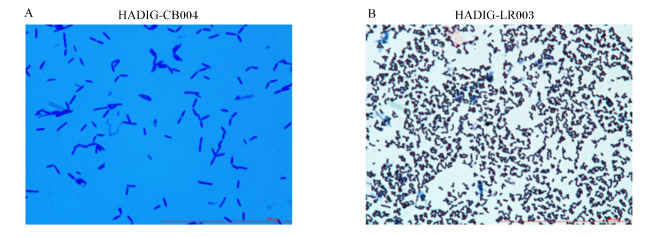
图1 猪源丁酸梭菌HADIG-CB004和罗伊氏乳杆菌HADIG-LR003的菌体形态图A:显微镜观察丁酸梭菌HADIG-CB004的菌体形态图(40 ×); B:显微镜观察罗伊氏乳杆菌HADIG-LR003的菌体形态图(40 ×)。 Fig.1 Morphological maps of Clostridium butyricum HADIG-CB004 and Lactobacillus reuteri HADIG-LR003 isolated from porcine sources A: Morphological maps of Clostridium butyricum HADIG-CB004 was observed by microscope (40 ×); B: Morphological maps of Lactobacillus reuteri HADIG-LR003 was observed by microscope (40 ×). |
2.2 评估CMP的抗氧化能力
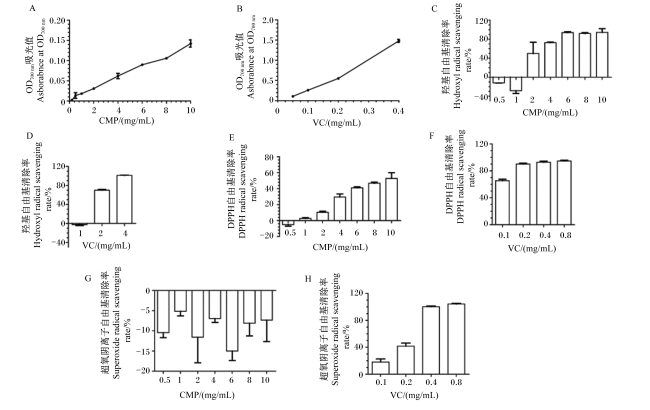
图2 CMP的抗氧化能力分析CMP:羧甲基茯苓多糖 carboxymethylpachymaran;VC:维生素C vitamin C;DPPH: 1,1-二苯基-2-三硝基苯肼 1, 1-diphenyl-2-trinitrophenylhydrazine。 A-B:CMP(A)和VC(B)还原力的测定;C-D:CMP(C)和VC(D)清除羟基自由基能力的测定;E-F:CMP(E)和VC(F)清除DPPH自由基能力的测定;G-H:CMP(G)和VC(H)清除超氧阴离子自由基能力的测定。A-B: determination of reducing power of CMP (A) and VC (B); C-D: determination of the ability of CMP (C) and VC (D) to scavenge hydroxyl free radicals; E-F: determination of the ability of CMP (E) and VC (F) to scavenge DPPH free radicals; G-H: determination of the ability of CMP (G) and VC (H) to scavenge superoxide anion free radicals. Fig.2 Analysis of antioxidant ability of CMP |
2.3 饲粮中添加PB与CMP复合物对昆明小鼠生长性能的影响
表2 饲粮中添加PB与CMP的复合物对昆明小鼠生长性能的影响Table 2 Impacts of dietary PB and CMP compound on growth performance of Kunming mice (n=6) |
| 项目 Items | 对照组 CON group | 5‰ PB组 5‰ PB group | 1‰ CMP组 1‰ CMP group | 6‰复合物组 6‰ compound group | P值 P-value |
|---|---|---|---|---|---|
| 体重BW/g | |||||
| 第1天Day 1 | 10.98±0.85 | 11.08±0.57 | 11.12±0.50 | 11.03±1.10 | 0.992 |
| 第6天Day 6 | 19.08±1.37 | 18.63±0.35 | 19.22±0.93 | 19.53±1.48 | 0.621 |
| 第10天Day 10 | 25.24±2.46 | 25.08±1.49 | 25.17±1.15 | 26.33±0.87 | 0.604 |
| 第13天Day 13 | 28.96±2.76b | 30.22±2.23ab | 29.45±1.56b | 31.62±1.43a | 0.041 |
| 第1~6天Days 1 to 6 | |||||
| 平均日采食量ADFI/(g/d) | 3.82 | 3.74 | 4.15 | 3.960 | |
| 平均日增重ADG/(g/d) | 1.62±0.16 | 1.51±0.14 | 1.62±0.13 | 1.70±0.12 | 0.183 |
| 料重比F/G | 2.36 | 2.48 | 2.56 | 2.33 | |
| 第7~10天Days 7 to 10 | |||||
| 平均日采食量ADFI/(g/d) | 5.11 | 5.31 | 5.38 | 6.16 | |
| 平均日增重ADG/(g/d) | 1.54±0.41 | 1.62±0.32 | 1.49±0.10 | 1.70±0.21 | 0.662 |
| 料重比F/G | 3.32 | 3.28 | 3.61 | 3.62 | |
| 第11~13天Days 11 to 13 | |||||
| 平均日采食量ADFI/(g/d) | 6.26 | 6.96 | 6.70 | 7.78 | |
| 平均日增重ADG/(g/d) | 1.24±0.33 | 1.71±0.40 | 1.43±0.46 | 1.76±0.35 | 0.112 |
| 料重比F/G | 5.05 | 4.07 | 4.69 | 4.42 | |
| 第1~13天Days 1 to 13 | |||||
| 平均日采食量ADFI/(g/d) | 4.86 | 5.07 | 5.20 | 5.65 | |
| 平均日增重ADG/(g/d) | 1.50±0.19 | 1.59±0.23 | 1.53±0.14 | 1.72±0.14 | 0.141 |
| 料重比F/G | 3.24 | 3.19 | 3.40 | 3.28 |
同行数据肩标不同小写字母表示差异显著(P<0.05)。表中PB含量是指除辅料以外的后生元净含量,CMP也指的是净含量。下表同。 | |
In the same row, values with different small letter superscripts mean significant difference (P<0.05). PB content in the table refered to the net content of postbiotics except excipients, and CMP also refered to the net content. The same as below. |
2.4 饲粮中添加PB与CMP复合物对昆明小鼠肠道菌群的影响
2.4.1 肠道菌群多样性分析
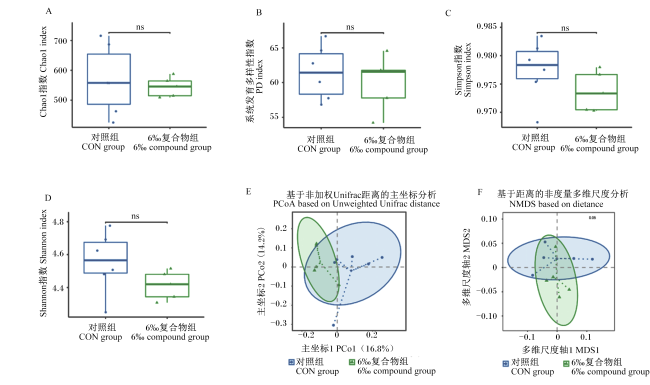
图3 饲粮中添加6‰复合物对昆明小鼠盲肠内容物中菌群α多样性和β多样性的影响ns表示组间差异不显著(P>0.05)。 A-D:α多样性的箱型图; E:不同处理样品的PCoA图; F:不同处理样品NMDS图。 Fig.3 Effects of dietary 6‰ compound on α-diversity and β-diversity of microflora in cecal contents of Kunming mice ns indicated no significant difference between groups (P>0.05). A-D: Box plot of alpha diversity; E: PCoA plot of different treated samples; F: NMDS plot of different treated samples. |
2.4.2 肠道菌群组成及其优势菌群相对丰度分析
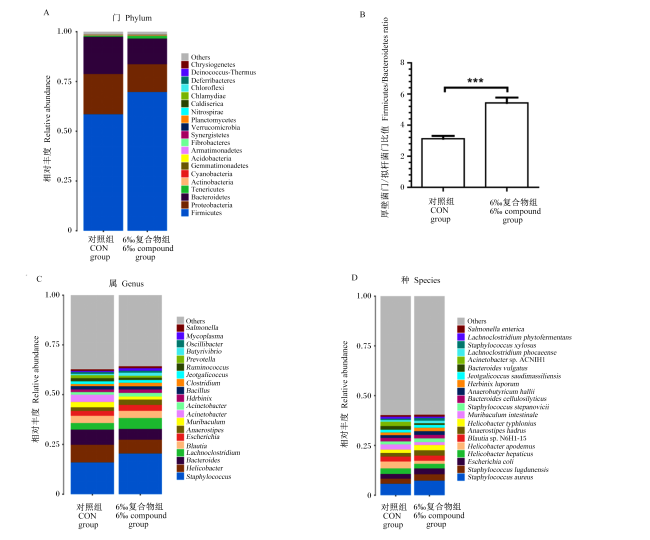
图4 饲粮中添加6‰复合物对昆明小鼠盲肠内容物中菌群组成的影响Chrysiogenetes:产金菌门;Deinococcus-Thermus:异常球菌-栖热菌门;Deferribacteres:脱铁杆菌门;Chloroflexi:绿弯菌门;Chlamydiae:衣原体门;Caldiserica:嗜热丝菌门;Nitrospirae:硝化螺旋菌门;Planctomycetes:浮霉菌门;Verrucomicrobia:疣微菌门;Synergistetes:互养菌门;Fibrobacteres:纤维杆菌门;Armatimonadetes:装甲菌门;Acidobacteria:酸杆菌门;Gemmatimonadetes:芽单胞菌门;Cyanobacteria:蓝菌门;Actinobacteria:放线菌门;Tenericutes:软壁菌门;Bacteroidetes:拟杆菌门;Proteobacteria:变形菌门;Firmicutes:厚壁菌门;Salmonella:沙门氏菌属;Mycoplasma:支原体属;Oscillibacter:颤杆菌克属;Butyrivibrio:丁酸弧菌属;Prevotella:普雷沃菌属;Ruminococcus:瘤胃球菌属;Jeotgalicoccus:海鲜球菌属;Clostridium:梭菌属;Bacillus:芽孢杆菌属;Acinetobacter:不动杆菌属;Escherichia:埃希氏杆菌属;Blautia:布劳特氏菌属;Bacteroides:拟杆菌属;Helicobacter:螺杆菌属;Staphylococcus:葡萄球菌属;Salmonella enterica:肠道沙门氏菌;Staphylococcus xylosus:木糖葡萄球菌;Acinetobacter sp. ACNIH1:不动杆菌属ACNIH1;Bacteroides vulgatus:普通拟杆菌;Anaerobutyricum hallii:厌氧丁酸杆菌;Bacteroides cellulosilyticus:解纤维素拟杆菌;Muribaculum intestinale:肠鼠杆菌;Anaerostipes hadrus:哈氏真杆菌;Blautia sp. N6H1-15:布劳特氏菌属N6H1-15;Helicobacter apodemus:田鼠螺杆菌;Helicobacter hepaticus:肝螺旋杆菌;Escherichia coli:大肠杆菌;Staphylococcus lugdunensis:路邓葡萄球菌;Staphylococcus aureus:金黄色葡萄球菌; Helicobacter typhlonius:盲肠螺杆菌。图5同 the same as Fig.5。 A:门水平肠道菌群组成;B:F/B比值;C:属水平肠道菌群组成;D:种水平肠道菌群组成。***为P<0.001。 Fig.4 Effects of dietary 6‰ compound on composition of microflora in cecum contents of Kunming mice A: phyla-level intestinal microflora composition; B: F/B ratio; C: genus-level intestinal microflora composition; D: species-level intestinal microflora composition. *** indicates P<0.001. |
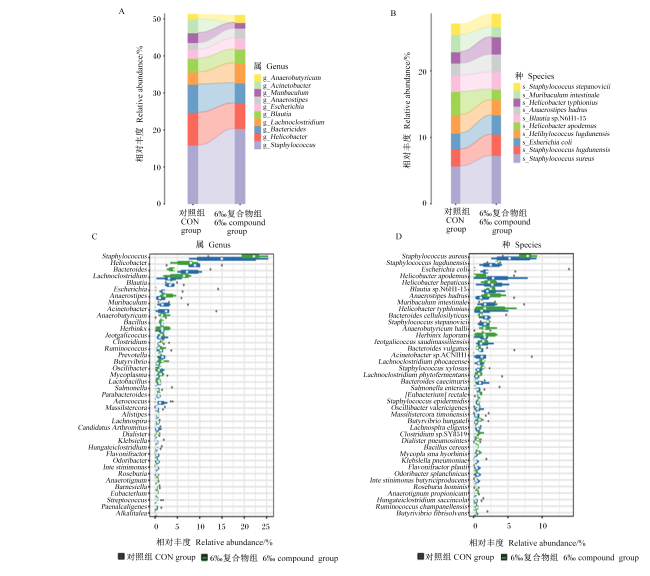
图5 饲粮中添加6‰复合物的昆明小鼠盲肠内容物中菌群组成在属和种水平上的差异分析Anaerostipes:厌氧链球菌属;Muribaculum:肠鼠杆菌属;Lactobacillus:乳杆菌属;Parabacteroides:副拟杆菌属;Aerococcus:气球菌属;Massilistercora:蒂氏马氏菌属;Alistipes:另枝菌属;Lachnospira:毛螺菌属;Candidatus Arthromitus:分节丝状菌属;Dialister:戴阿利斯特杆菌属;Klebsiella:克雷伯氏菌属;Flavonifractor:解黄酮菌属;Roseburia:罗斯氏菌属;Eubacterium:真杆菌属;Streptococcus:链球菌属;Lachnoclostridium phocaeense:噬海鞘氨醇梭菌;Lachnoclostridium phytofermentans:植物发酵梭菌;[Eubacterium] rectale:直肠真杆菌;Staphylococcus epidermidis:表皮葡萄球菌;Oscillibacter valericigenes:颤杆菌;Massilistercora timonensis:马塞氏杆菌;Butyrivibrio hungatei:亨盖特丁酸弧菌;Clostridium sp. SY8519:梭状芽孢杆菌属SY8519;Bacillus cereus:蜡样芽孢杆菌;Mycoplasma hyorhinis:猪鼻支原体;Klebsiella pneumoniae:肺炎克雷伯菌;Flavonifractor plautii:源自珀氏解黄酮菌;Odoribacter splanchnicus:内脏臭气杆菌;Roseburia hominis:罗斯拜瑞氏菌;Ruminococcus champanellensis:瘤胃球菌属香槟亚种;Butyrivibrio fibrisolvens:溶纤维丁酸弧菌;Herbinix luporum:哈尔滨毛螺菌。 A:高相对丰度属桑基图(按总平均丰度排序);B:高相对丰度种桑基图(按总平均丰度排序);C:对照组和6‰复合物组中40个最丰富的属之间的差异;D:对照组和6‰复合物组中40个最丰富的种之间的差异。*为差异显著(P<0.05), **为差异极显著(P<0.01)。A: Sankey map for genera with high relative abundance (sorted by total mean abundance); B: Sankey map for species with high relative abundance (sorted by total mean abundance); C: differences between the 40 most abundant genera in the CON group and the 6‰ compound group; D: differences between the 40 most abundant species in the CON group and 6‰ compound group. * was significantly different (P<0.05), ** was very significant difference (P<0.01). Fig.5 Difference analysis of microflora composition in cecum contents at genus and species levels of Kunming mice supplemented with 6‰ compound |
2.4.3 差异物种分析
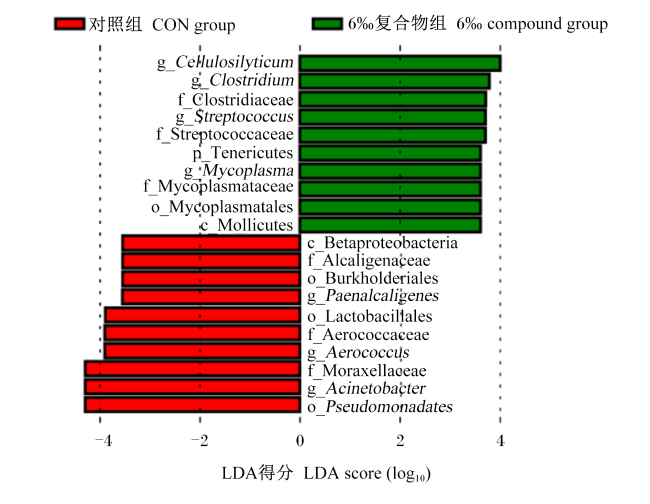


图6 饲粮中添加6‰复合物的昆明小鼠盲肠内容物中菌群组成的差异物种分析(LEfSe分析)Clostridium:梭菌属;Clostridiaceae:梭菌科;Streptococcus:链球菌属;Streptococcaceae:链球菌科;Tenericutes:软壁菌门;Mycoplasma:支原体属;Mycoplasmataceae:支原体科;Mycoplasmatales:支原体目;Mollicutes:柔膜菌纲;Betaproteobacteria:变形菌纲;Alcaligenaceae:产碱杆菌科;Burkholderiales:伯克霍尔德氏菌目;Lactobacillales:乳酸杆菌科;Aerococcaceae:气球菌科;Aerococcus:气球菌属;Moraxellaceae:莫拉氏菌科;Acinetobacter:不动杆菌属;Pseudomonadates:假单胞菌目。 Fig.6 Differential species analysis of microflora composition in cecum contents of Kunming mice supplemented with 6‰ compound (LEfSe analysis) |