REVIEW

Advances in Comparative Nutritional Characterization of Goat Milk and Sheep Milk

  • YANG Yaxin , 1, 2, 3 ,
  • LIU Huimin 1, 2 ,
  • MENG Lu 1, 2 ,
  • ZHENG Nan , 1, 2, *
Expand
  • 1 Key Laboratory of Quality Safety Control for Milk and Dairy Products of Ministry of Agriculture and Rural Affairs, Institute of Animal Sciences, Chinese Academy of Agricultural Sciences, Beijing 100193, China
  • 2 Laboratory of Quality and Safety Risk Assessment for Dairy Products of Ministry of Agriculture and Rural Affairs, Institute of Animal Sciences, Chinese Academy of Agricultural Sciences, Beijing 100193, China
  • 3 College of Animal Sciences of Shanxi Agricultural University, Jinzhong 030801, China
* professor, E-mail:

Received date: 2024-08-09

  Online published: 2025-04-15

Abstract

Goat milk and sheep milk have gained consumer preference due to their unique nutritional values and health benefits. This paper conducts a comprehensive comparative analysis to explore the differences in key nutrients such as protein, fat, lactose, amino acids, fatty acids, minerals, vitamins and oligosaccharides between goat milk and sheep milk. Additionally, the study examines the specific impacts of factors such as breed, lactation period, parity, feeding management, geographical region and seasonal variations on the nutritional components of milk. The research provides a scientific basis for further understanding the nutritional value of goat and sheep milk, offers references for the production and marketing strategies of the dairy industry, and provides comprehensive nutritional information for consumers, promoting a scientific understanding of healthy foods and supporting the sustainable development of the dairy industry.[Chinese Journal of Animal Nutrition, 2025, 37(4):2211-2224]

Cite this article

YANG Yaxin , LIU Huimin , MENG Lu , ZHENG Nan . Advances in Comparative Nutritional Characterization of Goat Milk and Sheep Milk[J]. Chinese Journal of Animal Nutrition, 2025 , 37(4) : 2211 -2224 . DOI: 10.12418/CJAN2025.188

山羊乳和绵羊乳在全球众多地区的营养摄取和饮食传统中扮演着重要的角色,在过去几十年中,全球山羊乳和绵羊乳的产量快速增长,预计到2030年将分别增长26%和53%[1]。国家统计局发布的《2023年中国农业统计年鉴》显示,截止2022年底,我国山羊数量为13 224.2万头,绵羊数量为19 403万头,绵羊数量远高于山羊,但我国绵羊乳行业发展却处于起步阶段。研究表明,山羊乳和绵羊乳是天然的功能乳,主要是因为其较高的营养价值、易消化特性以及治疗和饮食特性,这些特性主要源于特有的营养成分及生物活性成分[2]。因此,本文旨在通过综合分析现有的科学文献和研究报告,对山羊乳和绵羊乳的营养成分进行全面比较,并探讨影响这些营养成分的关键因素,以期为全面了解山羊乳和绵羊乳的营养价值提供科学依据,推动乳制品行业的可持续发展。

1 山羊乳和绵羊乳营养成分比较

1.1 蛋白质、脂肪、乳糖及总固形物含量比较

山羊乳和绵羊乳中蛋白质、脂肪、乳糖及总固形物含量存在差异(表1),山羊乳中蛋白质、脂肪和总固形物含量明显低于绵羊乳,而乳糖含量与绵羊乳接近,但略低于绵羊乳。
表1 山羊乳和绵羊乳主要组成成分及含量

Table 1 Main components and contents of goat milk and sheep milk g/100 g 液态奶

项目Items 山羊乳Goat milk 绵羊乳Sheep milk 参考文献References
蛋白质
Protein
3.19±0.08 5.72±0.28 [3]
2.88±0.05 5.74±0.19 [4]
3.71±0.01 5.52±0.03 [5]
3.97±0.53 5.35±0.60 [6]
脂肪
Fat
3.79±0.39 5.99±0.44 [3]
2.82±0.12 7.30±0.19 [4]
3.92±0.03 7.88±0.01 [5]
5.49±1.43 6.60±0.98 [6]
乳糖
Lactose
4.40±0.05 4.76±0.12 [3]
4.43±0.20 4.86±0.14 [4]
4.66±0.21 4.71±0.40 [6]
总固形物
Total solids
11.90±0.53 17.46±0.60 [3]
10.99±0.11 18.80±0.09 [4]
13.14±0.02 19.25±0.01 [5]
蛋白质主要包括乳清蛋白和酪蛋白,乳清蛋白由β-乳球蛋白、α-乳白蛋白、免疫球蛋白、乳铁蛋白(LF)等构成[7]。酪蛋白根据其化学性质及功能特性又分为αS1-酪蛋白、αS2-酪蛋白、β-酪蛋白和κ-酪蛋白4种类型,不同蛋白质引起的过敏反应的强度顺序为αS1-酪蛋白>β-乳球蛋白>αS2-酪蛋白>κ-酪蛋白[8]。Fiocchi等[9]报道,α-酪蛋白可以作为其他牛奶过敏原(β-乳球蛋白)的载体,在热处理过程中与酪蛋白胶束紧密结合,从而使其消化困难。如表2所示,山羊乳中α-酪蛋白含量较低,因此,山羊乳中的β乳球蛋白和其他过敏原可能更容易被消化,从而降低了致敏性。除此之外,山羊乳和绵羊乳中一些蛋白质具有免疫调节作用。α-酪蛋白是血管紧张素转换酶(ACE)的有效抑制剂,在调节血压和炎症中发挥作用,通过抑制ACE、α-酪蛋白可以减少炎症,有降低患心血管疾病的作用[10];乳铁蛋白可以调节免疫反应,抑制细菌和病毒的生长,减少炎症;乳铁蛋白已被证明可有效缓解关节炎、结肠炎和其他炎症性疾病动物模型中的炎症反应[11]
表2 山羊乳与绵羊乳中蛋白质组成

Table 2 Protein composition of goat and sheep milk[3] g/100 g蛋白质

项目Items 山羊乳Goat milk 绵羊乳Sheep milk
αS1-酪蛋白αS1-casein 8.9±0.4 34.1±1.1
αS2-酪蛋白αS2-casein 10.9±0.4 11.9±0.1
β-酪蛋白β-casein 44.2±0.8 29.0±0.5
κ-酪蛋白κ-casein 16.6±0.7 11.2±1.0
α-乳白蛋白α-lactalbumin 8.3±0.4 4.7±0.5
β-乳球蛋白β-lactoglobulin 11.1±0.8 9.1±0.5

1.2 氨基酸组成比较

氨基酸是人类和动物食品中蛋白质和肽的基本成分,也是神经递质和激素等化合物的含氮骨架。如表3所示,山羊乳和绵羊乳中氨基酸组成相似,且种类齐全,均含有人体所需的必需氨基酸。
表3 山羊乳和绵羊乳氨基酸组成

Table 3 Amino acid composition of goat milk and sheep milk[12] g/100 g液态奶

项目Items 山羊乳Goat milk 绵羊乳Sheep milk
必需氨基酸EAAs 1.95~2.21 2.45~2.98
组氨酸His 0.11~0.13 0.15~0.19
异亮氨酸Ile 0.19~0.22 0.25~0.32
亮氨酸Leu 0.40~0.46 0.50~0.58
赖氨酸Lys 0.34~0.41 0.48~0.54
蛋氨酸Met 0.14~0.15 0.18~0.21
苯丙氨酸Phe 0.23~0.26 0.28~0.37
苏氨酸Thr 0.28~0.30 0.31~0.38
色氨酸Typ ND ND
缬氨酸Val 0.26~0.28 0.30~0.39
非必需氨基酸NEAA 2.54~2.96 3.18~4.30
丙氨酸Ala 0.13~0.17 0.23~0.27
精氨酸Arg 0.13~0.16 0.21~0.26
天冬酰胺/天冬氨酸Asx/Asp 0.30~0.39 0.45~0.55
半胱氨酸Cys 0.04~0.05 0.05~0.09
谷氨酰胺/谷氨酸Glx/Gln 0.98~1.08 1.25~1.45
甘氨酸Gly 0.07~0.09 0.11~0.13
脯氨酸Pro 0.45~0.49 0.53~0.74
丝氨酸Ser 0.27~0.31 0.35~0.43
酪氨酸Tyr 0.17~0.22 0.31~0.38
总氨基酸TAAs 4.49~5.17 5.63~7.28

ND表示未检出。下表同。

ND indicate not detected. The same as below.

陈天鹏等[13]综述中山羊乳中色氨酸含量为1.26 g/100 g蛋白质。Muldasheva等[14]研究表明,绵羊乳中色氨酸含量为0.71~0.77 g/100 g蛋白质。相比于山羊乳,绵羊乳中总氨基酸含量、必需氨基酸总量以及各氨基酸含量均高于山羊乳。山羊乳中必需氨基酸占总氨基酸的百分比为43.06%,高于绵羊乳的42.06%;山羊乳和绵羊乳中谷氨酸与谷氨酰胺之和是总氨基酸中含量最高的,其次是脯氨酸、亮氨酸,这与Mohsin等[15]研究结果一致。不同氨基酸在人体生命活动中发挥不同作用,如亮氨酸不仅是翻译起始的关键因子,也是骨骼肌蛋白质合成的重要激活剂,在较短的身体活动中,亮氨酸能够有效地部分维护肌肉健康,发挥保护作用[16];谷氨酸是细胞内重要的递质物质,也是谷胱甘肽的前体,研究表明,含硫氨基酸具有抗氧化的特性,在食品或人体中添加或补充含硫氨基酸可有助于抑制氧化应激或减少细胞损伤[17-18]。当人体摄入必需氨基酸不足时,可能会出现抑郁、焦虑、失眠、疲劳、虚弱和生长迟缓等症状。因此,确保足够的必需氨基酸摄入对于维持正常的生理功能和预防相关疾病至关重要[19]
游离氨基酸(FAAs)是蛋白质合成的基础,并且特定的膳食游离氨基酸与幼龄动物的生长有关[20-21]。山羊乳和绵羊乳游离氨基酸组成见表4,山羊乳中游离氨基酸总量、必需氨基酸总量、非必需氨基酸总量均高于绵羊乳。山羊乳中谷氨酰胺/谷氨酸是含量最丰富的游离氨基酸,其次是甘氨酸、天冬酰胺/天冬氨酸;绵羊乳中酪氨酸是含量最丰富的游离氨基酸,其次是谷氨酰胺/谷氨酸、天冬酰胺/天冬氨酸。研究表明,膳食补充游离谷氨酰胺、谷氨酸和丝氨酸会增加幼龄动物日增重,这种效应在低出生体重的婴儿中得到证实[22-24]。游离氨基酸除了是细胞生长的关键调节剂之外,还是参与调节免疫细胞增殖、激活和功能的免疫活性成分[25-26]
表4 山羊乳和绵羊乳游离氨基酸组成

Table 4 Free amino acid composition of goat milk and sheep milk[12] mg/100 g液态奶

项目Items 山羊乳Goat milk 绵羊乳Sheep milk
必需氨基酸EAAs 2.56~4.29 1.83~3.46
组氨酸His 0.05~0.16 0.09~0.13
异亮氨酸Ile 0.19~0.37 0.21~0.23
亮氨酸Leu 0.25~0.67 0.30~0.56
赖氨酸Lys 0.51~0.78 0.24~0.29
蛋氨酸Met ND 0.00~0.03
苯丙氨酸Phe 0.39~0.49 0.35~1.11
苏氨酸Thr 0.54~0.84 0.28~0.64
色氨酸Typ ND ND
缬氨酸Val 0.63~0.98 0.36~0.47
非必需氨基酸NEAA 15.88~21.75 7.68~15.87
丙氨酸Ala 1.19~1.33 0.39~0.81
精氨酸Arg 0.48~1.24 0.63~0.78
天冬酰胺/天冬氨酸Asx/Asp 2.76~3.93 0.99~1.20
半胱氨酸Cys 0.03~0.11 ND
谷氨酰胺/谷氨酸Glx/Gln 4.91~7.62 4.08~1.87
甘氨酸Gly 4.29~4.78 0.89~1.35
脯氨酸Pro 0.16~0.44 0.13~0.43
丝氨酸Ser 1.59~1.66 0.25~0.31
酪氨酸Tyr 0.47~0.64 0.32~9.12
游离氨基酸FAAs 18.44~26.04 9.51~19.33

1.3 脂肪酸组成比较

乳脂主要由短链(C4~C10)、中链(C12~C15)和长链(C16~C24)的甘油三酯组成的复杂混合物[27]。牛奶中的甘油三酯中含有400多种不同的脂肪酸,这些脂肪酸具有独特的理化和生物特性[28]。生物活性脂质主要包括单不饱和脂肪酸(MUFA)、油酸(C18∶1 n-9)、多不饱和脂肪酸(PUFA)、亚油酸(LA,C18∶2 n-6)和α-亚麻酸(ALA,C18∶3 n-3)[28-29]等。Basdagianni等[30]对希腊西北部商业农场半粗放生产系统下饲养的山羊乳和绵羊乳进行了脂肪酸谱的比较,结果如表5表6所示,山羊乳中短链脂肪酸含量较绵羊乳更为丰富,尤其是己酸(C6∶0)、辛酸(C8∶0)和癸酸(C10∶0)含量更为显著。在山羊乳中,十三烷酸(C13∶0)、硬脂酸(C18∶0)和花生酸(C20∶0)的含量也相对较高。相比之下,绵羊乳中的亚油酸和α-亚麻酸的含量则相对较高。至于木蜡酸(C24∶0)这一脂肪酸,在山羊乳和绵羊乳中的含量差异并不明显。亚油酸和α-亚麻酸广泛存在于牧草等植物中,哺乳动物和反刍动物不能自身合成,需从食物中获取,属于必需脂肪酸,在人体健康中发挥着重要作用[31-32],例如降低血浆甘油三酯含量,降低患心血管疾病以及阿尔茨海默氏病的风险[33-35]。山羊乳的药用价值主要归因于脂肪酸,己酸、辛酸、癸酸约占总脂肪酸含量的15%,尽管Jansen等[36]发现摄入乳制品中含有的饱和脂肪酸(SFA),包括辛酸、癸酸和己酸,会增加胰腺癌的风险,但Narayanan等[37]体外研究证实,辛酸、癸酸和己酸能够抑制人结直肠癌(HTC-116)、人皮肤表皮样癌(A-431)和人乳腺癌细胞的增殖,具有显著的抗癌活性。
表5 山羊乳和绵羊乳脂肪酸组成

Table 5 Fatty acid composition of goat milk and sheep milk[30] %

脂肪酸Fatty acids 山羊乳Goat milk 绵羊乳Sheep milk
丁酸C4∶0 1.61 1.89
己酸C6∶0 1.90 1.75
辛酸C8∶0 2.29 1.84
癸酸C10∶0 8.01 6.23
癸酸C10∶1 0.18 0.22
十一烷酸C11∶0 0.07 0.09
月桂酸C12∶0 3.63 3.85
十三烷酸C13∶0 1.04 0.77
十三碳烯酸C13∶1 0.11 0.12
肉蔻酸C14∶0 9.14 10.36
肉蔻油酸C14∶1 0.20 0.28
十五烷酸C15∶0 0.83 1.08
十五碳烯酸C15∶1 0.24 0.29
棕榈酸C16∶0 25.38 24.70
棕榈亚酸C16∶1 0.60 0.97
十七烷酸C17∶0 0.71 0.77
十七碳烯酸C17∶1 0.25 0.30
硬脂酸C18∶0 12.73 9.77
反式-n-9油酸C18∶1 n-9 trans 0.40 0.43
反式-11油酸C18∶1 trans-11 1.52 2.36
顺式-n-9油酸C18∶1 n-9 cis 19.38 19.24
顺式-n-9油酸C18∶1 n-7 cis 0.65 0.76
顺式-9,反式-11共轭亚油酸CAL cis-9, trams-11 0.54 0.96
反式亚油酸C18∶2 n-6 trans 0.36 0.56
顺式亚油酸C18∶2 n-6 cis 2.30 2.63
α-亚麻酸C18∶3 n-3 0.83 1.03
花生酸C20∶0 0.39 0.34
附子脂酸C20∶2 0.04 0.04
花生四烯酸C20∶4 n-6 0.16 0.20
山嵛酸C22∶0 0.13 0.15
二十五碳五烯酸C20∶5 n-3 0.06 0.09
木蜡酸C24∶0 0.06 0.07
神经酸C24∶1 0.03 0.03
二十二碳五烯酸C22∶5 n-3 0.12 0.16
二十二碳六烯酸C22∶6 n-3 0.04 0.06
已识别Identified 95.93 94.41
未识别Unidentified 4.07 5.59
表6 山羊乳和绵羊乳脂肪酸比例及营养指数

Table 6 Fatty acid ratio and nutrient index of goat and sheep milk[30]

项目Items 山羊乳Goat milk 绵羊乳Sheep milk
饱和脂肪酸SFA/% 67.92 63.67
不饱和脂肪酸UFA/% 28.01 30.74
单不饱和脂肪酸MUFA/% 23.55 25.00
多不饱和脂肪酸PUFA/% 4.45 5.74
n-3多不饱和脂肪酸n-3 PUFA /% 1.06 1.33
n-6多不饱和脂肪酸n-6 PUFA /% 2.82 3.42
不饱和脂肪酸/饱和脂肪酸UFA/SFA 0.42 0.49
多不饱和脂肪酸/饱和脂肪酸PUFA/SFA 0.07 0.09
n-6/n-3多不饱和脂肪酸n-6/n-3 PUFA 3.08 2.89
致动脉粥样硬化指数AI 2.38 2.35
血栓形成指数TI 2.87 2.48

致动脉粥样硬化指数=(月桂酸+肉蔻酸×4+棕榈酸)/(单不饱和脂肪酸+多不饱和脂肪酸),血栓形成指数=(肉蔻酸+棕榈酸+硬脂酸)/(0.5×单不饱和脂肪酸+0.5×n-6多不饱和脂肪酸+3×n-3多不饱和脂肪酸+n-3/n-6多不饱和脂肪酸)[44]

AI=(C12∶0+C14∶0×4+C16∶0)/(MUFA+PUFA), TI=(C14∶0+C16∶0+C18∶0)/(0.5×MUFA+0.5×n-6 PUFA+3×n-3 PUFA+n-3/n-6 PUFA)[44].

Basdagianni等[30]研究结果表明,绵羊乳中MUFA、PUFA、n-3 PUFA、n-6 PUFA含量高于山羊乳,而SFA的含量低于山羊乳;山羊乳中致动脉粥样硬化指数(AI)、血栓形成指数(TI)以及n-6/n-3 PUFA比率显著高于绵羊乳,但不饱和脂肪酸(UFA)/SFA与PUFA/SFA比率却显著低于绵羊乳。Kondyli等[38]和Talpur等[39]研究结果与上述结果一致,且指出绵羊乳中发现顺式-9,反式-11共轭亚油酸含量更高。Markiewicz-Keszycka等[40]指出,绵羊乳中n-6/n-3 PUFA比率为2.31,山羊乳为5.00,牛乳为6.01;而Williams等[41]研究指出,n-6/n-3 PUFA比率接近1∶1或2∶1时,对健康而言最佳。研究表明,绵羊乳中n-6/n-3PUFA比率优于山羊乳和牛乳。此外,基于既往研究的饮食建议和政策表明,较少SFA的摄入量可以预防慢性疾病[42],AI和TI低(SFA含量较少)的食物具有更大的预防冠状动脉疾病的潜力[43]。因此,相比于山羊乳,绵羊乳在预防慢性疾病方面可能具有更大的潜力,但仍需进一步深入研究。

1.4 矿物质含量比较

矿物质是牛奶中天然存在的无机成分,具有多种生理功能[45]。如常量元素钙(Ca)、镁(Mg)等在骨骼形成以及肌肉收缩和松弛方面具有重要作用,从而实现各种身体活动;锌(Zn)、铁(Fe)、锰(Mn)、铜(Cu)、锶(Sr)、硒(Se)等微量元素在免疫调节、维持细胞结构稳定等方面发挥重要作用[46-47]。羊乳富含人体必需的矿物元素(表7),Chia等[45]研究发现,相比于山羊乳,绵羊乳中钙、磷、镁、铁、锌含量更高;Spiteri等[48]比较了饲养在Malta和Gozo岛上的山羊乳、绵羊乳和牛乳的矿物元素含量,结果表明不同地区饲养的相同物种动物,乳中矿物元素含量有显著差异,绵羊乳中钙、镁、铁、锌、钡和铜含量均高于山羊乳,而山羊乳中钾元素含量显著高于绵羊乳。
表7 山羊乳与绵羊乳中矿物质含量及范围

Table 7 Mineral contents and ranges in goat milk and sheep milk mg/L

项目Items 山羊乳Goat milk 绵羊乳Sheep milk 参考文献References
钙Ca (920±96)~(926±90)
1 537±97
1 060~1 920
1 003.48
(1 234±106)~(1 257±208)
1 855±35
1 360~2 184
1 541.25
[48]
[49]
[45]
[50]
镁Mg (140±14)~(142±23)
104.3±3.9
100~210
84.45
(166±20)~(171±34)
163.9±5.4
80~197
139.91
[48]
[49]
[45]
[50]
钾K (1 214±127)~(1 218±132)
1 797.0±47.0
1 239~2 370
1 090.10
(864±152)~(971±168)
1 407.3±114.7
974~2 256
746.10
[48]
[49]
[45]
[50]
钠Na 234.6±7.7
317~500
233.30
292.3±29.7
290~740
475.23
[49]
[45]
[50]
磷P 1 168.8±110.6
910~140
602.43
1 553.7±91.4
800~1 597
879.26
[49]
[45]
[50]
氯Cl 1 000~1 980 0~1 600 [45]
硫S 280
227.56
0~290
472.37
[45]
[50]
锌Zn (1.06±0.33)~(3.31±0.79)
4.85±0.09
2.4~5.6
2.706
(3.38±1.05)~(3.82±0.92)
5.21±0.06
3.8~7.7
3.149
[48]
[49]
[45]
[50]
铁Fe (0.62±0.13)~(0.69±0.12)
0.17±0.01
0.820
(0.78±0.33)~(1.07±0.58)
0.16±0.02
1.350
[48]
[49]
[50]
锰Mn 0.1~0.3
0.063
0.1
0.090
[45]
[50]
铜Cu 0.34±0.08
0.09±0.01
0.1~0.5
0.048
(0.36±0.15)~(0.39±0.13)
0.09±0.02
0.1~0.9
0.030
[48]
[49]
[45]
[50]
锶Sr 0.480 0.990 [50]
硒Se 0.027 0.054 [50]
钡Ba (0.58±0.50)~(1.07±1.38)
0.24
(0.61±3.02)~(0.65±0.33)
0.43
[48]
[50]

1.5 维生素含量比较

羊乳中富含多种维生素,最重要的是脂溶性维生素(维生素A、D、E、K)、水溶性维生素(维生素B1、B2、B3、B6、B12)、维生素C和维生素H[2]。与山羊乳相比,绵羊乳中维生素B1、B2、B3、B5、B6、B9、B12和C含量更高,而维生素A、D、H含量较低(表8)。Nayak等[51]研究结果显示,除维生素A以外,山羊乳中维生素B1、B2、B12、C和E含量均低于绵羊乳;且绵羊乳中维生素E含量为120 μg/dL,显著高于山羊乳(40 μg/dL)。维生素是人体无法自身合成的必需微量营养素,具有多种生物学功能。维生素A能够调节细胞和组织的生长和分化,B族维生素可作为酶辅因子和辅酶或其前体发挥作用,维生素D能够调节骨骼和身体其他器官的矿物质代谢,维生素C和E可作为抗氧化剂,防止体内自由基氧化细胞[52]。研究表明,维生素缺乏可能会导致糙皮病、脚气病、坏血病、佝偻病、神经缺陷病等;同时,一些维生素摄入过量时会有慢性毒性或急性毒性,如维生素A和D在体内积聚过多,可能会导致维生素过多症;亲和素可以抑制生物素的吸收,硫胺素能够抑制维生素B1酶的使用等[52]
表8 山羊乳和绵羊乳中维生素含量

Table 8 Vitamin contents in goat milk and sheep milk[2] μg/100 g

项目Items 山羊乳Goat milk 绵羊乳Sheep milk
维生素A VA 55.5 43.8
维生素D VD 0.06 0.28
维生素B1 VB1 68 80
维生素B2 VB2 210 376
维生素B3 VB3 270 461
维生素B5 VB5 310 408
维生素B6 VB6 46 80
维生素B9 VB9 1.0 5.0
维生素H VH 1.5 0.93
维生素B12 VB12 65 712
维生素C VC 1 290 4 160

1.6 低聚糖种类及含量比较

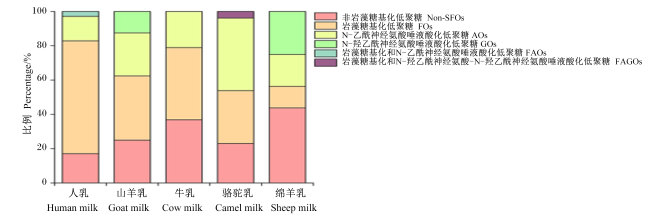
低聚糖是乳中碳水化合物重要组成,可作为益生元、免疫调节剂和病原体抑制剂发挥作用,并被发现可以改善肠道屏障功能[53]。山羊乳和绵羊乳中富含多种低聚糖(表9)。Wang等[54]对比了人乳、山羊乳、绵羊乳、牛乳、骆驼乳中低聚糖种类及丰度,结果表明山羊乳中鉴定得到的低聚糖种类更丰富,这与Shi等[55]、Albrecht等[56] 、Lee等[57]研究结果一致。Wang等[54]的研究结果也证明了不同物种之间,各种低聚糖丰度的差异(图1)。表10比较了文献中检测到的山羊乳与绵羊乳中各种低聚糖浓度,结果显示绵羊乳中2-岩藻糖基乳糖(2-FL)、3-岩藻糖基乳糖(3-SL)浓度较高,山羊乳中3-FL、乳糖-N-岩藻五糖Ⅰ(LNFPⅠ)、6-唾液酸乳糖(6-SL)浓度较高。
表9 山羊乳和绵羊乳中检测和发表的低聚糖结构列表

Table 9 List of oligosaccharide structures detected and published in goat milk and sheep milk

山羊乳Goat milk 绵羊乳Sheep milk 参考文献References
24 16 [54]
42 32 [55]
40 37 [56]
/ 15 [57]

/表示在此参考文献中未检测相关内容。下表同。

/ indicated that no relevant content has been detected in this reference. The same as below.

图1 不同动物乳汁中检测到的不同种类低聚糖比例

Fig.1 Percentage of different types of oligosaccharides detected in milk of different animals[54]

表10 山羊乳和绵羊乳中低聚糖浓度

Table 10 Concentration of oligosaccharides in goat milk and sheep milk[58-59] μg/mL

项目Items 山羊乳Goat milk 绵羊乳Sheep milk
3'-半乳糖基乳糖3'-GSL / 75
乳糖-N-新四糖LNnT ND /
乳糖-N-四糖LNT 115.39±6.74 50(包含乳糖-N-新四糖)
乳糖-N-新六糖LNnH 42.43±22.74 /
2-岩藻糖基乳糖2-FL 29.58±28.31 244
3-岩藻糖基乳糖3-FL 71.21±41.31 24
乳糖-N-岩藻五糖Ⅰ LNFPⅠ 98.59±43.31 3
乳糖-N-岩藻五糖Ⅱ LNFPⅡ / 1
乳糖-N-二岩藻六糖Ⅰ LNDFHⅠ / ND
乳糖-N-二岩藻六糖Ⅱ LNDFHⅡ / ND
3-唾液酸乳糖3-SL 156.19±84.28 245
6-唾液酸乳糖6-SL 2 257.89±185.23 190

1.7 其他活性成分

Anagnostopoulos等[60]通过蛋白质组学表征希腊山羊乳和绵羊乳,结果显示,山羊乳清蛋白质成分在分子功能方面表现出相似的特性,对乳酸脱氢酶B链(LACB)、钙调蛋白结合蛋白1(CIB1)和载脂蛋白A1(APOA1)3种蛋白质在绵羊乳和山羊乳中乳清成分发挥着独特作用。APOA1是一种已知的心血管危险因素,多项研究表明APOA1与心血管健康方面的高密度脂蛋白胆固醇呈负相关[61]。LACB是一种主要存在于牛奶中的过敏原,能够与免疫球蛋白E(IgE)相互作用,并引起皮肤、胃肠道和呼吸系统的过敏反应以及严重的过敏性休克。山羊乳清中,LACB含量比绵羊乳清中多,特别是在Capra山羊乳清中,这种蛋白质的含量更高[62]。CIB1是一种22 ku的螺旋状蛋白质,与钙调磷酸酶B相关,在许多细胞类型中表达,CIB1与多种其他蛋白质结合。最近研究表明,CIB1是正常胚胎发育所必需的,CIB1敲除小鼠表现出表型异常,包括病理性血管生成受损、肿瘤生长减少、防止心脏肥厚和雄性不育[63]。Anagnostopoulos等[60]研究结果显示,CIB1蛋白在绵羊乳清中的表达比山羊乳清更高。
Tagliazucchi等[64]比较了脱脂牛乳、骆驼乳、山羊乳和绵羊乳蛋白质的体外消化率、选定的生物活性和消化产物,结果表明山羊乳消化率最快,绵羊乳消化后的ACE抑制活性最高,且在山羊和绵羊消化乳中均检测到了焦谷氨酸肽(VPP)和异亮氨酸肽(IPP)2种肽,这2种肽已被证明每天剂量在5~100 mg可以降低高血压患者的收缩压和舒张压,并积极调节轻度高血压受试者的脉搏波速度[65]。此外,Manis等[66]还比较了山羊乳与绵羊乳脂质组的差异,结果显示相较于山羊乳,绵羊乳中鞘磷脂、丁酰肉碱以及其他神经酰胺类活性脂质含量更丰富,这些活性物质具有减轻炎症、预防肠道菌群失调的作用[67]

2 影响羊乳营养成分的因素

2.1 品种

Ferro等[68]综合比较了不同品种的山羊乳和绵羊乳总产奶量、日产奶量、乳成分和乳能量的平均值,结果显示山羊乳中波尔(Boer)羊乳蛋白、乳脂、乳糖和总固形物含量最高;绵羊乳中不同品种之间乳成分含量没有显著差异,但能量有显著差异。Lôbo等[69]比较了巴西东南部饲养的阿尔卑斯(Alpine)羊、萨能(Saanen)羊、吐根堡山(Toggenburg)羊的泌乳量和乳成分,结果发现品种会影响山羊乳成分。Yabrir等[70]研究了阿尔及利亚草原饲养的欧拉羊和杜泊羊的矿物元素分布,发现品种会显著影响钾、钠、锌含量,而钙、磷、镁、铁、铜、锰含量则不受影响。Mohsin等[15]比较了阿尔卑斯羊、贾母纳普尔(Jamnapari)山羊、萨能羊、大马士革山(Shami)羊和吐根堡山羊的化学成分(氨基酸、脂肪酸)和矿物质组成,结果显示,不同品种之间的化学成分和矿物组成存在显著差异。

2.2 泌乳期

Currò等[71]采集泌乳期为4~24周山羊乳检测乳成分及脂肪酸,结果显示从泌乳第4周至第8周蛋白质和脂肪百分比呈下降的趋势,第8周以后又缓慢上升;泌乳末期乳中n-3 PUFA、n-6 PUFA、共轭亚油酸、UFA、MUFA和PUFA含量高于泌乳早期,这些差异可能与泌乳中期和末期牧草摄入量的增加有关。Li等[5]对比了新西兰绵羊乳泌乳早期(30~60 d)、泌乳中期(60~130 d)、泌乳末期(130~180 d)的营养成分,结果显示泌乳末期乳脂肪、乳蛋白、总固形物及部分元素如镁、钠、氯含量显著高于泌乳早期和泌乳中期,乳糖、钾含量与之相反;泌乳末期绵羊乳脂的脂肪酸中短链SFA含量最低,肉蔻酸、棕榈酸和花生酸含量最高,这可能与硬脂酰辅酶A去饱和酶活性有关。据报道,绵羊乳在泌乳末期的硬脂酰辅酶A去饱和酶活性更高[72]。此外,Li等[5]结果也表明,泌乳早期反式-11油酸、亚油酸和α-亚麻酸含量显著高于泌乳中期和泌乳末期。

2.3 胎次

Adegoke等[73]比较胎次(1、2、3胎)对西非矮山羊哺乳期乳房性状、产奶量和乳成分的影响,结果显示3胎母羊产奶量显著高于1和2胎,且产奶量随胎次增加而显著增加;此外,胎次对羊乳的乳蛋白、乳脂肪、总固形物、非脂乳固体含量有显著影响,但对乳糖含量没有影响,且3胎羊乳中乳成分含量显著高于1和2胎羊乳。这与一些研究结果[74-75]一致,胎次也会影响羊乳脂肪酸谱、干物质、蛋白质和乳糖含量。

2.4 饲粮组成

饲粮组成和营养水平会影响产奶量和成分。Kasapidou等[76]比较了集约化饲养(舍饲)和半集约化饲养(白天放牧,晚上舍饲)对绵羊乳理化特性及营养成分的影响,结果发现半集约化饲养模式的绵羊乳脂肪酸组成和营养价值显著提高,这可能归因于饲粮中优质牧草的添加。Zazharska等[77]比较了常规饲粮(干草和精饲料)和通过引入颗粒状苜蓿干草、卷心菜和胡萝卜以及混合饲料改善的饲粮对山羊乳生产力和特性的影响,结果显示后者提高了产奶量,且乳中蛋白质含量也增加了,但冰点和电导率有所下降。

2.5 地区差异

Lôbo等[69]比较了巴西东南部饲养的萨能羊和巴西东北部饲养的萨能羊泌乳量及乳成分,结果显示东南部饲养的萨能羊乳脂肪、蛋白质及总固形物含量高于东北部饲养的萨能羊,地理位置(地区差异)可能会改变泌乳量及乳成分。Landi等[12]对在意大利Ailano和Valle Agricola 2个地区饲养的牛、山羊和绵羊乳中蛋白质、总氨基酸以及游离氨基酸含量进行表征,结果显示Ailano地区饲养下的生乳中总蛋白质以及非蛋白氮含量高于Valle Agricola地区饲养下的生乳中,且总氨基酸、必需氨基酸、非必需氨基酸含量均呈现以上趋势,但总游离氨基酸含量呈现相反的趋势。

2.6 季节差异

Li等[5]采集新西兰春、夏、冬3个季节的山羊乳比较其营养成分,结果显示乳脂肪、乳蛋白、总固形物、矿物元素以及部分脂肪酸含量受季节显著影响,特别是硬脂酸含量受季节影响最大。Siefarth等[78]研究了德国2个农场在夏季和冬季的山羊奶的脂肪酸组成,发现与夏季山羊乳相比,冬季山羊乳含有更高的硬脂酸和MUFA含量,而肉蔻酸含量更低。然而,冬季山羊乳和夏季山羊乳脂肪酸成分的总体差异相当小。

3 小结与展望

本文通过系统性分析山羊乳和绵羊乳的营养成分,揭示了它们在蛋白质、脂肪、乳糖、氨基酸、脂肪酸、矿物质、维生素以及低聚糖等关键营养元素方面具有显著差异。这些差异不仅有利于我们对羊乳营养特性的深入理解,而且为消费者选择羊乳产品提供了科学依据。未来研究将深入探讨这些营养成分对健康的潜在益处及其分子机制,同时着眼于通过创新的饲养与加工技术提升产品营养价值和安全性。同时考量羊乳生产的环境影响,推动可持续生产实践。综上所述,本研究致力于通过科学创新,提升羊乳产品的附加值,促进乳制品行业的持续创新和可持续发展。
[1]
PULINA G, MILÁN M J, LAVÍN M P, et al. Invited review:current production trends,farm structures,and economics of the dairy sheep and goat sectors[J]. Journal of Dairy Science, 2018, 101(8):6715-6729.

[2]
PANDYA A J, GOKHALE A J, MALLIK J M. Overview of functionality of goat and sheep milk[J]. International Journal of Current Microbiology and Applied Sciences, 2020, 9(10):2750-2764.

[3]
LI S Q, DELGER M, DAVE A, et al. Seasonal variations in the composition and physicochemical characteristics of sheep and goat milks[J]. Foods, 2022, 11(12):1737.

[4]
KAWECKA A, PASTERNAK M. Nutritional and dietetic quality of milk and traditional cheese made from the milk of native breeds of sheep and goats[J]. Journal of Applied Animal Research, 2022, 50(1):39-46.

[5]
TERZIOĞLU M E, BAKIRCI Ī, OZ E, et al. Comparison of camel,buffalo,cow,goat,and sheep yoghurts in terms of various physicochemical,biochemical,textural and rheological properties[J]. International Dairy Journal, 2023,146:105749.

[6]
PIRAS C, CENITI C, HARTMANE E, et al. Rapid liquid AP-MALDI MS profiling of lipids and proteins from goat and sheep milk for speciation and colostrum analysis[J]. Proteomes, 2020, 8(3):20.

[7]
SIDDIQUI S A, SALMAN S H M, REDHA A A, et al. Physicochemical and nutritional properties of different non-bovine milk and dairy products:a review[J]. International Dairy Journal, 2023,148:105790.

[8]
李贺, 马莺. 羊乳营养及其功能性特性[J]. 中国乳品工业, 2017, 45(1):29-33,49.

LI H, MA Y. Nutrition and functional properties of goat milk[J]. China Dairy Industry, 2017, 45(1):29-33,49. (in Chinese)

[9]
FIOCCHI A, BROZEK J, SCHÜNEMANN H, et al. World allergy organization (WAO) diagnosis and rationale for action against cow’s milk allergy (DRACMA) guidelines[J]. World Allergy Organization Journal, 2010, 3(4):57-161.

[10]
ALKAISY Q H, AL-SAADI J S, AL-RIKABI A K J, et al. Exploring the health benefits and functional properties of goat milk proteins[J]. Food Science & Nutrition, 2023, 11(10):5641-5656.

[11]
TILLIB S V, PRIVEZENTSEVA M E, IVANOVA T I, et al. Single-domain antibody-based ligands for immunoaffinity separation of recombinant human lactoferrin from the goat lactoferrin of transgenic goat milk[J]. Journal of Chromatography B: Analytical Technologies in the Biomedical and Life Sciences, 2014,949-950:48-57.

[12]
LANDI N, RAGUCCI S, DI MARO A. Amino acid composition of milk from cow,sheep and goat raised in Ailano and Valle Agricola,two localities of ‘Alto Casertano’ (Campania region)[J]. Foods, 2021, 10(10):2431.

[13]
陈天鹏, 刘翠, 冷友斌, 等. 羊乳营养成分及功能特性的研究进展[J]. 中国食物与营养, 2016, 22(3):71-76.

CHEN T P, LIU C, LENG Y B, et al. Research progress on nutritional components and functional propery of goat milk[J]. Food and Nutrition in China, 2016, 22(3):71-76. (in Chinese)

[14]
MULDASHEVA A, ZHAKUPOVA G, IBRAYEV D, et al. Comparative characteristics of the amino acids composition of sheep milk from breeds of northern Kazakhstan[J]. Current Research in Nutrition and Food Science, 2021, 9(3):980-987.

[15]
MOHSIN A Z, SUKOR R, SELAMAT J, et al. Chemical and mineral composition of raw goat milk as affected by breed varieties available in Malaysia[J]. International Journal of Food Properties, 2019, 22(1):815-824.

[16]
ENGLISH K L, METTLER J A, ELLISON J B, et al. Leucine partially protects muscle mass and function during bed rest in middle-aged adults[J]. The American Journal of Clinical Nutrition, 2016, 103(2):465-473.

[17]
SUMMER A, MALACARNE M, MARTUZZI F, et al. Structural and functional characteristics of modenese cow milk in Parmigiano-Reggiano cheese production[J]. Annals of the Faculty of Medicine and Veterinary of Parma University, 2002,22:163-174.

[18]
KIM J I, JANG H J, CHO W Y, et al. In vitro antioxidant actions of sulfur-containing amino acids[J]. Arabian Journal of Chemistry, 2020, 13(1):1678-1684.

[19]
LOPEZ M J, MOHIUDDIN S S. Biochemistry,essential amino acids[M]//LOPEZ M J,MOHIUDDIN S S.StatPearls [Internet]. Treasure Island (FL): StatPearls Publishing,2024:NBK557845.

[20]
MOU Q, YANG H S, YIN Y L, et al. Amino acids influencing intestinal development and health of the piglets[J]. Animals, 2019, 9(6):302.

[21]
REZAEI R, WANG W W, WU Z L, et al. Biochemical and physiological bases for utilization of dietary amino acids by young pigs[J]. Journal of Animal Science and Biotechnology, 2013, 4(1):7.

DOI PMID

[22]
ZHOU X H, ZHANG Y M, WU X, et al. Effects of dietary serine supplementation on intestinal integrity,inflammation and oxidative status in early-weaned piglets[J]. Cellular Physiology and Biochemistry, 2018, 48(3):993-1002.

[23]
ZOU T D, DENG C X, WANG Z R, et al. Dietary alanyl-glutamine improves growth performance of weaned piglets through maintaining intestinal morphology and digestion-absorption function[J]. Animal, 2019, 13(9):1826-1833.

DOI PMID

[24]
SAMPURNA M, ANGELIKA D N, UTOMO M T, et al. Effect of enteral glutamine supplementation for low-birth-weight infants on weight gain patterns and levels of fecal secretory immunoglobulin A[J]. Turk Pediatri Arsivi, 2018, 53(4):231-237.

[25]
LI P, YIN Y L, LI D F, et al. Amino acids and immune function[J]. British Journal of Nutrition, 2007, 98(2):237-252.

DOI PMID

[26]
KIM M H, KIM H. The Roles of glutamine in the intestine and its implication in intestinal diseases[J]. International Journal of Molecular Sciences, 2017, 18(5):1051.

[27]
ALONSO L, FONTECHA J, LOZADA L, et al. Fatty acid composition of caprine milk:major,branched-chain,and trans fatty acids[J]. Journal of Dairy Science, 1999, 82(5):878-884.

[28]
DJORDJEVIC J, LEDINA T, BAITIC M Z, et al. Fatty acid profile of milk[J]. IOP Conference Series:Earth and Environmental Science, 2019,333:012057.

[29]
SIEGEL G, ERMILOV E. Omega-3 fatty acids:benefits for cardio-cerebro-vascular diseases[J]. Atherosclerosis, 2012, 225(2):291-295.

[30]
BASDAGIANNI Z, PAPALOUKAS L, KYRIAKOU G, et al. A comparative study of the fatty acid and terpene profiles of ovine and caprine milk from Greek mountain sheep breeds and a local goat breed raised under a semi-extensive production system[J]. Food Chemistry, 2019,278:625-629.

[31]
CABIDDU A, DECANDIA M, ADDIS M, et al. Managing mediterranean pastures in order to enhance the level of beneficial fatty acids in sheep milk[J]. Small Ruminant Research, 2005, 59(2/3):169-180.

[32]
VOGEL L, GNOTT M, KRÖGER-KOCH C, et al. Effects of abomasal infusion of essential fatty acids together with conjugated linoleic acid in late and early lactation on performance,milk and body composition,and plasma metabolites in dairy cows[J]. Journal of Dairy Science, 2020, 103(8):7431-7450.

[33]
HARRIS W S, BULCHANDANI D. Why do omega-3 fatty acids lower serum triglycerides?[J]. Current Opinion in Lipidology, 2006, 17(4):387-393.

DOI PMID

[34]
CASULA M N A, SORANNA D, CATAPANO A L, et al. Long-term effect of high dose omega-3 fatty acid supplementation for secondary prevention of cardiovascular outcomes:a Meta-analysis of randomized,placebo controlled trials[corrected][J]. Atherosclerosis Supplements, 2013, 14(2):243-251.

[35]
KYLE D J, SCHAEFER E, PATTON G, et al. Low serum docosahexaenoic acid is a significant risk factor for Alzheimer’s dementia[J]. Lipids, 1999,34:S245.

[36]
JANSEN R J, ROBINSON D P, FRANK R D, et al. Fatty acids found in dairy,protein and unsaturated fatty acids are associated with risk of pancreatic cancer in a case-control study[J]. International Journal of Cancer, 2014, 134(8):1935-1946.

[37]
NARAYANAN A, BASKARAN S A, AMALARADJOU M A R, et al. Anticarcinogenic properties of medium chain fatty acids on human colorectal,skin and breast cancer cells in vitro[J]. International Journal of Molecular Sciences, 2015, 16(3):5014-5027.

[38]
KONDYLI E, SVARNAS C, SAMELIS J, et al. Chemical composition and microbiological quality of ewe and goat milk of native Greek breeds[J]. Small Ruminant Research, 2012, 103(2/3):194-199.

[39]
TALPUR F N, BHANGER M I, MEMON N N. Milk fatty acid composition of indigenous goat and ewe breeds from Sindh,Pakistan[J]. Journal of Food Composition and Analysis, 2009, 22(1):59-64.

[40]
MARKIEWICZ-KESZYCKA M, CZYŻAK-RUNOWSKA G, LIPIÑSKA P, et al. Fatty acid profile of milk-a review[J]. Journal of Veterinary Research, 2013, 57(2):135-139.

[41]
WILLIAMS C D, WHITLEY B M, HOYO C, et al. A high ratio of dietary n-6/n-3 polyunsaturated fatty acids is associated with increased risk of prostate cancer[J]. Nutrition Research, 2011, 31(1):1-8.

DOI PMID

[42]
TE MORENGA L S, MONTEZ J M. Health effects of saturated and trans-fatty acid intake in children and adolescents:systematic review and Meta-analysis[J]. PLoS One, 2017, 12(11):e0186672.

[43]
MOUSSAVI JAVARDI M S, MADANI Z, MOVAHEDI A, et al. The correlation between dietary fat quality indices and lipid profile with atherogenic index of plasma in obese and non-obese volunteers:a cross-sectional descriptive-analytic case-control study[J]. Lipids in Health and Disease, 2020, 19(1):213.

[44]
ULBRICHT T L, SOUTHGATE D A. Coronary heart disease:seven dietary factors[J]. The Lancet, 1991, 338(8773):985-992.

[45]
CHIA J, BURROW K, CARNE A, et al. Chapter 27-minerals in sheep milk[M]//WATSON R R,COLLIER R J,PREEDY V R.Nutrients in Dairy and Their Implications for Health and Disease. New York: Academic Press,2017:345-362.

[46]
DUBEY P, THAKUR V, CHATTOPADHYAY M. Role of minerals and trace elements in diabetes and insulin resistance[J]. Nutrients, 2020, 12(6):1864.

[47]
WEYH C, KRÜGER K, PEELING P, et al. The role of minerals in the optimal functioning of the immune system[J]. Nutrients, 2022, 14(3):644.

[48]
SPITERI R, ATTARD E. Determination of major and minor elements in Maltese sheep,goat and cow milk using microwave plasma-atomic emission spectrophotometry[J]. Journal of Agricultural Science, 2017, 9(8):43-50.

[49]
PASZCZYK B, TOÑSKA E, ŁUCZYÑSKA J. Health-promoting value of cow,sheep and goat milk and yogurts[J]. Mljekarstvo, 2019, 69(3):182-192.

[50]
LIOTTA L, LOPREIATO V, ASROOSH F, et al. Physicochemical and mineral content of milk from Talesh buffalos,sheep,goats,and cows,Saanen goats and Talesh-mediterranean buffalos:a comparative analysis[J]. Pakistan Journal of Zoology, 2022,2022:1-8.

[51]
NAYAK C M, RAMACHANDRA C T, KUMAR G M. A comprehensive review on composition of donkey milk in comparison to human,cow,buffalo,sheep,goat,camel and horse milk[J]. Mysore Journal of Agricultural Sciences, 2020, 54(3):42-50.

[52]
GODSWILL A G, SOMTOCHUKWU I V, LKECHUKWU A O, et al. Health benefits of micronutrients (vitamins and minerals) and their associated deficiency diseases:a systematic review[J]. International Journal of Food Sciences, 2020, 3(1):1-32.

[53]
VAN LEEUWEN S S, TE POELE E M, CHATZIIOANNOU A C, et al. Goat milk oligosaccharides:their diversity,quantity,and functional properties in comparison to human milk oligosaccharides[J]. Journal of Agricultural and Food Chemistry, 2020, 68(47):13469-13485.

[54]
WANG H Y, ZHANG M H, HUO Y C, et al. Comprehensive investigation of milk oligosaccharides in different mammalian species and the effect of breed and lactation period on sheep milk oligosaccharides[J]. Food Research International, 2023,172:113132.

[55]
SHI Y, HAN B S, ZHANG L N, et al. Comprehensive identification and absolute quantification of milk oligosaccharides in different species[J]. Journal of Agricultural and Food Chemistry, 2021, 69(51):15585-15597.

DOI PMID

[56]
ALBRECHT S, LANE J A, MARIÑO K, et al. A comparative study of free oligosaccharides in the milk of domestic animals[J]. British Journal of Nutrition, 2014, 111(7):1313-1328.

[57]
LEE H, CUTHBERTSON D J, OTTER D E, et al. Rapid screening of bovine milk oligosaccharides in a whey permeate product and domestic animal milks by accurate mass database and tandem mass spectral library[J]. Journal of Agricultural and Food Chemistry, 2016, 64(32):6364-6374.

DOI PMID

[58]
WANG Y F, ZHOU X H, GONG P M, et al. Comparative major oligosaccharides and lactose between Chinese human and animal milk[J]. International Dairy Journal, 2020,108:104727.

[59]
YAO Q Q, GAO Y N, WANG F G, et al. Label-free quantitation of milk oligosaccharides from different mammal species and heat treatment influence[J]. Food Chemistry, 2024,430:136977.

[60]
ANAGNOSTOPOULOS A K, KATSAFADOU A I, PIERROS V, et al. Milk of Greek sheep and goat breeds;characterization by means of proteomics[J]. Journal of Proteomics, 2016,147:76-84.

[61]
SAN MAURO MARTÍN I, COLLADO YURRITA L, CUADRADO CENZUAL M Á, et al. Role of ApoA1 on high-density lipoprotein:an intervention with plant sterols in patients with hypercholesterolemia[J]. Nutricion Hospitalaria, 2014, 31(1):494-499.

[62]
MARTORELL-ARAGONÉS A, ECHEVERRÁA-ZUDAIRE L, ALONSO-LEBRERO E, et al. Position document:IgE-mediated cow’s milk allergy[J]. Allergologia et Immunopathologia, 2015, 43(5):507-526.

[63]
FREEMAN T C J, BLACK J L, BRAY H G, et al. Identification of novel integrin binding partners for calcium and integrin binding protein 1 (CIB1):structural and thermodynamic basis of CIB1 promiscuity[J]. Biochemistry, 2013, 52(40):7082-7090.

[64]
TAGLIAZUCCHI D, MARTINI S, SHAMSIA S, et al. Biological activities and peptidomic profile of in vitro-digested cow,camel,goat and sheep milk[J]. International Dairy Journal, 2018,81:19-27.

[65]
CICERO A F G, FOGACCI F, COLLETTI A. Potential role of bioactive peptides in prevention and treatment of chronic diseases:a narrative review[J]. British Journal of Pharmacology, 2017, 174(11):1378-1394.

[66]
MANIS C, SCANO P, GARAU V, et al. Ion mobility-mass spectrometry approach for the comparison of sheep and goat milk lipidomes[J]. Applied Sciences, 2023, 13(6):3535.

[67]
NORRIS G H, PORTER C M, JIANG C, et al. Dietary milk sphingomyelin reduces systemic inflammation in diet-induced obese mice and inhibits LPS activity in macrophages[J]. Beverages, 2017, 3(3):37.

[68]
FERRO M M, TEDESCHI L O, ATZORI A S. The comparison of the lactation and milk yield and composition of selected breeds of sheep and goats[J]. Translational Animal Science, 2017, 1(4):498-506.

DOI PMID

[69]
LÔBO A M B O, LÔBO R N B, FACÓ O, et al. Characterization of milk production and composition of four exotic goat breeds in Brazil[J]. Small Ruminant Research, 2017,153:9-16.

[70]
YABRIR B, HAKEM A, MOSTEFAOUI A, et al. Nutritional value of Algerian breed ewe’s milk related to its mineral content[J]. Pakistan Journal of Nutrition, 2014, 13(3):176-180.

[71]
CURRÒ S, MANUELIAN C L, DE MARCHI M, et al. Effects of breed and stage of lactation on milk fatty acid composition of Italian goat breeds[J]. Animals, 2019, 9(10):764.

[72]
SOYEURT H, DEHARENG F, MAYERES P, et al. Variation of delta 9-desaturase activity in dairy cattle[J]. Journal of Dairy Science, 2008, 91(8):3211-3224.

DOI PMID

[73]
ADEGOKE E O, MACHEBE N S, EZEKWE A G, et al. Effect of parity on changes in udder traits, milk yield and composition of West African dwarf sheep during lactation[J]. Animal Production Science, 2016, 57(6):1047-1057.

[74]
SOJÁK L, BLAŠKO J, KUBINEC R, et al. Variation among individuals, breeds, parities and milk fatty acid profile and milk yield of ewes grazed on pasture[J]. Small Ruminant Research, 2013, 109(2/3):173-181.

[75]
CASOLI C, DURANTI E, MORBIDINI L, et al. Quantitative and compositional variations of massese sheep milk by parity and stage of lactation[J]. Small Ruminant Research, 1989, 2(1):47-62.

[76]
KASAPIDOU E, BASDAGIANNI Z, PAPADOPOULOS V, et al. Effects of intensive and semi-intensive production on sheep milk chemical composition,physicochemical characteristics,fatty acid profile,and nutritional indices[J]. Animals, 2021, 11(9):2578.

[77]
ZAZHARSKA N, BOYKO O, BRYGADYRENKO V. Influence of diet on the productivity and characteristics of goat milk[J]. Indian Journal of Animal Research, 2018, 52(5):711-717.

[78]
SIEFARTH C, BUETTNER A. The aroma of goat milk:seasonal effects and changes through heat treatment[J]. Journal of Agricultural and Food Chemistry, 2014, 62(49):11805-11817.

Outlines

/