RESEARCH PAPER

Effects of Rosemary Extract on Growth Performance, Antioxidant Capacity, and Serum Metabolome of Cherry Vally Meat Ducks

  • LIU Yang ,
  • ZHANG Luyao 1, * ,
  • MA Yuyong 2 ,
  • YAO Yaling 3 ,
  • LI Chuang 1 ,
  • HUANG Xuan 1 ,
  • ZHANG Xu 1 ,
  • DENG Ping 1 ,
  • HU Yan 1 ,
  • JIANG Guitao 1 ,
  • DAI Qiuzhong , 1, **
Expand
  • 1 Hunan Institute of Animal Husbandry and Veterinary Medicine, Changsha 410131, China
  • 2 Hengyang Academy of Agricultural Science, Hengyang 421200, China
  • 3 Huaihua Animal Husbandry and Aquatic Transaction Center, Huaihua 418000, China
** professor, E-mail:

* Contributed equally

Received date: 2024-08-26

  Online published: 2025-04-15

Abstract

This experiment was conducted to investigate the effects of dietary rosemary extract (RE) on growth performance, antioxidant capacity and serum metabolites of Cherry Valley ducks. A total of 210 one-day-old healthy female Cherry Valley ducks were randomly divided into 2 groups with 7 replicates per group and 15 ducks per replicate. Ducks in the control group were fed a basal diet, and those in the experimental group were fed the basal diet supplemented with 500 mg/kg RE. The experiment lasted for 42 days. Results showed as follows: compared with the control group, 1) dietary 500 mg/kg RE significantly increased the body weight and average daily gain (ADG) of meat ducks (P<0.05); 2) dietary 500 mg/kg RE significantly increased the contents of glutathione peroxidase (GSH-Px) and superoxide dismutase (SOD), total antioxidant capacity (T-AOC), the contents of interleukin-2 (IL-2), immunoglobulin G (IgG), and immunoglobulin A (IgA) in serum of meat ducks (P<0.05), and significantly decreased the content of malondialdehyde (MDA) in serum of meat ducks (P<0.05); 3) dietary 500 mg/kg RE significantly increased the contents of 15 metabolites in serum, including glutamine, L-yeast amino acid and indole-3-acetaldehyde [variables project importance (VIP)>1, P<0.05). The contents of 10 metabolites such as 3-hydroxybutyric acid, α-solanine and chlorazepine were significantly decreased (VIP>1, P<0.05). In addition, RE significantly affected D-glutamine and D-glutamate metabolism, lysine degradation and tryptophan metabolism pathway (P<0.05). In conclusion, dietary 500 mg/kg RE can improve growth performance, enhance antioxidant capacity and immune capacity, and change serum metabolite composition of Cherry Valley meat ducks. The possible mechanism is to regulate D-glutamine and D-glutamic acid metabolism, lysine degradation and tryptophan metabolic pathway.

Cite this article

LIU Yang , ZHANG Luyao , MA Yuyong , YAO Yaling , LI Chuang , HUANG Xuan , ZHANG Xu , DENG Ping , HU Yan , JIANG Guitao , DAI Qiuzhong . Effects of Rosemary Extract on Growth Performance, Antioxidant Capacity, and Serum Metabolome of Cherry Vally Meat Ducks[J]. Chinese Journal of Animal Nutrition, 2025 , 37(4) : 2367 -2378 . DOI: 10.12418/CJAN2025.201

近年来,人们对禽肉的需求日益增加。为了满足市场需求,集约化养殖已逐渐取代传统放养和小规模养殖,成为家禽养殖的主要模式。然而,高效的集约化养殖也对家禽健康造成巨大影响,如生理性应激、消化不良、肠道菌群紊乱等[1-2]。这些问题会破坏动物产品的产量和质量,造成严重经济损失。有研究表明,集约化养殖模式下棚舍中硫化氢和氨气含量提高,降低家禽免疫和抗氧化能力[3]。过去人们会使用抗生素缓解应激和促进生长。但由于抗生素的滥用会造成严重的食品安全问题,许多国家已经明令禁止在饲料中添加抗生素。因此,发展安全有效的饲料添加剂替代抗生素已成为当务之急。
迷迭香(Rosmarinus officinalis L.)是一种唇形科(Lamiaceae)多年生常绿亚灌木植物。晒干后的迷迭香叶常用于制备迷迭香提取物(RE),方法包括水蒸馏、浸渍、加压液体萃取、酶辅助萃取和有机溶剂萃取[4]。RE含有多种多酚类物质,其中鼠尾草酸、鼠尾草酚和迷迭香酸的含量尤为丰富[5]。RE具有多种生物活性,如保肝护肝、抗癌、降血糖、抗菌、抗氧化、抗炎等,在疾病治疗和食品保鲜方面展现出广泛应用价值[5-10]。近年来,随着集约化养殖模式的推广和抗生素禁用,RE作为一种新型饲料添加剂受到广泛关注。已有研究表明,饲粮中添加RE可提高断奶仔猪生长性能和抗氧化能力[11],提高肉鸡饲料转化率[12],提高鸡蛋品质[13],改善荷斯坦奶牛抗氧化能力并促进丙酸盐生成[14]。这些研究表明,饲粮中添加RE对猪、鸡、牛等畜禽动物具有促生长、增强免疫力和抗氧化作用。但关于RE对肉鸭的影响还鲜有研究,因此,本试验拟探究饲粮中添加500 mg/kg RE对樱桃谷肉鸭生长性能、抗氧化能力及血清代谢物的影响,以期为RE在肉鸭生产中的应用提供理论支持。

1 材料与方法

1.1 试验材料

本试验所用RE纯度≥98%,主要成分为肉桂酸(4.2%)、熊果酸(2.5%)、齐墩果酸(1.5%)和迷迭香酸(0.2%)。

1.2 试验设计

本试验经湖南省畜牧兽医研究所伦理委员会批准,批准编号为HNXMSY202118。试验选取210羽1日龄健康雌性樱桃谷肉鸭,随机分为2组,每组7个重复,每个重复15羽,重复之间试鸭体重接近(P>0.05)。对照组(CON组)饲喂基础饲粮,参照NRC(1994)[15]营养需要配制基础饲粮,其组成及营养水平见表1。基础饲粮代谢能、有效磷含量和氨基酸含量参照《中国饲料成分及营养价值表(2020年第31版)》[16]进行计算;粗蛋白质、钙、总磷、粗纤维和粗脂肪含量分别参考《饲料中粗蛋白的测定 凯氏定氮法》(GB/T 6432—2018)[17]、《饲料中钙的测定》(GB/T 6436—2018)[18]、《饲料中总磷的测定 分光光度法》(GB/T6437—2018)[19]、《饲料中粗纤维的含量测定》(GB/T 6434—2022)[20]和《饲料中粗脂肪的测定》(GB/T6433—2006)[21]中方法进行测定。试验组(RE组)饲粮为基础饲粮中添加500 mg/kg RE。该添加量参考Yao等[22]的研究结果。试验期42 d。试验期间试鸭自由采食和饮水,并按正常免疫程序进行免疫接种。
表1 基础饲粮组成及营养水平(干物质基础)

Table 1 Composition and nutrient levels of the basal diet (DM basis) %

项目
Items
前期(1~21日龄)
Early stage (1 to 21 days of age)
后期(22~42日龄)
Late stage (22 to 42 days of age)
原料Ingredients
玉米Corn 43.20 47.00
小麦粉Flour 10.00 10.00
豆粕Soybean meal 28.00 20.00
次粉Wheat middling 10.00 10.00
玉米蛋白粉Corn gluten meal 3.00 3.00
豆油Soybean oil 1.00 5.50
石粉Limestone 1.50 1.50
磷酸氢钙CaHPO4 1.30 1.00
食盐NaCl 0.30 0.30
70% L-赖氨酸硫酸盐70%L-Lys H2SO4 0.83 0.86
98% DL-蛋氨酸98%DL-Met 0.23 0.20
98% L-苏氨酸98%L-Thr 0.22 0.22
多维Multi-vitamins1) 0.05 0.05
多矿Multi-minerals2) 0.10 0.10
50%氯化胆碱50% choline chloride 0.10 0.10
复合酶Enzyme complex3) 0.03 0.03
防霉剂Mildewproof agent4) 0.10 0.10
抗氧化剂Antioxidant5) 0.02 0.02
益生菌Probiotics6) 0.02 0.02
合计Total 100.00 100.00
营养水平Nutrient levels7)
代谢能ME/(MJ/kg) 12.05 13.39
粗蛋白质CP 20.52 17.36
钙Ca 1.00 0.90
总磷TP 0.62 0.53
有效磷AP 0.36 0.29
粗纤维CF 5.18 4.77
粗脂肪EE 3.47 7.86
赖氨酸Lys 1.36 1.18
蛋氨酸Met 0.50 0.44
苏氨酸Thr 0.91 0.79
色氨酸Try 0.21 0.17

1)每千克多维含有 One kilogram of multi-vitamins contained the following: VA 87 000 IU,VB1 50 mg,VB2 22 mg,VB3 140 mg,VB6 80 mg,VB12 450 μg,VD3 2 480 IU,VE 10 IU,VH 2 mg,VK 120 mg,叶酸 folic acid 30 mg。

2)每千克多矿含有 One kilogram of multi-minerals contained the following: Cu (CuSO4·5H2O) 110 mg,Fe (FeSO4) 600 mg,Mn (MnSO4) 1 000 mg,Zn (ZnSO4) 800 mg,I (KI) 17 mg,Se (Na2SeO3) 2.7 mg。

3) 每克复合酶含有 One gram of enzyme complex contained the following: 纤维素酶 cellulase 600 IU,木聚糖酶 xylanase 4 000 IU,蛋白酶 protease 4 000 IU, 植酸酶 phytase 10 000 IU,葡萄糖氧化酶 glucose oxidase 10 000 IU, β-葡聚糖酶 β-glucanase 1 200 IU。

4)每克防霉剂含有 One gram of mildewproof agent contained the following: 丙酸 propionic acid 540 mg,丙酸盐 propionate 120 mg。

5) 每克抗氧化剂含有 One gram of antioxidant contained the following: 乙氧基喹啉 ethoxyquin 250 mg。

6)每克益生菌含有 Per gram of probiotics contained the following:嗜酸乳杆菌 Lactobacillus acidophilus 1010 CFU,丁酸梭菌 Clostridium butyricum 1010 CFU,地衣芽孢杆菌 Bacillus licheniformis 1010 CFU,枯草芽孢杆菌 Bacillus subtilis 1010 CFU,乳酸菌 Lactobacillus 1010 CFU。

7)代谢能、有效磷和氨基酸为计算值,其余营养水平为实测值。ME, AP, and AAs were calculated values, while the other nutrient levels were measured values.

1.3 样品采集

试验第42天,每个重复随机挑选1羽试鸭(每组7羽),禁食12 h后称重,翅下静脉采血5 mL,室温下静置1 h后,1 000×g离心15 min,取上清液,分别置于-20和-80 ℃保存备用。

1.4 检测指标

1.4.1 生长性能

试验开始和结束时称量试鸭体重(BW),称重前禁食12 h。以笼为单位记录每天喂料量。按以下公式计算试验全期的平均日增重(ADG)、平均日采食量(ADFI)和料重比(F/G)。
ADG=(末体重-初体重)/试验天数;
ADFI=(总喂料量-剩余量)/试验天数;
F/G=ADFI/ADG。

1.4.2 血清抗氧化指标

取出-20 ℃保存的血清,室温条件下融化后采用试剂盒(四川佰朋生物科技有限公司)测定谷胱甘肽过氧化物酶(GSH-Px)、超氧化物歧化酶(SOD)、过氧化氢酶(CAT)、丙二醛(MDA)含量及总抗氧化能力(T-AOC)。测定过程遵照试剂盒说明书操作,借助Multiskan Go全波长酶标仪(赛默飞世尔科技公司,美国)测定吸光度。

1.4.3 血清免疫指标

采用酶联免疫吸附测定(ELISA)试剂盒(南京建成生物工程研究所)测定血清中免疫球蛋白A(IgA)、免疫球蛋白M(IgM)、免疫球蛋白G(IgG)和白细胞介素-2(IL-2)的含量,测定过程遵照试剂盒说明书操作。

1.4.4 血清代谢组学分析

取出-80 ℃保存的血清,解冻后取200 μL血清加入等量的甲醇溶液,涡旋混匀萃取代谢物,于4 ℃孵育过夜。样品混合物在4 ℃,3 300×g条件下离心20 min,取上清液经0.22 μm滤膜过滤后加入50%甲醇溶液过滤。随后涡旋、孵育、离心,并再次过滤。收集上清液用于液相色谱-质谱(LC-MS)分析。
色谱和质谱条件如下:使用100 mm×2.1 mm,1.7 μm的ACQUITY BEH C18色谱柱,柱温40 ℃;流动相由A(0.1%甲酸水溶液)和B(0.1%甲酸的等比乙腈和异丙醇溶液)组成,流速为0.4 mL/min,进样量为2 μL。质谱参数设置为:喷雾电压3 500 V(+)和2 800 V(-),鞘气流速为40 psi,辅助气流速为10 psi,温度400 ℃,离子传输管温度为320 ℃。采用UHPLC-Q Exactive Mass质谱仪(赛默飞世尔科技公司,美国),电喷雾离子源(ESI)。一级(MS1)全扫描分辨率为70 000,二级(MS2)裂解分辨率为17 500,归一化碰撞能量为20~40~60 eV。
采用Progenesis QI软件处理LC-MS原始数据,获得每个样品中所有代谢物的保留时间、质荷比(m/z)值和峰强度,并将小于20%的样品、相对标准偏差大于30%或未识别的峰值剔除。筛选后,把低于定量下限的代谢物含量用最低代谢物值进行估算。通过质谱数据对差异代谢物进行鉴定,即根据化合物的精确质量搜索代谢物数据库(例如KEGG和HMDB)获得差异代谢物的理论分子式,并对其进行串级质谱法分析,获得的二级质谱图与数据库二级质谱图比对分析后最终确定差异代谢物种类、结构和相关生物学信息。

1.5 数据统计分析

数据使用SPSS 26.0软件,采用t检验比较2组间差异。当P<0.05时,结果具有统计学意义。

2 结果

2.1 RE对肉鸭生长性能的影响

表2可知,2组肉鸭的初体重无显著差异(P=0.891)。与CON组相比,RE组肉鸭末体重显著提高(P=0.005),1~42日龄的ADG显著提高(P=0.004)。饲粮中添加500 mg/kg RE对肉鸭1~42日龄的ADFI和F/G均无显著影响(P>0.05)。
表2 RE对肉鸭生长性能的影响

Table 2 Effects of RE on growth performance of meat ducks

项目
Items
组别Groups SEM P
P-value
CON RE
初体重Initial BW/g 52.514 52.284 0.792 0.891
末体重Final BW/g 2 752.279b 2 979.634a 2.286 0.005
平均日增重ADG/(g/d) 65.847b 71.399a 1.080 0.004
平均日采食量ADFI/(g/d) 124.156 127.584 3.010 0.590
料重比F/G 1.884 1.783 0.034 0.145

同行数据肩标不同小写字母表示差异显著(P<0.05),无字母表示差异不显著(P>0.05)。下表同。

Values in the same row with different lowercase letter superscripts mean significant difference (P<0.05), while with no letter superscripts mean no significant differences (P>0.05). The same as below.

2.2 RE对肉鸭血清抗氧化指标的影响

表3可知,与CON组相比,RE组肉鸭血清中GSH-Px和SOD含量及T-AOC显著提高(P<0.05),MDA含量显著降低(P=0.002)。此外,与CON组相比,RE组肉鸭血清中CAT含量无显著差异(P=0.068)。
表3 RE对肉鸭血清抗氧化指标的影响

Table 3 Effects of RE on serum antioxidant indexes of meat ducks

项目
Items
组别Groups SEM P
P-value
CON RE
谷胱甘肽过氧化物酶GSH-Px/(ng/mL) 153.951b 194.001a 8.637 0.013
丙二醛MDA/(nmol/mL) 1.713a 1.100b 0.114 0.002
超氧化物歧化酶SOD/(ng/mL) 1.274b 1.674a 0.072 0.001
过氧化氢酶CAT/(pg/mL) 2.219 2.699 0.133 0.068
总抗氧化能力T-AOC/(U/mL) 31.584b 47.556a 2.733 <0.001

2.3 RE对肉鸭血清免疫指标的影响

表4可知,与CON组相比,RE组肉鸭血清中IL-2、IgG和IgA含量显著提高(P<0.05)。此外,与CON组相比,RE组肉鸭血清中IgM含量无显著差异(P=0.621)。
表4 RE对肉鸭血清免疫指标的影响

Table 4 Effects of RE on serum immune indexes of meat ducks

项目
Items
组别Groups SEM P
P-value
CON RE
白细胞介素-2 IL-2/(pg/mL) 32.140b 42.623a 2.246 0.012
免疫球蛋白M IgM/(μg/mL) 111.397 115.901 4.313 0.621
免疫球蛋白G IgG/(μg/mL) 357.697b 426.571a 14.536 0.011
免疫球蛋白A IgA/(μg/mL) 40.506b 55.100a 2.504 <0.001

2.4 RE对肉鸭血清代谢组学的影响

2.4.1 偏最小二乘判别分析(PLS-DA)
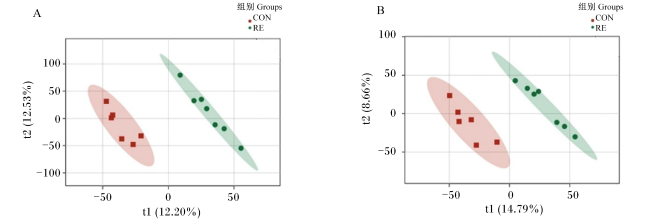
PLS-DA运用偏最小二乘回归建立代谢物表达量与样品类别之间的关系模型,可用于样品类别的预测。PLS-DA预测参数有R2X、R2Y和Q2,其中R2X和R2Y分别表示对模型X和Y矩阵的解释率,Q2表示模型预测能力。这3个参数越接近1表明模型越稳定可靠,另外,Q2大于0.5表明模型的预测能力较好。如图1所示,2组试鸭血清样品正电荷代谢物PLS-DA得分图R2X=0.312,R2Y=1.0,Q2=0.631,负电荷代谢物PLS-DA得分图R2X=0.316,R2Y=0.998,Q2=0.637,且代谢物在坐标轴上分离较好,表明2组间差异代谢物真实存在。
图1 血清样本液相色谱-质谱联用PLS-DA得分图

A:正离子模式 ESI+; B:负例子模式 ESI-。

Fig.1 PLS-DA score diagram of serum samples by LC-MS

2.4.2 差异代谢物鉴定

2组样本间的差异代谢物筛选采用单变量变异倍数(FC)分析和t检验。2组样本中共鉴定出51个差异代谢物(FC>1.5或FC<0.667,P<0.05)。以变量投射重要性(VIP)>1且P<0.05为标准在上述差异代谢物中共筛选出25个显著性差异代谢物,其中拉莫三嗪、异枞油烯醇、去氢木香内酯等15个种代谢物在RE组中显著上调(P<0.05),3-羟基丁酸、α-茄碱、氯氮卓等10个代谢物在RE组中显著下调(P<0.05)(表5)。
表5 CON和RE组肉鸭血清显著差异代谢物

Table 5 Significant differential metabolites in serum of meat ducks between CON and RE groups

代谢物
Metabolites
变量投射
重要性
VIP
差异倍数
FC
P
P-value
变化趋势
Change trend
3-羟基丁酸3-hydroxybutanoic acid 2.116 0.016 0.009 下调
α-茄碱α-solanine 2.723 0.307 <0.001 下调
氯氮卓Chlordiazepoxide 2.235 0.319 0.004 下调
大黄酸Rhein 2.019 0.336 0.020 下调
巴西苏木素Brazilin 1.962 0.357 0.033 下调
5-氨基戊酸甜菜碱5-aminovaleric acid betaine 2.430 0.394 0.002 下调
羟基缬草酸Hydroxyvalerenic acid 2.886 0.397 <0.001 下调
丙二酸盐Malonate 1.873 0.413 0.032 下调
法莫替丁Famotidine 2.471 0.422 0.001 下调
异丁酸Isobutyric acid 2.116 0.512 0.009 下调
拉莫三嗪Lamotrigine 1.737 1.544 0.042 上调
异枞油烯醇Isoabienol 1.828 1.761 0.039 上调
去氢木香内酯Dehydrocostus lactone 2.070 1.850 0.011 上调
白术内酯Ⅰ Atractylenolide Ⅰ 2.648 2.032 <0.001 上调
N2, N2-二甲基鸟苷N2, N2-dimethylguanosine 1.737 2.182 0.037 上调
谷氨酰胺Glutamine 2.326 2.519 0.004 上调
环肽素Cyclopeptine 2.089 2.664 0.016 上调
鹅去氧胆酸Chenodiol 1.873 2.738 0.035 上调
醋磺胺甲噁唑Acetylsulfamethoxazole 2.454 2.904 0.003 上调
1,4-屈萘酮1,4-chrysenequinone 2.397 3.097 0.003 上调
拉帕醇Lapachol 2.174 3.099 0.010 上调
吲哚-3-乙醛Indole-3-acetaldehyde 1.861 4.080 0.032 上调
奥美拉唑Omeprazole 1.785 5.433 0.038 上调
乳清酸Oratic acid 2.549 5.874 <0.001 上调
L-酵母氨酸L-saccharopine 1.850 79.246 0.028 上调

2.4.3 代谢通路分析

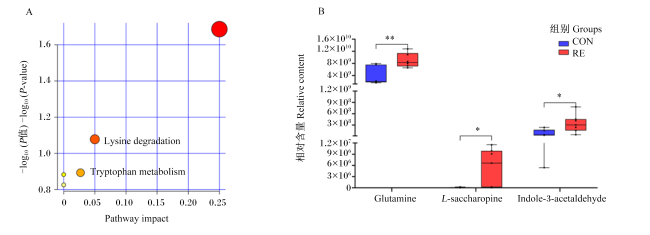
采用Metabo Analyst 5.0(http://www.metaboanalyst.ca)对血清显著差异代谢物进行代谢通路分析。由图2-A可知,饲粮中添加500 mg/kg的RE显著影响了肉鸭血清中D-谷氨酰胺和D-谷氨酸代谢、赖氨酸降解和色氨酸代谢3个途径。显著差异代谢物谷氨酰胺、L-酵母氨酸和吲哚-3-乙醛分别为D-谷氨酰胺和D-谷氨酸代谢、赖氨酸降解和色氨酸代谢通路的中间产物。由图2-B可知,与CON组相比,RE组试鸭血清中谷氨酰胺、L-酵母氨酸和吲哚-3-乙醛的含量显著提高(P<0.05)。
图2 CON和RE组肉鸭血清显著差异代谢物通路分析

A:KEGG通路富集分析。气泡大小代表通路影响率;气泡的颜色代表显著程度,红色代表显著程度高,黄色代表显著程度低KEGG pathway enrichment analysis. The bubble size was proportional to the impact of each pathway; the bubble color represents the degree of significant, that red stood for the highest and yellow stood for the lowest;B:富集通路相关代谢物相对含量 Relative content of metabolites associated with the enriched pathway。

Lysine degradation:赖氨酸降解;Tryptophan metabolism:色氨酸代谢;Pathway impact:通路影响;Glutamine:谷氨酰胺;L-saccharopine:L-酵母氨酸;Indole-3-acetaldehyde:吲哚-3-乙醛。*:P<0.05;**:P<0.01。

Fig. 2 Pathway analysis of significant differential metabolites in serum of meat ducks between CON and RE groups

2.4.4 血清代谢物与抗氧化及免疫相关指标关联分析

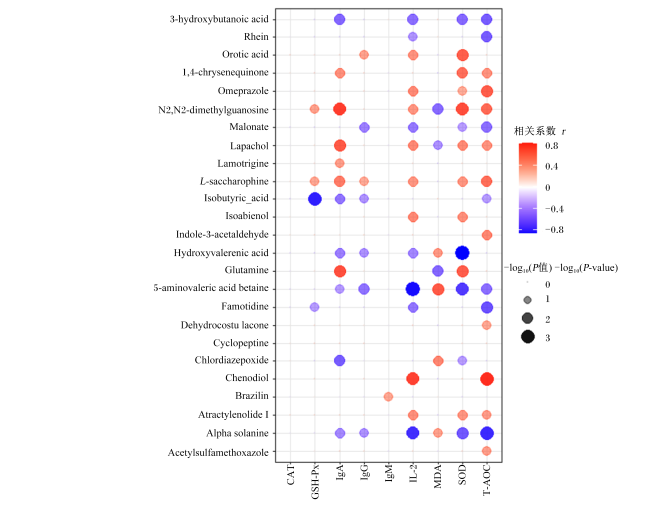
血清显著差异代谢物和抗氧化及免疫相关指标进行Spearman关联分析,探究肉鸭血清代谢物与免疫和抗氧化能力的潜在相关性。由图3可知,除CAT外,GSH-Px、SOD、MDA、IgA、IgG、IgM和IL-2含量及T-AOC至少与1种显著差异代谢物显著相关。RE组肉鸭血清中增加的代谢物如乳清酸、1,4-屈萘酮和奥美拉唑,与抗氧化酶和免疫调节的水平呈显著正相关(P<0.05),但与MDA含量呈显著负相关(P<0.05)。但RE组肉鸭血清中降低的代谢物如3-羟基丁酸、异枞油烯醇和羟基缬草酸,则显示出相反的相关性。此外,谷氨酰胺受RE影响含量增加,与IgA和SOD含量呈显著正相关,与MDA含量呈显著负相关(P<0.05)。L-酵母氨酸受RE的影响含量增加,与GSH-Px、SOD含量,T-AOC及IgA、IgG和IL-2含量呈显著正相关(P<0.05)。吲哚-3-乙醛受RE影响含量增加,与T-AOC呈显著正相关(P<0.05)。
图3 显著差异代谢物与免疫及抗氧化相关指标关联分析

仅显示有意义的相关性(r>0.5或r<-0.5,且P<0.05)。气泡大小表示P值对数,红色代表正相关,蓝色代表负相关。Only the significant correlations were showed (r>0.5 or r<-0.5, P<0.05). The bubble size represented the log10(P-value), red color represented positive correlation and blue color represented negative correlation.

3-hydroxybutanoic acid: 3-羟基丁酸;Rhein: 大黄酸;Orotic acid: 乳清酸;1,4-chrysenequinone: 1,4-屈萘酮;Omeprazole: 奥美拉唑;N2,N2-dimethylguanosine: N2,N2-二甲基鸟苷;Malonate: 丙二酸盐;Lapachol: 拉帕醇;Lamotrigine: 拉莫三嗪;L-saccharophine: L-酵母氨酸;Isobutyric acid: 异丁酸;Isoabienol: 异枞油烯醇;Indole-3-acetaldehyde: 吲哚-3-乙醛;Hydroxyvalerenic acid: 羟基缬草酸;Glutamine: 谷氨酰胺;5-aminovaleric acid betaine: 5-氨基戊酸甜菜碱;Famotidine: 法莫替丁;Dehydrocostu lacone: 去氢木香烃内酯;Cyclopeptine: 环肽素;Chlordiazepoxide: 氯氮卓;Chenodiol: 鹅去氧胆酸;Brazilin: 巴西苏木素;Atractylenolide Ⅰ: 白术内酯Ⅰ;α-solanine: α-茄碱;Acetylsulfamethoxazole: 醋磺胺甲噁唑;CAT: 过氧化氢酶 catalase;GSH-Px:谷胱甘肽过氧化物酶 glutathion peroxidase;IgA: 免疫球蛋白A immunoglobulin A;IgG: 免疫球蛋白G immunoglobulin G;IgM: 免疫球蛋白M immunoglobulin M;IL-2: 白细胞介素-2 interleukin-2;MDA: 丙二醛 malonaldehyde;SOD: 超氧化物歧化酶 superoxide dismutase;T-AOC: 总抗氧化能力 total antioxidant capacity。

Fig.3 Correlation analysis between significantly differential metabolites and immune and antioxidant-related indexes

3 讨论

3.1 RE对肉鸭生长性能的影响

大量研究表明,氧化应激是影响家禽生产的主要因素之一。在禽类生理过程中,细胞线粒体在能量代谢过程中会产生活性氧(ROS)等副产品。ROS水平在机体抗氧化系统调节下维持在较低水平,并通过与特定目标相互作用传递氧化还原信号,有助于禽类机体健康。然而在现代养殖场中,高温高密度等不利养殖条件,以及对快长性和高饲料转化率等特性的遗传选择,降低了禽类的抗氧化能力和免疫力,进而影响生长和生产性能[23]。RE有良好的抗氧化作用,具有替代抗生素缓解畜禽氧化应激的潜力。Yang等[11]研究发现,饲粮中添加100~400 mg/kg RE可提高仔猪的体重、ADG和ADFI,并降低腹泻率。Liu等[12]研究表明,饲粮中添加500和750 mg/kg RE可降低肉鸡F/G,提高养殖效益。本试验结果显示,肉鸭饲粮中添加500 mg/kg RE显著提高肉鸭1~42日龄的ADG,与前人研究结果一致。这说明RE作为饲料添加剂对肉鸭的生长有促进作用。

3.2 RE对肉鸭血清免疫指标和抗氧化指标的影响

RE中蕴含丰富的活性成分,主要包括迷迭香酸、熊果酸、鼠尾草酸、咖啡酸和鼠尾草酚[24]。它们通过向脂质自由基提供芳香环中的氢原子和酚羟基干扰脂质氧化。由于未配对电子在芳香环周围发生共振移位,且苯氧自由基无法与分子氧结合,ROS可被酚类物质捕获并保持相对稳定的状态。此外,酚类物质的羟基具有可螯合促氧化金属离子,有助于进一步延缓脂质氧化过程[25]。除了与ROS直接作用外,RE还能通过激活抗氧化酶和细胞因子表达调节机体抗氧化能力。SOD、GSH-Px和CAT等抗氧化酶构成机体抗氧化系统的第1层[23],而MDA是细胞膜多不饱和脂肪酸与ROS过氧化反应的产物,通常被视为氧化损伤的重要标志物[26]。前人研究发现,RE可提高仔猪血清和肝脏中的SOD和GSH-Px活性以及降低MDA含量,增强断奶仔猪的抗氧化能力并减轻氧化应激损伤[11]。Wang等[27]研究发现,与高脂饲粮组相比,饲粮中添加1.5 mg/mL RE显著提高果蝇体内的铜锌超氧化物歧化酶(CuZn-SOD)、锰超氧化物歧化酶(Mn-SOD)和CAT的活性。本实验室前期研究了饲粮中添加RE对肉鸡抗氧化能力的影响,发现饲粮中添加250~1 000 mg/kg RE可显著提高肉鸡血清中T-AOC及GSH-Px、SOD和CAT的含量,并降低MDA含量[12]。在本试验中,饲粮中添加500 mg/kg RE显著提高肉鸭血清中GSH-Px、SOD含量和T-AOC,降低MDA的含量,与前期研究结果一致,表明饲粮中添加RE可提高肉鸭的抗氧化能力,缓解氧化应激影响。此外,氧化平衡的破坏会影响免疫系统,因为氧化应激和炎症损伤是复杂病理生理过程,共同受到某些关键的细胞信号和细胞因子的调控,如核因子E2相关性2(Nrf2)和核因子-κB(NF-κB)[28]。在本试验中,饲粮添加500 mg/kg RE提高了肉鸭血清中IL-2、IgG和IgA的含量,表明肉鸭免疫能力增强。这与前人研究结果[12]一致,进一步证实了RE对家禽的抗氧化作用。

3.3 RE对肉鸭血清代谢物的影响

本研究中血清非靶向代谢组学结果显示,CON和RE组肉鸭血清代谢物组成存在显著差异。代谢通路分析进一步表明,饲粮中添加500 mg/kg RE的肉鸭血清中D-谷氨酰胺和D-谷氨酸代谢、赖氨酸降解和色氨酸代谢显著上调。其中,谷氨酰胺是参与D-谷氨酰胺和D-谷氨酸代谢的显著差异代谢物,是谷氨酸和谷胱甘肽生物合成的必需氨基酸,也是GSH-Px的组成成分之一[29]。谷氨酰胺可调节Nrf2-Keap1通路,激活抗氧化反应元件(包括抗氧化酶)的基因表达[30]。在细胞质中,L-谷氨酰胺可被谷氨酰胺酶催化合成L-谷氨酸。随后,L-谷氨酸可进一步参与谷氨酸代谢途径,或通过谷氨酸消旋酶生成D-谷氨酸。有研究报道,谷氨酰胺可提高荷斯坦断奶犊牛、断奶仔猪、热应激肉鸡等畜禽动物的抗氧化能力[31-33]。在本试验中,饲粮中添加500 mg/kg RE提高了肉鸭血清中谷氨酰胺的含量,可能与D-谷氨酰胺和D-谷氨酸代谢的上调有关。其次,本研究发现RE显著提高肉鸭血清中L-酵母氨酸含量。L-酵母氨酸是赖氨酸降解的中间产物,在禽类机体中主要通过糖胺酸途径产生,并促进游离谷氨酸的产生[34]。作为机体衰老的生物标志物,L-酵母氨酸可反映氧化应激和神经炎症的严重程度[35]。衰老与氧化应激密切相关,使脂类、糖类、蛋白质和核酸等大分子受到氧化损伤,导致机体器官功能退化[36]。有研究表明,在D-半乳糖诱导的衰老大鼠模型中,发现海马体中L-酵母氨酸含量较对照组显著降低,说明L-酵母氨酸与衰老引起的抗氧化损伤呈负相关[35]。Yue等[37]也研究发现,黄曲霉毒素B1攻毒肉鸡胸肌中L-酵母氨酸含量较对照组显著降低,说明肉鸡胸肌中L-酵母氨酸含量与氧化应激水平呈负相关。本试验与上述研究结果一致,即饲粮中添加500 mg/kg RE增加肉鸭血清中L-酵母氨酸含量,增强了肉鸭抗氧化能力。这可能是由于L-酵母氨酸含量的上调激活了谷氨酸合成,进一步促进了谷胱甘肽的合成[38]。此外,本研究还发现RE显著提高了肉鸭血清中吲哚-3-乙醛的含量。吲哚-3-乙醛是色氨酸代谢产生的一种重要代谢物,其主要由肠道微生物群分解色氨酸生成,并作为芳基烃受体或孕烷X受体的配体[39]。吲哚-3-乙醛对调控机体免疫系统有重要作用,同时影响动物肠道屏障的完整性[40]。Yang等[41]研究表明,砖茶多糖通过提高小鼠粪便中吲哚-3-乙醛和吲哚-3-乙酸含量,上调色氨酸代谢通路,增强缓解溃疡性结肠炎小鼠肝脏抗氧化能力,缓解结肠组织损伤。另有研究表明,竹叶黄酮可上调肉鸡血清中吲哚-3-乙醛含量,并影响色氨酸代谢途径,提高肉鸡的抗氧化能力和健康状况[42]。本试验与上述研究结果一致,说明饲粮中添加500 mg/kg RE可能通过增加肉鸭血清吲哚-3-乙醛的含量提高肉鸭的抗氧化能力。
血清差异代谢物与抗氧化因子的相关性分析进一步表明,除环肽素外,本试验鉴定的所有血清差异代谢物均与一种或多种抗氧化相关因子有显著相关性。其中RE下调的血清代谢物与抗氧化相关细胞因子(如抗氧化酶和免疫球蛋白)呈负相关,与MDA含量呈正相关;而RE上调的血清代谢物则与抗氧化相关细胞因子呈相反趋势。由此可知,饲粮中添加500 mg/kg RE能有效调节血清代谢物,并通过这一机制提高肉鸭的抗氧化能力。

4 结论

综上所述,饲粮中添加500 mg/kg RE可提高肉鸭的生长性能,增强免疫和抗氧化能力,缓解氧化应激。血清代谢组学分析结果表明,RE可能通过调节D-谷氨酰胺和D-谷氨酸代谢、赖氨酸降解和色氨酸代谢途径,上调谷胱甘肽、L-酵母氨酸、吲哚-3-乙醛含量,增强肉鸭抗氧化功能。
[1]
AVERÓS X, ESTEVEZ I. Meta-analysis of the effects of intensive rearing environments on the performance and welfare of broiler chickens[J]. Poultry Science, 2018, 97(11):3767-3785.

DOI PMID

[2]
WANG S M, CHEN L, HE M Z, et al. Different rearing conditions alter gut microbiota composition and host physiology in Shaoxing ducks[J]. Scientific Reports, 2018, 8(1):7387.

[3]
ZHENG S F, JIN X, CHEN M H, et al. Hydrogen sulfide exposure induces jejunum injury via CYP450s/ROS pathway in broilers[J]. Chemosphere, 2019,214:25-34.

[4]
NIETO G R G J A, Antimicrobial properties of rosemary (Rosmarinus officinalis):a review[J]. Medicines, 2018, 5(3):98.

[5]
NAIMI M, VLAVCHESKI F, SHAMSHOUM H, et al. Rosemary extract as a potential anti-hyperglycemic agent:current evidence and future perspectives[J]. Nutrients, 2017, 9(9):968.

[6]
RAŠKOVIĆ A, MILANOVIĆ I, PAVLOVIĆ N, et al. Antioxidant activity of rosemary (Rosmarinus officinalis L.) essential oil and its hepatoprotective potential[J]. BMC Complementary and Alternative Medicine, 2014,14:225.

[7]
MOORE J, YOUSEF M, TSIANI E. Anticancer effects of rosemary (Rosmarinus officinalis L.) extract and rosemary extract polyphenols[J]. Nutrients, 2016, 8(11):731.

[8]
IVANOVIC J, MISIC D, ZIZOVIC I, et al. In vitro control of multiplication of some food-associated bacteria by thyme, rosemary and sage isolates[J]. Food Control, 2012, 25(1):110-116.

[9]
KONTOGIANNI V G, TOMIC G, NIKOLIC I, et al. Phytochemical profile of Rosmarinus officinalis and Salvia officinalis extracts and correlation to their antioxidant and anti-proliferative activity[J]. Food Chemistry, 2013, 136(1):120-129.

[10]
YU M H, CHOI J H, CHAE I G, et al. Suppression of LPS-induced inflammatory activities by Rosmarinus officinalis L.[J]. Food Chemistry, 2013, 136(2):1047-1054.

[11]
YANG M, YIN Y X, WANG F, et al. Effects of dietary rosemary extract supplementation on growth performance, nutrient digestibility, antioxidant capacity, intestinal morphology, and microbiota of weaning pigs[J]. Journal of Animal Science, 2021, 99(9):skab237.

[12]
LIU Y, LI C, HUANG X, et al. Dietary rosemary extract modulated gut microbiota and influenced the growth, meat quality, serum biochemistry, antioxidant, and immune capacities of broilers[J]. Frontiers in Microbiology, 2022,13:1024682.

[13]
ZHANG L H, GE J W, GAO F, et al. Rosemary extract improves egg quality by altering gut barrier function, intestinal microbiota and oviductal gene expressions in late-phase laying hens[J]. Journal of Animal Science and Biotechnology, 2023, 14(1):121.

DOI PMID

[14]
KONG F L, WANG S, DAI D W, et al. Preliminary investigation of the effects of rosemary extract supplementation on milk production and rumen fermentation in high-producing dairy cows[J]. Antioxidants, 2022, 11(9):1715.

[15]
NRC. Nutrient requirements of poultry[S]. 9th ed.Washington,D.C.:The National Academies Press, 1994.

[16]
熊本海, 罗清尧, 郑姗姗, 等. 中国饲料成分及营养价值表(2020年第31版)制订说明[J]. 中国饲料, 2020(21):87-97.

XIONG B H, LUO Q Y, ZHENG S S, et al. Tables of feed composition and nutritive in China (31st edition,2020) formulation description[J]. China Feed, 2020(21):87-97. (in Chinese)

[17]
中华人民共和国国家市场监督管理总局, 中国国家标准化管理委员会. 饲料中粗蛋白的测定凯氏定氮法:GB/T 6432—2018[S]. 北京: 中国标准出版社, 2018.

People’s Republic of China State Administration of Market Supervision,China National Standardization Administration Committee. Determination of crude protein in feeds-Kjeldahl method:GB/T 6432—2018[S]. Beijing: China Standards Press, 2018. (in Chinese)

[18]
中华人民共和国国家质量监督检验检疫总局, 中国国家标准化管理委员会. 饲料中钙的测定:GB/T 6436—2018[S]. 北京: 中国标准出版社, 2018.

General Administration of Quality Supervision,Inspection and Quarantine of the People’s Republic of China, Standardization Administration of China.Determination of calcium in feeds:GB/T 6436—2018[S]. Beijing: China Standards Press, 2018. (in Chinese)

[19]
国家市场监督管理总局, 中国国家标准化管理委员会. 饲料中总磷的测定分光光度法:GB/T 6437—2018[S]. 北京: 中国标准出版社, 2018.

Administration for Market Regulation, Standardizaton Adminidtration of the People’s Republic of China. Determination of phosphorus in feeds-spectrophotometry:GB/T6437—2018[S]. Beijing: China Standards Press, 2018. (in Chinese)

[20]
国家市场监督管理总局, 中国国家标准化管理委员会. 饲料中粗纤维的含量测定:GB/T 634—2022[S]. 北京: 中国标准出版社, 2022.

State Administration for Market Regulation, Standardization Administration of China. Determination of crude fiber in feeds:GB/T 6343—2022[S]. Beijing: China Standards Press, 2022. (in Chinese)

[21]
中华人民共和国国家质量监督检验检疫总局, 中国国家标准化管理委员会. 饲料中粗脂肪的测定:GB/T 6433—2006[S]. 北京: 中国标准出版社, 2006.

General Administration of Quality Supervision,Inspection and Quarantine of the People’s Republic of China, China National Standardization Administration Committee.Determinaiion of crude fat in feeds:GB/T 6433—2006[S]. Beijing: China Standards Press, 2006. (in Chinese)

[22]
YAO Y, LIU Y, LI C, et al. Effects of rosemary extract supplementation in feed on growth performance,meat quality,serum biochemistry,antioxidant capacity,and immune function of meat ducks[J]. Poultry Science, 2023, 102(2):102357.

[23]
SURAI P F, KOCHISH I I, FISININ V I, et al. Antioxidant defence systems and oxidative stress in poultry biology: an update[J]. Antioxidants, 2019, 8(7):235.

[24]
AHMED H M, BABAKIR-MINA M. Investigation of rosemary herbal extracts (Rosmarinus officinalis) and their potential effects on immunity[J]. Phytotherapy Research, 2020, 34(8):1829-1837.

[25]
SENANAYAKE S. Rosemary extract as a natural source of bioactive compounds[J]. Journal of Food Bioactives, 2018,2:51-57.

[26]
CUI A A, GONG J C, HAN H L, et al. Relationship between free and total malondialdehyde, a well-established marker of oxidative stress, in various types of human biospecimens[J]. Journal of Thoracic Disease, 2018, 10(5):3088-3097.

DOI PMID

[27]
WANG H, SUN Z, REHMAN R, et al. Rosemary extract-mediated lifespan extension and attenuated oxidative damage in Drosophila melanogaster fed on high-fat diet[J]. Journal of Food Science, 2017, 82(4):1006-1011.

[28]
LEE M T, LIN W C, LEE T T. Potential crosstalk of oxidative stress and immune response in poultry through phytochemicals—a review[J]. Asian-Australasian Journal of Animal Sciences, 2019, 32(3):309-319.

[29]
NCHO C M, GUPTA V, CHOI Y H. Effects of dietary glutamine supplementation on heat-induced oxidative stress in broiler chickens: a systematic review and Meta-analysis[J]. ANTIOXIDANTS, 2023, 12(3):570.

[30]
HU H, DAI S F, LI J Q, et al. Glutamine improves heat stress-induced oxidative damage in the broiler thigh muscle by activating the nuclear factor erythroid 2-related 2/Kelch-like ECH-associated protein 1 signaling pathway[J]. Poultry Science, 2020, 99(3):1454-1461.

DOI PMID

[31]
WANG S, WANG F W, KONG F L, et al. Effect of supplementing different levels of L-glutamine on Holstein calves during weaning[J]. Antioxidants, 2022, 11(3):542.

[32]
HE J, FENG G D, AO X, et al. Effects of L-glutamine on growth performance, antioxidant ability, immunity and expression of genes related to intestinal health in weanling pigs[J]. Livestock Science, 2016,189:102-109.

[33]
BAI X, WANG K P, KHAN R U, et al. Effect of glutamine on the growth performance, oxidative stress, and Nrf2/p38 MAPK expression in the livers of heat-stressed broilers[J]. Animals, 2023, 13(4):652.

[34]
WATANABE G, KOBAYASHI H, SHIBATA M, et al. Reduction in dietary lysine increases muscle free amino acids through changes in protein metabolism in chickens[J]. Poultry Science, 2020, 99(6):3102-3110.

DOI PMID

[35]
CHEN S S, HU N, WANG H L, et al. The major anthocyanin of Lycium ruthenicum Murr. relieves cognitive deficits, oxidative stress, neuroinflammation, and hippocampal metabolome alterations in aging rats[J]. Journal of Functional Foods, 2022,94:105104.

[36]
JOVÉ M, PRADAS I, DOMINGUEZ-GONZALEZ M, et al. Lipids and lipoxidation in human brain aging. Mitochondrial ATP-synthase as a key lipoxidation target[J]. Redox Biology, 2019,23:101082.

[37]
YUE K, LIU K L, ZHU Y D, et al. Novel insights into total flavonoids of Rhizoma drynariae against meat quality deterioration caused by dietary aflatoxin B1 exposure in chickens[J]. Antioxidants, 2022, 12(1):83.

[38]
HAD-AISSOUNI L. Toward a new role for plasma membrane sodium-dependent glutamate transporters of astrocytes: maintenance of antioxidant defenses beyond extracellular glutamate clearance[J]. Amino Acids, 2012, 42(1):181-197.

[39]
SHATOVA O P, YAGODKINA E M, KAYDOSHKO S S, et al. Role of tryptophan metabolites and short-chain fatty acids in pathogenesis of autoimmune diseases[J]. Journal of Evolutionary Biochemistry and Physiology, 2023, 59(4):1360-1373.

[40]
AGUS A, PLANCHAIS J, SOKOL H. Gut microbiota regulation of tryptophan metabolism in health and disease[J]. Cell Host & Microbe, 2018, 23(6):716-724.

[41]
YANG W Q, REN D Y, ZHAO Y, et al. Fuzhuan brick tea polysaccharide improved ulcerative colitis in association with gut microbiota-derived tryptophan metabolism[J]. Journal of Agricultural and Food Chemistry, 2021, 69(30):8448-8459.

[42]
CAO G T, YU Y, WANG H X, et al. Effects of oral administration of bamboo (Dendrocalamus membranaceus) leaf flavonoids on the antioxidant capacity,caecal microbiota, and serum metabolome of Gallus gallus domesticus[J]. Frontiers in Nutrition, 2022,9:848532.

Outlines

/