RESEARCH PAPER

Effects of Fermented Concentrate on Growth Performance, Serum Biochemical Indices and Nutrient Apparent Digestibility of Angus Steers

  • REN Lingyu , 1 ,
  • CUI Xiaojing 1 ,
  • WU Hao 1 ,
  • MENG Qingxiang 1 ,
  • WU Lianfang 2 ,
  • ZHOU Zhenming , 1, *
Expand
  • 1 State Key Laboratory of Animal Nutrition and Feeding, College of Animal Science and Technology, China Agricultural University, Beijing 100193, China
  • 2 Beijing Doudian Hengsheng Animal Husbandry Technology Co., Ltd., Beijing 102400, China
* professor, E-mail:

Received date: 2024-08-22

  Online published: 2025-04-15

Abstract

This experiment was conducted to investigate the effects of fermented concentrate on growth performance, serum biochemical indices and nutrient apparent digestibility of Angus steers. Forty-five healthy Angus steers with similar body weight of (637.75±50.99) kg were randomly divided into 3 groups with 15 steers in each group. Cattle in the control group (CON group) were fed a basal diet, and those in the experimental groups were fed 15% (F15 group) and 30% (F30 group) fermented concentrate instead of the concentrate in the basal diet, respectively. The pre-trial period lasted for 14 days, and the experimental period lasted for 60 days. The results showed as follows: 1) compared with the basal concentrate, the crude ash (Ash) content in fermented concentrate was significantly increased (P<0.05), and the neutral detergent fiber (NDF) content had a tendency to be decreased (P=0.06). The activities of acid protease and cellulase in fermented concentrate were significantly higher than those before fermentation, but the amylase activity had no significant change. 2) From days 1 to 30, compared with CON group and F15 group, the average daily gain (ADG) of steers in F30 group was significantly increased (P<0.05), the dry matter intake (DMI) showed an increasing trend (P=0.09), and the ratio of feed to gain (F/G) was significantly decreased (P<0.05). 3) Compared with CON group and F15 group, the serum aspartate transaminase (AST) activity of steers in F30 group was significantly decreased (P<0.05), and the serum urea content had a decreasing trend (P=0.05). 4) Compared with CON group and F15 group, the crude protein (CP) apparent digestibility of steers in F30 group tended to be increased (P=0.06). In conclusion, the replacement of basal concentrate with fermented concentrate at 30% can improve the growth performance of Angus steers in the early fattening stage, and has the potential to improve their protein digestion and absorption.

Cite this article

REN Lingyu , CUI Xiaojing , WU Hao , MENG Qingxiang , WU Lianfang , ZHOU Zhenming . Effects of Fermented Concentrate on Growth Performance, Serum Biochemical Indices and Nutrient Apparent Digestibility of Angus Steers[J]. Chinese Journal of Animal Nutrition, 2025 , 37(4) : 2431 -2440 . DOI: 10.12418/CJAN2025.206

近年来,我国在全球牛肉的生产、消费和贸易方面都占据着重要的地位[1]。肉牛产业一直是中国畜牧业和肉类生产的重要组成部分,随着经济的快速增长,中国人均牛肉消费量迅速增长[2]。但是,我国肉牛行业起步晚、发展慢,目前仍处于初级发展阶段,这使得生产与消费之间的差距逐渐拉大,供不应求的现状使得我国成为牛肉进口大国[3]。同猪和禽等家畜相比,肉牛的饲料转化率较低,这是限制肉牛产业生产效率的重要原因之一[2]。因此,如何提升肉牛的饲料转化效率从而提高牛肉的生产效率引起人们的广泛关注。
微生物发酵饲料具有提升饲粮营养价值和利用效率、提高动物生长性能和免疫力、改善动物肠道健康以及降低环境污染等优点,在猪、家禽、反刍动物和水产养殖业等领域均有应用[4-7]。Jiang等[8]试验表明,玉米蛋白粉发酵后营养价值得到提升,其中性洗涤纤维(NDF)含量显著降低,粗蛋白质(CP)、氨基酸和小肽含量显著提高。魏炳栋等[9]研究发现,饲粮中添加5%和10%发酵玉米蛋白粉均能够显著降低肉仔鸡料重比(F/G),提高肉鸡生长性能和血清抗氧化酶活性。许广庆[10]研究发现,饲粮中添加30%水稻秸秆发酵饲料可以提高肉牛平均日增重(ADG)和采食量,并且改善牛肉品质。综上所述,经微生物发酵的饲料原料部分代替基础饲粮可以显著提升动物采食量和生长性能,并对改善动物健康具有促进作用。然而,目前发酵饲料在肉牛上的应用常是以单一的饲料原料为发酵底物,对于发酵混合饲料和发酵精料的应用研究较少,而精料含有丰富的可消化营养物质,因此改善精料的质量对于肉牛育肥潜力的发挥和健康状态的改善十分重要。因此,本试验旨在研究发酵精料对肉牛生长性能、血清生化指标和养分表观消化率的影响,以评价发酵精料在肉牛养殖中的应用潜力。

1 材料与方法

1.1 发酵精料制备

发酵菌剂:本试验采用4种商业发酵菌剂,其中酿酒酵母(Saccharomyces cerevisiae)活菌数为2×10¹⁰ CFU/g,枯草芽孢杆菌(Bacillus subtils)活菌数为2×10¹⁰ CFU/g,布氏乳杆菌(Lactobacillus buchneri)活菌数为3×10¹¹ CFU/g,混合乳酸菌—植物乳杆菌(Lactobacillus plantarum)和乳酸片球菌(Pediococcus acidilactici)活菌数分别5×10¹⁰和1.5×10¹⁰ CFU/g。
制作发酵精料所用基础精料组成及营养水平见表1。称取发酵原料1% DM的红糖用热水搅拌溶解,待水温降至37~40 ℃时,加入0.01%配比为1.0∶1.0∶0.1∶1.0(质量比)的菌剂,以保证每种菌剂的活菌数基本一致;静置1.0~1.5 h,得到混合菌液,将其加入到精料中搅拌均匀,含水量控制在40%左右,然后将充分混合的饲料装于发酵袋中,排尽空气后捆扎好袋口,堆放在阴凉处使其自然发酵14 d。
表1 基础精料组成及营养水平(干物质基础)

Table 1 Composition and nutrient levels of basal concentrate (DM basis) %

项目Items 含量Content
原料Ingredients
玉米Corn 77.00
豆粕Soybean meal 14.00
石粉Limestone 1.00
食盐NaCl 1.00
预混料Premix1) 4.00
碳酸氢钠NaHCO3 2.00
磷酸氢钙CaHPO4 1.00
合计Total 100.00
营养水平Nutrient levels2)
粗蛋白质CP 19.10
中性洗涤纤维NDF 15.31
钙Ca 0.74
磷P 0.56
总可消化养分TDN 82.53
代谢能ME/(MJ/kg) 14.36
增重净能NEg/(MJ/kg) 6.98

1)每千克预混料含有 One kg of the premix contained the following:VA 150 000~450 000 IU,VD3 40 000~120 000 IU,DL-α-生育酚 DL-α-tocopherol 400 mg,Cu 250~750 mg,Fe 1 000 ~5 000 mg,Mn 1 000~3 000 mg,Zn 1 500~3 700 mg,Ca 100 000~250 000 mg,P 3 000 mg,NaCl 150 000~300 000 mg。表2同 the same Table 2

2)代谢能、增重净能和总可消化养分为计算值,计算公式参考王菲[11],其余为实测值。表2同。ME, NEg and TDN were calculated referred to Wang[11], and the others were measured values. The same as Table 2.

1.2 试验设计和饲粮

本试验于中国农业大学房山肉牛试验基地开展,所有动物试验操作均按照中国农业大学实验动物福利与动物实验伦理审查委员会制定的原则和操作指南进行(批准编号:AW81404202-1-3)。
试验选取体况良好、体重[(637.75±50.99) kg]相近的安格斯阉牛45头,采用单因素完全随机设计原则,随机分为3组,每组15头。对照组(CON组)饲喂基础饲粮,试验组分别用发酵精料替代基础饲粮中15%(F15组)和30%精料(F30组)。试验所用全混合日粮(TMR)根据试验牛体重及营养需要,参照NASEM(2016)肉牛营养需要标准配制。TMR组成及营养水平见表2。试验组每日添加的发酵精料先与精料进行预混,再与青贮饲料混合。试验期74 d,其中预试期14 d,正试期60 d。
表2 TMR组成及营养水平(干物质基础)

Table 2 Composition and nutrient levels of TMR (DM basis) %

项目Items 含量Content
原料Ingredients
玉米Corn 47.10
豆粕Soybean meal 13.00
玉米秸秆Corn stalk 10.00
全株玉米青贮Whole corn silage 24.00
石粉Limestone 0.65
食盐NaCl 0.65
预混料Premix1) 2.60
碳酸氢钠NaHCO3 1.35
磷酸氢钙CaHPO4 0.65
合计Total 100.00
营养水平Nutrient levels2)
粗蛋白质CP 15.44
中性洗涤纤维NDF 27.27
钙Ca 0.42
磷P 0.31
总可消化养分TDN 74.53
代谢能ME/(MJ/kg) 12.71
增重净能NEg/(MJ/kg) 5.85

1.3 饲养管理

试验开始前,利用保定通道系统对试验阉牛称重和打耳标,调整圈舍。所有牛群进行统一管理,牛群自由采食和饮水,每天饲喂2次(08:30和16:30各1次)。定期更换牛圈垫料、清理采食槽和水槽,保持圈舍卫生。

1.4 测定指标及方法

1.4.1 饲粮营养成分含量和消化酶活性

饲粮干物质(DM)、粗灰分(Ash)、CP、淀粉、钙和磷含量分别参照GB/T 6435—2014、GB/T 6438—2007、GB/T 24318—2009、GB/T 20194—2018、GB/T 6436—2018和GB/T 6437—2018进行测定;饲粮NDF含量参考Van Soest等[12]的方法测定,所用仪器为ANKOM纤维分析仪。
酸性蛋白酶活性测定:在酸性条件下,酸性蛋白酶催化酪蛋白水解产生酪氨酸;在碱性条件下,酪氨酸还原磷钼酸化合物生成钨蓝,钨蓝在680 nm有特征吸收峰,通过测定其吸光度的变化,来计算酶的活性。纤维素酶活性测定:采用蒽酮比色法测定纤维素酶催化纤维素降解产生的还原糖的含量,从而计算纤维素酶活性。淀粉酶活性测定:淀粉酶催化淀粉水解生成还原糖,还原糖还原3,5-二硝基水杨酸生成棕红色物质,在540 nm有吸收峰;通过测定540 nm吸光度提高速率,计算淀粉酶活性。

1.4.2 生长性能

正试期试验牛采食量利用采食量自动记录系统测定,根据饲粮DM含量,计算每头牛的干物质采食量(DMI);于正试期第1、31和60天晨饲前,对试验牛进行称重并记录体重数据,计算每头牛的ADG和F/G。
F/G=DMI/ADG。

1.4.3 血清生化指标

在正试期最后1天晨饲前,采用一次性采血针和5 mL真空采血管对所有试验牛进行尾根静脉采血,室温静置30 min后通过1 509.3×g低温离心15 min制备血清,于-80 ℃保存。测定血清谷丙转氨酶(ALT)、谷草转氨酶(AST)、碱性磷酸酶(ALP)、总蛋白(TP)、白蛋白(ALB)、球蛋白(GLB)、总胆红素(TBILI)、葡萄糖(GLU)、尿素(UREA)、总胆固醇(TC)、甘油三酯(TG)和总超氧化物歧化酶(T-SOD)等指标。

1.4.4 养分表观消化率

正试期最后1天晨饲前,采用直肠取粪法采集粪样65 ℃烘干至恒重;正试期最后2 d,采集各组的饲粮样品65 ℃烘干至恒重。样品用于测定养分含量,采用内源指示剂法[用盐酸不溶灰分(AIA)作为指示剂]测定养分表观消化率,计算公式如下:
某养分表观消化率(%)=100×[1-(饲粮中AIA含量/粪中AIA含量)×(粪中该养分含量/饲粮中该养分含量)]。

1.5 数据统计分析

采用Excel 2010对试验数据进行初步整理,然后采用SAS 9.4软件进行单因素方差分析,并采用Tukey法进行多重比较,结果数据用平均值和标准误(SE)表示,P<0.05表示差异显著,0.05≤P<0.10表示差异有显著趋势。

2 结果

2.1 发酵精料营养成分含量和消化酶活性

表3可知,与基础精料相比,发酵精料Ash含量显著提高(P<0.05),NDF含量有降低趋势(P=0.06),CP和淀粉含量有所提高,但差异不显著(P>0.05)。
表3 基础精料和发酵精料营养成分含量

Table 3 Nutrient contents of basal concentrate and fermented concentrate

项目
Items
基础精料
Basal concentrate
发酵精料
Fermented concentrate
标准误
SE
P
P-value
干物质DM/% 88.07 58.83
粗蛋白质CP/% DM 19.11 19.12 0.11 0.97
中性洗涤纤维NDF/% DM 15.31 12.67 0.27 0.06
粗灰分Ash/% DM 9.49b 13.39a 1.12 <0.01
淀粉Starch/% DM 31.83 33.13 0.45 0.11

同行数据肩标不同字母表示差异显著(P<0.05)。下表同。

Values in the same row with different letter superscripts indicated significant difference (P<0.05). The same as below.

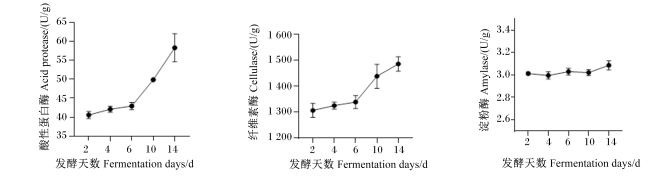
精料发酵过程中酸性蛋白酶、纤维素酶和淀粉酶活性的变化情况如图1所示。酸性蛋白酶和纤维素酶活性在发酵第6天后迅速提高,其中发酵精料中酸性蛋白酶活性比发酵前提高43.8%,纤维素酶活性比发酵前提高13.7%;而淀粉酶活性在发酵过程中并未发生明显变化。
图1 精料发酵过程中消化酶活性的变化

Fig.1 Changes of digestive enzyme activities during concentrate fermentation

2.2 发酵精料对安格斯阉牛生长性能的影响

表4可知,与CON组相比,试验组阉牛终末体重以及第31~60天和第1~60天ADG均无显著差异(P>0.05)。F30组阉牛第1~30天ADG显著高于CON组和F15组(P<0.05),F15组第1~30天ADG与CON组相比无显著差异(P>0.05)。
表4 发酵精料对安格斯阉牛体增重的影响

Table 4 Effects of fermented concentrate on body weight gain of Angus steers

项目
Items
组别Groups 标准误
SE
P
P-value
CON F15 F30
初始体重Initial BW/kg 636.77 637.00 639.54 20.16 0.99
终末体重Final BW/kg 718.31 724.29 733.62 21.88 0.79
平均日增重ADG/(kg/d)
第1~30天Days 1 to 30 1.47b 1.44b 1.77a 0.06 <0.01
第31~60天Days 31 to 60 1.16 1.37 1.25 0.06 0.32
第1~60天Days 1 to 60 1.35 1.51 1.68 0.04 0.22
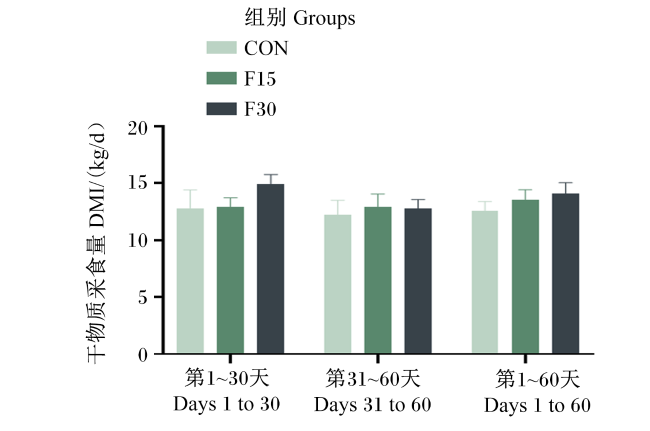
图2所示,与CON组和F15组相比,F30组阉牛第1~30天DMI有升高趋势(P=0.09);各组间第31~60天和第1~60天DMI均无显著差异(P>0.05)。
图2 发酵精料对安格斯阉牛DMI的影响

Fig.2 Effects of fermented concentrate on DMI of Angus steers

表5可知,第1~30天,F30组阉牛F/G显著低于CON组和F15组(P<0.05),F15组F/G与CON组相比无显著差异(P>0.05)。各组间阉牛第31~60天和第1~60天F/G均无显著差异(P>0.05)。
表5 发酵精料对安格斯阉牛F/G的影响

Table 5 Effects of fermented concentrate on F/G of Angus steers

项目
Items
组别Groups 标准误
SE
P
P-value
CON F15 F30
第1~30天Days 1 to 30 8.67a 9.02a 6.77b 0.33 <0.01
第31~60天Days 31 to 60 11.03 10.33 12.12 0.66 0.62
第1~60天Days 1 to 60 9.70 9.30 8.89 0.34 0.65

2.3 发酵精料对安格斯阉牛血清生化指标的影响

表6可知,F30组阉牛血清AST活性显著低于CON组和F15组(P<0.05),F15组血清AST活性与CON组相比无显著差异(P>0.05);3组间血清ALT活性无显著差异(P>0.05)。各组间阉牛血清TP、ALB和GLB含量以及ALB/GLB值均无显著差异(P>0.05)。此外,与CON组相比,F15组阉牛血清GLU含量显著降低(P<0.05),F30组血清GLU含量无显著差异(P<0.05)。F30组阉牛血清UREA含量与CON组和F15组相比有降低趋势(P=0.05)。
表6 发酵精料对安格斯阉牛血清生化指标的影响

Table 6 Effects of fermented concentrate on serum biochemical indices of Angus steers

项目
Items
组别Groups 标准误
SE
P
P-value
CON F15 F30
谷丙转氨酶ALT/(U/L) 29.96 31.27 30.73 0.65 0.72
谷草转氨酶AST/(U/L) 85.89a 88.03a 75.39b 1.80 0.01
碱性磷酸酶ALP/(U/L) 76.29 72.97 74.57 2.20 0.84
总蛋白TP/(g/L) 79.09 82.57 83.02 0.55 0.20
白蛋白ALB/(g/L) 37.52 37.33 37.03 0.24 0.72
球蛋白GLB/(g/L) 42.12 46.86 48.67 0.58 0.10
白蛋白/球蛋白ALB/GLB 0.89 0.78 0.73 0.01 0.14
总胆红素TBILI/(U/L) 1.71 1.84 2.03 0.09 0.34
总胆固醇TC/(mmol/L) 2.89 2.68 2.67 0.07 0.64
甘油三酯TG/(mmol/L) 0.27 0.27 0.33 0.01 0.11
葡萄糖GLU/(mmol/L) 2.55a 2.09b 2.36ab 0.08 0.04
尿素UREA/(mmol/L) 10.51 10.28 9.66 0.15 0.05
总超氧化物歧化酶T-SOD/(U/mL) 100.17 104.71 103.06 0.87 0.16

2.4 发酵精料对安格斯阉牛养分表观消化率的影响

表7可知,各组间阉牛DM和淀粉表观消化率均无显著差异(P>0.05);与CON组和F15组相比,F30组阉牛CP表观消化率有提高趋势(P=0.06)。
表7 发酵精料对安格斯阉牛养分表观消化率的影响

Table 7 Effects of fermented concentrate on nutrient apparent digestibility of Angus steers %

项目
Items
组别Groups 标准误
SE
P
P-value
CON F15 F30
干物质DM 71.50 66.75 69.21 0.33 0.26
淀粉Starch 98.31 97.34 98.16 0.66 0.32
粗蛋白质CP 72.44 70.96 75.44 0.34 0.06

3 讨论

3.1 精料发酵前后营养水平比较

饲料中常规营养成分的含量是评价饲料营养价值的基础指标。本试验中,经微生物发酵后的精料淀粉含量与发酵前相比并未发生显著变化,这与Canibe等[13]的试验结果一致,这可能是因为芽孢杆菌产生的α-淀粉酶并未达到其最适pH(最适pH=3);而发酵精料NDF含量较发酵前降低了17.24%,这是因为发酵过程中产生了分解纤维的酶类如纤维素酶[14],这些酶在发酵的第1~3天大量分泌,将植物细胞壁的纤维素降解成糖类,从而提升了精料的营养品质。除此之外,Ash含量在发酵后显著提高,这一方面是因为精料在发酵时添加的红糖含有较为丰富的矿物质[15];另一方面,底物的消耗可能导致了Ash含量的相对提高。

3.2 发酵精料对安格斯阉牛生长性能的影响

微生物对饲料原料进行发酵会产生大量有机酸[5],可以改善饲料的风味和适口性,促进动物采食。同时,益生菌发酵过程中产生的消化酶可将饲料原料中畜禽难以消化的大分子物质分解成易于消化吸收的小分子物质[16],有利于动物消化吸收,从而提高动物的养分消化率。本试验中,与CON组相比,F30组阉牛在饲养前期ADG显著提高,F/G显著降低。赵凯强等[17]研究发现,玉米芯经复合微生物发酵后NDF和酸性洗涤纤维(ADF)含量显著降低,CP含量显著提高;同时,在基础饲粮中添加10%的发酵玉米芯可以显著提高肉牛ADG和日采食量,肉牛的增重效益提高了14.51%。陈光吉[18]研究发现,用添加9.25%发酵酒糟的饲粮饲喂牦牛能显著提高其DMI和ADG。Tang等[19]研究发现,用混合菌剂发酵的甘蔗饲喂荷斯坦公犊牛能显著提高其ADG。上述试验结果表明,饲料原料经过微生物发酵可以提升其营养水平和适口性,进而提高动物的日增重。本试验结果表明,在肉牛育肥前期,发酵精料替代基础精料有利于提升动物的生长性能。因此,发酵精料在生产上有一定的应用价值。

3.3 发酵精料对安格斯阉牛血清生化指标的影响

血液是内环境的重要组成部分,是机体进行新陈代谢的基础,因此血液生化指标可以间接反映动物的营养吸收以及机体健康等方面的情况。肝脏是重要的中央免疫器官,其功能与ALT和AST这2种酶的活性密切相关。通常而言,血液中这2种酶的活性较低表明动物的健康状况良好[20]。Fan等[21]采用发酵花生粕替代鲤鱼饲料中的豆粕后发现,鲤鱼血清AST和ALT等酶活性降低,有利于维持鲤鱼肝脏健康,并提升其免疫能力。樊启文等[22]研究发现,发酵饲料桑可显著降低肉牛血浆AST活性,同时有降低ALT和ALP活性的趋势,提示发酵饲料桑对动物肝脏具有保护作用。本试验使用乳酸菌、枯草芽孢杆菌等益生菌对精料进行发酵,这些益生菌不仅可以抑制内源性病原体[23],还能改善肠道菌群。此外,肠道和肝脏通过胆道系统、门静脉和体循环进行广泛的沟通[24]。因此,肠道菌群的改善对肝脏具有一定的保护作用,从而降低了血清AST活性,有利于动物的生长健康。
GLU作为动物机体生长发育的重要成分,是反映机体糖代谢能力的重要指标之一[25],血糖水平由肝脏调节,血清GLU含量在一定范围内会有所变化。本试验中,试验组阉牛血清GLU含量较对照组均有所降低,但均在正常范围内(1.7~4.1 mmol/L)[26],表明发酵精料替代基础精料并不会对安格斯阉牛的糖代谢产生负面影响。而血清中TP、ALB和UREA含量与动物的蛋白质代谢密切相关。本试验中,安格斯阉牛血清UREA含量随着发酵精料的替代比例提高而呈现降低趋势,这与Zhang等[27]利用乳酸菌发酵豆粕及乳酸菌发酵麦麸饲喂羔羊的结果一致。血清UREA含量与饲粮含氮物含量、机体蛋白质利用率以及能量代谢等因素有关[28]。当动物血清UREA含量降低时,表明动物对氮的利用率提高了。这有助于促进机体蛋白质的合成代谢,进而有利于提高动物的蛋白质消化率。

3.4 发酵精料对安格斯阉牛养分表观消化率的影响

养分表观消化率可以直观地表现出阉牛对各类营养物质的利用效率,对预测动物的生长性能也有重要的参考价值。已有研究表明,发酵饲料如发酵杂粕、发酵豆渣等可以提高反刍动物的养分表观消化率[29-30]。本试验结果表明,将阉牛30%的基础精料替换为发酵精料有提高CP表观消化率的趋势,这一结果与Jiang等[8]用发酵饲料饲喂奶牛的结果一致。CP表观消化率之所以提高,一方面是因为在微生物发酵精料过程中酸性蛋白酶活性得到了提升,有助于动物对蛋白质的消化吸收[31];另一方面,微生物发酵饲料对瘤胃中的微生物群落有一定的改善作用,Guo等[32]研究发现,饲喂发酵玉米秸秆提高了优势菌普氏菌属的丰度,从而稳定了瘤胃微生物生态系统来改善瘤胃发酵,促进了牛对营养物质的吸收过程。Jia等[33-34]研究发现,本试验中用于发酵饲料原料的枯草芽孢杆菌可以改善奶牛的瘤胃微生物区系,提升奶牛生产性能和能量、氮代谢,并减少甲烷排放。因此发酵精料可能是通过改善了动物的瘤胃微生物区系,从而加强了瘤胃氮素循环过程,增强了蛋白质代谢的效率[35]。综上所述,采用发酵精料替代基础精料可以提高肉牛CP表观消化率,从而改善生长性能,提高生产效率。

4 结论

本试验中,采用发酵精料按30%的比例替代基础精料饲喂安格斯阉牛有提高CP表观消化率的趋势,同时在育肥前期显著提高其ADG。此外,发酵精料对安格斯阉牛的代谢过程无负面影响,且有助于保护肝脏。因此,使用发酵精料提升育肥前期肉牛的生长性能在生产实践中是有效且可行的。
[1]
昝林森, 梅楚刚, 王洪程. 我国肉牛产业经济发展形势及对策建议[J]. 西北农林科技大学学报(社会科学版), 2015, 15(6):48-52.

ZAN L S, MEI C G, WANG H C, et al. Current situation,existing problems and countermeasures on development of beef cattle industry in China[J]. Journal of Northwest A&F University(Social Science Edition), 2015, 15(6):48-52. (in Chinese).

[2]
LI X Z, YAN C G, ZAN L S. Current situation and future prospects for beef production in China-a review[J]. Asian-Australasian Journal of Animal Sciences, 2018, 31(7):984-991.

[3]
宝音都仍, 王星星. 我国肉牛生产现状及未来展望[J]中国饲料, 2021(2):122-124.

BAOYINDURENG, WANG X X. Beef cattle production status and future prospects in China[J]. China Feed, 2021(2):122-124 (in Chinese).

[4]
XU B C, LI Z, WANG C, et al. Effects of fermented feed supplementation on pig growth performance:a Meta-analysis[J]. Animal Feed Science and Technology, 2020,259:114315.

[5]
ZHU X, TAO L J, LIU H Y, et al. Effects of fermented feed on growth performance, immune organ indices, serum biochemical parameters, cecal odorous compound production, and the microbiota community in broilers[J]. Poultry Science, 2023, 102(6):102629.

[6]
ZHANG G N, LI Y, FANG X P, et al. Lactation performance, nitrogen utilization, and profitability in dairy cows fed fermented total mixed ration containing wet corn gluten feed and corn stover in combination replacing a portion of alfalfa hay[J]. Animal Feed Science and Technology, 2020,269:114687.

[7]
ZHANG Q S, JING X F, ZHAO Y J, et al. Partial replacement of pelleted feed by moist fermented feed improved the feed conversion efficiency, liver and intestine health, and gut microbiota structure in common carp (Cyprinus carpio)[J]. Aquaculture Reports, 2023,32:101690.

[8]
JIANG X, XU H J, MA G M, et al. Digestibility, lactation performance, plasma metabolites, ruminal fermentation, and bacterial communities in Holstein cows fed a fermented corn gluten-wheat bran mixture as a substitute for soybean meal[J]. Journal of Dairy Science, 2021, 104(3):2866-2880.

DOI PMID

[9]
魏炳栋, 苗国伟, 邱玉朗, 等. 发酵玉米蛋白粉对肉仔鸡生长性能、肠道微生物数量和抗氧化能力的影响[J]. 动物营养学报, 2017, 29(3):952-960.

WEI B D, MIAO G W, QIU Y L, et al. Effects of fermented corn gluten meal on growth performance, intestinal microflora number and antioxidant capacity of broilers[J]. Chinese Journal of Animal Nutrition, 2017, 29(3):952-960. (in Chinese)

[10]
许广庆. 水稻秸秆发酵饲料对肉牛生长性能、肉品质和经济效益的影响[J]. 中国饲料, 2023(20):111-114.

XU G Q. Effects of rice straw fermented feed on growth performance,meat quality,and economic benefits of beef cattle[J]. China Feed, 2023(20):111-114. (in Chinese)

[11]
王菲. 肉牛饲料有效能值预测模型的建立与评价[D]. 博士学位论文. 北京: 中国农业大学, 2016.

WANG F. Establishment and evaluation of effective energy prediction model in feeds of beef cattle[D]. Ph.D. Thesis. Beijing: China Agricultural University, 2016. (in Chinese)

[12]
VAN SOEST P J, ROBERTSON J B, LEWIS B A. Methods for dietary fiber, neutral detergent fiber,and nonstarch polysaccharides in relation to animal nutrition[J]. Journal of Dairy Science, 1991, 74(10):3583-3597.

[13]
CANIBE N, JENSEN B B. Fermented and nonfermented liquid feed to growing pigs:effect on aspects of gastrointestinal ecology and growth performance[J]. Journal of Animal Science, 2003, 81(8):2019-2031.

[14]
LATORRE J D, HERNANDEZ-VELASCO X, WOLFENDEN R E, et al. Evaluation and selection of Bacillus species based on enzyme production, antimicrobial activity,and biofilm synthesis as direct-fed microbial candidates for poultry[J]. Frontiers in Veterinary Science, 2016,3:95.

[15]
王冠群, 王文特, 傅骏青. 红糖和赤砂糖的理化性质及营养成分分析[J]. 食品安全导刊, 2023(22):149-151.

WANG G Q, WANG W T, FU J Q. Analysis of the physicochemical properties and nutritional components of brown sugar and brown granulated sugar[J]. China Food Safety Magazine, 2023(22):149-151. (in Chinese)

[16]
ZENGIN M, SUR A, ĪLHAN Z, et al. Effects of fermented distillers grains with solubles,partially replaced with soybean meal,on performance,blood parameters,meat quality,intestinal flora,and immune response in broiler[J]. Research in Veterinary Science, 2022,150:58-64.

[17]
赵凯强, 高燕程, 车育彦, 等. 发酵玉米芯饲料的制作及对肉牛生产性能的影响[J]. 饲料博览, 2022(2):1-5.

ZHAO K Q, GAO Y C, CHE Y Y, et al. Production of fermented corncob feed and its effect on production performance of beef cattle[J]. Feed Review, 2022(2):1-5. (in Chinese)

[18]
陈光吉. 发酵酒糟、 日粮NDF和能量水平对舍饲育肥牦牛生产性能、瘤胃发酵和胴体品质的影响[D]. 硕士学位论文. 成都: 西南民族大学, 2016.

CHEN G J. Effects of fermented distiller's grains,neutral detergent fiber and energy content on performance,ruminal fermentation and carcass quality of housing-feeding yaks[D]. Master’s Thesis. Chengdu: Southwest Minzu University, 2016. (in Chinese)

[19]
TANG Q F, HE R C, HUANG F, et al. Effects of ensiling sugarcane tops with bacteria-enzyme inoculants on growth performance, nutrient digestibility, and the associated rumen microbiome in beef cattle[J]. Journal of Animal Science, 2023,101:skad326.

[20]
LU J F, ZHANG X Y, LIU Y H, et al. Effect of fermented corn-soybean meal on serum immunity,the expression of genes related to gut immunity,gut microbiota,and bacterial metabolites in grower-finisher pigs[J]. Frontiers in Microbiology, 2019,10:2620.

[21]
FAN Z, CHENG M, WANG L S, et al. Feasibility evaluation of fermented peanut meal to replace soybean meal in the diet of common carp (Cyprinus carpio):growth performance, serum biochemistry, intestinal health and microflora composition[J]. Aquaculture Reports, 2023,31:101675.

[22]
樊启文, 郭万正, 赵娜, 等. 不同比例发酵饲料桑替代基础饲粮对肉牛生长性能、养分表观消化率、血液生理生化指标、血清抗氧化指标的影响[J]. 动物营养学报, 2023, 35(11):7235-7246.

DOI

FAN Q W, GUO W Z, ZHAO N, et al. Effects of different proportions of basal Diet replaced by fermented feed mulberry on growth performance,nutrient apparent digestibility,blood physiological and biochemical indexes and serum antioxidant indexes of beef cattle[J]. Chinese Journal of Animal Nutrition, 2023, 35(11):7235-7246. (in Chinese)

[23]
钟晨, 姜世光, 王修启, 等. 微生物发酵饲料在畜禽生产中的研究进展[J]. 动物营养学报, 2020, 32(8):3516-3525.

DOI

ZHONG C, JIANG S G, WANG X Q, et al. Research progress of microbial fermentation feed in livestock and[J]. Chinese Journal of Animal Nutrition, 2020, 32(8):3516-3525. (in Chinese)

[24]
WANG R, TANG R Q, LI B, et al. Gut microbiome,liver immunology,and liver diseases[J]. Cellular & Molecular Immunology, 2021, 18(1):4-17.

[25]
O’HARA E, NEVES A L A, SONG Y, et al. The role of the gut microbiome in cattle production and health: driver or passenger?[J]. Annual Review of Animal Biosciences, 2020,8:199-220.

[26]
李新萍, 陶岳, 张孝恩, 等. 新疆石河子地区成年奶牛产前、产后血液生化指标参考值范围的建立[J]. 黑龙江畜牧兽医, 2013(10):73-74.

LI X P, TAO Y, ZHANG X E, et al. Establishment of normal reference value range of blood biochemical indexes of young and adult dairy cows in Shihezi area of Xinjiang[J]. Heilongjiang Animal Science and Veterinary Medicine, 2013(10):73-74. (in Chinese)

[27]
ZHANG C, ZHANG C Y, DU M Y, et al. Effects of dietary supplementation with different fermented feeds on performance, nutrient digestibility, and serum biochemical indexes of fattening lambs[J]. Animal Bioscience, 2021, 34(4):633-641.

[28]
BROWN M S, PONCE C H, PULIKANTI R. Adaptation of beef cattle to high-concentrate diets: performance and ruminal metabolism[J]. Journal of Animal Science, 2006, 84(Suppl.):E25-E33.

[29]
曾钰. 日粮中发酵杂粕替代豆粕和添加小肽产品对肉牛生长性能、养分消化、瘤胃发酵和菌群组成的影响[D]. 硕士学位论文. 成都: 西南民族大学, 2020.

ZENG Y. Effects of fermented mixed meals to replace soybean meal and small peptide products supplementation in diets on growth performance, nutrient digestion, rumen fermentation and bacterial composition of beef cattle[D]. Master’s Thesis. Chengdu: Southwest Minzu University, 2020. (in Chinese)

[30]
范阳, 齐伟彪, 朱崇淼, 等. 日粮中添加发酵豆渣对湖羊生长性能、养分表观消化率、肉品质及血清生化指标的影响[J]. 草业学报, 2022, 31(11):86-93.

DOI

FAN Y, QI W B, ZHU C M, et al. Effects of fermented soybean residues on growth performance,apparent nutrient digestibility,meat quality and serum biochemical indexes of Hu sheep[J]. Acta Prataculturae Sinica, 2022, 31(11):86-93. (in Chinese)

[31]
SUGIHARTO S, RANJITKAR S. Recent advances in fermented feeds towards improved broiler chicken performance, gastrointestinal tract microecology and immune responses:a review[J]. Animal Nutrition, 2019, 5(1):1-10.

[32]
GUO W, GUO X J, ZHU B C, et al. In situ degradation, ruminal fermentation, and the rumen bacterial community of cattle fed corn stover fermented by lignocellulolytic microorganisms[J]. Animal Feed Science and Technology, 2019,248:10-19.

[33]
JIA P, DONG L F, TU Y, et al. Bacillus subtilis and Macleaya cordata extract regulate the rumen microbiota associated with enteric methane emission in dairy cows[J]. Microbiome, 2023, 11(1):229.

[34]
JIA P, TU Y, LIU Z H, et al. Diets supplementation with Bacillus subtilis and Macleaya cordata extract improve production performance and the metabolism of energy and nitrogen, while reduce enteric methane emissions in dairy cows[J]. Animal Feed Science and Technology, 2022,294:115481.

[35]
LAMONTAGNE J, RICO D E, PERDOMO C M, et al. Effects of direct-fed Bacillus subtilis and Bacillus licheniformis on production performance and milk fatty acid profile in dairy cows[J]. Journal of Dairy Science, 2023, 106(3):1815-1825.

Outlines

/