RESEARCH PAPER

Effects of L-Alanyl-L-Glutamine Dipeptide on Growth and Energy Balance of Juvenile Acipenser schrenckii♀×Acipenser baerii

  • WANG Hanya , 1, 2 ,
  • LIU Yangting 1, 2 ,
  • DU Fei 1, 2 ,
  • WANG Shuai 3 ,
  • LU Shaoxia 2 ,
  • HAN Shicheng 2 ,
  • WANG Chang’an , 2, * ,
  • LIU Hongbai , 2, *
Expand
  • 1 College of Fisheries and Life Science, Shanghai Ocean University, Shanghai 201306, China
  • 2 Key Laboratory of Aquatic Animal Diseases and Immunity of Heilongjiang Province, Heilongjiang River Fisheries Research Institute, Chinese Academy of Fishery Sciences, Harbin 150070, China
  • 3 Northeast Agricultural University, Harbin 150030, China
* WANG Chang’an, associate professor, E-mail: ;
LIU Hongbai, professor, E-mail:

Received date: 2024-08-16

  Online published: 2025-04-15

Abstract

This experiment was conducted to investigate the effects of dietary supplementation of L-alanyl-L-glutamine dipeptide (Ala-Gln) on growth and energy balance of juvenile Acipenser schrenckii♀×Acipenser baerii♂. A total of 450 hybrid sturgeons with an initial body weight of (21.23±0.17) g were randomly divided into 5 groups with 3 replicates per group and 30 fish per replicate. Fish in the control group (G1 group) were fed a basal diet, and those in the experimental groups were fed the basal diet supplemented with 0.25% (G2 group), 0.50% (G3 group), 0.75% (G4 group) and 1.00% Ala-Gln (G5 group), respectively. The experiment lasted for 56 days. The results showed as follows: 1) with the increase of dietary Ala-Gln supplemental level, the final body weight, weight gain rate and condition factor of fish were gradually increased, and the feed coefficient was gradually decreased. Compared with G1 group, the final body weight in G5 group was significantly increased (P<0.05), and the condition factor in G4 and G5 groups was significantly increased (P<0.05). 2) With the increase of dietary Ala-Gln supplemental level, the crude protein content in whole fish showed a trend of decreasing first and then increasing, and the crude protein content in whole fish in G4 group was the highest; the ether extract content in whole fish in G5 group was the lowest, and significantly lower than that in G2 group (P<0.05). 3) Dietary supplementation of Ala-Gln did not change the amino acid composition pattern of whole fish. The total amino acid content in whole fish in G5 group was the highest, and significantly higher than that in G4 group (P<0.05). 4) With the increase of dietary Ala-Gln supplemental level, the serum glutamine and alanine contents were gradually increased, and compared with G1 group, the serum glutamine and alanine contents in G3, G4 and G5 groups were significantly increased (P<0.05). 5) With the increase of dietary Ala-Gln supplemental level, the fecal energy and excretion energy were gradually decreased, and compared with G1 group, the fecal energy and excretion energy in G3, G4 and G5 groups were significantly decreased (P<0.05); the growth energy in G5 group was the highest, and significantly higher than that in G1 and G2 groups (P<0.05); meanwhile, the metabolic energy in G5 group was significantly lower than that in G1 group (P<0.05). In conclusion, the dietary supplementation of Ala-Gln can improve the final body weight and condition factor of juvenile hybrid sturgeons, promote protein synthesis and improve energy utilization efficiency. Under the conditions of this experiment, dietary supplementation of 0.75% to 1.00% Ala-Gln is the best.

Cite this article

WANG Hanya , LIU Yangting , DU Fei , WANG Shuai , LU Shaoxia , HAN Shicheng , WANG Chang’an , LIU Hongbai . Effects of L-Alanyl-L-Glutamine Dipeptide on Growth and Energy Balance of Juvenile Acipenser schrenckii♀×Acipenser baerii♂[J]. Chinese Journal of Animal Nutrition, 2025 , 37(4) : 2587 -2598 . DOI: 10.12418/CJAN2025.217

施氏鲟作为一种经济价值高的养殖鱼类,其生长性能和代谢调控机制的研究对于提升水产养殖效益具有重要意义。氨基酸及其衍生物作为鱼类饲料中重要的功能性营养物质,近年来受到了广泛关注。其中,谷氨酰胺(glutamine,Gln)因其在提高动物生长性能、增强免疫功能及改善应激反应等方面的作用,成为了研究的热点。然而,鲟鱼对Gln的要求很高,常规蛋白质源(如豆粕)只含有少量Gln[1]。因此,有必要在养殖动物的饲料中补充适量的Gln。
Gln是谷氨酸的酰胺,在机体内可由葡萄糖转化而成,L-Gln是机体内含量最丰富的氨基酸[2]。同时,Gln也是一种在肌肉内广泛分布存在的游离氨基酸,其在细胞内含量占总游离氨基酸的50%~60%,在蛋白质合成中起关键作用,并具有较强的生物活性[3]。此外,Gln还能够参与合成谷胱甘肽,促进机体的抗氧化能力;Gln是用于合成核苷酸和非必需氨基酸的主要氮源,并且其分解能直接给细胞提供能量[4]。因此,Gln被开发为一种优良的食品及饲料添加剂,经常用作营养补充与免疫调节。不过,由于Gln的溶解度小和不稳定性,热灭菌会使其产生谷氨醇等有毒物质,导致其使用的范围减少[5]。因此,作为Gln载体的L-丙氨酰-L-Gln二肽(Ala-Gln)经常被用于生产中,其在高温下稳定无毒,且在机体内可迅速水解成Gln发挥效应[6]。研究发现,在大鳞副泥鳅(Paramisgurnus dabryanus)饲料中添加0.75%的Ala-Gln,其生长性能、抗氧化能力等均得到显著的改善[7];在鳜鱼(Siniperca chuatsi)基础饲料中添加0.2%的Gln,结果显示其增重率(WGR)和饲料转化率显著提高[8]。这些研究结果表明,Ala-Gln具有作为绿色饲料添加剂的潜力。然而,关于Ala-Gln在水产动物中应用的研究仍然相对较少,尤其是在鲟鱼中的应用尚未得到充分探究。因此,本试验以杂交施氏鲟(Acipenser schrenckii♀×Acipenser baerii♂)为研究对象,在其基础饲料中添加不同剂量的Ala-Gln,探究Ala-Gln对施氏鲟幼鱼生长性能、氨基酸组成和能量收支的影响以及饲料中Ala-Gln的适宜添加量,旨在为Ala-Gln在水产动物中的应用提供依据,并为优化鲟鱼的饲料配制提供参考。

1 材料与方法

1.1 试验设计和饲料

本试验在中国水产科学研究院黑龙江水产研究所循环水车间进行,动物试验经中国水产科学研究院黑龙江水产研究所实验动物福利与伦理委员会审查批准(批准编号:20200615)。试验选取450尾初始体重为(21.23±0.17) g的杂交施氏鲟,随机分成5组,每组3个重复,每个重复30尾。对照组(G1组)饲喂基础饲料,试验组分别饲喂在基础饲料中添加0.25%(G2组)、0.50%(G3组)、0.75%(G4组)和1.00% Ala-Gln(G5组)的饲料。Ala-Gln添加量参照Wang等[9]的试验。试验期56 d。
各组饲料以鱼粉和豆粕为主要蛋白质源,以鱼油和大豆卵磷脂为脂肪源,共配制5种等氮等脂饲料。饲料原料经粉碎过60目筛后,混合制粒(颗粒直径1.5 mm),将颗粒饲料装入密封袋中,置于-20 ℃冰箱中保存。各组饲料组成及营养水平见表1。饲料干物质含量参照GB/T 6435—2014方法测定,粗蛋白质含量参照GB/T 6432—2018方法测定,粗脂肪含量参照GB/T 6433—2006方法测定,总能参照ISO 9831:1998方法测定。
表1 饲料组成及营养水平(干物质基础)

Table 1 Composition and nutrient levels of diets (DM basis) %

项目
Items
组别Groups
G1 G2 G3 G4 G5
原料Ingredients
鱼粉Fish meal 40.00 40.00 40.00 40.00 40.00
豆粕Soybean meal 30.00 30.00 30.00 30.00 30.00
次粉Wheat middling 19.00 19.00 19.00 19.00 19.00
鱼油Fish oil 7.00 7.00 7.00 7.00 7.00
大豆卵磷脂Soy lecithin 2.00 2.00 2.00 2.00 2.00
L-丙氨酰-L-谷氨酰胺Ala-Gln 0.25 0.50 0.75 1.00
甘氨酸Glycine (99%) 1.00 0.75 0.50 0.25
三氧化二铬Cr2O3 0.10 0.10 0.10 0.10 0.10
预混料Premix1) 0.90 0.90 0.90 0.90 0.90
合计Total 100.00 100.00 100.00 100.00 100.00
营养水平Nutrient levels2)
总能GE/(MJ/kg) 18.33 18.28 18.15 18.21 18.43
粗蛋白质Crude protein 39.86 39.52 39.39 39.46 39.35
粗脂肪Crude lipid 11.23 11.41 11.33 11.51 11.43

1)预混料为每千克饲料提供 The premix provided the following per kg of diets:VA 15 000 IU,VD3 3 000 IU,VC 100 mg,VE 60 mg,VK3 5 mg,VB1 15 mg,VB2 30 mg,VB6 15 mg,VB12 0.5 mg,烟酸 niacin 175 mg,叶酸 folic acid 5 mg,肌醇 inositol 1 000 mg,生物素 biotin 2.5 mg,泛酸钙 calcium pantothenate 50 mg,Fe 25 mg,Cu 3 mg,Mn 15 mg,Zn 60 mg,I 0.6 mg,Co 0.5 mg,Se 0.2 mg。

2)营养水平为实测值。Nutrient levels were measured values.

1.2 饲养管理

试验开始前,选择相同规格的鲟鱼将其放入水循环系统中,每天饲喂2次商品饲料,持续2周。暂养结束后,将试验鱼放入500 L的水族箱中,饥饿24 h后各组分别投喂相应的饲料。试验期间,每天饱食投喂2次(08:30和16:30各1次),试验用水为曝气自来水,水温为22.5~23.5 ℃,溶氧量>6.0 mg/L,pH为6.5~7.5,氨氮浓度<0.02 mg/L,亚硝酸盐浓度<0.1 mg/L,日换水量为1/3。试验期间,每天记录饲料消耗量并于试验开始和结束时对试验鱼进行称重。

1.3 样品采集

在采样前试验鱼需要禁食24 h,排空消化道内容物。先用麻醉剂(MS-222,100 mg/L)将试验鱼进行麻醉,在鱼完全麻醉后,测量每尾鱼的体重和体长,每重复随机选6尾鱼取出内脏团称重。从每重复随机抽取3尾鱼的尾静脉血液,在4 ℃下静置3 h,然后离心10 min,将上清液装入新的离心管并保存在-80 ℃的冰箱中。最后,每重复随机取6尾鱼放在-80 ℃的冰箱中保存,用来测定体成分。

1.4 测定指标及方法

1.4.1 生长性能

生长性能指标计算公式如下:
增重率(%)=100×(W1-W0)/W0;
肥满度(CF,g/cm3)=100×W1/ L 1 3;
饲料系数(FCR)=Wf/(W1-W0);
肝体比(HSI,%)=100×肝脏重量/体重;
脏体比(VSI,%)=100×内脏重量/体重;
式中:W0为初始体重(g);W1为终末体重(g);L1为终末体长(cm);Wf为饲料摄入量(g)。

1.4.2 全鱼体成分

参照AOAC(2016)[10]的方法测定试验鲟鱼全鱼体成分。将全鱼放在锡纸内称重后,放入65 ℃的干燥箱中烘至恒重后再次称重,以确定全鱼水分含量。将全鱼磨成粉备用,采用杜马斯定氮仪(rapid N exceed,Elementar,德国)测定粗蛋白质含量;粗灰分含量的测定采用灼烧法,称取(2.0±0.5) g样品放入坩埚内后放置于马弗炉中,先设置温度为350 ℃,灼烧30 min,随后使温度调到550 ℃左右燃烧4 h;粗脂肪含量的测定采用索氏提取法,称取(2.0±0.5) g样品装在滤纸包中,采用索氏提取系统(Extraction System-811,BUCHI,瑞士)和石油醚作为提取溶剂进行测定,提取过程持续10 h,以确保从样品中完全提取脂质含量。

1.4.3 全鱼氨基酸组成

样品预处理:采用盐酸水解法(会破坏含硫氨基酸),先将全鱼风干的样品细磨至可通过0.125 mm的隔筛,然后称取50~100 mg样品置于安瓿管内,用盐酸分解,并抽真空,将其密封,最后置于(110±1) ℃的恒温箱内;经水解24 h后,采用氢氧化钠(NaOH)溶液定容到100 mL后,过滤溶液,采用日立L-8900自动氨基酸分析仪对氨基酸含量进行测定。由于色氨酸遇到酸会被水解破坏,故没有测定。

1.4.4 血清游离氨基酸含量

样品制备:将采集的血样上清液离心(1 530×g,15 min),然后转移到新的离心管中,在9 568×g下离心0.5 h。将血清样本在生理盐水中按重量/体积进行制备,加入混合试剂和样品漩涡混匀,在37 ℃水浴锅中水浴15 min,加入显色剂显色,在1 138×g的转速下离心5~10 min,取上清液,在550 nm波长、0.5 cm光径下比色。血清游离氨基酸含量采用日立L-8900自动氨基酸分析仪进行测定。

1.4.5 能量收支

试验鱼在禁食24 h后称重。试验开始时,随机取10尾鱼作为初始对照,全鱼在70 ℃下烘干,以测定试验开始时试验鱼的干物质含量和能量。全鱼能值采用氧弹热量仪(Parr6400,Parr仪器公司,美国)测定。饲养期间,投喂1 h后取出剩余饵料,烘干并称重,计算剩余饵料的回收率,并根据饲料摄入量调整投喂量;每天收集2次鱼的粪便,晾干后进行分析。在试验开始的第1周,采用Yee等[11]的方法测定水中氨氮和尿素氮排泄量,即测定1周内换水前后水中氨氮和尿素氮含量,并测量每个水箱的水量以计算氮排泄量。
能量收支计算公式如下[12]:
C=F+R+U+G
式中:C为摄食能,依据饲料消耗量和饲料总能计算;F为粪能,依据表观消化率计算;U为排泄能,依据排出的氨氮和尿素氮含量,并按24.83 J/mg氨氮和23.03 J/mg尿素氮转化为能量进行计算[13];R为代谢能,由摄食能与能量收支中其他成分的能量之差计算得出,即R=C-F-U-G[14];G为生长能,由试验期间鱼的总能量变化计算得出。

1.5 数据统计分析

采用SPSS 23.0软件先将试验数据进行方差齐次性检验,然后进行单因素方差分析(one-way ANOVA)和Duncan氏法多重比较;采用SIMCA-P 11软件对血清氨基酸代谢谱进行主成分分析(PCA)和绘图,结果数据采用“平均值±标准误”表示,P<0.05表示差异显著。

2 结果与分析

2.1 Ala-Gln对杂交施氏鲟幼鱼生长性能的影响

表2可知,随着饲料中Ala-Gln添加量的提高,施氏鲟幼鱼终末体重和肥满度呈现逐渐提高的变化趋势,其中与G1组相比,G5组终末体重显著提高(P<0.05),G4组和G5组肥满度显著提高(P<0.05);脏体指数呈现先升高后降低的变化趋势,其中与G1组相比,G3组和G4组脏体指数显著提高(P<0.05)。随着饲料中Ala-Gln添加量的提高,施氏鲟幼鱼增重率逐渐提高,饲料系数逐渐降低,但各组间均无显著差异(P>0.05)。
表2 Ala-Gln对杂交施氏鲟幼鱼生长性能的影响

Table 2 Effects of Ala-Gln on growth performance of juvenile Acipenser schrenckii♀×Acipenser baerii

项目
Items
组别Groups
G1 G2 G3 G4 G5
初始体重IBW/g 21.78±0.47 21.51±0.55 21.61±0.50 21.40±0.07 21.83±0.28
终末体重FBW/g 92.93±2.69a 92.82±2.35a 93.23±2.47a 96.30±2.52ab 98.60±0.64b
增重率WGR/% 327.02±21.26 331.63±8.52 331.79±20.88 350.06±10.28 351.65±3.20
饲料系数FCR 1.13±0.02 1.12±0.05 1.09±0.01 1.08±0.04 1.06±0.04
肥满度CF/(g/cm3) 0.37±0.01a 0.36±0.02ab 0.38±0.01ab 0.40±0.03bc 0.42±0.01c
肝体指数HSI/% 3.23±0.02 3.26±0.05 3.28±0.02 3.22±0.06 3.31±0.17
脏体指数VSI/% 8.07±0.05a 8.11±0.08ab 8.28±0.04c 8.25±0.01bc 8.17±0.15abc

同行数据肩标无字母或相同字母表示差异不显著(P>0.05),不同字母表示差异显著(P<0.05)。下表同。

In the same row, values with no letter or the same letter superscripts mean no significant difference (P>0.05), while with different letter superscripts mean significant difference (P<0.05). The same as below.

2.2 Ala-Gln对杂交施氏鲟幼鱼全鱼体成分的影响

表3可知,饲料中添加Ala-Gln对杂交施氏鲟幼鱼全鱼干物质和粗灰分含量无显著影响(P>0.05)。随着饲料中Ala-Gln添加量的提高,施氏鲟幼鱼全鱼粗蛋白质含量呈现先降低后升高的变化趋势,其中G4组全鱼粗蛋白质含量最高,显著高于G3组(P<0.05);全鱼粗脂肪含量呈现升高后降低的变化趋势,其中G5组全鱼粗脂肪含量最低,显著低于G2组(P<0.05)。
表3 Ala-Gln对杂交施氏鲟幼鱼全鱼体成分的影响(鲜重基础)

Table 3 Effects of Ala-Gln on whole body composition of juvenile Acipenser schrenckii♀×Acipenser baerii ♂ (fresh weight basis) %

项目
Items
组别Groups
G1 G2 G3 G4 G5
干物质DM 22.35±0.06 22.51±0.05 22.22±0.12 22.39±0.18 22.35±0.06
粗蛋白质CP 13.63±0.20ab 13.59±0.08ab 13.47±0.07a 13.78±0.22b 13.74±0.19ab
粗脂肪EE 5.64±0.06ab 5.71±0.03b 5.59±0.01ab 5.62±0.01ab 5.55±0.03a
粗灰分Ash 3.04±0.23 3.18±0.14 3.11±0.15 2.95±0.27 3.02±0.23

2.3 Ala-Gln对杂交施氏鲟幼鱼全鱼氨基酸组成的影响

表4可知,饲料中添加Ala-Gln基本未改变杂交施氏鲟幼鱼全鱼氨基酸组成模式,各氨基酸在各组全鱼中均有检出,但显著影响部分氨基酸含量(P<0.05),且未表现出一致的变化规律。G5组全鱼总氨基酸含量最高,显著高于G4组(P<0.05)。
表4 Ala-Gln对杂交施氏鲟幼鱼全鱼氨基酸组成的影响

Table 4 Effects of Ala-Gln on amino acid composition in whole body of juvenile Acipenser schrenckii♀×Acipenser baerii %

项目
Items
组别Groups
G1 G2 G3 G4 G5
天冬氨酸Asp 3.96±0.04a 4.20±0.08b 4.08±0.06a 4.12±0.07b 3.97±0.08a
苏氨酸Thr 2.87±0.06b 2.50±0.03a 2.98±0.09cd 2.89±0.08bc 3.04±0.01d
丝氨酸Ser 3.30±0.02b 2.91±0.02a 3.37±0.02c 3.44±0.07cd 3.44±0.02d
谷氨酸Glu 11.19±0.12a 11.39±0.06a 11.40±0.12a 11.71±0.28b 11.96±0.09b
甘氨酸Gly 5.23±0.02a 5.43±0.04b 5.73±0.07c 5.39±0.13b 5.38±0.10b
丙氨酸Ala 4.38±0.02a 4.77±0.03b 4.51±0.26ab 4.34±0.21a 4.38±0.11a
半胱氨酸Cys 0.94±0.01a 1.14±0.01b 1.12±0.09b 1.42±0.19c 1.70±0.03d
缬氨酸Val 3.42±0.01a 3.92±0.03b 3.43±0.07a 3.45±0.11a 3.48±0.04a
蛋氨酸Met 2.07±0.03a 2.46±0.06b 2.08±0.06a 2.28±0.16b 2.29±0.13b
异亮氨酸Ile 3.26±0.01a 3.71±0.02b 3.26±0.08a 3.21±0.25a 3.29±0.07a
亮氨酸Leu 6.08±0.02b 7.08±0.22c 5.94±0.03b 6.16±0.02b 5.48±0.27a
酪氨酸Tyr 2.58±0.01b 2.34±0.05a 2.66±0.08bc 2.59±0.16b 2.81±0.12c
苯丙氨酸Phe 2.90±0.01b 2.52±0.03a 2.97±0.06c 3.01±0.02c 3.03±0.04c
赖氨酸Lys 6.21±0.02d 4.73±0.05c 4.57±0.11b 4.34±0.06a 4.28±0.04a
组氨酸His 1.54±0.05a 1.49±0.01a 1.80±0.08c 1.67±0.01b 1.49±0.09a
精氨酸Arg 4.61±0.02e 3.82±0.03a 4.47±0.02d 4.13±0.02b 4.28±0.16c
脯氨酸Pro 2.15±0.14a 2.21±0.02a 2.16±0.03a 2.27±0.01a 2.63±0.22b
总氨基酸Total amino acids 66.68±0.19ab 66.64±0.36ab 66.54±0.14ab 66.42±0.25a 66.94±0.06b

2.4 Ala-Gln对杂交施氏鲟幼鱼血清游离氨基酸含量的影响

表5可知,饲料中添加Ala-Gln对杂交施氏鲟幼鱼血清Gln和丙氨酸含量有显著影响(P<0.05),对其他血清游离氨基酸含量无显著影响(P>0.05)。随着饲料中Ala-Gln添加量的提高,血清Gln和丙氨酸含量均呈现逐渐升高的变化趋势,其中与G1组相比,G3组、G4组和G5组血清Gln和丙氨酸含量显著提高(P<0.05)。
表5 Ala-Gln对杂交施氏鲟幼鱼血清游离氨基酸含量的影响

Table 5 Effects of Ala-Gln on serum free amino acid contents of juvenile Acipenser schrenckii♀×Acipenser baerii nmol/mL

项目
Items
组别Groups
G1 G2 G3 G4 G5
精氨酸Arg 124.36±1.21 124.89±3.39 124.14±1.49 123.53±1.72 123.63±2.08
缬氨酸Val 77.21±1.17 77.75±2.69 77.26±1.65 76.55±1.73 76.61±2.02
苯丙氨酸Phe 66.01±0.71 66.75±3.03 66.48±1.90 65.61±1.76 65.68±2.04
亮氨酸Leu 51.41±0.73 52.48±2.86 52.37±1.84 51.53±1.73 51.62±2.01
赖氨酸Lys 48.12±0.71 49.03±4.59 48.34±1.70 47.62±1.77 47.71±2.09
异亮氨酸Ile 37.82±1.13 39.13±4.16 38.34±1.88 37.50±1.72 37.60±1.99
苏氨酸Thr 30.72±0.93 32.47±4.91 31.11±1.49 30.52±1.70 30.56±2.02
蛋氨酸Met 31.57±0.86 32.41±2.62 32.03±1.35 31.52±1.70 31.58±2.05
组氨酸His 27.59±1.17 28.90±3.12 27.85±1.32 28.08±1.60 27.58±2.02
半胱氨酸Cys 13.39±0.47 13.48±3.00 12.51±0.41 13.07±1.71 12.61±1.98
天冬氨酸Asp 137.28±2.45 137.56±2.86 136.84±1.88 136.62±1.37 136.14±1.60
丝氨酸Ser 120.59±1.77 120.48±2.44 119.84±2.09 119.44±1.28 119.04±1.55
谷氨酰胺Gln 134.08±0.56a 145.39±7.62a 167.09±7.02b 180.62±7.19c 183.34±8.64c
丙氨酸Ala 89.98±1.63a 95.13±3.12ab 99.24±0.45bc 98.92±2.55bc 102.31±5.26c
谷氨酸Glu 55.96±1.28 56.63±2.33 55.85±1.31 56.07±1.62 55.39±1.71
甘氨酸Gly 35.15±1.31 35.94±2.19 35.63±2.68 34.94±1.53 34.37±1.75
脯氨酸Pro 30.74±1.31 31.63±2.38 30.64±0.69 31.05±1.70 30.55±1.97
酪氨酸Tyr 21.76±1.30 22.64±2.38 20.13±1.59 21.92±2.14 19.95±0.86
通过对血清氨基酸代谢谱进行PCA表明,饲料中添加Ala-Gln后,影响血清氨基酸代谢谱的氨基酸主要为Gln和丙氨酸。

2.5 Ala-Gln对杂交施氏鲟幼鱼能量收支的影响

表6可知,饲料中添加Ala-Gln显著改变了杂交施氏鲟幼鱼的能量收支模式(P<0.05)。随着饲料中Ala-Gln添加量的提高,粪能和排泄能逐渐降低,其中与G1组相比,G3组、G4组和G5组粪能和排泄能显著降低(P<0.05);生长能呈现不同程度变化,其中G5组生长能最高,显著高于G1组和G2组(P<0.05);同时,G5组代谢能显著低于G1组(P<0.05)。
表6 Ala-Gln对杂交施氏鲟幼鱼能量收支的影响

Table 6 Effects of Ala-Gln on energy balance of juvenile Acipenser schrenckii♀×Acipenser baerii %

项目
Items
组别Groups
G1 G2 G3 G4 G5
粪能Fecal energy 3.59±0.09c 3.44±0.06b 3.47±0.02b 3.28±0.06a 3.39±0.06ab
排泄能Excretion energy 2.88±0.06b 2.78±0.02b 2.54±0.10a 2.55±0.07a 2.47±0.06a
生长能Growth energy 25.23±0.29ab 24.82±0.19a 25.70±0.59abc 26.12±0.88bc 26.36±0.43c
代谢能Metabolic energy 68.30±0.20ab 68.97±0.12b 68.28±0.62ab 68.04±0.81ab 67.78±0.39a

各能量数值以占摄食能的百分比表示。

Each energy value was expressed as percentage of diet energy.

3 讨论

3.1 Ala-Gln对杂交施氏鲟幼鱼生长性能的影响

Gln能够作为氮源,促进肌肉蛋白质的合成,并减少蛋白质的消耗和分解,同时通过细胞增容和水合作用增加肌细胞体积,促进肌细胞的快速分裂,从而提高生长性能[15]。Gln作为少数几种能刺激生长激素分泌释放的氨基酸之一,其能够使机体处于合成状态,促进机体生长[16]。本试验结果显示,随着饲料中Ala-Gln添加量的提高,施氏鲟幼鱼终末体重、增重率和肥满度逐渐提高,饲料系数逐渐降低,表明饲料中添加适量Ala-Gln可以提高施氏鲟幼鱼生长性能。此结果与在黄颡鱼(Pelteobagrus fulvidraco)[17]上的研究结果类似。研究表明,在草鱼(Ctenopharyngodon idella)饲料中添加适量Ala-Gln,其生长性能得到提高,同时肌肉风味也得以改善[18];在杂交石斑鱼(Epinephelus fuscoguttatus♀×Epinephelus lanceolatus )幼鱼饲料中添加2%Ala-Gln也可以改善其生长性能和肠道功能[19]。这可能主要与Ala-Gln能够增加肌肉和肝脏Gln储存,促进机体蛋白质合成有关。另外,在一定条件下,Ala-Gln能够提高动物生长性能还与其调控肠道发育、抗氧化功能、营养代谢水平、免疫功能以及酸碱平衡等有关[20]。尽管Gln是一种非必需氨基酸,但它在饲料中可以用作优化鱼类肠道健康和生长的添加剂,是鱼类营养中最重要的功能性氨基酸之一,其可参与生长调节和肠黏膜组织发育,不仅可以提高肠道黏膜功能,还可以改善消化酶的分泌,并参与调节其他氨基酸的吸收[21]。研究发现,饲料添加1.5%Gln能够显著提高尼罗罗非鱼(Oreochromis niloticus))幼鱼的生长性能和饲料效率[22]。这可能与Gln能够促进非必需氨基酸的合成从而提高肌肉蛋白质的沉积,同时能够减少蛋白质的分解代谢有关。
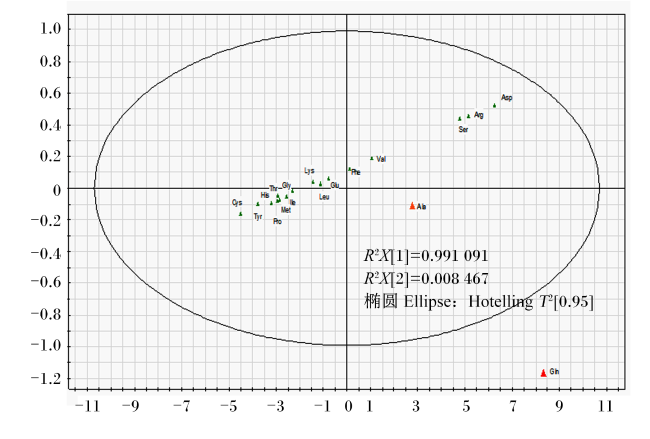
图1 杂交施氏鲟幼鱼血清氨基酸代谢谱PCA

Gln:谷氨酰胺 glutamine;Ala:丙氨酸 alanine;Cys:半胱氨酸 cysteine;Tyr:酪氨酸 tyrosine;His:组氨酸 histidine;Thr:苏氨酸 threonine;Pro:脯氨酸 proline;Met:蛋氨酸 methionine;Ile:异亮氨酸 isoleucine;Gly:甘氨酸 glycine;Lys:赖氨酸 lysine;Leu:亮氨酸 leucine;Glu:谷氨酸 glutamic acid;Phe:苯丙氨酸 phenylalanine;Val:缬氨酸 valine;Ser:丝氨酸 serine;Arg:精氨酸 arginine;Asp:天冬氨酸 aspartic acid。

Fig.1 PCA of serum amino acid metabolic profile of juvenile Acipenser schrenckii♀×Acipenser baerii♂

3.2 Ala-Gln对杂交施氏鲟幼鱼蛋白质合成的影响

Ala-Gln可作为水产动物能量和蛋白质的来源[23]。本试验结果显示,饲料中添加0.75%~1.00%Ala-Gln可提高鲟鱼全鱼粗蛋白质含量,而低水平添加组(添加0.25%~0.50%Ala-Gln)效果则不明显。由此可见,外源性补充适量的Ala-Gln有促进鱼体蛋白质合成的作用,此结果与在鲟鱼[24]上的研究结果类似,这可能与Ala-Gln能够调节鱼体的代谢水平有关。Gln不仅是机体内合成生物大分子如氨基酸、蛋白质、嘌呤、嘧啶及核苷酸等的重要前体,也是机体生长发育或组织或细胞分化的重要能源物质[25]。Gln可促进细胞内蛋白质的合成,并通过影响机体的新陈代谢来调节动物的生长[26]。研究表明,在石首鱼(Totoaba macdonaldi)饲料中添加1.5%Gln后,蛋白质利用率显著提高[27]。Gln可在体内转化为精氨酸,当精氨酸水平较高时,可促进生长激素(GH)的释放,释放后可提高DNA聚合酶的活性,从而促进mRNA的转录[28]。此外,GH还可以通过影响与肠道蛋白质吸收和代谢有关的尾型同源盒转录因子2(cdx2)、小肽转运载体1(PepT1)和雷帕霉素靶蛋白(mTOR)的表达,使体内蛋白质的表达加速[29]。有研究表明,Ala-Gln对促进大菱鲆(Scophthalmus maximus)幼鱼生长具有显著效果,且机体内的Gln含量显著升高[30],这可能是因为Gln能够激活mTOR信号通路[31]。另外,Gln还可促进胰岛素生长因子-Ⅰ(IGF-Ⅰ)的分泌,Chen等[32]研究发现,在建鲤(Cyprinus carpio var. Jian)饲料中添加1%Ala-Gln,其生长性能和糖皮质激素受体(GR)表达均显著提高;在大口黑鲈(Micropterus salmoides)的研究中发现[33],饲料中添加Gln后,小肠黏膜细胞IGF-Ⅰ mRNA表达量提高,进而促进机体蛋白质的合成。

3.3 Ala-Gln对杂交施氏鲟幼鱼氨基酸代谢的影响

鱼类对晶体氨基酸的利用程度有限,且Gln对酸性环境敏感,遇热不稳定,这限制了其的应用效果。Ala-Gln具有在水溶液中溶解度高、耐高温以及性质较为稳定等优点[34]。此外,鱼类肠道和肾脏中分别存在PepT1和小肽转运载体2(PepT2),可以使Ala-Gln以完整的形式转运到细胞内,然后被水解利用,而且转运载体PepT1转运二肽的效率远高于游离氨基酸[35]。作为Gln的稳定形式,Ala-Gln可弥补Gln单体在实际应用中的缺陷。本研究中,饲料中添加0.5%~1.0%Ala-Gln后,鲟鱼幼鱼血清Gln和丙氨酸含量显著提高。然而,在血清中未检测到Ala-Gln。这可能是因为血清中的游离氨基酸含量受到多种因素的影响,包括饲料中的氨基酸形式、饲料氨基酸水平以及蛋白质来源等[36]。然而,从全鱼的氨基酸组成来看,其氨基酸模式并没有发生明显的变化。这与在大口黑鲈[37]上的研究结果类似。由此可知,Ala-Gln被吸收后主要通过Gln和丙氨酸这2种氨基酸调节机体代谢。谷氨酸和Gln以游离和蛋白质结合形式占鱼类总氨基酸的很大一部分。尽管这2种氨基酸长期以来一直被认为是水生动物营养中的非必需氨基酸,但它们必须充分包含在饲料中,以支持机体最佳健康(尤其是肠道健康)和最大限度的生长[38]。在草鱼饲料中添加Gln(12 g/kg)60 d后,血清谷氨酸和丝氨酸含量显著下降[39],这与本试验研究结果相似。可能是因为Gln作为肠道发育的诱导剂和蛋白质合成的前体,可以促进蛋白质来源的使用[40]。因此,血清游离氨基酸含量的变化可归因于对饲料添加Gln的反应。然而,饲料中添加过量Gln可能是有害的,因为含有高水平游离氨基酸的饲料会使肠细胞的转运机制饱和并损害其他氨基酸的吸收,包括必需氨基酸[41]。由于鱼体内没有储存氨基酸的机制,因此多余的氨基酸必须被分解代谢和排出体外,这是一个消耗能量的过程[21]

3.4 Ala-Gln对杂交施氏鲟幼鱼能量收支的影响

能量收支是评估能量流动和分配的一种手段,可用于分析生物体对能量的分配和利用情况[42]。动物依靠从食物中获得的能量来维持生长等,根据摄入的食物类型差异,它们可能会将更多的能量用于生长和繁殖,或者在排泄中失去能量。所以,探究能量在各种生理功能上的分布对于水产养殖至关重要。在凡纳滨对虾(Litopenaeus vannamei)饲料中添加酶制剂可提高其摄食能[43]。本研究中,鲟鱼代谢能占摄食能为67.78%~68.30%,在摄食能中所占比例最大,即呼吸代谢是影响鲟鱼能量分布的主要因素;而生长能占摄食能为25.23%~26.36%,仅次于代谢能。在绿唇鲍鱼(Haliotis laevigata Donovan)[44]的研究中也有相似的结果。这可能是因为Ala-Gln在进入机体内会立即分解成Gln,血液中Gln含量高会为机体细胞的能量代谢、细胞生长等提供现成的碳和氮源。此外,本试验中,随着饲料中Ala-Gln添加量的提高,生长能逐渐提高,其中G5组生长能显著高于G1组和G2组,同时粪能和排泄能呈现逐渐降低的趋势。这与邢浩春等[45]的研究结果类似。由此可知,饲料中添加0.75%~1.00%Ala-Gln之所以能较好地促进施氏鲟幼鱼的生长是由于其提高了生长能并降低了粪能和排泄能的综合作用。归根结底,动物获得能量的速度必须快于它们消耗能量(新陈代谢)的速度,才能将净能量分配给生长和繁殖等,这对于动物的适应性至关重要[46]

4 结论

饲料中添加适量Ala-Gln可提高杂交施氏鲟幼鱼终末体重和肥满度,促进机体蛋白质合成,并提高能量利用效率。在本试验条件下,杂交施氏鲟幼鱼饲料中以添加0.75%~1.00%Ala-Gln效果较佳。
[1]
LI X Y, ZHENG S X, WU G Y. Nutrition and metabolism of glutamate and glutamine in fish[J]. Amino Acids, 2020, 52(5):671-691.

DOI PMID

[2]
孙奇奇, 吴昊鸣, 李森, 等. 氨基酸对炎症性肠病的调控作用[J]. 生物工程学报, 2022, 38(6):2128-2138.

SUN Q Q, WU H M, LI S, et al. Regulation of inflammatory bowel disease by amino acids[J]. Chinese journal of biotechnology, 2022, 38(6):2128-2138. (in Chinese)

[3]
OGDEN H B, CHILD R B, FALLOWFIELD J L, et al. Gastrointestinal tolerance of low,medium and high dose acute oral L-glutamine supplementation in healthy adults:a pilot study[J]. Nutrients, 2020, 12(10):2953.

[4]
UDDIN M M, IBRAHIM M M H, BRISKI K P. Sex-dimorphic neuroestradiol regulation of ventromedial hypothalamic nucleus glucoregulatory transmitter and glycogen metabolism enzyme protein expression in the rat[J]. BMC Neuroscience, 2020, 21(1):51.

DOI PMID

[5]
MACEDO ROGERO M, TIRAPEGUI J, PEDROSA R G, et al. Plasma and tissue glutamine response to acute and chronic supplementation with L-glutamine and L-alanyl-L-glutamine in rats[J]. Nutrition Research, 2004, 24(4):261-270.

[6]
PILLONETTO M, AREND L, GOMES S M T, et al. Molecular investigation of isolates from a multistate polymicrobial outbreak associated with contaminated total parenteral nutrition in Brazil[J]. BMC Infectious Diseases, 2018, 18(1):397.

DOI PMID

[7]
李佑杰, 陈琪, 袁志文, 等. 饲料中添加丙氨酰-谷氨酰胺对大鳞副泥鳅生长性能、血清生化指标、肝脏抗氧化能力以及肠道消化酶活性和形态结构的影响[J]. 动物营养学报, 2024, 36(5):3219-3230.

DOI

LI Y J, CHEN Q, YUAN Z W, et al. Effects of dietary alanyl-glutamine supplementation on growth performance,serum biochemical indices,liver antioxidant capacity,intestinal digestive enzyme activities and morphological structure of Paramisgurnus dabyranus[J]. Chinese Journal of Animal Nutrition, 2024, 36(5):3219-3230. (in Chinese)

[8]
方揽月, 许耀升, 刘天骥, 等. 饲料中谷氨酸、谷氨酰胺和谷氨酸钠对鳜摄食、生长、胃肠及肝功能的影响[J]. 水生生物学报, 2024, 48(4):592-599.

FANG L Y, XU Y S, LIU T J, et al. Dietary glutamic acid,glutamine and monosodium glutamate on feeding,growth,gastrointestinal and liver function of mandarin fish (Siniperca chuatsi)[J]. Acta Hydrobiologica Sinica, 2024, 48(4):592-599. (in Chinese)

[9]
WANG C A, XU Q Y, XU H, et al. Dietary L-alanyl-L-glutamine supplementation improves growth performance and physiological function of hybrid sturgeon Acipenser schrenckii♀×A.baerii ♂[J]. Journal of Applied Ichthyology, 2011, 27(2):727-732.

[10]
AOAC. Official Methods of Analysis of AOAC International[S]. Rockville, MD: AOAC International, 2016.

[11]
YEE J Y, DAVIS R O E. Determination of ammoniacal and urea nitrogen[J]. Analytical Chemistry, 1935, 7(4):259-261.

[12]
BRETT J R, GROVES T D D. 6-physiological energetics[J]. Fish physiology, 1979,8:279-352.

[13]
ELLIOTT J M. The energetics of feeding,metabolism and growth of brown trout (Salmo trutta L.) in relation to body weight,water temperature and ration size[J]. Journal of Animal Ecology, 1976, 45(3):923-948.

[14]
ELLIOTT J M. Energy losses in the waste products of brown trout (Salmo trutta L.)[J]. Journal of Animal Ecology, 1976, 45(2):561-580.

[15]
彭洁, 曹猛, 孙慕涵, 等. 谷氨酰胺代谢在机体免疫调控中作用的研究进展[J]. 癌变.畸变.突变, 2023, 35(3):231-235,239.

PENG J, CAO M, SUN M H, et al. Advances in the role of glutamine metabolism in the regulation of body immunity[J]. Carcinogenesis,Teratogenesis & Mutagenesis, 2023, 35(3):231-235,239. (in Chinese)

[16]
TIAN J, HE G, MAI K S, et al. Dietary Ala-Gln ameliorated growth suppression and intestinal injury induced by soya saponin in zebrafish[J]. Aquaculture, 2020,529:735748.

[17]
李雪, 张木子, 黎明, 等. 饲料中添加丙氨酰-谷氨酰胺二肽对黄颡鱼幼鱼生长性能、抗氧化能力、免疫应答能力及抗逆能力的影响[J]. 动物营养学报, 2019, 31(7):3197-3206.

LI X, ZHANG M Z, LI M, et al. Effects of alanyl-glutamine dipeptide supplementation on growth performance,antioxidant status,immune response and stress resistance of juvenile yellow catfish (Pelteobagrus fulvidraco)[J]. Chinese Journal of Animal Nutrition, 2019, 31(7):3197-3206. (in Chinese)

[18]
MA X Z, FENG L, WU P, et al. Enhancement of flavor and healthcare substances, mouthfeel parameters and collagen synthesis in the muscle of on-growing grass carp (Ctenopharyngodon idella) fed with graded levels of glutamine[J]. Aquaculture, 2020,528:735486.

[19]
HE Y F, DONG X H, YANG Q H, et al. Glutamine improves growth and intestinal health in juvenile hybrid groupers fed high-dose glycinin[J]. Fish & Shellfish Immunology, 2023,141:109003.

[20]
ZOU T D, DENG C X, WANG Z R, et al. Dietary alanyl-glutamine improves growth performance of weaned piglets through maintaining intestinal morphology and digestion-absorption function[J]. Animal, 2019, 13(9):1826-1833.

DOI PMID

[21]
PALOMINO RAMOS A R, CAMPELO D A V, CARNEIRO C L D S, et al. Optimal dietary L-glutamine level improves growth performance and intestinal histomorphometry of juvenile giant trahira (Hoplias lacerdae),a Neotropical carnivorous fish species[J]. Aquaculture, 2022,547:737469.

[22]
CARVALHO P L P F, XAVIER W D S, GUIMARÃES M G, et al. Dietary glutamine improves growth and intestinal morphology of juvenile GIFT tilapia (Oreochromis niloticus) but has limited effects on innate immunity and antioxidant capacity[J]. Aquaculture, 2023,563, Part 1:738976.

[23]
温震威, 黄建盛, 陈有铭, 等. L-丙氨酰-L-谷氨酰胺对低氧胁迫后军曹鱼幼鱼生长性能、血清生化与抗氧化指标的影响[J]. 动物营养学报, 2023, 35(4):2503-2513.

DOI

WEN Z W, HUANG J S, CHEN Y M, et al. Effects of L-akanyl-L-glutamine on growth performance,serum biochemical and antioxidant indexes of juvenile cobia (Rachycentron canadum) after hypoxia stress[J]. Chinese Journal of Animal Nutrition, 2023, 35(4):2503-2513. (in Chinese)

[24]
WANG C, SUN X, LU S, et al. Transcriptome analyses profiles of dietary L-alanyl-L-glutamine supplementation in amur sturgeon,Acipenser schrenckii,liver[J]. Journal of the World Aquaculture Society, 2023, 54(3):734-748.

[25]
江周影, 梁诗雨, 赵铁建, 等. 谷氨酰胺代谢调控慢性肝病作用机制的研究进展[J]. 解放军医学院学报, 2023, 44(7):800-805.

JIANG Z Y, LIANG S Y, ZHAO T J, et al. Research advances in glutamine metabolism in regulating chronic liver disease[J]. Academic Journal of Chinese PLA Medical School, 2023, 44(7):800-805. (in Chinese)

[26]
中国健康管理协会临床营养与健康分会, 国家老年疾病临床医学研究中心(解放军总医院), 中国老年医学学会, 等. 免疫营养素临床应用专家共识[J]. 中华老年多器官疾病杂志, 2023, 22(11):801-815.

Clinical Nutrition and Health Branch of China Health Management Association,National Clinical Medical Research Center for Geriatric Diseases (PLA General Hospital), Chinese Geriatric Society, et al. Expert consensus on clinical application of immunonutrients[J]. Chinese Journal of Multiple Organ Diseases in the Elderly, 2023, 22(11):801-815. (in Chinese)

[27]
FUENTES-QUESADA J P, VIANA M T, MATA-SOTRES J A, et al. Dietary glutamine enhances growth performance and gut integrity of Totoaba macdonaldi juveniles fed low fishmeal diets but has limited synergetic effects in combination with a prebiotic[J]. Aquaculture, 2023,576:739834.

[28]
李培佳, 赵红霞, 彭凯, 等. 精氨酸的生理功能及其在鱼类营养中的研究进展[J]. 饲料工业, 2022, 43(14):60-64.

LI P J, ZHAO H X, PENG K, et al. Physiological function and research progress of arginine in fish nutrition[J]. Feed Industry, 2022, 43(14):60-64. (in Chinese)

[29]
ZHOU Y H, GUO M X, LI Y J, et al. Effects of ghrelin on intestinal cell proliferation, the expression of protein absorption and metabolism factors in juvenile grass carp (Ctenopharyngodon idella)[J]. Aquaculture Reports, 2022,22:100928.

[30]
仲茜, 许丹丹, 王旋, 等. 饲料中添加亮氨酸和谷氨酰胺对大菱鲆幼鱼生长和肠道健康的影响[J]. 中国海洋大学学报(自然科学版), 2023, 53(4):8-17.

ZHONG Q, XU D D, WANG X, et al. Effects of dietary leucine and glutamine on growth and intestinal health of juvenile turbot (Scophthalmus maximus L.)[J]. Periodical of Ocean University of China, 2023, 53(4):8-17. (in Chinese)

[31]
JEWELL J L, KIM Y C, RUSSELL R C, et al. Differential regulation of mTORC1 by leucine and glutamine[J]. Science, 2015, 347(6218):194-198.

[32]
CHEN X M, GUO G L, SUN L, et al. Effects of Ala-Gln feeding strategies on growth,metabolism,and crowding stress resistance of juvenile Cyprinus carpio var.Jian[J]. Fish & Shellfish Immunology, 2016,51:365-372.

[33]
LIN Y J, CHEN J M, CHEN X M, et al. Effects of Ala-Gln on growth, biochemical indicators and stress-related gene expression of largemouth bass (Micropterus salmoides) under dual stress of flow rate and density[J]. Aquaculture Reports, 2024,35:101961.

[34]
WANG J X, PANG C P, TU Z L, et al. Double enzymes coupled screening assisted molecular modification of α-amino acid ester acyltransferase for L-alanyl-L-glutamine biosynthesis[J]. Food Bioscience, 2024,58:103643.

[35]
WEI Y L, LI B X, XU H G, et al. Effects of lysine and leucine in free and different dipeptide forms on the growth,amino acid profile and transcription of intestinal peptide,and amino acid transporters in turbot (Scophthalmus maximus)[J]. Fish Physiology and Biochemistry, 2020, 46(5):1795-1807.

[36]
YUN H, PARK G, KATYA K, et al. Determination of the dietary lysine requirement by measuring plasma free lysine concentrations in rainbow trout Oncorhynchus mykiss after dorsal aorta cannulation[J]. Fisheries and Aquatic Sciences, 2016, 19(4):1-7.

[37]
何明. 大口黑鲈饲料中发酵豆粕替代鱼粉的效果及谷氨酰胺、丁酸梭菌提升其效价的营养策略研究[D]. 博士学位论文. 上海: 上海海洋大学, 2020.

HE M. Study on the effects of fermented soybean meal in fish meal replacement and the improvement of glutamine and Clostridium butyricum on its effectiveness in the diet of largemouth bass (Micropterus salmoides)[D]. Ph.D. Thesis. Shanghai: Shanghai Ocean University, 2020. (in Chinese)

[38]
ANDERSEN S M, WAAGBØ R, ESPE M. Functional amino acids in fish nutrition,health and welfare[J]. Frontiers in Bioscience (Elite Edition), 2016,8:143-169.

[39]
QU F F, LIU Z, HU Y, et al. Effects of dietary glutamine supplementation on growth performance,antioxidant status and intestinal function in juvenile grass carp (Ctenopharyngodon idella)[J]. Aquaculture Nutrition, 2019, 25(3):609-621.

[40]
REFSTIE S, LANDSVERK T, BAKKE-MCKELLEP A M, et al. Digestive capacity,intestinal morphology,and microflora of 1-year and 2-year old Atlantic cod (Gadus morhua) fed standard or bioprocessed soybean meal[J]. Aquaculture, 2006, 261(1):269-284.

[41]
SIDDIK M A B, HOWIESON J, FOTEDAR R, et al. Enzymatic fish protein hydrolysates in finfish aquaculture:a review[J]. Reviews in Aquaculture, 2021, 13(1):406-430.

[42]
曲亮, 谢玺, 卢羽洁, 等. 海水酸化及升温对刺参生长及能量收支的影响[J]. 水生生物学报, 2023, 47(5):732-738.

QU L, XIE X, LU Y J, et al. Growth and bioenergetics of the sea cucumber Apostichopus japonicus (Echinodermata:Holothuroidea) in response to seawater acidification and warming[J]. Acta Hydrobiologica Sinica, 2023, 47(5):732-738. (in Chinese)

[43]
熊莹槐, 罗晓春, 钱雪桥, 等. 复合酶制剂和复合菌制剂对凡纳滨对虾生长、体生化组成及能量收支的影响[J]. 海洋湖沼通报, 2022, 44(6):41-48.

XIONG Y H, LUO X C, QIAN X Q, et al. Effects of feed compound enzyme preparation and compound probiotics preparation on growth,body biochemical composition and energy balance of Litopenaeus vannamei[J]. Transactions of Oceanology and Limnology, 2022, 44(6):41-48. (in Chinese)

[44]
DUONG D N, STONE D A J, QIN J G, et al. Energy budgets for greenlip abalone (Haliotis laevigata Donovan) fed graded dietary crude protein levels at seasonal water temperatures[J]. Aquaculture, 2021,536:736499.

[45]
邢浩春, 杜利强, 李同庆, 等. 维生素B6对史氏鲟幼鱼能量收支的影响[J]. 湖北农业科学, 2014, 53(14):3351-3353,3378.

XING H C, DU L Q, LI T Q, et al. Effects of dietary vitamin B6 on energy budget of juvenile Acipenser schrenki Brandt[J]. Hubei Agricultural Sciences, 2014, 53(14):3351-3353,3378. (in Chinese)

[46]
TOMLINSON S, ARNALL S G, MUNN A, et al. Applications and implications of ecological energetics[J]. Trends in Ecology & Evolution, 2014, 29(5):280-290.

Outlines

/