RESEARCH PAPER

Effects of Replacing Fish Meal with Cottonseed Protein Concentrate on Growth Performance, Antioxidant Ability, Immune Function and Intestinal Health of Paramisgurnus dabryanus

  • CHEN Qi , 1, 2 ,
  • LI Youjie 1, 2 ,
  • YUAN Zhiwen 1, 2 ,
  • PAN Jie 1, 2 ,
  • LI Yaping 1, 2 ,
  • YU Chuanqi 1, 2 ,
  • ZHANG Yazhou 1, 2 ,
  • ZHOU Qiubai , 1, 2, * ,
  • WANG Zirui , 1, 2, *
Expand
  • 1 College of Animal Science and Technology, Jiangxi Agricultural University, Nanchang 330045, China
  • 2 Nanchang Key Laboratory of Featured Hydrobios Nutritional Physiology and Healthy Breeding, Nanchang 330045, China
* ZHOU Qiubai, professor, E-mail: ;
WANG Zirui, professor, E-mail:

Received date: 2024-10-24

  Online published: 2025-05-14

Abstract

This experiment was conducted to investigate the effects of replacing fish meal with cottonseed protein concentrate on growth performance, antioxidant ability, immune function and intestinal health of Paramisgurnus dabryanus. A total of 960 healthy Paramisgurnus dabryanus with initial body weight of (2.60±0.01) g were randomly divided into 6 groups with 4 replicates per group and 40 fish per replicate. The six groups were fed diets in which 0 (control, FM group), 32% (CPC32 group), 44% (CPC44 group), 56% (CPC56 group), 68% (CPC68 group) and 80% (CPC80 group) fish meal were replaced by cottonseed protein concentrate, respectively. The experiment lasted for 8 weeks. The results showed as follows: 1) compared with FM group, the final body weight, weight gain rate (WGR), specific growth rate (SGR), hepatosomatic index (HSI) and viscerosomatic index (VSI) in CPC56, CPC68 and CPC80 groups were significantly decreased (P<0.05), and the feeding rate (FR) and feed coefficient (FCR) in CPC68 and CPC80 groups were significantly increased (P<0.05). 2) Compared with FM group, the contents of glucose (GLU), triglyceride (TG) and high-density lipoprotein cholesterol (HDL-C) and the activities of lysozyme (LYS) and alkaline phosphatase (AKP) in serum in CPC80 group were significantly decreased (P<0.05). 3) Compared with FM group, the malondialdehyde (MDA) content in liver in CPC32 group was significantly decreased (P<0.05), the superoxide dismutase (SOD) activity in liver in CPC44 group was significantly increased (P<0.05), and the alanine aminotransferase (ALT) activity, reduced glutathione (GSH) content and total antioxidant capacity (T-AOC) in liver in CPC68 and CPC80 groups were significantly decreased (P<0.05). 4) The intestinal trypsin activity in CPC44 and CPC56 groups was significantly higher than that in FM group (P<0.05), and the intestinal lipase activity in CPC44 group was significantly higher than that in the other groups (P<0.05). Compared with FM group, the intestinal villi height in CPC80 group was significantly decreased (P<0.05). 5) Compared with FM group, the intestinal Mycobacterium relative abundance in CPC80 group was significantly increased (P<0.05); the ratio of Firmicutes to Bacteroidetes in intestine was gradually increased with the increase of the proportion of cottonseed protein concentrate instead of fish meal. In conclusion, under the conditions of this experiment, 32% and 44% of cottonseed protein concentrate instead of fish meal in the diet has no negative effects on the growth of Paramisgurnus dabryanus. Based on the WGR broken line model analysis, the appropriate ratio of cottonseed protein concentrate to replace fish meal in the diet of Paramisgurnus dabryanus is 30.46%.

Cite this article

CHEN Qi , LI Youjie , YUAN Zhiwen , PAN Jie , LI Yaping , YU Chuanqi , ZHANG Yazhou , ZHOU Qiubai , WANG Zirui . Effects of Replacing Fish Meal with Cottonseed Protein Concentrate on Growth Performance, Antioxidant Ability, Immune Function and Intestinal Health of Paramisgurnus dabryanus[J]. Chinese Journal of Animal Nutrition, 2025 , 37(5) : 3271 -3292 . DOI: 10.12418/CJAN2025.270

鱼粉是水产动物饲料中极为重要的蛋白质源,具有适口性好、蛋白质含量高以及氨基酸平衡等特点[1],但近年来水产养殖行业与水产饲料的快速发展加剧了鱼粉供需之间的不平衡[2],同时由于全球捕捞业产量降低,造成鱼粉产量降低与价格暴涨,因此寻求新型蛋白质源替代鱼粉成为亟待解决的热点问题。目前,已有多种新型蛋白质源用于替代鱼粉,包括植物蛋白质[3-6]、昆虫蛋白质[7-8]、细菌蛋白质[9-10]以及微藻蛋白质[11]等,其中植物蛋白质来源广、价格低、供应稳定,已在水产饲料中进行了广泛研究。然而,植物蛋白质原料存在适口性差、氨基酸不平衡以及含有不同种类抗营养因子等缺陷,易导致水产动物生产性能下降,免疫力低下,引发肠炎或造成肝脏损伤等问题[12]。棉籽浓缩蛋白(cottonseed protein concentrate,CPC)通过低温脱酚技术降低棉籽粕中抗营养因子棉酚含量,减少蛋白质变性,提高蛋白质含量[13],是极具潜力的新型蛋白质源。近年来,已有研究报道,棉籽浓缩蛋白可有效替代大口黑鲈(Micropterus salmoides)[14-15]、虹鳟(Oncorhynchus mykiss)[16]、黄鳝(Monopterus albus)[17]、卵形鲳鲹(Trachinotus ovatus)[18]、大黄鱼(Larimichthys crocea)[19]、凡纳滨对虾(Litopenaeus vannamei)[20]以及杂交石斑鱼(Epinephelus fuscoguttatus♀×Epinephelus lanceolatus♂)[21]等饲料中的鱼粉,这些研究表明,饲料中适量添加棉籽浓缩蛋白有利于水产动物生长性能的提高,改善肠道健康并提高抗氧化能力和免疫能力。大鳞副泥鳅(Paramisgurnus dabryanus)属鲤形目,鳅科,副泥鳅属,具有肉质鲜美、生长速度快、适应能力强以及养殖成本低的特点,在我国广泛分布,具有优越的市场前景[22]。目前,使用棉籽浓缩蛋白替代饲料中鱼粉的研究在大鳞副泥鳅上鲜有报道。因此,本试验以大鳞副泥鳅为研究对象,探讨棉籽浓缩蛋白替代鱼粉对大鳞副泥鳅生长性能、血清生化指标、抗氧化能力、免疫功能和肠道健康的影响,用以探究棉籽浓缩蛋白替代大鳞副泥鳅饲料中鱼粉的可行性,从而为其在大鳞副泥鳅饲料中的应用提供科学依据。

1 材料与方法

1.1 试验材料

试验所用棉籽浓缩蛋白为市购产品,其粗蛋白质含量为62.53%,游离棉酚含量为228 mg/kg。大鳞副泥鳅购自江西东乡泥鳅科技小院,正式试验前转运至江西农业大学水产基地暂养2周,投喂基础饲料,使其适应养殖条件,试验开始前禁食24 h。

1.2 试验设计和饲料

本试验经江西农业大学动物保护与利用专业委员会批准(伦理批准号:YU2005-0001)。试验选取960尾体质健康、外观正常、初始体质量为(2.60±0.01) g的大鳞副泥鳅,随机分为6组,每组4个重复,每个重复40尾。6组分别饲喂采用棉籽浓缩蛋白替代基础饲料中0(对照,FM组)、32%(CPC32组)、44%(CPC44组)、56%(CPC56组)、68%(CPC68组)和80%(CPC80组)鱼粉的饲料。试验期8周。
本试验以鱼粉、豆粕、菜籽粕和棉籽浓缩蛋白作为主要蛋白质源,以鱼油和大豆油作为脂肪源,设计基础饲料鱼粉(粗蛋白质含量实测值为66.12%)含量为25%,并通过添加精氨酸、赖氨酸和蛋氨酸,配制6种等氮等脂的饲料。试验原料粉碎后过80目筛,根据饲料配方准确称取原料,逐级混合,并采用小型制粒机制成直径为1.0 mm的沉性颗粒饲料。饲料组成及营养水平见表1,饲料氨基酸组成见表2
表1 饲料组成及营养水平(干物质基础)

Table 1 Composition and nutrient levels of diets (DM basis) %

项目
Items
组别Groups
FM CPC32 CPC44 CPC56 CPC68 CPC80
原料Ingredients
鱼粉Fish meal 25.00 17.00 14.00 11.00 8.00 5.00
棉籽浓缩蛋白Cottonseed protein concentrate 8.50 11.60 14.80 18.00 21.10
豆粕Soybean meal 16.00 16.00 16.00 16.00 16.00 16.00
菜籽粕Cottonseed meal 7.00 7.00 7.00 7.00 7.00 7.00
玉米蛋白粉Corn gluten meal 14.00 14.00 14.00 14.00 14.00 14.00
小麦粉Wheat flour 24.00 23.00 22.00 21.00 20.00 19.00
鱼油Fish oil 2.50 2.98 3.16 3.34 3.52 3.70
大豆油Soybean oil 2.50 2.50 2.50 2.50 2.50 2.50
大豆卵磷脂Soy lecithin 1.50 1.50 1.50 1.50 1.50 1.50
磷酸二氢钙Ca(H2PO4)2 2.00 2.00 2.00 2.00 2.00 2.00
氯化胆碱Choline chloride 0.50 0.50 0.50 0.50 0.50 0.50
纤维素Cellulose 1.75 1.84 2.57 3.20 3.83 4.56
海藻酸钠Sodium alginate 1.50 1.50 1.50 1.50 1.50 1.50
预混料Premix1) 1.00 1.00 1.00 1.00 1.00 1.00
精氨酸Arginine 0.75 0.44 0.33 0.22 0.11
赖氨酸Lysine 0.16 0.22 0.28 0.34 0.40
蛋氨酸Methionine 0.08 0.12 0.16 0.20 0.24
合计Total 100.00 100.00 100.00 100.00 100.00 100.00
营养水平Nutrient levels2)
粗蛋白质CP 43.47 43.54 43.44 43.30 43.28 43.52
粗脂肪EE 8.55 8.25 8.26 8.30 8.50 8.62
粗灰分Ash 8.78 7.87 7.53 7.17 6.87 6.63
水分(风干基础) Moisture (air-dry basis) 8.77 9.21 9.17 8.89 8.96 9.02
游离棉酚Free gossypol/(mg/kg) 19.57 45.13 57.20 67.96 79.30 90.28
总能GE/(MJ/kg) 18.80 18.68 18.80 18.68 18.50 18.32

1)预混料为每千克饲料提供 The premix provided the following per kg of diets:VA 5 000 IU,VB1 25 mg,VB2 45 mg,VB6 20 mg,VB12 0.1 mg,VK3 10 mg,VE 200 mg,VC 200 mg,VD3 2 500 IU,肌醇 inositol 200 mg,泛酸 pantothenic acid 60 mg,烟酸 nicotinic acid 200 mg,叶酸 folic acid 10 mg,生物素 biotin 1.5 mg,NaSeO3·5H2O 0.3 mg,CoCl2·6H2O 0.4 mg,KI 0.8 mg,CuSO4·5H2O 10 mg,MnSO4·4H2O 20 mg,ZnSO4·H2O 50 mg,FeSO4·7H2O 150 mg,MgSO4·7H2O 500 mg,NaCl 1 000 mg。

2)营养水平为实测值。Nutrient levels were measured values.

表2 饲料氨基酸组成(干物质基础)

Table 2 Amino acid composition of diets (DM basis) %

项目
Items
组别Groups
FM CPC32 CPC44 CPC56 CPC68 CPC80
天冬氨酸Asp 2.79 2.81 2.84 2.90 2.88 2.86
苏氨酸Thr 1.29 1.24 1.22 1.23 1.20 1.17
丝氨酸Ser 1.45 1.47 1.46 1.51 1.51 1.49
谷氨酸Glu 6.44 6.78 6.89 7.20 7.28 7.31
脯氨酸Pro 2.11 2.06 2.05 2.06 2.03 1.99
甘氨酸Gly 1.62 1.51 1.50 1.47 1.42 1.36
丙氨酸Ala 2.16 2.04 2.00 1.98 1.92 1.85
胱氨酸Cys 0.48 0.51 0.53 0.53 0.54 0.55
缬氨酸Val 1.66 1.63 1.63 1.64 1.63 1.60
蛋氨酸Met 0.70 0.73 0.72 0.72 0.75 0.75
异亮氨酸Ile 1.46 1.40 1.37 1.38 1.36 1.31
亮氨酸Leu 3.33 3.24 3.22 3.25 3.20 3.11
酪氨酸Tyr 1.06 1.02 0.98 1.04 1.05 1.02
苯丙氨酸Phe 1.61 1.70 1.74 1.77 1.81 1.80
组氨酸His 0.83 0.83 0.83 0.85 0.85 0.84
赖氨酸Lys 1.86 1.86 1.88 1.88 1.87 1.83
精氨酸Arg 2.38 2.42 2.44 2.53 2.58 2.59
总氨基酸Total amino acids 33.22 33.24 33.29 33.92 33.87 33.42

氨基酸含量为实测值。Amino acid contents were measured values.

1.3 饲养管理

饲养试验在江西农业大学水产基地进行,养殖用桶规格为80 cm×66 cm×64 cm,养殖水体为270 L,养殖用水为曝气自来水。试验期间,每天08:00和17:00对大鳞副泥鳅进行饱食投喂,每隔4 d更换2/3水量,每天观察试验泥鳅摄食情况和死亡情况并记录,每周对大鳞副泥鳅摄食量进行称重测定,根据泥鳅摄食情况对投喂量及时调整,并且对每次投喂后残饵进行打捞,烘干后称重,粪便则通过换水进行处理。饲养水温波动范围为26~30 ℃,24 h不间断充氧,保证溶氧含量大于5 mg/L,pH在7.2左右。

1.4 样品采集

饲养试验结束后,试验泥鳅禁食24 h。采用MS-222麻醉后,统计每个养殖桶内的泥鳅尾数和总质量。每桶随机挑选12尾泥鳅,取3尾作为全鱼样品,用于常规营养成分的测定;另外9尾测量体长和体重,之后采取尾静脉抽血,4 ℃静置,离心机1 006.2×g离心10 min,取上清液保存于-80 ℃冰箱,用于血清生化和免疫指标的测定。采血后解剖鱼体,取出内脏团,分离肝脏和肠道,分别对内脏团和肝脏进行称重,快速放于液氮中速冻,储存于-80 ℃冰箱中,用于后续肠道免疫指标和消化酶活性测定以及肠道菌群分析。每桶随机挑选3尾泥鳅,取肠道样品浸没在4%甲醛固定液中固定,用于后续肠道形态结构的观察。

1.5 测定指标及方法

1.5.1 生长性能

生长性能相关指标计算公式如下:
$增重率(weight gain rate,WGR, \%)=100 \times\left(W_{t}-W_{0}\right) / W_{0} ;特定生长率(specific growth rate,SGR,%/d ) =100 \times\left(\ln W_{i}-\ln W_{0}\right) / t ;饲料系数(feed coefficient, FCR )=F_{c} /\left(W_{t}-W_{0}\right) ;摄食率(feeding rate,FR, \% / \mathrm{d} ) =100 \times F_{c} /\left[\left(W_{t}+W_{0}\right) / 2 \times t\right] ;肥满度(condition factor, \mathrm{CF}, \mathrm{g} / \mathrm{cm}^{3} ) =100 \times W / L^{3} ;肝体比(hepatosomatic index,HSI, \% ) =100 \times W_{h} / W ;脏体比(viscerosomatic index,VSI,%) =100 \times W_{v} / W ;存活率(survival rate, \mathrm{SR}, \% ) =100 \times N_{i} / N_{0} 。$
式中:WtW0分别为终末体质量和初始体质量(g);t为养殖试验天数(d);Fc为饲料干物质总摄食量(g);NtN0分别为终末尾数和初始尾数(尾);W为体质量(g);L为体长(cm);Wv为内脏重(g);Wh为肝脏重(g)。

1.5.2 营养成分

采用国标方法测定饲料和大鳞副泥鳅鱼体水分(GB/T 6435—2014)、粗蛋白质(GB/T 6432—2018)、粗脂肪(GB/T 6433—2006)和粗灰分(GB/T 6438—2007)含量,饲料氨基酸含量采用GB/T 18246—2019测定;饲料总能参照国际标准ISO 9831:1998,采用全自动氧弹热仪测定;游离棉酚含量采用GB/T 13086—2020测定。

1.5.3 血清生化指标

采用全自动生化仪测定血清总蛋白(TP)、白蛋白(ALB)、葡萄糖(GLU)、甘油三酯(TG)、总胆固醇(TC)、高密度脂蛋白胆固醇(HDL-C)和低密度脂蛋白胆固醇(LDL-C)含量;谷丙转氨酶(ALT)和谷草转氨酶(AST)活性采用南京建成生物工程研究所试剂盒测定。

1.5.4 肝脏抗氧化指标和肠道消化酶活性

肝脏谷胱甘肽过氧化物酶(GSH-Px)活性、还原型谷胱甘肽(GSH)含量、超氧化物歧化酶(SOD)活性、过氧化氢酶(CAT)活性、丙二醛(MDA)含量、总抗氧化能力(T-AOC)以及肠道脂肪酶(LPS)、胰蛋白酶(TPS)、α-淀粉酶(AMS)活性采用南京建成生物工程研究所试剂盒测定。

1.5.5 血清和肠道免疫指标

血清和肠道碱性磷酸酶(AKP)和酸性磷酸酶(ACP)活性采用南京建成生物工程研究所试剂盒测定,免疫球蛋白M(IgM)含量和溶菌酶(LYS)活性采用上海优选生物科技有限公司试剂盒测定。

1.5.6 肠道形态结构

将肠道组织固定于4%多聚甲醛固定液中,对组织样品进行修剪,随后经梯度乙醇(乙醇的浓度从75%提高到100%)脱水;然后将样品包埋在石蜡中,并切成4 μm的切片;最后进行苏木精-伊红(HE)染色,在光学显微镜下观察肠道组织切片(100×)。每组选取4张不连续切片,每张切片选取4个视野,采用Image Pro Plus 6.0软件测量5根完整肠绒毛高度(VH)和对应的5处隐窝深度(CD)以及5处肌层厚度(MT)。

1.5.7 肠道菌群

采用OMEGA Soil DNA Kit (D5635-02,Omega Bio-Tek,美国)试剂盒提取肠道内容物中细菌的总DNA;利用2%琼脂糖凝胶回收PCR的产物,对其进行纯化和定量检测;随后利用纯化后的PCR扩增片段构建高通量测序文库(Illumina MiSeq平台)。采用QIIME 2软件DADA2方法对得到的原始序列进行序列去噪和质控分析,按100%的序列相似度进行归并,获得扩增子序列变异(ASV)特征序列;采用classify-sklearn算法进行物种注释,在门和属水平上统计各个样本的群落结构。

1.6 数据统计与分析

采用SPSS 26.0软件对试验数据进行单因素方差分析(one-way ANOVA),并采用Duncan氏法进行多重比较检验,结果数据采用“平均值±标准误”表示,P<0.05为差异显著。

2 结果与分析

2.1 棉籽浓缩蛋白替代鱼粉对大鳞副泥鳅生长性能的影响

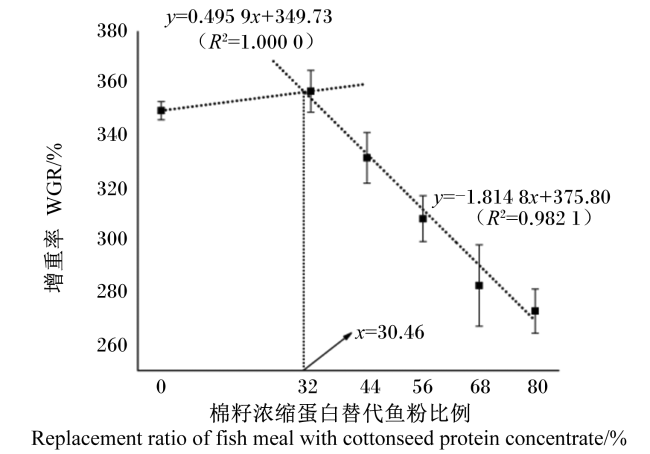
表3可知,各组间大鳞副泥鳅SR无显著差异(P>0.05)。与FM组相比,CPC56组、CPC68组和CPC80组终末体质量、WGR和SGR显著降低(P<0.05)。随着棉籽浓缩蛋白替代鱼粉比例的提高,HSI和VSI呈现逐渐降低趋势,其中CPC56组、CPC68组和CPC80组HSI和VSI显著低于FM组(P<0.05)。与FM组相比,CPC68组和CPC80组FR和FCR显著提高(P<0.05)。如图1所示,基于WGR的折线模型分析,大鳞副泥鳅饲料中棉籽浓缩蛋白替代鱼粉的适宜比例为30.46%。
表3 棉籽浓缩蛋白替代鱼粉对大鳞副泥鳅生长性能的影响

Table 3 Effects of replacing fish meal with cottonseed protein concentrate on growth performance of Paramisgurnus dabryanus

项目
Items
组别Groups P
P-value
FM CPC32 CPC44 CPC56 CPC68 CPC80
初始体质量IBW/g 2.61±0.01 2.66±0.01 2.64±0.02 2.66±0.02 2.61±0.07 2.65±0.01 0.156
终末体质量FBW/g 11.74±0.04ab 12.22±0.23a 11.34±0.29bc 10.81±0.22c 9.92±0.29d 9.85±0.24d <0.001
增重率WGR/% 349.73±3.49a 357.17±8.00a 331.60±9.75ab 308.25±8.79bc 282.65±15.60cd 272.80±8.52d <0.001
特定生长率
SGR/(%/d)
2.69±0.01a 2.71±0.03a 2.61±0.04ab 2.51±0.04bc 2.39±0.07cd 2.34±0.04d <0.001
存活率SR/% 98.75±1.25 96.25±0.72 96.88±0.63 97.50±1.77 95.00±1.02 96.25±1.25 0.353
肥满度CF/(g/cm3) 0.97±0.01ab 0.99±0.02a 0.94±0.01b 0.95±0.01ab 0.94±0.02b 0.93±0.01b 0.040
肝体比HSI/% 1.82±0.08a 1.73±0.10ab 1.61±0.06abc 1.50±0.05bc 1.51±0.08bc 1.45±0.08c 0.005
脏体比VSI/% 7.07±0.12a 6.96±0.11ab 6.75±0.13ab 6.64±0.10b 6.61±0.12b 6.60±0.17b 0.035
摄食率FR/(%/d) 2.64±0.03b 2.69±0.04b 2.67±0.02b 2.74±0.01b 3.31±0.10a 2.96±0.09a <0.001
饲料系数FCR 1.16±0.01b 1.21±0.03b 1.24±0.01b 1.29±0.01b 1.56±0.09a 1.46±0.06a <0.001

同行数据肩标不同字母表示差异显著(P<0.05),相同字母或无字母表示差异不显著(P>0.05)。表4表10同。

In the same row, values with different letter superscripts means significant difference (P<0.05), while with the same letter or no letter superscripts means no significant difference (P>0.05). The same as Table 4 to Table 10.

图1 棉籽浓缩蛋白替代鱼粉对大鳞副泥鳅WGR的影响

Fig.1 Effects of replacing fish meal with cottonseed protein concentrate on WGR of Paramisgurnus dabryanus

2.2 棉籽浓缩蛋白替代鱼粉对大鳞副泥鳅体成分的影响

表4可知,各组间大鳞副泥鳅粗蛋白质和水分含量无显著差异(P>0.05)。与FM组相比,CPC80组大鳞副泥鳅粗脂肪含量显著降低(P<0.05),CPC56组和CPC68组粗灰分含量显著提高(P<0.05)。
表4 棉籽浓缩蛋白替代鱼粉对大鳞副泥鳅体成分的影响(湿重基础)

Table 4 Effects of replacing fish meal with cottonseed protein concentrate on body composition of Paramisgurnus dabryanus (wet weight basis) %

项目
Items
组别Groups P
P-value
FM CPC32 CPC44 CPC56 CPC68 CPC80
粗蛋白质CP 15.23±0.08 15.05±0.06 15.21±0.07 15.24±0.09 15.25±0.06 15.27±0.01 0.289
粗脂肪EE 5.81±0.13a 6.03±0.01a 5.68±0.05a 5.91±0.16a 5.76±0.12a 5.27±0.15b 0.010
粗灰分Ash 2.41±0.02b 2.39±0.05b 2.41±0.03b 2.58±0.04a 2.58±0.04a 2.43±0.04b 0.009
水分Moisture 74.96±0.08 74.96±0.06 75.01±0.08 74.99±0.08 75.15±0.02 75.13±0.02 0.174

2.3 棉籽浓缩蛋白替代鱼粉对大鳞副泥鳅血清生化指标的影响

表5可知,各组间大鳞副泥鳅血清TP、ALB、TC和LDL-C含量以及ALT和AST活性均无显著差异(P>0.05)。与FM组相比,CPC44组、CPC56组、CPC68组和CPC80组血清GLU和HDL-C含量显著降低(P<0.05),CPC68组和CPC80组血清TG含量显著降低(P<0.05)。
表5 棉籽浓缩蛋白替代鱼粉对大鳞副泥鳅血清生化指标的影响

Table 5 Effects of replacing fish meal with cottonseed protein concentrate on serum biochemical indices of Paramisgurnus dabryanus

项目
Items
组别Groups P
P-value
FM CPC32 CPC44 CPC56 CPC68 CPC80
总蛋白TP/(g/L) 31.83±1.90 30.77±0.91 31.43±0.30 31.17±0.35 31.33±0.17 31.07±0.92 0.973
白蛋白ALB/(g/L) 12.60±0.74 12.43±0.48 12.10±0.23 11.67±0.18 11.60±0.10 11.43±0.20 0.260
葡萄糖GLU/(mmol/L) 6.18±0.39a 6.54±0.30a 5.49±0.17b 4.86±0.14bc 4.70±0.02c 4.43±0.04c <0.001
甘油三酯TG/(mmol/L) 5.90±0.18ab 6.50±0.03a 5.56±0.12bc 5.35±0.37bc 5.00±0.32cd 4.48±0.33d 0.002
总胆固醇TC/(mmol/L) 5.01±0.30 4.72±0.30 4.54±0.04 4.53±0.23 4.46±0.27 4.37±0.21 0.516
高密度脂蛋白胆固醇
HDL-C/(mmol/L)
0.69±0.07a 0.57±0.03ab 0.52±0.02b 0.48±0.02b 0.48±0.07b 0.47±0.04b 0.046
低密度脂蛋白胆固醇
LDL-C/(mmol/L)
1.34±0.06 1.18±0.05 1.27±0.06 1.40±0.10 1.43±0.17 1.55±0.10 0.199
谷丙转氨酶ALT/(U/L) 4.63±0.20 4.50±0.49 4.54±0.44 4.51±0.25 5.36±0.48 5.84±0.98 0.456
谷草转氨酶AST/(U/L) 9.84±1.20 10.49±0.33 11.97±0.22 11.89±0.46 13.09±1.82 14.65±2.15 0.175

2.4 棉籽浓缩蛋白替代鱼粉对大鳞副泥鳅血清和肠道免疫指标的影响

表6可知,各组间大鳞副泥鳅血清ACP活性和IgM含量无显著差异(P>0.05)。随着棉籽浓缩蛋白替代鱼粉比例的提高,血清LYS和AKP活性均呈现逐渐降低趋势;与FM组相比,CPC80组血清LYS活性显著降低(P<0.05),各棉籽浓缩蛋白替代组血清AKP活性均显著降低(P<0.05)。
表6 棉籽浓缩蛋白替代鱼粉对大鳞副泥鳅血清免疫指标的影响

Table 6 Effects of replacing fish meal with cottonseed protein concentrate on serum immune indices of Paramisgurnus dabryanus

项目
Items
组别Groups P
P-value
FM CPC32 CPC44 CPC56 CPC68 CPC80
免疫球蛋白M
IgM/(g/L)
14.24±1.67 12.62±0.97 11.86±1.28 12.45±1.43 12.66±1.16 8.23±0.51 0.073
溶菌酶LYS/(U/L) 6.87±0.51a 6.70±0.26a 6.67±0.37a 6.54±0.22a 6.39±0.16a 4.42±0.04b 0.001
酸性磷酸酶
ACP/(金氏单位/dL)
5.31±0.28 5.20±0.55 5.21±0.11 5.43±0.21 4.94±0.32 5.17±0.05 0.910
碱性磷酸酶
AKP/(金氏单位/dL)
4.99±0.25a 4.02±0.11b 4.13±0.15b 3.96±0.20b 3.45±0.32b 3.73±0.17b 0.005
表7可知,各组间大鳞副泥鳅肠道LYS活性无显著差异(P>0.05)。随着棉籽浓缩蛋白替代鱼粉比例的提高,肠道IgM含量呈现逐渐降低的变化趋势,但各组间无显著差异(P>0.05)。与FM组相比,CPC44组和CPC56组肠道ACP活性显著提高(P<0.05),CPC68组和CPC80组肠道AKP活性显著降低(P<0.05)。
表7 棉籽浓缩蛋白替代鱼粉对大鳞副泥鳅肠道免疫指标的影响

Table 7 Effects of replacing fish meal with cottonseed protein concentrate on intestinal immune indices of Paramisgurnus dabryanus

项目
Items
组别Groups P
P-value
FM CPC32 CPC44 CPC56 CPC68 CPC80
免疫球蛋白M
IgM/(g/g prot)
0.66±0.03 0.61±0.03 0.58±0.04 0.55±0.08 0.53±0.03 0.44±0.00 0.058
溶菌酶
LYS/(U/g prot)
0.18±0.02 0.21±0.04 0.23±0.07 0.24±0.05 0.22±0.04 0.17±0.02 0.878
酸性磷酸酶
ACP/(金氏单位/g prot)
150.13±11.06c 167.27±5.04bc 237.54±4.18a 188.60±5.39b 175.77±13.32bc 172.88±8.70bc <0.001
碱性磷酸酶
AKP/(金氏单位/g prot)
190.99±5.32a 192.23±8.38a 199.06±14.54a 185.54±5.36a 158.26±2.99b 155.95±4.53b 0.007

2.5 棉籽浓缩蛋白替代鱼粉对大鳞副泥鳅肝脏抗氧化指标的影响

表8可知,各组间大鳞副泥鳅肝脏AST、CAT以及GSH-Px活性无显著差异(P>0.05)。与FM组相比,CPC56组、CPC68组和CPC80组大鳞副泥鳅肝脏ALT活性和GSH含量显著降低(P<0.05),CPC68组和CPC80组肝脏T-AOC显著降低(P<0.05)。随着棉籽浓缩蛋白替代鱼粉比例的提高,肝脏SOD活性呈现先升高后降低的变化趋势,其中CPC44肝脏SOD活性显著高于其他各组(P<0.05);肝脏MDA含量呈现先降低后升高的变化趋势,且在CPC32组中最低,显著低于FM组、CPC68组和CPC80组(P<0.05)。
表8 棉籽浓缩蛋白替代鱼粉对大鳞副泥鳅肝脏抗氧化指标的影响

Table 8 Effects of replacing fish meal with cottonseed protein concentrate on liver antioxidant indices of Paramisgurnus dabryanus

项目
Items
组别Groups P
P-value
FM CPC32 CPC44 CPC56 CPC68 CPC80
谷丙转氨酶
ALT/(U/g prot)
3.83±0.59a 3.80±0.08a 3.71±0.37ab 2.41±0.56bc 1.83±0.49c 1.30±0.21c 0.003
谷草转氨酶
AST/(U/g prot)
16.76±0.60 16.89±0.67 16.48±0.76 16.24±0.49 16.29±0.39 14.88±0.39 0.228
超氧化物歧化酶
SOD/(U/mg prot)
46.98±4.25b 45.32±3.47b 66.48±3.76a 51.81±2.59b 48.27±1.95b 43.50±2.82b 0.003
丙二醛
MDA/(nmol/mg prot)
0.70±0.05b 0.47±0.04c 0.59±0.04bc 0.65±0.03bc 0.96±0.13a 1.14±0.07a <0.001
总抗氧化能力
T-AOC/(mmol/g prot)
0.17±0.01a 0.16±0.01a 0.16±0.00a 0.16±0.01a 0.15±0.01b 0.12±0.00b 0.037
过氧化氢酶
CAT/(U/g prot)
146.60±19.58 112.68±16.74 117.12±18.50 102.65±8.79 100.23±13.08 92.48±7.36 0.214
还原型谷胱甘肽
GSH/(μmol/g prot)
27.08±0.16a 25.41±1.83a 27.11±2.81a 17.22±2.26b 17.23±2.95b 16.57±2.23b 0.007
谷胱甘肽过氧化物酶
GSH-Px/(U/mg prot)
31.11±2.78 30.77±3.85 30.18±2.44 29.86±4.12 28.89±2.30 20.52±0.08 0.172

2.6 棉籽浓缩蛋白替代鱼粉对大鳞副泥鳅肠道消化酶活性和形态结构的影响

表9可知,各组间大鳞副泥鳅肠道α-淀粉酶活性无显著差异(P>0.05)。随着棉籽浓缩蛋白替代鱼粉比例的提高,肠道胰蛋白酶和脂肪酶活性呈现先升高后降低的变化趋势,其中CPC44组和CPC56组肠道胰蛋白酶活性显著高于FM组(P<0.05),CPC44组肠道脂肪酶活性显著高于其他各组(P<0.05)。
表9 棉籽浓缩蛋白替代鱼粉对大鳞副泥鳅肠道消化酶活性的影响

Table 9 Effects of replacing fish meal with cottonseed protein concentrate on intestinal digestive enzyme activities of Paramisgurnus dabryanus

项目
Items
组别Groups P
P-value
FM CPC32 CPC44 CPC56 CPC68 CPC80
胰蛋白酶
TPS/(U/mg prot)
2 108.33
±124.79c
2 172.48
±167.37bc
2 672.41
±147.25a
2 590.41
±146.11ab
2 433.93
±117.38abc
2 507.27
±76.71abc
0.035
脂肪酶
LPS/(U/g prot)
0.71
±0.11b
0.66
±0.03b
0.94
±0.11a
0.50
±0.04b
0.52
±0.01b
0.72
±0.05b
0.007
α-淀粉酶
AMS/(U/mg prot)
1.24
±0.03
1.32
±0.24
1.27
±0.12
1.22
±0.12
1.21
±0.12
1.20
±0.15
0.993
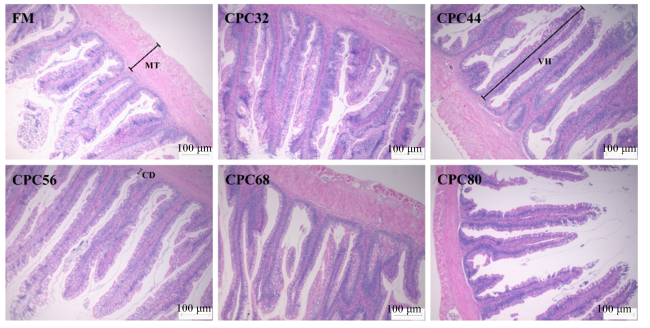
表10图2可知,与FM组相比,CPC80组大鳞副泥鳅肠道绒毛高度显著降低(P<0.05)。随着棉籽浓缩蛋白替代鱼粉比例的提高,肠道隐窝深度呈现逐渐升高的变化趋势,肠道肌层厚度呈现先升高后降低的变化趋势,但各组间均无显著差异(P>0.05)。
表10 棉籽浓缩蛋白替代鱼粉对大鳞副泥鳅肠道形态结构的影响

Table 10 Effects of replacing fish meal with cottonseed protein concentrate on intestinal morphology and structure of Paramisgurnus dabryanus m

项目
Items
组别Groups P
P-value
FM CPC32 CPC44 CPC56 CPC68 CPC80
绒毛高度
VH
2 018.51
±45.02a
2 154.10
±38.12a
2 093.76
±44.56a
2 062.22
±56.02a
2 004.95
±47.98a
1 805.27
±46.35b
<0.001
隐窝深度
CD
74.94
±1.54
77.59
±2.10
78.14
±2.33
80.31
±2.75
84.58
±2.41
83.08
±2.75
0.052
肌层厚度
MT
448.73
±11.51
474.33
±16.70
442.22
±11.04
455.97
±12.91
444.27
±18.02
416.94
±13.76
0.067
图2 棉籽浓缩蛋白替代鱼粉对大鳞副泥鳅肠道形态结构的影响

MT:肌层厚度 muscular thickness;VH:绒毛高度 villus height;CD:隐窝深度 crypt depth。

Fig.2 Effects of replacing fish meal with cottonseed protein concentrate on intestinal morphology and structure of Paramisgurnus dabryanus

2.7 棉籽浓缩蛋白替代鱼粉对大鳞副泥鳅肠道菌群的影响

2.7.1 α多样性分析
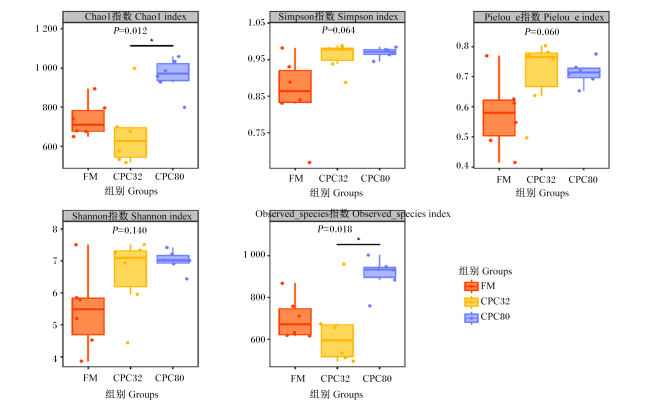
图3所示,各组间大鳞副泥鳅肠道菌群Simpson指数、Shannon指数和Pielou_e指数无显著差异(P>0.05),表明棉籽浓缩蛋白替代鱼粉对菌群多样性无显著影响;CPC32组和CPC80组Chao1指数和Observed_species指数与FM组相比无显著差异(P>0.05),但CPC80组Chao1指数和Observed_species指数显著高于CPC32组(P<0.05),表明CPC32组和CPC80组菌群丰富度与FM组相比无显著差异,CPC32组菌群丰富度低于CPC80组。
图3 棉籽浓缩蛋白替代鱼粉对大鳞副泥鳅肠道菌群α多样性的影响

*表示差异显著(P<0.05)。

Fig.3 Effects of replacing fish meal with cottonseed protein concentrate on α diversity of intestinal microbiota of Paramisgurnus dabryanus

* mean significant difference (P<0.05).

2.7.2 β多样性分析

本试验基于Bray-Curits算法运用置换多元方差分析(PERMANOVA)方法检验组间肠道菌群差异,结果见表11,FM组肠道菌群与CPC32组和CPC80组之间均存在显著差异(P<0.05),且CPC32组与CPC80组之间亦存在显著差异(P<0.05)。
表11 大鳞副泥鳅肠道菌群差异分析(基于Bray-Curits算法的PERMANOVA)

Table 11 Difference analysis of intestinal microbiota of Paramisgurnus dabryanus (PERMANOVA based on Bray-Curits algorithm)

项目
Items
样本量
Sample size
置换
Permutations
F
Pseudo-F-value
P
P-value
Q
Q-value
全部All 18 999 1.843 594 0.002
FM组vs CPC32组FM group vs CPC32 group 12 999 1.958 410 0.015 0.023
FM组vs CPC80组FM group vs CPC80 group 12 999 1.893 511 0.003 0.009
CPC32组vs CPC80组CPC32 group vs CPC80 group 12 999 1.645 727 0.034 0.034
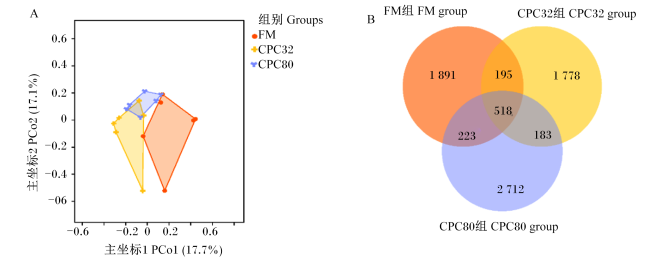
采用主坐标分析(PCoA)进行肠道菌群β多样性分析,如图4-A所示,各组间菌群组成差异较大(P<0.05)。基于ASV水平绘制韦恩图,如图4-B所示,本试验共鉴别出6 381个ASV,其中各组共有的ASV数量为518个,分别占FM组、CPC32组和CPC80组ASV数量的27.39%、29.13%和19.10%,FM组与CPC32组共有的ASV数量为713个,FM组与CPC80组共有的ASV数量为741个。
图4 棉籽浓缩蛋白替代鱼粉对大鳞副泥鳅肠道菌群β多样性的影响

Fig.4 Effects of replacing fish meal with cottonseed protein concentrate on β diversity of intestinal microbiota of Paramisgurnus dabryanus

2.7.3 在门和属水平上组成分析

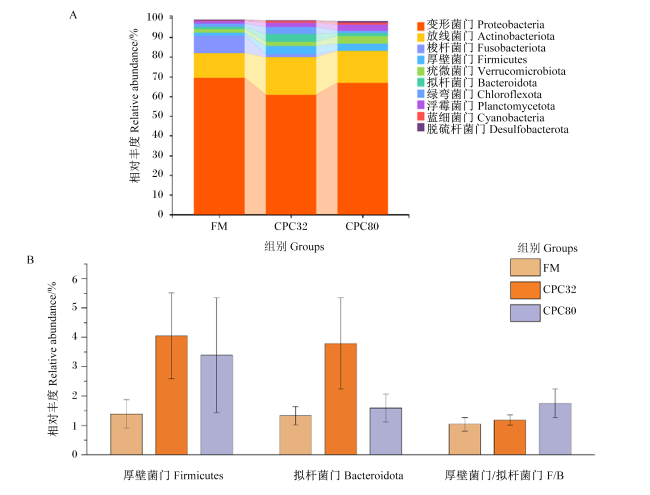
图5-A所示,各组肠道菌群在门水平上组成主要为变形菌门(Proteobacteria)、放线菌门(Actinobacteriota)、梭杆菌门(Fusobacteriota)、厚壁菌门(Firmicutes)、疣微菌门(Verrucomicrobiota)、拟杆菌门(Bacteroidota)、绿弯菌门(Chloroflexota)、浮霉菌门(Planctomycetota)、蓝细菌门(Cyanobacteria)和脱硫杆菌门(Desulfobacterota)等。如图5-B所示,各组间厚壁菌门和拟杆菌门相对丰度无显著差异(P>0.05),厚壁菌门/拟杆菌门(F/B)值随棉籽浓缩蛋白替代鱼粉比例的提高呈现逐渐升高的趋势(P>0.05)。
图5 棉籽浓缩蛋白替代鱼粉对大鳞副泥鳅肠道菌群在门水平上组成的影响

Fig.5 Effects of replacing fish meal with cottonseed protein concentrate on intestinal microbiota composition of Paramisgurnus dabryanus at phylum level

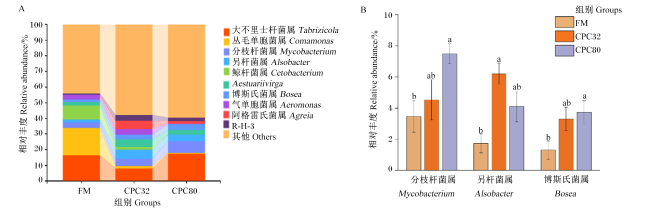
图6-A所示,各组肠道菌群在属水平上组成主要为大不里士杆菌属(Tabrizicola)、丛毛单胞菌属(Comamonas)、分枝杆菌属(Mycobacterium)、另杆菌属(Alsobacter)、鲸杆菌属(Cetobacterium)、Aestuariivirga、博斯氏菌属(Bosea)、气单胞菌属(Aeromonas)、阿格雷氏菌(Agreia)以及R-H-3等。如图6-B所示,CPC80组分枝杆菌属和博斯氏菌属相对丰度显著高于FM组(P<0.05),CPC32组另杆菌属相对丰度显著高于FM组(P<0.05)。
图6 棉籽浓缩蛋白替代鱼粉对大鳞副泥鳅肠道菌群在属水平上组成的影响

数据柱标记不同字母表示差异显著(P<0.05)。

Fig.6 Effects of replacing fish meal with cottonseed protein concentrate on intestinal microbiota composition of Paramisgurnus dabryanus at genus level

Values columns with different letters indicated significant difference (P<0.05).

2.7.4 相关性分析

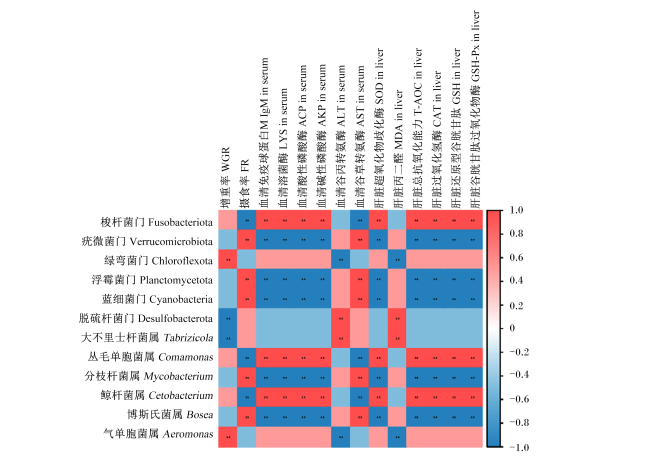
将大鳞副泥鳅肠道菌群相对丰度与生长性能、抗氧化能力和免疫功能相关指标进行Spearman相关性分析,如图7所示,在门水平上,WGR与绿弯菌门相对丰度呈极显著正相关(P<0.01),与脱硫杆菌门相对丰度呈极显著负相关(P<0.01),血清ALT活性和MDA含量与WGR相关性正好相反;血清IgM含量、LYS活性、ACP活性、AKP活性以及肝脏SOD活性、T-AOC、CAT活性、GSH含量和GSH-Px活性均与梭杆菌门相对丰度呈极显著正相关(P<0.01),与疣微菌门、浮霉菌门和蓝细菌门相对丰度呈极显著负相关(P<0.01),FR和血清AST活性与以上指标的相关性正好相反。在属水平上,WGR与大不里士杆菌属相对丰度呈极显著负相关(P<0.01),与气单胞菌属相对丰度呈极显著正相关(P<0.01),血清ALT活性和肝脏MDA含量与WGR相关性正好相反;血清IgM含量、LYS活性、ACP活性、AKP活性以及肝脏SOD活性、T-AOC、CAT活性、GSH含量和GSH-Px活性均与丛毛单胞菌属和鲸杆菌属呈极显著正相关(P<0.01),与分枝杆菌属和博斯氏菌属相对丰度呈极显著负相关(P<0.01),FR和血清AST活性与以上指标的相关性正好相反。
图7 大鳞副泥鳅肠道菌群与生长性能、抗氧化能力和免疫功能相关性分析

**表示极显著相关(P<0.01)。

Fig.7 Correlation analysis of intestinal microbiota with growth performance, antioxidant capacity and immune function of Paramisgurnus dabryanus

** indicated extremely significant correlation (P<0.01).

2.7.5 差异物种分析

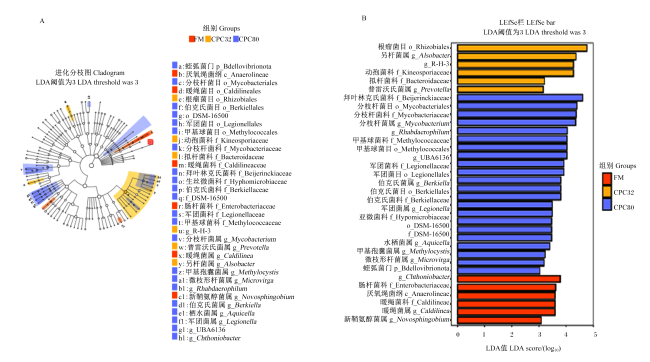
采用线性判别分析(LDA)效应大小(LEfSe)分析各组间肠道菌群具有显著差异(LDA阈值为3,P<0.05)的物种,如图8所示,FM组优势菌属为新鞘氨醇菌属(Novosphingobium)(LDA=3.08,P=0.01)和暖绳菌属(Caldilinea)(LDA=3.60,P<0.01),CPC32组优势菌属为另杆菌属(LDA=4.35,P<0.01)、R-H-3(LDA=4.27,P=0.01)和普雷沃氏菌属(Prevotella)(LDA=3.15,P<0.01),CPC80组优势菌属为分枝杆菌属(LDA=4.34,P=0.04)、UBA6136(LDA=4.02,P=0.02)、伯克氏菌属(Berkiella)(LDA=3.79,P=0.04)、甲基孢囊菌属(Methylocystis)(LDA=3.40,P=0.03)、微枝形杆菌属(Microvirga)(LDA=3.22,P=0.01)和Chthoniobacter(LDA=3.04,P=0.03)。
图8 大鳞副泥鳅肠道菌群LEfSe分析

Fig.8 LEfSe analysis of intestinal microbiota of Paramisgurnus dabryanus

3 讨论

3.1 棉籽浓缩蛋白替代鱼粉对大鳞副泥鳅生长性能的影响

研究表明,适量棉籽浓缩蛋白可以替代部分鱼粉而不影响鱼体的正常生长,过量替代则会抑制降低动物的生长性能[15,18-19]。棉籽浓缩蛋白中主要的抗营养因子为游离棉酚[23],相较于陆栖动物而言,鱼类对棉酚的耐受度更高,根据相关标准[饲料卫生标准(GB 13078—2017)和《无公害食品 渔用配合饲料安全限量》(NY 5072—2002)],鱼类饲料中棉酚的安全使用量应低于150 mg/kg,不同的鱼类对棉酚的敏感度不同,过高的棉酚会引起中毒[24],棉酚中毒一般表现为生长受阻、营养不良以及引发肠胃炎等消化道疾病[25]。Li等[26]研究表明,棉籽浓缩蛋白替代30%及以下的豆粕(游离棉酚含量为37.21 mg/kg)不会影响尼罗罗非鱼(Oreochromis niloticus)生长状况。Liu等[15]研究表明,棉籽浓缩蛋白替代25%和50%鱼粉(游离棉酚含量<151 mg/kg)对大口黑鲈生长性能无显著影响,替代75%鱼粉(游离棉酚含量为284 mg/kg)则显著降低了鱼体的生长性能。Chen等[19]研究表明,低于60%的脱酚棉籽蛋白可以替代大黄鱼幼鱼饲料中的鱼粉而不显著抑制生长性能。在卵形鲳鲹的研究中发现,浓缩棉籽蛋白的替代比例在36%以内,对WGR和SGR影响不显著,超过48%的替代比例则会降低生长性能[18]。上述研究说明,适宜的棉籽浓缩蛋白不会对水产动物生长方面产生负面影响。本研究结果表明,棉籽浓缩蛋白替代44%及以下的鱼粉对大鳞副泥鳅生长性能无显著影响,替代56%及以上的鱼粉则显著降低了大鳞副泥鳅的WGR、SGR、HSI和VSI,抑制了大鳞副泥鳅的生长。其主要原因可能是随着棉籽浓缩蛋白替代比例的提高,游离棉酚等抗营养因子含量增加,造成动物机体损伤,机体对营养物质的消化吸收能力下降,出现生长受阻现象[25]。棉籽浓缩蛋白具有游离棉酚含量低、蛋白质含量高以及精氨酸和谷氨酸含量高的特点[23],在黄颡鱼(Pelteobagrus fulvidraco)幼鱼[27]、许氏平鲉(Sebastes schlegelii)幼鱼[28]中的研究表明,饲料中精氨酸含量过高对其生长产生了显著抑制,同时精氨酸与赖氨酸存在拮抗作用,精氨酸含量过高会影响赖氨酸的利用率[29]。此外,游离棉酚具有与赖氨酸结合的特性,同样会降低赖氨酸的利用率[30]。本试验采用WGR与棉籽浓缩蛋白替代比例作双折线回归分析发现,本试验中棉籽浓缩蛋白替代鱼粉的适宜比例为30.46%。

3.2 棉籽浓缩蛋白替代鱼粉对大鳞副泥鳅血清生化和免疫指标的影响

血清生化指标可以反映机体代谢情况、健康状态以及营养状况[31]。血清GLU含量是反映鱼体整体健康状况水平的重要指标之一[32]。本试验中,44%及以上的棉籽浓缩蛋白替代鱼粉显著降低大鳞副泥鳅血清GLU含量,这与申建飞等[18]、Xu等[32]的研究结果一致,可能是由于棉籽浓缩蛋白替代比例过高,饲料中抗营养因子含量会增加,导致大鳞副泥鳅肝脏中糖代谢受损[33]。HDL-C能将肝脏外的胆固醇输入肝脏进行分解,加快脂质的运转[34-35]。研究表明,棉籽粕替代鱼粉能显著降低血清HDL-C含量,影响脂质代谢[36],这与本研究结果一致。TG是血脂的主要组成部分,其含量与鱼体脂质代谢能力密切相关。研究报道,酶促棉籽蛋白替代鱼粉能够降低血清TG含量[2]。本研究中,CPC68组和CPC80组血清TG含量显著低于FM组,可能是因为GLU缺乏,TG用于提供能量和营养物质所致[37]。此外,在对Ⅱ型糖尿病小鼠的研究中发现,经棉酚干预后,糖尿病小鼠血清GLU和TG含量显著降低,棉酚能够通过调节脂代谢,发挥降血糖作用[38]。动物体内最主要的解毒器官是肝脏,棉酚在动物体内沉积量最多的也是肝脏,棉酚经血液在肝脏中部分分解,但没分解的棉酚在肝脏中大量淤积,对肝脏造成损伤[25]。ALT和AST是血清中重要的氨基转移酶,其活性常作为反映鱼类肝脏健康及其功能的重要指标[39],当鱼体肝脏组织受损时,细胞膜通透性发生变化,ALT和AST被释放入血液循环[40-41]。本研究中,大鳞副泥鳅血清ALT和AST活性随棉籽浓缩蛋白替代鱼粉比例的提高呈现上升趋势,在肝脏中则相反,这与在松浦镜鲤(Cyprinus carpio Songpu)幼鱼[34]和虹鳟幼鱼[16]中的研究结果相似,可能意味着高水平棉籽浓缩蛋白替代鱼粉可能对大鳞副泥鳅肝脏健康产生不利影响。根据以上结果推测,随着棉籽浓缩蛋白替代比例的提高,饲料中抗营养因子含量增加,对大鳞副泥鳅肝脏功能造成一定损伤,增加肝脏代谢负荷,从而进一步导致鱼体糖与脂代谢异常。
LYS、IgM、ACP和AKP是鱼类非特异性免疫的重要指标,在机体抵御外来病原的免疫反应中起重要作用[42-43]。在乌苏里鲶(Pseudobagrus ussuriensis)幼鱼[44]和中华绒螯蟹(Eriocheir sinensis)[45]的研究中发现,用棉籽蛋白水解物替代鱼粉,其AKP和LYS活性随替代比例的提高呈现先上升后下降的趋势。对草鱼(Ctenopharyngodon idella)进行攻毒试验显示[46],饲料中的棉酚含量大于121.38 mg/kg会显著降低草鱼肠道LYS和ACP活以及IgM含量,下调抗菌肽与非特异性免疫相关基因的表达,损害鱼类肠道免疫功能。本试验结果表明,适当比例的棉籽浓缩蛋白替代鱼粉对大鳞副泥鳅免疫相关酶活性几乎无负面影响,当替代比例在68%及以上(游离棉酚含量>79.30 mg/kg)则可能降低机体的免疫功能,这可能是与饲料中游离棉酚含量过高,降低了肠道中抗菌物质的活力和含量,对非特异性免疫能力产生负面影响有关[44]

3.3 棉籽浓缩蛋白替代鱼粉对大鳞副泥鳅肝脏抗氧化指标的影响

鱼类的抗氧化系统对鱼体健康和生长起着重要作用,主要由抗氧化酶系统和非抗氧化酶系统构成,包括SOD、CAT及GSH等,主要功能是清除机体在接受外源性刺激后体内过量生成的活性氧[18-19,31]。MDA是脂质过氧化的主要代谢产物,可作为氧化损伤的标志物,间接反映组织氧化损伤的程度[2,47]。T-AOC作为评价鱼体抗氧化能力的常用指标,是衡量机体总体抗氧化能力的综合指标[48]。Fan等[47]在鲤鱼(Cyprinus carpio)的研究中发现,棉籽浓缩蛋白替代比例为75%和100%时,机体抗氧化酶(SOD、CAT和GSH-Px)活性均有所降低。据报道,棉籽浓缩蛋白替代比例为20%时,中华绒螯蟹的MDA含量显著低于其余各组,且随着棉籽浓缩蛋白替代鱼粉比例的逐渐升高,肝胰腺SOD活性、T-AOC、GSH含量以及谷胱甘肽-S-转移酶(GSH-ST)活性均呈下降趋势[49]。本研究中,与FM组相比,CPC32组肝脏MDA含量显著降低,CPC44组肝脏SOD活性显著提高,表明适当比例的棉籽浓缩蛋白替代鱼粉能够改善大鳞副泥鳅的抗氧化能力,减少过氧化物对机体的损伤;而当棉籽浓缩蛋白替代比例大于44%时,肝脏MDA含量呈上升趋势,肝脏T-AOC、CAT活性、GSH含量及和GSH-Px则相反。研究表明,棉酚通过乳酸脱氢酶(LDH)同源酶Ⅴ型抑制线粒体氧化磷酸化和电子传递,破坏线粒体功能,诱导活性氧的过量产生,从而抑制各种酶活性,造成氧化损伤[50],这表明棉籽浓缩蛋白替代比例过高会抑制大鳞副泥鳅肝脏的抗氧化酶活性,对肝脏抗氧化系统造成一定的损伤,同时ALT和AST活性的变化反映大鳞副泥鳅肝脏组织受损,进而对大鳞副泥鳅抗氧化能力造成一定影响。

3.4 棉籽浓缩蛋白替代鱼粉对大鳞副泥鳅肠道健康的影响

3.4.1 棉籽浓缩蛋白替代鱼粉对大鳞副泥鳅肠道形态结构和消化酶活性的影响

肠道是鱼类营养物质消化和吸收的主要场所,且具有免疫调节功能,在鱼体的代谢、生理调控及免疫方面具有重要作用[31,51]。绒毛高度、隐窝深度和肌层厚度反映了肠道功能以及形态结构的完整性,是衡量肠道健康的重要指标[52]。Liu等[53]对多鳞鱚(Sillago sihama Forsskal)的研究表明,高替代组肠道组织结构完整性遭到破坏,肠绒毛缩短、脱落或受损。在大口黑鲈的研究中也有相似的结论[15],然而在对鲫鱼(Carassius auratus gibelio♀×Cyprinus carpio♂)的研究中则发现高替代对其肠道结构未造成显著影响[54],这可能是因为鱼种不同及其对抗营养因子的耐受程度不同。在探究棉酚对草鱼肠道结构屏障的研究中发现,棉酚通过上调草鱼肠道中凋亡因子相关基因表达,加剧肠道细胞凋亡,损害肠道组织学结构[46]。在本研究中,CPC80组肠绒毛变得稀疏,绒毛高度显著低于FM组,出现脱落与游离现象;隐窝深度随替代比例的提高呈现上升趋势,CPC68组隐窝深度明显高于FM组,说明高水平棉籽浓缩蛋白替代鱼粉可能通过损害大鳞副泥鳅的肠道结构,降低肠道对营养物质的吸收和运输能力,从而影响肠道健康。
肠道消化酶的活性往往反映肠道的消化能力[55]。脂肪酶可以催化酯水解反应、转脂反应和脂合成反应[56]。本试验结果表明,当棉籽浓缩蛋白替代比例为44%时,大鳞副泥鳅肠道脂肪酶活性显著高于FM组。肠道胰蛋白酶活性随棉籽浓缩蛋白替代鱼粉比例的提高呈现先升高后降低的变化趋势,表明棉籽浓缩蛋白的替代对大鳞副泥鳅胰蛋白酶活性没有造成负面影响。然而,在对虹鳟幼鱼[57]和卵形鲳鲹[18]的研究中发现,棉籽浓缩蛋白的替代会显著降低其肠道胰蛋白酶活性,松浦镜鲤幼鱼[34]、黑鲷(Acanthopagrus schlegelii)幼鱼[56]等杂食性鱼类的肠道胰蛋白酶则随棉籽浓缩蛋白替代比例的提高表现出先上升后下降的趋势,这可能是鱼类食性的不同造成的,杂食性鱼类对植物蛋白质的适应性更强,而肉食性鱼类缺乏利用植物性蛋白质源的相关酶系,对植物蛋白质的利用率比较差[58]。本研究表明,适宜比例棉籽浓缩蛋白替代鱼粉可能通过提高大鳞副泥鳅肠道胰蛋白酶和脂肪酶活性,提升其对植物蛋白质的利用率,促进脂类物质水解,从而提高机体对营养物质的消化吸收[59]

3.4.2 棉籽浓缩蛋白替代鱼粉对大鳞副泥鳅肠道菌群的影响

肠道菌群是一个与宿主共生的复杂生态系统,通过代谢交换与宿主相互作用,影响其生长、免疫、营养和代谢水平等诸多方面[60-61],在正常肠道功能的发展和肠道稳态的维持中起着至关重要的作用[62]。鱼类肠道菌群的组成和丰度受环境、饲料、遗传等方面的影响[20,43,63]。本研究表明,与FM组相比,棉籽浓缩蛋白替代鱼粉对大鳞副泥鳅肠道菌群的多样性和丰富度无显著影响,这与在草鱼[64]上的研究结果相似。β多样性结果表明,棉籽浓缩蛋白替代组与FM组肠道菌群结构之间具有显著差异,CPC80组呈聚集状,FM组与CPC32组成分散状,这表明CPC80组大鳞副泥鳅的肠道菌群比CPC32组和FM组的肠道菌群具有更高的特异性,这与LEfSe分析的结果一致,说明棉籽浓缩蛋白替代鱼粉可能改变了大鳞副泥鳅的肠道菌群结构。
研究表明,泥鳅的肠道菌群主要包括变形菌门和放线菌门[63,65-66],本试验得到类似的结果。变形菌门分布着大量的致病菌,因此被普遍认为是一种潜在的致病标志菌[67],当变形菌门相对丰度提高时,稳态失调通常会导致宿主营养与代谢紊乱或免疫失调[68]。厚壁菌门和拟杆菌门具有提高鱼类消化率和免疫状态的能力[61]。F/B值升高是肠道菌群失调的一个典型特征[69],且F/B值升高通常与肥胖、糖尿病和代谢障碍相关[70]。据报道,棉籽浓缩蛋白替代鱼粉后草鱼肠道变形菌门相对丰度呈现先降低后升高的趋势[64],杂交石斑鱼(Epinephelus fuscoguttatus♀×Epinephelus lanceolatus♂)肠道厚壁菌门和拟杆菌门相对丰度则随替代比例的提高逐渐降低[43]。本研究中,肠道变形菌门相对丰度在CPC32组降低,在CPC80组又升高,厚壁菌门和拟杆菌门则相反,且F/B值随替代比例的提高而升高,这说明适当比例棉籽浓缩蛋白替代鱼粉可能通过降低肠道有害菌相对丰度,提高肠道有益菌相对丰度,有益于维持肠道菌群稳态;而替代比例过高时,大鳞副泥鳅肠道中有害菌相对丰度提高,有益菌相对丰度降低,这可能与棉籽浓缩蛋白中的抗营养因子棉酚有关[71],饲料中棉酚含量过高,破坏了肠道菌群的稳态,阻碍了有益菌的生长[72],进而影响代谢与免疫能力,这与血清生化指标的结果保持一致,进一步印证高水平棉籽浓缩蛋白替代鱼粉蛋白可能影响大鳞副泥鳅糖和脂代谢,对肠道健康造成不利影响。分枝杆菌属于革兰氏阳性菌,具有致病性,经消化道、破坏皮肤黏膜等途径,并经血液循环等方式引起其他部位感染,引起一系列疾病[73]。本研究发现,CPC80组主要优势菌群为分枝杆菌属,其相对丰度与抗氧化和免疫相关指标呈负相关;且与FM组相比,CPC80组分枝杆菌属相对丰度显著提高,结合抗氧化和免疫指标结果推测,高水平棉籽浓缩蛋白替代鱼粉可能通过提高肠道分枝杆菌属相对丰度提高大鳞副泥鳅致病风险,影响抗氧化能力和免疫功能。

4 结论

在本试验条件下,饲料中棉籽浓缩蛋白替代鱼粉比例为32%和44%时对大鳞副泥鳅生长无负面影响,基于WGR的折线模型分析,大鳞副泥鳅饲料中棉籽浓缩蛋白替代鱼粉的适宜比例为30.46%。高水平棉籽浓缩蛋白替代鱼粉可能通过降低大鳞副泥鳅抗病力,影响肝脏和肠道健康,从而抑制生长。
[1]
HAN D, SHAN X J, ZHANG W B, et al. A revisit to fishmeal usage and associated consequences in Chinese aquaculture[J]. Reviews in Aquaculture, 2018, 10(2):493-507.

[2]
ZHANG Q L, LIANG H L, XU P, et al. Effects of enzymatic cottonseed protein concentrate as a feed protein source on the growth,plasma parameters,liver antioxidant capacity and immune status of largemouth bass (Micropterus salmoides)[J]. Metabolites, 2022, 12(12):1233.

[3]
范泽, 李晨辉, 吴迪, 等. 两种新型植物蛋白替代豆粕在大规格鲤饲料中的应用效果研究[J]. 水产学杂志, 2023, 36(4):20-28,37.

FAN Z, LI C H, WU D, et al. Application effect of two new plant protein substitutes for soybean meal in large-size common carp feed[J]. Chinese Journal of Fisheries, 2023, 36(4):20-28,37. (in Chinese)

[4]
罗悦, 张蕉南, 向倩, 等. 发酵植物蛋白替代鱼粉对水产动物的影响[J]. 饲料工业, 2023, 44(22):72-79.

LUO Y, ZHANG J N, XIANG Q, et al. Effect of substituting fish meal with fermented plant protein on aquatic animals[J]. Feed Industry, 2023, 44(22):72-79. (in Chinese)

[5]
黄莹, 娄格格, 刘轩宇, 等. 双低菜粕替代鱼粉对克氏原螯虾幼虾生长性能、抗氧化能力和消化系统组织形态的影响[J]. 水生生物学报, 2023, 47(12):1918-1931.

HUANG Y, LOU G G, LIU X Y, et al. Replacing fish meal with rapeseed meal on growth performance,antioxidant capacity and digestive system morphology of juvenile Procambarus clarkii[J]. Acta Hydrobiologica Sinica, 2023, 47(12):1918-1931. (in Chinese)

[6]
MUGWANYA M, DAWOOD M A O, KIMERA F, et al. Replacement of fish meal with fermented plant proteins in the aquafeed industry:a systematic review and Meta-analysis[J]. Reviews in Aquaculture, 2023, 15(1):62-88.

[7]
MUSYOKA S N, LITI D, OGELLO E O, et al. Earthworm,eisenia fetida,bedding meal as potential cheap fishmeal replacement ingredient for semi-intensive farming of Nile tilapia,Oreochromis niloticus[J]. Aquaculture Research, 2020, 51(6):2359-2368.

[8]
PERERA A D, BHUJEL R C. Field cricket (Gryllus bimaculatus) meal (FCM) to replace fishmeal in the diets for sex reversal and nursing of Nile tilapia (Oreochromis niloticus) fry[J]. Aquaculture Research, 2021, 52(10):4946-4958.

[9]
BISWAS A, TAKAKUWA F, YAMADA S, et al. Partial replacement of fishmeal by a protein-rich product from methanotrophic bacteria in juvenile red sea bream (Pagrus major)[J]. Aquaculture Nutrition, 2021, 27(6):2726-2738.

[10]
WU Y, TIAN S J, YUAN J, et al. Effects of clostridium autoethanogenum protein as substitute for dietary fishmeal on the growth,feed utilization,intestinal health and muscle quality of large yellow croaker Larimichthys crocea[J]. Aquaculture, 2022,561:738591.

[11]
KARAPANAGIOTIDIS I T, METSOVITI M N, GKALOGIANNI E Z, et al. The effects of replacing fishmeal by Chlorella vulgaris and fish oil by Schizochytrium sp. and Microchloropsis gaditana blend on growth performance,feed efficiency,muscle fatty acid composition and liver histology of gilthead seabream (Sparus aurata)[J]. Aquaculture, 2022,561:738709.

[12]
彭凯, 罗锦伟, 黄文. 植物蛋白原料替代鱼粉在水产饲料中的研究进展[J]. 饲料研究, 2022, 45(15):136-140.

PENG K, LUO J W, HUANG W. Research progress of plant protein ingredients replacing fish meal in aquatic feed[J]. Feed Research, 2022, 45(15):136-140. (in Chinese)

[13]
李旭巧, 李汉东, 吉红, 等. 棉籽浓缩蛋白替代饲料中豆粕对草鱼生长性能、健康状况及肌肉品质的影响[J]. 水生生物学报, 2023, 47(2):235-248.

LI X Q, LI H D, JI H, et al. Substitution of soybean meal with cottonseed protein concentrate on growth performance,health status and flesh quality of grass carp (Ctenopharyngodon idella)[J]. Acta Hydrobiologica Sinica, 2023, 47(2):235-248. (in Chinese)

[14]
XIE X Z, WANG J, GUAN Y, et al. Cottonseed protein concentrate as fishmeal alternative for largemouth bass (Micropterus salmoides) supplemented a yeast-based paraprobiotic:effects on growth performance,gut health and microbiome[J]. Aquaculture, 2022,551:737898.

[15]
LIU Y L, LU Q S, XI L W, et al. Effects of replacement of dietary fishmeal by cottonseed protein concentrate on growth performance,liver health,and intestinal histology of largemouth bass (Micropterus salmoides)[J]. Frontiers in Physiology, 2021,12:764987.

[16]
LIU Y, MA S W, LV W H, et al. Effects of replacing fishmeal with cottonseed protein concentrate on growth performance,blood metabolites,and the intestinal health of juvenile rainbow trout (Oncorhynchus mykiss)[J]. Frontiers in Immunology, 2022,13:1079677.

[17]
安雨琪. 棉籽蛋白复合物替代鱼粉对黄鳝生产性能及肠道菌群的影响[D]. 硕士学位论文. 南昌: 江西农业大学, 2023.

AN Y Q. Effects of replacing fish meal with cottonseed protein complex on production performance and intestinal microflora of Monopterus albus[D]. Master's Thesis. Nanchang: Jiangxi Aquaculture University, 2023. (in Chinese)

[18]
申建飞, 陈铭灿, 刘泓宇, 等. 浓缩棉籽蛋白替代鱼粉对卵形鲳鲹幼鱼生长性能、血清生化指标、肝脏抗氧化指标及胃肠道蛋白酶活性的影响[J]. 动物营养学报, 2019, 31(2):746-756.

SHEN J F, CHEN M C, LIU H Y, et al. Effects of fish meal replacement by concentrated cottonseed protein on growth performance,serum biochemical indices,liver antioxidant indices and gastrointestinal tract protease activities of juvenile Trachinotus ovatus[J]. Chinese Journal of Animal Nutrition, 2019, 31(2):746-756. (in Chinese)

[19]
CHEN S, TANG Y H, ZHANG Z, et al. Replacement of dietary fishmeal protein with degossypolized cottonseed protein on growth performance,nonspecific immune response,antioxidant capacity,and target of rapamycin pathway of juvenile large yellow croaker (Larimichthys crocea)[J]. Aquaculture Nutrition, 2022,2022:8529556.

[20]
WANG H M, HU X, ZHENG Y D, et al. Effects of replacing fish meal with cottonseed protein concentrate on the growth,immune responses,digestive ability and intestinal microbial flora in Litopenaeus vannamei[J]. Fish & Shellfish Immunology, 2022,128:91-100.

[21]
IRM M, YE B, WU X Y, et al. Assessment of conventional and low gossypol cottonseed meal as alternative protein sources in low-fishmeal diets of hybrid grouper (Epinephelus fuscoguttatus♀×Epinephelus lanceolatus♂):growth,feed utilization,gut histology,and immunity[J]. Animals, 2022, 12(15):1906.

[22]
王自蕊, 周秋白, 张锦华, 等. 泥鳅营养需求研究进展[J]. 动物营养学报, 2019, 31(6):2451-2457.

WANG Z R, ZHOU Q B, ZHANG J H, et al. Research progress on nutritional requirement of loaches[J]. Chinese Journal of Animal Nutrition, 2019, 31(6):2451-2457. (in Chinese)

[23]
李敏, 吕旦, 陈冰, 等. 棉籽蛋白的营养价值及其在动物饲料中的应用研究进展[J]. 中国畜牧兽医, 2024, 51(9):3867-3877.

DOI

LI M, LV D, CHEN B, et al. Research progress on the nutritional value of cottonseed protein and its application in animal feed[J]. China Animal Husbandry & Veterinary Medicine, 2024, 51(9):3867-3877. (in Chinese)

[24]
张璐. 饲料蛋白源及抗营养因子对中华绒螯蟹生理生化影响的初步研究[D]. 硕士学位论文. 上海: 华东师范大学, 2007.

ZHANG L. The study of effect of dietary proteinsources and anti-nutritional factors onphysiology and chemistry in the Chinese mitten-handed crab,Eriocheir sinensis[D]. Master's Thesis. Shanghai: East China Normal University, 2007. (in Chinese)

[25]
胡波, 郑文新, 高维明, 等. 游离棉酚毒理学与脱毒技术的研究进展[J]. 草食家畜, 2020(3):1-7,38.

HU B, ZHENG W X, GAO W M, et al. Research progress of toxicology and detoxification technology of free gossypol[J]. Grass-Feeding Livestock, 2020(3):1-7,38. (in Chinese)

[26]
LI W J, WU H X, ZHANG L, et al. Effects of replacing soybean meal protein with cottonseed protein concentrate on the growth condition and intestinal health of Nile tilapia (Oreochromis niloticus)[J]. Aquaculture Nutrition, 2021, 27(6):2436-2447.

[27]
赵红霞, 陈启明, 黄燕华, 等. 饲料精氨酸水平对黄颡鱼幼鱼生长性能、消化吸收相关指标、免疫功能和抗氧化能力的影响[J]. 动物营养学报, 2018, 30(12):5040-5051.

ZHAO H X, CHEN Q M, HUANG Y H, et al. Effects of dietary arginine level on growth performance,digestive and absorptive related indexes,immune function and antioxidant ability of juvenile yellow catfish (Pelteobagrus fulvidraco)[J]. Chinese Journal of Animal Nutrition, 2018, 30(12):5040-5051. (in Chinese)

[28]
沈钰博, 王际英, 李宝山, 等. 许氏平鲉幼鱼对饲料中精氨酸需求量的研究[J]. 渔业科学进展, 2022, 43(3):33-44.

SHEN Y B, WANG J Y, LI B S, et al. Dietary arginine requirement of juvenile rockfish (Sebastes schlegelii)[J]. Progress in Fishery Sciences, 2022, 43(3):33-44. (in Chinese)

[29]
李培佳, 赵红霞, 彭凯, 等. 精氨酸的生理功能及其在鱼类营养中的研究进展[J]. 饲料工业, 2022, 43(14):60-64.

LI P J, ZHAO H X, PENG K, et al. Physiological function and research progress of arginine in fish nutrition[J]. Feed Industry, 2022, 43(14):60-64. (in Chinese)

[30]
WANG K Z, JIANG W D, WU P, et al. Gossypol reduced the intestinal amino acid absorption capacity of young grass carp (Ctenopharyngodon idella)[J]. Aquaculture, 2018,492:46-58.

[31]
李佑杰, 陈琪, 袁志文, 等. 饲料中添加丙氨酰-谷氨酰胺对大鳞副泥鳅生长性能、血清生化指标、肝脏抗氧化能力以及肠道消化酶活性和形态结构的影响[J]. 动物营养学报, 2024, 36(5):3219-3230.

DOI

LI Y J, CHEN Q, YUAN Z W, et al. Effects of dietary alanyl-glutamine supplementation on growth performance,serum biochemical indices,liver antioxidant capacity,intestinal digestive enzyme activities and morphological structure of Paramisgurnus dabyranus[J]. Chinese Journal of Animal Nutrition, 2024, 36(5):3219-3230. (in Chinese)

[32]
XU X Y, YANG H, ZHANG C Y, et al. Effects of replacing fishmeal with cottonseed protein concentrate on growth performance,flesh quality and gossypol deposition of largemouth bass (Micropterus salmoides)[J]. Aquaculture, 2022,548:737551.

[33]
WU Z X, PANG S F, CHEN X X, et al. Effect of coriolus versicolor polysaccharides on the hematological and biochemical parameters and protection against Aeromonas hydrophila in allogynogenetic crucian carp (Carassius auratus gibelio)[J]. Fish Physiology and Biochemistry, 2013, 39(2):181-190.

[34]
葛凯博. 棉籽浓缩蛋白替代鱼粉在松浦镜鲤幼鱼饲料中的应用研究[D]. 硕士学位论文. 哈尔滨: 东北农业大学, 2023.

GE K B. The study of replacement of fish meal with cottonseed protein concentrate in feed for juvenil Songpu mirror carp (Cyprinus carpio Songpu)[D]. Master's Thesis. Harbin: Northeast Agricultural University, 2023. (in Chinese)

[35]
王文娟, 孟骞骞, 李美静, 等. 日粮脂肪水平对鲤生长、血清生化指标、糖代谢及抗氧化能力的影响[J]. 江苏农业学报, 2023, 39(9):1908-1916.

WANG W J, MENG Q Q, LI M J, et al. Effects of dietary fat levels on growth,serum biochemical indices,glyco-metabolism and antioxidant capacity of common carp[J]. Jiangsu Journal of Agricultural Sciences, 2023, 39(9):1908-1916. (in Chinese)

[36]
LIU H K, YAN Q G, HAN D, et al. Effect of dietary cottonseed meal on growth performance,physiological response,and gossypol accumulation in pre-adult grass carp,Ctenopharyngodon idellus[J]. Chinese Journal of Oceanology and Limnology, 2016, 34(5):992-1003.

[37]
LI X Y, HAN T, ZHENG S X, et al. Hepatic glucose metabolism and its disorders in fish[J]. Advances in Experimental Medicine and Biology, 2022,1354:207-236.

[38]
王蓉蓉. 棉酚对2型糖尿病大鼠糖、脂代谢和肝纤维化的影响及机制探讨[D]. 硕士学位论文. 温州: 温州医科大学, 2007.

WANG R R. Effect and mechanism of gossypol on metabolism of glucose,lipid and fibrosis of liver in type 2 diabetic rats[D]. Master's Thesis. Wenzhou: Wenzhou Medical University, 2007. (in Chinese)

[39]
GODA A M A S, AHMED S R, NAZMI H M, et al. Partial replacement of dietary soybean meal by high-protein distiller's dried grains (HPDDG) supplemented with protease enzyme for European seabass,Dicentrarchus labrax fingerlings[J]. Aquaculture Nutrition, 2020, 26(3):842-852.

[40]
侯静宜, 许耀升, 方揽月, 等. 左旋肉碱对鳜生长、抗氧化能力及肠道和肝脏功能的改善作用研究[J]. 动物营养学报, 2024, 36(3):1834-1845.

DOI

HOU J Y, XU Y S, FANG L Y, et al. Research on improvement of growth,antioxidant ability,intestinal and hepatic function of Siniperca chuatsi by L-carnitine[J]. Chinese Journal of Animal Nutrition, 2024, 36(3):1834-1845. (in Chinese)

[41]
郭怡彤, 林茂, 蔡国鹤, 等. 虾青素对组胺胁迫下美洲鳗鲡幼鱼肝脏健康的影响[J]. 饲料研究, 2024, 47(2):41-45.

GUO Y T, LIN M, CAI G H, et al. Effect of astaxanthin addition on hepatic health of juvenile Anguilla rostrata under histamine stress[J]. Feed Research, 2024, 47(2):41-45. (in Chinese)

[42]
YUSUF A, HUANG X X, CHEN N S, et al. Impact of dietary vitamin c on plasma metabolites,antioxidant capacity and innate immunocompetence in juvenile largemouth bass,Micropterus salmoides[J]. Aquaculture Reports, 2020,17:100383.

[43]
YE G L, DONG X H, YANG Q H, et al. Low-gossypol cottonseed protein concentrate used as a replacement of fish meal for juvenile hybrid grouper (Epinephelus fuscoguttatus ♀×Epinephelus lanceolatus ♂):effects on growth performance,immune responses and intestinal microbiota[J]. Aquaculture, 2020,524:735309.

[44]
BU X Y, CHEN A J, LIAN X Q, et al. An evaluation of replacing fish meal with cottonseed meal in the diet of juvenile ussuri catfish Pseudobagrus ussuriensis:growth,antioxidant capacity,nonspecific immunity and resistance to Aeromonas hydrophila[J]. Aquaculture, 2017,479:829-837.

[45]
CHENG H H, LIU W B, YUAN X Y, et al. Effects of dietary cottonseed meal protein hydrolysate on growth, antioxidants and immunity of Chinese mitten crab Eriocheir sinensis[J]. Journal of Oceanology and Limnology, 2020, 38(3):869-882.

[46]
WANG K Z, FENG L, JIANG W D, et al. Dietary gossypol reduced intestinal immunity and aggravated inflammation in on-growing grass carp (Ctenopharyngodon idella)[J]. Fish & Shellfish Immunology, 2019,86:814-831.

[47]
FAN Z, GE K B, WU D, et al. Suitable cottonseed protein concentrate supplementation in common carp (Cyprinus carpio) serves as an effective strategy for fish meal sparing based on improvement in intestinal antioxidant capacity,barrier and microbiota composition[J]. Antioxidants, 2024, 13(4):436.

[48]
ZHAO W, LIU Z L, NIU J. Growth performance,intestinal histomorphology,body composition,hematological and antioxidant parameters of Oncorhynchus mykiss were not detrimentally affected by replacement of fish meal with concentrated dephenolization cottonseed protein[J]. Aquaculture Reports, 2021,19:100557.

[49]
XIE S C, ZHOU Q C, ZHANG X S, et al. Effect of dietary replacement of fish meal with low-gossypol cottonseed protein concentrate on growth performance and expressions of genes related to protein metabolism for swimming crab (Portunus trituberculatus)[J]. Aquaculture, 2022,549:737820.

[50]
AITKEN R J, MUSCIO L, WHITING S, et al. Analysis of the effects of polyphenols on human spermatozoa reveals unexpected impacts on mitochondrial membrane potential,oxidative stress and DNA integrity;implications for assisted reproductive technology[J]. Biochemical Pharmacology, 2016,121:78-96.

[51]
刘晓蕊, 马喜波, 张南, 等. 饲料中绿原酸对泥鳅生长性能、消化酶活性、免疫功能及抗氧化能力的影响[J]. 水产学报, 2023, 47(10):97-110.

LIU X R, MA X B, ZHANG N, et al. Effects of chlorogenic acid in feed on the growth performance,digestive enzyme activity,immune function,and antioxidant capacity of loach (Misgurnus anguillicaudatus)[J]. Journal of Fisheries of China, 2023, 47(10):97-110. (in Chinese)

[52]
WEI L, WU P, ZHOU X Q, et al. Dietary silymarin supplementation enhanced growth performance and improved intestinal apical junctional complex on juvenile grass carp (Ctenopharyngodon idella)[J]. Aquaculture, 2020,525:735311.

[53]
LIU H, DONG X H, TAN B P, et al. Effects of fish meal replacement by low-gossypol cottonseed meal on growth performance,igestive enzyme activity,intestine histology and inflammatory gene expression of silver sillago (Sillago sihama Forsskal)(1775)[J]. Aquaculture Nutrition, 2020, 26(5):1724-1735.

[54]
CAI C, LI E, YE Y, et al. Effect of dietary graded levels of cottonseed meal and gossypol on growth performance,body composition and health aspects of allogynogenetic silver crucian carp,Carassius auratus gibelio♀×Cyprinus carpio♂[J]. Aquaculture Nutrition, 2011, 17(4):353-360.

[55]
陈严轩, 王国霞, 邱建强, 等. 姜黄素改善氧化鱼油对黄颡鱼肠道的不利影响[J]. 动物营养学报, 2024, 36(8):5297-5307.

DOI

CHEN Y X, WANG G X, QIU J Q, et al. Curcumin improves adverse effects of oxidized fish oil on intestine of Pelteobagrus fulvidraco[J]. Chinese Journal of Animal Nutrition, 2024, 36(8):5297-5307. (in Chinese)

[56]
杨彬彬, 华颖, 肖金星, 等. 棉粕替代部分鱼粉对黑鲷幼鱼消化酶活性及肠道组织结构的影响[J]. 扬州大学学报(农业与生命科学版), 2015, 36(4):45-51.

YANG B B, HUA Y, XIAO J X, et al. Effects of partial replacement of fish meal by cottonseed meal on digestive enzymes activity and intestine histology of juvenile black sea bream Acanthopagrus schlegelii[J]. Journal of Yangzhou University(Agricultural and Life Science Edition), 2015, 36(4):45-51. (in Chinese)

[57]
马淑伟. 棉籽浓缩蛋白替代虹鳟饲料鱼粉的研究[D]. 硕士学位论文. 南京: 南京农业大学, 2022.

MA S W. Study on fishmeal replacement by cottonseed protein concentrate in diets of rainbow trout[D]. Master’s Thesis. Nanjing: Nanjing Agricultural University, 2022. (in Chinese)

[58]
刘运正, 何艮, 周慧慧. 水产饲料动植物蛋白源替代体系及其与养殖鱼类食性的关系[J]. 河北渔业, 2014(8):54-57.

LIU Y Z, HE G, ZHOU H H. Substitution system of animal and plant protein sources for aquafeed and its relationship with the feeding habits of farmed fish[J]. Hebei Fisheries, 2014(8):54-57. (in Chinese)

[59]
龚俊勇, 吴伟坚, 钟国防. 不同水平脂肪酶对罗非鱼生长性能、形体指数及血清生化、免疫指标的影响[J]. 广东饲料, 2021, 30(1):25-30.

GONG J Y, WU W J, ZHONG G F. Effects of different levels of lipase on growth performance,body index,serum biochemical and immune indexes of Oreochromis[J]. Guangdong Feed, 2021, 30(1):25-30. (in Chinese)

[60]
张碧云, 杨红玲, 汪攀, 等. 鱼类肠道微生物与宿主免疫系统相互作用研究进展[J]. 微生物学报, 2021, 61(10):3046-3058.

ZHANG B Y, YANG H L, WANG P, et al. Advances in the interactions between intestinal microorganisms and host immune system in fish[J]. Acta Microbiologica Sinica, 2021, 61(10):3046-3058. (in Chinese)

[61]
赵新宇, 史宝, 程汉良, 等. 肠道菌群对水产动物重要经济性状影响的研究进展[J]. 水产学杂志, 2024, 37(3):100-108,116.

ZHAO X Y, SHI B, CHENG H L, et al. Research progress on effect of gut microbiota on important economic traits of animals in aquaculture:a review[J]. Chinese Journal of Fisheries, 2024, 37(3):100-108,116. (in Chinese)

[62]
SHEN J F, LIU H Y, TAN B P, et al. Effects of replacement of fishmeal with cottonseed protein concentrate on the growth,intestinal microflora,haematological and antioxidant indices of juvenile golden pompano (Trachinotus ovatus)[J]. Aquaculture Nutrition, 2020, 26(4):1119-1130.

[63]
WANG Z R, LI S Y, ZHOU Q B, et al. Effects of different protein and lipid levels on the growth performance and intestinal microflora of loach (Paramisgurnus dabryanus)[J]. Animal Nutrition, 2023,13:229-239.

[64]
LIU G Q, ZHOU M, WANG X Y, et al. Effects of dietary cottonseed protein concentrate levels on growth performance,health status,flesh quality and intestinal microbiota of grass carp (Ctenopharyngodon idellus)[J]. Metabolites, 2022, 12(11):1046.

[65]
LIN H M, ZENG C, SHUI S S, et al. Effects of Fe(Ⅱ) -chelating hairtail protein hydrolysates on the immune characteristics and intestinal microorganisms in loach (Misgurnus anguillicaudatus)[J]. Aquaculture Reports, 2021,19:100630.

[66]
PETER M, LV H R, JIANG X Q, et al. Effects of starvation on enzyme activities and intestinal microflora composition in loach (Paramisgurnus dabryanus)[J]. Aquaculture Reports, 2020,18:100467.

[67]
DIWAN A D, HARKE S N, PANCHE A N. Studies on exploring the potentials of gut microbiomes to mitigate the bacterial and viral diseases of fish and shellfish in aquaculture farming[J]. The Microbe, 2024,2:100031.

[68]
SHIN N R, WHON T W, BAE J W. Proteobacteria:microbial signature of dysbiosis in gut microbiota[J]. Trends in Biotechnology, 2015, 33(9):496-503.

[69]
张慧莹, 曾丽萍, 任运红, 等. 乳酸芽孢杆菌发酵液护色的山药多糖对葡聚糖硫酸钠诱导的小鼠结肠炎的改善作用及机制[J]. 食品科学, 2022, 43(9):120-127.

ZHANG H Y, ZENG L P, REN Y H, et al. Ameliorative effect of polysaccharides from Chinese yam treated with the fermentation broth of Bacillus sp.to inhibit browning on dextran sulfate sodium-induced colitis in mice[J]. Food Science, 2022, 43(9):120-127. (in Chinese)

[70]
STOJANOV S, BERLEC A, ŠTRUKELJ B. The influence of probiotics on the Firmicutes/Bacteroidetes ratio in the treatment of obesity and inflammatory bowel disease[J]. Microorganisms, 2020, 8(11):1715.

[71]
LI W J, ZHANG L, WU H X, et al. Intestinal microbiota mediates gossypol-induced intestinal inflammation,oxidative stress,and apoptosis in fish[J]. Journal of Agricultural and Food Chemistry, 2022, 70(22):6688-6697.

[72]
CHEN G F, YIN B, LIU H Y, et al. Effects of fishmeal replacement with cottonseed protein concentrate on growth,digestive proteinase,intestinal morphology and microflora in pearl gentian grouper(♀Epinephelus fuscoguttatus×♂Epinephelus lanceolatu)[J]. Aquaculture Research, 2020,51:2870-2884.

[73]
DZIGBA P, RYLSKI A K, ANGERA I J, et al. Immune targeting of mycobacteria through cell surface glycan engineering[J]. ACS Chemical Biology, 2023, 18(7):1548-1556.

DOI PMID

Outlines

/