RESEARCH PAPER

Rumen Fermentation Characteristics and Dynamic Changes of Microbiota at Different Time Points after Feeding in Simmental Cattle

  • ZHOU Xiang , 1, 2 ,
  • WANG Wenxing 1, 2 ,
  • LI Qiushuang 1, 2 ,
  • ZHANG Xiumin 1, 2 ,
  • WANG Rong 1, 2 ,
  • WU Duanqin , 3, * ,
  • WANG Min , 1, 2, *
Expand
  • 1 Institute of Subtropical Agriculture, Chinese Academy of Sciences, Changsha 410125, China
  • 2 University of Chinese Academy of Sciences, Beijing 100049, China
  • 3 Institute of Bast Fiber Crops, Chinese Academy of Agricultural Sciences, Changsha 410205, China
* WU Duanqin, professor, E-mail: ;
WANG Min, professor, E-mail:

Received date: 2024-11-07

  Online published: 2025-06-12

Abstract

This experiment was conducted to study the rumen fermentation characteristics and dynamic changes of microbiota at different time points after feeding in Simmental cattle. A total of 10 Simmental bulls with good body condition and similar body weight were fed once a day at 08:30. Rumen fluid was collected after feeding (0, 6 and 12 h) for fermentation parameter determination, and microbiota structure and function were analyzed by 16S rRNA sequencing. The results showed as follows: 1) compared with 0 h, the concentrations of dissolved hydrogen, dissolved methane and total volatile fatty acids were significantly increased at 6 h (P<0.05), and then decreased to 0 h at 12 h (P>0.05); the proportion of acetic acid at 6 h was significantly decreased (P<0.05), while the proportions of propionic acid and butyric acid were significantly increased (P<0.05), indicating that the rumen fermentation pattern at 6 h had a tendency to change to propionic acid type. 2) The results of β diversity analysis showed that there were significant differences in rumen microbiota structure at different time points after feeding (P<0.05). At the phylum level, the Proteobacteria relative abundance at 12 h was significantly higher than that at 0 h (P<0.05), while the Fibrobacterota relative abundance at 6 h was significantly higher than that at 12 h (P<0.05); at the genus level, the relative abundances of Ruminococcus and Fibrobacter at 6 h were significantly higher than those at 12 h (P<0.05), while the Ruminobacter relative abundance was significantly lower than that at 12 h (P<0.05). Among methanogenic archaea, the Methanobrevibacter relative abundance at 6 h was significantly higher than that at 0 and 12 h (P<0.05), and the Methanosphaera relative abundance at 12 h was significantly higher than that at 0 h (P<0.05). 3) The abundances of glycolysis, acetyl CoA fermentation to butanoate and pyruvate fermentation to acetate and lactate pathways at 6 and 12 h were significantly up-regulated compared with 0 h (P<0.05), and the methanogenesis pathway abundance at 6 h was significantly up-regulated compared with 0 and 12 h (P<0.05). In conclusion, the rumen fermentation pattern of Simmental cattle shows a trend of transformation from acetic acid type to propionic acid type and then to acetic acid type from 0 to 12 h after feeding, and is accompanied by dynamic changes in rumen microbiota composition and function.

Cite this article

ZHOU Xiang , WANG Wenxing , LI Qiushuang , ZHANG Xiumin , WANG Rong , WU Duanqin , WANG Min . Rumen Fermentation Characteristics and Dynamic Changes of Microbiota at Different Time Points after Feeding in Simmental Cattle[J]. Chinese Journal of Animal Nutrition, 2025 , 37(6) : 3877 -3888 . DOI: 10.12418/CJAN2025.318

反刍动物具有由细菌、古菌、原生动物和真菌等微生物组成的复杂瘤胃微生态系统,其中的细菌、真菌等可以将碳水化合物转化为挥发性脂肪酸(volatile fatty acid,VFA)和微生物蛋白等营养物质,提供了宿主所需能量的70%[1-2],其中细菌在大多数复杂多糖的降解和发酵中发挥着重要作用[3-5]。瘤胃微生物群落组成和功能受饲粮种类、个体遗传和动物年龄等因素的影响,而其中饲粮中碳水化合物的种类是最为主要的影响因素[6]
动物在采食后瘤胃内环境会发生一系列变化,饲粮中的碳水化合物在瘤胃内发酵降解,导致VFA浓度升高、pH下降和瘤胃温度上升,这种瘤胃内环境的改变同时也会影响瘤胃微生物群落[7]。目前已有研究揭示,人和小鼠胃肠道中的微生物群落结构和功能呈现周期性的变化规律[8]。而在反刍动物的相关研究发现,瘤胃微生物产生的代谢产物不仅塑造了它们的生态位,还导致了群落组成和功能的昼夜变化[9]。动物采食后,瘤胃微生物会产生VFA、乳酸等代谢物,这些物质进一步导致瘤胃pH的下降。同时,微生物群落的变化总是伴随着pH和甲烷分压的变化,表明它们之间呈现高度的功能关联性。
VFA浓度和瘤胃微生物群落结构具有昼夜节律性,相关研究发现,乙酸和丙酸浓度在白天高于夜间;瘤胃拟杆菌门(Bacteroidota)和毛霉菌门(Mucoromycota)白天相对丰度高于夜间,而厚壁菌门(Firmicutes)夜间相对丰度高于白天[10]。瘤胃发酵模式主要有乙酸型和丙酸型2类,乙丙比(乙酸/丙酸)通常与动物的能量利用效率呈反比,而且乙酸和丙酸的生成分别伴随瘤胃氢的生成和消耗,而氢气又是甲烷生成的前体物质,因此瘤胃发酵模式的类型可以作为评估动物生产性能以及甲烷产量的依据之一[11-12]。本试验聚焦西门塔尔牛采食后瘤胃发酵模式以及微生物群落组成和功能机制的变化规律,选取西门塔尔公牛作为试验对象,对其采食后(0、6和12 h)的瘤胃发酵模式、微生物群落结构和功能进行研究,以期为调控反刍动物采食,优化饲粮配方等提供科学依据。

1 材料与方法

1.1 试验设计

选取10头(1.7±1.0)月龄、体重(405±11) kg的西门塔尔公牛,栓系饲养,每日08:30饲喂1次,自由采食。分别在采食后0、6和12 h采集瘤胃液,用于后续溶解气体、pH、VFA和微生物分析,以研究西门塔尔牛瘤胃发酵特征、微生物群落结构和功能等随采食后时间变化的过程。本试验所有程序遵循《实验动物管理与使用指南》要求,试验动物的使用经中国科学院亚热带农业生态研究所动物伦理委员会批准,批准编号为ISA-W-202201。

1.2 试验饲粮

试验所用的粗饲料为玉米秸秆青贮,混合精料为商品料。饲粮组成及营养水平见表1
表1 饲粮组成及营养水平(干物质基础)

Table 1 Composition of nutrient levels of the diet (DM basis) %

项目Items 含量Content
原料Ingredients
玉米秸秆青贮Corn stalk silage 54.0
混合精料Concentrate1) 46.0
合计Total 100.0
营养水平Nutrient levels2)
有机物OM 91.0
粗蛋白质CP 11.4
中性洗涤纤维NDF 43.5
酸性洗涤纤维ADF 23.9
淀粉Starch 16.8
综合净能NEmf/(MJ/kg) 6.1
维持净能NEm/(MJ/kg) 7.3
增重净能NEg/(MJ/kg) 4.6

1)混合精料组成:玉米、豆粕、麦麸、喷浆玉米皮、玉米酒糟、棉籽粕、糖蜜、米糠粕、碳酸氢钠和预混料。Concentrate composition: corn, soybean meal, wheat bran, sprayed corn husk, corn distillers, cottonseed meal, molasses, rice bran meal, NaHCO3 and premix.
每千克预混料含有 Each kilogram of premix contained:VA 250 000 IU,VD3 70 000 IU,VE 1 000 IU,Fe 1.2 g,Cu 0.8 g,Zn 1.5 g,Mn 1.3 g,I 27 mg,Se 11.5 mg,Co 23 mg。
2)综合净能、维持净能和增重净能根据《肉牛饲养标准》(NY/T 815—2004)计算,其他为实测值。NEmf, NEm and NEg were calculated refered to Feeding Standard of Beef Cattle (NY/T 815—2004), and the others were measured values.

1.3 样品采集与处理

1.3.1 饲粮营养水平的测定

参考AOAC(2005)[13]的方法测定有机物(organic matter,OM)和粗蛋白质(crude protein,CP)含量;参照Van Soest等[14]的方法,配制中性洗涤剂和酸性洗涤剂,随后测定中性洗涤纤维(neutral detergent fiber,NDF)和酸性洗涤纤维(acid detergent fiber,ADF)含量,测定NDF时,添加热稳定淀粉酶和亚硫酸钠;参照Karthner等[15]的方法测定淀粉含量。

1.3.2 样品处理

分别在动物采食后0、6和12 h,通过口腔胃管从瘤胃中收集约500 mL的瘤胃液,为避免唾液污染,将最初的100 mL丢弃,留取剩余瘤胃液用于测定pH、溶解气体浓度和瘤胃微生物。取1份样品(20 mL),用便携式pH计(S210,Mettler Toleddo,上海)测定瘤胃液pH;取2份样品(35 mL),参照Wang等[16]的方法测定溶解氢和溶解甲烷浓度;取2份样品(1.5 mL)于2 mL冻存管中,立即转移至液氮中冷冻后于-80 ℃保存,用于DNA提取和微生物分析;另取3份样品(10 mL),4 ℃条件下12 000×g离心10 min,离心后取1.5 mL上清液至新的冻存管中,每管加150 μL偏磷酸(25%),于-20 ℃保存,用于VFA浓度测定。

1.4 测定指标及方法

1.4.1 VFA浓度的测定

瘤胃液样品(-20 ℃保存)于室温解冻1 h,4 ℃条件下12 000×g离心10 min,取1 mL上清液过滤至上样瓶中,采用气相液相质谱联用仪(7890A,Agilent,美国)测定总挥发性脂肪酸(TVFA)浓度及各组分比例。

1.4.2 16S rRNA测序

室温解冻采集的瘤胃液微生物样品(-80 ℃保存)1 h,参照Ma等[17]的方法提取DNA。采用引物27F(5'-AGAGTTTGATCMTGGCTCAG-3')和1492R(5'-CRGYTACCTTGTTACGACTT-3')对细菌16S rRNA基因的V3~V4区进行PCR扩增,另外用产甲烷古菌引物Met86F(5'-GCTCAGTAACACGTGG-3')和Met471R(5'-GWRTTACCGCGGCKGCTG-3')对产甲烷古菌16S rRNA进行PCR扩增。委托上海凌恩生物科技有限公司利用Illumina MiSeq平台进行16S扩增子测序。

1.5 生物信息数据处理

数据下机后,在Linux(20.04.1-Ubuntu)系统上的R(version 4.4.0)中,使用DADA2(version 3.16)包分别对细菌和产甲烷古菌16S数据进行扩增子序列变异(ASV)聚类,分别得到高质量reads 1 391 376条和1 500 633条,平均每个样本(46 379±5 478)条和(50 021±4 358)条。之后对细菌和产甲烷古菌的代表序列分别用SILVA(release 138, http://www.arb-silva.de)进行分类注释,用PICRUSt2(version 2.5.3)利用MetaCyc数据库进行代谢通路丰度预测。对于β多样性分析,使用vegan(version 2.6-6.1)包抽平、生成Bray-Curtis距离矩阵以及Adonis多重置换检验,设置种子为123,之后用ape(version 5.8)包进行主坐标分析(principal coordinate analysis,PCoA)。使用microeco(version 1.8.0)包进行属水平线性判别分析(LDA)效应大小(LEfSe)分析,设置LDA评分(log10)>2.5。使用randomForest(version 4.7-1.1)进行平均下降精度(mean decrease accuracy,MDA)分析,设置种子为123。结果通过ggplot2(version 3.5.1)包绘图进行展示。

1.6 数据处理与统计分析

试验数据使用Excel 2016进行整理,采用SPSS 27.0统计软件one-way ANOVA程序对VFA以及溶解氢和溶解甲烷数据进行单因素方差分析,差异显著时采用LSD法进行多重比较检验,以P<0.05为差异显著。微生物相关数据采用SPSS 27.0统计软件的非参数Kruskal-Wallis检验分析,使用Bonferroni法对P值进行校正,以P<0.05为差异显著,0.05<P<0.10为差异有显著趋势。

2 结果与分析

2.1 西门塔尔牛采食后不同时间点瘤胃pH和溶解气体浓度的变化

表2可知,西门塔尔牛采食后0 h瘤胃pH显著高于6和12 h(P<0.05),采食后6和12 h 2个时间点之间瘤胃pH无显著差异(P>0.05)。瘤胃溶解氢和溶解甲烷浓度都在6 h达到最高,显著高于0和12 h(P<0.05),且0和12 h之间无显著差异(P>0.05)。
表2 西门塔尔牛采食后不同时间点瘤胃pH和溶解气体浓度

Table 2 Rumen pH and dissolved gas concentrations at different time points after feeding in Simmental cattle

项目
Items
时间点Time points/h 均值标准误
SEM
P
P-value
0 6 12
pH 7.10a 6.61b 6.72b 0.046 <0.001
溶解氢Dissolved hydrogen/(μmol/L) 5.34b 96.50a 31.55b 19.400 <0.001
溶解甲烷Dissolved methane/(mmol/L) 0.39b 0.71a 0.45b 0.051 0.033

同行数据肩标无字母或相同字母表示差异不显著(P>0.05),不同字母表示差异显著(P<0.05)。下表同。

In the same row, values with no letter or the same letter superscripts indicated no significant difference (P>0.05), while with different letter superscripts indicated significant difference (P<0.05). The same as below.

2.2 西门塔尔牛采食后不同时间点瘤胃VFA浓度的变化

表3可知,西门塔尔牛采食后0 h瘤胃总挥发性脂肪酸(TVFA)浓度以及丙酸、丁酸、戊酸比例显著低于6 h(P<0.05),瘤胃乙酸比例则正好相反。0 h瘤胃丁酸比例显著低于12 h(P<0.05),而2个时间点间瘤胃TVFA浓度以及乙酸、丙酸和戊酸比例无显著差异(P>0.05)。0 h瘤胃异丁酸和异戊酸比例显著高于6和12 h(P<0.05),6 h瘤胃异丁酸比例显著低于12 h(P>0.05),6和12 h之间瘤胃异戊酸比例无显著差异(P>0.05)。0 h瘤胃乙丙比显著高于6 h(P<0.05),但与12 h相比无显著差异(P>0.05)。
表3 西门塔尔牛采食后不同时间点瘤胃VFA浓度

Table 3 Rumen VFA concentrations at different time points after feeding in Simmental cattle

项目
Items
时间点Time points/h 均值标准误
SEM
P
P-value
0 6 12
总挥发性脂肪酸TVFA/(mmol/L) 64.50b 78.50a 68.10b 1.560 <0.001
挥发性脂肪酸比例VFA proportion/%
乙酸Acetate 73.40a 70.60b 73.30a 0.246 <0.001
丙酸Propionate 13.20b 15.50a 13.70b 0.165 <0.001
丁酸Butyrate 7.07c 8.81a 7.82b 0.123 <0.001
异丁酸Isobutyrate 3.51a 2.19c 2.65b 0.084 <0.001
戊酸Valerate 1.64b 2.19a 1.72b 0.045 <0.001
异戊酸Isovalerate 1.11a 0.71b 0.80b 0.032 <0.001
乙丙比Acetate/propionate 5.57a 4.58b 5.35a 0.073 <0.001

2.3 西门塔尔牛采食后不同时间点瘤胃微生物群落β多样性分析

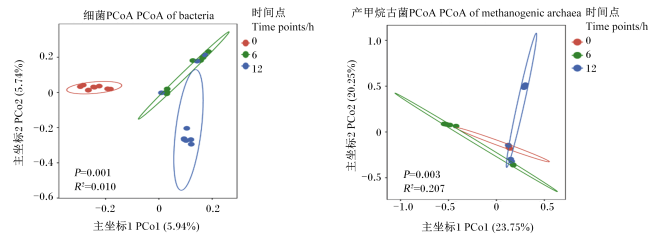
图1所示,PCoA结果显示,西门塔尔牛瘤胃细菌(P=0.001,R2=0.010)和产甲烷古菌(P=0.003,R2=0.207)群落结构在采食后不同时间点间均存在明显的分离,且经Adonis多重置换检验差异显著(P<0.05)。以上结果表明,西门塔尔牛采食后不同时间点瘤胃细菌和产甲烷古菌群落结构显著不同。
图1 西门塔尔牛采食后不同时间点瘤胃微生物群落PCoA

Fig.1 PCoA of rumen microbiota at different time points after feeding in Simmental cattle

2.4 西门塔尔牛采食后不同时间点瘤胃微生物群落组成

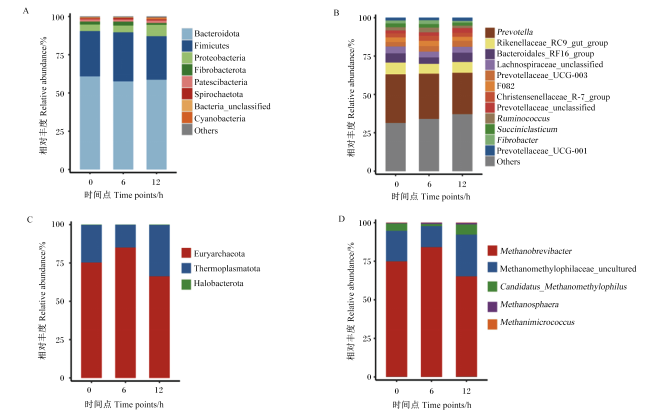
图2-A图2-B所示,在门水平上,拟杆菌门(59.1%)、厚壁菌门(30.0%)和变形菌门(Proteobacteria,5.42%)为西门塔尔牛采食后不同时间点瘤胃主要的细菌门,占总细菌的94.1%;在属水平上,普雷沃氏菌属(Prevotella,29.5%)为主要的细菌属,除此之外还有19个相对丰度在1%以上的细菌属,包括常见的瘤胃球菌属(Ruminococcus,2.28%)、纤维杆菌属(Fibrobacter,1.87%)、瘤胃杆菌属(Ruminobacter,1.65%)和丁酸弧菌属(Butyrivibrio,1.12%)。如图2-C图2-D所示,在产甲烷古菌中,广古菌门(Euryarchaeota,75.6%)为主要的门,其他还有热原体门(Thermoplasmatota,24.3%)和嗜盐古菌门(Halobacterota,0.09%);甲烷短杆菌属(Methanobrevibacter,74.6%)为最主要的属,除此之外还有甲烷甲基嗜菌科未培养属(Methanomethylophilaceae_uncultured,20.2%),以及Candidatus_Methanomethylophilus(4.23%)和甲烷球菌属(Methanosphaera,0.74%)。
图2 西门塔尔牛采食后不同时间点瘤胃微生物群落组成

A:细菌门水平 bacteria at phylum level;B:细菌属水平 bacteria at genus level;C:产甲烷古菌门水平 methanogenic archaea at phylum level;D:产甲烷古菌属水平 methanogenic archaea at genus level。

Bacteroidota:拟杆菌门;Fimicutes:厚壁菌门;Proteobacteria:变形菌门;Fibrobacterota:纤维杆菌门;Patescibacteria:髌骨菌门;Spirochaetota:螺旋体门;Bacteria_unclassified:细菌未分类门;Cyanobacteria:蓝细菌门;Euryarchaeota:广古菌门;Thermoplasmatota:热原体门;Halobacterota:嗜盐古菌门;Prevotella:普雷沃氏菌属;Rikenellaceae_RC9_gut_group:理研菌科RC9肠道群;Bacteroidales_RF16_group:拟杆菌目RF16群;Lachnospiraceae_unclassified:毛螺菌科未分类属;Prevotellaceae_UCG-003:普雷沃氏菌科UCG-003;Christensenellaceae_R-7_group:克里斯滕森氏菌科R-7群;Prevotellaceae_unclassified:普雷沃氏菌科未分类属;Ruminococcus:瘤胃球菌属;Succiniclasticum:解琥珀酸菌属;Fibrobacter:纤维杆菌属;Prevotellaceae_UCG-001:普雷沃氏菌科UCG-001;Methanobrevibacter:甲烷短杆菌属;Methanomethylophilaceae_uncultured:甲烷甲基嗜菌科未培养属;Methanosphaera:甲烷球菌属;Methanimicrococcus:甲烷微球菌属;Others:其他。

Fig.2 Composition of rumen microbiota at different time points after feeding in Simmental cattle

表4可知,瘤胃细菌在门水平上,12 h变形菌门相对丰度显著高于0 h(P<0.05),6 h与0和12 h相比均无显著差异(P>0.05),但6 h有比12 h升高的趋势(P=0.058);6 h纤维杆菌门相对丰度显著高于12 h(P<0.05),0 h与6和12 h相比均无显著差异(P>0.05);0和6 h蓝细菌门(Cyanobacteria)相对丰度保持相对稳定,但12 h显著升高(P<0.05)。瘤胃细菌在属水平上,6 h瘤胃球菌属和纤维杆菌属相对丰度显著高于12 h(P<0.05),瘤胃杆菌属显著低于12 h(P<0.05),但0 h与6和12 h相比并无显著差异(P>0.05);琥珀酸弧菌科UCG-002(Succinivibrionaceae_UCG-002)相对丰度在12 h达到最高,显著高于0和6 h(P<0.05);12 h梭菌纲UCG-014(Clostridia_UCG-014)相对丰度显著高于0 h(P<0.05),6 h与0和12 h相比无显著差异(P>0.05)。
表4 西门塔尔牛采食后不同时间点瘤胃差异细菌

Table 4 Rumen differential bacteria at different time points after feeding in Simmental cattle %

项目
Items
时间点Time points/h 均值标准误
SEM
P
P-value
0 6 12
门水平Phylum level
变形菌门Proteobacteria 4.30b 4.40ab 7.56a 0.520 0.021
纤维杆菌门Fibrobacterota 1.93ab 2.57a 1.12b 0.212 0.020
蓝细菌门Cyanobacteria 0.29b 0.15b 0.65a 0.066 0.002
属水平Genus level
瘤胃球菌属Ruminococcus 2.13ab 3.13a 1.62b 0.255 0.009
瘤胃杆菌属Ruminobacter 1.68ab 1.02b 2.32a 0.220 0.011
纤维杆菌属Fibrobacter 1.94ab 2.60a 1.13b 0.215 0.017
琥珀酸弧菌科UCG-002 Succinivibrionaceae_UCG-002 0.97b 0.49b 2.27a 0.216 0.002
梭菌纲UCG-014 Clostridia_UCG-014 0.68b 1.46ab 1.88a 0.144 0.002

仅展示具有显著差异的门,以及所有具有显著差异的属中相对丰度排名前5的属。表5同。

Only phyla with significant differences were shown, as well as the top 5 genera in relative abundance among all genera with significant differences. The same as Table 5.

表5可知,瘤胃产甲烷古菌在门水平上,6 h广古菌门和热原体门相对丰度显著高于0和12 h(P<0.05);在属水平上,6 h甲烷短杆菌属相对丰度显著高于0和12 h(P<0.05),而0和12 h之间无显著差异(P>0.05);0 h甲烷球菌属相对丰度显著低于12 h(P<0.05),6 h与0和12 h相比均无显著差异(P>0.05);6 h Candidatus_Methanomethylophilus相对丰度显著低于0和12 h(P<0.05)。
表5 西门塔尔牛采食后不同时间点瘤胃差异产甲烷古菌

Table 5 Rumen differential methanogenic archaea at different time points after feeding in Simmental cattle %

项目
Items
时间点Time points/h 均值标准误
SEM
P
P-value
0 6 12
门水平Phylum level
广古菌门Euryarchaeota 75.00b 85.30a 66.40b 2.010 <0.001
热原体门Thermoplasmatota 24.90a 14.60b 33.50a 2.000 <0.001
属水平Genus level
甲烷短杆菌属Methanobrevibacter 74.40b 84.40a 65.10b 0.945 <0.001
甲烷甲基嗜菌科未培养属
Methanomethylophilaceae_uncultured
20.30ab 13.40b 27.00a 1.570 0.002
甲烷球菌属Methanosphaera 0.57b 0.94ab 1.40a 0.129 0.012
Candidatus_Methanomethylophilus 6.16a 1.57b 9.15a 0.894 <0.001

2.5 西门塔尔牛采食后不同时间点瘤胃代表性差异微生物

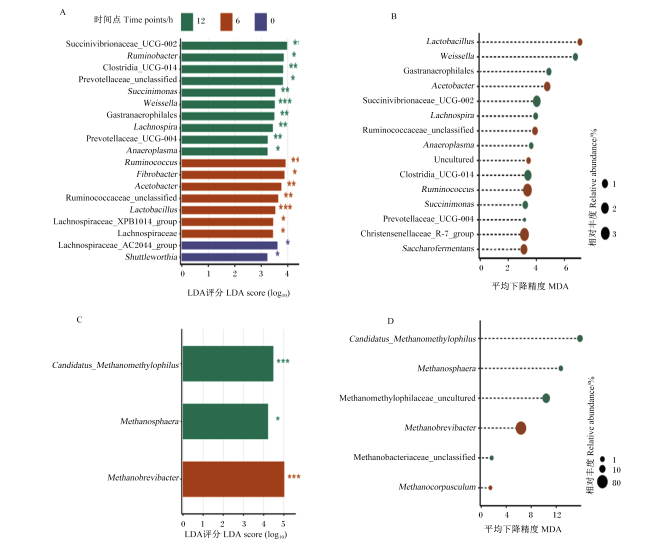
图3所示,0 h瘤胃细菌中发现的具有代表性的富集微生物属较少,在LEfSe分析中仅有毛螺菌科AC2044群(Lachnospiraceae_XPB1014_group)和沙特尔沃思氏菌属(Shuttleworthia)2个属的LDA评分较高;6 h具有代表性的富集微生物属明显增多,且在LEfSe和MDA分析中均得到较高评分,包括瘤胃球菌属、瘤胃球菌科未分类属(Ruminococcaceae_unclassified)、乳杆菌属(Lactobacillus),并且有高于0 h的趋势(P=0.081);12 h出现的代表性差异微生物最多,其中LDA评分高于3的有11个属,而MDA评分在前15的属中有8个都在采食后12 h富集;此外,12 h的MDA评分靠前的属均能在LDA评分高于3的属中找到,包括琥珀酸弧菌科UCG-002、梭菌纲UCG-014、魏斯氏菌属(Weissella)、琥珀酸单胞菌属(Succinimonas)、毛螺菌属(Lachnospira)、Gastranaerophilales、普雷沃氏菌科UCG-004(Prevotellaceae_UCG-004)和厌氧支原体属(Anaeroplasma)等,其中琥珀酸弧菌科UCG-002相对丰度在12 h显著升高(P<0.05)。
图3 西门塔尔牛采食后不同时间点瘤胃微生物群落LEfSe和MDA分析

A:细菌属水平LEfSe分析 LEfSe analysis of bacteria at genus level;B:细菌属水平MDA分析 MDA analysis of bacteria at genus level;C:产甲烷古菌属水平LEfSe分析 LEfSe analysis of methanogenic archaea at genus level;D:产甲烷古菌属水平MDA分析 MDA analysis of methanogenic archaea at genus level。

Succinivibrionaceae_UCG-002:琥珀酸弧菌科UCG-002属;Ruminobacter:瘤胃杆菌属;Clostridia_UCG-014:梭菌纲UCG-014;Prevotellaceae_unclassified:普雷沃氏菌科未分类属;Succinimonas:琥珀酸单胞菌属;Weissella:魏斯氏菌属;Lachnospira:毛螺菌属;Prevotellaceae_UCG-004:普雷沃氏菌科UCG-004;Anaeroplasma:厌氧支原体属;Ruminococcus:瘤胃球菌属;Fibrobacter:纤维杆菌属;Acetobacter:乙酸杆菌属;Ruminococcaceae_unclassified:瘤胃球菌科未分类属;Lactobacillus:乳杆菌属;Lachnospiraceae_XPB1014_group:毛螺菌科XPB1014群;Lachnospiraceae:毛螺菌科;Lachnospiraceae_AC2044_group:毛螺菌科AC2044群;Shuttleworthia:沙特尔沃思氏菌属;Christensenellaceae_R-7_group:克里斯滕森氏菌科R-7群;Saccharofermentans:糖发酵菌属;Methanosphaera:甲烷球菌属;Methanobrevibacter:甲烷短杆菌属;Methanomethylophilaceae_uncultured:甲烷甲基嗜菌科未培养属;Methanobacteriaceae_unclassified:甲烷杆菌科未分类属;Methanocorpusculum:甲烷粒菌属。Uncultured:未培养属。

*表示P<0.05,**表示P<0.01,***表示P<0.001。

Fig.3 LEfSe and MDA analysis of rumen microbiota at different time points after feeding in Simmental cattle

* mean P<0.05, ** mean P<0.01, and *** mean P<0.001.

在瘤胃产甲烷古菌中,0 h发现的具有代表性的富集微生物属同样较少,没有LDA评分大于2.5或MDA评分靠前的属;6 h甲烷短杆菌属最具代表性,无论LDA和MDA评分,还是相对丰度都在古菌中处于领先地位,这与2.4中分析结果一致;12 h较有代表性的属有甲烷甲基嗜菌科未培养属、Candidatus_Methanomethylophilus和甲烷球菌属。

2.6 西门塔尔牛采食后不同时间点瘤胃微生物差异代谢通路预测

表6可知,使用PICRUSt2分别对细菌和产甲烷古菌进行MetaCyc代谢通路丰度预测,结果表明,6和12 h细菌中糖酵解、乙酰辅酶A发酵产丁酸和丙酮酸发酵生成乙酸和乳酸通路丰度显著高于0 h(P<0.05);6 h产甲烷古菌中甲烷生成通路丰度显著高于0和12 h(P<0.05)。
表6 西门塔尔牛采食后不同时间点瘤胃微生物差异代谢通路

Table 6 Different metabolic pathways of rumen microorganisms at different time points after feeding in Simmental cattle

代谢通路
Metabolic pathways
时间点Time points/h 均值标准误
SEM
P
P-value
0 6 12
细菌Bacteria
糖酵解Glycolysis 17 848b 20 916a 21 894a 466 <0.001
乙酰辅酶A发酵产丁酸
Acetyl-CoA fermentation to butanoate
1 837b 3 917a 4 464a 338 0.003
丙酮酸发酵生成乙酸和乳酸
Pyruvate fermentation to acetate and lactate
23 760b 27 369a 26 774a 512 0.008
古菌Archaea
甲烷生成Methanogenesis 19 584b 25 205a 20 389b 603 <0.001

3 讨论

3.1 动物采食对瘤胃发酵模式的影响

瘤胃pH是反映反刍动物瘤胃微生物发酵和内环境稳定的重要指标,其正常范围为5.5~7.5,而当其处于6.2~6.8时对瘤胃发酵最有利[18-19]。本试验中,瘤胃pH均在正常范围内,且6和12 h的pH最有利于发酵。瘤胃内氢气在碳水化合物发酵过程中产生,作为产甲烷古菌的能量来源,产甲烷是其最主要的去向[20-21]。6 h碳水化合物在瘤胃内发酵产生大量氢气,导致进入溶解氢池的氢气增多,产甲烷古菌利用溶解氢的效率升高,使得甲烷大量生成。在此之后,由于淀粉发酵降解基本完成,瘤胃内发酵速率下降,溶解氢以及溶解甲烷浓度恢复至0 h水平。
饲粮中的碳水化合物经由瘤胃微生物降解所产生主要代谢产物为VFA,其是反刍动物主要的供能物质,其中乙酸、丙酸和丁酸占TVFA的95%以上[22]。不同类型的碳水化合物降解生成VFA的比例存在差异,纤维有利于乙酸和丁酸生成,而淀粉则更有利于丙酸生成[1]。现有研究表明,瘤胃中淀粉的降解时间为0.5~5.0 h,仅有10%的纤维在0.5~1.0 h发生降解,而90%以上的纤维在4~72 h被持续降解[22-23]。本研究中,6 h淀粉和部分纤维被降解,导致瘤胃TVFA浓度显著升高,由于该阶段淀粉降解占据主导地位,且乙酸和丙酸生成分别是生氢和耗氢的过程,此时氢气浓度较高不利于乙酸生成而有利于丙酸生成,因此丙酸比例显著高于0和12 h,乙酸则与之相反。有研究表明,乙丙比与反刍动物能量利用效率呈反比,本研究中,6 h的乙丙比降低或说明此时能量利用效率最高[11]。动物采食6 h后,瘤胃中淀粉降解基本完成,剩余纤维开始持续降解,丙酸和丁酸比例下降。6 h的瘤胃TVFA浓度达到最高值,随后逐渐恢复至0 h水平,Shaani等[9]的研究结果与本试验结果一致。一般认为,瘤胃内乙丙比低于3是丙酸型发酵,高于3则为乙酸型发酵[24]。6 h的乙丙比虽然未低于3,但仍显著低于0和12 h,说明与0和12 h相比,6 h瘤胃发酵模式有向丙酸型转变的趋势。

3.2 动物采食对瘤胃微生物群落组成和功能机制的影响

本研究中PCoA结果显示,采食后不同时间点之间瘤胃细菌的群落结构存在显著差异。采食后瘤胃内碳水化合物的降解经历了从以淀粉降解为主,逐渐过渡到以纤维降解为主的过程,采食是导致细菌群落结构差异的主要原因[25-26]。瘤胃作为反刍动物特有的消化器官,其微环境具有高度的复杂性和独特性,瘤胃微生物形成复杂且协调的代谢网络能够迅速适应采食饲粮、饲粮成分以及宿主生理状态等变化,通过调节菌群组成和功能来维持瘤胃内的发酵稳定[27]。Li等[28]的研究结果表明,拟杆菌门和厚壁菌门作为主要的复合碳水化合物消化菌门,其相对丰度几乎不受采食行为刺激的影响,这与本研究结果一致。属水平上,瘤胃球菌属作为核心的纤维降解菌,其相对丰度的变化趋势呈现为采食后先升高后降低并恢复至0 h水平,其原因主要为:6 h随着淀粉降解速率减慢,瘤胃球菌属开始快速增殖以满足瘤胃对纤维降解的需求[29]。瘤胃杆菌属属于变形菌门,其作为淀粉利用菌在0和6 h间的相对丰度无显著差异,说明肉牛采食的淀粉在6 h内已经降解殆尽,导致已经增加的瘤胃杆菌属又回到原有的基础。
瘤胃微生物的变化也反映在微生物的代谢功能上,本试验中不同时间点一些与微生物碳水化合物代谢直接相关的通路丰度出现了显著变化。在细菌中,糖酵解、乙酰辅酶A发酵产丁酸以及丙酮酸发酵生成乙酸和乳酸通路丰度都在采食后显著上调,这种上调可能是由于参与碳水化合物降解和具有发酵功能微生物相对丰度的提高,导致碳水化合物降解和发酵能力增强,由此导致VFA(尤其是乙酸和丁酸)和乳酸产生增多,驱动瘤胃pH降低和溶解氢增加。Shaani等[9]研究发现,采食导致糖酵解、丙酮酸丁酸代谢基因的丰度随着喂食时间的延长而升高,这是由于参与碳水化合物分解和发酵功能的微生物相对丰度的提高。
瘤胃微生物小亚基rRNA中,古菌仅占0.3%~3.3%,而产甲烷古菌是瘤胃古菌的主要组成部分,其依靠氢气作为电子供体还原二氧化碳生成甲烷,并以此作为主要的能量来源[30]。在产甲烷古菌中,广古菌门的甲烷短杆菌属占据主导地位,瘤胃中约80%的氢气被甲烷短杆菌属利用生成甲烷[31-32]。在产甲烷古菌甲烷生成通路中也发现,其丰度在6 h较0和12 h显著上调。研究表明,采食后VFA的产生和甲烷的排放增多,并且产甲烷代谢基因的丰度随时间延长而提高[33]。甲烷短杆菌属可以利用瘤胃中大量的溶解氢产生甲烷,导致溶解甲烷浓度的升高;随着溶解氢的消耗增加与产生减少,甲烷短杆菌属相对丰度降低和甲烷生成通路下调,对溶解氢的利用降低,最终使12 h的溶解甲烷浓度降低。

4 结论

① 在采食后0~12 h,西门塔尔牛瘤胃发酵模式存在由乙酸型到丙酸型再到乙酸型转变的趋势。
② 采食对西门塔尔牛瘤胃微生物组成和功能具有显著影响,具体为:6 h纤维降解菌和甲烷短杆菌相对丰度最高,碳水化合物降解通路也在此时上调;而12 h淀粉降解菌相对丰度最高。
[1]
LI Q S, WANG R, MA Z Y, et al. Dietary selection of metabolically distinct microorganisms drives hydrogen metabolism in ruminants[J]. The International Society for Microbial Ecology Journal, 2022, 16(11):2535-2546.

[2]
FLINT H J. Polysaccharide breakdown by anaerobic microorganisms inhabiting the mammalian gut[J]. Advances in Applied Microbiology, 2004,56:89-120.

[3]
XUE M Y, SUN H Z, WU X H, et al. Multi-omics reveals that the rumen microbiome and its metabolome together with the host metabolome contribute to individualized dairy cow performance[J]. Microbiome, 2020, 8(1):64.

[4]
BICKHART D M, WEIMER P J. Symposium review:host-rumen microbe interactions may be leveraged to improve the productivity of dairy cows[J]. Journal of Dairy Science, 2018, 101(8):7680-7689.

[5]
KIM M, MORRISON M, YU Z T. Status of the phylogenetic diversity census of ruminal microbiomes[J]. FEMS Microbiology Ecology, 2011, 76(1):49-63.

DOI PMID

[6]
BO TRABI E, SEDDIK H E, XIE F, et al. Comparison of the rumen bacterial community,rumen fermentation and growth performance of fattening lambs fed low-grain,pelleted or non-pelleted high grain total mixed ration[J]. Animal Feed Science and Technology, 2019,253:1-12.

[7]
LEEDLE J A, BRYANT M P, HESPELL R B. Diurnal variations in bacterial numbers and fluid parameters in ruminal contents of animals fed low- or high-forage diets[J]. Applied and Environmental Microbiology, 1982, 44(2):402-412.

DOI PMID

[8]
THAISS C A, ZEEVI D, LEVY M, et al. Transkingdom control of microbiota diurnal oscillations promotes metabolic homeostasis[J]. Cell, 2014, 159(3):514-529.

DOI PMID

[9]
SHAANI Y, ZEHAVI T, EYAL S, et al. Microbiome niche modification drives diurnal rumen community assembly,overpowering individual variability and diet effects[J]. The ISME Journal, 2018, 12(10):2446-2457.

[10]
ZHANG C T, MA T, TU Y, et al. Effects of circadian rhythm and feeding modes on rumen fermentation and microorganisms in Hu sheep[J]. Microorganisms, 2022, 10(12):2308.

[11]
谭支良, 黄瑞林. 反刍动物能量代谢调控新技术[J]. 中国饲料, 2000(7):16-18.

TAN Z L, HUANG R L. New technology for the regulation of energy metabolism in ruminants[J]. China Feed, 2000(7):16-18.(in Chinese)

[12]
LI M M, GHIMIRE S, WENNER B A, et al. Effects of acetate,propionate,and pH on volatile fatty acid thermodynamics in continuous cultures of ruminal contents[J]. Journal of Dairy Science, 2022, 105(11):8879-8897.

[13]
AOAC. Official methods of analysis of AOAC International[S].18th ed. Gaithersburg: AOAC International, 2005.

[14]
VAN SOEST P J, ROBERTSON J B, LEWIS B A. Methods for dietary fiber,neutral detergent fiber, and nonstarch polysaccharides in relation to animal nutrition[J]. Journal of Dairy Science, 1991, 74(10):3583-3597.

[15]
KARTHNER R J, THEURER B. Comparison of hydrolysis methods used in feed,digesta,and fecal starch analysis[J]. Journal of Agricultural and Food Chemistry, 1981, 29(1):8-11.

[16]
WANG M, SUN X Z, JANSSEN P H, et al. Responses of methane production and fermentation pathways to the increased dissolved hydrogen concentration generated by eight substrates in in vitro ruminal cultures[J]. Animal Feed Science and Technology, 2014,194:1-11.

[17]
MA Z Y, ZHANG X M, WANG R, et al. Effects of chemical and mechanical lysis on microbial DNA yield,integrity,and downstream amplicon sequencing of rumen bacteria and protozoa[J]. Frontiers in Microbiology, 2020,11:581227.

[18]
杨宝钰, 王娇, 颜轶男, 等. 奶牛瘤胃pH、消化酶活性及原虫数量的日动态变化研究[J]. 动物营养学报, 2021, 33(3):1534-1544.

DOI

YANG B Y, WANG J, YAN Y N, et al. Daily dynamic changes of rumen pH,digestive enzyme activities and protozoa number in dairy cows[J]. Chinese Journal of Animal Nutrition, 2021, 33(3):1534-1544.(in Chinese)

[19]
姜南, 李学威, 张楠, 等. 日粮不同能量和蛋白质水平对生长期牦牛瘤胃发酵参数及瘤胃菌群的影响[J]. 中国草食动物科学, 2024, 44(2):18-26.

JIANG N, LI X W, ZHANG N, et al. Effect of different dietary energy and protein levels on rumen fermentation parameters and rumen microflora in growing yaks[J]. China Herbivore Science, 2024, 44(2):18-26.(in Chinese)

[20]
JANSSEN P H. Influence of hydrogen on rumen methane formation and fermentation balances through microbial growth kinetics and fermentation thermodynamics[J]. Animal Feed Science and Technology, 2010, 160(1/2):1-22.

[21]
WOLF P G, BISWAS A, MORALES S E, et al. H2 metabolism is widespread and diverse among human colonic microbes[J]. Gut Microbes, 2016, 7(3):235-245.

[22]
王洪荣. 反刍动物碳水化合物代谢利用机制及消化道健康的系统营养调控研究进展[J]. 动物营养学报, 2020, 32(10):4686-4696.

DOI

WANG H R. Research advances in system-nutritional regulation on mechanism of carbohydrates metabolism and gastrointestinal health of ruminants[J]. Chinese Journal of Animal Nutrition, 2020, 32(10):4686-4696.(in Chinese)

[23]
MORAÏS S, MIZRAHI I. Islands in the stream:from individual to communal fiber degradation in the rumen ecosystem[J]. FEMS Microbiology Reviews, 2019, 43(4):362-379.

[24]
KUNG L Jr, SHEPERD A C, SMAGALA A M, et al. The effect of preservatives based on propionic acid on the fermentation and aerobic stability of corn silage and a total mixed ration[J]. Journal of Dairy Science, 1998, 81(5):1322-1330.

PMID

[25]
HENDERSON G, COX F, GANESH S, et al. Rumen microbial community composition varies with diet and host,but a core microbiome is found across a wide geographical range[J]. Scientific Reports, 2015,5:14567.

[26]
詹彦波, 张丽, 瞿明仁, 等. 不同pH对瘤胃细菌数量和菌群结构的影响[J]. 江西农业大学学报, 2024, 46(1):184-195.

ZHAN Y B, ZHANG L, QU M R, et al. Effects of different pH on number and community structure of rumen bacteria[J]. Acta Agriculturae Universitatis Jiangxiensis, 2024, 46(1):184-195.(in Chinese)

[27]
FIRKINS J L, YU Z. RUMINANT NUTRITION SYMPOSIUM:how to use data on the rumen microbiome to improve our understanding of ruminant nutrition[J]. Journal of Animal Science, 2015, 93(4):1450-1470.

[28]
LI R W, CONNOR E E, LI C J, et al. Characterization of the rumen microbiota of pre-ruminant calves using metagenomic tools[J]. Environmental Microbiology, 2012, 14(1):129-139.

DOI PMID

[29]
高星, 李永丽, 燕亚平, 等. 瘤胃纤维素降解细菌的研究进展[J]. 微生物学杂志, 2023, 43(5):107-114.

GAO X, LI Y L, YAN Y P, et al. Advances in rumen cellulose-degradable bacteria[J]. Journal of Microbiology, 2023, 43(5):107-114.(in Chinese)

[30]
JANSSEN P H, KIRS M. Structure of the archaeal community of the rumen[J]. Applied and Environmental Microbiology, 2008, 74(12):3619-3625.

DOI PMID

[31]
祁杰, 李大彪, 牛晓雨, 等. 高产和低产奶牛甲烷产量和产甲烷菌多样性的比较研究[J]. 饲料研究, 2024, 47(1):56-60.

QI J, LI D B, NIU X Y, et al. Comparative study on methane production and methanogenic bacteria diversity of high-yielding and low-yielding dairy cows[J]. Feed Research, 2024, 47(1):56-60.(in Chinese)

[32]
RABEE A E, ASKAR A R. Composition of the rumen archaeal community of growing camels fed different concentrate levels[EB/OL]. International Microbiology, 2023(2023-12-07)[2024-09-26]. https://europepmc.org/article/MED/38057458.

[33]
VAN LINGEN H J, EDWARDS J E, VAIDYA J D, et al. Diurnal dynamics of gaseous and dissolved metabolites and microbiota composition in the bovine rumen[J]. Frontiers in Microbiology, 2017,8:45-46.

Outlines

/