RESEARCH PAPER

Effects of Supplemental Feeding Diets with Different Protein Levels on Growth Performance and Intestinal Microorganisms of Grazing Yaks during Warm Season

  • ZHOU Pengyu , 1, 2, 3, 4 ,
  • HU Bo 1, 2, 3, 4 ,
  • CUI Zhanhong 1, 2, 3, 4 ,
  • MA Jinxiu 5 ,
  • LIU Shujie 1, 2, 3, 4 ,
  • SUN Lu , 1, 2, 3, 4, * ,
  • WANG Xun , 1, 2, 3, 4, *
Expand
  • 1 Qinghai Academy of Animal Husbandry and Veterinary Sciences, Qinghai University, Xining 810016, China
  • 2 Key Laboratory of Animal Nutrition and Forage-Feed of Grazing Yak and Tibetan Sheep in Qinghai-Tibetan Plateau, Xining 810016, China
  • 3 Key Laboratory of Plateau Grazing Animal Nutrition and Feed Science of Qinghai Province, Xining 810016, China
  • 4 Yak Engineering Technology Research Center of Qinghai Province, Xining 810016, China
  • 5 Qinghai Xuefeng Yak Dairy Industry Co., Ltd., Gonghe 811800, China
* SUN Lu, associate professor, E-mail: ;
WANG Xun, associate professor, E-mail:

Received date: 2024-11-30

  Online published: 2025-06-12

Abstract

The aim of this experiment was to study the effects of supplemental feeding diets with different protein levels on the growth performance and intestinal microorganisms of grazing yaks during warm season. Forty-eight adult yaks with similar age and body weight were randomly divided into 4 groups with 12 yaks in each group, which were natural grazing group (NG group), low protein supplement group (CP15 group, protein level was 15.09%) and medium protein supplement group (CP17 group, protein level was 17.00%) and high protein supplemental group (CP19 group, protein level was 18.98%), and the yaks in the supplementation group were fed at a rate of 1.5 kg/head per day for a period of 10 days in the pre-feeding period, and 90 days in the positive test period. The results showed as follows: 1) in terms of growth performance, the total weight gain and average daily gain of yaks in the supplemental feeding group were significantly higher than those in the NG group (P<0.05), and the average daily gain of yaks in the CP17 group was 0.81 kg, which was higher than that in the CP15 and CP19 groups. 2) In terms of gut microorganisms, there was no significant difference in the alpha diversity indexes between the NG and supplemental feeding groups (P>0.05); there was a large difference in beta diversity, with smaller differences in communities between the supplemental feeding groups. At the phylum level, Firmicutes and Bacteroidetes were the dominant bacteria in the yak intestine under the four feeding conditions, in which the relative abundance of Firmicutes for a significantly higher percentage of the NG and CP19 groups than the CP15 group ( P<0.05), the relative abundance of Spirochaetota was significantly higher in CP15 group than in the NG and CP19 groups (P<0.05), and the relative abundance of Verrucomicrobia was significantly higher in CP15 group than in the NG group (P<0.05); at the genus level, Ruminococcaceae_UCG-005 and Rihenellaceae_RC9_gut_group were the dominant bacteria under the four feeding conditions, with the relative abundance of Ruminococcaceae_UCG-005 and Christensenellaceae_R-7_group in the NG group were significantly higher than those in the supplemental feeding group (P<0.05); the relative abundance of Treponema and Monoglobus were significantly higher in CP15 group than those in the NG group (P<0.05). By linear discriminant analysis effect size (LEfSe) analysis, Ruminococcus_UCG-005 and Oscillospiraceae were significantly enriched in the grazing group (P<0.05), and Spirochaetaceae, Treponema and Lachnospiraceae were significantly enriched in the supplemental feeding group (P<0.05); in terms of functional prediction, the NG group was significantly higher than the CP15 and CP17 groups in terms of metabolism of cofactors and vitamins and energy metabolism (P<0.05), the CP15 and CP17 groups were significantly higher than the NG group in terms of signal transduction (P<0.05), and the CP17 group was significantly higher than the NG group in terms of carbohydrate metabolism (P<0.05). In conclusion, supplemental feeding of concentrates can significantly increase yak average daily gain and immunity, and 17.00% protein level can provide more energy for yaks and is more favorable to yak growth.

Cite this article

ZHOU Pengyu , HU Bo , CUI Zhanhong , MA Jinxiu , LIU Shujie , SUN Lu , WANG Xun . Effects of Supplemental Feeding Diets with Different Protein Levels on Growth Performance and Intestinal Microorganisms of Grazing Yaks during Warm Season[J]. Chinese Journal of Animal Nutrition, 2025 , 37(6) : 3889 -3902 . DOI: 10.12418/CJAN2025.319

牦牛(Bos grunniens)是青藏高原重要的畜种之一,为当地牧民提供肉、乳、皮毛及燃料等生活资源[1-2]。牦牛传统的生产方式以放牧为主,但青藏高原特殊的地理及高寒、缺氧、干旱的气候特点,导致天然牧草生长期短,产量低,营养物质输出不平衡,难以满足牦牛的营养需求,补饲成为解决牦牛营养摄入不足的主要手段。
青藏高原的气候特征表现为冷季和暖季交替出现,暖季牧草的营养价值和产量均显著高于冷季,这使得对牦牛补饲的研究主要集中于冷季。已有研究发现,暖季仅依靠放牧仍无法满足牦牛的营养需求[3-4],在暖季对牦牛进行补饲,可通过补偿生长作用,进一步发挥牦牛的生长潜力。
戴东文等[5]发现,暖季补饲可显著提高牦牛的日增重及养殖效益。伪玛张等[6]研究发现,暖季补饲显著提高了牦牛乳的产量,且乳品质得到提升。甄虎等[7]研究发现,舍饲不同蛋白质水平饲粮对牦牛的日增重、瘤胃发酵类型及瘤胃微生物均会产生显著影响。杨得玉等[8]在研究中发现,暖季补饲矿物质盐砖可显著提高牦牛日体重和牧草消化率。黎凌铄[9]在研究中发现,饲喂高蛋白质水平饲粮可影响牦牛瘤胃微生物组成和瘤胃发酵,提高养分表观消化率进而提高牦牛的生产性能。目前关于放牧牦牛暖季补饲营养物质主要为补充矿物质元素,饲粮蛋白质水平对牦牛的影响研究相对较少。而牦牛本身具有高效利用蛋白质的特点[10],因此,很有必要开展暖季补饲不同蛋白质水平饲粮对牦牛生长及肠道微生物的效果评价。
肠道是动物消化和吸收的重要器官,微生物在肠道功能中起着重要的作用,研究发现肠道微生物受宿主的年龄、生存环境、遗传及饲喂情况等因素的影响[11-12],其中饲粮是影响微生物群落的主要因素之一[13]。同时肠道微生物与宿主的生理、免疫和健康状况间存在密切联系[14-15],通过对肠道微生物的研究可以了解不同蛋白质水平饲粮对动物生理活动及健康情况的影响。
本研究采用16S rRNA技术研究暖季补饲不同蛋白质水平饲粮对牦牛肠道微生物的影响,同时结合牦牛生长性能指标进行饲喂效果评价,从而获得放牧生产条件下牦牛暖季补饲最适合的饲粮蛋白质水平。

1 材料与方法

1.1 试验时间与地点

试验时间为2023年7—10月,共100 d。试验在青海省海南州共和县黑马河镇敖包生态农畜产品购销专业合作社进行,海拔3 272 m,属于典型的高原大陆性气候,年平均温度-0.4 ℃,全年无绝对无霜期,牧草生长期为150~180 d,年平均降水量397 mm。草地类型主要为高寒草甸,优势牧草为高山嵩草(Carex parvula)、冰草(Agropyron cristatum)、线叶嵩草(Carex capillifolia)等。

1.2 试验动物与试验设计

本试验已通过青海省畜牧兽医科学院实验动物管理委员会批准,批准号:2024-QHMKY-006。试验选取放牧条件下体重[(160±20) kg]接近、健康状况良好的成年牦牛48头,随机分为4组,即自然放牧组(NG组)、低蛋白质补饲组(CP15组,蛋白质水平为15.09%)、中蛋白质补饲组(CP17组,蛋白质水平为17.00%)、高蛋白质补饲组(CP19组,蛋白质水平为18.98%),每组12头牦牛。本研究中饲粮蛋白质水平参照团队前期研究结果[5,7]设置,试验饲粮组成见表1,试验饲粮和牧草营养水平见表2
表1 试验饲粮组成(干物质基础)

Table 1 Composition of experimental diets (DM basis) %

项目
Items
组别Groups
CP15 CP17 CP19
玉米Corn 44.00 40.00 37.00
小麦Maize 26.00 18.00 13.00
麸皮Bran 10.00 16.00 17.00
菜籽粕Rapeseed meal 10.00 13.00 18.00
豆粕Soybean meal 5.00 8.00 10.00
预混料Premix 4.00 4.00 4.00
食盐NaCl 1.00 1.00 1.00
合计Total 100.00 100.00 100.00

预混料为每千克饲粮提供 Premix provided the following per kg of diets:VA 7 000 IU,VD3 1 200 IU,VE 60 IU,Cu (as copper sulfate) 15 mg,Fe (as ferrous sulfate) 75 mg,Zn (as zinc sulfate) 27 mg,Mn (as manganese sulfate) 51 mg,I (as potassium iodide) 0.90 mg,Se (as sodium selenite) 0.71 mg,Co (as cobalt sulfate) 0.40 mg。

表2 试验饲粮和牧草营养水平(干物质基础)

Table 2 Nutrient levels of experimental diets and forage (DM basis) %

项目
Items
组别Groups 牧草
Forage grass
CP15 CP17 CP19
代谢能ME/(MJ/kg) 11.16 11.32 11.49
有机物OM 91.91 91.83 91.78 93.06
粗蛋白质CP 15.09 17.00 18.98 5.45
粗脂肪EE 3.92 4.29 4.65 2.78
中性洗涤纤维NDF 15.91 17.03 19.35 52.46
酸性洗涤纤维ADF 7.70 8.77 9.87 35.20
钙Ca 0.77 0.79 0.82 0.57
磷P 0.33 0.37 0.41 0.10
粗灰分Ash 8.09 8.17 8.22 6.94

代谢能为计算值,参考NRC(2016)计算,其他营养水平均为实测值。

ME was a calculated value, which was calculated according to NRC (2016), while the other nutrient levels were all measured values.

所有牦牛在试验期间均自由采食牧草、自由饮水,补饲组牦牛在傍晚归牧后进行补饲,补饲量为1.5 kg/(头·d)。预试期10 d,正试期90 d。在正试期第1天和第90天,于出牧前对所有牦牛进行称重,采集肠道内容物及试验地牧草样品。

1.3 样品采集及指标测定

1.3.1 样品采集

牧草采集设置3个1 m×1 m样方草地齐地剪下,自然风干后粉碎过40目筛待测;肠道内容物采用直肠法采集,液氮速冻后转移至-80 ℃冰箱保存。

1.3.2 指标测定

使用电子地磅测定牦牛空腹体重,根据初体重(IBW)、末体重(FBW)及饲喂时间计算总增重(TWG)和平均日增重(ADG)。
牧草和饲粮中的干物质含量采用 GB/T 6435—2014 中的方法测定;粗蛋白质含量采用GB/T 6432—2018中的方法测定;粗脂肪含量采用GB/T 6433—2006中的方法测定;中性洗涤纤维含量采用GB/T 20806—2022中的方法测定;酸性洗涤纤维含量采用NY/T 1459—2022中的方法测定;钙含量采用GB/T 13885—2017中的方法测定;磷含量采用GB/T 6437—2018中的方法测定;粗灰分含量采用GB/T 6438—2007中的方法进行测定。有机物(%)=干物质(%)-粗灰分(%)。
直肠内容物样品交由北京诺禾致源科技股份有限公司进行16S rRNA测序。具体操作使用Illumina MiSeq平台对直肠内容物微生物测序,对直肠内容物微生物16S rRNA基因V3~V4区进行PCR扩增,引物序列为341F(5'-CCTAYGGGRBGCASCAG-3')和806R(3'-GGACTACNNGGGTATCTAAT-5'),使用NovaSeq 6000进行PE250上机测序。使用Qiime软件(Version 1.9.1)计算Shannon和Simpson等指数,使用R软件(Version 2.15.3)绘制相关分析图,最后使用PICRUSt软件进行功能预测分析。

1.4 数据处理

使用SPSS 27.0统计软件进行单因素方差分析(one-way ANOVA),并用LSD法进行组间多重比较(显著性水平设置为0.05),结果以平均值和均值标准误(SEM)表示。

2 结果与分析

2.1 生长性能

表3可知,各组间牦牛初体重无显著差异(P>0.05),各补饲组牦牛的末体重、总增重及平均日增重都显著高于NG组(P<0.05),尤以CP17组牦牛的总增重和平均日增重最高,且显著高于CP15组(P<0.05)。整个试验期,NG组牦牛共增重26.21 kg,CP15组、CP17组和CP19组分别增重61.85、72.93和70.42 kg,较NG组分别多增重了135.98%、178.25%和168.68%。
表3 不同蛋白质水平饲粮对牦牛生长性能的影响

Table 3 Effects of diets with different protein levels on growth performance of yaks kg

项目
Items
组别Groups SEM P
P-value
NG CP15 CP17 CP19
初体重IBW 163.17 160.77 162.21 162.24 1.324 0.576
末体重FBW 189.38c 222.62b 235.14a 232.66a 2.697 <0.001
总增重TWG 26.21c 61.85b 72.93a 70.42a 2.292 <0.001
平均日增重ADG 0.29c 0.69b 0.81a 0.78a 0.028 <0.001

同行数据肩标不同字母表示差异显著(P<0.05)。下表同。

In the same row, values with different letter superscripts mean significant difference (P<0.05). The same as below.

2.2 肠道微生物

2.2.1 样品测序结果及多样性指数

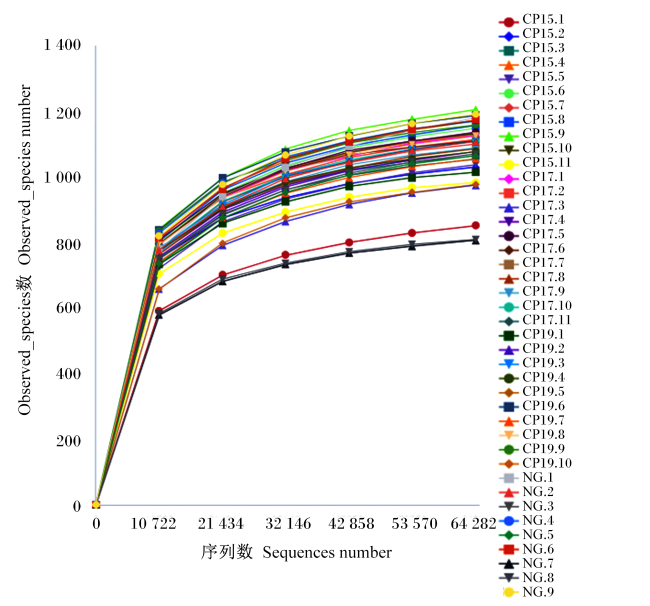
图1所示,4组样本的细菌稀释曲线均逐渐趋平稳,表明测序结果合理,即当前测序深度能够反映样本所包含的微生物多样性。
图1 细菌稀释曲线

CP15:CP15组,蛋白质水平为15.09%;CP17:CP17组,蛋白质水平为17.00%;CP19:CP19组,蛋白质水平为18.98%;NG:自然放牧组。下图同。

Fig.1 Bacterial dilution curve

CP15: CP15 group, the protein level was 15.09%; CP17: CP17 group, the protein level was 17.00%; CP19: CP19 group, the protein level was 18.98%; NG: natural grazing group. The same as below.

表5可知,4组的Observed_species、Shannon、Simpson及Chao1指数均无显著差异(P>0.05),表明不同蛋白质水平饲粮对牦牛直肠内容物微生物丰富度无显著影响。
表4 Alpha多样性指数

Table 4 Alpha diversity indexes

项目
Items
组别Groups SEM P
P-value
NG CP15 CP17 CP19
Observed_species指数
Observed_species index
1 063.67 1 076.09 1 089.73 1 094.90 14.674 0.893
Shannon指数
Shannon index
7.78 7.82 7.92 7.91 0.041 0.471
Simpson指数
Simpson index
0.99 0.99 0.99 0.99 0.001 0.863
Chao1指数Chao1 index 1 142.08 1 146.73 1 152.17 1 161.25 15.953 0.981

2.2.2 Venn图

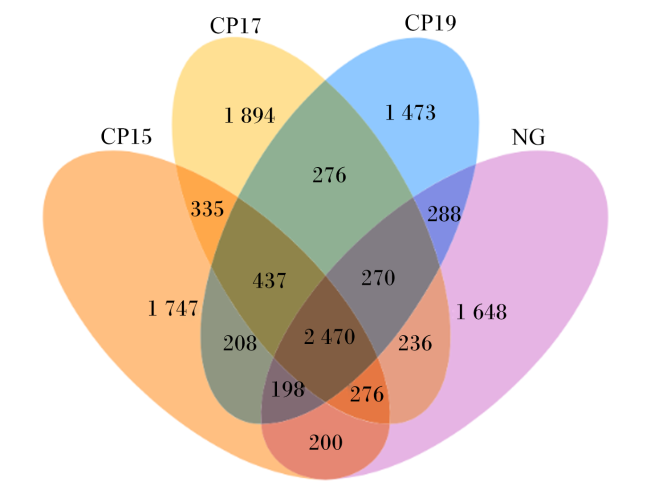
图2所示,4组样品共鉴定出11 956个扩增子序列变体(ASVs),NG组、CP15组、CP17组和CP19组的ASVs分别为5 586、5 871、6 194和5 620个,其中4组样品中共有的ASVs数为2 470个。NG组、CP15组、CP17组和CP19组特有的ASVs数分别为1 648、1 747、1 894和1 473个。
图2 Venn图

Fig.2 Venn diagram

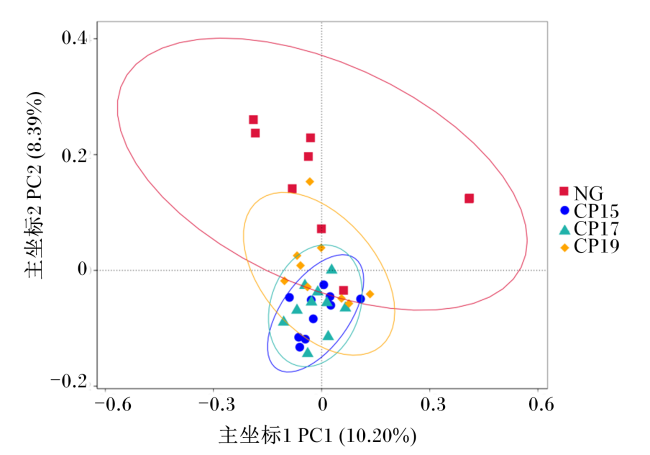
图3为基于Bray-Curtis距离的主坐标分析(PCoA),结果显示,主坐标1(PC1)对组间差异贡献值为10.20%,主坐标2(PC2)为8.39%。CP15组、CP17组和CP19组内样本距离接近,表明3组组内的微生物群落结构相近;而NG组与CP15组、CP17组和CP19组距离较远,表明NG组与CP15组、CP17组和CP19组的微生物群落结构存在较大差异。
图3 基于Bray-Curtis距离的主坐标分析

Fig.3 PCoA based on Bray-Curtis distance

2.2.3 微生物在门、属水平上的组成差异

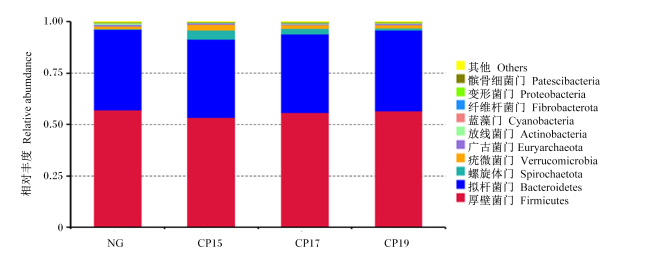
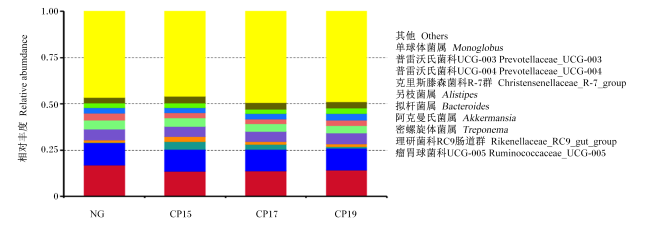
各组样品中门水平优势菌群的相对丰度如图4表5所示,排名前10的菌门为厚壁菌门(Firmicutes)、拟杆菌门(Bacteroidetes)、螺旋体门(Spirochaetota)、疣微菌门(Verrucomicrobia)、广古菌门(Euryarchaeota)、放线菌门(Actinobacteria)、蓝藻门(Cyanobacteria)、纤维杆菌门(Fibrobacterota)、变形菌门(Proteobacteria)、髌骨细菌门(Patescibacteria)。相对丰度最高的是厚壁菌门,其次是拟杆菌门,两者占比合计超过90%。其中厚壁菌门在各组细菌总序列中的占比均在50%以上,具体相对丰度分别为57.05%、53.42%、55.82%、56.63%;拟杆菌门在各组细菌总序列中的占比均接近40%,具体相对丰度分别为39.20%、38.12%、38.25%、39.19%;两者合计在各组细菌总序列中的占比均超过90%。NG组和CP19组厚壁菌门相对丰度显著高于CP15组(P<0.05);CP15组螺旋体门相对丰度显著高于NG组和CP19组(P<0.05);CP15组疣微菌门相对丰度显著高于NG组(P<0.05)。
图4 微生物在门水平上相对丰度的柱状图

Fig.4 Histogram of relative abundance of microorganisms at phylum level

表5 不同蛋白质水平饲粮对牦牛肠道门和属水平微生物的影响

Table 5 Effects of diets with different protein levels on intestinal microorganisms at phylum and genus levels in yaks %

项目
Items
组别Groups SEM P
P-value
NG CP15 CP17 CP19
门水平Phylum level
厚壁菌门Firmicutes 57.05a 53.42b 55.82ab 56.63a 0.522 0.019
拟杆菌门Bacteroidetes 39.20 38.12 38.25 39.19 0.493 0.494
螺旋体门Spirochaetota 0.31b 4.28a 2.62b 1.05b 0.482 0.007
疣微菌门Verrucomicrobia 1.19b 2.78a 1.69ab 1.51ab 0.283 0.049
属水平Genus level
瘤胃球菌科UCG-005
Ruminococcaceae_UCG-005
16.87a 13.43b 13.73b 14.20b 0.369 0.003
理研菌科RC9肠道群
Rikenellaceae_RC9_gut_group
12.06 11.82 11.70 11.77 0.274 0.689
密螺旋体菌属Treponema 0.29b 4.22a 2.57ab 0.95b 0.476 0.007
阿克曼氏菌属Akkermansia 1.18 2.75 1.66 1.47 0.276 0.069
拟杆菌属Bacteroides 5.98 5.52 5.30 5.76 0.162 0.184
另枝菌属Alistipes 4.85 4.59 4.28 4.17 0.202 0.288
克里斯滕森菌科R-7群
Christensenellaceae_R-7_group
3.68a 2.76b 2.62b 2.93b 0.133 0.012
普雷沃氏菌科UCG-004
Prevotellaceae_UCG-004
3.00 2.93 2.99 3.41 0.361 0.409
普雷沃氏菌科UCG-003
Prevotellaceae_UCG-003
2.68 2.45 2.33 3.16 0.173 0.128
单球体菌属Monoglobus 2.91b 3.61a 3.51ab 3.18ab 0.114 0.033
图5表5可知,在属水平上各组排名前10的菌属分别为瘤胃球菌科UCG-005、理研菌科RC9肠道群、密螺旋体菌属、阿克曼氏菌属、拟杆菌属、另枝菌属、克里斯滕森菌科R-7群、普雷沃氏菌科UCG-004、普雷沃氏菌科UCG-003和单球体菌属。瘤胃球菌科UCG-005和理研菌科RC9肠道群均为优势菌属,在各组中瘤胃球菌科UCG-005相对丰度分别为16.87%、13.43%、13.73%、14.20%,理研菌科RC9肠道群相对丰度分别为12.06%、11.82%、11.70%、11.78%。NG组瘤胃球菌科UCG-005相对丰度显著高于补饲组(P<0.05);CP15组密螺旋体菌属相对丰度显著高于NG组(P<0.05);NG组克里斯滕森菌科R-7群相对丰度显著高于补饲组(P<0.05);CP15组单球体菌属相对丰度显著高于NG组(P<0.05)。
图5 微生物在属水平上相对丰度的柱状图

Fig.5 Histogram of relative abundance of microorganisms at genus level

2.2.4 线性判别分析效应量(LEfSe)分析

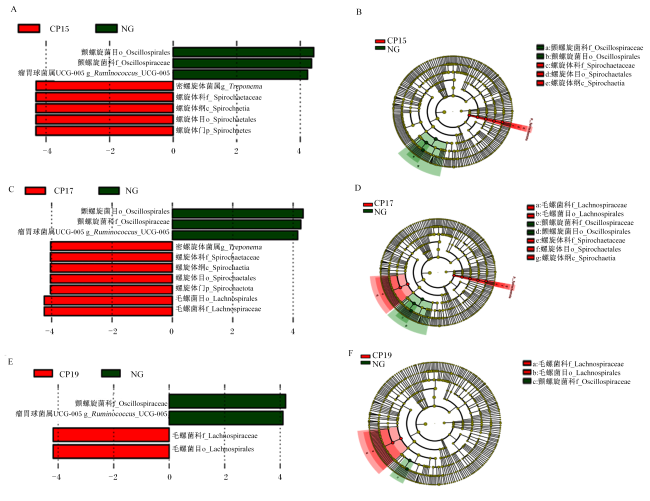
通过LEfSe对补饲组和NG组的微生物显著性差异进行分析,设置线性判别分析(LDA)值>4。由图6-A图6-B可知,通过NG组与CP15组对比,瘤胃球菌属UCG-005、颤螺旋菌科在NG组中显著富集(P<0.05);螺旋体科、密螺旋体菌属在CP15组显著富集(P<0.05)。由图6-C图6-D可知,通过NG组与CP17组对比,瘤胃球菌属UCG-005、颤螺旋菌科在NG组中显著富集(P<0.05);毛螺菌科、螺旋体科、密螺旋体菌属在CP17组显著富集(P<0.05)。由图6-E图6-F可知,通过NG组与CP19组对比,瘤胃球菌属UCG-005、颤螺旋菌科在NG组中显著富集(P<0.05);毛螺菌科在CP19组显著富集(P<0.05)。
图6 LEfSe分析结果

A:NG组与CP15组LDA值分布柱状图 histogram of the distribution of LDA values in NG and CP15 groups;B:NG组与CP15组进化分支图 evolutionary branching diagram of NG and CP15 groups;C:NG组与CP17组LDA值分布柱状图 histogram of the distribution of LDA values in NG and CP17 groups;D:NG组与CP17组进化分支图 evolutionary branching diagram of NG and CP17 groups;E:NG组与CP19组LDA值分布柱状图 histogram of the distribution of LDA values in NG and CP19 groups;F:NG组与CP19组进化分支图 evolutionary branching diagram of NG and CP19 groups。

Fig.6 Results of LEfSe analysis

2.2.5 功能预测与结果分析

表6可知,KEGG二级通路对牦牛肠道微生物进行功能预测,选取功能丰度排名前28的基因进行比较(相对丰度>0.1%)。牦牛肠道微生物功能主要位于膜运输、碳水化合物代谢、氨基酸代谢及复制和修复。NG组基因相较于补饲组在复制和修复、能量代谢、辅助因子和维生素的代谢、环境适应方面显著富集(P<0.05);CP15组基因相较于NG组在信号转导、内分泌系统方面显著富集(P<0.05);CP17组基因相较于NG组在碳水化合物代谢、信号转导方面显著富集(P<0.05);CP19组基因相较于NG组在酶家族方面显著富集(P<0.05)。其中氨基酸代谢、脂质代谢、糖蛋白的生物合成与代谢、折叠、分类和降解、信号转导等随着饲粮蛋白质水平的升高而减弱;而复制和修复、能量代谢、辅助因子和维生素的代谢、核苷酸代谢、细胞过程和信号传导、转录、酶家族、其他氨基酸的代谢等随着饲粮蛋白质水平的升高而增强。
表6 PICRUSt功能预测(前28位)

Table 6 PICRUSt function prediction (top 28)

项目
Items
组别Groups SEM P
P-value
NG CP15 CP17 CP19
膜运输Membrane transport 10.97 11.23 11.30 11.23 0.063 0.311
碳水化合物代谢
Carbohydrate metabolism
10.07b 10.12ab 10.15a 10.14ab 0.012 0.032
氨基酸代谢
Amino acid metabolism
9.85 9.82 9.81 9.81 0.010 0.566
复制和修复Replication and repair 9.21a 9.11b 9.12ab 9.15ab 0.016 0.035
翻译Translation 6.02 5.96 5.96 5.95 0.012 0.244
能量代谢Energy metabolism 5.94a 5.84b 5.86b 5.89ab 0.012 0.029
特征不明显Poorly characterized 4.76ab 4.79a 4.75b 4.74b 0.006 0.035
辅助因子和维生素的代谢
Metabolism of cofactors and vitamins
4.43a 4.33b 4.35b 4.38ab 0.012 0.026
核苷酸代谢
Nucleotide metabolism
4.17 4.12 4.13 4.14 0.008 0.167
细胞过程和信号传导
Cellular processes and signaling
3.98 3.97 3.98 3.10 0.008 0.785
细胞运动性Cell motility 2.83 2.90 2.91 2.86 0.029 0.800
脂质代谢Lipid metabolism 2.76 2.79 2.77 2.77 0.009 0.742
转录Transcription 2.86 2.82 2.83 2.86 0.007 0.155
遗传信息处理
Genetic information processing
2.77 2.76 2.73 2.74 0.008 0.276
糖蛋白的生物合成与代谢
Glycan biosynthesis and metabolism
2.34 2.39 2.35 2.34 0.018 0.614
折叠、分类和降解
Folding, sorting and degradation
2.52 2.53 2.51 2.50 0.007 0.475
新陈代谢Metabolism 2.47 2.47 2.46 2.47 0.005 0.846
酶家族Enzyme families 2.21a 2.18b 2.19a 2.20a 0.004 0.004
信号转导Signal transduction 1.66b 1.71a 1.69a 1.68ab 0.006 0.009
萜类化合物和聚酮类化合物的代谢
Metabolism of terpenoids and polyketides
1.68 1.66 1.66 1.67 0.004 0.335
外来生物的生物降解和代谢
Xenobiotics biodegradation and
metabolism
1.59 1.57 1.56 1.59 0.007 0.484
其他氨基酸的代谢
Metabolism of other amino acids
1.45 1.44 1.44 1.45 0.003 0.285
其他次级代谢物的生物合成
Biosynthesis of other secondary
metabolites
0.97 0.97 0.97 0.97 0.003 0.776
细胞生长和死亡Cell growth and death 0.53 0.54 0.54 0.53 0.001 0.175
传染性疾病Infectious diseases 0.37 0.37 0.37 0.37 0.006 0.132
转运和分解代谢
Transport and catabolism
0.33ab 0.35a 0.34ab 0.33b 0.003 0.033
内分泌系统Endocrine system 0.33b 0.34a 0.33ab 0.32b 0.013 0.037
环境适应Environmental adaptation 0.17a 0.17a 0.16ab 0.16b 0.006 0.022

3 讨论

3.1 暖季补饲不同蛋白质水平饲粮对放牧牦牛生长性能的影响

饲粮中的营养水平会对牦牛的各项指标产生影响,其中蛋白质水平的影响尤为明显[9]。据报道,牦牛之所以在高海拔地区的适应能力更强可能与其蛋白质利用效率更高有关[7]。在本研究中,CP17组和CP19组的平均日增重显著高于CP15组,这可能是因为较高的蛋白质水平提高牦牛对饲粮中粗蛋白质和中性洗涤纤维的表观消化率[16],从而为牦牛生长提供更多能量有关。但CP17组与CP19组平均日增重却无显著差异,甚至CP17组平均日增重略高于CP19组,这可能与较高的蛋白质水平抑制了瘤胃微生物的发酵,从而影响到瘤胃对能量的利用有关[17]。宋和键等[18]研究表明,暖季补饲显著提升牦牛的生产性能,其补饲组平均日增重为0.74 kg,这与本研究结果相近。郭凯等[19]研究发现,饲粮蛋白质水平过高或者过低都会对犊牛的生长性能产生不利影响;同样,有研究发现过量蛋白质摄入会对反刍动物的免疫功能、抗氧化能力、肉品质、经济效益及氮排放等方面产生消极的影响[20-21]。在本研究中,补饲不同蛋白质水平饲粮对牦牛的生长性能均产生了显著影响,其中CP17组平均日增重最高,表明补饲蛋白质水平为17.00%的饲粮更有利于提升牦牛的生长性能。

3.2 暖季补饲不同蛋白质水平饲粮对牦牛肠道微生物的影响

3.2.1 暖季补饲不同蛋白质水平饲粮对牦牛肠道微生物多样性的影响

高丰富度的微生物群落可以提高饲料的吸收效率[22]。在本研究中,4组间的Alpha多样性指数无显著差异,表明补饲不同蛋白质水平饲粮对牦牛肠道微生物的多样性、丰富度和覆盖率无显著影响,这与张颖楠等[23]的研究结果相一致;NG组的多项Alpha多样性指数均低于补饲组,补饲组中随着饲粮蛋白质水平的提升,多项Alpha多样性指数也随之提升,这表明随着饲粮蛋白质水平的提升,牦牛直肠内容物中的微生物物种丰富度也随之小幅提升,此结果与甄虎等[7]的研究结果一致。PCoA可通过距离远近反映各组微生物群落的相似程度,在本研究中,NG组与补饲组间微生物群落结构存在较大差异,而3个补饲组间的群落结构则较为接近,此结果与张振祥等[24]的研究结果相一致。

3.2.2 暖季补饲不同蛋白质水平饲粮对牦牛肠道门水平微生物的影响

在门水平上,各组牦牛的肠道微生物优势菌群均为厚壁菌门和拟杆菌门,两者合计占比在90%以上,此结果与前人研究结果[25-27]相似。厚壁菌门包含多种有益菌,其中多种菌属与纤维的分解相关[28],可降解纤维类物质产生短链脂肪酸,而短链脂肪酸在肠道健康中起着重要作用,如抗炎、清除耐药性致病菌等[29-30];同时厚壁菌门可参与胃肠道内营养物质消化及能量物质的代谢[31]。在本研究中,NG组的厚壁菌门相对丰度高于补饲组,这主要是因为厚壁菌门与纤维的分解相关,而NG组牦牛仅采食牧草。在补饲组中厚壁菌门相对丰度随着饲粮蛋白质水平的升高而升高,这表明提高饲粮的蛋白质水平可提升厚壁菌门的相对丰度,这与雒诚龙[32]的研究结果相一致。拟杆菌门主要用于分解含氮化合物(如蛋白质)和非纤维类碳水化合物(如淀粉),代谢产物以乙酸盐和丙酸盐为主[33],可为机体提供能量。因此,厚壁菌门和拟杆菌门主要参与碳水化合物代谢、氨基酸代谢和短链脂肪酸的产生等生理过程,在能量生成及肠道健康中发挥重要作用[34]

3.2.3 暖季补饲不同蛋白质水平饲粮对牦牛肠道属水平微生物的影响

在属水平上,各组牦牛的肠道微生物丰富度均为瘤胃球菌科UCG-005和理研菌科RC9肠道群。瘤胃球菌科UCG-005作为厚壁菌门的一种,广泛存在于反刍动物肠道中[35]。其可以分解植物纤维,从而产生短链脂肪酸,为机体提供能量。同时瘤胃球菌科UCG-005对分解支链淀粉起到重要作用[36]。理研菌科RC9肠道群作为一种有益菌,在消化粗饲料方面起到重要作用[37],可以琥珀酸、乳酸或乙酸为底物,产生丙酸和丁酸,从而在机体的供能方面起到重要作用[38-39]。在本研究中,NG组瘤胃球菌科UCG-005和理研菌科RC9肠道群相对丰富均高于补饲组,这可能与NG组饲粮中的植物纤维和粗饲料占比要高于补饲组有关。其中瘤胃球菌科UCG-005随着补饲蛋白质水平的提高,其在菌属中的占比也有小幅提高,这可能与饲粮蛋白质水平的提高增加了牦牛饲草的采食量增加有关[7]。而理研菌科RC9肠道群随着补饲蛋白质水平的提高在菌属中的占比几乎无差异,此结果与张振祥等[24]的研究结果不一致,这可能是试验季节不同所致。

3.2.4 LEfSe分析揭示暖季补饲不同蛋白质水平饲粮牦牛肠道微生物的差异

基于LEfSe分析发现,NG组中瘤胃球菌科UCG-005、颤螺旋菌科相较于补饲组显著富集;补饲组则是螺旋体科、密螺旋体菌属及毛螺菌科显著富集。UCG-005是肠道中的有益菌,主要功能表现为纤维分解。颤螺旋菌科同样是有益菌,其与丁酸盐及短链脂肪酸的产生相关[40]。螺旋体科可降解纤维等形成挥发性脂肪酸,为动物提供能量[41]。密螺旋体菌属在多数研究中被认为是有害菌,与动物的生长性能呈负相关[42-43],但在姜长津等[44]的研究中发现,密螺旋体菌属同样在高体重猪的肠道中显著富集,这与本研究结果一致,因此关于密螺旋体菌属的研究需要更广泛的研究。毛螺菌科在肠道中主要产生短链脂肪酸,对病原菌及炎症表现出拮抗作用[45];毛螺菌科在补饲蛋白质水平为17%和19%的饲粮中显著富集,表明高蛋白质水平饲粮可能表现出更强的产能及免疫能力。以上分析表明,NG组相较于补饲组菌群主要集中在纤维素的分解等方面,而补饲组菌属主要与免疫(短链脂肪酸的生成、抗炎)及供能等方面相关。

3.2.5 暖季补饲不同蛋白质水平饲粮对牦牛肠道微生物功能的影响

在本研究中,NG组辅助因子和维生素的代谢与能量代谢丰度显著高于CP15组和CP17组,而信号转导则显著低于CP15组和CP17组,这与张振祥等[24]的研究结果一致;因厚壁菌门在能量代谢方面发挥重要作用[28],NG组能量代谢丰度更高可能与其厚壁菌门的比例更高有关。碳水化合物是反刍动物重要的能量来源,聂洪辛等[26]在研究中发现,提高牦牛饲粮中的精料比例可提高牦牛的碳水化合物代谢通路,从而为牦牛提供更多能量;CP17组的碳水化合物代谢显著高于NG组,表明蛋白质水平在17.00%的饲粮可提供更多能量,这也与CP17组平均日增重最高的结果相一致。

4 结论

暖季补饲不同蛋白质水平饲粮均可显著提高牦牛平均日增重。CP17组牦牛的平均日增重较高,同时其碳水化合物代谢最富集,表明补饲蛋白质水平为17.00%的饲粮可为牦牛提供更多能量,更有利于牦牛的生长。
[1]
王可, 祝超智, 赵改名, 等. 中国牦牛的品种与分布[J]. 中国畜牧杂志, 2019, 55(10):168-171.

WANG K, ZHU C Z, ZHAO G M, et al. Breeds and distribution of yaks in China[J]. Chinese Journal of Animal Science, 2019, 55(10):168-171.(in Chinese)

[2]
ZHANG L, SUN B Z, XIE P, et al. Using near infrared spectroscopy to predict the physical traits of Bos grunniens meat[J]. Food Science and Technology, 2015, 64(2):602-608.

[3]
XUE B, ZHAO X Q, ZHANG Y S. Seasonal changes in weight and body composition of yak grazing on alpine-meadow grassland in the Qinghai-Tibetan plateau of China[J]. Journal of Animal Science, 2005, 83(8):1908-1913.

[4]
罗惦. 青藏高原牦牛冷暖季体况变化及其与牧草营养状况关系[D]. 硕士学位论文. 兰州: 兰州大学, 2016.

LUO D. Yaks’ body condition and nutritious compositions of herbage in different seasons in Qinghai-Tibet plateau[D]. Master’s Thesis. Lanzhou: Lanzhou University, 2016.(in Chinese)

[5]
戴东文, 王书祥, 王迅, 等. 精料补饲水平对暖季放牧牦牛生长性能、血清生化指标及养殖收益的影响[J]. 草业科学, 2020, 37(11):2359-2365.

DAI D W, WANG S X, WANG X, et al. Effects of different concentrate supplementation levels on growth performance,blood markers,and economic return of yaks grazing in the warm season[J]. Pratacultural Science, 2020, 37(11):2359-2365.(in Chinese)

[6]
伪玛张, 次仁曲宗, 汪诗平, 等. 暖季补饲对高寒牧区天然草地放牧泌乳牦牛产乳性能的效应[J]. 草业科学, 2024, 41(1):195-206.

WEI M Z, CIRENQUZONG, WANG S P, et al. Effects of warm season supplementary feeding on the milk performance of lactating yaks grazing on natural grassland in an alpine pastoral area[J]. Pratacultural Science, 2024, 41(1):195-206.(in Chinese)

[7]
甄虎, 庞凯悦, 李红丽, 等. 不同蛋白质水平饲粮对舍饲牦牛生长性能、瘤胃发酵参数及菌群结构和功能的影响[J]. 动物营养学报, 2023, 35(9):5787-5800.

DOI

ZHEN H, PANG K Y, LI H L, et al. Effects of diets with different protein levels on growth performance,rumen fermentation parameters and structure and function of bacterial flora of housed yaks[J]. Chinese Journal of Animal Nutrition, 2023, 35(9):5787-5800.(in Chinese)

DOI

[8]
杨得玉, 黄文植, 冯宇哲, 等. 暖季补饲矿物质盐砖对放牧牦牛生长性能、瘤胃发酵、血液和被毛矿物质含量的影响[J]. 草业学报, 2024, 33(7):105-118.

DOI

YANG D Y, HUANG W Z, FENG Y Z, et al. Effects of mineral salt brick supplementation in the warm season on growth performance,rumen fermentation,blood,and hair mineral content of grazing yaks[J]. Acta Prataculturae Sinica, 2024, 33(7):105-118.(in Chinese)

DOI

[9]
黎凌铄. 不同蛋白水平日粮中添加过瘤胃蛋氨酸对牦牛生长性能、血清指标、瘤胃发酵和菌群组成的影响[D]. 硕士学位论文. 成都: 西南民族大学, 2021.

LI L S. Effects of rumen protected methionine in diets with different protein levels on growth performance,serum indices,rumen fermentation and bacterial composition of yak[D]. Master’s Thesis. Chengdu: Southwest University for Nationalities, 2021.(in Chinese)

[10]
ZHOU J W, ZHONG C L, LIU H, et al. Comparison of nitrogen utilization and urea kinetics between yaks (Bos grunniens) and indigenous cattle (Bos taurus)[J]. Journal of Animal Science, 2017, 95(10):4600-4612.

[11]
ZHAO W J, WANG Y P, LIU S Y, et al. The dynamic distribution of porcine microbiota across different ages and gastrointestinal tract segments[J]. PLoS One, 2015, 10(2):e0117441.

[12]
詹明晔, 付小花, 张姝, 等. 不同地区成体大熊猫肠道微生物结构差异性及其与纤维素消化能力的相关性[J]. 应用与环境生物学报, 2019, 25(3):736-742.

ZHAN M Y, FU X H, ZHANG S, et al. Differences of the intestinal microbial structure of adult giant panda in different regions and its correlation with the digestibility of cellulose[J]. Chinese Journal of Applied & Environmental Biology, 2019, 25(3):736-742.(in Chinese)

[13]
CLAESSON M J, JEFFERY I B, CONDE S, et al. Gut microbiota composition correlates with diet and health in the elderly[J]. Nature, 2012, 488(7410):178-184.

[14]
LYNCH S V, PEDERSEN O. The human intestinal microbiome in health and disease[J]. New England Journal of Medicine, 2016, 375(24):2369-2379.

[15]
KURILSHIKOV A, WIJMENGA C, FU J Y, et al. Host genetics and gut microbiome:challenges and perspectives[J]. Trends in Immunology, 2017, 38(9):633-647.

[16]
VAN DUNG D, BA N X, VAN N H, et al. Practice on improving fattening local cattle production in Vietnam by increasing crude protein level in concentrate and concentrate level[J]. Tropical Animal Health and Production, 2013, 45(7):1619-1626.

DOI PMID

[17]
李红丽. 不同能量与蛋白水平饲粮对牦牛育肥前后期生长性能、血清生化指标及瘤胃发酵参数的影响[D]. 硕士学位论文. 西宁: 青海大学, 2022.

LI H L. Effects of different energy and protein levels on growth performance,serum biochemical parameters and rumen fermentation parameters of yaks in the first and second stages of fattening[D]. Master’s Thesis. Xining: Qinghai University, 2022.(in Chinese)

[18]
宋和键, 王晨曦, 姜菲, 等. 暖季补饲精料对牦牛生长性能、血清生化指标和经济效益的影响[J]. 黑龙江畜牧兽医, 2023(4):117-120.

SONG H J, WANG C X, JIANG F, et al. Effects of supplementary feeding concentrate in warm season on growth performance,serum biochemical indexes and economic benefits of yaks[J]. Heilongjiang Animal Science and Veterinary Medicine, 2023(4):117-120.(in Chinese)

[19]
郭凯, 唐梦琪, 霍倩倩, 等. 不同蛋白水平饲粮对犊牛瘤胃微生物区系多样性及组成的影响[J]. 家畜生态学报, 2019, 40(11):22-28.

GUO K, TANG M Q, HUO Q Q, et al. Effects of diets with different protein level on rumen bacterial community in calves[J]. Acta Ecologae Animalis Domastici, 2019, 40(11):22-28.(in Chinese)

[20]
ZHANG X, ZHANG Z B, SUN Y Q, et al. Antioxidant capacity,inflammatory response,carcass characteristics and meat quality of Hu sheep in response to dietary soluble protein levels with decreased crude protein content[J]. Antioxidants, 2023, 12(12):2098.

[21]
KELLER M, SCHEURER A, REIDY B, et al. Nitrogen and energy losses and methane missions from beef cattle fed diets with gradual replacement of maize silage and content rate with grass silage and corn-cob mix[J]. Animal, 2023, 17(3):100722.

[22]
刘韶娜, 郭飞, 张斌, 等. 复合益生菌对超早期断奶杜藏乳仔猪肠道微生物群落结构的影响[J]. 南方农业学报, 2021, 52(3):547-558.

LIU S N, GUO F, ZHANG B, et al. Effects of the probiotic combinations on intestinal microbiota in ultra-early weaned piglets of Duroc×Diqing Tibetan pig[J]. Journal of Southern Agriculture, 2021, 52(3):547-558.(in Chinese)

[23]
张颖楠, 李世关, 刘书杰, 等. 不同饲喂水平对断奶牦牛犊牛生长性能、瘤胃发酵及微生物区系的影响[J]. 饲料工业, 2023, 44(6):38-45.

ZHANG Y N, LI S G, LIU S J, et al. Effects of different feeding levels on growth performance,rumen fermentation and microbiota of weaned yak calves[J]. Feed Industry, 2023, 44(6):38-45.(in Chinese)

[24]
张振祥, 曹铨, 丁路明, 等. 冷季不同饲养管理模式和粗精比饲粮对牦牛瘤胃菌群结构和功能的影响[J]. 草业科学, 2024, 41(6):1453-1470.

ZHANG Z X, CAO Q, DING L M, et al. Effects of different models of feeding and management and concentrate-to-forage ratios on the structure and function of rumen microbiota in yaks in the cold season[J]. Pratacultural Science, 2024, 41(6):1453-1470.(in Chinese)

[25]
佟海峰, 姜洋洋, 吴国芳, 等. 微生态制剂和发酵白酒糟对西门塔尔牛生长性能、血清生化和免疫指标以及粪便菌群的影响[J]. 动物营养学报, 2024, 36(6):3725-3738.

DOI

TONG H F, JIANG Y Y, WU G F, et al. Effects of microecological preparations and fermented white distiller’s grains on growth performance,serum biochemical and immune indices and fecal microflora of Simmental cattle[J]. Chinese Journal of Animal Nutrition, 2024, 36(6):3725-3738.(in Chinese)

[26]
聂洪辛, 李毓敏, 庞凯悦, 等. 不同精粗比对牦牛粪便菌群结构的影响[J]. 草业学报, 2023, 32(12):189-197.

DOI

NIE H X, LI Y M, PANG K Y, et al. Effect of different concentrate to forage ratios on the structure of microflora in yak manure[J]. Acta Prataculturae Sinica, 2023, 32(12):189-197.(in Chinese)

[27]
YEOMAN C J, ISHAQ S L, BICHI E, et al. Biogeographical differences in the influence of maternal microbial sources on the early successional development of the bovine neonatal gastrointestinal tract[J]. Scientific Reports, 2018, 8(1):3197.

DOI PMID

[28]
BRULC J M, ANTONOPOULOS D A, MILLER M E B, et al. Gene-centric metagenomics of the fiber-adherent bovine rumen microbiome reveals forage specific glycoside hydrolases[J]. Proceedings of the National Academy of Sciences of the United States of America, 2009, 106(6):1948-1953.

DOI PMID

[29]
FERNÁNDEZ J, REDONDO-BLANCO S, GUTIÉRREZ-DEL-RÍO I, et al. Colon microbiota fermentation of dietary prebiotics towards short-chain fatty acids and their roles as anti-inflammatory and antitumour agents:a review[J]. Journal of Functional Foods, 2016,25:511-522.

[30]
SMITH P M, HOWITT M R, PANIKOV N, et al. The microbial metabolites,short-chain fatty acids,regulate colonic Treg cell homeostasis[J]. Science, 2013, 341(6145):569-573.

[31]
孙美杰, 姜君, 徐诣轩, 等. 不同尿素添加水平对育肥湖羊瘤胃发酵及微生物菌群结构的影响[J]. 南京农业大学学报, 2022, 45(2):323-332.

SUN M J, JIANG J, XU Y X, et al. Effects of incremental urea supplementation in diet on rumen fermentation and microbial communities in fattening Hu lambs[J]. Journal of Nanjing Agricultural University, 2022, 45(2):323-332.(in Chinese)

[32]
雒诚龙. 日粮蛋白水平对泌乳奶牛生产性能、瘤胃微生物区系及代谢的影响[D]. 博士学位论文. 乌鲁木齐: 新疆农业大学, 2022.

LUO C L. Effects of dietary crude protein level on production performance,rumen microflora and metabolomics of lactating dairy cows[D].Ph.D. Thesis. Urumqi: Xinjiang Agricultural University, 2022.(in Chinese)

[33]
YUE Y N, WANG J Y, WU X Y, et al. The fate of anaerobic syntrophy in anaerobic digestion facing propionate and acetate accumulation[J]. Waste Management, 2021,124:128-135.

[34]
张君胜, 徐盼, 倪黎纲, 等. 芽孢杆菌制剂对苏姜猪弱仔猪生长性能及粪便菌群的影响[J]. 饲料研究, 2023, 46(1):23-28.

ZHANG J S, XU P, NI L G, et al. Effect of Bacillus preparation on growth performance and fecal microflora of weak Sujiang piglets[J]. Feed Research, 2023, 46(1):23-28.(in Chinese)

[35]
SUN C H, LIU H Y, LIU B, et al. Analysis of the gut microbiome of wild and captive Père David's deer[J]. Frontiers in Microbiology, 2019,10:2331.

[36]
COUCH C E, ARNOLD H K, CROWHURST R S, et al. Bighorn sheep gut microbiomes associate with genetic and spatial structure across a metapopulation[J]. Scientific Reports, 2020, 10(1):6582.

DOI PMID

[37]
ZHANG J, SHI H T, WANG Y J, et al. Effect of dietary forage to concentrate ratios on dynamic profile changes and interactions of ruminal microbiota and metabolites in Holstein heifers[J]. Frontiers in Microbiology, 2017,8:2206.

[38]
PETERS B A, SHAPIRO J A, CHURCH T R, et al. A taxonomic signature of obesity in a large study of American adults[J]. Scientific Reports, 2018, 8(1):9749.

DOI PMID

[39]
HOSOMI K, SAITO M, PARK J, et al. Oral administration of Blautia wexlerae ameliorates obesity and type 2 diabetes via metabolic remodeling of the gut microbiota[J]. Nature Communications, 2022, 13(1):4477.

[40]
KONIKOFF T, GOPHNA U. Oscillospira:a central,enigmatic component of the human gut microbiota[J]. Trends in Microbiology, 2016, 24(7):523-524.

[41]
郭威, 郭晓军, 周贤, 等. 复合菌剂发酵玉米秸秆对绵羊瘤胃液细菌多样性的影响[J]. 畜牧兽医学报, 2018, 49(4):736-745.

GUO W, GUO X J, ZHOU X, et al. Effect of corn stalk fermented by complex bacterial on rumen bacteria diversity in sheep[J]. Acta Veterinaria et Zootechnica Sinica, 2018, 49(4):736-745.(in Chinese)

DOI

[42]
陈巧慧, 蓝群, 潘家华, 等. 莆田黑猪肠道菌群的动态变化及其对平均日增重的影响[J]. 中国微生态学杂志, 2022, 34(8):900-906.

CHEN Q H, LAN Q, PAN J H, et al. Dynamic distribution of gut microbiota in Putian black pigs and effect on average daily gain[J]. Chinese Journal of Microecology, 2022, 34(8):900-906.(in Chinese)

[43]
OH J K, CHAE J P, PAJARILLO E A B, et al. Association between the body weight of growing pigs and the functional capacity of their gut microbiota[J]. Animal Science Journal, 2020, 91(1):e13418.

[44]
姜长津, 陈云, 潘鹏丞, 等. 育肥猪粪便菌群结构及其与生长速度的相关性分析[J]. 中国畜牧兽医, 2022, 49(3):924-931.

DOI

JIANG C J, CHEN Y, PAN P C, et al. Fecal microflora structure and its correlation with growth rate in finishing pigs[J]. China Animal Husbandry & Veterinary Medicine, 2022, 49(3):924-931.(in Chinese)

[45]
SURANA N K, KASPER D L. Moving beyond microbiome-wide associations to causal microbe identification[J]. Nature, 2017, 552(7684):244-247.

Outlines

/