RESEARCH PAPER

Change Features of Serum Biochemical Indices and Fecal Microbiota in Different Physiological Stages of Wagyu Cattle and Their Correlation

  • ZHANG Lei , 1, 2 ,
  • GUO Guangzhen 2 ,
  • LI Shaoxu 1, 2 ,
  • HU Fan 2 ,
  • ZHAO Jun 3 ,
  • WANG Gang 3 ,
  • TAN Zhiliang 2 ,
  • WANG Shuilian , 1, * ,
  • HE Zhixiong , 2, *
Expand
  • 1 College of Veterinary Medicine, Hunan Agricultural University, Changsha 410128, China
  • 2 Public Technology Center, Hunan Key Laboratory of Animal Nutrition Physiology and Metabolic Process, Hunan Engineering and Technology Research Center of Livestock and Poultry Healthy Breeding, National Engineering Laboratory for Pollution Control and Waste Utilization in Livestock and Poultry Production, Key Laboratory of Agroecological Processes in Subtropical Region, Institute of Subtropical Agriculture, Chinese Academy of Sciences, Changsha 410125, China
  • 3 Inner Mongolia Yuanniu Breeding Technology Co., Ltd., Hohhot 011500, China
* WANG Shuilian, professor, E-mail: ;
HE Zhixiong, professor, E-mail:

Received date: 2024-10-28

  Online published: 2025-06-12

Abstract

The purpose of this experiment was to study the change features and correlation of serum biochemical indices and fecal microbiota in different physiological stages of Wagyu cattle. Each 6 cattle (a total of 24 cattle) with similar age, body weight and good health were selected from 4 stages: weaning stage (DN group), growing stage (YC group), early fattening stage (YQ group) and late fattening stage (YH group). Then the blood samples were collected for serum biochemical index determination, and fecal microbiota composition was analyzed by 16S rDNA sequencing. The results showed as follows: 1) the alanine aminotransferase (ALT) activity and contents of glucose (GLU), calcium and phosphorus in serum in YH group were significantly lower than those in YQ group (P<0.05), and the triglyceride (TG) content in serum was significantly higher than that in YQ group (P<0.05). The contents of total cholesterol (TC), high-density lipoprotein (HDL) and low-density lipoprotein (LDL) in serum were significantly increased with the extension of physiological stage (P<0.05). 2) The α diversity analysis results showed that the richness and evenness of fecal microbiota were decreased with the extension of physiological stage from growing stage; the β-diversity analysis results showed that the fecal microbiota structure was significantly different in different physiological stages. 3) At the phylum level, the Firmicutes relative abundance was decreased with the extension of physiological stage, and which in YH group was significantly lower than that in the other three groups (P<0.05); the Bacteroidota relative abundance was increased with the extension of physiological stage, and which in YH group was significantly higher than that in the other three groups (P<0.05); the Spirochaetota relative abundance in YH group was significantly higher than that in the other three groups (P<0.05). At the genus level, the Monoglobus relative abundance in YC group was significantly higher than that in the other three groups (P<0.05), the Romboutsia relative abundance in YQ group was significantly higher than that in the other three groups (P<0.05), the Alistipes relative abundance in YH group was significantly higher than that in DN and YQ groups (P<0.05), and the Ruminococcus relative abundance in YH group was significantly lower than that in the other three groups (P<0.05). 4) The correlation analysis results between serum biochemical indices and the relative abundance of fecal microbiota showed that the Firmicutes relative abundance was significantly positively correlated with the serum alkaline phosphatase (ALP) activity and GLU content (P<0.05), while it was significantly negatively correlated with the lipid metabolism related indices (serum contents of TC, LDL and HDL) (P<0.05); Bacteroidota was the opposite. The Alistipes relative abundance had a significant negative correlation with the serum contents of TP and GLU (P<0.05), and a significant positive correlation with the lipid metabolism related indices (serum contents of TG, TC, LDL and HDL) (P<0.05). In summary, the serum biochemical indices and fecal microbiota of Wagyu cattle would change significantly with the physiological stage changes, and there is a significant correlation between them, which provides a basis for the research on the regulation of intestinal health and growth and development of Wagyu cattle throughout the life cycle.

Cite this article

ZHANG Lei , GUO Guangzhen , LI Shaoxu , HU Fan , ZHAO Jun , WANG Gang , TAN Zhiliang , WANG Shuilian , HE Zhixiong . Change Features of Serum Biochemical Indices and Fecal Microbiota in Different Physiological Stages of Wagyu Cattle and Their Correlation[J]. Chinese Journal of Animal Nutrition, 2025 , 37(6) : 3903 -3915 . DOI: 10.12418/CJAN2025.320

和牛营养丰富、肉质鲜嫩、适口性好,是日本改良牛中最成功的品种之一,也是世界公认的优良肉用品种。随着优质牛肉在未来市场需求的不断扩大,比普通牛肉更优质的和牛肉有望迎来更大的市场规模,在消费端也会更加普及。我国主要通过克隆、胚胎移植和冻精等技术进行和牛的本土培育[1],近年来通过杂交纯化本土和牛开始规模化养殖起来。然而,与其他优质肉牛(西门塔尔牛、利木赞牛和夏洛莱牛等)相比,和牛需要更长的育肥时间(通常达到24~30月龄),这也暗示着和牛需要更高的饲养成本来维持整个饲养周期,并面临长期高精饲粮引发的健康问题[2-3]。通过优化和牛饲养管理以及提高规模化养殖场生产水平,对于提升和牛养殖经济效益具有重要意义。
血清生化指标可以在一定程度上反映动物的生长情况和机体的代谢状态[4]。Mohri等[5]通过对不同日龄的荷斯坦牛研究发现,多数血清生化指标与年龄存在显著的相关性。动物肠道中存在着细菌、古细菌和原生动物等大量微生物,微生物与宿主的共同进化不仅可以促进宿主对饲粮中营养物质的消化代谢,还可以调节机体免疫平衡以抑制病原体入侵[6]。肠道微生物组成会受到年龄、环境、生理状况和饮食习惯等多种因素的影响[7-10]。有研究表明,肠道微生物的构成和功能在整个生命周期中呈动态变化,并保持相对稳定。随着肠道菌群研究技术的发展,越来越多的研究将目光聚焦于不同生命阶段菌群的动态变化[11]。但聚焦于和牛不同生理阶段的研究较少。因此,本试验主要目的是研究长周期育肥和牛在不同生理阶段下血清生化指标和粪便微生物的变化情况,并探索微生物与血清生化指标的相关性,为和牛全生命周期肠道健康和生长发育的调控技术研究提供理论基础。

1 材料与方法

1.1 试验设计和饲粮

本试验于2023年8—10月在内蒙古鄂尔多斯草原和牛投资有限公司进行,试验所有程序遵循《实验动物管理与使用指南》要求,试验动物的使用经中国科学院亚热带农业生态研究所动物伦理委员会批准,批准编号为:论理科2022第(0057)号。
试验分别选取年龄和体重相近以及健康状况良好的断奶期[DN组,5月龄,体重(127.00±3.28) kg]、育成期[YC组,9月龄,体重(205.83±8.87) kg]、育肥前期[YQ组,14月龄,体重(442.50±16.65) kg]和育肥后期[YH组,28月龄,体重(767.33±20.69) kg]4个阶段的和牛各6头,共24头。试验牛均舍饲喂养,自由采食和饮水。每天于07:00和14:00饲喂2次,饲粮由牛场提供。和牛各阶段饲粮组成及营养水平见表1。饲粮干物质含量参照《饲料中水分的测定》(GB/T 6435—2014)[12]测定,粗蛋白质含量参照《饲料中粗蛋白的测定 凯氏定氮法》(GB/T 6432—2018)[13]测定,中性洗涤纤维含量参照《饲料中中性洗涤纤维(NDF)的测定》(GB/T 20806—2022)[14]测定,酸性洗涤纤维含量参照《饲料中酸性洗涤纤维的测定》(NY/T 1459—2022)[15]测定,粗脂肪含量参照《饲料中粗脂肪的测定》(GB/T 6433—2006)[16]测定,粗灰分含量参照《饲料中粗灰分的测定》(GB/T 6438—2007)[17]测定。
表1 饲粮组成及营养水平(干物质基础)

Table 1 Composition and nutrient levels of diets (DM basis) %

项目
Items
组别Groups
DN YC YQ YH
原料Ingredients
青贮Silage 43.33 28.09
稻草Straw 17.54 15.91 11.55
玉米压片Corn flake 13.79 29.27
大麦压片Barley flake 16.95
益生菌Probiotics 4.39
燕麦草Oat grass 39.45 5.48 4.23
断奶料Weaning feed1) 60.55
育成料Breeding feed2) 33.65
育肥前期料Early finishing feed3) 37.98
育肥后期料Later finishing feed4) 37.84
合计Total 100.00 100.00 100.00 100.00
营养水平Nutrient levels5)
干物质(风干基础) DM (air-dry basis) 98.12 98.26 98.26 98.37
粗蛋白质CP 16.22 15.55 13.33 11.16
中性洗涤纤维NDF 43.67 40.90 30.23 18.17
酸性洗涤纤维ADF 24.50 22.30 18.31 14.13
粗脂肪EE 2.57 2.98 4.31 6.53
粗灰分Ash 14.78 13.08 8.80 7.35

1)断奶料营养成分包括 The nutrients in weaning feed were as follows:粗蛋白质 CP 20.00%,粗灰分Ash 7.20%,钙 Ca 0.87%,磷 P 0.50%,粗纤维 CF 5.70%,粗脂肪 EE 2.75%。
2)育成料营养成分包括 The nutrients in breeding feed were as follows:粗蛋白质 CP 30.00%,粗灰分Ash 12.70%,钙 Ca 1.97%,磷 P 0.74%,粗纤维 CF 8.7 %,粗脂肪EE 3.10%。
3)育肥前期料营养成分包括 The nutrients in early finishing feed were as follows:粗蛋白质 CP 24.00%,粗灰分 Ash 11.60%,钙 Ca 1.97%,磷 P 0.94%,粗纤维 CF 9.40%,粗脂肪 EE 2.10%。
4)育肥后期料营养成分包括 The nutrients in later finishing feed were as follows:粗蛋白质 CP 14.00%,粗灰分 Ash 13.80%,钙 Ca 2.60%,磷 P 0.51%,粗纤维 CF 5.70%,粗脂肪 EE 7.70%。
5)实测值 measured values。

1.2 检测指标

1.2.1 血清生化指标

不同阶段和牛在晨饲前空腹采血,每头牛于尾根静脉采集10 mL血液,室温静置1 h后1 300×g离心15 min,取上清液于-20 ℃保存备用。采用全自动生化分析仪(Cobas c311,Roche,瑞士)测定血清生化指标(由于YC组血清缺失,因此只对DN组、YQ组以及YH组进行测定)。
血清生化指标包括血清总蛋白(TP)、白蛋白(ALB)、葡萄糖(GLU)、甘油三酯(TG)、总胆固醇(TC)、低密度脂蛋白(LDL)、高密度脂蛋白(HDL)、钙和磷含量以及谷草转氨酶(AST)、谷丙转氨酶(ALT)和碱性磷酸酶(ALP)活性。

1.2.2 粪便微生物区系

采用E.Z.N.A.® Soil DNA Kit(Omega Bio-Tek,美国)进行粪便微生物总DNA提取。细菌群落结构分析采用16S rRNA的V3~V4通用引物338F(5'-ACTCCTACGGGAGGCAGCAG-3')和806R(5'-GGACTACHVGGGTWTCTAAT-3')进行PCR扩增,每个样本的扩增引物含有8碱基标签序列用以区分样本。PCR反应体系如下:4 μL的5×FastPfu Buffer,2 μL的2.5 mmol/L dNTPs,上游和下游引物各0.8 μL(5 μmol/L),0.4 μL的FastPfu Polymerase,以及10 ng模板DNA。PCR反应条件如下:95 ℃预变性2 min;95 ℃变性30 s,55 ℃退火30 s,72 ℃延伸1 min,25个循环;最后72 ℃保持5 min。扩增产物经2%琼脂糖凝胶电泳后,采用AxyPrep DNA Gel Extraction Kit(Axygen Biosciences,美国)参照说明书操作流程进行纯化。采用NEXTFLEX Rapid DNA-Seq Kit进行建库并利用Illumina公司的MiSeq PE300/NovaSeq PE250平台进行测序。
首先生成扩增子序列变异(ASV)序列,将传递的序列进行重复复制,然后进行DADA2算法以识别插入缺失和替换;对双端测序数据进行处理,每个read最多有2个预期的误差(maxEE=2);将序列拼接并且嵌合体过滤后,通过RDP Classifier针对Silva(SSU132)16S rRNA数据库进行比对,使用70%的置信度阈值分析每个16S rRNA基因序列的系统发育关系。采用UCLUST算法对ASV代表序列进行分类学分析,并由此统计各个水平上各样本的群落组成。基于Mothur v.1.21.1软件进行稀释曲线分析,以揭示α多样性指数,包括Chao1、ACE、Shannon和Simpson指数。采用Bray-Curtis统计算法计算两两样本间距离,获得主坐标分析(PCoA)图,以揭示以β多样性。采用非参数因子克鲁斯卡尔-沃利斯和秩验检(non-parametric factorial Kruskal-Wallis sum-rank test)分析具有显著差异的丰度特征,并找到丰度有显著性差异的类群,然后采用线性判别分析(LDA)效应大小(LEfSe)分析来估算每个组分(物种)丰度对差异效果影响的大小。

1.3 数据统计分析

试验数据先由Excel 2016整理,然后使用SPSS 27.0软件进行单因素方差分析(one-way ANOVA)和LSD多重比较,结果数据以“平均值±标准差”形式表示,以P<0.05为差异显著;相关性热图采用Origin软件的Correlation Plot插件进行绘制。

2 结果与分析

2.1 和牛不同生理阶段血清生化指标

表2可知,YH组(育肥后期)和牛血清GLU含量显著低于YQ组(育肥前期)(P<0.05),血清钙和磷含量显著低于DN组(断奶期)和YQ组(P<0.05)。和牛血清TC、LDL和HDL含量随生理阶段延长呈上升趋势,YH组上述指标显著高于DN组和YQ组(P<0.05),且YQ组显著高于DN组(P<0.05)。YH组血清TG含量显著高于其他2组(P<0.05),且DN组与YQ组之间无显著差异(P>0.05)。YQ组血清ALT活性显著高于DN组和YH组(P<0.05)。各组间血清TP、ALB含量以及AST、ALP活性无显著差异(P>0.05)。
表2 和牛不同生理阶段血清生化指标

Table 2 Serum biochemical indices in different physiological stages of Wagyu cattle

项目
Items
组别Groups P
P-value
DN YQ YH
总蛋白TP/(g/L) 70.35±3.76 72.00±4.94 68.18±5.42 0.430
白蛋白ALB/(g/L) 35.88±5.58 40.62±1.78 40.00±2.43 0.082
葡萄糖GLU/(mmol/L) 5.95±0.78ab 6.36±1.43a 4.87±0.45b 0.047
甘油三酯TG/(mmol/L) 0.35±0.11b 0.38±0.05b 0.49±0.06a 0.014
总胆固醇TC/(mmol/L) 1.99±0.45c 3.88±0.18b 7.29±1.38a <0.001
低密度脂蛋白LDL/(mmol/L) 0.47±0.13c 1.15±0.10b 3.58±0.97a <0.001
高密度脂蛋白HDL/(mmol/L) 1.62±0.45c 3.25±0.12b 5.50±1.11a <0.001
钙Ca/(mmol/L) 2.80±0.12a 2.85±0.09a 2.63±0.07b 0.007
磷P/(mmol/L) 2.94±0.37b 3.40±0.11a 2.56±0.21c <0.001
谷丙转氨酶ALT/(U/L) 22.75±4.31b 32.23±3.89a 20.52±3.77b <0.001
谷草转氨酶AST/(U/L) 68.83±14.03 73.17±4.75 79.00±9.17 0.246
碱性磷酸酶ALP/(U/L) 194.83±29.38 162.83±20.78 108.40±9.64 0.057

同行数据肩标无字母或相同字母表示差异不显著(P>0.05),不同字母表示差异显著(P<0.05)。表3同。

In the same row, values with no letter or the same letter superscripts mean no significant difference (P>0.05), while with different letter superscripts mean significant difference (P<0.05). The same as Table 3.

2.2 和牛不同生理阶段粪便微生物区系

2.2.1 和牛不同生理阶段粪便微生物α多样性分析

表3可知,YC组(育成期)和牛粪便Chao1和ACE指数显著高于其他3组(P<0.05);YQ组粪便Chao1和ACE指数显著高于DN组(P<0.05),与YH组无显著差异(P>0.05)。YC组粪便Shannon指数显著高于其他3组(P<0.05);YQ组和YH组粪便Shannon指数显著高于DN组(P<0.05),而YQ组与YH组之间无显著差异(P>0.05)。DN组粪便Simpson指数显著低于其他3组(P<0.05),其他3组之间无显著差异(P>0.05)。
表3 和牛不同生理阶段粪便微生物α多样性分析

Table 3 Analysis of fecal microbial α diversity in different physiological stages of Wagyu cattle

项目
Items
组别Groups P
P-value
DN YC YQ YH
Chao1指数Chao1 index 434.33±85.90c 651.41±8.82a 553.73±47.60b 493.06±69.41bc <0.001
ACE指数ACE index 434.45±85.85c 651.63±8.89a 553.96±47.67b 493.13±69.49bc <0.001
Shannon指数Shannon index 5.25±0.28c 5.93±0.12a 5.67±0.13b 5.60±0.17b <0.001
Simpson指数Simpson index 0.99±0.008b 0.99±0.004a 0.99±0.001a 0.99±0.001a 0.040

2.2.2 和牛不同生理阶段粪便微生物β多样性分析

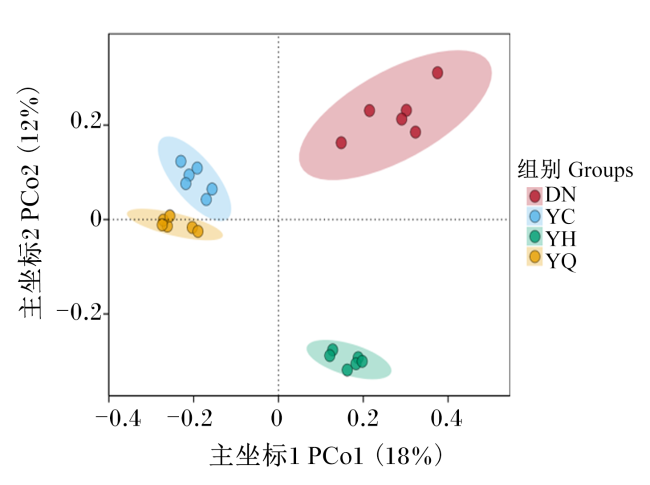
由PCoA结果(图1)可知,DN组、YC组、YQ组和YH组和牛粪便微生物明显分离,说明4个阶段和牛的粪便微生物群落结构存在差异。
图1 和牛不同生理阶段粪便微生物PCoA

Fig.1 PCoA of fecal microbiota in different physiological stages of Wagyu cattle

2.2.3 和牛不同生理阶段粪便微生物组成分析

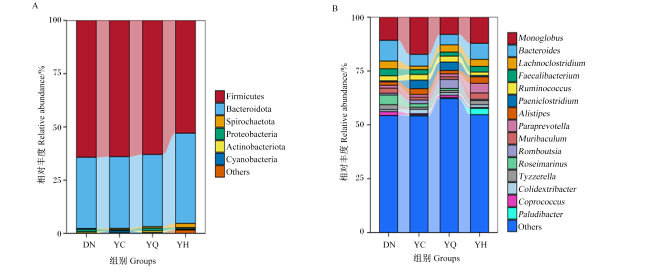
本试验在不同生理阶段和牛粪便微生物中共检测到18个菌门。如图2-A所示,在门水平上,相对丰度前6位的分别是厚壁菌门(Firmicutes)、拟杆菌门(Bacteroidota)、螺旋体门(Spirochaetota)、变形菌门(Proteobacteria)、放线菌门(Actinobacteriota)和蓝藻菌门(Cyanobacteria);其中,厚壁菌门和拟杆菌门相对丰度在4组中均占90%以上。同时,厚壁菌门相对丰度随生理阶段延长呈降低趋势,YH组厚壁菌门相对丰度显著低于其他3组(P<0.05),且其他3组之间无显著差异(P>0.05);拟杆菌门相对丰度随生理阶段延长呈上升趋势,YH组拟杆菌门相对丰度显著高于其他3组(P<0.05),且在其他3组之间无显著差异(P>0.05);YH组螺旋体门相对丰度显著高于其他3组(P<0.05);YC组蓝藻菌门相对丰度显著高于其他3组(P<0.05)。
图2 和牛不同生理阶段粪便微生物组成分析

A:门水平 phylum level;B:属水平 genus level。

Firmicutes:厚壁菌门;Bacteroidota:拟杆菌门;Spirochaetota:螺旋体门;Proteobacteria:变形菌门;Actinobacteriota:放线菌门;Cyanobacteria:蓝藻菌门;Others:其他;Monoglobus:单球状体菌属;Bacteroides:拟杆菌属;Lachnoclostridium:毛梭菌属;Faecalibacterium:粪杆菌属;Ruminococcus:瘤胃球菌属;Paeniclostridium:类梭菌属;Alistipes:另枝菌属;Paraprevotella:帕拉普氏菌属;Muribaculum:鼠杆菌属;Romboutsia:罗姆布茨菌属;Roseimarinus:粉色海生菌属;Coprococcus:粪球菌属;Paludibacter:栖泥沼杆菌属。

Fig.2 Analysis of fecal microbiota composition in different physiological stages of Wagyu cattle

在不同生理阶段和牛粪便微生物中共检测到256个菌属。如图2-B所示,DN组优势菌属为单球状体菌属(Monoglobus)、拟杆菌属(Bacteroides)和毛梭菌属(Lachnoclostridium)等;YC组优势菌属为单球状体菌属、拟杆菌属和类梭菌属(Paeniclostridium)等;YQ组优势菌属为单球状体菌属、拟杆菌属和罗姆布茨菌属(Romboutsia)等;YH组优势菌属为单球状体菌属、拟杆菌属和另枝菌属(Alistipes)等。单球状体菌属和拟杆菌属是4组中相对丰度前2位的菌属,其中YC组单球状体菌属相对丰度显著高于其他3组(P<0.05),且其他3组之间无显著差异(P>0.05);各组间拟杆菌属相对丰度无显著差异(P>0.05);YQ组罗姆布茨菌属相对丰度显著高于其他3组(P<0.05);YH组另枝菌属相对丰度显著高于DN组和YQ组(P<0.05);YH组瘤胃球菌属(Ruminococcus)相对丰度显著低于其他3组(P<0.05)。

2.2.4 和牛不同生理阶段粪便微生物差异分析

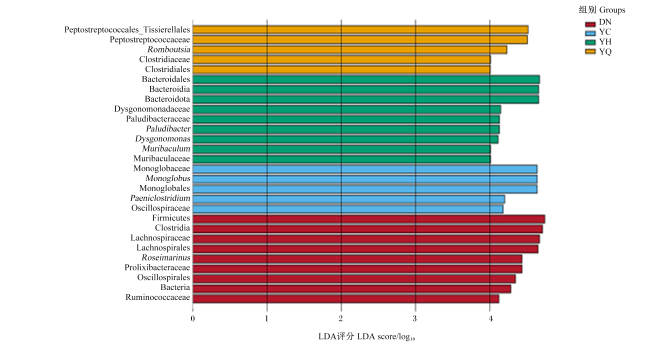
通过LEfSe分析和牛不同生理阶段具有显著差异的标志粪便物生物(LDA评分>4),结果如图3所示。DN组差异微生物有9个,其中粉色海生菌属(Roseimarinus)、伸长杆菌科(Prolixibacteraceae)属于拟杆菌门,其他均属于厚壁菌门;YC组差异微生物有5个,均属于厚壁菌门;YQ组差异微生物有5个,均属于厚壁菌门;YH组差异微生物有9个,均属于拟杆菌门。
图3 和牛不同生理阶段粪便微生物LEfSe分析

Peptostreptococcales_Tissierellales:消化链球菌目-泰氏菌目;Peptostreptococcaceae:消化链球菌科;Romboutsia:罗姆布茨菌属;Clostridiaceae:梭菌科;Clostridiales:梭菌目;Bacteroidales:拟杆菌目;Bacteroidia:拟杆菌纲;Bacteroidota:拟杆菌门;Dysgonomonadaceae:营发酵单胞菌科;Paludibacteraceae:栖泥沼杆菌科;Paludibacter:栖泥沼杆菌属;Dysgonomonas:营发酵单胞菌属;Muribaculum:鼠杆菌属;Muribaculaceae:鼠杆菌科;Monoglobaceae:单球状体菌科;Monoglobus:单球状体菌属;Monoglobales:单球状体菌目;Paeniclostridium:类梭菌属;Oscillospiraceae:颤螺菌科;Firmicutes:厚壁菌门;Clostridia:梭菌纲;Lachnospiraceae:毛螺菌科;Lachnospirales:毛螺菌目;Roseimarinus:粉色海生菌属;Prolixibacteraceae:伸长杆菌科;Oscillospirales:颤螺菌目;Bacteria:细菌;Ruminococcaceae:瘤胃球菌科。

Fig.3 LEfSe analysis of fecal microbiota in different physiological stages of Wagyu cattle

2.3 和牛不同生理阶段血清生化指标与粪便微生物相关性分析

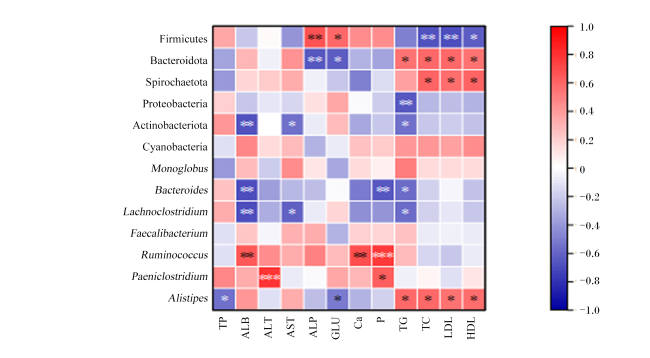
将和牛不同生理阶段血清生化指标与粪便微生物优势菌群相对丰度进行Spearman相关性分析,结果如图4所示。在门水平上,粪便厚壁菌门相对丰度与血清ALP活性和GLU含量呈显著正相关(P<0.05),而与脂质代谢相关指标(血清TC、LDL和HDL含量)呈显著负相关(P<0.05);拟杆菌门与之正好相反。螺旋体门相对丰度也与脂质代谢相关指标(血清TC、LDL和HDL含量)呈显著正相关(P<0.05),而变形菌门相对丰度与血清TG含量呈显著负相关(P<0.05)。放线菌门相对丰度与血清ALB含量、AST活性和TG含量呈显著负相关(P<0.05)。在属水平上,拟杆菌属和毛梭菌属相对丰度均与血清ALB和TG含量呈显著负相关(P<0.05);瘤胃球菌属相对丰度与血清ALB、钙和磷含量呈显著正相关(P<0.05);类梭菌属相对丰度与血清ALT活性和磷含量呈显著正相关(P<0.05);另枝菌属相对丰度与血清TP和GLU含量呈显著负相关(P<0.05),而与脂质代谢相关指标(血清TG、TC、LDL和HDL含量)呈显著正相关(P<0.05)。
图4 和牛不同生理阶段血清生化指标与粪便微生物相关性分析

Firmicutes:厚壁菌门;Bacteroidota:拟杆菌门;Spirochaetota:螺旋体门;Proteobacteria:变形菌门;Actinobacteriota:放线菌门;Cyanobacteria:蓝藻菌门;Monoglobus:单球状体菌属;Bacteroides:拟杆菌属;Lachnoclostridium:毛梭菌属;Faecalibacterium:粪杆菌属;Ruminococcus:瘤胃球菌属;Paeniclostridium:类梭菌属;Alistipes:另枝菌属;TP:总蛋白 total protein;ALB:白蛋白 albumin;ALT:谷丙转氨酶 alanine transaminase;AST:谷草转氨酶 aspartate aminotransferase;ALP:碱性磷酸酶 alkaline phosphatase;GLU:葡萄糖 glucose;Ca:钙 calcium;P:磷 phosphorus;TG:甘油三酯 triglyceride;TC:总胆固醇 total cholesterol;LDL:低密度脂蛋白 low-density lipoprotein;HDL:高密度脂蛋白 high-density lipoprotein。

*表示显著相关(P<0.05),**(P<0.01)和***(P<0.001)表示极显著相关。

Fig.4 Correlation analysis of serum biochemical indices and fecal microbiota in different physiological stages of Wagyu cattle

* mean significant correlation (P<0.05), and ** (P<0.01) and *** (P<0.001) mean extremely significant correlation.

3 讨论

3.1 和牛不同生理阶段血清生化指标变化特征

血清生化指标可间接反映动物对饲粮中营养物质的利用和代谢情况,是评价动物生长发育情况的重要指标。血清GLU含量通常与提高糖代谢效率和提升育肥效果相关[18]。操君等[19]研究表明,牦牛血清GLU含量会随着育肥时间的增加而降低,这与本试验结果一致,提示育肥后期和牛糖代谢效率提高,使血清中GLU更好地被机体吸收。
本试验中,血清脂质代谢相关指标(血清TG、TC、LDL和HDL含量)随生理阶段延长呈上升趋势,且YH组显著高于YQ组。刘淼儿等[20]也得到相似结论,血清TG和TC含量随生理阶段延长而显著升高,血清LDL和HDL含量有升高趋势但不显著。TG和TC主要为机体供给和储存能量,同时也反映了机体脂质代谢的利用程度[21]。而载脂蛋白HDL和LDL主要参与血液中TC的运输以及脂质代谢[22]。养殖场在肉牛育肥后期通常会通过提高饲粮精粗比来提高饲粮的能量供应,以达到更好的脂肪沉积效果。本试验中,YH组较其他3组更高能量的饲粮使和牛肝脏中TC合成及其分解到血液里的速度更快,从而促使机体合成更多的HDL,将脂类转运至肝脏进行分解代谢。由于肝脏代谢能力有限,会合成更多的LDL将TC由肝脏向外周转运,最终导致血清HDL和LDL含量都升高。
微量元素钙和磷是动物机体内重要的矿物质元素,用于维持机体的正常生命活动和健康水平。体内98%以上的钙和80%~85%的磷存在于骨骼和牙齿中,以维持其正常硬度[23]。本试验结果显示,YH组(28月龄)血清钙和磷含量较YQ组(14月龄)更低。初汉平等[24]在对荷斯坦牛的研究中也得到相似结论,24月龄较12和18月龄的荷斯坦牛血清钙和磷含量更低。育肥后期和牛由于骨骼发育已基本完成,其对钙和磷的需求量明显下降。
血清ALT、AST和ALP活性通常用于评估肝脏的健康状态。Barbosa等[25]研究发现,从12月龄到24月龄,邦斯马拉(Bonsmara)牛血清ALT活性随年龄增长而提高。本试验结果与之相反,YQ组和牛血清ALT活性显著高于其他2组,ALT作为肝脏损伤的生物标志物,提示YQ组和牛可能存在着肝脏损伤。

3.2 和牛不同生理阶段粪便微生物变化特征

肠道微生物和宿主之间的动态平衡不仅可以促进宿主对饲粮中营养物质的消化与代谢,还可以调节机体的免疫功能,抑制病原体的入侵[6]。通过对不同阶段和牛的粪便样本进行高通量测序分析,可以清楚反映其肠道微生物群落的组成和变化。本试验β多样性分析结果显示,各个生理阶段的和牛粪便微生物都具有其独特的构成。α多样性分析结果显示,从育成期开始,和牛粪便微生物的丰富度和均匀度逐渐减少。聂召龙[26]研究结果显示,不同年龄牦牛的粪便微生物丰富度和均匀度会随年龄增加而增加,这与本试验结果相反。而曾子铭等[27]研究发现,提高饲粮精粗比可以降低牦牛粪便菌群的多样性和丰富度以及部分纤维相关降解菌的相对丰度。因此可以推测,在本试验中育肥后期牛场为了达到更好的育肥效果,添加过多的精饲料,使得肠道乳酸含量增多、pH降低,进而降低了菌群的丰富度。
本试验中,在门水平上,厚壁菌门和拟杆菌门是和牛粪便微生物的主要优势菌群(两者相对丰度之和占比90%以上),这与前人研究结果[28]一致。厚壁菌门中多为有益菌,如乳杆菌、粪杆菌等,这些菌中含有大量纤维分解菌[29],降解纤维类物质产生挥发性脂肪酸,参与胃肠道内营养物质的发酵和能量物质代谢,提高饲料利用率[30];拟杆菌门的细菌基因组中富含大量碳水化合物活性酶基因[31],主要降解饲粮中的非纤维类碳水化合物,代谢产物以乙酸盐和丙酸盐为主[32]。本试验中,厚壁菌门相对丰度呈现随生理阶段延长而降低趋势,而拟杆菌门相对丰度呈现随生理阶段延长而提高趋势,可能也是饲粮精粗比变化造成。动物肠道中的变形菌门和螺旋体门包含多种致病菌[33],如螺旋体、大肠杆菌、沙门氏菌和幽门螺旋杆菌等[34],这些致病菌的存在可能导致腹泻等健康问题。本试验中,YH组螺旋体门相对显著高于其他3组,各组间变形菌门相对差异不显著,说明YH组和牛存在致病风险。放线菌门在肠道中的占比较小,但在维持肠道稳态方面起着重要作用[35],其主要是通过T细胞调节而避免过度炎症反应[36]。本试验中,这YH组放线菌门相对丰度有所降低,但各组间差异不显著。
在属水平上,4个阶段和牛粪便微生物的优势菌属均包含单球状体菌属和拟杆菌属。单球状体菌属具有发酵膳食纤维的能力,可能会促进丁酸盐的产生[37];其他研究显示,单球状体菌属失调可能会使大鼠的肠道屏障破坏,从而使其血清中主要促炎因子增加[38]。拟杆菌属细菌可促进宿主免疫T细胞的功能完善[39];Yoshida等[40]发现,拟杆菌属可以减少肠道中微生物脂多糖的产生,有效抑制促炎反应。在本试验中,单球状体菌属和拟杆菌属相对丰度随着生理阶段的延长呈现不同的变化趋势,YH组较YQ组升高,说明YH组存在一定炎症反应,导致了单球状体菌属和拟杆菌属相对丰度的上调。罗姆布茨菌属是一种新发现的细菌属,在维持宿主健康中发挥重要作用[41]。本试验中,YQ组罗姆布茨菌属相对丰度显著高于其他3组。另枝菌属作为有益菌属,含有多种与宿主健康呈正相关的厌氧菌[42]。当另枝菌属相对丰度降低时,机体抗炎能力则会下降[43];其他研究也发现其相对丰度的降低可能不利于牛的健康[44]。营发酵单胞菌属(Dysgonomonas)被认为是一种潜在的益生菌,可维持肠道菌群的动态平衡,减轻病原体导致的肠道炎症[45]。本试验中,营发酵单胞菌属和另枝菌属相对丰度的变化趋势与单球状体菌属和拟杆菌属一样。瘤胃球菌属最早在牛瘤胃中被发现,具有降解纤维素的能力[46],其中的白色瘤胃球菌和黄色瘤胃球菌可以分泌大量的纤维素酶和半纤维素酶,是反刍动物主要的纤维降解菌[47]。本试验中,YH组瘤胃球菌属相对丰都显著低于其他3组,可能是由于YH组粗饲料减少导致的。
此外,LEfSe分析结果显示,不同生理阶段和牛粪便差异微生物均属于厚壁菌门和拟杆菌门。由于90%的微生物都出于厚壁菌门和拟杆菌门,所以得到这样的结果是合理的。育成期和育肥前期的差异微生物都属于厚壁菌门,育肥后期都属于拟杆菌门,而断奶期既有厚壁菌门也有拟杆菌门。这样的结果应该和各阶段饲粮组成相关,YC组和YQ组粗饲料更多,需要更多的纤维降解菌;而YH组精料更多,需要更多的非纤维降解菌。

3.3 和牛不同生理阶段血清生化指标与粪便微生物相关性

本试验中,通过将不同生理阶段和牛血清生化指标与粪便微生物优势菌群相对丰度进行相关性分析发现,厚壁菌门相对丰度与血清GLU含量呈正相关,而拟杆菌门相对丰度与血清GLU含量呈显著负相关;变形菌门相对丰度与血清脂质代谢相关指标呈负相关。这些结果与Huang等[48]的报道相似。此外,Huang等[48]发现,相对丰度与血清LDL和HDL含量呈正相关的细菌大多属于变形菌门和梭杆菌门,它们主要是一些致病菌或机会性病原体。这些致病菌的存在与炎症发生有关[49],且有研究表明炎症会提高机体血液中脂质代谢水平[50]。YH组血清脂质代谢相关指标的升高可能与炎症发生有关。在属水平上,毛梭菌属相对丰度与血清ALT活性呈负相关,有研究发现益生菌混合物(包含链球菌、双歧杆菌和乳酸杆菌)可以改善肝脏组织功能,减少脂肪肝的发生,并降低血清ALT活性[51],这与本试验结果一致。

4 结论

和牛血清生化指标和粪便微生物在不同生理阶段存在显著差异。在血清生化指标中,血清ALT活性以及GLU、钙和磷含量在育肥前期显著高于育肥后期,血清TG、TC、LDL和HDL含量在育肥后期显著高于育肥前期,说明和牛不同生理阶段其营养成分代谢能力不同。粪便微生物的多样性和均匀度从育成期开始逐渐降低,且各生理阶段微生物结构有显著差异。育肥后期粪便螺旋体门(多为致病菌)相对丰度提高,且与血清脂质代谢相关指标呈显著正相关;放线菌门(多为益生菌)相对丰度降低,且与血清脂质代谢相关指标呈负相关,提示和牛在育肥后期可能存在肠道损伤,高血脂则暗示其与炎症反应相关。
[1]
刘文生, 张锁链. 日本和牛的引种扩繁及其杂交改良[J]. 中国畜禽种业, 2007(2):72-74.

LIU W S, ZHANG S L. Introduction and propagation and hybrid improvement of Japanese and cattle[J]. The Chinese Livestock and Poultry Breeding, 2007(2):72-74.(in Chinese)

[2]
苏玉若. 肉牛育肥期的饲养管理技术[J]. 今日畜牧兽医, 2024, 40(8):59-61.

SU Y R. Feeding and management techniques for beef cattle during the fattening period[J]. Today Animal Husbandry and Veterinary Medicine, 2024, 40(8):59-61.(in Chinese)

[3]
杨远前. 肉牛不同生长阶段的饲养管理要点[J]. 广东蚕业, 2024, 58(5):49-51.

YANG Y Q. Key points of feeding and management in different growth stages of beef cattle[J]. Guangdong Silkulture, 2024, 58(5):49-51.(in Chinese)

[4]
HOSODA K, KURAMOTO K, ERUDEN B, et al. The effects of three herbs as feed supplements on blood metabolites,hormones,antioxidant activity,IgG concentration,and ruminal fermentation in Holstein steers[J]. Asian-Australasian Journal of Animal Sciences, 2006, 19(1):35-41.

[5]
MOHRI M, SHARIFI K, EIDI S. Hematology and serum biochemistry of Holstein dairy calves:age related changes and comparison with blood composition in adults[J]. Research in Veterinary Science, 2007, 83(1):30-39.

[6]
VOGT S L, FINLAY B B. Gut microbiota-mediated protection against diarrheal infections[J]. Journal of Travel Medicine,2017,24:S39-S43.

[7]
LAHTINEN S J, TAMMELA L, KORPELA J, et al. Probiotics modulate the Bifidobacterium microbiota of elderly nursing home residents[J]. Age, 2009, 31(1):59-66.

[8]
ZOETENDAL E G, COLLIER C T, KOIKE S, et al. Molecular ecological analysis of the gastrointestinal microbiota:a review[J]. The Journal of Nutrition, 2004, 134(2):465-472.

[9]
TOROK V A, OPHEL-KELLER K, LOO M, et al. Application of methods for identifying broiler chicken gut bacterial species linked with increased energy metabolism[J]. Applied and Environmental Microbiology, 2008, 74(3):783-791.

DOI PMID

[10]
KRETZSCHMAR-MCCLUSKEY V, CURTIS P A, ANDERSON K E, et al. Influence of hen age and molting treatments on shell egg exterior,interior,and contents microflora and Salmonella prevalence during a second production cycle[J]. Poultry Science, 2008, 87(10):2146-2151.

[11]
谢卓君, 马光宇, 陈鹏宇, 等. 生命周期不同阶段肠道菌群的影响因素[J]. 暨南大学学报(自然科学与医学版), 2024, 45(3):248-255,262.

XIE Z J, MA G Y, CHEN P Y, et al. Factors influencing intestinal microbiota across different life stages[J]. Journal of Jinan University (Natural Science & Medicine Edition), 2024, 45(3):248-255,262.(in Chinese)

[12]
中华人民共和国国家质量监督检验检疫总局, 中国国家标准化管理委员会. 饲料中水分的测定:GB/T 6435—2014[S]. 北京: 中国标准出版社, 2015.

General Administration of Quality Supervision,Inspection and Quarantine of the People’s Republic of China, Standardization Administration of the People’s Republic of China. Determination of moisture in feedstuffs:GB/T 6435—2014[S]. Beijing: Standards Press of China, 2015.(in Chinese)

[13]
国家市场监督管理总局, 中国国家标准化管理委员会. 饲料中粗蛋白的测定凯氏定氮法:GB/T 6432—2018[S]. 北京: 中国标准出版社, 2018.

State Administration for Market Regulation, Standardization Administration of the People’s Republic of China. Determination of crude protein in feeds—Kjeldahl method:GB/T 6432—2018[S]. Beijing: Standards Press of China, 2018.(in Chinese)

[14]
国家市场监督管理总局, 中国国家标准化管理委员会. 饲料中中性洗涤纤维(NDF)的测定:GB/T 20806—2022[S]. 北京: 中国标准出版社, 2022.

State Administration for Market Regulation, Standardization Administration of the People’s Republic of China. Determination of neutral detergent fiber (NDF) in feeds:GB/T 20806—2022[S]. Beijing: Standards Press of China, 2022.(in Chinese)

[15]
中华人民共和国农业农村部. 饲料中酸性洗涤纤维的测定:NY/T 1459—2022[S]. 北京: 中国农业出版社, 2022.

Ministry of Agriculture and Rural Affairs of the People’s Republic of China. Determination of acidic detergent fiber in feed:NY/T 1459—2022[S]. Beijing: China Agriculture Press, 2022.(in Chinese)

[16]
中华人民共和国国家质量监督检验检疫总局, 中国国家标准化管理委员会. 饲料中粗脂肪的测定:GB/T 6433—2006[S]. 北京: 中国标准出版社, 2006.

General Administration of Quality Supervision,Inspection and Quarantine of the People’s Republic of China, Standardization Administration of the People’s Republic of China. Determination of crude fat in feeds:GB/T 6433—2006[S]. Beijing: Standards Press of China, 2006.(in Chinese)

[17]
中华人民共和国国家质量监督检验检疫总局, 中国国家标准化管理委员会. 饲料中粗灰分的测定:GB/T 6438—2007[S]. 北京: 中国标准出版社, 2007.

General Administration of Quality Supervision,Inspection and Quarantine of the People’s Republic of China, Standardization Administration of the People’s Republic of China. Animal feeding stuffs—determination of crude ash:GB/T 6438—2007[S]. Beijing: Standards Press of China, 2007.(in Chinese)

[18]
张振宇, 梁春年, 姚喜喜, 等. 日粮不同营养水平对牦牛生产性能、屠宰指标和血清生化指标的影响[J]. 畜牧兽医学报, 2021, 52(1):135-143.

DOI

ZHANG Z Y, LIANG C N, YAO X X, et al. Effects of different nutrition levels of diets on production performance,slaughter indexes and serum biochemical indexes of yak[J]. Acta Veterinaria et Zootechnica Sinica, 2021, 52(1):135-143.(in Chinese)

[19]
操君, 周磊, 周玉青, 等. 不同育肥阶段牦牛养分表观消化率、血清生化指标和屠宰性能的比较[J]. 饲料研究, 2022, 45(17):9-12.

CAO J, ZHOU L, ZHOU Y Q, et al. Comparison of nutrient apparent digestibility,serum biochemical indexes and slaughter performance of yak in different fattening stages[J]. Feed Research, 2022, 45(17):9-12.(in Chinese)

[20]
刘淼儿, 丁子旭, 徐祎雪, 等. 不同生长阶段水牛血清代谢物差异比较研究[J]. 基因组学与应用生物学, 2024, 43(9):1565-1574.

LIU M E, DING Z X, XU Y X, et al. Comparative study of differences in serum metabolites in buffaloes at different growth stages[J]. Genomics and Applied Biology, 2024, 43(9):1565-1574.(in Chinese)

[21]
李隐侠, 舒嘉傲, 张晨俭, 等. 补饲胆固醇对高温环境下湖羊母羊繁殖性能和血清生化指标的影响[J]. 中国畜牧兽医, 2024, 51(1):145-152.

DOI

LI Y X, SHU J A, ZHANG C J, et al. Effects of cholesterol supplementation on reproductive performance and serum biochemical indexes in Hu sheep ewes under high temperature environment[J]. China Animal Husbandry & Veterinary Medicine, 2024, 51(1):145-152.(in Chinese)

[22]
梁见弟. 盐角草提取物对绵羊生长性能、消化性能、屠宰性能及肉品质的影响[D]. 硕士学位论文. 乌鲁木齐: 新疆农业大学, 2022.

LIANG J D. Effects of Salicornia europaea L. extract on growth performance,digestibility,slaughter performance and meat quality of sheep[D]. Master’s Thesis. Urumqi: Xinjiang Agricultural University, 2022.(in Chinese)

[23]
MARTINIAKOVA M, BABIKOVA M, MONDOCKOVA V, et al. The role of macronutrients,micronutrients and flavonoid polyphenols in the prevention and treatment of osteoporosis[J]. Nutrients, 2022, 14(3):523.

[24]
初汉平, 王中华, 李福昌. 年龄及泌乳阶段对荷斯坦奶牛日粮钙、磷表观消化率的影响[J]. 中国奶牛, 2010(11):16-19.

CHU H P, WANG Z H, LI F C. The influence of growth and lactation periods on apparent digestibilities of dietary calcium and phosphorus in Holstein cows[J]. China Dairy Cattle, 2010(11):16-19.(in Chinese)

[25]
BARBOSA F C, OLIVEIRA JUNIOR W, FARIA J G K, et al. Influence of age and sex on blood biochemical profile of Bonsmara cattle breed up to two years[J]. Ciência Animal Brasileira, 2022,23:e-73054.

[26]
聂召龙. 年龄及季节对放牧牦牛瘤胃和粪便细菌区系的影响[D]. 硕士学位论文. 西宁: 青海大学, 2020.

NIE Z L. A study of the age and seasonal variation of rumen and fecal bacterial flora in grazing yak[D]. Master’s Thesis. Xining: Qinghai University, 2020.(in Chinese)

[27]
曾子铭, 柴沙驼, 李毓敏, 等. 饲粮精粗比转换下的牦牛粪便菌群区系演替[J]. 饲料研究, 2024, 47(4):7-12.

ZENG Z M, CHAI S T, LI Y M, et al. Succession of microbial community in yak feces under transition of feed concentrate to roughage ratio[J]. Feed Research, 2024, 47(4):7-12.(in Chinese)

[28]
LOPES D R G, LA REAU A J, et al. DE SOUZA DUARTE M, The bacterial and fungal microbiota of nelore steers is dynamic across the gastrointestinal tract and its fecal-associated microbiota is correlated to feed efficiency[J]. Frontiers in Microbiology, 2019,10:1263.

[29]
BRULC J M, ANTONOPOULOS D A, MILLER M E B, et al. Gene-centric metagenomics of the fiber-adherent bovine rumen microbiome reveals forage specific glycoside hydrolases[J]. Proceedings of the National Academy of Sciences of the United States of America, 2009, 106(6):1948-1953.

DOI PMID

[30]
孙美杰, 姜君, 徐诣轩, 等. 不同尿素添加水平对育肥湖羊瘤胃发酵及微生物菌群结构的影响[J]. 南京农业大学学报, 2022, 45(2):323-332.

SUN M J, JIANG J, XU Y X, et al. Effects of incremental urea supplementation in diet on rumen fermentation and microbial communities in fattening Hu lambs[J]. Journal of Nanjing Agricultural University, 2022, 45(2):323-332.(in Chinese)

[31]
THOMAS F, HEHEMANN J H, REBUFFET E, et al. Environmental and gut Bacteroidetes:the food connection[J]. Frontiers in Microbiology, 2011,2:93.

[32]
YUE Y N, WANG J Y, WU X Y, et al. The fate of anaerobic syntrophy in anaerobic digestion facing propionate and acetate accumulation[J]. Waste Management, 2021,124:128-135.

[33]
WANG Y H, HUANG Y. Effect of Lactobacillus acidophilus and Bifidobacterium bifidum supplementation to standard triple therapy on Helicobacter pylori eradication and dynamic changes in intestinal flora[J]. World Journal of Microbiology & Biotechnology, 2014, 30(3):847-853.

[34]
TROTT D J, MCLAREN A J, HAMPSON D J. Pathogenicity of human and porcine intestinal spirochetes in one-day-old specific-pathogen-free chicks:an animal model of intestinal spirochetosis[J]. Infection and Immunity, 1995, 63(9):3705-3710.

[35]
BINDA C, LOPETUSO L R, RIZZATTI G, et al. Actinobacteria:a relevant minority for the maintenance of gut homeostasis[J]. Digestive and Liver Disease, 2018, 50(5):421-428.

[36]
O’MAHONY C, SCULLY P, O’MAHONY D, et al. Commensal-induced regulatory T cells mediate protection against pathogen-stimulated NF-kappaB activation[J]. PLoS Pathogens, 2008, 4(8):e1000112.

[37]
GORIS T, PÉREZ-VALERO Á, MARTÍNEZ I, et al. Repositioning microbial biotechnology against COVID-19:the case of microbial production of flavonoids[J]. Microbial Biotechnology, 2021, 14(1):94-110.

[38]
LUKASZYK C, IVERS R Q, JAGNOOR J. Systematic review of drowning in India:assessment of burden and risk[J]. Injury Prevention, 2018, 24(6):451-458.

[39]
TELESFORD K M, YAN W, OCHOA-REPARAZ J, et al. A commensal symbiotic factor derived from Bacteroides fragilis promotes human CD39+Foxp3+ T cells and Treg function[J]. Gut Microbes, 2015, 6(4):234-242.

[40]
YOSHIDA N, EMOTO T, YAMASHITA T, et al. Bacteroides vulgatus and Bacteroides dorei reduce gut microbial lipopolysaccharide production and inhibit atherosclerosis[J]. Circulation, 2018, 138(22):2486-2498.

[41]
RICABONI D, MAILHE M, KHELAIFIA S, et al. Romboutsia timonensis,a new species isolated from human gut[J]. New Microbes and New Infections, 2016,12:6-7.

[42]
WANG Y, NAN X M, ZHAO Y G, et al. Coupling 16S rDNA sequencing and untargeted mass spectrometry for milk microbial composition and metabolites from dairy cows with clinical and subclinical mastitis[J]. Journal of Agricultural and Food Chemistry, 2020, 68(31):8496-8508.

DOI PMID

[43]
PARKER B J, WEARSCH P A, VELOO A C M, et al. The genus Alistipes:gut bacteria with emerging implications to inflammation,cancer,and mental health[J]. Frontiers in Immunology, 2020,11:906.

[44]
ZHANG F, ZHAO Y G, WANG Y, et al. Dietary supplementation with calcium propionate could beneficially alter rectal microbial composition of early lactation dairy cows[J]. Frontiers in Veterinary Science, 2022,9:940216.

[45]
BAO Z W, WANG W T, WANG X F, et al. Sub-chronic difenoconazole exposure induced gut microbiota dysbiosis in mice[J]. Toxics, 2022, 10(1):34.

[46]
HUNGATE R E. The cellulose-decomposing bacteria in the rumen of cattle[J]. Journal of Bacteriology, 1946,51:589.

[47]
DOERNER K C, WHITE B A. Assessment of the endo-1,4-beta-glucanase components of Ruminococcus flavefaciens FD-1[J]. Applied and Environmental Microbiology, 1990, 56(6):1844-1850.

[48]
HUANG X C, FANG S M, YANG H, et al. Evaluating the contribution of gut microbiome to the variance of porcine serum glucose and lipid concentration[J]. Scientific Reports, 2017, 7(1):14928.

DOI PMID

[49]
LOUBINOUX J, BRONOWICKI J P, PEREIRA I A C, et al. Sulfate-reducing bacteria in human feces and their association with inflammatory bowel diseases[J]. FEMS Microbiology Ecology, 2002, 40(2):107-112.

DOI PMID

[50]
SHAPIRO M D, FAZIO S. From lipids to inflammation:new approaches to reducing atherosclerotic risk[J]. Circulation Research, 2016, 118(4):732-749.

[51]
WANG B H, JIANG X Y, CAO M, et al. Altered fecal microbiota correlates with liver biochemistry in nonobese patients with non-alcoholic fatty liver disease[J]. Scientific Reports, 2016,6:32002.

Outlines

/