RESEARCH PAPER

Gut Microbiota Characteristics during Entire Growth Stage of Dairy and Meat Dual-Purpose Sanhe Cattle

  • LI Shaoxu , 1, 2 ,
  • YAN Aifei 2 ,
  • HU Fan 2 ,
  • ZHANG Lei 1, 2 ,
  • LIU Dexin 3 ,
  • HAN Xiaoyu 3 ,
  • WU Lan 3 ,
  • ZHAO Man 3 ,
  • LYU Hong 4 ,
  • TAN Zhiliang 2 ,
  • WANG Shuilian , 1, * ,
  • HE Zhixiong , 2, *
Expand
  • 1 College of Veterinary Medicine, Hunan Agricultural University,Changsha 410128, China
  • 2 Public Technology Center, Hunan Provincial Key Laboratory of Animal Nutritional Physiology and Metabolic Process, Hunan Engineering and Technology Research Center of Livestock and Poultry Healthy Breeding, National Engineering Laboratory for Pollution Control and Waste Utilization in Livestock and Poultry Production, Key Laboratory for Agro-Ecological Processes in Subtropical Region, Institute of Subtropical Agriculture, Chinese Academy of Sciences, Changsha 410125, China
  • 3 Hulunbuir Agricultural Reclamation Group Sheertala First Ranch, Hulunbuir 021012, China
  • 4 Inner Mongolia Autonomous Region Agricultural and Animal Husbandry Technology Extension Center, Hohhot 010011, China
* WANG Shuilian, professor, E-mail: ;
HE Zhixiong, professor, E-mail:

Received date: 2024-10-28

  Online published: 2025-06-12

Abstract

The purpose of this experiment was to investigate the composition and colonization patterns of gut microbiota of dairy and meat dual-purpose Sanhe cattle during the entire growth stage in Hulunbuir and to explore the marker microorganisms. Sanhe cattle with good health status were selected for the experiment, and the data were collected from nine stages: neonatal stage (NS, n=10), weaning stage (WS, n=14), early fattening stage (EFS, n=14), mid fattening stage (MFS, n=16), late fattening stage (LFS, n=12), reserve period (RP, n=10), perinatal period (PP, n=10), lactation period (LP, n=10), and dry period (DP, n=10). Rectal content samples were collected before morning feeding for 16S rRNA sequencing analysis. The results showed as follows: 1) the α diversity analysis showed that the richness and diversity of gut microbiota were increased with age, and tended to be stable after the mid fattening period. The β diversity analysis showed that the gut microbiota was obviously separated in each stage before the mid fattening period, and gathered into a cluster during the mid fattening period and late fattening stage; in lactation stage, the perinatal period and dry period were clustered, and the lactation period and reserve period were separated. 2) At the phylum level, Firmicutes was dominant in all stages after weaning; the Bacteroidetes relative abundance was increased with age and tended to be stable after the mid fattening stage. At the genus level, the relative abundances of Escherichia and Clostridium in neonatal stage were significantly higher than those in the other stages (P<0.05), the relative abundances of Pseudoclostridium and Prevotella in weaning stage were significantly higher than those in the other stages (P<0.05), and the relative abundances of Bacteroides and Paraprevotella were increased with age before the mid fattening stage. 3) Through hierarchical clustering analysis of gut microbiota, 612 strains were classified into 9 microbial colonization patterns (C1 to C9 clusters). Among them, the microorganisms in C7 and C9 clusters had early colonization time and high abundance, and could colonize continuously in the gut of Sanhe cattle. At the family level, Oscillospiraceae, Lachnospiraceae, Bacteroidaceae, Prevotellaceae and Clostridiaceae were the dominant families in the C7 and C9 clusters. In conclusion, this experiment reveals the composition and differences of gut microbiota of Sanhe cattle during the entire growth stage, explores the colonization patterns, and screens out the marker microorganisms at each stage, which provides the basic data for enriching the gut microbiota resources of dairy and meat dual-purpose Sanhe cattle in alpine pastoral areas.

Cite this article

LI Shaoxu , YAN Aifei , HU Fan , ZHANG Lei , LIU Dexin , HAN Xiaoyu , WU Lan , ZHAO Man , LYU Hong , TAN Zhiliang , WANG Shuilian , HE Zhixiong . Gut Microbiota Characteristics during Entire Growth Stage of Dairy and Meat Dual-Purpose Sanhe Cattle[J]. Chinese Journal of Animal Nutrition, 2025 , 37(6) : 3916 -3932 . DOI: 10.12418/CJAN2025.321

哺乳动物消化道内栖居着大量的微生物,其主要由细菌、真菌、原生动物和古细菌组成[1]。多项研究表明,反刍动物胃肠道环境中存在数量众多且种类多样的共生微生物群落,并形成了一个独特且具有多样性的微生态系统,是迄今为止发现的细胞密度最高的系统之一[2-3]。前人研究发现,肠道微生物与动物机体的代谢、免疫功能、营养物质吸收及环境适应能力等都有着密切的关系,稳定的肠道微生物群落不仅可以保护宿主免受病原微生物的侵害,还可以提高宿主的生物合成能力,增强对营养物质的吸收,从而提高动物的生产性能[4-6]。在反刍动物中,肠道微生物能够帮助宿主消化复杂的饲粮,特别是在纤维素的生物降解中起着重要作用,不仅可以利用饲粮中的非蛋白氮合成菌体蛋白质,还可以合成动物所必需的B族维生素和维生素K等维生素,为宿主提供所需的能量及营养物质[7-8]。宿主肠道中定殖的微生物在蛋白质、多糖、氨基酸和维生素等营养物质的合成代谢及通路上发挥着重要的作用[9-11]。而反刍动物肠道中的微生物可以利用肠道中的碳水化合物等营养物质合成菌体蛋白及挥发性脂肪酸,从而提高饲料利用率[12]。因此,肠道微生物群落的组成及定殖规律能在一定程度上反映动物对营养物质的消化吸收及利用能力。
三河牛是我国内蒙古自治区呼伦贝尔地区经过几代人的精心选育而培育出的乳肉兼用型品种,其原产于呼伦贝尔市三河地区[13]。呼伦贝尔位于北纬47°~53°,为大兴安岭以西地区,常年平均气温为-2.5 ℃,冬季平均气温为-25 ℃,最低气温为-50 ℃[14]。三河牛毛色为红黄白花为主,具有耐粗饲、耐高寒、抗病力强、遗传性能稳定以及乳脂率和干物质比例高等特性[15]。乳用型牛从出生到后备期主要以躯干的生长为主,3月龄乳腺开始发育,6月龄后乳腺的发育速度加快,且与饲粮的营养水平呈现正相关。肉用型牛的体重及体尺指标在发育初期在1.0~1.5岁前表现出较高的生长速度,而在1.5岁之后,体重及体尺生长速度减缓,脂肪沉积速度加快。
基于微生物在宿主生物学功能过程中发挥的重要作用,适于在高寒牧区生长的三河牛可能有着不同于其他地区和品种肉牛或奶牛的肠道微生物群落特征。因此,本研究的主要目的是探究乳肉兼用型三河牛不同生长阶段的肠道微生物群落特征,并探索各阶段标志微生物,旨在为挖掘适宜高寒牧区生长的乳肉兼用型三河牛微生物资源提供数据支撑。

1 材料与方法

1.1 试验动物和饲养管理

本试验于2023年9月在呼伦贝尔谢尔塔拉第一牧场进行,试验所有程序遵循《实验动物管理与使用指南》要求,试验动物的使用经中国科学院亚热带农业生态研究所动物伦理委员会批准,批准编号为伦审科2022第(0057)号,并根据该委员会制定的法规和指导原则进行试验。
挑选健康状况良好且体重相近的个体,在断奶前牛群中,挑选新生期(1日龄)公牛10头,断奶期(63日龄)公牛14头;在育肥阶段牛群中,挑选育肥前期[(177±13)日龄]公牛14头、育肥中期[(386±16)日龄]公牛16头和育肥后期[(683±26)日龄]公牛12头;在泌乳母牛群中,挑选后备期[(501±33)日龄]、围产期[(1 180±95)日龄]、泌乳期[(1 413±286)日龄]和干奶期[(2 034±187)日龄]母牛各10头。同一阶段的三河牛饲养在同一栏舍中,且饲养管理及饲粮相同。饲养管理按照牧场原有的饲养管理制度进行,试验牛自由饮水,自由活动,于每天08:00和16:00饲喂2次,各阶段饲粮组成见表1
表1 不同生长阶段三河牛饲粮组成

Table 1 Diet composition of Sanhe cattle at different growth stages %

项目
Items
新生期
Neonatal
stage
断奶期
Weaning
stage
育肥前期
Early
fattening
stage
育肥中期
Mid
fattening
stage
育肥后期
Late
fattening
stage
后备期
Reserve
stage
围产期
Perinatal
stage
泌乳期
Lactation
stage
干奶期
Dry stage
原料Ingredients
青贮饲料Ensilage 34.25 64.70 52.17 52.17 52.17 60.00 64.81 65.33
苜蓿Alfalfa hay 10.95 3.47 1.26
围产精料
Perinatal concentrate
16.67
羊草Chinese wildrye 6.85 17.65 21.74 21.74 21.74 16.67 4.63 8.79
压片玉米
Flaked corn
6.85 3.33 2.32 2.51
干奶精料Dry stage concentrate
泌乳精料
Lactation concentrate
6.85 24.77 22.11
育成精料
Fattening concentrate
17.65 17.39 17.39 17.39
水Water 34.25 8.70 8.70 8.70 3.33
牛奶Milk 100.00
合计Total 100.00 100.00 100.00 100.00 100.00 100.00 100.00 100.00 100.00

1.2 样品采集及指标测定

在晨饲前,通过直肠采集不同生长阶段三河牛的直肠内容物,立即液氮速冻,并保存于-80 ℃的超低温冰箱中。

1.3 三河牛肠道微生物16S rRNA测序及生物信息学分析

参照E.Z.N.A.® Soil DNA Kit试剂盒(Omega Bio-Tek,美国)说明书,提取直肠内容物样本中的微生物总DNA。细菌群落结构研究采用16S rRNA全长通用引物27F(5'-AGRGTTYGATYMTGGCTCAG-3')和1492R(5'-RGYTACCTTGTTACGACTT-3')进行PCR扩增,每个样本的扩增引物含有8碱基标签序列用以区分样本。PCR反应体系如下:4 μL的5×FastPfu Buffer,2 μL的 2.5 mmol/L dNTPs,上游和下游引物各0.8 μL (5 μmol/L),0.4 μL的FastPfu Polymerase,以及10 ng模板DNA。PCR扩增程序如下:95 ℃下进行5 min;95 ℃下进行30 s,55 ℃下进行30 s,72 ℃下进行45 s,上述3步骤进行27个循环;最后72 ℃保持5 min。扩增产物经2%琼脂糖凝胶电泳后,采用AxyPrep DNA Gel Extraction Kit试剂盒(Axygen Biosciences,美国),参照说明书操作流程进行纯化。
根据制造商(Pacific Biosciences)的说明书通过平端连接从扩增的DNA中制备SMRTbell文库。将每个样本连接特定的barcode序列后等质量混合,扩增子混合物使用Pacific Biosciences SMRTbellTM Template Prep Kit 1.0试剂盒构建测序文库,并在PacBio Sequel Ⅱ上进行测序。使用SMRT Link Analysis 6.0软件处理PacBio原始reads,以获得环形一致性序列(circular consensus sequencing,CCS)reads:参数设置最小通过次数=3,最小预测准确度=0.99。原始reads通过SMRT Portal处理,以筛选序列的长度(<800或>2 500 bp)和质量。通过去除barcode、引物序列、嵌合体和包含10个连续的相同碱基的序列进行进一步过滤。使用UPARSE 7.1软件(http://drive5.com/uparse/)将操作分类单元(OTU)按照98.65%的相似性阈值聚类,并使用UCHIME软件鉴定并去除嵌合序列。采用RDP Classifier(http://rdp.cme.msu.edu/)针对Silva(SSU132)16S rRNA数据库,使用70%的置信度阈值[16]分析每个16S rRNA序列的系统发育关系。基于Mothur v.1.35.1软件[17]进行稀释曲线分析,以揭示α多样性;β多样性分析使用Bray-Curtis距离和UniFrac矩阵[18]比较群落差异。
本研究中,不同生长阶段三河牛肠道微生物测序原始数据已上传至美国国家生物技术信息中心(NCBI)数据库,可在Sequencing Read Archive(SRA登录号:PRJNA1200204)中获得。

1.4 数据统计分析

试验数据经Excel 2021进行初步整理后,采用SPSS 26.0软件进行单因素方差分析和Duncan氏多重比较,并采用R语言包和GraphPad Prism 10.1.2绘图,结果数据以平均值和均值标准误(SEM)的形式呈现,P<0.05表示差异显著。

2 结果与分析

2.1 不同生长阶段三河牛肠道微生物群落α多样性分析

本试验中,所有样品共检测到3 696 582个有效序列,序列平均长度为1 449.34 bp,测序结果能较好地反映不同生长阶段三河牛肠道微生物群落的真实情况。由表2可知,对不同生长阶段三河牛肠道微生物群落α多样性进行分析发现,从新生期到育肥后期,试验牛肠道菌群多样性指数Observed_species指数和Shannon指数以及丰富度指数Chao1指数和ACE指数随着生长发育进程而逐渐提高,且在育肥中期以前各阶段间存在显著差异(P<0.05)(新生期和断奶期间Chao1指数除外);同时,育肥中期和育肥后期间上述指标无显著差异(P>0.05);泌乳母牛各阶段间α多样性指数均无显著差异(P>0.05);新生期Simpson指数与其他阶段相比显著降低(P<0.05),且其他阶段间Simpson指数均无显著差异(P>0.05)。
表2 不同生长阶段三河牛肠道微生物群落α多样性

Table 2 α diversity of gut microbiota of Sanhe cattle at different growth stages

项目
Items
新生期
Neonatal
stage
断奶期
Weaning
stage
育肥前期
Early
fattening
stage
育肥中期
Mid
fattening
stage
育肥后期
Late
fattening
stage
后备期
Reserve
period
围产期
Perinatal
period
泌乳期
Lactation
period
干奶期
Dry period
均值标准误
SEM
P
P-value
Observed_species指数
Observed_species index
724.30e 2 566.35d 4 610.50c 6 483.25a 6 557.91a 5 780.22b 5 625.09b 5 712.10b 5 560.80b 180.33 <0.001
Chao1指数
Chao1 index
1 261.44d 4 701.03d 11 644.84c 21 162.52a 21 652.41a 15 052.47b 16 044.99b 17 428.59b 16 355.80b 692.98 <0.001
ACE指数
ACE index
1 441.71e 5 518.22d 13 265.92c 23 271.29a 23 897.51a 16 334.84bc 17 806.02b 18 855.23b 17 351.29b 747.75 <0.001
Shannon指数
Shannon index
3.58d 5.97c 7.12b 8.18a 8.19a 8.07a 7.90a 7.87a 7.89a 0.13 <0.001
Simpson指数
Simpson index
0.90b 0.99a 0.99a 0.99a 0.99a 0.99a 0.99a 0.99a 0.99a <0.01 <0.001

同行数据肩标无字母或相同字母表示差异不显著(P>0.05),不同字母表示差异显著(P<0.05)。下表同。

In the same row, values with no letter or the same letter superscripts mean no significant difference (P>0.05), while with different letter superscripts mean significant difference (P<0.05). The same as below.

2.2 不同生长阶段三河牛肠道微生物群落β多样性分析

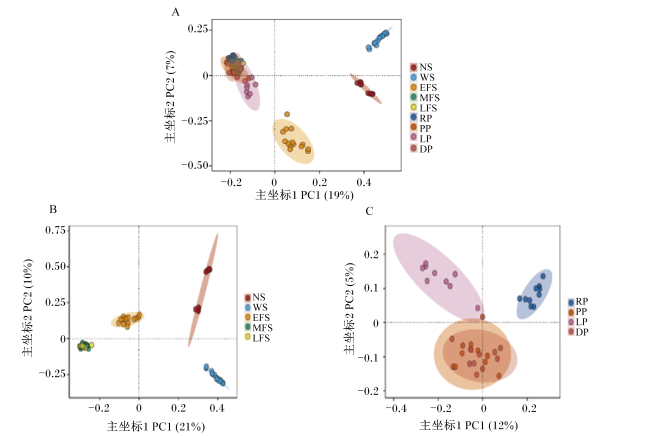
三河牛全生长阶段肠道微生物群落主坐标分析(PCoA)结果(图1-A)表明,育肥中期、育肥后期、后备期、围产期、泌乳期和干奶期聚集成一簇,而新生期、断奶期和育肥前期较为分离;育肥阶段PCoA结果(图1-B)表明,育肥中期和育肥后期聚集在一起,新生期、断奶期和育肥前期各单独成一簇,表明育肥中期以前三河牛肠道微生物组成变化较大,而育肥中期之后肠道微生物组成变化较小,且趋于稳定;泌乳阶段PCoA结果(图1-C)表明,干奶期和围产期较为聚集,泌乳期和后备期单独成一簇。
图1 不同生长阶段三河牛肠道微生物群落PCoA

A:全生长阶段PCoA;B:育肥阶段PCoA;C:泌乳阶段PCoA。

NS:新生期 neonatal stage;WS:断奶期 weaning stage;EFS:育肥前期 early fattening stage;MFS:育肥中期 mid fattening stage;LFS:育肥后期 late fattening stage;RP:后备期 reserve period;PP:围产期 perinatal period;LP:泌乳期 lactation period;DP:干奶期 dry period。图2图4同 the same as Fig.2 to Fig.4

Fig.1 PCoA of gut microbiota of Sanhe cattle at different growth stages

A: PCoA of entire growth stage; B: PCoA of fattening stage; C: PCoA of lactation stage.

2.3 不同生长阶段三河牛肠道微生物群落在门水平上的组成及变化

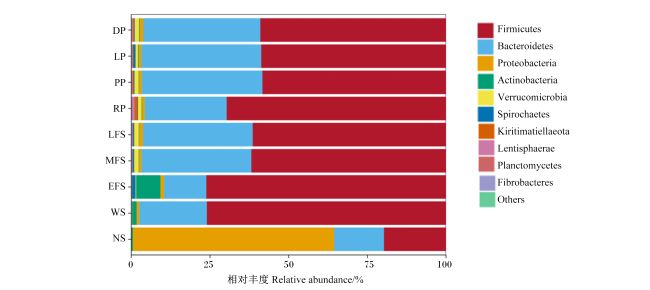
对所得有效序列在门类水平上进行物种注释和统计,共在不同生长阶段三河牛肠道微生物群落中鉴定出44个菌门。如图2所示,厚壁菌门(Firmicutes)、拟杆菌门(Bacteroidetes)、变形菌门(Proteobacteria)和放线菌门(Actinobacteria)为三河牛肠道中存在的优势菌门,相对丰度均大于1%。
图2 不同生长阶段三河牛肠道微生物群落在门水平上的组成

Firmicutes:厚壁菌门;Bacteroidetes:拟杆菌门;Proteobacteria:变形菌门;Actinobacteria:放线菌门;Verrucomicrobia:疣微菌门;Spirochaetes:螺旋体门;Lentisphaerae:黏胶球形菌门;Planctomycetes:浮霉菌门;Fibrobacteres:纤维杆菌门;Others:其他。图5图7同 The same as Fig.5 to Fig.7

Fig.2 Gut microbiota composition of Sanhe cattle at different growth stages at phylum level

通过对不同生长阶段三河牛肠道微生物群落在门水平上的相对丰度分析发现(表3),断奶期和育肥前期厚壁菌门相对丰度较高,显著高于除后备期外的其他阶段(P<0.05);后备期厚壁菌门相对丰度显著高于新生期、围产期、泌乳期和干奶期(P<0.05);新生期厚壁菌门相对丰度最低,显著低于其他阶段(P<0.05)。育肥中期、育肥后期、围产期、泌乳期和干奶期拟杆菌门相对丰度较高,显著高于其他阶段(P<0.05);育肥前期拟杆菌门相对丰度最低。新生期变形菌门相对丰度最高,显著高于其他阶段(P<0.05)。育肥前期放线菌门相对丰度最高,显著高于其他阶段(P<0.05)。疣微菌门(Verrucomicrobia)相对丰度在新生期、断奶期和育肥前期均较低,从育肥中期开始显著提高(P<0.05)。
表3 不同生长阶段三河牛肠道微生物群落在门水平上的相对丰度

Table 3 Relative abundance of gut microbiota of Sanhe cattle at different growth stages at phylum level %

项目
Items
新生期
Neonatal
stage
断奶期
Weaning
stage
育肥前期
Early
fattening
stage
育肥中期
Mid
fattening
stage
育肥后期
Late
fattening
stage
后备期
Reserve
period
围产期
Perinatal
period
泌乳期
Lactation
period
干奶期
Dry period
均值标准误
SEM
P
P-value
厚壁菌门Firmicutes 19.73d 75.99a 76.17a 61.86bc 61.43bc 69.70ab 58.34c 58.73c 59.01c 17.15 <0.001
拟杆菌门Bacteroidetes 15.84cd 21.45bc 13.41d 34.90a 34.85a 26.03b 38.31a 38.07a 37.18a 11.56 <0.001
变形菌门
Proteobacteria
63.94a 0.88b 1.16b 0.78b 1.22b 0.87b 0.88b 0.89b 1.18b 18.69 <0.001
放线菌门
Actinobacteria
0.42b 1.36b 7.69a 0.14b 0.12b 0.16b 0.13b 0.18b 0.17b 3.12 <0.001
疣微菌门
Verrucomicrobia
0.03c 0.01c 0.22c 1.39a 1.44a 1.10ab 1.32a 0.78b 1.36a 0.75 <0.001

2.4 不同生长阶段三河牛肠道微生物群落在属水平上的组成及变化

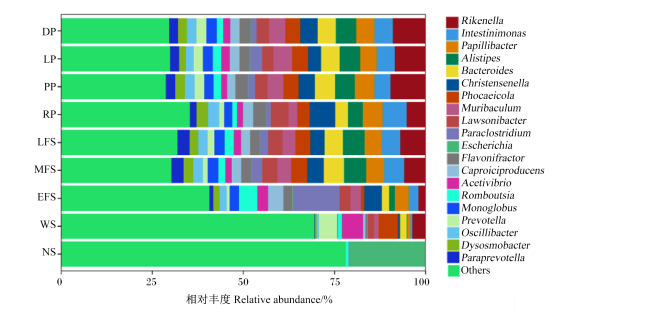
对所得有效序列在属水平上进行物种注释和统计,共在不同生长阶段三河牛肠道微生物群落中鉴定出711个菌属。如图3所示,理研菌属(Rikenella)、肠单胞菌属(Intestinimonas)、乳头杆菌属(Papillibacter)、另枝菌属(Alistipes)、拟杆菌属(Bacteroides)、克里斯滕森菌属(Christensenella)和Phocaeicola等菌属为优势菌属。
图3 不同生长阶段三河牛肠道微生物群落在属水平上的组成

Rikenella:理研菌属;Intestinimonas:肠单胞菌属;Papillibacter:乳头杆菌属;Alistipes:另枝菌属;Bacteroides:拟杆菌属;Christensenella:克里斯滕森菌属;Lawsonibacter:劳森氏杆菌属;Paraclostridium:副梭菌属;Escherichia:埃希氏菌属;Flavonifractor:解黄酮菌属;Caproiciproducens:产己酸菌属;Acetivibrio:醋弧菌属;Romboutsia:罗姆布茨菌属;Prevotella:普雷沃氏菌属;Oscillibacter:颤杆菌属;Paraprevotella:副普雷沃氏菌属;Others:其他。

Fig.3 Gut microbiota composition of Sanhe cattle at different growth stages at genus level

通过对不同生长阶段三河牛肠道微生物群落在属水平上的相对丰度分析发现(表4),新生期埃希氏菌属(Escherichia)、Sediminibacterium、梭菌属(Clostridium)和贪噬菌属(Variovorax)相对丰度显著高于其他阶段(P<0.05)。断奶期Phocaeicola相对丰度显著高于新生期和育肥前期(P<0.05),醋弧菌属(Acetivibrio)、HerbivoraxPseudoclostridium和普雷沃氏菌属(Prevotella)相对丰度显著高于其他阶段(P<0.05),且上述菌属相对丰度在新生期均低于0.1%。副梭菌属(Paraclostridium)、罗姆布茨菌属(Romboutsia)、产己酸菌属(Caproiciproducens)相对丰度在出生后逐渐升高,在育肥前期达到最高,并显著高于其他阶段(P<0.05)。
表4 不同生长阶段三河牛肠道微生物群落在属水平上的相对丰度

Table 4 Relative abundance of gut microbiota of Sanhe cattle at different growth stages at genus level %

项目
Items
新生期
Neonatal
stage
断奶期
Weaning
stage
育肥前期
Early
fattening
stage
育肥中期
Mid
fattening
stage
育肥后期
Late
fattening
stage
后备期
Reserve
period
围产期
Perinatal
period
泌乳期
Lactation
period
干奶期
Dry
period
均值
标准误
SEM
P
P-value
埃希氏菌属Escherichia 20.911a 0.041b 0.137b 0.044b 0.048b 0.096b 0.106b 0.170b 0.163b 9.049 <0.001
Sediminibacterium 14.680a 0.020b 0.123b 0.030b 0.025b 0.039b 0.044b 0.079b 0.107b 5.989 <0.001
梭菌属Clostridium 10.585a 0.114b 1.485b 0.611b 0.576b 0.574b 0.624b 0.896b 0.709b 5.964 0.001
贪噬菌属Variovorax 8.049a 0.068b 0.290b 0.079b 0.105b 0.053b 0.074b 0.076b 0.075b 3.398 <0.001
Phocaeicola 0.026c 5.367a 0.922c 4.342ab 4.109ab 3.369ab 4.156ab 4.361ab 4.090ab 2.311 <0.001
醋弧菌属Acetivibrio 0.011d 5.781a 2.892b 1.708bc 1.939bc 1.541c 1.599c 2.266bc 1.912bc 1.992 <0.001
Herbivorax 0.015b 9.631a 1.328b 0.625b 0.628b 0.506b 0.651b 0.957b 0.706b 3.943 <0.001
Pseudoclostridium 0.003b 7.224a 1.091b 0.452b 0.554b 0.372b 0.422b 0.653b 0.501b 3.210 <0.001
普雷沃氏菌属Prevotella 0.017d 5.010a 0.837cd 1.346bcd 1.916bc 1.379bcd 2.709b 2.555bc 2.766b 2.325 <0.001
副梭菌属Paraclostridium 0.029c 0.138bc 12.809a 3.016bc 2.291bc 1.187bc 1.965bc 3.302b 1.528bc 4.585 <0.001
罗姆布茨菌属Romboutsia 0.801d 1.150cd 5.119a 1.922bcd 2.598b 1.376bcd 2.142bc 2.380bc 1.799bcd 1.816 <0.001
产己酸菌属Caproiciproducens 0.007d 0.657c 4.201a 2.686b 2.489b 2.805b 2.279b 2.679b 2.525b 1.332 <0.001
拟杆菌属Bacteroides 0.011d 1.868c 2.037c 5.575a 5.045a 3.488b 5.565a 5.185a 5.007a 2.161 <0.001
另枝菌属Alistipes 0.024d 0.131d 1.605c 6.040a 5.894a 4.037b 5.367a 5.503a 5.581a 2.550 <0.001
Monoglobus 0.005c 0.134c 2.542ab 2.913a 2.743ab 2.189b 2.492ab 2.688ab 2.859a 1.250 <0.001
副普雷沃氏菌属Paraprevotella 0.001e 0.103e 1.016d 3.249a 3.327a 1.779c 2.548b 2.502b 2.447b 1.321 <0.001
阿克曼菌属Akkermansia 0.028c 0.012c 0.215c 1.385a 1.441a 1.073ab 1.321a 0.768b 1.353a 0.748 <0.001
肠单胞菌属Intestinimonas 0.009e 0.551e 2.701d 5.571b 5.134bc 6.607a 4.489c 4.968bc 5.055bc 2.269 <0.001
克里斯滕森菌属Christensenella 0.007d 0.577d 4.732b 4.562b 3.917bc 7.024a 4.441b 3.522c 4.749b 2.226 <0.001
乳头杆菌属Papillibacter 0.021e 0.810d 3.771c 4.895ab 4.672b 5.449a 5.372a 4.570b 5.047ab 2.013 <0.001
劳森氏杆菌属Lawsonibacter 0.014e 1.724d 3.008c 4.170ab 3.848bc 4.910a 3.423bc 3.092c 3.376bc 1.583 <0.001
解黄酮菌属Flavonifractor 0.007f 0.511e 2.441d 2.685cd 2.666cd 3.548a 3.371ab 2.765cd 2.995bc 1.250 <0.001
颤杆菌属Oscillibacter 0.007f 0.651e 1.969d 2.620b 2.521bc 3.064a 2.645b 2.185cd 2.592b 1.036 <0.001
Dysosmobacter 0.005e 0.517d 1.713c 2.685b 2.389b 3.170a 2.681b 1.839c 2.421b 1.050 <0.001
理研菌属Rikenella 0.028f 3.665de 1.963ef 5.869cd 6.960bc 5.215cd 9.598a 8.496ab 8.959ab 3.557 <0.001
Muribaculum 0.014g 1.151f 2.895e 3.807cd 3.588d 2.418e 4.342bc 5.144a 4.511ab 1.686 <0.001
拟杆菌属、另枝菌属、Monoglobus、副普雷沃氏菌属(Paraprevotella)、阿克曼菌属(Akkermansia)相对丰度在育肥中期前随日龄的增长而逐渐升高,后趋于稳定。育肥中期和育肥后期副普雷沃氏菌属相对丰度显著高于围产期、泌乳期和干奶期(P<0.05),而后备期又显著低于围产期、泌乳期和干奶期(P>0.05)。与育肥前期相比,产己酸杆菌属相对丰度在育肥中期后显著降低(P<0.05)。肠单胞菌属、克里斯滕森菌属、乳头杆菌属、劳森氏杆菌属(Lawsonibacter)、解黄酮菌属(Flavonifractor)、颤杆菌属(Oscillibacter)和Dysosmobacter相对丰度在新生期均低于0.1%,但随日龄的增长逐渐提高,在后备期达到最高。理研菌属相对丰度在围产期最高。Muribaculum相对丰度在泌乳期最高。

2.5 不同生长阶段三河牛肠道微生物群落定殖规律

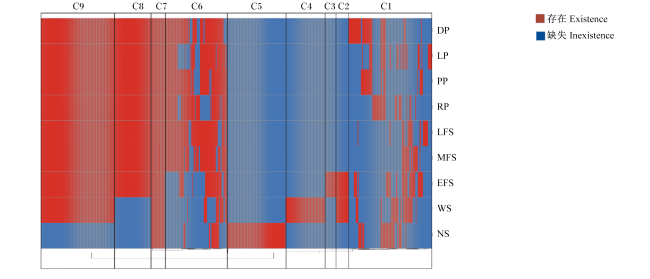
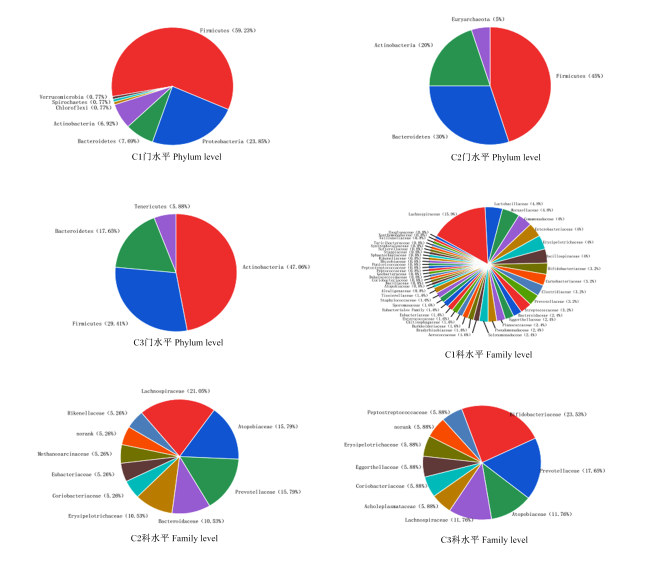
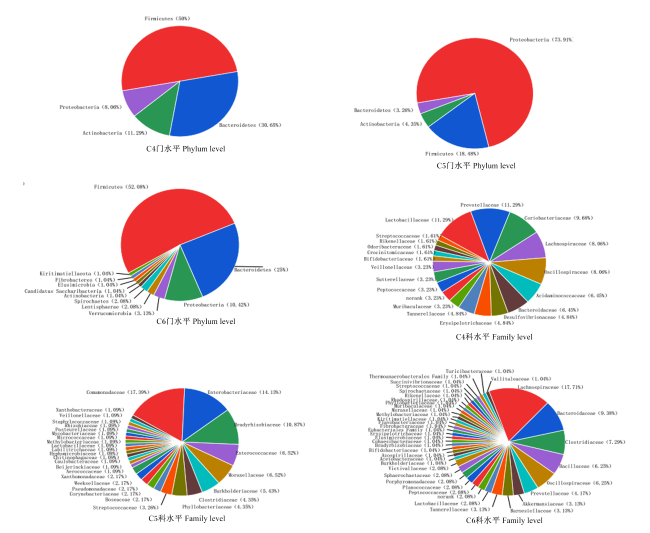
在种水平上,将每个生长阶段至少在30%以上的样本中出现的微生物认定为是在三河牛肠道中普遍定殖的微生物,本试验共计得到612个菌种,根据层级聚类结果(图4),将612个菌种分为9个簇(C1~C9分簇),每一个簇代表一种独特的微生物定殖模式,反映了微生物在三河牛肠道中的初始定殖时间和持续时间。其中,C1分簇中出现的微生物可以称之为三河牛肠道中的“过客”,即随机出现,并不能持久的在三河牛肠道内定殖;C2分簇中的微生物仅出现在断奶期和育肥前期2个阶段;C3、C4和C5分簇中的微生物分别仅出现在育肥前期、断奶期和新生期;C6分簇中的微生物在新生期、断奶期和育肥前期3个阶段仅有少量出现,大部分出现于育肥中期之后;C7分簇中的微生物在出生后就存在,且持续定殖于整个生长阶段;C8和C9分簇中的微生分别出现于育肥前期和断奶期,出现后即在三河牛肠道中持续定殖。
图4 不同生长阶段三河牛肠道微生物群落定殖分簇

C1~C9表示将在三河牛肠道中普遍定殖的612个菌种微生物分成9个簇。图5图7同。

Fig.4 Gut microbiota colonization clusters of Sanhe cattle at different growth stages

C1 to C9 indicated that 612 strains commonly colonized in gut of Sanhe cattle were divided into 9 clusters. The same as Fig.5 to Fig.7.

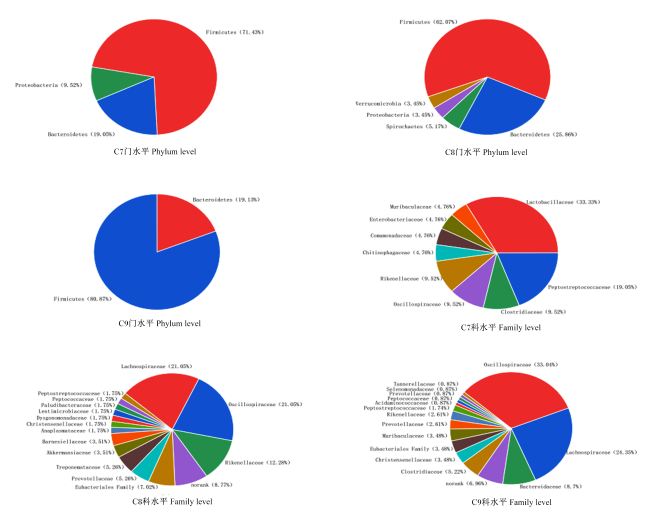
在整个三河牛肠道微生物群落定殖分簇中,C6、C7、C8和C9这4个分簇中的微生物表现出在三河牛肠道中持续定殖的规律(图5~图7),通过对三河牛育肥阶段和泌乳阶段肠道微生物在种水平上相对丰度大于1%的菌种与微生物定殖分簇对比发现,这些微生物主要分布在C7和C9这2个分簇中。对C7和C9这2个分簇中的微生物进行探究发现,在门水平上均以厚壁菌门和拟杆菌门为优势菌门,且厚壁菌门相对丰度均在70%以上;而在科水平上,颤螺菌科(Oscillospiraceae)、毛螺菌科(Lachnospiraceae)、拟杆菌科(Bacteroidaceae)、普雷沃氏菌科(Prevotellaceae)、梭菌科(Clostridiaceae)、理研菌科(Rikenellaceae)和消化链球菌科(Peptostreptococcaceae)等菌科为优势菌科。
图5 不同生长阶段三河牛肠道微生物群落定殖C1~C3分簇在门和科水平上物种组成

Chloroflexi:绿弯菌门;Euryarchaeota:广古菌门;Tenericutes:软壁菌门。Lachnospiraceae:毛螺菌科;Lactobacillaceae:乳杆菌科;Moraxellaceae:莫拉氏菌科;Comamonadaceae:丛毛单胞菌科;Enterobacteriaceae:肠杆菌科;Erysipelotrichaceae:丹毒丝菌科;Oscillospiraceae:颤螺菌科;Bifidobacteriaceae:双歧杆菌科;Carnobacteriaceae:肉杆菌科;Clostridiaceae:梭菌科;Prevotellaceae:普雷沃氏菌科;Streptococcaceae:链球菌科;Bacteroidaceae:拟杆菌科;Eggerthellaceae:伊格尔兹氏菌科;Planococcaceae:动球菌科;Pseudomonadaceae:假单胞菌科;Selenomonadaceae:硒单胞菌科;Aerococcaceae:气球菌科;Bradyrhizobiaceae:慢生根瘤菌科;Burkholderiaceae:伯克氏菌科;Chitinophagaceae:噬几丁质菌科;Enterococcaceae:肠球菌科;Eubacteriaceae:优杆菌科;Eubacteriales Family:真细菌目科;Sporomusaceae:鼠孢菌科;Staphylococcaceae:葡萄球菌科;Tissierellaceae:泰氏菌科;Alcaligenaceae:产碱菌科;Atopobiaceae:奇异菌科;Bacillaceae:芽孢杆菌科;Coriobacteriaceae:红蝽菌科;Dehalococcoidaceae:脱卤球菌科;Geobacteraceae:地杆菌科;Peptococcaceae:消化球菌科;Peptostreptococcaceae:消化链球菌科;Puniceicoccaceae:紫红球菌科;Rhizobiaceae:根瘤菌科;Rikenellaceae:理研菌科;Stappiaceae:斯塔普氏菌科;Sutterellaceae:萨特氏菌科;Syntrophotaleaceae:互养菌科;Turicibacteraceae:苏黎世杆菌科;Veillonellaceae:韦荣氏菌科;Xanthomonadaceae:黄单胞菌科;Zoogloeaceae:动胶菌科;Methanosarcinaceae:甲烷八叠球菌科;norank:未定级;Acholeplasmataceae:无胆甾原体科。图6图7同 the same as Fig.6 and Fig.7

Fig.5 Species composition of gut microbiota C1 to C3 clusters colonized in Sanhe cattle at different growth stages at phylum and family levels

图6 不同生长阶段三河牛肠道微生物群落定殖C4~C6分簇在门和科水平上物种组成

Elusimicrobia:迷踪菌门;Acidaminococcaceae:氨基酸球菌科;Desulfovibrionaceae:脱硫弧菌科;Tannerellaceae:坦纳氏菌科;Muribaculaceae:鼠杆状菌科;Odoribacteraceae:臭杆菌科;Phyllobacteriaceae:叶杆菌科;Corynebacteriaceae:棒状杆菌科;Weeksellaceae:威克斯氏菌科;Beijerinckiaceae:拜叶林克氏菌科;Caulobacteraceae:柄杆菌科;Hyphomicrobiaceae:生丝微菌科;Methylobacteriaceae:甲基杆菌科;Micrococcaceae:微球菌科;Mycobacteriaceae:分枝杆菌科;Pasteurellaceae:巴斯德氏菌科;Akkermansiaceae:阿克曼氏菌科;Barnesiellaceae:巴恩斯氏菌科;Porphyromonadaceae:紫单胞菌科;Victivallaceae:食物谷菌科;Acetobacteraceae:醋杆菌科;Azospirillaceae:固氮螺菌科;Cohaesibacteraceae:黏着杆菌科;Elusimicrobiaceae:迷踪菌科;Fibrobacteraceae:纤维杆菌科;Flavobacteriaceae:黄杆菌科;Rhodospirillaceae:红螺菌科;Spirochaetaceae:螺旋体科;Succinivibrionaceae:琥珀酸弧菌科;Thermoanaerobacterales Family:热厌氧菌目科。图7同 the same Fig.7

Fig.6 Species composition of gut microbiota C4 to C6 clusters colonized in Sanhe cattle at different growth stages at phylum and family levels

图7 不同生长阶段三河牛肠道微生物群落定殖C7~C9分簇在门和科水平上物种组成

Treponemataceae:密螺旋体科;Anaplasmataceae:无形小体科;Christensenellaceae:克里斯滕森菌科;Dysgonomonadaceae:营发酵单胞菌科;Paludibacteraceae:栖泥沼杆菌科。

Fig.7 Species composition of gut microbiota C7 to C9 clusters colonized in Sanhe cattle at different growth stages at phylum and family levels

而通过将泌乳阶段和育肥阶段的种水平微生物进行差异性分析发现,仅在育肥阶段中出现的菌种有Romboutsia timonensis、普遍另枝杆菌(Alistipes communis)、食半乳糖醇产己酸杆菌(Caproiciproducens galactitolivorans)、球状双歧杆菌(Bifidobacterium globosum)、产乙酸杆状菌属sp900066565(Acetatifactor sp900066565)和劳森氏杆菌属sp003478995(Lawsonibacter sp003478995),仅在泌乳阶段出现的菌种有Rikenella massiliensis、普雷沃氏菌属sp900547005(Prevotella sp900547005)和鸡盲肠丁酸球菌(Butyricicoccus pullicaecorum)。这2个分簇中的微生物表现出定殖时间早,丰度较高,且能持续定殖在三河牛肠道中。

3 讨论

3.1 不同生长阶段三河牛肠道微生物群落多样性分析

肠道是哺乳动物营养物质吸收的主要场所,其中肠道微生态系统有助于宿主营养物质的吸收[19],特别是反刍动物在对饲粮中的纤维素、非蛋白氮等营养物质的吸收利用过程中微生物起着十分重要的作用[7-8]。前人研究表明,新生犊牛肠道中几乎没有微生物定殖,在出生后与外界环境接触中获得大量的微生物在肠道中迅速定殖[20-21]。反刍动物在2.5岁之前,肠道微生物群落多样性和丰富度随日龄的变化而逐渐提高[22-23]。本试验中,三河牛直肠微生物群落的丰富度和多样性随着生长发育而提高,但在育肥中期后α多样性指数并未出现显著的增长,表明在育肥中期之后的肠道菌群组成趋于稳定,同时泌乳期各阶段的α多样性指数间也并未出现显著差异。同时,PCoA结果表明,在育肥中期前每个阶段的三河牛直肠微生物群落组成均存在显著差异;泌乳阶段中,干奶期和围产期较为聚集,而后备期和泌乳期较为分离。育肥中期前随着三河牛的生长发育,每个生长阶段直肠微生物都表现出其独特性,主要是由于不同生长阶段有着不同类型的饲粮,即从液体饲料到固体开口料再到粗饲料,不同的饲粮底物对肠道微生物群落组成有着显著的影响[24-25]。不同种类的饲粮,其蛋白质、能量和脂肪含量的变化都会对反刍动物的消化道微生物定殖产生一定的影响[26-29]

3.2 不同生长阶段三河牛肠道微生物群落组成及差异性分析

反刍动物肠道微生物群落随年龄的变化呈现出一定的发育规律[30]。不同生长阶段三河牛直肠微生物群落在门水平上均以厚壁菌门、拟杆菌门和变形菌门为优势菌门,这与此前报道的反刍动物的肠道微生物群落结果[31-32]一致。新生犊牛肠道微生物群落主要由变形菌门和拟杆菌门组成[33],且以变形菌门占主导地位[34],这与本试验中观察到的结果相同。而厚壁菌门相对丰度在断奶后显著升高且明显高于其他菌门。本研究中,不同生长阶段饲粮的改变,导致不同生长阶段营养结构发生变化,尤其是出生到断奶,从高蛋白质饲粮转变为高碳水化合物饲粮,这可能是导致肠道微生物群落发生改变的主要原因。
在属水平上,埃希氏菌属、Sediminibacterium、梭菌属和贪噬菌属等显著富集在新生犊牛阶段,而后相对丰度陡然下降,相对丰度均在1%左右,绝大多数低于1%的水平。埃希氏菌属在出生当天为优势菌属,但随着年龄的增长显著减少[35],这与本试验中观察的结果相同。前人研究认为,对于新生犊牛肠道中最先定殖的优势微生物,一般认为是通过垂直传播的方式定殖在犊牛肠道中[34]。普雷沃氏菌属作为一种有益菌,广泛存在于反刍动物肠道中,是反刍动物胃肠道中的核心菌属,在淀粉、多糖和蛋白质降解过程中发挥着重要的作用[36],其相对丰度在断奶期显著升高,可能与开口料采食量的升高相关。据报道,产己酸杆菌可利用碳水化合物合成挥发性脂肪酸[37]。拟杆菌属相对丰度在出生后随着日龄的增长逐渐升高,且在育肥中期后稳定在一个较高的水平,拟杆菌属分解多种难以消化的膳食纤维多糖、直链淀粉和支链淀粉等[38]。随着犊牛年龄的增长、肠道的不断发育以及饲粮的不断变化,肠道微生物群落整体呈现出一个发育性变化。

3.3 不同生长阶段三河牛肠道微生物群落定殖规律分析

前人研究发现,犊牛随着年龄的增长,肠道微生物群落的多样性和丰富度呈现上升的趋势[22-23],然而对牛全生长阶段中肠道微生物群落的演替规律仍然缺少研究。本研究中,对种水平微生物的筛选后并通过ward.2聚类,划分出9个分簇,且每个分簇中的微生物在定殖时间、定制规律上存在着显著的区别,而每个分簇中的微生物都与宿主存在着密切的联系。本研究发现,厚壁菌门和拟杆菌门在不同的微生物定殖模式中均以较高的相对丰度存在。而在反刍动物中,厚壁菌门在纤维和纤维素的降解过程中发挥着重要的作用[39];拟杆菌门则主要是在碳水化合物和蛋白质的降解过程中发挥着作用[40],并且拟杆菌门还可以促进肠黏膜的形成,调节肠道环境,维持肠道微生态的平衡[41]。C3分簇中放线菌门相对丰度明显高于其他分簇,且C3分簇中的微生物仅在育肥前期出现。而放线菌门在维持肠道微生物稳态[42],参与植物性碳水化合物分解代谢上发挥着重要的作用[43]。在育肥前期阶段,犊牛高蛋白质饲粮的饲喂量减少,而高碳水化合物的精饲料采食量急剧升高,可能是引起放线菌门相对丰度升高的原因。C5分簇中的微生物以变形菌门占据着主导地位,且C5分簇中的微生物仅出现在新生期,这与前人的研究报道相同,新生犊牛肠道微生物中变形菌门占据主导地位[34]。三河牛肠道微生物随年龄的增长,变形菌门相对丰度降低,以及厚壁菌门、拟杆菌门和放线菌门相对丰度升高,表明宿主对营养物质降解利用能力的提高,以及对腹泻等疾病的抵抗力增强。肠道微生物的定殖规律,其初始定殖时间以及是否能持续的定殖在宿主的肠道中,受诸多因素的影响,其中年龄、饲粮类型以及外界环境等均能影响微生物的定殖。
前人研究报道,肠道中的厚壁菌门与拟杆菌门的比值(F/B)与产奶性能、乳脂率和脂肪沉积等方面表现出显著正相关[44-45]。高凤[46]研究发现,不同生长阶段荷斯坦奶牛肠道F/B为1.15~3.30。李晓睿[47]在西门塔尔牛育成期中发现其肠道F/B为1.70~1.98。本试验中,三河牛肠道F/B在6月龄时达到最高的5.68,在育肥阶段和泌乳阶段为1.52~2.67。在微生物定殖C7和C9分簇中,其F/B达到了3.74和4.22,F/B更高,表明三河牛肠道微生物对饲粮中营养物质的获取能力更强。研究发现,厚壁菌门在纤维和纤维降解利用过程中发挥着重要的作用[39]。Li等[48]研究发现,高产泌乳奶牛泌乳高峰期时肠道微生物群落中厚壁菌门相对丰度为57.62%。Tong等[49]在高产和低产泌乳奶牛肠道微生物群落研究中发现,高产组厚壁菌门相对丰度(44.30%)显著高于低产组(27.71%)。这主要是由于厚壁菌门中的毛螺菌科和瘤胃球菌科等微生物,可以降解纤维素和半纤维素,并合成反刍动物所需的挥发性脂肪酸[50]。本试验中,断奶后三河牛肠道微生物群落厚壁菌门相对丰度均高于58%,这表明三河牛对粗饲料有更强的消化能力。综上所述,三河牛作为我国高寒地区乳肉兼用型品种,通过对其肠道微生物群落结构的挖掘及不同生长阶段微生物定殖模式的探究,印证了三河牛耐粗饲、增重快、乳品质好及适应性强等的特点,这为三河牛的生产奠定了的基础。

4 结论

三河牛肠道微生物群落在不同生长阶段存在较大差异,其多样性和丰富度随着日龄的增长而逐渐升高,并在育肥中期以后较为稳定,全生长阶段肠道微生物群落整体呈现发育性变化。三河牛肠道微生物群落在育肥阶段和泌乳阶段均以厚壁菌门和拟杆菌门占据主导地位。本研究通过对种水平微生物的挖掘,筛选出了分别仅出现在育肥阶段和泌乳阶段的微生物,为揭示呼伦贝尔三河牛全生长阶段肠道微生物群落特征及动态变化,并为丰富高寒牧区乳肉兼用型三河牛肠道微生物资源提供了基础数据。
[1]
LIN L M, XIE F, SUN D M, et al. Ruminal microbiome-host crosstalk stimulates the development of the ruminal epithelium in a lamb model[J]. Microbiome, 2019, 7(1):83.

DOI PMID

[2]
BÄCKHED F, LEY R E, SONNENBURG J L, et al. Host-bacterial mutualism in the human intestine[J]. Science, 2005, 307(5717):1915-1920.

DOI PMID

[3]
苏德其其格, 李颖, 宋峰, 等. 新生犊牛不同时间段肠道微生物菌群结构的变化[J]. 中国微生态学杂志, 2022, 34(12):1394-1400.

SU D Q Q G, LI Y, SONG F, et al. The changes of intestinal microflora structure in newborn calves at different times[J]. Chinese Journal of Microecology, 2022, 34(12):1394-1400.(in Chinese)

[4]
KARASOV W H, MARTÍNEZ DEL RIO C, CAVIEDES-VIDAL E. Ecological physiology of diet and digestive systems[J]. Annual Review of Physiology, 2011,73:69-93.

[5]
ROSENBERG E, ZILBER-ROSENBERG I. The hologenome concept of evolution after 10 years[J]. Microbiome, 2018, 6(1):78.

[6]
KAMADA N, CHEN G Y, INOHARA N, et al. Control of pathogens and pathobionts by the gut microbiota[J]. Nature Immunology, 2013, 14(7):685-690.

DOI PMID

[7]
王砀砀. 奶山羊消化道微生物特征及其长期影响胃肠道发酵和生产性能的机制[D]. 博士学位论文. 杨凌: 西北农林科技大学, 2023.

WANG D D. The digestive tract microbiome features of dairy goats and their long-term effects on gastrointestinal fermentation and production performance[D].Ph.D. Thesis. Yangling: Northwest A&F University, 2023.(in Chinese)

[8]
WANG J, FAN H, HAN Y, et al. Characterization of the microbial communities along the gastrointestinal tract of sheep by 454 pyrosequencing analysis[J]. Asian-Australasian Journal of Animal Sciences, 2017, 30(1):100-110.

DOI PMID

[9]
CHEN M, SU S Y, ZHANG C F, et al. The role of biogeography in shaping intestinal flora and influence on fatty acid composition in red swamp crayfish (Procambarus clarkii)[J]. Microbial Ecology, 2023, 86(4):3111-3127.

DOI PMID

[10]
GAO G L, ZHAO X Z, LI Q, et al. Genome and metagenome analyses reveal adaptive evolution of the host and interaction with the gut microbiota in the goose[J]. Scientific Reports, 2016,6:32961.

[11]
ZHANG J C, XU C B, HUO D X, et al. Comparative study of the gut microbiome potentially related to milk protein in Murrah buffaloes (Bubalus bubalis) and Chinese Holstein cattle[J]. Scientific Reports, 2017,7:42189.

[12]
程新东, 辛国省, 伍修锟, 等. 反刍动物肠道菌群对饲料利用效率调节效应的研究进展[J]. 动物营养学报, 2021, 33(5):2474-2482.

DOI

CHENG X D, XIN G S, WU X K, et al. Research progress on effects of gut microbiota on regulation of feed efficiency in ruminant[J]. Chinese Journal of Animal Nutrition, 2021, 33(5):2474-2482.(in Chinese)

[13]
多乐, 罗保华, 于喆, 等. 不同饲养方式对三河牛生产性能、繁殖性能的影响[J]. 现代畜牧科技, 2023(12):93-95.

DUO L, LUO B H, YU Z, et al. The effect of different feeding methods on the production and reproductive performance of Sanhe cattle[J]. Modern Animal Husbandry Science & Technology, 2023(12):93-95.(in Chinese)

[14]
高建, 李金霞, 刘杰, 等. 呼伦贝尔岭西地区奶业面临的挑战及发展建议[J]. 当代畜禽养殖业, 2024, 44(1):47-48,53.

GAO J, LI J X, LIU J, et al. Challenges and development suggestions faced by the dairy industry in the west of Hulunbuir mountains[J]. Modern Livestock and Poultry Breeding Industry, 2024, 44(1):47-48,53.(in Chinese)

[15]
吴宏军, 马孝林, 刘爱荣, 等. 内蒙古三河牛培育历程及进展[J]. 中国牛业科学, 2012, 38(4):48-52.

WU H J, MA X L, LIU A R, et al. Breeding history and current improvements of Sanhe cattle in Inner Mongolia[J]. China Cattle Science, 2012, 38(4):48-52.(in Chinese)

[16]
AMATO K R, YEOMAN C J, KENT A, et al. Habitat degradation impacts black howler monkey (Alouatta pigra) gastrointestinal microbiomes[J]. The ISME Journal, 2013, 7(7):1344-1353.

[17]
SCHLOSS P D, WESTCOTT S L, RYABIN T, et al. Introducing mothur:open-source,platform-independent,community-supported software for describing and comparing microbial communities[J]. Applied and Environmental Microbiology, 2009, 75(23):7537-7541.

[18]
LOZUPONE C, LLADSER M E, KNIGHTS D, et al. UniFrac:an effective distance metric for microbial community comparison[J]. The International Society for Microbial Ecology, 2011, 5(2):169-172.

[19]
CHUNG H C, PAMP S J, HILL J A, et al. Gut immune maturation depends on colonization with a host-specific microbiota[J]. Cell, 2012, 149(7):1578-1593.

DOI PMID

[20]
KLEIN-JÖBSTL D, SCHORNSTEINER E, MANN E, et al. Pyrosequencing reveals diverse fecal microbiota in Simmental calves during early development[J]. Frontiers in Microbiology, 2014,5:622.

[21]
杨敏娜, 朱焕, 高伟星, 等. 新生荷斯坦犊牛后肠道微生物母源传递特征的研究[J]. 动物营养学报, 2021, 33(11):6445-6451.

DOI

YANG M N, ZHU H, GAO W X, et al. Study on maternal transmission characteristics of hindgut microorganism in newborn Holstein calves[J]. Chinese Journal of Animal Nutrition, 2021, 33(11):6445-6451.(in Chinese)

[22]
JEWELL K A, MCCORMICK C A, ODT C L, et al. Ruminal bacterial community composition in dairy cows is dynamic over the course of two lactations and correlates with feed efficiency[J]. Applied and Environmental Microbiology, 2015, 81(14):4697-4710.

DOI PMID

[23]
郭文杰, 刘书杰, 崔占鸿, 等. 基于16S rRNA测序技术对不同年龄放牧公牦牛肠道细菌区系的比较分析[J]. 中国畜牧兽医, 2021, 48(10):3614-3624.

DOI

GUO W J, LIU S J, CUI Z H, et al. Comparative analysis of gut bacterial composition of grazing male yaks at different ages based on 16S rRNA sequencing technology[J]. China Animal Husbandry & Veterinary Medicine, 2021, 48(10):3614-3624.(in Chinese)

[24]
WELCH C B, LOURENCO J M, KRAUSE T R, et al. Evaluation of the fecal bacterial communities of Angus steers with divergent feed efficiencies across the lifespan from weaning to slaughter[J]. Frontiers in Veterinary Science, 2021,8:597405.

[25]
史晨迪. 饲粮过渡方式对断奶羔羊生长性能、营养物质消化率、瘤胃发酵和血清指标的影响[D]. 硕士学位论文. 保定: 河北农业大学, 2022.

SHI C D. Effects of dietary transition methods on growth performance,nutrient digestibility,rumen fermentation and serum indices of weaned lambs[D]. Master’s Thesis. Baoding: Hebei Agricultural University, 2022.(in Chinese)

[26]
陶慧. 日粮中的脂肪水平对绵羊生长性能、肌肉中脂肪酸成分及瘤胃细菌多样性的影响[D]. 博士学位论文. 北京: 中国农业科学院, 2020.

TAO H. Effect of dietary fat level on performance,fatty acids composition and gastrointestinal bacteria in sheep[J]. Ph.D. Thesis. Beijing:Chinese Academy of Agricultural Sciences. 2020.(in Chinese)

[27]
AHMAD A A, YANG C, ZHANG J B, et al. Effects of dietary energy levels on rumen fermentation,microbial diversity,and feed efficiency of yaks (Bos grunniens)[J]. Frontiers in Microbiology, 2020,11:625.

[28]
DIAS J, MARCONDES M I, NORONHA M F, et al. Effect of pre-weaning diet on the ruminal archaeal,bacterial,and fungal communities of dairy calves[J]. Frontiers in Microbiology, 2017,8:1553.

[29]
李蒋伟, 周力, 马博研, 等. 日粮蛋白水平对育肥藏羊瘤胃细菌多样性的影响[J]. 安徽农业大学学报, 2022, 49(1):98-102.

LI J W, ZHOU L, MA B Y, et al. Effect of dietary protein level on rumen microbial diversity of fattening Tibetan sheep[J]. Journal of Anhui Agricultural University, 2022, 49(1):98-102.(in Chinese)

[30]
O’HARA E, KENNY D A, MCGOVERN E, et al. Investigating temporal microbial dynamics in the rumen of beef calves raised on two farms during early life[J]. FEMS Microbiology Ecology, 2020, 96(2):fiz203.

[31]
MALMUTHUGE N, GRIEBEL P J, GUAN L L. Taxonomic identification of commensal bacteria associated with the mucosa and digesta throughout the gastrointestinal tracts of preweaned calves[J]. Applied and Environmental Microbiology, 2014, 80(6):2021-2028.

DOI PMID

[32]
SHANKS O C, KELTY C A, ARCHIBEQUE S, et al. Community structures of fecal bacteria in cattle from different animal feeding operations[J]. Applied and Environmental Microbiology, 2011, 77(9):2992-3001.

DOI PMID

[33]
REY M, ENJALBERT F, COMBES S, et al. Establishment of ruminal bacterial community in dairy calves from birth to weaning is sequential[J]. Journal of Applied Microbiology, 2014, 116(2):245-257.

DOI PMID

[34]
KLEIN-JÖBSTL D, QUIJADA N M, DZIECIOL M, et al. Microbiota of newborn calves and their mothers reveals possible transfer routes for newborn calves’ gastrointestinal microbiota[J]. PLoS One, 2019, 14(8):e0220554.

[35]
JIAO J Z, HUANG J Y, ZHOU C S, et al. Taxonomic identification of ruminal epithelial bacterial diversity during rumen development in goats[J]. Applied and Environmental Microbiology, 2015, 81(10):3502-3509.

DOI PMID

[36]
HENDERSON G, COX F, GANESH S, et al. Rumen microbial community composition varies with diet and host,but a core microbiome is found across a wide geographical range[J]. Scientific Reports, 2015,5:14567.

[37]
KIM B C, SEUNG JEON B, KIM S, et al. Caproiciproducens galactitolivorans gen.nov.,sp.nov.,a bacterium capable of producing caproic acid from galactitol,isolated from a wastewater treatment plant[J]. International Journal of Systematic and Evolutionary Microbiology, 2015, 65(12):4902-4908.

[38]
XU J, BJURSELL M K, HIMROD J, et al. A genomic view of the human-Bacteroides thetaiotaomicron symbiosis[J]. Science, 2003, 299(5615):2074-2076.

DOI PMID

[39]
HOOK S E, STEELE M A, NORTHWOOD K S, et al. Impact of subacute ruminal acidosis (SARA) adaptation and recovery on the density and diversity of bacteria in the rumen of dairy cows[J]. FEMS Microbiology Ecology, 2011, 78(2):275-284.

DOI PMID

[40]
LI L B, LI K P, BIAN Z Y, et al. Association between body weight and distal gut microbes in Hainan black goats at weaning age[J]. Frontiers in Microbiology, 2022,13:951473.

[41]
BÉCHON N, GHIGO J M. Gut biofilms:Bacteroides as model symbionts to study biofilm formation by intestinal anaerobes[J]. FEMS Microbiology Reviews, 2022, 46(2):fuab054.

[42]
BINDA C, LOPETUSO L R, RIZZATTI G, et al. Actinobacteria:a relevant minority for the maintenance of gut homeostasis[J]. Digestive and Liver Disease, 2018, 50(5):421-428.

[43]
POKUSAEVA K, FITZGERALD G F, VAN SINDEREN D. Carbohydrate metabolism in Bifidobacteria[J]. Genes & Nutrition, 2011, 6(3):285-306.

[44]
李烨青. 不同采食水平对奶牛生产性能、瘤胃发酵、微生物区系及其代谢组的影响[D]. 硕士学位论文. 南京: 南京农业大学, 2019.

LI Y Q. Effects of feed intake levels on performances,rumen fermentation,microflora and metabolome in cows[D]. Master’s Thesis. Nanjing: Nanjing Agricultural University, 2019.(in Chinese)

[45]
JAMI E, WHITE B A, MIZRAHI I. Potential role of the bovine rumen microbiome in modulating milk composition and feed efficiency[J]. PLoS One, 2014, 9(1):e85423.

[46]
高凤. 奶牛肠道微生物群落结构与多样性研究[D]. 硕士学位论文. 邯郸: 河北工程大学, 2017.

GAO F. The study on intestinal microbial community structure and diversity of dairy cows[D]. Master’s Thesis. Handan: Hebei University of Engineering, 2017.(in Chinese)

[47]
李晓睿. 不同营养水平对西门塔尔育成母牛营养代谢和肠道菌群组成的影响[D]. 硕士学位论文. 呼和浩特: 内蒙古农业大学, 2023.

LI X R. Effects of different nutrient levels on nutrient metabolism and intestinal microflora composition of Simmental heifer[D]. Master’s Thesis. Hohhot: Inner Mongolia Agricultural University, 2023.(in Chinese)

[48]
LI W C, HOU Q C, WANG Y J, et al. Analysis of the gut microbial diversity of dairy cows during peak lactation by PacBio Single-Molecule Real-Time (SMRT) sequencing[J]. Current Microbiology, 2018, 75(10):1316-1323.

DOI PMID

[49]
TONG J J, ZHANG H, YANG D L, et al. Illumina sequencing analysis of the ruminal microbiota in high-yield and low-yield lactating dairy cows[J]. PLoS One, 2018, 13(11):e0198225.

[50]
BIDDLE A, STEWART L, BLANCHARD J, et al. Untangling the genetic basis of fibrolytic specialization by Lachnospiraceae and Ruminococcaceae in diverse gut communities[J]. Diversity, 2013, 5(3):627-640.

Outlines

/