RESEARCH PAPER

Effects of Combined Supplementation of Purslane and Citric Acid in Diet on Intestinal Physical and Microbial Barriers of Meat Rabbits

  • HE Min ,
  • DANG Wenqing * ,
  • REN Keliang ,
  • ZHAN Haijie ,
  • ZHAO Ruisheng ,
  • LI Jun ,
  • CAO Liang , **
Expand
  • College of Animal Sciences, Shanxi Agricultural University, Taigu 030801, China
** associate professor, E-mail:

*Contributed equally

Received date: 2024-11-17

  Online published: 2025-06-12

Abstract

This experiment was conducted to investigate the effects of the combined supplementation of purslane and citric acid in diet on intestinal tissue morphology and permeability, expression of tight junction protein-related genes and cecal microbiota of meat rabbits. One hundred and fifty healthy 35-day-old weaned Ira commercial meat rabbits (half male and half female) were selected and randomly divided into 3 groups, with 50 replicates in each group and 1 rabbit in each replicate. Rabbits in the control group (T0 group) were fed a basal diet, those in T1 group were fed an experimental diet containing 3% purslane (equivalent to replacing the wheat bran in the basal diet), and those in T2 group were fed the diet supplemented with 1% citric acid on the basis of the diet in T1 group. The experiment lasted for 35 days after 7-day adaption. The results showed as follows: 1) compared with T0 group, the crypt depth in duodenum of meat rabbits in T2 group was significantly decreased (P<0.05), and the villus height in jejunum and ileum and the ratio of villus height to crypt depth (V/C) in ileum in T1 and T2 groups were significantly increased (P<0.05). Meanwhile, the villus height in jejunum and ileum and the V/C in ileum in T2 group were significantly higher than those in T1 group (P<0.05). 2) Compared with T0 group, the serum diamine oxidase activity of meat rabbits in T1 and T2 groups was significantly decreased (P<0.05). 3) In duodenum, compared with T0 group, the mRNA relative expression levels of zonula occludens-1 (ZO-1) and claudin-1 in T1 group were extremely significantly increased (P<0.01), and the ZO-1 mRNA relative expression level in T2 group was extremely significantly increased (P<0.01). In jejunum, compared with T0 group, the claudin-1 mRNA relative expression level in T1 group was significantly increased (P<0.05), and the mRNA relative expression levels of ZO-1, claudin-1 and occludin in T2 group were all extremely significantly increased (P<0.01); meanwhile, the mRNA relative expression levels of ZO-1 and occludin in T2 group were extremely significantly higher than those in T1 group (P<0.01). In ileum, compared with T0 group, the mRNA relative expression levels of ZO-1 and occludin in T1 group were extremely significantly increased (P<0.01), and the mRNA relative expression levels of ZO-1 and claudin-1 in T2 group were extremely significantly increased (P<0.01); meanwhile, the claudin-1 mRNA relative expression level in T2 group was extremely significantly higher than that in T1 group (P<0.01). 4) The number of microorganisms identified in cecum of meat rabbits in T2 group at family, genus and species levels was significantly lower than that in T0 group (P<0.05), while the Ruminococcus relative abundance in cecum was significantly higher than that in T0 and T1 groups (P<0.05). The Kyoto Encyclopedia of Genes and Genomes (KEGG) database predicted that cecal microbiota were mainly involved in carbohydrate metabolism and amino acid metabolism. In conclusion, the combined supplementation of purslane and citric acid in diet can enhance the physical and microbial barrier function in intestine of meat rabbits by improving the tissue morphology and permeability of small intestine, increasing the expression of tight junction proteins in small intestine, and increasing the Ruminococcus relative abundance in cecum; moreover, the combined effect is superior to that of adding purslane alone.

Cite this article

HE Min , DANG Wenqing , REN Keliang , ZHAN Haijie , ZHAO Ruisheng , LI Jun , CAO Liang . Effects of Combined Supplementation of Purslane and Citric Acid in Diet on Intestinal Physical and Microbial Barriers of Meat Rabbits[J]. Chinese Journal of Animal Nutrition, 2025 , 37(6) : 3994 -4007 . DOI: 10.12418/CJAN2025.327

肠道疾病高发是生长肉兔养殖中存在的主要问题,且由饲粮结构的改变和细菌感染等原因引起。肠道疾病会引发炎症,导致幼兔腹泻,影响其生长与健康,降低养殖效益。而植物性添加剂已在替代抗生素、解决动物众多肠道问题方面发挥重要作用。马齿苋的主要活性成分为黄酮和生物碱,在临床上被广泛用于防治胃肠道疾病。研究表明,马齿苋黄酮对多种细菌有较好的抑制作用[1];发酵的马齿苋汁对Caco-2细胞的炎症和上皮损伤有潜在的改善效果[2];在肉兔饲粮中添加3%马齿苋干粉可降低其死亡率和腹泻频率,同时,复合添加3%马齿苋和1%柠檬酸可显著提高肉兔末重、平均日增重和平均日采食量,显著降低死亡率,并有降低腹泻频率的趋势[3]。酸化剂能降低食糜pH、抑制致病菌增殖和维持肠道菌群的平衡,同时提高消化酶活性以及机体的免疫能力,从而提高动物生长性能[4],且功能性有机酸化剂在生产中有非常广阔的应用前景。
肠道组织结构和功能的完整性是家畜高效生产的有效保障。小肠黏膜上皮细胞的绒毛和隐窝结构可增加营养物质的吸收面积和分泌消化酶,上皮细胞间的紧密连接可调控其通透性,这些结构和功能一旦受损就会造成炎症反应。肠道菌群的稳态对维持宿主肠道健康也有重要意义。家兔的盲肠微生物在营养物质消化吸收、宿主能量利用和维持宿主正常生理功能等方面发挥着重要作用。研究表明,饲粮中添加3%马齿苋干粉能改善肉鸡的肠道菌群[5];饲粮中添加1%柠檬酸可提高断奶肉兔盲肠微生物群落多样性[6];马齿苋水提物可显著提高热应激小鼠空肠绒毛高度,上调空肠黏膜闭锁小带蛋白-1(ZO-1)表达,并提高肠道内优势菌乳酸杆菌和链球菌相对丰度[7]
基于以上研究,本试验旨在探究饲粮中复合添加马齿苋和柠檬酸对肉兔肠道物理和微生物屏障的影响,为阐释马齿苋和柠檬酸的肠道作用机理以及两者作为家兔饲粮替抗添加剂的研发和应用提供理论依据。

1 材料与方法

1.1 伦理声明

本试验经山西农业大学动物伦理委员会批准,批准编号为SXAU-EAW-2023R.UG.004029177。

1.2 试验材料

本试验所用马齿苋主要成分含量:干物质96.90%,粗蛋白质17.20%,粗脂肪2.00%,粗灰分18.48%,中性洗涤纤维43.40%,酸性洗涤纤维32.20%,木质素6.10%,钙1.83%,磷0.56%,总有机酸1.77%,总酚14.08 mg/g,多糖54.71 mg/g,总黄酮5.49 mg/g,皂苷1.10 mg/g,总三萜1.71 mg/g。柠檬酸为食品级一水柠檬酸,有效含量≥99.5%。

1.3 试验设计和饲粮

试验选取健康的35日龄断奶伊拉商品肉兔150只(公母各占1/2),随机分为3组,每组50个重复,每个重复1只兔。对照组(T0组)饲喂基础饲粮,T1组饲喂饲粮中含3%马齿苋(等量替代基础饲粮中的麸皮)的试验饲粮,T2组饲喂在T1组饲粮的基础上添加1%柠檬酸的饲粮。预试期7 d,正试期35 d。试验兔于每日08:00和18:00各饲喂1次,自由采食和饮水,机械通风。
饲粮参考《肉兔营养需要量》(NY/T 4049—2021)[8]配制,其组成及营养水平见表1。饲粮中干物质、粗蛋白质、粗灰分、粗脂肪、中性洗涤纤维、酸性洗涤纤维、酸性洗涤木质素、钙和总磷含量分别参照GB/T 6435—2014、GB/T 6432—2018、GB/T 6438—2007、GB/T 6433—2006、GB/T 20806—2022、NY/T 1459—2022、GB/T 20805—2006、GB/T 6436—2018和GB/T 6437—2018进行测定。
表1 饲粮组成及营养水平(风干基础)

Table 1 Composition and nutrient levels of diets (air-dry basis) %

原料
Ingredients
基础饲粮
Basal diet
试验饲粮
Experimental
diet
营养水平
Nutrient levels2)
基础饲粮
Basal diet
试验饲粮
Experimental
diet
玉米Corn 18.00 18.00 消化能DE/(MJ/kg) 9.06 9.17
麸皮Wheat bran 15.80 12.80 干物质DM 90.60 90.80
豆粕Soybean meal 12.00 12.00 粗蛋白质CP 15.50 15.50
棉籽粕Cottonseed meal 2.00 2.00 粗灰分Ash 6.36 7.65
菜籽粕Rapeseed meal 3.00 3.00 粗脂肪EE 2.80 2.90
酵母培养物Yeast culture 2.00 2.00 中性洗涤纤维NDF 35.68 36.56
玉米胚芽粕Corn germ meal 7.00 7.00 酸性洗涤纤维ADF 24.30 24.50
苜蓿颗粒Alfalfa pellets 5.00 5.00 酸性洗涤木质素ADL 5.30 5.40
葵花壳Sunflower shell 31.00 31.00 钙Ca 1.10 1.11
马齿苋Purslane 3.00 总磷TP 0.48 0.49
次粉Wheat middling 2.00 2.00 赖氨酸Lys 0.87 0.89
磷酸氢钙CaHPO4 0.60 0.60 蛋氨酸+胱氨酸Met+Cys 0.59 0.60
氯化钠NaCl 0.50 0.50
石粉Limestone 0.30 0.30
预混料Premix1) 0.80 0.80
合计Total 100.00 100.00

1)预混料为每千克饲粮提供 The premix provided the following per kg of diets:VA 6 000 IU,VD3 950 IU,VE 40 mg,赖氨酸 Lys 2.0 g,蛋氨酸 Met 1.0 g,Cu (as copper sulfate) 10 mg,Fe (as ferrous sulfate) 50 mg,Mn (as manganese sulfate) 8.0 mg,Zn (as zinc sulfate) 50 mg。
2)消化能和氨基酸为计算值,参照《肉兔营养需要量》(NY/T 4049—2021)[8]计算,其余均为实测值。DE and amino acids were calculated value, which were calculated according to the Nutrient Requirements of Meat Rabbit (NY/T 4049—2021)[8], while the others were measured values.

1.4 测定指标及方法

1.4.1 肠道组织形态

试验结束后,每组根据肉兔的平均体重分别选取6只试验兔进行屠宰,采集十二指肠、空肠和回肠中段组织约2 cm,于4%多聚甲醛中固定24 h,制作石蜡切片,并用苏木精-伊红染色,在显微镜下观察其形态结构并拍照。采用Image-Pro Plus软件测量各个肠段绒毛高度和隐窝深度,并计算绒毛高度/隐窝深度(V/C)值。

1.4.2 肠道通透性

采集所有屠宰肉兔的血液5 mL,静置30 min后,3 000×g离心10 min,收集上清液于EP管中于-20 ℃保存。采用微板法分别按照ADS-W-T017和ADS-W-QT043试剂盒说明书测定血清D-乳酸含量和二胺氧化酶(DAO)活性;其中,D-乳酸标准品线性回归值与预期值决定系数(R2)≥0.997。

1.4.3 肠道紧密连接蛋白相关基因表达

采集所有屠宰肉兔的十二指肠、空肠和回肠中段组织2~3 cm,用生理盐水轻轻冲洗干净肠道内容物,放入冻存管后,立即放入液氮冷冻30 min,然后置于-80 ℃超低温冰箱保存,用于测定ZO-1、封闭蛋白-1(claudin-1)和闭合蛋白(occludin)mRNA相对表达量,内参基因为甘油醛-3-磷酸脱氢酶(GAPDH)。各基因的引物由华大基因合成,引物序列见表2
表2 紧密连接蛋白相关基因引物序列

Table 2 Primer sequences for tight junction protein related genes

基因
Genes
登录号
Accession number
引物序列
Primer sequences (5'—3')
产物长度
Product length/bp
闭合蛋白Occludin XM_008262320.1 F:CGGCGTCGGCAGATTGA
R:GTGCATCTCACCACCGTACA
179
封闭蛋白-1 Claudin-1 NM_001089316.1 F:ACGAGGGGCTATGGATGTCT
R:GCCAATCACCATCAAGGCAC
122
闭锁小带蛋白-1 ZO-1 XM_008269782.1 F:GCCACACTGTGATCCTAAAACC
R:ACACACAGTTTGCTCCCACA
80
甘油醛-3-磷酸脱氢酶GAPDH NC_013676.1 F:TAAGAGCCCTCAAACCACCG
R:AAGAGGGGCAGATTCTCAGC
117
采用TRIzol(DP424,天根)提取肠道组织总RNA,然后采用PrimeScriptTM RT reagent Kit with gDNA Eraser试剂盒(TaKaRa)合成cDNA的第1链。去除基因组DNA:在PCR管中加入5×gDNA Clean Reaction Mix 2 μL和RNA 1 μg,RNase-Free Water补足至10 μL,42 ℃温水浴2 min,反应结束后4 ℃保存。cDNA第1链合成20 μL反应体系及条件包括:1 μL PrimeScript RT Enzyme Mix、1 μL RT Primer Mix、4 μL 5×Prime Script Buffer 2、4 μL RNase Free dH2O、去基因组DNA反应液10 μL;37 ℃ 15 min,85 ℃ 5 s,-20 ℃保存。按照荧光定量PCR试剂盒(Q711-03,诺唯赞)说明书配制10 μL反应体系及条件:2×SG Green qPCR Mix 5 μL、上游和下游引物各0.2 μL、cDNA溶液1 μL、3.6 μL RNase Free dH2O;95 ℃ 3 min,95 ℃ 10 s,60 ℃ 30 s,40个循环,60~95 ℃每1 s升高0.5 ℃。试验结束后保存目的和内参基因的Ct值,按照2-△△Ct法计算目的基因的mRNA相对表达量。每个基因有6个样品重复,每个样品3次技术重复。

1.4.4 盲肠微生物区系

采集所有屠宰肉兔的盲肠内容物放入冻存管后,立即放入液氮冷冻30 min,然后放入-80 ℃超低温冰箱保存,用于盲肠微生物16S rRNA基因测序。

1.5 数据统计分析

试验数据采用SPSS 24.0软件进行单因素方差分析(one-way ANOVA),并采用Duncan氏法进行多重比较,结果以“平均值±标准差”形式表示,P<0.05表示差异显著,P<0.01表示差异极显著。

2 结果与分析

2.1 饲粮中复合添加马齿苋和柠檬酸对肉兔肠道组织形态的影响
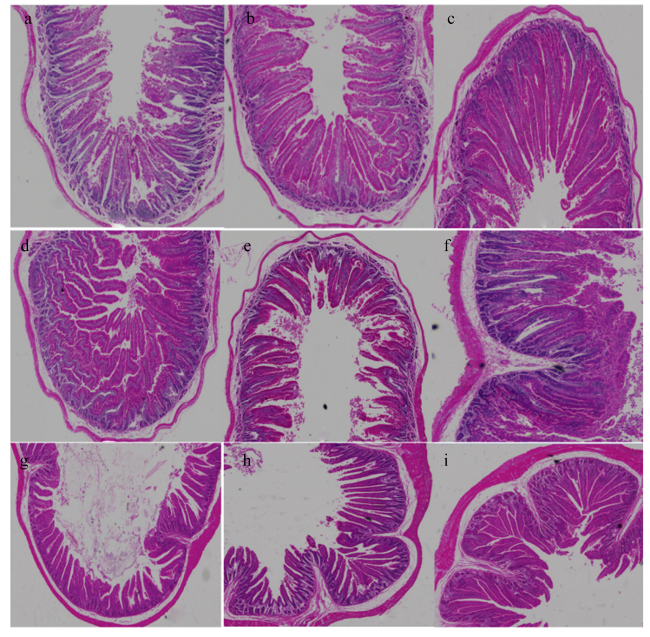
图1所示,与T0组相比,T1组和T2组肉兔十二指肠、空肠和回肠的绒毛更加致密,环状皱襞更多,绒毛断裂的情况明显减少。
图1 饲粮中复合添加马齿苋和柠檬酸对肉兔肠道组织形态的影响

a~c分别表示T0组、T1组和T2组十二指肠,d~f分别表示T0组、T1组和T2组空肠,g~i分别表示T0组、T1组和T2组回肠。

Fig.1 Effects of combined supplementation of purslane and citric acid in diet on intestinal tissue morphology of meat rabbits (40×)

From a to c represented duodenum in T0 group, T1 group and T2 group, from d to f represented jejunum in T0 group, T1 group and T2 group, and from g to i represented ileum in T0 group, T1 group and T2 group, respectively.

表3可知,T2组肉兔十二指肠隐窝深度显著低于T0组(P<0.05);T1组和T2组空肠绒毛高度显著高于T0组(P<0.05),且T2组空肠绒毛高度显著高于T1组(P<0.05);T1组和T2组回肠绒毛高度和V/C值显著高于T0组(P<0.05),且T2组回肠绒毛高度和V/C值显著高于T1组(P<0.05)。
表3 饲粮中复合添加马齿苋和柠檬酸对肉兔肠道组织形态的影响

Table 3 Effects of combined supplementation of purslane and citric acid in diet on intestinal tissue morphology of meat rabbits

项目
Items
组别Groups P
P-value
T0 T1 T2
十二指肠Duodenum
绒毛高度Villus height/μm 1 532.55±18.55 1 450.90±38.16 1 451.28±28.29 0.462
隐窝深度Crypt depth/μm 170.71±10.26a 149.09±6.03ab 136.67±5.23b 0.015
绒毛高度/隐窝深度V/C 9.28±0.45 9.90±0.42 10.62±0.68 0.320
空肠Jejunum
绒毛高度Villus height/μm 868.11±39.57c 1 164.24±49.22b 1 300.15±25.95a <0.001
隐窝深度Crypt depth/μm 134.36±12.05 153.93±16.25 154.27±13.54 0.424
绒毛高度/隐窝深度V/C 6.75±1.00 7.61±0.65 7.93±0.46 0.532
回肠Ileum
绒毛高度Villus height/μm 694.47±38.86c 856.75±34.97b 1 022.60±27.06a 0.002
隐窝深度Crypt depth/μm 89.17±6.96 83.69±4.41 84.31±5.93 0.883
绒毛高度/隐窝深度V/C 8.56±0.57c 10.35±0.98b 12.26±1.04a 0.002

同行数据肩标无字母或相同字母表示差异不显著(P>0.05),不同字母表示差异显著(P<0.05)。表4表5同。

In the same row, values with no letter or the same letter superscripts mean no significant difference (P>0.05), while with different letter superscripts mean significant difference (P<0.05). The same as Table 4 and Table 5.

2.2 饲粮中复合添加马齿苋和柠檬酸对肉兔肠道通透性的影响

表4可知,与T0组相比,T1组和T2组肉兔血清D-乳酸含量有所降低,但差异不显著(P>0.05);T1组和T2组血清DAO活性显著降低(P<0.05)。
表4 饲粮中复合添加马齿苋和柠檬酸对肉兔肠道通透性的影响

Table 4 Effects of combined supplementation of purslane and citric acid in diet on intestinal permeability of meat rabbits

项目
Items
组别Groups P
P-value
T0 T1 T2
D-乳酸D-lactic acid/(mmol/L) 5.15±0.64 4.56±0.61 3.95±0.43 0.299
二胺氧化酶DAO/(U/mL) 15.37±1.62a 10.32±1.01b 9.29±1.69b 0.023

2.3 饲粮中复合添加马齿苋和柠檬酸对肉兔肠道紧密连接蛋白相关基因表达的影响
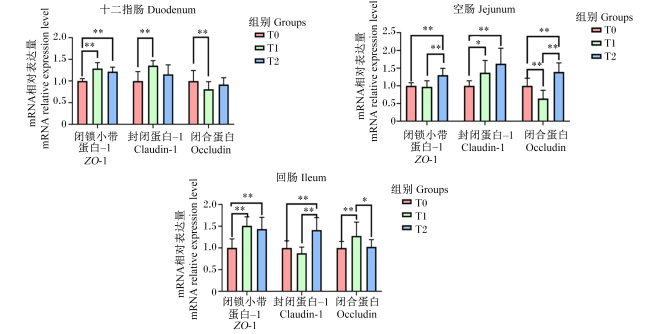
图2所示,在十二指肠中,与T0组相比,T1组肉兔ZO-1和claudin-1 mRNA相对表达量极显著提高(P<0.01),而occludin mRNA相对表达量极显著降低(P<0.01);T2组ZO-1 mRNA相对表达量极显著提高(P<0.01)。在空肠中,与T0组相比,T2组肉兔ZO-1、claudin-1和occludin mRNA相对表达量均极显著提高(P<0.01);T1组claudin-1 mRNA相对表达量显著提高(P<0.05),而occludin mRNA相对表达量极显著降低(P<0.01)。此外,T2组空肠ZO-1和occludin mRNA相对表达量均极显著高于T1组(P<0.01)。在回肠中,与T0组相比,T2组肉兔ZO-1和claudin-1 mRNA相对表达量均极显著提高(P<0.01),T1组ZO-1和occludin mRNA相对表达量均极显著提高(P<0.01)。此外,T2组回肠claudin-1 mRNA相对表达量极显著高于T1组(P<0.01),而回肠occludin mRNA相对表达量显著低于T1组(P<0.05)。
图2 饲粮中复合添加马齿苋和柠檬酸对肉兔肠道紧密连接蛋白相关基因表达的影响

数据柱标注**表示差异极显著(P<0.01),*表示差异显著(P<0.05)。图3同。

Fig.2 Effects of combined supplementation of purslane and citric acid in diet on expression of tight junction protein-related genes in intestine of meat rabbits

Value columns with ** indicated extremely significant difference (P<0.01), and * indicated significant difference (P<0.05). The same as Fig.3.

2.4 饲粮中复合添加马齿苋和柠檬酸对肉兔盲肠微生物区系的影响

2.4.1 肉兔盲肠微生物区系组成分析

表5可知,T2组肉兔盲肠在科、属和种水平上鉴定出的微生物数量显著低于T0组(P<0.05)。
表5 肉兔盲肠在各分类水平上鉴定出的微生物

Table 5 Microorganisms identified at each taxonomic level in cecum of meat rabbits %

项目
Items
组别Groups P
P-value
T0 T1 T2
界Domain 1.17±0.17 1.33±0.21 1.50±0.22 0.521
门Phylum 10.50±0.56 9.17±0.54 9.17±0.31 0.114
纲Class 18.00±0.89 16.33±0.56 15.83±0.17 0.061
目Order 23.50±0.96 23.17±1.28 20.71±0.93 0.231
科Family 39.17±1.40a 36.67±1.38ab 33.50±0.99b 0.022
属Genus 40.00±1.75a 39.50±1.65a 34.57±0.68b 0.027
种Species 19.00±1.77a 17.17±2.20ab 12.33±0.50b 0.033
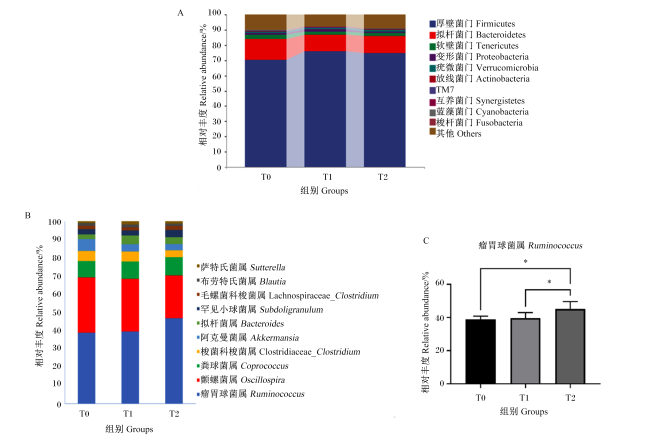
图3-A所示,在门水平上,厚壁菌门(Firmicutes)和拟杆菌门(Bacteroidetes)为各组肉兔盲肠中的优势菌门;如图3-B所示,在属水平上,瘤胃球菌属(Ruminococcus)、颤螺菌属(Oscillospira)和粪球菌属(Coprococcus)等为各组肉兔盲肠中的优势菌属;如图3-C所示,T2组肉兔盲肠瘤胃球菌属相对丰度显著高于T0组和T1组(P<0.05),T1组盲肠瘤胃球菌属相对丰度与T0组相比无显著差异(P>0.05)。
图3 肉兔盲肠微生物区系组成

Fig.3 Microbiota composition in cecum of meat rabbits

2.4.2 肉兔盲肠微生物区系多样性分析

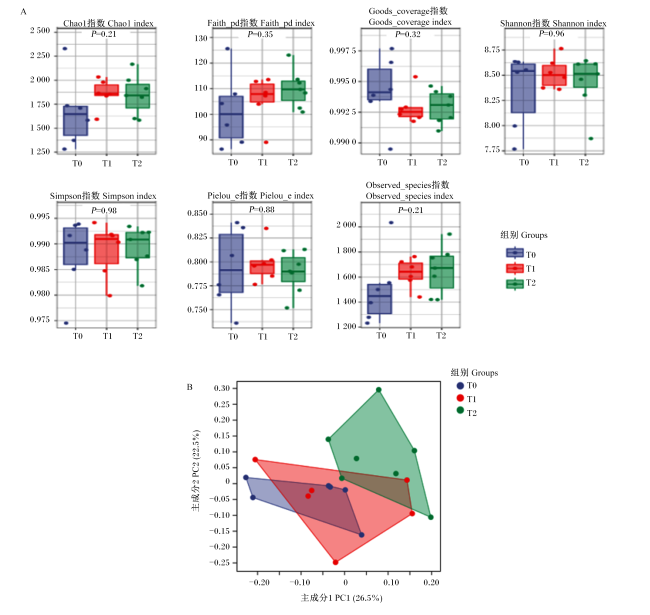
图4-A所示,alpha多样性分析结果表明,各组肉兔盲肠内容物样品用来表示测序深度的Goods_coverage指数均达到了99%以上,表明测序具有代表性;各组间盲肠微生物区系alpha多样性指数均无显著差异(P>0.05)。如图4-B所示,正交偏最小二乘法判别分析(OPLS-DA)结果表明,各组肉兔盲肠微生物区系在主成分1(PC1)和主成分2(PC2)这2个维度上均有重叠区域,但T0组和T2组间的样品各自聚集的距离相对较远。
图4 肉兔盲肠微生物区系多样性分析

A:alpha多样性分析 alpha diversity analysis;B:正交偏最小二乘法判别分析 OPLS-DA。

Fig.4 Microbiota diversity analysis in cecum of meat rabbits

表6可知,相似性分析(ANOSIM)结果表明,各组间肉兔盲肠微生物区系无显著差异(P>0.05)。
表6 肉兔盲肠微生物区系相似性分析

Table 6 ANOSIM of microbiota in cecum of meat rabbits

组1
Group1
组2
Group 2
样本数
Sample size
置换数
Permutations
决定系数
R2
P
P-value
Q
Q-value
全部All 19 999 1.066 394 0.189
T0 T1 12 999 1.108 696 0.186 0.312
T0 T2 13 999 1.079 550 0.208 0.312
T1 T2 13 999 1.015 883 0.403 0.403

2.4.3 肉兔盲肠微生物区系差异标志物筛选

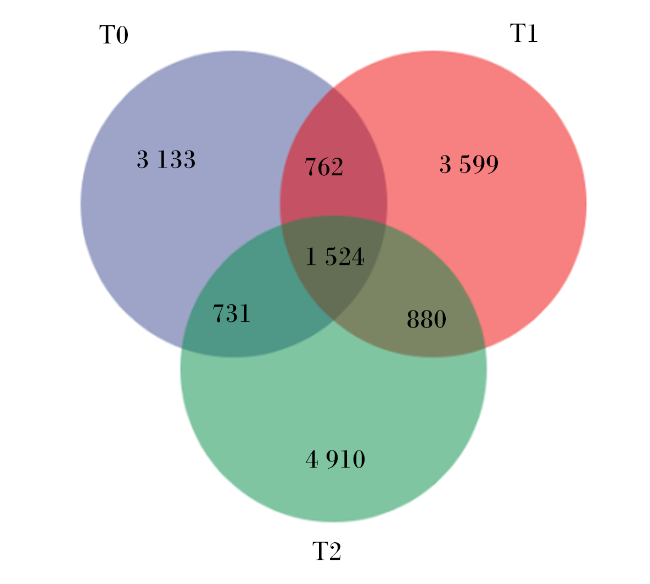
图5所示,3组肉兔盲肠微生物区系共有的扩增子序列变异(ASV)数为1 524个,T0组、T1组和T2组分别各自独有的ASV数为3 133、3 599和4 910个。
图5 肉兔盲肠微生物区系扩增子序列变异韦恩图

Fig.5 Venn diagram of amplicon sequence variations in cecal microbiota of meat rabbits

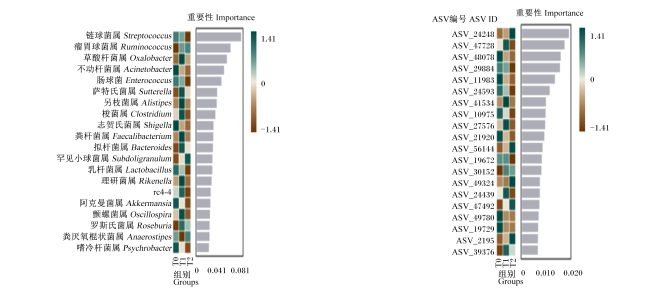
图6所示,肉兔盲肠微生物区系组间差异标志物种随机森林分析结果表明,在属水平,瘤胃球菌属和链球菌属(Streptococcus)是主要的差异菌属。由表7可知,经分析和筛选得出,ASV_21920可能是链球菌属在组间的差异标志物种,ASV_24248可能是瘤胃球菌属在组间的差异标志物种。
图6 肉兔盲肠微生物区系组间差异标志物种随机森林分析

Fig.6 Random forest analysis of marker species with differences between groups in cecal microbiota of meat rabbits

表7 肉兔盲肠微生物区系差异物种宏基因组测序分析

Table 7 MetagenomeSeq analysis of differential species in cecal microbiota of meat rabbits

ASV编号
ASV ID
组别Groups 分类学
Taxonomy
T0 T1 T2
ASV_21920 24.5 12.1 6.0 厚壁菌门(p_Firmicutes);杆菌纲(c_Bacilli);乳杆菌目(o_Lactobacillales);
链球菌科(f_Streptococcaceae);链球菌属(g_Streptococcus);
未鉴定链球菌属种(s_unidentified_Streptococcus)
ASV_24248 106.0 277.8 986.0 厚壁菌门(p_Firmicutes);梭菌纲(c_Clostridia);梭菌目(o_Clostridiales);
瘤胃球菌科(f_Ruminococcaceae);瘤胃球菌属(g_Ruminococcus);
白色瘤胃球菌(s_Ruminococcus albus)

2.4.4 肉兔盲肠微生物区系代谢通路分析

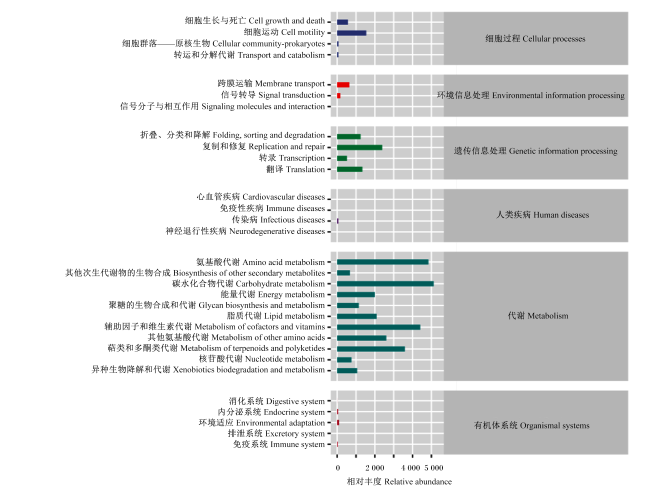
本试验先采用PICRUSt2软件来预测样本功能丰度,再使用京都基因与基因组百科全书(KEGG)数据库进行代谢通路的预测,结果如图7所示,3组肉兔盲肠微生物均参与了6大类代谢通路;其中,代谢通路参与较多的有碳水化合物代谢和氨基酸代谢,遗传信息处理通路主要进行了复制和修复,细胞过程通路主要有细胞运动。
图7 肉兔盲肠微生物区系KEGG代谢通路分析

Fig.7 Analysis of KEGG metabolic pathways in cecal microbiota of meat rabbits

3 讨论

肠道的健康状况与动物的健康息息相关。肠道不仅是动物最大的免疫系统,约70%的淋巴细胞和80%的抗体分布并来源于肠道[9];也是主要的消化器官,其结构和功能的完整将直接影响营养物质的消化吸收与利用。对家兔来说,小肠同样是营养物质消化吸收的主要场所,其黏膜的绒毛高度越高,表明肠道的吸收面积越大;隐窝深度变浅则会降低肠腺细胞的更新频率,促使其更加成熟,从而使得分泌消化酶的能力更强。因此,采用绒毛高度、隐窝深度以及两者的比值能衡量肠道的吸收能力。研究表明,复方中草药可显著提高新西兰白兔空肠绒毛高度,降低隐窝深度[10];马齿苋水提物可显著提高热应激小鼠空肠绒毛高度[7]。在断奶仔猪饲粮中添加1%二甲酸钾可显著提高空肠绒毛高度[11];饲粮添加0.8%柠檬酸有提高四川白鹅十二指肠和空肠V/C值的趋势[12];甲酸和甲酸铵复合添加剂可显著提高肉仔鸡空肠和回肠绒毛高度,降低空肠隐窝深度,同时提高空肠V/C值[13]。本研究中,在肉兔饲粮中添加马齿苋可显著提高肉兔空肠和回肠绒毛高度以及回肠V/C值;饲粮中复合添加马齿苋和柠檬酸除了能显著提高上述指标外,还能显著降低十二指肠隐窝深度,这与以上报道结果相符。D-乳酸和DAO可作为血清学检测肠道通透性的指标,也能反映肠道是否有炎症。D-乳酸由肠道的细菌产生,在肠道屏障功能受损时,其能透过受损的肠黏膜被大量释放至外周血中,参与调控机体的各种代谢反应,是肠道抗感染的一项重要屏障。DAO是哺乳动物肠黏膜上皮绒毛中具有高度活性的一种细胞内酶,具有调节细胞内离子平衡、促进肠道细胞修复等功能,能反映肠道物理屏障的完整性和受损程度[14]。本研究中,饲粮中添加马齿苋以及复合添加马齿苋和柠檬酸可显著降低肉兔血清DAO活性,这与发酵马齿苋能显著降低断奶仔猪血清DAO活性的结果[15]相一致。由此可见,在肉兔饲粮中添加马齿苋或复合添加马齿苋和柠檬酸均能提高小肠上皮结构的完整性。
肠道紧密连接是一类蛋白复合体,由2种整合蛋白[封闭蛋白(claudin)和occludin]、斑块蛋白[上皮细胞钙黏蛋白(E-cadherin)、ZO-1和连接黏附分子(JAM)]和其他蛋白组成。肠道黏膜上皮细胞间的紧密连接会在上皮细胞间形成限制溶质和物质运动的屏障,对维持上皮细胞间的极性及调节肠道物理屏障的通透性具有重要作用[16]。紧密连接蛋白结构变异或不完整会造成肠黏膜上皮间隙扩大,通透性增加,细菌或内毒素通过细胞间隙进入体内就会引起肠道炎症性疾病。其中,claudin和occludin通过连接顶端细胞间隙,调节离子和小的不带电溶质的被动扩散来形成调节渗透性屏障[17]。当occludin表达量下降和亚基去除会导致肠道通透性增加[18],claudin分子的胞外环与相邻细胞间的相互作用会影响选择性分子的通过[19],而ZO-1是连接整合蛋白和肌动蛋白之间细胞骨架的桥梁。目前,有关马齿苋和柠檬酸对肠道紧密连接蛋白影响的报道较少。而复方中草药可显著上调兔十二指肠和回肠中occludin mRNA相对表达量以及回肠中ZO-1 mRNA相对表达量[10];由马齿苋、槐花、刺五加、土鳖虫和猪苓组成的草药混合物可通过显著提高黄羽肉鸡42日龄空肠绒毛高度和绒隐比,上调claudin-1和occludin mRNA相对表达量来增强肠道的屏障功能[20];马齿苋水提物可显著提高热应激小鼠空肠黏膜中ZO-1 mRNA相对表达量[7]。此外,酸化剂能将紧密蛋白锚定在肌动蛋白上,促进两者间的交联,从而增强上皮细胞间的紧密性[21]。例如,酸化剂能显著提高断奶仔猪空肠claudin-1 mRNA相对表达量[22];有机酸(甲酸和丙酸)可显著提高伊拉肉兔空肠黏膜3种紧密连接蛋白mRNA相对表达量[23]。本研究中,饲粮中添加马齿苋显著提高肉兔十二指肠和回肠ZO-1 mRNA相对表达量,饲粮中复合添加马齿苋和柠檬酸显著提高十二指肠、空肠和回肠ZO-1 mRNA相对表达量,表明马齿苋可能通过ZO-1调控紧密连接蛋白的组装。此外,复合添加马齿苋和柠檬酸还显著提高肉兔回肠claudin-1 mRNA相对表达量,尤其是能同时提高空肠中这3种紧密连接蛋白的mRNA相对表达量,这可能对空肠的物理屏障功能起到重要作用。由此可见,饲粮中复合添加马齿苋和柠檬酸可能会促进肉兔小肠物理屏障功能的发挥。
肠道菌群的稳态对维持宿主肠道健康具有重要意义,其会影响营养物质消化吸收、机体供能以及维持肠道黏膜屏障等功能的正常运行。研究表明,马齿苋水提物可显著提高热应激小鼠肠道内优势菌如乳酸杆菌和链球菌等的相对丰度[7];复方中草药可显著提高Chao1指数,从而提高肉兔盲肠微生物的多样性[10]。本研究中,在肉兔饲粮中复合添加马齿苋和柠檬酸后使盲肠微生物在科、属和种水平上的物种显著减少,其中T2组盲肠瘤胃球菌属相对丰度显著高于T0组和T1组,说明马齿苋和柠檬酸复合使用比马齿苋单独使用的效果更好。
瘤胃球菌属是厌氧型革兰氏阳性菌,首次发现于反刍动物的瘤胃中。有研究报道,通过对比奶牛和湖羊的瘤胃微生物与兔子的盲肠微生物发现,兔子盲肠中得到7个与瘤胃微生物相同的操作分类单元(OTU),说明兔子盲肠中也寄居着与瘤胃相似的球菌[24]。研究表明,复方中草药可显著提高生茸期梅花鹿瘤胃中瘤胃球菌属相对丰度[25],乙酸钠可显著提高奶山羊瘤胃中瘤胃球菌属相对丰度[26],1%柠檬酸能显著提高肉兔盲肠中瘤胃球菌属相对丰度[6]。本研究中,饲粮中添加马齿苋对肉兔盲肠瘤胃球菌属相对丰度无显著影响,复合添加马齿苋和柠檬酸后该菌属相对丰度显著提高,这说明在提高肠道有益菌相对丰度方面,马齿苋和柠檬酸复合添加可起到互补作用。此外,含马齿苋的中草药混合物显著提高黄羽肉鸡空肠中瘤胃球菌属、乳杆菌属和颤螺菌属相对丰度,显著降低空肠粪杆菌属相对丰度,且上述菌属相对丰度与其生长性能、肠道完整性和紧密连接蛋白等相关[20],这与本研究结果一致。

4 结论

饲粮中复合添加马齿苋和柠檬酸能通过改善肉兔小肠组织形态和通透性、增强小肠紧密连接蛋白表达以及提高盲肠瘤胃球菌属相对丰度来提高肠道物理和微生物屏障功能,且效果优于单独添加马齿苋。
[1]
吴晓红, 高生平. 马齿苋中活性成分及其药理作用的研究进展[J]. 安徽农业科学, 2023, 51(10):21-24.

WU X H, GAO S P. Research progress on active components and pharmacological effects of purslane[J]. Journal of Anhui Agricultural Sciences, 2023, 51(10):21-24.(in Chinese)

[2]
DI CAGNO R, FILANNINO P, VINCENTINI O, et al. Fermented Portulaca oleracea L. juice:a novel functional beverage with potential ameliorating effects on the intestinal inflammation and epithelial injury[J]. Nutrients, 2019, 11(2):248.

[3]
党文庆, 何敏, 上官明军, 等. 饲粮中复合添加马齿苋、柠檬酸和葡萄糖氧化酶对肉兔生长性能、屠宰性能以及免疫和抗氧化功能的影响[J]. 动物营养学报, 2024, 36(3):1857-1866.

DOI

DANG W Q, HE M, SHANG GUAN M J, et al. Effects of compound supplementation of purslane,citric acid and glucose oxidase on growth performance,slaughter performance,immune and antioxidant functions of meat rabbits[J]. Chinese Journal of Animal Nutrition, 2024, 36(3):1857-1866.(in Chinese)

[4]
吕国晓. 酸化剂对肉鸡生长发育、养分利用和盲肠微生物影响的研究[D]. 硕士学位论文. 泰安: 山东农业大学, 2024.

LV G X. Study on the effects of acidifiers on growth and development,nutrient utilization and cecal microorganisms in broiler chickens[D]. Master’s Thesis. Tai’an: Shandong Agricultural University, 2024.(in Chinese)

[5]
WANG C, LIU Q, YE F C, et al. Dietary purslane (Portulaca oleracea L.) promotes the growth performance of broilers by modulation of gut microbiota[J]. AMB Express, 2021, 11(1):31.

[6]
郑建婷, 冯国亮, 曹亮, 等. 柠檬酸对伊拉肉兔盲肠微生物多样性及代谢产物的影响[J]. 动物营养学报, 2020, 32(8):3808-3818.

DOI

ZHENG J T, FENG G L, CAO L, et al. Effects of citric acid on caecal microbial diversity and metabolites of Ira rabbits[J]. Chinese Journal of Animal Nutrition, 2020, 32(8):3808-3818.(in Chinese)

[7]
郭月. 马齿苋水提物对热应激小鼠肠道结构及吸收功能的影响[D]. 硕士学位论文. 保定: 河北农业大学, 2020.

GUO Y. The effect of aqueous extract of Portulaca oleracea L. on the structure and absorption function of intestinal in mice with heat stress[D]. Master’s Thesis. Baoding: Hebei Agricultural University, 2020.(in Chinese)

[8]
中华人民共和国农业农村部. 肉兔营养需要量:NY/T 4049—2021[S]. 北京: 中国农业出版社, 2021.

Ministry of Agriculture and Rural Affairs of the People’s Republic of China. Nutrient requirements of meat rabbit:NY/T 4049—2021[S]. Beijing: China Agriculture Press, 2021.(in Chinese)

[9]
吴峰洋, 李冲, 崔嘉, 等. 甘露寡糖对兔肠道健康及功能形态的影响[J]. 家畜生态学报, 2017, 38(6):5-7,36.

WU F Y, LI C, CUI J, et al. Effects of mannose oligosaccharides on intestinal tract health and functional morphology of rabbits[J]. Acta Ecologae Animalis Domastici, 2017, 38(6):5-7,36.(in Chinese)

[10]
徐翔飞, 黄盼, 崔雪梅, 等. 复方中草药对兔生长性能和肠道健康的影响[J]. 中国兽医杂志, 2024, 60(1):134-143.

XU X F, HUANG P, CUI X M, et al. Effects of compound Chinese herbal medicine on growth performance and intestinal health in rabbits[J]. Chinese Journal of Veterinary Medicine, 2024, 60(1):134-143.(in Chinese)

[11]
淡江华, 李国柱, 冯燕平, 等. 不同饲料添加剂对断奶仔猪生长性能、免疫性能、肠道健康及粪便微生物的影响[J]. 动物营养学报, 2024, 36(9):5581-5593.

DOI

DAN J H, LI G Z, FENG Y P, et al. Effects of different feed additives on growth performance,immune performance,intestinal health and fecal microorganisms of weaned piglets[J]. Chinese Journal of Animal Nutrition, 2024, 36(9):5581-5593.(in Chinese)

[12]
张永康. 柠檬酸对生长期四川白鹅生产性能、血液指标、肠道健康和肝脏转录的影响[D]. 硕士学位论文. 重庆: 西南大学, 2023.

ZHANG Y K. Effects of citric acid on growth performance,blood parameters,intestinal health and hepatic transcriptomics of growing Sichuan white goose[D]. Master’s Thesis. Chongqing: Southwest University, 2023.(in Chinese)

[13]
刘新泽, 胡友军, 赵晓南, 等. 饲粮中添加不同组合的酸化剂对肉鸡肠道微生物菌群、肠道形态以及胃蛋白酶活性的影响[J]. 动物营养学报, 2022, 34(6):3559-3569.

DOI

LIU X Z, HU Y J, ZHAO X N, et al. Effects of dietary different combinations of acidifiers on intestinal microbial flora,intestinal morphology and pepsin activity of broilers[J]. Chinese Journal of Animal Nutrition, 2022, 34(6):3559-3569.(in Chinese)

[14]
KETTNER L, SEITL I, FISCHER L. Recent advances in the application of microbial diamine oxidases and other histamine-oxidizing enzymes[J]. World Journal of Microbiology & Biotechnology, 2022, 38(12):232.

[15]
XU L, GAO G, ZHOU Z A, et al. Fermented purslane (Portulaca oleracea L.) supplementation enhances growth and immune function parallel to the regulation of gut microbial butyrate production in weaned piglets[J]. Microorganisms, 2024, 12(7):1403.

[16]
陈意, 李方方, 张勇, 等. 肠黏膜上皮组织紧密连接的生物学功能和作用机理[J]. 动物营养学报, 2017, 29(9):3068-3074.

CHEN Y, LI F F, ZHANG Y, et al. Biological function and mechanism of tight junction of intestinal mucosal epithelium[J]. Chinese Journal of Animal Nutrition, 2017, 29(9):3068-3074.(in Chinese)

[17]
MADARA J L. Intestinal absorptive cell tight junctions are linked to cytoskeleton[J]. The American Journal of Physiology, 1987, 253(1 Pt 1):C171-C175.

[18]
MCLAUGHLIN J, PADFIELD P J, BURT J P H, et al. Ochratoxin a increases permeability through tight junctions by removal of specific claudin isoforms[J]. American Journal of Physiology.Cell Physiology, 2004, 287(5):C1412-C1417.

[19]
VAN ITALLIE C M, ANDERSON J M. Claudins and epithelial paracellular transport[J]. Annual Review of Physiology, 2006,68:403-429.

[20]
LIU M J, ZHOU J, LI Y, et al. Effects of dietary polyherbal mixtures on growth performance,antioxidant capacity,immune function and jejunal health of yellow-feathered broilers[J]. Poultry Science, 2023, 102(7):102714.

[21]
FÖRSTER C. Tight junctions and the modulation of barrier function in disease[J]. Histochemistry and Cell Biology, 2008, 130(1):55-70.

DOI PMID

[22]
项新东. 酸化剂对断奶仔猪生长性能、免疫功能、抗氧化能力和肠道菌群的影响[D]. 硕士学位论文. 武汉: 华中农业大学, 2022.

XIANG X D. Effects of acidifiers on growth performance,immunity,antioxidant capacity and gut microbiota of weaned piglets[D]. Master’s Thesis. Wuhan: Huangzhong Agricultural University, 2022.(in Chinese)

[23]
杨国峰, 贺佳仪, 狄斌, 等. 复合酸化剂对伊拉兔空肠消化酶活性、免疫功能和紧密连接蛋白表达的影响[J]. 动物营养学报, 2023, 35(3):1948-1956.

DOI

YANG G F, HE J Y, DI B, et al. Effects of compound acidifier on digestive enzyme activity,immune function and tight junction protein expression in jejunum of Ira rabbits[J]. Chinese Journal of Animal Nutrition, 2023, 35(3):1948-1956.(in Chinese)

[24]
孙中远, 王佳堃, 刘建新. 水牛、奶牛和湖羊瘤胃及兔盲肠内容物中细菌的多样性分析[C]//印遇龙,谭支良,贺建华.中国畜牧兽医学会动物营养学分会第十一次全国动物营养学术研讨会论文集.北京:中国农业科学技术出版社, 2012:255.

SUN Z Y, WANG J K, LIU J X. Diversity analysis of bacteria in the rumen of buffaloes,dairy cows and lake sheep and in the contents of rabbit cecum[C]//YIN Y L,TAN Z L,HE J H.Proceedings of the 11th National Symposium on Animal Nutrition of the Animal Nutrition Branch of the Chinese Association of Animal Science and Veterinary Medicine. Beijing: China Agricultural Science and Technology Press, 2012,255.(in Chinese)

[25]
魏倩倩. 复方中草药添加剂对生茸期梅花鹿生产性能、血清生化及胃肠道菌群的影响[D]. 硕士学位论文. 北京: 中国农业科学院, 2023.

WEI Q Q. Effects of compound Chinese herbal additives on performance,serum biochemistry and gastrointestinal microbiota in velvet antler of sika deer during growing stage[D]. Master’s Thesis. Beijing: The Chinese Academy of Agricultural Sciences, 2023.(in Chinese)

[26]
王亚玲, 孔鹏辉, 袁冬冬, 等. 饲粮添加乙酸钠对奶山羊泌乳性能和瘤胃微生物区系的影响[J]. 动物营养学报, 2023, 35(1):428-438.

DOI

WANG Y L, KONG P H, YUAN D D, et al. Effects of dietary sodium acetate on lactation performance and rumen microbiota of dairy goats[J]. Chinese Journal of Animal Nutrition, 2023, 35(1):428-438.(in Chinese)

DOI

Outlines

/