

在现代蜜蜂规模化养殖中,中华蜜蜂(Apis cerana cerana)蜂群中常发生由病原菌,如蜂房蜜蜂球菌等引起的传染性疾病,其普遍具有快速传播、高死亡率以及难根治等特点,严重阻碍了中华蜜蜂的生长发育及繁殖[1-2],并被认为是引起蜜蜂种群下降的重要原因之一[3]。养殖户为了避免由蜜蜂疾病引起的经济利益受损,一般在蜜蜂饲养过程中在其饲粮中添加四环素、土霉素等抗生素,但抗生素的治疗往往不够有效,且长期使用还会导致蜜蜂肠道微生态平衡破坏、病原菌耐药性增强及蜂产品药物残留等问题,对人类健康产生诸多危害[4-6]。另有研究表明,抗生素抗性基因在蜜蜂体内积累,蜜蜂作为传播媒介,可以将抗性基因转移到病原体上,甚至有可能在授粉、哺育和社交等过程中传播,对人类和动物健康造成潜在风险[7]。因此,在蜜蜂养殖过程中寻找抗生素的替代品,对提高蜜蜂对疾病的防御能力、降低蜜蜂死亡率具有重要的现实意义。
益生菌作为潜在的抗生素替代品之一,可通过有效调节宿主肠道微生态环境,提高有益菌的比例,同时通过竞争性抑制病原菌的生长,在疾病预防中发挥十分重要的作用[8-10]。研究显示,益生菌可增强宿主免疫力,提高其对饲粮的利用率,对宿主健康生长发育具有促进作用[11-12]。乳酸菌是最为常见的益生菌。本课题组前期研究表明,在中华蜜蜂饲粮中添加植物乳杆菌(Lactobacillus plantarum)可提高其肠道消化酶活性,增强肠道免疫功能[13];另有报道称,饲粮中添加乳酸菌可以显著提高蜜蜂肠道有益菌的丰度,改善肠道菌群结构,提高蜂群的群势,并提升蜂群的生产性能[14-15];研究还显示,乳酸菌对蜜蜂的病原菌如蜂房蜜蜂球菌、蜜蜂微孢子虫等有一定的抑制作用[16]。
不过,关于抗生素和乳酸菌对昆虫的影响还有待进一步研究,特别是关于其对昆虫肠道健康方面的作用,仍缺乏二者在蜜蜂饲粮中应用的基础数据。鉴于此,本试验在实验室条件下,通过在中华蜜蜂饲粮中添加四环素和植物乳杆菌,观察肠道菌群结构和肠道组织发育状态的差异,同时比较在不同饲粮条件下的蔗糖消耗量以及工蜂存活率的变化,以期为其在蜜蜂养殖中的应用提供理论和数据支持。
1 材料与方法
1.1 试验材料
试验所用四环素购自上海麦克林生化科技有限公司;试验所用植物乳杆菌购自苏州北纳创联生物技术有限公司,其中活菌数≥1×10¹¹ CFU/g;MRS、LB和EA固体培养基均购自青岛海博生物技术有限公司;磷酸盐缓冲液(PBS)购自生工生物工程(上海)股份有限公司。
本试验所用中华蜜蜂于2023年9月取自重庆市荣昌区直升科研基地试验蜂场,试验蜂群3群,为自然环境下郎氏标准箱饲养,群势均为4足框,其中卵平均0.16足框、幼虫平均0.33足框、封盖子平均0.65足框。在试验蜂群中选取封盖子脾(工蜂即将出房)放置于饲养盒(48.8 cm×10.0 cm×24.0 cm)中带回重庆市畜牧科学院实验室,封盖子脾连同饲养盒一起放置于人工气候箱中过夜培养,人工气候箱条件为温度34 ℃、相对湿度70%[17]。于第2天获得24 h内出房的成年工蜂,记为0日龄。
1.2 试验设计和饲养管理
1.3 监测指标及方法
1.3.1 蔗糖消耗量的测定
对照组和试验组蔗糖溶液的饲喂采用注射器的方式饲喂,将无菌注射器(每天更换)吸入蔗糖溶液后从饲喂盒上方插入其中供蜜蜂食用。注射器中的饲喂液每周新鲜配制并保存于4 ℃冰箱。用注射器吸取约3 mL饲喂液,采用电子天平(精度0.1 mg)称重后饲喂蜜蜂,第2天约相同时间(±30 min)将注射器连同剩余的饲喂液再次称重,连续2 d重量的差值除以当时笼子中存活的蜜蜂的数量,即为每只蜜蜂每天蔗糖溶液的消耗量。为了排除培养箱中的蒸发量,将每组3个对照注射器装入不同处理的蔗糖溶液,放入无蜜蜂的昆虫饲喂盒中,每天放入培养箱中并测量,用平均蒸发量来调整所有处理的蔗糖溶液消耗量。
1.3.2 蜜蜂中肠组织发育状态观察
中肠组织发育状态观察采取制作中肠组织切片的方式进行。对照组和试验组蜜蜂分别在饲养10 d后取样,首先利用剪刀和镊子解剖出蜜蜂的肠道,截取中肠,放于多聚甲醛固定液中,然后将固定好的中肠组织进行苏木精-伊红染色,切片的制作由武汉塞维尔生物科技有限公司完成,选取中肠中段大致相同位置切片,显微镜(10×)拍照。肠壁厚度和隐窝深度的测量方法:将肠道平均分成4部分,每部分随机取1个测量点,取平均值作为蜜蜂中肠肠壁厚度和隐窝深度值。
1.3.3 肠道菌群培养分析
肠道菌群分析采用培养基培养的方式进行。对照组和试验组蜜蜂分别在饲养的第3天、第6天和第9天取样,利用剪刀和镊子无菌解剖出10只蜜蜂的从中肠到直肠部分,将其放入离心管中,称重,加入PBS 1 mL,利用手持式匀浆仪充分匀浆,用PBS 10倍梯度稀释后分别接种到不同的固体培养基中。乳酸菌的培养选用MRS培养基,细菌的培养选用LB培养基,肠球菌的培养选用EA培养基。37 ℃培养48 h后,统计乳酸菌、细菌和肠球菌数量,除以肠道样品的重量(g),计算对照组和试验组肠道菌群的lg(CFU/g)值。
1.3.4 工蜂存活率的测算
按照1.2中叙述的分组和饲喂方式,对照组和试验组均设置工蜂105只(分装到3个昆虫饲喂盒中饲喂,每盒平均为35只工蜂)。每天09:00(±30 min)将昆虫饲喂盒中死亡的工蜂取出,做好记录,直至最后一只工蜂死亡。
1.4 数据处理
采用SPSS 21.0软件进行单因素方差分析(one-way ANOVA),采用Duncan氏法进行多重比较,以P<0.05为差异显著。蔗糖消耗量数据采用SPSS 21.0软件进行重复测量方差分析(repeated measures ANOVA),存活率数据分析采用生存分析的Kaplan-Meier进行,并利用GraphPad Prism 8制图。
2 结果与分析
2.1 四环素和植物乳杆菌对中华蜜蜂蔗糖消耗量的影响
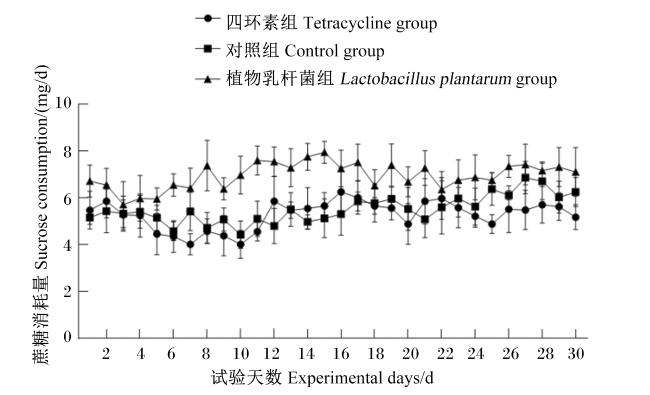
如图1所示,在试验期的第1天至第30天(即中华蜜蜂工蜂8~37日龄)生命周期中,四环素组中华蜜蜂工蜂蔗糖消耗量与对照组相比无显著差异(P>0.05),植物乳杆菌组工蜂蔗糖消耗量显著高于对照组(P<0.05)。对照组、四环素组和植物乳杆菌组工蜂不同日龄间蔗糖消耗量均有显著变化(P<0.05)。植物乳杆菌组工蜂蔗糖消耗量[(6.95±0.82) mg]约是对照组[(5.51±0.83) mg]的1.26倍。
2.2 四环素和植物乳杆菌对中华蜜蜂肠道菌群结构的影响
如图2所示,试验第3天、第6天和第9天,与对照组相比,四环素组中华蜜蜂肠道中乳酸菌和肠球菌数量显著减少(P<0.05);植物乳杆菌组肠道中乳酸菌数量显著增加(P<0.05),肠球菌数量显著减少(P<0.05)。
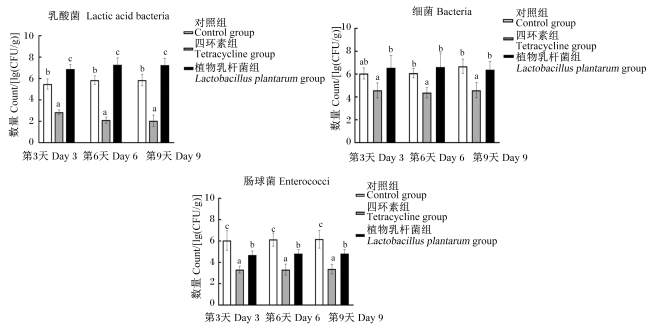
图2 四环素和植物乳杆菌对中华蜜蜂肠道菌群结构的影响数据柱上标注相同小写字母表示差异不显著(P>0.05),不同小写字母表示差异显著(P<0.05)。图3同。 Fig.2 Effects of tetracycline and Lactobacillus plantarum on intestinal microflora structure of Apis cerana cerana Value columns with the same letters mean no significant difference (P>0.05), while with different letters mean significant difference (P<0.05). The same as Fig.3. |
2.3 四环素和植物乳杆菌对中华蜜蜂肠道组织发育的影响
如图3所示,中华蜜蜂在室内饲养10 d后,四环素组中肠肠壁厚度和隐窝深度显著低于对照组和植物乳杆菌组(P<0.05),植物乳杆菌组中肠肠壁厚度和隐窝深度与对照组相比无显著差异(P>0.05)。由此推测,四环素显著降低中华蜜蜂中肠肠壁厚度和隐窝深度,而植物乳杆菌对中华蜜蜂肠道组织发育无显著影响。
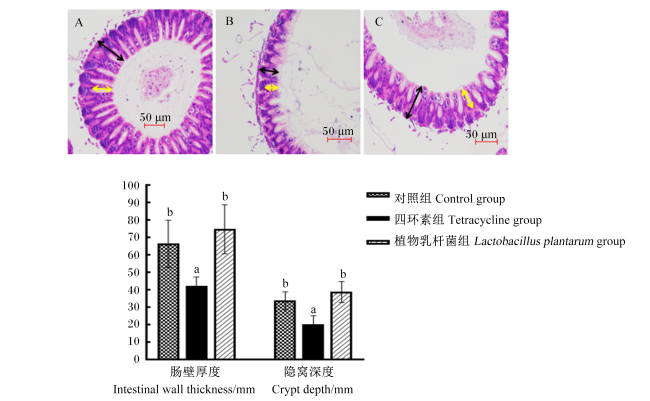
图3 四环素和植物乳杆菌对中华蜜蜂肠道组织发育的影响A:对照组;B:四环素组;C:植物乳杆菌组。肠壁厚度如图中黑色双箭头表示,隐窝深度如图中黄色双箭头表示(苏木精-伊红染色,显微镜10×)。 Fig.3 Effects of tetracycline and Lactobacillus plantarum on intestinal tissue development of Apis cerana cerana A: control group; B: tetracycline group; C: Lactobacillus plantarum group. Black double arrows indicated intestinal wall thickness, and yellow double arrows indicated crypt depth (hematoxylin-eosin staining, microscope 10×). |
2.4 四环素和植物乳杆菌对中华蜜蜂工蜂存活率的影响
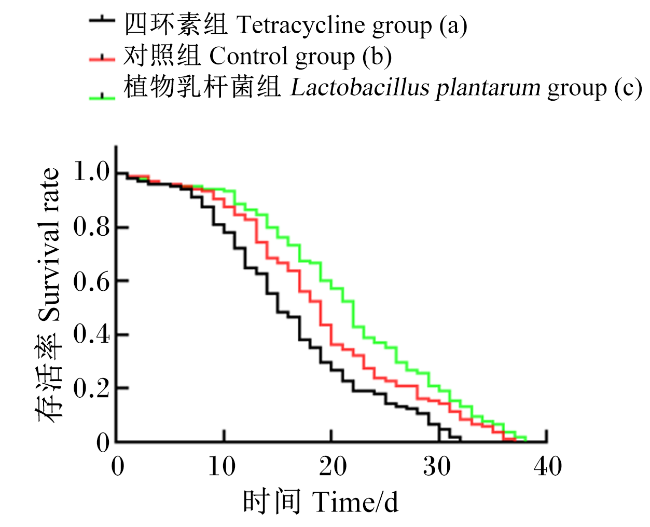
如图4所示,与对照组相比,饲喂四环素和植物乳杆菌均对中华蜜蜂工蜂存活率产生了显著影响(P<0.05)。其中,饲喂四环素导致工蜂平均生存时间比对照组显著缩短3.06 d(P<0.05),饲喂植物乳杆菌可以使工蜂平均生存时间比对照组显著延长2.40 d(P<0.05)。


3 讨论
3.1 四环素对中华蜜蜂蔗糖消耗、肠道菌群和组织发育及工蜂存活率的影响
前人研究表明,抗生素的使用会对昆虫的生长发育及存活率产生不利影响,如抗生素的添加导致小菜蛾(Plutella xylostella)发育历期延长、蛹的畸形率提高和成虫死亡率升高等[21-22];抗生素的使用导致西花蓟马(Frankliniella occidentalis)的存活率显著降低,并与抗生素的浓度和处理时间成反比[23]。本研究证实,抗生素的使用也降低了中华蜜蜂的工蜂存活率,根据本研究果推测,一方面是由于四环素的使用影响了蜜蜂肠道菌群的组成和结构,肠道共生菌减少,干扰了对食物的降解和消化,从而影响其存活;另一方面,四环素对蜜蜂肠道产生毒性效应,不利于中肠肠道的组织发育和保护,降低了对营养物质的吸收利用,从而导致蜜蜂存活率降低。
养蜂业中抗生素的广泛使用对蜜蜂的共生菌产生负面影响[24]。Raymann等[18]研究表明,四环素处理蜜蜂并没有完全根除肠道核心菌种,但四环素组蜜蜂肠道的细菌总丰度和几个菌种的绝对丰度均下降,其中对双歧杆菌(Bifidobacterium)、乳杆菌Firm-5(Lactobacillus Firm-5)、乳杆菌Firm-4(Lactobacillus Firm-4)和Snodgrassella这4种细菌影响最为显著。蜜蜂肠道中乳酸菌具有补充营养物质、促进消化吸收、调节免疫以及抵御病原菌等重要作用[25],本研究中,四环素处理后,中华蜜蜂肠道中乳酸菌数量显著减少,其数量降低则可能引起蜜蜂对营养物质的消化吸收、自身的免疫能力等受到影响,从而导致蜜蜂的存活率降低。这与前人关于抗生素对昆虫的影响作用上的研究结果一致,如Daisley等[26]将抗生素添加到西方蜜蜂的食物中,降低了成年工蜂中一些已知具有调节免疫功能和营养代谢的关键共生菌的丰度,并且这些共生菌丰度的变化在功能上表现为封盖子数量(蜂群营养状况和生产力的标志)的减少和成年工蜂血淋巴(免疫能力指标)抗菌能力的降低。下一步,笔者将进行在不同病原菌存在的条件下四环素对蜜蜂的影响作用研究。
3.2 植物乳杆菌对中华蜜蜂蔗糖消耗、肠道菌群和组织发育及工蜂存活率的影响
肠道菌群是蜜蜂生长发育、免疫功能和抵御病原体入侵的基础,良好的肠道菌群对蜜蜂的健康和活力至关重要,而且蜜蜂肠道菌群的结构可以成为蜜蜂健康的指标[27]。工蜂刚出房时肠道菌群很少,在与蜂群内的其他工蜂的社交过程中获得相关的共生菌,在自然条件下出房6 d后蜜蜂肠道微生物可稳定定殖,成为适应其生长的共生菌[28]。研究表明,与无菌工蜂相比,正常肠道菌群工蜂体重及肠道质量增加,腹部及大脑的胰岛素/类胰岛素(insulin/insulin-like signaling,IIS)信号通路ilp1和Vg mRNA表达上调,表明肠道菌群可以促进蜜蜂肠道发育和机体生长[29]。在与蜜蜂相关的共生菌中,乳酸菌通过提高蜜蜂的免疫力并帮助宿主克服病原菌的攻击,对蜜蜂具有益生作用[30],其作用涉及多种机制,包括释放抗菌物质的直接抑菌作用、对免疫系统的刺激作用以及乳酸菌参与的竞争排斥作用。
本研究中,选取7日龄中华蜜蜂工蜂,此时肠道菌群已稳定定殖,饲喂其植物乳杆菌后,对蜜蜂肠道微生态菌群结构起到积极的调节作用,即提高了乳酸菌数量和降低了肠球菌数量,最终使蜜蜂的存活率提高。本结果与前人的研究结果相似,如Li等[31]将益生菌SWL-19添加到食物中饲喂给家蚕(Bombyx mori L.)后,其体重和抗氧化能力显着提高,同时有效调节了肠道免疫功能。东方蜜蜂(Apis cerana)内源菌瑞士乳杆菌KM7也表现出较强的益生菌潜力,Lv等[32]将其添加到糖饲料中饲喂给蜜蜂后,对工蜂肠道微生态平衡起到了改善作用,并提高了工蜂的存活率。另外,结合本课题组前期研究发现植物乳杆菌可提高蜜蜂肠道消化酶活性[13],因此推测,植物乳杆菌可以增加蜜蜂对蔗糖的敏感性,通过提高中华蜜蜂蔗糖消耗量,提高对营养物质的消化吸收,增强体质,从而提高蜜蜂的存活率。
3.3 乳酸菌在蜜蜂饲粮中的应用前景
如今,使用益生菌、益生元、植物提取物或脂肪酸等天然物质预防传染病的替代方法备受关注,这些方法不会对蜂产品产生不利影响,也不会对环境造成负担。类似于哺乳动物,使用益生菌可能会影响蜜蜂肠道微生物群的组成,提高取食量和免疫力等[33]。研究表明,蜜蜂的肠道微生物群落多样性较低,乳酸菌是其中的重要组成部分[34]。正常的蜜蜂微生物群落参与花粉的分解和利用、环境有毒化合物的降解或激活蜜蜂的免疫系统以阻止病原微生物的定殖[35]。本研究证实了外源乳酸菌对蜜蜂肠道微生物群落的积极作用,表现为乳酸菌数量的增加,肠球菌数量的减少。尽管如此,在植物乳杆菌停用一段时间后,植物乳杆菌在蜜蜂肠道中的定殖情况如何,蜜蜂肠道中的乳酸菌数量是否仍有增加,以及在蜂场环境下是否能传播给下一代,持续为整个蜂群提供更好的保护,这些内容将作为笔者下一步研究的课题。
研究表明,不同来源的乳酸菌均可对蜜蜂产生刺激产卵、增加群势、提高免疫力、延长寿命以及提高产蜜量等益生作用[36]。但是乳酸菌具有物种及菌种特异性,因此在蜜蜂养殖实际应用时要注重菌种的选择。研究表明,有的乳酸菌在蜂群应用时并没有产生理想的效果,如Janashia等[37]测试了5种不同的乳酸菌菌株对蜜蜂幼虫免疫系统的影响,发现只有其中2种乳酸菌菌株对免疫系统具有激活作用,而且在检测的7个免疫相关基因中也仅上调了抗菌肽蜜蜂抗菌肽1(apidaecin 1)的表达量。有些菌株甚至会对机体本身产生损伤,Ptaszyńska等[38]将鼠李糖乳杆菌添加到食物中饲喂蜜蜂,并没有对病原菌产生抵御作用,相反地,还破坏了其免疫系统,提高了发病速度,降低了存活率。另外,值得注意的是,由于蜂场环境的复杂性[39],植物乳杆菌应用于蜂场的最适剂量、应用方法和应用时间等都有待进一步研究。
有研究显示,3种乳酸菌菌株[植物乳杆菌Lp39(Lactobacillus plantarum Lp39)、鼠李糖乳杆菌GR-1(Lactobacillus rhamnosus GR-1)、Lactobacillus kunkeei BR-1]的组合疗法可以减轻成年工蜂因抗生素引起的微生物群失调和免疫缺陷,并通过将幼虫的病原数量抑制到接近不用检测的水平,最大限度地发挥了抗生素的预期作用[26]。因此,为了减少蜜蜂疾病负担,环境抗生素暴露和抗生素耐药性的传播,基于益生菌的治疗方法可以提供一个简单但有效的解决方案。然而,本研究中植物乳杆菌是否可缓解由抗生素引起的免疫缺陷和微生物失调有待进一步验证。
近年来,随着蜜蜂养殖业集约化发展的推进,我国全面禁止饲用抗生素政策的施行,为了缓解养殖环境、蜂产品抗生素残留以及蜜蜂致病菌等方面的压力对蜜蜂养殖业带来的负面影响,人们在益生菌研究方面开展了很多工作,乳酸菌因其益生特性也得到了广泛的研究,这使得其在饲料市场中进行商业开发提供了依据[40]。另外,本研究进一步证实了蜜蜂外源乳酸菌对其的积极作用,这为今后蜜蜂"减抗"领域的研究和应用奠定了良好的基础。
4 结论
饲喂四环素会破坏中华蜜蜂肠道菌群结构,干扰肠道组织发育,降低工蜂存活率;饲喂植物乳杆菌可提高中华蜜蜂蔗糖消耗量,改善肠道菌群结构,提高工蜂存活率。