RESEARCH PAPER

Mechanism of Chlorogenic Acid on Intestinal Diarrhea in Sheep Lambs from Perspective of Network Pharmacology

  • CHEN Peng , 1 ,
  • Yilalete 2, * ,
  • SA Chula 2 ,
  • ZHANG Chunhua 2 ,
  • WANG Bo 2 ,
  • JIN Lu 2 ,
  • LI Shengli 2 ,
  • YANG Ding 2 ,
  • SUN Haizhou , 1, 2, **
Expand
  • 1 College of Animal Science, Inner Mongolia Agricultural University, Hohhot 010018, China
  • 2 Inner Mongolia Key Laboratory of Herbivores Nutrition, Key Laboratory of Grass-Feeding Livestock Healthy Breeding and Livestock Product Quality Control (Co-Construction by Ministry and Province), Ministry of Agriculture and Rural Affairs, Inner Mongolia Academy of Agricultural and Animal Husbandry Sciences, Hohhot 010031, China
** professor, E-mail:

*Contributed equally

Received date: 2024-11-19

  Online published: 2025-06-12

Abstract

Based on network pharmacology and molecular docking technology, this study aimed to explore the target and pathway regulation mechanism of chlorogenic acid in alleviating intestinal diarrhea in sheep lambs. The potential targets of chlorogenic acid were predicted by TCMSP, Pharm Mapper and Swiss Target Prediction database, and the potential targets of sheep lamb diarrhea were obtained by combining Gene Card and OMIM database. The protein-protein interaction network was constructed and the core target was screened. Furthermore, GO function and KEGG pathway enrichment analysis were conducted through the DAVID database to reveal the biological processes and signaling pathways regulated by chlorogenic acid, and then molecular docking technology was used to test docking activity. The results showed that there were 36 potential targets for chlorogenic acid to alleviate intestinal diarrhea in sheep lambs among which 7 core targets were caspase 3, catenin beta 1, epidermal growth factor receptor, amyloid-beta precursor protein, proto-oncogene tyrosine-protein kinase, G1/S-specific cyclin D1 and hepatocyte growth factor receptor. The enrichment analysis of GO function and KEGG pathway showed that the target effects included 25 biological processes, 11 cell components and 8 molecular functions (P<0.05), and 39 pathways such as adhesive plaques, adhesive junctions, mitogen-activated protein kinase and phosphatidylinositol 3-kinase-protein kinase B were enriched. Molecular docking results showed that the binding energy between chlorogenic acid and core target was less than -25.12 kJ/mol. In summary, this study screens the targets and related pathways of chlorogenic acid regulation of diarrhea in sheep lambs, providing a theoretical basis for the application of chlorogenic acid as a green feed additive in lamb breeding.

Cite this article

CHEN Peng , Yilalete , SA Chula , ZHANG Chunhua , WANG Bo , JIN Lu , LI Shengli , YANG Ding , SUN Haizhou . Mechanism of Chlorogenic Acid on Intestinal Diarrhea in Sheep Lambs from Perspective of Network Pharmacology[J]. Chinese Journal of Animal Nutrition, 2025 , 37(6) : 4090 -4104 . DOI: 10.12418/CJAN2025.335

养羊业作为内蒙古自治区畜牧业发展的支柱产业之一,其健康养殖对于保障经济效益至关重要[1]。随着现代畜牧业的规模化和集约化发展,羔羊健康问题日益凸显出来,其中腹泻病的高发病率尤为突出,已然成为制约羊场经济效益提升的关键因素之一[2]。羔羊腹泻的成因复杂,涵盖病毒、细菌感染、营养失衡及环境压力等多重因素,这些因素协同作用,破坏肠道屏障,触发炎症反应,最终导致羔羊生长性能下降和死亡率上升[3-4]。据统计,集约化养殖场中羔羊腹泻的发病率高达23.29%,且在羔羊死亡案例中,约51%与腹泻存在直接关联[5]。传统的治疗策略主要依赖抗生素,尽管在短期内能有效控制腹泻,但长期使用抗生素不仅导致耐药性的增加,还可能引起药物残留问题,对人类健康和生态环境构成潜在威胁[6]。因此,寻找和开发可替代抗生素且绿色健康的添加剂产品是目前畜牧养殖产业亟待解决的问题。
绿原酸作为一种天然酚类化合物,广泛存在于忍冬花以及杜仲等中草药中[7-8]。它具有卓越的抗菌、抗氧化和抗炎特性,已被证实对多种病原微生物具有抑制作用,且在动物腹泻的治疗中展现出潜在的应用前景[9-10]。刘凯伟等[11]的研究指出,饲粮中添加含有绿原酸的复合植物提取物能有效提高羔羊的免疫能力和抗氧化能力,显著降低羔羊的腹泻率。然而,绿原酸缓解羔羊腹泻的具体机制尚未明确,这限制了其在实际养殖中的广泛应用。网络药理学作为一种融合了系统生物学、生物信息学和药理学的多学科方法,通过构建药物-靶点-疾病蛋白质互作网络,不仅能识别潜在的作用靶点,还能深入解析药物调控的生物过程和信号通路,为新药研发和临床应用提供科学依据[12]
本研究以绿原酸为研究对象,通过TCMSP和Gene Card等数据库筛选其潜在作用和疾病相关靶点,构建绿原酸-靶点-绵羊羔羊腹泻蛋白质互作网络。结合DAVID数据库进行检索分析,揭示绿原酸调控的生物过程和信号通路,并借助分子对接技术验证绿原酸与核心靶点的结合能力。研究结果不仅为绿原酸作为新型饲料添加剂的应用提供了理论依据,也为解决抗生素滥用问题提供了新的研究思路与方法,有望为畜牧业的健康养殖以及可持续发展注入新的动力。

1 材料与方法

1.1 绿原酸潜在作用靶点预测及筛选

本研究以“Chlorogenic acid”为关键词,在TCMSP数据库(https://old.tcmsp-e.com/tcmsp.php/)中进行检索,从而获取绿原酸的mol 2文件。随后,将该mol 2文件导入至Pharm Mapper数据库(https://lilab-ecust.cn/pharmmapper/)中,以此检索并收集绿原酸潜在靶点。同时,还在PubChem数据库(https://pubchem.ncbi.nlm.nih.gov/)中进行检索,获取绿原酸的Canonical SMILES格式的分子表达式。紧接着,把此分子表达式导入Swiss Target Prediction数据库(http://www.swisstargetprediction.ch/),再次检索并收集绿原酸的潜在靶点。将分别从上述2个数据库获取的潜在靶点进行合并操作。为确保靶点名称的规范性,在合并后去除重复值的基础上,进一步借助UniProt数据库(https://www.uniprot.org)对潜在靶点名称进行规范,统一为“Gene symbol”形式。

1.2 绵羊羔羊腹泻的靶基因预测及筛选

以“Lamb diarrhea”为关键词在Gene Card(https://www.genecards.org/)和OMIM(https://www.omim.org/)数据库中检索潜在靶点基因,将上述数据库结果合并后去除重复靶点。

1.3 绿原酸缓解绵羊羔羊腹泻的靶点整理

将上述获得的绿原酸和绵羊羔羊腹泻相关的靶点上传到Venny 2.1(https://bioinfogp.cnb.csic.es/tools/venny/)进行分析并绘制韦恩图,获得绿原酸缓解绵羊羔羊腹泻相关的潜在靶点。

1.4 蛋白质-蛋白质相互作用(PPI)网络的构建和核心靶点的筛选

将绿原酸缓解绵羊羔羊腹泻的潜在靶点输入STRING 12.0数据库(https://cn.string-db.org/),并将物种限定为“Ovis aries”,从而展开PPI网络分析。通过这一分析过程,得到PPI网络的初始结果,并将其保存为TSV格式。将结果文件导入Cytoscape 3.8.2软件,利用CytoNCA插件,对其中的中间中心度(betweenness)、接近中心度(closeness)、计算度数(degree)和特征向量(eigenvector)等指标进行分析[13],筛选出上述指标值均大于平均值的靶点,将这些靶点确定为核心靶点。

1.5 GO功能富集与KEGG通路富集分析

将绿原酸和绵羊羔羊腹泻的交集靶点导入DAVID数据库(https://david.ncifcrf.gov/home.jsp/),设置序列属性为“OFFICIAL_GENE_SYMBOL”,物种类型为“Ovis aries”,进行GO功能富集和KEGG通路富集分析。对于GO功能分析,分别从生物进程(biological processes,BP)、分子功能(molecular functions,MF)和细胞组分(cellular components,CC)这3个方面筛选出排名前10的结果(P≤0.05);对于KEGG通路,则筛选出排名前20的结果(P≤0.05)。将上述筛选结果通过微生信在线网站(http://www.bioinformatics.com.cn/)进行可视化处理,以获取可视化结果。针对关键通路,借助KEGG数据库(https://www.kegg.jp/)查阅其通路图,并将核心靶蛋白定位渲染。

1.6 绿原酸-绵羊羔羊腹泻靶点-信号通路网络构建

将绿原酸缓解绵羊羔羊腹泻的靶点和前20条KEGG富集到的相关通路信息导入Cytoscape 3.8.2软件,调整参数,绘制绿原酸-绵羊羔羊腹泻靶点-信号通路网络图。

1.7 绿原酸与核心靶点分子对接验证

在PubChem数据库(https://pubchem.ncbi.nlm.nih.gov/)中获取绿原酸的结构,并将其保存为sdf文件。接着,运用Chem 3D 22.0软件对绿原酸物质构象进行调整,使其能量达到最小化,随后保存为mol 2格式。利用Autodock Tools 1.5.7软件打开保存为mol 2格式的绿原酸文件,在此过程中进行加氢原子和电荷操作,检测配体的root,对可旋转键进行搜寻与定义,并将文件保存为pdbqt文件。对于核心靶蛋白,将筛选出的核心靶蛋白名称输入到RSCB PDB数据库(https://www.rcsb.org/)中,从而获取高分辨率的三维靶蛋白结构。之后,借助PyMol 3.0软件从原始受体蛋白中去除水分子和原始配体分子,再使用Autodock Tools 1.5.7软件打开处理后的蛋白文件,通过添加氢原子、计算Gasteiger电荷、合并非极性氢等操作,将其定义为受体并保存成pdbqt文件。依据配体的位置确定分子对接的坐标和盒子大小,采用Autodock Tools 1.5.7软件开展半柔性对接,选取对接结合能量最低的构象用于对接结合模式分析,并且应用PyMol 3.0软件进行作图。
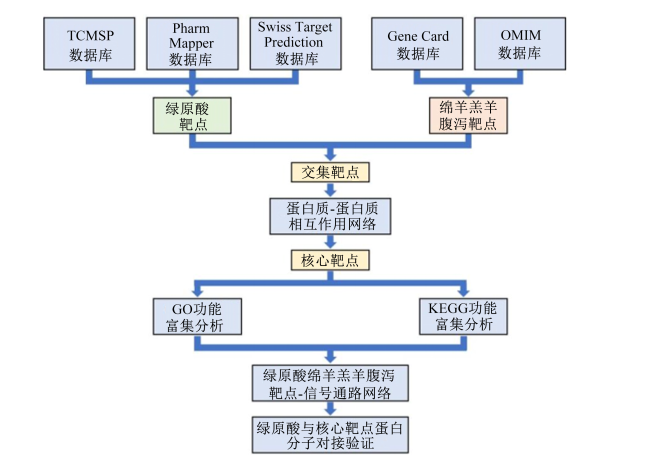
完整的分析流程如图1所示。
图1 网络药理学及分子对接技术流程图

Fig.1 Flowchart of network pharmacology and molecular docking technology

2 结果

2.1 绿原酸缓解绵羊羔羊腹泻的靶点可视化分析

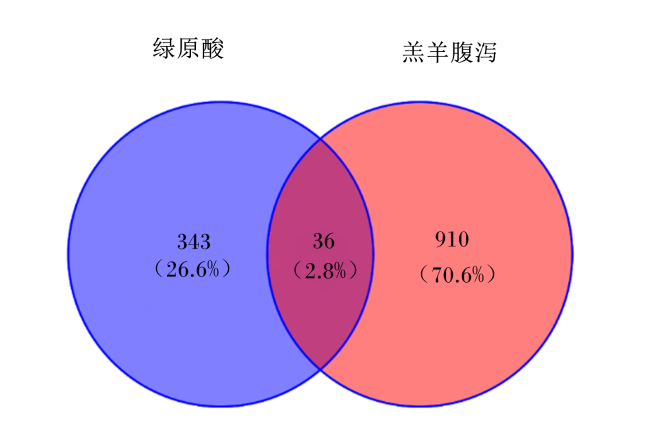
Pharm Mapper和Swiss Target Prediction数据库中分别获取到299和100个绿原酸的靶点,去除其中的重复值后,最终获得379个绿原酸靶点。从Gene Card和OMIM数据库中分别获取到893和54个绵羊羔羊腹泻靶点,去除重复值后,最终确定了946个疾病靶点。运用Venny 2.1在线网站绘制韦恩图,通过图2可知绿原酸和绵羊羔羊腹泻的交集靶点,数量为36个。
图2 绿原酸缓解绵羊羔羊腹泻靶点韦恩图

Fig.2 Venn diagram of target point for alleviating sheep lamb diarrhea with chlorogenic acid

2.2 绿原酸缓解绵羊羔羊腹泻的靶点网络构建及核心靶点筛选

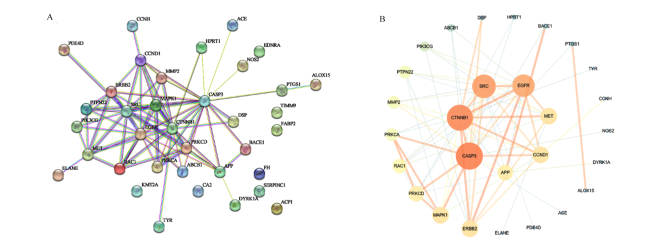
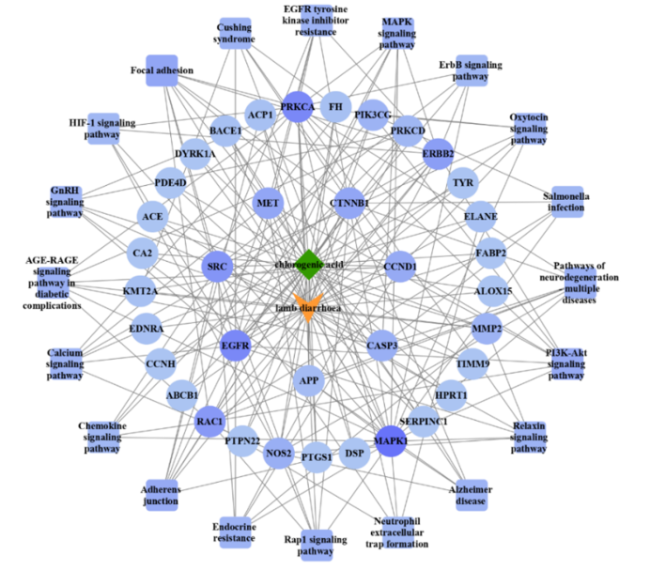
将与绿原酸缓解绵羊羔羊相关的36个靶点导入STRING 12.0数据库,获取其PPI网络(图3-A)。再利用Cytoscape 3.8.2软件对该PPI网络进行可视化分析得知,此PPI网络包含28个节点以及75条边。依据中间中心度(>30.857)、接近中心度(>0.018)、计算度数(>5.357)和特征向量(>0.152)指标进行筛选,最终得到半胱天冬酶3(caspase 3,CASP3)、连环蛋白β1(catenin beta 1,CTNNB1)、表皮生长因子受体(epidermal growth factor receptor,EGFR)、淀粉样前体蛋白(amyloid-beta precursor protein,APP)、原癌基因酪氨酸蛋白激酶(proto-oncogene tyrosine-protein kinase,SRC)、G1/S-特定周期蛋白D1(G1/S-specific cyclin D1,CCND1)和肝细胞生长因子受体(hepatocyte growth factor receptor,MET)核心靶点7个(表1)。在可视化的网络中,这些核心靶点具有颜色越深、节点越大以及边越粗的特点。这表明其关联度越高(图3-B)。
图3 绿原酸缓解绵羊羔羊腹泻靶点PPI网络图

APP:淀粉样前体蛋白 amyloid-beta precursor protein;CAPS3:半胱天冬酶3 caspase 3;CCND1:G1/S-特定周期蛋白D1 G1/S-specific cyclin D1;SRC:原癌基因酪氨酸蛋白激酶 proto-oncogene tyrosine-protein kinase;EGFR:表皮生长因子受体 epidermal growth factor receptor;CTNNB1:连环蛋白β1 catenin beta 1;MET:肝细胞生长因子受体 hepatocyte growth factor receptor;PRKCA:蛋白激酶C α protein kinase C alpha;FH:线粒体富马酸水合酶 fumarate hydratase, mitochondrial;PIK3CG:磷脂酰肌醇4,5-二磷酸3-激酶催化亚基phosphatidylinositol 4,5-bisphosphate 3-kinase catalytic subunit gamma isoform;PRKCD:蛋白激酶C δ protein kinase C delta;ERBB2:受体蛋白酪氨酸激酶 receptor protein-tyrosine kinase erbB2;TYR:酪氨酸酶 tyrosinase;ELANE:中性粒细胞弹性蛋白酶 neutrophil elastase;FABP2:肠脂肪酸结合蛋白2 intestinal fatty acid-binding protein 2;ALOX15:花生四烯酸-15-脂加氧酶 arachidonate 15-lipoxygenase;MMP2:基质金属蛋白酶2 matrix metalloproteinase 2;TIMM9:线粒体导入内膜转位酶亚基9 mitochondrial import inner membrane translocase subunit Tim 9;HPRT1:次黄嘌呤磷酸核糖基转移酶1 hypoxanthine-guanine phosphoribosyltransferase 1;SERPINC1:抗凝血酶Ⅲ antithrombin Ⅲ;MAPK1:丝裂原活化蛋白激酶1 mitogen-activated protein kinase 1;DSP:桥粒斑蛋白 desmoplakin;PTGS1:前列腺素G/H合成酶1 prostaglandin G/H synthase 1;NOS2:诱导型一氧化氮合酶2 inducible nitric oxide synthase 2;PTPN22:酪氨酸蛋白磷酸酶非受体22型 tyrosine-protein phosphatase non-receptor type 22;RAC1:Ras相关C3肉毒毒素底物 Ras-related C3 botulinum toxin substrate;ABCB1:ATP结合盒转运蛋白 B1 ATP-dependent translocase 1;CCNH:细胞周期蛋白 H cyclin H;EDNRA:内皮素1受体 endothelin-1 receptor;KMT2A:组蛋白赖氨酸N-甲基转移酶2A histone-lysine N-methyltransferase 2A;CA2:碳酸酐酶Ⅱ carbonic anhydrase Ⅱ;ACE:血管紧张素转化酶 angiotensin-converting enzyme;PDE4D:磷酸二酯酶4D phosphodiesterase 4D;DYRK1A:双特异性酪氨酸磷酸化调节激酶1A dual specificity tyrosine-phosphorylation-regulated kinase 1A;BACE1:β分泌酶1 beta-secretase 1;ACP1:低分子量磷酸酪氨酸蛋白磷酸酶1 low molecular weight phosphotyrosine protein phosphatase 1。图10同 the same as Fig.10

Fig.3 PPI network diagram of target point for alleviating sheep lamb diarrhea with chlorogenic acid

表1 绿原酸缓解绵羊羔羊腹泻的核心靶点信息

Table 1 Core target information for alleviating sheep lamb diarrhea with chlorogenic acid

序号No. 基因名称Gene name Uniport ID 蛋白质名称Protein name
1 CASP3 P42574 半胱天冬酶3
2 CTNNB1 P35222 连环蛋白β1
3 EGFR P00533 表皮生长因子受体
4 APP P05067 淀粉样前体蛋白
5 SRC P12931 原癌基因酪氨酸蛋白激酶
6 CCND1 P24385 G1/S-特定周期蛋白D1
7 MET P08581 肝细胞生长因子受体

UniProt ID:通用蛋白编号 universal protein ID。

2.3 GO功能富集与KEGG通路富集分析

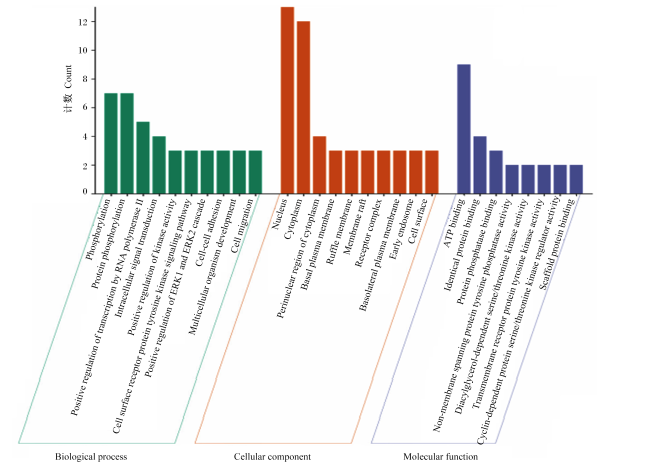
GO功能富集分析在P<0.05的条件下,共得到25种生物进程、11种细胞组分和8种分子功能。从中筛选出的前10个分析结果,如图4所示。结果表明,在生物进程方面,其影响主要集中于磷酸化作用、蛋白磷酸化以及RNA聚合酶Ⅱ转录阳性调控等方面;在细胞组分方面,影响主要发生在细胞核、细胞质和细胞质核周区等方面;在分子功能方面,影响主要体现在ATP结合、相同的蛋白质结合和蛋白磷酸酶结合等方面。
图4 GO功能富集分析结果

Biological process:生物进程;Cellular component:细胞组分;Molecular function:分子功能;Phosphorylation:磷酸化;Protein phosphorylation:蛋白质磷酸化;Positive regulation of transcription by RNA polymerase Ⅱ:RNA聚合酶Ⅱ正调控转录;Intracellular signal transduction:细胞内信号转导;Positive regulation of kinase activity:激酶活性的正向调节;Cell surface receptor protein tyrosine kinase signaling pathway:细胞表面受体蛋白酪氨酸激酶信号通路;Positive regulation of ERK1 and ERK2 cascade:正向调节细胞外调节蛋白激酶1和细胞外调节蛋白激酶2级联;Cell-cell adhesion:细胞间黏着;Multicellular organism development:多细胞生物发育;Cell migration:细胞迁移;Nucleus:核;Cytoplasm:细胞质;Perinuclear region of cytoplasm:细胞质核周区;Basal plasma membrane:基质膜;Ruffle membrane:莱夫膜;Membrane raft:膜筏;Receptor complex:受体复合物;Basolateral plasma membrane:基底外侧质膜;Early endosome:早期内体;Cell surface:细胞表面;ATP binding:ATP结合;Identical protein binding:相同的蛋白质结合;Protein phosphatase binding:蛋白磷酸酶结合;Non-membrane spanning protein tyrosine phosphatase activity:非跨膜蛋白酪氨酸磷酸酶活性;Diacylglycerol-dependent serine/threonine kinase activity:二酰基甘油依赖性丝氨酸/苏氨酸激酶活性;Transmembrane receptor protein tyrosine kinase activity:跨膜受体蛋白酪氨酸激酶活性;Cyclin-dependent protein serine/threonine kinase regulator activity:周期蛋白依赖蛋白丝氨酸/苏氨酸激酶调节因子活性;Scaffold protein binding:支架蛋白结合。

Fig.4 Results of GO functional enrichment analysis

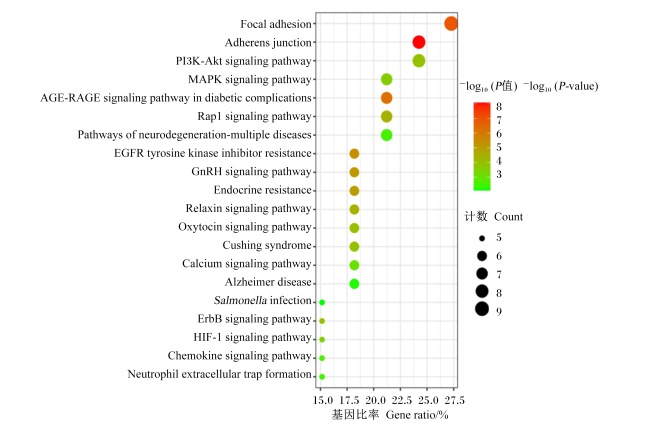
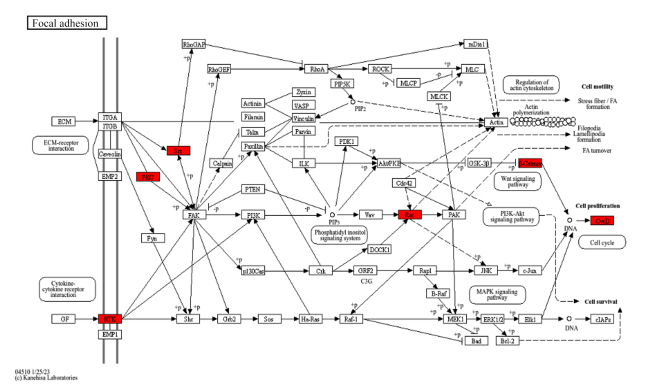
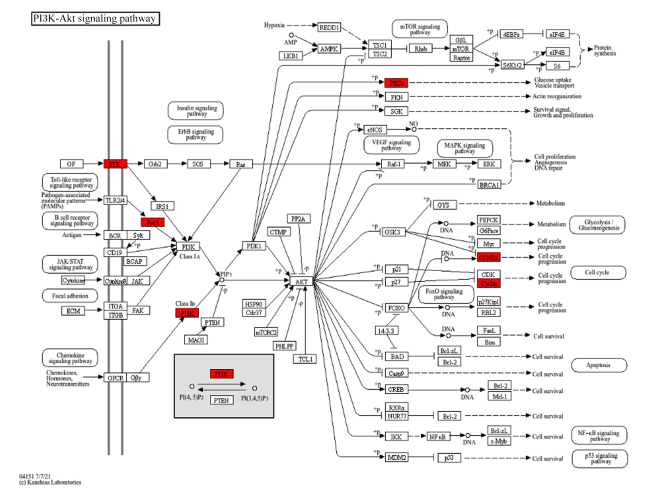
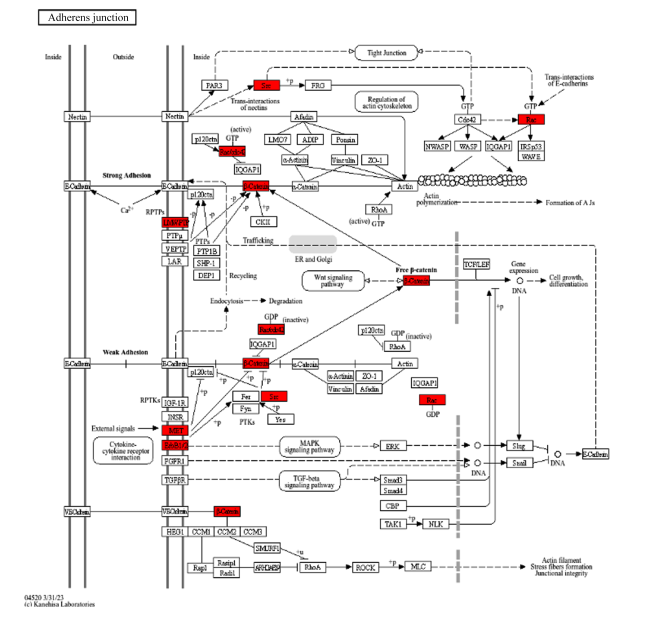
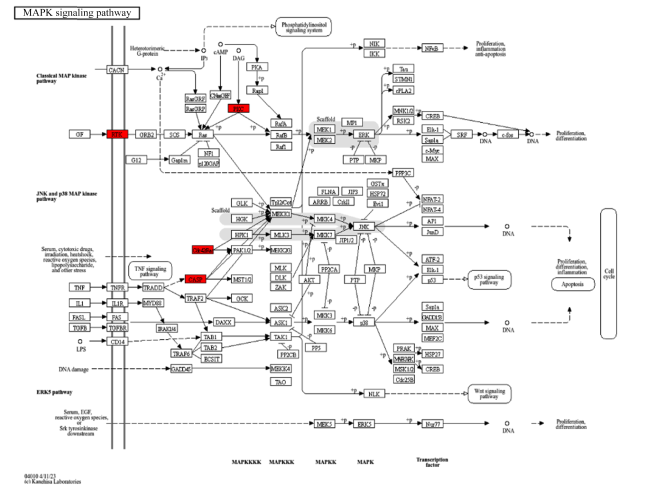
KEGG通路富集分析在P<0.05时,共富集到84条通路,其中相关性较强的前20条通路,如图5所示。在这些通路中,与绿原酸缓解绵羊羔羊腹泻相关性较强的通路包含黏着斑、黏附连接、丝裂原活化蛋白激酶(mitogen-activated protein kinase,MAPK)信号通路、磷脂酰肌醇3激酶-蛋白激酶B(phosphatidylinositol 3-kinase-protein kinase B,PI3K-Akt)信号通路等。值得注意的是,这些信号通路大多与CASP3、CTNNB1、EGFR、APP、SRC、CCND1和MET等相关。通过定位渲染结果可知,各个靶蛋白均位于重点通路中的多个关键节点位置(图6图9)。
图5 KEGG 通路富集分析结果

Focal adhesion:黏着斑;Adherens junction:黏附连接;PI3K-Akt signaling pathway:磷酸肌醇3激酶-蛋白激酶B信号通路;MAPK signaling pathway:丝裂原活化蛋白激酶信号通路;AGE-RAGE signaling pathway in diabetic complications:高级糖基化终末产物-受体信号通路在糖尿病并发症中的作用;Rap1 signaling pathway:Ras相关蛋白1信号通路;Pathways of neurodegeneration-multiple diseases:神经退行性变的途径-多重疾病;EGFR tyrosine kinase inhibitor resistance:表皮生长因子受体酪氨酸激酶抑制剂耐药性;GnRH signaling pathway:促性腺激素释放激素信号通路;Endocrine resistance:内分泌阻力;Relaxin signaling pathway:松弛素信号通路;Oxytocin signaling pathway:催产素信号通路;Cushing syndrome:库欣综合症;Calcium signaling pathway:钙信号通路;Alzheimer disease:阿尔茨海默病;Salmonella infection:沙门氏菌感染;ErbB signaling pathway:受体型酪氨酸激酶信号通路;HIF-1 signaling pathway:缺氧诱导因子-1信号通路;Chemokine signaling pathway:趋化因子信号通路;Neutrophil extracellular trap formation:中性粒细胞胞外陷阱形成。图10同 the same as Fig.10

Fig.5 Results of KEGG pathway enrichment analysis

图6 KEGG富集通路中黏着斑信号通路的靶蛋白定位渲染

仅注释主要蛋白 only annotate the main proteins。RTK:受体酪氨酸激酶 receptor tyrosine kinase;PKC:蛋白激酶C protein kinase C;SRC:原癌基因酪氨酸蛋白激酶 proto-oncogene tyrosine-protein kinase;RAC1:Ras相关C3肉毒毒素底物 Ras-related C3 botulinum toxin substrate;β-catenin:β-连环蛋白;CycD:D型细胞周期蛋白 Cyclin D。

Fig.6 Target protein localization rendering of focal adhesion signaling pathway in KEGG enrichment pathways

图7 KEGG富集通路中PI3K-Akt信号通路的靶蛋白定位渲染

仅注释主要蛋白 only annotate the main proteins。RTK:受体酪氨酸激酶 receptor tyrosine kinase;RAC1:Ras相关C3肉毒毒素底物 Ras-related C3 botulinum toxin substrate 1;P13K:磷脂酰肌醇-3-激酶 phosphatidylinositol 3-kinase;PKC:蛋白激酶C protein kinase C;CCD1:类胡萝卜素9,10(9',10')-裂解双加氧酶 carotenoid 9,10(9',10')-cleavage dioxygenase 1;Cyclin:细胞周期蛋白。

Fig.7 Target protein localization rendering of PI3K-Akt signaling pathway in KEGG enrichment pathways

图8 KEGG富集通路中黏附连接信号通路的靶蛋白定位渲染

仅注释主要蛋白 only annotate the main proteins。SRC:原癌基因酪氨酸蛋白激酶 proto-oncogene tyrosine-protein kinase Src;RAC1:Ras相关C3肉毒毒素底物 Ras-related C3 botulinum toxin substrate 1;β-catenin:β-连环蛋白;LMW-PTP:低分子量蛋白质酪氨酸磷酸酶 low molecular weight protein tyrosine phosphatase;MET:肝细胞生长因子受体 hepatocyte growth factor receptor;ErbB1/2:受体酪氨酸蛋白激酶1/2 receptor tyrosine-protein kinase ErbB 1/2。

Fig.8 Target protein localization rendering of adherens junction signaling pathway in KEGG enrichment pathways

图9 KEGG富集通路中MAPK信号通路的靶蛋白定位渲染

仅注释主要蛋白 only annotate the main proteins。RTK:受体酪氨酸激酶 receptor tyrosine kinase;PKC:蛋白激酶C protein kinase C;RAC1:Ras相关C3肉毒毒素底物 Ras-related C3 botulinum toxin substrate 1;CASP:半胱天冬酶 caspase。

Fig.9 Target protein localization rendering of MAPK signaling pathway in KEGG enrichment pathways

2.4 绿原酸-绵羊羔羊腹泻靶点-信号通路网络构建

通过Cytoscape 3.8.2软件将绿原酸缓解绵羊羔羊腹泻的前20个信号通路和相关靶点进行可视化分析,绘制成药物-靶点-信号通路-疾病的网络图(图10)。由结果可知,试验共得到58个节点和198条边,其中绿色菱形代表药物,橙色菱角形代表疾病,圆形代表靶点基因,正方形代表信号通路,颜色越深,关联度越高。通过网络图构建,可以直观地分析绿原酸缓解绵羊羔羊腹泻的靶点调控情况。
图10 绿原酸-绵羊羔羊腹泻靶点-信号通路网络图

Fig.10 Chlorogenic acid-sheep lamb diarrhea targets-signaling pathway network diagram

2.5 分子对接

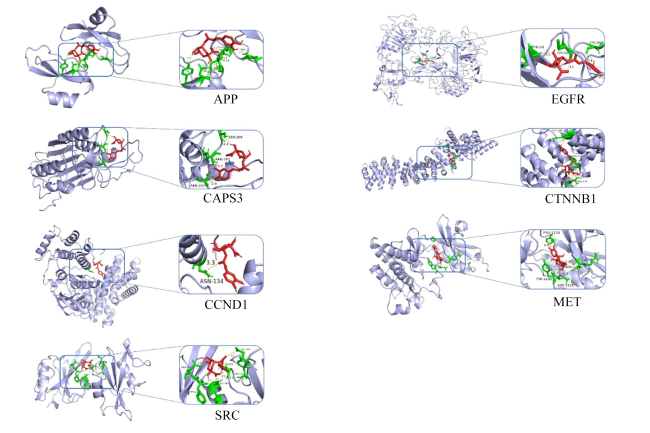
针对筛选出的核心靶点结构与绿原酸结构开展分子对接操作,其中绿原酸作为配体,而CASP3、CTNNB1、EGFR、APP、SRC、CCND1和MET分别作为受体。分子对接结果如表2所示。从表2中可以看出,这7种蛋白分子在与绿原酸的对接位点处,其自由结合能均小于-25.12 kJ/mol。这表明两者之间具备良好的结合能力。其中,EGFR和APP与绿原酸的自由结合能小于等于-33.49 kJ/mol。最后,将分子对接结果进行可视化处理,受体和配体的预测结合模式如图11所示。
表2 分子对接结果

Table 2 Results of molecular docking

序号
No.
UniProt ID 基因名称
Gene name
蛋白质名称
Protein name
PDB ID 结合能
Binding energy/(kJ/mol)
1 P42574 CASP3 半胱天冬酶3 1GFW -28.88
2 P35222 CTNNB1 连环蛋白β1 2Z6H -27.21
3 P00533 EGFR 表皮生长因子受体 1IVO -36.00
4 P05067 APP 淀粉样前体蛋白 1AAP -33.49
5 P12931 SRC 原癌基因酪氨酸蛋白激酶 1A07 -33.07
6 P24385 CCND1 G1/S-特定周期蛋白D1 2W96 -28.46
7 P08581 MET 肝细胞生长因子受体 1R0P -31.39

UniProt ID:通用蛋白编号 universal protein ID;PDB ID:蛋白质结构数据库编号ProteinData Bank ID。

图11 绿原酸与核心靶点的分子对接结果

APP:淀粉样前体蛋白 amyloid-beta precursor protein;CAPS3:半胱天冬酶3 caspase 3;CCND1:G1/S-特定周期蛋白D1 G1/S-specific cyclin D1;SRC:原癌基因酪氨酸蛋白激酶 proto-oncogene tyrosine-protein kinase;EGFR:表皮生长因子受体 epidermal growth factor receptor;CTNNB1:连环蛋白β1 catenin beta 1;MET:肝细胞生长因子受体 hepatocyte growth factor receptor。

Fig.11 Molecular docking results of chlorogenic acid and core targets

3 讨论

3.1 绿原酸缓解绵羊羔羊腹泻的作用靶点

本研究借助网络药理学技术,对绿原酸缓解绵羊羔羊腹泻的靶点进行检索,成功获取了36个相关靶点。随后,以“绵羊”为限定物种,通过PPI网络分析进一步筛选,得到了7个核心靶点基因,即CASP3、CTNNB1、EGFRAPPSRCCCND1和MET。这一结果提示绿原酸可能经由这些靶点来缓解绵羊羔羊的腹泻症状。其中,CASP3作为一种在程序性细胞死亡进程里扮演关键角色的酶,深度参与炎症过程以及凋亡途径[14]。CASP3活性的失衡与多种疾病存在关联,像癌症、神经退行性疾病以及其他细胞死亡异常(过多或不足)的病症[15]。黄长辉[16]研究发现,在炎症性肠病或者感染引发的腹泻状况下,CASP3能够被诱导激活,进而加剧肠道组织的损伤,并使炎症进一步恶化。有研究报道,绿原酸能够抑制猪德尔塔冠状病毒感染引起的细胞凋亡[17]CTNNB1是编码β-连环蛋白(β-catenin)的基因,其是Wnt信号通路不可或缺的组成部分。该通路对诸多细胞过程意义重大,涵盖细胞黏附和信号转导[18]。已有研究表明,β-连环蛋白信号通路的异常可能与炎症性肠病、结肠癌等肠道疾病相关,而这些疾病往往伴随着腹泻症状[19]。此外,β-连环蛋白还可能对肠道微生物群的组成产生影响,从而间接影响肠道的健康状态[20]。有研究表明,饲粮中添加绿原酸能够通过抑制核转录因子-κB(nuclear factor kappa-B,NF-κB)信号通路、激活自噬途径和调节肠道菌群来缓解仔猪肠道炎症反应[21-22]。EGFR是位于细胞膜上的酪氨酸激酶受体,在调控细胞生长、分裂以及存活的细胞信号通路中起着至关重要的作用[23]。当EGF或其他配体与EGFR相结合时,会促使受体发生二聚体化和自磷酸化,进而激活包括Ras-RAF-MAPK和PI3K-Akt通路在内的众多下游信号通路[24-25]。有研究显示,EGFR信号的失调会加剧肠道炎症,损伤肠道上皮,最终导致腹泻[26]。绿原酸作用于上述靶点,表明其通过调控细胞增殖、调节肠道炎症、改善肠道上皮状况,在抑制绵羊羔羊肠道腹泻方面发挥着积极作用。

3.2 绿原酸缓解绵羊羔羊腹泻的潜在通路

进一步KEGG分析发现,绿原酸可通过对黏着斑、黏附连接、沙门氏菌感染、MAPK、PI3K-Akt等信号通路来缓解绵羊羔羊腹泻,且这些信号通路与核心靶点紧密相关。肠道上皮的完整性在抵御病原体和毒素入侵方面具有关键意义,其中黏着斑和黏附连接对维持肠道上皮细胞的完整性和功能不可或缺[27]。一旦黏着斑和黏附连接遭到破坏,肠道屏障功能就会受损,进而引发腹泻[28]。在黏附连接中,CTNNB1(编码蛋白β-连环蛋白)和钙黏蛋白1(cadherin 1,CDH1)[编码蛋白E-钙黏素(E-cadherin)]发挥着重要作用,E-钙黏素构建细胞间连接,而β-连环蛋白与E-钙黏素结合以维持连接的稳定性和功能[29]。有研究表明,断奶应激减少了羔羊肠道中闭锁小带蛋白-1(zonula occludens-1,ZO-1)和闭合蛋白(Occludin)基因表达水平,改变了十二指肠形态结构[30]。Villota等[31]的研究表明,绿原酸能够通过降低CTNNB1、CDH1和Wnt通路靶基因CCND1的表达,从而抑制细胞活力,调节SW480和HT-29结肠直肠癌细胞的迁移和侵袭特性。
陈佳力[32]研究发现,饲粮中添加绿原酸能够提高仔猪抗氧化能力,维护肠道上皮屏障结构完整性,从而缓解肠道上皮屏障氧化损伤。细菌侵袭上皮细胞会损害肠道屏障功能,细菌在细胞内繁殖还会引发局部炎症反应并扰乱肠道菌群,最终导致腹泻[33-35]。腹泻羔羊肠道中微生物多样性和丰富度降低,大肠埃希氏菌志贺氏菌、苏黎世杆菌和沙门氏菌等是导致羔羊腹泻的重要原因[36-38]。陈琨[39]研究表明,绿原酸能够抑制大肠埃希氏菌、金黄色葡萄球菌、肠炎沙门氏菌、志贺氏菌等病原菌的生长。Zhang等[40]的研究指出,饲粮中添加绿原酸能够调节断奶仔猪回肠微生物组成,增加有益菌的丰富度,降低肠道炎症因子的含量,增强断奶仔猪的肠道健康。并且肠道发生炎症后,炎症因子会激活MAPK和PI3K-Akt信号通路,促使肠道炎症恶化,造成肠道进一步损伤和腹泻[41]。Gao等[42]的研究发现,在饮水中添加绿原酸能够通过抑制MAPK/细胞外调节蛋白激酶(extracellular regulated protein kinases,ERK)/c-Jun氨基末端激酶(c-Jun N-terminal kinase,JNK)信号通路减轻小鼠肠道组织炎症和细胞凋亡,从而缓解溃疡性结肠炎。Chen等[43]的研究显示,绿原酸可通过共同调节PI3K-Akt和核因子-κB抑制因子α(nuclear factor kappa B inhibitor α,IκBα)-NF-κB信号通路减轻断奶仔猪氧化应激诱导的肠上皮炎症和损伤。上述研究均表明,绿原酸能够对炎症通路、肠道上皮细胞连接和肠道菌群进行调控以改善肠道腹泻状况,这为绿原酸改善绵羊羔羊肠道腹泻提供了理论依据。

3.3 绿原酸与靶蛋白的分子对接

分子对接结果显示,绿原酸与EGFR和APP的结合能力最强。EGFR是位于细胞膜上的酪氨酸激酶受体,能够激活MAPK和PI3K-Akt通路,这一结果在KEGG通路分析中也得到了验证,表明绿原酸可通过该靶点缓解绵羊羔羊腹泻,EGFR在这方面具有较大的开发潜力。APP是在细胞中广泛表达的膜结合蛋白,不仅参与免疫反应调节,而且在神经系统中发挥着尤为重要的作用,已有研究发现阿尔茨海默病的发病机制与APP密切相关[44]。本研究借助网络药理学分析了绿原酸缓解绵羊羔羊肠道腹泻的靶点及其功能通路。然而,由于目前关于这方面的文献相对较少,本研究存在一定的局限性。绿原酸是否确实通过上述靶点和功能通路来缓解绵羊羔羊肠道腹泻,还需要进一步的验证。

4 结论

本研究通过网络药理学和分子对接技术,系统探讨了绿原酸缓解绵羊羔羊肠道腹泻的作用机制。研究结果表明,绿原酸可能作用于CASP3、CTNNB1、EGFRAPPSRCCCND1和MET等核心靶点,影响黏着斑、黏附连接、MAPK和PI3K-Akt等关键通路,从而有效缓解绵羊羔羊的肠道腹泻。本研究为绿原酸作为绿色饲料添加剂在绵羊羔羊养殖中的应用提供了理论依据。未来研究应进一步验证绿原酸在实际养殖中的应用效果,并深入探讨其在不同生理和病理条件下的作用机制。
[1]
鸿勤. 内蒙古肉羊产业的国内竞争力研究[D]. 硕士学位论文. 呼和浩特: 内蒙古大学, 2020.

HONG Q. A study on the competitiveness of mutton sheep lndustry in inner Mongolia[D]. Master’s Thesis. Hohhot: Inner Mongolia University, 2020.(in Chinese)

[2]
BAN D, GESANG Z G, FAN Y Y, et al. Therapeutic potential of compound extract from Dracocephalum rupestre Hance and Berberidis Radix against Salmonella-induced lamb diarrhea[J]. Scientific Reports, 2024, 14(1):23789.

[3]
李碧波, 吴克, 师晓龙, 等. 羊源Lactobacillus plantarum对腹泻羔羊空肠菌群及肠道黏膜屏障的调控作用[J]. 畜牧兽医学报, 2024, 55(8):3552-3569.

DOI

LI B B, WU K, SHI X L, et al. Sheep-derived Lactobacillus plantarum regulates the bacterial community and mucosal barrier in jejunum of diarrheic lambs[J]. Acta Veterinaria et Zootechnica Sinica, 2024, 55(8):3552-3569.(in Chinese)

[4]
GUO H R, CUI J Z, LI Q, et al. A multi-omic assessment of the mechanisms of intestinal microbes used to treat diarrhea in early-weaned lambs[J]. mSystems, 2024, 9(2):e0095323-e0095337.

[5]
HADGU A, LEMMA A, YILMA T, et al. Major causes of calf and lamb mortality and morbidity and associated risk factors in the mixed crop-livestock production system in Jamma District,South Wollo,Ethiopia[J]. Veterinary Medicine International, 2021,2021:6689154.

[6]
刘孟健, 张文举, 姚峻. 布拉迪酵母壁多糖对早期断奶羔羊腹泻及肠道黏膜免疫的影响[J]. 动物营养学报, 2020, 32(9):4205-4211.

DOI

LIU M J, ZHANG W J, YAO J. Effects of Saccharomyces boulardii cell wall polysaccharides on diarrhea and intestinal mucosal immunity of early-weaned lambs[J]. Chinese Journal of Animal Nutrition, 2020, 32(9):4205-4211.(in Chinese)

[7]
LIU H W, CHEN P, LV X G, et al. Effects of chlorogenic acid on performance,anticoccidial indicators,immunity,antioxidant status,and intestinal barrier function in coccidia-infected broilers[J]. Animals, 2022, 12(8):963.

[8]
YE X L, LI J, GAO Z, et al. Chlorogenic acid inhibits lipid deposition by regulating the enterohepatic FXR-FGF15 pathway[J]. BioMed Research International, 2022,2022:4919153.

[9]
SANTANA-GÁLVEZ J, CISNEROS-ZEVALLOS L, JACOBO-VELÁZQUEZ D A. Chlorogenic acid:recent advances on its dual role as a food additive and a nutraceutical against metabolic syndrome[J]. Molecules, 2017, 22(3):358.

[10]
XU J G, HU Q P, LIU Y. Antioxidant and DNA-protective activities of chlorogenic acid isomers[J]. Journal of Agricultural and Food Chemistry, 2012, 60(46):11625-11630.

[11]
刘凯伟, 吕慧源, 屠焰, 等. 复合植物提取物对羔羊腹泻、血清免疫、炎症反应和抗氧化能力的影响[J]. 饲料工业, 2023, 44(2):39-44.

LIU K W, LV H Y, TU Y, et al. Effects of compound plant extracts on diarrhea, serum immunity, inflammatory response and serum antioxidant capacity of lambs[J]. Feed Industry, 2023, 44(2):39-44.(in Chinese)

[12]
世界中医药学会联合会. 网络药理学评价方法指南[J]. 世界中医药, 2021, 16(4):527-532.

World Federation of Chinese Medicine Societies. Guidelines for network pharmacological evaluation methods[J]. World of Chinese Medicine, 2021, 16(4):527-532.(in Chinese)

[13]
王晋鹏, 罗仍卓么, 李彦霞, 等. lncRNA RRAS2-AS1在LPS诱导奶牛乳腺上皮细胞炎症中的功能[J]. 中国农业科学, 2024, 57(14):2874-2888.

DOI

WANG J P, LUORENG Z, LI Y X, et al. The function of lncRNA RRAS2-AS1 in LPS induced bovine mammary epithelial cells inflammation[J]. Scientia Agricultura Sinica, 2024, 57(14):2874-2888.(in Chinese)

DOI

[14]
刘卓琳, 刘红云. 基于网络药理学和分子对接探究芹菜素缓解奶牛热应激及低氧应激的潜力与机制[J]. 中国农业科学, 2024, 57(5):1010-1022.

DOI

LIU Z L, LIU H Y. The potential and mechanisms of apigenin to relieve heat stress and hypoxia in dairy cows based on network pharmacology and molecular docking[J]. Scientia Agricultura Sinica, 2024, 57(5):1010-1022.(in Chinese)

DOI

[15]
李盛楠. 调更汤调控ASK1/MKK7/JNK信号通路改善下丘脑神经元细胞凋亡的作用机制研究[D]. 博士学位论文. 上海: 上海中医药大学, 2020.

LI S N. Study on mechanism of Tiaogeng decoction regulating ASK1/MKK7/JNK signaling pathway to improve apoptosis of hypothalamic neurons[D]. Ph.D.Thesis. Shanghai: Shanghai University of Traditional Chinese Medicine, 2020.(in Chinese)

[16]
黄长辉. 复方救必应对兔腹泻治疗效果及作用机制研究[D]. 硕士学位论文. 南宁: 广西大学, 2023.

HUANG C H. Treatment effect and mechanism research of compound Jiubiying with rabbit diarrhea[D]. Master’s Thesis. Nanning: Guangxi University, 2023.(in Chinese)

[17]
梁微微. 绿原酸对PDCoV的释放抑制作用及机制研究[D]. 硕士学位论文. 郑州: 河南农业大学, 2024.

LIANG W W. Inhibitory effect and mechanism of chlorogenic acid on PDCoV release[D]. Master’s Thesis. Zhengzhou: Henan Agricultural University, 2024.(in Chinese)

[18]
王明祥. miRNA-185-5p/HMGA2/Wnt/β-catenin轴标识分子在结直肠癌患者中临床意义的研究[D]. 硕士学位论文. 大连: 大连医科大学, 2022.

WANG M X. Clinical significance of miRNA-185-5p/HMGA2/Wnt/β-catenin axis marker in patients with colorectal cancer[D]. Master’s Thesis. Dalian: Dalian Medical University, 2022.(in Chinese)

[19]
CLEVERS H. Wnt/beta-catenin signaling in development and disease[J]. Cell, 2006, 127(3):469-480.

DOI PMID

[20]
祁琴. 针灸对克罗恩病大鼠全基因组DNA甲基化图谱的影响及肠道菌群调节作用的研究[D]. 博士学位论文. 上海: 上海中医药大学, 2021.

QI Q. Effect of acupuncture and moxibustion on genome-wide DNA methylation map and regulation of intestinal flora in Crohn’s disease rats[D].Ph.D.Thesis. Shanghai: Shanghai University of Traditional Chinese Medicine, 2021.(in Chinese)

[21]
万凡. 杜仲叶提取物和绿原酸调控仔猪肠道炎症的机制研究[D]. 博士学位论文. 兰州: 兰州大学, 2023.

WAN F. The mechanism study of extract Eucommia ulmoides oliver leaf and chlorogenic acid in regulating intestinal inflammation of piglets[D]. Ph.D.Thesis. Lanzhou: Lanzhou University, 2023.(in Chinese)

[22]
谢凯桓, 张云露, 张龙林, 等. 绿原酸对仔猪腹泻的调控作用及机理[J]. 中国畜牧杂志, 2021, 57(11):56-60,66.

XIE K H, ZHANG Y L, ZHANG L L, et al. Chlorogenic acid in modulating mechanisms of reducing incidence of diarrhea of weaned piglets[J]. Chinese Journal of Animal Science, 2021, 57(11):56-60,66.(in Chinese)

[23]
范励雯. 人参皂苷CK通过EGFR/AKT/G6PC3轴抑制肺腺癌糖酵解提高培美曲塞疗效及机制研究[D]. 博士学位论文. 长春: 吉林大学, 2023.

FAN L W. Ginsenoside CK enhances efficacy of pemetrexed in lung adenocarcinoma by inhibiting glycolysis via EGFR/AKT/G6PC3 signaling axis[D]. Ph.D.Thesis. Changchun: Jilin University, 2023.(in Chinese)

[24]
张丹丹. 京尼平苷通过抑制EGFR/PI3K/AKT通路和Ca2+通道减轻CCI大鼠的神经性疼痛[D]. 硕士学位论文. 杭州: 浙江中医药大学, 2023.

ZHANG D D. Geniposide lelieves neuropathic pain in CCI rats by inhibiting the EGFR/PI3K/AKT pathway and Ca2+ channels[D]. Master’s Thesis. Hangzhou: Zhejiang Chinese Medical University, 2023.(in Chinese)

[25]
齐杰. 泛素连接酶PELI1与表皮生长因子受体EGFR协作促进乳腺癌转移的机制研究[D]. 博士学位论文. 济南: 山东大学, 2023.

QI J. Study on the mechanism of ubiquitin ligase PELl1 cooperating with epidermal growth factor receptor to promote breast cancer metastasis[D]. Ph.D.Thesis. Ji’nan: Shandong University, 2023.(in Chinese)

[26]
汤小朋. 表皮生长因子对脂多糖诱导的仔猪肠道屏障功能及磷吸收影响研究[D]. 博士学位论文. 长沙: 湖南农业大学, 2018.

TANG X P. The study of influences of epidermal growth factor on intestinal barrier function and phosphorus absorption of weaned piglets[D]. Ph.D.Thesis. Changsha: Hunan Agricultural University, 2018.(in Chinese)

[27]
ORR S E, GOKULAN K, BOUDREAU M, et al. Alteration in the mRNA expression of genes associated with gastrointestinal permeability and ileal TNF-α secretion due to the exposure of silver nanoparticles in Sprague-Dawley rats[J]. Journal of Nanobiotechnology, 2019, 17(1):63.

DOI PMID

[28]
ZENG H W, SAFRATOWICH B D, CHENG W H, et al. Deoxycholic acid modulates cell-junction gene expression and increases intestinal barrier dysfunction[J]. Molecules, 2022, 27(3):723.

[29]
DEMETTER P, DE VOS M, VAN DAMME N, et al. Focal up-regulation of E-cadherin-catenin complex in inflamed bowel mucosa but reduced expression in ulcer-associated cell lineage[J]. American Journal of Clinical Pathology, 2000, 114(3):364-370.

PMID

[30]
尚振华, 吴锦艳, 王有祥, 等. 羔羊断奶后应激腹泻对肠道屏障的影响[J]. 动物医学进展, 2020, 41(7):63-67.

SHANG Z H, WU J Y, WANG Y X, et al. Effect of post-weaning stress diarrhea on intestinal barrier in lambs[J]. Progress in Veterinary Medicine, 2020, 41(7):63-67.(in Chinese)

[31]
VILLOTA H, SANTA-GONZÁLEZ G A, URIBE D, et al. Modulatory effect of chlorogenic acid and coffee extracts on Wnt/β-catenin pathway in colorectal cancer cells[J]. Nutrients, 2022, 14(22):4880.

[32]
陈佳力. 绿原酸对断奶仔猪肠道上皮屏障氧化损伤的保护作用及其机制研究[D]. 博士学位论文. 雅安: 四川农业大学, 2019.

CHEN J L. Protective effects of chlorogenic acid on oxidative damage of intestinal epithelial barrier in weaned pigs and its mechanisms[D]. Ph.D.Thesis. Ya’an: Sichuan Agricultural University, 2019.(in Chinese)

[33]
CHEN Y Y, CUI W W, LI X, et al. Interaction between commensal bacteria, immune response and the intestinal barrier in inflammatory bowel disease[J]. Frontiers in Immunology, 2021,12:761981.

[34]
郭洪冉. 粪菌移植缓解早期断奶羔羊营养性腹泻的作用机理研究[D]. 博士学位论文. 杨凌: 西北农林科技大学, 2024.

GUO H R. Study on the mechanism action of fecal microbiota transplantation in alleviating nutritional diarrhea in early weaned lambs[D]. Ph.D.Thesis. Yangling: Northwest A & F University, 2024.(in Chinese)

[35]
蒋昀轩. 羔羊腹泻病原菌的分离鉴定及病羊肠道菌群分析[D]. 硕士毕业论文. 泰安: 山东农业大学, 2023.

JIANG Y X. Isolation and identification of pathogenic bacteria from lamb diarrhea and analysis of intestinal flora in sick sheep[D]. Master’s Thesis. Tai’an: Shandong Agricultural University, 2023.(in Chinese)

[36]
董宁. 腹泻羔羊的肠道微生物检测分析及抗生素治疗的影响研究[D]. 硕士毕业论文. 杨凌: 西北农林科技大学, 2022.

DONG N. Detection and analysis of intestinal microorganisms in lambs with diarrhea and study on the effect of antibiotic treatment[D]. Master’s Thesis. Yangling: Northwest A & F University, 2022.(in Chinese)

[37]
杨磊, 安晓萍, 孟子琪, 等. 羔羊病原性腹泻的病因及防治措施研究进展[J]. 当代畜禽养殖业, 2022(2):25-28.

YANG L, AN X P, MENG Z Q, et al. Research progress of etiology and control measures of pathogenic diarrhea in lambs[J]. Modern Livestock and Poultry Breeding Industry, 2022(2):25-28.(in Chinese)

[38]
李婷. 健康与腹泻羔羊生长发育及肠道菌群变化的相关性研究[D]. 硕士学位论文. 乌鲁木齐: 新疆农业大学, 2018.

LI T. Relationship between lamb growth and gastrointestinal flora changes in health and diarrhea[D]. Master’s Thesis. Urumqi: Xinjiang Agricultural University, 2018.(in Chinese)

[39]
陈琨. 绿原酸对Y.enterocolitica的抑菌活性及其在食品贮藏保鲜中的应用[D]. 硕士学位论文. 青岛: 青岛农业大学, 2022.

CHEN K. Antibacterial activity of chlorogenic acid against Y.enterocolitica and its application in food storage and freshness preservation[D]. Master’s Thesis. Qingdao: Qingdao Agricultural University, 2022.(in Chinese)

[40]
ZHANG B B, TIAN M, WU J, et al. Chlorogenic acid enhances the intestinal health of weaned piglets by inhibiting the TLR4/NF-κB pathway and activating the Nrf2 pathway[J]. International Journal of Molecular Sciences, 2024, 25(18):9954.

[41]
ZHENG S H, XUE T Y, WANG B, et al. Chinese medicine in the treatment of ulcerative colitis:the mechanisms of signaling pathway regulations[J]. The American Journal of Chinese Medicine, 2022, 50(7):1781-1798.

[42]
GAO W Y, WANG C H, YU L, et al. Chlorogenic acid attenuates dextran sodium sulfate-induced ulcerative colitis in mice through MAPK/ERK/JNK pathway[J]. BioMed Research International, 2019,2019:6769789.

[43]
CHEN J L, LUO Y H, LI Y, et al. Chlorogenic acid attenuates oxidative stress-induced intestinal epithelium injury by co-regulating the PI3K/Akt and IκBα/NF-κB signaling[J]. Antioxidants, 2021, 10(12):1915.

[44]
SAITO T, MATSUBA Y, MIHIRA N, et al. Single App knock-in mouse models of Alzheimer’s disease[J]. Nature Neuroscience, 2014, 17(5):661-663.

Outlines

/