REVIEW

Nutritional Composition of Resource Insects and Its Application in Aquaculture-A Case Study of Yellow Mealworm, Black Soldier Fly and Superworm

  • YAN Yuqi , 1, 2 ,
  • XUE Min 1, 2 ,
  • WU Lixin 1 ,
  • LIANG Xiaofang , 2, *
Expand
  • 1 College of Fisheries and Life, Dalian Ocean University, Dalian 116023, China
  • 2 National Aquatic Feed Safety Evaluation Center, Feed Research Institute, Chinese Academy of Agricultural Sciences, Beijing 100081, China
* professor, E-mail:

Received date: 2024-12-26

  Online published: 2025-07-12

Abstract

China’s feed industry has long faced a structural shortage of protein raw materials, with key ingredients such as fishmeal and soybeans heavily reliant on imports. Resource insects, as an efficient and environmentally sustainable alternative protein source, have gained widespread attention in recent years. This paper systematically reviews the nutritional composition of key resource insects, such as yellow mealworm (Tenebrio molitor), black soldier fly (Hermetia illucens), and superworm (Zophobas atratus), and evaluates their applications in aquaculture species, including largemouth bass (Micropterus salmoides) and rainbow trout (Oncorhynchus mykiss). Furthermore, we propose an integrated “organic waste-insect protein-aquaculture” three in one circular model, which insect biotechnology facilitates the valorization of agricultural waste while simultaneously producing high-quality insect-based feed, offering a viable pathway to address protein resource scarcity and promote low-carbon transformation in aquaculture.

Cite this article

YAN Yuqi , XUE Min , WU Lixin , LIANG Xiaofang . Nutritional Composition of Resource Insects and Its Application in Aquaculture-A Case Study of Yellow Mealworm, Black Soldier Fly and Superworm[J]. Chinese Journal of Animal Nutrition, 2025 , 37(7) : 4310 -4320 . DOI: 10.12418/CJAN2025.353

水产养殖在全球粮食生产中占据重要地位。随着人口增长,水产品需求不断增加,传统捕捞业难以满足。据联合国粮食及农业组织统计,2023年水产养殖总产量达到1.854亿t,与2022年相比略为增长了0.6%,其中野生捕捞渔业产量下降了1.7%,水产养殖产量增长了2.8%[1]。中国作为水产养殖大国之一,水产品总产量达到7 116.2万t,其中人工养殖量占80%[2]。全球水产养殖主要依赖外部饲料的供应[3],鱼粉和大豆是主要的蛋白质来源,我国鱼粉和大豆主要依靠进口[4],因此,寻找饲料中替代蛋白质来源成为紧要研究任务。
昆虫生长快、繁殖能力强,同时蛋白质和脂肪含量高,富含多种生物活性物质,使得它们成为一种潜在的高效蛋白质来源。黑水虻(Hermetia illucens)通常世代历时35 d左右,黄粉虫(Tenebrio molitor)在2~3个月达到成虫,大麦虫(Zophobas atratus)在3~4个月达到成虫。雌性黑水虻成虫产卵量达到800~1 000个,黄粉虫一生(3个月)产卵160个,大麦虫一生(1年)产卵1 500个[5-6]。此外,可食用昆虫含有多种具有抗炎、抗菌和抗氧化性能的生物活性物质[7]。昆虫除了自身营养价值丰富,与畜牧生产相比,养殖所需的土地资源和水资源较少,温室气体排放量更低,此外,昆虫的饲料转化率相对较高[8]。Oonincx等[9]研究表明,黄粉虫、美洲蟋蟀(Acheta domesticus)、亚洲飞蝗(Locusta migratoria)、杜比亚蟑螂(Blaptica dubia)4种昆虫的温室气体排放量远远低于同等增重的猪,仅为反刍动物温室气体排放量的1%左右。资源昆虫可利用废弃物和农业副产品,降低对有限资源的依赖,并减少环境污染。例如,黑水虻以各种腐殖质为食,如腐烂的水果蔬菜、厨余垃圾以及动物粪便等[10]。值得注意的是,它们具有适应多种底物的能力,在富含n-3多不饱和脂肪酸(polyunsaturated fatty acids,PUFA)的基质上饲养昆虫可以增加其体内的PUFA含量,因此可通过利用昆虫的生物转换能力开发功能性昆虫蛋白质,进一步应用到动物饲料中[11]
本综述探讨了黑水虻、黄粉虫和大麦虫等资源昆虫的营养组成及其在水产养殖中的应用现状,并分析了昆虫蛋白质在水产养殖产业链中的定位,提出了昆虫蛋白质推动水产养殖行业可持续发展的创新模式。

1 昆虫蛋白质的营养组成

1.1 蛋白质和氨基酸

昆虫的营养价值受昆虫种类、发育阶段、来源、食性以及提取方式等因素影响[8]。不同基质下不同昆虫营养组成不同(表1)。资源昆虫的粗蛋白质含量可达25%~75%[18],脱脂家蝇(Musca domestica)幼虫粉的粗蛋白质含量为60.38%,蛹的粗蛋白质含量为76.23%[19],草甸蚂蚱(Chorthippus parallelus)的粗蛋白质含量为69%,且具有良好的消化率和氨基酸谱[20]。昆虫蛋白质富含多种必需氨基酸(表2),对动物生长、组织修复、免疫功能以及肌肉合成和代谢调节至关重要。研究表明,微波干燥处理能够更好地保留黑水虻幼虫中的谷氨酸,而常规干燥处理的黑水虻幼虫中天门冬氨酸含量最高[23]。通过优化干燥技术可以有效提高昆虫蛋白质的营养价值。脱脂处理能够提高昆虫蛋白质的氨基酸含量,脱脂大麦虫的大多数氨基酸含量为脱脂前的1.1~1.3倍,其中亮氨酸含量最高,是脱脂前的1.3倍[24]。蛋白酶可以将昆虫中的蛋白质提取为肽和游离氨基酸。在实验室条件下,使用木瓜蛋白酶、胰蛋白酶、脱氨酶Ⅰ、胃蛋白酶、巴氏芽孢杆菌蛋白酶、菠萝蛋白酶和胰蛋白酶等7种不同酶进行水解,成功提取了小粉虫(Alphitobius diaperinus)和黑水虻的蛋白质,最终小粉虫的蛋白质提取率达到67%,黑水虻的蛋白质提取率达到71%,同时酶水解后能够显著提高黑水虻和小粉虫蛋白质的总游离氨基酸含量[25]。酶水解在提高昆虫蛋白质提取效率和优化氨基酸组成方面具有重要潜力。
表1 不同种类昆虫营养组成(干物质基础)

Table 1 Nutritional composition of different insect species (DM basis)%

种类
Species
饲喂基质
Feeding
substrate
水分
Moisture
粗蛋白质
Crude protein
粗脂肪
Crude lipid
粗灰分
Crude ash
参考文献
References
黄粉虫 Tenebrio molitor 麦麸、白菜 - 53.22 34.54 4.04 Ghosh等[12]


黑水虻 Hermetia illucens
麦麸、果蔬 - 35.00 29.80 5.30 Rawski等[13]
餐厨垃圾 56.81 30.93 42.13 12.85

石超宏等[14]
尾菜 80.41 48.32 10.64 18.58
鸡粪 73.20 37.07 16.48 27.39
大麦虫 Zophobas atratus - 55.78 49.51 38.99 2.13 何伟灵等[15]
美洲大蠊 Periplaneta americana - 12.42 8.72 17.64 3.52 Boate等[16]

家蝇 Musca domestica
麦麸 76.18 44.79 20.37 8.68
夏冰天等[17]
药渣 75.99 47.80 23.84 6.20

-:无此项或未测定 None or not measured。下表同 The same as below。

表2 不同种类昆虫氨基酸组成

Table 2 Amino acids composition of different insect species%

氨基酸
Amino acids
黄粉虫
Tenebrio molitor
黑水虻
Hermetia illucens[22]
大麦虫
Zophobas atratus
麦麸+白菜
Wheat bran+
Chinese cabbage[12]
红薯
Sweet potato
咖啡渣
Spent coffee
面团
Dough
麦麸+卷心菜
Wheat bran+cabbage[21]
必需氨基酸 EAA
组氨酸 His 2.80 1.37 1.51 0.97 1.91
异亮氨酸 lle 1.98 2.06 2.06 1.61 2.48
亮氨酸 Leu 3.37 2.94 2.91 2.07 2.76
赖氨酸 Lys 2.01 2.59 2.58 1.94 2.60
蛋氨酸 Met - 0.71 0.75 0.57 0.73
苯丙氨酸 Phe 1.76 1.87 1.85 1.56 1.70
苏氨酸 Thr 1.83 1.67 1.64 1.35 1.86
色氨酸 Trp - 0.63 0.73 0.57 -
缬氨酸 Val 2.94 2.88 2.99 2.25 2.62
非必需氨基酸 NEAA
精氨酸 Arg 2.23 1.87 1.95 1.43 3.05
甘氨酸 Gly 2.61 2.48 2.62 1.77 2.01
天冬氨酸 Asp 2.76 3.56 3.48 2.37 3.37
丝氨酸 Ser 2.20 1.52 1.52 1.03 1.72
谷氨酸 Glu 5.78 3.84 3.99 2.89 4.79
丙氨酸 Ala 3.96 2.66 2.91 2.74 2.53
酪氨酸 Tyr 3.45 2.69 2.70 2.12 4.53
胱氨酸 Cys 3.16 0.32 0.34 0.22 0.00
脯氨酸 Pro 1.66 2.31 2.54 2.35 3.87
鸟氨酸 Orn - 0.09 0.14 0.06 -
羊毛硫氨酸 Lan - 0.16 0.17 0.29 -
牛磺酸 Tau - 0.06 0.06 0.06 -
总必需氨基酸 ∑EAA 16.69 16.72 17.02 12.89 16.66
总非必需氨基酸 ∑NEAA 27.81 21.56 22.42 17.33 25.86
总氨基酸含量 ∑TAA 44.50 38.28 39.44 30.22 42.52

1.2 脂肪和脂肪酸

脂肪是昆虫体内仅次于蛋白质的第二大营养成分。干物质基础下,昆虫的脂肪含量在7.9%~47.0%[26]。Barroso等[27]研究表明,双翅目、直翅目和鞘翅目大多数昆虫的脂肪含量达20%,亚洲飞蝗、家蝇幼虫、黄粉虫的脂肪含量达30%,大麦虫的脂肪含量达38%。研究表明,几乎所有的昆虫都能生物合成棕榈酸、硬脂酸和油酸,包括家蝇在内的一些昆虫体内携带有负责合成亚油酸的Δ12去饱和酶[28]。与饱和脂肪酸(saturated fatty acid,SFA)相比,昆虫脂质中含有大量不饱和脂肪酸(unsaturated fatty acids,UFA)[29]。在黄粉虫中,单不饱和脂肪酸(monounsaturated fatty acids,MUFA)含量最高的是油酸,PUFA中含量最高的是α-亚油酸和α-亚麻酸;在雌雄虫蛹中检测到的最普遍的脂肪酸是SFA中的肉豆蔻酸、棕榈酸和硬脂酸,MUFA中的油酸、16:1n-5酸和棕榈油酸,PUFA中的α-亚油酸和α-亚麻酸,同时研究还表明黄粉虫幼虫是人类首选的适合食用的发育阶段,因为幼虫的n-6 PUFA/n-3 PUFA比值更低[30]。在用11种不同基质喂食黑水虻的研究中发现,无论基质如何,幼虫脂肪主要由月桂酸和其他SFA组成,底物的脂肪酸组成和幼虫重量都会影响幼虫的脂肪酸谱。体重较高的幼虫含有较高的SFA含量和较低的UFA含量,如二十碳五烯酸(EPA)和二十二碳六烯酸(DHA),但通过饮食来调整黑水虻幼虫脂肪酸组成的可能性有限[31]。在用人工饲粮和麦麸饲养大麦虫的试验中,UFA在人工饲粮和麦麸中分别占58.3%和61.9%,SFA分别占41.7%和38.1%,且棕榈酸在SFA中含量最高[32]。这些研究结果表明了饲料成分对昆虫幼虫脂肪酸组成的影响,为开发新型饲料和优化昆虫营养成分提供了重要参考价值。

1.3 碳水化合物

昆虫体内的碳水化合物主要以多糖为主[33-35],几丁质是昆虫多糖的主要来源,存在于昆虫外骨骼中,它们为昆虫提供了重要的能量和营养,同时也对昆虫的消化系统和健康起着重要作用。几丁质作为一种轻便但机械强度高的支架材料,与主要决定角质层机械性能的角质层蛋白紧密相关联[36]。在干物质基础下,黄粉虫碳水化合物含量为(11.45±0.38)%,总可溶性糖含量为(3.22±0.10)%,因此黄粉虫体内含有丰富的不溶性碳水化合物,几丁质及其衍生物是存在于昆虫被膜中的典型不溶性碳水化合物[37]。在用4种不同基质饲喂黑水虻的试验中,预蛹的几丁质含量为56~67 g/kg,提取的几丁质中每千克含有60~62 g的氮,预蛹的几丁质含量略低[38]。饲喂麦麸基质下的大麦虫的碳水化合物含量为6.1%,而饲喂50%啤酒糟和50%麦麸混成的基质的大麦虫的碳水化合物含量为7.4%[39]

1.4 维生素

昆虫缺乏一些重要营养化合物合成的代谢途径,除了必需氨基酸以外,昆虫还需要从食物中补充大多数维生素[40]。可食用昆虫富含大量的维生素A、维生素B1、维生素B2、维生素B6、维生素D、维生素E、维生素K和维生素C,黄粉虫的维生素B12含量为0.3 μg/100 g,核黄素含量为1.21 mg/100 g,烟酸含量为4.1 mg/100 g,叶酸含量为137 mg/100 g[41]。在经过50 ℃烘干处理的黑水虻幼虫中均发现维生素C、硫胺素和核黄素,硫胺素作为辅酶代谢碳水化合物以产生能量,对于支持养殖动物正常生长具有重要作用[42]。胆固醇是维生素D的前体,大麦虫幼虫体内的胆固醇含量与肉类中的胆固醇含量相当,而黄粉虫幼虫体内的胆固醇含量明显更高,黄粉虫幼虫中含有大量α-生育酚,其他生育酚的含量很少[43]

1.5 矿物质

昆虫中有许多矿物质元素,如铁、锌、钾、钠、钙、磷、镁、锰和铜[28]。在Lu等[44]所总结的67种饲养昆虫中,黄粉虫的钙、钾、镁、磷、钠、锌、铜和硒含量最高。一些昆虫在食物中可能摄入一些重金属,研究表明,鞘翅目的昆虫与重金属接触较少[45]。黄粉虫的钙含量最高,包括排泄物和蜕皮里的钙含量,表明黄粉虫的废物循环利用是有益的[46],同时,黄粉虫中有大量的锌、铜、磷,甚至超过了膳食推荐值[47]。在黑水虻预蛹虫粉中,铁、锰和铝的含量远高于鱼粉和豆粕,其他的矿物质如钠、镁、锌等的含量也高于鱼粉和豆粕,但钾和铜的含量略低[48]。在麦麸基质饲喂下的大麦虫中,检测出钾含量为746.7 mg/100 g,磷含量为553.7 mg/100 g,钠含量为112.1 mg/100 g,镁含量为107.9 mg/100 g;而在50%啤酒糟和50%麦麸混成的基质饲喂的大麦虫中,检测出钾含量为781.1 mg/100 g,磷含量为570.2 mg/100 g,钠含量为116.9 mg/100 g,镁含量为112.5 mg/100 g,均高于基质饲喂下的大麦虫;在微量元素方面,麦麸基质及50%啤酒糟和50%麦麸混成的基质饲喂的大麦虫中,锌含量均为8.4 mg/100 g,铜含量均为1.4 mg/100 g,锰含量均为1.2 mg/100 g,由于富含矿物质,大麦虫成为一种极具潜力的饲料来源[39]

2 昆虫粉在水产养殖中的应用

2.1 提高生长性能和营养物质消化率

与植物蛋白质和动物蛋白质相比,昆虫蛋白质在营养价值、蛋白质含量和必需氨基酸比例方面表现更优,呈现出更高水平的蛋白质特性[29],以支持鱼类和虾蟹类的生长和健康。昆虫是可消化蛋白质的良好来源,其消化率和乳清相当[49]。在对尼罗罗非鱼(Oreochromis niloticus)营养物质消化率的研究中发现,黄粉虫粉组的干物质、蛋白质以及几丁质消化率优于其他5个组(对照组、灰色庭蠊粉组、大麦虫粉组、马达加斯加蟑螂粉组、短翅蟋蟀粉组);其中,马达加斯加蟑螂粉组在脂质方面的消化率最高[50]。Gasco等[51]评估了4种脱脂虫粉[黄粉虫粉1(TM1组,饲喂基质为麦麸)、黄粉虫粉2(TM2组,饲喂基质未知)、黑水虻虫粉(HI组)和小粉虫粉(AD组)]在虹鳟(Oncorhynchus mykiss)上的干物质、粗蛋白质、粗脂肪、总能、氨基酸和主要脂肪酸消化率,结果表明,各组之间除粗脂肪外的其他营养物质消化率存在显著差异,TM1组粗蛋白质消化率显著高于AD组,总能消化率为TM1组>TM2组=HI组≥AD组;必需氨基酸中只有蛋氨酸消化率存在显著差异,表现为TM2组=HI组>TM1组>AD组。在针对非洲杂交鲶鱼(Clarias gariepinus×Heterobranchus longifilis)幼鱼的一项消化试验结果表明,添加脱脂黑水虻虫的饲料在粗蛋白质、粗脂肪、粗灰分和磷方面的消化率显著高于对照饲料,但必需氨基酸的消化率较低,与添加脱脂黄粉虫的饲料相比,非洲杂交鲶鱼能够更有效的消化添加脱脂黑水虻虫和红头丽蝇的饲料[52]。在对欧洲鲈(Dicentrarchus labrax)的体内营养物质消化率研究中,使用2种黄粉虫粉(TM组,全脂黄粉虫粉;TMd组,脱脂黄粉虫粉)、2种不同黑水虻虫粉(HI组,全脂黑水虻虫粉;HId组,脱脂黑水虻虫粉组)及蝗虫粉(LM组,全脂蝗虫粉)制成饲料,结果表明TM组的干物质和粗脂肪消化率最高,TMd组的粗蛋白质、磷和能量消化率均最高[53]。这些数据表明,虫粉在营养物质消化利用效率上存在差异,相比黑水虻虫粉,黄粉虫粉具有高粗蛋白质含量、高粗蛋白质消化率和高可消化必需氨基酸含量,是水产养殖中更为优质的蛋白质来源。
昆虫蛋白质在水产动物配合饲料中的应用日益广泛,展现出良好的替代潜力。研究表明,脱脂黄粉虫粉能够替代饲料中高达50%的鱼粉,而不影响大口黑鲈(Micropterus salmoides)的生长性能和营养物质消化率,同时还能显著提高浮性饲料的膨化率[54]。黄粉虫粉不仅具有作为优质饲料成分的潜力,还能通过免疫调节作用保护鱼类肠道健康。研究表明,脱脂黄粉虫粉可完全替代饲料中100%的鱼粉而不会影响虹鳟幼鱼的生长及营养组成[55]。在黑水虻虫粉替代鱼粉的试验中,大口黑鲈幼鱼的配合饲料中可以用黑水虻幼虫粉替代50%鱼粉而不影响大口黑鲈的生长性能;当黑水虻虫粉替代33.33%鱼粉时,饲料系数最低,肌肉粗脂肪含量和全鱼粗蛋白质含量最高,肝脏合成DHA的能力最强[56]。在对克氏原螯虾(Procambarus clarkii)的研究中,黑水虻幼虫粉替代饲料中34.25%的鱼粉时,克氏原螯虾的生长性能最佳[57]。当脱脂黑水虻幼虫粉替代饲料中30%~45%的鱼粉时,不会对中华鳖(Pelodiscus sinensis)稚鳖的生长性能产生负面影响,并能改善肝脏抗氧化能力与肠道菌群结构[58]。在草鱼(Ctenopharyngodon idella)配合饲料研究中,当使用蚕蛹粉、黑水虻粉、黄粉虫粉和蝇蛆粉分别替代饲料中50%、50%、30%和25%的豆粕时,均未对草鱼的生长性能产生不利影响,表明昆虫粉作为豆粕替代品具有可行性[59]

2.2 抗菌和免疫功能

昆虫中含有大量的抗菌肽,不仅对细菌和真菌有广谱杀伤作用,而且对病毒、原生动物和癌细胞也有杀伤作用,与传统抗生素相比,不易引起微生物耐药[60]。抗菌肽可能有助于延长水产饲料保质期并对鱼类产生免疫刺激,分别用低脂和全脂的大麦虫粉替代鱼粉饲喂大西洋鲷(Sparus aurata),结果发现大西洋鲷血清中大肠杆菌抗菌活性不同,这表明大麦虫粉中的脂质结合化合物可能具有直接抗菌活性或刺激鱼类提高其抗菌活性[61]。在红海鲷(Pagrus major)的饲料中添加低水平的蝇蛆粉,可以提高腹膜白细胞的吞噬活性[62];而Loh等[63]认为这种效应归因于包括防御素、天蚕素、致死素和二聚胰素在内的抗菌肽。当黄粉虫粉替代饲料中24%的鱼粉时,可以改善大口黑鲈肠道免疫功能,爱德华氏菌感染下发现黄粉虫粉通过激活增强Toll样受体(TLR)/髓样分化因子88(MyD88)/核因子-κB抑制蛋白激酶(IKK)/核因子-κB(NF-κB)信号通路,降低了肠道细胞的大规模凋亡,提高了肠道健康[64]。黑水虻幼虫粉替代饲料中20%~40%的鱼粉可提高克氏原螯虾血淋巴中总蛋白和葡萄糖含量以及部分免疫酶活性,从而提高机体免疫能力[57]。25%蝇蛆粉替代豆粕显著提高了草鱼血清中高密度脂蛋白胆固醇含量和肌肉中谷氨酸含量,并抑制了促炎基因NF-κB的表达[59]

2.3 提高肌肉品质

适当添加虫粉到饲料中能够改善肌肉品质。研究发现,脱脂黄粉虫粉可以替代饲料中高达45%的鱼粉而不会影响大菱鲆(Scophthalmus maximus)的体色,在养殖56 d时,不会影响大菱鲆生肉的质构,包括硬度、咀嚼性、弹性、胶黏性和内聚性,而在养殖85 d后,肌肉质构指标发生了显著变化,当脱脂黄粉虫粉的替代水平不超过60%时,对肌肉的保鲜品质没有负面影响,而15%的脱脂黄粉虫粉替代水平能够显著提高大菱鲆肌肉的保鲜品质[65]。在大口黑鲈肌肉的研究中,各脱脂黑水虻幼虫粉替代水平组的重金属铜、镉和砷均未超标,且不会影响大口黑鲈体色、肌肉质构、pH、羟脯氨酸含量和胶原蛋白含量,但当脱脂黑水虻幼虫粉替代水平≥75%时,会显著增加肌肉中∑n-6 PUFA含量,同时显著降低EPA含量,并且降低肌肉黄度[66]。草鱼方面的研究结果表明,蚕蛹粉、黑水虻粉和蝇蛆粉分别替代饲料中50%、50%和25%的豆粕时,草鱼肌肉中的n-3 PUFA含量显著提高,且n-3PUFA/n-6 PUFA的比例也显著增加[59]

3 可持续发展与创新模式

废弃的农作物残余物和食品加工副产品等可以作为昆虫养殖的饲料资源,被转化为高质量的昆虫蛋白质,不仅实现了资源的循环利用,还减少了资源浪费和低效利用带来的废弃物产生。当前,大量的研究致力于探索如何提高这些昆虫的生物转换效率,实现废弃物减量化和资源化[67-68]。黑水虻是一种腐生昆虫,以有机废弃物或动植物遗体为食[69]。使用黑水虻进行有机废物的环保处理,不仅可以将有机废物(如餐厨垃圾、畜禽粪便、变质果蔬、农作物废弃物、食品加工废弃物等)转化为有用且无害的形式,还可以将其中的营养物质转化为昆虫生物量[48]。农作物秸秆的无害化处理一直是研究的热点,而黄粉虫、大麦虫等多种昆虫具有转换作物秸秆的能力。黄粉虫幼虫能够以玉米秸秆为主要食物来源,其肠道微生物群分泌类漆酶多铜氧化酶、细胞色素P450、单加氧酶、超氧化物酶和脱氢酶等物质,参与木质素等降解[70]。此外,黄粉虫和大麦虫具有食用、降解塑料的能力,大麦虫以聚苯乙烯为唯一食物时,每只大麦虫的摄食速率为0.58 mg/d,是黄粉虫的4倍[71]
与传统的畜牧业相比,昆虫养殖所需的资源更少,同时饲料转化率高,产生的温室气体排放少,从而减少了碳足迹。与传统的动物蛋白质来源如牛肉、鸡肉、猪肉和牛奶相比,黄粉虫生产的成本高于牛奶或鸡肉,与猪肉和牛肉相似;然而,与鸡、猪和牛相比,黄粉虫所产生的温室气体要少得多,同时所需的土地也远远少于传统的动物蛋白质来源[6]。昆虫蛋白质的生产过程相对高效,能够在相对较小的空间内实现规模化生产。Oonincx等[6]对黄粉虫进行生命周期评估,在土地利用方面,每年生产1 kg黄粉虫的土地使用面积为3.6 m2,其中85%用于种植饲料谷物,14%用于生产胡萝卜。相较于传统的畜牧业和植物蛋白质来源,昆虫的水足迹值往往较低。在黄粉虫水足迹值的研究中显示,以每克蛋白质的用水量(L/g蛋白质)表示,黄粉虫的水足迹值为23 L/g蛋白质,而鸡肉、猪肉和牛肉的水足迹值分别为34、57和112 L/g蛋白质,由于黄粉虫具有非常高的饲料转化率和蛋白质含量,与其他传统养殖动物相比,黄粉虫更能有效的作为蛋白质来源[72]
图1以转化农作物秸秆为例,生产资源昆虫应用于水产养殖,可形成一套“作物秸秆-资源昆虫-水产养殖”可持续生产模式。该模式以资源昆虫为关键环节,经农作物秸秆规模化养殖的昆虫经过加工处理,可制成虫粉和昆虫蛋白质,作为饲料原料进一步用于水产养殖。虫粪是一种有机肥料,富含有机质和营养物质,可以提供植物生长所需的养分。Chavez等[73]对各种昆虫的粪便进行了分析,并与传统肥料和堆肥进行比较,结果表明未经堆肥处理的粪便往往具有最高的碳、氮和磷浓度,昆虫的粪便与无机肥料结合使用,实际上能够产生最佳的作物生产效果,以及提高作物抗病能力。同时,养殖过程中产生的废水富含氮营养素等,可用于灌溉农作物,作物秸秆经灭菌处理后循环用于昆虫养殖。研究表明,92%的已知可食用昆虫来自野外捕捉,6%为半驯化,只有2%是人工养殖的[74]。通过人工养殖可以更好地控制昆虫的生长环境,确保其饮食安全与营养均衡。基于昆虫蛋白质的水产养殖模式,不仅能有效提升食品供应链的可持续性,提供优质蛋白质饲料原料,还减少对传统饲料原料的依赖,缓解秸秆处理压力。
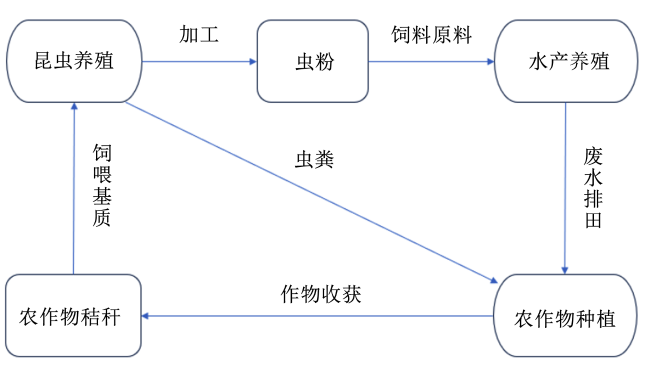
图1 基于昆虫蛋白质的水产养殖可持续生产模式

Fig.1 Sustainable production model of aquaculture based on insect protein

4 小结

随着我国水产养殖业对可持续蛋白质源需求的增长,饲用昆虫(如黑水虻、黄粉虫、大麦虫等)因其高效转化有机废弃物、低碳排放及高营养价值的特点,在替代传统饲料蛋白质方面展现出了广阔的应用前景。黑水虻、黄粉虫、大麦虫等资源昆虫不仅具备高营养组成,而且富含抗菌肽等活性成分,能提升水产动物的免疫力,为解决传统饲料中抗生素滥用的问题提供了新思路。此外,昆虫蛋白质的生产和应用过程通过构建“有机废弃物-昆虫蛋白质-水产养殖”的循环模式,将厨余垃圾、工农业副产物等低值资源转化为高附加值的饲料原料。这一循环模式不仅有效减少了水产养殖对鱼粉、大豆蛋白质资源的依赖,还大幅降低了养殖业的环境负担。尽管目前昆虫蛋白质产业化仍面临技术瓶颈,如几丁质脱除工艺的优化等问题,未来可通过技术创新(如基因改良昆虫种质、高效加工工艺)、政策支持(饲料法规)及产业链整合(昆虫养殖-饲料加工-水产养殖)等途径加速产业化进程,推动水产养殖业向资源集约、环境友好型发展。
[1]
Food and Agriculture Organization of the United Nations. International markets for fisheries and aquaculture products[M]. Rome: Food and Agriculture Organization of the United Nations, 2024.

[2]
国家统计局. 2024年中国统计年鉴[M]. 北京: 中国统计出版社, 2024.

National Bureau of Statistics of China. 2024 China statistical yearbook[M]. Beijing: China Statistics Press, 2024. (in Chinese)

[3]
TACON A G J, METIAN M. Feed matters:satisfying the feed demand of aquaculture[J]. Reviews in Fisheries Science & Aquaculture, 2015, 23(1):1-10.

[4]
HODAR A R, VASAVA R, MAHAVADIYA D R, et al. Fish meal and fish oil replacement for aqua feed formulation by using alternative sources:a review[J]. Journal of Experimental Zoology India, 2020, 23(1):13-21.

[5]
李来刚. 优质活体饵料生物-黑水虻[J]. 科学养鱼, 2016, 38(7):68-69.

LI L G. High-quality live feed organism-black soldier fly[J]. Scientific Fish Farming, 2016, 38(7):68-69. (in Chinese)

[6]
OONINCX D G A B, DE BOER I J M. Environmental impact of the production of mealworms as a protein source for humans-a life cycle assessment[J]. PLOS One, 2012, 7(12):e51145.

[7]
RIVAS-NAVIA D M, DUEÑAS-RIVADENEIRA A A, DUEÑAS-RIVADENEIRA J P, et al. Bioactive compounds of insects for food use:potentialities and risks[J]. Journal of Agriculture and Food Research, 2023, 14:100807.

[8]
TOVIHO O, BÁRSONY P. Insect base-protein:a new opportunity in animal nutrition[J]. Acta Agraria Debreceniensis, 2020,(1):129-138.

[9]
OONINCX D G A B, VAN ITTERBEECK J, HEETKAMP M J W, et al. An exploration on greenhouse gas and ammonia production by insect species suitable for animal or human consumption[J]. PLoS One, 2010, 5(12):e14445.

[10]
MAKKAR H P S, TRAN G, HEUZÉ V, et al. State-of-the-art on use of insects as animal feed[J]. Animal Feed Science and Technology, 2014, 197:1-33.

[11]
MAULU S, LANGI S, HASIMUNA O J, et al. Recent advances in the utilization of insects as an ingredient in aquafeeds:a review[J]. Animal Nutrition, 2022, 11:334-349.

[12]
GHOSH S, LEE S M, JUNG C, et al. Nutritional composition of five commercial edible insects in South Korea[J]. Journal of Asia-Pacific Entomology, 2017, 20(2):686-694.

[13]
RAWSKI M, MAZURKIEWICZ J, KIEROŃCZYK B, et al. Black soldier fly full-fat larvae meal as an alternative to fish meal and fish oil in siberian sturgeon nutrition:the effects on physical properties of the feed,animal growth performance,and feed acceptance and utilization[J]. Animals:an Open Access Journal from MDPI, 2020, 10(11):2119.

[14]
石超宏, 王凤英, 卢钰升, 等. 不同废弃物对黑水虻幼虫生长、营养组成及生产性能影响研究[J]. 环境昆虫学报, 2024, 46(3):753-764.

SHI C H, WANG F Y, LU Y S, et al. Effect of different organic wastes on the development and nutritional composition of black soldier fly (Hermetia illucens) larvae and the production performance[J]. Journal of Environmental Entomology, 2024, 46(3):753-764. (in Chinese)

[15]
何伟灵, 容庭, 刘志昌, 等. 大麦虫幼虫营养成分分析[J]. 广东农业科学, 2014, 41(6):122-126.

HE W L, RONG T, LIU Z C, et al. Analysis of nutritive composition in Zophobas morio larvae[J]. Guangdong Agricultural Sciences, 2014, 41(6):122-126. (in Chinese)

[16]
ROSEMARY BOATE U, DORCAS SUOTONYE B. Cockroach (Periplaneta americana):nutritional value as food and feed for man and livestock[J]. Asian Food Science Journal, 2020, 15(2):37-46.

[17]
夏冰天, 魏洪, 梁文惠, 等. 药渣饲养家蝇幼虫的营养成分研究[J]. 贵阳医学院学报, 2016, 41(1):60-62.

XIA B T, WEI H, LIANG W H, et al. Study on the nutrient content of housefly larva fed by herb residues[J]. Journal of Guiyang Medical College, 2016, 41(1):60-62. (in Chinese)

[18]
OONINCX D D A B, FINKE M D. Nutritional value of insects and ways to manipulate their composition[J]. Journal of Insects as Food and Feed, 2021, 7(5):639-659.

[19]
PRETORIUS Q. The evaluation of larvae of Musca domestica (common house fly) as protein source for broiler production[D]. Stellenbosch: Stellenbosch University, 2011.

[20]
PAUL A, FREDERICH M, UYTTENBROECK R, et al. Nutritional composition and rearing potential of the meadow grasshopper (Chorthippus parallelus Zetterstedt)[J]. Journal of Asia-Pacific Entomology, 2016, 19(4):1111-1116.

[21]
DRAGOJLOVIĆ D, DURAGIĆ O, PEZO L, et al. Comparison of nutritional profiles of super worm (Zophobas morio) and yellow mealworm (Tenebrio molitor) as alternative feeds used in animal husbandry:is super worm superior?[J]. Animals:an Open Access Journal from MDPI, 2022, 12(10):1277.

[22]
ROMANO N, FISCHER H, KUMAR V, et al. Productivity,conversion ability,and biochemical composition of black soldier fly (Hermetia illucens) larvae fed with sweet potato,spent coffee or dough[J]. International Journal of Tropical Insect Science, 2022, 42(1):183-190.

[23]
HUANG C, FENG W L, XIONG J, et al. Impact of drying method on the nutritional value of the edible insect protein from black soldier fly (Hermetia illucens L.) larvae:amino acid composition,nutritional value evaluation,in vitro digestibility,and thermal properties[J]. European Food Research and Technology, 2019, 245:11-21.

[24]
KIM S Y, KIM H G, KO H J, et al. Comparative analysis of nutrients and hazardous substances in Zophobas atratus larvae[J]. Journal of Life Science, 2019, 29(12):1378-1385.

[25]
LENI G, SOETEMANS L, JACOBS J, et al. Protein hydrolysates from Alphitobius diaperinus and Hermetia illucens larvae treated with commercial proteases[J]. Journal of Insects as Food and Feed, 2020, 6(4):393-404.

[26]
BENZERTIHA A, KIEROŃCZYK B, RAWSKI M, et al. Insect fat in animal nutrition-a review[J]. Annals of Animal Science, 2020, 20(4):1217-1240.

[27]
BARROSO F G, DE HARO C, SÁNCHEZ-MUROS M J, et al. The potential of various insect species for use as food for fish[J]. Aquaculture, 2014, 422/423:193-201.

[28]
PAUL A, FREDERICH M, MEGIDO R C, et al. Insect fatty acids:a comparison of lipids from three orthopterans and Tenebrio molitor L.larvae[J]. Journal of Asia-Pacific Entomology, 2017, 20(2):337-340.

[29]
DE CASTRO R J S, OHARA A, AGUILAR J G D S, et al. Nutritional,functional and biological properties of insect proteins:processes for obtaining,consumption and future challenges[J]. Trends in Food Science & Technology, 2018, 76:82-89.

[30]
DREASSI E, CITO A, ZANFINI A, et al. Dietary fatty acids influence the growth and fatty acid composition of the yellow mealworm Tenebrio molitor (Coleoptera:Tenebrionidae)[J]. Lipids, 2017, 52(3):285-294.

[31]
EWALD N, VIDAKOVIC A, LANGELAND M, et al. Fatty acid composition of black soldier fly larvae (Hermetia illucens)-possibilities and limitations for modification through diet[J]. Waste Management, 2020, 102:40-47.

[32]
KIM S Y, KWAK K W, LEE K Y, et al. Comparative analysis of nutritional components of Zophobas atratus larvae raised with artificial diet and wheat branan[J]. Journal of Life Science, 2020, 30(12):1109-1117.

[33]
CHEN X M, FENG Y Y, ZHANG H, et al. Review of the nutritive value of edible insects[J]. Forest Insects as Food:Humans Bite Back, 2010, 85:1-8.

[34]
HLONGWANE Z T, SLOTOW R, MUNYAI T C. Nutritional composition of edible insects consumed in Africa:a systematic review[J]. Nutrients, 2020, 12(9):2786.

[35]
HAMEED A, MAJEED W, NAVEED M, et al. Success of aquaculture industry with new insights of using insects as feed:a review[J]. Fishes, 2022, 7(6):395.

[36]
MERZENDORFER H, ZIMOCH L. Chitin metabolism in insects:structure,function and regulation of chitin synthases and chitinases[J]. Journal of Experimental Biology, 2003, 206(Pt 24):4393-4412.

[37]
SON Y J, HWANG I K, NHO C W, et al. Determination of carbohydrate composition in mealworm (tenebrio molitor L.) larvae and characterization of mealworm chitin and chitosan[J]. Foods, 2021, 10(3):640.

[38]
SPRANGHERS T, OTTOBONI M, KLOOTWIJK C, et al. Nutritional composition of black soldier fly (Hermetia illucens) prepupae reared on different organic waste substrates[J]. Journal of the Science of Food and Agriculture, 2017, 97(8):2594-2600.

DOI PMID

[39]
KIM S Y, KIM H G, LEE K Y, et al. Effects of brewer’s spent grain on the growth and nutrition of the giant mealworm beetle,Zophobas atratus[J]. International Journal of Industrial Entomology, 2018, 37(2):73-81.

[40]
SALEM H, BAUER E, STRAUSS A S, et al. Vitamin supplementation by gut symbionts ensures metabolic homeostasis in an insect host[J]. Proceedings of the Royal Society B:Biological Sciences, 2014, 281(1796):20141838.

[41]
FENG S. Tenebrio molitor L.,entomophagy and processing into ready to use therapeutic ingredients:a review[J]. Journal of Nutritional Health & Food Engineering, 2018, 8(3):280-285.

[42]
ZULKIFLI N F N M, SEOK-KIAN A Y, SENG L L, et al. Nutritional value of black soldier fly (Hermetia illucens) larvae processed by different methods[J]. PLoS One, 2022, 17(2):e0263924.

[43]
SABOLOVÁ M, ADÁMKOVÁ A, KOUŘIMSKÁ L, et al. Minor lipophilic compounds in edible insects[J]. Potravinarstvo Slovak Journal of Food Sciences, 2016, 10(1)400-406.

[44]
LU M X, ZHU C X, SMETANA S, et al. Minerals in edible insects:a review of content and potential for sustainable sourcing[J]. Food Science and Human Wellness, 2024, 13(1):65-74.

[45]
HEIKENS A, PEIJNENBURG W J G M, HENDRIKS A J. Bioaccumulation of heavy metals in terrestrial invertebrates[J]. Environmental Pollution, 2001, 113(3):385-393.

PMID

[46]
RAVZANAADII N, KIM S H, CHOI W H, et al. Nutritional value of mealworm,Tenebrio molitor as food source[J]. International Journal of Industrial Entomology, 2012, 25(1):93-98.

[47]
KOSEČKOVÁ P, ZVĚŘINA O, PĚCHOVÁ M, et al. Mineral profile of cricket powders,some edible insect species and their implication for gastronomy[J]. Journal of Food Composition and Analysis, 2022, 107:104340.

[48]
LIU C C, WANG C W, YAO H Y. Comprehensive resource utilization of waste using the black soldier fly (Hermetia illucens(L.)) (Diptera:Stratiomyidae)[J]. Animals:an Open Access Journal from MDPI, 2019, 9(6):349.

[49]
MANDITSERA F A, LUNING P A, FOGLIANO V, et al. Effect of domestic cooking methods on protein digestibility and mineral bioaccessibility of wild harvested adult edible insects[J]. Food Research International, 2019, 121:404-411.

DOI PMID

[50]
FONTES T V, DE OLIVEIRA K R B, GOMES ALMEIDA I L, et al. Digestibility of insect meals for Nile tilapia fingerlings[J]. Animals:an Open Access Journal from MDPI, 2019, 9(4):181.

[51]
GASCO L, CAIMI C, TROCINO A, et al. Digestibility of defatted insect meals for rainbow trout aquafeeds[J]. Journal of Insects as Food and Feed, 2022, 8(11):1385-1399.

[52]
SÁNDOR Z J, BANJAC V, VIDOSAVLJEVIĆ S, et al. Apparent digestibility coefficients of black soldier fly (Hermetia illucens),yellow mealworm (Tenebrio molitor),and blue bottle fly (Calliphora vicina) insects for juvenile African catfish hybrids (Clarias gariepinus×Heterobranchus longifilis)[J]. Aquaculture Nutrition, 2022, 2022:4717014.

[53]
BASTO A, MATOS E, VALENTE L M P. Nutritional value of different insect larvae meals as protein sources for European sea bass (Dicentrarchus labrax) juveniles[J]. Aquaculture, 2020, 521:735085.

[54]
GE C Y, CHENG H Y, LI J, et al. Effects of defatted yellow mealworm (Tenebrio molitor) on the feed qualities and the growth performance of largemouth bass (Micropterus salmoides)[J]. Journal of Insects as Food and Feed, 2022, 8(11):1-15.

[55]
REMA P, SARAVANAN S, ARMENJON B, et al. Graded incorporation of defatted yellow mealworm (Tenebrio molitor) in rainbow trout (Oncorhynchus mykiss) diet improves growth performance and nutrient retention[J]. Animals:an Open Access Journal from MDPI, 2019, 9(4):187.

[56]
游翠红, 李鸿伟, 周萌, 等. 黑水虻幼虫粉替代不同比例鱼粉对加州鲈生长、机体健康和肌肉品质的影响[J]. 水生生物学报, 2024, 48(3):372-383.

YOU C H, LI H W, ZHOU M, et al. Replacing different proportions of fishmeal with Hermitia illucens meal on the growth,health and muscle quality of Micropterus salmoides[J]. Acta Hydrobiologica Sinica, 2024, 48(3):372-383. (in Chinese)

[57]
韩光明, 张家宏, 吴雷明, 等. 黑水虻幼虫粉替代鱼粉对克氏原螯虾生长、体组成及免疫力的影响[J]. 动物营养学报, 2023, 35(7):4495-4506.

DOI

HAN G M, ZHANG J H, WU L M, et al. Effects of replacing fish meal with black soldier fly larvae meal on growth,body composition and immunity of red swamp crayfish (Procambarus clarkii)[J]. Chinese Journal of Animal Nutrition, 2023, 35(7):4495-4506. (in Chinese)

[58]
牛秋雪, 邵仙萍, 叶金云, 等. 脱脂黑水虻幼虫粉替代鱼粉对中华鳖生长性能、肝脏抗氧化能力和肠道菌群的影响[J]. 动物营养学报, 2023, 35(10):6650-6664.

DOI

NIU Q X, SHAO X P, YE J Y, et al. Effects of defatted black soldier fly larva meal replacing fish meal on growth performance,hepatic antioxidant ability and intestinal microflora of juvenile Chinese soft-shelled turtle (Pelodiscus sinensis)[J]. Chinese Journal of Animal Nutrition, 2023, 35(10):6650-6664. (in Chinese)

[59]
余维鹏, 陈延娜, 张玉茹, 等. 4种昆虫蛋白粉对草鱼生长和免疫功能的影响[J]. 饲料工业, 2023, 44(2):81-88.

YU W P, CHEN Y N, ZHANG Y R, et al. Effects of four insect protein powders on growth and immunity of grass carp (Ctenopharyngodon idellus)[J]. Feed Industry, 2023, 44(2):81-88. (in Chinese)

[60]
WU Q H, PATOČKA J, KUČA K. Insect antimicrobial peptides,a mini review[J]. Toxins, 2018, 10(11):461.

[61]
HENRY M A, GOLOMAZOU E, ASIMAKI A, et al. Partial dietary fishmeal replacement with full-fat or defatted superworm (Zophobas morio) larvae meals modulates the innate immune system of gilthead seabream,Sparus aurata[J]. Aquaculture Reports, 2022, 27:101347.

[62]
IDO A, IWAI T, ITO K, et al. Dietary effects of housefly (Musca domestica) (Diptera:Muscidae) pupae on the growth performance and the resistance against bacterial pathogen in red sea bream (Pagrus major) (Perciformes:Sparidae)[J]. Applied Entomology and Zoology, 2015, 50(2):213-221.

[63]
LOH J Y, MOUSAVI S, ZAHEDINEZHAD S. A review on insect meals in aquaculture:the immunomodulatory and physiological effects[J]. International Aquatic Research, 2020, 12(2):100-115.

[64]
GE C Y, LIANG X F, WU X L, et al. Yellow mealworm (Tenebrio Molitor) enhances intestinal immunity in largemouth bass (Micropterus salmoides) via the NF-κB/survivin signaling pathway[J]. Fish & Shellfish Immunology, 2023, 136:108736.

[65]
亓泽政. 两种新型非粮蛋白源替代饲料鱼粉对大菱鲆品质的影响[D].硕士学位论文. 济南: 山东大学, 2023.

QI Z Z. The effects of dietary fish meal replacement by two non-food protein sources on the quality of turbot (Scophthalmus maximus)[D].Master’s Thesis. Ji’nan: Shandong University, 2023. (in Chinese)

[66]
晏显芳. 脱脂黑水虻幼虫粉替代鱼粉对大口黑鲈生长性能、组织结构和肌肉品质的影响及其机制研究[D].硕士学位论文. 杨凌: 西北农林科技大学, 2023.

YAN X F. Effect of fish meal replacement by defatted black soldier fly larvae meal on growth performance,tissue structure,muscle quality and mechanism of largemouth bass (Micropterus salmoides)[D].Master’s Thesis. Yangling: Northwest A&F University, 2023. (in Chinese)

[67]
HE L, ZHANG Y, DING M Q, et al. Sustainable strategy for lignocellulosic crop wastes reduction by Tenebrio molitor Linnaeus (mealworm )and potential use of mealworm frass as a fertilizer[J]. Journal of Cleaner Production, 2021, 325:129301.

[68]
LIU C C, WANG C W, YAO H Y, et al. Pretreatment is an important method for increasing the conversion efficiency of rice straw by black soldier fly larvae based on the function of gut microorganisms[J]. Science of the Total Environment, 2021, 762:144118.

[69]
BONDARI K, SHEPPARD D C. Soldier fly,Hermetia illucens L.,larvae as feed for channel catfish,Ictalurus punctatus (Rafinesque),and blue tilapia,Oreochromis aureus (Steindachner)[J]. Aquaculture Research, 1987, 18:209-220.

[70]
MAMTIMIN T, HAN H W, KHAN A, et al. Gut microbiome of mealworms (Tenebrio molitor Larvae) show similar responses to polystyrene and corn straw diets[J]. Microbiome, 2023, 11(1):98.

[71]
YANG Y, WANG J L, XIA M L. Biodegradation and mineralization of polystyrene by plastic-eating superworms Zophobas atratus[J]. Science of the Total Environment, 2020, 708:135233.

[72]
MIGLIETTA P P, DE LEO F, RUBERTI M, et al. Mealworms for food:a water footprint perspective[J]. Water, 2015, 7(11):6190-6203.

[73]
CHAVEZ M, UCHANSKI M. Insect left-over substrate as plant fertiliser[J]. Journal of Insects as Food and Feed, 2021, 7(5):683-694.

[74]
YEN A L. Insects as food and feed in the Asia Pacific region:current perspectives and future directions[J]. Journal of Insects as Food and Feed, 2015, 1(1):33-55.

Outlines

/