RESEARCH PAPER

Effects of on-Site Preparation of Enzyme-Hydrolyzed Soybean Meal for Wet-Mixed Feeding on Growth Performance, Nutrient Apparent Digestibility and Intestinal Health of Weaned Piglets

  • CHEN Qiuhong ,
  • LI Wentao ,
  • ZHOU Qiang ,
  • FANG Zhengfeng ,
  • LIN Yan ,
  • XU Shengyu ,
  • FENG Bin ,
  • ZHUO Yong ,
  • JIANG Xuemei ,
  • WU De ,
  • TANG Jiayong , * ,
  • CHE Lianqiang , *
Expand
  • Key Laboratory of Animal Disease-Resistance Nutrition of Ministry of Education, Animal Nutrition Institute, Sichuan Agricultural University, Chengdu 611130, China
* TANG Jiayong, associate professor, E-mail: ;
CHE Lianqiang, professor, E-mail:

Received date: 2024-11-30

  Online published: 2025-07-12

Abstract

This experiment was conducted to explore the effects of effects of on-site preparation of enzyme-hydrolyzed soybean meal for wet-mixed feeding on growth performance, nutrient apparent digestibility and intestinal health of weaned piglets. Using a 2 (two kinds of soybean meal treatment methods: soaking and enzymatic hydrolysis) ×2 [two soybean meal supplemental levels: low (10%) and normal (15%) levels] two-factor experimental design, a total of 96 Duroc, Landrace and Yorkshire crossbreed weaned piglets with (24±2) days of age and average weight of (7.49±0.19) kg were randomly divided into 4 groups, with 8 replicates in each group and 3 pigs in each replicate. Diets in the four groups were supplemented with 10% soaked soybean meal (10% soaked soybean meal group), 10% enzyme-hydrolyzed soybean meal (10% enzyme-hydrolyzed soybean meal group), 15% soaked soybean meal (15% soaked soybean meal group) and 15% enzyme-hydrolyzed soybean meal (15% enzyme-hydrolyzed soybean meal group), respectively, and prepared on-site for wet-mixed feeding with feed-to-water ratio of 1:1. The experiment lasted for 21 days. The results show as follows: 1) compared with the soaked soybean meal, the contents of glycinin, β-conglycinin and raffinose in the enzyme-hydrolyzed soybean meal were decreased by 81.60%, 87.73% and 44.19%, respectively, and the acid-soluble protein content was increased by 11.24 times. 2) Compared with the soaked soybean meal, dietary enzyme-hydrolyzed soybean meal tended to reduce the feed to gain ratio (F/G) of weaned piglets in week 2 (P=0.05), tended to increase the average daily feed intake (ADFI) in week 3 (P=0.06), extremely significantly increasing the F/G in week 3 (P<0.01), and extremely significantly reduced the diarrhea index in week 3 (P<0.01). In week 1 of the experiment, compared with the low soybean meal level group, the final body weight and average daily gain (ADG) of weaned piglets in the normal soybean meal level group were significantly increased (P<0.05), and the F/G was extremely significantly decreased (P<0.01); in the whole phase, compared with the low soybean meal level group, the F/G in the normal soybean meal level group was significantly decreased (P<0.05). 2) Compared with the low soybean meal level group, the cysteine apparent digestibility in the normal soybean meal level group was significantly increased (P<0.05), and the apparent digestibilities of crude protein (P=0.08) and tyrosine (P=0.05) showed an increasing trend. 3) Compared with the soaked soybean meal, dietary enzyme-hydrolyzed soybean meal tended to increase the villus height in ileum of weaned piglets (P=0.07), extremely significantly increase the villus height to crypt depth ratio in ileum (P<0.01), and tended to reduce the number of goblet cells (P=0.05); meanwhile, dietary enzyme-hydrolyzed soybean meal significantly or extremely significantly reduced the contents of propionate, isobutyrate, valerate and total short-chain fatty acids in colon chyme (P<0.05 or P<0.01). 4) The treatment method and supplemental level of soybean meal as well as the interaction between them had no significant effects on the α diversity of the microbial community in colon chyme of weaned piglets (P>0.05). The linear discriminant analysis effect size (LEfSe) analysis indicated that o_Clostridia_UCG-014, o_Enterobacterales, f_Clostridia_UCG-014, f_Selenomonadaceae, f_Enterobacteriaceae, g_Clostridia_UCG-014 and g_Escherichia-Shigella were enriched in colon chyme in 10% enzyme-hydrolyzed soybean meal group, and g_Ruminococcus was enriched in colon chyme in 15% enzyme-hydrolyzed soybean meal group. In conclusion, on-site preparation of enzyme-hydrolyzed soybean meal for wet-mixed feeding can reduce the diarrhea index of weaned piglets in the late nursery period, increase feed intake, and improve intestinal morphology and microbiota structure.

Cite this article

CHEN Qiuhong , LI Wentao , ZHOU Qiang , FANG Zhengfeng , LIN Yan , XU Shengyu , FENG Bin , ZHUO Yong , JIANG Xuemei , WU De , TANG Jiayong , CHE Lianqiang . Effects of on-Site Preparation of Enzyme-Hydrolyzed Soybean Meal for Wet-Mixed Feeding on Growth Performance, Nutrient Apparent Digestibility and Intestinal Health of Weaned Piglets[J]. Chinese Journal of Animal Nutrition, 2025 , 37(7) : 4349 -4361 . DOI: 10.12418/CJAN2025.356

仔猪断奶后胃肠道发育不完善、消化酶分泌不足,同时受由断奶前采食液体母乳转变为断奶后采食固体饲粮以及环境改变等因素影响,易导致断奶应激综合征。使用液态副产品(如植物提取液、液体发酵产品和食品加工副产品等)或水与常规干饲料混合制备流体或湿拌饲料,有利于断奶仔猪采食,可缓解由液体奶到固体料过渡的压力,防止可能的致病性感染,从而缓解断奶应激[1-3]。豆粕中含有40%~50%的粗蛋白质且氨基酸含量均衡,是猪饲粮中主要的植物源蛋白质原料。但豆粕中同时又含有大量抗原蛋白(如大豆球蛋白、β-伴大豆球蛋白等)及其他抗营养因子,对仔猪生长和肠道健康有负面作用,添加过高比例豆粕会加剧断奶仔猪的肠道损伤,引起消化不良、腹泻等应激反应[4-5]。而豆粕添加比例过低(不额外补充因低豆粕带来的氨基酸不足),则会因必需氨基酸摄入不足而导致猪的生长性能和饲料转化率降低[6]
蛋白酶可有效断裂蛋白质分子内特定的肽键或二硫键,破坏构象表位[7],从而有效降解豆粕中的抗原蛋白,并提高小肽含量[8-9]。在低豆粕饲粮中添加蛋白酶可提高仔猪常规养分和氨基酸消化率,从而改善因豆粕减少带来的部分负面影响[10]。豆粕经蒸煮并联合菌酶协同液态处理后,抗原蛋白几乎完全被降解,且能显著降低仔猪腹泻率,并显著提高干物质和粗蛋白质表观消化率[11]。不过,蒸煮联合菌酶协同工艺复杂、能耗高且现场制备难度大,而蛋白酶水解也可较好地降解豆粕中的抗原蛋白。因此,本研究旨在通过对豆粕现场酶解调制湿拌全价饲粮并饲喂断奶仔猪,探究不同水平酶解豆粕(enzyme-hydrolyzed soybean meal,ESBM)对仔猪生长性能、养分表观消化率和肠道健康的影响,以期为现代集约化猪场饲料原料的现场液态调制及饲喂提供指导。

1 材料与方法

1.1 试验材料

酶解豆粕酶解工艺参数为50 ℃、pH=9.2、料水比1:3.5、0.75%碱性蛋白酶(≥110 000 U/mL),酶解3 h后再加入0.5%风味蛋白酶[≥350亮氨酸氨肽酶单位(LAPU)/mL]和0.5% α-半乳糖苷酶(≥500 U/g)继续酶解1.5 h。浸泡豆粕(soaked soybean meal,SSBM)浸泡工艺参数为料水比1:3.5,室温浸泡4.5 h。酶解豆粕和浸泡豆粕制备后,按酶解和浸泡前其风干基础量对应液态酶解量现场加入不同全价饲粮剩余原料及添加物,并按全价料风干基础量补充水至料水比=1:1(风干基础:水),搅拌调制成湿拌料。

1.2 试验设计及饲粮

本动物试验经四川农业大学动物伦理与福利委员会审核,符合动物保护、动物福利和原理,符合国家动物福利伦理的相关规定,批准号:20220179。
试验采用2(2种豆粕处理方式:浸泡和酶解)×2[2个豆粕添加水平:低(10%)和正常(15%)水平]双因素试验设计,选取96头“杜长大”断奶仔猪[(24±2)日龄,平均体重(7.49±0.19) kg],随机分为4组,每组8个重复,每个重复3头猪。4组分别在饲粮中添加10%浸泡豆粕(10%浸泡豆粕组)、10%酶解豆粕(10%酶解豆粕组)、15%浸泡豆粕(15%浸泡豆粕组)和15%酶解豆粕(15%酶解豆粕组),现场调制成湿拌料后饲喂。
各组饲粮代谢能和氨基酸模式(限制性氨基酸/赖氨酸)一致,其中15%豆粕水平组仔猪营养需要满足或超过NRC(2012)猪营养标准推荐值,饲粮组成及营养水平见表1。饲粮为湿拌料(料水比=1:1),猪只自由采食和饮水。试验期21 d。
表1 饲粮组成及营养水平(风干基础)

Table 1 Composition and nutrient levels of diets (air-dry basis)%

项目
Items
10%浸泡豆粕组
10% SSBM group
10%酶解豆粕组
10% ESBM group
15%浸泡豆粕组
15% SSBM group
15%酶解豆粕组
15% ESBM group
原料 Ingredients
玉米 Corn 23.31 23.31 18.15 18.15
膨化玉米 Extruded corn 20.00 20.00 20.00 20.00
豆粕 Soybean meal1) 10.00 10.00 15.00 15.00
膨化大豆 Extruded soybean 5.50 5.50 5.50 5.50
低蛋白质乳清粉 Low protein whey powder 15.00 15.00 15.00 15.00
大豆浓缩蛋白 Soy protein concentrate 4.00 4.00 4.00 4.00
鱼粉 Fish meal 4.00 4.00 4.00 4.00
全脂奶粉 Full-fat milk powder 8.00 8.00 8.00 8.00
大豆油 Soybean oil 2.50 2.50 2.70 2.70
蔗糖 Sucrose 4.00 4.00 4.00 4.00
L-赖氨酸盐酸盐 L-Lys·HCl 0.47 0.47 0.47 0.47
DL-蛋氨酸 DL-Met 0.23 0.23 0.25 0.25
L-苏氨酸 L-Thr 0.19 0.19 0.19 0.19
L-色氨酸 L-Trp 0.07 0.07 0.07 0.07
L-缬氨酸 L-Val 0.09 0.09 0.08 0.08
氯化胆碱 Choline chloride 0.16 0.16 0.16 0.16
碳酸钙 CaCO3 0.78 0.78 0.76 0.76
磷酸氢钙 CaHPO4 0.15 0.15 0.12 0.12
氯化钠 NaCl 0.40 0.40 0.40 0.40
氧化锌 ZnO 0.20 0.20 0.20 0.20
益生菌 Probiotics 0.05 0.05 0.05 0.05
壳寡糖 Chitosan oligosaccharide 0.01 0.01 0.01 0.01
枯草芽孢杆菌 Bacillus subtilis 0.08 0.08 0.08 0.08
酸化剂 Acidifier 0.50 0.50 0.50 0.50
抗氧化剂 Antioxidant 0.02 0.02 0.02 0.02
香味剂 Fragrance 0.02 0.02 0.02 0.02
甜味剂 Sweetener 0.02 0.02 0.02 0.02
预混料 Premix2) 0.25 0.25 0.25 0.25
合计 Total 100.00 100.00 100.00 100.00
营养水平 Nutrient levels3)
代谢能 ME/(MJ/kg) 14.23 14.23 14.23 14.23
粗蛋白质 CP 17.81 17.61 19.29 19.21
钙 Ca 0.80 0.80 0.80 0.80
有效磷 AP 0.40 0.40 0.40 0.40
赖氨酸 Lys 1.41 1.41 1.53 1.53
蛋氨酸 Met 0.54 0.54 0.58 0.58
苏氨酸 Thr 0.88 0.88 0.95 0.95
色氨酸 Trp 0.29 0.29 0.31 0.31

1)10%和15%分别对应酶解和浸泡前豆粕的风干基础量。10% and 15% corresponded to the air-dry basis of soybean meal before enzymatic hydrolysis and soaking, respectively.
2)预混料为每千克饲粮提供 The premix provided the following per kg of diets:VA 12 000 IU,VD3 2 000 IU,VE 40 mg,VK3 5 mg,VB1 5 mg,VB2 12.5 mg,VB6 6 mg,VB12 0.06 mg,烟酸 nicotinic acid 50 mg,泛酸 pantothenic acid 25 mg,叶酸 folic acid 2.5 mg,生物素 biotin 0.25 mg,Fe (as ferrous sulfate) 100 mg,Cu (as copper sulfate) 6 mg,Zn (as zinc sulfate) 100 mg,Mn (as manganese sulfate) 4 mg,I (as potassium iodide) 0.14 mg,Se (as sodium selenite) 0.35 mg。
3)粗蛋白质为实测值,其余为计算值[根据《中国饲料成分及营养价值表(2023年第34版)》计算]。CP was a measured value, while the others were calculated values according to Tables of Feed Composition and Nutritive Values in China (34th edition, 2023).

1.3 饲养管理

饲养试验于2022年10—11月在四川农业大学教学科研基地进行,期间按照基地对断奶仔猪的饲养程序进行免疫和管理,每天饲喂4次。饲养第8天用0.3%三氧化二铬(Cr2O3)作为外源指示剂进行消化试验,4 d适应期后于第12~14天每次饲喂结束后收集粪便,并按粪便质量的10%(V/W)加入1 mol/L的硫酸(H2SO4)混匀后于-20 ℃保存。豆粕浸泡和酶解处理后各采集100 g,于-20 ℃保存待测。

1.4 屠宰与采样

饲养试验结束后,每重复选取1头接近该重复平均体重的仔猪,前腔静脉采集血液5 mL于乙二胺四乙酸抗凝采血管中,常温静置30 min后,3 500×g离心15 min收集上清,-20 ℃保存。仔猪采血后按200 mg/kg BW注射戊巴比妥钠,待昏迷后屠宰,分离肠段,取2 cm中段回肠于4%多聚甲醛中固定,取结肠内容物液氮速冻后于-80 ℃保存。

1.5 检测指标及方法

1.5.1 酶解豆粕理化特性

酶解和浸泡豆粕中大豆球蛋白和β-伴大豆球蛋白含量采用酶联免疫吸附试验(ELISA)法检测,棉子糖含量参照GB/T 22491—2008检测,酸溶蛋白含量参照GB/T 22492—2008检测。

1.5.2 生长性能和腹泻指数

分别于试验第1、7、14和21天对空腹仔猪以重复为单位进行称重,记录各重复每天加料、余料和损料量,根据料水比1:1换算成风干基础量,计算仔猪每周和全期的平均日采食量(ADFI)、平均日增重(ADG)和料重比(F/G)。饲养期间每天观察圈舍内粪便及猪尾部情况,记录粪便评分[11],计算腹泻指数。计算公式为:
腹泻指数=粪便评分之和/(试验猪头数×天数×每日评分次数)。

1.5.3 饲粮营养成分及养分表观消化率

粗蛋白质含量参照GB/T 6432—2018方法测定,粗脂肪含量参照GB/T 6433—2006方法测定,氨基酸含量参照GB/T 18246—2019方法测定,铬含量参照GB/T 13088—2006方法测定,干物质含量参照AOAC[12]方法(930.15)测定,总能采用Parr 6400型绝热氧弹量热计(美国)测定。养分表观消化率计算公式如下:
某养分表观消化率(%)=100-100×(饲粮中铬含量×粪便中该养分含量)/(粪便中铬含量×饲粮中该养分含量)。

1.5.4 回肠形态

回肠组织经4%多聚甲醛固定后,经冲洗、脱水、透明、包埋、切片和过典酸雪夫氏(PAS)染色等操作后,于BX43型显微镜(奥林巴斯,日本)下用Image Pro Plus 6.0对视野中10个完整绒毛高度、隐窝深度、杯状细胞数量及面积进行测量,并计算绒隐比(绒毛高度/隐窝深度)。

1.5.5 结肠内容物微生物群落及短链脂肪酸含量

结肠内容物DNA采用粪便DNA提取试剂盒(No. D4015-01,Omega,美国)提取,合格DNA样品送至北京诺禾致源科技股份有限公司对微生物进行16S rRNA序列分析,具体分析及操作步骤参照Tang等[11]进行;结肠内容物中短链脂肪酸含量采用CP-3800型气相色谱仪(瓦里安,美国)测定,具体操作步骤参照Tang等[11]进行。

1.6 数据统计分析

采用SAS 9.4软件进行2×2双因素统计分析,豆粕处理方式和添加水平为固定效应,断奶仔猪体重为随机效应;采用UNIVARIATE程序对数据进行正态性检验,符合正态分布用MIXED模型分析,不符合正态分布则先运行RANK程序再用MIXED模型分析,组间数据采用Tukey法进行多重比较。生长性能、腹泻指数和养分表观消化率以重复为统计单位,其余指标以个体为统计单位。结果以“平均值±标准误”形式表示,P<0.01为差异极显著,P<0.05为差异显著,0.05≤P<0.10为差异有显著趋势。

2 结果与分析

2.1 酶解对豆粕理化特性的影响

表2可知,与浸泡豆粕相比,酶解豆粕中大豆球蛋白、β-伴大豆球蛋白和棉子糖含量分别降低了81.60%、87.73%和44.19%,酸溶蛋白含量提高了11.24倍,粗蛋白质、粗脂肪含量和总能无明显变化。
表2 酶解对豆粕理化特性的影响

Table 2 Effects of enzymatic hydrolysis on physicochemical characteristics of soybean meal

项目 Items 浸泡豆粕 SSBM 酶解豆粕 ESBM
大豆球蛋白 Glycinin/(mg/g) 186.98 34.41
β-伴大豆球蛋白 β-conglycinin/(mg/g) 102.64 12.59
棉子糖 Raffinose/% 0.43 0.24
酸溶蛋白 Acid-soluble protein/% 1.04 12.73
粗蛋白质 Crude protein/% 45.74 45.57
粗脂肪 Ether extract/% 1.39 1.45
总能 Gross energy/(MJ/kg) 18.45 18.50

2.2 酶解豆粕对断奶仔猪生长性能和腹泻指数的影响

表3可知,与浸泡豆粕相比,饲粮中添加酶解豆粕有降低断奶仔猪第2周F/G的趋势(P=0.05),有提高第3周ADFI的趋势(P=0.06),同时极显著提高第3周F/G(P<0.01),并极显著降低第3周腹泻指数(P<0.01)。试验第1周,与低豆粕水平组相比,正常豆粕水平组断奶仔猪末重和ADG均显著提高(P<0.05),F/G极显著降低(P<0.01);试验全期,与低豆粕水平组相比,正常豆粕水平组F/G显著降低(P<0.05)。豆粕处理方式与添加水平对断奶仔猪生长性能和腹泻指数无显著交互效应(P>0.05)。
表3 酶解豆粕对断奶仔猪生长性能和腹泻指数的影响

Table 3 Effects of ESBM on growth performance and diarrhea index of weaned piglets (n=8)

项目
Items
10%浸泡豆粕组
10% SSBM
group
10%酶解豆粕组
10% ESBM
group
15%浸泡豆粕组
15% SSBM
group
15%酶解豆粕组
15% ESBM
group
PP-value
P1 P2 P3
体重 BW/kg
第1天 Day 1 7.49±0.40 7.49±0.41 7.49±0.40 7.49±0.40
第7天 Day 7 8.12±0.37 8.04±0.44 8.42±0.51 8.25±0.44 0.24 0.01 0.66
第14天 Day 14 10.07±0.39 10.00±0.44 10.12±0.49 10.31±0.46 0.75 0.36 0.51
第21天 Day 21 13.65±0.48 12.76±0.39 13.71±0.63 13.38±0.49 0.11 0.36 0.46
平均日增重 ADG/(g/d)
第1周 Week 1 94±9 78±12 120±14 116±15 0.41 0.02 0.65
第2周 Week 2 265±21 279±16 258±13 293±9 0.12 0.82 0.51
第3周 Week 3 503±23 502±17 511±22 498±25 0.75 0.92 0.53
全期 Whole phase 283±13 285±11 292±13 294±13 0.87 0.50 0.99
平均日采食量 ADFI/(g/d)
第1周 Week 1 252±15 249±17 244±17 245±24 0.59 0.82 0.91
第2周 Week 2 477±28 475±19 469±31 484±25 0.80 0.93 0.77
第3周 Week 3 845±43 890±25 858±40 891±51 0.06 0.85 0.41
全期 Whole phase 520±24 538±15 515±26 528±31 0.57 0.94 0.65
料重比 F/G
第1周 Week 1 2.79±0.29 3.71±0.59 2.12±0.14 2.21±0.21 0.13 <0.01 0.30
第2周 Week 2 1.85±0.13 1.72±0.07 1.82±0.10 1.65±0.06 0.05 0.59 0.76
第3周 Week 3 1.68±0.04 1.78±0.04 1.68±0.03 1.79±0.07 <0.01 0.90 0.81
全期 Whole phase 1.84±0.06 1.89±0.05 1.76±0.04 1.79±0.06 0.51 0.04 0.69
腹泻指数 Diarrhea index
第1周 Week 1 0.26±0.03 0.21±0.05 0.21±0.03 0.30±0.06 0.95 0.94 0.23
第2周 Week 2 0.08±0.03 0.06±0.02 0.10±0.04 0.02±0.01 0.46 0.46 0.38
第3周 Week 3 0.02±0.01 0.00±0.00 0.04±0.01 0.00±0.00 <0.01 0.86 0.86
全期 Whole phase 0.12±0.01 0.09±0.02 0.12±0.03 0.10±0.02 0.33 0.98 0.48

P1表示豆粕处理方式,P2表示豆粕添加水平,P3表示豆粕处理方式与添加水平的交互效应。下表同。

P1 represented treatment method of soybean meal, P2 represented supplemental level of soybean meal, and P3 represented the interaction between treatment method and supplemental level. The same as below.

2.3 酶解豆粕对断奶仔猪养分表观消化率的影响

表4可知,与浸泡豆粕相比,饲粮中添加酶解豆粕对断奶仔猪干物质、粗蛋白质、粗脂肪、总能以及氨基酸表观消化率均无显著影响(P>0.05)。与低豆粕水平组相比,正常豆粕水平组半胱氨酸表观消化率显著提高(P<0.05),且粗蛋白质(P=0.08)和酪氨酸(P=0.05)表观消化率有提高趋势。豆粕处理方式与添加水平对断奶仔猪养分表观消化率无显著交互效应(P>0.05)。
表4 酶解豆粕对断奶仔猪养分表观消化率的影响

Table 4 Effects of ESBM on nutrient apparent digestibility of weaned piglets (n=8)%

项目
Items
10%浸泡豆粕组
10% SSBM
group
10%酶解豆粕组
10% ESBM
group
15%浸泡豆粕组
15% SSBM
group
15%酶解豆粕组
15% ESBM
group
PP-value
P1 P2 P3
干物质 DM 84.29±0.52 84.09±0.60 84.59±0.84 85.29±0.51 0.54 0.15 0.35
粗蛋白质 CP 72.51±1.12 71.83±1.67 72.95±1.74 76.62±1.28 0.31 0.08 0.14
粗脂肪 EE 77.62±2.06 78.18±1.43 78.99±2.44 79.24±1.02 0.76 0.43 0.97
总能 GE 83.77±0.64 83.07±1.21 82.88±1.00 83.30±0.63 0.87 0.71 0.54
总氨基酸
Total amino acids
75.18±1.17 74.16±1.67 75.11±1.55 77.03±1.45 0.75 0.34 0.32
半胱氨酸 Cys 75.99±4.02 78.37±1.61 88.48±4.69 85.90±3.56 0.97 0.01 0.50
酪氨酸 Tyr 69.93±1.47 68.32±2.26 71.43±1.75 74.04±1.55 0.78 0.05 0.24
天冬氨酸 Asp 72.70±1.32 71.51±1.83 72.66±1.85 74.93±1.63 0.74 0.31 0.30
苏氨酸 Thr 73.30±1.27 72.37±1.67 72.09±1.68 74.08±1.49 0.72 0.86 0.33
丝氨酸 Ser 74.27±1.27 73.61±1.71 73.40±1.71 75.50±1.38 0.63 0.74 0.37
谷氨酸 Glu 80.11±0.94 79.32±1.44 79.75±1.28 81.32±1.18 0.75 0.50 0.34
甘氨酸 Gly 69.79±1.28 67.89±1.81 69.78±1.88 71.86±1.69 0.95 0.24 0.23
丙氨酸 Ala 66.96±1.32 65.18±2.08 65.97±2.14 68.45±1.99 0.85 0.55 0.27
缬氨酸 Val 71.69±1.62 70.94±1.78 72.41±1.78 74.18±1.58 0.76 0.24 0.45
蛋氨酸 Met 77.69±1.29 77.90±1.50 76.13±1.58 79.38±1.40 0.23 0.98 0.29
异亮氨酸 Ile 69.76±1.48 68.28±2.07 70.62±1.80 72.73±1.77 0.85 0.13 0.30
亮氨酸 Leu 73.21±1.18 70.97±2.03 73.25±1.70 75.06±1.62 0.90 0.22 0.23
苯丙氨酸 Phe 72.04±1.22 70.43±2.05 72.56±1.70 74.44±1.59 0.93 0.18 0.30
赖氨酸 Lys 79.92±0.93 78.88±1.31 79.93±1.34 81.70±1.23 0.75 0.23 0.24
组氨酸 His 77.46±0.91 79.22±1.51 78.11±1.36 79.39±1.32 0.98 0.15 0.34
精氨酸 Arg 79.32±1.35 77.91±1.53 79.66±1.43 81.81±1.35 0.79 0.14 0.21
脯氨酸 Pro 78.36±0.73 79.43±1.28 77.28±1.25 78.86±1.18 0.25 0.47 0.82

2.4 酶解豆粕对断奶仔猪回肠形态的影响

表5可知,与浸泡豆粕相比,饲粮中添加酶解豆粕有提高断奶仔猪回肠绒毛高度的趋势(P=0.07),极显著提高回肠绒隐比(P<0.01),同时有降低杯状细胞数量的趋势(P=0.05)。与低豆粕水平组相比,正常豆粕水平组回肠隐窝深度极显著提高(P<0.01),回肠绒隐比极显著降低(P<0.01)。豆粕处理方式与添加水平对断奶仔猪回肠隐窝深度和绒隐比表现出显著或极显著交互效应(P<0.05或P<0.01)。
表5 酶解豆粕对断奶仔猪回肠形态的影响

Table 5 Effects of ESBM on ileal morphology of weaned piglets (n=8)

项目
Items
10%浸泡豆粕组
10% SSBM
group
10%酶解豆粕组
10% ESBM
group
15%浸泡豆粕组
15% SSBM
group
15%酶解豆粕组
15% ESBM
group
PP-value
P1 P2 P3
绒毛高度 VH/μm 329.27±29.72 397.56±80.04 339.05±54.23 354.08±63.86 0.07 0.46 0.24
隐窝深度 CD/μm 151.53±17.80 126.17±15.00 158.98±13.89 166.03±17.47 0.14 <0.01 0.01
绒隐比 VH/CD 2.25±0.20 3.24±0.47 2.18±0.31 2.17±0.37 <0.01 <0.01 <0.01
杯状细胞
Goblet cells/
(×10-4个/μm2)
5.42±1.45 3.40±1.14 5.21±1.47 4.78±1.04 0.05 0.34 0.20

2.5 酶解豆粕对断奶仔猪结肠内容物微生物群落的影响

2.5.1 结肠内容物微生物α多样性分析
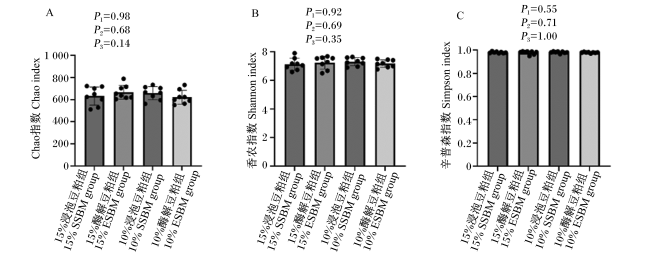
图1所示,豆粕处理方式和添加水平以及二者的交互效应对断奶仔猪结肠内容物微生物群落Chao指数、香农指数和辛普森指数均无显著影响(P>0.05)。
图1 酶解豆粕对断奶仔猪结肠内容物微生物α多样性的影响

P1表示豆粕处理方式,P2表示豆粕添加水平,P3表示豆粕处理方式与添加水平的交互效应。

Fig.1 Effects of ESBM on microbial α diversity in colon chyme of weaned piglets (n=8)

P1 represented treatment method of soybean meal, P2 represented supplemental level of soybean meal, and P3 represented the interaction between treatment method and supplemental level.

2.5.2 结肠内容物微生物物种差异性分析

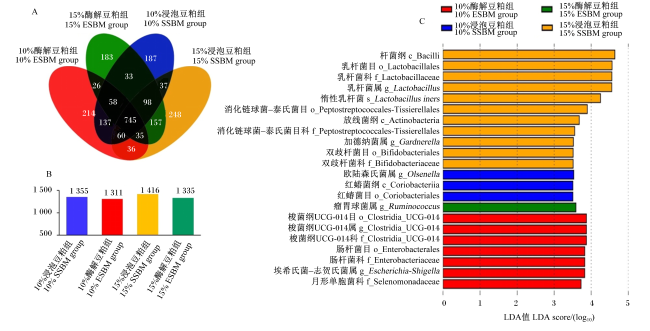
本试验中,10%浸泡豆粕组、10%酶解豆粕组、15%浸泡豆粕组和15%酶解豆粕组断奶仔猪结肠内容物中分别获得531 518、65 972、63 993和501 805条有效序列。如图2所示,上述各组分别拥有1 355、1 311、1 416和1 335个操作分类单元(OTU),共享745个OTU,分别独有187、214、248和183个OTU。采用线性判别分析(LDA)效应大小(LEfSe)分析(LDA阈值>3.5)表明,分别有3类、7类、11类和1类微生物显著富集于10%浸泡豆粕组、10%酶解豆粕组、15%浸泡豆粕组和15%酶解豆粕组断奶仔猪结肠内容物中(P<0.05)。其中,10%酶解豆粕组7类差异微生物中有4类[梭菌纲UCG-014目(o_Clostridia_UCG-014)、月形单胞菌科(f_Selenomonadaceae)、梭菌纲UCG-014科(f_Clostridia_UCG-014)和梭菌纲UCG-014属(g_Clostridia_UCG-014)]属于厚壁菌门(Firmicutes),有3类[肠杆菌目(o_Enterobacterales)、肠杆菌科(f_Enterobacteriaceae)和埃希氏菌-志贺氏菌属(g_Escherichia-Shigella)]属于γ-变形菌纲;15%浸泡豆粕组11类差异性微生物中有5类属于杆菌纲(c_Bacilli),4类属于放线菌纲(c_Actinobacteria),2类属于消化链球菌-泰氏菌目(o_Peptostreptococcales-Tissierellales)。
图2 酶解豆粕对断奶仔猪结肠内容物微生物特性的影响

A:OTU韦恩图 Venn diagram of OTU;B:OTU数量 OTU number;C:LDA值分布柱状图 LDA score distribution histogram。

Fig.2 Effects of ESBM on microbial characteristics in colon chyme of weaned piglets (n=8)

2.6 酶解豆粕对断奶仔猪结肠内容物短链脂肪酸含量的影响

表6可知,与浸泡豆粕相比,饲粮中添加酶解豆粕显著或极显著降低断奶仔猪结肠内容物丙酸、异丁酸、戊酸和总短链脂肪酸含量(P<0.05或P<0.01),有降低结肠内容物乙酸(P=0.08)和异戊酸(P=0.07)含量的趋势。豆粕添加水平及豆粕处理方式与添加水平的交互效应对断奶仔猪结肠内容物短链脂肪酸含量均无显著影响(P>0.05)。
表6 酶解豆粕对断奶仔猪结肠内容物短链脂肪酸含量的影响

Table 6 Effects of ESBM on short-chain fatty acid content in colon chyme of weaned piglets (n=8)mg/g

项目
Items
10%浸泡豆粕组
10% SSBM
group
10%酶解豆粕组
10% ESBM
group
15%浸泡豆粕组
15% SSBM
group
15%酶解豆粕组
15% ESBM
group
PP-value
P1 P2 P3
乙酸 Acetate 2.25±0.21 1.93±0.12 2.36±0.38 1.87±0.19 0.08 0.90 0.70
丙酸 Propionate 1.27±0.09 1.03±0.06 1.34±0.21 0.91±0.07 0.01 0.83 0.45
异丁酸 Isobutyrate 0.09±0.00 0.06±0.00 0.08±0.01 0.05±0.01 0.03 0.48 0.81
丁酸 Butyrate 0.96±0.10 0.90±0.09 1.05±0.12 0.97±0.13 0.38 0.32 0.94
异戊酸 Isovalerate 0.24±0.01 0.20±0.00 0.25±0.01 0.23±0.02 0.07 0.15 0.60
戊酸 Valerate 0.25±0.02 0.19±0.01 0.26±0.02 0.20±0.02 <0.01 0.70 0.77
总短链脂肪酸
Total short-chain
fatty acids
5.08±0.40 4.30±0.25 5.36±0.74 4.26±0.42 0.04 0.78 0.71

3 讨论

为降低或消除豆粕中的抗原蛋白并提高其可消化性,常采用挤压膨化、热加工、微生物发酵以及酶解等方法来实现。酶解法在消除抗营养因子上具有高效、环境友好和适口性良好等优点,其主要是酶通过断裂肽键和二硫键,改变抗原蛋白结构,从而破坏空间结构中的抗原活性位点及连续序列中的抗原表位,以此降低原料的抗原性[7-9,13]。研究发现,采用碱性蛋白酶水解豆粕,酶解10 min时7S伴球蛋白的α(67 ku)、α'(71 ku)、β(50 ku)亚基以及酶解60 min时11S球蛋白(300~400 ku)的酸性亚基等主要抗原蛋白均被完全水解,并新产生了分子质量为23 ku和大量分子量为14 ku以下的蛋白质及小分子肽,同时蛋白质溶解度显著提高[14]。本研究中,采用0.75%碱性蛋白酶水解豆粕后,其大豆球蛋白、β-伴大豆球蛋白和棉子糖含量分别降低了81.60%、87.73%、44.19%,且酸溶蛋白含量提高了11.24倍,表明豆粕中的抗原蛋白得以有效降解。
豆粕经酶解后抗原蛋白含量降低,小肽含量增加[8-9],可提高断奶仔猪ADFI和ADG,降低F/G和腹泻率[15]。酶解豆粕添加水平从5%提高到15%,可使断奶仔猪末重、ADFI和ADG分别提高18%、25%和38%[16]。本研究中,豆粕经蛋白酶液态酶解后,大豆球蛋白和β-伴大豆球蛋白降解率达80%以上,将其现场调制湿拌全价饲粮饲喂仔猪,有降低保育第2周F/G的趋势,但极显著提高了第3周F/G,这可能与本次试验仔猪断奶应激大,第1周腹泻率高,导致仔猪肠道受损,从而使试验猪体重增长少甚至个别出现负增长有关。不过,饲粮中添加酶解豆粕在第3周显著降低断奶仔猪腹泻指数,并有提高ADFI的趋势,这可能与酶解豆粕中抗原蛋白含量降低从而更利于肠道健康相关。研究发现,17%酶解豆粕湿拌饲喂可降低断奶仔猪腹泻指数,提高ADFI[11],这与本研究结果相一致。同时,与正常豆粕水平组相比,低豆粕水平组断奶仔猪第1周末重和ADG降低,第1周和全期F/G提高,这表明仔猪断奶后第1周对蛋白质需求较高。这与断奶仔猪在保育期分2个阶段饲喂低豆粕水平(第1~14天4%,第15~42天16%)饲粮,显著降低仔猪生长性能的结果[10]相一致。饲粮中蛋白质缺乏会导致猪营养不良、生长发育迟缓、体重减轻、肌肉萎缩以及消化功能受损等[17]。在低豆粕水平饲粮中添加蛋白酶会提高仔猪生长性能,这与蛋白质被蛋白酶水解为游离氨基酸和小肽从而提高其消化率有关[10,18-19]。但也有研究发现,在正常或低豆粕水平饲粮中额外添加蛋白酶均对断奶仔猪生长性能几乎无改善作用[19-20]。综上所述,酶解豆粕在一定程度上,特别是保育后期,可降低仔猪腹泻并提高其采食量,而低豆粕水平较正常豆粕水平则降低了仔猪生长性能。
断奶仔猪腹泻与饲粮中抗原蛋白、抗营养因子及肠道健康密切相关[21]。豆粕中的抗原蛋白会刺激仔猪消化道黏膜免疫系统引发过敏反应,增加肠黏膜水肿及渗透性,使肠黏膜肿胀并刺激肥大细胞释放组胺,从而引起腹泻[15,22]。本研究中,豆粕添加水平对断奶仔猪腹泻指数无显著影响,但与10%豆粕水平相比,15%豆粕水平极显著提高断奶仔猪回肠隐窝深度以及降低绒隐比,这与抗原蛋白可导致仔猪肠道隐窝细胞大量增加以及小肠绒毛萎缩的结果[23]相一致。同时,酶解豆粕较浸泡豆粕提高了断奶仔猪回肠绒毛高度和绒隐比,降低了杯状细胞数量及第3周腹泻指数,这与外源蛋白酶添加可提高肠绒毛高度和绒隐比,有效缓解断奶仔猪腹泻的结果[19,24-25]相一致,表明酶解豆粕在一定程度上可改善仔猪的肠道健康状态。
高含量抗原蛋白可通过降低绒毛高度和提高隐窝深度来改变小肠形态,从而降低仔猪对养分的消化和吸收能力[26];而蛋白酶可有效降解抗原蛋白,如在正常或低豆粕水平饲粮中添加蛋白酶均可提高仔猪养分表观消化率[10-11,16]。本研究中,饲喂酶解豆粕湿拌调制饲粮提高了断奶仔猪回肠绒隐比,但对养分表观消化率无显著影响,这可能与养分表观消化率粪样(第12~14天)和肠道组织样(第21天)采集时间不一致有关。也有研究发现,豆粕酶解与否对断奶仔猪大部分氨基酸的标准回肠消化率无显著影响[27],表明豆粕中抗营养因子的去除并不总是能提高蛋白质和氨基酸消化率[28]。本研究中,10%低豆粕水平较15%正常豆粕水平显著降低断奶仔猪半胱氨酸表观消化率,并有降低粗蛋白质和酪氨酸表观消化率的趋势,这与低豆粕水平显著降低仔猪粗蛋白质表观消化率[10],显著提高半胱氨酸、缬氨酸和蛋氨酸表观消化率的结果[29]一致,表明低豆粕水平在一定程度上影响仔猪对养分的消化吸收,不利于其生长。
肠道微生物群落对宿主健康和生理状态发挥着重要作用[30]。本研究中,在相同豆粕添加水平下,酶解豆粕组仔猪结肠内容物微生物中OTU数量较浸泡豆粕组数量少,但各组间α多样性指数无显著差异。这表明酶解豆粕较浸泡豆粕可降低仔猪结肠内容物微生物数量但并未改变微生物多样性,这可能与浸泡豆粕的养分更多地流向后肠并促进结肠微生物增殖有关[27]。通过LEfSe分析发现,15%浸泡豆粕组断奶仔猪结肠内容物中显著差异性微生物多达11类[其中4类属于乳杆菌目(o_Lactobacillales)],而15%酶解豆粕组却只有1类[瘤胃球菌属(g_Ruminococcus)]。乳杆菌主要产乳酸,其产生的乳酸可被用于产生短链脂肪酸[31],从而增强肠道屏障功能、平衡肠道微生物群落、调节先天免疫系统和防止病原体定殖[32]。10%浸泡豆粕组断奶仔猪结肠内容物中有1类差异微生物是消化链球菌-泰氏菌目,其具有形成醋酸盐、丁酸盐和/或乳酸盐的能力[31]。这与酶解豆粕相比浸泡豆粕降低断奶仔猪结肠内容物短链脂肪酸含量的结果相匹配,表明酶解豆粕在前肠被消化的多,从而流向后肠被微生物发酵利用的少[27],产生短链脂肪酸也较少。另外,豆粕酶解过程中加入了0.5% α-半乳糖苷酶,该酶可将哺乳动物无法利用的寡糖降解为单糖,促进寡糖在前肠的消化利用,降低其进入后肠的量,减少后肠气体产生[33]

4 结论

豆粕经碱性蛋白酶、风味蛋白酶和α-半乳糖苷酶液态酶解处理后,大豆球蛋白和β-伴大豆球蛋白降解率达80%以上;酶解豆粕现场调制湿拌饲喂,可降低断奶仔猪保育后期腹泻指数,并提高ADFI,这可能与肠道形态的改善和菌群结构的改变有关,但对ADG无显著影响;此外,饲粮适宜蛋白质水平对维持仔猪生长性能和肠道健康具有重要意义。
[1]
CANIBE N, JENSEN B B. Fermented and nonfermented liquid feed to growing pigs:effect on aspects of gastrointestinal ecology and growth performance[J]. Journal of Animal Science, 2003, 81(8):2019-2031.

[2]
COLUMBUS D, ZHU C L, PLUSKE J R, et al. Body weight gain and nutrient utilization in starter pigs that are liquid-fed high-moisture corn-based diets supplemented with phytase[J]. Canadian Journal of Animal Science, 2010, 90(1):45-55.

[3]
MISSOTTEN J A M, MICHIELS J, OVYN A, et al. Fermented liquid feed for pigs[J]. Archives of Animal Nutrition, 2010, 64(6):437-466.

DOI PMID

[4]
HOTZ C, GIBSON R S. Traditional food-processing and preparation practices to enhance the bioavailability of micronutrients in plant-based diets[J]. The Journal of Nutrition, 2007, 137(4):1097-1100.

[5]
CSÁKY I, FEKETE S. Soybean:feed quality and safety.Part 2:pathology of soybean feeding in animals.A review[J]. Acta Veterinaria Hungarica, 2004, 52(3):315-326.

[6]
KERR B J, MCKEITH F K, EASTER R A. Effect on performance and carcass characteristics of nursery to finisher pigs fed reduced crude protein,amino acid-supplemented diets[J]. Journal of Animal Science, 1995, 73(2):433-440.

[7]
ZHOU H, WANG C Z, YE J Z, et al. Effects of high hydrostatic pressure treatment on structural,allergenicity,and functional properties of proteins from ginkgo seeds[J]. Innovative Food Science & Emerging Technologies, 2016, 34:187-195.

[8]
YANG H, QU Y Z, LI J T, et al. Improvement of the protein quality and degradation of allergens in soybean meal by combination fermentation and enzymatic hydrolysis[J]. LWT-Food Science and Technology, 2020, 128:109442.

[9]
刘显琦. 菌酶协同发酵制备低抗原性豆粕工艺的研究[D].硕士学位论文. 沈阳: 沈阳农业大学, 2019.

LIU X Q. Study on preparation of soybean meal with low antigenicity by fermentation assisted enzymatic hydrolysis[D].Master’s Thesis. Shenyang: Shenyang Agricultural University, 2019. (in Chinese)

[10]
YU J, YU G X, YU B, et al. Dietary protease improves growth performance and nutrient digestibility in weaned piglets fed diets with different levels of soybean meal[J]. Livestock Science, 2020, 241:104179.

[11]
TANG J Y, LI W T, ZHOU Q, et al. Effect of heating,microbial fermentation,and enzymatic hydrolysis of soybean meal on growth performance,nutrient digestibility,and intestinal microbiota of weaned piglets[J]. Journal of Animal Science, 2023, 101:skad384.

[12]
AOAC. Official methods of analysis of AOAC international[S].21st ed. Rockville,MD: AOAC International, 2019.

[13]
YANG H, LI X, GAO J Y, et al. Germination-assisted enzymatic hydrolysis can improve the quality of soybean protein[J]. Journal of Food Science, 2017, 82(8):1814-1819.

DOI PMID

[14]
王章存, 李乐静, 赵学伟, 等. 碱性蛋白酶水解对豆粕中大豆抗原蛋白的影响[J]. 中国粮油学报, 2013, 28(2):6-9.

WANG Z C, LI L J, ZHAO X W, et al. The influence of alcalase enzymatic hydrolysis on the soybean antigen proteins in soybean meal[J]. Journal of the Chinese Cereals and Oils Association, 2013, 28(2):6-9. (in Chinese)

[15]
刘海燕, 邱玉朗, 魏炳栋, 等. 发酵酶解豆粕对仔猪生长性能、日粮营养物质消化率和血液指标的影响[J]. 吉林农业大学学报, 2012, 34(6):655-660,666.

LIU H Y, QIU Y L, WEI B D, et al. Effect of fermented soybean meal on growth performance,nutrient digestibility and blood indices in piglets[J]. Journal of Jilin Agricultural University, 2012, 34(6):655-660,666. (in Chinese)

[16]
ZHOU S F, SUN Z W, MA L Z, et al. Effect of feeding enzymolytic soybean meal on performance,digestion and immunity of weaned pigs[J]. Asian-Australasian Journal of Animal Sciences, 2010, 24(1):103-109.

[17]
LE FLOC’H N, WESSELS A, CORRENT E, et al. The relevance of functional amino acids to support the health of growing pigs[J]. Animal Feed Science and Technology, 2018, 245:104-116.

[18]
SHAHIR M H, RAHIMI R, TAHERI H R, et al. Effect of protein source and protease addition on performance,blood metabolites and nutrient digestibility of turkeys fed on low-protein diets from 28 to 55 d post hatch[J]. British Poultry Science, 2016, 57(3):390-396.

[19]
ZHANG J H, ZHOU C X, ZOU H L, et al. Effects of protease in soybean meal-reduced diets on growth performance,nutrient digestibility,and intestinal health of weaned piglets[J]. Animals, 2023, 14(1):101.

[20]
ZHU Q Q, WANG Y X, LIU Y J, et al. Effects of a novel protease on growth performance,nutrient digestibility and intestinal health in weaned piglets[J]. Animals, 2022, 12(20):2803.

[21]
JHA R, BERROCOSO J F D. Dietary fiber and protein fermentation in the intestine of swine and their interactive effects on gut health and on the environment:a review[J]. Animal Feed Science and Technology, 2016, 212:18-26.

[22]
徐述亮. 大豆蛋白抗原对断奶仔猪的免疫原性及作用机理研究[D].硕士学位论文. 合肥: 安徽农业大学, 2010.

XU S L. Immunogenicity and mechanisim of soybean proteantigen on the weanling piglets[D].Master’s Thesis. Hefei: Anhui Agricultural University, 2010. (in Chinese)

[23]
JEZIERNY D, MOSENTHIN R, BAUER E. The use of grain legumes as a protein source in pig nutrition:a review[J]. Animal Feed Science and Technology, 2010, 157(3/4):111-128.

[24]
MUNEZERO O, KIM I H. Effects of protease enzyme supplementation in weanling pigs’ diet with different crude protein levels on growth performance and nutrient digestibility[J]. Journal of Animal Science and Technology, 2022, 64(5):854-862.

[25]
ZUO J J, LING B M, LONG L N, et al. Effect of dietary supplementation with protease on growth performance,nutrient digestibility,intestinal morphology,digestive enzymes and gene expression of weaned piglets[J]. Animal Nutrition, 2015, 1(4):276-282.

[26]
LI J, YIN L M, WANG L, et al. Effects of vitamin B6 on growth,diarrhea rate,intestinal morphology,function,and inflammatory factors expression in a high-protein diet fed to weaned piglets1[J]. Journal of Animal Science, 2019, 97(12):4865-4874.

[27]
CERVANTES-PAHM S K, STEIN H H. Ileal digestibility of amino acids in conventional,fermented,and enzyme-treated soybean meal and in soy protein isolate,fish meal,and casein fed to weanling pigs[J]. Journal of Animal Science, 2010, 88(8):2674-2683.

[28]
NAVARRO D M D L, LIU Y, BRUUN T S, et al. Amino acid digestibility by weanling pigs of processed ingredients originating from soybeans,00-rapeseeds,or a fermented mixture of plant ingredients[J]. Journal of Animal Science, 2017, 95(6):2658-2669.

[29]
YANG Z G, DENG H, HE T L, et al. Effects of dietary protein levels on fecal amino acids excretion and apparent digestibility,and fecal and ileal microbial amino acids composition in weaned piglets[J]. Frontiers in Nutrition, 2021, 8:738707.

[30]
LALLÈS J P. Microbiota-host interplay at the gut epithelial level,health and nutrition[J]. Journal of Animal Science and Biotechnology, 2016, 7:66.

[31]
LI B Y, XIA Z Y, GOU M, et al. Production of volatile fatty acid from fruit waste by anaerobic digestion at high organic loading rates:performance and microbial community characteristics[J]. Bioresource Technology, 2022, 346:126648.

[32]
VALERIANO V D V, BALOLONG M P, KANG D K. Probiotic roles of Lactobacillus sp. in swine:insights from gut microbiota[J]. Journal of Applied Microbiology, 2017, 122(3):554-567.

[33]
DERSJANT-LI Y, PEISKER M. The impact of soy oligosaccharides on digestion and intestinal health in weaning piglets[J]. Livestock Science, 2010, 134(1/2/3):187-189.

Outlines

/