RESEARCH PAPER

Effects of Carob Pod Powder on Growth Performance, Nutrient Digestion, Immune Function and Fecal Microbiota of Weaned Piglets

  • WANG Xinyu , 1 ,
  • LIANG Xilong 1 ,
  • WU Xingli 2 ,
  • LIU Yang , 2, * ,
  • ZHU Xin , 1, *
Expand
  • 1 College of Animal Science and Veterinary Medicine, Shenyang Agricultural University, Shenyang 110866, China
  • 2 Beijing Jinshubairun Feed Additives Co., Ltd., Beijing 101499, China
* LIU Yang, lecturer, E-mail: ;
ZHU Xin, E-mail:

Received date: 2024-12-08

  Online published: 2025-07-12

Abstract

This study was performed to assess the effects of carob pod powder on growth performance, nutrient digestion, immune function and fecal microbiota of weaned piglets. A total of 540 healthy 35-day-old “Duroc×Landrace×Large White” weaned piglets [average body weight: (10.30±0.17) kg] were randomly assigned to three groups, each with 6 replicates and 30 piglets per replicate. The control group was provided a basal diet, while the experimental groups received the same basal diet supplemented with 1.5% and 3.0% carob pod powder, respectively, in place of an equivalent amount of broken rice. The experiment lasted for 14 days. The results showed as follows: 1) in contrast to the control group, the groups supplemented with 1.5% and 3.0% carob pod powder exhibited significantly higher final body weight, average daily feed intake (ADFI) and average daily gain (ADG) (P<0.05), while feed-to-gain ratio (F/G) and diarrhea rate were significantly reduced (P<0.05). 2) Compared with the control group, the apparent digestibility of dry matter, crude protein, ether extract, crude ash, calcium was significantly improved in the 1.5% carob pod powder group (P<0.05), and the dry matter, ether extract, crude ash, calcium and total phosphorus was significantly improved in the 3.0% carob pod powder group (P<0.05). 3)The serum contents of immunoglobulin A (IgA), immunoglobulin G (IgG), immunoglobulin M (IgM), interleukin-2 (IL-2) and transforming growth factor-β (TGF-β) in the 1.5% carob pod powder group were significantly higher than those in the control group (P<0.05), while the serum interleukin-6 (IL-6) content was significantly lower than that in the control group (P<0.05); the serum contents of complement 3 (C3), complement 4 (C4) in the 1.5% carob pod powder group were significantly higher than those in the control group (P<0.05); the serum tumour necrosis factor-α (TNF-α) content in the 3.0% carob pod powder group was significantly lower than that in the control group (P<0.05), while the serum lysozyme (LZM) content was significantly higher than that in the control group (P<0.05). 4) Compared with the control group, the serum total antioxidant capacity (T-AOC), glutathione peroxidase (GSH-Px) and superoxide dismutase (SOD) activities in 1.5% and 3.0% carob pod powder groups were significantly increased (P<0.05); in addition, the serum catalase (CAT) activity in 3.0% carob pod powder group was significantly increased (P<0.05), while the serum malondialdehyde (MDA) content was significantly decreased (P<0.05). 5) Compared with the control group, the relative abundance of Lactobacillus of fecal microbiota in the 3.0% carob pod powder groups was significantly increased (P<0.05), while the relative abundance of Methanobrevibacter in the 3.0% carob powder group was significantly decreased (P<0.05). In conclusion, dietary supplementation with carob pod powder can increase the growth performance, promote nutrient digestion, enhance immune function, and improve intestinal microbial composition of weaned piglets. Under this experimental conditions, the optimal amount of cowpea powder added to the diet of weaned pig is 3.0%.

Cite this article

WANG Xinyu , LIANG Xilong , WU Xingli , LIU Yang , ZHU Xin . Effects of Carob Pod Powder on Growth Performance, Nutrient Digestion, Immune Function and Fecal Microbiota of Weaned Piglets[J]. Chinese Journal of Animal Nutrition, 2025 , 37(7) : 4362 -4373 . DOI: 10.12418/CJAN2025.357

断奶是仔猪养殖中的关键阶段,断奶应激会破坏肠道菌群平衡,导致屏障功能受损、免疫力下降,从而引发生长停滞、饲料转化率下降和腹泻等问题,严重影响养猪业经济效益[1]。在禁用抗生素的背景下,开发绿色、安全、高效的抗生素替代品对提升断奶仔猪生长性能和健康具有重要意义[2]
角豆树(Ceratonia siliqua L.)是一种生长于地中海地区的经济植物,其果实角豆荚的果肉部分占全重的90%,经过去籽、烘烤和碾磨后制成的角豆荚粉具有巧克力样的香味,且不含可可碱和咖啡因,是可可粉的有效替代品,被广泛用于食品中,如冰淇淋、糕点和酸奶[3-4]。角豆荚粉约含50%总糖(主要为蔗糖、葡萄糖和果糖)、26%多酚类化合物(单宁含量约占20%)、18%非淀粉多糖等,以及少量蛋白质和矿物质[5]。研究表明,多酚类化合物具有抗氧化、抗炎和免疫调节作用,非淀粉多糖有助于维持肠道菌群平衡并改善肠道屏障功能[6]。角豆荚制品在预防和治疗腹泻、糖尿病及高脂血症等方面已被证明有效[7-8]。角豆荚也可作为动物饲料来源。在断奶仔兔饲粮中添加5 g/kg角豆荚粉和5 g/kg乳清粉可显著改善其生长性能、肠道功能和抗氧化能力[9];在肉鸡饲粮中添加3%或7%的角豆荚粉不仅不会对生长性能产生不利影响,还可显著增加肌肉中不饱和脂肪酸含量和肠道乳酸菌数量[10]。然而,目前国内关于角豆荚粉在畜禽养殖中的应用尚未见报道。因此,本试验旨在探讨饲粮中添加角豆荚粉对断奶仔猪生长性能、养分消化、免疫功能及粪便微生物的影响,以期为角豆荚粉作为绿色饲料添加剂在畜禽生产中的应用提供科学依据。

1 材料与方法

1.1 试验材料

本试验所使用的角豆荚粉干物质含量为94%,干物质中含有42%的总糖、19%的淀粉、5%的粗蛋白质、0.5%的粗脂肪、3%的粗灰分、6%的单宁、72%的无氮浸出物、30%的中性洗涤纤维、15%的酸性洗涤纤维。

1.2 试验设计

本试验采用完全随机区组设计。选用540头35日龄的健康“杜×长×大”断奶仔猪,平均体重为(10.30±0.17) kg,随机分为3组,每组6个重复,每个重复30头仔猪。以重复为单位在单栏圈舍内饲养,平均每头仔猪占地面积为0.7 m2。对照组饲喂基础饲粮,试验组则分别用1.5%和3.0%的角豆荚粉等比例替换基础饲粮中的碎米,饲养试验持续14 d。试验饲粮的配制依据NRC(2012)中的营养标准,其组成及营养水平见表1
表1 试验饲粮组成及营养水平(风干基础)

Table 1 Composition and nutrient levels of experimental diets (air-dry basis)%

项目
Items
对照组
Control group
角豆荚粉组 Carob pod powder groups
1.5% 3.0%
原料 Ingredients
碎米 Broken rice 33.93 32.43 30.93
膨化玉米Extruded corn 10.00 10.00 10.00
发酵豆粕 Fermented soybean meal (43% CP) 5.00 5.00 5.00
豆粕 Soybean meal (45% CP) 18.30 18.30 18.30
膨化大豆Extruded soybeans 9.00 9.00 9.00
磷酸氢钙 CaHPO4 0.20 0.20 0.20
大豆油 Soybean oil 3.50 3.50 3.50
乳清粉 Whey powder 10.00 10.00 10.00
葡萄糖 Glucose 5.00 5.00 5.00
预混料 Premix1) 5.00 5.00 5.00
DL-蛋氨酸DL-methionine 0.03 0.03 0.03
L-色氨酸L-tryptophan 0.04 0.04 0.04
角豆荚粉Carob pod powder 1.50 3.00
合计 Total 100.00 100.00 100.00
营养水平 Nutrient levels2)
消化能 DE/(MJ/kg) 15.20 14.95 14.84
粗蛋白质 CP 19.16 19.24 19.87
粗脂肪 EE 6.70 6.71 6.72
粗纤维 CF 2.34 2.48 2.61
粗灰分 Ash 5.69 5.74 5.78
钙 Ca 0.60 0.60 0.61
总磷 TP 0.70 0.70 0.70
总糖 Total sugar 10.25 11.15 11.78
中性洗涤纤维 NDF 5.98 6.43 6.88
酸性洗涤纤维 ADF 2.84 3.07 3.29
标准回肠可消化赖氨酸 SID Lys 1.21 1.25 1.29
标准回肠可消化蛋氨酸 SID Met 0.38 0.42 0.46
标准回肠可消化苏氨酸SID Thr 0.72 0.75 0.78
标准回肠可消化色氨酸 SID Try 0.19 0.21 0.24

1)预混料为每千克饲粮提供 The premix provided the following for each kilogram of diets:VA 12 000 IU,VB1 2 mg,VB2 6 mg,VB6 3.5 mg,VB12 0.04 mg,VD3 2 000 IU,VE 80 mg,D-泛酸 D-pantothenic acid 20 mg,叶酸 folic acid 1 mg,烟酸 nicotinic acid 50 mg,烟酰胺 nicotinamide 40 mg,生物素 biotin 0.2 mg,Cu (as copper sulfate) 20 mg,Zn (as zinc oxide) 120 mg,Mn (as manganese sulfate) 35 mg,Fe (as ferrous sulfate) 80 mg,Se (as sodium selenite) 0.4 mg。
2)消化能参考《中国饲料成分及营养价值表(2023年第34版)》计算得出,标准回肠可消化氨基酸参考《猪营养需要量》(GB/T 39235—2020)计算得出,其他营养指标为实测值。DE was calculated according to the China Feed Composition and Nutritional Value Table (34th edition, 2023), SID AAs were calculated according to the Nutritional Requirements of Swine (GB/T 39235—2020), while other nutritional indicators were measured values.

1.3 饲养管理

动物试验所有程序均经沈阳农业大学实验动物福利伦理审查委员会批准(批准号:24050101)。试验期间所有断奶仔猪均饲养在同一栋舍内,舍内温度保持在22~24 ℃,相对湿度控制在50%~70%。每天进行2次清粪处理,以确保环境的清洁与卫生。每天06:00、11:00、16:00和22:00饲喂,所有猪只自由采食和饮水。喂料后,观察仔猪的采食、饮水情况,以及精神状态和腹泻表现。仔猪的免疫接种、驱虫等管理工作则按照猪场的常规操作流程进行。

1.4 指标测定及方法

1.4.1 生长性能

分别在试验第1和14天禁食不禁水12 h后进行称重,每天记录每一栏仔猪的采食量和腹泻情况,并根据这些数据来计算平均日采食量(ADFI)、平均日增重(ADG)、料重比(F/G)以及腹泻率。
ADG(g/d)=(每栏仔猪末重-每栏仔猪初始重)/(试验天数×每栏试验仔猪头数);
ADFI(g/d)=(每栏总投料量-每栏剩料总量)/(试验天数×每栏试验仔猪头数);
F/G=ADFI/ADG;
腹泻率(%)=[(试验期内每栏仔猪腹泻头数×腹泻天数)/(每栏试验仔猪头数×试验天数)]×100。

1.4.2 养分表观消化率

在试验期的最后3 d(第12~14天),每天采集各组仔猪的新鲜粪便样本100 g于自封袋中,采集过程中要避免粪便与地面接触导致污染,按照粪便样品与盐酸10:1的比例添加10%的稀盐酸进行固氮,混合均匀后置于-20 ℃保存,粪样收集完成后,将3 d的粪样均匀混合待检。粪便样品在4 ℃下解冻后,置于65 ℃烘箱中干燥72 h,干燥后过40目筛粉碎并装袋待测。饲粮和粪便测定的指标包括干物质、粗蛋白质、粗脂肪、粗纤维、粗灰分、钙、总磷、总糖、中性洗涤纤维、酸性洗涤纤维以及盐酸不溶灰分,按照以下标准方法进行测定:GB/T 6435—2006(干物质)、GB/T 6432—2018(粗蛋白质)、GB/T 6433—2006(粗脂肪)、SN/T 0800.8—1999(粗纤维)、GB/T 6438—2007(粗灰分)、GB/T 6436—2018(钙)、GB/T 6437—2018(总磷)、DB12/T 847—2018(总糖)、GB/T 20806—2022(中性洗涤纤维)、NY/T 1459—2022(酸性洗涤纤维)和GB/T 23742—2009(盐酸不溶灰分)。
养分表观消化率(%)=[1-(A1×F2)/(A2×F1)]×100。
式中:F1F2分别表示饲粮和粪便中该养分的含量(%);A1A2分别表示饲粮和粪便中盐酸不溶灰分的含量(%)。

1.4.3 血清免疫指标

在试验的第1天和第14天早晨饲喂前,随机从每个重复中挑选2头体重接近平均值的仔猪,通过前腔静脉采集血样。采集的血样放入10 mL离心管中,经过1 000×g离心10 min后,吸取血清并存储于-20 ℃的冰箱中。
采用酶联免疫吸附检测(ELISA)试剂盒检测血清中补体3(C3)(编号:BL84169-B)、补体4(C4)(编号:BL84172-A)、免疫球蛋白G(IgG)(编号:BL4555-A)、免疫球蛋白M(IgM)(编号:BL4554-A)、免疫球蛋白A(IgA)(编号:BL4658-A)、白细胞介素-2(IL-2)(编号:BL4573-A)、白细胞介素-6(IL-6)(编号:BL4570-A)、肿瘤坏死因子-α(TNF-α)(编号:BL4535-A)、转化生长因子-β(TGF-β)(编号:BL4722-A)及溶菌酶(LZM)(编号:BL8192-A)的含量,所有测定由全自动酶标仪(Sunrise F50,瑞士)完成,试剂盒由江苏宝莱生物科技有限公司提供,试验操作严格按照说明书要求进行。

1.4.4 血清抗氧化指标

采用比色法试剂盒测定血清中总抗氧化能力(T-AOC)(编号:A015-1-2)、谷胱甘肽过氧化物酶(GSH-Px)(编号:A005-1-2)、过氧化氢酶(CAT)(编号:A007-1-1)、超氧化物歧化酶(SOD)(编号:A001-3-1)和丙二醛(MDA)(编号:A003-1-1)的含量或活性。所使用的试剂盒均购自南京建成生物工程研究所,操作步骤按说明书进行。

1.4.5 粪便微生物

试验结束当天(第14天),从每个重复中随机挑选1头仔猪,采集新鲜、未接触地面的粪便样本,并将其放入5 mL的冻存管后迅速置于液氮中保存备用。从2 g解冻的粪便样本中提取微生物的基因组DNA,并通过琼脂糖凝胶电泳技术确认DNA的完整性。之后,使用带有样本条形码(barcode)的特异性引物对16S rRNA的V3+V4区域进行扩增。引物序列为:341F,5'-CCTACGGGNGGCWGCAG-3';806R,5'-GGACTACHVGGGTATCTAAT-3'。测序工作由广州基迪奥生物科技有限公司代理完成,采用Illumina NovaSeq 6000平台进行高通量测序。原始测序序列经过滤、拼接后,按照97%相似性对优化序列进行操作分类单元(OTU)聚类,利用Omicsmart平台进行Alpha多样性、Beta多样性及微生物组成分析。

1.5 数据统计与分析

所有试验数据菌采用SPSS 27.0软件分析。生长性能、养分表观消化率及血清指标等数据经正态性检验后,符合正态分布时,采用单因素方差分析(one-way ANOVA),显著性差异通过Duncan氏法进行多重比较;微生物组学数据则采用Kruskal-Wallis检验进行组间差异分析。结果以“平均值±标准差”表示,P<0.05表示差异显著。

2 结果与分析

2.1 角豆荚粉对断奶仔猪生长性能的影响

表2可以看出,与对照组相比,1.5%和3.0%角豆荚粉组在末重、ADG和ADFI上表现出显著提高(P<0.05),在F/G上表现为显著降低(P<0.05),但1.5%和3.0%角豆荚粉组之间上述指标均未见显著差异(P>0.05);另外,对照组的腹泻率显著高于2个试验组(P<0.05),其中3.0%角豆荚粉组的腹泻率最低。
表2 角豆荚粉对断奶仔猪生长性能的影响

Table 2 Effects of carob pod powder on growth performance of weaned piglets

项目
Items
对照组
Control group
角豆荚粉组 Carob pod powder groups P
P-value
1.5% 3.0%
始重 IBW/kg 10.29±0.17 10.36±0.23 10.18±0.17 0.821
末重 FBW/kg 16.24±0.29b 17.86±0.18a 18.20±0.69a 0.004
平均日增重 ADG/(g/d) 424.88±29.99b 536.31±23.54a 572.86±45.28a 0.008
平均日采食量 ADFI/(g/d) 775.78±52.70b 811.99±34.85a 800.45±52.08a 0.009
料重比 F/G 1.87±0.13a 1.53±0.06b 1.43±0.10b 0.012
腹泻率 Diarrhea rate/% 6.02±0.51a 3.28±2.98b 1.37±0.13c 0.001

同行数据肩标不同小写字母表示差异显著(P<0.05),相同或无字母表示差异不显著(P>0.05)。下表同。

In the same row, values with different small letter superscripts mean significant difference (P<0.05), while with the same or no letter superscripts mean no significant difference (P>0.05). The same as below.

2.2 角豆荚粉对断奶仔猪养分表观消化率的影响

表3可以看出,与对照组相比,1.5%角豆荚粉组的干物质、粗蛋白质、粗脂肪、粗灰分和钙表观消化率显著提高(P<0.05),3.0%角豆荚粉组的干物质、粗脂肪、粗灰分、钙和总磷表观消化率显著提高(P<0.05);粗纤维表观消化率各组间未见显著差异(P>0.05)。
表3 角豆荚粉对断奶仔猪养分表观消化率的影响

Table 3 Effects of carob pod powder on apparent digestibility of nutrients of weaned piglets%

项目
Items
对照组
Control group
角豆荚粉组 Carob pod powder groups P
P-value
1.5% 3.0%
干物质 DM 90.68±0.50c 95.84±0.08a 94.57±0.06b 0.001
粗蛋白质 CP 85.59±0.29b 87.71±0.41a 85.18±0.58b 0.005
粗脂肪 EE 77.71±0.23b 89.16±1.66a 88.08±4.25a 0.040
粗纤维 CF 35.21±1.27 46.72±6.67 49.50±6.60 0.181
粗灰分 Ash 54.51±1.72b 64.92±3.35a 67.49±0.76a 0.016
钙 Ca 55.75±0.20c 59.05±0.44b 61.81±0.20a 0.001
总磷 TP 39.37±0.28b 40.34±0.26b 42.77±0.82a 0.001

2.3 角豆荚粉对断奶仔猪血清免疫指标的影响

表4可以看出,试验第14天时,1.5%角豆荚粉组的血清C3和C4含量显著高于对照组(P<0.05),但与3.0%角豆荚粉组差异不显著(P>0.05);1.5%和3.0%角豆荚粉组血清IgA、IgG和IgM含量显著高于对照组(P<0.05);与对照组相比,1.5%和3.0%角豆荚粉组血清IL-2和TGF-β含量显著提高(P<0.05),IL-6含量显著降低(P<0.05);3.0%角豆荚粉组血清TNF-α含量显著低于对照组(P<0.05),LZM含量显著高于对照组(P<0.05),但与1.5%角豆荚粉组差异不显著(P>0.05)。
表4 角豆荚粉对断奶仔猪血清免疫指标的影响

Table 4 Effects of carob pod powder on serum immune indexes of weaned piglets

项目
Items
对照组
Control group
角豆荚粉组 Carob pod powder groups P
P-value
1.5% 3.0%
第1天 Day 1
补体3 C3/(μg/mL) 570.03±29.63 517.26±32.52 574.03±58.48 0.581
补体4 C4/(ng/mL) 77.71±4.16 72.45±4.04 75.29±3.55 0.647
免疫球蛋白A IgA/(μg/mL) 328.17±83.73 377.87±91.19 384.84±56.02 0.823
免疫球蛋白G IgG/(g/L) 18.20±2.81 21.10±2.57 20.71±2.04 0.679
免疫球蛋白M IgM/(mg/mL) 5.51±0.51 5.89±0.58 5.11±0.69 0.657
白细胞介素-2 IL-2/(pg/mL) 200.21±7.55 213.85±8.04 208.17±3.30 0.493
白细胞介素-6 IL-6/(pg/mL) 45.06±1.24 43.07±1.83 42.12±1.22 0.370
肿瘤坏死因子-α TNF-α/(pg/mL) 320.09±15.95 327.31±23.59 320.01±25.12 0.964
转化生长因子-β TGF-β/(pg/mL) 676.25±24.70 682.84±22.12 693.56±19.52 0.858
溶菌酶 LZM/(ng/mL) 44.01±1.14 46.88±1.44 44.42±1.16 0.251
第14天 Day 14
补体3 C3/(μg/mL) 964.88±15.88b 1 100.41±14.05a 1 026.80±15.31ab 0.013
补体4 C4/(ng/mL) 95.91±9.00b 148.83±6.99a 131.35±9.35ab 0.002
免疫球蛋白A IgA/(μg/mL) 417.01±28.30b 698.33±48.94a 649.01±52.19a 0.004
免疫球蛋白G IgG/(g/L) 19.85±2.12b 39.93±3.99a 35.79±1.30a 0.001
免疫球蛋白M IgM/(mg/mL) 9.78±1.60b 17.49±1.02a 16.17±1.12a 0.004
白细胞介素-2 IL-2/(pg/mL) 228.02±5.24b 259.67±7.72a 250.06±6.73a 0.026
白细胞介素-6 IL-6/(pg/mL) 44.56±0.82a 34.65±2.13b 35.57±1.32b 0.001
肿瘤坏死因子-α TNF-α/(pg/mL) 317.13±19.80a 272.81±16.74ab 245.16±19.30b 0.047
转化生长因子-β TGF-β/(pg/mL) 695.76±29.93b 808.79±26.09a 795.26±19.91a 0.014
溶菌酶 LZM/(ng/mL) 46.58±3.25b 50.74±2.11ab 58.55±2.42a 0.018

2.4 角豆荚粉对断奶仔猪血清抗氧化指标的影响

表5可以看出,试验第14天时,与对照组相比,1.5%和3.0%角豆荚粉组血清T-AOC、GSH-Px和SOD活性显著提高(P<0.05);3.0%角豆荚粉组血清CAT活性显著高于1.5%角豆荚粉组(P<0.05),且显著高于对照组(P<0.05);同时,与对照组相比,3.0%角豆荚粉组中的血清MDA含量显著降低(P<0.05)。
表5 角豆荚粉对断奶仔猪血清抗氧化指标的影响

Table 5 Effects of carob pod powder on serum antioxidant indexes of weaned piglets

项目
Items
对照组
Control group
角豆荚粉组Carob pod powder groups P
P-value
1.5% 3.0%
第1天 Day 1
总抗氧化能力 T-AOC/(U/mL) 7.56±1.15 7.89±1.78 8.14±1.78 0.968
谷胱甘肽过氧化物酶 GSH-Px/(U/mL) 690.75±22.84 606.55±41.86 666.04±43.99 0.293
过氧化氢酶 CAT/(U/mL) 8.51±2.63 8.31±1.32 8.51±2.63 0.996
超氧化物歧化酶 SOD/(U/mL) 47.87±1.88 48.96±1.73 44.88±0.98 0.202
丙二醛 MDA/(nmol/mL) 4.59±0.63 4.53±0.74 4.79±0.35 0.542
第14天 Day 14
总抗氧化能力 T-AOC/(U/mL) 8.66±1.98b 17.88±3.37a 25.23±3.01a 0.003
谷胱甘肽过氧化物酶 GSH-PX/(U/mL) 681.00±23.54b 797.34±20.02a 766.05±18.98a 0.004
过氧化氢酶 CAT/(U/mL) 10.33±2.71c 17.02±2.09b 23.81±0.81a 0.006
超氧化物歧化酶 SOD/(U/mL) 51.84±1.94b 64.55±4.23a 73.48±3.20a 0.005
丙二醛 MDA/(nmol/mL) 5.45±0.89a 3.72±0.55ab 3.10±0.14b 0.043

2.5 角豆荚粉对断奶仔猪粪便微生物的影响

2.5.1 角豆荚粉对断奶仔猪粪便菌群多样性的影响

表6可以看出,各组的Goods_coverage指数均在0.99,表明样本中检测出的物种数量多、覆盖面广,可较为全面地反映菌群结构组成。各组间Ace、Chao1、Shannon和Simpson指数差异不显著(P>0.05)。
表6 角豆荚粉对断奶仔猪粪便菌群Alpha多样性指数的影响

Table 6 Effects of carob pod powder on Alpha diversity indexes of fecal microbiota of weaned piglets

项目
Items
对照组
Control group
角豆荚粉组Carob pod powder groups P
P-value
1.5% 3.0%
Goods_coverage指数 Goods_coverage index 0.99±0.00 0.99±0.00 0.99±0.00 0.387
Ace指数 Ace index 2 082.25±38.66 1 903.44±37.86 1 808.07±46.40 0.126
Chao1指数 Chao1 index 1 992.13±35.54 1 813.39±36.30 1 718.59±46.56 0.124
Shannon指数 Shannon index 7.30±0.10 7.17±0.08 7.12±0.24 0.145
Simpson指数 Simpson index 0.97±0.00 0.97±0.00 0.96±0.00 0.742
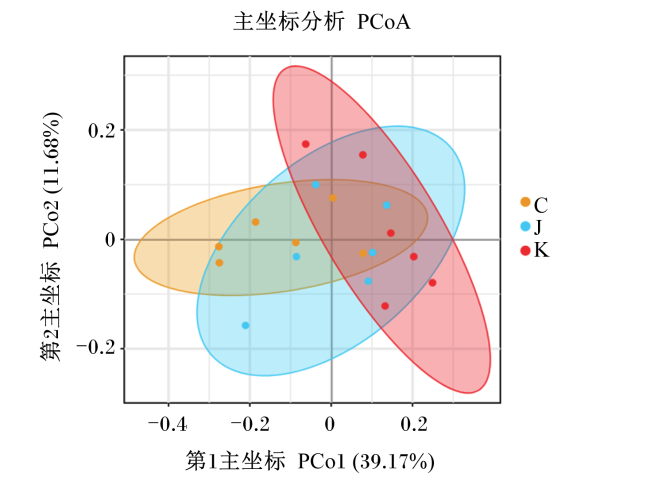
Beta多样性分析显示,主坐标分析(PCoA)图中第1主坐标(PCo1)解释了39.17%的变异,第2主坐标(PCo2)解释了11.68%的变异(图1);通过置换多元方差分析(PERMANOVA),3.0%角豆荚粉组与对照组的菌群结构差异达到了显著水平(P<0.05)。
图1 断奶仔猪粪便菌群PCoA图

C为对照组;J为1.5%角豆荚粉组;K为3.0%角豆荚粉组。下图同。

Fig.1 PCoA diagram of fecal microbiota of weaned piglets

C is the control group, J is the 1.5% carob pod powder group, and K is the 3.0% carob pod powder group. The same as below.

2.5.2 断奶仔猪粪便菌群组成分析

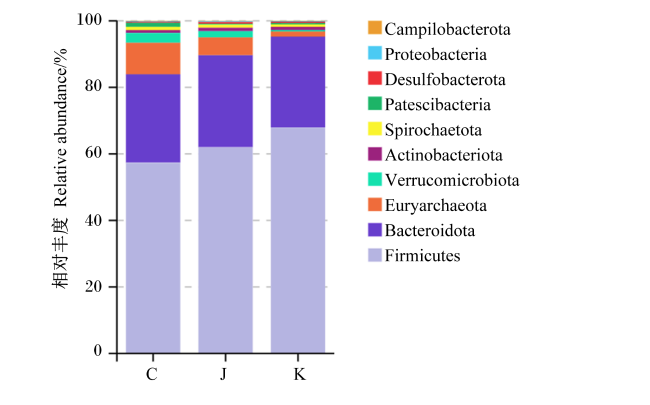
图2可知,在门水平上,主要优势菌群依次为厚壁菌门(Firmicutes)、拟杆菌门(Bacteroiddta)、广古菌门(Euryarchaeota)和疣微菌门(Verrucomicrobiota),占总菌门的95%以上。与对照组相比,3.0%角豆荚粉组厚壁菌门的相对丰度显著提高(P<0.05),广古菌门的相对丰度显著降低(P<0.05)(表7)。
图2 断奶仔猪粪便菌群组成(门水平,前10)

Campilobacterota:弯曲菌门;Proteobacteria:变形菌门;Desulfobacterota:脱硫杆菌门;Patescibacteria:隐杆菌门;Spirochaetota:螺旋体门;Actinobacteriota:放线菌门;Verrucomicrobiota:疣微菌门;Euryarchaeota:广古菌门;Bacteroidota:拟杆菌门;Firmicutes:厚壁菌门。

Fig.2 Composition of fecal microbiota of weaned piglets (phylum level, top 10)

表7 角豆荚粉对断奶仔猪粪便菌群门水平相对丰度的影响

Table 7 Effects of carob pod powder on relative abundance of fecal microbiota at phylum level of weaned piglets%

项目
Items
对照组
Control group
角豆荚粉组 Carob pod powder groups P
P-value
1.5% 3.0%
厚壁菌门 Firmicutes 57.38±3.18b 60.75±2.71b 67.95±2.85a 0.049
拟杆菌门 Bacteroidota 26.55±1.11 27.65±0.81 27.29±2.47 0.818
广古菌门 Euryarchaeota 9.47±2.56a 5.37±2.36ab 1.53±0.59b 0.026
疣微菌门 Verrucomicrobiota 2.95±1.27 1.87±0.71 0.44±0.27 0.163
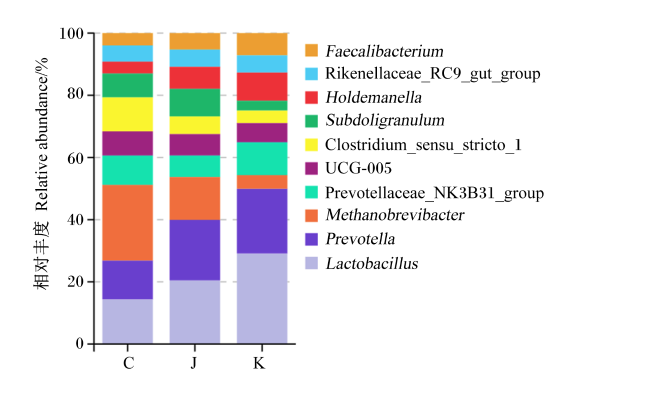
图3可知,在属水平上,各组相对丰度前10的菌群中,优势菌属依次为乳杆菌属(Lactobacillus)、普雷沃氏菌属(Prevotella)、甲烷短杆菌属(Methanobrevibacter)、普雷沃氏菌科NK3B31群(Prevotellaceae_NK3B31_group)。与对照组相比,3.0%角豆荚粉组乳杆菌属的相对丰度显著提高(P<0.05),甲烷短杆菌属的相对丰度显著降低(P<0.05),其他菌属组间差异均不显著(P>0.05)(表8)。
图3 断奶仔猪粪便菌群组成(属水平,前10)

Faecalibacterium:粪杆菌属;Rikenellaceae_RC9_gut_group:理研菌科RC9肠道群;Holdemanella:霍尔德曼菌属;Subdoligranulum:亚颗粒菌属;Clostridium_sensu_stricto_1:狭义梭菌属1;Prevotellaceae_NK3B31_group:普雷沃氏菌科NK3B31群;Methanobrevibacter:甲烷短杆菌属;Prevotella:普雷沃氏菌属;Lactobacillus:乳杆菌属。

Fig.3 Composition of fecal microbiota of weaned piglets (genus level, top 10)

表8 角豆荚粉对断奶仔猪粪便菌群属水平相对丰度的影响

Table 8 Effects of carob pod powder on relative abundance of fecal microbiota at genus level of weaned piglets%

项目
Items
对照组
Control group
角豆荚粉组Carob pod powder groups P
P-value
1.5% 3.0%
乳杆菌属 Lactobacillus 14.32±5.82b 20.46±4.93ab 29.07±6.55a 0.038
普雷沃氏菌属 Prevotella 12.49±1.54 19.47±3.67 20.83±5.19 0.276
甲烷短杆菌属 Methanobrevibacter 24.36±6.25a 13.78±5.09ab 4.41±1.99b 0.033
普雷沃氏菌科NK3B31群
Prevotellaceae_NK3B31_group
9.44±1.14 6.90±1.17 10.57±3.40 0.494
UCG-005 7.78±1.74 6.89±0.88 6.15±2.82 0.846
狭义梭菌属1 Clostridium_sensu_stricto_1 10.94±3.20 5.70±1.31 4.03±1.56 0.099
亚颗粒菌属 Subdoligranulum 7.66±2.35 8.86±3.16 3.16±1.21 0.235
霍尔德曼菌属 Holdemanella 3.82±0.75 7.09±2.21 9.07±2.38 0.185
理研菌科RC9肠道群
Rikenellaceae_RC9_gut_group
5.22±0.55 5.55±0.80 5.54±1.08 0.951
粪杆菌属 Faecalibacterium 3.98±0.70 5.30±0.83 7.16±1.08 0.069

3 讨论

3.1 角豆荚粉对断奶仔猪生长性能的影响

Bottegal等[11]研究发现,在饲粮中添加20%的角豆荚果肉对育肥猪的ADG和ADFI没有不利影响。在本试验中,饲粮中添加角豆荚粉显著提高了断奶仔猪的ADG和ADFI,并显著降低了F/G。断奶仔猪采食量增加可能与角豆荚粉中含有巧克力香味和蔗糖成分有关。这种香甜味可能通过刺激仔猪嗅觉和味觉使其产生强烈的食欲,从而增加采食量,促进仔猪生长发育[12]。Hossain等[13]研究表明,饲粮中添加1%的蔗糖可以显著提高生长猪的ADFI,并增加ADG。此外,本试验还发现饲粮中添加角豆荚粉能够降低断奶仔猪的腹泻率,推测其原因可能与角豆荚粉所含的单宁成分有关,1.5%角豆荚粉组饲粮中单宁含量约为0.09%,而3.0%角豆荚粉组饲粮中单宁含量约为0.18%。相关研究已证明,在饲粮中添加不高于0.2%的单宁能够降低断奶仔猪的腹泻率,同时不影响生长性能[14-15]。以上结果表明,饲粮中添加角豆荚粉可以提高断奶仔猪的生长性能,同时降低腹泻率。

3.2 角豆荚粉对断奶仔猪养分表观消化率的影响

养分表观消化率能够在一定程度上体现出动物对饲料中营养成分的消化和利用能力。动物的消化吸收能力越高,其生长状况也越有保障。本研究结果表明,在饲粮中添加角豆荚粉显著提升了断奶仔猪对干物质、粗蛋白质、粗脂肪、粗灰分、钙和总磷的表观消化率。这可能是由于角豆荚粉中的单宁成分通过刺激唾液和胆汁的分泌,提高消化酶活性,同时改善肠道形态结构,从而提高对养分的消化吸收[16]。Xu等[17]研究发现,饲粮中添加0.15%的单宁能够提高断奶仔猪十二指肠中胰蛋白酶活性,从而提高粗蛋白质表观消化率。Liu等[18]研究发现,在断奶仔猪饲粮中添加0.1%的单宁显著增加了空肠绒毛高度和绒隐比,回肠绒毛高度有增加趋势。本试验中,1.5%和3.0%角豆荚粉组饲粮中单宁的含量分别约为0.09%和0.18%,与以上相关研究中单宁添加量相近,表明饲粮中添加角豆荚粉可以促进断奶仔猪对营养物质的消化吸收。

3.3 角豆荚粉对断奶仔猪免疫功能的影响

免疫球蛋白(如IgA、IgG和IgM)含量是反映体液免疫能力的常用指标,而C3和C4是体液中具有酶原活性但不耐热的球蛋白,在细胞吞噬、炎症介导、免疫黏附方面发挥着重要的作用,是衡量机体非特异性免疫功能的重要指标[19]。本试验结果显示,饲粮中添加角豆荚粉能够显著提高断奶仔猪血清中C3、C4、IgA、IgG、IgM、IL-2、TGF-β和LZM含量,显著降低IL-6和TNF-α含量。同样地,Rtibi等[9]研究发现,在断奶仔兔饲粮中添加50 g/kg的角豆荚粉,可显著降低血清中TNF-α含量。这可能与角豆荚粉中含有的单宁等多酚类物质有关[7]。郑翠玲[20]研究发现,饲粮中添加500 mg/kg单宁可以显著提高断奶仔猪血清中IgA、IgG、IgM、IL-2以及C3和C4的含量。
体内自由基的过度产生或其清除不足易引起氧化应激,对畜禽机体健康和生产性能产生不利影响[21]。MDA是机体氧化应激的标志性产物,而SOD和CAT是机体内源性清除自由基的抗氧化酶[22]。T-AOC综合反映了体内抗氧化物质和抗氧化酶的水平。Abu Hafsa等[23]研究表明,饲粮中添加2.5%、5%和10%的角豆荚粉能够显著提高断奶肉兔血清中SOD、GSH-Px和CAT活性。同样地,本试验结果亦表明,饲粮中添加角豆荚粉能够提高断奶仔猪血清中GSH-Px、CAT和SOD活性及T-AOC,降低MDA含量。推测其原因可能是角豆荚粉中的多酚类化合物能够清除自由基、抑制脂质过氧化以及增强抗氧化酶(如SOD和GSH-Px)活性,从而提升机体的抗氧化防御能力[24]。以上结果表明,在饲粮中添加角豆荚粉能够提高机体的抗氧化能力,进而增强断奶仔猪的免疫功能,进一步促进其健康并提高生长性能。

3.4 角豆荚粉对断奶仔猪粪便微生物的影响

肠道微生物在动物生长、养分消化和免疫调控等方面发挥着重要作用,新鲜粪便中的微生物在一定程度上能够反映出肠道菌群组成[25]。肠道菌群多样性与动物健康和生长性能密切相关[26]。本研究发现,饲粮中添加角豆荚粉能够提高断奶仔猪粪便菌群多样性,表明角豆荚粉能够维持肠道菌群平衡,有利于仔猪健康和生长性能提高。各组断奶仔猪粪便菌群中的优势菌门是厚壁菌门和拟杆菌门,占总菌量的95%以上,这与Mach等[27]的研究结果一致。此外,本研究还发现,饲粮中添加3.0%的角豆荚粉能够显著提高断奶仔猪粪便中厚壁菌门的相对丰度,这可能与角豆荚粉中纤维类物质促进了有益菌增殖有关。Liu等[28]研究表明,育肥猪结肠中厚壁菌门的相对丰度和厚壁菌门/拟杆菌门比值随饲粮膳食纤维水平的增加而增加。厚壁菌门是肠道中最丰富的菌群之一,在分解纤维、降解碳水化合物等方面起着重要的作用,其相对丰度增加有益于机体对营养物质的消化,从而促进机体生长发育[29]
在属水平上,本试验结果显示,饲粮中添加角豆荚粉能够提高断奶仔猪粪便菌群中乳杆菌属的相对丰度。乳杆菌属细菌具有维持肠道菌群平衡、提高机体对营养物质消化吸收、阻止肠道致病菌增殖、促进生长发育等作用[30]。Abu Hafsa等[23]研究表明,在断奶肉兔的饲粮中添加5%的角豆荚显著增加了盲肠中乳杆菌属的相对丰度,提高了断奶肉兔的ADG。这可能是由于角豆荚粉中丰富的膳食纤维抑制肠道内病原菌(如大肠杆菌)的生长,并提供抗氧化环境,从而促进乳酸杆属细菌增殖[31]。已有研究表明,饲喂含10%~30%麦麸纤维和豌豆纤维的饲粮显著提高了育肥猪回肠和结肠中乳杆菌属的相对丰度[32]。此外,本研究还发现,饲粮中添加3.0%的角豆荚粉能够显著降低断奶仔猪粪便菌群中甲烷短杆菌属的相对丰度。甲烷短杆菌属是肠道内一类主要的产甲烷菌,能够利用其他细菌发酵产物,如氢气和二氧化碳等生成甲烷,其相对丰度与甲烷排放之间存在着明显的正相关关系[33-34]。这种抑制产甲烷菌生长是作用可能与角豆荚粉中含有的单宁有关。研究已经证明,在反刍动物饲粮中添加单宁可以有效降低瘤胃中产甲烷菌数量[35-36]。单宁通过与产甲烷菌的细胞壁相互作用,改变其形态结构,使细胞壁出现褶皱或塌陷,从而降低其活性[37]。此外,单宁还能通过与产甲烷菌中的关键酶(如甲基辅酶M还原酶)结合,抑制其活性,从而阻断产甲烷菌的生长[38]。以上结果表明,在饲粮中添加角豆荚粉可以维持断奶仔猪肠道菌群平衡,刺激乳酸菌等有益菌增殖,从而有助于降低腹泻率和提高生张性能。此外,角豆荚粉抑制产甲烷菌生长,有助于减少甲烷排放,表明其在降低甲烷等温室气体排放方面有着重要的环保意义。

4 结论

饲粮中添加1.5%或3.0%的角豆荚粉等比例替代碎米能够提高断奶仔猪的ADG和ADFI,降低F/G和腹泻率,并且在提高养分表观消化率、增强免疫功能、改善肠道菌群结构方面具有积极影响。本试验条件下,以生长性能为衡量指标,断奶仔猪饲粮中以添加3.0%的角豆荚粉等比例替代碎米效果最优。
[1]
徐晓明, 邱月琴, 张贝贝, 等. 肠道健康程度对断奶仔猪生长性能、养分表观消化率、体组成和肠道菌群的影响[J]. 动物营养学报, 2024, 36(8):4910-4924.

DOI

XU X M, QIU Y Q, ZHANG B B, et al. Effects of intestinal health degree on growth performance,nutrient apparent digestibility,body composition and intestinal microbiota of weaned piglets[J]. Chinese Journal of Animal Nutrition, 2024, 36(8):4910-4924. (in Chinese)

[2]
刘军, 喻礼怀, 董丽. 抗生素及其潜在替代物在断奶仔猪上的应用[J]. 中国饲料, 2018(15):10-15.

LIU J, YU L H, DONG L. The application of antibiotics and the potential substitute in weanling piglets[J]. China Feed, 2018(15):10-15. (in Chinese)

[3]
LOULLIS A, PINAKOULAKI E. Carob as cocoa substitute:a review on composition,health benefits and food applications[J]. European Food Research and Technology, 2018, 244(6):959-977.

[4]
CORREIA P J, PESTANA M. Sugars and phenols in carob tree fruits from different producing countries:a short review[J]. Heliyon, 2024, 10(10):e30922.

[5]
IKRAM A, KHALID W, ZAFAR K W, et al. Nutritional,biochemical,and clinical applications of carob:a review[J]. Food Science & Nutrition, 2023, 11(7):3641-3654.

[6]
QUILES-CARRILLO L, MELLINAS C, GARRIGOS M C, et al. Optimization of microwave-assisted extraction of phenolic compounds with antioxidant activity from carob pods[J]. Food Analytical Methods, 2019, 12(11):2480-2490.

[7]
LAARAJ S, HUSSAIN A, MOUHADDACH A, et al. Nutritional benefits and antihyperglycemic potential of carob fruit (Ceratonia silique L.)—an overview[J]. Ecological Engineering & Environmental Technology, 2024, 25(3):124-132.

[8]
LOEB H, VANDENPLAS Y, WÜRSCH P, et al. Tannin-rich carob pod for the treatment of acute-onset diarrhea[J]. Journal of Pediatric Gastroenterology and Nutrition, 1989, 8(4):480-485.

DOI PMID

[9]
RTIBI K, MARZOUKI K, SALHI A, et al. Dietary supplementation of carob and whey modulates gut morphology,hemato-biochemical indices,and antioxidant biomarkers in rabbits[J]. Journal of Medicinal Food, 2021, 24(10):1124-1133.

[10]
MAHMOUDI S, MAHMOUDI N, BENAMIROUCHE K, et al. Effect of feeding carob (Ceratonia siliqua L.) pulp powder to broiler chicken on growth performance,intestinal microbiota,carcass traits,and meat quality[J]. Poultry Science, 2022, 101(12):102186.

[11]
BOTTEGAL D N, LATORRE M A, LOBÓN S, et al. Fatteningpigs with tannin-rich source (Ceratonia siliqua L.) and high doses of vitamin E:effects on growth performance,economics,digestibility,physiology,and behaviour[J]. Animals, 2024, 14(13):1855.

[12]
易建华, 廖汉江, 李兆文, 等. 诱食剂在猪饲料中的应用[J]. 中国饲料, 2017(21):42-45.

YI J H, LIAO H J, LI Z W, et al. Application of feed attractants in pig[J]. China Feed, 2017(21):42-45. (in Chinese)

[13]
HOSSAIN M M, KIM I H. Response of growing pig in dietary sucrose supplementation on growth performance,nutrient digestibility,fecal score,and serum cortisol[J]. Korean Journal of Agricultural Science, 2024, 51(3):251-260.

[14]
MA M, CHAMBERS J K, UCHIDA K, et al. Effects of supplementation with a quebracho tannin product as an alternative to antibiotics on growth performance,diarrhea,and overall health in early-weaned piglets[J]. Animals, 2021, 11(11):3316.

[15]
邓文, 张世昌, 蔡荣斌, 等. 栗树单宁对断奶仔猪生产性能、肠道形态和通透性及抗氧化性能的影响[J]. 中国饲料, 2018(1):44-48.

DENG W, ZHANG S C, CAI R B, et al. Effects of chestnut tannins on the performance,intestinal morphology and permeability,and antioxidant status in weaned piglets[J]. China Feed, 2018(1):44-48. (in Chinese)

[16]
SCALBERT A. Antimicrobial properties of tannins[J]. Phytochemistry, 1991, 30(12):3875-3883.

[17]
XU T T, MA X, ZHOU X C, et al. Coated tannin supplementation improves growth performance,nutrients digestibility,and intestinal function in weaned piglets[J]. Journal of Animal Science, 2022, 100(5):skac088.

[18]
LIU H S, HU J X, MAHFUZ S, et al. Effects of hydrolysable tannins as zinc oxide substitutes on antioxidant status,immune function,intestinal morphology,and digestive enzyme activities in weaned piglets[J]. Animals, 2020, 10(5):757.

[19]
GRÜNER N, MATTNER J. Bile acids and microbiota:multifaceted and versatile regulators of the liver-gut axis[J]. International Journal of Molecular Sciences, 2021, 22(3):1397.

[20]
郑翠玲. 中草药饲料添加剂对保育猪生长性能、肠道菌群及免疫功能的影响[J]. 饲料研究, 2022, 45(3):29-32.

ZHENG C L. Effects of Chinese herbal feed additives on growth performance,intestinal flora and immune function of nursery pigs[J]. Feed Research, 2022, 45(3):29-32. (in Chinese)

[21]
DAENEN K, ANDRIES A, MEKAHLI D, et al. Oxidative stress in chronic kidney disease[J]. Pediatric Nephrology, 2019, 34(6):975-991.

DOI PMID

[22]
ZHOU Y X, WEI J, DENG G, et al. Delivery of low-density lipoprotein from endocytic carriers to mitochondria supports steroidogenesis[J]. Nature Cell Biology, 2023, 25(7):937-949.

[23]
ABU HAFSA S H, IBRAHIM S A, HASSAN A A. Carob pods (Ceratonia siliqua L.) improve growth performance,antioxidant status and caecal characteristics in growing rabbits[J]. Journal of Animal Physiology and Animal Nutrition, 2017, 101(6):1307-1315.

[24]
FIDAN H, MIHAYLOVA D, PETKOVA N, et al. Determination of chemical composition,antibacterial and antioxidant properties of products obtained from carob and honey locust[J]. Turkish Journal of Biochemistry, 2018, 44(3):316-322.

[25]
ZHANG L, JING J R, HAN L, et al. Characterization of gut microbiota,metabolism and cytokines in benzene-induced hematopoietic damage[J]. Ecotoxicology and Environmental Safety, 2021, 228:112956.

[26]
MARCHESI J R, ADAMS D H, FAVA F, et al. The gut microbiota and host health:a new clinical frontier[J]. Gut, 2016, 65(2):330-339.

[27]
MACH N, BERRI M, ESTELLÉ J, et al. Early-life establishment of the swine gut microbiome and impact on host phenotypes[J]. Environmental Microbiology Reports, 2015, 7(3):554-569.

DOI PMID

[28]
LIU B, YAN J, HAO H X, et al. Effects of dietary fiber and copper on the performance and gut microbiota of finishing pigs[J]. Animals, 2024, 14(22):3168.

[29]
HAO W L, LEE Y K. Microflora of the gastrointestinal tract:a review[J]. Methods in Molecular Biology, 2004, 268:491-502.

[30]
BECCACCIA A, CALVET S, CERISUELO A, et al. Effects of nutrition on digestion efficiency and gaseous emissions from slurry in growing-finishing pigs.Ⅰ.Influence of the inclusion of two levels of orange pulp and carob meal in isofibrous diets[J]. Animal Feed Science and Technology, 2015, 208:158-169.

[31]
HONG J S, NDOU S P, ADAMS S, et al. Canola meal in nursery pig diets:growth performance and gut health[J]. Journal of Animal Science, 2020, 98(11):skaa338.

[32]
CHEN H, MAO X B, CHE L Q, et al. Impact of fiber types on gut microbiota,gut environment and gut function in fattening pigs[J]. Animal Feed Science and Technology, 2014, 195:101-111.

[33]
HOEGENAUER C, HAMMER H F, MAHNERT A, et al. Methanogenic archaea in the human gastrointestinal tract[J]. Nature Reviews Gastroenterology & Hepatology, 2022, 19(12):805-813.

[34]
张秀敏, 王荣, 马志远, 等. 反刍家畜胃肠道甲烷排放与减排策略[J]. 农业环境科学学报, 2020, 39(4):732-742.

ZHANG X M, WANG R, MA Z Y, et al. Enteric methane emissions and mitigation strategies in ruminants[J]. Journal of Agro-Environment Science, 2020, 39(4):732-742. (in Chinese)

[35]
任格晗, 刘宁, 张瑞, 等. 饲粮添加硝酸钠和单宁对奶山羊产奶性能、甲烷排放和瘤胃微生物区系的影响[J]. 动物营养学报, 2023, 35(8):5284-5296.

DOI

REN G H, LIU N, ZHANG R, et al. Effects of dietary supplementation with sodium nitrate and tannin on milk production performance,methane emission and rumen microbiota in dairy goats[J]. Chinese Journal of Animal Nutrition, 2023, 35(8):5284-5296. (in Chinese)

[36]
YANG K, WEI C, ZHAO G Y, et al. Effects of dietary supplementing tannic acid in the ration of beef cattle on rumen fermentation,methane emission,microbial flora and nutrient digestibility[J]. Journal of Animal Physiology and Animal Nutrition, 2017, 101(2):302-310.

[37]
PATRA A K, SAXENA J. Dietary phytochemicals as rumen modifiers:a review of the effects on microbial populations[J]. Antonie van Leeuwenhoek, 2009, 96(4):363-375.

[38]
SAMINATHAN M, SIEO C C, GAN H M, et al. Effects of condensed tannin fractions of different molecular weights on population and diversity of bovine rumen methanogenic archaea in vitro,as determined by high-throughput sequencing[J]. Animal Feed Science and Technology, 2016, 216:146-160.

Outlines

/