RESEARCH PAPER

Effects of Dietary Supplementation of Bacillus subtilis, Enterococcus faecium, Yeast and Their Complex Bacteria on Growth Performance, Inflammatory Response and Intestinal Barrier Function of Broilers Infected with Eimeria tenella

  • LI Jianmei ,
  • SHEN Haiyu ,
  • XU Ming ,
  • DOU Xinhong , *
Expand
  • Jiangsu Institute of Poultry Science, Yangzhou 225125, China
* professor, E-mail:

Received date: 2024-12-13

  Online published: 2025-07-12

Abstract

This experiment was conducted to investigate the effects of dietary supplementation of Bacillus subtilis, Enterococcus faecium, yeast and their complex bacteria on growth performance, inflammatory response and intestinal barrier function of broilers infected with Eimeria tenella (E. tenella). A total of 360 three-day-old Arbor Acres (AA) male broilers with similar initial body weight were randomly allocated into 8 groups with 3 replicates in each group and 15 birds in each replicate. The positive control group (NC group) and negative control group (PC group) were fed the basal diet, the sulfonamides group (YW group) was fed the basal diet+4.00 g/kg sulfonamides, the Bacillus subtilis group (BS group) was fed the basal diet+0.50 g/kg Bacillus subtilis (1×10⁸ CFU/kg), the Enterococcus faecium group (EF group) was fed the basal diet+0.04 g/kg Enterococcus faecium (4×10⁹ CFU/kg), the yeast group (Yeast group) was fed the basal diet+2.00 g/kg yeast (1×10⁹ CFU/kg), the mixed 1 group (Mix1 group) was fed the basal diet+0.25 g/kg Bacillus subtilis (0.5×10⁸ CFU/kg)+0.02 g/kg Enterococcus faecium (2×10⁹ CFU/kg)+1.00 g/kg yeast (0.5×10⁹ CFU/kg), and the mixed 2 group (Mix2 group) was fed the basal diet+0.50 g/kg Bacillus subtilis (1×10⁸ CFU/kg)+0.04 g/kg Enterococcus faecium (4×10⁹ CFU/kg)+2.00 g/kg yeast (1×10⁹ CFU/kg). On 14 days of age, each broiler in PC, YW, BS, EF, Yeast, Mix1 and Mix 2 groups was administered with 1 mL E. tenella sporulated oocysts, and each broiler in NC group was administered with 1 mL sterilized phosphate buffer solution. The experiment ended at 21 days of age for the experimental broilers. The results showed as follows: 1) compared with the PC group, the 21-day-old body weight, average daily gain and average daily feed intake of Mix1 and Mix2 groups were significantly increased (P<0.05), and the feed to gain ratio was significantly decreased (P<0.05). 2) Compared with the PC group, the cecal lesion score of EF, Yeast and Mix2 groups was significantly decreased (P<0.05); the cecal lesion score of BS, EF, Yeast, Mix1 and Mix2 groups was significantly higher than that of NC and YW groups (P<0.05). 3) Compared with the PC group, the mRNA relative expression levels of interleukin-1β (IL-1β) and tumor necrosis factor-α (TNF-α) in cecum of BS, EF, Yeast, Mix1 and Mix2 groups were significantly decreased (P<0.05), and the mRNA relative expression level of interleukin-10 (IL-10) in cecum was significantly increased (P<0.05); the mRNA relative expression level of interferon-γ (IFN-γ) in cecum of Yeast groups was significantly increased (P<0.05). 3) Compared with NC, PC and YW groups, the mRNA relative expression level of tight junction protein 2 (TJP2) in cecum of BS and Mix2 groups was significantly increased (P<0.05), the mRNA relative expression levels of junctional adhesion molecule 2 (JAM2) and occludin (OCLN) in cecum of Mix2 group were significantly increased (P<0.05), the mRNA relative expression level of zonula occluden-2 (ZO-2) in cecum of BS, EF and Mix1 groups was significantly increased (P<0.05), and the mRNA relative expression level of mucin 2 (MUC2) in cecum of BS, EF and Mix2 groups was significantly increased (P<0.05). In conclusion, dietary supplementation of Bacillus subtilis, Enterococcus faecium, yeast and their complex bacteria can mitigate intestinal damage induced by E. tenella infection in broilers through enhancing intestinal barrier function and modulating inflammatory responses, and the effect of mix2 group is better.

Cite this article

LI Jianmei , SHEN Haiyu , XU Ming , DOU Xinhong . Effects of Dietary Supplementation of Bacillus subtilis, Enterococcus faecium, Yeast and Their Complex Bacteria on Growth Performance, Inflammatory Response and Intestinal Barrier Function of Broilers Infected with Eimeria tenella[J]. Chinese Journal of Animal Nutrition, 2025 , 37(7) : 4384 -4396 . DOI: 10.12418/CJAN2025.359

现如今我国已经成为世界第二大肉鸡生产和消费国[1],肉鸡产业在畜牧业中占有重要地位。随着养殖减抗、产品无抗的“后抗生素时代”的到来,肉鸡产业转型升级迫在眉急,“无抗养殖”这一概念应运而生,已逐渐成为当今肉鸡产业的发展趋势。在众多的抗生素替代品中,益生菌因具有平衡肠道菌群、增强肠道屏障功能、调节免疫系统、抑制病原体感染等诸多优势而在家禽生产中应用相对广泛[2]。肉鸡养殖中常用的益生菌菌群主要有乳酸菌群、酵母菌群及芽孢杆菌群等。其中,枯草芽孢杆菌(Bacillus subtilis,BS)是肉鸡生产中应用较为广泛的益生菌之一,不仅可以作为生长促进剂,还可以作为疾病预防剂[3]。据报道,枯草芽孢杆菌作为饲料添加剂可以预防大肠杆菌(Escherichia coli)[4]、产气荚膜梭菌(Clostridium perfringens)[5]等细菌性疾病。在鸡球虫病方面,研究表明补充枯草芽孢杆菌对肠道共生属菌群有积极影响,这些菌群在丁酸盐产生、抗炎、代谢反应和调节病原体的保护途径中发挥作用,从而改善柔嫩艾美耳球虫(Eimeria tenella,E. tenella)引起的肠道紊乱[6]
屎肠球菌(Enterococcus faecium,EF)作为动物肠道内的有益菌[7],是欧盟(European Union,EU)和美国食品药品监督管理局(Food and Drug Administration,FDA)批准用于动物饲料的首批益生菌之一[8]。饲粮补充屎肠球菌不仅可以提高肉鸡的生长性能,还可以增强肉鸡对大肠杆菌病、沙门氏菌病、鸡球虫病等疾病的抵抗力[9-10]。长期以来,酵母菌(yeast)一直被用作动物饲料中直接饲喂的微生物,以提高动物的生长性能[11]。酵母细胞和细胞壁成分已被证明可以调节细胞和体液免疫反应,以对抗球虫感染[12]。以上研究表明,单独添加枯草芽孢杆菌、屎肠球菌或酵母菌对肉鸡的生长性能、免疫功能和抗病力方面均具有积极影响。然而,目前关于单独或联合添加枯草芽孢杆菌、屎肠球菌和酵母菌等益生菌对球虫病的作用效果的研究有限。
相关研究表明,至国家农业农村部194号公告发布以来,肉鸡生产中消化道疾病和呼吸道疾病增多[13]。其中,鸡球虫病是一种在我国肉鸡养殖中广泛流行的消化道疾病,流行率可达86.12%[14],该病是由艾美耳属(Eimeria)球虫感染而引起的肠道疾病,可导致肠道出血、吸收不良、腹泻、增重减少、对其他疾病的易感性增加,严重时甚至导致死亡[15]。目前,对球虫病的控制主要通过预防性应用抗球虫药物和接种活疫苗。然而,抗球虫药物的长期和广泛使用引发了人们对鸡蛋和肉类产品中抗生素耐药性和药物残留等问题的关注。此外,活疫苗的使用也存在鸡对继发感染的易感性增加、诱发局部炎症,影响增重和饲料转化率等问题[16]。因此,积极探索安全和高效的防控鸡球虫病的替代策略势在必行。据报道,益生菌可竞争性的排斥病原菌定植以防止球虫病继发感染,还可以改善肠黏膜屏障功能从而防止球虫定植及入侵上皮细胞。另外,益生菌在控制球虫感染方面还具有免疫调节和改善作用[17]。基于此,本研究旨在探索在肉鸡基础饲粮中单独或联合添加枯草芽孢杆菌、屎肠球菌和酵母菌等益生菌对E. tenella感染肉鸡生长性能、卵囊产量、肠道损伤和病理变化、炎症反应及肠道屏障功能的影响,以期为鸡球虫病的防治和抗生素替代品的研发提供理论依据。

1 材料与方法

1.1 试验材料

1日龄雄性爱拔益加(AA)肉鸡,购自江苏京海禽业集团有限公司,出壳后运回实验室,饲养在无球虫的环境中,饲喂不含任何抗球虫药的全价饲料。试验开始前,采用常规方法镜检有无球虫卵囊,确认无球虫卵囊污染后,方可用于试验。
试验用益生菌枯草芽孢杆菌活菌数为2×10¹¹ CFU/Kg,屎肠球菌活菌数为1×1011 CFU/g,酵母菌活菌数为5×108 CFU/g。磺胺类药物有效成分含量为95%。
试验用球虫虫株为柔嫩艾美耳球虫扬州株(Eimeria tenella YZ strain),由扬州大学寄生虫教研室馈赠,试验前经鸡体传代复壮。

1.2 试验设计与饲养管理

所有动物试验均已获得江苏省家禽科学研究所动物福利与伦理审查委员会批准(批准文号:S20220320)。本研究中的所有试验均按照中华人民共和国农业农村部制定的相关指导方针和规定进行。
在3日龄时,选取体重相近、健康状况良好的AA肉鸡360羽,随机分成8个组,每组3个重复,每个重复15羽。正对照组(NC组)和负对照组(PC组)饲喂基础饲粮,磺胺类药物组(YW组)饲喂基础饲粮+4.00 g/kg磺胺类药物,枯草芽孢杆菌组(BS组)饲喂基础饲粮+0.50 g/kg枯草芽孢杆菌(1×108 CFU/kg),屎肠球菌组(EF组)饲喂基础饲粮+0.04 g/kg屎肠球菌(4×109 CFU/kg),酵母菌组(Yeast组)饲喂基础饲粮+2.00 g/kg酵母菌(1×109 CFU/kg),混合1组(Mix1组)饲喂基础饲粮+0.25 g/kg枯草芽孢杆菌(0.5×108 CFU/kg)+0.02 g/kg屎肠球菌(2×109 CFU/kg)+1.00 g/kg酵母菌(0.5×109 CFU/kg),混合2组(Mix2组)饲喂基础饲粮+0.50 g/kg枯草芽孢杆菌(1×108 CFU/kg)+0.04 g/kg屎肠球菌(4×109 CFU/kg)+2.00 g/kg酵母菌(1×109 CFU/kg)。14日龄时,PC组、YW组、BS组、EF组、Yeast组、Mix1组和Mix2组肉鸡每只灌服1 mL E. tenella孢子化卵囊(5×10⁴个),NC组肉鸡每只灌服1 mL灭菌磷酸盐缓冲液(PBS)。试验鸡21日龄时结束试验。
每天观察试验鸡的精神状态、饮欲、食欲、粪便与发病情况,并对死亡鸡只立即进行称重和剖检,确定是否死于球虫病,并统计死亡率[(试验结束时每组死亡鸡数/试验开始时每组鸡数)×100]。试验过程中使用4层的层叠式鸡笼(70 cm×70 cm×30 cm)进行笼养,每笼15羽,试验重复均匀分布,鸡舍温度第1周为33~35 ℃,之后每周下降2 ℃。试验过程中试验鸡自由采食和饮水。

1.3 基础饲粮

基础饲粮参考《鸡饲养标准》(NY/T 33—2004)肉用鸡营养需要配制,为玉米-豆粕型饲粮,其组成及营养水平见表1。其中,粗蛋白质含量参照GB/T 6432—2018的方法测定,钙含量参照GB/T 6436—2018的方法测定,总磷含量参照GB/T 6437—2018的方法测定,色氨酸含量参照GB/T 15400—2018的方法测定,其余氨基酸含量参照GB/T 18246—2019的方法测定,代谢能参考中国饲料数据库(https://www.chinafeeddata.org.cn/)计算得出。
表1 基础饲粮组成及营养水平(风干基础)

Table 1 Composition and nutrient levels of the basal diet (air-dry basis)%

原料 Ingredients 含量 Content 营养水平 Nutrient levels3) 含量 Content
玉米 Corn 59.13 代谢能 ME/(MJ/kg) 12.54
豆粕 Soybean meal 27.48 粗蛋白质 CP 21.00
玉米蛋白粉 Corn gluten meal 4.40 赖氨酸 Lys 1.10
大豆油 Soybean oil 4.00 苏氨酸 Thr 0.85
麦麸 Wheat bran 2.00 色氨酸 Try 0.23
石粉 Limestone 1.09 蛋氨酸 Met 0.50
磷酸氢钙 CaHPO4 1.25 蛋氨酸+胱氨酸 Met+Cys 0.91
氯化钠 NaCl 0.30 钙 Ca 0.95
维生素预混料 Vitamin premix1) 0.09 总磷 TP 0.65
矿物元素预混料 Vitamin premix2) 0.26
合计 Total 100.00

1)维生素预混料为每千克饲粮提供 The vitamin premix provided the following per kg of the diet: VA 12 500 IU,VD3 2 500 IU,VE 20 IU,VK3 0.5 mg,VB1 2 mg,VB2 6 mg,VB12 0.02 mg,生物素 biotin 0.17 mg,叶酸 folic acid 0.55 mg,烟酸 nicotinic acid 40 mg,泛酸 pantothenic acid 12 mg,胆碱 choline 1 300 mg。
2)矿物元素预混料为每千克饲粮提供 The mineral premix provided the following per kg of the diet: Cu 8 mg,Zn 75 mg,Fe 80 mg,Mn 100 mg,I 0.65 mg,Se 0.3 mg。
3)代谢能为计算值,其余为实测值。ME was a calculated value, while the others were measured values.

1.4 测定指标及方法

1.4.1 生长性能

分别于3、14(攻虫前)、21日龄(攻虫后第7天),以重复为单位对试验鸡进行整体空腹称重,统计各组试验鸡平均增重,计算相对增重率[18]。另外,统计14~21日龄各组试验鸡耗料量,计算平均日增重(ADG)、平均日采食量(ADFI)和料重比(F/G)。

1.4.2 盲肠病变记分

攻虫后第7天,对各组所有存活试验鸡进行安乐死,参照Johnson等[19]的标准对盲肠进行病变记分。盲肠病变记分标准:0分,盲肠壁厚度正常,无肉眼可见病变;1分,盲肠黏膜可见点状出血,盲肠壁不增厚;2分,盲肠内容物有黏液,有少许血丝,盲肠壁略增厚,黏膜有散在的出血点;3分,盲肠内有大量血液或有盲肠芯(血凝块或灰白色干酪样的香蕉型块状物),盲肠壁增厚明显;4分,盲肠壁极度增厚,形成干酪样盲肠芯,肠黏膜布满出血点或出血斑。死于球虫病的鸡盲肠病变记分记为4分。

1.4.3 盲肠组织病理学检测

攻虫后第7天,每个重复分别屠宰2只试验鸡,即每组共6只试验鸡,收集其盲肠组织。在4%多聚甲醛中固定24~48 h,以不同浓度梯度的酒精(75%、85%、95%、100%、100%)进行组织脱水与透明,制作5 μm厚的石蜡盲肠组织切片,用于苏木精-伊红(HE)染色。使用SlideViewer 2.5软件查看并捕获图像。

1.4.4 盲肠卵囊产量

攻虫后第7天,收集各组剩余试验鸡盲肠及其内容物,以1/1 000胃蛋白酶溶液匀浆后调节pH至3,置37 ℃消化过夜,采用麦克马斯特计数法(Mc Master’s method)计算收集的各组试验鸡盲肠匀浆内卵囊数。卵囊产量计算公式为:
卵囊产量(个/只)=[卵囊计数×稀释倍数×(样本体积/计数室体积)]/每组鸡只数[20]

1.4.5 盲肠炎症因子和肠道屏障相关基因表达

采用动物组织RNA提取试剂盒(南京诺唯赞生物科技股份有限公司)提取各组试验鸡盲肠组织中的RNA。提取后根据HiScript®Ⅲ RT SuperMix for qPCR反转录试剂盒(南京诺唯赞生物科技股份有限公司)说明书操作将RNA反转为cDNA。使用TB Green Premix Ex Taq Ⅱ(日本TaKaRa公司)在Mx3000P实时荧光定量PCR系统(美国Agilent Stratagene公司)中检测各组试验鸡盲肠组织中白细胞介素-1β(IL-1β)、白细胞介素-10(IL-10)、干扰素-γ(IFN-γ)、肿瘤坏死因子-α(TNF-α)等炎症因子及连接黏附分子2(JAM2)、紧密连接蛋白2(TJP2)、闭合蛋白(OCLN)、闭锁小带蛋白-2(ZO-2)、黏蛋白2(MUC2)等肠道屏障相关基因的mRNA相对表达量。反应体系为20 μL。反应程序为:95 ℃ 2 min;95 ℃ 5 s,55 ℃ 30 s,72 ℃ 30 s,循环40次;熔解曲线95 ℃ 15 s,55 ℃ 60 s,95 ℃ 15 s。以β-肌动蛋白(β-actin)作为内参基因,每个样品进行3次重复。基因的mRNA相对表达量采用2-ΔΔCt方法计算。引物序列见表2,引物由生工生物工程(上海)股份有限公司合成。
表2 引物序列

Table 2 Primer sequences

基因
Genes
引物序列
Primer sequences (5'—3')
产物大小
Product size/bp
登录号
Accession number
β-肌动蛋白
β-actin
F:CCTAGCACAATGAAAATCAAGATCA
R:GTCCGGATTCGTCATACTCC
136 NM_205518
白细胞介素-1β
IL-1β
F:GGAGGAGCACAGCACCG
R:AATCCAGGCGAGGCTTCTTC
163 NM_204524
白细胞介素-10
IL-10
F:CTCAGCTCTGAACTGCTGGA
R:AGGTGAAGAAGCGGTGACAG
199 NM_001004414
干扰素-γ
IFN-γ
F:CCAAGCTCCCGATGAACGA
R:CGGAGGATCCACCAGCTTC
86 NM_205149
肿瘤坏死因子-α
TNF-α
F:ACAAGTACACCTGTTACAGTTCAGA
R:CCACACGACAGCCAAGTCAA
155 HQ739087
连接黏附分子2
JAM2
F:ACTTGGGGGTCTTCTGCTATCAT
R:ACGGATTCCCGTATTCAGCA
242 NM_001397141
紧密连接蛋白2
TJP2
F:TCCGTCAGCAGGGAACAAAC
R:GCCACCAGAAACTGCAATCC
225 NM_001396726
闭合蛋白
OCLN
F:GGCGGAGGGCCACCA
R:GTCGTCCACGTAGTAGGAGC
137 NM_205128
闭锁小带蛋白-2
ZO-2
F:CAAAATGAGATGCGTTTGCTGC
R:TTTGGGCGTGACGTATAGCTG
118 AF085184
黏蛋白2
MUC2
F:TGAACTTAGCTTTTCCCCGCT
R:TCCATAGGTGTATGCAACTCAGA
120 JX284122

1.5 数据分析

应用Excel 2019对试验数据进行初步整理统计后,应用SPSS 22.0统计软件对试验数据进行单因素方差分析(one-way ANOVA),用Duncan氏法对组间数据进行多重比较,P<0.05为差异显著,数据用平均值±标准误(SE)表示。采用GraphPadPrism 9.5软件对试验数据进行分析并做图。

2 结果与分析

2.1 饲粮中添加枯草芽孢杆菌、屎肠球菌、酵母菌及其复合菌对E. tenella感染肉鸡生长性能的影响

表3可知,YW组14日龄体重显著高于NC组(P<0.05)。YW组、Mix1组和Mix2组21日龄体重显著高于PC组(P<0.05),BS组、EF组、Yeast组和Mix1组21日龄体重显著低于YW组(P<0.05)。YW组、EF组、Mix1组和Mix2组ADG显著高于PC组(P<0.05)。YW组、Mix1组和Mix2组ADFI显著高于PC组(P<0.05)。EF组、Mix1组和Mix2组F/G显著低于PC组(P<0.05),但BS组、EF组、Yeast组和Mix1组F/G显著高于YW组(P<0.05)。相对增重率方面,YW组最高(120.95%),其次为Mix2组(109.87%)、Mix1组(98.25%)、EF组(94.54%)。以上结果表明,饲粮中添加屎肠球菌及复合菌可在一定程度上改善E. tenella感染肉鸡的生长性能。
表3 饲粮中添加枯草芽孢杆菌、屎肠球菌、酵母菌及其复合菌对E. tenella感染肉鸡生长性能的影响

Table 3 Effects of dietary supplementation of Bacillus subtilis, Enterococcus faecium, yeast and their complex bacteria on growth performance of broilers infected with E. tenella

项目
Items
组别 Groups
NC PC YW BS EF Yeast Mix1 Mix2
14日龄体重
14-day-old BW/g
213.74
±3.92a
221.52
±7.55ab
230.82
±4.38b
223.88
±4.12ab
221.59
±4.81ab
229.05
±4.26ab
224.35
±4.23ab
218.99
±5.03ab
21日龄体重
21-day-old BW/g
335.41
±5.77ab
314.27
±7.70a
377.98
±7.58c
315.33
±10.10a
336.62
±10.19ab
326.71
±10.25ab
343.88
±9.61b
352.67
±8.75bc
平均日增重
ADG/g
17.38
±0.40c
13.25
±0.86a
21.02
±0.76d
13.06
±1.38a
16.43
±0.90bc
13.95
±1.05ab
17.08
±1.04c
19.09
±0.90cd
平均日采食量
ADFI/g
34.68
±2.56bcd
31.22
±0.89ab
37.78
±0.34d
31.80
±0.48abc
34.09
±1.19bcd
30.33
±0.54a
35.10
±0.52cd
36.80
±0.67d
料重比
F/G
2.00
±0.15abc
2.36
±0.07de
1.80
±0.02a
2.43
±0.04e
2.08
±0.07bc
2.17
±0.04cd
2.05
±0.03bc
1.93
±0.04ab
相对增重率 RWG/% 100 76.24 120.95 75.16 94.54 80.27 98.25 109.87

同行数据肩标不同小写字母表示差异显著(P<0.05),相同或无字母表示差异不显著(P>0.05)。下表同。

In the same row, values with different small letter superscripts mean significant difference (P<0.05), while with the same or no letter superscripts mean no significant difference (P>0.05). The same as below.

2.2 饲粮中添加枯草芽孢杆菌、屎肠球菌、酵母菌及其复合菌对E. tenella感染肉鸡卵囊产量、肠道病变记分及死亡率的影响

表4可知,与PC组相比,其他各组盲肠卵囊产量降低,其中Mix2盲肠卵囊产量最低;BS组、EF组、Yeast组、Mix1组和Mix2组盲肠卵囊产量均高于YW组。YW组、EF组、Yeast组和Mix2组盲肠病变记分显著低于PC组(P<0.05),BS组、EF组、Yeast组、Mix1组和Mix2组盲肠病变记分显著高于NC组和YW组(P<0.05)。试验期间,BS组在感染后第4天有1只鸡死亡,死亡率为2.22%;PC组在感染后第5天有2只鸡死亡,死亡率为4.44%。剖检死亡鸡只,均死于球虫病。以上结果表明,饲粮中添加枯草芽孢杆菌、屎肠球菌、酵母菌及其复合菌可降低E. tenella感染肉鸡的盲肠病变记分和卵囊产量。
表4 饲粮中添加枯草芽孢杆菌、屎肠球菌、酵母菌及其复合菌对E. tenella感染肉鸡盲肠卵囊产量、盲肠病变记分及死亡率的影响

Table 4 Effects of dietary supplementation of Bacillus subtilis, Enterococcus faecium, yeast and their complex bacteria on cecal oocyst production, cecal lesion score and mortality of broilers infected with E. tenella

项目
Items
组别 Groups
NC PC YW BS EF Yeast Mix1 Mix2
盲肠卵囊产量
Cecal oocyst
production/(个/只)
0 1.94×
106
0.23×
106
1.63×
106
1.06×
106
1.50×
106
1.00×
106
0.63×
106
盲肠病变记分
Cecal lesion score/分
0.00
±0.00a
3.21
±0.10d
0.25
±0.09a
3.02
±0.08cd
2.59
±0.18b
2.68
±0.19bc
2.93
±0.04bcd
2.83
±0.15bc
死亡率
Mortality/%
0.00
±0.00a
4.44
±0.03b
0.00
±0.00a
2.22
±0.02ab
0.00
±0.00a
0.00
±0.00a
0.00
±0.00a
0.00
±0.00a

2.3 饲粮中添加枯草芽孢杆菌、屎肠球菌、酵母菌及其复合菌对E. tenella感染肉鸡盲肠病理变化的影响
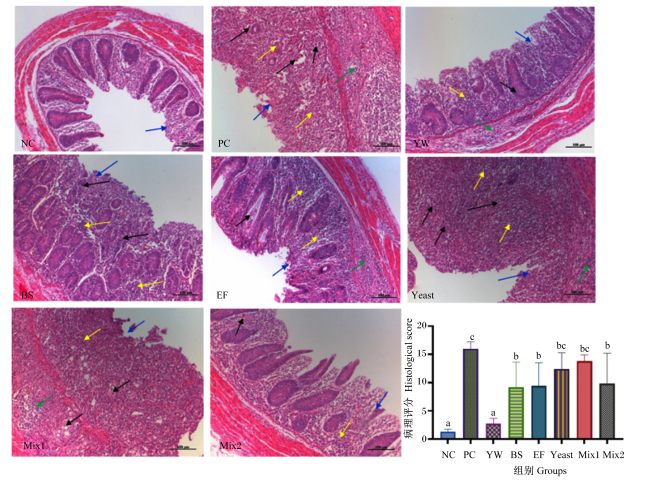
图1所示,病理变化结果显示,BS组、EF组和Mix2组病理评分显著低于PC组(P<0.05),BS组、EF组、Yeast组、Mix1组和Mix2组病理评分显著高于NC组和YW组(P<0.05)。NC组盲肠黏膜层、黏膜下层、肌层和浆膜层结构可辨,黏膜上皮细胞轻微脱落(蓝色箭头)。PC组盲肠明显增厚,黏膜上皮细胞中度坏死脱落(蓝色箭头);黏膜固有层肠腺重度坏死、大量的炎性细胞浸润以及轻微充血和出血(黄色箭头);黏膜下层增厚,大量的炎性细胞浸润(绿色箭头);黏膜固有层和肠腺内见有大量的虫体(裂殖体)(黑色箭头)。YW组、BS组、EF组和Mix2组黏膜上皮细胞轻微坏死脱落(蓝色箭头);黏膜固有层少量的炎性细胞浸润以及轻微充血和出血(黄色箭头);黏膜下层增厚,少量的炎性细胞浸润(绿色箭头);黏膜固有层见有零星的虫体(裂殖体)(黑色箭头)。Yeast组和Mix1组黏膜上皮细胞中度坏死脱落(蓝色箭头);黏膜固有层肠腺坏死、大量的炎性细胞浸润以及轻微充血和出血(黄色箭头);黏膜下层增厚,大量的炎性细胞浸润(绿色箭头);黏膜固有层和肠腺内见有大量的虫体(裂殖体)(黑色箭头)。以上结果表明,饲粮中添加枯草芽孢杆菌、屎肠球菌及复合菌可在一定程度上减轻因E. tenella感染而导致的肉鸡肠道损伤。
图1 饲粮中添加枯草芽孢杆菌、屎肠球菌、酵母菌及其复合菌对E. tenella感染肉鸡盲肠病理变化的影响(标尺:100 μm)

蓝色箭头:黏膜上皮细胞;绿色箭头:黏膜固有层炎性细胞;黄色箭头:黏膜下层炎性细胞;黑色箭头:虫体(裂殖体)。

数据柱标相同小写字母表示差异不显著(P>0.05),不同小写字母表示差异显著(P<0.05)。下图同。

Fig.1 Effects of dietary supplementation of Bacillus subtilis, Enterococcus faecium, yeast and their complex bacteria on cecal pathological changes of broilers infected with E. tenella (scale bars: 100 μm)

Blue arrows: mucosal epithelial cells; green arrows: inflammatory cells in the submucosal lamina propria; yellow arrows: highlight submucosal inflammatory cells; black arrows: oocysts (schizonts).

Value columns with the same small letter mean no significant difference (P>0.05), while with different small letters mean significant difference (P<0.05). The same as below.

2.4 饲粮中添加枯草芽孢杆菌、屎肠球菌、酵母菌及其复合菌对E. tenella感染肉鸡盲肠中炎症因子表达的影响

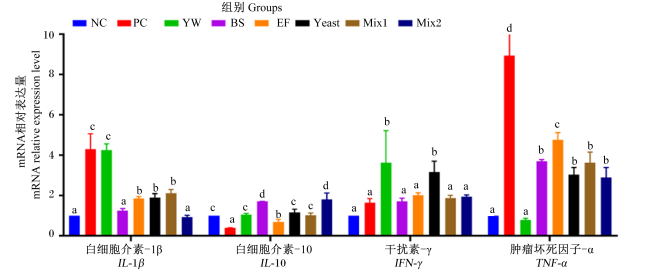
图2所示,与PC组相比,YW组盲肠IL-10的mRNA相对表达量显著提高(P<0.05),盲肠TNF-α的mRNA相对表达量显著降低(P<0.05);BS组、EF组、Yeast组、Mix1组和Mix2组盲肠IL-1βTNF-α的mRNA相对表达量显著降低(P<0.05),盲肠IL-10的mRNA相对表达量显著提高(P<0.05),其中,BS组和Mix2组盲肠IL-10的mRNA相对表达量显著高于NC组和YW组(P<0.05)。与PC组相比,只有Yeast组盲肠IFN-γ的mRNA相对表达量显著升高(P<0.05);与YW组相比,NC组、PC组、BS组、EF组、Mix1组和Mix2组盲肠IFN-γ的mRNA相对表达量显著降低(P<0.05)。以上结果表明,E. tenella感染后,饲粮中添加枯草芽孢杆菌、屎肠球菌、酵母菌及其复合菌可通过调控E. tenella感染肉鸡盲肠中促炎细胞因子和抗炎细胞因子的mRNA相对表达量而调控炎症反应。
图2 饲粮中添加枯草芽孢杆菌、屎肠球菌、酵母菌及其复合菌对E. tenella感染肉鸡盲肠中炎症因子表达的影响

Fig.2 Effects of dietary supplementation of Bacillus subtilis, Enterococcus faecium, yeast and their complex bacteria on cecal inflammatory factor expression of broilers infected with E. tenella

2.5 饲粮中添加枯草芽孢杆菌、屎肠球菌、酵母菌及其复合菌对E. tenella感染肉鸡盲肠中屏障相关基因表达的影响

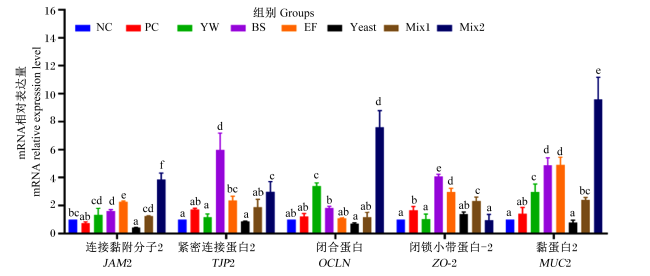
图3所示,与PC组相比,BS组、EF组、Mix1组和Mix2组盲肠JAM2的mRNA相对表达量显著提高(P<0.05),其中,EF组和Mix2组盲肠JAM2的mRNA相对表达量显著高于NC组和YW组(P<0.05)。与NC组、PC组和YW组相比,BS组和Mix2组盲肠TJP2的mRNA相对表达量显著提高(P<0.05);Mix2组盲肠OCLN的mRNA相对表达量显著提高(P<0.05);BS组、EF组和Mix1组盲肠ZO-2的mRNA相对表达量显著提高(P<0.05);BS组、EF组和Mix2组盲肠MUC2的mRNA相对表达量显著提高(P<0.05)。以上结果表明,饲粮中添加枯草芽孢杆菌、屎肠球菌及复合菌可提高E. tenella感染肉鸡盲肠中肠道屏障相关基因的mRNA相对表达量。
图3 饲粮中添加枯草芽孢杆菌、屎肠球菌、酵母菌及其复合菌对E. tenella感染肉鸡盲肠中屏障相关基因表达的影响

Fig.3 Effects of dietary supplementation of Bacillus subtilis, Enterococcus faecium, yeast and their complex bacteria on cecal barrier-related genes expression of broilers infected with E. tenella

3 讨论

3.1 饲粮中添加枯草芽孢杆菌、屎肠球菌、酵母菌及其复合菌改善E. tenella感染肉鸡生长性能

益生菌作为重要的抗生素替代物,对畜禽生长的促进作用已得到广泛证实。在本研究中,饲粮中添加枯草芽孢杆菌、屎肠球菌、酵母菌及其复合菌可提高试验鸡攻虫前的体重,研究结果与前人报道的饲粮中添加枯草芽孢杆菌[21]、屎肠球菌[22]、酵母菌[23]可提高肉鸡生长性能的结果相一致。攻虫后,EF组、Mix1组和Mix2组E. tenella感染肉鸡的生长性能在一定程度上得到了改善,体现在ADG、ADFI和相对增重率与PC组相比提高,F/G降低。这一结果与焦宇洲等[9]报道的肉鸡饲粮中添加屎肠球菌可预防因E. tenella感染引起的增重减少的结果相一致。另外,已有研究表明饲粮中添加复合益生菌可提高试验鸡的生长性能[24-25]。本研究结果也表明,枯草芽孢杆菌、屎肠球菌和酵母菌联合应用可以显著减轻E. tenella感染对雏鸡增重的影响,其发挥协同作用机制可能与益生菌分泌的代谢物和营养物质有关,如枯草芽孢杆菌分泌的蛋白酶、纤维素酶、脂肪酶等消化酶,能够改善肉鸡对营养物质的消化吸收[26];屎肠球菌分解产生多种营养物质(维生素、氨基酸、促生长因子等)可参与动物机体的新陈代谢,促进动物的生长[27];酵母菌含有丰富的赖氨酸、色氨酸、组氨酸、蛋氨酸等氨基酸,具有一定的营养作用,另外酵母菌还可提供一些肉鸡所需的矿物质和维生素等生长发育过程中所必需的营养物质[28]

3.2 饲粮中添加枯草芽孢杆菌、屎肠球菌、酵母菌及其复合菌降低E. tenella感染肉鸡死亡率、盲肠卵囊产量和盲肠病变记分

肠道卵囊产量和病变记分是评估家禽球虫感染严重程度的重要临床指标[29]。本研究中,感染E. tenella的肉鸡盲肠病变记分升高,盲肠卵囊产量增加,表明E. tenella感染对肉鸡造成了严重影响。相比之下,饲粮中添加枯草芽孢杆菌、屎肠球菌、酵母菌及其复合菌可降低盲肠病变记分和卵囊产量,尤其是EF组和Mix2组效果更为明显。在死亡率方面,各益生菌添加组中仅BS组出现2.22%的死亡率,其余组均全部存活,表明益生菌的添加提高了E. tenella感染鸡的存活率。本研究结果与前人研究报道的饲粮中添加枯草芽孢杆菌[20]、屎肠球菌[30]、酵母菌[31]可以降低球虫感染肉鸡的肠道卵囊产量和病变记分,减少球虫感染肉鸡的死亡率的结果一致。进一步的病理观察发现,BS组、EF组和Mix2组的盲肠病理变化较PC组轻,这一结果进一步支持了基础饲粮中添加益生菌可减轻球虫病引起的肠道损伤的观点。因此,在E. tenella感染的鸡只中补充益生菌所产生的促生长效果,得到了死亡率降低、盲肠病变评分改善以及盲肠卵囊产量减少的结果支持。

3.3 饲粮中添加枯草芽孢杆菌、屎肠球菌、酵母菌及其复合菌减轻E. tenella感染肉鸡的炎症反应

E. tenella感染后在盲肠上皮细胞中复制,导致急性炎症。这种过度的炎症反应与炎症细胞的浸润和随后的促炎介质如IL-1β、IFN-γ、TNF-α等的释放有关[32]。IL-1β是一种有效的促炎细胞因子,由许多不同类型的细胞分泌,主要由受刺激的巨噬细胞产生[33]。IL-1β在促进组织修复和维持体内稳态中起着至关重要的作用[34]。IFN-γ作为Th1细胞的标志性细胞因子,参与抗球虫感染的保护性免疫应答[35]。TNF-α是一种多效性细胞因子,与全身炎症和宿主防御的调节有关[36]。IL-10是调节性T细胞(Tregs)介导的免疫反应中的标志性细胞因子,一旦被诱导,它们就会对促炎免疫反应产生负调控作用[35],抑制IFN-γ、TNF-α、IL-1β等促炎细胞因子,控制宿主免疫反应,限制炎症引起的过度组织破坏[37]。本研究中,饲粮中添加枯草芽孢杆菌、屎肠球菌、酵母菌及其复合菌可降低盲肠IL-1βTNF-α的mRNA相对表达量,提高盲肠IL-10的mRNA相对表达量。这一结果与相关研究报道的饲粮中补充枯草芽孢杆菌可增加血清IL-10含量,降低血清TNF-α和IL-1β含量的结果[38]一致。同时,与Lin等[39]认为的酿酒酵母水解物可以通过抑制IL-1β、白细胞介素-6(IL-6)和TNF-α的过度表达来发挥抗炎作用的观点相符。本研究中,各益生菌添加组盲肠IFN-γ的mRNA相对表达量均升高,IFN-γ的高表达可能有助于清除感染和发展对再感染的免疫力。这一结果也与之前报道的饲粮中添加以乳酸杆菌为基础的商业益生菌能增加鸡肠道IFN-γ和白细胞介素-2(IL-2)的表达,使粪便中卵囊数降低的结果[40]一致。但与相关研究报道的饲粮中添加枯草芽孢杆菌或屎肠球菌通过降低感染肉鸡中IL-1βIFN-γ的表达来减轻炎症反应的结果[7,41]并不完全一致。究其原因可能与感染的病原种类不同有关,前者感染的病原是产气荚膜梭菌和肠炎沙门氏菌,本研究中感染的病原是E. tenella。据报道,IFN-γ在鸡球虫的感染中起着至关重要的作用,可抑制子孢子在盲肠上皮细胞内繁殖[42]。因而,饲粮中添加益生菌可通过促炎细胞因子和抗炎细胞因子间的相互调控,减轻E. tenella感染肉鸡的炎症反应。

3.4 饲粮中添加枯草芽孢杆菌、屎肠球菌、酵母菌及其复合菌增强E. tenella感染肉鸡的肠道屏障功能

肠道不仅具备消化食物、吸收营养物质和膳食因子的功能,还为病原体、毒素及过敏原等有害物质从管腔向黏膜组织的扩散提供了生化与物理屏障。紧密连接(TJs)是肠道物理屏障的主要决定因素,在肠道屏障功能中起重要作用。肠上皮细胞中的紧密连接由不同的连接分子组成,包括OCLN、闭合蛋白(CLDNs)、连接黏附分子(JAMs)和闭锁小带蛋白(ZOs)等。紧密连接屏障完整性和结构的受损导致了免疫细胞的异常激活以及多种组织的慢性炎症[43]。此外,黏液层作为胃肠道表面的第一道屏障,可以有效地将肠上皮细胞与肠腔分离,保护肠上皮细胞不受肠道细菌及其代谢物或食物抗原的接触和刺激。肠黏液层由黏蛋白(MUC)、抗菌肽(AMPs)、分泌型免疫球蛋白A(sIgA)等约30种核心蛋白组成,其中由杯状细胞在上皮细胞层合成的MUC2是最重要的成分[44]。据报道,球虫病会对肠道的消化、吸收能力及屏障功能造成损害,并增加继发细菌感染的风险[45]。球虫感染后,会导致紧密连接分子如闭锁小带蛋白-1(ZO-1)、OCLNJAM2及MUC2基因表达下调[46-48]。然而,饲粮中添加屎肠球菌[49]、复合益生菌[50]、嗜酸乳杆菌和枯草芽孢杆菌[51],可以提高与肠道屏障相关的基因表达,从而改善肠道屏障功能。与前人的研究结果相似,本研究中,BS组、EF组和Mix2组盲肠JAM2、TJP2、OCLNZO-2、MUC2等肠道屏障相关基因的表达上调。因此,可以推测在饲粮中添加益生菌能够通过提高肠道中紧密连接分子和黏蛋白的表达,从而增强E. tenella感染肉鸡的肠道屏障功能。

4 结论

尽管饲粮中添加枯草芽孢杆菌、屎肠球菌、酵母菌及其复合菌对E. tenella感染肉鸡的作用效果低于磺胺类药物,但可通过改善E. tenella感染肉鸡的生长性能、降低盲肠卵囊产量和肠道病变记分、调节免疫炎症反应及肠道屏障功能等,缓解E. tenella感染对肉鸡造成的损伤。本试验中,饲粮中添加0.50 g/kg枯草芽孢杆菌+0.04 g/kg屎肠球菌+2.00 g/kg酵母菌对E. tenella感染肉鸡的作用效果较好。
[1]
GUO W, DONG S S, QIAN J R. The green productivity of broiler production in China:considering the resource utilization of manure[J]. Heliyon, 2023, 9(12):e22759.

[2]
高铎, 李欣南, 韩镌竹, 等. 益生菌在家禽生产中的作用机制及应用研究进展[J]. 动物营养学报, 2023, 35(11):6840-6847.

DOI

GAO D, LI X N, HAN J Z, et al. Research progress on mechanism and application of probiotics in poultry production[J]. Chinese Journal of Animal Nutrition, 2023, 35(11):6840-6847. (in Chinese)

DOI

[3]
NINGSIH N, RESPATI A N, ASTUTI D, et al. Efficacy of Bacillus subtilis to replace in-feed antibiotics of broiler chickens under necrotic enteritis-challenged experiments:a systematic review and meta-analysis[J]. Poultry Science, 2023, 102(10):102923.

[4]
GUO M J, LI M T, ZHANG C C, et al. Dietary administration of the Bacillus subtilis enhances immune responses and disease resistance in chickens[J]. Frontiers in Microbiology, 2020, 11:1768.

[5]
GHIMIRE S, SUBEDI K, ZHANG X W, et al. Efficacy of Bacillus subtilis probiotic in preventing necrotic enteritis in broilers:a systematic review and meta-analysis[J]. Avian Pathology, 2024, 53(6):451-466.

[6]
MEMON F U, YANG Y Q, ZHANG G Y, et al. Chicken gut microbiota responses to dietary Bacillus subtilis probiotic in the presence and absence of Eimeria infection[J]. Microorganisms, 2022, 10(8):1548.

[7]
KHALIFA A, IBRAHIM H I M. Enterococcus faecium from chicken feces improves chicken immune response and alleviates Salmonella infections:a pilot study[J]. Journal of Animal Science, 2023, 101:skad016.

[8]
FRANZ C M A P, HUCH M, ABRIOUEL H, et al. Enterococci as probiotics and their implications in food safety[J]. International Journal of Food Microbiology, 2011, 151(2):125-140.

[9]
焦宇洲, 杨欢欢, 卢垚, 等. 屎肠球菌对感染柔嫩艾美耳球虫肉鸡生长性能和肠道屏障的影响[J]. 畜牧兽医学报, 2022, 53(4):1210-1219.

DOI

JIAO Y Z, YANG H H, LU Y, et al. Effect of Enterococcus faecium on growth performance and intestinal barrier of broilers infected with Eimeria tenella[J]. Acta Veterinaria et Zootechnica Sinica, 2022, 53(4):1210-1219. (in Chinese)

[10]
ZHANG Y, LIU Y Y, JIAO S J, et al. Short-term supplementation with uncoated and encapsulated Enterococcus faecium affected growth performance,gut microbiome and intestinal barrier integrity in broiler chickens[J]. Poultry Science, 2024, 103(7):103808.

[11]
GAO W W, AN K Y, LI P, et al. Dietary Saccharomyces cerevisiae improves intestinal flora structure and barrier function of pekin ducks[J]. Poultry Science, 2023, 102(1):101940.

[12]
LEUNG H, PATTERSON R, BARTA J R, et al. Nucleotide-rich yeast extract fed to broiler chickens challenged with Eimeria:impact on growth performance,jejunal histomorphology,immune system,and apparent retention of dietary components and caloric efficiency1[J]. Poultry Science, 2019, 98(10):4375-4383.

[13]
朱静, 刘向萍, 李婷婷, 等. 规模肉鸡养殖场抗生素与抗生素替代品使用现状调查与分析[J]. 中国畜牧杂志, 2023, 59(7):322-327,331.

ZHU J, LIU X P, LI T T, et al. Investigation and analysis of the use of antibiotics and antibiotic substitutes in large-scale broiler farms[J]. Chinese Journal of Animal Science, 2023, 59(7):322-327,331. (in Chinese)

[14]
LIAO S Q, LIN X H, ZHOU Q F, et al. Epidemiological investigation of coccidiosis and associated risk factors in broiler chickens immunized with live anticoccidial vaccines in China[J]. Frontiers in Veterinary Science, 2024, 11:1375026.

[15]
EL-SHALL N A, ABD EL-HACK M E, ALBAQAMI N M, et al. Phytochemical control of poultry coccidiosis:a review[J]. Poultry Science, 2022, 101(1):101542.

[16]
JAVANMIRI E, RAHIMI S, KARIMI TORSHIZI M A, et al. Comparison of the effect of anticoccidial drug,probiotic,synbiotic,phytochemicals and vaccine in prevention and control of coccidiosis in broiler chickens challenged with Eimeria spp.[J]. Poultry Science, 2024, 103(12):104357.

[17]
焦宇洲, 于江旭, 高东阳, 等. 益生菌调控肠道屏障功能预防家禽球虫病的研究进展[J]. 微生物学报, 2021, 61(5):1064-1072.

JIAO Y Z, YU J X, GAO D Y, et al. Advances in prevention of chicken coccidiosis by probiotics regulating intestinal barrier[J]. Acta Microbiologica Sinica, 2021, 61(5):1064-1072. (in Chinese)

[18]
索勋, 李国清. 鸡球虫病学[M]. 北京: 中国农业大学出版社, 1998.

SUO X, LI G Q. Coccidia and coccidiosis of domestic fowl[M]. Beijing: China Agricultural University Press, 1998. (in Chinese)

[19]
JOHNSON J, REID W M. Anticoccidial drugs:lesion scoring techniques in battery and floor-pen experiments with chickens[J]. Experimental Parasitology, 1970, 28(1):30-36.

[20]
PARK I, LEE Y, GOO D, et al. The effects of dietary Bacillus subtilis supplementation,as an alternative to antibiotics,on growth performance,intestinal immunity,and epithelial barrier integrity in broiler chickens infected with Eimeria maxima[J]. Poultry Science, 2020, 99(2):725-733.

[21]
WANG J, ISHFAQ M, MIAO Y, et al. Dietary administration of Bacillus subtilis KC1 improves growth performance,immune response,heat stress tolerance,and disease resistance of broiler chickens[J]. Poultry Science, 2022, 101(3):101693.

[22]
张立恒, 史洪涛, 乔宏兴, 等. 日粮添加屎肠球菌对肉仔鸡生长性能、抗氧化及免疫能力的影响[J]. 饲料研究, 2020, 43(5):40-44.

ZHANG L H, SHI H T, QIAO H X, et al. Effect of Enterococcus faecium on growth performance,antioxidation and immunity of broilers[J]. Feed Research, 2020, 43(5):40-44. (in Chinese)

[23]
BILAL R M, HASSAN F U, SAEED M, et al. Role of yeast and yeast-derived products as feed additives in broiler nutrition[J]. Animal Biotechnology, 2023, 34(2):392-401.

[24]
TONG D Q, LU Z J, ZENG N, et al. Dietary supplementation with probiotics increases growth performance,improves the intestinal mucosal barrier and activates the Wnt/β-catenin pathway activity in chicks[J]. Journal of the Science of Food and Agriculture, 2023, 103(9):4649-4659.

[25]
巨玉鑫. 复合益生菌制剂对肉鸡生长性能、免疫功能和肠道形态的影响[J]. 国外畜牧学(猪与禽), 2024, 44(2):74-78.

JU Y X. Effects of compound probiotics on growth performance,immune function and intestinal morphology of broilers[J]. Animal Science Abroad (Pigs and Poultyr), 2024, 44(2):74-78. (in Chinese)

[26]
刘叶青, 高爱琴. 枯草芽孢杆菌在肉鸡生产中的应用研究进展[J]. 饲料研究, 2023, 46(21):165-169.

LIU Y Q, GAO A Q. Research progress on application of Bacillus subtilis in broiler production[J]. Feed Research, 2023, 46(21):165-169. (in Chinese)

[27]
彭众, 董丽, 喻礼怀. 屎肠球菌的作用机制及其在动物生产中应用的研究进展[J]. 中国饲料, 2018(17):18-22.

PENG Z, DONG L, YU L H. Study on the mechanism of Enterococcus faecium and its application in animal production[J]. China Feed, 2018(17):18-22. (in Chinese)

[28]
张慈航, 杨海明, 张轶斌, 等. 益生菌及其在肉鸡生产中的研究与应用[J]. 饲料研究, 2023, 46(14):185-189.

ZHANG C H, YANG H M, ZHANG Y B, et al. Research and application of probiotics and their application in broilers production[J]. Feed Research, 2023, 46(14):185-189. (in Chinese)

[29]
AHMAD R, YU Y H, HUA K F, et al. Management and control of coccidiosis in poultry-a review[J]. Animal Bioscience, 2024, 37(1):1-15.

[30]
EL-SAWAH A A, ABOELHADID S M, EL-NAHASS E N, et al. Efficacy of probiotic Enterococcus faecium in combination with diclazuril against coccidiosis in experimentally infected broilers[J]. Journal of Applied Microbiology, 2020, 129(4):1020-1028.

[31]
KIARIE E G, LEUNG H, AKBARI MOGHADDAM KAKHKI R, et al. Utility of feed enzymes and yeast derivatives in ameliorating deleterious effects of coccidiosis on intestinal health and function in broiler chickens[J]. Frontiers in Veterinary Science, 2019, 6:473.

DOI PMID

[32]
TOMAL F, SAUSSET A, LE VERN Y, et al. Microbiota promotes recruitment and pro-inflammatory response of caecal macrophages during E.tenella infection[J]. Gut Pathogens, 2023, 15(1):65.

[33]
KASEM S M, MIRA N M, HELAL I B, et al. Prophylactic and therapeutic efficacy of ultrasonicated Rosmarinus officinalis ethanolic extract and its chitosan-loaded nanoparticles against Eimeria tenella infected broiler chickens[J]. Acta Parasitologica, 2024, 69(1):951-999.

[34]
DUAN C H, ABUDUREHEMAN T, WANG S, et al. Expression of IL-1β in transgenic Eimeria necatrix enhances the immunogenicity of parasites and promotes mucosal immunity against coccidiosis[J]. Frontiers in Immunology, 2024, 15:1435702.

[35]
CHEN C, CHEN Y F, LU M M, et al. IFN-γ inhibitory molecules derived from Eimeria maxima inhibit IL-12 secretion by modulating MAPK pathways in chicken macrophages[J]. Poultry Science, 2024, 103(2):103359.

[36]
LU M M, LEE Y, LI C, et al. Immunological characterization of chicken tumor necrosis factor-α (TNF-α) using new sets of monoclonal antibodies specific for poultry TNF-α[J]. Developmental and Comparative Immunology, 2022, 131:104374.

[37]
RODRÍGUEZ S P, HERRERA A L, PARRA J E. Gene expression of pro-inflammatory (IL-8,IL-18,TNF-α and IFN-γ) and anti-inflammatory (IL-10) cytokines in the duodenum of broiler chickens exposed to lipopolysaccharides from Escherichia coli and Bacillus subtilis[J]. Veterinary World, 2023, 16(3):564-570.

[38]
ZHANG Y, ZHOU J Y, JI L B, et al. Bacillus subtilis improves antioxidant capacity and optimizes inflammatory state in broilers[J]. Animal Bioscience, 2024, 37(6):1041-1052.

[39]
LIN J, COMI M, VERA P, et al. Effects of Saccharomyces cerevisiae hydrolysate on growth performance,immunity function,and intestinal health in broilers[J]. Poultry Science, 2023, 102(1):102237.

[40]
DALLOUL R A, LILLEHOJ H S, TAMIM N M, et al. Induction of local protective immunity to Eimeria acervulina by a Lactobacillus-based probiotic[J]. Comparative Immunology, Microbiology and Infectious Diseases, 2005, 28(5/6):351-361.

[41]
WANG Y Y, XU Y B, XU S L, et al. Bacillus subtilis DSM29784 alleviates negative effects on growth performance in broilers by improving the intestinal health under necrotic enteritis challenge[J]. Frontiers in Microbiology, 2021, 12:723187.

[42]
LEE Y, LU M M, LILLEHOJ H S. Coccidiosis:recent progress in host immunity and alternatives to antibiotic strategies[J]. Vaccines, 2022, 10(2):215.

[43]
SUZUKI T. Regulation of the intestinal barrier by nutrients:the role of tight junctions[J]. Animal Science Journal, 2020, 91(1):e13357.

[44]
YAO D B, DAI W L, DONG M, et al. MUC2 and related bacterial factors:therapeutic targets for ulcerative colitis[J]. EBioMedicine, 2021, 74:103751.

[45]
BLAKE D P, MARUGAN-HERNANDEZ V, TOMLEY F M. Spotlight on avian pathology:Eimeria and the disease coccidiosis[J]. Avian Pathology, 2021, 20:209-213.

[46]
PARK I, OH S, GOO D, et al. Effect of dietary sophorolipids on growth performance and gastrointestinal functionality of broiler chickens infected with Eimeria maxima[J]. Poultry Science, 2022, 101(7):101944.

[47]
KISHAWY A T Y, ABD EL-WAHAB R A, ELDEMERY F, et al. Insights of early feeding regime supplemented with glutamine and various levels of omega-3 in broiler chickens:growth performance,muscle building,antioxidant capacity,intestinal barriers health and defense against mixed Eimeria spp. infection[J]. Veterinary Quarterly, 2024, 44(1):1-20.

[48]
SHARMA M K, LIU G C, WHITE D L, et al. Effects of mixed Eimeria challenge on performance,body composition,intestinal health,and expression of nutrient transporter genes of Hy-Line W-36 pullets (0-6 wks of age)[J]. Poultry Science, 2022, 101(11):102083.

[49]
HUANG L Q, LUO L P, ZHANG Y R, et al. Effects of the dietary probiotic,Enterococcus faecium NCIMB11181,on the intestinal barrier and system immune status in Escherichia coli O78-Challenged broiler chickens[J]. Probiotics and Antimicrobial Proteins, 2019, 11(3):946-956.

[50]
傅予彤, 房勇, 曲绍军, 等. 复合益生菌制剂对肉仔鸡生长性能、肠道屏障功能及肠道菌群的影响[J]. 饲料工业, 2022, 43(14):19-23.

FU Y T, FANG Y, QU S J, et al. Effects of compound probiotics on growth performance,intestinal barrier function and intestinal microflora of broiler chickens[J]. Feed Industry, 2022, 43(14):19-23. (in Chinese)

[51]
CHEN X, CHEN W W, CI W J, et al. Effects of dietary supplementation with Lactobacillus acidophilus and Bacillus subtilis on mucosal immunity and intestinal barrier are associated with its modulation of gut metabolites and microbiota in late-phase laying hens[J]. Probiotics and Antimicrobial Proteins, 2023, 15(4):912-924.

Outlines

/