RESEARCH PAPER

Effects of Dietary Crude Protein Level on Growth Performance, Serum Biochemical Indices, Nutrient Apparent Digestibility and Fecal Microbial Composition of Duhua Piglets

  • WEN Xiaolu , 1 ,
  • LI Yaojie 1 ,
  • YANG Linfang 2 ,
  • LIU Yanzhi 2 ,
  • YANG Xuefen 1 ,
  • GAO Kaiguo 1 ,
  • YE Xiufeng 1 ,
  • JIANG Zongyong 1 ,
  • WANG Li , 1, *
Expand
  • 1 Guangdong Provincial Key Laboratory of Animal Breeding and Nutrition, Key Laboratory of Animal Nutrition and Feed Science in South China, Ministry of Agriculture and Rural Affairs, State Key Laboratory of Swine and Poultry Breeding Industry, Institute of Animal Science, Guangdong Academy of Agricultural Sciences, Guangzhou 510640, China
  • 2 Guangdong Yihao Indigenous Pig Research Institute Co., Ltd., Zhanjiang 524033, China
*professor, E-mail:

Received date: 2024-12-13

  Online published: 2025-08-14

Abstract

This experiment was conducted to investigate the effects of different dietary crude protein levels on growth performance, serum biochemical indices, nutrient apparent digestibility and fecal microbial composition of Duhua piglets. A total of 360 healthy piglets (Duroc×Guangdong small-spotted pigs) at 32 days of age were divided into 6 groups according to body weight with 6 replicates per group and 10 piglets (half male and half female) per replicate. The piglets in the six groups were fed corn-soybean meal diets with crude protein levels of 15.00%, 16.00%, 17.00%, 18.00%, 19.00% and 20.00%, respectively, and the proportion of essential amino acids such as lysine was consistent with that of crude protein. The experimental period was 28 days. On days 1, 14 and 28 of the experiment, the body weight was weighed by fasting, and the diarrhea was recorded daily. The results showed as follows: 1) with the increase of dietary crude protein level, the body weight of piglets on day 28 increased linearly (P<0.05), and showed a quadratic curve change (P<0.05). The average daily gain (ADG) of piglets from days 1 to 28 increased linearly (P<0.05) and showed a quadratic curve change (P<0.05). From days 15 to 28, the average daily feed intake (ADFI)of piglets increased linearly (P<0.05). From days 1 to 28, the feed/gain (F/G)of piglets decreased linearly (P<0.05) and showed a quadratic curve change (P<0.05). Broken-line analysis recommended optimal crude protein levels of 17.92%, 20.13%, and 17.33% based on ADG, ADFI, and F/G, respectively. 2) Higher crude protein levels tended to linearly increase diarrhea rates during days 1 to 14 (P=0.052) and days 1 to 28 (P=0.084), with quadratic trends (P=0.057). 3) With the increase of dietary crude protein level, serum creatinine and triglycerides contents increased linearly (P<0.05) and quadratically (P<0.05), while total cholesterol content decreased linearly (P<0.05) and quadratically (P<0.05). No significant effects were observed on low-density lipoprotein and high-density lipoprotein contents, aspartate aminotransferase and alkaline phosphatase activities, or albumin content in serum (P>0.05). 4) With the increase of dietary crude protein level, the apparent digestibility of crude protein increased linearly (P<0.05) and showed a quadratic curve change (P<0.05). The apparent digestibility of crude fat decreased linearly (P<0.05), and showed a quadratic curve change (P<0.05). The apparent digestibility of crude ash had no significant effect (P>0.05). 5) Analysis of the microbial composition in feces by 16S rRNA sequencing showed that with the increase of dietary crude protein level, Chao index, Richness index and ACE index in the feces of piglets showed a significant quadratic curve change (P<0.05). The relative abundances of Prevotella and Faecalibacterium decreased linearly (P<0.05) and quadratically (P<0.05), while those of Limosilactobacillus and Lactobacillus increased linearly (P<0.05),with that of Lactobacillus showing additional quadratic effects (P<0.05). In summary, increasing dietary crude protein level can significantly improve the growth performance, apparent digestibility of crude protein and intestinal microecology of Duhua piglets, but if the dietary crude protein level is too high, it will increase the diarrhea rate. Considering the growth performance and diarrhea rate of piglets, the recommended dietary crude protein level for Duhua piglets is 18.00%.

Cite this article

WEN Xiaolu , LI Yaojie , YANG Linfang , LIU Yanzhi , YANG Xuefen , GAO Kaiguo , YE Xiufeng , JIANG Zongyong , WANG Li . Effects of Dietary Crude Protein Level on Growth Performance, Serum Biochemical Indices, Nutrient Apparent Digestibility and Fecal Microbial Composition of Duhua Piglets[J]. Chinese Journal of Animal Nutrition, 2025 , 37(8) : 5033 -5046 . DOI: 10.12418/CJAN2025.412

杜花猪是杜洛克与广东小耳花猪的杂交一代。广东小耳花猪是广东省畜禽遗传资源保护名录的优质地方品种,主要分布于广东省湛江、肇庆、云浮、茂名下属各县区,具有母性温顺、繁殖力强、肉质鲜美、适应南方高温高湿等特点,是目前广东粤西地区存栏量最大的优质地方良种猪之一,但是其同时也具有体型小、瘦肉率低、生长速度缓慢等缺点[1-3]。杜花猪则兼具了广东小耳花猪皮薄肉嫩、肌间脂肪含量高、耐粗饲和杜洛克瘦肉率高、生长速度快等特点,目前是华南地区主要饲养的地方品种配套系[4]。蛋白质是所有动物的重要营养物质,在现代养猪生产中,蛋白质摄入不足会导致猪生长和健康状况不佳[5]。另外,饲粮中粗蛋白质水平过高可能导致胃肠道消化吸收不完全,造成资源浪费,导致粪氮排泄过多[6-7]。高蛋白质水平饲粮与肠道健康和仔猪腹泻有关[8]。周力等[9]研究报道,藏香仔猪粗蛋白质最佳需要量为18.00%。湘村黑猪[10]、苏山猪[11]仔猪阶段推荐粗蛋白质水平分别为17.18%、15.00%,而《中国猪营养需要》[12]推荐肉脂型3~8 kg仔猪粗蛋白质水平为19.50%。由此可见,地方品种猪粗蛋白质需求差异很大,目前关于杜花仔猪营养需要的研究比较少,适宜的粗蛋白质水平研究处于空白阶段。因此,本试验拟研究饲粮粗蛋白质水平对杜花仔猪生长性能、血清生化指标、营养物质表观消化率和粪便微生物组成的影响,旨在确定最佳饲粮粗蛋白质水平,为杜花仔猪的科学饲养和饲粮的合理配制提供理论依据。

1 材料与方法

1.1 试验设计

本动物试验由广东省农业科学院动物科学研究所实验动物伦理委员会审批,伦理批准编号为 GAASISA-2022-26。
本试验在广东省湛江市某猪场完成。试验选取体重[(3.90±0.05) kg]相近、3~5胎的32日龄杜花仔猪360头,随机分为6组,分别饲喂6种粗蛋白质水平饲粮(粗蛋白质水平分别为15.00%、16.00%、17.00%、18.00%、19.00%、20.00%),每组6个重复,每个重复10头猪(公母各占1/2)。试验采用玉米-豆粕型基础饲粮,根据《中国猪营养需要量》(2020)[12]肉脂型猪3~8 kg阶段营养需要分别配制A饲粮(粗蛋白质水平为15.00%)和B饲粮(粗蛋白质水平为20.00%),其组成及营养水平见表1。之后2种饲粮分别以100∶0、80∶20、60∶40、40∶60、20∶80、0∶100比例混合,得到相应粗蛋白质水平的试验饲粮。
表1 饲粮组成及营养水平(风干基础)

Table 1 Composition and nutrient levels of diets (air-dry basis) %

项目
Items
A饲粮
Diet A
B饲粮
Diet B
原料Ingredients
玉米Corn 47.52 36.60
膨化玉米Extruded corn 20.00 20.00
大豆粕Soybean meal 6.80 12.50
膨化大豆Extruded soybean 7.00 10.00
发酵豆粕Fermented soybean meal 4.00 7.00
鱼粉Fish meal 2.00 3.00
乳清粉Whey powder 6.00 6.00
大豆油Soybean oil 1.60
石粉Limestone 0.79 0.80
磷酸氢钙CaHPO4 1.00 0.65
食盐NaCl 0.35 0.35
L-赖氨酸盐酸盐L-Lys·HCL 0.46 0.50
DL-蛋氨酸DL-Met 0.13 0.21
L-苏氨酸L-Thr 0.23 0.29
L-色氨酸L-Trp 0.05 0.03
氯化胆碱Choline chloride 0.10 0.10
二氧化钛TiO2 0.40 0.40
预混料Premix1) 1.50 1.50
合计Total 100.00 100.00
营养水平Nutrient levels2)
粗蛋白质CP 14.90 19.78
消化能DE/(MJ/kg) 14.56 14.56
标准回肠可消化赖氨酸SID Lys 0.98 1.30
标准回肠可消化苏氨酸SID Thr 0.66 0.88
标准回肠可消化蛋氨酸+半胱氨酸
SID Met+Cys
0.56 0.75
标准回肠可消化色氨酸SID Trp 0.18 0.23
标准回肠可消化苯丙氨酸SID Phe 0.60 0.80
标准回肠可消化缬氨酸SID Val 0.57 0.77
标准回肠可消化组氨酸SID His 0.32 0.42
钙Ca 0.70 0.70
总磷TP 0.55 0.53
粗脂肪EE 6.55 5.87
粗灰分Ash 2.70 3.41

1)预混料为每千克饲粮提供The premix provided the following per kg of diets:VA 4 000 IU,VB1 10 mg,VB2 20 mg,VB5 75 mg,VB6 12.5 mg,VB12 125 μg,VD3 800 IU,VE 40 IU,VK3 2 mg,生物素 biotin 0.50 mg,叶酸 folic acid 2.5 mg,D-泛酸 D-pantothenic acid 75 mg,烟酸 nicotinic acid 100 mg,Cu (CuSO4·5H2O) 10 mg,Fe (FeSO4·H2O) 100 mg,Mn (MnSO4·H2O) 20 mg,Zn (ZnSO4·H2O) 105 mg,I (KIO3) 0.20 mg,Se (Na2SeO3) 0.30 mg。 2)粗蛋白质、钙、总磷、粗脂肪、粗灰分为实测值,消化能和标准回肠可消化氨基酸根据NRC(2012)计算得到。CP, Ca, TP, EE, Ash were measured values, while DE and SID amino acids were calculated values according to NRC(2012).

1.2 饲养管理

试验期为28 d,期间试验猪分栏饲养于控温密闭舍内,在带有塑料漏缝地板的保育床上,初始温度保持在30 ℃左右。在整个试验期间,所有仔猪自由采食颗粒饲粮,并通过乳头饮水器自由饮水。每天于07:00、11:00、15:00、17:00定时饲喂,饲喂量以料槽中含有较少余料为宜。定时消毒清扫,各组饲养管理条件保持一致,确保圈舍通风、干燥、卫生。试验期间记录每天的采食量,并观察试验猪的健康状况及腹泻率情况。

1.3 样品采集与测定

1.3.1 生长性能

试验期间每天记录每栏猪的采食量,分别于试验第1、14、28天,禁食(自由饮水)12 h后每头仔猪称重,以栏为单位计算平均日增重、平均日采食量和料重比。

1.3.2 仔猪腹泻率

在整个试验过程中,每天08:30和15:30由2位固定人员观察并记录每头猪的腹泻情况,并根据以下公式计算腹泻率:

腹泻率(%)=[(腹泻头数×腹泻天数)/(试验猪的总头数×试验天数)]×100。

1.3.3 营养物质表观消化率

试验第20天早上进食前采集刚排出、未被污染的新鲜粪便样品(无腹泻猪),喷洒10%的硫酸固氮,连续采集5 d,总共采集新鲜粪样250 g,置于密封袋保存在-20 ℃冰箱待测。粪便样品以栏为单位,采集后经过65 ℃烘干、粉碎保存待测。饲粮样品和粪样中粗蛋白质(CP)、粗脂肪(EE)、粗灰分(Ash)、钙(Ca)、总磷(TP)、二氧化钛含量分别参照GB/T 6432—2018、GB/T 6433—2006、GB/T 6438—2007、GB/T 6436—2018、GB/T 6437—2018和GB 5009.246—2016方法进行测定。以二氧化钛为外源指示剂计算粗蛋白质、粗脂肪和粗灰分表观消化率。计算公式如下:

某养分表观消化率(%)=100-[(饲粮中钛含量/粪样中钛含量)×(粪样中该养分含量/饲粮中该养分含量)×100]。

1.3.4 血清生化指标

在试验第28天称重结束后,每个栏选取1头接近平均体重仔猪前腔静脉采血10 mL,注入采血管,经低温静止30 min后,于4 ℃、1 000×g条件下离心10 min后得到血清,分装后置于-80 ℃冰箱保存,使用全自动生化分析仪(荷兰威图Selectra-Pro-XL)测定总蛋白(TP)、白蛋白(ALB)、肌酐(CR)、尿素(UN)、葡萄糖(GLU)、甘油三酯(TG)、总胆固醇(TCHO)、高密度脂蛋白胆固醇(HDL-C)、低密度脂蛋白胆固醇(LDL-C)含量及谷草转氨酶(AST)、碱性磷酸酶(ALP)、谷丙转氨酶(ALT)活性,相关试剂购自中生北控生物科技股份有限公司。

1.3.5 粪便微生物组成

在试验第28天,对每栏采血的仔猪进行采样。采用无菌棉签在仔猪肛门采取少量粪便放入2 mL的EP管中,转入液氮保存。然后通过对粪便微生物DNA提取,V3~V4区341F-806R片段的扩增、检验合格后,采用Illumina PE250平台进行高通量测序。通过对所得原始测序序列进行质控、过滤和双端拼接获得优化数据,然后对微生物进行多样性和差异性分析。

1.4 数据统计分析

生长性能、腹泻率以及养分表观消化率数据以栏为统计单位,其他结果数据以单一猪个体为统计单位,采用SAS 9.3软件中GLM程序对各指标数据进行单因素方差分析、线性和二次曲线趋势分析,所有数据均表示为平均值±均值标准误。采用LSD法对差异显著的指标进一步进行多重比较,P<0.05为差异显著性判断标准,0.05≤P<0.10表示有差异趋势。使用NLIN程序中折线回归分析推算仔猪最佳粗蛋白质需要量[13]

2 结果与分析

2.1 饲粮粗蛋白质水平对杜花仔猪生长性能的影响

表2可知,随着饲粮粗蛋白质水平的提高,第28天仔猪体重、第15~28天平均日增重、第1~28天平均日增重呈显著线性提高(P<0.05),并呈显著二次曲线变化(P<0.05);有线性提高试验第14天体重、第1~14天平均日增重的趋势(P=0.086和P=0.070);第15~28天平均日采食量呈显著线性提高(P<0.05)。随着饲粮粗蛋白质水平的提高,第1~14天、第15~28天、第1~28天仔猪料重比呈显著线性降低(P<0.05),第1~14天、第1~28天料重比呈显著二次曲线变化(P<0.05)。
表2 饲粮粗蛋白质水平对杜花仔猪生长性能和腹泻频率的影响

Table 2 Effects of dietary crude protein levels on growth performance and diarrhea frequency of Duhua piglets

项目
Items
饲粮粗蛋白质水平Dietary CP levels/% PP-value
15.00 16.00 17.00 18.00 19.00 20.00 方差分析
ANOVA
线性
Linear
二次
Quadratic
第1~14天Days 1 to 14
初重Initial BW/kg 3.91±0.06 3.90±0.06 3.91±0.06 3.92±0.06 3.89±0.06 3.90±0.06 0.545 0.422 0.727
末重Final BW/kg 5.92±0.12 5.86±0.12 6.00±0.12 6.03±0.12 6.09±0.13 6.23±0.13 0.647 0.086 0.203
平均日增重ADG/g 141.94±5.52 139.53±5.83 147.61±5.43 147.96±5.80 155.67±6.08 164.35±6.83 0.577 0.070 0.153
平均日采食量ADFI/g 170.58±15.98 171.25±15.14 168.97±17.35 167.79±13.11 173.41±15.8 178.31±19.31 0.998 0.733 0.881
料重比F/G 1.19±0.04 1.21±0.04 1.13±0.06 1.13±0.05 1.10±0.06 1.07±0.02 0.245 0.014 0.049
腹泻率Diarrhea rate/% 1.67±0.44b 1.90±0.48b 2.50±0.63b 2.62±1.19b 1.79±0.60b 4.40±1.10a 0.045 0.052 0.109
第15~28天Day 15 to 28
末重Final BW/kg 9.72±0.24 9.93±0.24 10.45±0.23 10.48±0.23 10.56±0.24 11.16±0.23 0.054 0.001 0.006
平均日增重ADG/g 271.47±11.50c 290.41±10.89bc 318.12±9.54ab 316.36±8.82ab 319.40±10.31ab 351.98±10.03a 0.011 <0.001 0.001
平均日采食量ADFI/g 426.01±23.03 432.83±23.07 465.31±27.16 458.96±18.32 472.83±28.72 496.10±35.21 0.454 0.033 0.108
料重比F/G 1.58±0.06 1.48±0.04 1.45±0.03 1.45±0.05 1.48±0.05 1.40±0.05 0.185 0.023 0.114
腹泻率Diarrhea rate/% 0.98±0.30 0.50±0.30 0.26±0.26 0.13±0.13 0.49±0.24 1.32±0.67 0.217 0.630 0.026
第1~28天Days 1 to 28
平均日增重ADG/g 206.60±7.43b 215.00±7.55b 232.86±6.95ab 233.36±6.53ab 237.53±7.47ab 258.16±7.31a 0.045 0.001 0.004
平均日采食量ADFI/g 299.61±15.49 305.17±17.75 313.44±22.77 313.37±14.69 323.12±21.35 337.21±25.82 0.813 0.135 0.321
料重比F/G 1.45±0.03 1.41±0.02 1.34±0.04 1.34±0.04 1.35±0.04 1.29±0.04 0.053 0.003 0.009
腹泻率Diarrhea rate/% 1.50±0.19 1.35±0.38 1.55±0.41 1.56±0.66 1.27±0.30 3.27±1.10 0.149 0.084 0.057

同行数据肩标不同小写字母表示差异显著(P<0.05),相同或无字母表示差异不显著(P>0.05)。下表同。

In the same row, values with different small letter superscripts mean significant difference(P<0.05), while with the same or no letter superscripts mean no significant difference(P>0.05). The same as below.

分别以平均日增重、平均日采食量、料重比为评价指标进行折线回归分析,得到回归方程分别为平均日增重=242.7-13×(17.92-粗蛋白质);平均日采食量=334-6.97×(20.13-粗蛋白质);料重比=1.327+0.055×(17.3-粗蛋白质)。推荐仔猪饲粮最佳粗蛋白质水平分别为17.92%、20.13%、17.30%。

2.2 饲粮粗蛋白质水平对杜花仔猪血清生化指标的影响

表3可知,随着饲粮粗蛋白质水平的提高,仔猪血清中肌酐、甘油三酯的含量呈显著线性提高(P<0.05);血清中谷丙转氨酶活性、总胆固醇含量呈显著线性降低(P<0.05),并呈显著二次曲线变化(P<0.05);血清中总蛋白含量呈二次曲线变化趋势(P=0.063)。19.00%和20.00%组仔猪血清肌酐的含量显著高于15.00%组(P<0.05)。随着饲粮粗蛋白质水平的提高,仔猪血清中白蛋白、尿素、葡萄糖、高密度脂蛋白胆固醇、低密度脂蛋白胆固醇含量和碱性磷酸酶、谷草转氨酶活性无显著变化(P>0.05)。
表3 饲粮粗蛋白质水平对杜花仔猪血清生化指标的影响

Table 3 Effects of dietary crude protein levels on serum biochemical indices of Duhua piglets

项目
Items
饲粮粗蛋白质水平Dietary CP levels/% PP-value
15.00 16.00 17.00 18.00 19.00 20.00 方差分析
ANOVA
线性
Linear
二次
Quadratic
总蛋白TP/(g/L) 45.29±1.23 47.35±2.03 52.27+4.91 50.43±2.19 53.33±1.32 50.40±1.88 0.261 0.569 0.063
白蛋白ALB/(g/L) 18.01±0.98 18.93±2.00 16.92±1.95 16.23±1.07 16.92±1.99 17.69±0.90 0.862 0.516 0.628
肌酐CR/(μmol/L) 58.44±0.69c 70.08±4.09abc 66.48±1.98bc 70.11±3.61abc 78.62±3.48ab 82.30±3.91a <0.001 <0.001 <0.001
谷草转氨酶AST/(U/L) 49.80±5.45 65.02±9.53 58.51±9.33 63.82±9.52 77.55±5.56 58.53±9.93 0.344 0.045 0.089
碱性磷酸酶ALP/(U/L) 400.03±36.96 416.03±65.94 374.52±32.67 378.17±26.32 320.90±29.21 346.67±41.08 0.613 0.102 0.268
谷丙转氨酶ALT/(U/L) 67.13±5.74 74.04±8.88 65.39±8.06 65.38±7.53 52.15±3.68 45.51±4.45 0.510 0.247 0.273
尿素UN/(mmol/L) 1.30±0.12 2.59±0.68 1.76±0.54 2.39±0.48 2.46±0.76 2.26±0.77 0.248 0.313 0.472
葡萄糖GLU/(mmol/L) 4.77±0.28 5.13±0.49 4.18±0.45 4.12±0.37 4.53±0.27 5.27±0.49 0.437 0.538 0.106
甘油三酯TG/(mmol/L) 0.45±0.04 0.84±0.26 0.70±0.20 0.95±0.29 1.36±0.19 1.32±0.23 0.035 0.001 0.005
总胆固醇TCHO/(mmol/L) 8.68±0.26a 8.21±0.66ab 7.84±0.27ab 7.25±0.30ab 6.68±0.12b 7.31±0.35ab 0.007 <0.001 0.001
高密度脂蛋白胆固醇
HDL-C/(mmol/L)
0.83±0.05 0.83±0.14 0.79±0.08 0.78±0.08 0.71±0.07 0.79±0.08 0.927 0.414 0.613
低密度脂蛋白胆固醇
LDL-C/(mmol/L)
1.12±0.08 1.13±0.11 1.24±0.16 1.08±0.10 1.20±0.16 1.45±0.19 0.454 0.142 0.204

2.3 饲粮粗蛋白质水平对杜花仔猪养分表观消化率的影响

表4可知,随着饲粮粗蛋白质水平的提高,仔猪粗蛋白质、粗脂肪表观消化率呈显著线性提高(P<0.05),并呈显著二次曲线变化(P<0.05);粗灰分表观消化率无显著变化(P>0.05)。
表4 饲粮粗蛋白质水平对杜花仔猪养分表观消化率的影响

Table 4 Effects of dietary crude protein levels on nutrient apparent digestibility of Duhua piglets %

项目
Items
饲粮粗蛋白质水Dietary CP levels/% PP-value
15.00 16.00 17.00 18.00 19.00 20.00 方差分析
ANOVA
线性
Linear
二次
Quadratic
粗蛋白质Crude protein 71.66±1.88c 75.07±0.55b 76.70±1.03ab 78.28±0.72a 79.69±0.64a 78.90±1.07a <0.001 <0.001 <0.001
粗灰分Crude ash 19.85±3.81 19.61±4.13 20.30±20.21 20.17±1.63 19.98±2.25 21.29±2.50 0.999 0.714 0.923
粗脂肪Crude fat 68.12±2.75bc 76.78±2.00a 71.99±2.24ab 68.97±1.86bc 64.66±1.36c 67.59±1.23bc 0.002 0.012 0.029

2.4 饲粮粗蛋白质水平对杜花仔猪粪便微生物组成的影响

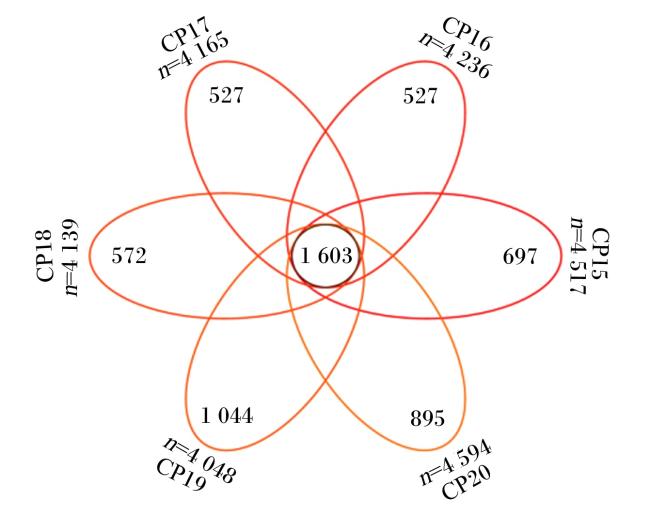
Venn图体现不同组之间共有和独有的操作分类单元(OTU)的数量,由图1可知,6组OTU的数目为5 865个,其中共同拥有的OTU数目为1 603个,15.00%、16.00%、17.00%、18.00%、19.00%、20.00%组独有的OTU数目分别为697、527、527、572、1 044、895个。
图1 OTU水平物种韦恩图

Fig.1 Venn diagram for species at OTU level

CP15:15.00%组 15.00% group;CP16:16.00%组 16.00% group;CP17:17.00%组 17.00% group;CP18:18.00%组 18.00% group;CP19:19.00%组 19.00% group;CP20:20.00%组 20.00% group。下同图 the same as below。

表5可知,随着饲粮粗蛋白质水平的提高,仔猪粪便微生物Chao指数、Richness指数、ACE指数均呈显著二次曲线变化(P<0.05),Chao指数、Richness指数有线性降低的趋势(P=0.074和P=0.099);不同组之间Shannon指数、Simpson指数无显著差异(P>0.05)。
表5 饲粮粗蛋白质水平对杜花仔猪粪便中菌群α多样性的影响

Table 5 Effects of dietary crude protein levels on fecal microflora α-diversity of Duhua piglets

项目
Items
饲粮粗蛋白质水平Dietary CP levels/% PP-value
15.00 16.00 17.00 18.00 19.00 20.00 方差分析
ANOVA
线性
Linear
二次
Quadratic
Chao指数Chao index 2 426±28a 2 309±65ab 2 292±45ab 2 068±111bc 1 931±103c 2 369±135a 0.003 0.074 0.011
Richness指数Richness index 1 972±23a 1 890±50ab 1 861±50ab 1 680±88bc 1 608±92c 1 913±112ab 0.033 0.099 0.029
Shannon指数Shannon index 7.66±0.12 7.85±0.12 7.70±0.11 6.97±0.46 7.49±0.26 7.63±0.28 0.245 0.388 0.425
Simpson指数Simpson index 0.033±0.080 0.019±0.004 0.021±0.004 0.059±0.004 0.022±0.006 0.028±0.010 0.546 0.88 0.930
ACE指数ACE index 2 528±33a 2 403±65ab 2 383±56ab 2 178±119bc 2 044±126c 2 499±153a 0.013 0.151 0.023
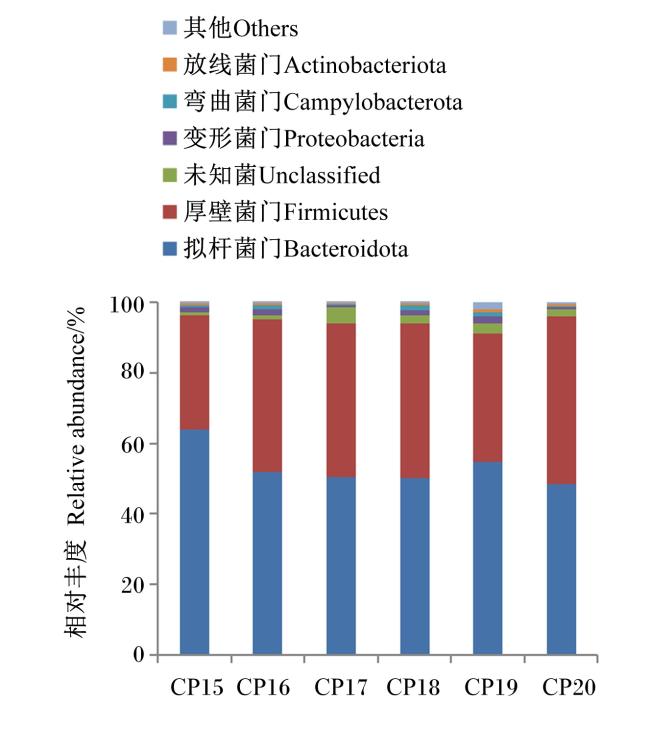
表6图2可知,在门水平,不同饲粮粗蛋白质水平组仔猪粪便中主要菌群均为拟杆菌门(Bacteroidota)、厚壁菌门(Firmicutes),两者之和在90%以上,还有少量变形菌门(Proteobacteria)、弯曲菌门(Campylobacterota)、放线菌门(Actinobacteriota)。不同粗蛋白质水平饲粮对微生物门水平组成无显著影响(P>0.05)。
表6 粪便菌群门水平组成

Table 6 Composition of fecal microbial community at phylum level

项目
Items
饲粮粗蛋白质水平Dietary CP levels/% PP-value
15.00 16.00 17.00 18.00 19.00 20.00 方差分析
ANOVA
线性
Linear
二次
Quadratic
拟杆菌门Bacteroidota 63.82±3.95 51.79±7.66 50.42±7.92 50.18±7.73 54.78±6.21 48.52±7.54 0.671 0.239 0.354
厚壁菌门Firmicutes 32.38±3.79 43.24±7.69 43.44±6.99 43.70±6.25 36.42±5.56 47.51±7.55 0.592 0.303 0.424
变形菌门Proteobacteria 1.23±0.10 1.73±0.63 0.61±0.13 1.59±1.04 2.06±0.49 0.63±0.13 0.341 0.833 0.802
弯曲菌门Campylobacterota 0.66±0.27 1.02±0.70 0.19±0.53 1.38±0.84 1.00±0.53 0.18±0.08 0.491 0.762 0.661
放线菌门Actinobacteriota 0.62±0.14 0.68±0.18 0.51±0.07 0.54±0.10 0.94±0.22 0.73±0.19 0.464 0.320 0.501
图2 门水平上粪便微生物群落相对丰度

Fig.2 Relative abundance of fecal microbial community at phylum level

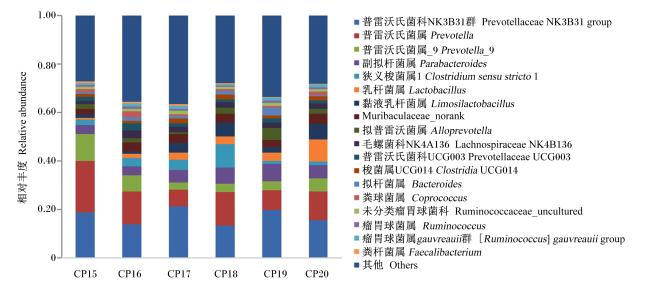
表7图3可知,仔猪粪便中在属水平上相对丰度比较高的菌属分别为普雷沃氏菌科NK3B31群(Prevotellaceae NK3B31 group)、普雷沃氏菌属(Prevotella)、普雷沃氏菌属_9(Prevotella_9)、副拟杆菌属(Parabacteroides)、狭义梭菌属1(Clostridium sensu stricto 1)、乳杆菌属(Lactobacillus)、黏液乳杆菌属(Limosilactobacillus)、Muribaculaceae_norank、拟普雷沃菌属(Alloprevotella)等。通过差异性比较发现,随着饲粮粗蛋白质水平的提高,粪便中普雷沃氏菌属、粪杆菌属相对丰度呈显著线性降低(P<0.05),并呈显著二次曲线变化(P<0.05);黏液乳杆菌属相对丰度呈显著线性提高(P<0.05);乳杆菌属相对丰度呈显著线性提高(P<0.05),并呈显著二次曲线变化(P<0.05),普雷沃氏菌属_9相对丰度呈二次曲线变化趋势(P=0.063)。
表7 粪便菌群属水平组成

Table 7 Composition of fecal microbial community at genus level

项目
Items
饲粮粗蛋白质水平Dietary CP level/% PP-value
15.00 16.00 17.00 18.00 19.00 20.00 方差分析
ANOVA
线性
Linear
二次
Quadratic
普雷沃氏菌属Prevotella 21.14±3.89a 13.62±2.76ab 6.76±1.11b 13.91±4.20ab 8.27±1.59b 11.68±2.03b 0.019 0.037 0.012
普雷沃氏菌属_9 Prevotella_9 11.01±4.82 6.63±3.74 3.08±1.52 3.37±1.23 3.57±2.20 5.64±1.78 0.372 0.141 0.063
副拟杆菌属Parabacteroides 3.67±1.84 3.59±1.07 5.08±1.17 6.79±1.28 7.21±1.93 5.34±1.19 0.384 0.087 0.143
乳杆菌属Lactobacillus 0.81±0.39 1.74±1.02 3.04±1.88 3.11±1.32 3.39±1.11 9.14±4.08 0.094 0.008 0.017
黏液乳杆菌属Limosilactobacillus 1.54±0.67 1.17±0.57 3.80±1.57 5.80±2.67 2.22±0.54 6.46±2.69 0.172 0.048 0.146
拟普雷沃菌属Alloprevotella 1.84±0.48 1.73±0.98 0.86±0.29 2.56±1.11 4.77±1.49 2.04±0.49 0.094 0.156 0.379
粪杆菌属Faecalibacterium 0.80±0.17 0.70±0.19 0.74±0.21 0.50±0.18 0.19±0.01 0.45±0.10 0.154 0.026 0.044
图3 属水平上粪便微生物群落相对丰度

Fig.3 Relative abundance of fecal microbial community at genus level

3 讨论

3.1 饲粮粗蛋白质水平对杜花仔猪生长性能的影响

仔猪断奶时,由于受到环境、饲粮类型和心理等多种因素的影响,容易造成仔猪免疫功能紊乱,肠道微生态失衡,从而引起仔猪腹泻、生长受阻和死亡率上升等问题[14-17]。蛋白质是动物机体的组成部分,饲粮蛋白质是动物生长和维持的重要营养物质,与机体免疫、发育、生长密切相关[18]。饲粮粗蛋白质水平过低,不能满足仔猪营养需求影响生长速度;粗蛋白质水平过高,消化道不能完全吸收,造成资源浪费,还会增加仔猪的腹泻风险[19]。因此,在仔猪阶段,适宜的饲粮粗蛋白质水平对缓解仔猪断奶应激、提高生长性能至关重要。目前关于杜花仔猪适宜粗蛋白质需要量的研究较少。Liu等[11]报道在相同赖氨酸水平下,饲粮粗蛋白质水平从15.00%提高到20.00%对苏山仔猪生长性能无显著影响。周力等[9]报道,藏香仔猪饲粮粗蛋白质水平从16.00%提高到22.00%,平均日增重呈现出先升高后降低的趋势,18.00%组平均日增重最高。本研究中,饲粮粗蛋白质水平从14.91%提高到19.78%,显著提高仔猪的平均日增重和平均日采食量,显著降低料重比。20.00%组仔猪末重、平均日增重、平均日采食量最高,说明杜花仔猪阶段粗蛋白质需求量较高。通过Broken-line模型分析,以平均日增重、平均日采食量、料重比为评价指标,推荐杜花仔猪饲粮粗蛋白质水平分别为17.92%、20.13%、17.33%。通过每千克增重成本分析发现,20.00%组增重成本最低为5.8元/kg,其次为17.00%组和18.00%组,15.00%组的增重成本最高为6.2元/kg。这说明增加饲粮粗蛋白质水平虽然增加饲料成本,但是平均增重成本是降低的,适宜的粗蛋白质水平不仅提高生长性能,还可以降低饲养成本。王鑫[20]也研究报道,断奶仔猪饲粮粗蛋白质水平从15.00%提高到18.00%,仔猪的平均日增重显著提高。Limbach等[21]也发现,提高仔猪饲粮中粗蛋白质水平显著提高仔猪生长性能。不同的研究结果可能与仔猪饲粮中赖氨酸、苏氨酸、色氨酸等必需氨基酸水平有相关。如果各组赖氨酸等必需氨基酸水平相同,且在较高水平,那么调整粗蛋白质水平则对仔猪生长性能无显著影响。如果低粗蛋白质组饲粮中必需氨基酸水平较低或者不能满足的仔猪需要,那么调整粗蛋白质水平则会改善生长性能。

3.2 饲粮粗蛋白质水平对杜花仔猪腹泻率的影响

提高饲粮粗蛋白质水平虽然可以提高仔猪生长性能,但是仔猪腹泻率也会随之提高。仔猪断奶后腹泻是养猪生产中常见疾病,严重的腹泻会导致仔猪生长受阻甚至死亡。高粗蛋白质水平饲粮通过降低紧密连接蛋白和mRNA的表达,改变肠黏膜的通透性,引起仔猪腹泻[22]。另外,提高饲粮中粗蛋白质水平还会增加结肠中氨氮、腐氨、组氨、亚精氨等有害代谢产物的浓度,从而引起结肠道损伤和腹泻[23-24]。本研究表明,提高杜花仔猪饲粮中粗蛋白质水平有提高试验第1~28天腹泻率的趋势,20.00%组的腹泻率显著高于其他组。Wu等[25]也研究发现,断奶仔猪饲粮粗蛋白质水平从17.00%提高23.70%,显著提高仔猪的腹泻率。Limbach等[21]研究报道,提高仔猪饲粮粗蛋白质水平,回肠内容物的pH、促炎性细胞因子表达和粪便评分也提高,空肠的绒毛高度和抗炎基因转化生长因子-β(TGF-β)、白细胞介素-10(IL-10)的丰度却降低。其他研究也有报道,高粗蛋白质水平饲粮可通过破坏肠道形态、降低肠道基础炎症状态相关参数以及激活核转录因子-κB(NF-κB)信号诱导肠道炎症引起仔猪腹泻[8]

3.3 饲粮粗蛋白质水平对杜花仔猪血清生化指标的影响

血清生化指标的变化是机体组织细胞通透性改变和代谢功能改变的结果,反映了动物机体的健康程度和营养物质代谢状况。血清蛋白是机体蛋白质合成代谢的重要标志,总蛋白和白蛋白含量反映机体对蛋白质的吸收和代谢情况[26]。血清蛋白质含量提高有利于动物的代谢和免疫力,促进蛋白质合成,增加氮沉积[27]。本研究表明,不同饲粮粗蛋白质水平饲粮对杜花仔猪血清中白蛋白含量无显著影响,总蛋白含量呈二次曲线变化,与其他研究结果[10,28]一致。高含量的肌酐与肾脏损伤相关,不能有效排除体内的蛋白质代谢产物[29]。本研究表明,提高饲粮中粗蛋白质水平血清中肌酐的含量呈线性提高,说明高水平的粗蛋白质饲粮可能对肾脏造成一定损伤。谷草转氨酶、谷丙转氨酶和碱性磷酸酶是参与肝脏代谢的重要酶,是衡量肝脏是否有炎症和受到损伤的关键指标[30]。本研究发现,随着饲粮粗蛋白质水平的升高,血清谷草转氨酶活性呈线性增加,说明高粗蛋白质水平饲粮会损伤肝脏功能。尿素氮含量反映了氨基酸的利用效率,血清中含量升高说明蛋白质和氨基酸的利用率降低[31]。研究报道,血清尿素含量与饲粮粗蛋白质水平呈显著正相关,本研究结果与其他研究结果[11,20]一致。血清中葡萄糖是为机体供能的重要营养物质,是机体能量代谢的关键指标。甘油三酯、总胆固醇、高密度脂蛋白和低密度脂蛋白含量反映了机体脂质代谢情况,甘油三酯含量反映了脂肪的合成情况,总胆固醇参与形成胆汁和构成细胞膜参与营养物质代谢[26]。本研究发现,提高饲粮中粗蛋白质水平,显著提高血清中甘油三酯含量,降低总胆固醇含量。霍永久等[32]也发现,提高饲粮中粗蛋白质水平显著提高淮猪血清中甘油三酯含量。Kim等[33]也报道,饲粮粗蛋白质水平的提高有线性提高血清甘油三酯含量的趋势。而其他研究报道,饲粮粗蛋白质水平对血清甘油三酯和总胆固醇含量无显著影响[34],研究结果的差异可能是由于试验动物的品种和饲粮粗蛋白质水平有关。

3.4 饲粮蛋白质水平对杜花仔猪养分表观消化率的影响

养分表观消化率是反映饲粮配方是否合理、营养水平是否满足动物营养需要的重要指标,与动物健康状况和生长性能密切相关[35]。本研究结果表明,提高饲粮中粗蛋白质水平,粗蛋白质表观消化率呈线性提高,与杜花仔猪的平均日增重变化趋势一致。郑自彬等[36]也报道,提高杜长大三元仔猪饲粮中粗蛋白质水平,粗蛋白质的消化率显著提高。在牦牛和羊上也发现,高粗蛋白质组粗蛋白质消化率显著高于低粗蛋白质组[29,37]。这可能是适宜的饲粮粗蛋白质水平提高了消化道的蛋白酶活性和肠道黏膜消化吸收能力。本研究发现,提高饲粮粗蛋白质水平,粗脂肪表观消化率先增高后降低,粗灰分的表观消化率无显著变化。Kim等[33]研究报道,饲粮粗蛋白质的水平从16.00%提高到21.00%对断奶仔猪的粗脂肪和粗灰分的消化率无显著影响。其他研究报道,饲粮粗蛋白质水平从15.50%到20.00%,粗脂肪的消化率呈先降低后增高的趋势[36]。不同的试验结果可能是由于不同试验饲粮配方中粗脂肪的含量差异导致的,本试验中粗脂肪含量随饲粮粗蛋白质水平升高而降低,而其他2个研究中的粗脂肪含量是随着饲粮粗蛋白质水平提高而升高。

3.5 饲粮粗蛋白质水平对杜花仔猪粪便微生物组成的影响

肠道菌群及其发酵代谢产物在动物健康中起着重要作用。粪便菌群与肠道菌群密切相关,其对肠道的形态功能、营养吸收和机体免疫调节起到重要作用[38]。饲粮营养组成和动物品种是影响肠道菌群的主要因素。Alpha多样性反映样本中微生物的丰富度和稳定性,是肠道微生物多样性的重要评价指标。Simpson指数和Shannon指数分别与微生物物种的均匀度和多样性相关,Chao指数、Ace指数和Richness指数与物种的丰富度和种类相关[39]。本研究发现,提高饲粮粗蛋白质水平,杜花仔猪粪便微生物Chao指数、Ace指数和Richness指数均呈现先降低后升高的趋势,在19.00%组Alpha多样性指数最低。与粗蛋白质表观消化率趋势相反,说明适宜的饲粮粗蛋白质水平能够抑制肠道中微生物的生长,提高营养物质消化率。饲粮粗蛋白质水平过高或者过低均促进肠道微生物的繁殖,对肠道健康和消化吸收功能起到负面影响。在本研究中,厚壁菌门和拟杆菌门是杜花仔猪粪便中的主要菌群,两者总计在90%以上,与苏山猪、外三元、昭通乌金猪等其他品种猪研究结果[11,40-41]相同。通过差异分析发现,提高饲粮粗蛋白质水平对粪便微生物在门水平上的组成无显著影响,在属水平上进一步分析发现,副拟杆菌属、乳杆菌属和黏液乳杆菌属相对丰度显著提高。副拟杆菌属代谢产物为乙酸和琥珀酸,乳杆菌属和黏液乳杆菌属可以调节肠道免疫,降低炎症损伤,均属于有益菌[42-43]。这2种菌属相对丰度的显著提高说明在一定范围内提高饲粮粗蛋白质水平可以改善肠道微生态,促进肠道健康。普雷沃氏菌属和普雷沃氏菌属_9参与机体对纤维素的降解,有研究报道其会引起肠道反应,增加肠道通透性[44]。本研究发现,提高饲粮粗蛋白质水平,普雷沃氏菌属和普雷沃氏菌属_9相对丰度呈先降低后增高的趋势,与仔猪腹泻率结果趋势一致,说明适当提高饲粮粗蛋白质水平可以改善肠道微生物组成,降低仔猪腹泻。粪杆菌属利用肠道中的碳水化合物产生乙酸和戊酸[45]。随着饲粮粗蛋白质水平提高,杜花仔猪肠道消化吸收能力提高,导致进入后肠的碳水化合物含量降低,最终降低了与碳水化合物发酵相关的微生物菌群的丰度。

4 结论

在本试验条件下,提高饲粮中粗蛋白质水平显著提高杜花仔猪的平均日增重、粗蛋白质表观消化率,改善粪便微生物组成,但是过高的粗蛋白水平会导致仔猪腹泻率增加。综合考虑,推荐杜花仔猪饲粮粗蛋白质水平18.00%。
[1]
国家畜禽遗传资源委员会. 中国畜禽遗传资源志-猪志[M]. 北京: 中国农业出版社, 2011.

National Commission on Genetic Resources for Livestock and Poultry. Animal genetic resources in China:pigs[M]. Beijing: China Agriculture Press, 2011. (in Chinese)

[2]
谢水华, 曾铨品. 广东小耳花猪生产性能与杂交效果的研究[J]. 养猪, 2015(6):63-64.

XIE S H, ZENG Q P. Studies on Guangdong Xiaoerhua swine traits performance and effect of crossbreed[J]. Swine Production, 2015(6):63-64. (in Chinese)

[3]
余海乐, 李镇养, 赵继念, 等. 广东小耳花猪胴体与肉质性状分析[J]. 养猪, 2021(1):65-67.

YU H L, LI Z Y, ZHAO J N, et al. Analysis on carcass and meat quality of Guangdong small-spotted pig[J]. Swine Production, 2021(1):65-67. (in Chinese)

[4]
张洁, 李宝红, 孟繁明, 等. 广东小耳花猪与杜洛克杂交效果分析[J]. 广东畜牧兽医科技, 2017, 42(2):45-47,52.

ZHANG J, LI B H, MENG F M, et al. Analysis on the effect of hybridization between Guangdong small ear spotted pig and Duroc[J]. Guangdong Journal of Animal and Veterinary Science, 2017, 42(2):45-47,52. (in Chinese)

[5]
ORLANDO U A D, et al.DE OLIVEIRA R F M,DONZELE J L, Dietary crude protein levels and amino acid supplementation for gilts from 30 to 60 kg maintained in a high environmental temperature[J]. Revista Brasileira de Zootecnia, 2007, 36(5):1573-1578.

[6]
WEBB J, BROOMFIELD M, JONES S, et al. Ammonia and odour emissions from UK pig farms and nitrogen leaching from outdoor pig production.A review[J]. The Science of the Total Environment, 2014,470/471:865-875.

[7]
PORTEJOIE S, DOURMAD J Y, MARTINEZ J, et al. Effect of lowering dietary crude protein on nitrogen excretion,manure composition and ammonia emission from fattening pigs[J]. Livestock Production Science, 2004, 91(1/2):45-55.

[8]
YIN L M, LI J, WANG M W, et al. Dietary high protein-induced diarrhea and intestinal inflammation by activation of NF-κB signaling in piglets[J]. Animal Nutrition, 2021, 7(4):1070-1077.

DOI PMID

[9]
周力, 李雪清, 侯生珍, 等. 不同蛋白水平日粮对藏香猪断奶仔猪生长性能和血清生化指标的影响[J]. 家畜生态学报, 2020, 41(10):52-56.

ZHOU L, LI X Q, HOU S Z, et al. Effects of different protein levels on growth performance and serum biochemical indices of weaned piglets of Tibetan pigs[J]. Journal of Animal Ecology, 2020, 41(10):52-56. (in Chinese)

[10]
杨永生, 谢红兵, 刘丽莉, 等. 湘村黑猪各阶段营养需求参数研究[J]. 畜牧兽医学报, 2013, 44(9):1400-1410.

YANG Y S, XIE H B, LIU L L, et al. Study on nutritional requirement parameters at different stages of Xiangcun black pigs[J]. Acta Veterinaria et Zootechnica Sinica, 2013, 44(9):1400-1410 (in Chinese).

[11]
LIU R, HE J, JI X, et al. A moderate reduction of dietary crude protein provide comparable growth performance and improve metabolism via changing intestinal microbiota in Sushan nursery pigs[J]. Animals, 2021, 11(4):1166.

[12]
李德发. 中国猪营养需要[M]. 北京: 中国农业出版社, 2020.

LI D F. Nutrient requirements of swine in China[M]. Beijing: China Agriculture Press, 2020. (in Chinese)

[13]
ROBBINS K R, SAXTON A M, SOUTHERN L L. Estimation of nutrient requirements using broken-line regression analysis[J]. Journal of Animal Science, 2006, 84(S13):E155-E165.

[14]
CAMPBELL J M, CRENSHAW J D, POLO J. The biological stress of early weaned piglets[J]. Journal of Animal Science and Biotechnology, 2013, 4(1):19.

DOI PMID

[15]
HEO J M, OPAPEJU F O, PLUSKE J R, et al. Gastrointestinal health and function in weaned pigs:a review of feeding strategies to control post-weaning diarrhoea without using in-feed antimicrobial compounds[J]. Journal of Animal Physiology and Animal Nutrition, 2013, 97(2):207-237.

[16]
温晓鹿, 王丽, 杨雪芬, 等. 合生素替代抗生素对断奶仔猪生长性能、肠道黏膜形态与免疫性能及结肠微生态的影响[J]. 动物营养学报, 2019, 31(5):2088-2097.

WEN X L, WANG L, YANG X F, et al. Effects of synbiotics substitution of antibiotics on growth performance,intestinal mucosal morphology,immune performance and colonic microbial ecosystem of weaned piglets[J]. Chinese Journal of Animal Nutrition, 2019, 31(5):2088-2097. (in Chinese)

[17]
YIN J, WU M M, XIAO H, et al. Development of an antioxidant system after early weaning in piglets[J]. Journal of Animal Science, 2014, 92(2):612-619.

DOI PMID

[18]
ZHANG L H, PIAO X S. Different dietary protein sources influence growth performance,antioxidant capacity,immunity,fecal microbiota and metabolites in weaned piglets[J]. Animal Nutrition, 2022, 8(1):71-81.

[19]
WELLOCK I J, FORTOMARIS P D, HOUDIJK J G M, et al. The effect of dietary protein supply on the performance and risk of post-weaning enteric disorders in newly weaned pigs[J]. Animal Science, 2006, 82(3):327-335.

[20]
王鑫. 不同蛋白源和蛋白水平日粮对断奶仔猪生长性能、血液指标及肠道菌群的影响[D]. 硕士学位论文. 杨凌: 西北农林科技大学, 2023.

WANG X. Efects of different diets with protein sources or protein levels on growth performance,blood indexes and intestinal microflora of weaned piglets[D]. Master’s Thesis. Yangling: Northwest A&F University, 2023. (in Chinese)

[21]
LIMBACH J R, ESPINOSA C D, PEREZ-CALVO E, et al. Effect of dietary crude protein level on growth performance,blood characteristics,and indicators of intestinal health in weanling pigs[J]. Journal of Animal Science, 2021, 99(6):skab166.

[22]
王昱茜. 饲粮蛋白水平对断奶仔猪小肠形态结构及紧密连接蛋白Occludin的影响[D]. 硕士学位论文. 雅安: 四川农业大学, 2019.

WANG Y X. Effects of dietary protein levels on intestinal morphology and tight junction protein Occludin in weaned piglets[D]. Master’s Thesis. Ya’an: Sichuan Agricultural University, 2019. (in Chinese)

[23]
董彦强. 饲粮蛋白水平对断奶仔猪结肠内氨氮含量,结肠损伤和腹泻的影响[D]. 硕士学位论文. 雅安: 四川农业大学, 2019.

DONG Y Q. Effect of dietary protein levels on ammonia nitrogen concentration of colon contents,colonic injury and diarrhoea of weaned piglets[D]. Master’s Thesis. Ya’an: Sichuan Agricultural University, 2019. (in Chinese)

[24]
WEN X L, WANG L, ZHENG C T, et al. Fecal scores and microbial metabolites in weaned piglets fed different protein sources and levels[J]. Animal Nutrition, 2018, 4(1):31-36.

DOI PMID

[25]
WU Y P, JIANG Z Y, ZHENG C T, et al. Effects of protein sources and levels in antibiotic-free diets on diarrhea,intestinal morphology,and expression of tight junctions in weaned piglets[J]. Animal Nutrition, 2015, 1(3):170-176.

[26]
李佳橙, 张文喆, 南珊珊, 等. 饲粮中添加不同饼粕源发酵饲料对断奶仔猪生长性能、营养物质表观消化率、血清生化指标和肠道菌群的影响[J]. 动物营养学报, 2024, 36(2):847-862.

DOI

LI J C, ZHANG W Z, NAN S S, et al. Effects of dietary fermented feed from different meal sources on growth performance,nutrient apparent digestibilities,serum biochemical indexes and intestinal microflora of weaned piglets[J]. Chinese Journal of Animal Nutrition, 2024, 36(2):847-862. (in Chinese)

[27]
LI H H, JIANG X R, QIAO J Y. Effect of dietary Bacillus subtilis on growth performance and serum biochemical and immune indexes in weaned piglets[J]. Journal of Applied Animal Research, 2021, 49(1):83-88.

[28]
杨小婷, 李吕木, 许发芝, 等. 日粮蛋白水平对圩猪生长性能、肉质和血清生化指标的影响[J]. 西北农林科技大学学报(自然科学版), 2013, 41(10):1-8.

YANG X T, LI L M, XU F Z, et al. Effect of dietary protein levels on growth performance,meat quality trait and serum biochemical parameters in Wei pigs[J]. Journal of Northwest A&F University(Natural Science Edition), 2013, 41(10):1-8. (in Chinese)

[29]
何振富, 谢建鹏, 陈平, 等. 不同蛋白质、能量水平饲粮对舍饲育肥牦牛生长性能、养分表观消化率及血清生化指标的影响[J]. 动物营养学报, 2024, 36(3):1698-1712.

DOI

HE Z F, XIE J P, CHEN P, et al. Effects of different protein and energy levels of diets on growth performance,nutrient apparent digestibility and serum biochemical indexes of fattening yaks in shelter feeding[J]. Chinese Journal of Animal Nutrition, 2024, 36(3):1698-1712. (in Chinese)

[30]
王丽媛, 占今舜, 肖海红, 等. 饲粮中添加芦丁对湖羊屠宰性能、肉品质和血清生化指标及器官发育的影响[J]. 甘肃农业大学学报, 2023, 58(3):7-14.

WANG L Y, ZHAN J S, XIAO H H, et al. Effects of dietary rutin supplementation on slaughter performance,meat quality,serum biochemical indices and organ development of Hu sheep[J]. Journal of Gansu Agricultural University, 2023, 58(3):7-14. (in Chinese)

[31]
石炳钊, 范佳俊, 古殿超, 等. 不同来源铁添加剂对断奶仔猪血清生化指标和器官指数的影响[J]. 中国畜牧杂志, 2023, 59(8):339-344.

SHI B Z, FAN J J, GU D C, et al. Effects of different sources of iron additives on serum biochemical indices and organ indices of weaned piglets[J]. Chinese Journal of Animal Science, 2023, 59(8):339-344. (in Chinese)

[32]
霍永久, 占今舜, 余同水, 等. 饲粮不同蛋白水平对淮猪生长性能、肉品质和血清生化指标的影响[J]. 草业学报, 2015, 24(6):133-141.

DOI

HUO Y J, ZHAN J S, YU T S, et al. The effect of diet with different crude protein levels on growth performance,meat quality and serum parameters in Huai pigs[J]. Acta Prataculturae Sinica, 2015, 24(6):133-141. (in Chinese)

[33]
KIM H, SHIN H, KIM Y Y. Effects of different levels of dietary crude protein on growth performance,blood profiles,diarrhea incidence,nutrient digestibility,and odor emission in weaning pigs[J]. Animal Bioscience, 2023, 36(8):1228-1240.

[34]
谭占坤, 宋天增, 商鹏, 等. 饲粮粗蛋白水平对高海拔地区断奶藏仔猪生产性能和血液生化指标的影响[J]. 江苏农业科学, 2017, 45(11):111-114.

TAN Z K, SONG T Z, SHANG P, et al. Effects of dietary crude protein level on performance and blood biochemical indexes of weaned Tibetan piglets in high altitude area[J]. Jiangsu Agricultural Sciences, 2017, 45(11):111-114. (in Chinese)

[35]
李进龙, 郭同军, 臧长江, 等. 不同水平辣椒秸秆饲粮对杜湖杂交羔羊生长性能、养分表观消化率和血清指标的影响[J]. 动物营养学报, 2024, 36(7):4531-4543.

DOI

LI J L, GUO T J, ZANG C J, et al. Effects of different pepper stalk level diets on growth performance,nutrient apparent digestibility and serum indices of Dorper×Hu hybrid lambs[J]. Chinese Journal of Animal Nutrition, 2024, 36(7):4531-4543. (in Chinese)

[36]
郑自彬, 姜宇翔, 雷龙, 等. 适宜代谢葡萄糖下日粮蛋白水平对仔猪生长性能及营养物质消化率的影响[J]. 中国畜牧杂志, 2020, 56(9):163-165.

ZHENG Z B, JIANG Y X, LEI L, et al. Effects of dietary protein level on growth performance and nutrient digestibility of piglets under appropriate metabolic glucose[J]. Chinese Journal of Animal Science, 2020, 56(9):163-165. (in Chinese)

[37]
雷耀庚, 李碧波, 王兴涛, 等. 日粮蛋白水平对陕北白绒山羊日增重、养分消化和精液品质的影响[J]. 畜牧与兽医, 2015, 47(11):22-27.

LEI Y G, LI B B, WANG X T, et al. Effects of dietary protein levels on average daily gain,nutrient degradation and semen quality in Shanbei white cashmere goat bucks[J]. Animal Husbandry & Veterinary Medicine, 2015, 47(11):22-27. (in Chinese)

[38]
BRULC J M, ANTONOPOULOS D A, MILLER M E B, et al. Gene-centric metagenomics of the fiber-adherent bovine rumen microbiome reveals forage specific glycoside hydrolases[J]. Proceedings of the National Academy of Sciences of the United States of America, 2009, 106(6):1948-1953.

DOI PMID

[39]
LI J, FENG S, PI Y, et al. Limosilactobacillus johnsoni and Limosilactobacillus mucosae and their extracellular vesicles alleviate gut inflammatory injury by mediating macrophage polarization in a lipopolysaccharide-challenged piglet model[J]. The Journal of Nutrition, 2023, 153(8):2497-2511.

[40]
杨凯. 日粮消化能, 粗蛋白和赖氨酸水平对生长前期昭通乌金猪生长性能和肠道菌群的影响[D]. 硕士学位论文. 昆明: 云南农业大学, 2022.

YANG K. Effects of dietary digestible energy、crude protein and lysine levels on growth performance and intestinal microflora of Zhaotong Wujin pigs in early growth stage[D]. Master’s Thesis. Kunming: Yunnan Agricultural University, 2022. (in Chinese)

[41]
HOU L, WANG L, QIU Y Q, et al. Effects of protein restriction and subsequent realimentation on body composition,gut microbiota and metabolite profiles in weaned piglets[J]. Animals, 2021, 11(3):686.

[42]
WANG K, LIAO M F, ZHOU N, et al. Parabacteroides distasonis alleviates obesity and metabolic dysfunctions via production of succinate and secondary bile acids[J]. Cell Reports, 2019, 26(1):222-235.

[43]
WANG M J, WU H Q, LU L H, et al. Lactobacillus reuteri promotes intestinal development and regulates mucosal immune function in newborn piglets[J]. Frontiers in Veterinary Science, 2020,7:42.

[44]
ILJAZOVIC A, ROY U, GÁLVEZ E J C, et al. Perturbation of the gut microbiome by Prevotella spp.enhances host susceptibility to mucosal inflammation[J]. Mucosal Immunology, 2021, 14(1):113-124.

[45]
BAI Y, ZHOU X J, LI N, et al. In vitro fermentation characteristics and fiber-degrading enzyme kinetics of cellulose,arabinoxylan,β-glucan and glucomannan by pig fecal microbiota[J]. Microorganisms, 2021, 9(5):1071.

Outlines

/