RESEARCH PAPER

Effects of Camellia oleifera Protein Powder on Growth Performance, Slaughter Performance, Serum Biochemical Indexes and Muscle Flavor Substance Contents of Yellow-Feathered Broilers

  • ZENG Bin , 1, 2, 3 ,
  • YAN Deyong 1 ,
  • TANG Peng 1 ,
  • MA Ming , 2, * ,
  • ZENG Jianqin , 1, *
Expand
  • 1 Postdoctoral Programme, Hunan Heguang Biotechnology Co. Ltd., Yongzhou 425000, China
  • 2 Key Laboratory of Chemical Biology & Traditional Chinese Medicine Research (Ministry of Education of China) and Key Laboratory of Phytochemical R&D of Hunan Province, Hunan Normal University, Changsha 410081, China
  • 3 Yongzhou Engineering Technology Research Center for Efficient and Healthy Breeding of Livestock and Poultry, College of Agriculture, YongZhou Vocational Technical College, Yongzhou 425000, China
*MA Ming, professor, E-mail: ;
ZENG Jianqin, professor, E-mail:

Received date: 2024-12-17

  Online published: 2025-08-14

Abstract

This experiment was conducted to investigate the effects of diets supplemented with different levels of Camellia oleifera protein powder on the growth performance, slaughter performance, serum biochemical indexes and muscle flavor substances contents of yellow feathered broilers. A total of 384 male fast-onset yellow-feathered broilers aged 28 days with similar body weight and healthy condition were randomly divided into 4 groups (8 replicates per group and 12 chickens per replicate): the broilers in the control group were fed a basal diet, and the others in the three experimental groups were fed the basal diet supplemented with 1%, 2% and 4% Camellia oleifera protein powder to replace some corn and soybean meal, respectively. The experiment lasted for 28 days. The results showed as follows: Compared with the control group, there were no significant differences in slaughter weight at 56 days of age, average daily gain, average daily feed intake and feed to gain ratio of broilers in 1% and 2% Camellia oleifera protein powder groups (P>0.05); with the dietary Camellia oleifera protein powder supplemental level increasing, the slaughter weight at 56 days of age and average daily gain of broilers were linearly decreased (P<0.05), and the average daily feed intake was linearly and quadratic changed (P<0.05). 2) With the dietary Camellia oleifera protein powder supplemental level increasing, the abdominal fat percentage of broilers was linearly decreased (P<0.05); there were no significant differences in dressing percentage, eviscerated yield percentage, half-eviscerated yield percentage, breast muscle percentage and leg muscle percentage of broilers among groups (P>0.05). 3) With the dietary Camellia oleifera protein powder supplemental level increasing, the contents of serum total cholesterol and high-density lipoprotein cholesterol were linearly decreased (P<0.05). 4) Compared with the control group, the contents of lysine, threonine, arginine, glutamic acid, tyrosine, alanine, proline and total amino acid, total sweet amino acid, total flavor amino acid and total umami amino acid in breast muscle of broilers in 2% Camellia oleifera protein powder group were significantly increased (P<0.05), while the content of myristate was significantly decreased (P<0.05). In conclusion, dietary supplementation of 1% to 2% Camellia oleifera protein powder has no effect on growth performance, slaughter performance and serum biochemical indexes of yellow feather broilers; dietary supplementation of 2% Camellia oleifera protein powder can decrease the percentage of abdominal fat and increase the content of flavor amino acids in muscle of broilers.

Cite this article

ZENG Bin , YAN Deyong , TANG Peng , MA Ming , ZENG Jianqin . Effects of Camellia oleifera Protein Powder on Growth Performance, Slaughter Performance, Serum Biochemical Indexes and Muscle Flavor Substance Contents of Yellow-Feathered Broilers[J]. Chinese Journal of Animal Nutrition, 2025 , 37(8) : 5573 -5583 . DOI: 10.12418/CJAN2025.452

在我国豆粕、玉米等常规饲料原料减量替代的大背景下,研究开发和高效利用我国现有常规和非常规饲料资源,促进饲料配方结构趋向多元化和降本提效,是当前动物饲料与营养研究领域的重点工作方向。油茶(Camellia oleifera)是我国重要的木本油料植物,根据国家林业和草原局发布的《加快油茶产业发展三年行动方案(2023—2025年)》,到2025年,全国油茶种植面积预计达到9 000万亩(1亩≈667 m2)以上,茶油产量达到200万t,油茶籽加工副产物年产量将达到400~500万t[1]。油茶加工副产物不仅含有蛋白质、碳水化合物和脂肪等常规营养成分[2],且含有皂苷、多糖等生物活性成分[3],可作为畜禽饲料原料开发利用。然而,本团队前期的研究结果发现,通过物理压榨和溶剂浸提等传统油茶籽取油方法,在加工过程中蛋白质等营养成分发生了系列热敏反应,得到的油茶籽饼、油茶籽粕副产物的饲用价值远低于采用“脱壳、粉碎和超临界二氧化碳萃取”工艺得到的油茶籽仁粉[4]。此外,油茶加工副产物中含有的大量油茶皂素等抗营养物质是限制其饲用的主要原因[5]。高剂量的油茶皂素进入血液后会破坏动物的红细胞(尤其是鱼类的红细胞),在饲料中会引起适口性降低、动物消化不良等问题。例如,樊庆山等[6-7]在犊牛饲粮中添加5%的油茶籽粕替代豆粕,犊牛采食量、氮利用效率和生长性能显著降低,但可提高血清免疫球蛋白含量。然而,油茶加工副产物中的生物活性成分可改善动物肉品质。张向杰等[8]研究发现,在湖羊饲粮中添加适量(800 mg/kg)的油茶皂苷糖萜素可显著提升羊肉品质。本团队在研究油茶籽仁粉副产物营养特性的基础上,通过对其进行茶皂素提取,得到高蛋白质、低皂素的新型产品——油茶蛋白粉(Camellia oleifera protein powder,COP),极大提高了油茶加工副产物的饲用营养价值。目前,本产品还未在动物饲粮中进行应用研究,鉴于肉鸡养殖是我国家禽业中的支柱产业,因此,本试验以黄羽肉鸡为研究对象,评估油茶蛋白粉作为新型饲料原料对其生长性能、屠宰性能、血清生化指标和肌肉风味物质含量的影响,为油茶蛋白粉在黄羽肉鸡养殖中得到科学和充分的应用提供依据。

1 材料与方法

1.1 试验材料

试验用油茶蛋白粉是一种的新型蛋白质饲料产品,来源于湖南永州某生物科技有限公司。该产品首先由去皮脱壳的风干油茶籽仁经过粉碎、超临界二氧化碳萃取油脂得到脱脂油茶籽仁粉,然后再经茶皂素提取、干燥、粉碎后得到。其主要营养和部分活性成分的实测值如下:水分含量8.09%、粗蛋白质含量20.22%、粗脂肪含量0.79%、粗纤维含量10.18%、粗灰分含量4.84%、蛋氨酸含量0.21%、赖氨酸含量1.01%、总糖含量31.66%、油茶皂苷含量5.66%。

1.2 试验设计

选用28日龄的雄性快速型黄羽肉鸡(新兴黄鸡2号),根据体重相近原则,随机分为4组,1个对照组和3个试验组,每组8个重复,每个重复12只鸡。对照组饲喂玉米-豆粕型基础饲粮,3个试验组分别用1.0%、2.0%和4.0%油茶蛋白粉等氮替代基础饲粮中部分玉米和豆粕,并分别命名为1%油茶蛋白组、2%油茶蛋白组和4%油茶蛋白组。各组饲粮为参考《黄羽肉鸡营养需要量》(NY/T 3645—2020)推荐的营养水平配制的全价配合饲料(粉状),试验饲粮组成及营养水平见表1。整个试验期4周,其中预试期3 d,正试期25 d。试验鸡由阶梯笼养,保证自由采食和饮水。光照、温度、注射疫苗等饲养管理均按照常规饲养规程进行。本动物试验根据湖南师范大学生物医学研究伦理委员会的建议进行,伦理委员会批准编号为2023第(480)号。
表1 试验饲粮组成及营养水平(风干基础)

Table 1 Composition and nutrient levels of experimental diets (air-dry basis) %

项目
Items
对照组
Control group
1%油茶蛋白粉组
1% COP group
2%油茶蛋白粉组
2% COP group
4%油茶蛋白粉组
4% COP group
原料Ingredients
油茶蛋白粉Camellia oleifera protein powder 1.00 2.00 4.00
玉米Corn 61.00 60.37 59.74 58.48
豆粕Soybean meal 28.00 27.63 27.26 26.52
小麦麸Wheat bran 5.00 5.00 5.00 5.00
豆油Soybean oil 2.00 2.00 2.00 2.00
预混料Premix1) 4.00 4.00 4.00 4.00
合计Total 100.00 100.00 100.00 100.00
营养水平Nutrient levels2)
代谢能ME/(MJ/kg) 12.65 12.64 12.63 12.61
粗蛋白质CP 17.82 17.82 17.82 17.82
粗纤维CF 2.85 2.85 2.86 2.87
钙Ca 0.79 0.79 0.79 0.79
有效磷AP 0.27 0.27 0.27 0.27
蛋氨酸Met 0.36 0.36 0.36 0.35
赖氨酸Lys 0.90 0.90 0.90 0.91
蛋氨酸+半胱氨酸Met+Cys 0.66 0.66 0.66 0.66

1)预混料为每千克饲粮提供 The premix provided the following per kg of diets:VA 10 000 IU,VB2 6 mg,VB6 3.6 mg,VB12 0.02 mg,VD3 2 500 IU,VE 20 IU,VK3 2 mg,烟酸 nicotinic acid 25 mg,D-泛酸 D-pantothenic acid 12 mg,氯化胆碱 choline chloride 380 mg,Mn 80 mg,Fe 100 mg,Zn 80 mg,Cu 10 mg,Co 0.35 mg,Se 0.45 mg,I 0.65 mg。
2)粗蛋白质、粗纤维、钙为实测值,其余为计算值。代谢能、有效磷和氨基酸参照《中国饲料成分及营养价值表(2023年第34版)》计算得到。CP, CF and Ca were measured values, while the others were measured values. ME, AP and amino acids were calculated with reference to the Table of Feed Composition and Nutritional Value in China (34th edition, 2023).

1.3 指标测定

1.3.1 营养成分和油茶皂苷含量测定

参考GB/T 6435—2014测定水分含量;参考GB/T 6432—2018测定粗蛋白质含量;参考GB/T 6433—2006测定粗脂肪含量;参考GB/T 6434—2022测定粗纤维含量;参考GB/T 6438—2007测定粗灰分含量;参考GB/T 18246—2019测定蛋氨酸和赖氨酸含量;参考DB12/T 847—2018测定总糖含量;参考GB/T 25247—2010中4.5的方法测定油茶皂苷含量。

1.3.1 生长性能和屠宰性能测定

试验期间,以重复为单位,每天08:00和16:00人工添料各1次,每天添料共2次,并记录采食量数据。试验鸡在31日龄试验开始前空腹称重,在56日龄试验结束时空腹称重,计算平均日采食量、平均日增重和料重比(平均日采食量/平均日增重);56日龄时试验鸡空腹称重后,每个重复随机选取1只试验鸡采血后屠宰,并按照《家禽生产性能名词术语和度量计算方法》(NY/T 823—2020)测定屠宰性能。

1.3.2 血清生化指标测定

对待屠宰的每只试验鸡空腹称重后采集血液约7 mL于10 mL离心管中,倾斜静置1 h后,在1 200×g离心力下离心10 min,取血清于2 mL离心管中,-80 ℃冰箱保存。血清样品送至广州达安临床检验中心采用全自动生化分析仪(7600,日立)检测葡萄糖(GLU)、总蛋白(TP)、白蛋白(ALB)、丙氨酸氨基转移酶(ALT)、天门冬氨酸氨基转移酶(AST)、碱性磷酸酶(ALP)、尿酸(UA)、甘油三酯(TG)、总胆固醇(TC)、高密度脂蛋白胆固醇(HDL-C)、低密度脂蛋白胆固醇(LDL-C)的含量或活性。

1.3.3 肌肉风味物质含量测定

肌肉风味物质含量测定所选试验鸡同屠宰性能测定。从对照组和最佳添加水平组(根据生长性能结果确定为2%油茶蛋白粉组)每个重复中选取1只试验鸡,统一取右侧胸肌50 g,-80 ℃冰箱保存。参照GB 5009.124—2016《食品安全国家标准 食品中氨基酸的测定》测定肌肉中氨基酸的含量,参照GB 5009.168—2016《食品安全国家标准 食品中脂肪酸的测定》检测肌肉中脂肪酸的含量。

1.4 数据统计与分析

试验数据首先数据处理软件(Excel 2020)进行整理和计算。本试验中4组数据的显著性采用SPSS 20.0统计软件中ANOVA方法进行单因素方差分析和Duncan氏法多重比较;采用多项式对比,检验油茶蛋白粉添加水平对肉鸡生长性能、屠宰性能和血清生化指标的线性和二次效应。2组数据的显著性采用t检验(t test)方法进行统计分析。试验结果以“平均值±标准误”表示。显著性判断标准为P<0.05。

2 结果与分析

2.1 油茶蛋白粉对黄羽肉鸡生长性能的影响

表2可知,与对照组相比,饲粮中添加1%或2%的油茶蛋白粉对肉鸡的56日龄屠宰体重、平均日增重、平均日采食量和料重比均没有显著影响(P>0.05),添加4%的油茶蛋白粉则显著降低了肉鸡的56日龄屠宰体重、平均日增重、平均日采食量和料重比(P<0.05);随着饲粮中油茶蛋白粉添加水平的增加,肉鸡56日龄屠宰体重和平均日增重呈线性下降(P<0.05),平均日采食量呈线性和二次变化(P<0.01)。在整个试验期间,全部试验鸡为健康状态,没有出现死亡。
表2 油茶蛋白粉对黄羽肉鸡生长性能的影响

Table 2 Effects of Camellia oleifera protein powder on growth performance of yellow-feathered broilers

项目
Items
对照组
Control group
1%油茶
蛋白粉组
1% COP group
2%油茶
蛋白粉组
2% COP group
4%油茶
蛋白粉组
4% COP group
PP-value
处理
Treatment
线性
Linear
二次
Quadratic
31日龄初始体重
FBW at 31 days of age/g
705.63±16.63 707.88±12.79 703.75±11.52 712.38±21.01 0.895 0.823 0.843
56日龄屠宰体重
Slaughter weight at 56
days of age/g
1 734.13±38.36a 1 752.88±32.19a 1 730.14±34.28a 1 646.50±46.92b 0.048 0.026 0.164
平均日增重ADG/g 41.14±1.10a 41.80±0.95a 41.06±0.95a 37.37±1.24b 0.029 0.015 0.066
平均日采食量ADFI/g 99.15±2.33a 101.05±2.65a 98.80±2.84a 92.04±3.37b 0.002 <0.001 <0.001
料重比F/G 2.41±0.03 2.42±0.03 2.41±0.02 2.46±0.04 0.227 0.326 0.357

同行数据肩标无字母或相同字母表示差异不显著(P>0.05),不同字母表示差异显著(P<0.05)。下表同。

In the same row, values with the same letter or no letter superscripts mean no significant difference (P>0.05), while with different letter superscripts mean significant difference (P<0.05). The same as below.

2.2 油茶蛋白粉对黄羽肉鸡屠宰性能的影响

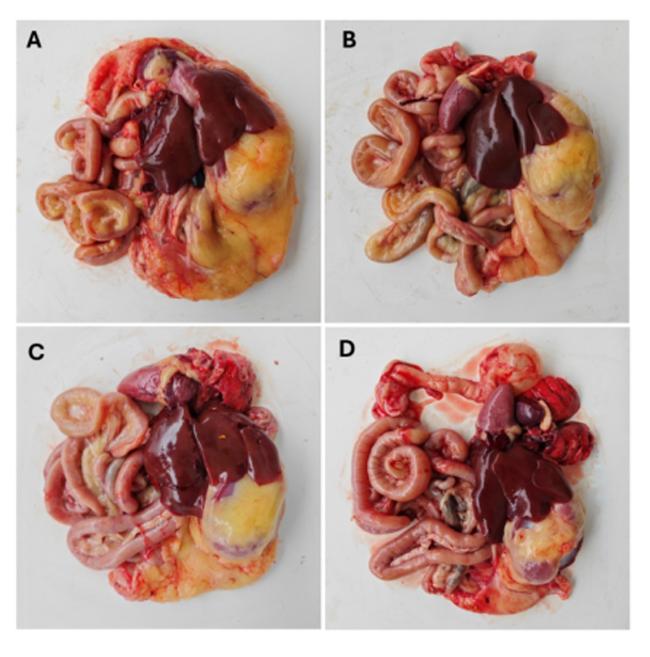
表3可知,与对照组相比,饲粮中添加1%、2%或4%的油茶蛋白粉对肉鸡的屠宰率、半净膛率、全净膛率、胸肌率和腿肌率均没有显著影响(P>0.05);2%和4%油茶蛋白粉组肉鸡腹脂率显著低于对照组和1%油茶蛋白粉组(P<0.05)。随着在饲粮中油茶蛋白粉添加水平的增加,肉鸡腹脂率呈现线性下降(P<0.01)。图1为各组肉鸡屠宰后内脏(含腹脂)图片。
表3 油茶蛋白粉对黄羽肉鸡屠宰性能的影响

Table 3 Effects of Camellia oleifera protein powder on slaughter performance of yellow-feathered broilers %

项目
Items
对照组
Control group
1%油茶
蛋白粉组
1% COP
2%油茶
蛋白粉组
2% COP
4%油茶
蛋白粉组
4% COP
PP-value
处理
Treatment
线性
Linear
二次
Quadratic
屠宰率
Dressing percentage
92.24±0.10 92.14±0.55 92.48±0.37 92.02±0.30 0.837 0.840 0.627
半净膛率
Half-eviscerated yield
percentage
84.10±0.70 83.84±0.26 84.04±0.37 83.52±0.40 0.807 0.461 0.778
全净膛率
Eviscerated yield percentage
78.01±0.64 77.81±0.32 78.22±0.45 77.70±0.33 0.772 0.873 0.905
胸肌率
Breast muscle percentage
14.55±0.46 14.90±0.48 14.28±0.40 14.53±0.21 0.754 0.702 0.899
腿肌率
Leg muscle percentage
18.86±0.43 18.66±0.58 19.33±0.39 18.41±0.31 0.515 0.726 0.417
腹脂率
Abdominal fat percentage
2.71±0.17a 2.70±0.18a 2.31±0.20b 1.98±0.21b 0.042 0.007 0.435
图1 肉鸡屠宰后内脏(含腹脂)图示

A、B、C、D分别为对照组、1%油茶蛋白粉组、2%油茶蛋白粉组和4%油茶蛋白粉组。

Fig.1 Diagrams of internal organs (including abdominal fat) of broilers after slaughter

A, B, C and D were control group, 1% COP group, 2% COP group and 4% COP group, respectively.

2.3 油茶蛋白粉对黄羽肉鸡血清生化指标的影响

表4可知,与对照组相比,饲粮中添加1%、2%或4%的油茶蛋白粉对肉鸡血清中葡萄糖、总蛋白、白蛋白、尿酸、甘油三酯、低密度脂蛋白胆固醇的含量与丙氨酸氨基转移酶、天门冬氨酸氨基转移酶、碱性磷酸酶的活性均没有显著影响(P>0.05)。随着饲粮中油茶蛋白粉添加水平的增加,肉鸡血清中总胆固醇、高密度脂蛋白胆固醇含量呈线性下降(P<0.05),4%油茶蛋白粉组肉鸡血清中总胆固醇、高密度脂蛋白胆固醇含量较对照组显著降低(P<0.05)。
表4 油茶蛋白粉对黄羽肉鸡血清生化指标的影响

Table 4 Effects of Camellia oleifera protein powder on serum biochemical indexes of yellow-feathered broilers

项目
Items
对照组
Control group
1%油茶
蛋白粉组
1% COP group
2%油茶
蛋白粉组
2% COP group
4%油茶
蛋白粉组
4% COP group
PP-value
处理
Treatment
线性
Linear
二次
Quadratic
葡萄糖GLU/(mmol/L) 13.67±0.49 13.63±0.36 13.84±0.40 13.56±0.34 0.941 0.921 0.763
总蛋白TP/(g/L) 29.30±1.05 29.25±0.81 29.29±0.71 29.41±0.69 0.920 0.915 0.917
白蛋白ALB/(g/L) 12.41±0.38 12.39±0.42 12.53±0.27 12.50±0.27 0.794 0.778 0.999
丙氨酸氨基转移酶
ALT/(U/L)
0.38±0.12 0.35±0.16 0.38±0.17 0.40±0.17 0.539 0.403 0.681
天门冬氨酸氨基转移酶
AST/(U/L)
212.38±8.65 236.00±8.08 218.63±9.53 236.71±8.21 0.167 0.133 0.065
碱性磷酸酶ALP/(U/L) 1 403.43±127.83 1 412.63±168.87 1 456.43±123.57 1 450.43±100.02 0.766 0.727 0.464
尿酸UA/(μmol/L) 160.88±12.37 185.63±29.27 186.75±11.58 205.75±14.26 0.109 0.035 0.870
总胆固醇TC/(mmol/L) 3.12±0.10a 3.06±0.08ab 2.98±0.12ab 2.89±0.08b 0.043 0.016 0.863
甘油三酯TG/(mmol/L) 0.35±0.01 0.34±0.02 0.33±0.03 0.33±0.02 0.870 0.415 0.816
高密度脂蛋白胆固醇
HDL-C/(mmol/L)
2.27±0.10a 2.23±0.09a 2.14±0.09ab 2.04±0.06b 0.039 0.011 0.545
低密度脂蛋白胆固醇
LDL-C/(mmol/L)
0.49±0.04 0.47±0.03 0.43±0.04 0.43±0.03 0.253 0.560 0.543

2.4 油茶蛋白粉对黄羽肉鸡肌肉风味物质含量的影响

2.4.1 油茶蛋白粉对黄羽肉鸡肌肉中氨基酸含量的影响

表5可知,2%油茶蛋白粉组肉鸡肌肉中赖氨酸、苏氨酸、精氨酸、谷氨酸、酪氨酸、丙氨酸、脯氨酸的含量以及17种氨基酸总量、甜味氨基酸总量、风味氨基酸总量、鲜味氨基酸总量显著高于对照组(P<0.05)。
表5 油茶蛋白粉对黄羽肉鸡肌肉中氨基酸含量的影响

Table 5 Effects of Camellia oleifera protein powder on amino acid contents in muscle of yellow feather broilers mg/g

项目
Items
对照组
Control group
2%油茶蛋白粉组
2% COP group
P
P-value
蛋氨酸Met 3.89±0.36 4.29±0.23 0.345
缬氨酸Val 9.85±0.78 11.20±0.42 0.138
赖氨酸Lys 15.73±1.46b 18.75±0.77a 0.047
异亮氨酸Ile 9.13±0.78 10.49±0.42 0.116
苯丙氨酸Phe 7.54±0.67 8.79±0.40 0.123
亮氨酸Leu 14.96±1.29 17.31±0.73 0.125
苏氨酸Thr 8.28±0.68b 9.60±0.36a 0.048
组氨酸His 7.26±0.58 7.63±0.37 0.595
丝氨酸Ser 7.27±0.55 8.44±0.36 0.081
精氨酸Arg 11.15±1.06b 13.68±0.62a 0.044
甘氨酸Gly 8.96±0.68 10.74±0.74 0.105
天冬氨酸Asn 17.70±1.48 20.72±0.85 0.091
谷氨酸Glu 27.28±2.37b 32.18±1.43a 0.039
酪氨酸Tyr 5.52±0.52b 6.56±0.28a 0.037
丙氨酸Ala 10.62±1.08b 12.86±0.55a 0.035
脯氨酸Pro 6.83±0.57b 8.32±0.42a 0.022
半胱氨酸Cys 0.81±0.08 0.97±0.03 0.669
氨基酸总量Total AA content 172.77±14.67b 202.54±8.60a 0.041
必需氨基酸总量Total EAA content1) 69.37±6.01 80.43±3.29 0.087
甜味氨基酸总量Total sweet AA content2) 41.96±3.41b 49.96±2.32a 0.039
风味氨基酸总量Total flavor AA content3) 75.72±6.48b 90.18±4.01a 0.043
鲜味氨基酸总量Total umami AA content4) 123.75±10.43b 145.94±6.29a 0.048

1)必需氨基酸包括蛋氨酸、缬氨酸、赖氨酸、异亮氨酸、苯丙氨酸、亮氨酸、苏氨酸。Essential amino acids included Met, Val, Lys, Ile, Phe, Leu and Thr.
2)甜味氨基酸包括苏氨酸、丝氨酸、甘氨酸、丙氨酸和脯氨酸[9]。Sweet amino acids included Thr, Ser, Gly, Ala and Pro[9].
3)风味氨基酸包括天门冬氨酸、谷氨酸、精氨酸、甘氨酸和丙氨酸[9]。Flavor amino acids included Asp, Glu, Arg, Gly and Ala[9].
4)鲜味氨基酸包含天门冬氨酸、丝氨酸、谷氨酸、亮氨酸、精氨酸、丙氨酸、异亮氨酸、甘氨酸、缬氨酸和脯氨酸[10]。Umami amino acids included Asp, Ser, Glu, Leu, Arg, Ala, Ile, Gly, Val and Pro[10].

2.4.2 油茶蛋白粉黄羽肉鸡肌肉中脂肪酸含量的影响

表6可知,2%油茶蛋白粉组肉鸡的胸肌中饱和脂肪酸含量低于对照组,但差异不显著(P>0.05)。与对照组相比,2%油茶蛋白粉组肉鸡的胸肌中肉豆蔻酸的含量显著降低(P<0.05),其余所检测的单个脂肪酸含量在2组之间均无显著差异(P>0.05)。
表6 油茶蛋白粉对黄羽肉鸡肌肉中脂肪酸含量的影响

Table 6 Effects of Camellia oleifera protein powder on fatty acid contents in muscle of yellow feather broilers

项目
Items
对照组
Control group
2%油茶蛋白粉组
2% COP group
P
P-value
己酸C6∶0/(μg/g) 0.49±0.08 0.45±0.05 0.632
肉豆蔻酸C14∶0/(μg/g) 3.93±0.69a 2.62±0.21b 0.037
棕榈酸C16∶0/(μg/g) 110.35±10.05 103.04±7.94 0.574
棕榈油酸C16∶1n-7/(μg/g) 16.68±1.64 15.74±2.12 0.734
硬脂酸C18∶0/(μg/g) 133.54±9.44 120.78±6.17 0.261
油酸C18∶1n-9c/(μg/g) 53.85±3.33 52.25±5.14 0.806
亚油酸C18∶2n-6c/(μg/g) 143.15±5.92 139.61±8.91 0.757
α亚麻酸C18∶3n-3/(μg/g) 2.55±0.16 2.53±0.26 0.955
二十碳二烯酸C20∶2/(μg/g) 7.47±1.05 7.33±0.95 0.921
二十碳三烯酸C20∶3n-6/(μg/g) 3.71±0.40 3.81±0.46 0.878
花生四烯酸C20∶4n-6/(μg/g) 240.77±21.45 233.50±25.34 0.838
二十二碳六烯酸C22∶6n-3/(μg/g) 8.94±0.46 8.46±1.27 0.762
饱和脂肪酸SFA/(μg/g) 248.31±19.87 227.03±13.99 0.384
不饱和脂肪酸UFA/(μg/g) 477.12±22.76 469.51±44.42 0.893
多不饱和脂肪酸PUFA/(μg/g) 406.59±23.83 395.47±36.63 0.804
单不饱和脂肪酸MUFA/(μg/g) 70.53±4.91 74.05±8.71 0.732
多不饱和脂肪酸/饱和脂肪酸SFA/UFA 2.01±0.23 2.04±0.08 0.428

3 讨论

3.1 油茶蛋白粉对黄羽肉鸡生长性能的影响

生长性能是评价肉鸡对新型饲料原料或配合饲粮营养代谢状况的重要指标,并可直接反映其经济效益[11-12]。油茶蛋白粉是在采用油茶创新型加工工艺下形成的新型蛋白质饲料原料,本研究将其在动物(黄羽肉鸡)的配合饲料中进行了应用,并进行了生长性能测定,结果表明,黄羽肉鸡的生长性能与油茶蛋白粉的添加水平关系密切。充足的采食量是保障动物体重维持和增长的基础。在本研究中,4%油茶蛋白粉组肉鸡的平均日采食量降低7.17%,导致肉鸡的平均日增重和屠宰体重显著降低,对肉鸡的生长性能产生负面影响。本试验测得油茶蛋白粉中油茶皂苷含量为5.66%,4%油茶蛋白粉组肉鸡饲粮中对应的油茶皂苷含量为2 264 mg/kg。油茶皂苷属五环三萜类皂甙,结构复杂,是由皂甙元、糖体和有机酸形成的化合物。油茶皂苷呈苦味,是导致动物采食量降低的主要原因。油茶加工副产物或提取物在动物上的饲用研究表明,饲粮中添加800 mg/kg油茶饼多糖显著降低了黄羽肉鸡43~50日龄的平均日采食量,而200 mg/kg的油茶饼多糖对肉鸡的生长和采食没有显著影响[13]。在断奶仔猪饲粮中添加500~5 000 mg/kg的油茶籽粕提取物,2 500和5 000 mg/kg添加剂量组仔猪的平均日采食量和平均日增重显著降低[14]。Khalaji等[15]研究表明,由于油茶皂苷的存在,当肉鸡饲粮中油茶提取物添加量为0.5 g/kg时,在整个试验期间,肉鸡的体重和采食量显著降低。因此,在肉鸡等动物饲粮中添加油茶蛋白粉,需要控制其添加剂量。此外,通过对油茶加工副产物进行生物发酵,进一步降低油茶皂素等含量,可显著增加其在动物饲粮中的有效添加剂量[12]

3.2 油茶蛋白粉对黄羽肉鸡屠宰性能的影响

通过饲料中的天然植物功能活性成分调控肉鸡机体营养代谢,从而改善其肉用性能已成为提高肉鸡养殖经济效益的重要措施[16]。屠宰性能可以直接反映不同组织部位质量占总质量的百分比,以及营养因素对不同组织部位营养物质沉积的特点和差异[17]。在本研究中,所有试验组屠宰率达到90%以上、全净膛率达到75%以上,表明饲粮中油茶蛋白粉添加水平在1%~4%时,肉鸡屠宰性能良好。腹腔作为肉鸡脂肪沉积的主要部位,腹脂率是肉鸡出栏时关注的重要指标之一,腹脂率越低胴体品质相对越好。本研究发现,在饲粮中添加油茶蛋白粉能有效降低黄羽肉鸡腹腔脂肪沉积。这一结果与陈晓[18]利用油茶粕生物饲料饲喂肉鸡的试验结果一致。在当前肉鸡逐步以屠宰后整只冰鲜或分解部位售卖的销售模式下,降低肉鸡腹脂沉积对肉鸡饲养的经济效益转化具有有益作用。本研究结果表明,油茶蛋白粉对黄羽肉鸡的胴体品质具有改善作用,是一种潜在的调控肉鸡腹腔脂肪代谢和沉积的营养剂。

3.3 油茶蛋白粉对黄羽肉鸡血清生化指标的影响

血清生化指标是评价动物机体物质代谢、营养转化和健康状况的重要依据。血清中葡萄糖、尿酸、总蛋白和白蛋白含量是评价动物碳水化合物代谢、蛋白质代谢和机体免疫的指标,血清中丙氨酸氨基转移酶、天门冬氨酸氨基转移酶和碱性磷酸酶活性是反映肝脏代谢损伤的指标[16]。本试验发现,饲粮中添加1%~4%的油茶蛋白粉对黄羽肉鸡血清中以上检测指标均没有显著影响,说明添加1%~4%的油茶蛋白粉对黄羽肉鸡的整体健康没有负面影响。血清中总胆固醇、甘油三酯、高密度脂蛋白胆固醇、低密度脂蛋白胆固醇含量可反映脂类的吸收、代谢及利用情况,与机体的脂肪代谢密切相关。Song等[19]研究表明,在肉鸡饲粮中添加500 mg/kg油茶籽提取物可显著降低肉鸡第21天和第42天血清中总胆固醇和甘油三酯含量。Wang等[13]在饲粮中添加200~800 mg/kg油茶多糖,黄羽肉鸡血清总胆固醇含量显著降低。本试验结果与上述研究结果相似,饲粮中添加4%的油茶蛋白粉可以显著降低黄羽肉鸡血清总胆固醇的含量。该结果同时也再次验证了油茶蛋白粉的添加可以调节肉鸡脂质代谢,如降低腹腔脂肪含量和肌肉脂肪酸含量。这可能与油茶籽中的活性成分能够降低机体血脂生物标志物相关基因氧化物酶体增殖物激活受体γ(PPARγ)的表达[20],并可能通过改变肠道微生物群,降低Toll样受体4(TLR4)的表达[21],从而改变动物机体脂肪代谢。

3.4 油茶蛋白粉对黄羽肉鸡肌肉风味的影响

鸡肉具有高蛋白质和低脂肪的特点,是一种健康和优质的肉类[22]。氨基酸不仅是合成肌肉蛋白质的底物,可作为肌肉营养成分的判定指标,而且直接参与了肌肉风味的形成[23]。本研究表明,饲粮中添加2%的油茶蛋白粉可以提高肉鸡肌肉中氨基酸的整体含量,其中赖氨酸和苏氨酸作为必需氨基酸,丙氨酸、脯氨酸作为甜味氨基酸[24],精氨酸和谷氨酸作为风味或甜味氨基酸[25],在2%油茶蛋白粉组的肌肉中含量显著增加,说明油茶蛋白粉不仅能够提高肌肉氨基酸和蛋白质等主要营养成分的营养价值,还能提升肉的风味。有研究表明,油茶提取物可以通过磷脂酰肌醇3-激酶(PI3K)/蛋白激酶B(Akt)/哺乳动物雷帕霉素靶蛋白(mTOR)信号通路促进肌肉细胞的葡萄糖摄取、氨基酸形成和类型转变[26-27]
肉类脂肪酸的含量和组成不仅是评价肉质营养价值的重要指标,也对肉质风味具有重要的影响[28-29]。本研究发现,油茶蛋白粉能降低黄羽肉鸡肌肉中脂肪酸含量,说明油茶蛋白粉能调控机体脂肪代谢,降低机体脂肪的合成,这一结果与屠宰性能中发现油茶蛋白粉降低肉鸡腹脂率的结果一致。肉豆蔻酸是一种14碳饱和脂肪酸,也是畜禽脂肪酸代谢的重要脂肪酸,能够促进脂质的合成[30-31],在2%油茶蛋白粉组中其含量显著降低。有研究表明,油茶中含有的油茶皂苷能抑制脂肪酸合成[32]。油茶皂苷可以增加小鼠骨骼肌中磷酸化腺苷酸活化蛋白激酶(p-AMPK)、沉寂信息调节因子(SIRT1)和肝脏中PPARγ和葡萄糖转运蛋白4(GLUT4)的表达,从而减少脂肪沉积[33]。茶皂素单体E1可以同时降低小鼠成肌细胞(C2C12)中腺苷酸活化蛋白激酶(AMPK)和乙酰辅酶A羧化酶(ACC)的活性,并减少脂肪合成[26]。家禽肌肉脂肪酸的类型也是评价肉品质的重要指标,饱和脂肪酸含量越低,不饱和脂肪酸含量越高,越受消费者喜爱[34]。本研究发现,以含2%油茶蛋白粉的饲粮饲喂黄羽肉鸡后,肌肉中饱和脂肪酸含量下降8.57%,而不饱和脂肪酸含量只下降1.59%,表明油茶蛋白粉可以通过调节脂肪酸类型,从而改善肉品质。

4 结论

饲粮中添加2%的油茶蛋白粉不影响黄羽肉鸡的生长性能,但可降低腹脂率,并通过提高肌肉中氨基酸含量、甜味氨基酸总量、风味氨基酸总量和鲜味氨基酸总量来改善肉品质。因此,油茶蛋白粉可替代部分常规饲料原料,并作为肉鸡功能性饲料资源开发利用。
[1]
张亚敏. 加快油茶产业发展三年行动方案印发[J]. 国土绿化, 2023(1):42.

ZHANG Y M. Issuance of three-year action plan to accelerate the development of oil tea industry[J]. Land and Greening, 2023(1):42. (in Chinese)

[2]
梅华迪, 陈卫东, 马现永, 等. 油茶粕的营养特点、脱毒工艺及其在动物生产中的应用研究进展[J]. 动物营养学报, 2023, 35(11):6946-6954.

DOI

MEI H D, CHEN W D, MA X Y, et al. Research progress on nutritional characteristics,detoxification technology and application in animal production of Camellia oleifera meal[J]. Chinese Journal of Animal Nutrition, 2023, 35(11):6946-6954. (in Chinese)

[3]
FENG S L, TANG M, JIANG Z F, et al. Optimization of extraction process,structure characterization,and antioxidant activity of polysaccharides from different parts of Camellia oleifera Abel[J]. Foods, 2022, 11(20):3185.

[4]
曾斌, 唐鹏, 曾健青, 等. 油茶籽不同加工技术产生的副产物成分测定及对比研究[J]. 中国饲料, 2024(15):188-192.

ZENG B, TANG P, ZENG J Q, et al. Determination and comparative study of components in by-products of Camellia oleifera seed with different processing techniques[J]. China Feed, 2024(15):188-192. (in Chinese)

[5]
ZHANG J P, YING Y, LI X B, et al. Changes in tannin and saponin components during co-composting of Camellia oleifera Abel shell and seed cake[J]. PLoS One, 2020, 15(3):e230602.

[6]
樊庆山, 屠焰, 刁其玉, 等. 含棕榈仁粕、油茶籽粕或茶籽粕饲粮对3-5月龄犊牛生长性能、抗氧化能力及免疫性能的影响[J]. 中国畜牧杂志, 2018, 54(7):76-82.

FAN Q S, TU Y, DIAO Q Y, et al. Effects of palm kernel cake,oil-tea camellia seed cake and tea seed cake supplementation on growth performance,serum antioxidant activity and immune function of meat calves[J]. Chinese Journal of Animal Science, 2018, 54(7):76-82. (in Chinese)

[7]
樊庆山, 毕研亮, 刁其玉, 等. 含棕榈仁粕、油茶籽粕或茶籽粕饲粮对断奶犊牛消化代谢及血清生化指标的影响[J]. 动物营养学报, 2018, 30(2):743-754.

FAN Q S, BI Y L, DIAO Q Y, et al. Effects of diets containing palm kernel meal,oil tea seed meal and tea seed meal on digestion,metabolism and serum biochemical indexes of weaned calves[J]. Chinese Journal of Animal Nutrition, 2018, 30(2):743-754. (in Chinese)

[8]
张向杰, 张团结, 傅晓东, 等. 油茶皂苷糖萜素对湖羊生长性能和肉质的影响[J]. 畜牧产业, 2023(7):72-77.

ZHANG X J, ZHANG T J, FU X D, et al. Effects of camellia saponins on growth performance and meat quality of Hu sheep[J]. Animal Agriculture, 2023(7):72-77. (in Chinese)

[9]
宋宇朵, 刘强, 杨密, 等. 甜菜碱对黄羽肉鸡屠宰性能和肌肉品质的影响[J]. 动物营养学报, 2022, 34(2):897-907.

DOI

SONG Y D, LIU Q, YANG M, et al. Effects of betaine on slaughter performance and muscle quality of yellow feather broilers[J]. Chinese Journal of Animal Nutrition, 2022, 34(2):897-907. (in Chinese)

[10]
张丽, 魏清宇, 韩洁茹, 等. 边鸡肌肉氨基酸含量的分析与比较[J]. 家禽科学, 2019(10):10-14.

ZHANG L, WEI Q Y, HAN J R, et al. Analysis and comparison of amino acid content in muscle of Bian chickens[J]. Poultry Science, 2019(10):10-14. (in Chinese)

[11]
VASILOPOULOS S, GIANNENAS I, SAVVIDOU S, et al. Growth performance,welfare traits and meat characteristics of broilers fed diets partly replaced with whole Tenebrio molitor larvae[J]. Animal Nutrition, 2023,13:90-100.

[12]
WU H Z, WANG S B, XIE J J, et al. Effects of dietary lycopene on the growth performance,antioxidant capacity,meat quality,intestine histomorphology,and cecal microbiota in broiler chickens[J]. Animals, 2024, 14(2):203.

[13]
WANG J, ZHANG M Y, GOU Z Y, et al. The effect of Camellia oleifera cake polysaccharides on growth performance,carcass traits,meat quality,blood profile,and caecum microorganisms in yellow broilers[J]. Animals, 2020, 10(2):266.

[14]
WANG M, YU B, HE J, et al. The toxicological effect of dietary excess of saccharicterpenin,the extract of camellia seed meal,in piglets[J]. Journal of Integrative Agriculture, 2020, 19(1):211-224.

DOI

[15]
KHALAJI S, ZAGHARI M, HATAMI K, et al. Black cumin seeds, Artemisia leaves (Artemisia sieberi),and Camellia L.plant extract as phytogenic products in broiler diets and their effects on performance,blood constituents,immunity,and cecal microbial population[J]. Poultry Science, 2011, 90(11):2500-2510.

[16]
李响, 尹月, 张喜闻, 等. 阿魏酸对白羽肉鸡生长性能、屠宰性能、肉品质、肌肉质构特性和血清生化指标的影响[J]. 动物营养学报, 2024, 36(2):921-934.

DOI

LI X, YIN Y, ZHANG X W, et al. Effects of ferulic acid on growth performance,slaughter performance,meat quality,muscle texture characteristics and serum biochemical indices of white feather broilers[J]. Chinese Journal of Animal Nutrition, 2024, 36(2):921-934. (in Chinese)

[17]
WANG Q X, WANG L, LI L W, et al. Effects of dietary supplementation of fermented Artemisia argyi on growth performance,slaughter performance,and meat quality in broilers[J]. Poultry Science, 2024, 103(4):103545.

[18]
陈晓. 油茶粕生物饲料在肉鸡养殖中的应用研究[D]. 硕士学位论文. 合肥: 安徽农业大学, 2015.

CHEN X. Research on the application of oil tea meal biological feed in broiler breeding[D]. Master’s Thesis. Hefei: Anhui Agricultural University, 2015. (in Chinese)

[19]
SONG D, WANG Y W, LU Z X, et al. Effects of dietary supplementation of microencapsulated Enterococcus fecalis and the extract of Camellia oleifera seed on laying performance,egg quality,serum biochemical parameters,and cecal microflora diversity in laying hens[J]. Poultry Science, 2019, 98(7):2880-2887.

[20]
GAO J, MA L, MA J, et al. Camellia (Camellia oleifera Abel.) seed oil regulating of metabolic phenotype and alleviates dyslipidemia in high fat-fed mice through serum branch-chain amino acids[J]. Nutrients, 2022, 14(12):2424.

[21]
YEH W J, KO J, HUANG W C, et al. Crude extract of Camellia oleifera pomace ameliorates the progression of non-alcoholic fatty liver disease via decreasing fat accumulation,insulin resistance and inflammation[J]. British Journal of Nutrition, 2020, 123(5):508-515.

[22]
GAI K, GE Y, LIU D P, et al. Identification of key genes affecting flavor formation in Beijing-You chicken meat by transcriptome and metabolome analyses[J]. Foods, 2023, 12(5):1025.

[23]
YIN L Q, XU M X, HUANG Q K, et al. Nutrition and flavor evaluation of amino acids in Guangyuan grey chicken of different ages,genders and meat cuts[J]. Animals, 2023, 13(7):1235.

[24]
ZHAO J, WANG T Z, XIE J C, et al. Meat flavor generation from different composition patterns of initial Maillard stage intermediates formed in heated cysteine-xylose-glycine reaction systems[J]. Food Chemistry, 2019,274:79-88.

[25]
KIRIMURA J, SHIMIZU A, KIMIZUKA A. The contribution of peptides and amino acids to the taste of foodstuffs[J]. Journal of Agricultural and Food Chemistry, 1969, 17(4):689-695.

[26]
ZHANG M, CHEN Z Y, TIAN D, et al. Effects of theasaponin E1 on the regulationglucose uptake of C2C12 myoblasts PI3K/Akt/mTOR signaling pathway[J]. CyTA-Journal of Food, 2023, 21(1):682-691.

[27]
HUANG S Y, SUN H Y, LIN D, et al. Camellia oil exhibits anti-fatigue property by modulating antioxidant capacity,muscle fiber,and gut microbial composition in mice[J]. Journal of Food Science, 2024, 89(4):2465-2481.

[28]
WANG F, CHENG Y, YIN L C, et al. Dietary supplementation with ellagic acid improves the growth performance,meat quality,and metabolomics profile of yellow-feathered broiler chickens[J]. Poultry Science, 2024, 103(6):103700.

[29]
ZHAI B, ZHAO Y L, LI H T, et al. Weighted gene co-expression network analysis identified hub genes critical to fatty acid composition in Gushi chicken breast muscle[J]. BMC Genomics, 2023, 24(1):594.

[30]
YIN L Q, LIU L, TANG Y, et al. The implications in meat quality and nutrition by comparing the metabolites of pectoral muscle between adult indigenous chickens and commercial laying hens[J]. Metabolites, 2023, 13(7):840.

[31]
HU M X, WU P F, GUO A W, et al. Myristic acid regulates triglyceride production in bovine mammary epithelial cells through the ubiquitination pathway[J]. Agriculture, 2023, 13(10):1870.

[32]
DI T, YANG S, DU F, et al. Oleiferasaponin A2,a novel saponin from Camellia oleifera Abel. seeds,inhibits lipid accumulation of HepG2 cells through regulating fatty acid metabolism[J]. Molecules, 2018, 23(12):3296.

[33]
CAO W J, WANG K Y, LIANG C H, et al. Dietary tea seed saponin combined with aerobic exercise attenuated lipid metabolism and oxidative stress in mice fed a high-fat diet (HFD)[J]. Journal of Food Biochemistry, 2022, 46(12):e14461.

[34]
JACHIMOWICZ K, WINIARSKA-MIECZAN A, TOMASZEWSKA E. The impact of herbal additives for poultry feed on the fatty acid profile of meat[J]. Animals, 2022, 12(9):1054.

Outlines

/