REVIEW

Role of Pantothenic Acid in Animal Health and Growth and Its Metabolic Mechanism

  • ZHAO Jinzhe ,
  • ZHANG Xuan ,
  • MA Yanfen ,
  • ZHANG Hongrui , *
Expand
  • Key Laboratory of Ruminant Molecular Cell Breeding in Ningxia, College of Animal Science and Technology, Ningxia University, Yinchuan 750021, China
* lecturer, E-mail:

Received date: 2025-02-28

  Online published: 2025-09-12

Abstract

Pantothenic acid (PA), also known as vitamin B5, serves as a key precursor of coenzyme A (CoA) and acyl carrier protein (ACP), and directly or indirectly affects the growth performance and health status of animals through the regulation of physiological processes, such as energy metabolism, lipid synthesis and immune function. Although many animals are able to produce PA endogenously through the biosynthetic pathway in the gastrointestinal microbial community, factors such as feed refinement, environmental stress and nutritional metabolism imbalance often inhibit the efficiency of endogenous synthesis in intensive aquaculture systems, increasing the risk of PA deficiency, which can lead to systemic pathologies such as growth retardation, immunosuppression, and metabolic disorders. The present review revolves around the research on the regulatory mechanisms of PA in animals and its application in animal production, aiming to gain insights into how PA regulates the health of animal organisms and to provide references for the application of PA in animal production.

Cite this article

ZHAO Jinzhe , ZHANG Xuan , MA Yanfen , ZHANG Hongrui . Role of Pantothenic Acid in Animal Health and Growth and Its Metabolic Mechanism[J]. Chinese Journal of Animal Nutrition, 2025 , 37(9) : 5802 -5810 . DOI: 10.12418/CJAN2025.472

水溶性B族维生素作为辅酶因子的核心组分,在机体的生化反应中发挥着至关重要的作用,特别是在氧化还原反应、碳单元转移及能量代谢等过程中帮助维持机体的稳态[1]。其中,泛酸(pantothenic acid,PA)由β-丙氨酸与泛解酸经酰胺键缩合而成,其生物活性形式(泛酸钙、泛醇)是辅酶A(coenzyme A,CoA)及酰基载体蛋白(acyl carrier protein,ACP)的专一性前体[2]。作为CoA的关键前体,PA不仅对动物的细胞正常代谢与生长发育至关重要,还广泛参与能量代谢、脂质合成、胆固醇合成和蛋白质修饰等多项生理过程。在这些过程中,CoA通过催化反应调节细胞内的能量平衡与物质转化,确保正常的生理功能。此外,CoA在免疫系统中的作用也不可忽视,特别是在免疫细胞增殖与分化、氧化还原稳态的维持以及炎症反应的调控中,发挥着至关重要的作用[3]。PA通过调节CoA依赖性代谢途径,支持免疫细胞功能,改善肠道屏障的完整性,并调控免疫反应。研究表明,PA在缓解慢性炎症和免疫相关疾病方面具有巨大潜力[4]
PA作为CoA生物合成的必需前体,其代谢途径在不同动物类群中存在显著差异[5]。成年动物通常通过内源性合成或膳食摄取来维持PA稳态。对于反刍动物来说,PA的合成依赖于瘤胃共生微生物的生物合成[6];而非反刍类哺乳动物则主要依赖小肠吸收外源性PA[7]。然而,幼年动物在PA代谢方面普遍面临较大的挑战。以新生犊牛为例,其瘤胃系统尚未完全发育,导致其合成PA的能力较弱,容易发生PA缺乏。更为严峻的是,当新生犊牛遭遇应激或腹泻时,瘤胃功能受损,进一步削弱了PA的合成与吸收能力,导致PA缺乏的风险增加。临床研究表明,亚临床PA缺乏可引起反刍动物生长迟滞、中性粒细胞吞噬功能受损及蹄叶炎等病症的发生[8]。因此,深入了解PA在动物体内的代谢机制及其在不同生长阶段和养殖条件下的应用,对于优化动物的健康和生长性能具有重要的理论与实践意义。通过合理的饲料配方与管理措施,确保动物获得充足的PA,不仅能促进其正常生长与发育,还能提高其抗病能力,减少疾病发生,从而提升养殖效益。本综述旨在系统解析PA在动物代谢中的关键作用及影响其代谢的主要因素,并探讨PA的适宜添加量,为动物健康管理与生长性能优化提供理论依据。

1 PA概述

PA是一种生物必需的水溶性氨基酸,广泛存在于动植物组织中,包括肉类、蔬菜、谷物、豆类以及鸡蛋等食物中[9]。PA是CoA和ACP的专一性前体物质,在多种酶促反应中起着至关重要的作用,尤其是在葡萄糖、脂肪酸代谢及类固醇合成过程中。作为柠檬酸循环、胆碱乙酰化和抗体合成等多条代谢途径中的必需中间物,PA确保了机体的稳态,尽管植物和微生物能够合成PA,动物体内却无法合成,因此必须通过饲料获取[10-11]。PA的代谢主要在肝脏进行,过量的PA不会在肝脏积累,而是通过胆汁和尿液排出体外[12]。PA通过提升CoA水平和促进谷胱甘肽合成,增强抗氧化作用,并参与炎症反应,从而调控免疫功能,增强机体对细菌感染的抵抗力[13]。现有研究表明,PA能够激活多条促炎信号通路,如核因子-κB(nuclear factor-κB,NF-κB)、磷脂酰肌醇3-激酶-蛋白激酶B(phosphatidylinositide 3-kinases-protein kinase B,PI3K-AKT)、细胞外调节蛋白激酶(extracellular regulated kinases,ERK)等信号通路,从而促进先天免疫细胞(如巨噬细胞、中性粒细胞和树突状细胞)中细胞因子的产生,发挥免疫调节作用[14]。特别是在结核免疫反应中,PA通过增强肿瘤坏死因子-α和白细胞介素-6的表达,发挥重要的抗结核免疫作用[15]。此外,PA还能够减少肝脏中的甘油三酯合成,促进脂肪酸的完全氧化,并减少酮体的产生,有助于维持脂质代谢的平衡[16]。PA摄入不足可导致肝脏脂肪沉积和代谢紊乱,且PA缺乏与多种代谢疾病密切相关,包括肝脏脂肪沉积、体重减轻、皮炎、血脂异常、神经病变和肾上腺功能障碍[17]。因此,确保足够的PA摄入对于动物的生长发育和维持正常生理功能至关重要。

2 瘤胃PA合成的微生物基础

PA是动物体内维持正常代谢功能所必需的关键营养物质,早期研究已表明,瘤胃中的微生物能够合成PA[18],然而,瘤胃作为一个复杂的发酵系统,其动态特性使得PA的合成、降解、传输和吸收过程几乎同时进行,这给PA合成的精准量化带来了挑战。瘤胃微生物群的多样性和复杂性进一步增加了对其代谢通量的测量和定量分析的难度。不同种类的微生物在不同环境条件下的代谢活性差异导致PA合成的速率和效率存在显著变化[19]。瘤胃内PA的合成不仅受到微生物组成和活性的直接影响,还受到宿主动物的饲粮组成、健康状况以及环境因素的影响[20]。饲粮的营养成分和纤维含量对瘤胃微生物群的结构和功能有显著影响。例如,高纤维饲粮能够促进某些纤维分解菌的生长,这些菌群可能具有较高的PA合成能力;而高蛋白质饲粮则可能抑制某些PA合成菌的活性[21]。因此,研究不同饲粮对瘤胃PA合成的影响,对于制定优化的饲养策略、提高动物健康和生产效率具有重要意义。
此外,宿主动物的健康状况也是影响瘤胃PA合成的关键因素。健康状况不佳的动物可能表现出瘤胃炎症或其他消化问题,这会影响瘤胃微生物群的平衡和功能[22]。研究表明,瘤胃炎症可能导致某些关键微生物群体的减少,从而影响PA的合成[23]。因此,保持宿主动物的健康不仅有助于提高PA的生物合成,还有助于维持瘤胃的整体功能和稳定性。环境因素,如温度、湿度和压力等也能对瘤胃微生物群产生影响,从而间接影响PA的合成[24]。例如,在极端温度条件下,某些微生物可能表现出较低的代谢活性,从而降低PA的合成速率[25]。综上所述,瘤胃中PA的合成是一个复杂的过程,受到多种因素的影响。未来的研究应继续探索不同饲粮、宿主健康状况以及环境因素对瘤胃PA合成的影响,为动物营养科学和畜牧业生产提供新的视角和解决方案。表1总结了在体外条件下,合成或需要PA的微生物种类[26]
表1 合成或需要PA的微生物种类

Table 1 Microbial species which synthesize or need PA[26]

项目
Items
是否合成PA
Whether or not synthesize PA
是否需要PA
Whether or not need PA
大肠杆菌Escherichia coli ×
牛链球菌Streptococcus bovis ×
粪肠球菌Streptococcus faecalis ×
液化链球菌Streptococcus liquefaciens ×
8株未分类的链球菌8 unclassified strains of Streptococcus ×
干酪乳杆菌Lactobacillus casei ×
发酵乳杆菌Lactobacillus fermenti ×
嗜酸乳杆菌Lactobacillus acidophilus × ×
植物乳杆菌Lactobacillus plantarum ×

√:是 yes;×:否 no。

3 PA-CoA轴代谢与免疫调控中的作用机制

3.1 PA-CoA轴在脂肪酸代谢中的调控作用

PA在动物脂肪代谢中发挥着核心的调控作用,其分子机制主要体现在作为CoA生物合成的关键前体[27]。该过程由泛酸激酶(pantothenate kinase,PanK)启动,首先PA与ATP反应生成4'-磷酸泛酸,随后与半胱氨酸结合形成4'-磷酸泛酰半胱氨酸,再经脱羧反应转化为4'-磷酸泛酰巯基乙胺,最终在脱磷酸-CoA连接酶的催化下合成CoA。这一合成途径决定了细胞内CoA的水平及其稳态。
在脂肪酸合成过程中,CoA通过其硫酯键与乙酰基结合生成乙酰-CoA,乙酰-CoA作为脂肪酸合成酶(fatty acid synthase,FAS)的核心底物[28],通过柠檬酸-丙酮酸穿梭系统运输至胞质,并在FAS催化下完成多轮缩合、还原、脱水与再还原反应,最终合成16碳棕榈酸[29-30]。FAS的活性依赖于其ACP结构域与CoA衍生物的精确结合。在脂肪酸分解过程中,长链脂肪酸通过肉碱穿梭系统进入线粒体,与CoA结合形成脂酰-CoA,启动β-氧化反应。每轮反应生成1分子乙酰-CoA,同时生成还原型烟酰胺腺嘌呤二核苷酸(nicotinamide adenine dinucleotide,NADH)、黄素腺嘌呤二核苷酸递氢体(flavine adenine dinucleotide,FADH2)和鸟苷三磷酸(guanosine triphosphate,GTP)。这些产物最终进入氧化磷酸化系统,提供细胞所需的能量[31]。此外,乙酰-CoA也可进入三羧酸循环提供额外能量。总之,PA通过维持CoA的稳态,在脂质合成与分解、能量产生及代谢调控中发挥着关键作用。CoA作为酰基载体,参与超过100种酶促反应;而乙酰-CoA作为重要的代谢枢纽,连接糖、脂肪和氨基酸的代谢途径,并通过变构调节机制影响多种代谢酶的活性,从而维持细胞代谢的整体平衡。

3.2 PA-CoA轴在免疫代谢调控中的作用

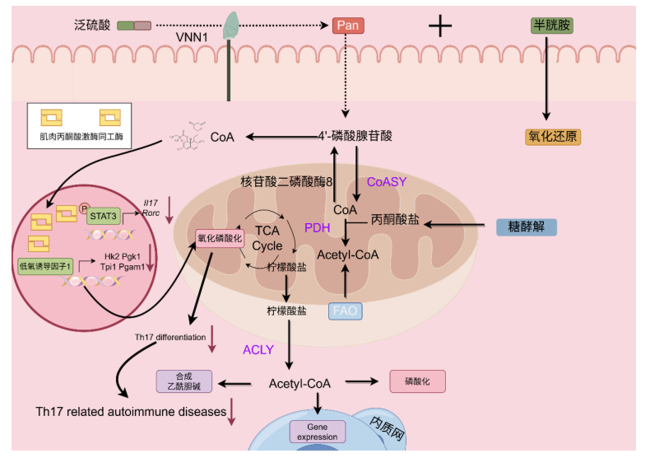
PA作为免疫稳态的重要调控分子,通过多重机制调节免疫细胞功能,影响能量代谢并促进免疫细胞的代谢重编程,增强宿主的免疫防御能力,降低感染性疾病的发生率(图1)[32]。PA通过维持CoA的生物合成,调控免疫细胞的表观遗传修饰和代谢表型转换,进而影响免疫反应[33]
图1 PA-CoA轴代谢与免疫调控中的作用机制

Pan:游离形态泛酸 free form pantothenic acid;VNN1:泛酰巯基乙胺酶 vanin 1;CoA:辅酶A coenzyme A;CoASY:双功能辅酶A合成酶 coenzyme A synthase;PDH:丙酮酸脱氢酶 pyruvate dehydrogenase;STAT3:信号转导与转录激活因子3 signal transducer and activator of transcription 3;Rorc:RAR相关孤儿受体C RAR related orphan receptor C;ACLY:ATP柠檬酸裂解酶 ATP citrate lyase;FAO:脂肪酸氧化 fatty acid oxidation;HIF-1α:低氧诱导因子-1α hypoxia inducible factor-1α;HK2:己糖激酶 hexokinase2;Pgk1:磷酸甘油酸酯激酶1 recombinant phosphoglycerate kinase 1;Tpi1:丙糖磷酸异构酶 1 triosephosphate isomerase 1;Pgam1:磷酸甘油酸变位酶1 recombinant phosphoglycerate mutase 1;Th17:辅助性T细胞17 T helper cell 17;TCA cycle:三羧酸循环 tricarboxylic acid cycle;Acetyl-CoA:乙酰乙酰辅酶A Acetoacetyl coenzyme A;differentiation:差异;related autoimmune diseases:相关自身免疫性疾病;Gene expression:基因表达。

Fig.1 Mechanism of action in PA-CoA axle metabolism and immune regulation[32]

PA衍生的CoA作为乙酰基供体,参与组蛋白的乙酰化修饰,激活免疫相关基因的转录。此外,PA调节乙酰-CoA与丙二酰-CoA的比例,平衡脂质代谢网络,为免疫细胞活化提供能量和生物合成前体[34]。PA以游离形态或泛硫乙胺形式存在,其肠道吸收依赖特定转运系统。钠依赖性多元维生素转运体[钠依赖性多维生素转运体(sodium-dependent multivitamin transporter,SMVT)/溶质载体家族5成员6(solute carrier family 5 member 6,SLC5A6)]介导游离泛酸的跨膜转运,而泛硫乙胺则通过泛酰巯基乙胺酶(vanin 1,VNN1)转运体被吸收[35]。在细胞内,泛硫乙胺经PanK催化生成4'-磷酸泛硫乙胺,最终转化为CoA。该过程受哺乳动物雷帕霉素靶蛋白复合体1(mammalian target of rapamycin complex 1,mTORC1)信号通路精细调控,确保免疫细胞在激活过程中能迅速扩充CoA库[36]。PA通过启动CoA合成级联反应,生成的CoA及其衍生物直接调控脂肪代谢的动态平衡。乙酰-CoA作为辅因子,不仅通过柠檬酸-丙酮酸循环修饰组蛋白,还通过激活促炎基因的转录并抑制免疫抑制基因的表达,调节辅助性T细胞17(T helper cell 17,Th17)/调节T细胞(regulatory T cells,Treg)的分化平衡[37]。此外,PA通过增强PanK活性促进CoA合成,加速缺氧诱导因子-1α(hypoxia inducible factor-1α,HIF-1α)的降解,并抑制肌肉丙酮酸激酶同工酶M2(pyruvate kinase isozyme type M2,PKM2)的糖酵解活性,从而阻断Th17细胞的分化,发挥双重抑制作用[38]。肠道微生物的代谢活动可能通过影响PA的生物利用度(如合成、代谢或吸收)间接调节宿主CoA水平,进一步影响脂肪代谢和免疫稳态[39-40]。综上所述,PA通过CoA代谢网络在脂肪代谢与免疫调控之间架起桥梁,成为二者相互作用的核心介质,为代谢性炎症疾病的干预提供了新的治疗靶点。

3.3 PA-CoA轴对抗氧化的调控作用

大脑由于抗氧化剂含量较低,易受到氧化损伤。研究表明,当大鼠全身暴露于γ射线引发氧化应激时,PA处理可显著减轻脑部氧化损伤,提升克雷布斯循环酶的活性,降低转氨酶的活性,并减少神经递质氨基酸的水平[41],表明PA可能通过增强CoA合成来提高抗氧化防御能力。作为CoA生物合成的前体,PA与半胱氨酸和ATP通过五步酶促反应生成CoA,而CoA衍生物乙酰-CoA不仅通过参与三羧酸循环、脂质和胆固醇合成等代谢途径,驱动能量释放与生物合成[42],还作为蛋白质乙酰化的关键供体,动态调控组蛋白的乙酰化修饰,从而影响染色质结构及基因转录活性,如促炎基因的激活与免疫抑制基因的沉默,参与癌症、阿尔茨海默病[43]等疾病中异常乙酰化的病理进程。值得注意的是,肠道微生物可能通过调节PA的代谢或吸收,进一步影响宿主CoA水平[44]。同样,在阿尔茨海默病等神经退行性疾病中,乙酰化水平的异常也可能影响神经元的功能和存活[45],进而联动脂代谢、免疫功能及表观遗传调控。靶向PA-CoA通路提供了干预代谢失衡、神经退行性疾病及免疫紊乱的潜在新策略。

4 PA在动物生产中的应用

PA是CoA和ACP的组成部分,广泛参与碳水化合物、脂肪和蛋白质的代谢。PA的缺乏会影响这些基本代谢过程,进而引发一系列健康问题。在动物生产中,PA的应用具有重要意义,主要体现在以下几个方面:促进生长发育、增强免疫功能、改善繁殖性能、促进皮毛和蹄甲健康、缓解应激反应以及预防营养性代谢病[46]。作为CoA的组成成分,PA在能量代谢、脂肪酸合成与分解中发挥重要作用,有助于提高饲料利用率和促进动物生长。同时,PA还能增强免疫系统功能,减少疾病发生,从而提高动物健康水平;PA有助于改善母畜繁殖效率,能够提高幼畜成活率[47]。此外,PA在促进皮毛健康和蹄甲生长方面也具有显著作用,能够防止皮肤病和蹄病的发生,还能够帮助动物应对应激反应,减轻运输、断奶等带来的负面影响[48]。合理添加PA能够有效预防因其缺乏引发的代谢性疾病,进而提高动物生产效益。因此,在饲粮中适量添加PA是一种有效的措施,有助于提升动物的健康状况和生长性能。表2列出了不同动物PA缺乏症的一些表现,进一步证明了PA在动物健康中的重要性。
表2 PA在动物中的缺乏症及添加量

Table 2 Deficiency symptoms and additive amounts of PA in animals

项目
Items
缺乏症
Deficiency symptoms
参考文献
References
奶牛Cows 犊牛:生长速度放缓,体重增加不足
成年奶牛:产奶量、乳脂含量↓;蹄病、乳腺炎的发生率↑;受胎率↓
[49-50]
羊Sheep 幼羊:生长速度放缓,体重增加不足
成年羊:羊毛质量↓;受胎率↓;羔羊存活率↓;蹄病发生率↑
[51-52]
鱼Fish 生长迟缓;饲料效率↓;肝脏脂质含量↑;肝炎发生率↑ [53-54]
鸡Chickens 雏鸡:生长速度慢;羽毛生长不良,羽毛脱落;皮肤干燥、鳞屑↑
育成鸡:产蛋量和蛋壳质量↓
[55]
肉牛Beef cows 犊牛:生长速度放缓
成年牛:繁殖性能↓;感染疾病几率↑
[56-57]
獭兔Rex rabbits 幼兔:生长速度放缓,体重增加不足
成年种兔:受胎率↓;活动减少、疲劳;出现异嗜的行为
[58]

↑:升高 increased;↓:降低 decreased。

5 小结

PA作为CoA的核心前体,广泛参与动物的能量代谢、脂质合成和免疫调控。在反刍动物中,瘤胃微生物能够合成PA,但其合成效率受到饲粮、环境应激等因素的抑制,导致PA缺乏,并引发脂代谢紊乱、免疫抑制及氧化应激等问题。通过瘤胃靶向调控技术(如包被PA添加剂)和动态补充策略(如D-泛酸钙),可以有效提高PA的利用效率。单胃动物则无法自主合成PA,完全依赖外源摄入。当前研究面临的挑战包括:反刍动物瘤胃PA合成动态监测技术的不足和宿主-微生物互作机制的不明确;而单胃动物则需解决PA肠道吸收和转运机制以及应激需求动态变化等难题。此外,单胃动物和反刍动物在PA介导的代谢-免疫互作分子机制方面仍存在研究空白。未来研究应开发实时监测技术,深入解析PA吸收和转运机制,建立动态营养需求模型,提升反刍动物的健康和生长性能,推动精准营养与智慧养殖的发展。
[1]
KUCHI BHOTLA H, MEYYAZHAGAN A, PAPPUSAMY M, et al. Dietary nutrients and their control of the redox bioenergetic networks as therapeutics in redox dysfunctions sustained pathologies[J]. Pharmacological Research, 2021,170:105709.

[2]
MOTA F, SILVA E, VARELA P, et al. An outbreak of occupational textile dye dermatitis from disperse blue 106[J]. Contact Dermatitis, 2000, 43(4):235-237.

PMID

[3]
AHVANOOEI M R R, NOROUZIAN M A, VAHMANI P. Beneficial effects of vitamins,minerals,and bioactive peptides on strengthening the immune system against COVID-19 and the role of cow’s milk in the supply of these nutrients[J]. Biological Trace Element Research, 2021,200:4664-4677.

[4]
BABAR Q, ALI A, SAEED A, et al. Novel treatment strategy against COVID-19 through anti-inflammatory,antioxidant and immunostimulatory properties of the B vitamin complex[M]// LEBLANCJ G.B-complex vitamins-sources,intakes and novel applications.[S.l.]:[s.n.],2021., 2021.

[5]
SCHOLEFIELD M, CHURCH S J, XU J S, et al. Substantively lowered levels of pantothenic acid (vitamin B5) in several regions of the human brain in Parkinson’s disease dementia[J]. Metabolites, 2021, 11(9):569.

[6]
JIANG Q, LIN L M, XIE F, et al. Metagenomic insights into the microbe-mediated B and K2 vitamin biosynthesis in the gastrointestinal microbiome of ruminants[J]. Microbiome, 2022, 10(1):109.

[7]
WANG X, QIN Y, LI J Z, et al. Vitamin B5 supplementation enhances intestinal development and alters microbes in weaned piglets[J]. Animal Biotechnology, 2024, 35(1):2335340.

[8]
MOLANO R A, GIRARD C L, VAN AMBURGH M E. Effect of dietary supplementation of 2 forms of a B vitamin and choline blend on the performance of Holstein calves during the transition and postweaning phase[J]. Journal of Dairy Science, 2021, 104(10):10812-10827.

[9]
CZUMAJ A, SZROK-JURGA S, HEBANOWSKA A, et al. The pathophysiological role of CoA[J]. International Journal of Molecular Sciences, 2020, 21(23):9057.

[10]
CHUNGCHUNLAM S M S, MOUGHAN P J. Comparative bioavailability of vitamins in human foods sourced from animals and plants[J]. Critical Reviews in Food Science and Nutrition, 2024, 64(31):11590-11625.

[11]
O’NEILL L A J, KISHTON R J, RATHMELL J. A guide to immunometabolism for immunologists[J]. Nature Reviews Immunology, 2016, 16(9):553-565.

DOI PMID

[12]
MUNTEANU C, SCHWARTZ B. B vitamins,glucoronolactone and the immune system:bioavailability,doses and efficiency[J]. Nutrients, 2023, 16(1):24.

[13]
IMAMI M. 3-[(2,4-dihydroxy-3,3-dimethylbutanoyl)amino]propanoic acid (vitamin B5):its synthesis,transformation into coenzyme a and role in disease[J]. UTSC’s Journal of Natural Sciences, 2021, 2(1):102-115.

[14]
PISOSCHI A M, POP A, IORDACHE F, et al. Antioxidant,anti-inflammatory and immunomodulatory roles of vitamins in COVID-19 therapy[J]. European Journal of Medicinal Chemistry, 2022,232:114175.

[15]
SHWAYAT S N. Investigating the interaction of soluble host proteins (SP-D,C1q and fibronectin) with Mycobacteria[D]. Master’s Thesis. London: Brunel University London, 2017.

[16]
HRUBŠA M, SIATKA T, NEJMANOVÁ I, et al. Biological properties of vitamins of the B-complex,part 1:vitamins B1,B2,B3,and B5[J]. Nutrients, 2022, 14(3):484.

[17]
WEDMAN J J, SIBON O C M, MASTANTUONO E, et al. Impaired coenzyme A homeostasis in cardiac dysfunction and benefits of boosting coenzyme A production with vitamin B5 and its derivatives in the management of heart failure[J]. Journal of Inherited Metabolic Disease, 2024, 47(5):885-894.

[18]
ZHANG J, ZHENG N, SHEN W J, et al. Synchrony degree of dietary energy and nitrogen release influences microbial community,fermentation,and protein synthesis in a rumen simulation system[J]. Microorganisms, 2020, 8(2):231.

[19]
RAGALLER V, LEBZIEN P, SÜDEKUM K H, et al. Pantothenic acid in ruminant nutrition:a review[J]. Journal of Animal Physiology and Animal Nutrition, 2011, 95(1):6-16.

[20]
WARNEKE R, HERZBERG C, KLEIN M, et al. Coenzyme a biosynthesis in Bacillus subtilis:discovery of a novel precursor metabolite for salvage and its uptake system[J]. mBio, 2024, 15(10):e01724-e01772.

[21]
LIU Q, WANG C, LI H Q, et al. Effects of dietary protein levels and rumen-protected pantothenate on ruminal fermentation,microbial enzyme activity and bacteria population in Blonde d’Aquitaine×Simmental beef steers[J]. Animal Feed Science and Technology, 2017,232:31-39.

[22]
FU Y H, HE Y H, XIANG K H, et al. The role of rumen microbiota and its metabolites in subacute ruminal acidosis (sarA)-induced inflammatory diseases of ruminants[J]. Microorganisms, 2022, 10(8):1495.

[23]
YI S M, DAI D W, WU H, et al. Dietary concentrate-to-forage ratio affects rumen bacterial community composition and metabolome of yaks[J]. Frontiers in Nutrition, 2022,9:927206.

[24]
ANEMA R F. Identification and characterization of three novel rumen bacterial species in sheep fed a concentrate diet[D]. Master’s Thesis. Brookings: South Dakota State University, 2024.

[25]
GUO J X, SUN X X, YUAN Y J, et al. Metabolic engineering of Saccharomyces cerevisiae for vitamin B5 production[J]. Journal of Agricultural and Food Chemistry, 2023, 71(19):7408-7417.

[26]
FORD J E, PERRY K D, BRIGGS C A E. Nutrition of lactic acid bacteria isolated from the rumen[J]. Journal of General Microbiology, 1958, 18(1):273-284.

PMID

[27]
VELAZQUEZ-ARELLANO A, HERNANDEZ-VAZQUEZ A D J. Chapter 35-vitamins as cofactors for energy homeostasis and their genomic control, with special reference to biotin,thiamine,and pantothenic acid[M]// RAFFAELE DE CATERINA J, MARTINEZA, KOHLMEIERM. Principles of nutrigenetics and nutrigenomics:fundamentals of individualized nutrition. Amsterdam: Academic Press,2020:271-277.

[28]
MOFFETT J R, PUTHILLATHU N, VENGILOTE R, et al. Acetate revisited:a key biomolecule at the nexus of metabolism,epigenetics and oncogenesis-Part 1:acetyl-CoA,acetogenesis and acyl-CoA short-chain synthetases[J]. Frontiers in Physiology, 2020,11:580167.

[29]
PAIVA P, MEDINA F E, VIEGAS M, et al. Animal fatty acid synthase:a chemical nanofactory[J]. Chemical Reviews, 2021, 121(15):9502-9553.

[30]
ZHUKOV A, POPOV V. Synthesis of C20-38 fatty acids in plant tissues[J]. International Journal of Molecular Sciences, 2022, 23(9):4731.

[31]
MAILLOUX R J. Teaching the fundamentals of electron transfer reactions in mitochondria and the production and detection of reactive oxygen species[J]. Redox Biology, 2015,4:381-398.

[32]
MIALLOT R, MILLET V, GALLAND F, et al. The vitamin B5/coenzyme A axis:a target for immunomodulation?[J]. European Journal of Immunology, 2023, 53(10):e2350435.

[33]
MISHRA P, BEURA S, GHOSH R, et al. Nutritional epigenetics:how metabolism epigenetically controls cellular physiology,gene expression and disease[J]. Sub-Cellular Biochemistry, 2022,100:239-267.

[34]
HE W T, HU S F, DU X L, et al. Vitamin B5 reduces bacterial growth via regulating innate immunity and adaptive immunity in mice infected with Mycobacterium tuberculosis[J]. Frontiers in Immunology, 2018,9:365.

[35]
SAID H M, ORTIZ A, MCCLOUD E, et al. Biotin uptake by human colonic epithelial NCM460 cells:a carrier-mediated process shared with pantothenic acid[J]. The American Journal of Physiology, 1998, 275(5):C1365-C1371.

[36]
MOISEENOK A G, KANUNNIKOVA N P. Brain CoA and acetyl CoA metabolism in mechanisms of neurodegeneration[J]. Biochemistry (Moscow), 2023, 88(4):466-480.

[37]
PROCHOWNIK E V, WANG H B. The metabolic fates of pyruvate in normal and neoplastic cells[J]. Cells, 2021, 10(4):762.

[38]
SHARMA L K, SUBRAMANIAN C, YUN M K, et al. A therapeutic approach to pantothenate kinase associated neurodegeneration[J]. Nature Communications, 2018, 9(1):4399.

DOI PMID

[39]
VOLCHENKOV R, NYGAARD V, SENER Z, et al. Th17 polarization under hypoxia results in increased IL-10 production in a pathogen-independent manner[J]. Frontiers in Immunology, 2017,8:698.

[40]
MEYER ZU HORSTE G, PRZYBYLSKI D, SCHRAMM M A, et al. Fas promotes T helper 17 cell differentiation and inhibits T helper 1 cell development by binding and sequestering transcription factor STAT1[J]. Immunity, 2018, 48(3):556-569.e7.

DOI PMID

[41]
SM S, HN S, NA E, et al. Curative role of pantothenic acid in brain damage of gamma irradiated rats[J]. Indian Journal of Clinical Biochemistry, 2018, 33(3):314-321.

DOI PMID

[42]
ZHANG Q, ZENG W Z, XU S, et al. Metabolism and strategies for enhanced supply of acetyl-CoA in Saccharomyces cerevisiae[J]. Bioresource Technology, 2021,342:125978.

[43]
VU L D, GEVAERT K, DE SMET I. Protein language:post-translational modifications talking to each other[J]. Trends in Plant Science, 2018, 23(12):1068-1080.

[44]
RODRÍGUEZ-ENRÍQUEZ S, ROBLEDO-CADENA D X, GALLARDO-PÉREZ J C, et al. Acetate promotes a differential energy metabolic response in human HCT 116 and COLO 205 colon cancer cells impacting cancer cell growth and invasiveness[J]. Frontiers in Oncology, 2021,11:697408.

[45]
KONSOULA Z, BARILE F A. Epigenetic histone acetylation and deacetylation mechanisms in experimental models of neurodegenerative disorders[J]. Journal of Pharmacological and Toxicological Methods, 2012, 66(3):215-220.

DOI PMID

[46]
WANG B W, ZHANG X, YUE B, et al. Effects of pantothenic acid on growth performance,slaughter performance,lipid metabolism,and antioxidant function of Wulong geese aged one to four weeks[J]. Animal Nutrition, 2016, 2(4):312-317.

[47]
QIAN Y, LI X F, ZHANG D D, et al. Effects of dietary pantothenic acid on growth,intestinal function,anti-oxidative status and fatty acids synthesis of juvenile blunt snout bream Megalobrama amblycephala[J]. PLoS One, 2015, 10(3):e0119518.

[48]
LANGOVA L, NOVOTNA I, NEMCOVA P, et al. Impact of nutrients on the hoof health in cattle[J]. Animals, 2020, 10(10):1824.

[49]
ZINN R A, OWENS F N, STUART R L, et al. B-vitamin supplementation of diets for feedlot calves[J]. Journal of Animal Science, 1987, 65(1):267-277.

PMID

[50]
RAGALLER V, LEBZIEN P, BIGALKE W, et al. Effects of a pantothenic acid supplementation to different rations on ruminal fermentation,nutrient flow at the duodenum,and on blood and milk variables of dairy cows[J]. Journal of Animal Physiology and Animal Nutrition, 2011, 95(6):730-743.

[51]
COVER S, WILCOX E B, NOBLE I. Lamb:an annotated bibliography[M]// College Station: Texas Agricultural Experiment Station,1946.

[52]
纪梦飞. 饲粮添加包被泛酸和包被烟酸对东北细毛羊公羔育肥效果的影响[D]. 硕士学位论文. 晋中: 山西农业大学, 2020.

JI M F. Effects of dietary supplementation with coated pantothenic acid and coated nicotinic acid on finishing performance of the Northeast merino male lambs[D]. Master’s Thesis. Jinzhong: Shanxi Agricultural University, 2020. (in Chinese)

[53]
王雅平. 大菱鲆幼鱼对泛酸、肌醇需求量的研究[D]. 硕士学位论文. 上海: 上海海洋大学, 2019.

WANG Y P. Study on the dietary pantothenic acid and myo-inositol requirements of juvenile turbot (Scophthalmus maximus L.)[D]. Master’s Thesis. Shanghai: Shanghai Ocean University, 2019. (in Chinese)

[54]
荀鹏伟. 卵形鲳鲹幼鱼对饲料中维生素B1、泛酸和烟酸需求量的研究[D]. 硕士学位论文. 上海: 上海海洋大学, 2019.

XUN P W. The study on the optimum dietary vitamin B1,pantothenic acid and niacin requirement of juvenile golden pompano (Trachinotus ovatus)[D]. Master’s Thesis. Shanghai: Shanghai Ocean University, 2019. (in Chinese)

[55]
吴潋池, 葛超悦, 吕雨杰, 等. D-泛酸钙对黄羽肉鸡生长性能、肉品质、抗氧化能力和免疫功能的影响[J]. 动物营养学报, 2023, 35(10):6361-6373.

DOI

WU L C, GE C Y, LV Y J, et al. Effects of D-calcium pantothenate on growth performance,meat quality,antioxidant capacity and immune function of yellow-feathered broilers[J]. Chinese Journal of Animal Nutrition, 2023, 35(10):6361-6373. (in Chinese)

[56]
李鹤琼. 不同蛋白日粮补充过瘤胃泛酸对肉牛瘤胃发酵和消化代谢的影响[D]. 硕士学位论文. 晋中: 山西农业大学, 2017.

LI H Q. Effects of rumen-protected pantothenate supplement on ruminal fermentation,nutrient digestion and metabolism in beef cattles based on different dietary protein level[D]. Master’s Thesis. Jinzhong: Shanxi Agricultural University, 2017. (in Chinese)

[57]
张航. 包被泛酸及能量水平对晋南牛瘤胃发酵及消化代谢的影响[D]. 硕士学位论文. 晋中: 山西农业大学, 2017.

ZHANG H. Effects of rumen protected pantothenate and energy level on ruminal fermentation,nutrient digestion and metabolism in Jinnan steers[D]. Master’s Thesis. Jinzhong: Shanxi Agricultural University, 2017. (in Chinese)

[58]
赵楠. 日粮泛酸水平对生长獭兔生产性能、抗氧化性能和脂肪代谢的影响[D]. 硕士学位论文. 泰安: 山东农业大学, 2016.

ZHAO N. Effects of dietary pantothenic acid levels on production performance,antioxidant performance and fat metabolism of growing otter rabbits[D]. Master’s Thesis. Tai’an: Shandong Agricultural University, 2016. (in Chinese)

Outlines

/