RESEARCH PAPER

Effects of Dietary Docosahexaenoic Acid on Performance, Egg Quality and Liver Function of Laying Hens with Fatty Liver Hemorrhage Syndrome during Late Laying Period

  • JIANG Haiyun , 1, 2 ,
  • CHEN Jinglong 2 ,
  • PEI Bixuan 2 ,
  • CUI Xiaoyan , 1, * ,
  • SHI Shourong , 2, *
Expand
  • 1 College of Animal Science and Technology, Yangzhou University, Yangzhou 225009, China
  • 2 Jiangsu Institute of Poultry Sciences, Yangzhou 225125, China
* CUI Xiaoyan, associate professor, E-mail: ;
SHI Shourong, professor, E-mail:

Received date: 2025-01-24

  Online published: 2025-09-12

Abstract

The aim of this study was to investigate the effects of dietary docosahexaenoic acid (DHA) on performance, egg quality and liver function of laying hens with fatty liver hemorrhage syndrome (FLHS) during late laying period. A total of 240 Hy-Line Brown laying hens at 71 weeks of age were randomly assigned to 3 groups with 8 replicates per group and 10 hens per replicate. The control group was fed a basal diet, the high-energy and low-protein group (HELD group) was fed a high-energy and low-protein diet (the basal diet supplemented with 5% chicken oil), and the DHA group was fed a high-energy and low-protein diet containing DHA (replaced 1% soybean oil with 1% DHA in the high-energy and low-protein diet). The experiment period was 12 weeks. The results showed as follows: 1) compared with the control group, the laying rate and average daily feed intake of the HELD group were significantly decreased (P<0.05). Compared with the HELD group, the laying rate of the DHA group was significantly increased (P<0.05). 2) Compared with the control group, the eggshell yellowness (b*) value, eggshell strength, eggshell weight and eggshell thickness on week 8 and the eggshell thickness on week 12 of the HELD group were significantly decreased (P<0.05). Compared with the HELD group, the eggshell strength, eggshell weight, and eggshell thickness on week 8 and the eggshell thickness on week 12 of the DHA group were significantly increased (P<0.05). 3) Compared with the control group, the liver weight, liver color, abdominal fat weight and abdominal fat index of the HELD group were significantly increased (P<0.05). Compared with the HELD group, the pancreatic weight and pancreatic index of the DHA group were significantly decreased (P<0.05). 4) Compared with the HELD group, the big yellow follicle number of the DHA group was significantly increased (P<0.05), and the genital tract length was significantly decreased (P<0.05). 5) Compared with the control group, the contents of triglycerides (TG) and total cholesterol (TC) in liver of the HELD group were significantly increased (P<0.05). Compared with the HELD group, the liver TC content of the DHA group was significantly decreased (P<0.05). In conclusion, dietary DHA can mitigate the decline in laying rate induced by FLHS, enhance the egg quality, and alleviate the adverse effects of FLHS on the performance of laying hens.

Cite this article

JIANG Haiyun , CHEN Jinglong , PEI Bixuan , CUI Xiaoyan , SHI Shourong . Effects of Dietary Docosahexaenoic Acid on Performance, Egg Quality and Liver Function of Laying Hens with Fatty Liver Hemorrhage Syndrome during Late Laying Period[J]. Chinese Journal of Animal Nutrition, 2025 , 37(9) : 5886 -5896 . DOI: 10.12418/CJAN2025.479

脂肪肝出血综合征(fatty liver hemorrhagic syndrome,FLHS)又称脂肪肝综合征,是蛋鸡产蛋高峰期和后期常见的一种慢性营养代谢疾病,主要特征为腹部脂肪沉积,肝脏脂质变性、出血和坏死,产蛋率下降,死亡率大幅上升等,严重制约了蛋鸡养殖业的发展[1-3]。目前,FLHS的发病机制尚不明确,主要受营养、遗传、内分泌和环境等因素影响,其中营养过剩、蛋白质与能量比例不均衡是造成蛋鸡患病的主要原因[4-5]。与哺乳动物不同,禽类脂质代谢主要器官是肝脏[1]。高能量低蛋白质饲粮中多余能量极易在肝脏被转化为脂肪,而无法及时被转运出,最终引起脂肪沉积;低能量高蛋白质饲粮则由于能量供应不足,肝脏会加大对氨基酸的代谢程度,进而加重代谢负担,导致FLHS的发生[6]。因此,能量与蛋白质比例失调极有可能引起FLHS的发生。
二十二碳六烯酸(docosahexaenoic acid,DHA)是微藻油脂中含量丰富的一种ω-3多不饱和脂肪酸,化学式为C22H32O2,具有多种重要的生理功能,包括调节脂代谢、抗炎、抗氧化和免疫调节等[7-8]。动物自身无法合成DHA,主要通过食用深海鱼类和藻类等途径进行补充[9-10]。微藻作为鱼和虾的食物之一,富含DHA,与鱼油相比,藻油拥有较高纯度的DHA和更高的安全性,而且从微藻里提取的DHA无鱼腥味、无环境污染,是代替鱼油的最佳营养剂,因此更受大众青睐[11-13]。在肉鸡上的研究表明,饲粮中添加DHA和二十碳五烯酸(eicosapentaenoic acid,EPA)等多不饱和脂肪酸能够减少脂肪在肉鸡体内的沉积[14]。在蛋鸡上,DHA常用于改善鸡蛋的蛋黄颜色、蛋壳品质、脂肪酸组成等。研究发现,饲粮中添加DHA复合添加剂能够提高海兰褐蛋鸡的蛋品质,其中8%的添加量能够显著提高鸡蛋哈氏单位[15]。饲粮中添加微藻粉不仅可以显著增加40周龄商品蛋鸡蛋黄颜色,对产蛋量、蛋壳厚度具有有益影响,还有效改变了鸡蛋中脂肪酸组成,增加了蛋黄中DHA含量[16]。杨蕊等[17]在蛋鸡基础饲粮中添加0.2%的DHA并饲喂42 d,显著提高了鸡蛋哈氏单位和蛋壳质量。此外,研究还发现,蛋鸡采食添加鱼油的饲粮后,DHA和EPA可有效在鸡蛋中富集,提高了鸡蛋中DHA的含量和转化率[18]。近年来,DHA在蛋鸡上的研究以及应用越来越广泛,但其是否对产蛋后期蛋鸡FLHS有改善作用仍不清楚。因此,本试验通过建立蛋鸡FLHS模型,研究DHA对产蛋后期FLHS蛋鸡生产性能、蛋品质、生殖指标和肝脏功能的影响,探讨DHA对产蛋后期蛋鸡FLHS的缓解效果。

1 材料与方法

1.1 伦理声明

本试验所有程序均经中国江苏省家禽科学研究所动物伦理委员会批准(批准编号:20230115)。

1.2 试验材料与动物

DHA添加形式为裂殖壶藻DHA藻油(DHA含量为50%)。鸡油脂肪含量为99.7%(其中不饱和脂肪酸占60%~70%,饱和脂肪酸占30%~40%),酸价为0.65 mg/g,过氧化值为0.24 g/kg,丙二醛含量为0.11 mg/kg。试验动物为海兰褐蛋鸡,购自南京市六合区嘉盛家庭农场。

1.3 试验设计

选取体重及产蛋率接近的71周龄海兰褐蛋鸡240只,随机分为3组,每组8个重复,每个重复10只鸡。对照组饲喂基础饲粮;高能量低蛋白质组(HELD组)饲喂高能量低蛋白质饲粮(基础饲粮中添加5%鸡油),建立FLHS模型;DHA组饲喂含DHA的高能量低蛋白质饲粮(高能量低蛋白质饲粮中将1%豆油替换为1% DHA)。试验饲粮组成及营养水平见表1。试验期12周。
表1 试验饲粮组成及营养水平(风干基础)

Table 1 Composition and nutrient levels of experimental diets (air-dry basis) %

项目
Items
基础饲粮
Basal diet
高能量低蛋白质饲粮
HELD diet
含DHA的高能量低蛋白质饲粮
HELD diet contained DHA
原料Ingredients
玉米Corn 62.00 60.00 60.00
豆粕Soybean meal 24.98 21.98 21.98
豆油Soybean oil 1.00 1.00
鸡油Chicken oil 5.00 5.00
二十二碳六烯酸DHA 1.00
石粉Limestone 10.00 10.00 10.00
磷酸氢钙CaHPO4 1.30 1.30 1.30
蛋氨酸Met 0.10 0.10 0.10
氯化钠NaCl 0.30 0.30 0.30
维生素预混料Vitamin premix1) 0.03 0.03 0.03
矿物质预混料Mineral premix2) 0.20 0.20 0.20
氯化胆碱Choline chloride 0.09 0.09 0.09
合计Total 100.00 100.00 100.00
营养水平Nutrient levels3)
代谢能ME/(MJ/kg) 11.26 12.34 12.34
粗蛋白质CP 15.68 14.20 14.20
钙Ca 3.519 3.521 3.521
总磷TP 0.440 0.438 0.438
赖氨酸Lys 0.831 0.843 0.843
蛋氨酸Met 0.407 0.402 0.402

1)维生素预混料为每千克饲粮提供 The vitamin premix provided the following per kg of diets:VA 13 500 IU,VD3 3 900 IU,VE 30 IU,VK3 4.8 mg,VB1 3 mg,VB2 7.5 mg,VB6 6 mg,VB12 0.024 mg,叶酸 folic acid 1.5 mg,生物素 biotin 0.18 mg,烟酸 nicotinic acid 45 mg,泛酸钙 calcium pantothenate 18 mg。

2)矿物质预混料为每千克饲粮提供 The mineral premix provided the following per kg of diets:Cu 20 mg,Fe 144 mg,Zn 144 mg,Mn 120 mg,I 0.96 mg,Se 0.7 mg,Co 1 mg。

3)代谢能和氨基酸为计算值,粗蛋白质、钙、总磷为实测值。ME and amino acids were calculated values, while CP, Ca and TP were measured values.

1.4 饲养管理

试验在江苏省家禽科学研究所仪征基地饲料与营养室蛋鸡舍中进行。试验鸡饲养于全封闭式的鸡舍内,阶梯式笼养,按每只120 g/d每天2次平均投喂(08:20和15:00),自由饮水。舍内采用负压通风和人工光照,每天光照16 h,采用乳头式自动饮水器饮水,人工喂料、机械清粪。按照标准化饲养程序饲养管理,每天对产蛋情况进行记录。试验场地每天清粪、定期消毒。试验前先预饲喂1周,调整鸡群,使各组产蛋率基本一致。进入正式试验期后,各组按照试验设计进行饲喂。

1.5 测定指标和方法

1.5.1 饲粮营养成分

饲粮代谢能和氨基酸含量参照NY/T 3645—2020进行计算,粗蛋白质、钙和总磷含量分别参照GB/T 6432—2018、GB/T 6436—2018和GB/T 6437—2018的方法进行测定。

1.5.2 肝脏组织病理学观测

试验结束后,每个重复随机挑选1只鸡进行屠宰,取肝脏进行形态观察,并取肝脏大叶部分1.5 cm×1.5 cm×1.5 cm组织块,置于装有4%多聚甲醛固定液的10 mL离心管中。固定好的组织经过脱水、包埋后切成5 μm的薄片,脱蜡后用苏木精-伊红(HE)进行染色,染好的切片用显微镜观察并拍照。

1.5.3 生产性能和蛋品质

试验期间,按重复每天准确记录产蛋数、蛋重及死亡鸡数,每周末定时退料并称重。在试验结束后计算各组的产蛋率、平均日采食量、平均蛋重和料蛋比。
试验期第8周和第12周,每个重复随机收集3枚鸡蛋,即每组24枚鸡蛋,进行蛋品质检测,检测指标包括蛋重、蛋壳颜色[亮度(L*)、红度(a*)、黄度(b*)值]、蛋壳强度、蛋壳重量、蛋壳厚度、蛋黄重量、蛋黄颜色、蛋白高度和哈氏单位。其中,蛋壳强度采用蛋壳强度测定仪(以色列ORKA公司)测定,蛋壳厚度采用电子数显卡尺(广陆数字测控股份有限公司)测定,蛋壳颜色采用分光测色仪(CM-2300d,日本MINOLTA公司)测定,蛋黄颜色、蛋白高度和哈氏单位采用蛋品质分析仪测定(EFR-01,以色列ORKA公司),蛋形指数采用游标卡尺测定。哈氏单位计算公式如下:
哈氏单位=100×lg(H-1.7×W0.37+7.57)。
式中:H为浓蛋白高度(mm);W为蛋重(g)。

1.5.4 脏器重量和脏器指数

试验结束后,每个重复随机挑选1只鸡称重,随后进行屠宰,分离各器官分别进行称重,使用便携式精密色差仪(NR10QC,深圳市三恩驰科技有限公司)测肝脏颜色(L*、a*、b*值),肝脏厚度采用游标卡尺测定,各脏器指数计算公式如下:
脏器指数(%)=100×脏器重量(g)/活鸡体重(g)。

1.5.5 卵巢、卵泡和生殖道指标

分离子宫部、输卵管、卵巢,收集卵巢、输卵管、生殖道和不同类型(大黄、小黄和大白卵泡)卵泡,对子宫部、卵巢、输卵管进行称重,并记录不同类型卵泡个数和重量。

1.5.6 肝脏甘油三酯(triglyceride,TG)和总胆固醇(total cholesterol,TC)含量

肝脏TG和TC含量检测方法严格参照试剂盒进行,试剂盒购自北京索莱宝科技有限公司。

1.6 数据统计分析

数据用SPSS 27.0统计软件进行统计分析,采用t检验分析对照组与HELD组、HELD组与DHA组之间各指标的差异显著性。P<0.05表示差异显著,结果以平均值±标准误表示。

2 结果

2.1 DHA对产蛋后期FLHS蛋鸡肝脏病理变化的影响

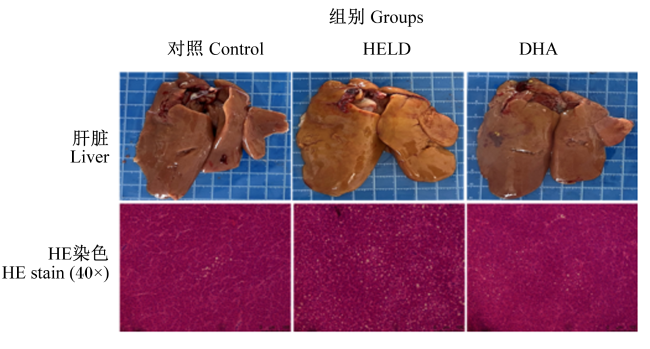
图1可知,与对照组相比,HELD组肝脏明显肿大,边缘钝圆,呈土黄色,有点状出血,并且质脆易碎,HE染色呈现肝脏细胞排列紊乱,脂滴数量大幅上升。与HELD组相比,DHA组肝脏基本恢复正常,与对照组无明显差异,HE染色呈现肝脏细胞有轻微变性,脂滴数量减少。
图1 DHA对产蛋后期FLHS蛋鸡肝脏病理变化的影响

Fig.1 Effects of DHA on liver pathological changes of laying hens with FLHS during late laying period

2.2 DHA对产蛋后期FLHS蛋鸡生产性能的影响

表2可知,与对照组相比,HELD组产蛋率和平均日采食量显著降低(P<0.05)。与HELD组相比,DHA组产蛋率显著提高(P<0.05)。
表2 DHA对产蛋后期FLHS蛋鸡生产性能的影响

Table 2 Effects of DHA on performance of laying hens with FLHS during late laying period

项目
Items
组别Groups PP-value
对照Control HELD DHA P1 P2
产蛋率Laying rate/% 89.99±1.55 80.29±1.03 87.81±0.52 <0.001 0.016
料蛋比Feed to egg ratio 2.05±0.03 2.22±0.03 2.10±0.02 0.150 0.659
平均日采食量Average daily feed intake/g 116.01±0.77 109.26±1.08 113.07±0.69 0.007 0.385
平均蛋重Average egg weight/g 63.09±0.51 62.19±0.29 61.14±0.64 0.917 0.836

P1为对照组与HELD组的t检验P值,P2为HELD组与DHA组的t检验P值。下表同。

P1 was P-value of t test between control group and HELD group, P2 was P-value of t test between HELD group and DHA group. The same as below.

2.3 DHA对产蛋后期FLHS蛋鸡蛋品质的影响

表3表4可知,与对照组相比,HELD组第8周蛋壳b*值、蛋壳强度、蛋壳重量、蛋壳厚度显著降低(P<0.05),第8周蛋黄颜色、蛋白高度和哈氏单位以及第12周蛋黄颜色、蛋形指数和蛋白高度显著提高(P<0.05)。与HELD组相比,DHA组第8周蛋壳强度、蛋壳重量和蛋壳厚度以及第12周蛋壳厚度显著提高(P<0.05),第8周蛋黄颜色、蛋白高度和哈氏单位以及第12周蛋黄颜色显著降低(P<0.05)。
表3 DHA对产蛋后期FLHS蛋鸡第8周蛋品质的影响

Table 3 Effects of DHA on egg quality on week 8 of laying hens with FLHS during late laying period

项目
Items
组别Groups PP-value
对照Control HELD DHA P1 P2
蛋重Egg weight/g 62.45±0.80 60.39±1.39 62.39±0.71 0.219 0.228
蛋形指数Egg shape index 1.29±0.01 1.30±0.01 1.29±0.01 0.420 0.577
蛋壳亮度Eggshell L* 61.27±1.03 62.43±1.01 63.50±0.44 0.431 0.376
蛋壳红度Eggshell a* 16.53±0.61 14.87±0.49 14.26±0.83 0.058 0.548
蛋壳黄度Eggshell b* 28.29±0.55 26.35±0.59 27.04±0.48 0.031 0.382
蛋壳强度Eggshell strength/(kg/cm2) 3.78±0.11 2.43±0.15 3.53±0.14 <0.001 <0.001
蛋黄重量Yolk weight/g 17.22±0.31 17.31±0.21 17.12±0.25 0.818 0.567
蛋壳重量Eggshell weight/g 5.79±0.07 4.05±0.10 5.47±0.16 <0.001 <0.001
蛋壳厚度Eggshell thickness/μm 392.56±7.95 292.02±5.60 377.89±5.53 <0.001 <0.001
蛋黄颜色Yolk color 6.75±0.29 7.90±0.34 5.73±0.27 0.024 <0.001
蛋白高度Albumen height/mm 5.16±0.26 6.11±0.26 5.12±0.20 0.022 0.010
哈氏单位Haugh unit 67.05±2.66 76.82±1.74 67.80±2.10 0.008 0.005
表4 DHA对产蛋后期FLHS蛋鸡第12周蛋品质的影响

Table 4 Effects of DHA on egg quality on week 12 of laying hens with FLHS during late laying period

项目
Items
组别Groups PP-value
对照Control HELD DHA P1 P2
蛋重Egg weight/g 60.51±0.64 63.16±1.09 60.11±1.30 0.056 0.093
蛋形指数Egg shape index 1.28±0.01 1.30±0.01 1.30±0.01 0.015 0.687
蛋壳亮度Eggshell L* 60.68±1.15 60.80±0.89 62.38±1.18 0.936 0.302
蛋壳红度Eggshell a* 15.76±0.61 16.11±0.40 14.74±0.66 0.631 0.098
蛋壳黄度Eggshell b* 27.02±0.58 27.32±0.34 25.52±0.79 0.668 0.053
蛋壳强度Eggshell strength/(kg/cm2) 4.00±0.10 3.85±0.16 3.57±0.04 0.466 0.116
蛋黄重量Yolk weight/g 16.36±0.18 16.88±0.43 16.32±0.26 0.265 0.272
蛋壳重量Eggshell weight/g 5.72±0.13 5.74±0.13 5.51±0.07 0.884 0.165
蛋壳厚度Eggshell thickness/μm 385.31±10.76 378.40±5.23 404.61±5.58 0.573 0.004
蛋黄颜色Yolk color 6.58±0.26 8.10±0.19 6.71±0.27 <0.001 0.001
蛋白高度Albumen height/mm 5.39±0.20 6.23±0.16 5.80±0.26 0.007 0.191
哈氏单位Haugh unit 70.75±1.78 75.63±2.92 74.57±2.15 0.174 0.773

2.4 DHA对产蛋后期FLHS蛋鸡脏器重量和脏器指数的影响

表5可知,与对照组相比,HELD组肝脏重量、肝脏颜色(L*、a*、b*值)、腹脂重量和腹脂指数显著提高(P<0.05)。与HELD组相比,DHA组体重显著提高(P<0.05),胰腺重量和胰腺指数显著降低(P<0.05)。
表5 DHA对产蛋后期FLHS蛋鸡脏器重量和脏器指数的影响

Table 5 Effects of DHA on organ weight and organ index of laying hens with FLHS during late laying period

项目
Items
组别Groups PP-value
对照Control HELD DHA P1 P2
体重Body weight/g 1 865.33±62.38 1 835.31±29.06 1 967.13±30.64 0.669 0.011
肝脏重量Liver weight/g 33.36±0.71 37.16±1.50 37.94±1.61 0.036 0.735
肝脏厚度Liver thickness/mm 14.49±0.92 15.33±0.89 17.24±0.92 0.517 0.163
肝脏亮度Liver L* 41.87±0.94 48.11±0.93 48.71±0.90 <0.001 0.669
肝脏红度Liver a* 13.07±0.64 14.84±0.21 15.16±0.69 0.021 0.669
肝脏黄度Liver b* 16.79±0.30 22.39±0.91 23.76±1.08 <0.001 0.349
腹脂重量Abdominal fat weight/g 37.11±4.83 78.00±9.95 76.29±3.87 0.002 0.875
脾脏重量Spleen weight/g 2.56±0.31 2.55±0.25 2.27±0.23 0.977 0.456
胰腺重量Pancreatic weight/g 3.31±0.13 3.44±0.11 3.02±0.12 0.456 0.024
肝脏指数Liver index/% 1.68±0.16 1.97±0.05 1.94±0.07 0.115 0.705
腹脂指数Abdominal fat index/% 1.83±0.27 3.64±0.31 4.04±0.20 <0.001 0.412
脾脏指数Spleen index/% 0.12±0.02 0.13±0.01 0.11±0.01 0.678 0.247
胰腺指数Pancreatic index/% 0.17±0.02 0.19±0.01 0.16±0.01 0.231 0.014

2.5 DHA对产蛋后期FLHS蛋鸡卵巢、卵泡及生殖道指标的影响

表6可知,与对照组相比,HELD组蛋鸡卵巢、卵泡及生殖道指标均无显著差异(P>0.05)。与HELD组相比,DHA组大黄卵泡个数显著提高(P<0.05),生殖道长度显著降低(P<0.05)。
表6 DHA对产蛋后期FLHS蛋鸡卵巢、卵泡及生殖道指标的影响

Table 6 Effects of DHA on ovary, follicle and reproductive tract indices of laying hens with FLHS during late laying period

项目
Items
组别Groups PP-value
对照Control HELD DHA P1 P2
子宫部重量Uterus region weight/g 25.26±0.63 24.31±0.48 23.74±0.92 0.249 0.559
输卵管重量Tubal weight/g 46.67±1.63 46.41±1.78 45.30±1.45 0.916 0.662
卵巢重量Ovary weight/g 41.93±3.71 37.18±3.95 43.24±2.31 0.392 0.234
大黄卵泡个数Big yellow follicles number/个 4.92±0.38 4.38±0.63 5.86±0.14 0.441 0.049
大黄卵泡重量Big yellow follicle weight/g 32.23±3.63 34.51±1.55 34.95±2.09 0.571 0.868
小黄卵泡个数Small yellow follicle number/个 13.50±1.20 15.50±1.59 15.38±1.43 0.327 0.957
小黄卵泡重量Small yellow follicle weight/g 2.09±0.17 2.32±0.26 2.13±0.19 0.492 0.604
大白卵泡个数Large white follicle number/个 33.45±3.51 29.40±2.21 27.43±2.50 0.351 0.567
大白卵泡重量Large white follicle weight/g 0.74±0.06 0.69±0.13 0.60±0.06 0.745 0.621
生殖道长度Genital tract length/cm 59.75±0.93 61.30±1.07 55.63±1.29 0.290 0.004

2.6 DHA对产蛋后期FLHS蛋鸡肝脏TG和TC含量的影响

表7可知,与对照组相比,HELD组肝脏TG和TC含量显著提高(P<0.05)。与HELD组相比,DHA组肝脏TC含量显著下降(P<0.05)。
表7 DHA对产蛋后期FLHS蛋鸡肝脏中TG和TC含量的影响

Table 7 Effects of DHA on contents of TG and TC in liver of laying hens with FLHS during late laying period mg/g

项目
Items
组别Groups PP-value
对照Control HELD DHA P1 P2
甘油三酯TG 23.05±2.82 50.87±10.07 35.29±6.34 0.039 0.245
总胆固醇TC 30.34±1.72 41.05±1.85 34.99±0.61 0.003 0.015

3 讨论

3.1 DHA对产蛋后期FLHS蛋鸡生产性能和器官发育的影响

目前,关于富含DHA的微藻对蛋鸡生产性能影响的报道不尽相同,主要原因可能是蛋鸡品种、年龄、生理状态及微藻的种类和添加剂量不一致等[19]。彭瑛等[15]研究了饲粮中添加不同水平DHA复合添加剂对海兰灰蛋鸡生产性能的影响,发现显著提高了蛋重,并且对饲料转化率有促进作用,但不影响蛋鸡采食量。陈秀丽等[20]研究发现,饲粮中添加不同水平DHA裂殖壶菌粉不影响蛋鸡的平均蛋重、料蛋比,但有提高产蛋率的趋势,同时提高了平均日采食量。Neijat等[21]和Liu等[22]研究发现,在蛋鸡饲粮中添加不同水平微藻DHA对蛋鸡的生产性能均无显著影响。此外,Herber等[23]在蛋鸡饲粮中添加微藻,却对蛋鸡产蛋率和日均蛋重产生了明显的负面效果。在本研究中,饲喂高能量低蛋白质饲粮显著降低了蛋鸡产蛋率和平均日采食量;在高能量低蛋白质饲粮中添加DHA显著提高了蛋鸡产蛋率,与上述研究不太一致。这些不同影响可能归因于DHA的组成、含量、添加剂量、饲料配方以及蛋鸡的生理阶段和品系的差异。
肝脏指数反映蛋鸡肝脏功能情况,产蛋后期蛋鸡肝脏指数过高将导致肝脏细胞损伤和脂肪变性,进而危害蛋鸡机体健康[19]。研究发现,在海兰褐壳蛋鸡饲粮中添加微藻DHA可以显著降低肝脏指数[17]。在本研究中,饲喂高能量低蛋白质饲粮显著提高了蛋鸡肝脏重量、肝脏颜色、腹脂重量和腹脂指数;而高能量低蛋白质饲粮中添加DHA显著降低了胰腺重量和胰腺指数,显著增加了大黄卵泡个数以及显著降低生殖道长度。

3.2 DHA对产蛋后期FLHS蛋鸡蛋品质的影响

在家禽生产过程中,蛋品质是重要的生产效益指标,关系到其市场售价和经济效益,其中哈氏单位反映鸡蛋的新鲜度[24]。杨蕊等[17]研究发现,饲粮中添加0.2%的DHA能显著提高鸡蛋的蛋黄颜色、哈氏单位和蛋壳质量。付兴周等[25]在饲粮中添加不同水平的DHA复合添加剂,饲喂50周龄海兰褐蛋鸡28 d,结果发现能够显著提高鸡蛋的平均蛋壳厚度和蛋壳强度,其中5%的添加水平效果最佳。刘敏杰等[26]分别添加了1%、2%、3%的DHA裂殖壶藻粉饲喂32周龄京粉一号商品蛋鸡,结果发现试验组蛋黄颜色均显著提高。在本研究中,与对照组相比,HELD组第8周蛋壳b*值、蛋壳强度、蛋壳重量、蛋壳厚度显著降低,第8周蛋黄颜色、蛋白高度和哈氏单位以及第12周蛋黄颜色、蛋形指数和蛋白高度显著提高。然而,Qiu等[27]研究发现,饲喂高能量低蛋白质饲粮显著降低了蛋白高度、蛋黄颜色和哈氏单位,但对蛋壳强度、蛋壳厚度和蛋形指数没有显著影响,与本研究结果不太一致。其原因可能是饲粮鸡油含量、蛋鸡品系和生理阶段等不同因素造成。此外,本研究还发现,与HELD组相比,DHA组第8周蛋壳强度、蛋壳重量和蛋壳厚度以及第12周蛋壳厚度显著提高,第8周蛋黄颜色、蛋白高度和哈氏单位以及第12周蛋黄颜色显著降低,其原因可能是DHA含量和种类、蛋鸡品系、生理阶段、造模方式、饲粮储存方式等因素不同。DHA含量和种类不同,即微藻油里极易氧化的多不饱和脂肪酸含量很高,饲喂蛋鸡后在鸡蛋里富集,在鸡蛋存储过程中非常容易发生氧化而变质[28],最终导致哈氏单位降低;造模方式不同,即本试验HELD组使用鸡油造模,以及鸡油的用量和组成不同,使得HELD组蛋黄颜色显著升高,并且鸡油里的饱和脂肪酸含量较高,和DHA相比鸡油不易被氧化;DHA组部分饲粮在存储过程中,DHA可能会因天气原因、室内温度变化被氧化变质,存在损耗。

3.3 DHA对产蛋后期FLHS蛋鸡肝脏病理变化及TG和TC含量的影响

FLHS亚临床病例的肝脏呈棕黄色,易碎、肿大,包膜下尤其是在肝小叶边缘小范围出血,腹腔沉积大量脂肪[29]。王安琪[30]研究发现,FLHS模型组剖检见肝脏肿大,质地松软易碎,表面有点状及条状出血;HE染色结果呈现出明显病理变化,大量肝细胞肿胀并排列紊乱,细胞质中可见明显脂肪空泡。本研究中,与对照组相比,HELD组肝脏肿大,质地易碎,表面呈黄色,HE染色结果呈现明显病理变化,肝细胞排列紊乱,细胞间质存在大量脂滴;与HELD组相比,DHA组肝脏形态及病理切片结果都有明显缓解,结果表明DHA可以一定程度上缓解蛋鸡FLHS症状。
肝脏是家禽脂肪加工和代谢的主要场所,在蛋鸡脂代谢过程中发挥重要作用。在蛋鸡产蛋后期,肝脏极易发生脂质代谢紊乱,脂肪过度沉积,从而诱发FLHS,造成蛋鸡生产性能下降甚至死亡[6]。之前的研究表明,DHA可显著降低非冠心病患者的肝脏TG含量,并增加肝脏高密度脂蛋白含量[31]。陈何妍[32]研究发现,在健康小鼠饮食中补充DHA可显著降低血清TC、低密度脂蛋白含量,TG含量有所下降但无显著差异,并且影响许多组织中DHA和脂肪酸的含量,表明DHA能干预体内脂代谢如血浆、肝脏等部位。有文献报道,DHA可通过下调肝脏低密度脂蛋白受体基因的表达抑制蛋鸡肝脏中3-羟基-3甲基戊二酰辅酶A还原酶(胆固醇合成关键酶)活性,使胆固醇合成受限,进而降低血清TC含量[33]。刘兵[19]在蛋鸡饲粮中添加0.5%~2.0%的微藻DHA,结果发现添加1.0%及以上水平微藻DHA显著降低了肝脏TG和非酯化脂肪酸(主要由体内脂肪组织中TG分解产生)含量以及血清TG含量。Davis等[34]研究发现,在老年蛋鸡饲粮中添加全亚麻籽可以显著降低血清谷草转氨酶活性,有效减少脂肪变性和肝细胞膨胀,并且有效下调了有关胆固醇代谢、脂代谢、炎症信号转导等基因表达,缓解了老年蛋鸡FLHS的严重程度。在本研究中,与对照组相比,HELD组肝脏发生明显病变,肝脏TG和TC含量显著升高;与HELD组相比,DHA组肝脏TC含量显著下降,与上述研究结果基本一致。DHA可能通过调节脂肪代谢和炎症相关基因的表达进而调节蛋鸡肝脏脂质代谢,发挥保护肝脏功能的作用。

4 结论

饲粮中添加DHA可缓解FLHS引起的蛋鸡产蛋率下降,改善蛋品质,减轻FLHS对蛋鸡生产性能的不利影响。
[1]
曾文惠, 曾庆节, 殷超, 等. 蛋鸡脂肪肝出血综合征及其分子机制的研究进展[J]. 中国兽医学报, 2021, 41(8):1658-1665.

ZENG W H, ZENG Q J, YIN C, et al. Research progress on fatty liver hemorrhage syndrome and its molecular mechanism in laying hens[J]. Chinese Journal of Veterinary Science, 2021, 41(8):1658-1665. (in Chinese)

[2]
苏晓晨. 牛磺酸对脂肪肝出血综合征蛋鸡肝细胞内质网-线粒体应激的影响[D]. 硕士学位论文. 沈阳: 沈阳农业大学, 2023.

SU X C. Effect of taurine on endoplasmic reticulum-mitochondrialstress in layer hens with fatty liver hemorrhagic syndrome[D]. Master’s Thesis. Shenyang: Shenyang Agricultural University, 2023. (in Chinese)

[3]
SHINI A, SHINI S, BRYDEN W L. Fatty liver haemorrhagic syndrome occurrence in laying hens:impact of production system[J]. Avian Pathology, 2019, 48(1):25-34.

[4]
陈璎, 简华锋, 董信阳. 蛋鸡脂肪肝出血综合征及其营养调控的研究进展[J]. 动物营养学报, 2024, 36(11):6841-6852.

DOI

CHEN Y, JIAN H F, DONG X Y. Research advances in fatty liver hemorrhagic syndrome and its nutritional regulation in laying hens[J]. Chinese Journal of Animal Nutrition, 2024, 36(11):6841-6852. (in Chinese)

DOI

[5]
裴碧璇, 陈静龙, 邵丹, 等. 饲粮添加吡咯喹啉醌对产蛋后期脂肪肝出血综合征蛋鸡生产性能、蛋品质及血浆和肝脏抗氧化指标的影响[J]. 中国家禽, 2024, 46(12):52-59.

PEI B X, CHEN J L, SHAO D, et al. Effects of dietary pyrroloquinoline quinone on production performance,egg quality,plasma and liver antioxidant indexes of laying hens with fatty liver hemorrhage syndrome in late laying period[J]. China Poultry, 2024, 46(12):52-59. (in Chinese)

[6]
张坤, 郭小权. 蛋鸡脂肪肝出血综合征病因分析及防治[J]. 黑龙江畜牧兽医, 2020(5):34-38.

ZHANG K, GUO X Q. Etiology analysis and prevention of fatty liver hemorrhagic syndrome in laying hens[J]. Heilongjiang Animal Science and Veterinary Medicine, 2020(5):34-38. (in Chinese)

[7]
LORENTE-CEBRIÁN S, COSTA A G V, NAVAS-CARRETERO S, et al. Role of omega-3 fatty acids in obesity,metabolic syndrome,and cardiovascular diseases:a review of the evidence[J]. Journal of Physiology and Biochemistry, 2013, 69(3):633-651.

[8]
刘亮, 胡勤玲, 薛伊宏, 等. DHA/EPA摄入比例对小鼠氧化应激和炎症的影响[J]. 食品科技, 2016, 41(3):105-110.

LIU L, HU Q L, XUE Y H, et al. Effects of the DHA/EPA ratios on oxidative stress and inflammatory factors in mice[J]. Food Science and Technology, 2016, 41(3):105-110. (in Chinese)

[9]
余丽, 曾玉萍, 汪莉, 等. 二十二碳六烯酸治疗癫痫的作用机制研究进展[J]. 中国医药导报, 2024, 21(23):56-60.

YU L, ZENG Y P, WANG L, et al. Research progress on mechanism of action of docosahexaenoic acid in the treatment of epilepsy[J]. China Medical Herald, 2024, 21(23):56-60. (in Chinese)

[10]
邓梦延, 朱晓辉, 黄力, 等. n-3多不饱和脂肪酸调节小胶质细胞激活及极化改善APPPS1小鼠学习记忆能力[J]. 陆军军医大学学报, 2024, 46(9):928-939.

DENG M Y, ZHU X H, HUANG L, et al. n-3 polyunsaturated fatty acids ameliorate learning and memory abilities in APPPS1 mice by regulating microglial activation and polarization[J]. Journal of Army Medical University, 2024, 46(9):928-939. (in Chinese)

[11]
黄淑婷, 李宏新, 于越, 等. DHA藻油的生理功能及在食品中复配协同应用的研究进展[J]. 食品工业科技, 2023, 44(6):468-476.

HUANG S T, LI H X, YU Y, et al. Research progress on physiological functions of DHA algal oil and its synergistic application in food[J]. Science and Technology of Food Industry, 2023, 44(6):468-476. (in Chinese)

[12]
孔欣欣, 郭楠楠. DHA藻油生产技术及其在食品中的应用进展[J]. 食品与发酵科技, 2015, 51(4):84-87,91.

KONG X X, GUO N N. Progress of production technology and application in food on DHA algal oil[J]. Sichuan Food and Fermentation, 2015, 51(4):84-87,91. (in Chinese)

[13]
RYCKEBOSCH E, BRUNEEL C, TERMOTE-VERHALLE R, et al. Nutritional evaluation of microalgae oils rich in omega-3 long chain polyunsaturated fatty acids as an alternative for fish oil[J]. Food Chemistry, 2014,160:393-400.

[14]
KIM M, VOY B H. Fighting fat with fat:n-3 polyunsaturated fatty acids and adipose deposition in broiler chickens[J]. Frontiers in Physiology, 2021,12:755317.

[15]
彭瑛, 占今舜, 李丽立, 等. 饲粮中添加DHA复合添加剂对蛋鸡生产性能和蛋品质的影响[J]. 华南农业大学学报, 2012, 33(4):539-543.

PENG Y, ZHAN J S, LI L L, et al. Effects of DHA compound additives in diets on production performance and egg quality of laying hens[J]. Journal of South China Agricultural University, 2012, 33(4):539-543. (in Chinese)

[16]
PARK J H, UPADHAYA S D, KIM I H. Effect of dietary marine microalgae (Schizochytrium) powder on egg production,blood lipid profiles,egg quality,and fatty acid composition of egg yolk in layers[J]. Asian-Australasian Journal of Animal Sciences, 2015, 28(3):391-397.

[17]
杨蕊, 徐方华, JONG-SUH S, 等. 日粮中添加微藻DHA和ALA对蛋鸡产蛋性能和蛋品质的影响[J]. 饲料研究, 2014(17):26-30,35.

YANG R, XU F H, JONG-SUH S, et al. Effects of dietary supplementation of microalgae DHA and ALA on laying performance and egg quality of laying hens[J]. Feed Research, 2014(17):26-30,35. (in Chinese)

[18]
ZHAO Y C, SHI H H, WANG C C, et al. The enrichment of eggs with docosahexaenoic acid and eicosapentaenoic acid through supplementation of the laying hen diet[J]. Food Chemistry, 2021,346:128958.

[19]
刘兵. 日粮硒和DHA改善产蛋后期蛋鸡肉蛋品质的效果和机制研究[D]. 博士学位论文. 无锡: 江南大学, 2021.

LIU B. Effects and mechanism of dietary selenium and DHA on improving the quality of meat and egg from aged laying hens[D]. Ph.D.Thesis. Wuxi: Jiangnan University, 2021. (in Chinese)

[20]
陈秀丽, 李连彬, 岳洪源, 等. 裂殖壶菌粉对鸡蛋品质与蛋黄n-3PUFA含量的影响[J]. 中国畜牧杂志, 2014, 50(23):66-70.

CHEN X L, LI L B, YUE H Y, et al. Effect of Schizochytrium limacinum on egg quality and content of n-3PUFA in egg yolk[J]. Chinese Journal of Animal Science, 2014, 50(23):66-70. (in Chinese)

[21]
NEIJAT M, OJEKUDO O, HOUSE J D. Effect of flaxseed oil and microalgae DHA on the production performance,fatty acids and total lipids of egg yolk and plasma in laying hens[J]. Prostaglandins,Leukotrienes,and Essential Fatty Acids, 2016,115:77-88.

[22]
LIU B, ZHOU Q, ZHU J M, et al. Time course of nutritional and functional property changes in egg yolk from laying hens fed docosahexaenoic acid-rich microalgae[J]. Poultry Science, 2020, 99(9):4616-4625.

DOI PMID

[23]
HERBER S M, VAN ELSWYK M E. Dietary marine algae promotes efficient deposition of n-3 fatty acids for the production of enriched shell eggs[J]. Poultry Science, 1996, 75(12):1501-1507.

PMID

[24]
陈雪梅, 唐晓姝, 胡博, 等. 鹰嘴纳豆粉对三黄鸡生产性能、蛋品质和营养成分的影响[J]. 中国家禽, 2023, 45(9):52-59.

CHEN X M, TANG X S, HU B, et al. Effects of chickpea natto powder on production performance,egg quality and nutrients of Sanhuang chicken[J]. China Poultry, 2023, 45(9):52-59. (in Chinese)

[25]
付兴周, 路志芳, 申海燕, 等. DHA复合添加剂对蛋鸡生产性能及蛋品质的影响[J]. 中国家禽, 2015, 37(17):35-38.

FU X Z, LU Z F, SHEN H Y, et al. Effect of dietary DHA compound preparation on production performance and egg quality of laying hens[J]. China Poultry, 2015, 37(17):35-38. (in Chinese)

[26]
刘敏杰, 熊铭鑫, 杨嘉成, 等. 裂殖壶藻粉对蛋鸡生产性能、蛋品质、DHA沉积及血清抗氧化能力的影响[J]. 饲料工业, 2021, 42(23):43-47.

LIU M J, XIONG M X, YANG J C, et al. Effects of schizochytrium powder on production performance,egg quality,DHA deposition and serum antioxidant capacity of laying hens[J]. Feed Industry, 2021, 42(23):43-47. (in Chinese)

[27]
QIU K, ZHAO Q, WANG J, et al. Effects of pyrroloquinoline quinone on lipid metabolism and anti-oxidative capacity in a high-fat-diet metabolic dysfunction-associated fatty liver disease chick model[J]. International Journal of Molecular Sciences, 2021, 22(3):1458.

[28]
佚名. 蛋鸡饲料中添加天然虾青素可以显著抑制鸡蛋中DHA的氧化[J]. 北方牧业, 2022(7):19.

Anon. The incorporation of natural astaxanthin into layer feed significantly inhibits the oxidation of DHA in eggs[J]. Northern Pastoral Industry, 2022(7):19. (in Chinese)

[29]
董晓芳, 佟建明, 常铁生, 等. 人工诱发产蛋鸡脂肪肝出血综合征的研究[J]. 中国兽医学报, 2011, 31(7):1046-1049.

DONG X F, TONG J M, CHANG T S, et al. Experimental fatty liver hemorrhagic syndrome in laying hens[J]. Chinese Journal of Veterinary Science, 2011, 31(7):1046-1049. (in Chinese)

[30]
王安琪. 共轭亚油酸对蛋鸡脂肪肝出血综合征的调控作用[D]. 硕士学位论文. 泰安: 山东农业大学, 2022.

WANG A Q. The regulatory effects of conjugated linoleic acid on fatty liver hemorrhagic syndrome in laying hens[D]. Master’s Thesis. Tai’an: Shandong Agricultural University, 2022. (in Chinese)

[31]
BERNSTEIN A M, DING E L, WILLETT W C, et al. A Meta-analysis shows that docosahexaenoic acid from algal oil reduces serum triglycerides and increases HDL-cholesterol and LDL-cholesterol in persons without coronary heart disease[J]. Journal of Nutrition, 2012, 142(1):99-104.

DOI PMID

[32]
陈何妍. 补充DHA藻油对健康大鼠组织脂肪酸代谢和肠道菌群的影响[D]. 硕士学位论文. 无锡: 江南大学, 2018.

CHEN H Y. The effect of algal oil supplementation on fatty acid metabolism and gut microbiota of healthy rats[D]. Master’s Thesis. Wuxi: Jiangnan University, 2018. (in Chinese)

[33]
FRØYLAND L, VAAGENES H, ASIEDU D K, et al. Chronic administration of eicosapentaenoic acid and docosahexaenoic acid as ethyl esters reduced plasma cholesterol and changed the fatty acid composition in rat blood and organs[J]. Lipids, 1996, 31(2):169-178.

PMID

[34]
DAVIS J E, CAIN J, SMALL C, et al. Therapeutic effect of flax-based diets on fatty liver in aged laying hens[J]. Poultry Science, 2016, 95(11):2624-2632.

PMID

Outlines

/