RESEARCH PAPER

Effects of Adding Different Forms and Doses of Copper on Growth Performance, Tissue Copper Deposition and Ileal Microbiota of Broilers

  • LU Hongmei ,
  • LI Fangfang ,
  • ZHANG Yong , ** ,
  • ZHANG Ruiyang ,
  • YIN Dafei ,
  • GUO Jiahao
Expand
  • College of Animal Science and Medicine, Shenyang Agricultural University, Shenyang 110866, China
** professor, E-mail:

*Contributed equally

Received date: 2025-01-23

  Online published: 2025-09-12

Abstract

This experiment aimed to investigate the effects of adding different doses of copper in the forms of copper sulfate (CS) and coated copper sulfate (CCS) to the diet on the growth performance, copper deposition in tissues and ileal microbiota of broilers. A total of 480 one-day-old male Ross 308 broilers were selected and randomly divided into 4 groups, with 6 replicates in each group and 20 broilers in each replicate. The experiment adopted a 2×2 factorial design. The two factors were the form of copper addition (CS and CCS) and the dose of copper addition (3.90 and 5.85 mg/kg). According to the experimental design, different forms and doses of copper were added to the basal diet, respectively: group Ⅰ, 3.90 mg/kg of copper was added in the form of CS; group Ⅱ, 3.90 mg/kg copper was added in the form of CCS; group Ⅲ, 5.85 mg/kg copper was added in the form of CS; group Ⅳ 5.85 mg/kg copper was added in the form of CCS. The pre-test period was from 1 to 7 days of age, and the formal test period was from 8 to 49 days of age. The formal test period was divided into two stages: 8 to 28 days of age and 29 to 49 days of age. The results showed that compared with CS, CCS could significantly increase the average daily gain (ADG) of broilers at the 8 to 28 days of age and 8 to 49 days of age (P<0.05), and extremely significantly reduce the average daily feed intake (ADFI) of broilers at the 29 to 49 days of age (P<0.01), as well as the ADFI and feed/gain ratio (F/G) of broilers at the 8 to 49 days of age (P<0.01). The addition dose of copper had no significant effect on the growth performance of broilers (P>0.05). In terms of copper deposition in tissues, compared with CS, CCS could extremely significantly increase the copper content in the liver of broilers (P<0.01). The copper content in the liver of broilers in group Ⅳ was extremely significantly higher than that in groups Ⅰ and Ⅲ (P<0.01), there was no significant difference compared with group Ⅱ (P>0.05). In terms of ileal microbiota, compared with CS, CCS could significantly increase the Simpson index of ileal microbiota of broilers (P<0.05); adding 3.90 mg/kg copper could significantly increase the Simpson index of ileal microbiota compared with adding 5.85 mg/kg copper (P<0.05). The Simpson index of group Ⅲ was significantly lower than that of groups Ⅰ, Ⅱ and Ⅳ (P<0.05). Based on a comprehensive assessment of various indicators, it is concluded that adding 3.90 mg/kg copper in the form of CCS to the diet of broilers can achieve better results.

Cite this article

LU Hongmei , LI Fangfang , ZHANG Yong , ZHANG Ruiyang , YIN Dafei , GUO Jiahao . Effects of Adding Different Forms and Doses of Copper on Growth Performance, Tissue Copper Deposition and Ileal Microbiota of Broilers[J]. Chinese Journal of Animal Nutrition, 2025 , 37(9) : 5936 -5943 . DOI: 10.12418/CJAN2025.483

铜在肉鸡体内广泛的参与各种生理功能,是维持肉鸡生长发育和调节肠道健康的重要微量元素。铜缺乏或摄入过量均会导致肉鸡生产性能下降、发生疾病甚至死亡。因此,为了满足肉鸡的营养需求,应在饲粮中添加适量的铜元素。在实际生产中,添加有机形式铜比添加无机形式铜能减少添加量[1],但利用率低。采用特殊材料对铜进行包被处理可在铜表面形成一层覆膜,避免铜与饲粮中的草酸、植酸、油脂和维生素等发生反应,有助于提高铜的利用率,减少铜的排泄[2]。与未包被的铜相比,饲粮中添加包被的铜可以显著提高产蛋后期蛋鸡的抗氧化能力及铜在组织中的沉积量,增加肠道有益菌的丰富度[3]。NRC(1994)[4]推荐肉鸡对铜的需要量为8 mg/kg。玉米的铜含量约为2.5 mg/kg,豆粕的铜含量约为0.7 mg/kg,因此常规玉米-豆粕基础饲粮中需补充铜以满足肉鸡对铜的需求。本试验探究分别以硫酸铜(CS)和包被硫酸铜(CCS)形式在饲粮中添加不同剂量的铜,研究其对肉鸡生长性能、组织中铜沉积和回肠微生物的影响,以期为CCS在肉鸡生产中的应用提供理论支持。

1 材料与方法

1.1 试验材料

试验所用的CS为五水硫酸铜(CuSO4·5H2O),铜含量为25%;CCS采用液固相融合分散的物理包被技术,以玉米醇溶蛋白、小麦醇溶蛋白等多种植物性醇溶蛋白为包被材料,搅拌五水硫酸铜并喷入醇溶蛋白和乙醇混合溶液,回收乙醇,再加入石粉、玉米淀粉等分散剂,喷入核心料总质量10%~20%的水,使分散剂均匀地分布在微量元素表面,增强包被层的抗磨损能力,再经过制型、干燥、冷却、制粒并筛分后制得,铜含量为10%。

1.2 试验设计与试验饲粮

试验选取1日龄的健康罗斯308雄性肉鸡480只,随机分为4组,每组6个重复,每个重复20只鸡。采用2×2析因设计,2个因素分别为铜添加形式(CS和CCS)和铜添加剂量(3.90与5.85 mg/kg)。按照试验设计,分别在基础饲粮中添加不同形式和剂量的铜:Ⅰ组,以CS形式添加3.90 mg/kg铜;Ⅱ组,以CCS形式添加3.90 mg/kg铜;Ⅲ组,以CS形式添加5.85 mg/kg铜;Ⅳ组,以CCS形式添加5.85 mg/kg铜。试验共持续49 d。1~7日龄为预试期,饲喂破碎饲料;8~49日龄为正试期,正试期分为8~28日龄、29~49日龄2个阶段,2个阶段的基础饲粮组成及营养水平如表1所示。Ⅰ~Ⅳ组8~28日龄饲粮中铜元素的实测值分别为7.8、14.8、8.5、15.5 mg/kg,29~49日龄分别为6.31、14.60、8.01、15.29 mg/kg,测定方法参考GB/T 13885—2017。饲粮中粗蛋白质、钙、总磷含量分别参考GB/T 6432—2018、GB/T 6436—2018、GB/T 6437—2018进行测定,蛋氨酸、赖氨酸、色氨酸、苏氨酸及精氨酸含量参照GB/T 18246—2019中方法采用日立L-8900全自动氨基酸分析仪测定,代谢能参照《中国饲料成分及营养价值表(2022年第33版)》[5]计算得出。
表1 基础饲粮组成及营养水平(风干基础)

Table 1 Composition and nutrient levels of basal diets (air-dry basis) %

项目
Items
8~28日龄
8 to 28
days of age
29~49日龄
29 to 49
days of age
原料Ingredients
玉米Corn 58.65 56.00
豆粕Soybean meal (43% CP) 28.00 25.00
大豆油Soybean oil 4.55 6.50
玉米DDGS Corn DDGS 4.00
玉米蛋白粉
Corn protein meal (60% CP)
3.80 3.50
预混料Premix1) 5.00 5.00
合计Total 100.00 100.00
营养水平Nutrient levels2)
代谢能ME/(MJ/kg) 13.05 13.60
粗蛋白质CP 16.20 15.33
钙Ca 0.83 0.80
总磷TP 0.65 0.64
蛋氨酸Met 0.63 0.58
赖氨酸Lys 1.29 1.16
色氨酸Try 0.22 0.20
苏氨酸Thr 0.88 0.81
精氨酸Arg 1.21 1.15

1)预混料为每千克饲粮提供 The premix provided the following per kg of diets:VA 1 200 IU,VE 12 IU,VD 4 000 IU,VK 2 mg,VB1 1.3 mg,VB2 6 mg,VB6 3 mg,VB12 0.02 mg,生物素 biotin 0.1 mg,泛酸 pantothenic acid 11 mg,叶酸 folic acid 0.5 mg,烟酰胺 niacinamide 40 mg,氯化胆碱 choline chloride 100 mg,植酸酶 phytase 10 mg。

2)代谢能为计算值,粗蛋白质、钙、总磷、氨基酸为测定值。ME was a calculated value, while CP, Ca, TP and amino acids were measured values.

1.3 饲养管理

本研究中试验程序已获得沈阳农业大学实验动物福利与伦理委员会的批准,批准编号SNLL25020501。饲养试验在沈阳农业大学试验基地进行。在试验期间,肉鸡自由采食和饮水,饲养管理程序严格按照《罗斯308肉鸡饲养管理手册》进行。

1.4 测定指标及方法

1.4.1 生长性能

在饲养过程中,记录肉鸡每日饲粮消耗量及死亡的数量,在8、28和49日龄时早晨空腹称重,计算平均日增重(ADG)、平均日采食量(ADFI)、料重比(F/G)、死淘率(MER)。

1.4.2 组织中铜含量

每个重复选取1只肉鸡屠宰后采样,将胫骨、胸肌及肝脏组织样本分别按组别编号放入自封袋并置于-20 ℃冰箱冻存,送至沈阳今惠科技科技有限公司,采用电感耦合等离子体原子发射光谱法测定组织中铜含量。

1.4.3 回肠微生物多样性

试验鸡屠宰后,在无菌的环境中取出回肠食糜,收集到无菌的冻存管,快速放入液氮暂存后,转移至-80 ℃保存。将冻存的样品送往深圳微科盟科技有限公司,进行DNA提取及16S rDNA扩增子测序分析。提取的总DNA通过PCR扩增形成测定文库,经过质检合格的样本将在NovaSeq PE250测序平台进行测序,过滤后获得有效数据,进行微生物多样性分析。

1.5 数据处理与统计分析

试验数据应用Excel 2010进行初步整理后,使用SPSS 25.0软件对数据进行2×2析因分析;互作效应显著时,使用SPSS 25.0软件进行单因素方差分析(one-way ANOVA),当差异显著时采用Duncan氏法进行多重比较。所有结果均用“平均值±标准差”表示,P<0.05表示差异显著,P<0.01表示差异极显著。

2 结果与分析

2.1 添加不同形式和剂量的铜对肉鸡生长性能的影响

添加不同形式和剂量的铜对肉鸡生长性能的影响见表2。主效应分析显示,与CS相比,CCS可显著提高8~28日龄肉鸡的ADG(P<0.05),极显著降低29~49日龄肉鸡的ADFI(P<0.01),显著提高8~49日龄肉鸡的ADG(P<0.05),极显著降低8~49日龄肉鸡的ADFI和F/G(P<0.01);饲粮中铜的添加剂量对各生长阶段肉鸡的生长性能均无显著影响(P>0.05),且铜的添加形式与添加剂量对各生长阶段肉鸡的生长性能均无显著的互作效应(P>0.05)。
表2 添加不同形式和剂量的铜对肉鸡生长性能的影响

Table 2 Effects of adding different forms and doses of copper on growth performance of broilers

项目
Items
8~28日龄8 to 28 days of age 29~49日龄29 to 49 days of age 8~49日龄8 to 49 days of age
初始
体重
IBW/g
终末
体重
FBW/g
平均
日增重
ADG/g
平均日
采食量
ADFI/g
料重比
F/G
终末
体重
FBW/g
平均
日增重
ADG/g
平均日
采食量
ADFI/g
料重比
F/G
平均
日增重
ADG/g
平均日
采食量
ADFI/g
料重比
F/G
死淘率
MER/%
组别
Groups
179.9
±0.2
1 293.7
±65.3
52.4
±2.7
79.7
±0.0
1.50
±0.09
2 367.0
±253.0
68.3
±6.9
144.8
±5.6
2.16
±0.10
59.1
±6.8
113.5
±2.7
1.90
±0.11
15.83
±13.93
180.0
±0.0
1 298.2
±41.5
53.7
±0.9
78.3
±3.4
1.50
±0.09
2 585.8
±233.0
72.6
±7.4
131.1
±12.1
1.99
±0.12
65.6
±4.1
105.5
±5.2
1.74
±0.08
19.16
±17.15
180.0
±0.0
1 298.2
±41.5
51.4
±2.1
79.1
±1.0
1.52
±0.06
2 480.8
±230.0
71.5
±8.9
147.3
±7.2
1.97
±0.04
62.1
±6.2
113.0
±3.9
1.85
±0.01
10.83
±10.68
180.0
±0.0
1 295.6
±59.1
54.0
±1.7
78.2
±2.4
1.50
±0.08
2 428.6
±189.5
70.1
±5.2
137.8
±5.7
1.97
±0.08
64.9
±1.6
109.7
±3.4
1.77
±0.03
5.83
±8.01


形式
Form
硫酸铜CS 179.9
±0.1
1 292.5
±65.2
51.9
±2.3
79.4
±0.7
1.51
±0.07
2 423.9
±238.4
69.9
±7.8
146.1
±6.3
2.09
±0.26
60.6
±6.4
113.2
±3.2
1.85
±0.01
13.33
±12.12
包被硫酸铜CCS 180.0
±0.0
1 296.9
±48.7
53.8
±1.3
78.3
±2.8
1.47
±0.09
2 507.2
±218.5
71.3
±6.2
134.4
±9.6
2.01
±0.12
65.3
±3.0
107.6
±4.7
1.77
±0.03
12.50
±14.53


剂量
Dose/(mg/kg)
3.90 179.9
±0.1
1 296.0
±52.2
53.1
±2.1
79.1
±2.4
1.50
±0.09
2 476.4
±258.7
69.9
±7.8
146.1
±6.3
2.09
±0.26
62.3
±6.3
109.5
±5.7
1.82
±0.12
17.50
±1.50
5.85 180.0
±0.0
1 293.4
±62.5
52.7
±2.3
78.6
±1.8
1.50
±0.08
2 454.7
±203.0
70.4
±7.2
138.0
±11.4
2.11
±0.20
63.5
±4.5
111.3
±3.9
1.79
±0.09
8.33
±9.37


P
P-value
形式Form 0.329 0.858 0.024 0.224 0.540 0.381 0.650 0.002 0.322 0.038 0.002 0.008 0.876
剂量Dose 0.329 0.999 0.452 0.757 0.524 0.818 0.913 0.205 0.205 0.578 0.267 0.065 0.097
形式×剂量
Form×dose
0.329 0.999 0.452 0.757 0.524 0.161 0.345 0.538 0.542 0.380 0.166 0.097 0.438

同列数据肩标相邻字母表示差异显著(P<0.05),相隔字母表示差异极显著(P<0.01),相同字母或无字母表示差异不显著(P>0.05)。下表同。

Data in the same column with adjacent letters on the shoulder indicated significant difference (P<0.05), and with separated letters indicated extremely significant difference (P<0.01), while with the same letter or no letter indicated no significant difference (P>0.05). The following tables were the same.

2.2 添加不同形式和剂量的铜对肉鸡组织中铜沉积的影响

添加不同形式和剂量的铜对肉鸡组织中铜沉积的影响见表3。主效应分析显示,与CS相比,CCS可极显著提高肝脏中铜含量(P<0.01),对胫骨、胸肌中铜含量均没有显著影响(P>0.05);饲粮中铜的添加剂量对肉鸡肝脏、胫骨和胸肌中铜含量均无显著影响(P>0.05),但铜的添加形式与添加剂量对肉鸡肝脏中铜含量有显著的互作效应(P<0.05)。单因素方差分析显示,Ⅳ组肉鸡肝脏中铜含量极显著高于Ⅰ组和Ⅲ组(P<0.01),同时Ⅱ组也显著高于Ⅰ组(P<0.05)。
表3 添加不同形式和剂量的铜对肉鸡组织中铜沉积的影响

Table 3 Effects of adding different forms and doses of copper on copper deposition in tissues of broilers mg/kg

项目
Items
胫骨中铜含量
Tibial Cu content
胸肌中铜含量
Chest muscle Cu content
肝脏中铜含量
Liver Cu content


组别
Groups
1.55±0.03 0.56±0.07 11.22±0.73c
1.80±0.07 0.63±0.04 12.62±0.49ab
1.60±0.22 0.52±0.07 11.53±0.49bc
1.70±0.06 0.58±0.04 12.68±0.58a

形式
Form
硫酸铜CS 1.67±0.05 0.56±0.06 11.92±0.61
包被硫酸铜CCS 1.75±0.08 0.60±0.04 12.65±0.48

剂量
Dose/(mg/kg)
3.90 1.68±0.14 0.63±0.04 11.92±0.94
5.85 1.65±0.15 0.58±0.04 12.10±0.79


P
P-value
形式Form 0.724 0.608 0.005
剂量Dose 0.890 0.268 0.116
形式×剂量Form×dose 0.325 0.702 0.043

2.3 添加不同形式和剂量的铜对肉鸡回肠微生物的影响

2.3.1 回肠微生物有效操作分类单元(OTU)数统计
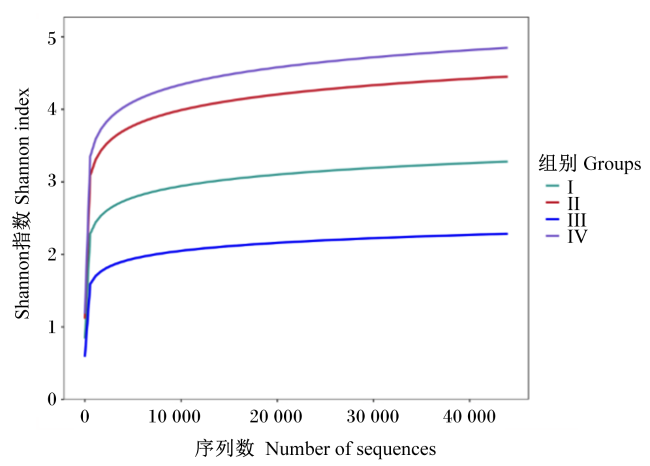
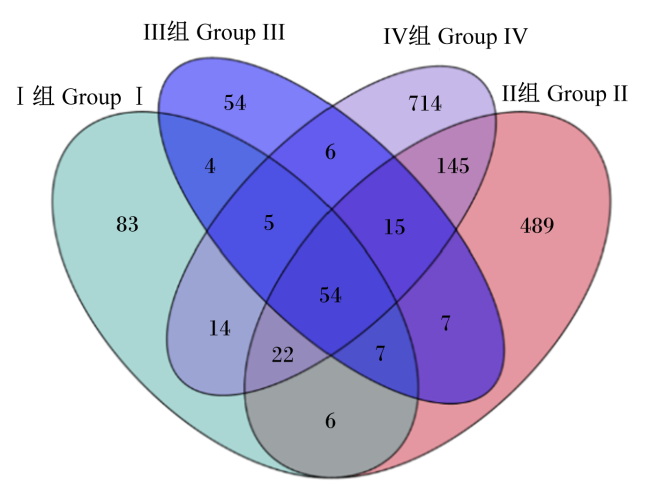
图1可知,Shannon指数曲线趋于平缓,说明测序量足够大,OTU数不会再随着测序量的增加而增长,可真实反映群落各物种间的相对比例关系,可以进行数据分析。肉鸡回肠菌群韦恩图(图2)显示,4组共有的OTU数为54个,Ⅰ组、Ⅱ组、Ⅲ组、Ⅳ组特有的OTU数分别为83、489、54、714个。从上述结果可知,相同添加剂量下,与CS组相比,CCS组的特有的OTU数目较多,说明添加CCS可以增加菌群物种数量。
图1 Shannon指数的稀释性曲线

Fig.1 Dilutive curve of Shannon index

图2 肉鸡回肠菌群韦恩图

Fig.2 Venn diagram of ileal microflora of broilers

2.3.2 回肠微生物Alpha多样性分析

添加不同形式和剂量的铜对回肠微生物Alpha多样性的影响见表4。主效应分析显示,与CS相比,CCS可显著提高Simpson指数(P<0.05),对Chao1、Shannon、Observed指数均无显著影响(P>0.05);从添加剂量来看,添加3.90 mg/kg铜相较于添加5.85 mg/kg铜可显著提升Simpson指数(P<0.05);饲粮中铜的添加形式与添加剂量对Simpson指数存在显著的互作效应(P<0.05)。单因素方差分析显示,Ⅲ组的Simpson指数显著低于Ⅰ组、Ⅱ组、Ⅳ组(P<0.05)。
表4 添加不同形式和剂量的铜对肉鸡回肠微生物Alpha多样性的影响

Table 4 Effects of adding different forms and doses of copper on Alpha diversity of ileal microbiota of broilers

项目
Items
Chao1指数
Chao1 index
Shannon指数
Shannon index
Simpson指数
Simpson index
Observed指数
Observed index


组别
Groups
179.90±114.16 3.65±1.11 0.83±0.10a 179.30±113.20
92.97±148.95 4.19±0.88 0.85±0.08a 291.60±147.96
75.45±17.44 2.15±0.62 0.57±0.08b 75.33±17.24
384.70±340.00 4.57±1.78 0.86±0.09a 384.30±339.82

形式
Form
硫酸铜CS 127.68±92.77 2.90±1.15 0.70±0.16 127.33±92.13
包被硫酸铜CCS 338.85±240.08 4.38±1.27 0.85±0.07 338.00±239.83

剂量
Dose/(mg/kg)
3.90 236.44±133.87 3.92±0.95 0.84±0.08 235.50±132.90
5.85 230.09±273.96 3.36±1.78 0.71±0.17 229.83±273.78


P
P-value
形式Form 0.097 0.062 0.018 0.097
剂量Dose 0.956 0.431 0.041 0.961
形式×剂量Form×dose 0.407 0.205 0.038 0.405

3 讨论

3.1 添加不同形式和剂量的铜对肉鸡生长性能的影响

包被膜能够有效地防止添加剂对饲料中营养成分的损害,从而提升添加剂的使用效率,并延长饲料的储存时间[6]。研究显示,在饲粮中添加包被复合微量元素能够提高肉鸡的生长性能,促进了肉鸡的生长发育[7];与有机微量元素和无机微量元素相比,包被微量元素能显著提高肉鸡的生长性能,降低饲料成本[8]。本试验发现,与CS相比,CCS提高了肉鸡8~28日龄和8~49日龄阶段的ADG,极显著降低了肉鸡29~49日龄、8~49日龄阶段的ADFI以及8~49日龄阶段的ADFI和F/G,与上述研究结果一致。有研究显示,在肉鸡饲粮中添加低剂量和高剂量的包被微量元素对肉鸡生长性能的效果相差不大[9]
本试验结果表明,添加3.90 mg/kg的铜降低了肉鸡8~49日龄阶段的ADFI,但对肉鸡生长性能没有产生显著影响。此外,本试验发现,试验期间肉鸡的MER高达10%,这可能是因为试验期间2023年7月23日沈阳气象台报道温度为33 ℃,但人体感温度达40 ℃,而当天鸡舍内所有的降温通风措施全部实施时鸡舍温度仍高达36 ℃,导致整个鸡群发生热应激,死亡率升高。

3.2 添加不同形式和剂量的铜对肉鸡组织中铜沉积的影响

肝脏、胫骨和胸肌是评估组织微量元素利用率的重要指标[10-11]。柯芙容[12]研究发现,CCS对肉鸡胫骨和胸肌中铜含量无显著影响。本试验结果表明,相较于CS,CCS可使肉鸡肝脏中铜含量极显著增加,但对胫骨、胸肌中铜含量无显著影响,与上述研究结果一致。这可能是因为试验设定的饲养周期不够长,导致CCS对铜在胸肌和胫骨组织中沉积的促进作用还未明显呈现。Ghasemi等[13]研究发现,低剂量和高剂量CCS对肉鸡胫骨中铜含量无显著影响。本验研究结果显示,铜添加剂量对肉鸡肝脏、胫骨和胸肌中铜含量均无显著影响。有研究表明,随着饲粮中铜含量的提高,肝脏中铜含量增加的并不显著,与本试验结果一致。单因素方差分析结果显示,饲粮中以CCS形式添加5.85 mg/kg铜时肉鸡肝脏中铜含量极显著高于以CS形式添加5.85 mg/kg铜时,而以CCS形式添加3.90与5.85 mg/kg铜时肉鸡肝脏中铜含量的平均值相差不大,故3.90 mg/kg CCS可以代替5.85 mg/kg CS。

3.3 添加不同形式和剂量的CS对肉鸡回肠微生物的影响

Chao1、Observed指数可反映样本物种的丰富度,而Shannon、Simpson指数可反映样本物种的多样性。本试验结果表明,相较于CS,添加CCS能够显著提升肉鸡回肠微生物的Simpson指数,对肠道菌群的平衡起到积极作用。代国滔等[14]研究发现,在饲粮中添加高剂量铜组种鹅的空肠微生物Shannon、Simpson指数最大,表明其物种多样性最丰富。本试验中,添加3.90 mg/kg铜相较于添加5.85 mg/kg铜可显著提升肉鸡回肠微生物的Simpson指数。这一结果与代国滔等[14]的研究结果不一致,可能是因为将铜元素进行包被可以减少铜的添加剂量,说明添加3.9 mg/kg的铜已足够。单因素方差分析显示,在肉鸡饲粮中以CS形式添加5.85 mg/kg铜时肉鸡回肠微生物的Simpson指数显著低于以CCS形式添加3.90和5.85 mg/kg铜时,而以CCS形式添加3.90和5.85 mg/kg铜对肉鸡回肠微生物的Alpha多样性的改善作用相差不大,说明3.90 mg/kg CCS可以替代5.85 mg/kg CS。

4 结论

① 从添加形式来看,CCS相较于CS能提高肉鸡的生长性能,增加铜在肝脏中的沉积量,有效提升回肠微生物的多样性。
② 从添加剂量来看,添加3.90 mg/kg铜相较于添加5.85 mg/kg铜可显著提升肉鸡回肠微生物的多样性。
③ 综合各项指标,肉鸡饲粮中以CCS形式添加3.90 mg/kg铜可取得较好效果。
[1]
刘伟, 刘增民, 杜元军, 等. 包被复合微量元素对产蛋高峰期蛋鸡生产性能、蛋品质、血液指标、胫骨指标和微量元素排泄的影响[J]. 动物营养学报, 2025, 37(3):1687-1697.

DOI

LIU W, LIU Z M, DU Y J, et al. Effects of coated complex trace elements on performance,egg quality,blood indexes,tibia indexes and trace element excretion of laying hens during peak laying period[J]. Chinese Journal of Animal Nutrition, 2025, 37(3):1687-169. (in Chinese)

DOI

[2]
马增欣, 肖开渝, 曹璐露, 等. 一种缓释微量元素预混合饲料及其制备方法:CN201610933213.9[P].2016-10-31.

MA Z X, XIAO K Y, CAO L L, et al. A slow-erlease trace elements premix and its preparation method:CN201610933213.9[P].2016-10-31. (in Chinese)

[3]
陈星, 卢文标, 梁明, 等. 包被微量元素对产蛋后期蛋鸡抗氧化能力和微量元素沉积的影响[J]. 中国畜牧杂志, 2023, 59(5):211-216.

CHEN X, LU W B, LIANG M, et al. Effects of coated trace elements on antioxidant capacity and trace element deposition of laying hens in late laying period[J]. Chinese Journal of Animal Science, 2023, 59(5):211-216. (in Chinese)

[4]
NRC. Nutrient requirements of poultry[S]. 9th ed.Washington,D.C.: The National Academies Press,1994.

[5]
中国农业科学院北京畜牧兽医研究所, 动物营养学国家重点实验室,中国饲料数据库情报网中心,国家农业科学数据中心(动物科学).中国饲料成分及营养价值表(2022年第33版)制订说明[J]. 中国饲料, 2022(23):109-119.

Institute of Animal Husbandry and Veterinary Medicine,Chinese Academy of Agricultural Sciences, State Key Laboratory of Animal Nutrition,China Feed Database Information Network Cente.Formulation of tables of feed composition and nutritive values in China (33th edition,2022)[J]. China Feed, 2022(23):109-119. (in Chinese)

[6]
SONG Y M, KIM M H, KIM H N, et al. Effects of dietary supplementation of lipid-coated zinc oxide on intestinal mucosal morphology and expression of the genes associated with growth and immune function in weanling pigs[J]. Asian-Australasian Journal of Animal Sciences, 2018, 31(3):403-409.

DOI PMID

[7]
胡世忠, 吴卓秋, 柯芙蓉, 等. 包被复合微量元素对黄羽肉鸡生长性能、血清生化指标和抗氧化能力的影响[J]. 福建农林大学学报(自然科学版), 2019, 48(2):210-215.

HU S Z, WU Z Q, KE F R, et al. Effects of micro-coating compound traceelements on the growth performance serum biochemical index and antioxidant function of broilers[J]. Journal of Fujian Agriculture and Forestry University (Natural Science Edition), 2019, 48(2):210-215.

[8]
LU W B, KUANG Y G, MA Z X, et al. The effect of feeding broiler with inorganic,organic,and coated trace minerals on performance,economics,and retention of copper and zinc[J]. Journal of Applied Poultry Research, 2020, 29(4):1084-1090.

[9]
AO T, PIERCE J L, POWER R, et al. Effects of feeding different forms of zinc and copper on the performance and tissue mineral content of chicks[J]. Poultry Science, 2009, 88(10):2171-2175.

DOI PMID

[10]
MWANGI S, TIMMONS J, AO T, et al. Effect of manganese preconditioning and replacing inorganic manganese with organic manganese on performance of male broiler chicks[J]. Poultry Science, 2019, 98(5):2105-2113.

DOI PMID

[11]
KIM J W, KIL D Y. Determination of relative bioavailability of copper in tribasic copper chloride to copper in copper sulfate for broiler chickens based on liver and feather copper concentrations[J]. Animal Feed Science and Technology, 2015,210:138-143.

[12]
柯芙容. 包被缓释复合微量元素在肉鸡中的应用研究[D]. 硕士学位论文. 福州: 福建农林大学, 2015.

KE F R. Study on application of micro-coating slow-releasing compound trace mineral on broilers[D]. Master’s Thesis. Fuzhou: Fujian Agriculture and Forestry University, 2015. (in Chinese)

[13]
GHASEMI H A, HAJKHODADADI I, HAFIZI M, et al. Effect of advanced chelate technology based trace minerals on growth performance,mineral digestibility,tibia characteristics,and antioxidant status in broiler chickens[J]. Nutrition & Metabolism, 2020, 17(1):94.

[14]
代国滔, 龙建华, 徐景峨, 等. 铜与枯草芽孢杆菌协同对产蛋期种鹅生产性能、空肠组织发育和微生物菌群结构的影响[J]. 中国畜牧杂志, 2023, 59(7):244-251.

DAI G T, LONG J H, XU J E, et al. Effects of copper and Bacillus subtilis synergistic on performance,jejunal tissue development and microflora structure of geese in laying period[J]. Chinese Journal of Animal Science, 2023, 59(7):244-251. (in Chinese)

Outlines

/