RESEARCH PAPER

Effects of Dietary Palm Kernel Meal on Flavor of Different Muscle Parts of Tibetan Sheep

  • GE Shipeng ,
  • MA Ying ,
  • HAN Lijuan , * ,
  • GUI Linsheng ,
  • HOU Shengzhen ,
  • YUAN Zhenzhen ,
  • SUN Shengnan ,
  • WANG Zhiyou ,
  • YANG Chao ,
  • YANG Baochun
Expand
  • College of Agriculture and Animal Husbandry, Qinghai University, Xining 810016, China
* associate professor, E-mail:

Received date: 2024-12-13

  Online published: 2025-09-12

Abstract

This experiment was conducted to investigate the effects of dietary palm kernel meal (PKM) on the flavor of different muscle parts of Tibetan sheep. Sixty Tibetan sheep aged of 2 to 3 months with a similar body weight of (18±3) kg were selected and randomly divided into 2 groups, with 6 replicates in each group and 5 sheep in each replicate. Sheep in the control group were fed a basal diet, while those in the PKM group were fed an experimental diet in which 18% PKM was supplemented into the concentrate supplement. The experiment lasted for 90 days after a pre-test of 14 days. After the experiment, the samples of longissimus dorsi, biceps femoris and triceps brachii were collected, and the composition and contents of volatile substances were determined by gas chromatography-ion mobility spectrometry (GC-IMS) technology. The results showed as follows: 1) a total of 36 volatile substances were detected from different muscle parts of Tibetan sheep, including 12 aldehydes, 11 alcohols, 9 ketones, 3 esters and 1 heterocyclic substance. Compared with the control group, the contents of volatile substances in different muscle parts in the PKM group were increased. 2) Taking the relative odor activity value (ROVA)>1 and variable importance projection (VIP)>1 as the screening criteria, the key flavor substances of different muscle parts in the control group were hexanal monomer and acetoin, while in the PKM group, hexanal dimer and 1-nonanal monomer were added. 3) The results of fingerprint and principal component analysis (PCA) indicated that there were obvious differences in volatile substances among different muscle parts in the PKM group, and the contents of aldehydes and alcohols in triceps brachii were higher than that in longissimus dorsi and biceps femoris. In conclusion, dietary PKM can effectively improve the flavor of different muscle parts of Tibetan sheep, especially in triceps brachii.

Cite this article

GE Shipeng , MA Ying , HAN Lijuan , GUI Linsheng , HOU Shengzhen , YUAN Zhenzhen , SUN Shengnan , WANG Zhiyou , YANG Chao , YANG Baochun . Effects of Dietary Palm Kernel Meal on Flavor of Different Muscle Parts of Tibetan Sheep[J]. Chinese Journal of Animal Nutrition, 2025 , 37(9) : 6084 -6097 . DOI: 10.12418/CJAN2025.495

藏羊作为一种青藏高原的特色牲畜品种,广泛分布在我国青海、甘肃及四川等高原地区,其肉具有低脂肪、高蛋白质以及富含多种微量元素和氨基酸等优势[1]。当前,随着我国畜牧业的大力发展,豆粕的需求量日益增加,豆粕价格也持续上涨。因此,为了解决饲料成本高等问题,研究发现采用棕榈粕(palm kernel meal,PKM)替代豆粕能够显著提高动物生产的经济效益[2-3]。PKM是由棕榈仁压榨去油后的副产物,其因价格低廉、粗蛋白质和粗脂肪等有效成分性价比优于纯粮饲料原料以及含有较多的粗纤维,而在反刍动物生产中被广泛应用[4]
饲粮中的蛋白质、能量以及风味物质等都会影响羊肉的肉质风味[5]。风味可以决定藏羊肉的品质,然而,独特风味的形成与不同种类和含量的挥发性物质有关。肉中挥发性物质不是直接存在于肉品之中,而是风味前体物质经过一系列反应得到的[6]。但风味前体物质本身是没有香味的,香味需通过脂质氧化降解、美拉德反应和硫胺素热解以及氨基酸降解等一系列化学反应形成[7-8]。丰富的风味化合物构成了藏羊肉的香气特征,其中主要包括酯类、醛类、酸类、酮类和醇类,其主要的特征气味有果味、花香、谷物味、酸味及醇味[9]。本课题组前期研究发现,饲粮精料中添加PKM对藏绵羊不同部位脂肪组织的风味和脂肪酸谱具有显著影响,PKM显著改善了藏羊不同部位脂肪组织中的风味,增加了一些香气挥发性风味化合物[10]。不过,目前关于PKM对藏羊肉不同部位肌肉中挥发性物质的影响却鲜有报道。
气相色谱-离子迁移谱(gas chromatography-ion mobility spectrometry,GC-IMS)可以快速、简单、直观和准确地分析出测试结果[11],且广泛应用于食品风味分析[12]和质量检测[13]。罗玉龙等[14]在苏尼特羊3个部位肌肉中检测出44种挥发性风味物质,包括醛类、酮类、醇类、烃类和烯类,其中背最长肌中的醛类和醇类含量高于臂三头肌和股二头肌,造成不同部位风味物质的差异可能与肉组织结构有关。赵天霞等[15]对藏羊上脑、眼肉、小黄瓜条、尾龙扒、针扒、羊腩、烩扒、前腱子、脖肉、肩肉、胸肉、辣椒条、后腱子、金钱腱、霖肉、外脊、上三筋、里脊、板腱和肋肉等20个部位进行了GC-IMS分析,共鉴定出40种挥发性物质,且发现藏羊不同部位肉的挥发性物质组成及相对含量差异显著。本研究旨在对比饲粮精料中添加18% PKM与未添加PKM对藏羊背最长肌、臂三头肌和股二头肌中挥发性物质影响的差异,并采用GC-IMS及结合主成分分析(principal component analysis,PCA),利用相对气味活度值(relative odor activity value,ROVA)筛选出关键风味物质,以明晰PKM对于藏羊不同部位肌肉中挥发性物质的影响,为今后饲料资源的合理开发及藏羊肉风味特性的研究提供参考。

1 材料与方法

1.1 伦理声明

本研究中的所有动物试验均符合青海大学动物保护委员会批准的动物福利规定(批准号:QUA-2020-0709)。

1.2 试验设计和饲粮

本课题组前期针对饲粮精料中添加0、15%和18% PKM对藏羊皮下脂肪、肌间脂肪及尾部脂肪的脂肪酸和挥发性物质进行了研究,结果表明,随着PKM添加水平的提高,其脂肪组织中脂肪酸含量和组成发生了显著变化,且在18% PKM添加水平下发现有益挥发性物质含量显著提高[10]。基于此,本研究在18% PKM添加水平下对藏羊肌肉组织(背最长肌、股二头肌和臂三头肌)挥发性物质进行进一步研究。
饲养试验在青海省海南藏族自治州共和县青海香咔梅朵牧业有限公司进行。选用60只体重[(18±3) kg]相近、2~3月龄的藏系绵羊,随机分为2组,每组6个重复,每个重复5只羊。对照组饲喂基础饲粮,PKM组饲喂在精料补充料中添加18% PKM的试验饲粮。PKM营养成分为:水分7.90%,粗灰分4.60%,粗蛋白质16.50%,粗脂肪6.00%,酸性洗涤纤维33.20%,中性洗涤纤维72.20%。预试期14 d,正试期90 d。饲粮精粗比为70∶30,其组成见表1,精料补充料营养水平参考前期研究[10]
表1 饲粮组成

Table 1 Composition of diets %

项目
Items
对照组
Control group
PKM组
PKM group
粗饲料Roughage (30%)
燕麦青干草Oat green hay 50.00 50.00
燕麦青贮Oat silage 50.00 50.00
合计Total 100.00 100.00
精料补充料
Concentrate supplement (70%)
玉米Corn 65.50 51.80
豆粕Soybean meal 8.00 5.00
棉籽粕Cottonseed meal 4.00 3.70
菜籽粕Rapeseed meal 16.00 15.00
棕榈粕Palm kernel meal 18.00
食盐NaCl 0.50 0.50
石粉Limestone 1.00 1.00
预混料Premix 5.00 5.00
合计Total 100.00 100.00

预混料为商品饲料。

Premix was commercial feed.

1.3 饲养管理

饲养试验为全舍饲饲喂,圈舍向阳、避风、干燥;试验羊每天早晚饲喂2次,自由采食,并保证充足饮水;每周对羊舍和运动场进行消毒杀菌,保持圈舍的清洁卫生。

1.4 样品采集

试验结束后,根据欧盟动物福利指南,在同一天、同一商业屠宰场通过机械电击和放血屠宰所有试验羊。屠宰后,采集股二头肌、臂三头肌及第12~13根肋骨之间的背最长肌,在自封袋和冻存管中进行分装,分装好的样品暂时用干冰进行储存,采样完成后运回实验室储存于-80 ℃冰箱中。

1.5 测定指标及方法

1.5.1 GC-IMS分析

1)顶空进样条件:准确称取藏羊肌肉样品1.0 g置于20 mL顶空瓶中,每个样品测定3个平行。
2)GC-IMS条件:色谱柱温度为80 ℃;载气为高纯氮气(纯度≥99.999%);程序升压为初始流量2.0 mL/min保持 2 min,在8 min内线性增至10.0 mL/min,在10 min内线性增至100.0 mL/min,在10 min内线性保持至100.0 mL/min;色谱运行时间为20 min;进样口温度为80 ℃。电离源为氚源;迁移管长度为53 mm;电场强度为500 V/cm;迁移管温度为45 ℃;漂移气体为高纯氮气(纯度≥99.999%);流速为150 mL/min;离子模式为正离子模式[16]

1.5.2 ROVA计算

参考刘登勇等[17]的方法计算关键风味物质的ROVA,计算公式如下:
ROVA= C A C m a x× T m a x T A
式中:CA为挥发性物质A的相对百分含量(%);TA为挥发性物质A的香气阈值(mg/kg);Cmax为对藏羊肉整体风味贡献最大的香气成分的相对百分含量(%);Tmax为对藏羊肉整体风味贡献最大的香气成分的香气阈值(mg/kg)。

1.6 数据处理

采用Excel 2019对试验数据进行初步整理,然后采用SPSS 25.0软件对对照组和PKM组间数据进行独立样本t检验,对PKM组藏羊不同部位肌肉间数据进行单因素方差分析和Duncan氏法多重比较,结果数据采用“平均值±标准差”形式表示,P<0.05表示差异显著。采用VOCal软件对目标物进行定性分析及谱图绘制;采用Origin 2022软件进行绘图,并采用正交偏最小二乘回归判别分析(OPLS-DA)法使用SIMCA 14.1软件进行分析。

2 结果与分析

2.1 藏羊不同部位肌肉挥发性物质组成和含量

2.1.1 PKM对藏羊不同部位肌肉挥发性物质组成和含量的影响

表2可知,本研究从藏羊不同部位肌肉中共检测出36种挥发性物质,包括醛类12种、醇类11种、酮类9种、酯类3种及杂环类1种,其中醛类和醇类较多,其次是酮类,而酯类和杂环类较少。与对照组相比,饲粮中添加PKM能够显著提高藏羊背最长肌、股二头肌和臂三头肌中大部分醛类物质含量(P<0.05),而显著降低大部分酮类物质含量(P<0.05)。此外,与对照组相比,PKM组部分醇类物质含量在背最长肌和股二头肌中有所提高,而在臂三头肌中有所降低;酯类含量在背最长肌中有所提高,却在股二头肌和臂三头肌中有所降低;同时,2-戊基呋喃含量在3个部位肌肉中都显著提高(P<0.05)。
表2 PKM对藏羊不同部位肌肉挥发性物质组成和含量的影响

Table 2 Effects of PKM on composition and contents of volatile substances in different muscle parts of Tibetan sheep %

项目
Items
保留时间
Retention
time/s
背最长肌Longissimus dorsi P
P-value
股二头肌Biceps femoris P
P-value
臂三头肌Triceps brachii P
P-value
对照组
Control
group
PKM组
PKM
group
对照组
Control
group
PKM组
PKM
group
对照组
Control
group
PKM组
PKM
group
醛类Aldehydes
(E)-2-庚烯醛(E)-2-heptenal 489.225 0.33±0.12 0.77±0.07 0.006 0.46±0.18 0.64±0.05 0.162 0.45±0.20 0.70±0.13 0.140
(E)-2-辛烯醛(E)-2-octenal 695.312 0.21±0.07 0.55±0.14 0.020 0.22±0.10 0.23±0.03 0.853 0.30±0.18 0.24±0.06 0.608
1-壬醛二聚体1-nonanal dimer 775.042 0.39±0.19 0.84±0.07 0.017 0.39±0.19 0.52±0.12 0.385 0.43±0.19 1.14±0.26 0.019
1-壬醛单体1-nonanal monomer 773.414 2.40±0.43 3.21±0.29 0.055 2.48±0.19 4.89±1.28 0.080 2.90±0.28 7.69±0.18 <0.001
1-辛醛二聚体1-octanal dimer 586.941 0.25±0.11 0.60±0.08 0.012 0.25±0.12 0.38±0.04 0.138 0.33±0.16 0.61±0.24 0.179
1-辛醛单体1-octanal monomer 586.941 0.99±0.21 1.63±0.01 0.032 1.34±0.21 2.92±0.82 0.032 1.36±0.32 4.26±0.42 <0.001
庚醛二聚体Heptanal dimer 390.184 0.22±0.08 0.49±0.03 0.007 0.21±0.09 0.40±0.10 0.080 0.26±0.11 1.26±0.44 0.052
庚醛单体Heptanal monomer 390.184 0.53±0.10 0.91±0.11 0.011 1.23±0.09 2.49±0.61 0.024 0.74±0.27 4.28±0.23 <0.001
己醛二聚体Hexanal dimer 264.688 0.26±0.14 0.55±0.04 0.030 1.30±0.10 4.07±1.77 0.054 0.33±0.19 8.99±1.27 0.006
己醛单体Hexanal monomer 265.458 1.29±0.13 1.24±0.14 0.719 5.10±0.10 8.21±1.21 0.011 1.73±0.86 7.62±0.80 <0.001
2-苯乙醛2-phenylacetaldehyde 648.583 0.34±0.16 1.00±0.32 0.034 0.32±0.11 0.52±0.06 0.057 0.46±0.18 0.41±0.08 0.670
1-丁醛1-butanal 137.660 0.26±0.05 0.34±0.03 0.077 0.20±0.02 0.17±0.02 0.186 0.74±0.24 0.11±0.03 0.044
醇类Alcohols
乙醇Ethanol 99.724 12.73±1.17 12.18±0.80 0.538 7.66±0.71 5.59±0.69 0.022 17.76±1.70 4.88±1.00 <0.001
1-丁醇二聚体1-butanol dimer 170.467 0.67±0.17 1.17±0.03 0.007 1.03±0.15 1.71±0.11 0.003 6.77±2.46 8.91±0.73 0.224
1-丁醇单体1-butanol monomer 170.467 4.61±0.26 4.89±0.58 0.488 4.02±0.14 3.97±0.21 0.788 19.68±3.78 12.22±0.86 0.029
1-戊醇二聚体1-pentanol dimer 246.673 0.14±0.09 0.37±0.02 0.010 0.40±0.10 1.21±0.48 0.045 0.24±0.15 3.30±0.22 <0.001
1-戊醇单体1-pentanol monomer 246.673 1.05±0.07 0.87±0.16 0.165 2.71±0.13 4.63±0.73 0.011 1.43±0.96 5.26±0.43 0.003
1-戊烯-3-醇1-penten-3-ol 181.237 1.37±0.06 2.51±0.11 <0.001 1.57±0.11 2.36±0.27 0.009 1.70±0.28 1.57±0.23 0.560
1-丙醇1-propanol 124.884 2.31±0.24 3.54±0.17 0.002 3.27±0.10 1.84±0.10 <0.001 1.89±0.06 1.19±0.20 0.005
1-辛烯-3-醇1-octen-3-ol 561.020 1.86±0.36 3.29±0.07 0.018 3.06±0.43 4.46±0.14 0.006 2.57±1.02 6.05±0.30 0.005
2-呋喃甲醇2-furfuryl alcohol 324.680 0.27±0.07 0.51±0.04 <0.001 0.19±0.07 0.25±0.05 0.289 0.26±0.06 0.09±0.02 0.007
2-甲基丁醇2-methyl butanol 210.483 1.26±0.11 0.42±0.04 0.012 1.00±0.10 0.70±0.22 0.110 0.40±0.09 0.17±0.03 0.016
3-辛醇3-octanol 545.849 0.54±0.19 1.11±0.11 0.018 0.66±0.14 2.03±0.58 0.016 0.59±0.21 2.79±0.35 <0.001
酮类Ketones
3-辛酮3-octanone 549.483 0.18±0.06 0.41±0.01 0.008 0.52±0.07 0.30±0.04 0.011 0.28±0.18 0.33±0.02 0.657
2-丁酮二聚体2-butanone dimer 133.192 2.89±0.18 4.00±0.19 <0.001 2.38±0.21 1.97±0.22 0.080 3.62±0.72 1.57±0.34 0.011
2-丁酮单体2-butanone monomer 132.480 5.90±0.05 9.23±0.35 0.012 4.46±0.22 4.27±0.14 0.281 6.86±0.61 2.65±0.40 <0.001
丙酮Acetone 108.396 8.29±0.36 22.61±1.04 0.018 16.79±1.05 11.55±2.08 0.018 9.54±0.28 4.83±0.10 <0.001
2-庚酮二聚体2-heptanone dimer 371.634 0.11±0.06 0.27±0.06 0.002 0.10±0.04 0.15±0.02 0.137 0.13±0.08 0.30±0.01 0.065
2-庚酮单体2-heptanone monomer 372.693 0.32±0.06 0.58±0.05 0.004 0.50±0.07 1.03±0.10 0.002 0.43±0.16 1.23±0.08 0.001
2-戊酮2-pentanone 176.689 1.68±0.04 3.76±0.15 <0.001 2.27±0.16 2.54±0.31 0.258 1.36±0.24 0.33±0.10 0.002
乙偶姻二聚体Acetoin dimer 210.090 15.66±0.94 0.98±0.13 <0.001 8.90±0.79 5.22±1.94 0.038 0.87±0.24 0.60±0.43 0.395
乙偶姻单体Acetoin monomer 213.365 27.43±1.04 9.28±0.28 <0.001 21.42±0.67 15.34±3.94 0.058 8.10±0.39 2.17±0.45 <0.001
酯类Esters
3-甲基丁酸丁酯3-butyl methyl butyrate 660.845 0.28±0.08 0.64±0.04 0.002 0.23±0.08 0.37±0.03 0.045 0.44±0.07 0.37±0.04 0.022
乙酸乙酯Ethyl acetate 143.069 1.16±0.03 2.65±0.13 0.002 1.06±0.07 1.28±0.14 0.072 2.27±0.48 0.67±0.04 0.028
乙酸甲酯Methyl acetate 126.665 1.68±0.12 2.21±0.16 0.010 2.09±0.06 1.32±0.16 0.005 2.56±0.24 0.79±0.21 <0.001
杂环类Heterocycles
2-戊基呋喃2-pentylfuran 555.997 0.16±0.04 0.38±0.02 0.001 0.20±0.06 0.45±0.03 0.012 0.21±0.09 0.43±0.00 0.047

2.1.2 藏羊不同部位肌肉中关键风味物质的鉴定

为了确定藏羊肌肉中挥发性物质对肉质整体风味的贡献情况,本试验测定了不同挥发性物质的ROVA,ROVA值越大,表明该物质对样品总体风味的贡献率就越大,其中,ROVA>1的组分为样品的关键风味物质,而0.1≤ROVA<1的组分为样品的可修饰性风味物质。由表3可知,与其他化合物相比,由于乙偶姻相对含量较高,其阈值为0.055 mg/kg,对各部位肌肉的风味贡献较大,故将其ROVA定为100。各样品中,ROVA>1的风味物质有2种,分别为1-壬醛和1-辛醛,其具有脂肪、柑橘、肥皂和柠檬的味道,使藏羊肉具有独特的风味;而己醛除了在对照组背最长肌外,其他部位的ROVA都大于1;庚醛在PKM组臂三头肌中ROVA较高。此外,0.1≤ROVA<1的组分有2-甲基丁醇、2-苯乙醛及庚醛,对藏羊肉的风味有修饰作用。
表3 藏羊不同部位肌肉挥发性物质的ROVA

Table 3 ROVA of volatile substances in different muscle parts of Tibetan sheep

项目
Items
阈值
Threshold/
(mg/kg)[18]
相对气味活度值ROVA 气味特征
Odor
characteristics
对照组Control group PKM组PKM group
背最长肌
Longissimus
dorsi
背最长肌
Longissimus
dorsi
股二头肌
Biceps
femoris
臂三头肌
Triceps
brachii
背最长肌
Longissimus
dorsi
股二头肌
Biceps
femoris
臂三头肌
Triceps
brachii
乙偶姻Acetoin 0.055 100 100 100 100 100 100 黄油、奶油
己醛Hexanal 0.005 0.40 2.32 2.54 1.92 6.72 64.55 青草、奶油、
脂肪
(E)-2-庚烯醛
(E)-2-heptenal
0.013 0.03 0.06 0.21 0.32 0.13 1.06 肥皂、脂肪、
杏仁
(E)-2-辛烯醛
(E)-2-octenal
0.003 0.09 0.14 0.62 0.98 0.21 1.57 坚果、脂肪
1-壬醛1-nonanal 0.001 3.57 5.23 20.49 21.68 14.77 171.76 脂肪、柑橘
1-辛醛1-octanal 0.001 2.26 4.15 14.93 17.11 12.90 136.19 脂肪、肥皂、
柠檬
1-戊烯-3-醇
1-penten-3-ol
0.100 0.02 0.06 0.16 0.18 0.12 1.17 黄油、刺鼻
2-甲基丁醇
2-methyl butanol
0.016 0.10 0.11 0.15 0.14 0.12 0.21 酒、洋葱
2-戊基呋喃
2-pentylfuran
0.006 0.03 0.06 0.21 0.34 0.20 1.37 绿豆、黄油
2-苯乙醛
2-phenylacetaldehyde
0.004 0.11 0.15 0.71 1.34 0.35 1.99 山楂、蜂蜜、
甘甜
3-辛醇3-octanol 0.018 0.04 0.07 0.20 0.33 0.31 3.04 苔藓、坚果、
蘑菇
庚醛Heptanal 0.003 0.32 0.87 2.07 2.50 2.64 36.11 脂肪、柑橘、
腐臭

气味特征描述来自Flavornet and human odor space数据库。

The odor characteristics were described from Flavornet and human odor space database.

在不同部位肌肉之间,对照组藏羊背最长肌、股二头肌和臂三头肌各挥发性物质的ROVA呈现由低到高的变化,且ROVA>1的物质有1-辛醛和1-壬醛;而PKM组臂三头肌挥发性物质的ROVA明显高于其他2个部位肌肉。与对照组相比,PKM组背最长肌、股二头肌和臂三头肌挥发性物质的ROVA明显提高,特别是臂三头肌的己醛、1-壬醛、1-辛醛和庚醛等。

2.1.3 藏羊不同部位肌肉挥发性物质OPLS-DA

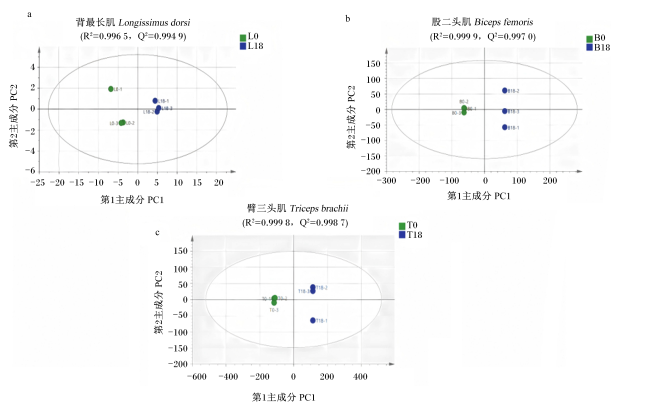
图1所示,通过OPLS-DA模型进一步分析藏羊不同部位肌肉挥发性物质差异,该模型中R2和Q2越接近于1.0,说明模型的拟合性越好[19]。本试验中,藏羊不同部位肌肉挥发性物质OPLS-DA的R2和Q2均接近1.0,表明模型具有良好的解释能力和预测能力[20]。2组间藏羊肌肉挥发性物质在不同部位均较好分离,且组内较为聚集,表明与对照组相比,PKM组不同部位肌肉挥发性物质均差异显著(P<0.05)。
图1 藏羊不同部位肌肉挥发性物质OPLS-DA

L0、B0和T0分别表示对照组背最长肌、股二头肌和臂三头肌,L18、B18和T18分别表示PKM组背最长肌、股二头肌和臂三头肌。图3图4同。

Fig.1 OPLS-DA of volatile substances in different muscle parts of Tibetan sheep

L0, B0 and T0 represented longissimus dorsi, biceps femoris and triceps brachii in the control group, and L18, B18 and T18 represented longissimus dorsi, biceps femoris and triceps brachii in PKM group, respectively. The same as Fig.3 and Fig.4.

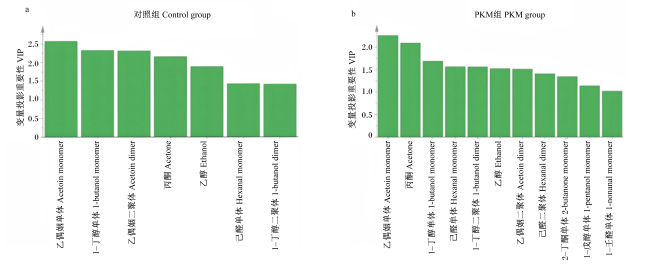
变量投影重要性(VIP)是用来衡量各种代谢物的表达模式和对各组样本分类判别的影响强度和解释能力[21],VIP越大,表明该物质对藏羊肉风味的贡献就越大。如图2-a所示,对照组藏羊不同部位肌肉中VIP>1的特征性挥发性物质有乙偶姻单体、1-丁醇单体、乙偶姻二聚体、丙酮、乙醇、己醛单体和1-丁醇二聚体;如图2-b所示,PKM组藏羊不同部位肌肉中VIP>1的特征性挥发性物质有乙偶姻单体、丙酮、1-丁醇单体、己醛单体、1-丁醇二聚体、乙醇、乙偶姻二聚体、己醛二聚体、2-丁酮单体、1-戊醇单体和1-壬醛单体。
图2 藏羊不同部位肌肉挥发性物质VIP

Fig.2 VIP of volatile substances in different muscle parts of Tibetan sheep

2.2 PKM组藏羊不同部位肌肉挥发性物质组成和含量差异

2.2.1 PKM组藏羊不同部位肌肉挥发性物质图谱和PCA分析
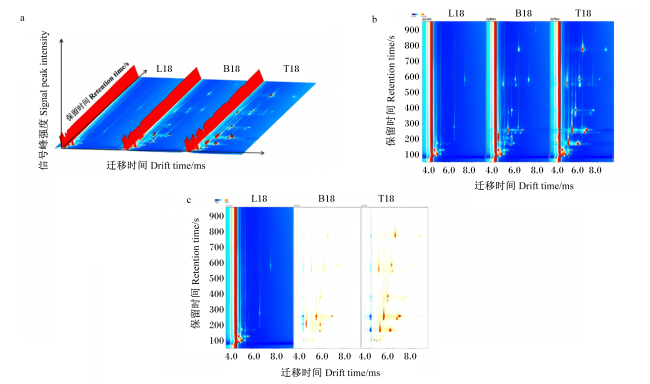
PKM组藏羊不同部位肌肉挥发性物质GC-IMS分析图谱如图3所示。如图3-a所示,藏羊不同部位肌肉间挥发性物质存在差异,与背最长肌相比,股二头肌和臂三头肌挥发性物质分布较为相似,但臂三头肌的信号峰值较多,且特征峰强度较高。如图3-b所示,整个图谱的背景为蓝色,红色竖线为反应离子峰(reactive ion peak,RIP),竖线2边红色的点为挥发性物质,越红表明其含量越高[22];其中,与背最长肌相比,股二头肌和臂三头肌挥发性物质种类较多、含量较高。为进一步分析不同部位肌肉间挥发性物质之间的差异,选取背最长肌作为参比对象,如图3-c所示,股二头肌红点和蓝点较少且颜色较浅,说明股二头肌与背最长肌挥发性物质相似;而臂三头肌红点较多,且颜色较深,表明臂三头肌挥发性物质种类较多、含量较高。
图3 PKM组藏羊不同部位肌肉挥发性物质GC-IMS分析三维图谱(a)、二维图谱(b)和差异图谱(c)

Fig.3 3D spectrum (a), 2D spectrum (b) and differential spectrum (c) of volatile substances in different muscle parts of Tibetan sheep in PKM group analyzed by GC-IMS

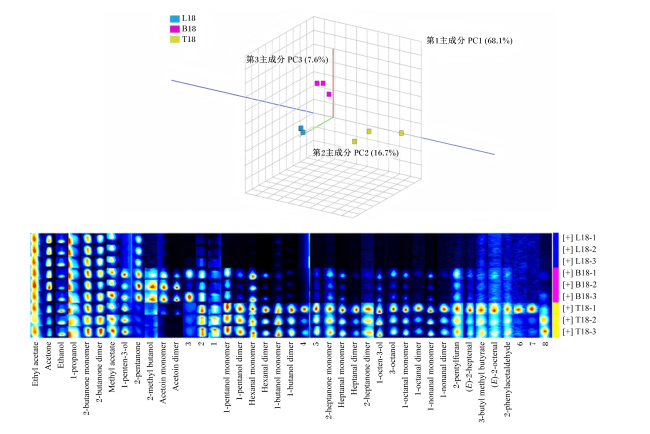
PKM组藏羊不同部位肌肉挥发性物质PCA如图4-a所示,不同部位肌肉间挥发性物质存在差异,第1主成分贡献率为68.1%,第2主成分贡献率为16.7%,第3主成分贡献率为7.6%,累计贡献率为92.4%;3个部位肌肉间挥发性物质具有较好的分离,表明挥发性物质差异明显。
图4 PKM组藏羊不同部位肌肉挥发性物质PCA及指纹图谱分析

Ethyl acetate:乙酸乙酯;Acetone:丙酮;Ethanol:乙醇;1-propanol:1-丙醇;2-butanone monomer:2-丁酮单体;2-butanone dimer:2-丁酮二聚体;Methyl acetate:乙酸甲酯;1-penten-3-ol:1-戊烯-3-醇;2-pentanone:2-戊酮;2-methyl butanol:2-甲基丁醇;Acetoin monomer:乙偶姻单体;Acetoin dimer:乙偶姻二聚体;1-pentanol monomer:1-戊醇单体;1-pentanol dimer:1-戊醇二聚体;Hexanal monomer:己醛单体;Hexanal dimer:己醛二聚体;1-butanol monomer:1-丁醇单体;1-butanol dimer:1-丁醇二聚体;2-heptanone monomer:2-庚酮单体;Heptanal monomer:庚醛单体;Heptanal dimer:庚醛二聚体;2-heptanone dimer:2-庚酮二聚体;1-octen-3-ol:1-辛烯-3-醇;3-octanol:3-辛醇;1-octanal monomer:1-辛醛单体;1-octanal dimer:1-辛醛二聚体;1-nonanal monomer:1-壬醛单体;1-nonanal dimer:1-壬醛二聚体;2-pentylfuran:2-戊基呋喃;(E)-2-heptenal:(E)-2-庚烯醛;3-butyl methyl butyrate:3-甲基丁酸丁酯;(E)-2-octenal:(E)-2-辛烯醛;2-phenylacetaldehyde:2-苯乙醛;1~8表示未知物质:1 to 8 represented unknown substances。

Fig.4 PCA and fingerprint analysis of volatile substances in different muscle parts of Tibetan sheep in PKM group

PKM组藏羊不同部位肌肉挥发性物质指纹图谱分析如图4-b所示,图中每一行代表一个样品中选取的全部信号峰,每一列代表同一挥发性物质在不同样品中的信号峰,由此可以看出每个部位肌肉样品的完整挥发性物质信息以及样品之间挥发性物质的差异。本试验中,PKM组藏羊3个部位肌肉间挥发性物质差异较大,其中背最长肌种类最少,而臂三头肌种类最多。此外,图中A区域挥发性物质含量在股二头肌中较高,主要有2-戊酮、2-甲基丁醇、乙偶姻单体和乙偶姻二聚体;而图中B区域挥发性物质含量在臂三头肌中含量较高,主要包括戊醇、己醛、丁醇、2-庚酮、庚醛、1-辛烯-3-醇、3-辛醇、辛醛、壬醛、2-戊基呋喃、(E)-2-庚烯醛、3-甲基丁酸丁酯、(E)-2-辛烯醛及2-苯乙醛。

2.2.2 PKM组藏羊不同部位肌肉挥发性物质定性和定量分析

为了进一步分析PKM组藏羊不同部位肌肉挥发性物质的差异,对其进行了定性和定量分析,结果见表4,与背最长肌和股二头肌相比,臂三头肌中醛类、醇类和杂环类物质含量相对较高,而酮类和酯类物质含量相对较低。此外,在背最长肌、股二头肌和臂三头肌中,1-壬醛单体、1-辛醛单体、庚醛单体、己醛二聚体、1-丁醇二聚体、1-戊醇、1-辛烯-3-醇、3-辛醇和2-庚酮单体等化合物含量呈现由低到高变化,表明在藏羊饲粮中添加PKM对不同部位肌肉的风味有良好的影响,特别是对臂三头肌风味的影响最大。
表4 PKM组藏羊不同部位肌肉挥发性物质定性和定量分析

Table 4 Qualitative and quantitative analysis of volatile substances in different muscle parts of Tibetan sheep in PKM group

项目
Items
保留时间
Retention
time/s
含量Content/% P
P-value
背最长肌
Longissimus
dorsi
股二头肌
Biceps
femoris
臂三头肌
Triceps
brachii
醛类Aldehydes
(E)-2-庚烯醛(E)-2-heptenal 489.225 0.77±0.07 0.64±0.05 0.70±0.13 0.291
(E)-2-辛烯醛(E)-2-octenal 695.312 0.55±0.14a 0.23±0.03b 0.24±0.06b 0.008
1-壬醛二聚体1-nonanal dimer 775.042 0.84±0.07ab 0.52±0.12b 1.14±0.26a 0.012
1-壬醛单体1-nonanal monomer 773.414 3.21±0.29c 4.89±1.28b 7.69±0.18a 0.001
1-辛醛二聚体1-octanal dimer 586.941 0.60±0.08 0.38±0.04 0.61±0.24 0.197
1-辛醛单体1-octanal monomer 586.941 1.63±0.01c 2.92±0.82b 4.26±0.42a 0.003
庚醛二聚体Heptanal dimer 390.184 0.49±0.03b 0.40±0.10b 1.26±0.44a 0.013
庚醛单体Heptanal monomer 390.184 0.91±0.11c 2.49±0.61b 4.28±0.23a <0.001
己醛二聚体Hexanal dimer 264.688 0.55±0.04c 4.07±1.77b 8.99±1.27a 0.010
己醛单体Hexanal monomer 265.458 1.24±0.14b 8.21±1.21a 7.62±0.80a <0.001
2-苯乙醛2-phenylacetaldehyde 648.583 1.00±0.32a 0.52±0.06b 0.41±0.08b 0.020
1-丁醛1-butanal 137.660 0.34±0.03a 0.17±0.02b 0.11±0.03c <0.001
醇类Alcohols
乙醇Ethanol 99.724 12.18±0.80a 5.59±0.69b 4.88±1.00b <0.001
1-丁醇二聚体1-butanol dimer 170.467 1.17±0.03b 1.71±0.11b 8.91±0.73a <0.001
1-丁醇单体1-butanol monomer 170.467 4.89±0.58b 3.97±0.21b 12.22±0.86a <0.001
1-戊醇二聚体1-pentanol dimer 246.673 0.37±0.02c 1.21±0.48b 3.30±0.22a <0.001
1-戊醇单体1-pentanol monomer 246.673 0.87±0.16b 4.63±0.73a 5.26±0.43a <0.001
1-戊烯-3-醇1-penten-3-ol 181.237 2.51±0.11a 2.36±0.27a 1.57±0.23b 0.003
1-丙醇1-propanol 124.884 3.54±0.17a 1.84±0.10b 1.19±0.20c <0.001
1-辛烯-3-醇1-octen-3-ol 561.020 3.29±0.07c 4.46±0.14b 6.05±0.30a <0.001
2-呋喃甲醇2-furfuryl alcohol 324.680 0.51±0.04a 0.25±0.05b 0.09±0.02c <0.001
2-甲基丁醇2-methyl butanol 210.483 0.42±0.04b 0.70±0.22a 0.17±0.03b 0.008
3-辛醇3-octanol 545.849 1.11±0.11b 2.03±0.58a 2.79±0.35a 0.006
酮类Ketones
3-辛酮3-octanone 549.483 0.41±0.01a 0.30±0.04b 0.33±0.02b 0.007
2-丁酮二聚体2-butanone dimer 133.192 4.00±0.19a 1.97±0.22b 1.57±0.34b <0.001
2-丁酮单体2-butanone monomer 132.480 9.23±0.35a 4.27±0.14b 2.65±0.40c <0.001
丙酮Acetone 108.396 22.61±1.04a 11.55±2.08b 4.83±0.10c <0.001
2-庚酮二聚体2-heptanone dimer 371.634 0.27±0.06a 0.15±0.02b 0.30±0.01a 0.006
2-庚酮单体2-heptanone monomer 372.693 0.58±0.05c 1.03±0.10b 1.23±0.08a <0.001
2-戊酮2-pentanone 176.689 3.76±0.15a 2.54±0.31b 0.33±0.10c <0.001
乙偶姻二聚体Acetoin dimer 210.090 0.98±0.13b 5.22±1.94a 0.60±0.43b 0.005
乙偶姻单体Acetoin monomer 213.365 9.28±0.28b 15.34±3.94a 2.17±0.45c 0.001
酯类Esters
3-甲基丁酸丁酯3-butyl methyl butyrate 660.845 0.64±0.04a 0.37±0.03b 0.37±0.04b <0.001
乙酸乙酯Ethyl acetate 143.069 2.65±0.13a 1.28±0.14b 0.67±0.04c <0.001
乙酸甲酯Methyl acetate 126.665 2.21±0.16a 1.32±0.16b 0.79±0.21c <0.001
杂环类Heterocycles
2-戊基呋喃2-pentylfuran 555.997 0.38±0.02b 0.45±0.03a 0.43±0.00a 0.021

同行数据肩标不同字母表示差异显著(P<0.05),相同字母或无字母表示差异不显著(P<0.05)。

In the same row, values with different letter superscripts mean significant difference (P<0.05), while with the same letter or no letter superscripts mean no significant difference (P>0.05).

3 讨论

风味是评价肉类品质的重要指标之一,好的风味不仅能使人得到感官上的愉悦,同时也能提高营养物质的消化吸收[23]。研究表明,羊肉的风味受饲粮种类及添加物,肉羊性别、年龄、肌肉组织结构及不同部位,以及加工方式等多重因素的影响[14]。因此了解饲粮中添加PKM对藏羊不同部位肌肉风味的影响至关重要。研究发现,PKM可通过影响肌肉代谢和瘤胃微生物来改善肉的品质和风味[24]。本研究通过GC-IMS检测出藏羊不同部位肌肉的挥发性物质包括醛类、醇类、酮类、酯类及杂环类,其中醛类和醇类较多,其次是酮类,而酯类和杂环类最少,这与罗玉龙等[14]的研究结果相似。同时,整体而言,与对照组相比,PKM组肌肉挥发性物质含量相对较高,这可能是由于PKM的添加导致蛋白质和脂肪酸沉积,进而形成了大量的挥发性物质[24]。此外,本试验结果表明,添加PKM后酯类物质含量在背最长肌中有所提高,在股二头肌和臂三头肌中却有所降低,这可能是因为背最长肌肌肉纤维较为发达,脂肪含量较高的原因。
肉品风味的形成主要跟低阈值的挥发性物质有关,醛类物质是由脂肪氧化产生的[25]。由于其阈值较低,对藏羊肉风味的贡献较大,是为肉品提供风味的主要挥发性物质。本研究检出藏羊肌肉中己醛、(E)-2-庚烯醛、(E)-2-辛烯醛、1-壬醛、1-辛醛和庚醛阈值较低,含量较高,是藏羊肉主要的挥发性风味物质,使其具有奶油味、脂肪味、青草味和坚果味等。
与醛类相比,醇类和酮类具有较高的阈值,醇类和酮类主要是通过碳水化合物代谢、脂质氧化、氨基酸脱羧和脱氢形成[26]。与对照组相比,PKM组肌肉醇类化合物中戊醇、1-辛烯-3-醇和3-辛醇等含量较高,对羊肉的气味有加和作用。同时,3-辛醇的阈值较低,其具有苔藓味、坚果味及蘑菇味,对藏羊肉风味的形成有一定的作用。此外,本试验中,藏羊不同部分肌肉乙醇含量较高,可能是因为屠宰过后肉样没有及时排酸,在酸形成过程中有乙醇未消耗完全[27]
虽然酮类比醛类和醇类少,但其阈值高于醛类而低于醇类[28],并且大多数酮类物质具有稳定的水果和奶油风味,对羊肉的特征风味起重要作用。直链酮主要由脂质降解产生,羟基酮是美拉德反应的糖降解产物[29]。本试验在饲粮中添加PKM后,藏羊3个部位肌肉中酮类物质含量有所降低,可能是PKM的加入导致脂肪含量降低。其中,乙偶姻的阈值低,含量高,使其具有黄油味和奶油味。
酯类是由脂肪氧化产生的醇和羧酸酯化而成的,并且具有相对较低的气味阈值[30]。通常而言,短链脂肪酸的酯提供水果味和甜味,而长链脂肪酸的酯产生脂肪气味[31]。本试验发现,饲粮中添加PKM降低了肌肉中酸的种类和含量,从而导致了酯类的减少。本研究从3个部位肌肉中共检测出3种酯,分别为3-甲基丁酸丁酯、乙酸乙酯和乙酸甲酯。除此之外,来源于美拉德反应和Strecker降解的杂环类化合物[32],其含量随着PKM的添加而提高,特别是2-戊基呋喃,且由于其较低的阈值[33]使羊肉具有绿豆味和黄油味。
综上所述,藏羊饲粮中添加PKM对不同部位肌肉的风味有良好的影响,特别是对臂三头肌风味的影响更大。因此,PKM作为一种相对较为廉价的饲料原料,用于反刍动物的养殖不仅能够提高肉的风味,而且还能够缓解传统饲料原料供应紧张的局面[34-35]

4 结论

本研究采用GC-IMS技术探究了饲粮中添加PKM对藏羊不同部位肌肉风味的影响,结果表明,在不同部位肌肉中共检测出36种挥发性物质,其中醛类12种、醇类11种、酮类9种、酯类3种及杂环类1种。总体而言,与对照组相比,PKM组不同部位肌肉挥发性物质含量有所提高,关键性风味物质有所增加,且臂三头肌的风味更好。
[1]
何国红. 棕榈粕在育肥牛饲料上的应用[J]. 今日畜牧兽医, 2023, 39(12):65-67.

HE G H. Application of palm meal in fattening cattle feed[J]. Today Animal Husbandry and Veterinary Medicine, 2023, 39(12):65-67. (in Chinese)

[2]
JAWORSKI N W, SHOULDERS J, GONZÁLEZ-VEGA J C, et al. Effects of using copra meal, palm kernel expellers, or palm kernel meal in diets for weanling pigs[J]. The Professional Animal Scientist, 2014, 30(2):243-251.

[3]
DA SILVA L O, DE CARVALHO G G P, TOSTO M S L, et al. Effects of palm kernel cake in high-concentrate diets on carcass traits and meat quality of feedlot goats[J]. Livestock Science, 2021,246:104456.

[4]
梁停停, 申立泉, 郭亮, 等. 棕榈粕在生长肥育猪饲料中的应用研究进展[J]. 养猪, 2022(6):13-16.

LIANG T T, SHEN L Q, GUO L, et al. Research progress on application of palm meal in feed for growing and fattening pigs[J]. Swine Production, 2022(6):13-16. (in Chinese)

[5]
王金兴. 日粮中添加茉莉花渣对山羊肉质和风味影响的研究[D]. 硕士学位论文. 南宁: 广西大学, 2023.

WANG J X. Study on the effect of adding jasmine flower residue to diets on meat quality and flavor of goats[D]. Master’s Thesis. Nanning: Guangxi University, 2023. (in Chinese)

[6]
罗玉龙, 靳志敏, 刘夏炜, 等. 肉制品中香味物质形成原因研究进展[J]. 食品与发酵工业, 2015, 41(2):254-258.

LUO Y L, JIN Z M, LIU X W, et al. Development of research on aroma of mechanism in meat products[J]. Food and Fermentation Industries, 2015, 41(2):254-258. (in Chinese)

[7]
程延彬, 陈军, 刘文芝, 等. 内蒙古三河牛牛肉挥发性风味物质分析[J]. 中国牛业科学, 2024, 50(1):39-49.

CHENG Y B, CHEN J, LIU W Z, et al. Analysis of volatile flavor substances in Sanhe beef from Inner Mongolia[J]. China Cattle Science, 2024, 50(1):39-49. (in Chinese)

[8]
王伦兴, 张洪礼, 陈德琴, 等. 黔北麻羊不同部位肌肉挥发性风味物质分析[J]. 肉类研究, 2021(1):47-52.

WANG L X, ZHANG H L, CHEN D Q, et al. Volatile flavor compounds in muscles from different carcass cuts of Qianbei Ma goat[J]. Meat Research, 2021(1):47-52. (in Chinese)

[9]
SONG X B, WANG G N, ZHU L, et al. Comparison of two cooked vegetable aroma compounds,dimethyl disulfide and methional,in Chinese Baijiu by a sensory-guided approach and chemometrics[J]. LWT-Food Science and Technology, 2021,146:111427.

[10]
MA Y, HAN L J, HOU S Z, et al. Fatty acids and volatile flavor components of adipose tissue from local Tibetan sheep in Qinghai with dietary supplementation of palm kernel meal (PKM)[J]. Animals, 2024, 14(14):2113.

[11]
WANG S Q, CHEN H T, SUN B G. Recent progress in food flavor analysis using gas chromatography-ion mobility spectrometry (GC-IMS)[J]. Food Chemistry, 2020,315:126158.

[12]
GU S, ZHANG J, WANG J, et al. Recent development of HS-GC-IMS technology in rapid and non-destructive detection of quality and contamination in agri-food products[J]. TrAC Trends in Analytical Chemistry, 2021,144:116435.

[13]
KAKOURI E, REVELOU P K, KANAKIS C, et al. Authentication of the botanical and geographical origin and detection of adulteration of olive oil using gas chromatography, infrared and raman spectroscopy techniques: a review[J]. Foods, 2021, 10(7):1565.

[14]
罗玉龙, 赵丽华, 王柏辉, 等. 苏尼特羊不同部位肌肉挥发性风味成分和脂肪酸分析[J]. 食品科学, 2017, 38(4):165-169.

DOI

LUO Y L, ZHAO L H, WANG B H, et al. Analysis of volatile components and fatty acid composition in muscles from different anatomical locations of Sunite sheep[J]. Food Science, 2017, 38(4):165-169. (in Chinese)

[15]
赵天霞, 陈丽, 王丽丽, 等. 基于GC-IMS藏羊部位肉挥发性物质差异性分析[J/OL]. 甘肃农业大学学报,1-17[2024-11-20].http://kns.cnki.net/kcms/detail/62.1055.S.20240702.1802.008.html.

ZHAO T X, CHEN L, WANG L L, et al. Analysis of volatile substances of Tibetan sheep parts meat based on GC-IMS[J/OL]. Journal of Gansu Agricultural University,1-17[2024-11-20].http://kns.cnki.net/kcms/detail/62.1055.S.20240702.1802.008.html.(in Chinese)

[16]
CAPITAIN C, WELLER P. Non-targeted screening approaches for profiling of volatile organic compounds based on gas chromatography-ion mobility spectroscopy (GC-IMS) and machine learning[J]. Molecules, 2021, 26(18):5457.

[17]
刘登勇, 周光宏, 徐幸莲. 确定食品关键风味化合物的一种新方法:“ROAV”法[J]. 食品科学, 2008, 29(7):370-374.

LIU D Y, ZHOU G H, XU X L. ROAV method:a new method for determining key odor compounds of Rugao ham[J]. Food Science, 2008, 29(7):370-374. (in Chinese)

[18]
里奥·范海默特. 化合物嗅觉阈值汇编(原书第二版)[M]. 刘强, 冒德寿,汤峨,译. 北京: 科学出版社, 2018.

VAN GEMERT L J. Compilations of odour threshold values (second enlarged and revised edition)[M]. LIUQ, MAOD S, TANG Etranslated. Beijing: Science Press, 2018. (in Chinese)

[19]
杨学博, 陈秋翰, 刘寿春, 等. 基于GC-IMS和OPLS-DA分析酵母-藿香复合对罗非鱼脱腥效果的影响[J/OL]. 食品与发酵工业, 2023:1-11[2024-11-20].https://doi.org/10.13995/j.cnki.11-1802/ts.036573.

YANG X B, CHEN Q H, LIU S C, et al. Effect of yeast-Agastache rugosus complex on deodorization of tilapia based on GC-IMS and OPLS-DA[J/OL]. Food and Fermentation Industries, 2023:1-11[2024-11-20].https://doi.org/10.13995/j.cnki.11-1802/ts.03657. (in Chinese)

[20]
马雪莲, 王鹏, 耿敬章, 等. 感官评价联合GC-MS与OPLS-DA解析加热温度对椒麻鸡赋味汤料呈香品质影响规律[J]. 食品科学, 2024, 45(17):127-134.

DOI

MA X L, WANG P, GENG J Z, et al. Effect of heating temperature on the flavor quality of Xinjiang spicy chicken seasoning sauce investigated by sensory evaluation combined with GC-MS and OPLS-DA[J]. Food Science, 2024, 45(17):127-134. (in Chinese)

[21]
WU Z B, CHEN L Z, WU L M, et al. Classification of Chinese honeys according to their floral origins using elemental and stable isotopic compositions[J]. Journal of Agricultural and Food Chemistry, 2015, 63(22):5388-5394.

DOI PMID

[22]
周芃, 郭小红, 李杰, 等. 韭菜子不同炮制品特异性气味的GC-IMS比较[J]. 中华中医药学刊, 2025, 43(5):61-65,276-279.

ZHOU P, GUO X H, LI J, et al. Comparison of specific odors of different processed Jiucaizi (semen Allii tuberosi) by GC-IMS[J]. Chinese Archives of Traditional Chinese Medicine, 2025, 43(5):61-65,276-279. (in Chinese)

[23]
李梦琪, 陈耀祥, 赵索南, 等. 青海藏羊肉特征风味指纹图谱分析[J]. 甘肃农业大学学报, 2017, 52(5):127-134,141.

LI M Q, CHEN Y X, ZHAO S N, et al. Analysis of characteristic flavor fingerprint of Tibetan mutton in Qinghai[J]. Journal of Gansu Agricultural University, 2017, 52(5):127-134,141. (in Chinese)

[24]
MA Y, HAN L J, RAZA S H A, et al. Exploring the effects of palm kernel meal feeding on the meat quality and rumen microorganisms of Qinghai Tibetan sheep[J]. Food Science & Nutrition, 2023, 11(6):3516-3534.

[25]
ELMORE J S, MOTTRAM D S, ENSER M, et al. Effect of the polyunsaturated fatty acid composition of beef muscle on the profile of aroma volatiles[J]. Journal of Agricultural and Food Chemistry, 1999, 47(4):1619-1625.

PMID

[26]
WANG D, ZHANG J, ZHU Z S, et al. Effect of ageing time on the flavour compounds in Nanjing water-boiled salted duck detected by HS-GC-IMS[J]. LWT-Food Science and Technology, 2022,155:112870.

[27]
俞彭欣, 斯叶青, 刘阳, 等. 南疆舍饲湖羊不同部位肌肉品质对比分析[J]. 现代食品科技, 2022, 38(5):235-243.

YU P X, SI Y Q, LIU Y, et al. Comparative analysis of different muscle parts from house-fed Hu sheep in southern Xinjiang[J]. Modern Food Science & Technology, 2022, 38(5):235-243. (in Chinese)

[28]
SONG S Q, ZHENG F T, TIAN X Y, et al. Evolution analysis of free fatty acids and aroma-active compounds during tallow oxidation[J]. Molecules, 2022, 27(2):352.

[29]
MADRUGA M S, ELMORE J S, ORUNA-CONCHA M J, et al. Determination of some water-soluble aroma precursors in goat meat and their enrolment on flavour profile of goat meat[J]. Food Chemistry, 2010, 123(2):513-520.

[30]
XIE Q S, XU B C, XU Y, et al. Effects of different thermal treatment temperatures on volatile flavour compounds of water-boiled salted duck after packaging[J]. LWT-Food Science and Technology, 2022,154:112625.

[31]
YEO H, BALAGIANNIS D P, KOEK J H, et al. Comparison of odorants in beef and chicken broth-focus on thiazoles and thiazolines[J]. Molecules, 2022, 27(19):6712.

[32]
BLEICHER J, EBNER E E, BAK K H. Formation and analysis of volatile and odor compounds in meat—a review[J]. Molecules, 2022, 27(19):6703.

[33]
马志胜. 宁夏滩羊不同部位肉中挥发性风味物质分析[J]. 畜牧兽医科学(电子版), 2017(12):24.

MA Z S. Analysis of volatile flavor substances in different parts of Tan sheep meat in Ningxia[J]. Graziery Veterinary Sciences (Electronic Version), 2017(12):24. (in Chinese)

[34]
LANNUZEL C, SMITH A, MARY A L, et al. Improving fiber utilization from rapeseed and sunflower seed meals to substitute soybean meal in pig and chicken diets: a review[J]. Animal Feed Science and Technology, 2022,285:115213.

[35]
SANGAVI S, SAWANT P B, ANDE M P, et al. Dietary inclusion of non-conventional palm kernel meal enhances growth, digestive enzyme activities and carcass characteristics of juvenile rohu (Labeo rohita)[J]. Aquaculture Reports, 2020,18:100502.

Outlines

/