RESEARCH PAPER

Effects of Arginine on Growth Performance, Blood Indexes and Hepatic Glucose Metabolism of Juvenile Songpu Mirror Carp

  • LI Jinnan ,
  • WU Di ,
  • FAN Ze ,
  • WANG Liansheng ,
  • WANG Chang’an ,
  • LIU Hongbai ,
  • HAN Shicheng , *
Expand
  • Key Laboratory of Aquatic Animal Diseases and Immune Technology of Heilongjiang Province, Heilongjiang River Fisheries Research Institute, Chinese Academy of Fishery Sciences, Harbin 150070, China
* associate professor, E-mail:

Received date: 2025-01-03

  Online published: 2025-09-12

Abstract

This experiment was conducted to investigate the effects of dietary arginine (Arg) supplementation on growth performance, blood indexes and hepatic glucose metabolism of juvenile Songpu mirror carp. A total of 360 healthy juvenile Songpu mirror carp with an initial body weight of (6.84±0.02) g were randomly divided into 5 groups with 4 replicates per group and 18 fish per replicate. The fish in 5 groups were fed isonitrogenous and isoenergetic diets supplemented with 0 (C0 group), 0.6% (C0.6 group), 1.2% (C1.2 group), 1.8% (C1.8 group) and 2.4% (C2.4 group) Arg, respectively. The trial lasted for 8 weeks. The results showed as follows: 1) compared with the C0 group, the weight gain rate (WGR) in all Arg-supplemented groups was significantly increased (P<0.05), and the feed conversion ratio (FCR) was significantly decreased(P<0.05); the condition factor (CF) in the C1.2, C1.8 and C2.4 groups was significantly increased (P<0.05); the protein efficiency ratio (PER) in the C1.8 and C2.4 groups was significantly increased (P<0.05). Broken line regression analysis based on WGR indicated that the optimal dietary Arg requirement for juvenile Songpu mirror carp was 1.85% of dry matter or 5.53% of dietary protein. 2) Compared with the C0 group, the content of triglyceride (TG) in serum in the C1.2, C1.8 and C2.4 groups was significantly decreased (P<0.05); the contents of total cholesterol (T-CHO) and high-density lipoprotein cholesterol (HDL-C) in serum in the C2.4 group were significantly decreased (P<0.05). 3) The activities of hepatic glucokinase (GK) and glycogen synthase kinase 3β (GSK3β) in the C2.4 group were significantly higher than those in other groups (P<0.05), while the activity of hepatic phosphofructokinase (PFK) was significantly lower than that in other groups (P<0.05). Compared with the C0 group, the activity of hepatic hexokinase (HK) in the C1.2 and C1.8 groups was significantly increased (P<0.05); the activity of hepatic 6-phosphofructo-2-kinase/fructose-2,6-bisphosphatase 2 (PFKFB2) in the C1.8 and C2.4 groups was significantly increased (P<0.05); the contents of hepatic insulin receptor (IR), phosphatidylinositol 3-kinase (PI3K), protein kinase B (AKT), glucose transporter 2 (GLUT2) and glucose transporter 4 (GLUT4) in the C1.2, C1.8 and C2.4 groups were significantly increased (P<0.05); and the content of hepatic phosphorylated protein kinase B (p-AKT) in the C1.2 group was significantly increased (P<0.05). 4) Among hepatic genes related to glucose transport, compared with the C0 group, the mRNA relative expression levels of AKT in the C0.6 and C1.2 groups, protein kinase B substrate 160 (AS160) in all Arg-supplemented groups, and GLUT2 in the C0.6, C1.2 and C1.8 groups were significantly increased (P<0.05). Among hepatic genes related to glycolysis, compared with the C0 group, the mRNA relative expression levels of PFKFB2 in the C1.2 group, GK in the C1.2 and C1.8 groups, and HK in the C0.6, C1.2 and C1.8 groups were significantly increased (P<0.05). Among hepatic genes related to gluconeogenesis, the mRNA relative expression level of forkhead box protein O1 (FOXO1) in the C1.2, C1.8 and C2.4 groups was significantly higher than that in the C0 and C0.6 groups (P<0.05); compared with the C0 group, the mRNA relative expression levels of glucose-6-phosphatase (G6Pase) in the C2.4 group and phosphoenolpyruvate carboxykinase (PEPCK) in all Arg-supplemented groups were significantly decreased (P<0.05). Among hepatic genes related to glycogen synthesis, the mRNA relative expression level of glycogen synthase (GSase) in the C0.6 and C1.2 groups was significantly higher than that in other groups (P<0.05). In conclusion, dietary supplementation with 0.6% to 2.4% Arg can improve the growth performance and promote hepatic glucose metabolism of juvenile Songpu mirror carp.

Cite this article

LI Jinnan , WU Di , FAN Ze , WANG Liansheng , WANG Chang’an , LIU Hongbai , HAN Shicheng . Effects of Arginine on Growth Performance, Blood Indexes and Hepatic Glucose Metabolism of Juvenile Songpu Mirror Carp[J]. Chinese Journal of Animal Nutrition, 2025 , 37(9) : 6110 -6121 . DOI: 10.12418/CJAN2025.497

精氨酸(Arg)是一种主要用于蛋白质合成的条件必需氨基酸。在鱼类体内,Arg是合成一氧化氮、多胺和肌酸等多种生物活性代谢物的重要底物[1-2]。由于鱼类内源性Arg生物合成能力有限,因此Arg成为鱼类生长发育过程中不可或缺的一种氨基酸。不同鱼类对Arg的需求量存在差异,范围为饲料干物质的1.0%~3.1%,饲料蛋白质的3.8%~8.1%[3]。近年来的研究表明,Arg不仅可以改善鱼类的生长性能,影响营养物质代谢,还参与非特异性免疫反应与抗氧化反应,提升鱼体疾病抵抗力[4-6]。此外,哺乳动物试验及临床试验表明,Arg可以改善胰岛素分泌和敏感性,促进葡萄糖吸收[7-9]。已有研究表明,Arg能通过激活葡萄糖转运蛋白4(GLUT4)的转位,增加细胞对葡萄糖的摄取,进而提高葡萄糖的利用率[10]。磷脂酰肌醇3-激酶(PI3K)/蛋白激酶B(AKT)信号通路,即胰岛素信号通路,是调节哺乳动物血糖稳态的主要信号通路[11-12]。胰岛素作为主要的降糖激素,能够促进糖酵解、糖原合成和脂质合成,同时抑制糖异生,从而降低血糖水平。胰岛素与胰岛素受体(IR)结合后,会激活PI3K/AKT信号通路下游的信号分子AKT,进而调节糖代谢过程。基于上述研究背景,本试验拟从PI3K/AKT信号通路入手,探究Arg对松浦镜鲤幼鱼生长性能、血液指标和肝脏糖代谢的影响,以期为Arg在水产饲料中的应用提供理论依据。

1 材料与方法

1.1 试验饲料

以鱼粉、酪蛋白为蛋白质源,鱼油、豆油和大豆卵磷脂为脂肪源,配制5种粗蛋白质含量为33.45%、粗脂肪含量为6.80%的等氮等脂试验饲料,其中Arg(L-Arg,纯度为99%)添加水平分别为0(C0)、0.6%(C0.6)、1.2%(C1.2)、1.8%(C1.8)、2.4%(C2.4)。饲料原料经粉碎、过筛后,按照饲料配比准确称量各原料,逐级混合均匀后,加入脂肪源和适量的水,制成粒径为1.5 mm的颗粒饲料[13],60 ℃烘4 h后,于-20 ℃冰箱中保存备用。试验饲料组成及营养水平见表1
表1 试验饲料组成及营养水平(风干基础)

Table 1 Composition and nutrient levels of experimental diets (air-dry basis) %

项目
Items
饲料Diets
C0 C0.6 C1.2 C1.8 C2.4
原料Ingredients
鱼粉Fish meal 8.0 8.0 8.0 8.0 8.0
酪蛋白Casein 32.0 32.0 32.0 32.0 32.0
α-淀粉α-starch 25.0 25.0 25.0 25.0 25.0
鱼油Fish oil 1.3 1.3 1.3 1.3 1.3
豆油Soybean oil 4.0 4.0 4.0 4.0 4.0
大豆卵磷脂Soybean lecithin 1.0 1.0 1.0 1.0 1.0
维生素预混料Vitamin premix1) 0.3 0.3 0.3 0.3 0.3
矿物质预混料Mineral premix2) 0.2 0.2 0.2 0.2 0.2
氯化胆碱Choline chloride 0.5 0.5 0.5 0.5 0.5
磷酸二氢钙Ca(H2PO4)2 2.0 2.0 2.0 2.0 2.0
L-苯丙氨酸L-Phe 1.1 1.1 1.1 1.1 1.1
L-苏氨酸L-Thr 0.2 0.2 0.2 0.2 0.2
羧甲基纤维素CM-cellulose 2.0 2.0 2.0 2.0 2.0
L-甘氨酸L-Gly 2.4 1.8 1.2 0.6
L-精氨酸L-Arg 0.6 1.2 1.8 2.4
纤维素Cellulose 20.0 20.0 20.0 20.0 20.0
合计Total 100.0 100.0 100.0 100.0 100.0
营养水平Nutrient levels3)
粗蛋白质CP 33.42 32.89 33.12 34.07 33.77
粗脂肪EE 7.12 6.74 6.88 6.69 6.57
精氨酸Arg 1.33 1.85 2.42 3.04 3.52

1)维生素预混料为每千克饲料提供The vitamin premix provided the following per kg of diets:VA 8 000 IU,VE 70 mg,VB1 18 mg,VB2 35 mg,VB6 18 mg,泛酸 pantothenate acid 60 mg,VB12 0.6 mg,VC 500 mg,VD3 2 000 IU,VK 7 mg,烟酸 nicotinic acid 200 mg,生物素 biotin 2.5 mg,叶酸 folic acid 6 mg,肌醇 inositol 1 000 mg。

2)矿物质预混料为每千克饲料提供The mineral premix provided the following per kg of diets:Zn 65 mg,Fe 75 mg,Cu 3.5 mg,Mn 16 mg,I 0.65 mg,Co 0.1 mg,Se 0.1 mg。

3)营养水平为实测值。Nutrient levels were measured values.

1.2 试验设计与饲养管理

动物试验经中国水产科学研究院黑龙江水产研究所实验动物福利伦理委员会批准(批准号:20201227-001)。
试验用松浦镜鲤幼鱼选自中国水产科学院黑龙江水产研究所呼兰试验站。在室内控温循环水族箱中暂养14 d后,挑取360尾健康、初始体重为(6.84±0.02) g的幼鱼,随机分为5组,每组4个重复,每个重复18尾,饲养于20个体积为200 L的玻璃缸中,分别对5组试验鱼投喂不同试验饲料。试验期8周。每日定时饱食投喂饲料3次,定时排污,并记录各组试验鱼的摄食情况。养殖期间,24 h持续供氧,控制水体溶解氧浓度≥5 mg/L、氨氮浓度≤0.02 mg/L、pH为7.05~7.20、水温为22~24 ℃。

1.3 样品采集

养殖试验结束后,试验鱼禁食12 h,以缸为单位进行称重并统计活鱼尾数。每缸中随机选取3尾鱼,置于100 mg/L的MS-222溶液中麻醉后,测量试验鱼的体重和体长;尾静脉抽取血液,在4 ℃下以1 000×g的离心力离心15 min,分离血清至无菌离心管中,于-20 ℃保存待测;抽血后立即进行解剖,分离内脏团和肝组织并进行称重;取肝脏组织样品,一部分于-40 ℃保存,用于测定糖代谢相关酶活性及关键因子含量;另一部分于-80 ℃保存,用于测定糖代谢相关基因的表达。此外,每缸中随机选取3尾鱼,置于-20 ℃保存,用于全鱼体成分的测定。

1.4 指标测定

1.4.1 生长性能

根据试验鱼存活数量、初重、末重和摄食情况,计算存活率(SR)、增重率(WGR)、蛋白质效率(PER)、饲料系数(FCR)和摄食量(FI);根据体重、体长、肝脏重和内脏团重,计算肥满度(CF)、肝体指数(HSI)和脏体指数(VSI)。计算公式如下:
SR(%)=(末尾数/初尾数)×100;
WGR(%)=[(末重-初重)/初重]×100;
PER=(末重-初重)/蛋白质摄入量;
FCR=摄食总量/(末重-初重);
FI(g/d)=摄食总量/养殖天数;
CF(g/cm3)=(鱼体重/鱼体长3)×100;
HSI(%)=(肝脏重/鱼体重)×100;
VSI(%)=(内脏团重/鱼体重)×100。

1.4.2 饲料营养成分和全鱼体成分

饲料和全鱼粗蛋白质含量采用凯氏定氮法(GB 5009.5—2016)测定;粗脂肪含量采用索氏抽提法(GB 5009.6—2016)测定。饲料中Arg含量采用全自动氨基酸分析仪(日立L-8900,日本)测定[14]。全鱼水分含量采用干燥恒重法(GB 5009.3—2016)测定;粗灰分含量采用高温灼烧法(GB 5009.4—2016)测定。

1.4.3 血清生化指标

采用Beckman ProCX4全自动生化分析仪(美国)测定血清生化指标,包括总蛋白(TP)、白蛋白(ALB)、球蛋白(GLB)、甘油三酯(TG)、总胆固醇(T-CHO)、高密度脂蛋白胆固醇(HDL-C)、低密度脂蛋白胆固醇(LDL-C)含量及谷丙转氨酶(ALT)、谷草转氨酶(AST)活性。

1.4.4 肝脏糖代谢相关酶活性及关键因子含量

肝脏组织样品经高速组织匀浆机匀浆后,4 ℃下以2 500×g的离心力离心10 min,取上清液分装至离心管,于-40 ℃冰箱中保存备用。采用南京建成生物工程研究所生产的试剂盒测定丙酮酸激酶(PK)、磷酸烯醇式丙酮酸羧激酶(PEPCK)、磷酸果糖激酶(PFK)和己糖激酶(HK)活性;采用上海酶联生物科技有限公司生产的酶联免疫吸附试验(ELISA)试剂盒测定葡萄糖激酶(GK)、糖原合成酶激酶3β(GSK3β)、6-磷酸果糖-2-激酶/果糖-2,6-二磷酸酶(PFKFB)2活性以及胰岛素受体(IR)、PI3K、AKT、磷酸化蛋白激酶B(p-AKT)、葡萄糖转运蛋白2(GLUT2)和GLUT4含量,具体操作按照试剂盒说明书进行。

1.4.5 肝脏糖代谢相关基因表达量

使用Trizol试剂提取肝脏的总RNA,之后用TaKaRa公司生产的PrimeScript®反转录试剂盒将RNA反转录成cDNA,具体过程根据试剂盒说明书进行。采用实时荧光定量PCR分析糖代谢相关基因表达变化,引物序列见表2。以β-肌动蛋白(β-actin)为内参基因,采用2-ΔΔCt法测定目的基因的mRNA相对表达量[14]。目的基因包括AKT、叉头盒蛋白O1(FOXO1)、葡萄糖6磷酸酶(G6Pase)、PEPCKGSK3βPFKFB2、GKHK、蛋白激酶B底物160(AS160)、GLUT2和糖原合成酶(GSase)。
表2 糖代谢相关基因引物

Table 2 Primers for genes related to glucose metabolism

基因
Genes
引物序列
Primer sequences (5'—3')
登录号
Accession number
蛋白激酶B
AKT
F:TTCTGATTTAGGGTGATGG
R:AACAAGGAATGTGGAGCA
XM_019100085.1
叉头盒蛋白O1
FOXO1
F:CCAAGAGCAGAGGACGAG
R:CATCAATAAAGGGCGAGA
XM_019117218.1
葡萄糖6磷酸酶
G6Pase
F:TCGCAGGAGTTATTTCAGG
R:CCAGGGTCCACAGCAGAT
AF427863.1
磷酸烯醇式丙酮酸羧激酶
PEPCK
F:AGGCTGGACGGTTGAGTGT
R:GTGTTCCTGGAGATGGTTGC
AF427865.1
糖原合成酶激酶3β
GSK3β
F:GCCAGACACTACAGCAAAG
R:GGAAACATTAGGCTCACC
XM_026204923.1
6-磷酸果糖-2-激酶/果糖-2,6-二磷酸酶2
PFKFB2
F:GAAGCTGACCCGATACCT
R:ATTGTCGTGACGGAAGAA
XM_019071322.1
葡萄糖激酶
GK
F:TGCTGCCCACTTATGTCCG
R:TTCATCCTCACCCACTTTCA
AF053332.2
己糖激酶
HK
F:GATGCTTTTGGTAAAGATTC
R:TTCTTCATCCCCATATAGTC
AF119837.1
蛋白激酶B底物160
AS160
F:GGCAAATGCGACTGGACG
R:TGGAATCGGCTTGGGATG
XM_019112751.1
葡萄糖转运蛋白2
GLUT2
F:TGGGAGCACTTCACCAGC
R:GACCGATGACCTGTAGAT
XM_019093984.1
糖原合成酶
GSase
F:TTTTGAGGTGTCGTGGGA
R:GCTTTGATGGCTTGGTTT
XM_019087847.1
β-肌动蛋白
β-actin
F:GGCAGGTCATCACCATCGG
R:TTGGCATACAGGTCTTTACGG
JQ619774.1

1.5 数据统计分析

试验数据采用SPSS 27.0统计软件进行单因素方差分析(one-way ANOVA),并采用Duncan氏法进行多重比较,结果用平均值±标准差表示,P<0.05表示差异显著。采用基于WGR的折线回归分析,确定松浦镜鲤幼鱼的最佳Arg需要量。

2 结果

2.1 Arg对松浦镜鲤幼鱼生长性能和全鱼体成分的影响

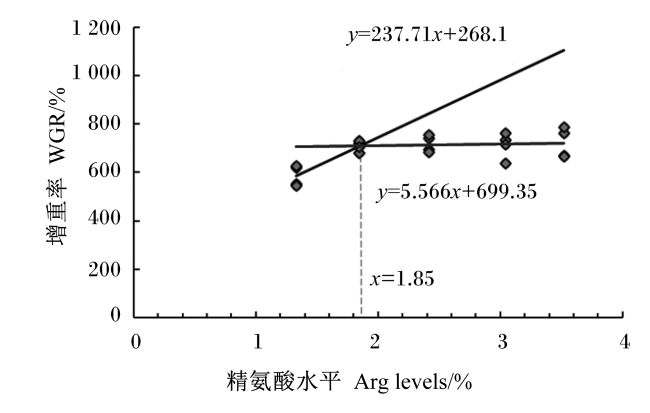
表3可知,各组间SR、FI、HSI和VSI均无显著差异(P>0.05)。与C0组相比,各Arg添加组WGR均显著提高(P<0.05),FCR均显著降低(P<0.05);C1.2、C1.8和C2.4组CF显著提高(P<0.05);C1.8和C2.4组PER显著提高(P<0.05)。基于WGR的折线回归分析(图1)表明, 松浦镜鲤幼鱼的最佳Arg需要量为饲料干物质的1.85%,饲料蛋白质的5.53%。
表3 Arg对松浦镜鲤幼鱼生长性能的影响

Table 3 Effects of Arg on growth performance of juvenile Songpu mirror carp

项目
Items
组别Groups
C0 C0.6 C1.2 C1.8 C2.4
存活率SR/% 98.61±2.78 98.61±2.78 100.00±0.00 100.00±0.00 98.61±2.78
增重率WGR/% 584.26±43.29a 707.87±21.13b 717.57±65.46b 711.59±54.34b 720.66±30.59b
蛋白质效率PER 1.93±0.11a 2.36±0.17ab 2.34±0.14ab 2.54±0.27b 2.66±0.53b
饲料系数FCR 1.62±0.09b 1.32±0.10a 1.35±0.12a 1.23±0.14a 1.20±0.26a
摄食量FI/(g/d) 1.14±0.03 1.14±0.08 1.17±0.17 1.06±0.05 1.03±0.03
肥满度CF/(g/cm3) 3.58±0.09a 3.79±0.14ab 3.98±0.35b 4.06±0.10b 4.15±0.21b
肝体指数HSI/% 2.54±0.33 2.54±0.39 2.18±0.06 2.47±0.33 2.03±0.42
脏体指数VSI/% 7.81±0.33 8.25±0.46 7.84±0.34 7.94±0.35 7.78±0.57

同行数据肩标无字母或相同字母表示差异不显著(P>0.05),不同小写字母表示差异显著(P<0.05)。下表同。

In the same row, values with no letter or the same letter superscripts mean no significant difference (P>0.05), while with different small letter superscripts mean significant difference (P<0.05). The same as below.

图1 基于WGR的折线回归分析

Fig.1 Broken line regression analysis based on WGR

表4可知,C1.2和C1.8组全鱼粗灰分含量显著高于其他各组(P<0.05);各组间全鱼水分、粗脂肪、粗蛋白质含量均无显著差异(P>0.05)。
表4 Arg对松浦镜鲤幼鱼全鱼体成分的影响

Table 4 Effects of Arg on whole body composition of juvenile Songpu mirror carp %

项目
Items
组别Groups
C0 C0.6 C1.2 C1.8 C2.4
水分Moisture 73.69±1.36 72.06±1.01 72.55±0.68 72.66±1.58 72.52±1.38
粗脂肪EE 8.73±1.25 10.24±0.89 9.34±0.62 9.22±1.53 8.56±0.49
粗蛋白质CP 14.22±0.45 14.43±0.41 15.05±0.57 14.95±0.49 14.80±1.50
粗灰分Ash 3.47±0.21a 3.83±0.17a 4.54±0.22b 4.80±0.62b 3.33±0.31a

2.2 Arg对松浦镜鲤幼鱼血清生化指标的影响

表5可知,各组间血清TP、ALB、GLB和LDL-C含量及ALT、AST活性均无显著差异(P>0.05)。与C0组相比,C1.2、C1.8和C2.4组血清TG含量显著降低(P<0.05);C2.4组血清T-CHO和HDL-C含量显著降低(P<0.05)。
表5 Arg对松浦镜鲤幼鱼血清生化指标的影响

Table 5 Effects of Arg on serum biochemical indices of juvenile Songpu mirror carp

项目
Items
组别Groups
C0 C0.6 C1.2 C1.8 C2.4
总蛋白TP/(g/L) 31.35±3.25 29.25±3.63 25.10±4.68 26.48±5.34 25.60±4.78
白蛋白ALB/(g/L) 16.65±1.42 16.38±2.02 13.70±2.20 13.93±2.46 14.17±1.74
球蛋白GLB/(g/L) 14.70±2.03 12.88±1.66 11.40±2.49 12.55±2.99 12.33±2.62
谷丙转氨酶ALT/(U/L) 28.00±5.77 25.50±5.00 25.00±5.42 27.75±6.13 25.50±5.69
谷草转氨酶AST/(U/L) 413.75±66.16 472.75±123.11 523.33±175.02 575.75±151.86 508.67±66.43
甘油三酯TG/(mmol/L) 2.68±0.44b 2.15±0.37ab 1.57±0.37a 1.86±0.45a 1.77±0.63a
总胆固醇T-CHO/(mmol/L) 5.07±0.97b 4.74±1.14b 4.32±0.34ab 4.24±1.02ab 3.26±0.71a
高密度脂蛋白胆固醇
HDL-C/(mmol/L)
2.01±0.36b 1.82±0.15b 1.75±0.20b 1.84±0.21b 1.30±0.18a
低密度脂蛋白胆固醇
LDL-C/(mmol/L)
0.81±0.18 0.70±0.05 0.82±0.31 0.69±0.24 0.55±0.26

2.3 Arg对松浦镜鲤幼鱼肝脏糖代谢相关酶活性的影响

表6可知,各组间肝脏PK和PEPCK活性均无显著差异(P>0.05)。C2.4组肝脏GK和GSK3β活性显著高于其他各组(P<0.05),肝脏PFK活性显著低于其他各组(P<0.05)。与C0组相比,C1.2和C1.8组肝脏HK活性显著提高(P<0.05);C1.8和C2.4组肝脏PFKFB2活性显著提高(P<0.05)。
表6 Arg对松浦镜鲤幼鱼肝脏糖代谢相关酶活性的影响

Table 6 Effects of Arg on activities of enzymes related to glucose metabolism in liver of juvenile Songpu mirror carp

项目
Items
组别Groups
C0 C0.6 C1.2 C1.8 C2.4
葡萄糖激酶GK/(U/g prot) 104.06±13.19a 116.44±16.72a 109.07±11.94a 135.81±12.93a 208.33±48.97b
己糖激酶HK/(U/mg prot) 25.84±8.32a 34.80±7.33ab 42.25±5.50b 42.41±15.77b 36.26±11.48ab
丙酮酸激酶PK/(U/g prot) 32.10±2.16 37.07±3.34 36.85±6.33 35.64±3.33 41.07±0.42
磷酸烯醇式丙酮酸羧激酶
PEPCK/(U/mg prot)
385.83±83.69 554.63±113.21 407.27±46.71 498.38±22.93 596.63±166.84
磷酸果糖激酶
PFK/(U/mg prot)
4 032.01±540.94b 4 086.57±247.16b 4 230.24±388.25b 4 404.38±132.90b 3 237.75±760.49a
糖原合成酶激酶3β
GSK3β/(U/mg prot)
15.61±1.75a 19.88±3.67a 19.02±2.47a 18.01±1.70a 27.86±5.17b
6-磷酸果糖-2-激酶/
果糖-2,6-二磷酸酶2
PFKFB2/(U/mg prot)
23.60±4.29a 25.70±2.02ab 28.29±4.14ab 30.72±6.30b 30.49±2.50b

2.4 Arg对松浦镜鲤幼鱼肝脏PI3K/AKT信号通路糖代谢关键因子含量的影响

表7可知,与C0组相比,C1.2、C1.8和C2.4组肝脏IR、PI3K、AKT、GLUT2和GLUT4含量显著提高(P<0.05);C1.2组肝脏p-AKT含量显著提高(P<0.05)。
表7 Arg对松浦镜鲤幼鱼肝脏PI3K/AKT信号通路糖代谢关键因子含量的影响

Table 7 Effects of Arg on contents of key glucose metabolism factors in PI3K/AKT signaling pathway in liver of juvenile Songpu mirror carp

项目
Items
组别Groups
C0 C0.6 C1.2 C1.8 C2.4
胰岛素受体IR/(pg/mL) 386.75±88.82a 387.38±129.06a 606.97±125.14b 703.35±118.79b 681.01±73.27b
磷脂酰肌醇-3-激酶
PI3K/(pg/mL)
218.49±48.37a 271.98±19.80a 338.83±51.20b 373.21±41.13b 367.80±17.19b
蛋白激酶B AKT/(μmol/L) 16.63±2.43a 17.97±2.26ab 24.62±3.12c 22.86±4.04bc 21.96±4.01bc
磷酸化蛋白激酶B
p-AKT/(μmol/L)
9.45±0.76a 10.29±1.33ab 12.54±0.69b 11.14±2.06ab 11.13±2.11ab
葡萄糖转运蛋白2
GLUT2/(ng/mL)
20.45±1.39a 23.02±4.04ab 26.87±4.32b 29.59±3.84c 28.40±4.39b
葡萄糖转运蛋白4
GLUT4/(ng/mL)
29.65±3.90a 31.87±3.59ab 37.71±4.63b 39.05±5.64b 41.23±5.11b

2.5 Arg对松浦镜鲤幼鱼肝脏PI3K/AKT信号通路糖代谢相关基因表达的影响
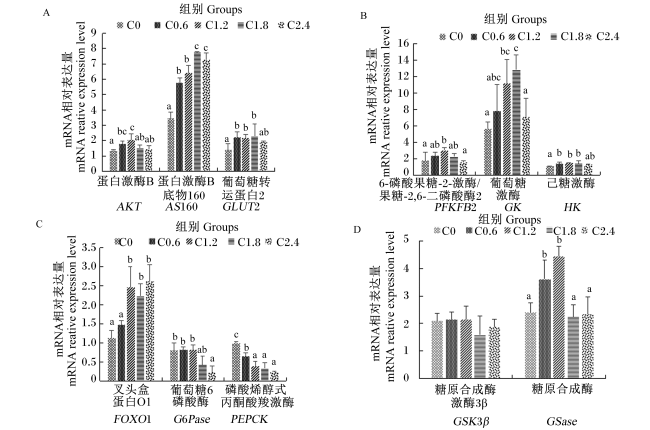
图2-A可知,与C0组相比,C0.6和C1.2组肝脏AKT的mRNA相对表达量显著提高(P<0.05);各Arg添加组肝脏AS160的mRNA相对表达量均显著提高(P<0.05);C0.6、C1.2和C1.8组肝脏GLUT2的mRNA相对表达量显著提高(P<0.05)。由图2-B可知,与C0组相比,C1.2组肝脏PFKFB2的mRNA相对表达量显著提高(P<0.05);C1.2和C1.8组肝脏GK的mRNA相对表达量均显著提高(P<0.05);C0.6、C1.2和C1.8组肝脏HK的mRNA相对表达量均显著提高(P<0.05)。由图2-C可知,C1.2、C1.8和C2.4组肝脏FOXO1的mRNA相对表达量显著高于C0和C0.6组(P<0.05)。与C0组相比,C2.4组肝脏G6Pase的mRNA相对表达量显著降低(P<0.05);各Arg添加组肝脏PEPCK的mRNA相对表达量均显著降低(P<0.05)。由图2-D可知,各组间肝脏GSK3β的mRNA相对表达量无显著差异(P>0.05),C0.6和C1.2组肝脏GSase的mRNA相对表达量显著高于其他各组(P<0.05)。
图2 Arg对松浦镜鲤幼鱼肝脏PI3K/AKT信号通路糖代谢相关基因表达的影响

A:葡萄糖转运相关基因;B:糖酵解相关基因;C:糖异生相关基因;D:糖原合成相关基因。数据柱形标注不同小写字母表示差异显著(P<0.05)。

Fig.2 Effects of Arg on expression of genes related to glucose metabolism in PI3K/AKT signaling pathway in liver of juvenile Songpu mirror carp

A: genes related to glucose transport; B: genes related to glycolysis; C: genes related to gluconeogenesis; D: genes related to glycogen synthesis. Value columns with different small letters mean significant difference (P<0.05).

3 讨论

已有大量研究表明,Arg可以提高鱼类的WGR和PER,降低FCR[15-17]。不同鱼类基于生长性能对Arg的需要量存在明显差异,范围为饲料干物质的1.29%~3.05%,饲料蛋白质的3.97%~8.10%,其中杂食性鱼类的需要量较低,而肉食性鱼类的需要量较高[4]。本试验中,饲料中添加0.6%~2.4% Arg显著增加了松浦镜鲤幼鱼的WGR,并显著降低了FCR。基于WGR的折线回归分析表明,松浦镜鲤幼鱼对Arg的需要量为饲料干物质的1.85%,饲料蛋白质的5.53%。这一结果与鲤科鱼类对Arg的需要量相似。Tu等[18]基于SGR的折线回归分析表明,初始体重为51.6 g的异育银鲫(Carassis auratus gibelio var. CAS Ⅲ)对Arg的需要量为饲料蛋白质的5.29%。Chen等[19]基于SGR的二次回归分析表明,初始体重为6.3 g的建鲤(Cyprinus carpio var.Jian)对Arg的需要量为饲料蛋白质的5.50%。Zehra等[20]基于绝对增重(AWG)的二次回归分析表明,初始体重为0.6 g的卡特拉鱼(Catla catla)对Arg的需要量为饲料蛋白质的5.10%。本试验结果还表明,饲料Arg添加水平显著影响了松浦镜鲤幼鱼的CF,这与在虹鳟(Oncorhynchus mykiss)上所得的研究结果一致[21]。此外,松浦镜鲤幼鱼鱼体Ash含量随饲料Arg添加量的增加呈现先上升后下降的趋势,这与在青石斑鱼(Epinephelus awoara)[22]和麦瑞加拉鲮(Cirrhinus mrigala)[23]上所得的研究结果一致。
血清生化指标是反映鱼类营养、代谢和健康状况的重要依据[24]。本试验中,与C0组相比,饲料中添加0.6%~2.4% Arg降低了松镜鲤幼鱼血清中TG、T-CHO和HDL-C含量,且在添加水平为2.4%时上述各指标显著降低。T-CHO和TG含量通常受蛋白质、碳水化合物和脂质代谢的影响,可用于评估肝功能[25]。其中,TG是鱼类细胞中脂肪的主要储存形式,也是代谢过程中的主要产物[26-27]。T-CHO参与动物体内细胞膜、胆汁、维生素D和激素的合成,其含量在一定程度上可以反映体内脂肪代谢的状况。鱼类能够自身合成胆固醇,其血液中的胆固醇主要来源于肝脏,部分来源于消化道。当肝细胞功能受损时,血液中的胆固醇含量会迅速升高。本试验结果表明,Arg具有调节血脂的作用,可能对肝功能具有保护作用,这与在哺乳动物上所得的研究结果一致[28]
在包括人类在内的哺乳动物研究中,Arg被证明可以增强胰岛素敏感性并刺激胰岛素的产生[29]。Carvalho等[30]研究表明,补充Arg可以通过激活AKT改善糖尿病大鼠后代的胰岛素敏感性。胰岛素是动物体内调节糖代谢的关键激素,可通过激活胰岛素信号通路,调控一系列糖代谢相关酶的活性和基因的表达。在胰岛素信号通路中,AKT是一个重要的信使因子,它可以激活PI3K/AKT信号通路下游与糖代谢相关的重要底物。Liang等[8]在对团头鲂(Megalobrama amblycephala)幼鱼的研究中发现,当饲料Arg水平为2.31%时,胰岛素信号通路中胰岛素受体底物1(IRS-1)、PI3KAKT的mRNA相对表达量提高,而当饲料Arg水平为2.70%时,这些基因的表达受到抑制。在杂交乌鳢(Channa maculata ♀×Channa argus ♂ )和鲤鱼幼鱼的研究中均发现,高糖饲料中添加Arg显著提高了AKT基因的表达[14,31-32]。在本试验中,饲料中Arg添加水平显著影响了松浦镜鲤幼鱼肝脏IR、PI3K、AKT、p-AKT含量和AKT的mRNA相对表达量。这一结果表明,Arg通过激活胰岛素信号通路增强了机体对胰岛素的敏感性。
AS160是AKT下游的重要底物之一,能够促进GLUT的易位[33],本试验结果表明,饲料中添加0.6%~2.4% Arg提高了松浦镜鲤幼鱼肝脏AS160和GLUT2的mRNA相对表达量,同时肝脏GLUT2和GLUT4含量也有所提高,这与在大西洋鲑鱼(Salmo salar)[34]和鲤鱼[14]上所得的研究结果相似。在虹鳟的研究中发现,Arg是虹鳟体内胰岛素和胰高血糖素释放的有效刺激因子[11]。有报道指出,长期注射胰岛素会提高虹鳟肝脏中GLUT基因的表达,同时减少葡萄糖的产生[35]。本研究证实,Arg可通过激活胰岛素信号通路上AS160和GLUT2的表达以调节葡萄糖的吸收。PFK是糖酵解过程中重要的限速酶,其家族包含4种同工酶(PFKFB1、PFKFB2、PFKFB3和PFKFB4),可促进糖酵解相关酶GKHKPK基因的表达。本试验中,饲料中添加1.2% Arg显著提高了松浦镜鲤幼鱼肝脏PFKFB2的mRNA相对表达量,添加1.2%和1.8% Arg显著提高了肝脏GK的mRNA相对表达量,添加0.6%~1.8% Arg显著提高了肝脏HK的mRNA相对表达量,这与在杂交乌鳢[31]和鲤鱼[14]上所得的研究结果相似。综上所述,Arg可通过提高松浦镜鲤幼鱼肝脏糖酵解基因的表达,提升肝脏糖代谢效率,从而促进鱼类对饲料中糖类物质的利用。
PI3K/AKT信号通路中FOXO1的表达可抑制糖异生相关基因PEPCKG6Pase的表达,从而调控糖异生作用。在本试验中,添加1.2%~2.4% Arg显著提高了松浦镜鲤幼鱼肝脏FOXO1的表达,添加2.4% Arg显著抑制了G6Pase的表达以及添加0.6%~2.4% Arg显著抑制了PEPCK的表达,说明饲料中适量添加Arg可以抑制糖异生,这与在哺乳动物[36]和鲤鱼[14]上所得的研究结果一致;但Liang等[8]对团头鲂的研究表明,摄食Arg水平为2.7%的饲料会促进其肝脏G6PasePEPCK的表达,诱导胰岛素抵抗,从而导致血糖升高。目前,Arg对鱼类糖异生作用的影响机制仍不明确,可能与Arg添加水平及鱼类物种差异相关,需进一步深入探究。
糖原合成激酶(GSK)被认为是通过调节糖原合成速率来维持葡萄糖稳态的关键酶。其中,GSK3β可磷酸化GSase,使其活性降低,从而抑制糖原的合成;而当AKT被激活后,它可磷酸化GSK3β的特定残基,使其活性受到抑制,进而提升GSase活性,促进糖原合成,实现多余糖类的储存[37]。哺乳动物细胞试验表明,经Arg处理的大鼠L6肌细胞中糖原合成显著增加[38],在本试验中,饲料中添加0.6%和1.2% Arg可通过上调松浦镜鲤幼鱼肝脏GSase基因的表达,调节机体对糖类物质的利用。

4 结论

综上所述,饲料中添加0.6%~2.4% Arg可显著提高松浦镜鲤幼鱼的生长性能,并可通过调控PI3K/AKT信号通路中糖代谢相关基因的表达,促进肝脏糖代谢,从而提高松浦镜鲤幼鱼对饲料中糖类物质的利用。
[1]
HAN F L, CHI S Y, TAN B P, et al. Metabolic and immune effects of orange-spotted grouper,Epinephelus coioides induced by dietary arginine[J]. Aquaculture Reports, 2018,10:8-16.

[2]
ZHENG H, GUO Q, DUAN X, et al. L-arginine inhibited apoptosis of fish leukocytes via regulation of NF-κB-mediated inflammation,NO synthesis,and antioxidant capacity[J]. Biochimie, 2019,158:62-72.

[3]
LIANG H L, REN M C, HABTE-TSION H M, et al. Dietary arginine affects growth performance,plasma amino acid contents and gene expressions of the TOR signaling pathway in juvenile blunt snout bream,Megalobrama amblycephala[J]. Aquaculture, 2016,461:1-8.

[4]
WANG Q C, XU Z, AI Q H. Arginine metabolism and its functions in growth,nutrient utilization,and immunonutrition of fish[J]. Animal Nutrition, 2021, 7(3):716-727.

[5]
HOSEINI S M, AHMAD KHAN M, YOUSEFI M, et al. Roles of arginine in fish nutrition and health:insights for future researches[J]. Reviews in Aquaculture, 2020, 12(4):2091-2108.

[6]
LI J N, WANG C A, WANG L S, et al. Effects of glutamate in low-phosphorus diets on growth performance,antioxidant enzyme activity,immune-related gene expression and resistance to Aeromonas hydrophila of juvenile mirror carp (Cyprinus carpio)[J]. Aquaculture Nutrition, 2020, 26(4):1329-1339.

[7]
FORZANO I, AVVISATO R, VARZIDEH F, et al. L-arginine in diabetes:clinical and preclinical evidence[J]. Cardiovascular Diabetology, 2023, 22(1):89.

[8]
LIANG H L, HABTE-TSION H M, GE X P, et al. Dietary arginine affects the insulin signaling pathway,glucose metabolism and lipogenesis in juvenile blunt snout bream Megalobrama amblycephala[J]. Scientific Reports, 2017, 7(1):7864.

[9]
CLEMMENSEN C, MADSEN A N, SMAJILOVIC S, et al. L-arginine improves multiple physiological parameters in mice exposed to diet-induced metabolic disturbances[J]. Amino Acids, 2012, 43(3):1265-1275.

DOI PMID

[10]
ANDERSEN S M, WAAGBØ R, ESPE M. Functional amino acids in fish nutrition,health and welfare[J]. Frontiers in Bioscience, 2016, 8(1):143-169.

[11]
MOMMSEN T P, MOON T W, PLISETSKAYA E M. Effects of arginine on pancreatic hormones and hepatic metabolism in rainbow trout[J]. Physiological and Biochemical Zoology, 2001, 74(5):668-678.

DOI PMID

[12]
GAO Y D, WU Y, TIE F F, et al. Stilbenoids from fenugreek seeds alleviate insulin resistance by regulating the PI3K/AKT/mTOR signaling pathway in a type 2 diabetes zebrafish model[J]. Heliyon, 2024, 10(13):e32007.

[13]
李晋南, 张圆圆, 范泽, 等. 饲料精氨酸水平对松浦镜鲤幼鱼生长、抗氧化能力和肠道消化酶活性及其组织学结构的影响[J]. 水产学杂志, 2021, 34(5):32-39.

LI J N, ZHANG Y Y, FAN Z, et al. Effects of dietary arginine level on growth,antioxidant capacity,and intestinal digestive enzyme activity and histological structure in juvenile Songpu mirror carp (Cyprinus carpio Songpu)[J]. Chinese Journal of Fisheries, 2021, 34(5):32-39. (in Chinese)

[14]
LI J N, FAN Z, WU D, et al. Effects of arginine supplementation in high-carbohydrate diets on the growth,hematological parameters,and hepatic and skeletal muscle glucose metabolism of juvenile mirror carp (Cyprinus carpio) based on PI3K/AKT signaling pathway[J].Aquaculture Reports, 2024,39:102409.

[15]
FAUZI I A, HAGA Y, KONDO H, et al. Effects of arginine supplementation on growth performance and plasma arginine,ornithine and citrulline dynamics of rainbow trout,Oncorhynchus mykiss[J]. Aquaculture Research, 2019, 50(4):1277-1290.

[16]
LUO Z, LIU Y J, MAI K S, et al. Effects of dietary arginine levels on growth performance and body composition of juvenile grouper Epinephelus coioides[J]. Journal of Applied Ichthyology, 2007, 23(3):252-257.

[17]
CHENG Z Y, BUENTELLO A, GATLIN D M. Effects of dietary arginine and glutamine on growth performance,immune responses and intestinal structure of red drum,Sciaenops ocellatus[J]. Aquaculture, 2011, 319(1/2):247-252.

[18]
TU Y Q, XIE S Q, HAN D, et al. Dietary arginine requirement for gibel carp (Carassis auratus gibelio var. CAS Ⅲ) reduces with fish size from 50 g to 150 g associated with modulation of genes involved in TOR signaling pathway[J]. Aquaculture, 2015,449:37-47.

[19]
CHEN G F, FENG L, KUANG S Y, et al. Effect of dietary arginine on growth,intestinal enzyme activities and gene expression in muscle,hepatopancreas and intestine of juvenile Jian carp (Cyprinus carpio var. Jian)[J]. British Journal of Nutrition, 2012, 108(2):195-207.

[20]
ZEHRA S, KHAN M A. Dietary arginine requirement of fingerling Indian major carp,Catla catla (Hamilton)[J]. Journal of the World Aquaculture Society, 2013, 44(3):363-373.

[21]
WANG Y L, WANG C, LIU S Y, et al. Effects of dietary arginine on growth performance,digestion,absorption ability,antioxidant capability,gene expression of intestinal protein synthesis,and inflammation-related genes of triploid juvenile Oncorhynchus mykiss fed a low-fishmeal diet[J]. Aquaculture Nutrition, 2022, 2022(1):3793727.

[22]
ZHOU Q C, ZENG W P, WANG H L, et al. Dietary arginine requirement of juvenile yellow grouper Epinephelus awoara[J]. Aquaculture, 2012,350/353:175-182.

[23]
AHMED I, KHAN M A. Dietary arginine requirement of fingerling Indian major carp,Cirrhinus mrigala(Hamilton)[J]. Aquaculture Nutrition, 2004, 10(4):217-225.

[24]
FAN Z, WANG L S, LI J N, et al. Momordica charantia saponins administration in low-protein-high-carbohydrate diet improves growth,blood biochemical,intestinal health and microflora composition of juvenile common carp (Cyprinus carpio)[J]. Fish & Shellfish Immunology, 2023,140:108980.

[25]
KHANZADEH M, HOSEINIFAR S H, BEIKZADEH B. Investigating the effect of hydroalcoholic extract of red algae (Laurencia caspica) on growth performance,mucosal immunity,digestive enzyme activity and resistance to Streptococcus iniae and Aeromonas hydrophila in Nile tilapia (Oreochromis niloticus)[J]. Aquaculture Reports, 2024,35:101984.

[26]
WANG L S, WU J G, WANG C A, et al. Dietary arginine requirement of juvenile hybrid sturgeon(Acipenser schrenckii ♀×Acipenser baerii ♂)[J]. Aquaculture Research, 2017,48:5193-5201.

[27]
ANDENEN D E, REID S D, MOON T W, et al. Metabolic effects associated with chronically elevated cortisol in rainbow trout (Oncorhynchus mykiss)[J]. Canadian Journal of Fisheries & Aquatic Sciences, 1992, 48(9):1811-1817.

[28]
HU S D, LI X L, REZAEI R, et al. Safety of long-term dietary supplementation with L-arginine in pigs[J]. Amino Acids, 2015, 47(5):925-936.

[29]
MCKNIGHT J R, SATTERFFELD M C, JOBGEN W S, et al. Beneffcial effects of L-arginine on reducing obesity:potential mechanisms and important implications for human health[J]. Amino Acids, 2010, 39(2):349-357.

[30]
CARVALHO D S, DINIZ M M, HAIDAR A A, et al. L-arginine supplementation improves insulin sensitivity and beta cell function in the offspring of diabetic rats through AKT and PDX-1 activation[J]. European Journal of Pharmacology, 2016,791:780-787.

[31]
ZHAO H X, LI P J, PENG K, et al. The positive effects of dietary arginine on juvenile hybrid snakehead (Channa maculata ♀×Channa Argus♂) fed high-carbohydrate diets:liver inflammation antioxidant response,and glucose metabolism[J]. Aquaculture Reports, 2023,30:101602.

[32]
李培佳, 陈冰, 李敏, 等. 高碳水化合物饲料添加精氨酸对杂交鳢的生长性能、抗氧化酶活性、肝脏免疫反应及糖代谢相关基因的影响[J]. 水产学报, 2024, 48(8):089615.

LI P J, CHEN B, LI M, et al. Effects of high carbohydrate diets supplemented with arginine on growth performance,antioxidant activity,immune response and genes related to glucose metabolism in hybrid snakehead [Channa maculata (♀)×C.Argus (♂)][J]. Journal of Fisheries of China, 2024, 48(8):089615. (in Chinese)

[33]
WANG Z F, CAO Y K, YIN Q, et al. Activation of AMPK alleviates cardiopulmonary bypass-induced cardiac injury via ameliorating acute cardiac glucose metabolic disorder[J]. Cardiovascular Therapeutics, 2018, 36(6):e12482.

[34]
ANDERSEN S M, TAYLOR R, HOLEN E, et al. Arginine supplementation and exposure time affects polyamine and glucose metabolism in primary liver cells isolated from Atlantic salmon[J]. Amino Acids, 2014, 46(5):1225-1233.

DOI PMID

[35]
POLAKOF S, SKIBA-CASSY S, CHOUBERT G, et al. Insulin-induced hypoglycaemia is co-ordinately regulated by liver and muscle during acute and chronic insulin stimulation in rainbow trout (Oncorhynchus mykiss)[J]. Journal of Experimental Biology, 2010, 213(Pt 9):1443-1452.

[36]
LUO K J, CHEN P Y, LI S P, et al. Effect of L-arginine supplementation on the hepatic phosphatidylinositol 3-kinase signaling pathway and gluconeogenic enzymes in early intrauterine growth-restricted rats[J]. Experimental and Therapeutic Medicine, 2017, 14(3):2355-2360.

[37]
MARR L, BISWAS D, DALY L A, et al. Mechanism of glycogen synthase inactivation and interaction with glycogenin[J]. Nature Communications, 2022, 13(1):3372.

DOI PMID

[38]
DE CASTRO BARBOSA T, JIANG L Q, ZIERATH J R, et al. L-arginine enhances glucose and lipid metabolism in rat L6 myotubes via the NO/c-GMP pathway[J]. Metabolism, 2013, 62(1):79-89.

Outlines

/