RESEARCH PAPER

Effects of Stocking Density on Growth Performance, Digestive Capacity and Muscle Nutrients of Penaeus monodon under Low-Salinity Condition

  • XU Jinzhen , 1 ,
  • YU Hanxiu 1 ,
  • TANG Hainan 1 ,
  • LI Jinxin 1 ,
  • HUANG Yongchun , 1, * ,
  • CAI Zhangyin 2 ,
  • YU Mingchao 3
Expand
  • 1 College of Fisheries, Jimei University, Xiamen 361021, China
  • 2 Longhai Shunyuan Aquatic Technology Co., Ltd., Longhai 363100, China
  • 3 Qingdao Hairen Aquatic Breeding Industry Technology Co., Ltd., Qingdao 266200, China
* professor, E-mail:

Received date: 2025-01-23

  Online published: 2025-09-12

Abstract

This experiment was conducted to explore the effects of different stocking densities on growth performance, digestive capacity and muscle nutrients of Penaeus monodon under low-salinity condition, and determine the appropriate stocking density. A total of 250 healthy Penaeus monodon with an average body weight of (3.02±0.30) g and an average body length of (5.88±0.52) cm were selected. The water salinity was set at (4.5±0.5) ‰, and five stocking densities were set, that was, each 6, 9, 12, 15 and 18 shrimps were raised in an experimental tank (with a water volume of 0.12 m3, 80 cm×50 cm×30 cm), corresponding to the stocking densities of 45, 70, 95, 120 and 145 shrimps/m3, which were labeled as M45, M70, M95, M120 and M145 groups, respectively. Three parallel tanks were set up for each stocking density. The experiment lasted for 42 days. The results showed as follows: 1) the final body weight, weight gain rate and specific growth rate in M45, M70 and M95 groups were significantly higher than those in M120 and M145 groups (P<0.05), and the feeding rate was significantly lower than that in M145 group (P<0.05); the survival rate in M45 and M70 groups was significantly higher than that in the other groups (P<0.05), the condition factor was significantly higher than that in M95 and M120 groups (P<0.05), the protein efficiency ratio was significantly higher than that in M120 and M145 groups (P<0.05), and the feed coefficient was significantly lower than that in M120 and M145 groups (P<0.05). 2) The amylase activity in hepatopancreas in M45 and M70 groups was significantly higher than that in the other groups (P<0.05); the activities of trypsin and lipase in hepatopancreas in M70 group were significantly higher than those in the other groups (P<0.05), and the mRNA relative expression levels of α-amylase, trypsin 1 and lipase maturation factor 2 (LMF2) in hepatopancreas were significantly higher than those in the other groups (P<0.05). 3) The crude protein content in muscle in M70 and M120 groups was significantly higher than that in the other groups (P<0.05), the crude ash content in muscle in M70 group was significantly lower than that in the other groups (P<0.05), and the moisture content in muscle in M145 group was significantly higher than that in the other groups (P<0.05). 4) Except for cystine and alanine, the contents of various amino acids, delicious amino acids, sweet amino acids, essential amino acids, non-essential amino acids and total amino acids in muscle in M145 group were significantly lower than those in the other groups (P<0.05). The essential amino acid index (EAAI) in muscle in each group ranged from 61.33% to 75.61%, among which M70 group had the highest index. Taking amino acid score (AAS) and chemical score (CS) as evaluation indices, valine was the main limiting amino acid in muscle. 5) The total saturated fatty acid content in muscle in M70 and M95 groups was significantly higher than that in the other groups (P<0.05), the total monounsaturated fatty acid content in muscle in M145 group was significantly higher than that in the other groups (P<0.05), the total polyunsaturated fatty acid content in muscle in M45 and M70 groups was significantly higher than that in M95 group (P<0.05), and the eicosapentaenoic acid (EPA)+docosahexaenoic acid (DHA) content in muscle in M70 group was significantly higher than that in M95 and M145 groups (P<0.05). The polyene index (PI) in muscle in M45 group was significantly higher than that in the other groups except M120 group (P<0.05). The index of atherogenicity (IA, 0.37 to 0.44) and index of thrombogenicity (IT, 0.38 to 0.46) in muscle in each group were all lower than the safe value (1.00). In conclusion, the stocking density of ≤70 shrimps/m3 under low-salinity condition is favorable to promote the growth of Penaeus monodon, improve the digestive capacity, and have a high food value.

Cite this article

XU Jinzhen , YU Hanxiu , TANG Hainan , LI Jinxin , HUANG Yongchun , CAI Zhangyin , YU Mingchao . Effects of Stocking Density on Growth Performance, Digestive Capacity and Muscle Nutrients of Penaeus monodon under Low-Salinity Condition[J]. Chinese Journal of Animal Nutrition, 2025 , 37(9) : 6210 -6227 . DOI: 10.12418/CJAN2025.504

斑节对虾(Penaeus monodon)中的金刚虾来自非洲海域,隶属于节肢动物门(Arthropoda)、甲壳纲(Crustacea)、十足目(Decapoda)、对虾科(Penaeidae)、对虾属(Penaeus)[1],自2008年引入以来,因其具有成活率高、肉质紧实和经济效益高等特点,逐渐成为我国主养对虾品种之一[2]
盐度是调控水产动物生长发育的关键要素之一,其主要通过调节养殖生物体内的渗透压,对生物体的生理活动产生显著影响,进而作用于其新陈代谢、生长速率、肌肉风味和整体健康状况[3-5]。目前,脊尾白虾(Exopalaemon carinicauda)[3]、凡纳滨对虾(Litopenaeus vannamei)[6-7]、中国明对虾(Fenneropenaeus chinensis)[8]、日本对虾(Penaeus japonicus)[9]、中华绒螯蟹(Eriocheir sinensis)[10]和拟穴青蟹(Scylla paramamosain)[11]等养殖品种有在不同盐度环境中生存能力的研究报道。斑节对虾作为一种广盐性(适宜盐度2‰~30‰)对虾[12],多见于高盐条件下的养殖研究[1,13-16],而有关其低盐条件下相关研究尚未见报道。
现有研究表明,养殖密度对罗氏沼虾(Macrobrachium rosenbergii)[17-18]、克氏原螯虾(Procambarus clarkii)[19]、凡纳滨对虾[20-21]、大黄鱼(Larimichthys crocea)[22-23]、刀鲚(Coilia nasus)[24-25]、黄颡鱼(Pelteobagrus fulvidraco)[26-27]、中国明对虾[28-29]和日本对虾[30]等养殖品种的生长性能、抗病能力和肠道菌群等指标产生影响。养殖密度过高会导致养殖生物生长速度减缓、规格不一、饲料利用率下降[31-32],肌肉营养成分发生改变[33],严重时还可能提高病害发生率,破坏水体生态环境[34];而养殖密度过低可能造成空间和水土资源的浪费,降低经济效益,同时因缺乏竞争而影响生物的正常生长[32,34-35]。由此可见,合理的养殖密度有助于水产动物的正常生长,优化生产效能。
基于此,本研究旨在综合分析在低盐条件下不同养殖密度对斑节对虾生长性能、消化能力和肌肉营养成分的影响,探究低盐条件下的适宜养殖密度,为扩大斑节对虾的养殖领域、提高养殖经济效益以及低盐健康养殖提供科学依据。

1 材料与方法

1.1 试验设计和饲养管理

本试验经集美大学水产学院实验动物伦理委员会批准(批准号:2021-04)。选取250尾活力好、健康无损伤的斑节对虾[平均体重为(3.02±0.30) g,平均体长为(5.88±0.52) cm]于圆桶(容量1 500 L,下直径140 cm,上直径160 cm,高度92 cm)中暂养5 d。根据斑节对虾养殖生物学特性和福建省斑节对虾低盐池塘放养密度的生产情况,水体盐度保持在(4.5±0.5)‰,并设置5个养殖密度,即在试验缸(水体体积0.12 m3,80 cm×50 cm×30 cm)中分别放养6、9、12、15和18尾对虾,对应养殖密度为45、70、95、120和145尾/m3,分别为M45组、M70组、M95组、M120组和M145组,每个养殖密度设置3个平行缸。试验期42 d。
饲料投喂量为斑节对虾体重的3%~5%(饲料为商品配合饲料,其主要成分见表1),每日投喂4次(07:00—07:30、12:00—12:30、17:00—17:30和22:00—22:30各1次),2 h抽污1次,每2 d换水1次,换水量为1/3;水体持续充氧,氨氮含量≤0.2 mg/L,亚硝酸盐含量≤0.05 mg/L,溶氧量≥5.0 mg/L,pH维持在7.8~8.5。
表1 商品配合饲料主要成分(饲喂基础)

Table 1 Main components of commercial compound diet (as-fed basis) %

项目
Item
粗蛋白质
CP
粗脂肪
EE
粗纤维
CF
粗灰分
Ash
总磷
TP
赖氨酸
Lys
水分
Moisture
含量Content ≥46.0 ≥6.0 ≤5.0 ≤15.0 1.0~3.0 ≥2.7 ≤12.0

1.2 样品采集

养殖试验结束后,将斑节对虾禁食24 h,每缸随机抽取5尾斑节对虾,测量体长、体重和肝胰腺重,用于生长性能相关指标的计算;采集肝胰腺,置于液氮速冻后保存于-80 ℃超低温冷冻冰箱(MDF-86V728E,安徽中科都菱商用电器股份有限公司),用于测定消化酶活性和消化能力相关基因表达量;将斑节对虾甲壳和肌肉分离,肌肉暂存于-40 ℃冰箱(DW-FL270,中科美菱低温科技股份有限公司)中,用于肌肉营养成分的测定。

1.3 指标测定及方法

1.3.1 生长性能

生长性能相关指标计算公式如下:
存活率(SR,%)=100×终末尾数/初始尾数;
增重率(WGR,%)=100×(终末体重-初始体重)/初始体重;
特定生长率(SGR,%/d)=100×(ln终末体重-ln初始体重)/饲养天数;
肥满度(CF,g/cm3)=100×终末体重/终末体长3;
肝体比(HSI,%)=100×肝胰腺重/终末体重;
摄食率(FR,%/d)=100×摄入饲料干重/[(终末体重+初始体重)/2]/饲养天数;
蛋白质效率(PER,%)=100×(终末体重-初始体重)/(摄入饲料干重×饲料粗蛋白质含量);
饲料系数(FCR)=摄入饲料干重/(终末体重+死亡个体重-初始体重)。

1.3.2 肝胰腺消化酶活性

将肝胰腺自-80 ℃超低温冷冻冰箱取出,按照试剂盒(南京建成生物工程研究所)说明书要求对肝胰腺胰蛋白酶、淀粉酶和脂肪酶活性进行测定。

1.3.3 肝胰腺消化能力相关基因表达

肝胰腺总RNA采用TRIzol法进行提取,提取的RNA采用超微量紫外分光光度计(A301221,Thermo Fisher,美国)测量吸光度(OD)值和RNA浓度;采用TaKaRa逆转录试剂盒(Takara Bio,日本)对RNA进行反转录得到cDNA于-20 ℃保存,用于荧光定量PCR分析。PCR所用引物序列见表2。PCR循环条件为:95 ℃预变性180 s;95 ℃变性15 s,59 ℃复性30 s,72 ℃延伸30 s,45个循环;熔解曲线95 ℃ 1 s,60 ℃ 60 s,95 ℃ 1 s。以β-肌动蛋白(β-actin)为内参基因,参照2-ΔΔCt方法[36]计算目的基因mRNA相对表达量。
表2 荧光定量PCR引物序列

Table 2 Primer sequences for fluorescence quantitative PCR

基因
Genes
上游引物
Forward primer (5'—3')
下游引物
Reverse primer (5'—3')
脂肪酶成熟因子2 LMF2 GGCGTTTTCAGCACCACTTT ATGACTTCTGGCCTGCCTTC
α-淀粉酶α-amylase GATTTCTTCAAGGCCGGTGC TCGCCGAAGTTGTTGAGGTA
胰蛋白酶1 Trypsin 1 GATAACACGAACGTCCTTGCG ACTTCATGGCTGGTCACTGG
β-肌动蛋白β-actin GCGACATTGACATCAGGAAGG GCACTTGCGGTGAACGATAC

1.3.4 肌肉营养成分

肌肉常规营养成分粗蛋白质、粗脂肪、粗灰分和水分含量分别采用凯氏定氮法[37]、索氏抽提法[38]、高温炉(550±25) ℃灼烧法[39]和直接干燥法[40]测定;氨基酸含量采用茚三酮法[41]进行测定;脂肪酸含量采用水解-提取法[42]进行测定。

1.3.5 肌肉氨基酸营养价值

肌肉氨基酸营养价值根据联合国粮食及农业组织/世界卫生组织(FAO/WHO)1973年建议的氨基酸评分标准模式[43]和中国预防医学科学院营养与食品卫生研究所1991年提出的全鸡蛋蛋白质氨基酸模式[44]进行评价,分别计算氨基酸评分(amino acid score,AAS)、化学评分(chemical score,CS)和必需氨基酸指数(essential amino acid index,EAAI),计算公式如下:
AAS=aa/AA(FAO/WHO);
CS=aa/AA(Egg);
EAAI(%)=[(100×A/AE)×(100×B/BE)×(100×C/CE)×…×(100×I/IE)]1/n
式中:aa为试验样品氨基酸含量(%);AA(FAO/WHO)为FAO/WHO评分标准模式中同种氨基酸含量(%);AA(Egg)为全鸡蛋蛋白质中同种氨基酸含量(%);n为比较的必需氨基酸数;A,B,C,…,I为样品蛋白质中比较的必需氨基酸含量(%,干物质基础);AE,BE,CE,…,IE为全鸡蛋蛋白质中对应的必需氨基酸含量(%,干物质基础)。

1.3.6 肌肉脂肪酸营养价值

采用多烯指数(polyene index,PI)、动脉粥样硬化指数(index of atherogenicity,IA)和血栓形成指数(index of thrombogenicity,IT)评价斑节对虾肌肉脂肪酸营养价值[45],计算公式如下:
PI=(C20∶5n-3+C22∶6n-3)/C16∶0;
IA=(C12∶0+4×C14∶0+C16∶0)/(∑n-6 PUFA+∑n-3 PUFA+∑MUFA);
IT=(C14∶0+C16∶0+C18∶0)/(0.5×∑MUFA+0.5×∑n-6 PUFA+3.0×∑n-3 PUFA+∑n-3 PUFA/∑n-6 PUFA)。
式中:C20∶5n-3为二十碳五烯酸含量;C22∶6n-3为二十二碳六烯酸含量;C16∶0为棕榈酸含量;C12∶0为月桂酸含量;C14∶0为肉豆蔻酸含量;C18∶0为硬脂酸含量;n-6 PUFA为n-6多不饱和脂肪酸含量;n-3 PUFA为n-3多不饱和脂肪酸含量;MUFA为单不饱和脂肪酸含量。

1.4 数据统计与分析

采用SPSS 22.0软件对试验数据进行单因素方差分析(one-way ANOVA),并采用Duncan氏法进行组间多重比较;结果数据采用“平均值±标准误(mean±SE)”形式表示,P<0.05表示差异显著;采用GraphPad Prism 9绘制肝胰腺消化酶活性和消化能力相关基因mRNA相对表达量柱状图。

2 结果与分析

2.1 低盐条件下不同养殖密度对斑节对虾生长性能的影响

表3可知,M45组、M70组和M95组斑节对虾终末体重、WGR和SGR显著高于其他组(P<0.05),且均表现为M45组>M70组>M95组>M120组>M145组;M45组和M70组SR显著高于其他组(P<0.05),表现为M70组>M45组>M95组>M120组>M145组;M45组和M70组CF显著高于M95组和M120组(P<0.05),表现为M70组>M45组>M145组>M95组>M120组;各组间HSI无显著差异(P>0.05);M45组和M70组FCR显著低于M120组和M145组(P<0.05),表现为M70组<M45组<M95组<M120组<M145组;M45组和M70组PER显著高于M120组和M145组(P<0.05),表现为M70组>M45组>M95组>M120组>M145组;FR呈现随养殖密度提高而提高的趋势,且在M145组达到最高,显著高于除M120组外的其他各组(P<0.05)。
表3 低盐条件下不同养殖密度对斑节对虾生长性能的影响

Table 3 Effects of different stocking densities on growth performance of Penaeus monodon under low-salinity condition

项目
Items
组别Groups
M45 M70 M95 M120 M145
初始体重IBW/g 3.02±0.30 3.02±0.30 3.02±0.30 3.02±0.30 3.02±0.30
终末体重FBW/g 10.02±1.56a 9.59±1.66a 9.46±2.02a 8.32±2.24b 7.66±1.65b
增重率WGR/% 231.76±51.54a 217.48±54.95a 213.14±66.94a 175.44±74.05b 153.54±54.59b
特定生长率SGR/(%/d) 2.83±0.38a 2.71±0.43a 2.66±0.58a 2.32±0.69b 2.16±0.53b
肥满度CF/(g/cm3) 1.38±0.70a 1.39±0.14a 1.31±0.11b 1.30±0.10b 1.34±0.15ab
肝体比HSI/% 5.03±0.57 5.17±0.73 4.86±0.80 4.86±1.09 4.86±1.13
存活率SR/% 94.44±9.62a 96.30±6.42a 75.00±16.67b 73.33±6.67b 50.00±5.56c
饲料系数FCR 1.52±0.48c 1.48±0.74c 1.64±0.72bc 1.96±0.29b 2.49±0.25a
蛋白质效率PER/% 1.36±0.16a 1.43±0.14a 1.05±0.14ab 0.83±0.35b 0.25±0.14c
摄食率FR/(%/d) 3.92±0.17b 3.68±0.19b 3.89±0.18b 4.41±0.62ab 5.18±0.70a

同行数据肩标相同字母或无字母表示差异不显著(P>0.05),不同字母表示差异显著(P<0.05)。表4表5表7表8同。

In the same row, values with no letter or the same letter superscripts mean no significant difference (P>0.05), while with different letter superscripts mean significant difference (P<0.05). The same as Table 4, Table 5, Table 7 and Table 8.

2.2 低盐条件下不同养殖密度对斑节对虾消化能力的影响

2.2.1 低盐条件下不同养殖密度对斑节对虾肝胰腺消化酶活性的影响
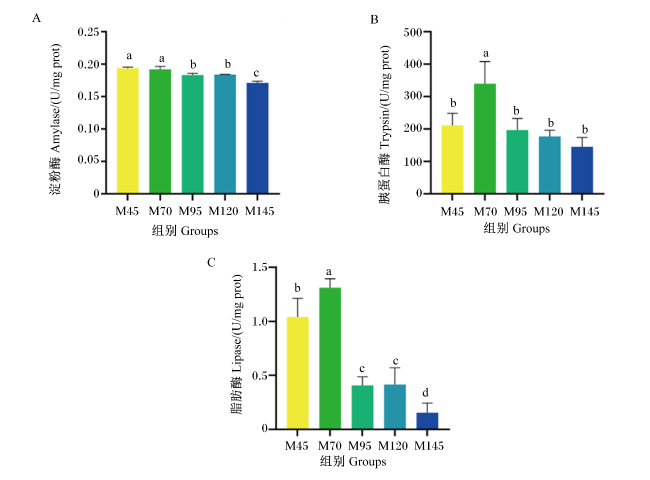
图1所示,低盐条件下养殖密度对斑节对虾肝胰腺淀粉酶、胰蛋白酶和脂肪酶活性有显著影响(P<0.05)。肝胰腺淀粉酶活性随养殖密度的提高呈现缓慢降低的趋势,M45组和M70组显著高于其他组(P<0.05);肝胰腺胰蛋白酶和脂肪酶活性随养殖密度的提高呈现先升高后降低的趋势,且均以M70组最高,显著高于其他组(P<0.05)。
图1 低盐条件下不同养殖密度对斑节对虾肝胰腺消化酶活性的影响

数据柱标注不同字母表示显著差异(P<0.05)。图2同。

Fig.1 Effects of different stocking densities on digestive enzyme activities in hepatopancreas of Penaeus monodon under low-salinity condition

Data columns with different letters mean significant differences (P<0.05). The same as Fig.2.

2.2.2 低盐条件下不同养殖密度对斑节对虾肝胰腺消化能力相关基因表达的影响
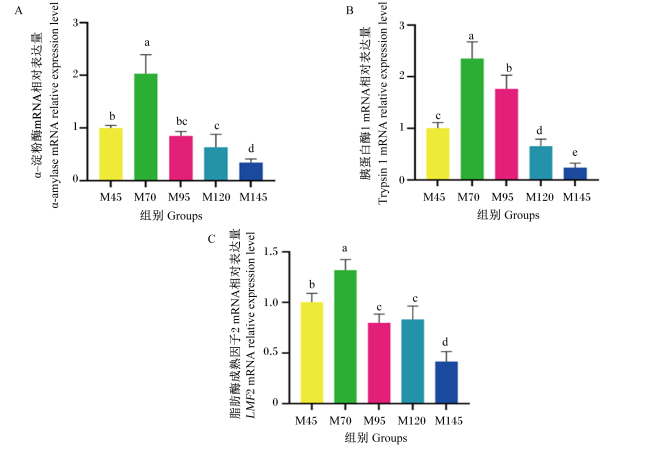
PCR结果显示,各引物的扩增效率分别为101.25%(α-淀粉酶)、96.59%(胰蛋白酶1)和101.73%[脂肪酶成熟因子2(LMF2)],且熔解曲线均呈现单一峰值特征,说明扩增产物具有高度特异性。此外,经DNA测序验证,扩增产物均为目的产物。因此,设计的引物可用于准确评估目的基因的表达水平。如图2所示,随着养殖密度的提高,斑节对虾肝胰腺α-淀粉酶和胰蛋白酶1 mRNA相对表达量呈现先升高后降低的趋势,肝胰腺LMF2 mRNA相对表达量则呈现先升高后降低、再升高再降低的趋势,且3种基因的mRNA相对表达量均在M70组中最高,显著高于其他各组(P<0.05)。
图2 低盐条件下不同养殖密度对斑节对虾肝胰腺消化能力相关基因表达的影响

Fig.2 Effects of different stocking densities on expression of genes related to digestive capacity in hepatopancreas of Penaeus monodon under low-salinity condition

2.3 低盐条件下不同养殖密度对斑节对虾肌肉营养成分的影响

2.3.1 低盐条件下不同养殖密度对斑节对虾肌肉常规营养成分含量的影响

表4可知,斑节对虾肌肉粗灰分含量表现为M145组>M120组>M95组、M45组>M70组,其中M70组肌肉粗灰分含量显著低于其他组(P<0.05),其余各组间无显著差异(P>0.05);肌肉粗蛋白质含量表现为M70组>M120组>M45组>M95组>M145组,其中M70组和M120组肌肉粗蛋白质含量显著高于其他组(P<0.05),M145组肌肉粗蛋白质含量显著低于其他组(P<0.05);肌肉水分含量随养殖密度的提高呈现升高的趋势,其中M145组肌肉水分含量显著高于其他组(P<0.05);各组间肌肉粗脂肪含量无显著差异(P>0.05)。
表4 低盐条件下不同养殖密度对斑节对虾肌肉常规营养成分含量的影响(湿重基础)

Table 4 Effects of different stocking densities on common nutrient contents in muscle of Penaeus monodon under low-salinity condition (wet weight basis) %

项目
Items
组别Groups
M45 M70 M95 M120 M145
水分Moisture 74.90±0.12d 74.97±0.16cd 75.48±0.22b 75.33±0.38bc 75.32±0.67a
粗蛋白质Crude protein 21.98±0.33b 22.28±0.77a 21.84±0.11c 22.20±0.16a 21.16±0.27d
粗脂肪Crude lipid 0.85±0.04 0.85±0.01 0.83±0.04 0.79±0.03 0.81±0.04
粗灰分Crude ash 1.43±0.37a 1.38±0.22b 1.43±0.23a 1.45±0.24a 1.46±0.15a

2.3.2 低盐条件下不同养殖密度对斑节对虾肌肉氨基酸组成和营养价值的影响

表5可知,5组斑节对虾肌肉中均检测出17种氨基酸,包括9种必需氨基酸、2种鲜味氨基酸、6种甜味氨基酸和7种苦味氨基酸,且均以谷氨酸含量最高。除胱氨酸和丙氨酸外,M145组肌肉各种氨基酸、鲜味氨基酸、甜味氨基酸、必需氨基酸、非必需氨基酸和总氨基酸含量均显著低于其他组(P<0.05),M45组、M70组、M95组和M120组间肌肉鲜味氨基酸、甜味氨基酸、必需氨基酸、非必需氨基酸和总氨基酸含量均无显著差异(P>0.05);各组间肌肉胱氨酸含量无显著差异(P>0.05);肌肉必需氨基酸/总氨基酸和必需氨基酸/非必需氨基酸值随养殖密度的升高而逐渐降低。
表5 低盐条件下不同养殖密度对斑节对虾肌肉氨基酸组成的影响(湿重基础)

Table 5 Effects of different stocking densities on amino acid composition in muscle of Penaeus monodon under low-salinity condition (wet weight basis) %

项目
Items
组别Groups
M45 M70 M95 M120 M145
天冬氨酸Asp* 2.06±0.03a 2.09±0.06a 2.05±0.01a 2.09±0.15a 1.54±0.03b
苏氨酸Thr# 0.77±0.02a 0.78±0.03a 0.76±0.00a 0.77±0.01a 0.65±0.02b
丝氨酸Ser# 0.72±0.12a 0.73±0.21a 0.72±0.00a 0.73±0.01a 0.50±0.01b
谷氨酸Glu* 3.67±0.07a 3.72±0.10a 3.67±0.02a 3.70±0.03a 3.00±0.10b
甘氨酸Gly# 1.92±0.02c 2.01±0.07b 2.10±0.01a 2.03±0.02ab 1.71±0.06d
丙氨酸Ala# 1.27±0.02b 1.35±0.04a 1.26±0.01b 1.38±0.01a 1.27±0.04b
胱氨酸Cys 0.19±0.02 0.18±0.03 0.19±0.02 0.18±0.02 0.17±0.02
缬氨酸Val& 0.93±0.02a 0.94±0.03a 0.92±0.01a 0.94±0.00a 0.79±0.02b
蛋氨酸Met& 0.51±0.03ab 0.53±0.01a 0.48±0.03b 0.48±0.03b 0.43±0.01c
异亮氨酸Ile& 0.89±0.02a 0.90±0.02a 0.88±0.01a 0.90±0.01a 0.76±0.02b
亮氨酸Leu& 1.57±0.03a 1.60±0.05a 1.57±0.01a 1.59±0.00a 1.32±0.05b
酪氨酸Tyr# 0.71±0.02ab 0.73±0.02a 0.69±0.02b 0.71±0.01ab 0.56±0.01c
苯丙氨酸Phe& 0.84±0.02a 0.85±0.03a 0.83±0.01a 0.85±0.01a 0.71±0.02b
赖氨酸Lys 1.76±0.03ab 1.80±0.05a 1.77±0.01ab 1.73±0.05b 0.87±0.02c
组氨酸His& 0.43±0.01a 0.43±0.01a 0.42±0.00a 0.42±0.01a 0.37±0.01b
精氨酸Arg& 1.96±0.03a 1.97±0.05a 1.97±0.02a 1.89±0.01b 1.13±0.03c
脯氨酸Pro# 1.20±0.01a 1.13±0.03b 1.06±0.01c 1.09±0.01c 0.78±0.03d
鲜味氨基酸DAA 5.73±0.10a 5.81±0.16a 5.73±0.02a 5.80±0.04a 4.54±0.13b
甜味氨基酸SAA 6.60±0.10a 6.73±0.20a 6.60±0.02a 6.72±0.05a 5.47±0.16b
苦味氨基酸BAA 7.12±0.14a 7.22±0.17a 7.09±0.06a 7.07±0.02a 5.50±0.13b
必需氨基酸EAA 9.64±0.18a 9.80±0.25a 9.62±0.07a 9.57±0.07a 7.02±0.17b
非必需氨基酸NEAA 10.86±0.16a 11.04±0.31a 10.88±0.03a 11.03±0.09a 8.80±0.27b
总氨基酸TAA 21.41±0.35a 21.74±0.60a 21.37±0.13a 21.49±0.01a 16.55±0.42b
必需氨基酸/总氨基酸
EAA/TAA
45.06 45.07 45.00 44.53 42.43
必需氨基酸/非必需氨基酸
EAA/NEAA
88.85 88.80 88.45 86.80 79.79

*表示鲜味氨基酸,#表示甜味氨基酸,&表示苦味氨基酸。

* represented delicious amino acids, # represented sweet amino acids, and & represented bitter amino acids.

表6可知,以AAS为评价标准,缬氨酸为M45组、M70组、M95组和M145组第一限制性氨基酸,蛋氨酸+胱氨酸为M120组第一限制性氨基酸;苏氨酸为M45组、M70组和M95组第二限制性氨基酸,缬氨酸为M120组第二限制性氨基酸,赖氨酸为M145组第二限制性氨基酸。以CS为评价标准,蛋氨酸+胱氨酸为各组第一限制性氨基酸;缬氨酸为各组第二限制性氨基酸。EAAI随养殖密度的提高呈现先升高后降低的趋势,各组表现为M70组>M45组>M95组>M120组>M145组。
表6 低盐条件下不同养殖密度对斑节对虾肌肉氨基酸营养价值的影响

Table 6 Effects of different stocking densities on nutritional value of amino acids in muscle of Penaeus monodon under low-salinity condition

项目
Items
FAO/WHO
标准模式
FAO/WHO
standard
mode/(mg/g)
全鸡蛋蛋
白质模式
Whole egg
protein model/
(mg/g)
M45组
M45 group
M70组
M70 group
M95组
M95 group
M120组
M120 group
M145组
M145 group
氨基酸
评分
AAS
化学评分
CS
氨基酸
评分
AAS
化学评分
CS
氨基酸
评分
AAS
化学评分
CS
氨基酸
评分
AAS
化学评分
CS
氨基酸
评分
AAS
化学评分
CS
苏氨酸Thr 250 292 0.872** 0.747 0.871** 0.746 0.870** 0.745 0.871 0.745 0.772 0.661
缬氨酸Val 310 411 0.850* 0.641** 0.848* 0.639** 0.853* 0.643** 0.853** 0.644** 0.753* 0.568**
异亮氨酸Ile 250 331 1.009 0.762 1.014 0.766 1.011 0.764 1.013 0.765 0.894 0.675
亮氨酸Leu 440 534 1.017 0.838 1.020 0.841 1.023 0.843 1.017 0.838 0.889 0.732
赖氨酸Lys 340 441 1.475 1.137 1.488 1.147 1.493 1.151 1.432 1.104 0.756** 0.583
蛋氨酸+胱氨酸
Met+Cys
220 386 0.909 0.518* 0.901 0.514* 0.872 0.497* 0.844* 0.481* 0.801 0.457*
苯丙氨酸+酪氨酸
Phe+Try
380 565 1.160 0.780 1.161 0.781 1.150 0.773 1.156 0.777 0.982 0.661
必需氨基酸指数
EAAI/%
75.55 75.61 75.24 74.48 61.33

*表示第一限制性氨基酸,**表示第二限制性氨基酸。

* represented the first limiting amino acid, and ** represented the second limiting amino acid.

2.3.3 低盐条件下不同养殖密度对斑节对虾肌肉脂肪酸组成和营养价值的影响

表7可知,5组斑节对虾肌肉中均检测出16种脂肪酸,包括7种饱和脂肪酸、3种单不饱和脂肪酸和6种多不饱和脂肪酸,其中各组肌肉含量最高的脂肪酸均为棕榈酸。斑节对虾肌肉总饱和脂肪酸含量表现为M95组>M70组>M120组>M145组>M45组,其中M70组和M95组肌肉总饱和脂肪酸含量显著高于其他组(P<0.05);斑节对虾肌肉总单不饱和脂肪酸含量表现为M145组>M120组>M45组>M95组>M70组,其中M145组肌肉总单不饱和脂肪酸含量显著高于其他组(P<0.05);斑节对虾肌肉总多不饱和脂肪酸含量表现为M45组>M70组>M120组>M145组>M95组,其中M95组肌肉总多不饱和脂肪酸含量显著低于M45组和M70组(P<0.05),其余各组间肌肉总多不饱和脂肪酸含量无显著差异(P>0.05);斑节对虾肌肉二十碳五烯酸(EPA)+二十二碳六烯酸(DHA)含量表现为M70组>M120组>M45组>M95组>M145组,其中M70组肌肉EPA+DHA含量显著高于M95组和M145组(P<0.05),与M45组和M120组无显著差异(P>0.05)。
表7 低盐条件下不同养殖密度对斑节对虾肌肉脂肪酸组成的影响(湿重基础)

Table 7 Effects of different stocking densities on fatty acid composition in muscle of Penaeus monodon under low-salinity condition (wet weight basis) %

项目
Items
组别Groups
M45 M70 M95 M120 M145
肉豆蔻酸C14∶0 0.64±0.01b 0.73±0.02a 0.65±0.04b 0.56±0.05c 0.56±0.03c
十五烷酸C15∶0 0.89±0.04a 0.36±0.04b 0.36±0.04b 0.32±0.01b 0.35±0.04b
棕榈酸C16∶0 20.17±0.32d 22.67±0.20a 22.89±0.16a 21.51±0.33b 20.83±0.10c
棕榈油酸C16∶1n7c 0.89±0.02b 0.70±0.01d 0.81±0.05c 0.80±0.02c 1.00±0.03a
十七烷酸C17∶0 1.17±0.09ab 1.20±0.00a 1.10±0.01b 1.16±0.03ab 1.14±0.01ab
硬脂酸C18∶0 11.31±0.16c 13.14±1.53ab 13.66±0.25a 12.21±0.35bc 12.28±0.13bc
油酸C18∶1n-9c 14.79±0.16b 12.44±0.45d 13.68±0.33c 15.21±0.39b 16.83±0.06a
亚油酸C18∶2n-6c 18.22±0.12a 17.50±0.42b 17.24±0.14b 17.38±0.18b 17.62±0.18b
α-亚麻酸C18∶3n-3c 0.79±0.04a 0.69±0.02b 0.61±0.02c 0.67±0.02b 0.67±0.02b
花生酸C20∶0 0.52±0.07ab 0.46±0.11b 0.60±0.03a 0.51±0.05ab 0.63±0.02a
二十碳一烯酸C20∶1n-9c 1.21±0.21b 1.48±0.12a 1.12±0.10b 1.00±0.03b 0.52±0.06c
二十碳二烯酸C20∶2n-6c 1.18±0.04ab 1.06±0.06c 1.09±0.04bc 1.19±0.06a 1.20±0.03a
花生四烯酸C20∶4n-6c 3.98±0.09c 4.14±0.08b 4.04±0.07bc 4.16±0.04b 4.57±0.05a
山嵛酸C22∶0 0.43±0.02c 0.15±0.02d 0.47±0.08c 0.56±0.03b 0.74±0.04a
二十碳五烯酸C20∶5n-3c 9.32±0.14c 10.10±0.13a 9.27±0.06c 9.65±0.13b 9.46±0.18bc
二十二碳六烯酸C22∶6n-3c 11.19±0.17a 11.05±1.15a 10.54±0.31ab 11.08±0.12a 9.75±0.09b
其他Others 3.30±0.14a 2.16±0.09b 1.88±0.07c 2.02±0.02bc 1.87±0.15c
总饱和脂肪酸∑SFA 35.14±0.55b 38.70±1.82a 39.73±0.16a 36.83±0.55b 36.51±0.16b
总单不饱和脂肪酸∑MUFA 16.89±0.32b 14.61±0.38d 15.61±0.41c 17.00±0.38b 18.36±0.15a
总多不饱和脂肪酸∑PUFA 44.68±0.36a 44.53±1.54a 42.79±0.41b 44.14±0.23ab 43.26±0.31ab
二十碳五烯酸+二十二碳六烯酸
EPA+DHA
20.51±0.25ab 21.14±1.27a 19.81±0.35bc 20.74±0.24ab 19.20±0.12c
表8可知,斑节对虾肌肉PI随养殖密度的提高呈现先降低后升高的趋势,具体表现为M45组>M120组>M70组>M145组>M95组,其中M95组显著低于除M145组外的其他组(P<0.05),M45组显著高于除M120组外的其他组(P<0.05);斑节对虾肌肉IA表现为M95组>M70组>M120组>M45组、M145组,其中M70组和M95组肌肉IA显著高于其他组(P<0.05),且这2组间无显著差异(P>0.05);斑节对虾肌肉IT表现为M95组>M70组>M145组>M120组>M45组,变化趋势与IA相似、与PI相反,其中M95组肌肉IT显著高于除M70组外的其他组(P<0.05)。
表8 低盐条件下不同养殖密度对斑节对虾肌肉脂肪酸营养价值的影响

Table 8 Effects of different stocking densities on nutritional value of fatty acids in muscle of Penaeus monodon under low-salinity condition

项目
Items
组别Groups
M45 M70 M95 M120 M145
多烯指数PI 1.01±0.03a 0.93±0.06b 0.87±0.02c 0.96±0.02ab 0.92±0.01bc
动脉粥样硬化指数IA 0.37±0.01b 0.43±0.02a 0.44±0.00a 0.39±0.01b 0.37±0.00b
血栓形成指数IT 0.38±0.01c 0.43±0.04ab 0.46±0.01a 0.40±0.01bc 0.41±0.03bc

3 讨论

3.1 低盐条件下不同养殖密度对斑节对虾生长性能的影响

养殖密度是水产养殖生产中的一个重要参数,养殖密度过低会造成空间和水资源的浪费,养殖密度过高则影响水产动物的生长率、SR和饲料转化率等。本研究结果显示,相较于高密度组(M120组和M145组),低密度组(M45组和M70组)斑节对虾在终末体重、WGR、SGR、PER、CF以及SR等方面均表现出显著优势;同时,低密度组FCR和FR也显著低于高密度组,呈现随养殖密度提高而提高的趋势,这与在凡纳滨对虾[20,31]、罗氏沼虾[46]、克氏原螯虾[19]、日本对虾[47]、中华绒螯蟹[48-49]、中国明对虾[28]、欧洲鲶鱼(Silurus glanis L.)[50]以及大黄鱼[22]上的研究结果基本相同。斑节对虾性情凶猛,具有互残性,养殖密度较大会引起空间竞争压力增大,导致拥挤胁迫和水质恶化,进而影响其正常的生理活动,对生长、存活和摄食等方面产生不利影响。

3.2 低盐条件下不同养殖密度对斑节对虾消化能力的影响

养殖动物的消化能力直接反映了其对营养物质的吸收和利用效率,其中消化酶活性是衡量消化能力的重要指标。养殖密度过高会降低养殖生物的消化酶活性,如中华小长臂虾(Palaemonetes sinensis)[51]、尼罗口孵鱼(Oreochromis niloticus)[52]、大黄鱼[22]和团头鲂(Megalobrama amblycephala)[53]等消化酶活性随养殖密度提高而降低。本研究中,斑节对虾肝胰腺淀粉酶活性随养殖密度的提高呈现缓慢降低的趋势,且M45组和M70组显著高于其他组;肝胰腺胰蛋白酶和脂肪酶活性随养殖密度的提高呈现先升高后降低的趋势,并在M70组中最高。胰蛋白酶和脂肪酶活性出现先升后降的趋势可能是由于在一定范围内的养殖密度能够提高斑节对虾的消化酶活性,超过这个范围消化酶活性则会降低。
本研究通过对α-淀粉酶、胰蛋白酶1和LMF2这3个反映消化能力的正向基因进行研究,结果表明,上述基因mRNA相对表达量均随养殖密度的提高整体呈现先升高后降低的趋势,且M70组均显著高于其他组,M145组均显著低于其他组,这表明养殖密度过高会抑制斑节对虾与消化能力相关基因的表达,从而影响其消化能力。不过,由于斑节对虾不同养殖密度对消化能力相关基因表达的研究较少,相关机理还有待进一步研究。

3.3 低盐条件下不同养殖密度对斑节对虾肌肉营养成分的影响

3.3.1 低盐条件下不同养殖密度对斑节对虾肌肉常规营养成分含量的影响

常规营养成分是评价斑节对虾肌肉营养价值的重要指标。养殖过程中,养殖生物体内的常规营养成分含量与养殖密度之间存在着紧密关联[27-28,54]。本研究发现,斑节对虾肌肉水分含量随养殖密度的提高呈现提高的趋势,这与余友斌等[22]对大黄鱼在养殖密度上的研究结果一致。本研究中,M70组肌肉粗灰分含量显著低于其他组;M70组和M120组肌肉粗蛋白质含量显著高于其他组,M145组肌肉粗蛋白质含量显著低于其他组;各组间肌肉粗脂肪含量无显著差异。本研究中养殖密度与肌肉粗蛋白质含量并非成线性关系,这与前期研究结果[22]存在差异,相关机理需进一步研究。

3.3.2 低盐条件下不同养殖密度对斑节对虾肌肉氨基酸组成和营养价值的影响

氨基酸是构成蛋白质的基础,不仅关乎生理功能的调节,还对维持机体新陈代谢起着至关重要的作用。必需氨基酸是动物机体为保持健康必需通过食物摄取的一类氨基酸;非必需氨基酸则是由动物机体自身能够合成并满足机体需要的氨基酸。此外,鲜味氨基酸、甜味氨基酸和苦味氨基酸,这些特殊氨基酸能够显著提升和调节肌肉的风味。这些氨基酸共同构成了复杂而完善的营养体系,确保了生命活动的正常进行。谷氨酸是一种鲜味氨基酸[55],本研究各组斑节对虾肌肉中含量最高的氨基酸均为谷氨酸,这与在不同养殖密度条件下大口黑鲈(Micropterus salmoides)[56]、刀鲚[24]和鲤鱼(Cyprinus carpio)[57]的研究结果一致,表明斑节对虾的肌肉具有较强的鲜味。本研究中,各组肌肉必需氨基酸/总氨基酸值为42.43%~45.07%,必需氨基酸/非必需氨基酸值≥79.79%,符合FAO/WHO提出的参考蛋白质模式标准(必需氨基酸/总氨基酸值≈40%,必需氨基酸/非必需氨基酸值>60%)[56],表明各组斑节对虾肌肉蛋白质含量符合理想蛋白质的标准要求。此外,本研究中M145组肌肉除胱氨酸和丙氨酸以外的各种氨基酸、鲜味氨基酸、甜味氨基酸、必需氨基酸、非必需氨基酸和总氨基酸含量均显著低于其他组,而其他组间肌肉的鲜味氨基酸、甜味氨基酸、必需氨基酸、非必需氨基酸和总氨基酸含量均无显著差异,这一现象是否是高养殖密度的M145组斑节对虾肌肉氨基酸代谢受到抑制,进而影响肌肉营养价值有待进一步的研究。
目前,氨基酸营养价值评估指标主要有EAAI、AAS和CS。其中,EAAI能够有效反映必需氨基酸的含量,EAAI越高,通常意味着营养价值更优。本研究中,5组斑节对虾肌肉EAAI为61.33%~75.61%,且M70组最高,表明在M70组养殖密度条件下斑节对虾肌肉氨基酸营养价值最高。除M145组外,其余4组斑节对虾肌肉EAAI达到74.48%~75.61%,高于南极磷虾(Euphausia superba)(54.95%)[58]、中国明对虾(72.98%)[59]、野生刀额新对虾(Metapenaeus ensis)(71.27%~73.70%)[60]和日本对虾(70.72%)[61],略低于凡纳滨对虾(87.31%)[62]。当养殖密度过高时,斑节对虾肌肉中的氨基酸代谢可能受到不利影响[56],进而可能导致必需氨基酸含量降低。依据AAS和CS结果,赖氨酸在评分中表现最为优异,这表明斑节对虾富含赖氨酸,可作为优质的赖氨酸来源,这与王娟[63]的研究相吻合。在上述2种评分体系下,缬氨酸为5组斑节对虾肌肉中的主要限制性氨基酸,这与崔茜等[64]的研究结果一致。由此可见,在斑节对虾肌肉中,缬氨酸是限制氨基酸利用率的关键。

3.3.3 低盐条件下不同养殖密度对斑节对虾肌肉脂肪酸组成和营养价值的影响

脂肪酸不仅是机体能量供应的重要来源之一,而且对于维持正常的生命活动发挥着至关重要的作用。此外,它还具备一定的抗病功效,有助于增强机体的防御能力[65]。根据脂肪酸分子中是否含有双键,脂肪酸分为饱和脂肪酸和不饱和脂肪酸两大类。不饱和脂肪酸根据双键数量的不同,又可分为单不饱和脂肪酸和多不饱和脂肪酸。其中,单不饱和脂肪酸在调节血脂、降低胆固醇和增强免疫力等方面展现出显著效果[66];多不饱和脂肪酸对促进大脑发育、预防心血管疾病、防止血栓形成及动脉粥样硬化等方面具有积极作用[67-71]。在多不饱和脂肪酸中,EPA和DHA因其显著的降脂和预防心血管疾病功效而备受关注[72]。本研究中,斑节对虾肌肉中总饱和脂肪酸含量为35.14%~39.73%,低于日本沼虾(Macrobrachium nipponense)(44.65%~53.21%)[73]、克氏原螯虾(48.96%~58.91%)[74]、斑尾刺虾虎鱼(Acanthogobius ommaturus)(38.05%~42.35%)[75]、凡纳滨对虾(40.72%)和罗氏沼虾(40.63%)[76],与崔茜等[64]的研究中低盐条件下斑节对虾肌肉饱和脂肪酸含量较为接近,这表明斑节对虾自身饱和脂肪酸含量相对较低。饱和脂肪酸是机体日常能量供应的主要来源之一[77]。本试验中,M70组和M95组肌肉总饱和脂肪酸含量显著高于其他3组,造成这种现象的原因可能是在低养殖密度条件下,饲料投喂不均匀,斑节对虾需要投入更多的能量去寻找饲料,导致能量消耗较高;而养殖密度过高又会引发拥挤胁迫,使斑节对虾之间的竞争加剧,进而导致能量消耗进一步增加。本研究中,斑节对虾肌肉中总多不饱和脂肪酸含量为42.79%~44.68%,其中EPA+DHA含量为19.81%~21.14%,这一结果高于罗氏沼虾(17.75%)和凡纳滨对虾(19.31%),但略低于日本沼虾(23.86%)[76],这也充分说明,斑节对虾是一种优质的EPA和DHA补充来源。此外,M70组斑节对虾肌肉EPA+DHA含量显著高于M95组和M145组,有高于M45组和M120组的趋势。由此可知,在M70组养殖密度下的斑节对虾肌肉富含EPA和DHA。
PI是评估个体脂肪酸代谢状况和健康风险的一个重要指标。本研究中,斑节对虾肌肉PI随养殖密度的提高呈现先降低后升高的趋势,其中M95组最低,M45组最高,这说明M45组斑节对虾肌肉多不饱和脂肪酸降解及氧化程度更小[45,78-79]。本研究中,各组斑节对虾肌肉IA(0.37~0.44)和IT(0.38~0.46)均低于安全值(1.00)[80],这表明食用斑节对虾肌肉符合食品安全。

4 结论

综上所述,低盐条件下养殖密度过高或者过低都会对斑节对虾生长性能、消化能力和肌肉营养成分产生不利影响,低盐条件下斑节对虾养殖密度不宜超过70尾/m3
[1]
唐海南, 柏月, 许金震, 等. 雨生红球藻粉对金刚虾生长性能、虾青素沉积和肠道健康的影响[J]. 动物营养学报, 2024, 36(9):5910-5923.

DOI

TANG H N, BAI Y, XU J Z, et al. Effects of Haematococcus pluvialis powder on growth performance,astaxanthin deposition and intestinal health of Penaeus monodon[J]. Chinese Journal of Animal Nutrition, 2024, 36(9):5910-5923. (in Chinese)

[2]
黄永春, 李兴华, 林楠, 等. 福建漳州地区金刚虾(Penaeus monodon)养殖特性、存在问题和对策措施[J]. 渔业研究, 2022, 44(6):629-637.

DOI

HUANG Y C, LI X H, LIN N, et al.Characteristics, existing problems and countermeasures of diamond shrimp culture (Penaeus monodon) in Zhangzhou City,Fujian Province[J]. Journal of Fisheries Research, 2022, 44(6):629-637. (in Chinese)

[3]
张年国, 周裕华, 于飞, 等. 低盐和高盐条件下不同脊尾白虾群体生长特性研究[J]. 广东农业科学, 2022, 49(10):135-145.

ZHANG N G, ZHOU Y H, YU F, et al. Growth characteristics of different Exopalaemon carinicauda populations under low and high salinity conditions[J]. Guangdong Agricultural Sciences, 2022, 49(10):135-145. (in Chinese)

[4]
HAN W F, LIU H, WANG Y C. Changes of nutrient composition in the ovaries and hepatopancreas of mud crab Scylla paramamosain broodstock and their offspring performance at different salinities[J]. Aquaculture, 2024,585:740704.

[5]
高玉倩, 王洋, 杨广, 等. 淡水、半咸水养殖凡纳滨对虾部分生物学特性的比较[J]. 饲料工业, 2023, 44(20):35-42.

GAO Y Q, WANG Y, YANG G, et al. Comparison of Some biological characteristics of Litopenaeus vannamei in freshwater and brackish water culture[J]. Feed Industry, 2023, 44(20):35-42. (in Chinese)

[6]
梁萌青, 王士稳, 王家林, 等. 海水养殖与低盐养殖凡纳滨对虾生长性能、酶活及RNA/DNA比值的差异[J]. 海洋水产研究, 2008, 29(4):69-73.

LIANG M Q, WANG S W, WANG J L, et al. Difference in growth performance,ACP and AKP activity and RNA/DNA ratio of Litopenaeus vannamei cultured in seawater and low salinity water[J]. Marine Fisheries Research, 2008, 29(4):69-73. (in Chinese)

[7]
JANNATHULLA R, DAYAL J S, MURALIDHAR M. Lipid class and fatty acid composition of whiteleg shrimp,Penaeus vannamei (Boone,1931) reared in a wide range of water salinities[J]. Aquaculture Research, 2022, 53(16):5667-5677.

[8]
LI J T, XU X W, LI W T, et al. Linking energy metabolism and locomotor variation to osmoregulation in Chinese shrimp Fenneropenaeus chinensis[J]. Comparative Biochemistry and Physiology B:Biochemistry and Molecular Biology, 2019,234:58-67.

[9]
FRANCIS B, ANTONY J, ARAVIND R, et al. Reproductive performance,salinity tolerance,growth and production performance of a cryptic species Penaeus (Marsupenaeus) japonicus[J]. Aquaculture Research, 2021, 52(11):5506-5516.

[10]
WEN B, JIANG Y S, HEQIU Y Q, et al. An investigation on the optimal lipid level for juvenile Chinese mitten crab (Eriocheir sinensis) reared under three salinities:survival,growth,digestive enzyme activities,antioxidant capacity and body composition[J]. Aquaculture Research, 2022, 53(5):1649-1662.

[11]
ZHANG Y, HUANG Z, ZHOU Y, et al. The effects of different diet,salinity and light condition on growth performance and moulting cycle of juvenile mud crab,Scylla paramamosain[J]. Aquaculture Research, 2022, 53(17):6333-6342.

[12]
黄继廷, 郑德州. 金刚虾高密度养殖[J]. 当代水产, 2020, 45(8):75-76.

HUANG J T, ZHENG D Z. High density aquaculture of Penaeus monodon[J]. Current Fisheries, 2020, 45(8):75-76. (in Chinese)

[13]
佚名. 金刚虾高密度养殖技术[J]. 农村新技术, 2021(4):29-30.

Anon. High density aquaculture technology for Penaeus monodon[J]. New Rural Technology, 2021(4):29-30. (in Chinese)

[14]
叶海斌, 王友红, 王晓璐, 等. 生物絮团对金刚虾的生长和非特异性免疫酶活性的实验研究[J]. 中国海洋大学学报(自然科学版), 2018(增刊2):52-58.

YE H B, WANG Y H, WANG X L, et al. Effect of bioflocs on growth performance and nonspecific immunity enzyme activities of Penaeus monodon[J]. Periodical of Ocean University of China (Natural Science Edition), 2018(Suppl.2):52-58. (in Chinese)

[15]
丁子元, 郝俊, 郑艳坤, 等. 人工隐蔽物及放养密度对南非金刚虾生长情况的影响[J]. 中国水产, 2017(11):78-80.

DING Z Y, HAO J, ZHENG Y K, et al. The impact of artificial concealment and stocking density on the growth of South African Penaeus monodon[J]. China Fisheries, 2017(11):78-80. (in Chinese)

[16]
唐海南, 柏月, 许金震, 等. 雨生红球藻粉对斑节对虾肝胰腺免疫性能及甲醛胁迫下相关基因表达的影响[J/OL]. 厦门大学学报(自然科学版), 2024:1-11(2024-08-28)[2024-12-20].http://kns.cnki.net/kcms/detail/35.1070.N.20240827.1619.002.html.

TANG H N, BAI Y, XU J Z, et al. Effects of rainy red algae powder on the immune performance of the hepatopancreas of Penaeus monodon and the expression of related genes under formaldehyde stress[J]. Journal of Xiamen University (Natural Science Edition), 2024:1-11(2024-08-28)[2024-12-20].http://kns.cnki.net/kcms/detail/35.1070.N.20240827.1619.002.html.(in Chinese)

[17]
李倩, 孙丽慧, 张海琪, 等. 密度对罗氏沼虾种虾存活率、抱卵率、水质、水体和肠道微生物群落的影响[J]. 水生生物学报, 2025, 49(4):042502.

LI Q, SUN L H, ZHANG H Q, et al. Density on the survival rate,ovulation rate,water quality,water,and intestinal microbial community of broodstock Macrobrachium rosenbergii[J]. Acta Hydrobiologica Sinica, 2025, 49(4):042502. (in Chinese)

[18]
倪蒙, 陈雪峰, 高强, 等. 放养密度对温棚养殖罗氏沼虾生长、生化指标、水质及养殖效益的影响[J]. 大连海洋大学学报, 2021, 36(3):423-429.

NI M, CHEN X F, GAO Q, et al. Effects of stocking density on growth performance, biochemical indices,water quality and economic benefits of giant freshwater prawn Macrobrachium rosenbergii in a greenhouse[J]. Journal of Dalian Fisheries University, 2021, 36(3):423-429. (in Chinese)

[19]
范文浩, 方刘, 周锦, 等. 养殖密度对克氏原螯虾生长及消化酶、免疫酶活性的影响[J]. 水产科学, 2021, 40(2):261-266.

FAN W H, FANG L, ZHOU J, et al. Effects of stocking density on growth,digestive enzyme and immune enzyme activities of red swamp crayfish Procambarus clarkii[J]. Fisheries Science, 2021, 40(2):261-266. (in Chinese)

[20]
袁航, 胡乃捷, 陈俭, 等. 养殖密度对凡纳滨对虾生长性能及其肠道消化酶和菌群结构的影响[J]. 南方农业学报, 2023, 54(1):289-302.

YUAN H, HU N J, CHEN J, et al. Effects of stocking density on the growth performance,intestinal digestive enzyme activities and microflora structure of Litopenaeus vannamei[J]. Journal of Southern Agriculture, 2023, 54(1):289-302. (in Chinese)

[21]
张华军, 李卓佳, 张家松, 等. 密度胁迫对凡纳滨对虾稚虾免疫指标及生长的影响[J]. 南方水产科学, 2012, 8(4):43-48.

ZHANG H J, LI Z J, ZHANG J S, et al. Effects of stocking density on immune parameters and growth of juvenile Litopenaeus vannamei[J]. South China Fisheries Science, 2012, 8(4):43-48. (in Chinese)

[22]
余友斌, 黄温赟, 崔铭超. 养殖密度对大黄鱼生长、血清生化、营养成分、消化酶和代谢酶活力的影响[J]. 渔业现代化, 2023, 50(3):64-71.

YU Y B, HUANG W Y, CUI M C. Effects of stocking densities on growth performance,nutrient composition,serum biochemical,digestive and metabolic enzymes activities of large yellow croaker (Larimichthys crocea)[J]. Fishery Modernization, 2023, 50(3):64-71. (in Chinese)

[23]
虞嘉玥, 王杰, 孙鹏, 等. 不同养殖密度条件下大黄鱼的生理响应及应激敏感指标的筛选[J]. 海洋渔业, 2021, 43(3):327-339.

YU J Y, WANG J, SUN P, et al. Physiological response of Larimichthys crocea under different stocking densities and screening of stress sensitive biomarkers[J]. Marine Fisheries, 2021, 43(3):327-339. (in Chinese)

[24]
施永海, 刘永士, 徐嘉波, 等. 2种养殖密度模式下刀鲚幼鱼的营养成分分析[J]. 西北农林科技大学学报(自然科学版), 2023, 51(5):1-7,18.

SHI Y H, LIU Y S, XU J B, et al. Analysis and evaluation of muscle nutrient components of Coilia nasus young fish under two cultural density levels[J]. Journal of Northwest A&F University (Natural Science Edition), 2023, 51(5):1-7,18. (in Chinese)

[25]
袁新程, 谢永德, 刘永士, 等. 两种养殖密度对刀鲚当年鱼种生长性能、消化及非特异性免疫能力的影响[J]. 上海海洋大学学报, 2021, 30(2):222-230.

YUAN X C, XIE Y D, LIU Y S, et al. Effects of two stocking densities on growth performance,digestion and non-specific immunity of the current year Coilia nasus[J]. Journal of Shanghai Ocean University, 2021, 30(2):222-230. (in Chinese)

[26]
颜孙安, 姚清华, 林香信, 等. 不同养殖密度瓦氏黄颡鱼肌肉营养成分分析与评价[J]. 食品安全质量检测学报, 2019, 10(19):6637-6644.

YAN S A, YAO Q H, LIN X X, et al. Analysis and evaluation of nutritional component of Pelteobagrus vachelli cultured with different stocking density[J]. Journal of Food Safety & Quality, 2019, 10(19):6637-6644. (in Chinese)

[27]
麻艳群, 司楠, 程蔓, 等. 放养密度对黄颡鱼生长、营养成分、消化及抗氧化性的影响[J]. 水产学杂志, 2024, 37(3):44-49.

MA Y Q, SI N, CHENG M, et al. Effects of stocking density on growth performance,nutrient composition,gigestion and antioxidant activity of yellow catfish Pelteobagrus fulvidraco[J]. Chinese Journal of Fisheries, 2024, 37(3):44-49. (in Chinese)

[28]
张海恩, 何玉英, 李健, 等. 不同养殖密度对中国明对虾生长和能量代谢的影响[J]. 渔业科学进展, 2021, 42(5):70-76.

ZHANG H E, HE Y Y, LI J, et al. Effects of different stocking densities on the growth and energy metabolism of Fenneropenaeus chinensis[J]. Progress in Fishery Sciences, 2021, 42(5):70-76. (in Chinese)

[29]
张海恩, 何玉英, 李健, 等. 密度胁迫对中国对虾幼虾生长、抗氧化系统功能及水质指标的影响[J]. 渔业科学进展, 2020, 41(2):140-149.

ZHANG H E, HE Y Y, LI J, et al. Effects of stocking density on growth, water quality,and antioxidant system of juvenile Fenneropenaeus chinensis[J]. Progress in Fishery Sciences, 2020, 41(2):140-149. (in Chinese)

[30]
蒋湘, 谢妙, 彭树锋, 等. 养殖密度对日本囊对虾生长与存活的影响[J]. 水产养殖, 2016, 37(10):36-40.

JIANG X, XIE M, PENG S F, et al. The effects of growth and survival rate on Penaeus japonicus in different stocking densities[J]. Journal of Aquaculture, 2016, 37(10):36-40. (in Chinese)

[31]
SAID M M, ABO-AL-ELA H G, EL-BARBARY Y A, et al. Influence of stocking density on the growth,immune and physiological responses,and cultivation environment of white-leg shrimp (Litopenaeus vannamei) in biofloc systems[J]. Scientific Reports, 2024, 14(1):11147.

[32]
KOZŁOWSKI M, PIOTROWSKA I. Effect of stocking density on growth,survival and cannibalism of juvenile pikeperch,Sander lucioperca (L.),in a recirculating aquaculture system[J]. Aquaculture International, 2024, 32(3):3587-3595.

[33]
WANG R, HUANG Z Y, MA L Z, et al. Effects of stocking density and salinity on the flavour performance and muscle microstructure of black tiger shrimp (Penaeus monodon) post larvae[J]. Aquaculture International, 2024, 32(6):8115-8129.

[34]
MAJHI S S, SINGH S K, BISWAS P, et al. Effect of stocking density on growth,water quality changes and cost efficiency of butter catfish (Ompok bimaculatus) during seed rearing in a biofloc system[J]. Fishes, 2023, 8(2):61.

[35]
MINAHAL Q, FATIMA S, KOMAL W, et al. Effects of different stocking densities on growth,nutritional quality,stress and antioxidant response in Labeo rohita;cultured in in-pond raceway system[J]. PLoS One, 2024, 19(5):e0298753.

[36]
LIVAK K J, SCHMITTGEN T D. Analysis of relative gene expression data using real-time quantitative PCR and the 2-ΔΔCT method[J]. Methods, 2001, 25(4):402-408.

[37]
中华人民共和国国家卫生和计划生育委员会, 国家食品药品监督管理总局. 食品安全国家标准食品中蛋白质的测定:GB 5009.5—2016[S]. 北京: 中国标准出版社, 2017.

National Health and Family Planning Commission of the People’s Republic of China,State Food and Drug Administration. National food safety standard-determination of protein in food:GB 5009.5—2016[S]. Beijing: Standards Press of China, 2016. (in Chinese)

[38]
中华人民共和国国家卫生和计划生育委员会, 国家食品药品监督管理总局. 食品安全国家标准食品中脂肪的测定:GB 5009.6—2016[S]. 北京: 中国标准出版社, 2017.

National Health and Family Planning Commission of the People’s Republic of China,State Food and Drug Administration. National food safety standard-determination of fat in food:GB 5009.6—2016[S]. Beijing: Standards Press of China, 2017. (in Chinese)

[39]
中华人民共和国国家卫生和计划生育委员会. 食品安全国家标准食品中灰分的测定:GB 5009.4—2016[S]. 北京: 中国标准出版社, 2017.

National Health and Family Planning Commission of the People’s Republic of China. National food safety standard-determination of ash content in food:GB 5009.4—2016[S]. Beijing: Standards Press of China, 2016. (in Chinese)

[40]
中华人民共和国国家卫生和计划生育委员会. 食品安全国家标准食品中水分的测定:GB 5009.3—2016[S]. 北京: 中国标准出版社, 2017.

National Health and Family Planning Commission of the People’s Republic of China. National food safety standard-determination of moisture in food:GB 5009.3—2016[S]. Beijing: Standards Press of China, 2017. (in Chinese)

[41]
中华人民共和国国家卫生和计划生育委员会, 国家食品药品监督管理总局. 食品安全国家标准食品中氨基酸的测定:GB 5009.124—2016[S]. 北京: 中国标准出版社, 2017.

National Health and Family Planning Commission of the People’s Republic of China,State Food and Drug Administration. National food safety standard-determination of amino acids in food:GB 5009.124—2016[S]. Beijing: Standards Press of China, 2017. (in Chinese)

[42]
中华人民共和国国家卫生和计划生育委员会, 国家食品药品监督管理总局. 食品安全国家标准食品中脂肪酸的测定:GB 5009.168—2016[S]. 北京: 中国标准出版社, 2017.

National Health and Family Planning Commission of the People’s Republic of China,State Food and Drug Administration. National food safety standard-determination of fatty acids in food:GB 5009.168—2016[S]. Beijing: Standards Press of China, 2017. (in Chinese)

[43]
World Health Organization. Energy and protein requirements:report of a joint FAO/WHO ad hoc expert committee?[R]. Geneva: World Health Organization & Food and Agriculture Organization of the United Nations.,1973.

[44]
中国预防医学科学院营养与食品卫生研究所. 食物成分表(全国代表值)[M]. 北京: 人民卫生出版社,1991.

Institute of Nutrition and Food Hygiene,Chinese Academy of Preventive Medical Sciences. Food composition table(national representative values)[M]. Beijing: People’s Medical Publishing House,1991. (in Chinese)

[45]
邵俊杰, 张世勇, 万金娟, 等. 配合饲料和冰鲜鱼对大口黑鲈肌肉中氨基酸、脂肪酸的组成和含量以及血清生化指标的影响[J]. 江苏农业学报, 2024, 40(3):522-530.

SHAO J J, ZHANG S Y, WAN J J, et al. Effects of formulated feed and frozen fresh fish on the composition and content of amino acids and fatty acids and serum biochemical indices in the muscle of Micropterus salmoides[J]. Jiangsu Journal of Agricultural Sciences, 2024, 40(3):522-530. (in Chinese)

[46]
RAHMAN M M, SALIN K R, TSUSAKA T W, et al. Effect of stocking density on growth performance and gonadal maturity of all-female giant freshwater prawn,Macrobrachium rosenbergii[J]. Journal of the World Aquaculture Society, 2022, 53(6):1120-1133.

[47]
KONG S, CHEN Z, GHONIMY A, et al. Effects of Penaeus japonicus stocking density on water quality and bacterial community structure in water in an integrated multi-trophic aquaculture (IMTA) system[J]. Fisheries Science, 2024, 90(1):75-91.

[48]
WANG Z Y, MAO Z F, LI X Y, et al. Growth performance,nutritional quality,and immune-related gene expression of the Chinese mitten crab (Eriocheir sinensis) in pond ecosystem as influenced by stocking density[J]. Fishes, 2022, 7(6):362.

[49]
ZHANG G B, JIANG X D, ZHOU W Q, et al. Stocking density affects culture performance and economic profit of adult all-female Chinese mitten crabs (Eriocheir sinensis) reared in earthen ponds[J]. Aquaculture, 2024,581:740352.

[50]
KÖPRÜCÜ K, YONAR S M, KÖPRÜCÜ S, et al. Effect of different stocking densities on growth,oxidative stress,antioxidant enzymes,and hematological and immunological values of European catfish (Silurus glanis L.,1758)[J]. Aquaculture International, 2024, 32(3):2957-2973.

[51]
DONG J, ZHAO Y Y, YU Y H, et al. Effect of stocking density on growth performance,digestive enzyme activities,and nonspecific immune parameters of Palaemonetes sinensis[J]. Fish & Shellfish Immunology, 2018,73:37-41.

[52]
LIU G, YE Z Y, LIU D Z, et al. Influence of stocking density on growth,digestive enzyme activities,immune responses,antioxidant of Oreochromis niloticus fingerlings in biofloc systems[J]. Fish & Shellfish Immunology, 2018,81:416-422.

[53]
王燚纬, 朱健, 戈贤平, 等. 高密度养殖对团头鲂生长表现、消化酶活性、抗氧化能力与肠道微生物的影响[C]// 2018年中国水产学会学术年会论文摘要集. 西安: 中国水产学会,2018:348.

WANG Y W, ZHU J, GE X P, et al. Effects of stocking density on the growth performance,digestive enzyme activities,antioxidant resistance,and intestinal microflora of blunt snout bream (Megalobrama amblycephala) juveniles[C]// Abstracts of Papers from 2018 Chinese Fisheries Society Academic Annual Meeting. Xi’an: China Society of Fisheries,2018:348. (in Chinese)

[54]
左腾, 黄凯, 汪婷, 等. 养殖密度对吉富罗非鱼幼鱼生长、免疫功能的影响[J]. 水产科学, 2019, 38(5):581-588.

ZUO T, HUANG K, WANG T, et al. Effects of stocking density on growth and immune function of juvenile GIFT tilapia Oreochromis niloticus[J]. Fisheries Science, 2019, 38(5):581-588. (in Chinese)

[55]
LIU M J, GAO J, GUO H Y, et al. Influence of aquaculture environments on the muscle quality of Golden Pompano (Trachinotus ovatus) in the Beibu Gulf:a multifaceted analysis of nutritional,textural,and flavor profiles[J]. LWT, 2024,212:116957.

[56]
丁崇航, 贾睿, 侯诒然, 等. 稻鲈共作系统中养殖密度对大口黑鲈抗氧化状态、肌肉营养品质和代谢功能的影响[J]. 中国水产科学, 2023, 30(8):1000-1014.

DING C H, JIA R, HOU Y R, et al. Effects of stocking density on the antioxidant capacity,muscle nutrient composition and metabolism function of Micropterus salmoides in integrated rice-bass farming systems[J]. Journal of Fishery Sciences of China, 2023, 30(8):1000-1014. (in Chinese)

[57]
RONG Y R, LI B, HOU Y R, et al. Influences of stocking density on antioxidant status,nutrients composition,and lipid metabolism in the muscles of Cyprinus carpio under rice-fish co-culture[J]. Antioxidants, 2024, 13(7):849.

[58]
姚梦珂, 张绵松, 赵福江, 等. 南极磷虾蛋白质营养及利用研究进展[J]. 食品研究与开发, 2021, 42(9):170-175.

YAO M K, ZHANG M S, ZHAO F J, et al. Progress in protein nutrition and utilization of Antarctic krill (Euphausia superba)[J]. Food Research and Development, 2021, 42(9):170-175. (in Chinese)

[59]
陈丽花, 肖作兵, 周培根. 中国对虾蛋白质的营养价值评价[J]. 上海海洋大学学报, 2009, 18(1):88-93.

CHEN L H, XIAO Z B, ZHOU P G. Nutritional value evaluation of proteins in Penaeus chinensis[J]. Journal of Shanghai Ocean University, 2009, 18(1):88-93. (in Chinese)

[60]
冀德伟, 闫茂仓, 胡利华, 等. 不同规格野生刀额新对虾肌肉营养成分分析[J]. 水产科学, 2022, 41(6):1045-1051.

JI D W, YAN M C, HU L H, et al. Analysis of nutritional compositions in muscle of wild sword prawn metapenaeus ensis with different sizes[J]. Fisheries Science, 2022, 41(6):1045-1051. (in Chinese)

[61]
许星鸿, 刘翔, 阎斌伦, 等. 日本对虾肌肉营养成分分析与品质评价[J]. 食品科学, 2011, 32(13):297-301.

XU X H, LIU X, YAN B L, et al. Nutritional component analysis and quality evaluation of Penaeus japonicus[J]. Food Science, 2011, 32(13):297-301. (in Chinese)

[62]
李晓, 王颖, 李红艳, 等. 凡纳滨对虾虾头与肌肉营养成分分析与评价[J]. 水产科学, 2018, 37(1):66-72.

LI X, WANG Y, LI H Y, et al. Analysis and assessment of nutrient composition in head and muscle of pacific white leg shrimp Litopenaeus vannamei[J]. Fisheries Science, 2018, 37(1):66-72. (in Chinese)

[63]
王娟. 中国对虾、南美白对虾和斑节对虾肌肉营养成分的比较[J]. 食品科技, 2013, 38(6):146-150.

WANG J. Comparision of nutritional compositions in muscles of Penaeus chinensis,Penaeus vannamei Boone and Penaeus japonicuss Bate[J]. Food Science and Technology, 2013, 38(6):146-150. (in Chinese)

[64]
崔茜, 王伟, 谢益韬, 等. 不同养殖模式金刚虾(斑节对虾)肌肉营养成分比较分析[J]. 食品工业科技, 2022, 43(23):276-281.

CUI Q, WANG W, XIE Y T, et al. Comparative analysis of nutrient composition in the muscle of Penaeus monodonin different culture models[J]. Science and Technology of Food Industry, 2022, 43(23):276-281. (in Chinese)

[65]
STEPHY P S, KUMAR C S R, CHANDRAMOHANAKUMAR N. A review on fatty acids as a potent antimicrobial agent to suppress marine pathogens[J/OL]. Vegetos, 2024:1-7(2024-09-10)[2025-01-05].https://doi.org/10.1007/s42535-024-01093-x.

[66]
付伟, 程国彬, 吕麟亚, 等. 中国汉族成年人群单不饱和脂肪酸摄入量与非酒精性脂肪性肝病风险关系的回顾性病例对照研究[J]. 中国全科医学, 2024, 27(29):3623-3628.

DOI

FU W, CHENG G B, LV L Y, et al. Association of monounsaturated fatty acid intake with nonalcoholic fatty liver disease risk in Chinese Han adults:a retrospective case-control study[J]. Chinese General Practice, 2024, 27(29):3623-3628. (in Chinese)

[67]
MIESZKOWSKI J, KONERT M, KOCHANOWICZ A, et al. Supplementation with n-3 polyunsaturated fatty acids does not impact physical performance but affects n-6 polyunsaturated fatty acid levels[J]. Journal of Functional Foods, 2024,121:106427.

[68]
ZHANG X W, LI C, REN W Z, et al. Omega-3 polyunsaturated fatty acids,especially DHA and EPA,remold gut microbiota to suppress inflammation in rabbits with atherosclerosis[J]. Animals and Zoonoses, 2025, 1(2):122-130.

[69]
BROSOLO G, DA PORTO A, MARCANTE S, et al. The role for ω-3 polyunsaturated and short chain fatty acids in hypertension:an updated view on the interaction with gut microbiota[J]. European Journal of Pharmacology, 2024,985:177107.

[70]
JIANG H, WANG L N, WANG D L, et al. Omega-3 polyunsaturated fatty acid biomarkers and risk of type 2 diabetes,cardiovascular disease,cancer,and mortality[J]. Clinical Nutrition, 2022, 41(8):1798-1807.

[71]
SUN G Y, SIMONYI A, FRITSCHE K L, et al. Docosahexaenoic acid (DHA):an essential nutrient and a nutraceutical for brain health and diseases[J]. Prostaglandins,Leukotrienes,and Essential Fatty Acids, 2018,136:3-13.

[72]
ZHANG Q C, ZHU H, WANG R, et al. Fish oil emulsions stabilized by enzymatic hydrolysis,glycation,and fibrillation of β-Lg:stability and EPA/DHA bioaccessibility[J]. Food Chemistry, 2025,469:142550.

[73]
唐金玉, 覃宝利, 叶建勇, 等. 放养模式对日本沼虾生长性状与肌肉营养成分的影响[J]. 浙江农业学报, 2024, 36(2):254-263.

DOI

TANG J Y, QIN B L, YE J Y, et al. Effects of stocking modes on growth traits and muscle nutritional composition of Macrobrachium nipponense[J]. Acta Agriculturae Zhejiangensis, 2024, 36(2):254-263. (in Chinese)

[74]
吴雷明, 韩光明, 覃宝利, 等. 不同水草养殖环境对克氏原螯虾生长性能、生理指标及肌肉营养成分的影响[J]. 大连海洋大学学报, 2023, 38(5):779-786.

WU L M, HAN G M, QIN B L, et al. Effects of different aquatic plants on growth performance,physiological indices and muscle nutrients of red swamp crayfish (Procambarus clarkii)[J]. Journal of Dalian Ocean University, 2023, 38(5):779-786. (in Chinese)

[75]
祝斐, 徐大凤, 贾超峰, 等. 野生与驯养斑尾刺虾虎鱼肌肉营养成分分析[J]. 水产科学, 2023, 42(2):279-287.

ZHU F, XU D F, JIA C F, et al. Comparison of nutritive composition in muscle of wild and domesticated goby Acanthogobius ommaturus[J]. Fisheries Science, 2023, 42(2):279-287. (in Chinese)

[76]
张祎, 陈霞霞, 曾军杰, 等. 3种经济虾营养成分分析及肌肉品质评价[J]. 浙江海洋大学学报(自然科学版), 2022, 41(6):508-515.

ZHANG Y, CHEN X X, ZENG J J, et al. Nutrient composition analysis and muscle quality evaluation of three economic shrimp species[J]. Journal of Zhejiang Ocean University (Natural Science), 2022, 41(6):508-515. (in Chinese)

[77]
原居林, 刘梅, 倪蒙, 等. 不同养殖模式对大口黑鲈生长性能、形体指标和肌肉营养成分影响研究[J]. 江西农业大学学报, 2018, 40(6):1276-1285.

YUAN J L, LIU M, NI M, et al. Effects of different culture models on growth performances, morphological traits and nutritional quality in muscles of Micropterus salmoides[J]. Acta Agriculturae Universitatis Jiangxiensis, 2018, 40(6):1276-1285. (in Chinese)

[78]
RODRÍGUEZ A, LOSADA V, LARRAÍN M A, et al. Development of lipid changes related to quality loss during the frozen storage of farmed Coho salmon (Oncorhynchus kisutch)[J]. Journal of the American Oil Chemists’ Society, 2007, 84(8):727-734.

[79]
李松, 郭全友, 李保国, 等. 养殖模式和饵料对养殖大黄鱼体色、质构和营养成分评价的影响[J]. 食品与发酵工业, 2019, 45(21):118-125.

DOI

LI S, GUO Q Y, LI B G, et al. Evaluation of culture mode and feed on body color,texture and nutritional composition of cultured Pseudosciaena crocea[J]. Food and Fermentation Industries, 2019, 45(21):118-125. (in Chinese)

[80]
吉红, 程小飞, 李杰, 等. 蚕蛹替代鱼粉对框鳞镜鲤幼鱼生长性能、体成分及健康状况的影响[J]. 水产学报, 2012, 36(10):1599-1611.

JI H, CHENG X F, LI J, et al. Effect of dietary replacement of fish meal protein with silkworm pupae on the growth performance,body composition,and health status of Cyprinus carpio var. specularis fingerlings[J]. Journal of Fisheries of China, 2012, 36(10):1599-1611. (in Chinese)

Outlines

/