REVIEW

Biological Functions of Ginsenosides and Their Application in Livestock and Poultry Production

  • WANG Linnan ,
  • LI Jidong ,
  • SONG Liangli , *
Expand
  • College of Animal Science and Technology, Ningxia University, Yinchuan 750021, China
*lecturer, E-mail:

Received date: 2025-03-28

  Online published: 2025-10-15

Abstract

Ginsenosides mainly exist in the dried roots of ginseng, which are the main active components of ginseng to exert medicinal value, and have many biological functions such as anti-oxidation, anti-inflammation and immune regulation. Studies have shown that ginsenosides Re, Rg1, CK, etc. regulate the physiological metabolic processes of livestock and poultry through the phosphatidylinositol-3-kinase (PI3K)/protein kinase B (Akt), nuclear factor erythroid 2-related factor 2 (Nrf2)/antioxidant response element (ARE) and adenosine monophosphate activated protein kinase (AMPK) signaling pathways, improve the growth performance of livestock and poultry, increase egg production of laying hens, reduce the diarrhea rate of piglets, and inhibit abdominal fat deposition of broilers. In this paper, the structure and classification, biological function and application of ginsenosides in livestock and poultry production were reviewed, in order to provide reference for the application of ginsenosides in livestock and poultry production.

Cite this article

WANG Linnan , LI Jidong , SONG Liangli . Biological Functions of Ginsenosides and Their Application in Livestock and Poultry Production[J]. Chinese Journal of Animal Nutrition, 2025 , 37(10) : 6583 -6593 . DOI: 10.12418/CJAN2025.535

人参(Panax ginseng C.A. Meyer)作为一味高价值的名贵药材,在中医药领域应用历史悠久,被誉为“百草之王”[1-2]。在传统中医学中,人参就因其显著的药用价值而备受推崇。《神农本草经》将人参列为上品,称其“补五脏、安精神、定魂魄、止惊悸、除邪气、明目益智、久服轻身延年”[3]。人参的卓越功效,主要得益于其多种活性成分,而人参皂苷则是其活性成分中最为关键且研究最为广泛的一类[4]。迄今为止,已报道了近200种人参皂苷,其中人参皂苷Rb1、Rb2、Rc、Re、Rg1和Rg3被认为是主要的活性成分[4-5]。人参皂苷源于天然植物,安全性相对较高,且具有广泛的药理活性,如提高免疫力[6]、抗肿瘤[7]、抗衰老[8]、抗炎[9]、调节血糖[10]、保护心脑血管[11]以及神经保护[12]等作用。随着消费者对食品安全和绿色养殖的关注度不断攀升,寻找安全、高效且环保的饲料添加剂成为养殖业健康可持续发展的关键[13]。本文就人参皂苷的结构与分类、生物学功能及其在畜禽生产中的应用进行综述,以期为人参皂苷在畜禽生产中的应用提供参考依据。

1 人参皂苷的结构与分类

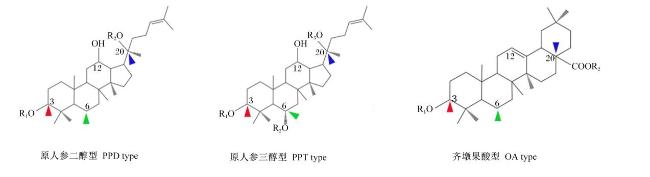
人参皂苷属于三萜类糖苷化合物,其基本结构是由30个碳原子排列成4个环的甾烷类固醇核,这一结构是人参皂苷结构多样性的基础[14]。从化学角度来看,这种四环结构的稳定性,使得人参皂苷在复杂的生物体内环境中能够保持相对稳定的结构,从而发挥其生物学功能。人参皂苷的分类核心在于皂苷元的结构差异,其中C-3位羟基连接的糖基类型和C-20位侧链构型是关键决定因素。例如,原人参二醇(protopanaxadiol,PPD)型皂苷元的C-3位连接糖基,C-20位为S构型;原人参三醇(protopanaxatriol,PPT)型皂苷元的C-6位额外连接糖基,C-20位亦为S构型;而齐墩果酸(oleanolic acid,OA)型皂苷元的C-3位连接糖基,且C-20位无侧链,形成五环三萜结构。人参皂苷化学结构式见图1。在人参皂苷的结构中,糖基通过糖苷键连接在三萜皂苷元的特定羟基位置[15]。常见的糖基包括葡萄糖、鼠李糖、阿拉伯糖、木糖等[16]。糖基的种类、数量、连接位置和连接顺序的不同,极大地丰富了人参皂苷的结构多样性,研究表明,PPD型在C-3位连接糖基,呈疏水性;而PPT型在C-3和C-6位均有糖基,亲水性提升,使其更易通过消化道黏膜吸收;OA型皂苷则在C-3位连接糖基且C-20位无侧链,结构上兼具一定极性与脂溶性[14,17]。此外,侧链结构的微小变化可以显著影响人参皂苷的生物活性,如C-20位侧链上糖基的种类和数量变化会影响人参皂苷与细胞表面受体的结合能力,从而改变其生物活性[18]。Wu等[19]研究发现,20(S)-人参皂苷Rg3和20(R)-人参皂苷Rg3处理的肝细胞癌H22移植肿瘤生长受到显著抑制,肿瘤生长抑制率分别为23.6%和40.9%,表明20(R)-人参皂苷Rg3相比于20(S)-人参皂苷Rg3具有更强的抗肿瘤活性,这是由于其C-20位构型的差异导致分子空间构象改变,进而影响了其与肿瘤细胞内相关靶点的相互作用。
图1 人参皂苷化学结构式

R1、R2和R3代表不同糖基;红色箭头:C-3位;绿色箭头:C-6位;蓝色箭头:C-20位。

Fig.1 Chemical structure of ginsenosides

R1, R2 and R3 represented different glycosyl; red arrow: C-3 position; green arrow: C-6 position; blue arrow: C-20 position.

PPD型的苷元为20(S)-原人参二醇,C-3位羟基连接糖基,C-20位为羟基或糖基,呈现疏水性,易富集于细胞膜脂质双层,通过调节线粒体功能发挥抗氧化作用[20]。其包含了众多人参皂苷,如人参皂苷Rb1、Rb2、Rb3、Rc、Rd、Rg3、Rh2及糖苷基PD等,具有抗炎、抗氧化等功效[21]。PPT型的苷元为20(S)-原人参三醇,C-6位额外连接糖基,亲水性增强,更易通过体液循环作用于细胞膜表面受体。包括人参皂苷Re、Rg1、Rg2、Rf及糖苷基PT等,具有免疫调节、抗疲劳等功效[22-23]。OA型的苷元为齐墩果酸,C-3位连接阿拉伯糖-葡萄糖醛酸链,C-20位无侧链,形成五环三萜结构,其平面构型使其易与炎症因子结合,阻断信号传导,主要包括人参皂苷Ro等[14]。皂苷具有独特的生物学活性,在抗炎、免疫调节、调节脂质代谢等方面表现突出[24]。人参皂苷的主要功效见表1
表1 人参皂苷的主要功效

Table 1 Main effects of ginsenosides

项目
Items
人参皂苷
Ginsenosides
主要功效
Main effects
参考文献
Reference


原人参二醇型
PPD type
Rb1 神经保护(促进神经干细胞增殖,改善记忆),
抗动脉粥样硬化(调节脂质代谢)
[25-27]
Rb2 调节糖代谢(提高胰岛素敏感性),
抗氧化应激(清除自由基)
[28]
Rc 神经保护(调节神经元损伤) [29]
Rd 抗炎(抑制炎症因子),心血管保护
(改善心肌缺血再灌注损伤)
[30]


原人参三醇型
PPT type
Re 免疫调节(增强T/B淋巴细胞活性),
神经保护(改善脑缺血损伤)
[31]
Rf 抗氧化(提高运动耐力) [32]
Rg1 神经保护(促进神经生长因子表达),扩张血管
(促进一氧化氮释放)
[33-34]
Rg2 心血管调节(增强心肌收缩力) [35]
齐墩果酸型
OA type
Ro 抗炎抗菌(抑制炎症信号通路),改善肥胖
(调节糖代谢与脂质代谢)
[36-37]

2 人参皂苷的生物学功能

2.1 抗氧化作用

自由基是一类具有高度化学反应活性的物质,在正常生理状态下,机体细胞内的氧化还原反应会产生少量的自由基,这些自由基在细胞信号传导、免疫防御等生理过程中发挥着重要作用。然而,当机体受到外界因素如紫外线照射、环境污染,或内部因素如炎症反应、代谢异常等影响时,自由基的产生会显著增加,导致体内活性氧(reactive oxygen species,ROS)过量生成,打破氧化与抗氧化平衡,引发氧化应激[38]。人参皂苷能够通过清除体内的自由基和ROS,抑制脂质过氧化物生成,从而抑制氧化应激。Xie等[39]研究报道,人参皂苷Re通过清除过氧化氢(H2O2)和羟基自由基,起着抗氧化剂的作用,保护心肌细胞免受外源性和内源性氧化剂诱导的损伤。氧化应激可以损害一系列细胞功能,从而导致各种病理状况,如衰老[40]、癌症[41]和神经退行性疾病[42]。研究表明,人参皂苷Rc有效抑制了H2O2诱导的小鼠骨骼肌细胞C2C12细胞毒性,并显著抑制了H2O2诱导细胞内ROS和线粒体超氧化物的产生,恢复过氧化物酶体增殖物激活受体γ辅激活因子-1α(peroxisome proliferator-activated receptor-gamma coactivator-1 alpha,PGC-1α)启动子活性,并增加ATP的合成[43]
此外,人参皂苷具有抗氧化作用或可能参与调节与氧化应激相关的信号通路,例如核因子E2相关因子2(nuclear factor erythroid 2-related factor 2,Nrf2)/抗氧化反应元件(antioxidant response element,ARE)信号通路和磷脂酰肌醇-3-激酶(phosphatidylinositol 3-kinase,PI3K)/蛋白激酶B(protein kinase B,Akt)信号通路。研究发现,人参皂苷Rg1可以通过抑制微小核糖核酸-144(microRNA-144,miR-144)的表达来激活Nrf2/ARE信号通路,从而防止体内和体外缺血再灌注诱导的神经元损伤[44]。此外,Dong等[45]在糖尿病导致的大鼠视网膜病变研究中发现,人参皂苷Rb1可以降低丙二醛(malondialdehyde,MDA)含量,增加谷胱甘肽(glutathione,GSH)含量,激活Nrf2信号通路,增加下游抗氧化剂的表达,表明人参皂苷Rb1可以通过调节大鼠视网膜的抗氧化功能来缓解糖尿病视网膜病变。PI3K/Akt信号通路在氧化应激反应中也起着重要作用。Xie等[46]研究发现,人参皂苷Re通过减少ROS产生并改善线粒体功能可以改善高葡萄糖(hyperglycemia,HG)诱导的视网膜血管生成并抑制氧化应激,其作用机制与PI3K/Akt信号通路的激活有关。综上所述,多种人参皂苷成分均可发挥较强的抗氧化作用,其抗氧化途径主要包括消除自由基、抑制脂质过氧化物生成和调节多种信号通路(表2)。
表2 不同人参皂苷的抗氧化机制

Table 2 Antioxidant mechanism of different ginsenosides

人参皂苷
Ginsenosides
抗氧化机制
Antioxidant mechanism
信号通路
Signaling pathway
参考文献
Reference
Rg1 抑制miR-144表达 Nrf2/ARE [44]
Rb1 降低MDA含量,增加GSH含量 Nrf2/ARE [45]
Re 减少ROS产生 PI3K/Akt [46]

miR-144:微小核糖核酸-144 microRNA-144;MDA:丙二醛 malondialdehyde;GSH:谷胱甘肽 glutathione;ROS:活性氧 reactive oxygen species;Nrf2:核因子E2相关因子2 nuclear factor erythroid 2-related factor 2;ARE:抗氧化反应元件 antioxidant response element;PI3K:磷脂酰肌醇-3-激酶 phosphatidylinositol 3-kinase;Akt:蛋白激酶B protein kinase B。

2.2 抗炎作用

炎症反应是机体对各种损伤刺激的一种防御反应,但过度或失控的炎症反应会导致组织损伤和疾病的发生发展。人参皂苷能够通过抑制炎症介质释放和阻断炎症信号通路等多种途径,有效地抑制炎症反应,减轻炎症对机体的损伤。研究表明,人参皂苷Rb1可显著抑制脂多糖(lipopolysaccharide,LPS)刺激的RAW264.7巨噬细胞中肿瘤坏死因子-α(tumor necrosis factor-α,TNF-α)的产生,表明人参皂苷Rb1是潜在的抗炎剂[47]。同样,人参皂苷Rb2通过阻断TNF-α的产生在LPS刺激的N9小胶质细胞中发挥神经保护作用[48]。炎症信号通路是炎症反应的核心调控机制,多种信号通路在炎症过程中相互作用,共同调节炎症细胞的活化、炎症介质的释放和炎症基因的表达。核转录因子-κB(nuclear factor-kappa B,NF-κB)信号通路是炎症反应中重要的信号传导途径,人参皂苷能够对NF-κB等炎症信号通路产生阻断作用,从源头抑制炎症反应的发生发展。Hu等[49]研究报道,人参皂苷Rg1在神经退行性疾病中通过调节小胶质细胞活化产生关键作用,当在小鼠脑室内注射LPS时,人参皂苷Rg1通过抑制小鼠NF-κB和丝裂原活化蛋白激酶(mitogen-activated protein kinase,MAPK)信号通路的激活,负向调节TNF-α和一氧化氮(NO)的产生以及促炎介质诱导型一氧化氮合酶(inducible nitric oxide synthase,iNOS)和电离钙结合接头分子-1(ionized calcium-binding adapter molecule-1,Iba-1)的表达,从而抑制LPS介导的炎症。此外,人参皂苷Ro通过剂量依赖性方式增加RAW264.7巨噬细胞中血红素加氧酶-1(heme oxygenase-1,HO-1)的表达,降低了LPS诱导的促炎介质iNOS和环氧合酶-2(cyclooxygenase-2,COX-2)的表达,从而逆转了炎症发生[50],表明人参皂苷的抗炎机制还与HO-1的表达上调有关。
综上所述,人参皂苷通过多途径发挥抗炎作用:一方面抑制TNF-α炎症介质的释放,如人参皂苷Rb1减少巨噬细胞中炎症因子生成,人参皂苷Rb2阻断小胶质细胞TNF-α产生;另一方面靶向调控炎症信号通路,如人参皂苷Rg1抑制NF-κB和MAPK信号通路以减少促炎介质表达,人参皂苷Ro通过上调HO-1、下调iNOSCOX-2逆转炎症反应。其机制呈现多信号通路协同特点,但不同人参皂苷成分的抗炎活性差异、体内代谢特性及长期使用对机体微生态的影响仍需深入研究,以推动其从基础研究向畜禽临床抗炎领域的转化。

2.3 免疫调节作用

自然杀伤(natural killer,NK)细胞作为固有免疫系统的重要成员,在机体的免疫防御中发挥着不可或缺的关键作用,可以快速识别和解决细菌或病毒感染,并且可以在不被特异性抗原引发的情况下消除肿瘤细胞。研究表明,人参皂苷能够显著增强NK细胞的活性,使其对靶细胞的杀伤能力大幅提升。在一项针对肿瘤细胞人红髓样白血病(K562)的研究中,发现人参皂苷Rg3通过激活MAPK/细胞外信号调节激酶(extracellular signal-regulated kinase,ERK)信号通路,增强了NK细胞的细胞毒性和激活受体表达的能力;同时,人参皂苷Rg3通过促进分化的NK细胞的功能成熟并增强其细胞毒性和细胞因子分泌活性来提高NK细胞的活性[51]。Yang等[52]研究表明,人参皂苷Rh2通过抑制内质网蛋白5(endoplasmic reticulum protein 5,ERp5)的表达和进一步破坏主要组织相容性复合体Ⅰ类相关链A(major histocompatibility complex class Ⅰ-related chain A,MICA)的蛋白质水解脱落来增强NK细胞的细胞毒性,从而对延缓乳腺癌的生长和转移产生显著影响。此外,在人参皂苷Rb1和Re联合干预衰老小鼠免疫系统的影响模型中,人参皂苷Rb1和Re的组合可提高胸腺指数和脾指数,分别提高了23.40%和25.50%,还可以将干扰素(interferon,INF)降低到与年轻小鼠相当的水平,表明人参皂苷Rb1和Re在衰老模型中可以延缓免疫系统的衰退[53]
综上所述,人参皂苷Rg3通过激活MAPK/ERK信号通路,提升NK细胞的细胞毒性;人参皂苷Rh2则通过抑制ERp5的表达、减少MICA的蛋白质水解脱落,增强NK细胞对肿瘤细胞的识别与杀伤效率;而人参皂苷Rb1与Re联合使用可调节INF水平,延缓衰老模型中免疫系统的衰退,体现了人参皂苷免疫调节机制的多样性。

3 人参皂苷在畜禽生产中的应用

3.1 改善生产和繁殖性能

人参皂苷在畜禽生长发育过程中发挥着重要的促进作用,其通过多种途径调节畜禽的生理代谢,提高生长速度和体重。在蛋鸡养殖中,产蛋率和产蛋量是评估蛋鸡生产性能的重要指标。相关研究表明,人参皂苷对蛋鸡的产蛋性能有着积极的影响。通过分组对比试验法,研究人员用人参皂苷粉代替药物拌入饲粮中饲喂产蛋母鸡,每1 000 kg饲粮中添加200 g人参皂苷粉,结果显示,饲喂添加人参皂苷饲粮的蛋鸡不仅提高了疾病抵抗力,还提升了产蛋量[54]。付府伊等[55]研究发现,在蛋鸡饲粮中添加人参粗提物可调控蛋鸡钙磷代谢,降低炎症反应,并有效改善鸡蛋品质。此外,Bi等[56]研究发现,人参皂苷Rg3通过抑制炎症反应、保护氧化损伤以及上调哺乳动物雷帕霉素靶蛋白(mammalian target of rapamycin,mTOR)、HO-1、超氧化物歧化酶1(superoxide dismutase 1,SOD1)的mRNA表达,可以减轻大肠杆菌LPS诱导的肉鸡雏鸡应激。以上研究结果表明,人参皂苷能够有效地提高蛋鸡的产蛋效率,增加产蛋量,控制雏鸡的免疫应激和炎症,为蛋鸡养殖业带来更好的经济效益。
在母猪养殖领域,母猪的肉品质和仔猪断奶重是衡量其生产和繁殖性能的关键指标,直接关系到养殖的经济效益。Huang等[57]研究表明,在仔猪饲粮中添加了含有人参的膳食中草药(Chinese medicinal herbs,CMH)并进行了28 d饲喂试验,发现饲粮中添加CMN改善了多形核细胞(polymorphonuclear neutrophil,PMN)的免疫活性和肠道形态,从而提高了断奶仔猪的营养物质消化率。同样,在母猪基础饲粮中添加1%的人参副产物,可提高饲料利用率,促进猪体生长,提升猪肉品质[58]。此外,Yun等[59]研究发现,在公猪精子培养物中添加野山参提取物可抑制黄嘌呤和黄嘌呤氧化酶诱导的ROS浓度,对维持精子活力具有积极作用。综上所述,人参皂苷在家畜生产中可提高畜禽的生长性能和养殖经济效益,推动了畜牧经济发展的进程。

3.2 调节肠道菌群和维护肠道健康

在畜禽的肠道内,栖息着种类繁多、数量庞大的微生物群落,它们与畜禽的健康密切相关。正常的肠道菌群对于维持肠道的消化、吸收功能,增强机体免疫力,抵御病原体入侵等方面起着至关重要的作用。一旦肠道菌群失衡,有害菌大量繁殖,有益菌数量减少,就会导致畜禽出现腹泻、生长缓慢、免疫力下降等一系列健康问题。人参皂苷能够通过多种机制调节肠道菌群的结构和功能,维持肠道微生态的平衡,为畜禽的健康生长提供良好的肠道环境。研究发现,人参皂苷Rh4可调节肠道菌群多样性,上调有益菌的相对丰度,尤其是显著促进有益的次级胆汁酸猪去氧胆酸(hyodeoxycholic acid,HDCA)的产生,减轻伊立替康诱导的肠道菌群失调,以肠道菌群依赖性方式修复肠道屏障功能受损,并恢复肠道黏膜稳态[60]
肠道屏障作为动物机体抵御外界有害物质入侵的重要防线,对维持肠道健康和机体稳态起着关键作用。研究发现,人参皂苷Re和Rg1可通过作用于多个靶点和介导PI3K/Akt、MAPK信号通路,缓解肠道上皮细胞损伤,具有保护仔猪肠道屏障的作用[61]。Song等[62]研究表明,在肉鸡饲粮中添加300 mg/kg的人参皂苷Rg1对促进生长性能具有很大潜力,可增加肉鸡的最终体重,并降低料重比,原因是通过改善肠道形态、紧密连接的完整性和分泌型免疫球蛋白A(secretory immunoglobulin A,sIgA)的分泌来增强吸收营养和抵抗病原体的能力。在一项肉鸡热应激模型中发现,人参皂苷能够增强肉鸡肠上皮细胞的紧密连接蛋白封闭蛋白-1(claudin-1)和闭合蛋白(occludin)的表达,表明其能够在热应激下改善肉鸡肠道屏障完整性来减轻热应激的不利影响[63]
综上所述,人参皂苷Rh4通过调节菌群多样性、促进有益菌及次级胆汁酸HDCA生成,修复药物诱导的菌群紊乱与屏障损伤;也可借助人参皂苷Re和Rg1激活PI3K/Akt和MAPK信号通路,缓解肠上皮细胞损伤,且在热应激模型中能增强屏障完整性以减轻应激损伤。目前关于人参皂苷在仔猪、肉鸡的肠道健康改善研究中展现出应用价值,但在其他畜禽中的研究较少,对于不同畜禽之间的人参皂苷成分功能的特异性仍需深入研究。

3.3 抑制脂肪生成和改善脂质代谢

在正常生理状态下,脂肪的储存和分解处于动态平衡,以维持机体的能量稳定。然而,当机体长期处于能量过剩的状态时,脂肪的储存会超过分解,导致脂肪在动物体内过度沉积,不仅影响肉的口感和营养品质,还易引发肥胖等相关疾病。研究发现,人参皂苷能够显著抑制脂肪生成,其作用机制主要与激活腺苷酸活化蛋白激酶(adenosine monophosphate activated protein kinase,AMPK)信号通路以及下调脂肪转录因子表达有关[64]。在一项针对脂质代谢对高脂饲粮(high fat diet,HFD)诱导的小鼠模型中,发现人参皂苷Rg1给药后小鼠体重及血清甘油三酯(triglyceride,TG)、总胆固醇(total cholesterol,TC)含量显著降低;进一步研究发现,人参皂苷Rg1给药后下调了小鼠脂肪转录因子过氧化物酶体增殖物激活受体γ(peroxisome proliferator-activated receptor gamma,PPARγ)、CCAAT增强子结合蛋白α(CCAAT-enhancer-binding protein alpha,C/EBPα)和固醇调节元件结合蛋白-1c(sterol regulatory element-binding protein-1c,SREBP-1c)的mRNA表达,表现出抗脂肪生成作用;此外,人参皂苷Rg1还激活AMPK信号通路并通过磷酸化抑制乙酰辅酶A羧化酶(acetyl-coA carboxylase,ACC)活性,通过抑制脂肪生成、减少细胞内脂质含量、缩小脂肪细胞体积及降低脂肪组织重量,发挥抗脂肪生成和抗肥胖作用[65]
此外,Zhang等[66]研究发现,在饲粮中添加人参茎叶(ginseng stems and leaves,GSL)提取物后,白羽肉鸡的平均日增重均呈上升趋势,通过检测肉鸡血液中的胆固醇代谢指标,发现饲喂GSL提取物的肉鸡血液中TC和TG含量显著降低,表明GSL提取物可以在降低脂质和增加平均日增重方面显著改善白羽肉鸡的生长性能。在脂肪组织中,过多的ROS会损伤细胞内的生物大分子,如脂质、蛋白质和DNA,导致细胞功能障碍和凋亡,干扰脂肪细胞的正常代谢,促进脂肪沉积。Oh等[67]研究发现,人参皂苷CK不仅可以抑制脂质和TG的积累,还通过在脂肪生成的早期阶段抑制细胞克隆扩增来抑制ROS的产生,并通过激活AMPK信号通路调节脂肪生成相关因子的表达,抑制ERK的磷酸化来抑制脂肪细胞分化。
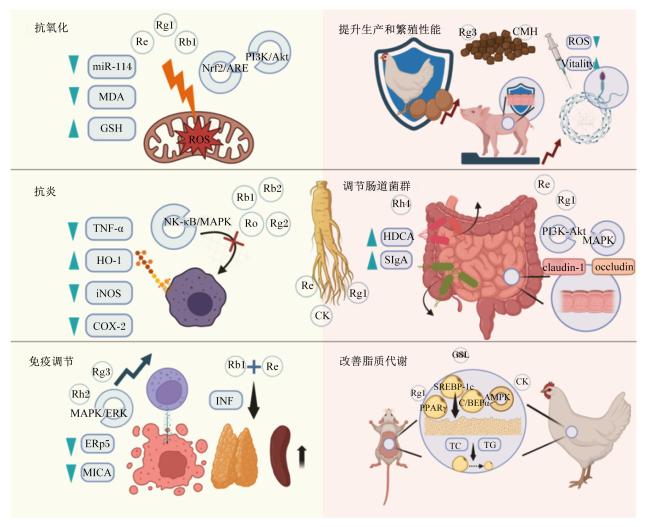
由此可知,人参皂苷通过激活AMPK信号通路、下调PPARγC/EBPαSREBP-1c等脂肪生成关键因子的表达,显著抑制脂肪沉积,改善脂质代谢紊乱,在小鼠和畜禽模型中均表现出抗肥胖潜力(图2)。然而,现有研究多集中于实验室小鼠模型,需进一步在畜禽等贴近实际应用场景的动物模型中验证其改善脂质代谢的能力。
图2 人参皂苷的生物学功能及其在畜禽生产中的应用(使用Biorender.com制作)

Re、Rb1、Rb2、Rg1、Rg2、Rg3、Ro、Rh2、Rh4、CK:人参皂苷 ginsenosides;miR-114:微小核糖核酸-144 microRNA-144;MDA:丙二醛 malondialdehyde;GSH:谷胱甘肽 glutathione;Nrf2:核因子E2相关因子2 nuclear factor erythroid 2-related factor 2;ARE:抗氧化反应元件 antioxidant response element;PI3K:磷脂酰肌醇-3-激酶 phosphatidylinositol 3-kinase;Akt:蛋白激酶B protein kinase B;CMH:中草药 Chinese medicinal herbs;ROS:活性氧 reactive oxygen species;Vitality:活力;TNF-α:肿瘤坏死因子-α tumor necrosis factor-α;HO-1:血红素加氧酶-1 heme oxygenase-1;iNOS:诱导型一氧化氮合酶 inducible nitric oxide synthase;COX-2:环氧合酶-2 yclooxygenase-2;NK-κB:核转录因子-Κb nuclear factor-kappa B;HDCA:猪去氧胆酸 hyodeoxycholic acid;SigA:分泌型免疫球蛋白A secretory immunoglobulin A;claudin-1:封闭蛋白-1;occludin:闭合蛋白;MAPK:丝裂原活化蛋白激酶 mitogen-activated protein kinase;ERK:细胞外信号调节激酶 extracellular signal-regulated kinase;INF:干扰素 interferon;Erp5:内质网蛋白5 endoplasmic reticulum protein 5;MICA:主要组织相容性复合体Ⅰ类相关链A major histocompatibility complex class Ⅰ-related chain A;GSL:人参茎叶 ginseng stems and leaves;PPARγ:过氧化物酶体增殖物激活受体γ peroxisome proliferator-activated receptor gamma;SREBP-1c:固醇调节元件结合蛋白-1c sterol regulatory element-binding protein-1c;C/BEPα:CCAAT增强子结合蛋白α CCAAT-enhancer-binding protein alpha;AMPK:腺苷酸活化蛋白激酶 adenosine monophosphate activated protein kinase;TC:总胆固醇 total cholesterol;TG:甘油三酯 triglyceride。

Fig.2 Biological function of ginsenosides and their application in livestock and poultry production (created in Biorender.com)

4 小结与展望

人参皂苷作为人参的主要活性成分,具有丰富多样的生物学功能,在畜禽生产中也展现出了巨大的应用潜力。人参皂苷具备抗氧化、抗炎、免疫调节等多样生物学功能,可维护机体细胞和组织正常功能,预防和治疗炎症及代谢性疾病。人参皂苷在家禽养殖中,可提高蛋鸡产蛋量、改善蛋品质,提升肉鸡生长性能、缓解热应激损伤并降低脂质沉积;在猪养殖中,人参皂苷可增强仔猪营养物质消化率、提升母猪饲料利用率和肉品质,野山参提取物还能维持公猪精子活力,同时人参皂苷还通过调节肠道菌群与脂肪转录因子,修复肠道屏障,改善脂质代谢。然而,现有研究主要集中在细胞试验和小鼠试验阶段,对牛、羊等大型反刍动物的研究较少,对于不同畜禽的有效剂量差异、皂苷成分功能特异性及跨物种代谢机制均不明确,需进一步拓展动物模型以推动人参皂苷在畜禽生产中的实际应用。随着消费者对食品安全和生态环境的关注度不断提高,未来需针对这些问题开展更多研究,为人类健康和畜禽养殖行业的发展作出更大的贡献。
[1]
XU F J, VALAPPIL A K, MATHIYALAGAN R, et al. In vitro cultivation and ginsenosides accumulation in Panax ginseng:a review[J]. Plants, 2023, 12(17):3165.

[2]
ZHAO L X, ZHANG T B, ZHANG K. Pharmacological effects of ginseng and ginsenosides on intestinal inflammation and the immune system[J]. Frontiers in Immunology, 2024,15:1353614.

[3]
孔洋洋, 袁红霞. 《神农本草经》与经方应用之人参篇[J]. 山东中医药大学学报, 2023, 47(2):127-131.

KONG Y Y, YUAN H X. Renshen (Ginseng Radix Et Rhizoma) in Shennong classic of materia medica and classical formulas[J]. Journal of Shandong University of Traditional Chinese Medicine, 2023, 47(2):127-131. (in Chinese)

[4]
KIM J H, YI Y S, KIM M Y, et al. Role of ginsenosides,the main active components of Panax ginseng,in inflammatory responses and diseases[J]. Journal of Ginseng Research, 2017, 41(4):435-443.

[5]
KIM K H, LEE D H, LEE H L, et al. Beneficial effects of Panax ginseng for the treatment and prevention of neurodegenerative diseases:past findings and future directions[J]. Journal of Ginseng Research, 2018, 42(3):239-247.

[6]
RATAN Z A, YOUN S H, KWAK Y S, et al. Adaptogenic effects of Panax ginseng on modulation of immune functions[J]. Journal of Ginseng Research, 2021, 45(1):32-40.

[7]
ZHU H, HE Y S, MA J, et al. The dual roles of ginsenosides in improving the anti-tumor efficiency of cyclophosphamide in mammary carcinoma mice[J]. Journal of Ethnopharmacology, 2021,265:113271.

[8]
FANG Z Q, ZHANG J Y, HUANG J W, et al. Research progress on anti-aging effects and mechanisms of the new ginsenoside compound K[J]. Journal of Dermatologic Science and Cosmetic Technology, 2025, 2(1):100072.

[9]
YU T, YANG Y Y, KWAK Y S, et al. Ginsenoside Rc from Panax ginseng exerts anti-inflammatory activity by targeting tank-binding kinase 1/interferon regulatory factor-3 and p38/ATF-2[J]. Journal of Ginseng Research, 2017, 41(2):127-133.

[10]
SHAO J W, JIANG J L, ZOU J J, et al. Therapeutic potential of ginsenosides on diabetes:from hypoglycemic mechanism to clinical trials[J]. Journal of Functional Foods, 2020,64:103630.

[11]
FAN W X, HUANG Y L, ZHENG H, et al. Ginsenosides for the treatment of metabolic syndrome and cardiovascular diseases:pharmacology and mechanisms[J]. Biomedicine & Pharmacotherapy, 2020,132:110915.

[12]
CHEN Y Y, LIU Q P, AN P, et al. Ginsenoside Rd:a promising natural neuroprotective agent[J]. Phytomedicine, 2022,95:153883.

[13]
PANDEY A K, KUMAR P, SAXENA M J. Feed additives in animal health[M]//GUPTA R, SRIVASTAVA A, LALL R. Nutraceuticals in veterinary medicine. Cham:Springer,2019:345-362.

[14]
PIAO X M, HUO Y, KANG J P, et al. Diversity of ginsenoside profiles produced by various processing technologies[J]. Molecules, 2020, 25(19):4390.

[15]
CHEN C, XIA J X, REN H W, et al. Effect of the structure of ginsenosides on the in vivo fate of their liposomes[J]. Asian Journal of Pharmaceutical Sciences, 2022, 17(2):219-229.

[16]
LI X, LIU J, ZUO T T, et al. Advances and challenges in ginseng research from 2011 to 2020:the phytochemistry,quality control,metabolism,and biosynthesis[J]. Natural Product Reports, 2022, 39(4):875-909.

[17]
MATHIYALAGAN R, KIM Y J, WANG C, et al. Protopanaxadiol aglycone ginsenoside-polyethylene glycol conjugates:synthesis,physicochemical characterizations,and in vitro studies[J]. Artificial Cells,Nanomedicine,and Biotechnology, 2016, 44(8):1803-1809.

[18]
NAG S A, QIN J J, WANG W, et al. Ginsenosides as anticancer agents:in vitro and in vivo activities,structure-activity relationships,and molecular mechanisms of action[J]. Frontiers in Pharmacology, 2012,3:25.

[19]
WU R H, RU Q, CHEN L, et al. Stereospecificity of ginsenoside Rg3 in the promotion of cellular immunity in hepatoma H22-bearing mice[J]. Journal of Food Science, 2014, 79(7):H1430-H1435.

[20]
LI Y N, LI J N, YANG L X, et al. Ginsenoside Rb1 protects hippocampal neurons in depressed rats based on mitophagy-regulated astrocytic pyroptosis[J]. Phytomedicine, 2023,121:155083.

[21]
ZHU H R, ZHANG R, HUANG Z X, et al. Progress in the conversion of ginsenoside Rb1 into minor ginsenosides using β-glucosidases[J]. Foods, 2023, 12(2):397.

[22]
YANG L, ZOU H C, GAO Y C, et al. Insights into gastrointestinal microbiota-generated ginsenoside metabolites and their bioactivities[J]. Drug Metabolism Reviews, 2020, 52(1):125-138.

DOI PMID

[23]
OH H A, KIM D E, CHOI H J, et al. Anti-fatigue effects of 20(S)-protopanaxadiol and 20(S)-protopanaxatriol in mice[J]. Biological and Pharmaceutical Bulletin, 2015, 38(9):1415-1419.

DOI PMID

[24]
JIANG Z, QIAN J, DONG H Y, et al. The traditional Chinese medicine Achyranthes bidentata and our de novo conception of its metastatic chemoprevention:from phytochemistry to pharmacology[J]. Scientific Reports, 2017, 7(1):3888.

[25]
GONG L, YIN J Y, ZHANG Y, et al. Neuroprotective mechanisms of ginsenoside Rb1 in central nervous system diseases[J]. Frontiers in Pharmacology, 2022,13:914352.

[26]
XUE Q Q, HE N N, WANG Z B, et al. Functional roles and mechanisms of ginsenosides from Panax ginseng in atherosclerosis[J]. Journal of Ginseng Research, 2021, 45(1):22-31.

[27]
HOU L J, ZOU Z M, WANG Y, et al. Exploring the anti-atherosclerosis mechanism of ginsenoside Rb1 by integrating network pharmacology and experimental verification[J]. Aging, 2024, 16(8):6745-6756.

[28]
LIU Y H, DENG Y C, WANG F Y, et al. A new mechanism for ginsenoside Rb1 to promote glucose uptake,regulating riboflavin metabolism and redox homeostasis[J]. Metabolites, 2022, 12(11):1011.

[29]
杨芳, 庞洋, 刘宝贵, 等. 人参皂苷Rc激活Nrf2信号通路缓解氧糖剥夺再复氧诱导的神经元损伤[J]. 中国老年学杂志, 2024, 44(24):6035-6040.

YANG F, PANG Y, LIU B G, et al. Ginsenoside Rc activates Nrf2 signaling pathway to alleviate neuronal damage induced by oxygen-glucose deprivation and reoxygenation[J]. Chinese Journal of Gerontology, 2024, 44(24):6035-6040. (in Chinese)

[30]
WANG Y P, ZHENG J D, XIAO X Y, et al. Ginsenoside Rd attenuates myocardial ischemia\reperfusion injury by inhibiting inflammation and apoptosis through PI3K/Akt signaling pathway[J]. The American Journal of Chinese Medicine, 2024, 52(2):433-451.

[31]
GAO X Y, LIU G C, ZHANG J X, et al. Pharmacological properties of ginsenoside Re[J]. Frontiers in Pharmacology, 2022,13:754191.

[32]
DU Y H, FU M, WANG Y T, et al. Neuroprotective effects of ginsenoside Rf on amyloid-β-induced neurotoxicity in vitro and in vivo[J]. Journal of Alzheimers Disease, 2018, 64(1):309-322.

[33]
ZHU Y Q, CHEN J Y, LI J, et al. Ginsenoside Rg1 as a promising adjuvant agent for enhancing the anti-cancer functions of granulocytes inhibited by noradrenaline[J]. Frontiers in Immunology, 2023,14:1070679.

[34]
SUN Y, YANG Y T, LIU S S, et al. New therapeutic approaches to and mechanisms of ginsenoside Rg1 against neurological diseases[J]. Cells, 2022, 11(16):2529.

[35]
LI Y, HAO H, YU H Z, et al. Ginsenoside Rg2 ameliorates myocardial ischemia/reperfusion injury by regulating TAK1 to inhibit necroptosis[J]. Frontiers in Cardiovascular Medicine, 2022,9:824657.

[36]
XUE P, YANG X S, ZHAO L, et al. Relationship between antimicrobial activity and amphipathic structure of ginsenosides[J]. Industrial Crops and Products, 2020,143:111929.

[37]
姜琳珊. 人参皂苷Ro改善肥胖及其代谢并发症的药效学及作用机制研究[D].博士学位论文. 上海: 上海中医药大学, 2019.

JIANG L S. Pharmacodynamics and mechanism of ginsenoside Ro on improvement of obesity and associated complications[D].Ph.D.Thesis. Shanghai: Shanghai University of Traditional Chinese Medicine, 2019. (in Chinese)

[38]
CHAUDHARY P, JANMEDA P, DOCEA A O, et al. Oxidative stress,free radicals and antioxidants: potential crosstalk in the pathophysiology of human diseases[J]. Frontiers in Chemistry, 2023,11:1158198.

[39]
XIE J T, SHAO Z H, VANDEN HOEK T L, et al. Antioxidant effects of ginsenoside Re in cardiomyocytes[J]. European Journal of Pharmacology, 2006, 532(3):201-207.

[40]
HAJAM Y A, RANI R, GANIE S Y, et al. Oxidative stress in human pathology and aging: molecular mechanisms and perspectives[J]. Cells, 2022, 11(3):552.

[41]
JELIC M D, MANDIC A D, MARICIC S M, et al. Oxidative stress and its role in cancer[J]. Journal of Cancer Research and Therapeutics, 2021, 17(1):22-28.

DOI PMID

[42]
REKATSINA M, PALADINI A, PIROLI A, et al. Pathophysiology and therapeutic perspectives of oxidative stress and neurodegenerative diseases:a narrative review[J]. Advances in Therapy, 2020, 37(1):113-139.

[43]
KIM A, PARK S M, KIM N S, et al. Ginsenoside Rc,an active component of Panax ginseng,alleviates oxidative stress-induced muscle atrophy via improvement of mitochondrial biogenesis[J]. Antioxidants, 2023, 12(8):1576.

[44]
CHU S F, ZHANG Z, ZHOU X, et al. Ginsenoside Rg1 protects against ischemic/reperfusion-induced neuronal injury through miR-144/Nrf2/ARE pathway[J]. Acta Pharmacologica Sinica, 2019, 40(1):13-25.

[45]
DONG C X, LIU P, WANG H Z, et al. Ginsenoside Rb1 attenuates diabetic retinopathy in streptozotocin-induced diabetic rats1[J]. Acta Cirurgica Brasileira, 2019, 34(2):e201900201.

[46]
XIE W J, ZHOU P, QU M W, et al. Ginsenoside Re attenuates high glucose-induced RF/6A injury via regulating PI3K/AKT inhibited HIF-1α/VEGF signaling pathway[J]. Frontiers in Pharmacology, 2020,11:695.

[47]
CHO J Y, YOO E S, BAIK K U, et al. In vitro inhibitory effect of protopanaxadiol ginsenosides on tumor necrosis factor (TNF)-alpha production and its modulation by known TNF-alpha antagonists[J]. Planta Medica, 2001, 67(3):213-218.

[48]
WU C F, BI X L, YANG J Y, et al. Differential effects of ginsenosides on NO and TNF-alpha production by LPS-activated N9 microglia[J]. International Immunopharmacology, 2007, 7(3):313-320.

DOI PMID

[49]
HU J F, SONG X Y, CHU S F, et al. Inhibitory effect of ginsenoside Rg1 on lipopolysaccharide-induced microglial activation in mice[J]. Brain Research, 2011,1374:8-14.

[50]
KIM S, OH M H, KIM B S, et al. Upregulation of heme oxygenase-1 by ginsenoside Ro attenuates lipopolysaccharide-induced inflammation in macrophage cells[J]. Journal of Ginseng Research, 2015, 39(4):365-370.

DOI PMID

[51]
LEE Y, PARK A, PARK Y J, et al. Ginsenoside 20(R)-Rg 3 enhances natural killer cell activity by increasing activating receptor expression through the MAPK/ERK signaling pathway[J].International Immunopharmacology, 2022,107:108618.

[52]
YANG C M, QIAN C, ZHENG W W, et al. Ginsenoside Rh 2 enhances immune surveillance of natural killer (NK) cells via inhibition of ERp5 in breast cancer[J].Phytomedicine, 2024,123:155180.

[53]
SHI M, MA J, JIN S, et al. Effects of saponins Rb1 and Re in American ginseng combined intervention on immune system of aging model[J]. Frontiers in Molecular Biosciences, 2024,11:1392868.

[54]
马强, 刘爱萍, 张云玲, 等. 饲料中添加人参皂甙粉、松花粉饲喂产蛋鸡的试验报告[J]. 中国畜牧兽医文摘, 2016, 32(1):225-226.

MA Q, LIU A P, ZHANG Y L, et al. Experimental report on feeding laying hens with ginsenoside powder and pine pollen in feed[J]. Chinese Animal Husbandry and Veterinary Abstract, 2016, 32(1):225-226. (in Chinese)

[55]
付府伊, 徐钰栋, 赖宇谦, 等. 人参粗提物与裂褶多糖或葡萄糖氧化酶复配对蛋鸡生产性能和血清生化指标的影响[J]. 饲料研究, 2024, 47(22):27-33.

FU F Y, XU Y D, LAI Y Q, et al. Effects of compound combination of ginseng crude extract with schizophyllan or glucose oxidase on production performance and serum biochemical indexes of laying hens[J]. Feed Research, 2024, 47(22):27-33. (in Chinese)

[56]
BI S C, QU Y W, SHAO J J, et al. Ginsenoside Rg3 ameliorates stress of broiler chicks induced by Escherichia coli lipopolysaccharide[J]. Frontiers in Veterinary Science, 2022,9:878018.

[57]
HUANG C W, LEE T T, SHIH Y C, et al. Effects of dietary supplementation of Chinese medicinal herbs on polymorphonuclear neutrophil immune activity and small intestinal morphology in weanling pigs[J]. Journal of Animal Physiology and Animal Nutrition, 2012, 96(2):285-294.

DOI PMID

[58]
明雷, 宋继红, 战桂娟. 人参副产物对猪生长性能、胴体性状的影响及经济效益分析[J]. 饲料工业, 2017, 38(1):39-41.

MING L, SONG J H, ZHAN G J. Effects of ginseng by-product on growth performance and carcass traits for pig and its economic benefits[J]. Feed Industry, 2017, 38(1):39-41. (in Chinese)

[59]
YUN S J, BAE G S, PARK J H, et al. Antioxidant effects of cultured wild ginseng root extracts on the male reproductive function of boars and guinea pigs[J]. Animal Reproduction Science, 2016,170:51-60.

[60]
BAI X, DENG J J, DUAN Z G, et al. Ginsenoside Rh4 alleviates gastrointestinal mucositis and enhances chemotherapy efficacy through modulating gut microbiota[J]. Phytomedicine, 2024,128:155577.

[61]
杜林, 张莉, 胡卫东, 等. 人参皂苷Rg1、Re对感染LPS猪空肠上皮细胞IPEC-J2的保护作用[J]. 中国兽医学报, 2024, 44(6):1256-1267.

DU L, ZHANG L, HU W D, et al. Protective effects of ginsenosides Rg1 and Re on LPS-induced damage of porcine jejunal epithelial cells IPEC-J2[J]. Chinese Journal of Veterinary Science, 2024, 44(6):1256-1267. (in Chinese)

[62]
SONG Z H, XIE K H, ZHANG Y L, et al. Effects of dietary ginsenoside Rg1 supplementation on growth performance,gut health,and serum immunity in broiler chickens[J]. Frontiers in Nutrition, 2021,8:705279.

[63]
SANDNER G, MUELLER A S, ZHOU X D, et al. Ginseng extract ameliorates the negative physiological effects of heat stress by supporting heat shock response and improving intestinal barrier integrity:evidence from studies with heat-stressed Caco-2 cells,C. elegans and growing broilers[J]. Molecules, 2020, 25(4):835.

[64]
ZHOU J, ZHANG J, LI J Y, et al. Ginsenoside F2 suppresses adipogenesis in 3T3-L1 cells and obesity in mice via the AMPK pathway[J]. Journal of Agricultural and Food Chemistry, 2021, 69(32):9299-9312.

[65]
LIU H M, WANG J, LIU M H, et al. Antiobesity effects of ginsenoside Rg1 on 3T3-L1 preadipocytes and high fat diet-induced obese mice mediated by AMPK[J]. Nutrients, 2018, 10(7):830.

[66]
ZHANG P, ZHANG H Y, MA C J, et al. Effect of ginseng stem leaf extract on the production performance,meat quality,antioxidant status,immune function,and lipid metabolism of broilers[J]. Frontiers in Veterinary Science, 2024,11:1463613.

[67]
OH J M, CHUN S. Ginsenoside CK inhibits the early stage of adipogenesis via the AMPK,MAPK,and AKT signaling pathways[J]. Antioxidants, 2022, 11(10):1890.

Outlines

/