RESEARCH PAPER

Effects of Dietary Fiber Level on Expression of Endogenous Antimicrobial Peptides in Three Breeds of Pigs

  • XIN Ye , 1, 2 ,
  • TAN Bi’e 2 ,
  • ZHU Qian 1 ,
  • DING Sujuan 1 ,
  • CHENG Yating 1 ,
  • KONG Xiangfeng , 1, 2, *
Expand
  • 1 Hunan Provincial Key Laboratory of Animal Nutrition Physiology and Metabolic Processes, Institute of Subtropical Agroecology, Chinese Academy of Sciences, Changsha 410125, China
  • 2 Hunan Provincial Key Laboratory for the Products Quality Regulation of Livestock and Poultry, College of Animal Science and Technology, Hunan Agricultural University, Changsha 410128, China
*professor, E-mail:

Received date: 2025-03-14

  Online published: 2025-10-15

Abstract

This experiment aimed to investigate the effects of dietary fiber level on the expression of endogenous antimicrobial peptides in multiple organ tissues of three breeds of pigs. Each twenty healthy Taoyuan black pigs with an average body weight of (13.87±0.58) kg, Xiangcun black pigs with an average body weight of (14.47±0.15) kg and Duroc pigs with an average body weight of (18.50±1.09) kg at 60 days of age were selected and randomly divided into 2 groups, with 10 replicates in each group and 1 pig in each replicate. For each breed, the pigs in the two groups were fed a low-fiber level diet (with crude fiber content of 3.14%, LF group) and a high-fiber level diet (with crude fiber content of 6.86%, HF group), respectively. The pre-trial period lasted for 7 days, and the trial period lasted for 28 days. After the experiment, the jejunum, ileum and colon mucosa, as well as the liver and spleen tissues were collected after slaughter, and the expression levels of antimicrobial peptide genes such as porcine β-defensin-2 (pBD-2), porcine β-defensin-3 (pBD-3), protegrin-1 (PG-1), proline and arginine-rich antimicrobial peptide-39 (PR-39), and porcine myeloid antibacterial peptide-37 (PMAP-37) were analyzed by real-time fluorescence quantitative PCR technology. The results showed as follows: 1) The fiber level and tissue had no significant effects on the mRNA relative expression levels of five endogenous antimicrobial peptides in Duroc pigs (P>0.05). Compared with LF group, the mRNA relative expression levels of pBD-2 in ileum and colon, pBD-3 and PG-1 in spleen and jejunum, and PMAP-37 in ileum of local breed pigs in HF group were significantly increased (P<0.05), while the mRNA relative expression levels of pBD-2 in spleen and jejunum and pBD-3 in liver of local breed pigs, PR-39 in liver and colon of Taoyuan black pigs, and pBD-2 and PG-1 in liver of Xiangcun black pigs were significantly decreased (P<0.05). 2) Compared with Duroc pigs, the mRNA relative expression levels of pBD-2 in colon, pBD-3 in liver and ileum, and PG-1, PR-39 and PMAP-37 in ileum of local breed pigs were significantly increased (P<0.05), and the mRNA relative expression levels of PMAP-37 in liver and spleen of Taoyuan black pigs and in colon of Xiangcun black pigs were significantly increased (P<0.05). 3) The mRNA relative expression levels of pBD-2 in spleen and jejunum and pBD-3 mRNA in liver in LF group were significantly higher than those in HF group (P<0.05), while the mRNA relative expression levels of pBD-2 in ileum and colon, PG-1 in jejunum, and PR-39 and PMAP-37 in spleen and ileum in HF group were significantly higher than those in LF group (P<0.05). 4) The mRNA relative expression levels of pBD-2 in colon, pBD-3 in liver, and PG-1, PR-39 and PMAP-37 in ileum were significantly higher than those in the other tissues (P<0.05). 5) There was a significant interaction among breed, fiber level and tissue on the expression of the five endogenous antimicrobial peptides (P<0.05). In conclusion, the expression of endogenous antimicrobial peptides in pigs is breed-specific, while that in local breed pigs is tissue-specific. High-fiber level diet can up-regulate the expression of antimicrobial peptides in spleen and intestine of local breed pigs and down-regulate the expression of antimicrobial peptides in liver, but has no significant effects on the expression and tissue distribution of endogenous antimicrobial peptides in Duroc pigs.

Cite this article

XIN Ye , TAN Bi’e , ZHU Qian , DING Sujuan , CHENG Yating , KONG Xiangfeng . Effects of Dietary Fiber Level on Expression of Endogenous Antimicrobial Peptides in Three Breeds of Pigs[J]. Chinese Journal of Animal Nutrition, 2025 , 37(10) : 6612 -6624 . DOI: 10.12418/CJAN2025.538

麦麸中含有约50%的膳食纤维(dietary fiber,DF),主要由小麦仁纤维外层中的阿拉伯木聚糖、纤维素和β-D-葡聚糖等组成[1]。DF具有调节肠道微生态平衡、改善胃肠道健康等功能[1-2]。因此,在畜禽饲粮中添加适量麦麸不仅能够促进肠道健康发育,还能够节约饲料成本。抗菌肽是一类具有广谱抗致病菌活性以及强大免疫调节和抗癌能力的小分子肽[3]。机体尤其是直接暴露于微生物环境中的皮肤和肠道表面不断合成并释放抗菌肽[4]。抗菌肽与肠道微生物之间存在相互作用,抗菌肽可以通过抑制肠道病原菌的增殖来改善肠道菌群结构平衡[5],肠道微生物代谢DF生成的短链脂肪酸(short-chain fatty acids,SCFAs)能够诱导内源性宿主防御肽(host defense peptides,HDPs)的表达[6]。例如,SCFAs可通过抑制组蛋白脱乙酰酶(histone deacetylase,HDAC)促进HDPs的合成,还可上调奶牛气管抗菌肽的表达[7]。大麦纤维固态发酵可以有效改善肉鸡肠道功能,上调β-防御素-1的表达[8]。因此,探究影响抗菌肽表达的各类因素,对畜牧生产中增强动物免疫功能具有重要意义。
桃源黑猪是我国地方特色品种猪,具有较强的抗病和耐粗饲特性;湘村黑猪是以杜洛克猪为父本、桃源黑猪为母本杂交培育的新品种。目前,关于地方品种猪的研究多聚焦于生长性能[9]和肉品质[10]等方面。笔者前期研究发现,饲喂3.14%纤维水平饲粮时杜洛克猪、湘村黑猪和桃源黑猪的平均日采食量分别为761.92、713.07和906.49 g/d,而饲喂6.86%纤维水平饲粮时3个品种猪的平均日采食量分别为748.02、730.34和855.96 g/d,可见饲粮纤维水平对采食量的影响较小,但高纤维水平饲粮显著提高了湘村黑猪的平均日增重,降低了料重比[11-12];同时,高纤维水平饲粮还显著提高了桃源黑猪和湘村黑猪的肠道微生物多样性[13]和SCFAs浓度[14],改善了桃源黑猪的血浆免疫指标,增强了湘村黑猪的肠道屏障功能[15]。不过,目前对3个品种猪抗菌肽表达特性及其影响因素的研究有限。因此,本研究测定了3个品种猪内源抗菌肽表达水平的差异,探讨饲粮纤维对其多个器官组织中抗菌肽表达水平的影响,旨在为地方品种猪的选育和饲粮配方设计提供科学依据。

1 材料与方法

1.1 试验设计和饲养管理

本研究中的动物试验程序经中国科学院亚热带农业研究所动物护理与使用委员会批准(批准号:20200018)。选取60日龄的健康桃源黑猪[平均体重(13.87±0.58) kg]、湘村黑猪[平均体重(14.47±0.15) kg]和杜洛克猪[平均体重(18.50±1.09) kg]各20头,每个品种猪随机分为2组,每组10个重复,每个重复1头猪。每个品种2组猪分别饲喂低纤维水平饲粮(粗纤维含量为3.14%,LF组)和高纤维水平饲粮(粗纤维含量为6.86%,HF组)。麦麸纤维总膳食纤维含量≥95%。低纤维水平饲粮的组成及营养水平符合NRC(2012),高纤维水平饲粮符合《猪饲养标准》(NY/T 65—2004)保育仔猪营养需要,饲粮组成及营养水平见表1。预试期7 d,正试期28 d。试验期间,试验猪单栏饲养,自由采食与饮水,室温控制在22~25 ℃。
表1 饲粮组成及营养水平(饲喂基础)

Table 1 Composition and nutrient levels of diets (as-fed basis) %

项目
Items
低纤维
水平饲粮
Low fiber
level diet
高纤维
水平饲粮
High fiber
level diet
原料Ingredients
玉米Corn 35.70 25.21
膨化玉米Extrude corn 27.41 20.20
膨化大豆Extrude soybean 8.49 12.30
豆粕Soybean meal 18.00 16.40
玉米淀粉Corn starch 8.70
鱼粉Fish meal 4.50 5.40
大豆油Soybean oil 1.68 3.00
蔗糖Sucrose 2.00 2.00
麦麸纤维Wheat bran fiber 4.90
石粉Limestone 0.50 0.30
磷酸氢钙CaHPO4 0.58 0.45
食盐NaCl 0.20 0.20
L-赖氨酸盐酸盐L-Lys·HCl 0.32 0.30
DL-蛋氨酸DL-Met 0.09 0.08
L-苏氨酸L-Thr (98.5%) 0.02 0.05
L-色氨酸L-Try (98%) 0.01 0.01
氯化胆碱Choline chloride 0.15 0.15
预混料Premix1) 0.35 0.35
合计Total 100.00 100.00
营养水平Nutrient levels2)
消化能DE/(MJ/kg) 14.59 14.64
粗蛋白质CP 19.15 19.19
粗纤维CF 3.14 6.86
赖氨酸Lys 1.22 1.26
蛋氨酸Met 0.39 0.40
蛋氨酸+胱氨酸Met+Cys 0.66 0.66
苏氨酸Thr 0.70 0.74
色氨酸Try 0.21 0.33
钙Ca 0.73 0.69
有效磷AP 0.39 0.36

1)预混料为每千克饲粮提供 The premix provided the following per kg of diets:VA 6 000 IU,VD3 3 000 IU,VE 24 mg,VK3 3 mg,VB1 1.50 mg,VB2 6 mg,VB6 3 mg,VB12 0.02 mg,烟酸 nicotinic acid 14 mg,泛酸 pantothenic acid 15 mg,叶酸 folic acid 1.2 mg,生物素 biotin 0.15 mg,Fe (as ferrous sulfate) 100 mg,Cu (as copper sulphate) 5 mg,Zn (as zinc sulfate) 80 mg,Mn (as manganese sulfate) 3 mg,I (as potassium iodide) 0.14 mg,Se (as sodium selenate) 0.25 mg。2)营养水平为实测值。Nutrient levels were measured values.

1.2 样品采集和处理

试验结束后,屠宰试验猪,取空肠、回肠和结肠黏膜以及肝脏和脾脏等器官组织,液氮速冻后置于-80 ℃保存,用于测定抗菌肽基因表达水平。

1.3 饲粮营养水平测定

将饲粮和粪便样品干燥后粉碎,依据美国分析化学家协会(AOAC)标准方法,利用绝热弹式量热计(AOAC 945.16)测定其总能;采用凯氏定氮法(AOAC 984.13)、温氏法(AOAC 978.10)、酸水解后柱后衍生高效液相色谱(HPLC)法(AOAC 994.12)、微波消解后电感耦合等离子体原子发射光谱(ICP-AES)法(AOAC 984.27)和钒钼黄比色法(AOAC 965.17)结合盐酸提取有效磷法分别测定粗蛋白质、粗纤维、氨基酸、钙和有效磷含量。以三氧化二铬(Cr2O3)作为外源指示剂计算消化能,计算公式如下:
消化能(MJ/kg)={饲粮总能×1 000-[粪便总能×(饲粮Cr2O3含量/粪便Cr2O3含量)×(100/100-饲粮水分含量)]/1 000}。

1.4 内源抗菌肽mRNA相对表达量测定

采用TRIzol试剂(湖南艾科瑞生物工程有限公司)提取总RNA,然后使用核酸蛋白仪检测RNA溶液的浓度和质量,RNA溶液的吸光度(OD)260 nm/OD280 nm值介于1.8~2.0,表示RNA质量良好;将RNA浓度稀释至约500 ng/μL,采用Evo M-MLV反转录预混型试剂(湖南艾科瑞生物工程有限公司)将mRNA反转录成cDNA,并于-20 ℃保存。反应总体系为20 μL,包括2 μL gDNA Clean Reaction Mix、4 μL Evo M-MLVRT Reaction Mix、2 μL总RNA和12 μL RNase free water。反应程序为:37 ℃ 15 min、85 ℃ 5 s,4 ℃保存。
参考相关文献[16-18]设计抗菌肽基因的引物序列,委托北京擎科生物科技股份有限公司合成引物,引物序列见表2。将cDNA原液稀释至25 ng/μL,以cDNA作为模板,按照SYBR® Green Pro Taq HS预混型qPCR试剂盒(湖南艾科瑞生物工程有限公司)操作方法,使用实时荧光定量PCR仪(LightCycler® 408,Roche,瑞士)进行检测。反应体系为10 μL,包括5.0 μL SYBR Green Pro Taq HS Premix、4.2 μL cDNA以及上游和下游引物(10 μmol/L)各0.4 μL。反应程序为:95 ℃ 30 s;95 ℃ 5 s、60 ℃ 30 s,40个循环。采用2-ΔΔCt法,以β-肌动蛋白(β-actin)为内参基因对目的基因mRNA相对表达量进行分析,目的抗菌肽基因包括猪β-防御素-2(pBD-2)、猪β-防御素-3(pBD-3)、protegrin-1(PG-1)、富含脯氨酸和精氨酸的抗菌肽-39(PR-39)和猪骨髓抗菌肽-37(PMAP-37)。
表2 实时荧光定量PCR所用引物序列

Table 2 Primer sequences used for real-time fluorescence quantitative PCR

基因
Genes
登录号
Accession number
引物序列
Primer sequences (5'—3')
产物大小
Product size/bp
猪β-防御素-2
pBD-2
NM-214442.2 F:ТGТСТGССТССТСТСТТСС
R:AACAGGTCCCТTCAATCCTG
149
猪β-防御素-3
pBD-3
NM-214444.1 F:CCTTCTCTTTGCCTTGCТCTT
R:GCCACTCACAGAACAGCTACC
163
PG-1 NM-001123149.2 F:AACGGGCGGGTGAAACAGT
R:CCCCTGACACCTTGAACCTCA
95
富含脯氨酸和精氨酸的抗菌肽-39
PR-39
NM-214450.2 F:CAAGGCCACCTCCGTTTT
R:CCACTCCATCACCGTTTTCC
127
猪骨髓抗菌肽-37
PMAP-37
L39641.1 F:CTACTTAGCCGACTGCGTGAT
R:GATAGCCTGAATCTTAGGACTG
125
β-肌动蛋白
β-actin
U07786.1 F:ATCGTGCGGGACATCAAGG
R:GGCAGCTCGTAGCTCTTCTC
109

1.5 数据统计与分析

采用Excel 2019对试验数据进行整理,然后采用SPSS 24.0软件对数据进行三因素(品种、纤维水平和组织)方差分析(three-way ANOVA),并采用LSD法进行多重比较;采用GraphPad Prism 8.0软件绘制图表。结果数据以“平均值±标准误”形式表示,P<0.05表示差异显著。

2 结果与分析

2.1 饲粮纤维水平对3个品种猪内源pBD-2表达的影响

表3可知,品种、纤维水平和组织对3个品种猪内源pBD-2 mRNA相对表达量有显著影响(P<0.05),同时存在显著的两因素和三因素交互作用(P<0.05)。与杜洛克猪相比,地方品种猪(湘村黑猪和桃源黑猪)结肠pBD-2 mRNA相对表达量显著提高(P<0.05),桃源黑猪空肠pBD-2 mRNA相对表达量显著提高(P<0.05),湘村黑猪回肠pBD-2 mRNA相对表达量显著提高(P<0.05)。与LF组相比,HF组回肠和结肠pBD-2 mRNA相对表达量显著提高(P<0.05),脾脏和空肠pBD-2 mRNA相对表达量显著降低(P<0.05)。结肠pBD-2 mRNA相对表达量显著高于其他组织(P<0.05)。纤维水平和组织对杜洛克猪内源pBD-2 mRNA相对表达量无显著影响(P>0.05);与LF组相比,HF组湘村黑猪肝脏以及地方品种猪脾脏和空肠pBD-2 mRNA相对表达量显著降低(P<0.05),地方品种猪回肠和结肠pBD-2 mRNA相对表达量显著提高(P<0.05)。
表3 饲粮纤维水平对3个品种猪内源pBD-2表达的影响

Table 3 Effects of dietary fiber level on endogenous pBD-2 expression in three breeds of pigs

项目
Items
肝脏
Liver
脾脏
Spleen
空肠
Jejunum
回肠
Ileum
结肠
Colon
杜洛克猪Duroc pig
LF组LF group 1.01±0.32 1.01±0.04 1.01±0.09 1.00±0.15 1.02±0.22
HF组HF group 1.01±0.16 1.03±0.24 1.02±0.31 1.01±0.17 1.02±0.17
湘村黑猪Xiangcun black pig
LF组LF group 1.75±0.43Aa 1.14±0.20Aab 1.16±0.36Aab 0.82±0.13Bb 1.09±0.21Bab
HF组HF group 0.53±0.22Bc 0.68±0.23Bc 0.43±0.19Bc 2.75±0.63Ab 21.23±3.24Aa
桃源黑猪Taoyuan black pig
LF组LF group 0.41±0.24b 2.31±0.49Aa 2.76±0.82Aa 0.82±0.14Bb 0.97±0.17Bb
HF组HF group 0.60±0.09cd 0.39±0.12Bd 1.18±0.35Bc 2.14±0.51Ab 3.95±0.92Aa
主效应Main effects
组织Tissue 0.88±0.12d 1.09±0.12cd 1.26±0.11bc 1.42±0.11b 4.88±0.11a
纤维水平Fiber level
LF组LF group 1.01±0.67bc 1.52±0.68Aab 1.59±0.91Aa 0.89±0.16Bc 1.02±0.19Bbc
HF组HF group 0.71±0.27c 0.72±0.33Bc 1.18±0.35Bc 2.02±0.86Ab 8.17±8.95Aa
品种Breed
杜洛克猪Duroc pig 1.01±0.21AB 1.02±0.21 1.01±0.20B 1.01±0.19B 1.02±0.20C
湘村黑猪Xiangcun black pig 1.14±0.20Ac 0.91±0.20c 0.80±0.17Bc 1.78±0.19Ab 11.16±0.21Aa
桃源黑猪Taoyuan black pig 0.50±0.19Bd 1.35±0.21c 1.97±0.20Aab 1.48±0.19ABbc 2.46±0.18Ba
PP-value
品种×纤维水平×组织Breed×fiber level×tissue <0.001
品种×纤维水平Breed×fiber level <0.001
品种×组织Breed×tissue <0.001
纤维水平×组织Fiber level×tissue <0.001
品种Breed <0.001
纤维水平Fiber level <0.001
组织Tissue <0.001

同行数据肩标不同小写字母表示差异显著(P<0.05),同列数据肩标不同大写字母表示差异显著(P<0.05)。下表同。

Values in the same row with different small letter superscripts indicated significant differences (P<0.05), and in the same column with different capital letter superscripts indicated significant differences (P<0.05). The same as below.

2.2 饲粮纤维水平对3个品种猪内源pBD-3表达的影响

表4可知,品种和组织对3个品种猪内源pBD-3 mRNA相对表达量有显著影响(P<0.05),且品种、纤维水平与组织、品种与组织以及纤维水平与组织存在显著交互作用(P<0.05)。与杜洛克猪相比,地方品种猪肝脏和回肠pBD-3 mRNA相对表达量显著提高(P<0.05),空肠和结肠pBD-3 mRNA相对表达量显著降低(P<0.05)。LF组肝脏pBD-3 mRNA相对表达量显著高于HF组(P<0.05),而HF组脾脏、空肠和回肠pBD-3 mRNA相对表达量显著高于LF组(P<0.05)。肝脏和回肠pBD-3 mRNA相对表达量显著高于其他组织(P<0.05)。纤维水平和组织对杜洛克猪内源pBD-3 mRNA相对表达量无显著影响(P>0.05);与LF组相比,HF组地方品种猪肝脏pBD-3 mRNA相对表达量显著降低(P<0.05),地方品种猪脾脏和空肠以及桃源黑猪回肠pBD-3 mRNA相对表达量显著提高(P<0.05)。
表4 饲粮纤维水平对3个品种猪内源pBD-3表达的影响

Table 4 Effects of dietary fiber level on endogenous pBD-3 expression in three breeds of pigs

项目
Items
肝脏
Liver
脾脏
Spleen
空肠
Jejunum
回肠
Ileum
结肠
Colon
杜洛克猪Duroc pig
LF组LF group 1.02±0.09 1.07±0.27 1.10±0.26 1.07±0.30 1.03±0.23
HF组HF group 1.06±0.22 1.00±0.17 1.06±0.52 1.04±0.35 0.99±0.25
湘村黑猪Xiangcun black pig
LF组LF group 2.69±0.21Aa 0.83±0.19Bc 0.26±0.09Bcd 1.55±0.38b 0.59±0.20c
HF组HF group 0.80±0.27Bbc 1.70±0.26Aa 1.07±0.23Ab 1.54±0.63a 0.64±0.28c
桃源黑猪Taoyuan black pig
LF组LF group 3.62±1.10Aa 1.08±0.21Bb 0.38±0.16Bc 1.01±0.31Bb 0.55±0.17c
HF组HF group 0.43±0.04Bc 1.39±0.26Ab 0.78±0.11Ac 2.78±0.69Aa 0.62±0.26c
主效应Main effects
组织Tissue 1.61±0.06a 1.18±0.05b 0.78±0.06c 1.50±0.05a 0.74±0.05c
纤维水平Fiber level
LF组LF group 2.43±1.31Aa 0.99±0.24Bc 0.58±0.42Bd 1.19±0.39Bb 0.71±0.29d
HF组HF group 0.76±0.33Bc 1.36±0.37Ab 0.78±0.11Ac 1.75±0.92Aa 0.72±0.30c
品种Breed
杜洛克猪Duroc pig 1.04±0.10B 1.03±0.09 1.08±0.09A 1.06±0.09C 1.01±0.10A
湘村黑猪Xiangcun black pig 1.75±0.12Aa 1.26±0.09b 0.67±0.10Bc 1.54±0.10Ba 0.62±0.09Bc
桃源黑猪Taoyuan black pig 2.03±0.10Aa 1.24±0.09b 0.58±0.09Bc 1.90±0.09Aa 0.58±0.09Bc
PP-value
品种×纤维水平×组织Breed×fiber level×tissue <0.001
品种×纤维水平Breed×fiber level 0.617
品种×组织Breed×tissue <0.001
纤维水平×组织Fiber level×tissue <0.001
品种Breed 0.001
纤维水平Fiber level 0.195
组织Tissue <0.001

2.3 饲粮纤维水平对3个品种猪内源PG-1表达的影响

表5可知,纤维水平和组织对3个品种猪内源PG-1 mRNA相对表达量有显著影响(P<0.05),同时品种、纤维水平与组织存在显著的两因素和三因素交互作用(P<0.05)。与杜洛克猪相比,地方品种猪回肠PG-1 mRNA相对表达量显著提高(P<0.05);桃源黑猪脾脏PG-1 mRNA相对表达量显著降低(P<0.05),结肠PG-1 mRNA相对表达量显著提高(P<0.05)。HF组空肠PG-1 mRNA相对表达量显著高于LF组(P<0.05)。回肠PG-1 mRNA相对表达量显著高于其他组织(P<0.05)。纤维水平和组织对杜洛克猪内源PG-1 mRNA相对表达量无显著影响(P>0.05);与LF组相比,HF组湘村黑猪肝脏和结肠PG-1 mRNA相对表达量显著降低(P<0.05),地方品种猪脾脏和空肠以及桃源黑猪回肠PG-1 mRNA相对表达量显著提高(P<0.05)。
表5 饲粮纤维水平对3个品种猪内源PG-1表达的影响

Table 5 Effects of dietary fiber level on endogenous PG-1 expression in three breeds of pigs

项目
Items
肝脏
Liver
脾脏
Spleen
空肠
Jejunum
回肠
Ileum
结肠
Colon
杜洛克猪Duroc pig
LF组LF group 1.00±0.42 1.03±0.26 0.98±0.34 1.00±0.04 1.03±0.23
HF组HF group 1.01±0.06 1.02±0.20 1.20±0.69 1.03±0.17 1.04±0.14
湘村黑猪Xiangcun black pig
LF组LF group 1.24±0.26Ab 0.44±0.28Bc 0.40±0.27Bc 2.15±0.57a 1.76±0.38Aab
HF组HF group 0.32±0.05Bb 0.83±0.23Ab 2.08±1.35Aa 2.07±0.72a 0.73±0.29Bb
桃源黑猪Taoyuan black pig
LF组LF group 0.75±0.13b 0.22±0.07Bb 0.53±0.20Bb 1.35±0.44Ba 1.35±0.37a
HF组HF group 0.97±0.21c 0.81±0.13Ac 2.04±0.37Aab 2.14±0.50Aa 1.55±0.51b
主效应Main effects
组织Tissue 0.88±0.08c 0.72±0.09c 1.20±0.07b 1.62±0.08a 1.24±0.08b
纤维水平Fiber level
LF组LF group 1.00±0.36b 0.55±0.41c 0.60±0.35Bc 1.43±0.60a 1.34±0.43a
HF组HF group 0.76±0.35d 0.89±0.20cd 2.04±0.37Aa 1.80±0.72a 1.11±0.50c
品种Breed
杜洛克猪Duroc pig 1.00±0.13 1.02±0.15A 1.09±0.13 1.01±0.13B 1.03±0.13B
湘村黑猪Xiangcun black pig 0.78±0.15c 0.64±0.14ABc 1.24±0.11b 2.11±0.13Aa 1.24±0.13ABb
桃源黑猪Taoyuan black pig 0.86±0.15c 0.51±0.15Bc 1.28±0.12b 1.75±0.14Aa 1.45±0.13Aab
PP-value
品种×纤维水平×组织Breed×fiber level×tissue <0.001
品种×纤维水平Breed×fiber level <0.001
品种×组织Breed×tissue <0.001
纤维水平×组织Fiber level×tissue <0.001
品种Breed 0.110
纤维水平Fiber level 0.001
组织Tissue <0.001

2.4 饲粮纤维水平对3个品种猪内源PR-39表达的影响

表6可知,纤维水平和组织对3个品种猪内源PR-39 mRNA相对表达量有显著影响(P<0.05),同时品种、纤维水平与组织存在显著的两因素和三因素交互作用(P<0.05)。与杜洛克猪相比,地方品种猪回肠PR-39 mRNA相对表达量显著提高(P<0.05);湘村黑猪肝脏PR-39 mRNA相对表达量显著降低(P<0.05),脾脏PR-39 mRNA相对表达量显著提高(P<0.05);桃源黑猪脾脏PR-39 mRNA相对表达量显著降低(P<0.05)。HF组脾脏和回肠PR-39 mRNA相对表达量显著高于LF组(P<0.05)。回肠PR-39 mRNA相对表达量显著高于其他组织(P<0.05)。纤维水平和组织对杜洛克猪内源PR-39 mRNA相对表达量无显著影响(P>0.05);与LF组相比,HF组湘村黑猪脾脏和回肠PR-39 mRNA相对表达量显著提高(P<0.05),桃源黑猪肝脏和结肠PR-39 mRNA相对表达量显著降低(P<0.05)。
表6 饲粮纤维水平对3个品种猪内源PR-39表达的影响

Table 6 Effects of dietary fiber level on endogenous PR-39 expression in three breeds of pigs

项目
Items
肝脏
Liver
脾脏
Spleen
空肠
Jejunum
回肠
Ileum
结肠
Colon
杜洛克猪Duroc pig
LF组LF group 0.97±0.15 1.03±0.28 1.07±0.46 1.02±0.26 1.07±0.22
HF组HF group 1.01±0.17 1.06±0.41 1.05±0.27 1.24±0.50
湘村黑猪Xiangcun black pig
LF组LF group 0.11±0.03b 0.87±0.22Ba 0.70±0.25a 0.69±0.09Bab 0.90±0.26a
HF组HF group 0.17±0.06d 2.32±0.73Ab 4.08±1.70Aa 0.78±0.33c
桃源黑猪Taoyuan black pig
LF组LF group 1.29±0.37Aab 0.45±0.16d 1.11±0.56b 1.94±0.14a 1.23±0.32Ab
HF组HF group 0.12±0.04Bc 0.59±0.18bc 2.20±1.30a 0.71±0.39Bb
主效应Main effects
组织Tissue 0.61±0.09c 1.05±0.09b 0.96±0.12b 1.83±0.09a 1.00±0.09b
纤维水平Fiber level
LF组LF group 0.71±0.56b 0.78±0.33Bb 0.92±0.44ab 1.20±0.56Ba 1.11±0.32ab
HF组HF group 0.40±0.42d 1.32±0.88Ab 2.50±1.70Aa 0.88±0.44c
品种Breed
杜洛克猪Duroc pig 0.99±0.16A 1.05±0.16B 1.07±0.21 1.03±0.16B 1.15±0.16
湘村黑猪Xiangcun black pig 0.14±0.15Bd 1.59±0.16Ab 0.70±0.18c 2.38±0.16Aa 0.84±0.15c
桃源黑猪Taoyuan black pig 0.70±0.17Abc 0.52±0.16Cc 1.11±0.23b 2.07±0.14Aa 1.02±0.14b
PP-value
品种×纤维水平×组织Breed×fiber level×tissue <0.001
品种×纤维水平Breed×fiber level <0.001
品种×组织Breed×tissue <0.001
纤维水平×组织Fiber level×tissue <0.001
品种Breed 0.163
纤维水平Fiber level 0.001
组织Tissue <0.001

HF组空肠数据缺失,表7同。

Data in jejunum in HF group were missing, the same as Table 7

2.5 饲粮纤维水平对3个品种猪内源PMAP-37表达的影响

表7可知,品种、纤维水平和组织对3个品种猪内源PMAP-37 mRNA相对表达量有显著影响(P<0.05),同时存在显著的两因素和三因素交互作用(P<0.05)。与杜洛克猪相比,地方品种猪回肠PMAP-37 mRNA相对表达量显著提高(P<0.05),桃源黑猪肝脏和脾脏PMAP-37 mRNA相对表达量显著提高(P<0.05),湘村黑猪结肠PMAP-37 mRNA相对表达量显著提高(P<0.05)。HF组肝脏、脾脏和回肠PMAP-37 mRNA相对表达量显著高于LF组(P<0.05)。回肠PMAP-37 mRNA相对表达量显著高于其他组织(P<0.05)。纤维水平和组织对杜洛克猪内源PMAP-37 mRNA相对表达量无显著影响(P>0.05);与LF组相比,HF组桃源黑猪肝脏和脾脏、湘村黑猪结肠以及地方品种猪回肠PMAP-37 mRNA相对表达量显著提高(P<0.05)。
表7 饲粮纤维水平对3个品种猪内源PMAP-37表达的影响

Table 7 Effects of dietary fiber level on endogenous PMAP-37 expression in three breeds of pigs

项目
Items
肝脏
Liver
脾脏
Spleen
空肠
Jejunum
回肠
Ileum
结肠
Colon
杜洛克猪Duroc pig
LF组LF group 1.04±0.15 1.00±0.16 1.13±0.55 1.04±0.16 1.04±0.22
HF组HF group 1.03±0.23 0.98±0.20 1.15±0.37 1.14±0.62
湘村黑猪Xiangcun black pig
LF组LF group 0.70±0.23 0.89±0.18 0.86±0.36 0.59±0.17B 1.18±0.29B
HF组HF group 0.62±0.40c 1.12±0.25c 2.63±0.78Aa 1.88±0.76Ab
桃源黑猪Taoyuan black pig
LF组LF group 0.92±0.31B 1.19±0.20B 0.93±0.36 0.73±0.10B 0.77±0.38
HF组HF group 2.74±0.92Ab 2.05±0.38Ac 3.35±1.22Aa 0.79±0.83d
主效应Main effects
组织Tissue 1.17±0.09b 1.20±0.09b 0.98±0.12b 1.58±0.09a 1.13±0.08b
纤维水平Fiber level
LF组LF group 0.89±0.26B 1.01±0.21B 0.99±0.43 0.81±0.24B 1.00±0.33
HF组HF group 1.48±1.12Ab 1.36±0.55Ab 2.46±1.23Aa 1.22±0.84b
品种Breed
杜洛克猪Duroc pig 1.03±0.16B 0.99±0.14B 1.13±0.19 1.09±0.16B 1.09±0.13B
湘村黑猪Xiangcun black pig 0.66±0.16Bb 1.00±0.15Bb 0.86±0.22b 1.61±0.16Aa 1.53±0.14Aa
桃源黑猪Taoyuan black pig 1.83±0.16Aa 1.62±0.16Aa 0.93±0.19b 2.04±0.15Aa 0.78±0.13Bb
PP-value
品种×纤维水平×组织Breed×fiber level×tissue <0.001
品种×纤维水平Breed×fiber level <0.001
品种×组织Breed×tissue <0.001
纤维水平×组织Fiber level×tissue <0.001
品种Breed <0.001
纤维水平Fiber level <0.001
组织Tissue 0.003

2.6 3个品种猪5种内源抗菌肽表达的差异与变化

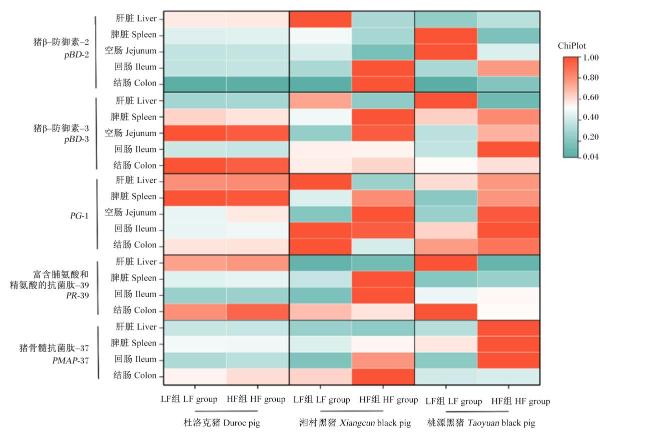
图1所示,杜洛克猪5种内源抗菌肽的表达主要受组织因素的影响;高纤维水平饲粮对桃源黑猪、湘村黑猪和杜洛克猪内源抗菌肽表达的调节作用依次递减;地方品种猪5种内源抗菌肽的表达水平整体稍高于杜洛克猪,杜洛克猪内源pBD-3和PG-1的表达水平稍高于其他3种抗菌肽。
图1 3个品种猪5种内源抗菌肽表达热图

Fig.1 Heatmap of expression of five endogenous antimicrobial peptides in three breeds of pigs

3 讨论

不同品种猪在基因组上存在一定的遗传多样性,这可能导致内源抗菌肽基因表达及其调节机制的差异。本研究发现,与杜洛克猪相比,地方品种猪结肠pBD-2、肝脏和回肠pBD-3以及回肠PG-1、PR-39和PMAP-37 mRNA相对表达量显著提高。这表明2个地方品种猪与杜洛克猪内源抗菌肽的表达存在品种差异,桃源黑猪在内源抗菌肽表达方面的抗逆特性较好地遗传给了湘村黑猪。目前也有类似的研究报道,如约大乌猪和乌金猪内源猪β-防御素-1(pBD-1)、pBD-2和pBD-3的表达具有品种特异性[19];梅山猪β-防御素在大部分组织中的表达水平均高于三元杂交猪[20];藏猪淋巴组织中pBD-1和PR-39 mRNA相对表达量高于约克夏猪[21];民猪多个组织中抗菌肽的表达水平高于长白猪[22]。另有研究发现,7个品种猪脾脏组织中PR-39拷贝数的增加与其基因表达水平呈正相关[23]
抗菌肽会在关键免疫组织中高表达,参与免疫防御屏障的构建。因此,抗菌肽的组织特异性表达与器官组织的功能相关。例如,在小肠、脾脏和胸腺等组织中存在多种β-防御素,pBD-2主要在肾脏和肝脏中表达[24]。pBD-2具有促进免疫细胞释放趋化因子和细胞因子的功能[25]。本研究发现,结肠pBD-2以及肝脏和回肠pBD-3 mRNA相对表达量显著高于其他组织,表明地方品种猪pBD-2和pBD-3主要在肝脏和肠道等具备免疫功能的组织中表达。PG-1具有维持肠道稳态、改善肠道菌群结构等功能[26]。胃肠道中的抗菌肽主要来源于潘氏细胞、肠上皮细胞和免疫细胞[27]。本研究中,饲喂高纤维水平饲粮时地方品种猪PG-1在回肠和空肠中高水平表达,推测高纤维水平饲粮可激活免疫细胞,间接调控PG-1表达,进而改善地方品种猪的肠道健康。PR-39富含脯氨酸和精氨酸,具有免疫调节、促进伤口愈合、抵抗细胞凋亡和促进血管生成等功能,其主要在骨髓和其他淋巴组织中表达[28]。脾脏是机体抗细菌和真菌免疫反应的最重要器官[29]。本研究中,饲喂高纤维水平饲粮时PR-39在湘村黑猪脾脏和回肠中高水平表达,表明肠道和脾脏是PR-39的主要表达器官,并且PR-39的表达受饲粮纤维水平的影响。
饲粮营养成分可影响抗菌肽的表达。例如,L-精氨酸通过Toll样受体4(TLR4)/核因子-κB(NF-κB)和丝裂原活化蛋白激酶(MAPK)信号通路调控β-防御素的表达[30];锌离子(Zn2+)和L-异亮氨酸可剂量依赖性地诱导β-防御素表达[31];25-羟基维生素D3可上调轮状病毒感染的猪肠道上皮细胞中猪骨髓抗菌肽-23(PMAP-23)、PG-1~5和PR-39的表达[32]。本研究中,饲粮纤维水平影响了桃源黑猪和湘村黑猪内源抗菌肽的表达;高纤维水平饲粮可显著下调2个地方品种猪肝脏中部分抗菌肽的表达,显著上调肠道和脾脏中部分抗菌肽的表达。笔者前期研究发现,高纤维水平饲粮显著降低了肠道病原真菌毛霉菌属(Mucor)丰度,提高了纤维发酵相关真菌新美鞭菌属(Neocallimastix)丰度,并且桃源黑猪和湘村黑猪肠道中子囊菌门(Ascomycota)真菌丰度较高,这可能与其耐粗饲料性状有关[33];桃源黑猪肠道乳酸杆菌和芽孢杆菌丰度高于杜洛克猪,高纤维水平饲粮降低了大肠杆菌丰度,同时提高了盲肠中有益微生物丰度以及结肠中乙酸、丙酸和丁酸浓度[11-12]。SCFAs已被证明通过与G蛋白偶联受体43(GPR43)的相互作用、c-Jun氨基末端激酶(JNK)和MAPK/细胞外信号调节激酶(ERK)通路的激活以及巨噬细胞的增殖来促进HDPs的合成[6]。例如,丁酸钠对HDPs的调节存在物种依赖性,可诱导IPEC-J2细胞、3D4/31巨噬细胞和原代单核细胞表达pBD-2和pBD-3[18];丁酸可抑制HDAC活性,并通过NF-κB通路诱导猪肾上皮细胞PK-15表达β-防御素[34]。因此,推测高水平纤维及其发酵产物SCFAs对抗菌肽的表达具有调控作用。在养殖生产过程中适当上调饲粮纤维水平,既能够通过优化肠道微生物群落结构,增强肠道免疫和屏障功能,以此来维持肠道健康稳态;又能够通过SCFAs代谢及宿主信号通路,调控抗菌肽的表达,进而增强动物的抗病力与抗逆性,减少畜禽养殖中的抗生素使用,推动绿色健康生产。然而,高水平纤维对抗菌肽的调控是通过代谢产物发挥作用,且不具有抗菌肽和组织的特异性,调控效果还受猪肠道菌群结构的影响,其具体作用机制还需要进一步深入研究。
湘村黑猪作为杜洛克猪与桃源黑猪杂交培育的品种,本研究发现,湘村黑猪pBD-2、PG-1、PR-39和PMAP-37在脾脏中呈现“中间型”表达模式。前期研究发现,高纤维水平饲粮能够显著降低结肠和粪便中病原菌定植、逃避宿主免疫和铁吸收相关的毒力因子(virulence factors,VFs)以及移动遗传元件(mobile genetic element,MGE)质粒的丰度;高水平纤维代谢物SCFAs与VFs的丰度存在显著负相关,并且主要是乙酸通过抑制病原微生物的增殖降低VFs的丰度;受肠道微生物、MGE(主要是质粒)和乙酸的影响,湘村黑猪结肠内VFs兼具桃源黑猪和杜洛克猪菌株的特性[13]。此外,湘村黑猪肠道真菌组成及其携带的宿主致病性相关基因的丰度表现出桃源黑猪和杜洛克猪的混合特征[33]

4 结论

猪内源抗菌肽的表达具有品种特异性,地方品种猪内源抗菌肽的表达具有组织特异性;高纤维水平饲粮可上调地方品种猪脾脏和肠道抗菌肽的表达,下调肝脏抗菌肽的表达,但对杜洛克猪内源抗菌肽的表达及组织分布无显著影响。
[1]
SAINI P, ISLAM M, DAS R, et al. Wheat bran as potential source of dietary fiber:prospects and challenges[J]. Journal of Food Composition and Analysis, 2023,116:105030.

[2]
ROSENFELDER P, EKLUND M, MOSENTHIN R. Nutritive value of wheat and wheat by-products in pig nutrition:a review[J]. Animal Feed Science and Technology, 2013, 185(3/4):107-125.

[3]
ZHANG Q Y, YAN Z B, MENG Y M, et al. Antimicrobial peptides:mechanism of action,activity and clinical potential[J]. Military Medical Research, 2021, 8(1):48.

[4]
GALLO R L, HOOPER L V. Epithelial antimicrobial defence of the skin and intestine[J]. Nature Reviews Immunology, 2012, 12(7):503-516.

DOI PMID

[5]
ZONG X, FU J, XU B C, et al. Interplay between gut microbiota and antimicrobial peptides[J]. Animal Nutrition, 2020, 6(4):389-396.

DOI PMID

[6]
LIU T Z, SUN Z, YANG Z C, et al. Microbiota-derived short-chain fatty acids and modulation of host-derived peptides formation:focused on host defense peptides[J]. Biomedicine & Pharmacotherapy, 2023,162:114586.

[7]
ALVA-MURILLO N, OCHOA-ZARZOSA A, LÓPEZ-MEZA J E. Short chain fatty acids (propionic and hexanoic) decrease Staphylococcus aureus internalization into bovine mammary epithelial cells and modulate antimicrobial peptide expression[J]. Veterinary Microbiology, 2012, 155(2/3/4):324-331.

[8]
IBRAHIM D, EL-SAYED H I, MAHMOUD E R, et al. Impacts of solid-state fermented barley with fibrolytic exogenous enzymes on feed utilization,and antioxidant status of broiler chickens[J]. Veterinary Sciences, 2023, 10(10):594.

[9]
CHENG Y T, DING S J, AZAD M A K, et al. Comparison of the pig breeds in the small intestinal morphology and digestive functions at different ages[J]. Metabolites, 2023, 13(1):132.

[10]
SONG B, CHENG Y T, AZAD M A K, et al. Muscle characteristics comparison and targeted metabolome analysis reveal differences in carcass traits and meat quality of three pig breeds[J]. Food & Function, 2023, 14(16):7603-7614.

[11]
LIU J H, LUO Y H, KONG X F, et al. Effects of dietary fiber on growth performance,nutrient digestibility and intestinal health in different pig breeds[J]. Animals, 2022, 12(23):3298.

[12]
LIU J H, LUO Y H, KONG X F, et al. Influences of wheat bran fiber on growth performance,nutrient digestibility,and intestinal epithelium functions in Xiangcun pigs[J]. Heliyon, 2023, 9(7):e17699.

[13]
WANG T, LUO Y H, KONG X F, et al. Genetic- and fiber-diet-mediated changes in virulence factors in pig colon contents and feces and their driving factors[J]. Frontiers in Veterinary Science, 2024,11:1351962.

[14]
WANG T, LUO Y H, KONG X F, et al. Genetic- and fiber-diet-mediated changes in antibiotic resistance genes in pig colon contents and feces and their driving factors[J]. Microorganisms, 2023, 11(10):2370.

[15]
DING S J, CHENG Y T, AZAD M A, et al. Dietary fiber alters immunity and intestinal barrier function of different breeds of growing pigs[J]. Frontiers in Immunology, 2023,14:1104837.

[16]
张敬梅, 顾以韧, 李江淩, 等. 乌金猪、青峪猪和成华猪免疫器官与组织Toll样受体和抗菌肽基因表达比较研究[J]. 四川动物, 2018, 37(5):525-532.

ZHANG J M, GU Y R, LI J L, et al. Comparison of gene expression of Toll-like receptors and antimicrobial peptides in the immune organs and tissues of Wujin pig,Qingyu pig and Chenghua pig[J]. Sichuan Journal of Zoology, 2018, 37(5):525-532.

[17]
卢艳敏. 猪感染PRRSV后Cathelicidins抗菌肽基因的表达情况[J]. 江苏农业科学, 2018, 46(2):24-27.

LU Y M. Expression of Cathelicidins antimicrobial peptide genes in pigs after PRRSV infection[J]. Jiangsu Agricultural Sciences, 2018, 46(2):24-27. (in Chinese)

[18]
ZENG X F, SUNKARA L T, JIANG W Y, et al. Induction of porcine host defense peptide gene expression by short-chain fatty acids and their analogs[J]. PLoS One, 2013, 8(8):e72922.

[19]
AN Q C, GUO R F. Expression differences of pBD-1,pBD-2 and pBD-3 genes in tissues from Wujin and Yuedawu pigs[J]. Research Journal of Biotechnology, 2016, 11(3):72-76.

[20]
CHEN J Y, QI S, GUO R F, et al. Different messenger RNA expression for the antimicrobial peptides beta-defensins between Meishan and crossbred pigs[J]. Molecular Biology Reports, 2010, 37(3):1633-1639.

[21]
CHENG C, SUN W K, LIU R, et al. Comparison of gene expression of Toll-like receptors and antimicrobial peptides in immune organs and tissues between Yorkshire and Tibetan pigs[J]. Animal Genetics, 2015, 46(3):272-279.

DOI PMID

[22]
MA Q Q, JIAO W J, WANG Z Y, et al. Tissue specificity and species superiority of cathelicidin gene expression in Chinese indigenous Min pigs[J]. Livestock Science, 2014,161:36-40.

[23]
AHN B, JEON H, CHO H S, et al. Sequence polymorphisms of PR39 cathelicidins and extensive copy variations in commercial pig breeds[J]. Gene, 2022,822:146323.

[24]
VELDHUIZEN E J A, VAN DIJK A, TERSTEEG M H G, et al. Expression of beta-defensins pBD-1 and pBD-2 along the small intestinal tract of the pig:lack of upregulation in vivo upon Salmonella typhimurium infection[J]. Molecular Immunology, 2007, 44(4):276-283.

[25]
ADYNS L, PROOST P, STRUYF S. Role of defensins in tumor biology[J]. International Journal of Molecular Sciences, 2023, 24(6):5268.

[26]
ZUGHAIER S M, SVOBODA P, POHL J. Structure-dependent immune modulatory activity of protegrin-1 analogs[J]. Antibiotics, 2014, 3(4):694-713.

[27]
FILIPP D, BRABEC T, VOBOŘIL M, et al. Enteric α-defensins on the verge of intestinal immune tolerance and inflammation[J]. Seminars in Cell & Developmental Biology, 2019,88:138-146.

[28]
GAO Y H, RONG Y L, WANG Y M, et al. Expression pattern of porcine antimicrobial peptide PR-39 and its induction by enterotoxigenic Escherichia coli (ETEC) F4ac[J].Veterinary Immunology and Immunopathology, 2014, 160(3/4):260-265.

[29]
MEBIUS R E, KRAAL G. Structure and function of the spleen[J]. Nature Reviews Immunology, 2005, 5(8):606-616.

DOI PMID

[30]
LAN J, DOU X J, LI J W, et al. L-arginine ameliorates lipopolysaccharide-induced intestinal inflammation through inhibiting the TLR4/NF-κB and MAPK pathways and stimulating β-defensin expression in vivo and in vitro[J]. Journal of Agricultural and Food Chemistry, 2020, 68(9):2648-2663.

[31]
MAO X B, QI S, YU B, et al. Zn2+ and L-isoleucine induce the expressions of porcine β-defensins in IPEC-J2 cells[J]. Molecular Biology Reports, 2013, 40(2):1547-1552.

[32]
TIAN G, LIANG X F, CHEN D W, et al. Vitamin D3 supplementation alleviates rotavirus infection in pigs and IPEC-J2 cells via regulating the autophagy signaling pathway[J]. Journal of Steroid Biochemistry and Molecular Biology, 2016,163:157-163.

[33]
WANG T, LIU J H, LUO Y H, et al. Combined effects of host genetics and diet on porcine intestinal fungi and their pathogenic genes[J]. Frontiers in Microbiology, 2023,14:1192288.

[34]
DOU X J, HAN J L, SONG W T, et al. Sodium butyrate improves porcine host defense peptide expression and relieves the inflammatory response upon Toll-like receptor 2 activation and histone deacetylase inhibition in porcine kidney cells[J]. Oncotarget, 2017, 8(16):26532-26551.

DOI PMID

Outlines

/