RESEARCH PAPER

Evaluation of Effective Energy Value and Construction of Net Energy Prediction Equation of Cottonseed Meal in Whit-Feathered Broilers

  • WEI Xu , 1 ,
  • LI Chong 1 ,
  • YAN Shijia 1 ,
  • LIU Jiayuan 1 ,
  • LI Xiaoran 1 ,
  • LIU Guohua 2 ,
  • LIU Shudong , 1, ** ,
  • $\boxed{\hbox{CHEN Baoguo}}$ , 1, **
Expand
  • 1 College of Animal Science and Technology, Hebei Agricultural University, Baoding 071001, China
  • 2 Key Laboratory of Feed Biotechnology of the Ministry of Agriculture and Rural Affairs, Institute of Feed Research, Chinese Academy of Agricultural Sciences, Beijing 100081, China
**LIU Shudong, lecturer, E-mail: ;
CHEN Baojiang, professor, E-mail:

*Contributed equally

Received date: 2025-03-18

  Online published: 2025-10-15

Abstract

This study aimed to determine the effective energy values of 6 types of cottonseed meal in white-feathered broilers using indirect calorimetry combined with the substitution method, and to establish the net energy prediction equation based on conventional nutritional components by stepwise regression. One hundred and sixty-eight 7-day-old Arbor Acres (AA) broilers with similar body weight and good health status were randomly divided into 7 groups, including 1 corn-soybean meal basal diet group and 6 experimental diet groups with 20% substitution of cottonseed meal (crude protein content ranging from 40.30% to 60.04%), with 6 replicates in each group and 4 broilers in each replicate. The experiment lasted for 7 days, including a 4-day adaptation period and a 3-day formal trial period. The 7-day-old broilers were transferred to respiratory calorimeters for 4-day adaptation, followed by 3 consecutive days of respiratory calorimetry and metabolizable energy determination. The results showed as follows: 1) the apparent metabolizable energy of 6 types of cottonseed meal in white-feathered broilers ranged from 12.33 to 12.98 MJ/kg DM; the net energy ranged from 3.93 to 6.04 MJ/kg DM; the nitrogen-corrected apparent metabolizable energy ranged from 12.15 to 12.90 MJ/kg DM; the ratio of apparent metabolizable energy to gross energy was 70.20% to 75.63%; and the ratio of net energy to apparent metabolizable energy was 30.95% to 46.09%. 2) The net energy prediction equation of cottonseed meal in white-feathered broilers was: net energy=9.019-0.001×free gossypol-0.043×crude protein-0.076×neutral detergent fiber [coefficient of determination (R2)=0.994, root mean square error (RMSE)=0.055, P<0.001). In conclusion, there were differences in effective energy values and energy conversion efficiency among the 6 types of cottonseed meal in white-feathered broilers. The cross-validation method was used to verify the net energy prediction equation, and the predicted values were almost close to the measured values, indicating that the established net energy prediction equation for cottonseed meal in white-feathered broilers had high accuracy.

Cite this article

WEI Xu , LI Chong , YAN Shijia , LIU Jiayuan , LI Xiaoran , LIU Guohua , LIU Shudong , $\boxed{\hbox{CHEN Baoguo}}$ . Evaluation of Effective Energy Value and Construction of Net Energy Prediction Equation of Cottonseed Meal in Whit-Feathered Broilers[J]. Chinese Journal of Animal Nutrition, 2025 , 37(10) : 6662 -6674 . DOI: 10.12418/CJAN2025.542

动物的一切生理活动与生长发育都依赖能量代谢来维持,能量直接影响动物的生理状态和生长发育。能量类饲料原料在生产应用中占比较大,准确测定其有效能值,让动物合理摄入能量,不仅能节约饲料成本,还可有效地促进动物机体健康[1]。目前,肉鸡生产中应用最广泛的是代谢能体系,但该体系未考虑热增耗,既无法精确测算动物对能量的实际需求,也不能客观评定饲料原料的真实能量利用效率[2]
净能是指代谢能减去热增耗后剩余的能量。目前,净能的评价方法主要包括直接测热法和间接测热法。直接测热法是用量热装置直接测定动物散失到外界的热量,再结合代谢能摄入量来计算净能值。然而,该装置操作较为繁琐,在当前的研究中应用较少。间接测热法是通过特殊手段间接测算产热量,进而计算净能值,主要分为比较屠宰法和呼吸测热法。其中,比较屠宰法是通过比较屠宰试验计算出动物体内的能量沉积,再结合代谢能摄入量得出净能值。不过,该方法在应用过程中耗费大量人力物力,多用于小动物研究[3]。呼吸测热法则是利用呼吸测热装置记录动物在一定时间内的二氧化碳排出量与氧气消耗量,根据呼吸熵(RQ)或碳氮平衡理论计算出动物的总产热量,进而计算净能值。这种方法较为方便快捷,目前应用较多。与代谢能体系相比,净能体系可以更精确地测算饲粮的有效能值[4]
我国棉籽产量巨大,年产量已达600万t,占全球棉籽总产量的27.37%,仅次于印度。棉籽粕作为一种具有潜力的可持续蛋白质原料,其粗蛋白质含量为20%~60%,广泛应用于畜禽饲料中。棉籽粕在加工过程中因脱壳比例不同,导致其营养价值差异较大:不脱壳的棉籽粕粗蛋白质含量为20%~30%;经一般脱壳后,其粗蛋白质含量可达到41%~42%[5-6];而完全脱壳且工艺优化后的棉籽粕粗蛋白质含量能达到60%[7]。合理有效地利用棉籽粕,可以在很大程度上解决家禽蛋白质饲料资源短缺的问题。然而,常规研究中关于棉籽粕能量利用率的报道较少。因此,本试验通过间接测热法结合套算法测定11~14日龄白羽肉鸡对棉籽粕的有效能值(表观代谢能、净能),并根据棉籽粕常规营养成分构建净能预测方程,以期为家禽净能体系研究提供基础数据。

1 材料与方法

1.1 伦理声明

本试验于河北农业大学畜牧教学基地开展,试验方案已获得河北农业大学实验动物伦理委员会批准,批准文号为2024164。

1.2 试验原料及饲粮

本试验所用的6种待测棉籽粕均产自新疆,其粗蛋白质含量分别为40.30%、41.98%、43.24%、45.31%、50.72%和60.04%。饲粮为1种玉米-豆粕型基础饲粮和6种待测棉籽粕替代比例为20%的试验饲粮,饲粮组成及营养水平见表1
表1 饲粮组成及营养水平(风干基础)

Table 1 Composition and nutrient levels of diets (air-dry basis) %

项目
Items
基础饲粮
Basal diet
试验饲粮Experimental diets
1 2 3 4 5 6
原料Ingredients
玉米Corn 54.43 42.93 42.93 42.93 42.93 42.93 42.93
豆粕Soybean meal 30.15 23.79 23.79 23.79 23.79 23.79 23.79
待测棉籽粕Test cottonseed meal 20.00 20.00 20.00 20.00 20.00 20.00
玉米蛋白粉Corn gluten meal 6.11 4.82 4.82 4.82 4.82 4.82 4.82
大豆油Soybean oil 4.05 3.20 3.20 3.20 3.20 3.20 3.20
磷酸氢钙CaHPO4 1.76 1.76 1.76 1.76 1.76 1.76 1.76
石粉Limestone 1.40 1.40 1.40 1.40 1.40 1.40 1.40
氯化钠NaCl 0.35 0.35 0.35 0.35 0.35 0.35 0.35
氯化胆碱Choline chloride (50%) 0.20 0.20 0.20 0.20 0.20 0.20 0.20
DL-蛋氨酸DL-Met 0.33 0.33 0.33 0.33 0.33 0.33 0.33
L-赖氨酸盐酸盐L-Lys·HCl 0.25 0.25 0.25 0.25 0.25 0.25 0.25
L-苏氨酸L-Thr 0.05 0.05 0.05 0.05 0.05 0.05 0.05
植酸酶Phytase 0.02 0.02 0.02 0.02 0.02 0.02 0.02
预混料Premix1) 0.50 0.50 0.50 0.50 0.50 0.50 0.50
二氧化钛TiO2 0.40 0.40 0.40 0.40 0.40 0.40 0.40
合计Total 100.00 100.00 100.00 100.00 100.00 100.00 100.00
营养水平Nutrient levels2)
干物质DM 90.20 88.15 88.21 87.93 88.16 87.84 87.98
总能GE/(MJ/kg) 17.68 17.39 17.62 17.81 17.66 17.64 17.33
粗蛋白质CP 23.53 25.58 25.92 26.17 26.58 27.66 29.53
粗脂肪EE 2.30 2.36 2.34 2.27 2.32 2.26 2.31
钙Ca 0.97 0.99 1.00 1.03 1.00 1.02 0.99
总磷TP 0.64 0.75 0.77 0.77 0.78 0.80 0.85
蛋氨酸Met 0.60 0.64 0.65 0.66 0.67 0.69 0.73
赖氨酸Lys 1.14 1.28 1.30 1.32 1.35 1.42 1.55
蛋氨酸+半胱氨酸Met+Cys 0.90 1.02 1.04 1.04 1.05 1.08 1.13
苏氨酸Thr 0.80 0.90 0.90 0.91 0.92 0.95 1.00

1)预混料为每千克饲粮提供 The premix provided the following per kg of diets:VA 12 500 U,VB1 0.01 mg,VB2 8.00 mg,VB6 4.5 mg,VB12 0.02 mg,VD3 3 500 IU,VE 20 IU,VK3 3 mg,生物素 biotin 0.2 mg,叶酸 folic acid 0.5 mg,D-泛酸 D-pantothenic acid 12 mg,烟酸 nicotinic acid 34 mg,Cu (as copper sulfate) 8 mg,Fe (as ferrous sulfate) 80 mg,Mn (as manganese sulfate) 80 mg,Zn (as zinc sulfate) 80 mg,I (as potassium iodide) 0.70 mg,Se (as sodium selenite) 0.3 mg。2)氨基酸为计算值,其余均为实测值。Amino acids were calculated values, while the others were measured values.

1.3 试验设计及饲养管理

本试验采用间接测热法结合套算法测定11~14日龄白羽肉鸡对棉籽粕的有效能值,试验采用完全随机设计,选取168只体重相近、健康状况良好的7日龄爱拔益加(AA)肉鸡,随机分为7组,每组6个重复,每个重复4只鸡。每组对应饲喂1种饲粮,试验周期为7 d,其中预试期4 d,正试期3 d。将7日龄肉鸡转入呼吸测热室适应4 d后,进行连续3 d的呼吸测热及代谢能测定。试验期间的环境条件(温度、相对湿度、光照时间和强度)严格参照《AA肉鸡饲养管理手册》要求进行控制。每天检查呼吸测热设备的运转情况,确保设备正常运行。每天09:00添加饲粮和水,试验全程保证肉鸡自由采食和饮水。

1.4 样品采集

正试期间采集呼吸测热室内肉鸡的氧气消耗量和二氧化碳排出量等数据,计算产热量。正试期开始和结束时分别称量肉鸡的初始体重和终末体重,同时记录其采食量,并对排泄物进行称重,采用全收粪法收集正试期肉鸡3 d的粪便样品,其中1/3的粪样喷洒10%的稀盐酸进行固氮处理,将每日收集的粪样置于-20 ℃冰箱中保存。试验结束后,将3 d收集的粪便混合在一起,放入65 ℃烘箱中烘72 h后,室温下回潮24 h,粉碎过40目筛,装入自封袋中保存备用。

1.5 指标测定及方法

饲料原料:测定干物质、粗蛋白质、粗脂肪、粗灰分、粗纤维、中性洗涤纤维、酸性洗涤纤维、游离棉酚、无氮浸出物、植酸含量和总能。饲粮:测定干物质、粗蛋白质、粗脂肪、钙、总磷含量和总能。粪样:测定干物质、粗蛋白质含量和总能。
测定方法如下:水分(GB/T 6435—2014)、粗蛋白质(GB/T 6432—2018)、粗脂肪(GB/T 6433—2006)、粗灰分(GB/T 6438—2007)、粗纤维(GB/T 6434—2006)、游离棉酚(GB/T 13086—2020)、无氮浸出物(GB/T 6432—2018)、植酸(GB/T 23742—2009)、中性洗涤纤维(GB/T 20806—2006)、酸性洗涤纤维(NY/T 1459—2007)含量分别参照国家标准或行业标准测定,根据水分含量计算干物质含量,总能采用氧弹测热仪(C3000,IKA,德国)测定。饲粮中氨基酸含量参照《中国饲料成分及营养价值表(2021年第32版)》[8]计算得出。

1.6 计算公式

总能摄入量(MJ)=饲粮总能(MJ/kg)×采食量(kg);
排泄总能(MJ)=粪能(MJ/kg)×排粪量(kg);
表观代谢能摄入量(MJ)=总能摄入量(MJ)-排泄总能(MJ);
表观代谢能(MJ/kg)=表观代谢能摄入量(MJ)/采食量(kg);
氮沉积量(g)=氮摄入量(g)-氮排出量(g);
氮校正表观代谢能(MJ/kg)=表观代谢能(MJ/kg)-氮沉积量(kg)×34.39;
热增耗(kJ)=总产热量(kJ)-绝食产热量(kJ);
净能(MJ/kg)=[表观代谢能摄入量(MJ)-热增耗(MJ)]/采食量(kg)。
式中:氮沉积量为家禽每采食l g饲粮所沉积氮量(g),家禽每沉积1 g氮需要34.39 kJ的能量进行校正;采食量、排粪量、氮排出量均为每重复平均每天每只的量。
总产热量参考Brouwer[9]的公式计算:
总产热量(kJ)=16.175 3×氧气消耗量(L)+5.0208×二氧化碳排出量(L)。
绝食产热量参考Noblet等[10]的公式计算:
绝食产热量(kJ)=代谢体重(BW0.70,kg)×450(kJ/kg BW0.70)。
式中:BW指试验期间肉鸡的平均体重。
呼吸熵=二氧化碳排出量(L)/氧气消耗量(L);
沉积能(kJ)=表观代谢能摄入量(kJ)-总产热量(kJ);
蛋白质沉积能(MJ)=氮沉积量(g)×6.25×23.84;
脂肪沉积能(MJ)=沉积能(MJ)-蛋白质沉积能(MJ)。
待测原料有效能值参考Wu等[11]的公式计算:
待测原料有效能值=(试验饲粮有效能值-基础饲粮有效能值×a)/b。
式中:a为基础饲粮的供能原料部分在试验饲粮中所占的比例(%);b为待测原料在试验饲粮中所占的比例(%)。

1.7 数据统计与分析

原始数据采用Excel 2010进行基础处理,然后采用SPSS 26.0软件进行单因素方差分析(one-way ANOVA),并采用Duncan氏法对差异显著的数据进行多重比较,P<0.05表示差异显著。同时,利用SPSS 26.0软件中的逐步法对棉籽粕的表观代谢能、净能和常规营养成分进行线性回归分析,建立净能的预测方程。

2 结果与分析

2.1 棉籽粕原料的营养成分

表2可知,6种待测棉籽粕原料的总能为17.16~17.90 MJ/kg,平均值为17.56 MJ/kg;干物质含量为91.32%~92.97%,平均值为92.18%;粗蛋白质含量为40.30%~60.04%,平均值为46.93%;粗脂肪含量为0.56%~2.32%,平均值为1.20%;粗灰分含量为7.14%~8.05%,平均值为7.62%;粗纤维含量为8.04%~19.13%,平均值为12.35%;中性洗涤纤维含量为12.00%~29.63%,平均值为22.82%;酸性洗涤纤维含量为3.96%~18.60%,平均值为13.56%;植酸含量为21.67~24.32 g/kg,平均值为23.15 g/kg;游离棉酚含量为383.04~1 106.71 mg/kg,平均值为747.23 mg/kg;无氮浸出物含量为10.01%~23.47%,平均值为19.52%。其中,粗蛋白质含量在营养成分中占比最高,粗脂肪含量占比最低。除总能、干物质、植酸和粗灰分以外,其他营养成分含量变异系数均大于10%,表明本试验中6种待测棉籽粕原料间营养成分含量差异较大,具有试验代表性。
表2 棉籽粕原料营养成分(风干基础)

Table 2 Nutrients of cottonseed meal raw material (air-dry basis)

项目
Items
棉籽粕编号Cottonseed meal number 平均值
Mean
变异系数
CV
1 2 3 4 5 6
总能GE/(MJ/kg) 17.39 17.56 17.90 17.75 17.57 17.16 17.56 1.49
干物质DM/% 92.68 92.97 91.57 92.72 91.32 91.84 92.18 0.75
粗蛋白质CP/% 40.30 41.98 43.24 45.31 50.72 60.04 46.93 15.68
粗脂肪EE/% 2.32 0.73 0.83 1.43 0.56 1.35 1.20 53.82
粗灰分Ash/% 7.88 7.54 7.63 7.47 8.05 7.14 7.62 4.20
粗纤维CF/% 8.73 11.24 19.13 10.53 8.04 16.41 12.35 35.98
中性洗涤纤维NDF/% 12.00 24.30 29.63 23.42 25.38 22.18 22.82 25.78
酸性洗涤纤维ADF/% 3.96 17.83 18.60 15.97 12.27 12.71 13.56 39.58
植酸Phytic acid/(g/kg) 23.22 22.37 21.67 24.32 24.08 23.21 23.15 4.34
游离棉酚Free gossypol/(mg/kg) 383.04 783.41 831.18 452.34 1 106.71 926.68 747.23 37.35
无氮浸出物NFE/% 20.66 20.36 23.47 19.88 22.76 10.01 19.52 24.95

2.2 不同饲粮对白羽肉鸡生长性能、氮平衡及能量代谢的影响

不同饲粮对白羽肉鸡生长性能及氮平衡的影响见表3。不同饲粮对白羽肉鸡的采食量、体增重、料重比、氧气消耗量、二氧化碳产生量、呼吸熵、氮摄入量、氮排出量及氮沉积量存在显著影响(P<0.05)。不同饲粮对白羽肉鸡能量代谢的影响见表4。不同饲粮对白羽肉鸡的总产热量、热增耗、沉积能、蛋白质沉积能、脂肪沉积能、总能摄入量、表观代谢能摄入量、净能摄入量、表观代谢能、氮校正表观代谢能、净能、表观代谢能/总能及净能/表观代谢能存在显著影响(P<0.05)。
表3 不同饲粮对白羽肉鸡生长性能及氮平衡的影响

Table 3 Effects of different diets on growth performance and nitrogen balance of white-feathered broilers

项目
Items
基础饲粮
Basal diet
试验饲粮Experimental diets SEM P
P-value
1 2 3 4 5 6
生长性能Growth performance
初始体重IBW/g 369.76 370.63 371.28 371.23 371.22 371.48 370.34 0.980 0.762
终末体重FBW/g 414.44 412.92 411.99 413.21 413.84 411.91 413.57 1.036 0.859
采食量FI/(g/d) 52.28a 51.67b 49.99d 49.77d 51.60b 49.97d 51.20c 0.191 <0.001
体增重BW gain/(g/d) 44.68a 42.29c 40.71d 41.98c 42.62bc 40.43d 43.23b 0.328 <0.001
料重比F/G 1.20bc 1.22ab 1.23a 1.19c 1.21abc 1.24a 1.18c 0.010 0.001
呼吸量Respiratory capacity
氧气消耗量
O2 consumption/
[L/(kg BW0.70·d)]
36.49d 39.32c 40.15b 40.51ab 40.37ab 40.02b 40.94a 0.305 <0.001
二氧化碳产生量
CO2 production/
[L/(kg BW0.70·d)]
35.93e 37.63d 38.67c 39.78b 38.59c 38.62c 40.56a 0.321 <0.001
呼吸熵RQ 0.985ab 0.957de 0.963cd 0.982b 0.956e 0.965c 0.991a 0.003 0 <0.001
氮平衡Nitrogen balance/(g/d)
氮摄入量Nitrogen intake 1.97f 2.11d 2.07e 2.08e 2.19c 2.21b 2.42a 0.008 <0.001
氮排出量Nitrogen excreta 0.65d 0.89b 1.11a 1.15a 0.82c 1.15a 1.12a 0.019 <0.001
氮沉积量Nitrogen retained 1.31b 1.23c 0.96e 0.94e 1.37a 1.07d 1.30b 0.021 <0.001

同行数据肩标无字母或相同小写字母表示差异不显著(P>0.05),不同小写字母表示差异显著(P<0.05)。下表同。

In the same row, values with no letter or the same small letter superscripts mean no significant difference (P>0.05), while with different small letter superscripts mean significant difference (P<0.05). The same as below.

表4 不同饲粮对白羽肉鸡能量代谢的影响

Table 4 Effects of different diets on energy metabolism of white-feathered broilers

项目
Items
基础饲粮
Basal diet
试验饲粮Experimental diets SEM P
P-value
1 2 3 4 5 6
能量平衡Energy balance/[kJ/(BW0.70·d)]
总产热量THP 770.67d 825.03c 834.41bc 844.80b 846.77b 841.20b 861.41a 6.354 <0.001
热增耗HI 320.67d 375.03c 388.60b 399.52b 396.77b 391.20b 413.49a 6.339 <0.001
沉积能RE 523.29a 389.90b 342.71cd 327.06d 364.14bc 321.59d 343.91cd 13.234 <0.001
蛋白质沉积能RE as protein 376.80b 352.12c 278.31e 272.30e 393.31a 305.94d 374.96b 6.163 <0.001
脂肪沉积能RE as fat 146.48a 37.78cd 64.40b 54.76bc -29.18e 15.65d -31.06e 11.508 <0.001
总能摄入量GEI 1 779.72a 1 731.42c 1 716.22c 1 726.73c 1 753.42b 1 698.68d 1 717.78c 7.956 <0.001
表观代谢能摄入量AMEI 1 293.95a 1 214.94b 1 186.23bc 1 179.03c 1 210.91b 1 162.79c 1 209.69b 13.189 <0.001
净能摄入量NEI 973.28a 839.90b 797.63cd 782.46d 814.14bc 771.59d 796.21cd 13.498 <0.001
有效能值Effective energy values/(MJ/kg DM)
表观代谢能AME 12.85a 12.20b 12.17b 12.16b 12.19b 12.07b 12.20b 0.106 <0.001
氮校正表观代谢能AMEn 12.81a 12.16b 12.15b 12.13b 12.15b 12.04b 12.76a 0.163 <0.001
净能NE 9.67a 8.43b 8.19bc 8.07c 8.20bc 8.01c 8.03c 0.124 <0.001
能量转化效率Energy conversion efficiency/%
表观代谢能/总能AME/GE 72.70a 70.16bc 69.11cd 68.27d 69.06cd 68.45d 70.42b 0.606 <0.001
净能/表观代谢能NE/AME 75.22a 69.11b 67.23c 66.35cd 67.23c 66.35cd 65.81d 0.578 <0.001

2.3 白羽肉鸡对棉籽粕的有效能值和能量转化效率

表5可知,白羽肉鸡对6种棉籽粕的表观代谢能为12.33~12.98 MJ/kg DM,净能为3.93~6.04MJ/kgDM,氮校正表观代谢能为12.15~12.90 MJ/kg DM,表观代谢能/总能为70.20%~75.63%,净能/表观代谢能为30.95%~46.09%。白羽肉鸡对6种棉籽粕的净能和净能/表观代谢能存在显著差异(P<0.05)。
表5 白羽肉鸡对棉籽粕的有效能值和能量转化效率(干物质基础)

Table 5 Effective energy values and energy conversion efficiency of cottonseed meal in white-feathered broilers (DM basis)

项目
Items
棉籽粕编号Cottonseed meal number SEM P
P-value
1 2 3 4 5 6
有效能值Effective energy values/(MJ/kg DM)
表观代谢能AME 12.97 12.86 12.76 12.94 12.33 12.98 0.547 0.841
净能NE 6.04a 4.88ab 4.22b 4.87ab 3.93b 4.03b 0.660 0.032
氮校正表观代谢能AMEn 12.90 12.70 12.60 12.85 12.15 12.76 0.594 0.831
能量转化效率Energy conversion efficiency/%
表观代谢能/总能AME/GE 72.48 73.23 73.38 72.92 70.20 75.63 3.090 0.673
净能/表观代谢能NE/AME 46.09a 37.22b 32.49b 37.29b 31.70b 30.95b 3.842 0.004

2.4 棉籽粕原料营养成分含量与净能值相关性分析

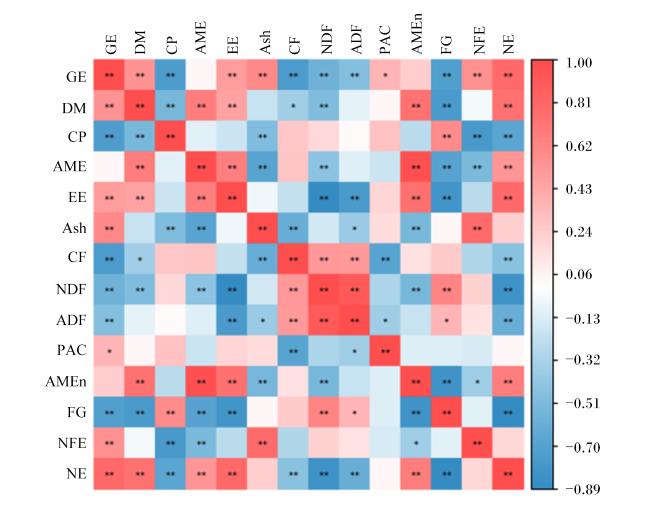
棉籽粕原料的营养成分含量与有效能值相关性分析见图1。棉籽粕原料的净能值与粗蛋白质、粗纤维、酸性洗涤纤维、中性洗涤纤维和游离棉酚含量呈极显著负相关(P<0.01),与粗脂肪、干物质含量以及总能、表观代谢能、氮校正表观代谢能呈极显著正相关(P<0.01)。
图1 棉籽粕原料营养成分含量与有效能值相关性分析

GE:总能 gross energy;DM:干物质 dry matter;CP:粗蛋白质 crude protein;AME:表观代谢能 apparent metabolizable energy;EE:粗脂肪 ether extract;Ash:粗灰分;CF:粗纤维 crude fiber;NDF:中性洗涤纤维 neutral detergent fiber;ADF:酸性洗涤纤维 acid detergent fiber;PAC:植酸 phytic acid;FG:游离棉酚 free gossypol;NFE:无氮浸出物 nitrogen-free extract;NE:净能 net energy;AMEn:氮校正表观代谢能 nitrogen-corrected apparent metabolizable energy。*和* *分别表示相关性显著(P<0.05)和极显著(P<0.01)。* and * * indicated significant correlation (P<0.05) and extremely significant correlation (P<0.01), respectively.

Fig.1 Correlation analysis between nutrient content and effective energy value of cottonseed meal raw material

2.5 基于棉籽粕常规营养成分构建净能预测方程

基于肉鸡棉籽粕的常规营养成分构建的净能预测方程见表6。预测方程3(净能=9.019-0.001×游离棉酚-0.043×粗蛋白质-0.076×中性洗涤纤维)的决定系数(R2)最高,为0.994,均方根误差(RMSE)最低,为0.055。其预测值与实测值的比较见表7。预测方程3预测值与实测值的平均差值为0.13 MJ/kg DM,相对标准偏差(RSD)为2.15%。棉籽粕净能预测方程适应性验证见表8。验证棉籽粕预测值与实测值的差值为0.29 MJ/kg DM,RSD为3.97%。
表6 棉籽粕净能预测逐步回归方程(干物质基础)

Table 6 Net energy prediction stepwise regression equation for cottonseed meal (DM basis)

编号
No.
预测方程
Prediction equation
决定系数
R2
均方根误差
RMSE
P
P-value
1 净能=6.514-0.002×游离棉酚 0.777 0.344 <0.001
2 净能=7.269-0.002×游离棉酚-0.059×中性洗涤纤维 0.893 0.239 <0.001
3 净能=9.019-0.001×游离棉酚-0.043×粗蛋白质-0.076×中性洗涤纤维 0.994 0.055 <0.001
表7 棉籽粕净能预测值与实测值比较(干物质基础)

Table 7 Comparison of predicted and measured values of net energy of cottonseed meal (DM basis)

项目
Items
棉籽粕编号Cottonseed meal number 平均值
Mean
1 2 3 4 5 6
实测值Measured values/(MJ/kg DM) 6.04 4.81 4.22 4.87 3.93 4.03 4.65
预测值Predicted values/(MJ/kg DM) 5.99 4.58 4.08 4.84 3.80 3.82 4.52
差值Difference/(MJ/kg DM) 0.05 0.23 0.14 0.03 0.13 0.21 0.13
相对标准偏差RSD/% 0.58 3.41 2.44 0.46 2.33 3.69 2.15
表8 棉籽粕净能预测方程适应性验证(干物质基础)

Table 8 Adaptability verification of cottonseed meal NE prediction equation (DM basis)

项目
Item
营养成分Nutrients 净能NE/(MJ/kg DM) 相对标
准偏差
RSD/%
粗蛋白质
CP/%
游离棉酚
Free gossypol/
(mg/kg)
中性洗
涤纤维
NDF/%
预测值
Predicted
value
实测值
Measured
value
差值
Difference
验证棉籽粕
Verification of
cottonseed meal
47.30 432.10 22.36 4.85 5.13 0.28 3.97

3 讨论

3.1 棉籽粕原料的营养成分

棉籽粕是仅次于豆粕的重要蛋白质资源之一,由棉籽经去绒、不同比例去壳后,通过浸提或预压榨法榨油所得。棉籽粕主要由棉仁和棉籽壳组成,其中棉籽壳约占棉籽总重的40%,棉仁约占60%。棉籽的粗蛋白质含量约为20%,而棉仁的粗蛋白质含量较高,为40%~60%,棉籽壳的蛋白质含量则较低,仅为3%左右,其主要成分为粗纤维。因此,在棉籽粕生产工艺中,用于榨油的棉仁含壳率是影响棉籽粕粗蛋白质和粗纤维含量的关键因素[12]。王文策等[13]对15种棉籽粕营养成分的研究表明,其粗脂肪含量为0.23%~1.55%;孟红梅[14]对32种棉籽粕营养成分的研究表明,其粗脂肪含量为0.30%~1.75%;李再山[15]对15种棉籽粕营养成分的研究表明,其粗脂肪含量为0.28%~8.84%,粗灰分含量为5.65%~8.78%。本试验中棉籽粕原料的营养成分含量均处于上述研究结果范围内。我国饲料卫生标准(GB 13078—2017)[16]规定,棉籽加工产品中游离棉酚含量不得高于1 200 mg/kg,本试验结果符合国家标准要求。陈玉娟[17]对25种棉籽粕营养成分的研究表明,其粗蛋白质含量为41.40%~54.96%;Li等[18]对10种棉籽粕营养成分的研究表明,其粗蛋白质含量为34.35%~54.01%。本试验测定的6种棉籽粕粗蛋白质含量与上述研究结果相近,但6号棉籽粕的粗蛋白质含量高于前人报道值,这可能是由于6号棉籽粕在加工过程中脱壳率较高,从而提高了其粗蛋白质含量。

3.2 棉籽粕的净能和表观代谢能

净能和表观代谢能是评价饲料原料营养价值的两项关键参数。本研究测定了6种棉籽粕原料的相关指标:净能为3.93~6.04 MJ/kg DM,表观代谢能为12.33~12.98 MJ/kg DM,表观代谢能/总能为70.20%~75.63%,净能/表观代谢能为30.95%~46.09%。张琼莲[19]采用比较屠宰法结合套算法,测得7~15日龄康达尔黄羽肉公鸡在15%棉籽粕替代比例下的净能为5.22 MJ/kg DM,代谢能为8.29 MJ/kg DM;杨瑛等[20]测得30周龄AA肉种鸡棉籽粕的表观代谢能为9.48 MJ/kg DM;邓雪娟等[21]测得28日龄AA肉鸡棉籽粕的表观代谢能为11.17MJ/kgDM;Fraps[22]测得粗蛋白质含量为41%~48%的棉籽粕在肉鸡中的净能为6.24~7.54 MJ/kg DM。孟红梅[14]采用比较屠宰法结合套算法,测得7日龄英系北京鸭中32种棉籽粕原料的净能为5.04~7.30 MJ/kg DM,表观代谢能为8.00~12.22 MJ/kg DM,净能/表观代谢能为58.11%~64.62%。
上述结果表明,棉籽粕在不同家禽的上有效能值存在差异。本试验测得棉籽粕的表观代谢能高于前人所测数值,造成这种现象的因素较多,Daskiran等[23]研究表明,不同动物消化道的长度和黏度差异会影响其代谢产热,进而影响净能值的测定。此外,随着动物的生长发育,其对饲粮营养物质的消化吸收能力逐渐增强[24],这会使饲粮及原料的代谢能测算值增高。有研究表明,原料的加工方式和颗粒粒度也会显著影响动物对饲粮的消化吸收效率,并进一步影响消化器官的发育[25-27]。Barekatain等[3]研究发现,采用间接测热法和比较屠宰法测定玉米酒糟的有效能值时,比较屠宰法测得的有效能值显著高于间接测热法,表明不同的试验方法可能导致检测结果的差异。采用套算法计算原料代谢能与净能值时会受到基础饲粮、替代比例、营养成分和试验动物品种、日龄等多种因素的影响[28-29]。综上所述,本试验结果与前人研究结果的差异可能由以下原因导致:1)试验动物的品种和日龄不同,其对营养物质的代谢能力差异较大;2)对棉籽粕有效能值的测定方法不同;3)棉籽粕产地与加工方式不同,使得棉籽粕粗蛋白质、粗脂肪、粗纤维和抗营养因子等含量不尽相同。饲料原料营养成分含量与其有效能值存在相关关系[30]。这些因素共同作用,导致了棉籽粕净能、表观代谢能、表观代谢能转化效率和净能转化效率的差异。

3.3 不同饲粮对白羽肉鸡生长性能、能量代谢和氮平衡的影响

饲粮组成及营养水平、日龄、品种等都是影响肉鸡生长性能的重要因素。本试验中,不同饲粮显著影响了肉鸡的生长性能。不同饲粮组间的总产热量和热增耗也存在显著差异。总产热量与肉鸡品种、饲养规程、饲粮组成密切相关[31-33]。棉籽粕储量丰富,粗蛋白质含量高,且氨基酸种类丰富。Spratt等[34]与Barekatain等[3]研究表明,肉鸡采食高蛋白质饲粮时,其自身产热量高于采食低蛋白质饲粮,这可能是由于肉鸡消化高蛋白质饲粮会增加器官的代谢负担,导致机体产热增加。Macleod[35]的研究也表明,肉鸡采食粗蛋白质含量为21%的饲粮时,产热量高于采食粗蛋白质含量为13%的饲粮。另有研究表明,动物在代谢不同营养成分时的热增耗存在差异,其中蛋白质和纤维的热增耗较高[2]。因此,推测本试验中不同饲粮组间产热量差异显著可能与饲粮粗蛋白质含量不同有关。
本试验结果表明,棉籽粕饲粮组的表观代谢能显著低于基础饲粮组,这可能是由于饲粮构成及营养水平不同导致的。棉籽粕饲粮是由棉籽粕替代基础饲粮20%的供能部分构成,棉籽粕的代谢能为玉米代谢能的57%~67%[8],因此导致棉籽粕饲粮的表观代谢能低于基础饲粮。Musharaf等[36]研究表明,动物以蛋白质作为能量来源时,会使机体氮摄入量与氮排出量增加。李琴等[37]研究表明,白鹅采食高蛋白质饲粮会提高其氮摄入量与氮排出量。本试验中,棉籽粕饲粮的粗蛋白质含量高于基础饲粮,同时棉籽粕饲粮组肉鸡的总产热量、氮摄入量与氮排出量均显著高于基础饲粮组,这与前人研究结果一致,符合相关研究规律。

3.4 棉籽粕的净能预测方程

目前,家禽领域关于棉籽粕净能预测方程的研究报道相对较少。本研究以棉籽粕的常规营养成分和表观代谢能为预测因子,通过逐步回归分析,构建了棉籽粕净能值的预测方程:净能=9.019-0.001×游离棉酚-0.043×粗蛋白质-0.076×中性洗涤纤维,R2为0.994,RMSE为0.055,预测值与实测值的偏差为0.03~0.23 MJ/kg DM,表明预测结果与实测值高度吻合。该预测方程的建立显著提升了棉籽粕净能的检测效率,也为净能数据库的构建提供了重要数据支持。陈玉娟[17]采用1~21日龄黄羽肉鸡作为试验动物,测定了棉籽粕的净能值,并提出了基于化学成分与表观代谢能结合的净能预测方程:净能=2.655+0.530×表观代谢能-3.366×粗蛋白质+9.287×粗脂肪-2.715×粗纤维。江秋雨等[38]研究表明,预测方程中预测因子的增加会使其R2增高,方程的拟合度更好。本研究构建的预测方程在预测因子及其系数方面与上述研究存在差异,这可能与试验动物的品系和日龄不同有关。因此,本试验所得预测方程是否适用于其他品系或日龄的肉鸡,仍需进一步验证。为衡量预测方程的准确性,本试验采用交叉验证法,通过测定验证棉籽粕的有效能值及常规营养成分进行验证。王婷婷[39]研究表明,当预测方程中预测值与真实值的RSD在0~5%之间时,数据处于允许误差范围内。潘敏慧等[40]和李全丰[41]也采用此方法验证预测方程的准确性。本研究中预测方程的RSD在0~5%之间,表明所构建的方程准确性较高。

4 结论

① 本试验测得11~14日龄白羽肉鸡对6种棉籽粕的净能分别为6.04、4.88、4.22、4.87、3.93和4.03 MJ/kg DM,表观代谢能分别为12.97、12.86、12.76、12.94、12.33和12.98 MJ/kg DM,净能/表观代谢能分别为46.09%、37.22%、32.49%、37.29%、31.70%和30.95%。
② 以常规营养成分构建的白羽肉鸡棉籽粕净能预测方程为:净能=9.019-0.001×游离棉酚-0.043×粗蛋白质-0.076×中性洗涤纤维(R2=0.994,RMSE=0.055,P<0.001)。
[1]
刘伟, 廖瑞波, 闫海洁, 等. 家禽净能的测定方法、影响其测定的因素及研究现状[C]// 第七届中国畜牧科技论坛. 重庆: 中国畜牧兽医学会, 2016:349.

LIUW, LIAOR B, YANH J, et al. Net energy determination for poultry feeds:methods and influential factors and current situation[C]// Proceedings of the 7th China Animal Husbandry Science and Technology Forum of the Chinese Association of Animal Husbandry and Veterinary Medicine. Chongqing: Chinese Society of Animal Husbandry and Veterinary Medicine, 2016:349. (in Chinese)

[2]
邹轶, 张小凤, 刘松柏, 等. 净能体系在肉鸡应用中的研究进展[J]. 中国畜牧兽医, 2019, 46(11):3270-3276.

DOI

ZOU Y, ZHANG X F, LIU S B, et al. Research advances of net energy application for broiler production[J]. China Animal Husbandry & Veterinary Medicine, 2019, 46(11):3270-3276. (in Chinese)

[3]
BAREKATAIN M R, NOBLET J, WU S B, et al. Effect of sorghum distillers dried grains with solubles and microbial enzymes on metabolizable and net energy values of broiler diets[J]. Poultry Science, 2014, 93(11):2793-2801.

DOI PMID

[4]
张芳毓, 沈龙仙, 班志彬, 等. 肉鸡饲粮净能评价研究进展[J]. 畜牧业环境, 2020(3):31-33,71.

ZHANG F Y, SHEN L X, BAN Z B, et al. Research progress on net energy evaluation of broiler feed[J]. Animal Industry and Environment, 2020(3):31-33,71. (in Chinese)

[5]
ZINN R A, MONTAÑO M, ALVAREZ E, et al. Feeding value of cottonseed meal for feedlot cattle[J]. Journal of Animal Science, 1997, 75(9):2317-2322.

PMID

[6]
吴世林, 蒋宗勇, 余德谦, 等. 用回、直肠吻合法测定猪饲料氨基酸消化率研究[C]// 第四届全国饲料营养学术研讨会论文集. 南京: 中国畜牧兽医学会, 2002:32.

WU S L, JIANG Z Y, YU D Q, et al. Study on the determination of amino acid digestibility in pig feed by rectal anastomosis method[C]// Proceedings of the Fourth National Symposium on Feed Nutrition. Nanjing: Chinese Society of Animal Husbandry and Veterinary Medicine, 2002:32. (in Chinese)

[7]
倪海球, 李军国, 杨玉娟, 等. 响应面分析法优化棉粕膨化工艺参数[J]. 饲料工业, 2020, 41(21):24-31.

NI H Q, LI J G, YANG Y J, et al. Response surface analysis method for optimizing cotton meal puffing process parameters[J]. Feed Industry, 2020, 41(21):24-31. (in Chinese)

[8]
熊本海, 罗清尧, 赵峰, 等. 中国饲料成分及营养价值表(2021年第32版)制订说明[J]. 中国饲料, 2021(23):97.

XIONG B H, LUO Q Y, ZHAO F, et al. Introduction of tables of feed composition and nutritive values in China (2021 thirty-second edition)[J]. China Feed, 2021(23):97. (in Chinese)

[9]
BROUWER E. Report of sub-committee on constants and factors[C]// Proceedings of the 3rd Symposium on Energy Metabolism of Farm Animals. London: Academic Press, 1965:441-443.

[10]
NOBLET J, DUBOIS S, LASNIER J, et al. Fasting heat production and metabolic BW in group-housed broilers[J]. Animal, 2015, 9(7):1138-1144.

DOI PMID

[11]
WU S B, SWICK R A, NOBLET J, et al. Net energy prediction and energy efficiency of feed for broiler chickens[J]. Poultry Science, 2019, 98(3):1222-1234.

[12]
朱良. 棉籽粕饲料猪消化能评定及化学估测模型的研究[D].硕士学位论文. 长沙: 湖南农业大学, 2011.

ZHU L. Evaluation of digestible energy value of cottonseed meal feeds for pigs and prediction of digestible energy value of cottonseed meal from chemical analysis[D].Master’s Thesis. Changsha: Hunan Agricultural University, 2011. (in Chinese)

[13]
王文策, 龚红, 叶慧, 等. 不同产地棉籽粕营养成分、代谢能及氨基酸利用率的研究[J]. 饲料工业, 2015, 36(16):32-40.

WANG W C, GONG H, YE H, et al. Nutritional characteristics, metabolic energy and amino acid availability of cottenseed meal from different producing areas[J]. Feed Industry, 2015, 36(16):32-40. (in Chinese)

[14]
孟红梅. 评定棉籽粕的肉鸭净能的研究[D].硕士学位论文. 雅安: 四川农业大学, 2016.

MENG H M. Study on evaluating the net energy of cottonseed meal (sol) for duck[D].Master’s Thesis. Ya’an: Sichuan Agricultural University, 2016. (in Chinese)

[15]
李再山. 1-21日龄艾维茵肉鸡菜籽粕和棉籽粕净能预测模型研究[D].硕士学位论文. 雅安: 四川农业大学, 2011.

LI Z S. Prediction models for the net energy values of rapeseed meal and cottonseed meal for Avian broilers aged from 1 to 21 days[D].Master’s Thesis. Ya’an: Sichuan Agricultural University, 2011. (in Chinese)

[16]
中华人民共和国国家质量监督检验检疫总局, 中国国家标准化管理委员会. 饲料卫生标准:GB 13078—2017[S]. 北京: 中国标准出版社, 2017.

General Administration of Quality Supervision,Inspection and Quarantine of the People’s Republic of China, Standardization Administration of the People’s Republic of China. Hygienical standard for feeds:GB 13078—2017[S]. Beijing: China Standard Press, 2017. (in Chinese)

[17]
陈玉娟. 化学成分及傅里叶近红外建立0-3周龄黄羽肉鸡棉粕净能预测模型的研究[D].硕士学位论文. 雅安: 四川农业大学, 2011.

CHEN Y J. The use of chemical composition and Fourier near infrared spectroscopy to predict the net energy value of cottonseed meal for 0-3-week-old yellow plumage broiler[D].Master’s Thesis. Ya’an: Sichuan Agricultural University, 2011. (in Chinese)

[18]
LI J T, LI D F, ZANG J J, et al. Evaluation of energy digestibility and prediction of digestible and metabolizable energy from chemical composition of different cottonseed meal sources fed to growing pigs[J]. Asian-Australasian Journal of Animal Sciences, 2012, 25(10):1430-1438.

DOI PMID

[19]
张琼莲. 0-3周龄黄羽肉鸡菜粕、棉粕、麦麸、米糠净能测定及其对生长性能、氮利用率的影响[D].硕士学位论文. 雅安: 四川农业大学, 2011.

ZHANG Q L. Evaluation of the net energy value of rapeseed meal,cottonseed meal and wheat bran, rice bran and its influence on performanee and nitrogen utilization for 0-3-week-old yellow plumage broiler[D].Master’s Thesis. Ya’an: Sichuan Agricultural University, 2011. (in Chinese)

[20]
杨瑛, 刘金华, 许昌明, 等. 爱拔益加父母代肉种鸡对几种蛋白饲料能量和氨基酸的利用率[J]. 饲料工业, 2001, 22(7):28-30.

YANG Y, LIU J H, XU C M, et al. The utilization rate of energy and amino acids in several protein feed options for Arbor Acres parent broiler chickens[J]. Feed Industry, 2001, 22(7):28-30. (in Chinese)

[21]
邓雪娟, 蔡辉益, 刘国华, 等. 肉仔鸡饲料原料代谢能的生物学评定及可加性研究[J]. 中国饲料, 2009(12):17-20.

DENG X J, CAI H Y, LIU G H, et al. Study on additivity and biological value of metabolizable energy in ingredients for broilers[J]. China Feed, 2009(12):17-20. (in Chinese)

[22]
FRAPS G S. Composition and productive energy of poultry feeds and rations[EB/OL].[2025-03-01]. https://core.ac.uk/download/4274303.pdf.

[23]
DASKIRAN M, TEETER R G, FODGE D, et al. An evaluation of endo-β-D-mannanase (Hemicell) effects on broiler performance and energy use in diets varying in β-mannan content[J].Poultry Science, 2004, 83(4):662-668.

[24]
黄春慧, 万晓莉, 吕其建, 等. 家禽能量和蛋白饲料原料净能评定研究进展[J]. 畜牧与兽医, 2023, 55(3):145-151.

HUANG C H, WAN X L, LV Q J, et al. Net energy evaluation on energy and protein feed ingredients for poultry:a review[J]. Animal Husbandry & Veterinary Medicine, 2023, 55(3):145-151. (in Chinese)

[25]
EGE G, BOZKURT M, KOCER B, et al. Influence of feed particle size and feed form on productive performance,egg quality,gastrointestinal tract traits,digestive enzymes,intestinal morphology,and nutrient digestibility of laying hens reared in enriched cages[J]. Poultry Science, 2019, 98(9):3787-3801.

[26]
KIARIE E G, MILLS A. Role of feed processing on gut health and function in pigs and poultry:conundrum of optimal particle size and hydrothermal regimens[J]. Frontiers in Veterinary Science, 2019,6:19.

[27]
MTEI A W, ABDOLLAHI M R, SCHREURS N M, et al. Impact of corn particle size on nutrient digestibility varies depending on bird type[J]. Poultry Science, 2019, 98(11):5504-5513.

DOI PMID

[28]
LOPEZ G, LEESON S. Assessment of the nitrogen correction factor in evaluating metabolizable energy of corn and soybean meal in diets for broilers[J]. Poultry Science, 2008, 87(2):298-306.

DOI PMID

[29]
ADEOLA O, ILELEJI K E. Comparison of two diet types in the determination of metabolizable energy content of corn distillers dried grains with solubles for broiler chickens by the regression method[J]. Poultry Science, 2009, 88(3):579-585.

DOI PMID

[30]
潘迪子. 米糠肉仔鸡代谢能与标准回肠氨基酸消化率的评定[D].硕士学位论文. 长沙: 湖南农业大学, 2017.

PAN D Z. Evaluation of metabolic energy and standardized ileal amino acid digestibility for broiler chickens[D].Master’s Thesis. Changsha: Hunan Agricultural University, 2017. (in Chinese)

[31]
NING D, YUAN J M, WANG Y W, et al. The net energy values of corn,dried distillers grains with solubles and wheat bran for laying hens using indirect calorimetry method[J]. Asian-Australasian Journal of Animal Sciences, 2014, 27(2):209-216.

[32]
CHUDY A, SOUFFRANT W B, KUHLA S, et al. Energy and protein (AA) metabolism of high productive laying hens in dependence on exogenous factors[M]// SOUFFRANTW B, METGESC C. Progress in research on energy and protein metabolism. Wageningen: Wageningen Academic Publishers, 2003:339-343.

[33]
NING D, GUO Y M, WANG Y W, et al. Earlier metabolizable energy intake level influences heat production during a following 3-day fast in laying hens[J]. Asian-Australasian Journal of Animal Sciences, 2013, 26(4):558-563.

DOI PMID

[34]
SPRATT R S, BAYLEY H S, MCBRIDE B W, et al. Energy metabolism of broiler breeder hens.1. The partition of dietary energy intake[J]. Poultry Science, 1990, 69(8):1339-1347.

[35]
MACLEOD M G. Energy and nitrogen intake,expenditure and retention at 20 degrees in growing fowl given diets with a wide range of energy and protein contents[J]. British Journal of Nutrition, 1990, 64(3):625-637.

[36]
MUSHARAF N A, LATSHAW J D. Heat increment as affected by protein and amino acid nutrition[J]. World’s Poultry Science Journal, 1999, 55(3):233-240.

[37]
李琴, 陈明君, 彭祥伟. 饲粮粗蛋白质和代谢能水平对4-8周龄四川白鹅生产性能和氮平衡的影响[J]. 动物营养学报, 2015, 27(1):67-75.

DOI

LI Q, CHEN M J, PENG X W. Effects of dietary crude protein and metabolizable energy levels on performance and nitrogen balance of Sichuan white geese aged from 4 to 8 weeks[J]. Chinese Journal of Animal Nutrition, 2015, 27(01):67-75. (in Chinese)

[38]
江秋雨, 武威, 呙于明, 等. 不同比例豆粕组合的营养价值及肉仔鸡代谢能预测模型的建立[J]. 动物营养学报, 2021, 33(7):3799-3809.

DOI

JIANG Q Y, WU W, GUO Y M, et al. Nutrient levels of soybean meal combinations in different ratios and prediction model establishment of metabolizable energy for broilers[J]. Chinese Journal of Animal Nutrition, 2021, 33(7):3799-3809. (in Chinese)

[39]
王婷婷. 育肥猪玉米麸质饲料能值和氨基酸消化率预测方程的建立[D].硕士学位论文. 北京: 中国农业大学, 2014.

WANG T T. Establishment of predictive equations for energy value and amino acid digestibility of corn gluten feed for finishing pigs[D].Master’s Thesis. Beijing: China Agricultural University, 2014. (in Chinese)

[40]
潘敏慧, 李柏浩, 班志彬, 等. 豆粕在蛋鸡日粮中有效能值的测定及净能预测模型的构建[J]. 中国畜牧杂志, 2024, 60(12):248-254.

PAN M H, LI B H, BAN Z B, et al. Determination of effective energy value of soybean meal in egg chicken diets and construction of net energy prediction model[J]. Chinese Journal of Animal Science, 2024, 60(12):248-254. (in Chinese)

[41]
李全丰. 中国玉米猪有效营养成分预测方程的构建[D].博士学位论文. 北京: 中国农业大学, 2014.

LI Q F. Establish prediction modeling on available nutrients with Chinese corn for pigs[D].Ph.D.Thesis. Beijing: China Agricultural University, 2014. (in Chinese)

Outlines

/