RESEARCH PAPER

Effects of Highly Loaded Selenium Clostridium butyricum and Its Postbiotics on Immune Function, Intestinal Morphology and Cecal Flora Structure of Peking Ducks

  • YAN Huihui , 1 ,
  • WANG Baowei , 1, * ,
  • ZHANG Ming’ai 2 ,
  • FAN Wenlei 2 ,
  • SONG Jiaxue 1 ,
  • WANG Binghan 3 ,
  • LYU Guangzhou 4 ,
  • QI Guofeng 4 ,
  • WANG Qiaoli 4
Expand
  • 1 College of Food Science and Engineering, Qingdao Agricultural University, Qingdao 266109, China
  • 2 College of Animal Science and Technology, Qingdao Agricultural University, Qingdao 266109, China
  • 3 Qingdao Huihe Biotechnology Co., Ltd., Qingdao 266109, China
  • 4 Qingdao Puxing Biotechnology Co., Ltd., Qingdao 266113, China
*professor, E-mail:

Received date: 2025-03-20

  Online published: 2025-10-15

Abstract

The aim of this experiment was to investigate the effects of highly loaded selenium Clostridium butyricum and its postbiotics on immune function, intestinal morphology and cecal flora structure of Peking ducks. One hundred and eighty 1-day-old Pekin ducks (males) with average body weigh of (60±2) g were selected and randomly divided into 5 groups with 6 replicates in each group and 6 ducks in each replicate. The control group was fed a basal diet, and the experimental groups were fed basal diets supplemented with Clostridium butyricum fermentation broth (group Ⅰ), high loaded selenium Clostridium butyricum fermentation broth (group Ⅱ), high loaded selenium Clostridium butyricum postbiotics (group Ⅲ) and high loaded selenium Clostridium butyricum bacteriophage (group Ⅳ), respectively, and the supplemental levels were 0.3%. The experimental period was 42 days. The results showed as follows: 1) compared with the control group, the spleen index of groups Ⅱ, Ⅲ and Ⅳ was significantly increased (P<0.05). 2) Compared with the control group, the jejunal mucosa immunoglobulin A (IgA) content of groups Ⅰ, Ⅱ, Ⅲ and Ⅳ was significantly increased (P<0.05), and the jejunal mucosa immunoglobulin G (IgG) content of groups Ⅱ, Ⅲ and Ⅳ was significantly increased (P<0.05). 3) Compared with the control group, the villus height and villus height/crypt depth in jejunum and ileum of groups Ⅱ, Ⅲ and Ⅳ were significantly increased (P<0.05), and the villus height and villus height/crypt depth in duodenum of groups Ⅱ and Ⅲ were significantly increased (P<0.05). 4) At the phylum level, compared with the control group, the relative abundance of Bacteroidota in cecum of groups Ⅱ, Ⅲ and Ⅳ was significantly increased (P<0.05), and the relative abundance of Firmicutes in cecum of groups Ⅱ and Ⅲ was significantly decreased (P<0.05). At the genus level, compared with the control group, the relative abundance of Bacteroides in cecum of groups Ⅱ, Ⅲ and Ⅳ was significantly increased (P<0.05). In conclusion, the highly loaded selenium Clostridium butyricum and its postbiotics can improve the immune function of Peking ducks, promote the intestinal development, and optimize the intestinal flora structure.

Cite this article

YAN Huihui , WANG Baowei , ZHANG Ming’ai , FAN Wenlei , SONG Jiaxue , WANG Binghan , LYU Guangzhou , QI Guofeng , WANG Qiaoli . Effects of Highly Loaded Selenium Clostridium butyricum and Its Postbiotics on Immune Function, Intestinal Morphology and Cecal Flora Structure of Peking Ducks[J]. Chinese Journal of Animal Nutrition, 2025 , 37(10) : 6766 -6776 . DOI: 10.12418/CJAN2025.551

在当今集约化养殖环境中,高密度饲养环境导致禽类疾病多发,抗生素使用导致食品安全风险增加,为应对这些挑战,开发绿色、安全的替代抗生素产品至关重要。丁酸梭菌是一种常用的饲料添加剂,已被广泛研究并证实其对提高畜禽生长性能、优化肠道内微生物的生存环境以及维护肠道健康的积极作用[1]。硒是饲料添加剂中的一种重要的微量元素,对动物营养和人类健康都具有不可或缺的作用[2]。丁酸梭菌可以促进动物生长、保护肠道上皮细胞、调节肠道微生物平衡以及有效预防肠炎的发生[3]。研究表明,丁酸梭菌能够增加肉鸡免疫球蛋白含量和免疫器官指数,此外,它还能有效促进肠绒毛的生长,从而维护动物体的健康状态[4]。丁酸梭菌后生元经肠道后活性不变,可抑制有害菌繁殖,维护肠道健康[5]。适当的添加硒不仅能促进免疫器官的发育,还能促进淋巴细胞增殖,提高机体细胞和体液免疫[6]。饲粮中添加黄芪多糖和酵母硒可联合发挥协同效应,促进肠道上皮组织细胞的再生,并增加肠道有益微生物的数量,改善肠道健康,促进机体消化吸收饲料中的营养物质[7]。高负载硒丁酸梭菌及其后生元在促进北京鸭生长发育、肉品质、氧化功能和调节抗炎因子等方面的研究目前未见报道。因此,本试验拟采用北京鸭作为试验对象,旨在探究高负载硒丁酸梭菌及其后生元对北京鸭免疫功能、肠道形态及盲肠菌群结构的影响,以期为家禽的科学饲养与益生菌合理利用提供坚实的数据支撑。

1 材料与方法

1.1 试验材料

高负载硒丁酸梭菌(保藏号为CGMCC No.30181,活菌数为1×10⁹ CFU/mL)由青岛农业大学优质水禽研究所提供。

1.2 试验设计

动物试验由青岛农业大学动物科技学院批准,试验审批编号为:DKY20230603。
选择健康、平均体重(60±2) g的1日龄180只北京鸭(公),随机分为5组,每组6个重复,每个重复6只鸭。对照组饲喂基础饲粮,试验组分别在基础饲粮中添加丁酸梭菌发酵液(Ⅰ组)、高负载硒丁酸梭菌发酵液(Ⅱ组)、高负载硒丁酸梭菌后生元(Ⅲ组)和高负载硒丁酸梭菌菌体(Ⅳ组),添加量均为0.3%[8]。基础饲粮组成及营养水平见表1
表1 基础饲粮组成及营养水平(风干基础)

Table 1 Composition and nutrient levels of the basal diet (air-dry basis) %

项目Items 含量Content
原料Ingredients
玉米Corn 63.04
豆粕Soybean meal 24.94
豆油Soybean oil 5.00
菊花梗粉
Chrysanthemum stem powder
3.24
石粉Limestone 1.23
磷酸氢钙CaHPO4 1.59
DL-蛋氨酸DL-Met 0.17
赖氨酸盐酸L-Lys·HCl 0.06
色氨酸Tryptophan 0.01
维生素预混料Vitamin premix1) 0.10
微量元素预混料Trace element premix2) 0.15
食盐NaCl 0.30
氯化胆碱Choline chloride 0.07
防霉剂Fungicide 0.10
合计Total 100.00
营养水平Nutrient levels3)
代谢能ME/(MJ/kg) 13.03
粗蛋白质CP 16.69
粗纤维CF 4.00
粗脂肪EE 8.20
钙Ca 1.02
总磷TP 0.60
蛋氨酸Met 0.42
赖氨酸Lys 0.98
苏氨酸Thr 0.63
色氨酸Trp 0.22

1)维生素预混料为每千克饲粮提供 The vitamin premix provided the following per kg of the diet:VA 12 000 IU,VB1 3 mg,VB2 8 mg,VB6 7 mg,VB12 0.3 mg,VD3 2 500 IU,VE 20 mg,VK3 3 mg,叶酸 folic acid 1.5 mg,D-泛酸 D-pantothenic acid 20 mg,烟酸 nicotinic acid 50 mg,生物素 biotin 0.1 mg。2)微量元素预混料为每千克饲粮提供 The trace element premix provided the following per kg of the diet:Cu 9 mg,Zn 110 mg,Fe 100 mg,Mn 100 mg,I 0.6 mg。3)粗蛋白质、粗纤维和粗脂肪为实测值,其余为计算值[9]。CP, CF and EE were measured values, while the others were calculated values[9].

1.3 饲养管理

试验前对设备和环境进行全面清洗消毒,试验鸭采用舍饲网床饲养,粉状饲料饲喂,自由采食和饮水,采用人工与自然光照相结合方法。育雏舍第1~3天32 ℃,第4~7天30 ℃,以后每周降低2~3 ℃,直到舍内温度在20 ℃左右恒定;7日龄前24 h光照,8日龄后23 h光照;环境相对湿度保持在50%~65%。试验期42 d。

1.4 样品采集与指标测定

1.4.1 饲粮营养水平

饲粮粗蛋白质、粗纤维、粗脂肪含量分别参照GB/T 6432—2018[10]、GB/T 6434—2006[11]、GB/T 6433—2006[12]中方法进行测定。

1.4.2 免疫器官指数

养殖试验结束后,取42日龄北京鸭各免疫器官(胸腺、脾脏、法氏囊)并称重,计算免疫器官指数,计算公式如下:
免疫器官指数(g/kg)=免疫器官重(g)/活体重(kg)。

1.4.3 空肠黏膜免疫指标

取北京鸭空肠肠段,剖开后用4 ℃生理盐水冲洗内容物,刮取空肠黏膜组织,加入适量生理盐水,捣碎放置于离心管中,1 581×g离心20 min,收集上清液,测定免疫球蛋白A(IgA)、免疫球蛋白M(IgM)、免疫球蛋白G(IgG)含量,测定仪器为INFINITE-200 PRO酶标仪(瑞士TECAN公司),酶联免疫吸附测定(ELISA)试剂盒均购自南京建成生物工程研究所。

1.4.4 肠道形态

解剖截取北京鸭的空肠、回肠、十二指肠的中端,用生理盐水冲洗内容物,于福尔马林溶液中固定,固定好的肠组织用乙醇逐步脱水、石蜡包埋后切片、苏木精-伊红(HE)染色,显微镜下观察(50×),测量绒毛高度和隐窝深度,并计算绒毛高度/隐窝深度。

1.4.5 肠道菌群

挤压盲肠内容物于冻存管中,并立即放入液氮中保存,将内容物中的DNA进行PCR扩增,利用Illumina NextSeq 2000平台测序,委托上海美吉生物科技有限公司开展基因文库建设和测序工作。

1.5 数据统计分析

试验数据采用SPSS 28.0软件进行单因素方差分析(one-way ANOVA),采用Duncan氏多重比较法对分析结果进行显著性检验,P<0.05为差异显著,试验数据采用平均值和均值标准误(SEM)表示。

2 结果与分析

2.1 高负载硒丁酸梭菌及其后生元对北京鸭免疫器官指数的影响

表2可知,与对照组相比,Ⅱ、Ⅲ、Ⅳ组脾脏指数显著升高(P<0.05)。各组之间胸腺和法氏囊指数无显著差异(P>0.05)。
表2 高负载硒丁酸梭菌及其后生元对北京鸭免疫器官指数的影响

Table 2 Effects of highly loaded selenium Clostridium butyricum and its postbiotics on immune organ indexes of Peking ducks g/kg

项目
Items
组别Groups SEM P
P-value
对照Control
脾脏指数Spleen index 0.35b 0.44ab 0.46a 0.48a 0.49a 0.017 0.049
胸腺指数Thymus gland index 1.27 1.33 1.56 1.50 1.41 0.081 0.818
法氏囊指数Bursa of Fabricius index 0.60 0.61 0.75 0.77 0.74 0.039 0.500

同行数据肩标不同小写字母表示差异显著(P<0.05),相同或无字母表示差异不显著(P>0.05)。下表同。

In the same row, values with different small letter superscripts mean significant difference (P<0.05), while with the same or no letter superscripts mean no significant difference (P>0.05). The same as below.

2.2 高负载硒丁酸梭菌及其后生元对北京鸭空肠黏膜免疫指标的影响

表3可知,与对照组相比,Ⅰ、Ⅱ、Ⅲ、Ⅳ组空肠黏膜IgA含量显著升高(P<0.05),Ⅱ、Ⅲ、Ⅳ组空肠黏膜IgG含量显著升高(P<0.05);与Ⅰ组相比,Ⅱ组空肠黏膜IgG含量显著升高(P<0.05)。各组之间空肠黏膜IgM含量无显著差异(P>0.05)。
表3 高负载硒丁酸梭菌及其后生元对北京鸭空肠黏膜免疫指标的影响

Table 3 Effects of high loaded selenium Clostridium butyricum and its postbiotics on jejunal mucosal immune indexes of Peking ducks μg/g

项目
Items
组别Groups SEM P
P-value
对照Control
免疫球蛋白A IgA 3.47b 3.99a 4.20a 4.18a 4.04a 0.087 0.033
免疫球蛋白G IgG 48.74c 54.49bc 62.32a 55.68ab 56.37ab 0.961 0.009
免疫球蛋白M IgM 26.63 26.82 28.71 29.20 29.27 0.569 0.403

2.3 高负载硒丁酸梭菌及其后生元对北京鸭肠道形态的影响

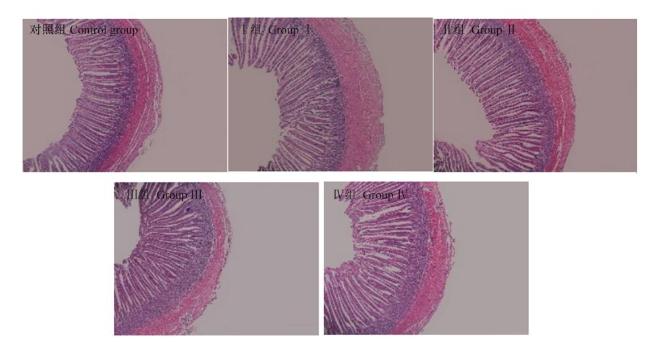
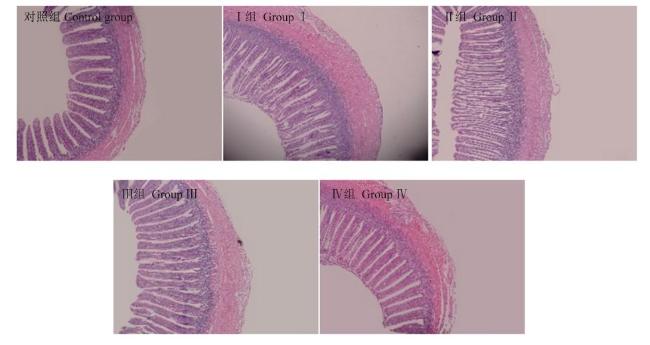
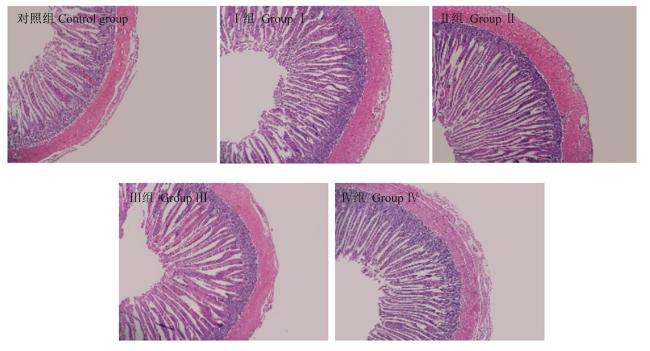
图1可知,与对照组相比,Ⅰ、Ⅱ、Ⅲ、Ⅳ空肠绒毛变长。由图2可知,与对照组相比,Ⅰ、Ⅱ、Ⅲ、Ⅳ组回肠绒毛排列更加紧密有序,Ⅱ、Ⅲ、Ⅳ组回肠绒毛未发现明显断裂。由图3可知,对照组十二指肠绒毛排列紊乱无规律,且尖端发生明显缺失,Ⅱ组十二指肠绒毛形态最佳。
图1 高负载硒丁酸梭菌及其后生元对北京鸭空肠形态的影响

Fig.1 Effects of high loaded selenium Clostridium butyricum and its postbiotics on jejunal morphology of Peking ducks (50×)

图2 高负载硒丁酸梭菌及其后生元对北京鸭回肠形态的影响

Fig.2 Effects of high loaded selenium Clostridium butyricum and its postbiotics on ileal morphology of Peking ducks (50×)

图3 高负载硒丁酸梭菌及其后生元对北京鸭十二指肠形态的影响

Fig.3 Effects of high loaded selenium Clostridium butyricum and its postbiotics on duodenal morphology of Peking ducks (50×)

表4可知,与对照组相比,Ⅱ、Ⅲ、Ⅳ组空肠绒毛高度和绒毛高度/隐窝深度显著升高(P<0.05);Ⅰ、Ⅱ、Ⅲ、Ⅳ组回肠绒毛高度和绒毛高度/隐窝深度显著升高(P<0.05);Ⅰ、Ⅱ、Ⅲ、Ⅳ组十二指肠绒毛高度显著升高(P<0.05),Ⅱ、Ⅲ组十二指肠绒毛高度/隐窝深度显著升高(P<0.05)。
表4 高负载硒丁酸梭菌及其后生元对北京鸭肠道形态的影响

Table 4 Effects of high loaded selenium Clostridium butyricum and its postbiotics on intestinal morphology of Peking ducks

项目
Items
组别Groups SEM P
P-value
对照Control


空肠
Jejunum
绒毛高度
Villus height/μm
862.51b 909.21b 1 045.56a 1 054.47a 1 098.60a 26.021 0.005
隐窝深度
Crypt depth/μm
250.01 237.39 229.96 251.60 257.64 5.191 0.460
绒毛高度/隐窝深度
Villus height/crypt depth
3.47b 3.92ab 4.53a 4.22a 4.29a 0.121 0.043


回肠
Ileum
绒毛高度
Villus height/μm
755.14b 942.99a 994.40a 1 011.36a 949.09a 20.858 <0.001
隐窝深度
Crypt depth/μm
276.28 270.50 249.62 257.43 260.69 6.930 0.789
绒毛高度/隐窝深度
Villus height/crypt depth
2.76b 3.56a 3.99a 3.94a 3.83a 0.138 0.015


十二指肠
Duodenum
绒毛高度
Villus height/μm
883.90d 944.31c 1 015.52b 1 083.43a 954.50c 14.995 <0.001
隐窝深度
Crypt depth/μm
274.90 252.49 267.34 270.77 280.99 5.286 0.540
绒毛高度/隐窝深度
Villus height/crypt depth
3.25b 3.75ab 3.86a 3.99a 3.47ab 0.091 0.049

2.4 高负载硒丁酸梭菌及其后生元对北京盲肠道菌群结构的影响

根据前期试验结果综合考虑,选取Ⅱ、Ⅲ、Ⅳ组与对照组进行比较,分析高负载硒丁酸梭菌及其后生元对北京鸭盲肠菌群结构的影响。

2.4.1 测序质量评估

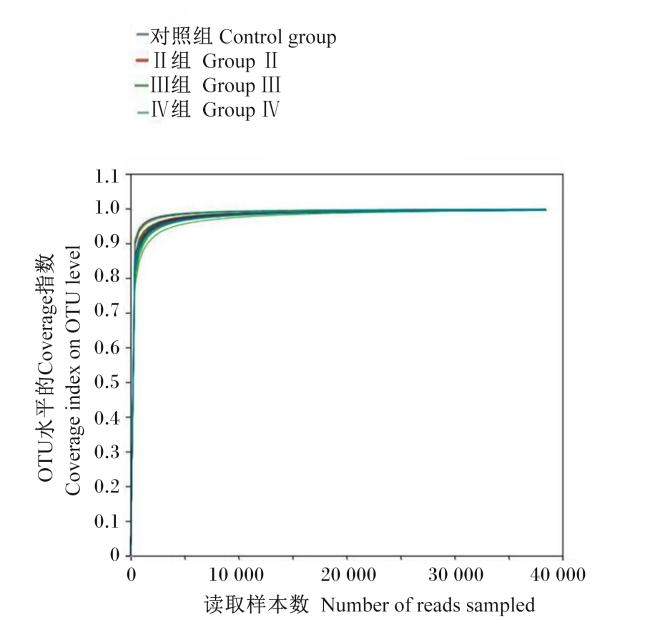
稀释曲线可用于比较不同测序数据量样本的物种丰富度,并评估测序量是否合理。由图4可知,稀释曲线趋于平缓,表明测序量充足,样品测序数据合理。
图4 北京鸭盲肠样品稀释曲线

Fig.4 Dilution curve of cecal samples of Peking ducks

2.4.2 操作分类单元(OTU)分析

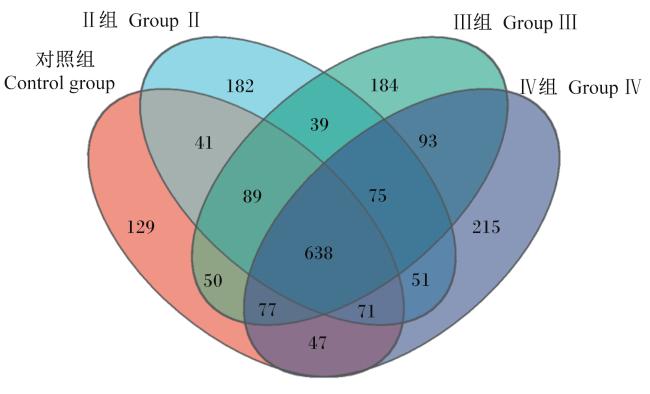
图5可知,对照、Ⅱ、Ⅲ、Ⅳ组独有的OTU数目分别为129、182、184和215个。与对照组相比,Ⅱ、Ⅲ、Ⅳ组OTU数目均增多,表明饲粮中添加高负载硒丁酸梭菌及其后生元后,北京鸭盲肠内容物中微生物种类增多。
图5 北京鸭盲肠样品韦恩图

Fig.5 Veen diagram of cecal samples of Peking ducks

2.4.3 α多样性分析

表5可知,各组之间盲肠菌群ACE、Chao1、Simpson、Shannon指数差异不显著(P>0.05)。与对照组相比,Ⅲ、Ⅳ组盲肠菌群Chao1指数升高,Ⅱ、Ⅲ、Ⅳ组盲肠菌群Shannon指数降低。
表5 高负载硒丁酸梭菌及其后生元对北京鸭盲肠菌群α多样性的影响

Table 5 Effects of highly loaded selenium Clostridium butyricum and its postbiotics on cecal flora α iversity of Peking ducks

项目
Items
组别Groups SEM P
P-value
对照Control
Shannon指数Shannon index 4.67 4.49 4.58 4.56 0.046 0.818
ACE指数ACE index 871.69 869.80 879.68 956.77 22.825 0.637
Chao1指数Chao1 index 855.15 848.32 873.95 946.56 24.068 0.667
Simpson指数Simpson index 0.021 0.027 0.031 0.029 0.002 0.734

2.4.4 门水平盲肠菌群分析

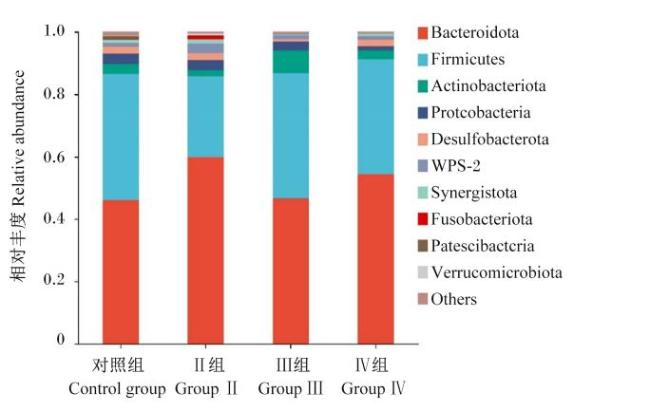
图6可知,在门水平上,盲肠菌群由拟杆菌门(Bacteroidota)、厚壁菌门(Firmicutes)、放线菌门(Actinobacteriota)、变形菌门(Protcobacteria)、热脱硫杆菌门(Desulfobacterota)等组成,主要优势菌群为拟杆菌门和厚壁菌门。
图6 盲肠内容物门水平上的微生物组成

Bacteroidota:拟杆菌门;Firmicutes:厚壁菌门;Actinobacteriota:放线菌门;Protcobacteria:变形菌门;Desulfobacterota:热脱硫杆菌门;WPS-2:WPS-2菌门;Synergistota:同力菌门;Fusobacteriota:梭杆菌门;Patescibactcria:髌骨菌门;Verrucomicrobiota:疣微菌门;Others:其他。

Fig.6 Microbial composition at phylum level of cecal contents

2.4.5 属水平盲肠菌群分析

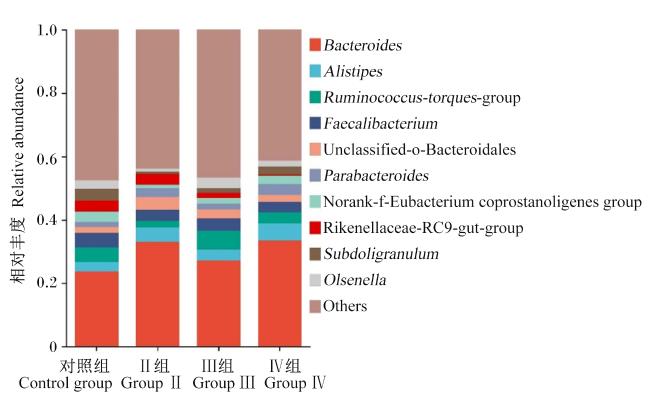
图7可知,在属水平上,盲肠菌群由拟杆菌属(Bacteroides)、另枝菌属(Alistipes)、瘤胃球菌属(Ruminococcus-torques-group)、粪杆菌属(Faecalibacterium)、未分类拟杆菌科(unclassified-o-Bacteroidales)、副杆菌属(Parabacteroides)等组成,主要优势菌群为拟杆菌属、另枝菌属、瘤胃球菌属和粪杆菌属。
图7 盲肠内容物门水平上的微生物组成

Bacteroides:拟杆菌属;Alistipes:另枝菌属;Ruminococcus-torques-group:瘤胃球菌属;Faecalibacterium:粪杆菌属;Unclassified-o-Bacteroidales:未分类拟杆菌科;Parabacteroides:副杆菌属;Norank-f-Eubacterium coprostanoligenes group:未分类真杆菌科-产粪固醇菌群;Rikenellaceae-RC9-gut-group:理研氏菌科RC9肠道群;Subdoligranulum:罕见小球菌属;Olsenella:奥尔森氏菌属;Others:其他。

Fig.7 Microbial composition at genus level of cecal contents

2.4.6 高负载硒丁酸梭菌及其后生元对肉鸭盲肠优势菌群的影响

表6可知,在门水平上,与对照组相比,Ⅱ、Ⅳ组盲肠拟杆菌门相对丰度显著升高(P<0.05),Ⅱ组盲肠厚壁菌门相对丰度显著降低(P<0.05)。在属水平上,与对照组相比,Ⅱ、Ⅲ、Ⅳ组盲肠拟杆菌属相对丰度显著升高(P<0.05)。
表6 高负载硒丁酸梭菌及其后生元对北京鸭盲肠优势菌群的影响

Table 6 Effects of highly loaded selenium Clostridium butyricum and its postbiotics on cecal dominant flora of Peking ducks

项目
Items
组别Groups SEM P
P-value
对照Control

门水平Phylum level
拟杆菌门Bacteroidota 0.46b 0.60a 0.47b 0.54a 0.019 0.002
厚壁菌门Firmicutes 0.40a 0.26b 0.40a 0.37a 0.020 0.007
属水平Genus level 拟杆菌属Bacteroides 0.23b 0.33a 0.27a 0.34a 0.017 0.050

3 讨论

3.1 高负载硒丁酸梭菌及其后生元对北京鸭免疫器官指数的影响

机体免疫系统由免疫器官、免疫细胞和免疫因子组成,三者密切协作保证生命体免受病菌伤害[13]。邹俊等[14]研究发现,饲粮中添加丁酸梭菌可提高肉鸡免疫器官指数。免疫器官指数升高,抵御致病菌能力越高,机体免疫功能越强[15]。李莹等[4]研究发现,饲粮中添加丁酸梭菌能够增强肉鸡的生长性能,提高血清免疫球蛋白数量和免疫器官的指数。王娜[16]研究发现,饲粮中添加酵母硒能够提高肉鸡免疫器官指数。本试验结果表明,饲粮中添加高负载硒丁酸梭菌及其后生元可提高北京鸭脾脏指数;与添加丁酸梭菌发酵液相比较,添加高负载硒丁酸梭菌发酵液、高负载硒丁酸梭菌后生元和高负载硒丁酸梭菌菌体均提高了各免疫器官指数,说明高负载硒丁酸梭菌及其后生元对北京鸭免疫器官发育更有益,从而增强北京鸭机体免疫功能。

3.2 高负载硒丁酸梭菌及其后生元对北京鸭空肠黏膜免疫指标的影响

肠道承担着营养物质的消化、吸收及转运功能,并构成人体最大的免疫器官。肠道中有丰富的微生物,在营养代谢和免疫方面发挥着巨大作用[17]。免疫球蛋白是人体免疫系统产生的具有抗体活性或类似结构的大分子蛋白质。纳米硒可以调节机体肠道免疫功能,将益生菌和纳米硒结合,可将益生效果达到最大化[18]。家禽肠道作为最大的免疫器官,IgA通过阻断病原体与肠黏膜的结合,同时激活机体的体液和细胞免疫反应。此外,IgG在免疫过程中能够启动补体系统,从而有效中和并清除病原微生物[19]。饲粮中添加益生素的雏鸡肠黏膜组织IgA、IgG、IgM含量明显增多[20]。饲粮中添加丁酸梭菌和凝结芽孢杆菌能够提高肠道中IgA含量,减少肠道炎症发生[8]。本试验结果表明,饲粮中添加高负载硒丁酸梭菌及其后生元可显著提高北京鸭空肠IgA、IgG含量,这与前人研究结果一致,表明高负载硒丁酸梭菌及其后生元可有效提高北京鸭肠道免疫功能;且饲粮中添加高负载硒丁酸梭菌发酵液组的空肠IgA、IgG含量最高,这可能是因为丁酸梭菌与硒二者发生协同作用,增强肠道免疫功能,说明高负载硒丁酸梭菌对肉鸭肠道发育更有益。

3.3 高负载硒丁酸梭菌及其后生元对北京鸭肠道形态的影响

研究表明,肠道作为北京鸭营养吸收的主要场所,其消化吸收水平决定了机体营养状况[8]。小肠绒毛长度越长,与营养物质的接触面积越大,营养物价吸收率越高,隐窝深浅代表细胞成熟度,隐窝越浅细胞成熟度越高,肠道的消化吸收功能就越好[21]。武丽达等[22]研究表明,丁酸梭菌在早期肉仔鸡中可以降低肠道隐窝深度和提高绒毛高度/隐窝深度。肉鸡饲喂丁酸梭菌可提高空肠绒毛高度[23]。细菌硒作为有机硒来源能提高肠内炎症因子含量,增加绒毛高度,从而对硒由更高的吸收与保留效果[24]。这与本试验研究结果相同,高负载硒丁酸梭菌及其后生元可促进空肠、回肠、十二指肠的肠绒毛生长,可能是由于高负载丁酸梭菌为其提供了能量。这表明高负载硒丁酸梭菌可以有效将无机硒转化为有机硒,促进北京鸭肠道绒毛生长和营养物质吸收,提高饲料的利用率。

3.4 高负载硒丁酸梭菌及其后生元对北京鸭盲肠菌群结构的影响

肠道黏膜组成的免疫系统还能抑制有害菌群的过度定植,维持肠道微生物的稳态[18]。益生菌在胃肠道内定植能够防止有害菌的入侵[25]。众所周知,有害菌需要定植在胃肠道才能对胃肠道产生有害影响[26]。研究表明,饲粮中添加丁酸梭菌可提高肉鸡肠道中厚壁菌门相对丰度[27]。番鸭饲粮中添加丁酸梭菌后,发现拟杆菌门是干预鸭盲肠微生物群落中第一优势菌门,厚壁菌门是第二优势菌门;在属水平上,优势菌属是拟杆菌属[28]。后生元还可以调节肠道微生物群并抑制病原体[29],补充硒可以改善小鼠肠道菌群结构[30]。拟杆菌门降解多糖,其与厚壁菌门的比值调控肠道健康,益生菌通过调节其比值可改善脂质代谢,降低肥胖风险[8]。本试验结果表明,在门水平上,与对照组相比,Ⅱ、Ⅳ组盲肠拟杆菌门相对丰度显著升高,Ⅱ组厚壁菌门相对丰度显著降低,这可能是因为Ⅱ组盲肠拟杆菌门相对丰度大幅度升高。在肠道菌群结构方面,高负载硒丁酸梭菌及其后生元可增加北京鸭肠道有益菌群占比,尤其是拟杆菌门和拟杆菌属,高负载硒丁酸梭菌与高负载硒丁酸梭菌后生元作用效果基本相同。

4 结论

高负载硒丁酸梭菌及其后生元可促进北京鸭免疫器官发育,改善肠道形态,增强肠道免疫功能,优化肠道菌群结构,可作为饲料添加剂使用。
[1]
肖明霞, 黄遵锡, VANHNASENG P, 等. 丁酸梭菌稳定性对肉鸡肠道菌群调控作用的影响[J]. 云南农业大学学报(自然科学), 2024, 39(11):75-81.

XIAO M X, HUANG Z X, VANHNASENG P, et al. Effects of the stability of Clostridium butyricum additive on intestinal microflora regulation in broiler chickens[J]. Journal of Yunnan Agricultural University (Natural Science), 2024, 39(6):75-81. (in Chinese)

[2]
李贺贺, 程炳金, 马雷国. 酵母硒对Z型北京鸭生长性能、胸肉系水力及硒含量的影响[J]. 北方牧业, 2022(14):24.

LI H H, CHENG B J, MA L G. Effects of yeast selenium on growth performance,breast meat hydraulics and selenium content of Z-type Pekin ducks[J]. Northern Pastoralism, 2022(14):24. (in Chinese)

[3]
李文嘉, 徐彬, 魏凤仙, 等. 丁酸梭菌对肉鸡生长、肠道形态及屏障功能的影响[J]. 河南农业科学, 2023, 52(1):144-153.

LI W J, XU B, WEI F X, et al. Effects of Clostridium butyricum on growth,intestinal morphology and barrier function of broilers[J]. Journal of Henan Agricultural Sciences, 2023, 52(1):144-153. (in Chinese)

[4]
李莹, 张庆华, 钟丽娟, 等. 丁酸梭菌对白羽肉鸡生长性能、免疫功能和肠道健康的影响[J]. 动物营养学报, 2023, 35(8):5023-5035.

DOI

LI Y, ZHANG Q H, ZHONG L J, et al. Effects of Clostridium butyricum on growth performance,immune function and intestine health of white-feathered broilers[J]. Chinese Journal of Animal Nutrition, 2023, 35(8):5023-5035. (in Chinese)

[5]
钟扬丹, 陈佳欣, 张立实, 等. 后生元的健康益处及作用机制研究进展[J]. 中国食品添加剂, 2023, 34(10):22-33.

ZHONG Y D, CHEN J X, ZHANG L S, et al. Research progress on health benefits and mechanism of postbiotics[J]. China Food Additives, 2023, 34(10):22-33. (in Chinese)

[6]
李冰心, 曹楠, 刘洋, 等. 硒对畜禽免疫功能的影响[J]. 仲恺农业工程学院学报, 2018, 31(2):65-71.

LI B X, CAO N, LIU Y, et al. Effects of selenium on immune function of livestock and poultry[J]. Journal of Zhongkai University of Agriculture and Technology, 2018, 31(2):65-71. (in Chinese)

[7]
官丽辉, 刘海斌, 张立永. 酵母硒-黄芪多糖浓缩料对坝上长尾鸡生长性能、肠道健康、屠宰性能及肉品质的影响[J]. 动物营养学报, 2023, 35(7):4312-4320.

DOI

GUAN L H, LIU H B, ZHANG L Y. Effects of selenium yeast-Astragalus polysaccharide concentrated feed on growth performance,intestinal health,slaughter performance and meat quality of Bashang long-tail chickens[J]. Chinese Journal of Animal Nutrition, 2023, 35(7):4312-4320. (in Chinese)

[8]
邹函峪, 王宝维, 张名爱, 等. 凝结芽孢杆菌和丁酸梭菌对肉鸭生长性能、屠宰性能、血清生化指标及肠道健康的影响[J]. 动物营养学报, 2023, 35(5):3025-3040.

DOI

ZOU H Y, WANG B W, ZHANG M A, et al. Effects of bacillus coagulans and Clostridium butyricum on growth performance,slaughter performance,serum biochemical indexes and intestinal health of meat ducks[J]. Chinese Journal of Animal Nutrition, 2023, 35(5):3025-3040. (in Chinese)

[9]
熊本海, 罗清尧, 赵峰, 等. 中国饲料成分及营养价值表(2021年第32版)制订说明[J]. 中国饲料, 2021(23):98-107.

XIONG B H, LUO X Y, ZHAO F. Introduction of tables of feed composition and nutritive values in China (2021 thirty-two edition) formulate instructions[J]. China Feed, 2021(23):98-107. (in Chinese)

[10]
中华人民共和国国家市场监督管理总局, 中国国家标准化管理委员会. 饲料中粗蛋白的含量测定凯氏定氮法:GB/T 6432—2018[S]. 北京: 中国标准出版社, 2018.

State Administration for Market Regulation, Standardization Administration of the People’s Republic of China. Determination of crude protein in feeds-Kjeldahl method:GB/T 6432—2018[S]. Beijing: Standards Press of China, 2018. (in Chinese)

[11]
国家市场监督管理总局, 中国国家标准化管理委员会. 饲料中粗纤维的含量测定:GB/T 6434—2006[S]. 北京: 中国标准出版社, 2006.

State Administration for Market Regulation, Standardization Administration of the People’s Republic of China. Determination of crude fiber content in feeds:GB/T 6434—2006[S]. Beijing: Standards Press of China, 2006. (in Chinese)

[12]
中华人民共和国国家质量监督检验检疫总局, 中国国家标准化管理委员会. 饲料中粗脂肪的测定:GB/T 6433—2006[S]. 北京: 中国标准出版社, 2006.

General Administration of Quality Supervision,Inspection and Quarantine of the People’s Republic of China, Standardization Administration of the People’s Republic of China. Determination of crude fat in feed:GB/T 6433—2006[S]. Beijing: Standards Press of China, 2006. (in Chinese)

[13]
ČERNÝ J, STŘÍŽ I. Adaptive innate immunity or innate adaptive immunity?[J]. Clinical Science, 2019, 133(14):1549-1565.

DOI

[14]
邹俊, 龚建刚, 郝艳霜, 等. 丁酸梭菌、二甲酸钾及其组合对肉鸡生长性能、屠宰性能及免疫器官指数的影响[J]. 饲料研究, 2022, 45(7):36-40.

ZOU J, GONG J G, HAO Y S, et al. Effect of Clostridium butyricum,potassium diformate and their combination on growth performance,slaughter performance and immune organ index of broiler[J]. Feed Research, 2022, 45(7):36-40. (in Chinese)

[15]
李洪涛, 李爱军, 庄佳荣, 等. 丁酸梭菌对商品肉鸡生长性能、屠宰性能、免疫器官指数和经济效益的影响[J]. 饲料工业, 2023, 44(15):19-24.

LI H T, LI A J, ZHUANG J R, et al. Effects of Clostridium butyricum on growth performance,slaughter performance,immune organ index and economic benefits of commercial broilers.[J]. Feed Industry, 2023, 44(15):19-24. (in Chinese)

[16]
王娜. 酵母硒对817肉鸡生产性能和免疫器官指数影响的研究[J]. 家禽科学, 2019(10):19-21.

WANG N. Study of yeast selenium on growth performance and immune organ index in 817 broiler[J]. Poultry Science, 2019(10):19-21. (in Chinese)

[17]
LI N, ZUO B, HUANG S M, et al. Spatial heterogeneity of bacterial colonization across different gut segments following inter-species microbiota transplantation[J]. Microbiome, 2020, 8(1):161.

DOI PMID

[18]
续丹丹, 程怡瑞, 黄世猛, 等. 生物合成纳米硒对肠道黏膜免疫功能和菌群稳态影响的研究进展[J]. 食品与发酵工业, 2025, 51(10):368-375.

DOI

XU D D, CHENG Y R, HUANG S M, et al. Research progress on effects of biosynthetic selenium nanoparticles on intestinal mucosal immune function and microbial homeostasis[J]. Food and Fermentation Industry, 2025, 51(10):368-375. (in Chinese)

[19]
牛晓雨, 邢媛媛, 李大彪. 植物活性成分对动物肠道屏障功能的调控作用及其机制[J]. 畜牧兽医学报, 2024, 55(4):1467-1477.

DOI

NIU X Y, XING Y Y, LI D B. Advances in regulation and mechanism of plant bioactive compounds on intestinal barrier function in animals[J]. Acta Veterinaria et Zootechnica Sinica, 2024, 55(4):1467-1477. (in Chinese)

DOI

[20]
何国茹, 姚军虎. 营养因素对肉鸡肠道黏膜免疫的影响[J]. 四川畜牧兽医, 2011, 38(6):29-31.

HE G R, YAO J H. Nutritional factors on the influence of intestinal mucosa immunization in chicken[J]. Sichuan Animal Husbandry and Veterinary Medicine, 2011, 38(6):29-31. (in Chinese)

[21]
付子贤, 肖英平, 杨彩梅, 等. 育雏期饲喂丁酸梭菌对育肥期番鸭生长性能、屠宰性能、肉品质和肌肉中氨基酸含量的影响[J]. 动物营养学报, 2023, 35(11):7174-7182.

DOI

FU Z X, XIAO Y P, YANG C M, et al. Effects of feeding Clostridium butyricum in brooding period on growth performance,slaughter performance,meat quality and muscle amino acid contents of muscovy ducks in fattening period[J]. Chinese Journal of Animal Nutrition, 2023, 35(11):7174-7182. (in Chinese)

[22]
武丽达, 沈雪梅, 杨鑫, 等. 丁酸梭菌、黑曲霉菌丝体对肉鸡生长性能、血清生化指标和肠道形态的影响[J]. 中国饲料, 2022(9):25-29.

WU L D, SHEN X M, YANG X, et al. Effects of Clostridium butyricum or Aspergillus niger mycelium on growth performance,serum biochemical indexes and intestinal morphology of broilers[J]. China Feed, 2022(9):25-29. (in Chinese)

[23]
YANG T, DU M, ZHANG J, et al. Effects of Clostridium butyricum as an antibiotic alternative on growth performance,intestinal morphology,serum biochemical response,and immunity of broilers[J]. Antibiotics, 2023, 12(3):433.

[24]
DALIA A M, LOH T C, SAZILI A Q, et al. Influence of bacterial organic selenium on blood parameters,immune response,selenium retention and intestinal morphology of broiler chickens[J]. BMC Veterinary Research, 2020, 16(1):365.

[25]
CHO J H, ZHAO P Y, KIM I H. Probiotics as a dietary additive for pigs:a review[J]. Journal of Animal & Veterinary Advances, 2011, 10(16):2127-2134.

[26]
YIRGA H. The use of probiotics in animal nutrition[J]. Journal of Probiotics & Health, 2015, 3(2):1-10.

[27]
WANG Y B, WANG Y, LIN X J, et al. Effects of Clostridium butyricum,sodium butyrate,and butyric acid glycerides on the reproductive performance,egg quality,intestinal health,and offspring performance of yellow-feathered breeder hens[J]. Frontiers in Microbiology, 2021,12:657542.

[28]
XIAO X N, FU Z X, LI N, et al. Modulation of the intestinal microbiota by the early intervention with Clostridium butyricum in muscovy ducks[J]. Antibiotics, 2021, 10(7): 826.

[29]
ZHONG Y F, WANG S S, DI H Q, et al. Gut health benefit and application of postbiotics in animal production[J]. Journal of Animal Science and Biotechnology, 2022, 13(1):38.

DOI PMID

[30]
ZHAI Q X, CEN S, LI P, et al. Effects of dietary selenium supplementation on intestinal barrier and immune responses associated with its modulation of gut microbiota[J]. Environmental Science & Technology Letters, 2018, 5(12):724-730.

Outlines

/