RESEARCH PAPER

Comparative Study on Rumen Microbiota Structure and Function between Wagyu and Holstein Calves

  • BU Ye , 1 ,
  • HE Tengfei 2 ,
  • WANG Haoran 3 ,
  • LIU Li 1 ,
  • WANG Chunwei 4 ,
  • MENG Xiangren 1 ,
  • ZHAO Xiaochuan 1 ,
  • XU Shanshan 1 ,
  • CHEN Zhaohui , 2, * ,
  • SUN Fang , 1, *
Expand
  • 1 1. Institute of Animal Husbandry of Heilongjiang Academy of Agricultural Sciences, Harbin 150086, China
  • 2 College of Animal Science and Technology, China Agricultural University, Beijing 100193, China
  • 3 College of Veterinary Medicine, Northeast Agricultural University, Harbin 150030, China
  • 4 Heilongjiang Provincial Animal Husbandry Station, Harbin 150069, China
*CHEN Zhaohui, associate professor, E-mail: ;
SUN Fang, professor, E-mail:

Received date: 2025-03-13

  Online published: 2025-10-15

Abstract

The purpose of this experiment was to comparatively study the changing patterns of rumen microbiota structure and function between Wagyu and Holstein calves. Each five 3-month-old Wagyu cattle and Holstein cattle were selected. The Wagyu group was divided into W3 group, W4 group, W5 group and W6 group (corresponding to 3, 4, 5 and 6 months of age, respectively), and the Holstein group was divided into H3 group, H4 group, H5 group and H6 group (corresponding to 3, 4, 5 and 6 months of age, respectively). The experimental calves were fed twice daily with unlimited Leymus chinensis and free access to water. The rumen fluid was collected before morning feeding at 3, 4, 5 and 6 months of age for metagenomic analysis. The results showed as follows: 1) the number of rumen microbiota in both breed calves at phylum level totaled 181 species in common, with 18 species specific to Wagyu cattle and 1 species specific to Holstein cattle, and the number at genus level totaled 3 019 species in common, with 672 species specific to Wagyu cattle and 57 species specific to Holstein cattle. 2) For the Shannon index, within a single breed, the W5 and W6 groups were significantly higher than the W3 group (P<0.05). Between breeds at the same age, the W5 group was significantly higher than the H5 group (P<0.05), and the W6 group was extremely significantly higher than the H6 group (P<0.01). For the ACE index, within a single breed, the W5 and W6 groups were significantly higher than the W3 group (P<0.05), and the W6 group was significantly higher than the W4 group (P<0.05). Between breeds at the same age, the W4 group was significantly higher than the H4 group (P<0.05), and the W5 and W6 groups were extremely significantly higher than the H5 and H6 groups, respectively (P<0.01). 3) The distribution of sample distances between Wagyu groups was relatively extensive, that of Holstein calves was relatively concentrated, and there was an extremely significant difference in rumen microbiota beta diversity between breeds (P<0.01). 4) A total of 4 level 1 metabolic pathways and 22 level 2 metabolic pathways were annotated using the KEGG database. The relative abundances of functional genes in the level 1 pathways were in the order of: metabolism (76.35%), genetic information processing (13.75%), environmental information processing (6.91%), and cellular processes (2.99%). 5) There was a significant interaction between month of age and breed on metabolism and cellular processes (P<0.05). It is concluded that the rumen microbiota structure of Wagyu and Holstein calves exhibits both breed-conserved and breed-specific characteristics. Wagyu calves demonstrate greater variability in rumen microbiota structure with increasing of month of age, whereas Holstein calves maintain relative stability. The differences in the function of rumen microbiota between the two breeds are primarily reflected in the relative abundances of functional genes within metabolic pathways. Additionally, a significant interaction between month of age and breed is observed on specific metabolic pathways.

Cite this article

BU Ye , HE Tengfei , WANG Haoran , LIU Li , WANG Chunwei , MENG Xiangren , ZHAO Xiaochuan , XU Shanshan , CHEN Zhaohui , SUN Fang . Comparative Study on Rumen Microbiota Structure and Function between Wagyu and Holstein Calves[J]. Chinese Journal of Animal Nutrition, 2025 , 37(10) : 6852 -6866 . DOI: 10.12418/CJAN2025.558

反刍动物瘤胃微生物与宿主之间存在紧密的共生关系[1],宿主的遗传因素、饲粮组成和生理状态等直接影响瘤胃微生物群落结构和功能,反之瘤胃微生物也可以调节宿主的机体代谢、生长发育和免疫应答[2-3]。Jami等[4]发现,新生犊牛瘤胃微生物群落在门和属水平上的主导菌群分别是厚壁菌门(Firmicutes)和链球菌属(Streptococcus),但随着个体生长,以普雷沃氏菌属(Prevotella)为主的拟杆菌门(Bacteroidetes)逐渐成为优势菌群;Dias等[5]通过比较犊牛7~28日龄和49~63日龄瘤胃微生物群落表明,群落动态与年龄存在显著相关性;Fonseca等[6]在安格斯牛、夏洛莱牛及其杂交牛上研究表明,瘤胃上皮基因表达与瘤胃微生物存在显著相关性,同时具有品种特异性。与之相同,Zhao等[7]通过比较西门塔尔牛、西门塔尔×中国荷斯坦牛和西门塔尔×蒙古牛瘤胃微生物群落结构,也表明不同遗传背景与瘤胃菌群存在相关性。目前,我国高档牛肉市场份额不断扩大,但相关的研究仍集中在西门塔尔等品种上,而在荷斯坦牛肉用方面研究较少。因此,本试验选择具有生产高档牛肉特点的和牛,以及具有生产大理石纹牛肉潜力的荷斯坦牛为研究对象,通过比较2个品种犊牛阶段瘤胃微生物群落的特征,旨在为进一步完善荷斯坦牛生产大理石纹牛肉技术提供科学依据。

1 材料与方法

1.1 试验设计

本试验于2024年8—11月在黑龙江省某规模化奶牛场和规模化和牛繁育场进行,动物试验经黑龙江省农业科学院动物福利委员会批准(批准编号:NKY-20140506)。试验分别在2个牛场选择3月龄体况健康的和牛和荷斯坦牛各5头,按照3~6月龄采样时间设置分组,和牛组分别为W3组、W4组、W5组和W6组(分别对应3、4、5和6月龄),荷斯坦牛组分别为H3组、H4组、H5组和H6组(分别对应3、4、5和6月龄),研究2个品种犊牛瘤胃微生物群落结构和代谢通路随生长的变化规律及相同月龄时品种间的差异。试验牛首次采样的初始日龄见表1。为保证2个品种牛饲养管理和饲粮营养水平一致,试验牛均单独饲养,并饲喂相同的犊牛精料补充料,每日饲喂2次,羊草不限饲,自由饮水,基础饲粮组成及营养水平见表2。饲粮中水分、粗蛋白质(CP)和粗脂肪(EE)含量分别参照GB/T 6435—2014[8]、GB/T 6432—2018[9]和GB/T 6433—2006[10]中方法测定,中性洗涤纤维(NDF)和酸性洗涤纤维(ADF)含量分别参照GB/T 20806—2022[11]和NY/T 1459—2022[12]采用滤袋法测定,粗灰分(Ash)、钙(Ca)和总磷(TP)含量分别参照GB/T 6438—2007[13]、GB/T 6436—2018[14]和GB/T 6437—2018[15]中方法测定。
表1 试验牛首次采样的初始日龄

Table 1 Initial days of age of experimental cattle at the first sampling

品种
Breed
序号
Number
初始日龄
Initial days of age
品种
Breed
序号
Number
初始日龄
Initial days of age


和牛
Wagyu cattle
1 94


荷斯坦牛
Holstein cattle
1 97
2 96 2 105
3 89 3 105
4 94 4 108
5 106 5 107
表2 基础饲粮组成及营养水平(干物质基础)

Table 2 Composition and nutrient levels of basal diets (DM basis)

项目
Items
3~4月龄
3 to 4 months of age
4~5月龄
4 to 5 months of age
5~6月龄
5 to 6 months of age
干物质
采食量
DMI/[kg/
(头·d)]
含量
Content/%
干物质
采食量
DMI/[kg/
(头·d)]
含量
Content/%
干物质
采食量
DMI/[kg/
(头·d)]
含量
Content/%
原料Ingredients
精料补充料Concentrate supplement 2.00 62.50 2.80 66.67 3.60 67.93
蒸气压片玉米Steam-flaked corn 1.00 31.25 1.10 26.19 1.20 22.64
羊草Leymus chinensis1) 0.20 6.25 0.30 7.14 0.50 9.43
合计Total 3.20 100.00 4.20 100.00 5.30 100.00
营养水平Nutrient levels2)
水分(风干基础)
Moisture (air-dry basis)
6.88 7.32 7.66
粗蛋白质CP 19.24 20.46 20.68
粗脂肪EE 7.15 8.37 8.48
中性洗涤纤维NDF 31.07 32.14 32.08
酸性洗涤纤维ADF 19.15 19.37 20.36
粗灰分Ash 8.27 9.03 9.33
钙Ca 1.58 1.61 1.63
总磷TP 0.80 0.85 0.84

1)不限制羊草饲喂量,此值为平均采食量。Unlimited feeding of Leymus chinensis, the value was the average feed intake.2)营养水平均为实测值。Nutrient levels were all measured values.

1.2 样品采集

分别在犊牛3、4、5和6月龄晨饲前使用瘤胃导管经口采集瘤胃液,弃掉前200 mL瘤胃液,后续采集的瘤胃液经4层无菌纱布过滤后置于液氮中保存待测。

1.3 样品检测

1.3.1 DNA文库的构建和测序

采用DNA提取试剂盒[DP812,天根生化科技(北京)有限公司]和全自动核酸提取纯化仪[TGuide S96,天根生化科技(北京)有限公司]完成总DNA的提取,然后采用荧光定量仪[Qubit 3.0 Flurometer,赛默飞世尔科技(中国)有限公司]和琼脂糖凝胶电泳对提取的总DNA分别进行浓度和完整性检测。检测合格后采用建库试剂盒(VAHTSTM Universal Plus DNA Library Prep Kit for Illumina)进行文库构建,将DNA酶切打断,对片段化的DNA进行末端修复、3'端加腺嘌呤(A)、连接测序接头、连接产物片段筛选纯化及PCR扩增和纯化,再使用荧光定量仪进行文库浓度测定,最后采用Illumina NovaSeq 6000(PE 150)平台对合格的文库进行测序(本研究测序原始数据已上传至国家生物信息中心,GSA编号:CRA026481)。

1.3.2 测序数据质控

使用fastp软件(v0.23.1,参数:-5 -W 50 -M 20 -l 60 -n 0 -g -A)过滤测序原始数据,得到高质量的测序数据(Clean Tags);使用bowtie 2软件(v2.2.4,参数:-seed 123456 -I 200 -X 1000 -un-conc-gz)比对去除宿主污染;使用MEGAHIT软件(v1.1.2,默认参数)进行宏基因组组装,过滤短于300 bp的连续片段(contig)序列;使用QUAST软件(v2.3,默认参数)对组装结果进行评估;使用MetaGeneMark软件(v3.26,默认参数)识别基因组编码区域;使用MMseq 2软件(v12-113e3,相似性阈值为95%,覆盖度阈值为90%)进行非冗余基因构建,将非冗余基因序列分别与NR数据库和KEGG数据库进行BLAST(v0.9.29,比对筛选阈值:1e-5)比对注释。

1.4 数据统计分析

基于线性判别分析(LDA)效应大小(LEfSe)筛选组间差异物种(LDA得分>2.0)。基于物种丰富度和均匀度的Shannon指数以及丰度的覆盖估计值ACE指数计算alpha多样性,并利用单因素方差分析(one-way ANOVA)计算组间差异。基于主坐标分析(PCoA)获得beta多样性的Bray-Curtis距离矩阵,并采用置换多元方差分析(PERMANOVA)检验组间差异。采用Kruskal-Wallis秩和检验对组间代谢通路进行非参数检验,并用Benjamini-Hochberg(BH)法校正错误率。基于一般线性模型(general linear model,GLM)分析月龄与品种的交互作用。以上数据分别使用R(v3.1.1)和Python(v2.0)进行分析和绘图。P<0.05表示具有统计学意义。

2 结果与分析

2.1 基因组测序数据质控和组装评估

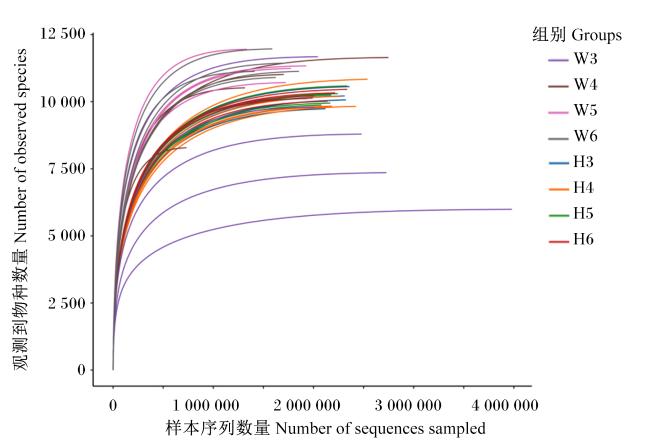
图1所示,各组样本测序数据稀释曲线均趋于平缓,表明测序数据饱和,可用于后续生物学分析。测序数据质控结果见表3,Q20值和Q30值分别表示测序碱基所占比例的错误率小于1.0%和0.1%,是衡量测序数据质量的重要指标,本试验中各组Q20值和Q30值均较高(Q20值≥99.54%,Q30值≥97.92%),表明测序质量较好。宏基因组组装评估结果见表4,N50值和比对率分别是评估基因组组装连续性和匹配效果的重要指标,和牛组中N50质和比对率随月龄增长呈现降低趋势(W3组~W6组N50值依次为1 219 bp>741 bp>631 bp>578 bp,比对率依次为84.94%>67.40%>62.65%>59.88%);荷斯坦牛组中N50值和比对率随月龄增长变化相对稳定。
图1 稀释曲线

W3、W4、W5和W6分别对应和牛3、4、5和6月龄,H3、H4、H5和H6分别对应荷斯坦牛3、4、5和6月龄。下图同。

Fig.1 Rarefaction curves

W3, W4, W5 and W6 represented the ages of 3, 4, 5 and 6 months of Wagyu cattle, while H3, H4, H5 and H6 represented the ages of 3, 4, 5 and 6 months of Holstein cattle, respectively. The same as below.

表3 测序数据质控

Table 3 Sequencing data quality control

组别
Groups
质控后数据量
Data volume after
quality control/bp
去除宿主后数据量
Data volume after
removing host/bp
有效数据量
Effective data
volume/bp
GC含量
GC
content/%
Q20值
Q20
value/%
Q30值
Q30
value/%


和牛组
Wagyu group
W3 6 336 943 776 6 171 872 971 41 319 846 47.09 99.62 98.23
W4 6 491 293 794 5 403 780 006 36 176 565 46.95 99.60 98.11
W5 6 343 665 839 6 150 578 851 41 181 321 47.94 99.61 98.17
W6 6 510 199 011 6 451 108 189 43 163 418 45.56 99.61 98.17


荷斯坦牛组
Holstein group
H3 6 528 075 507 6 515 600 434 43 555 718 50.07 99.57 98.00
H4 6 662 327 090 6 641 798 502 44 433 175 50.33 99.55 97.95
H5 6 426 791 854 6 409 733 001 42 846 782 49.80 99.54 97.92
H6 6 350 023 168 6 232 226 541 41 686 724 49.78 99.56 97.97

W3、W4、W5和W6分别对应和牛3、4、5和6月龄,H3、H4、H5和H6分别对应荷斯坦牛3、4、5和6月龄。下表同。

W3, W4, W5 and W6 represented the ages of 3, 4, 5 and 6 months of Wagyu cattle, while H3, H4, H5 and H6 represented the ages of 3, 4, 5 and 6 months of Holstein cattle, respectively. The same as below.

表4 宏基因组组装评估

Table 4 Metagenomic assembly assessment

组别
Groups
连续片段数
Number of
contigs
连续片段碱基数
Number of bases
in contigs/
bp
最长连续片段碱基数
Number of bases
in the longest
contig/bp
N50值
N50
value/bp
GC含量
GC
content/%
比对率
Mapping
rate/%


和牛组
Wagyu group
W3 499 639 410 034 915 439 530 1 219 46.79 84.94
W4 587 397 415 682 111 372 953 741 47.24 67.40
W5 795 868 495 591 986 194 281 631 46.98 62.65
W6 898 227 519 208 435 108 435 578 44.98 59.88


荷斯坦牛组
Holstein group
H3 787 751 572 177 406 439 630 781 50.38 75.62
H4 799 542 580 469 752 377 358 779 50.61 76.08
H5 767 474 561 583 605 383 094 790 50.09 74.84
H6 739 874 536 341 278 398 651 777 50.19 74.35

2.2 瘤胃微生物群落组成

2.2.1 瘤胃微生物群落在门水平上韦恩图

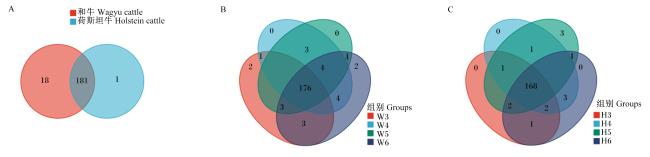
在门水平上,按照品种和月龄将各组犊牛瘤胃微生物群落以韦恩图进行展示。如图2-A所示,2个品种犊牛瘤胃微生物群落共注释到200个菌门,其中共有菌门181个,和牛特有菌门18个,荷斯坦牛特有菌门1个。如图2-B所示,3~6月龄和牛瘤胃微生物群落共注释到199个菌门,其中共有菌门176个,W3组和W6组特有菌门均为2个,W4组和W5组未注释到特有菌门。如图2-C所示,3~6月龄荷斯坦牛瘤胃微生物群落共注释到182个菌门,其中共有菌门168个,H3组、H4组和H6组未注释到特有菌门,H5组特有菌门3个。
图2 不同品种和月龄犊牛瘤胃微生物群落在门水平上韦恩图

Fig.2 Venn graph of rumen microbiota at phylum level in calves of different breeds and months of age

2.2.2 瘤胃微生物群落在属水平上韦恩图

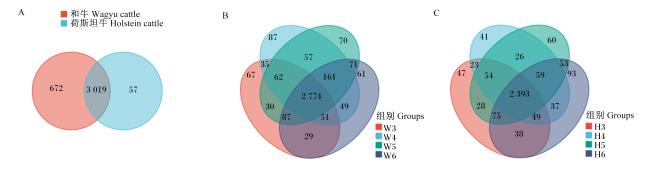
在属水平上,按照品种和月龄将各组犊牛瘤胃微生物群落以韦恩图进行展示。如图3-A所示,2个品种犊牛瘤胃微生物群落共注释到3 748个菌属,其中共有菌属3 019个,和牛特有菌属672个,荷斯坦牛特有菌属57个。如图3-B所示,3~6月龄和牛瘤胃微生物群落共注释到3 691个菌属,其中共有菌属2 774个,W3组、W4组、W5组和W6组特有菌属分别为67、87、70和61个。如图3-C所示,3~6月龄荷斯坦牛瘤胃微生物群落共注释到3 076个菌属,其中共有菌属2 393个,H3组、H4组、H5组和H6组特有菌属分别为47、41、60和93个。
图3 不同品种和月龄犊牛瘤胃微生物群落在属水平上韦恩图

Fig.3 Venn graph of rumen microbiota at genus level in calves of different breeds and months of age

2.2.3 瘤胃微生物群落在门和属水平上相对丰度

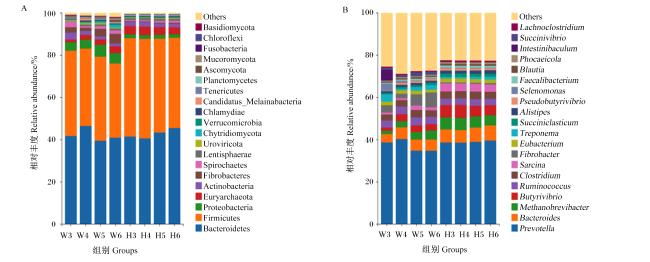
不同品种和月龄犊牛瘤胃微生物群落在门和属水平上相对丰度前20的菌群如图4所示。如图4-A所示,在门水平上,在和牛瘤胃中,W3组排名前5的菌门依次为拟杆菌门(41.75%)、厚壁菌门(40.39%)、变形菌门(Proteobacteria,3.96%)、放线菌门(Actinobacteria,3.36%)和螺旋体门(Spirochaetes,2.58%),W4组依次为拟杆菌门(46.45%)、厚壁菌门(36.70%)、变形菌门(4.21%)、广古菌门(Euryarchaeota,2.20%)和放线菌门(1.95%),W5组依次为厚壁菌门(39.81%)、拟杆菌门(39.48%)、变形菌门(5.63%)、纤维杆菌门(Fibrobacteres,3.50%)和广古菌门(2.51%),W6组依次为拟杆菌门(40.89%)、厚壁菌门(35.18%)、变形菌门(4.93%)、纤维杆菌门(4.63%)和广古菌门(3.15%);在荷斯坦牛瘤胃中,H3组排名前5的菌门依次为厚壁菌门(46.59%)、拟杆菌门(41.44%)、广古菌门(3.92%)、放线菌门(2.03%)和变形菌门(1.79%),H4组依次为厚壁菌门(47.13%)、拟杆菌门(40.58%)、广古菌门(4.00%)、放线菌门(2.22%)和变形菌门(1.76%),H5组依次为厚壁菌门(44.48%)、拟杆菌门(43.35%)、广古菌门(3.64%)、变形菌门(1.80%)和放线菌门(1.79%),H6组依次为拟杆菌门(45.45%)、厚壁菌门(42.79%)、广古菌门(3.27%)、放线菌门(1.73%)和变形菌门(1.65%)。如图4-B所示,在属水平上,在和牛瘤胃中,W3组排名前5的菌属依次为普雷沃氏菌属(38.63%)、肠杆菌属(Intestinibaculum,5.07%)、拟杆菌属(Bacteroides,4.00%)、月形单胞菌属(Selenomonas,3.45%)和纤维杆菌属(Fibrobacter,3.39%),W4组依次为普雷沃氏菌属(40.20%)、拟杆菌属(5.60%)、瘤胃球菌属(Ruminococcus,3.64%)、丁酸弧菌属(Butyrivibrio,3.30%)和梭菌属(Clostridium,3.02%),W5组依次为普雷沃氏菌属(34.72%)、纤维杆菌属(5.41%)、拟杆菌属(5.33%)、瘤胃球菌属(3.81%)和甲烷短杆菌属(Methanobrevibacter,3.53%),W6组依次为普雷沃氏菌属(34.69%)、纤维杆菌属(7.07%)、拟杆菌属(5.34%)、甲烷短杆菌属(4.29%)和瘤胃球菌属(3.52%);在荷斯坦牛瘤胃中,H3组排名前5的菌属依次为普雷沃氏菌属(38.63%)、拟杆菌属(6.21%)、丁酸弧菌属(5.84%)、甲烷短杆菌属(5.67%)和八叠球菌属(Sarcina,3.81%),H4组依次为普雷沃氏菌属(38.56%)、拟杆菌属(6.11%)、甲烷短杆菌属(5.94%)、丁酸弧菌属(5.81%)和八叠球菌属(3.70%),H5组依次为普雷沃氏菌属(38.89%)、拟杆菌属(6.84%)、甲烷短杆菌属(5.25%)、丁酸弧菌属(5.00%)和八叠球菌属(3.62%),H6组依次为普雷沃氏菌属(39.54%)、拟杆菌属(7.20%)、甲烷短杆菌属(4.80%)、丁酸弧菌属(4.77%)和八叠球菌属(3.41%)。
图4 不同品种和月龄犊牛瘤胃微生物群落在门(A)和属(B)水平上相对丰度(前20)

Bacteroidetes:拟杆菌门;Firmicutes:厚壁菌门;Proteobacteria:变形菌门;Euryarchaeota:广古菌门;Actinobacteria:放线菌门;Fibrobacteres:纤维杆菌门;Spirochaetes:螺旋体门;Lentisphaerae:黏胶球形菌门;Uroviricota:尾噬菌体门;Chytridiomycota:壶菌门;Verrucomicrobia:疣微菌门;Chlamydiae:衣原体门;Candidatus_Melainabacteria:暂定梅莱纳菌门;Tenericutes:软壁菌门;Planctomycetes:浮霉菌门;Ascomycota:子囊菌门;Mucoromycota:毛霉菌门;Fusobacteria:梭杆菌门;Chloroflexi:绿弯菌门;Basidiomycota:担子菌门;Prevotella:普雷沃氏菌属;Bacteroides:拟杆菌属;Methanobrevibacter:甲烷短杆菌属;Butyrivibrio:丁酸梭菌属;Ruminococcus:瘤胃球菌属;Clostridium:梭菌属;Sarcina:八叠球菌属;Fibrobacter:纤维杆菌属;Eubacterium:真杆菌属;Treponema:密螺旋体属;Succiniclasticum:解琥珀酸菌属;Alistipes:另枝菌属;Pseudobutyrivibrio:假丁酸弧菌属;Selenomonas:月形单胞菌属;Faecalibacterium:粪杆菌属;Blautia:布劳特氏菌属;Phocaeicola:海豹菌属;Intestinibaculum:肠杆菌属;Succinivibrio:琥珀酸弧菌属;Lachnoclostridium:毛螺梭菌属;Others:其他。图5图6同 the same as Fig.5 and Fig.6

Fig.4 Relative abundances of rumen microbiota at phylum (A) and genus (B) level in calves of different breeds and months of age (top 20)

2.3 瘤胃微生物群落差异物种分析

2.3.1 瘤胃微生物群落随月龄变化的差异物种LEfSe分析
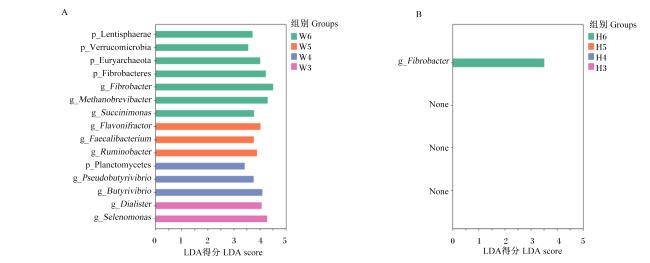
基于LEfSe分析,筛选单一品种犊牛瘤胃微生物群落在门和属水平上随月龄变化而具有显著差异的物种(LDA得分>2,P<0.05)。如图5-A所示,在和牛瘤胃具有显著差异的物种中,W3组在属水平上有小杆菌属(Dialister)和月形单胞菌属2种;W4组在门水平上有浮霉菌门(Planctomycetes)1种,在属水平上有假丁酸弧菌属(Pseudobutyrivibrio)和丁酸弧菌属2种;W5组在属水平上有解黄酮菌属(Flavonifractor)、粪杆菌属(Faecalibacterium)和反刍杆菌属(Ruminobacter)3种;W6组在门水平上有黏胶球形菌门(Lentisphaerae)、疣微菌门(Verrucomicrobia)、广古菌门和纤维杆菌门4种,在属水平上有纤维杆菌属、甲烷短杆菌属和琥珀酸单胞菌属(Succinimonas)3种。如图5-B所示,在荷斯坦牛瘤胃具有显著差异的物种中,仅H6组在属水平上有纤维杆菌属1种。
图5 和牛(A)和荷斯坦牛(B)犊牛瘤胃微生物群落随月龄变化的差异物种LEfSe分析

Succinimonas:琥珀酸单胞菌属;Flavonifractor:解黄酮菌属;Ruminobacter:反刍杆菌属;Dialister:小杆菌属;None:无。图6同 the same as Fig.6

Fig.5 LEfSe analysis of differential species in rumen microbiota in Wagyu (A) and Holstein (B) calves with months of age increasing

2.3.2 瘤胃微生物群落品种间差异物种LEfSe分析

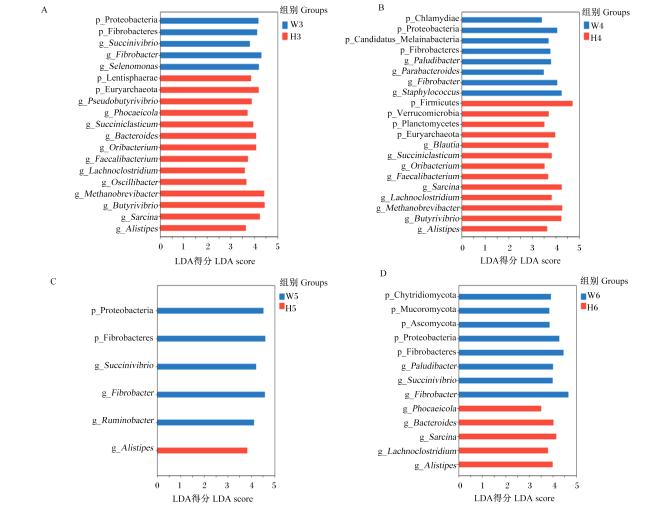
基于LEfSe分析,筛选相同月龄犊牛品种间瘤胃微生物群落在门和属水平上具有显著差异的物种(LDA得分>2,P<0.05)。如图6-A所示,3月龄时,在瘤胃具有显著差异的物种中,W3组在门水平上有变形菌门和纤维杆菌门2种,在属水平上有琥珀酸弧菌属(Succinivibrio)、纤维杆菌属和月形单胞菌属3种;H3组在门水平上有黏胶球形菌门和广古菌门2种,在属水平上有假丁酸弧菌属、海豹菌属(Phocaeicola)、解琥珀酸菌属(Succiniclasticum)、拟杆菌属、奥里巴菌属(Oribacterium)、粪杆菌属、毛螺梭菌属(Lachnoclostridium)、颤杆菌属(Oscillibacter)、甲烷短杆菌属、丁酸弧菌属、八叠球菌属和另枝菌属(Alistipes)12种。如图6-B所示,4月龄时,在瘤胃具有显著差异的物种中,W4组在门水平上有衣原体门(Chlamydiae)、变形菌门、暂定梅莱纳菌门(Candidatus_Melainabacteria)和纤维杆菌门4种,在属水平上有栖泥沼杆菌属(Paludibacter)、副拟杆菌属(Parabacteroides)、纤维杆菌属和葡萄球菌属(Staphylococcus)4种;H4组在门水平上有厚壁菌门、疣微菌门、浮霉菌门和广古菌门4种,在属水平上有布劳特氏菌属(Blautia)、解琥珀酸菌属、奥里巴菌属、粪杆菌属、八叠球菌属、毛螺梭菌属、甲烷短杆菌属、丁酸弧菌属和另枝菌属9种。如图6-C所示,5月龄时,在瘤胃具有显著差异的物种中,W5组在门水平上有变形菌门和纤维杆菌门2种,在属水平上有琥珀酸弧菌属、纤维杆菌属和反刍杆菌属3种;H5组仅在属水平上有另枝菌属1种。如图6-D所示,6月龄时,在瘤胃具有显著差异的物种中,W6组在门水平上有壶菌门(Chytridiomycota)、毛霉菌门(Mucoromycota)、子囊菌门(Ascomycota)、变形菌门和纤维杆菌门5种,在属水平上有栖泥沼杆菌属、琥珀酸弧菌属和纤维杆菌属3种;H6组在属水平上有海豹菌属、拟杆菌属、八叠球菌属、毛螺梭菌属和另枝菌属5种。
图6 犊牛瘤胃微生物群落品种间差异物种LEfSe分析

Oribacterium:奥里巴菌属;Oscillibacter:颤杆菌属;Paludibacter:栖泥沼杆菌属;Parabacteroides:副拟杆菌属;Staphylococcus:葡萄球菌属。

Fig.6 LEfSe analysis of differential species in rumen microbiota in calves between breeds

2.4 瘤胃微生物群落多样性分析

2.4.1 瘤胃微生物群落alpha多样性
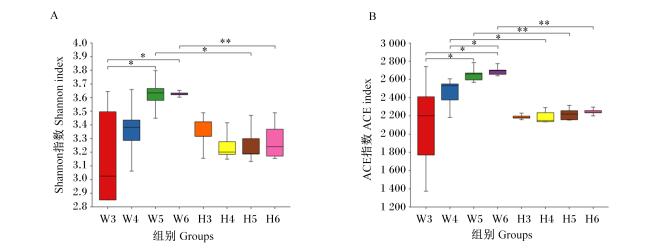
图7-A所示,瘤胃微生物群落Shannon指数在单一品种内随月龄变化的比较中,和牛组内Shannon指数随月龄增长而提高,W5组和W6组显著高于W3组(P<0.05);而荷斯坦牛组内Shannon指数随月龄增长无显著差异(P>0.05)。Shannon指数在相同月龄的品种间比较中,W5组显著高于H5组(P<0.05),W6组极显著高于H6组(P<0.01),其他月龄时品种间无显著差异(P>0.05)。如图7-B所示,ACE指数在单一品种内随月龄变化的比较中,和牛组内ACE指数随月龄增长而提高,W5组和W6组显著高于W3组(P<0.05),W6组显著高于W4组(P<0.05);而荷斯坦牛组内ACE指数随月龄增长无显著差异(P>0.05)。ACE指数在相同月龄的品种间比较中,W4组显著高于H4组(P<0.05),W5组和W6组分别极显著高于H5组和H6组(P<0.01)。
图7 不同品种和月龄犊牛瘤胃微生物群落在属水平上alpha多样性

*表示差异显著(P<0.05),* *表示差异极显著(P<0.01)。

Fig.7 Alpha diversity of rumen microbiota at genus level in calves of different breeds and months of age

* mean significant difference (P<0.05), and * * mean extremely significant difference (P<0.01).

2.4.2 瘤胃微生物群落beta多样性

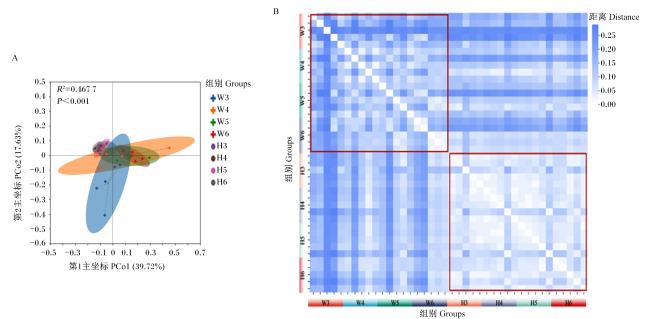
基于PCoA和样本间距离矩阵分析各组犊牛瘤胃微生物群落在属水平上的beta多样性。如图8-A所示,第1主坐标(PCo1)和第2主坐标(PCo2)分别解释了各组间瘤胃微生物群落在属水平上组成差异39.72%和17.63%的变异量,且置换多元方差分析结果R2值解释了46.77%的不同组别的物种数量特征,且达到差异极显著水平(P<0.01)。如图8-B所示,和牛组内瘤胃微生物群落在属水平上样本间距离较大,分布相对较广泛;而荷斯坦牛组内样本间距离较小,分布相对较集中。
图8 不同品种和月龄犊牛瘤胃微生物群落在属水平上beta多样性

Fig.8 Beta diversity of rumen microbiota at genus level in calves of different breeds and months of age

2.5 瘤胃微生物群落代谢通路

2.5.1 瘤胃微生物群落KEGG代谢通路注释
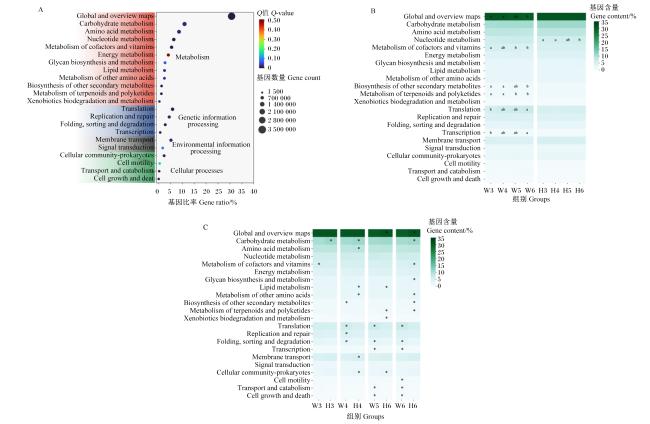
基于KEGG数据库分析各组犊牛瘤胃微生物群落的1级和2级代谢通路。如图9-A所示,共注释到4条1级代谢通路,其中功能基因相对丰度最高的是代谢(76.35%),其他依次是遗传信息处理(13.75%)、环境信息处理(6.91%)和细胞过程(2.99%)。根据注释到的1级通路继续注释到22条2级代谢通路,其中代谢相关的通路包括全局和概览图(30.71%)、碳水化合物代谢(10.91%)和氨基酸代谢(8.57%)等12条,遗传信息处理相关的通路包括翻译(5.85%)、复制和修复(4.46%)以及折叠、分类和降解(2.78%)等4条,环境信息处理相关的通路包括膜转运(5.19%)和信号转导(1.71%)2条,细胞过程相关的通路包括细胞群体-原核生物(2.31%)、细胞运动(0.43%)以及运输和分解代谢(0.23%)等4条。如图9-B所示,2级通路功能基因相对丰度在单一品种内随月龄变化的比较中,和牛组中,W3组和W4组全局和概览图、其他次生代谢物生物合成显著高于W6组(P<0.05),W3组辅因子和维生素代谢显著高于W5组和W6组(P<0.05),W3组和W4组萜类和聚酮类代谢显著高于W5组和W6组(P<0.05),W6组翻译、转录显著高于W3组(P<0.05);荷斯坦牛组中,仅H3组和H4组核苷酸代谢显著高于H6组(P<0.05)。如图9-C所示,2级通路功能基因相对丰度在相同月龄不同品种间比较中,3月龄时,W3组辅因子和维生素代谢显著高于H3组(P<0.05),碳水化合物代谢显著低于H3组(P<0.05);4月龄时,W4组其他次生代谢物生物合成、翻译、复制和修复以及折叠、分类和降解显著高于H4组(P<0.05),碳水化合物代谢、氨基酸代谢、脂质代谢、其他氨基酸代谢、膜转运以及细胞群落-原核生物显著低于H4组(P<0.05);5月龄时,W5组翻译、折叠、分类和降解、转录、运输和分解代谢以及细胞生长和死亡显著高于H5组(P<0.05),全局和概览图、脂质代谢、萜类和聚酮类代谢、外源物质生物降解和代谢以及细胞群落-原核生物显著低于H5组(P<0.05);6月龄时,W6组翻译、折叠、分类和降解、转录、细胞运动、运输和分解代谢以及细胞生长和死亡显著高于H6组(P<0.05),全局和概览图、碳水化合物代谢、辅因子和维生素代谢、聚糖生物合成和代谢、其他氨基酸代谢、其他次生代谢物生物合成以及萜类和聚酮类代谢显著低于H6组(P<0.05)。
图9 犊牛瘤胃微生物群落KEGG 1级和2级代谢通路注释

Metabolism:代谢;Genetic information processing:遗传信息处理;Environmental information processing:环境信息处理;Cellular processes:细胞过程;Global and overview maps:全局和概览图;Carbohydrate metabolism:碳水化合物代谢;Amino acid metabolism:氨基酸代谢;Nucleotide metabolism:核苷酸代谢;Metabolism of cofactors and vitamins:辅因子和维生素代谢;Energy metabolism:能量代谢;Glycan biosynthesis and metabolism:聚糖生物合成和代谢;Lipid metabolism:脂质代谢;Metabolism of other amino acids:其他氨基酸代谢;Biosynthesis of other secondary metabolites:其他次生代谢物生物合成;Metabolism of terpenoids and polyketides:萜类和聚酮类代谢;Xenobiotics biodegradation and metabolism:外源物质生物降解和代谢;Translation:翻译;Replication and repair:复制和修复;Folding, sorting and degradation:折叠、分类和降解;Transcription:转录;Membrane transport:膜转运;Signal transduction:信号转导;Cellular community-prokaryotes:细胞群体-原核生物;Cell motility:细胞运动;Transport and catabolism:运输和分解代谢;Cell growth and death:细胞生长和死亡。单一品种组内标记不同字母表示不同月龄间差异显著(P<0.05),相同月龄组间标记*表示不同品种间差异显著(P<0.05)。Groups of the single breed with different letters mean significant difference between months of age (P<0.05), and groups in the same month of age marked with * mean significant difference between different breeds (P<0.05).

Fig.9 Annotation of level 1 and level 2 metabolic pathways in KEGG of rumen microbiota in calves

2.5.2 月龄和品种对瘤胃微生物群落代谢通路的影响

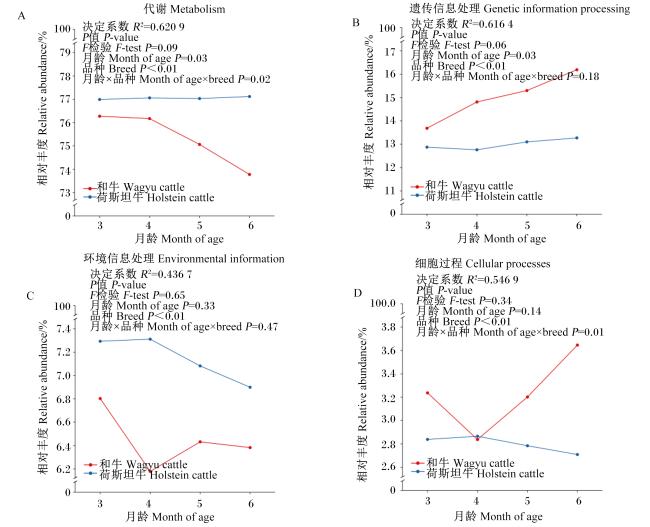
基于GLM分析月龄与品种对瘤胃微生物群落4条1级代谢通路功能基因相对丰度的交互作用。如图10-A所示,月龄和品种均是代谢的主效应(P<0.05),且二者的交互作用对代谢有显著影响(P<0.05)。如图10-B所示,月龄和品种均是遗传信息处理的主效应(P<0.05),但其交互作用对遗传信息处理无显著影响(P>0.05)。如图10-C所示,月龄不是环境信息处理的主效应(P>0.05),而品种是其主效应(P<0.05),但二者的交互作用对环境信息处理无显著影响(P>0.05)。如图10-D所示,月龄不是细胞过程的主效应(P>0.05),而品种是其主效应(P<0.05),且二者的交互作用对细胞过程有显著影响(P<0.05)。
图10 月龄与品种在犊牛瘤胃微生物群落代谢通路中的交互作用

Fig.10 Interaction between month of age and breed in metabolic pathways of rumen microbiota in calves

3 讨论

和牛因具有生产大理石纹牛肉的品种特性而著名,但其生产工艺复杂,养殖成本较高[16]。荷斯坦牛具有优秀的产奶性能,常归类于乳用品种,但其公犊牛也具备生产大理石纹牛肉的潜力[17]。已有研究表明,瘤胃微生物在反刍动物营养和能量代谢过程中起到重要作用,能够分解饲粮中的纤维素、淀粉等碳水化合物[18-19],同时将饲粮中的氮源转化为菌体蛋白[20-21],为宿主的生长发育提供营养。本试验收集3~6月龄和牛和荷斯坦牛犊牛的瘤胃液样本,在不同品种和月龄条件下,研究瘤胃微生物群落结构和功能的发育规律。
本试验中,和牛和荷斯坦牛瘤胃微生物群落在门和属水平上的相同物种分别占总量的90.5%和80.5%,然而和牛在2个不同分类水平下特有物种数分别是荷斯坦牛的18.0倍和11.8倍,且在各自品种内,特有物种数随月龄发生变化,这表明2个品种犊牛瘤胃微生物群落结构既有跨品种的保守性,又有生长对群落塑造的特异性,原因可能是宿主长期进化与群落形成共生关系,在确保基础消化功能稳定的同时,在各自脂肪沉积、肉质或乳质改善等方面表现出更好的适应性[22-24]。同时,和牛犊牛瘤胃微生物群落的丰富度和均匀度随月龄增长而显著提高,表现为月龄驱动型,并在5和6月龄的生理阶段上显著高于荷斯坦牛;而荷斯坦牛在多样性空间矩阵分布中更紧凑,组间变异更小,相似性更高,这表明犊牛瘤胃微生物群落的差异可能受到月龄和品种的共同影响[25-27]。2个品种犊牛瘤胃厚壁菌门和拟杆菌门始终是主要的优势菌门,普雷沃氏菌属为主要的优势菌属,这与Wu等[28]和Ahmad等[29]对不同月龄犊牛瘤胃微生物群落变化的研究所得结果相同。厚壁菌门包括乳杆菌属、丁酸弧菌属和链球菌属等,拟杆菌门包括普雷沃氏菌属、拟杆菌属和副拟杆菌属等,在瘤胃中协同降解纤维和复杂多糖,维持宿主的营养供应及基础代谢[30]。其他菌门和菌属相对丰度远低于上述主要优势物种,如和牛瘤胃纤维杆菌属和甲烷短杆菌属相对丰度随月龄增长而升高,而荷斯坦牛中未观察到类似趋势,这可能是因为和牛犊牛的纤维分解能力和产甲烷能力表现出明显的月龄增长型特征,这与Islam等[31]和Nan等[32]在相同饲粮条件下荷斯坦牛与其他品种牛胃肠道微生物群落对比研究的结论基本一致。在瘤胃微生物群落KEGG代谢通路差异比较中,随着犊牛生理阶段的变化,和牛瘤胃代谢相关通路功能基因相对丰度逐渐降低,遗传信息处理相关通路功能基因相对丰度逐渐提高,2个品种犊牛瘤胃碳水化合物代谢、氨基酸代谢、能量代谢以及脂质代谢均未表现出生理阶段的差异;但在品种间的比较中发现,和牛遗传信息处理相关通路功能基因相对丰度始终高于荷斯坦牛,而荷斯坦牛代谢相关通路功能基因相对丰度始终高于和牛,说明瘤胃微生物群落丰富度和覆盖度较高的和牛可能存在更复杂的群落演替过程,为以后宿主育肥阶段脂肪沉积做准备,而荷斯坦牛更趋向于现有微生物结构的稳定扩增[22-23,33-34]。此外,在众多可能影响瘤胃微生物群落功能的因素中[2,35],本研究结果证实了月龄与品种这2个因素对某些代谢通路可能存在交互作用。

4 结论

和牛和荷斯坦牛犊牛瘤胃微生物群落结构既有跨品种保守性,又有品种特异性;和牛瘤胃微生物群落结构随月龄增长变异较大,荷斯坦牛则相对稳定;在影响2个品种犊牛瘤胃微生物群落功能方面,这种差异主要体现在代谢通路功能基因相对丰度的差异上;此外,月龄与品种对特定代谢通路存在显著的交互作用。
[1]
於江坤. 宏基因组学解析瘤胃微生物组成和功能特性及外源添加剂调控瘤胃微生物发酵的研究[D].博士学位论文. 武汉: 华中农业大学, 2021:2-15.

YU J K. Study on rumen microbial composition and functional profiles using metagenomics and the regulation of rumen microbial fermentation with exogenous additives[D].Ph.D.Thesis. Wuhan: Huazhong Agricultural University, 2021:2-15. (in Chinese)

[2]
FURMAN O, SHENHAV L, SASSON G, et al. Stochasticity constrained by deterministic effects of diet and age drive rumen microbiome assembly dynamics[J]. Nature Communications, 2020, 11(1):1904.

DOI PMID

[3]
ZHANG B Y, JIANG X Z, YU Y, et al. Rumen microbiome-driven insight into bile acid metabolism and host metabolic regulation[J]. The International Society for Microbial Ecology Journal, 2024, 18(1):wrae098.

[4]
JAMI E, ISRAEL A, KOTSER A, et al. Exploring the bovine rumen bacterial community from birth to adulthood[J]. ISME Journal, 2013, 7(6):1069-1079.

DOI PMID

[5]
DIAS J, MARCONDES M I, MOTTA DE SOUZA S, et al. Bacterial community dynamics across the gastrointestinal tracts of dairy calves during preweaning development[J]. Applied and Environmental Microbiology, 2018, 84(9):e02675-17.

[6]
FONSECA P A S, LAM S, CHEN Y, et al. Multi-breed host rumen epithelium transcriptome and microbiome associations and their relationship with beef cattle feed efficiency[J]. Scientific Reports, 2023, 13(1):16209.

[7]
ZHAO Y X, CHEN H, ZHAO P F, et al. Effect of different genetic backgrounds on rumen microbiota and serum metabolic phenotypes in beef cattle[J]. Scientific Reports, 2024, 14(1):24005.

DOI PMID

[8]
中华人民共和国国家质量监督检验检疫总局, 中国国家标准化管理委员会. 饲料中水分的测定:GB/T 6435—2014[S]. 北京: 中国标准出版社, 2014.

General Administration of Quality Supervision,Inspection and Quarantine of the People’s Republic of China, Standardization Administration of the People’s Republic of China. Determination of moisture in feedstuffs:GB/T 6435—2014[S]. Beijing: Standards Press of China, 2014. (in Chinese)

[9]
国家市场监督管理总局, 中国国家标准化管理委员会. 饲料中粗蛋白的测定凯氏定氮法:GB/T 6432—2018[S]. 北京: 中国标准出版社, 2018.

State Administration for Market Regulation, Standardization Administration of the People’s Republic of China. Determination of crude protein in feeds-Kjeldahl method:GB/T 6432—2018[S]. Beijing: Standards Press of China, 2018. (in Chinese)

[10]
中华人民共和国国家质量监督检验检疫总局, 中国国家标准化管理委员会. 饲料中粗脂肪的测定:GB/T 6433—2006[S]. 北京: 中国标准出版社, 2006.

General Administration of Quality Supervision,Inspection and Quarantine of the People’s Republic of China, Standardization Administration of the People’s Republic of China. Determination of crude fat in feeds:GB/T 6433—2006[S]. Beijing: Standards Press of China, 2006. (in Chinese)

[11]
国家市场监督管理总局, 中国国家标准化管理委员会. 饲料中中性洗涤纤维(NDF)的测定:GB/T 20806—2022[S]. 北京: 中国标准出版社, 2022.

State Administration for Market Regulation, Standardization Administration of the People’s Republic of China. Determination of neutral detergent fiber (NDF) in feeds:GB/T 20806—2022[S]. Beijing: Standards Press of China, 2022. (in Chinese)

[12]
中华人民共和国农业农村部. 饲料中酸性洗涤纤维的测定:NY/T 1459—2022[S]. 北京: 中国农业出版社, 2022.

Ministry of Agriculture and Rural Affairs of the People’s Republic of China. Determination of acid detergent fiber (ADF) in feeds:NY/T 1459—2022[S]. Beijing: China Agriculture Press, 2022. (in Chinese)

[13]
中华人民共和国国家质量监督检验检疫总局, 中国国家标准化管理委员会. 饲料中粗灰分的测定:GB/T 6438—2007[S]. 北京: 中国标准出版社, 2007.

General Administration of Quality Supervision,Inspection and Quarantine of the People’s Republic of China, Standardization Administration of the People’s Republic of China. Animal feeding stuffs-determination of crude ash:GB/T 6438—2007[S]. Beijing: Standards Press of China, 2007. (in Chinese)

[14]
国家市场监督管理总局, 中国国家标准化管理委员会. 饲料中钙的测定:GB/T 6436—2018[S]. 北京: 中国标准出版社, 2018.

State Administration for Market Regulation, Standardization Administration of the People’s Republic of China. Determination of calcium in feeds:GB/T 6436—2018[S]. Beijing: Standards Press of China, 2018. (in Chinese)

[15]
国家市场监督管理总局, 中国国家标准化管理委员会. 饲料中总磷的测定分光光度法:GB/T 6437—2018[S]. 北京: 中国标准出版社, 2018.

State Administration for Market Regulation, Standardization Administration of the People’s Republic of China. Determination of phosphorus in feeds-spectrophotometry:GB/T 6437—2018[S]. Beijing: Standards Press of China, 2018. (in Chinese)

[16]
INAGAKI S, AMANO Y, KUMAZAWA K. Identification and characterization of volatile components causing the characteristic flavor of Wagyu beef (Japanese black cattle)[J]. Journal of Agricultural and Food Chemistry, 2017, 65(39):8691-8695.

DOI PMID

[17]
孙芳, 屠焰, 刘利, 等. 荷斯坦公犊牛低成本高效生产优质牛肉技术研发与应用[Z]. 哈尔滨:黑龙江省农业科学院畜牧研究所, 2020.

SUN F, TU Y, LIU L, et al. Research and application of low-cost and high-efficiency technology for the production of high-quality beef from Holstein cattle[Z]. Harbin:Heilongjiang Academy of Agricultural Sciences, 2020. (in Chinese)

[18]
WEIMER P J. Degradation of cellulose and hemicellulose by ruminal microorganisms[J]. Microorganisms, 2022, 10(12):2345.

[19]
WANG M, WANG R, XIE T Y, et al. Shifts in rumen fermentation and microbiota are associated with dissolved ruminal hydrogen concentrations in lactating dairy cows fed different types of carbohydrates[J]. Journal of Nutrition, 2016, 146(9):1714-1721.

DOI PMID

[20]
LEE H M, THAI T D, LIM W, et al. Functional small peptides for enhanced protein delivery,solubility,and secretion in microbial biotechnology[J]. Journal of Biotechnology, 2023,375:40-48.

[21]
CHEN P L, LI Y, SHEN Y Z, et al. Effect of dietary rumen-degradable starch to rumen-degradable protein ratio on in vitro rumen fermentation characteristics and microbial protein synthesis[J]. Animals, 2022, 12(19):2633.

[22]
ABBAS W, KNOELL A L, TOM W A, et al. 458 impact of rumen bacteria on marbling in Wagyu cattle[J]. Journal of Animal Science, 2018,96 (Suppl.2):245-246.

[23]
KIM M, PARK T, JEONG J Y, et al. Association between rumen microbiota and marbling score in Korean native beef cattle[J]. Animals, 2020, 10(4):712.

[24]
ZOU X, LIU G B, MENG F M, et al. Exploring the rumen and cecum microbial community from fetus to adulthood in goat[J]. Animals, 2020, 10(9):1639.

[25]
WU Y L, JIAO C, DIAO Q Y, et al. Effect of dietary and age changes on ruminal microbial diversity in Holstein calves[J]. Microorganisms, 2023, 12(1):12.

[26]
LI F Y, HITCH T C A, CHEN Y H, et al. Comparative metagenomic and metatranscriptomic analyses reveal the breed effect on the rumen microbiome and its associations with feed efficiency in beef cattle[J]. Microbiome, 2019, 7(1):6.

DOI PMID

[27]
LOURENCO J M, KRAUSE T R, WELCH C B, et al. Longitudinal changes of the ruminal microbiota in Angus beef steers[J]. Animals, 2022, 12(9):1066.

[28]
WU S T, BALDWIN R L, LI W Z, et al. The bacterial community composition of the bovine rumen detected using pyrosequencing of 16S rRNA genes[J]. Metagenomics, 2012,1:235571.

[29]
AHMAD A A, ZHANG J B, LIANG Z Y, et al. Age-dependent variations in rumen bacterial community of Mongolian cattle from weaning to adulthood[J]. BMC Microbiology, 2022, 22(1):213.

DOI PMID

[30]
BRULC J M, ANTONOPOULOS D A, MILLER M E B, et al. Gene-centric metagenomics of the fiber-adherent bovine rumen microbiome reveals forage specific glycoside hydrolases[J]. Proceedings of the National Academy of Sciences of the United States of America, 2009, 106(6):1948-1953.

DOI PMID

[31]
ISLAM M, KIM S H, RAMOS S C, et al. Holstein and Jersey steers differ in rumen microbiota and enteric methane emissions even fed the same total mixed ration[J]. Frontiers in Microbiology, 2021,12:601061.

[32]
NAN S S, LI J C, KUANG Y, et al. Differential microbial composition and interkingdom interactions in the intestinal microbiota of Holstein and German simmental×Holstein cross F1 calves:a comprehensive analysis of bacterial and fungal diversity[J]. Microorganisms, 2024, 12(3):486.

[33]
董沛雨, 闫陈雨湄, 杨占岗, 等. 渤海黑牛与荷斯坦奶牛瘤胃微生物群落组成及功能比较研究[J]. 中国畜禽种业, 2024, 20(1):53-59.

DONG P Y, YAN C Y M, YANG Z G, et al. Comparative study on the composition and function of rumen microbial communities in Bohai black cattle and Holstein cattle[J]. The Chinese Livestock and Poultry Breeding, 2024, 20(1):53-59. (in Chinese)

[34]
MALIK P K, TRIVEDI S, KOLTE A P, et al. Comparative analysis of rumen metagenome,metatranscriptome,fermentation and methane yield in cattle and buffaloes fed on the same diet[J]. Frontiers in Microbiology, 2023,14:1266025.

[35]
YIN X J, JI S K, DUAN C H, et al. Age-related changes in the ruminal microbiota and their relationship with rumen fermentation in lambs[J]. Frontiers in Microbiology, 2021,12:679135.

Outlines

/