RESEARCH PAPER

Effects of Different Diet Types on Growth Performance, Rumen Fermentation Parameters and Digestive Tract Microbiota of Fattening Goats

  • ZHAO Na , 1, 2 ,
  • WEI Jintao , 1, * ,
  • GUO Wanzheng 1 ,
  • FAN Qiwen 1 ,
  • CHEN Fang 1 ,
  • DU Encun 1 ,
  • JIN Feng 1
Expand
  • 1 Institute of Animal Sciences and Veterinary Medicine, Hubei Academy of Agricultural Sciences, Wuhan 430064, China
  • 2 Key Laboratory of Animal Embryo Engineering and Molecular Breeding of Hubei Province, Wuhan 430064, China
*associate professor, E-mail:

Received date: 2025-02-27

  Online published: 2025-10-15

Abstract

This experiment aimed to investigate the effects of different diet types on growth performance, nutrient apparent digestibility, slaughter performance, meat quality, rumen fermentation parameters and digestive tract microbiota of fattening goats. Sixty healthy Chubao black-head goats aged 6 months and weighing about 17 kg were selected and randomly divided into 2 groups, with 3 replicates in each group and 10 goats in each replicate. Goats in the total mixed ration (TMR) group were fed a common TMR, while those in the pelleted TMR group (PTMR group) were fed the pelleted TMR. The composition and nutrient levels of the two diets remained consistent. The pre-experiment was 7 days and the formal experiment was 90 days. The results showed as follows: 1) compared with TMR group, the final body weight, relative growth rate of body weight, average daily gain and average dry matter intake in PTMR group were significantly increased (P<0.05), and the feed to gain ratio was significantly decreased (P<0.05). 2) Compared with TMR group, the apparent digestibilities of crude protein and acid detergent fiber in PTMR group were significantly increased (P<0.05). 3) Compared with TMR group, the alanine aminotransferase activity and the contents of cholesterol and triglyceride in serum in PTMR group were significantly increased (P<0.05), the serum superoxide dismutase activity was significantly increased (P<0.05), and the serum malondialdehyde content was significantly decreased (P<0.05). 4) Compared with TMR group, the slaughter rate and eye muscle area in PTMR group were significantly increased (P<0.05), the muscle water loss rate, lightness value and redness value were significantly decreased (P<0.05), and the muscle cooked meat rate was significantly increased (P<0.05). 5) Compared with TMR group, the contents of acetic acid, propionic acid, isovaleric acid and total volatile fatty acid in rumen in PTMR group were significantly increased (P<0.05). 6) Compared with TMR group, the ACE index, Chao1 index, Shannon index and PD_whole_tree index of rumen and cecum microbiota in PTMR group were significantly decreased (P<0.05). At the phylum level, compared with TMR group, the Firmicutes relative abundance in rumen in PTMR group was significantly decreased (P<0.05), and the Bacteroidetes relative abundance in rumen was significantly increased (P<0.05); the Tenericutes relative abundance in cecum in PTMR group was significantly increased (P<0.05). At the genus level, compared with TMR group, the relative abundances of Quinella and uncultured_bacterium_f_Veillonellaceae in rumen in PTMR group were significantly decreased (P<0.05), while the relative abundances of Prevotella_1, Succiniclasticum and uncultured_bacterium_f_Muribaculaceae in rumen were significantly increased (P<0.05); the uncultured_bacterium_o_Mollicutes_RF39 relative abundance in cecum in PTMR group was significantly increased (P<0.05), while the relative abundances of Ruminococcaceae_UCG-005 and Alistipes in cecum were significantly decreased (P<0.05). In conclusion, compared with feeding common TMR, feeding pelleted TMR can enhance the growth performance and nutrient apparent digestibility of fattening goats, improve the slaughter performance and meat quality, increase the antioxidant capacity, and improve the rumen fermentation and digestive tract microbiota, which has better production application effects in goat fattening.

Cite this article

ZHAO Na , WEI Jintao , GUO Wanzheng , FAN Qiwen , CHEN Fang , DU Encun , JIN Feng . Effects of Different Diet Types on Growth Performance, Rumen Fermentation Parameters and Digestive Tract Microbiota of Fattening Goats[J]. Chinese Journal of Animal Nutrition, 2025 , 37(10) : 6890 -6903 . DOI: 10.12418/CJAN2025.561

饲粮营养的均衡性及有效摄入对育肥羊的生长发育、消化代谢和机体健康具有重要调控作用,是决定肉羊养殖生产效益的关键因素。研究表明,不同饲喂方式对动物采食量影响很大,显著改变其生产性能[1-2],并进一步作用于器官发育、肉品质形成[3]。因此,优化饲喂方式对提升肉羊产业经济效益具有重要意义。目前,我国肉羊育肥主要采用精粗分饲与全混合日粮(total mixed ration,TMR)的饲喂方式。与传统精粗分饲模式相比,TMR技术通过科学配比粗饲料、精饲料及各类营养添加剂[4],能够实现饲粮营养的精准供给,已成为现代集约化养殖的重要发展方向。根据物理形态差异,TMR可分为粉状和颗粒2种类型:粉状TMR生产工艺简单、成本较低,但存在饲喂过程易分层、动物挑食等问题,导致实际营养摄入偏离配方设计;颗粒TMR在粉状TMR基础上制粒成型,最大限度地减少饲养和储存过程中的饲料损失[5-6],并通过改变饲料物理特性显著提升采食效率与饲料报酬[7-10]。同时,制粒工艺通过促进淀粉糊化[11]和调控瘤胃发酵动态[12]来改善饲料利用率。近年研究证实,全价颗粒饲料可有效提高北川白山羊日增重、降低料重比并缩短育肥周期[13];在相同营养水平下,颗粒饲料组湖羊采食量及日增重较粉料组显著提升[14]。Li等[15]认为饲喂颗粒TMR是羔羊集约化育肥的可行策略。不过,现有研究多聚焦于TMR对生产表型的影响,关于不同物理形态TMR对胃肠道微生物区系的影响尚未明晰,这制约了精准营养调控技术的进一步发展。基于此,本研究通过比较普通TMR和颗粒TMR对肉羊生长性能、瘤胃发酵参数及消化道菌群等的影响,为颗粒TMR在规模肉羊育肥中的标准化应用提供理论依据,助力产业提质增效。

1 材料与方法

1.1 试验设计

本试验经湖北省农业科学院科学伦理委员会批准,批准编号:2021-620-000-001-021。选择60只6月龄、体重为17 kg左右的健康楚宝黑头羊,随机分为2组,每组3个重复,每个重复10只羊。TMR组饲喂普通TMR,颗粒TMR组(PTMR组)饲喂颗粒TMR,2种饲粮组成及营养水平保持一致。预试期7 d,正试期90 d。

1.2 试验饲粮

本试验以玉米、豆粕和花生藤等为主要饲料原料,参照《肉羊营养需要量》(NY/T 816—2021)设计试验饲粮,其组成及营养水平见表1。饲粮和粪样干物质含量参照GB/T 6435—2014中方法测定,粗蛋白质含量参照GB/T 24318—2009采用杜马斯燃烧法测定,粗灰分含量参照GB/T 6438—2007中方法测定,钙含量参照GB/T 6436—2018中方法测定,总磷含量参照GB/T 6437—2018中方法测定,中性洗涤纤维含量参照GB/T 20806—2022中方法测定,酸性洗涤纤维含量参照NY/T 1459—2022中方法测定,盐酸不溶灰分含量参照GB/T 23742—2009中方法测定;有机物含量由干物质和粗灰分含量的差值计算得出。
表1 试验饲粮组成及营养水平(干物质基础)

Table 1 Composition and nutrient levels of the experimental diet (DM basis) %

原料Ingredients 含量Content 营养水平Nutrient levels2) 含量Content
玉米Corn 35.50 代谢能ME/(MJ/kg) 9.75
豆粕Soybean meal 10.00 粗蛋白质CP 14.20
花生藤Peanut vine 50.00 粗灰分Ash 6.54
小苏打Baking soda 0.50 钙Ca 0.94
预混料Premix1) 4.00 总磷TP 0.40
合计Total 100.00 中性洗涤纤维NDF 29.85
酸性洗涤纤维ADF 17.50

1)预混料为每千克饲粮提供 The premix provided the following per kilogram of the diet:VA 2 800 IU,VD 100 IU,VE 60 IU,Fe 80 mg,Cu 10 mg,Zn 40 mg,Mn 28 mg,Se 0.3mg,Co 20 mg,I 1 mg。2)代谢能依据《肉羊营养需要量》(NY/T 816—2021)计算得出,其余均为实测值。ME was calculated according to Nutrient Requirements of Meat-Type Sheep and Goat (NY/T 816—2021), while the others were measured values.

颗粒TMR制作方法:花生藤等粗饲料采用粉碎机粉碎过4 mm筛板,与其他饲料原料混合后采用平模制粒机(5 mm模板,压缩比4.7∶1.0)制成直径5 mm、长度为10 mm的颗粒。

1.3 饲养管理

饲养试验在湖北省荆门市某肉羊养殖场进行。试验羊为散栏式舍饲,预试期间对试验羊驱除体内外寄生虫。试验期间,试验羊自由采食、自由饮水。每日准确记录每栏羊群的饲喂量,每次饲喂前清理掉上一次的余料并称重。

1.4 测定指标及方法

1.4.1 生长性能

分别于正试期第1天和第90天空腹12 h后称量试验羊初始体重和终末体重,并计算平均日增重(ADG)、体重相对增长率、平均干物质采食量(ADMI)和料重比(F/G)。

1.4.2 营养物质表观消化率

采用内源指示剂法测定营养物质表观消化率。分别收集试验期最后3 d各组羊只的新鲜粪便,喷洒10%稀盐酸搅拌均匀后于-20 ℃冷冻保存;按照组别将3 d收集的粪便混合、于65 ℃风干后测定干物质、粗蛋白质、中性洗涤纤维、酸性洗涤纤维、粗灰分、钙、磷和盐酸不溶灰分含量。营养物质表观消化率计算公式如下:
某营养物质表观消化率(%)=100-100×(A/B)×(C/D)。
式中:A为饲粮中指示剂含量(%);B为粪中指示剂含量(%);C为粪中该营养物质含量(%);D为饲粮中该营养物质含量(%)。

1.4.3 血清生化和抗氧化指标

试验结束当天早晨,采集空腹12 h试验羊的颈静脉血液,静置1 h后1 006×g离心,分离出血清。采用全自动生化分析仪(迪瑞CS-800)测定血清谷草转氨酶(AST)、谷丙转氨酶(ALT)活性以及胆固醇(CHOL)、甘油三酯(TG)、白蛋白(ALB)含量;采用试剂盒(南京建成生物工程研究所)测定血清超氧化物歧化酶(SOD)活性、丙二醛(MDA)含量和总抗氧化能力(T-AOC)。

1.4.4 屠宰性能、脏器指数和肉品质

试验结束当天,每个重复随机选取2只空腹12 h的试验羊(每组6只),参照《种羊生产性能测定技术规范》(NY/T 1236—2023)测定屠宰率、肋肉厚(GR值)和眼肌面积,并测定肌肉pH、肉色、失水率、嫩度、滴水损失和熟肉率。对瘤胃、肝脏、肾脏和心脏等脏器称重,并计算脏器指数。

1.4.5 瘤胃和盲肠内容物采集及瘤胃发酵参数

试验羊屠宰后,迅速取出瘤胃和盲肠,将表面用酒精棉球擦拭后,用无菌刀片划开,将内容物倒入灭菌离心管,-80 ℃保存,用于微生物群落分析;另取一部分瘤胃内容物用4层清洁纱布过滤,得到的一部分瘤胃液立刻测定pH,另一部分装于洁净PE离心管中于-80 ℃保存,采用苯酚-次氯酸钠比色法测定氨态氮(NH3-N)含量,采用气相色谱仪(Agilent 6890N GC system,美国)测定挥发性脂肪酸含量。

1.4.6 瘤胃和盲肠微生物群落分析

瘤胃和盲肠内容物样品委托北京百迈客生物科技有限公司采用第3代16S rRNA基因高通量测序技术分析微生物群落。建库测序:提取样品总DNA后,根据全长引物序列合成带有Barcode的特异引物,进行PCR扩增并对其产物进行纯化、定量和均一化形成测序文库,引物为27F(5'-AGRGTTTGATYNTGGCTCAG-3')和1492R(5'-TASGGHTACCTTGTTASGACTT-3');原始下机subreads进行校正得到环形一致性测序(circular consensus sequencing,CCS)序列,然后使用Lima 1.7.0软件识别不同样品的CCS序列并去除嵌合体,得到高质量的CCS序列;通过smrtlink分析软件导出CCS文件。数据分析:将CCS文件用Lima 1.7.0软件识别,得到raw-CCS序列数据;采用cutadapt 1.9.1软件进行引物序列的识别与去除并进行长度过滤,得到不包含引物序列的clean-CCS序列数据;保留长度阈值1 200~1 650 bp的序列,采用UCHIME v4.2软件,鉴定并去除嵌合体序列,得到effective-CCS序列数据。采用USEARCH 10.0软件在相似性97%的水平上对序列进行聚类,以测序所有序列数的0.005%作为阈值过滤操作分类单元(operational taxonomic unit,OTU)。采用线性判别分析(LDA)效应大小(LEfSe)分析对差异微生物进行评估。

1.5 数据统计分析

采用Excel 2019整理试验原始数据,并采用SPSS 26.0对数据进行独立样本t检验,结果数据采用“平均值±标准误”形式表示,P<0.05为差异显著。

2 结果与分析

2.1 不同饲粮类型对育肥山羊生长性能的影响

表2可知,与TMR组相比,PTMR组山羊终末体重、体重相对增长率、平均日增重和平均干物质采食量均显著提高(P<0.05),分别提高了14.78%、34.75%、35.30%和20.41%;PTMR组料重比显著降低(P<0.05),降低了10.77%。
表2 不同饲粮类型对育肥山羊生长性能的影响

Table 2 Effects of different diet types on growth performance of fattening goats

项目
Items
TMR组
TMR group
PTMR组
PTMR group
P
P-value
初始体重Initial body weight/kg 17.33±1.93 17.16±1.65 0.912
终末体重Final body weight/kg 30.65±1.75b 35.18±1.43a 0.023
体重相对增长率Body weight relative growth rate/% 78.73±15.60b 106.09±16.80a 0.014
平均日增重ADG/(g/d) 148.00±6.86b 200.25±12.38a 0.008
平均干物质采食量ADMI/(kg/d) 0.98±0.11b 1.18±0.13a 0.042
料重比F/G 6.59±0.73a 5.88±0.62b 0.041

同行数据肩标无字母表示差异不显著(P>0.05),不同字母表示差异显著(P<0.05)。下表同。

In the same row, values with no letter superscripts mean no significant difference (P>0.05), while with different letter superscripts mean significant difference (P<0.05). The same as below.

2.2 不同饲粮类型对育肥山羊营养物质表观消化率的影响

表3可知,与TMR组相比,PTMR组山羊粗蛋白质和酸性洗涤纤维表观消化率显著提高(P<0.05),干物质、有机物、中性洗涤纤维、总磷和钙表观消化率也所提高,但差异不显著(P>0.05)。
表3 不同饲粮类型对育肥山羊营养物质表观消化率的影响

Table 3 Effects of different diet types on nutrient apparent digestibility of fattening goats %

项目
Items
TMR组
TMR group
PTMR组
PTMR group
P
P-value
干物质DM 77.09±0.62 78.39±1.12 0.143
粗蛋白质CP 72.24±2.85b 78.88±0.21a 0.041
有机物OM 80.32±0.66 82.16±0.97 0.078
中性洗涤纤维NDF 58.23±2.79 59.02±2.18 0.390
酸性洗涤纤维ADF 55.51±2.95b 61.33±1.80a 0.044
钙Ca 36.45±1.37 38.71±0.27 0.074
总磷TP 40.05±0.38 40.67±0.41 0.129

2.3 不同饲粮类型对育肥山羊血清生化和抗氧化指标的影响

表4可知,与TMR组相比,PTMR组山羊血清谷丙转氨酶活性以及胆固醇和甘油三酯含量显著提高(P<0.05),血清SOD活性也显著提高(P<0.05),血清MDA含量显著降低(P<0.05)。
表4 不同饲粮类型对育肥山羊血清生化和抗氧化指标的影响

Table 4 Effects of different diet types on serum biochemical and antioxidant indices of fattening goats

项目
Items
TMR组
TMR group
PTMR组
PTMR group
P
P-value
谷草转氨酶AST/(U/L) 30.80±2.21 33.99±2.02 0.783
谷丙转氨酶ALT/(U/L) 16.14±3.68b 22.26±2.15a 0.021
胆固醇CHOL/(mmol/L) 1.88±0.36b 2.62±0.37a 0.035
甘油三酯TG/(mmol/L) 0.22±0.13b 0.64±0.19a 0.027
白蛋白ALB/(g/L) 29.69±1.19 28.26±0.81 0.867
超氧化物歧化酶SOD/(U/mL) 81.68±1.58b 94.99±0.39a 0.024
丙二醛MDA/(nmol/mL) 4.21±1.04a 2.59±1.77b 0.034
总抗氧化能力T-AOC/(U/mL) 3.58±1.74 5.00±3.23 0.601

2.4 不同饲粮类型对育肥山羊屠宰性能、脏器指数和肉品质的影响

表5可知,与TMR组相比,PTMR组山羊屠宰率和眼肌面积显著提高(P<0.05),GR值有所提高,但差异不显著(P>0.05);PTMR组瘤胃、心脏、肝脏、肾脏、脾脏、肺脏和腹脂等脏器指数均无显著差异(P>0.05)。
表5 不同饲粮类型对育肥山羊屠宰性能和脏器指数的影响

Table 5 Effects of different diet types on slaughter performance and visceral indices of fattening goats

项目
Items
TMR组
TMR group
PTMR组
PTMR group
P
P-value
屠宰性能Slaughter performance
屠宰率Slaughter rate/% 49.33±1.97b 53.28±1.66a 0.039
GR值GR value/cm 1.37±0.16 1.66±0.21 0.877
眼肌面积Eye muscle area/cm2 5.55±0.74b 8.09±1.45a 0.029
脏器指数Visceral indices/%
瘤胃指数Rumen index 2.02±0.15 1.81±0.30 0.667
心脏指数Heart index 0.44±0.03 0.41±0.06 0.925
肝脏指数Liver index 1.95±0.05 2.12±0.13 0.743
肾脏指数Kidney index 0.32±0.05 0.32±0.02 0.984
脾脏指数Spleen index 0.18±0.08 0.19±0.02 0.937
肺脏指数Lung index 1.13±0.33 1.29±0.09 0.852
腹脂指数Abdominal fat index 2.79±0.29 3.12±0.60 0.759
表6可知,与TMR组相比,PTMR组山羊肌肉失水率、亮度值和红度值显著降低(P<0.05),肌肉熟肉率显著提高(P<0.05);PTMR组肌肉黄度值、pH、嫩度和滴水损失均无显著差异(P>0.05)。
表6 不同饲粮类型对育肥山羊肉品质的影响

Table 6 Effects of different diet types on meat quality of fattening goats

项目
Items
TMR组
TMR group
PTMR组
PTMR group
P
P-value


肉色
Meat color
亮度L* 35.72±3.81a 32.81±2.74b 0.039
红度a* 14.84±1.08a 12.21±0.82b 0.035
黄度b* 2.53±0.44 1.49±0.09 0.057
嫩度Tenderness/N 20.71±5.78 22.47±7.24 0.665
失水率Water loss rate/% 34.15±4.47a 29.51±3.46b 0.039


pH
45 min 6.31±0.20 6.28±0.20 0.782
24 h 5.94±0.28 6.03±0.20 0.855
滴水损失Drip loss/% 1.25±1.90 1.28±1.12 0.892
熟肉率Cooked meat rate/% 53.80±1.05b 56.68±1.49a 0.041

2.5 不同饲粮类型对育肥山羊瘤胃发酵参数的影响

表7可知,与TMR组相比,PTMR组山羊瘤胃乙酸、丙酸、异戊酸和总挥发性脂肪酸含量均显著提高(P<0.05),其他挥发性脂肪酸含量无显著差异(P>0.05)。2组山羊瘤胃挥发性脂肪酸中均以乙酸含量最高,发酵类型均为乙酸型发酵。2组间山羊瘤胃pH和氨态氮含量无显著差异(P>0.05)。
表7 不同饲粮类型对育肥山羊瘤胃发酵参数的影响

Table 7 Effects of different diet types on rumen fermentation parameters of fattening goats

项目
Items
TMR组
TMR group
PTMR组
PTMR group
P
P-value
pH 6.35±0.36 6.42±0.28 0.875
乙酸Acetic acid/(mmol/L) 56.33±2.41b 62.34±2.85a 0.033
丙酸Propionic acid/(mmol/L) 13.29±3.96b 17.46±1.22a 0.041
异丁酸Isobutyric acid/(mmol/L) 1.49±0.04 2.27±0.29 0.529
丁酸Butyric acid/(mmol/L) 12.11±3.71 14.78±3.04 0.691
异戊酸Isovaleric acid/(mmol/L) 1.90±0.02b 4.00±0.68a 0.044
戊酸Valeric acid/(mmol/L) 0.80±0.22 1.62±0.70 0.539
总挥发性脂肪酸TVFA/(mmol/L) 85.92±3.31b 102.47±3.65a 0.027
氨态氮NH3-N/(mg/dL) 24.83±3.61 22.01±2.10 0.679

2.6 不同饲粮类型对育肥山羊瘤胃和盲肠菌群的影响

2.6.1 样品序列测序和多样性分析
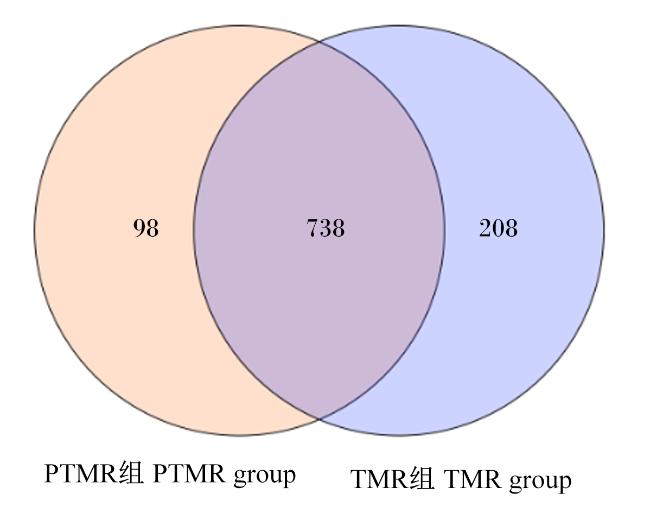
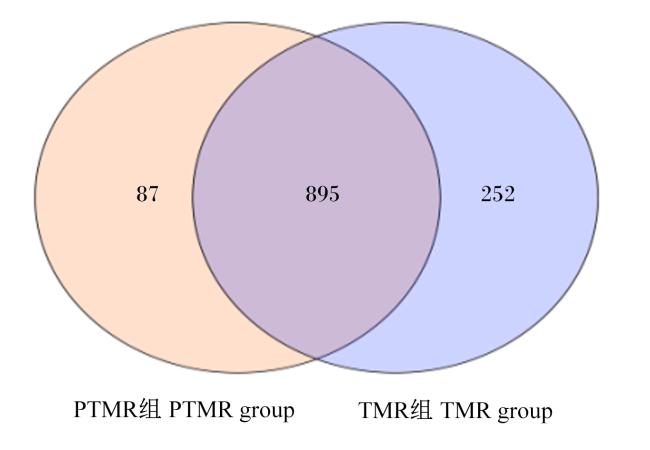
本试验采集了2组山羊瘤胃和盲肠内容物样品,各组样品提取的序列覆盖度都在90%以上。其中,各组瘤胃内容物样品中共得到有效序列59 650条,将所得有效序列在不同分类水平上进行物种注释,共得到1 044个OTU,2组共有OTU数为738个,PTMR组和TMR组独有OTU数分别为98和208个(图1),这些OTU归属于14个门、20个纲、36个目、56个科和123个属。各组盲肠内容物样品中共得到有效序列59 275条,将所得有效序列在不同分类水平上进行物种注释,共得到1 234个OTU,2组共有OTU数为895个,PTMR组和TMR组独有OTU数分别为87和252个(图2),这些OTU归属于11个门、16个纲、27个目、47个科和119个属。结果表明,与PTMR组相比,TMR组山羊瘤胃和盲肠内容物样品OTU均表现出较高的丰富度和多样性。
图1 山羊瘤胃微生物群落OTU韦恩图

Fig.1 Venn diagram of OTU in rumen microbiota of goats

图2 山羊盲肠微生物群落OTU韦恩图

Fig.2 Venn diagram of OTU in cecum microbiota of goats

表8可知,与TMR组相比,PTMR组山羊瘤胃和盲肠微生物群落ACE指数、Chao1指数、香农指数和PD_whole_tree指数均显著降低(P<0.05),辛普森指数无显著差异(P>0.05)。
表8 山羊瘤胃和盲肠微生物群落alpha多样性分析

Table 8 Alpha diversity analysis of rumen and cecum microbiota of goats

项目
Items
瘤胃Rumen 盲肠Cecum
TMR组
TMR group
PTMR组
PTMR group
P
P-value
TMR组
TMR group
PTMR组
PTMR group
P
P-value
ACE指数ACE index 777.69±48.28c 586.25±104.46d 0.014 971.46±93.41a 809.93±48.76b 0.030
Chao1指数Chao1 index 783.41±58.25b 583.22±105.24c 0.017 972.34±87.21a 821.58±42.95b 0.021
辛普森指数Simpson index 0.99±0.00 0.98±0.01 0.932 0.99±0.00 0.98±0.01 0.929
香农指数Shannon index 7.97±0.23a 7.05±0.42b 0.046 8.27±0.20a 7.67±0.21b 0.048
PD_whole_tree指数
PD_whole_tree index
46.91±2.57a 38.98±4.93b 0.023 46.70±2.26a 41.35±1.10b 0.026
覆盖度Coverage 0.99±0.00 0.99±0.00 0.999 0.98±0.01 0.98±0.01 0.998

2.6.2 微生物结构分析

山羊瘤胃菌群中相对丰度在门和属水平上排名前10位的菌群见表9。在门水平上,2组山羊瘤胃厚壁菌门(Firmicutes)和拟杆菌门(Bacteroidetes)为相对丰度较高的2大菌门,相对丰度总和超过91%。PTMR组瘤胃厚壁菌门相对丰度(54.43%)显著低于TMR组(63.25%)(P<0.05),瘤胃拟杆菌门相对丰度(37.21%)显著高于TMR组(28.65%)(P<0.05)。TMR组瘤胃相对丰度排名第3位的菌门为软壁菌门(Tenericutes),而PTMR组为Kiritimatiellaeota。在属水平上,PTMR组瘤胃奎因氏菌属(Quinella)和未培养细菌韦荣氏菌科(uncultured_bacterium_f_Veillonellaceae)相对丰度显著低于TMR组(P<0.05),而瘤胃普雷沃氏菌属1(Prevotella_1)、解琥珀酸菌属(Succiniclasticum)和未培养细菌鼠杆菌科(uncultured_bacterium_f_Muribaculaceae)相对丰度显著高于TMR组(P<0.05)。
表9 不同饲粮类型对育肥山羊瘤胃菌群组成的影响

Table 9 Effects of different diet types on rumen microbiota composition of fattening goats %

项目
Items
TMR组
TMR group
PTMR组
PTMR group
P
P-value


门Phylum
厚壁菌门Firmicutes 63.25±4.97a 54.43±22.80b 0.046
拟杆菌门Bacteroidetes 28.65±5.80b 37.21±21.51a 0.042
软壁菌门Tenericutes 2.03±1.99 1.75±1.43 0.059
Kiritimatiellaeota 1.88±0.46 2.89±2.42 0.062
变形菌门Proteobacteria 1.64±0.34 1.59±0.37 0.126
互养菌门Synergistetes 1.60±1.08a 0.50±0.82b 0.047
放线菌门Actinobacteria 0.40±0.61 0.01±0.02 0.093
浮霉菌门Planctomycetes 0.20±0.17 1.11±1.82 0.438
纤维杆菌门Fibrobacteres 0.07±0.04 0.04±0.03 0.223
螺旋体门Spirochaetes 0.01±0.01 0.29±0.39 0.142


属Genus
奎因氏菌属Quinella 15.46±5.79a 1.70±2.02b 0.001
理研菌科RC9肠道群Rikenellaceae_RC9_gut_group 12.69±3.14 12.00±8.96 0.087
克里斯滕森菌科R-7群Christensenellaceae_R-7_group 9.85±2.05 7.91±3.23 0.063
普雷沃氏菌属1 Prevotella_1 7.92±1.32b 14.31±10.29a 0.032
未培养细菌韦荣氏菌科Uncultured_bacterium_f_Veillonellaceae 4.64±2.75a 1.11±1.71b 0.024
解琥珀酸菌属Succiniclasticum 4.53±0.72b 6.22±0.95a 0.041
瘤胃球菌科NK4A214群Ruminococcaceae_NK4A214_group 4.21±2.76 4.92±3.84 0.122
未培养细菌鼠杆菌科Uncultured_bacterium_f_Muribaculaceae 2.83±0.79b 4.30±1.74a 0.029
韦荣氏菌科UCG-001 Veillonellaceae_UCG-001 2.11±0.80 1.54±0.77 0.186
瘤胃球菌科UCG-014 Ruminococcaceae_UCG-014 1.91±2.01 1.76±2.40 0.327
山羊盲肠菌群中相对丰度在门和属水平上排名前10位的菌群见表10。在门水平上,2组山羊盲肠厚壁菌门、拟杆菌门和软壁菌门为相对丰度较高的3大菌门,相对丰度总和超过96%。PTMR组盲肠软壁菌门相对丰度(8.51%)显著高于TMR组(4.77%)(P<0.05),2组间盲肠厚壁菌门和拟杆菌门相对丰度无显著差异(P>0.05)。在属水平上,PTMR组盲肠未培养细菌柔膜菌纲RF39(uncultured_bacterium_o_Mollicutes_RF39)相对丰度显著高于TMR组(P<0.05),盲肠瘤胃球菌科UCG-005(Ruminococcaceae_UCG-005)和另枝菌属(Alistipes)相对丰度显著低于TMR组(P<0.05);2组间盲肠其他菌属相对丰度均无显著差异(P>0.05)。
表10 不同饲粮类型对育肥山羊盲肠菌群组成的影响

Table 10 Effects of different diet types on cecum microbiota composition of fattening goats %

项目
Items
TMR组
TMR group
PTMR组
PTMR group
P
P-value


门Phylum
厚壁菌门Firmicutes 69.54±2.68 68.62±5.65 0.677
拟杆菌门Bacteroidetes 22.85±4.13 19.27±9.38 0.436
软壁菌门Tenericutes 4.77±1.87b 8.51±5.33a 0.039
疣微菌门Verrucomicrobia 1.26±1.18 2.60±1.97 0.105
变形菌门Proteobacteria 0.86±0.28 0.76±0.26 0.432
螺旋体门Spirochaetes 0.56±0.44 0.12±0.11 0.250
蓝细菌门Cyanobacteria 0.05±0.07 0.01±0.01 0.321
Kiritimatiellaeota 0.04±0.02 0.06±0.07 0.556
放线菌门Actinobacteria 0.03±0.03 0.01±0.01 0.433
髌骨细菌门Patescibacteria 0.01±0.01 0.02±0.02 0.421


属Genus
瘤胃球菌科UCG-005 Ruminococcaceae_UCG-005 14.56±3.90a 11.01±1.08b 0.032
理研菌科RC9肠道群Rikenellaceae_RC9_gut_group 12.13±3.80 11.47±5.37 0.753
瘤胃球菌科UCG-010 Ruminococcaceae_UCG-010 7.44±3.89 6.45±2.04 0.644
产粪甾醇真杆菌群[Eubacterium]_coprostanoligenes_group 6.23±1.68 8.61±2.67 0.321
未培养细菌柔膜菌纲RF39
Uncultured_bacterium_o_Mollicutes_RF39
4.17±2.02b 8.13±5.05a 0.039
克里斯滕森菌科R-7群Christensenellaceae_R-7_group 5.93±1.40 5.86±0.72 0.876
未培养细菌毛螺菌科Uncultured_bacterium_f_Lachnospiraceae 4.23±1.20 4.39±1.36 0.852
瘤胃球菌科UCG-014 Ruminococcaceae_UCG-014 4.33±0.58 4.18±0.86 0.535
拟杆菌属Bacteroides 3.32±1.64 1.67±0.70 0.127
另枝菌属Alistipes 3.31±0.84a 1.53±0.63b 0.041
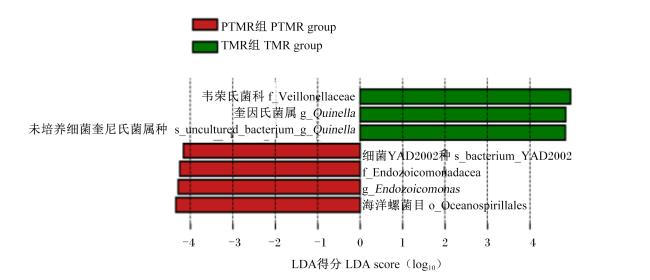
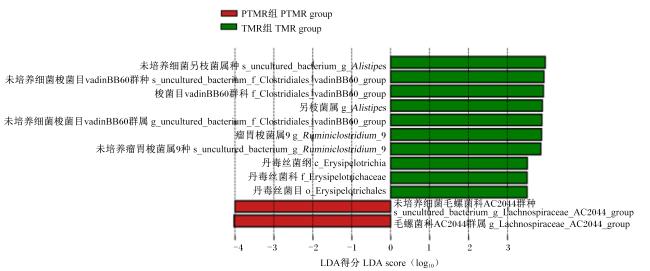
图3图4所示,LEfSe分析结果表明,TMR组山羊瘤胃特征菌为韦荣氏菌科(Veillonellaceae)和奎因氏菌属,PTMR组瘤胃特征菌为细菌YAD2002种(s_bacterium_YAD2002)、f_Endozoicomonadacea、g_Endozoicomonas和海洋螺菌目(Oceanospirillales);TMR组山羊盲肠特征菌为另枝菌属、梭菌目vadinBB60群(Clostridiales_vadinBB60_group)、瘤胃梭菌属9(Ruminiclostridium_9)和丹毒丝菌纲(Erysipelotrichia)等,PTMR组盲肠特征菌为毛螺菌科AC2044群(Lachnospiraceae_AC2044_group)。由此可见,不同饲粮类型显著影响山羊瘤胃和盲肠微生物组成。
图3 山羊瘤胃差异微生物分析

Fig.3 Analysis of differential microbiota in rumen of goats

图4 山羊盲肠差异微生物分析

Fig.4 Analysis of differential microbiota in cecum of goats

3 讨论

3.1 不同饲粮类型对育肥山羊生长性能的影响

将饲草研磨、制粒可以提高纤维的消化率和平均日增重[16-17]。本研究结果显示,PTMR组山羊终末体重、体重相对增长率、平均日增重和平均干物质采食量等生长性能指标均显著高于TMR组,料重比较TMR组显著降低了10.77%。由此可知,饲粮类型对山羊干物质采食量和生长性能有显著影响。前人研究表明,用颗粒TMR可以改善饲料均匀性,提高饲料密度,从而提升采食量并减少浪费,这在山羊[18]和绵羊[19]上都得到验证。但郭萍[20]认为,粗饲料经压缩制粒后能减少牛羊反刍,降低胃肠道紧张度,提高采食量;饲草粒度与干物质采食量呈负相关,并可能影响育肥动物生长性能[21];侯沛君等[22]报道,颗粒TMR组湖羊干物质采食量和平均日增重显著提高,但料重比未达到差异显著水平,这与本研究结果存在一定差异,可能与试验动物品种、颗粒加工工艺参数等因素有关。从生产实践角度分析,颗粒TMR技术通过精准的营养配比、物料压缩制粒,保证了动物营养摄入并减少损耗,能有效提升育肥羊采食效率,这对推动集约化肉羊养殖实现精准营养管理和提质增效具有重要应用价值。

3.2 不同饲粮类型对育肥山羊营养物质表观消化率的影响

研究报道,与饲喂TMR相比,饲喂颗粒TMR能显著提高绵羊对干物质、粗蛋白质、中性洗涤纤维和酸性洗涤纤维的表观消化率[23-24],这与本研究的结果基本一致。陈想等[25]以原位尼龙袋技术揭示了不同类型饲粮在绵羊瘤胃中的降解规律,采食12~48 h,颗粒TMR的干物质、中性洗涤纤维和酸性洗涤纤维降解率不同程度高于TMR。颗粒型饲粮能提高营养物质的表观消化率,可能是因为制粒过程中的高温导致淀粉糊化,纤维素被破坏、软化,瘤胃消化吸收的面积增大;同时,瘤胃中的原虫可以更好地吞噬淀粉颗粒,也使植物性蛋白质能较好地与消化酶接触,从而提高瘤胃对粗蛋白质、纤维素和干物质的表观消化率[26-28]

3.3 不同饲粮类型对育肥山羊屠宰性能和肉品质的影响

本研究中,PTMR组山羊肌肉失水率和肉色亮度值显著低于TMR组,熟肉率显著高于TMR组。肌肉失水率越低,表明保水性越强,肉质越嫩[29],而熟肉率愈高则表明烹调损失愈少。Islam等[19]报道,饲喂颗粒TMR提高了孟加拉加罗勒羊肌肉嫩度;侯川川等[30]也发现,饲喂颗粒TMR降低了湖羊肌肉失水率,改善了肉品质,这与本研究结果一致。由此可见,饲粮类型是影响羊肉品质的主要因素之一,颗粒TMR可提高羊肉品质。此外,本研究中,PTMR组山羊屠宰率和眼肌面积较TMR组显著提高,说明PTMR组肉羊膘情和产肉性能较好,胴体商品价值更高。

3.4 不同饲粮类型对育肥山羊血清生化和抗氧化指标的影响

血清中的甘油三酯和胆固醇含量可以反映山羊的营养代谢状况。本研究中,PTMR组山羊血清胆固醇和甘油三酯含量显著高于TMR组,且处于正常值范围[31]。戴建军等[32]报道,颗粒组山羊血清甘油三酯含量显著高于TMR组,这与本试验结果一致,说明颗粒TMR使山羊的营养状况更好。此外,PTMR组肉羊血清SOD活性显著高于TMR组,且血清MDA含量显著低于TMR组,说明PTMR组山羊抗氧化能力更强。

3.5 不同饲粮类型对育肥山羊瘤胃发酵参数的影响

瘤胃液pH以及挥发性脂肪酸和氨态氮含量反映瘤胃内环境状况及饲粮的发酵情况[33]。瘤胃pH过高或过低都会影响饲粮在瘤胃内的发酵及挥发性脂肪酸的吸收。本试验中,2组间山羊瘤胃pH和氨态氮含量无显著差异,瘤胃微生物处于适宜生长的内环境[34-36]。同时,本研究中PTMR组山羊瘤胃乙酸、丙酸、异戊酸和总挥发性脂肪酸含量均显著高于TMR组,表明颗粒型饲粮能够提高瘤胃挥发性脂肪酸含量[37]

3.6 不同饲粮类型对育肥山羊消化道菌群的影响

瘤胃微生物群落对瘤胃生态系统和动物健康至关重要[38],瘤胃微生物丰度与饲料效率和动物生产性能密切相关。本研究发现,PTMR组山羊瘤胃和盲肠微生物群落ACE指数、Chao1指数、香农指数和PD_whole_tree指数均显著低于TMR组,证实了颗粒饲料导致瘤胃微生物群落多样性的降低[38]。李偲奇[39]认为,制作工艺等因素使颗粒料中微生物群落较为稳定,进而导致PTMR组瘤胃和盲肠微生物群落丰富度和多样性较低。本试验结果显示,在门水平上,2组山羊瘤胃微生物群落以厚壁菌门和拟杆菌门为主,这与之前对山羊的研究结果[40]一致,这些菌门作为瘤胃微生物群落的核心,主要起到降解瘤胃中非纤维植物成分和分解纤维的作用[41-42]
盲肠微生物群落作为反刍动物消化道生态系统的重要组成部分,在宿主营养代谢和肠道稳态维持中发挥关键作用。尽管近年来关于反刍动物胃肠道微生物的研究取得显著进展,但针对盲肠这一特殊区室的微生物组成和功能解析仍存在诸多研究空白。龚紫凤等[43]报道,藏系绵羊的盲肠优势菌属为拟杆菌属和炭疽菌属等;刘威等[44]认为,颗粒TMR可降低毛螺菌和丹毒菌的相对丰度,会阻碍盲肠的发育和生长。本研究对山羊盲肠内容物样本分析发现,盲肠优势菌门为厚壁菌门、拟杆菌门和软壁菌门,与金磊等[45]报道的努比亚黑山羊盲肠菌群具有高度一致性。进一步分析显示,山羊盲肠核心功能菌群主要由瘤胃球菌科UCG-005、理研菌科RC9肠道群以及瘤胃球菌科UCG-010等纤维降解相关菌属构成,这些优势菌群通过分泌纤维素酶,协同参与植物细胞壁多糖(纤维素、半纤维素)的分解代谢[46-47],其代谢产物经交叉供养作用进入宿主能量代谢通路。同时,宏基因组功能注释揭示该菌群在氨基酸代谢、脂质转化等关键生理过程中具有重要功能[45,48]。由此可知,盲肠微生物群落可能通过“微生物-宿主共代谢”模式,在反刍动物能量获取效率和肠道屏障功能调节方面发挥双重作用。

4 结论

与饲喂普通TMR相比,饲喂颗粒TMR可以提高育肥山羊生长性能和营养物质表观消化率,提升屠宰性能和肉品质,增强机体抗氧化能力,并改善瘤胃发酵和消化道菌群。综合来看,颗粒TMR在山羊育肥中有更好的生产应用效果。
[1]
刘凤华, 辛萍萍, 温华梅, 等. 饲粮类型对驴驹生长性能和血清生化指标的影响[J]. 饲料研究, 2021, 44(19):103-106.

LIU F H, XIN P P, WEN H M, et al. Effect of feed types on growth performance and serum biochemical indexes of donkey foal[J]. Feed Research, 2021, 44(19):103-106. (in Chinese)

[2]
刘桂芹, 格尔乐其木格, 张心壮, 等. 饲喂方式对德州驴生长性能、营养物质消化率和盲肠微生物多样性的影响[J]. 动物营养学报, 2020, 32(2):706-714.

DOI

LIU G Q, GERELCHIMEG, ZHANG X Z, et al. Effects of feeding mode on growth performance,nutrient digestibility and cecal microbial diversity of Dezhou donkeys[J]. Chinese Journal of Animal Nutrition, 2020, 32(2):706-714. (in Chinese)

[3]
李宏, 吴建平, 宋淑珍, 等. 相对饲养水平对阿勒泰羊生长性能、屠宰性能、器官发育及肉品质的影响[J]. 动物营养学报, 2020, 32(4):1927-1935.

DOI

LI H, WU J P, SONG S Z, et al. Effects of relative feeding level on growth performance,slaughter performance,organ development and meat quality of Altai sheep[J]. Chinese Journal of Animal Nutrition, 2020, 32(4):1927-1935. (in Chinese)

[4]
柴君秀, 李颖康, 马小明, 等. 肉羊全混合日粮技术与传统精粗分饲技术效果对比试验[J]. 黑龙江畜牧兽医, 2014(1):76-77.

CHAI J X, LI Y K, MA X M, et al. A comparative experiment on the effects of total mixed ration technology and traditional concentrate-roughage separation technology for mutton sheep[J]. Heilongjiang Animal Science and Veterinary Medicine, 2014(1):76-77. (in Chinese)

[5]
WANG X, LI F, ZHANG N N, et al. Effects of supplementing a yeast culture in a pelleted total mixed ration on fiber degradation,fermentation parameters,and the bacterial community in the rumen of sheep[J]. Animal Feed Science and Technology, 2023,296:115565.

[6]
SONG B J, WU T T, YOU P H, et al. Dietary supplementation of yeast culture into pelleted total mixed rations improves the growth performance of fattening lambs[J]. Frontiers in Veterinary Science, 2021,8:657816.

[7]
王建华, 戈新, 李培培, 等. 全混合颗粒料和粉料对崂山奶山羊生产性能的影响[J]. 饲料研究, 2011(12):60-61.

WANG J H, GE X, LI P P, et al. Effects of mixed granules and powders on performance of Laoshan dairy goats[J]. Feed Research, 2011(12):60-61. (in Chinese)

[8]
崔建华. 全价颗粒饲料与传统精、粗料混合饲喂技术对肉羊育肥效果的对比试验[J]. 畜牧与饲料科学, 2016, 37(4):38-40.

CUI J H. Comparison of effects of feeding complete pellet feed and traditional feeding method with mixture of concentrate and roughage on growth of fattening lambs[J]. Animal Husbandry and Feed Science, 2016, 37(4):38-40. (in Chinese)

[9]
李博. 全价颗粒饲料对育肥羊生产性能、消化和肉品质的影响[D].硕士学位论文. 泰安: 山东农业大学, 2019.

LI B. Effects of feeding pelleted complete feed on growth performance,digestion and meat quality of fattening lambs[D].Master’s Thesis. Tai’an: Shandong Agricultural University, 2019. (in Chinese)

[10]
胡旭旭, 黄艳娜. 全价颗粒饲料研究进展[J]. 当代畜禽养殖业, 2021(1):18-20.

HU X X, HUANG Y N. Research progress of full-price pellet feed[J]. Modern Animal Husbandry, 2021(1):18-20. (in Chinese)

[11]
SOLANAS E, CASTRILLO C, SERRANO X, et al. Effect of concentrate extrusion and castration on diet digestion and performance of intensively reared male calves[J]. Livestock Production Science, 2005, 94(3):225-236.

[12]
BEAUCHEMIN K A, YANG W Z, RODE L M. Effects of barley grain processing on the site and extent of digestion of beef feedlot finishing diets[J]. Journal of Animal Science, 2001, 79(7):1925-1936.

PMID

[13]
周爱民, 李廷见, 张晓晖, 等. 饲喂全价颗粒饲料对北川白山羊生产性能和血液生化指标的影响[J]. 四川畜牧兽医, 2021, 48(4):23-25.

ZHOU A M, LI T J, ZHANG X H, et al. Effects of feeding full-price pellet feed on performance and blood biochemical indexes of Beichuan white goats[J]. Sichuan Animal & Veterinary Sciences, 2021, 48(4):23-25. (in Chinese)

[14]
林嘉, 徐雪芹, 黄玉汀, 等. 全混合颗粒料与瘤胃素对山羊生长的影响[J]. 中国畜牧杂志, 2003, 39(6):35-37.

LIN J, XU X Q, HUANG Y T, et al. Effects of fully mixed pellets and rumensin on goat growth[J]. Chinese Journal of Animal Science, 2003, 39(6):35-37. (in Chinese)

[15]
LI B, SUN X Z, HUO Q, et al. Pelleting of a total mixed ration affects growth performance of fattening lambs[J]. Frontiers in Veterinary Science, 2021,8:629016.

[16]
ZHANG C, LI M M, AL-MARASHDEH O, et al. Performance,rumen fermentation,and gastrointestinal microflora of lambs fed pelleted or unpelleted total mixed ration[J]. Animal Feed Science and Technology, 2019,253:22-31.

[17]
ZHONG R Z, FANG Y, ZHOU D W, et al. Pelleted total mixed ration improves growth performance of fattening lambs[J]. Animal Feed Science and Technology, 2018,242:127-134.

[18]
PI Z K, WU Y M, LIU J X. Effect of pretreatment and pelletization on nutritive value of rice straw-based total mixed ration,and growth performance and meat quality of growing Boer goats fed on TMR[J]. Small Ruminant Research, 2005, 56(1/2/3):81-88.

[19]
ISLAM R, REDOY M R A, SHUVO A A S, et al. Effect of pellet from total mixed ration on growth performance,blood metabolomics,carcass and meat characteristics of Bangladeshi Garole sheep[J]. Progressive Agriculture, 2017, 28(3):222-229.

[20]
郭萍. 饲料粉碎粒度对粗纤维测定的影响[J]. 饲料广角, 2004(23):34-35.

GUO P. The effect of feed crushes size to determining CF[J]. Feed China, 2004(23):34-35. (in Chinese)

[21]
MALIK M I, RASHID M A, YOUSAF M S, et al. Rumen morphometry and sorting behavior of fattening male goat fed pelleted and unpelleted TMR with two levels of wheat straw[J]. Small Ruminant Research, 2021,196:106316.

[22]
侯沛君, 朱河水, 张立阳, 等. 颗粒化全混合日粮对湖羊生长性能、瘤胃发酵参数和血清生化指标的影响[J]. 动物营养学报, 2021, 33(3):1774-1782.

DOI

HOU P J, ZHU H S, ZHANG L Y, et al. Effects of pelleted total mixed ration on growth performance,rumen fermentation parameters and serum biochemical indices of Hu sheep[J]. Chinese Journal of Animal Nutrition, 2021, 33(3):1774-1782. (in Chinese)

[23]
于忠升. 不同饲喂模式对绵羊瘤胃发酵及营养物质代谢的影响[D].硕士学位论文. 大庆: 黑龙江八一农垦大学, 2018.

YU Z S. Effects of different feeding patterns on rumen fermentation and nutrient metabolism in sheep[D].Master’s Thesis. Daqing: Heilongjiang Bayi Agricultural University, 2018. (in Chinese)

[24]
BARGO F, MULLER L D, VARGA G A, et al. Ruminal digestion and fermentation of high-producing dairy cows with three different feeding systems combining pasture and total mixed rations[J]. Journal of Dairy Science, 2002, 85(11):2964-2973.

PMID

[25]
陈想, 于忠升, 刘丽丽, 等. 不同饲喂模式对绵羊瘤胃营养物质降解率的影响[J]. 中国饲料, 2020(13):40-44.

CHEN X, YU Z S, LIU L L, et al. Effects of different feeding modes on nutrient degradation rate in rumen of sheep[J]. China Feed, 2020(13):40-44. (in Chinese)

[26]
李大彪, 于永强, 王卫云, 等. 单宁和聚乙二醇对绵羊和山羊瘤胃微生物数量和营养物质表观消化率的影响[J]. 动物营养学报, 2015, 27(10):3155-3162.

LI D B, YU Y Q, WANG W Y, et al. Effects of tannin and polyetylene glycol on ruminal microorganism quantity and nutrient apparent digestibility of sheep and goats[J]. Chinese Journal of Animal Nutrition, 2015, 27(10):3155-3162. (in Chinese)

[27]
王慧, 刘永明, 王胜义, 等. 复合微量元素营养舔砖对藏羊血清抗氧化能力和免疫功能的影响[J]. 中国草食动物, 2014, 34(4):42-45.

WANG H, LIU Y M, WANG S Y, et al. Effects of multinutrient blocks on the antioxidant capacity and immune function in serum of Tibetan sheep[J]. China Herbivore Science, 2014, 34(4):42-45. (in Chinese)

[28]
杨丽, 高立鹏, 白云峰, 等. 不同物理有效纤维水平饲粮制粒对山羊养分表观消化率的影响[J]. 动物营养学报, 2017, 29(8):2996-3003.

YANG L, GAO L P, BAI Y F, et al. Effects of pelleted diets with different physically effective neutral detergent fiber levels on nutrient apparent digestibility of goats[J]. Chinese Journal of Animal Nutrition, 2017, 29(8):2996-3003. (in Chinese)

[29]
热孜瓦古丽·米吉提, 买买提伊明·巴拉提, 依巴代提·米吉提, 等. 绵羊羊肉氨基酸成分的比较研究[J]. 新疆农业科学, 2012, 49(8):1552-1556.

REZIWAGULI M, MAIMAITIYIMING B, YIBADAITI M, et al. Comparative studies of mutton amino acids[J]. Xinjiang Agricultural Science, 2012, 49(8):1552-1556. (in Chinese)

[30]
侯川川, 马莲香, 邱家凌, 等. 饲粮类型对育肥湖羊生长性能、屠宰性能和肉品质的影响[J]. 动物营养学报, 2018, 30(12):5023-5031.

HOU C C, MA L X, QIU J L, et al. Effects of different Diet types on growth performance,slaughter performance and meat quality of fattening Hu sheep[J]. Chinese Journal of Animal Nutrition, 2018, 30(12):5023-5031. (in Chinese)

[31]
KANEKO J J, HARVEY J W, BRUSS M L, et al. Clinical biochemistry of domestic animals[M]. 6th ed. San Diego: Academic Press, 2008.

[32]
戴建军, 李丹阳, 孙玲伟, 等. 不同形式饲粮对生长期白山羊生长性能、肉质性能和血液生理生化指标的影响[J]. 动物营养学报, 2021, 33(8):4748-4759.

DOI

DAI J J, LI D Y, SUN L W, et al. Effects of different diet forms on growth performance,meat performance and blood physiological and biochemical indexes of white goats[J]. Chinese Journal of Animal Nutrition, 2021, 33(8):4748-4759. (in Chinese)

[33]
谭支良, 卢德勋, 胡明, 等. 绵羊日粮中不同碳水化合物比例对瘤胃内环境参数的影响[J]. 动物营养学报, 2000, 12(1):42-47.

TAN Z L, LU D X, HU M, et al. Effects of different proportions of dietarycarbohydrates on the ruminal environmentalparameters for sheep fed a wheat straw based diet[J]. Chinese Journal of Animal Nutrition, 2000, 12(1):42-47. (in Chinese)

[34]
HOBSON P N, STEWART C S. The rumen microbial ecosystem[M]. 2nd ed. Dordrecht: Springer Netherlands, 1997.

[35]
ØRSKOV E R. Protein nutrition in ruminants[M]. San Diego: Academic Press, 2003.

[36]
PRESTON T R, LENG R A. Matching ruminant production systems with available resources in the tropics and sub-tropics[M]. Armidale: Penambul Books, 1987.

[37]
王永超. 日粮组成对奶公犊牛生长性能、营养物质消化代谢及肉品质的影响[D].硕士学位论文. 北京: 中国农业科学院, 2013.

WANG Y C. Effects of diet composition on growth performance,nutrient digestibilities and metabolism,and meat quality of dairy bull calves[D].Master’s Thesis. Beijing: The Chinese Academy of Agricultural Sciences, 2013. (in Chinese)

[38]
BO TRABI E, SEDDIK H E, XIE F, et al. Effect of pelleted high-grain total mixed ration on rumen morphology,epithelium-associated microbiota and gene expression of proinflammatory cytokines and tight junction proteins in Hu sheep[J]. Animal Feed Science and Technology, 2020,263:114453.

[39]
李偲奇. 不同料型日粮对育肥羊生产性能、胃肠道微生物组和代谢组的影响研究[D].硕士学位论文. 泰安: 山东农业大学, 2020.

LI S Q. Effects of diets types on performance,gastrointestinal microbiome and metabolome of fattening lambs[D].Master’s Thesis. Tai’an: Shandong Agricultural University, 2020. (in Chinese)

[40]
ZHANG R Y, YE H M, LIU J H, et al. High-grain diets altered rumen fermentation and epithelial bacterial community and resulted in rumen epithelial injuries of goats[J]. Applied Microbiology and Biotechnology, 2017, 101(18):6981-6992.

DOI PMID

[41]
FLINT H J, SCOTT K P, DUNCAN S H, et al. Microbial degradation of complex carbohydrates in the gut[J]. Gut Microbes, 2012, 3(4):289-306.

DOI PMID

[42]
TURNBAUGH P J, LEY R E, MAHOWALD M A, et al. An obesity-associated gut microbiome with increased capacity for energy harvest[J]. Nature, 2006, 444(7122):1027-1031.

[43]
龚紫凤, 冶贵生, 徐淑琴, 等. 基于宏基因组学技术揭示祁连地区藏羊胃肠道菌群的多样性[J]. 安徽农业大学学报, 2024, 51(4):615-621.

GONG Z F, YE G S, XU S Q, et al. Diversity of the gastrointestinal flora of Tibetan sheep in Qilian region revealed by macrogenomics-based technology[J]. Journal of Anhui Agricultural University, 2024, 51(4):615-621. (in Chinese)

[44]
刘威, 鲍宇红, 拜彬强, 等. 精粗分饲及不同类型全混合日粮对反刍动物的饲喂效果研究进展[J]. 动物营养学报, 2025, 37(2):756-770.

DOI

LIU W, BAO Y H, BAI B Q, et al. Research progress on feeding effects of concentrate and roughage separation feeding and different types of total mixed rations on ruminants[J]. Chinese Journal of Animal Nutrition, 2025, 37(2):756-770. (in Chinese)

DOI

[45]
金磊, 王立志, 王之盛, 等. 基于高通量测序技术对山羊盲肠细菌多样性的分析[J]. 微生物学通报, 2019, 46(6):1423-1433.

JIN L, WANG L Z, WANG Z S, et al. Analysis of cecum bacterial diversity of goat based on Illumina MiSeq sequencing[J]. Microbiology China, 2019, 46(6):1423-1433. (in Chinese)

[46]
ZENG Y, ZENG D, ZHANG Y, et al. Characterization of the cellulolytic bacteria communities along the gastrointestinal tract of Chinese Mongolian sheep by using PCR-DGGE and real-time PCR analysis[J]. World Journal of Microbiology and Biotechnology, 2015, 31(7):1103-1113.

[47]
ZHU L F, WU Q, DAI J Y, et al. Evidence of cellulose metabolism by the giant panda gut microbiome[J]. Proceedings of the National Academy of Sciences of the United States of America, 2011, 108(43):17714-17719.

DOI PMID

[48]
WEI X J, DONG Z, CHENG F S, et al. Seasonal diets supersede host species in shaping the distal gut microbiota of yaks and Tibetan sheep[J]. Scientific Reports, 2021, 11(1):22626.

DOI PMID

Outlines

/