RESEARCH PAPER

Effects of Dietary 5-Aminolevulinic Acid on Growth, Antioxidant Capacity, and Glucose Metabolism for Litopenaeus vannamei

  • WU Jiahua , 1, 2 ,
  • JIN Honghao 1, 2 ,
  • DING Xuejing 1, 2 ,
  • YANG Yundeng 1, 2 ,
  • LIU Hongyu 1, 2, 3 ,
  • CHI Shuyan 1, 2, 3 ,
  • TAN Beiping 1, 2, 3 ,
  • YANG Qihui , 1, 2, 3, *
Expand
  • 1 Laboratory of Aquatic Animal Nutrition and Feed, College of Fisheries, Guangdong Ocean University, Zhanjiang 524088, China
  • 2 Aquatic Animals Precision Nutrition and High-Efficiency Feed Engineering Research Centre of Guangdong Province, Zhanjiang 524088, China
  • 3 Guangdong Provincial Key Laboratory of Aquatic Animal Disease Control and Healthy Culture, Zhanjiang 524088, China
*professor, E-mail:

Received date: 2025-02-11

  Online published: 2025-10-15

Abstract

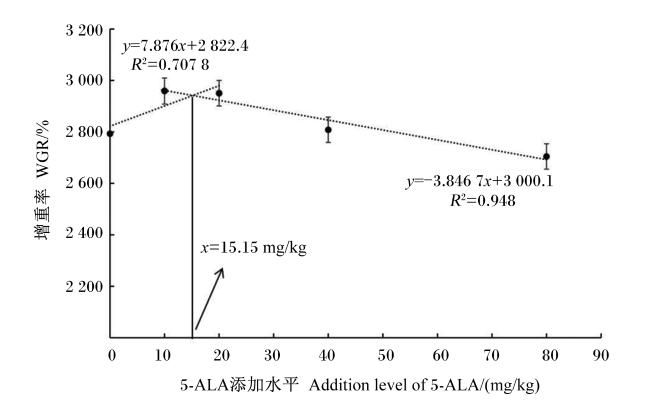
This study aimed to explore the effects of dietary 5-aminolevulinic acid (5-ALA) on the growth, non-specific immunity, antioxidant capacity, and glucose metabolism for juvenile Litopenaeus vannamei. Five isonitrogenous and isolipidic experimental diets were formulated by adding 0, 10, 20, 40, and 80 mg/kg of 5-ALA to the basal diet, designated as G0 (control), G10, G20, G40, and G80, respectively. A total of 600 Litopenaeus vannamei with an average initial body weight of (0.24±0.01) g were randomly divided into 5 groups, which were fed with the five experimental diets respectively. Each group had 3 replicates, with 40 shrimps per replicate. The experimental period lasted for 56 days. The results showed as follows: 1) compared with the control group, the addition of 10 mg/kg 5-ALA significantly increased the final body weight (FBW), weight gain rate (WGR), and specific growth rate (SGR) (P<0.05), significantly decreased the feed conversion ratio (FCR) (P<0.05), and had no significant effect on the survival rate (SR) (P>0.05). When the 5-ALA addition level was 10 to 40 mg/kg, it significantly increased the crude protein (CP) content in muscle (P<0.05), but had no significant effects on the contents of moisture, ether extract (EE), and crude ash (Ash) (P>0.05). 2) Compared with the control group, the addition of 10 to 80 mg/kg 5-ALA significantly increased the serum phenoloxidase (PO) activity (P<0.05); the addition of 10 mg/kg 5-ALA significantly increased the serum total protein (TP) content and the activities of alkaline phosphatase (AKP) and acid phosphatase (ACP) (P<0.05). 3) Compared with the control group, the addition of 10 to 80 mg/kg 5-ALA significantly decreased the activities of catalase (CAT), superoxide dismutase (SOD), and glutathione peroxidase (GSH-Px) in the hepatopancreas (P<0.05), and significantly increased the malondialdehyde (MDA) content in the hepatopancreas (P<0.05). 4) Compared with the control group, the addition of 10 to 80 mg/kg 5-ALA significantly increased the muscle hexokinase (HK) activity (P<0.05), had no significant effect on the muscle lactate dehydrogenase (LDH) activity (P>0.05); the addition of 10 to 20 mg/kg 5-ALA significantly increased the muscle pyruvate kinase (PK) and succinate dehydrogenase (SDH) activities (P<0.05). 5) Compared with the control group, the addition of 10 to 80 mg/kg 5-ALA significantly up-regulated the relative expression level of prophenoloxidase (proPO) gene (P<0.05); the addition of 10 mg/kg 5-ALA significantly up-regulated the relative expression levels of HK, phosphofructokinase (PFK), PK, and SDH genes in muscle (P<0.05), and had no significant effect on the relative expression level of LDH gene (P>0.05). In conclusion, adding an appropriate level of 5-ALA can significantly improve the growth performance, non-specific immunity, and promote glucose metabolism of shrimp. Based on the broken-line regression analysis with WGR as the evaluation index, the optimal 5-ALA addition level for Litopenaeus vannamei to achieve the best WGR is 15.15 mg/kg.

Cite this article

WU Jiahua , JIN Honghao , DING Xuejing , YANG Yundeng , LIU Hongyu , CHI Shuyan , TAN Beiping , YANG Qihui . Effects of Dietary 5-Aminolevulinic Acid on Growth, Antioxidant Capacity, and Glucose Metabolism for Litopenaeus vannamei[J]. Chinese Journal of Animal Nutrition, 2025 , 37(10) : 6997 -7009 . DOI: 10.12418/CJAN2025.569

凡纳滨对虾(Litopenaeus vannamei)俗称南美白对虾,其作为一种集味道鲜美、生长快、抗逆性强、成活率高、经济效益高等特点于一体的营养均衡优质水产品而被广泛养殖[1]。此外,受海洋渔业资源的限制,全球鱼粉供应量有限,鱼粉市场价格居高不下[2]。在我国鱼粉资源短缺严重制约了水产饲料行业的发展,寻求来源广泛、价格低廉的可替代鱼粉的新型蛋白质源符合当前行业的发展趋势[2-3]。然而,植物蛋白质(例如豆粕、发酵豆粕和玉米蛋白粉等)存在氨基酸不平衡、适口性差、含抗营养因子的问题,在饲料降低鱼粉使用量的同时若使用过量的植物蛋白质会降低水产动物生长性能、削弱免疫防御能力[3]
5-氨基乙酰丙酸(5-aminolevulinic acid,5-ALA)又称δ-氨基乙酰丙酸,是四吡咯化合物(叶绿素、血红素、维生素B12)的关键前体[4]。5-ALA近年来被广泛应用于医学、农业和畜牧领域,可通过多重生理途径提升养殖动物健康[5-8]。已有研究表明,5-ALA作为血红素合成前体,通过促进血红蛋白生成和增强携氧能力进而提升有氧代谢水平、驱动ATP高效合成,提高饲料利用率和蛋白质转化率,从而促进凡纳滨对虾生长[9-10];激活酚氧化酶原(proPO)系统而提高对虾非特异性免疫能力,提高其对副溶血弧菌(Vibrio parahaemolyticus)的抵抗力等[11-12];但5-ALA对凡纳滨对虾肌肉糖代谢的影响机制尚未明确。此外,现有剂量效应研究多聚焦于“有效-安全”范围(10~50 mg/kg),高剂量潜在问题缺乏系统评估。因此,本研究在凡纳滨对虾饲料中添加不同水平5-ALA,对其生长、非特异性免疫能力、抗氧化能力和糖代谢等方面进行综合分析,评估5-ALA在对虾饲料中的应用效果与适宜添加水平,为凡纳滨对虾功能性饲料的开发提供理论参考。

1 材料与方法

1.1 试验饲料

试验采用纯度为5%的5-ALA,以有效成分含量为基准,每千克饲料中分别添加含5% 5-ALA的商品制剂0、0.2、0.4、0.8、1.6 g(对应的有效成分含量分别为0、10、20、40、80 mg/kg),配制5种等氮等脂饲料[G0(对照)、G10、G20、G40、G80],5-ALA添加水平参考Pedrosa-Gerasmio等[12]和Li等[10]对凡纳滨对虾的推荐范围(<60 mg/kg)。基础饲料组成及营养水平见表1
表1 基础饲料组成及营养水平(干物质基础)

Table 1 Composition and nutrient levels of the basal diet (DM basis) %

项目Items 含量Contents
原料Ingredients
红鱼粉Brown fish meal 12.00
豆粕Soybean meal 21.00
花生粕Peanut meal 9.00
玉米蛋白粉Corn gluten meal 8.00
啤酒酵母Brewers yeast 6.00
虾壳粉Shrimp shell meal 6.00
面粉Wheat flour 24.00
大豆磷脂油Soybean lecithin 1.30
鱼油Fish oil 1.50
大豆油Bean oil 1.50
磷酸二氢钙Ca(H2PO4)2 1.50
维生素C Vitamin C 0.05
氯化胆碱Choline chloride 0.50
预混料Premix1) 1.00
L-赖氨酸L-lysine 0.20
DL-蛋氨酸DL-methionine 0.33
微晶纤维素Microcrystalline cellulose 6.12
合计Total 100.00
营养水平Nutrient levels2)
粗蛋白质Crude protein 36.69
粗脂肪Ether extract 6.61
粗灰分Crude ash 6.75

1)预混料为每千克饲料提供 Premix provided the following per kg of the diet:硫胺素 thiamine 5 mg,核黄素 riboflavin 10 mg,VA 5 000 IU,VE 40 mg,VD3 1 000 IU,VK3 10 mg,吡哆醇 pyridoxine 10 mg,生物素 biotin 0.1 mg,氰钴胺 cyanocobalamin 0.02 mg;烟酸 nicotinic acid 40 mg,叶酸 folic acid 1 mg,泛酸钙 calcium pantothenate 20 mg,VC 150 mg,Fe 100 mg,I 0.8 mg,Cu 3 mg,Zn 50 mg,Mn 12 mg,Se 0.3 mg,Co 0.2 mg。2) 营养水平为实测值。Nutrient levels were measured values.

将原料粉碎并过筛(80目),准确称量所有原料,全部混合均匀后在每组饲料中加入30%水再次混合均匀,经双螺杆挤条机(F-26,广州华工光机电科技有限公司)制备成粒径分别为1.0和1.5 mm的试验饲料,于60 ℃烘箱后熟化30 min后室内自然风干,分别装入密封袋置于-20 ℃储存备用。

1.2 试验动物与饲养管理

本试验已获广东海洋大学动物伦理和福利委员会的批准,批准号:GDOU-AEWC-20180063。
凡纳滨对虾幼虾在广东海洋大学海洋生物研究基地室外水泥池暂养30 d。挑选600尾体质健康、大小均匀、体质量为(0.24±0.01) g的凡纳滨对虾幼虾,随机分为5组,分别饲喂5种试验饲料,每组设3个重复,每个重复40尾虾,于300 L的玻璃纤维钢桶中开展为期56 d的养殖试验。每天投喂对虾体质量5%~8%的试验饲料,分别于07:00、12:00、17:00和22:00进行投喂,并根据投喂情况和天气情况及时调整投喂量,投喂40 min后用虹吸管清除桶底部的残饵。试验期间不间断充气,每天换水量约50%,水温为28.3~31.5 ℃,溶解氧浓度>7.31 mg/L,pH为7.80~8.08,海水盐度为25~28,氨氮浓度<0.03 mg/L。

1.3 样品采集

养殖试验结束后将对虾禁食24 h,并分别统计对虾的数量以及质量。参照吴远彩等[13]的方法,每桶随机选取20尾对虾于围心腔抽血,4 ℃静置过夜,离心取上清液保存于-80 ℃,用于测定血清非特异性免疫酶活性;每个重复取5尾对虾保存于-20 ℃,用于分析肌肉成分。参照Lin等[14]方法,每个重复取4尾对虾的肝胰腺组织和肌肉组织,分别装入冻存管,经液氮速冻后保存于-80 ℃,用于测定对虾肝胰腺抗氧化酶活性和肌肉代谢酶活性;每个重复取4尾对虾的肝胰腺组织和肌肉组织分别浸没于RNA later中,4 ℃过夜后保存于-80 ℃,用于检测对虾肝胰腺和肌肉相关基因的表达。

1.4 指标测定

1.4.1 生长性能指标[15]

增重率(WGR,%)=100×(终末体质量-初始体质量)/初始体质量;

特定生长率(SGR,%/d)=100×(ln终末体质量-ln初始体质量)/饲养天数;

饲料系数(FCR)=摄食饲料质量/(终末体质量-初始体质量);

存活率(SR,%)=100×终末对虾尾数/初始对虾尾数。

1.4.2 饲料和凡纳滨对虾肌肉成分分析

试验饲料和肌肉的营养成分含量参照国标法检测,水分含量测定使用105 ℃烘干法(GB 5009.3—2016),凯氏定氮法测定粗蛋白质含量(GB 5009.5—2016),索氏抽提法测定粗脂肪含量(GB/T 14772—2008),550 ℃灼烧法测定粗灰分含量(GB/T 6438—2007)。

1.4.3 血清、肝胰腺和肌肉相关酶活性的测定

血清总蛋白(TP,A045-2-2)含量及酚氧化酶(PO,H247-1-2)、碱性磷酸酶(AKP,A059-2-2)和酸性磷酸酶(ACP,A060-2-2)活性;肝胰腺过氧化氢酶(CAT,A007-2-1)、超氧化物歧化酶(SOD,A001-2-2)、谷胱甘肽过氧化物酶(GSH-Px,A005-1-2)活性和丙二醛(MDA,A003-2-2)含量;肌肉己糖激酶(HK,A077-3-1)、丙酮酸激酶(PK,A076-1-1)、乳酸脱氢酶(LDH,A020-2-2)和琥珀酸脱氢酶(SDH,A022-1-1)活性采用南京建成生物工程研究所试剂盒测定,具体操作步骤及试剂用量严格按照试剂盒中说明书进行。

1.4.4 肝胰腺和肌肉相关基因的表达分析

用Transol Up Plus RNA Kit(北京全式金生物技术股份有限公司)提取组织中RNA,于超微量紫外可见光分光光度计(Nano Drop-2000,Thermo scientific,美国)测定RNA质量。将合格的RNA作为反转录模板用Evo M-MLV反转录预混型试剂盒(艾科瑞生物)于热循环仪(K960,杭州晶格科学仪器有限公司)反转录成cDNA。用SYBR® Green Premix Pro Taq HS qPCR试剂盒Ⅱ(艾科瑞生物)进行实时荧光定量PCR(qRT-PCR),测定目的基因的相对表达量。qRT-PCR 10 μL反应体系包括:2×SYBR® Green ProTaq HS Premix Ⅱ 5 μL、cDNA 1 μL、Primer F 0.4 μL、Primer R 0.4 μL、RNase free water 3.2 μL。反应条件为:95 ℃ 30 s;95 ℃ 5 s,60 ℃ 30 s,40个循环。β-肌动蛋白作为参考基因,2-ΔΔCt[16]计算目的基因相对表达量。表2所示为qRT-PCR分析的引物,均由生工生物工程(上海)股份有限公司合成。
表2 实时荧光定量PCR引物

Table 2 Primers used in real-time quantitative PCR

基因
Genes
引物序列
Primer sequence (5'—3')
GenBank登录号
GenBank accession No.
β-肌动蛋白
β-actin
F: CGAGGTATCCTCACCCTGAA
R: GTCATCTTCTCGCGGTTAGC
AF300705.2
过氧化氢酶
CAT
F: CAAGTGGCGATTACCCCTCAT
R: CCCATGAGGCCATACTTTGGT
AY518322
超氧化物歧化酶
SOD
F: ATCCACCACACAAAGCATCA
R: AGCTCTCGTCAATGGCTTGT
XM_027352840.1
酚氧化酶原
proPO
F: TTCCAGCTCTTCTTCATGCT
R: TCGGGGTACTTGGCGTCCTG
EF115296
己糖激酶
HK
F:AGTCGCAGCAACAGGAAGTT
R:CGCTCTTCTGGCACATGATA
EF102106
磷酸果糖激酶
PFK
F: TTGTTGCTGCTTTGACCTCT
R: AACCTTCTTCACTCCTTCCG
EF102107.1
丙酮酸激酶
PK
F: AGCTGTCTCAGCAGGTCCAT
R: AGCGAGGCCTGTACTTTGAA
EF102105
琥珀酸脱氢酶
SDH
F: GCTTTTGTCGGGCAATTTCG
R: CATGGGACCACAGGTGTTGAG
XM_027376121.1
乳酸脱氢酶
LDH
F: AGTTCGAAACACCAGGTTGG
R: AGCAGATGTGCTGTGTCAGG
HQ433259

1.5 数据处理

试验数据以平均值±标准误表示,数据分析采用SPSS 27.0软件进行单因素方差分析(one-way ANOVA),用Duncan氏法进行多重比较检验,P<0.05为差异显著。用Graphpad Prism 8软件进行数据制图。

2 结果

2.1 5-ALA对凡纳滨对虾幼虾生长性能的影响

表3可知,G10和G20组FBW、WGR、SGR显著高于G0和G80组(P<0.05),G10组FCR显著低于G0组(P<0.05)。如图1所示,将饲料不同5-ALA添加水平(x)和凡纳滨对虾幼虾的WGR(y)做折线模型,使用以下折线模型回归方程估计WGR与饲料中5-ALA水平的关系:y1=7.876x+2 822.4,R2=0.707 8;y2=-3.846 7x+3 000.1,R2= 0.948;凡纳滨对虾幼虾获得最佳WGR的5-ALA添加水平为15.15 mg/kg。
表3 5-ALA对凡纳滨对虾幼虾生长性能的影响

Table 3 Effects of 5-ALA on growth performance for juvenile L.vannamei (n=3)

项目
Items
组别Groups P
P-value
G0(对照Control) G10 G20 G40 G80
初始体质量IBW/g 0.24±0.00 0.24±0.00 0.24±0.00 0.24±0.01 0.24±0.00 0.962
终末体质量FBW/g 7.12±0.07b 7.54±0.10a 7.52±0.09a 7.29±0.08ab 7.08±0.05b 0.006
摄食量FI/g 305.20 311.53 322.05 314.63 304.87
增重率WGR/% 2 793.18±11.76bc 2 959.60±35.82a 2 950.70±29.75a 2 808.40±24.66b 2 704.61±41.79c 0.001
特定生长率SGR/(%/d) 6.01±0.01bc 6.11±0.02a 6.11±0.02a 6.02±0.01b 5.95±0.03c 0.001
饲料系数FCR 1.00±0.02a 0.95±0.01b 0.99±0.01ab 1.02±0.02a 1.04±0.02a 0.026
成活率SR/% 99.17±0.83 99.17±0.83 98.33±0.83 97.50±2.50 96.67±0.83 0.637

同行数据肩标无字母或相同字母表示差异不显著(P>0.05),不同小写字母表示差异显著(P<0.05)。下表同。

In the same row, values with no letter or the same letter superscripts mean no significant difference (P>0.05), while with different small letter superscripts mean significant difference (P<0.05). The same as below.

图1 5-ALA添加水平与凡纳滨对虾幼虾增重率的关系

Fig.1 Relationship between 5-ALA addition level and WGR for juvenile L.vannamei (n=3)

2.2 5-ALA对凡纳滨对虾幼虾肌肉营养成分的影响

表4可知,与G0组相比,饲料中添加不同水平5-ALA对凡纳滨对虾幼虾肌肉水分、粗脂肪和粗灰分含量无显著影响(P>0.05),G10、G20和G40组肌肉粗蛋白质含量显著提高(P<0.05)。
表4 5-ALA对凡纳滨对虾幼虾肌肉营养成分的影响

Table 4 Effects of 5-ALA on muscle nutrients for juvenile L.vannamei (n=3) %

项目
Items
组别Groups P
P-value
G0(对照Control) G10 G20 G40 G80
水分Moisture 74.49±0.82 73.57±0.09 74.19±0.49 73.73±0.35 74.80±0.65 0.499
粗蛋白质Crude protein 19.74±0.09d 20.98±0.01a 20.23±0.04c 20.60±0.06b 19.77±0.03d <0.001
粗脂肪Ether extract 1.50±0.20 1.39±0.17 1.32±0.23 1.44±0.10 1.47±0.27 0.966
粗灰分Crude ash 1.46±0.02 1.51±0.02 1.42±0.06 1.50±0.01 1.45±0.01 0.262

2.3 5-ALA对凡纳滨对虾幼虾肝胰腺抗氧化能力的影响

表5可知,与G0组相比,饲料中添加不同水平5-ALA显著降低凡纳滨对虾幼虾肝胰腺SOD、CAT和GSH-Px活性(P<0.05),MDA含量显著高于G0组(P<0.05)。
表5 5-ALA对凡纳滨对虾幼虾肝胰腺抗氧化能力的影响

Table 5 Effects of 5-ALA on hepatopancreas antioxidant capacity for juvenile L. vannamei (n=3)

项目
Items
组别Groups P
P-value
G0(对照Control) G10 G20 G40 G80
超氧化物歧化酶
SOD/(U/g prot)
4.56±0.05a 1.28±0.14e 2.69±0.09c 3.33±0.07b 2.24±0.23d <0.001
过氧化氢酶
CAT/(U/g prot)
1.73±0.07a 0.61±0.07d 0.72±0.08bc 0.81±0.04b 0.68±0.02bc <0.001
谷胱甘肽过氧化物酶
GSH-Px/(U/g prot)
9.44±0.07a 2.30±0.17e 3.86±0.22d 6.72±0.06b 5.18±0.23c <0.001
丙二醛
MDA/(nmol/mg prot)
0.08±0.00e 0.21±0.00b 0.15±0.00c 0.23±0.01a 0.10±0.00d <0.001

2.4 5-ALA对凡纳滨对虾幼虾血清非特异性免疫能力的影响

表6可知,G10组血清AKP活性显著高于G0组(P<0.05);G10和G20组血清TP含量和ACP活性显著高于G0组(P<0.05),其余各组与G0组无显著差异(P>0.05);与G0组相比,添加不同水平5-ALA均显著提高血清PO活性(P<0.05)。
表6 5-ALA对凡纳滨对虾幼虾血清非特异性免疫能力的影响

Table 6 Effects of 5-ALA on serum non-specific immune capacity for juvenile L. vannamei (n=3)

项目
Items
组别Groups P
P-value
G0(对照Control) G10 G20 G40 G80
总蛋白TP/(g/L) 56.52±0.75b 77.23±6.00a 70.09±3.58a 66.40±1.74ab 55.88±1.67b 0.005
碱性磷酸酶AKP/(U/L) 76.03±3.86bc 97.40±2.05a 92.77±7.54ab 87.96±1.70abc 74.78±7.25c 0.038
酸性磷酸酶ACP/(U/L) 197.29±1.86b 232.28±10.92a 224.06±3.62a 212.79±11.07ab 166.52±7.53c 0.001
酚氧化酶PO/(U/L) 21.31±0.60e 54.79±0.35a 39.23±0.76d 47.74±0.68b 43.09±0.63c <0.001

2.5 5-ALA对凡纳滨对虾幼虾肌肉糖代谢酶活性的影响

表7可知,与G0组相比,饲料中添加不同水平5-ALA对凡纳滨对虾幼虾肌肉LDH活性无显著影响(P>0.05);G10、G20组肌肉PK和SDH活性显著提高(P<0.05),其余各组与G0组无显著差异(P>0.05);饲料中添加不同水平5-ALA均显著提高肌肉HK活性(P<0.05)。
表7 5-ALA对凡纳滨对虾幼虾肌肉糖代谢酶活性的影响

Table 7 Effects of 5-ALA on muscle glucose metabolism enzyme activities for juvenile L. vannamei (n=3)

项目
Items
组别Groups P
P-value
G0(对照Control) G10 G20 G40 G80
丙酮酸激酶
PK/(U/g prot)
2.67±0.07c 3.00±0.03a 2.88±0.02ab 2.79±0.09bc 2.74±0.04bc 0.021
己糖激酶
HK/(nmol/g prot)
0.18±0.03b 0.54±0.07a 0.41±0.03a 0.42±0.05a 0.37±0.08a 0.011
乳酸脱氢酶
LDH/(U/g prot)
8.24±0.28 8.36±0.15 8.33±0.18 8.04±0.08 8.41±0.21 0.688
琥珀酸脱氢酶
SDH/(U/mg prot)
6.74±0.16b 7.60±0.17a 7.43±0.08a 7.20±0.17ab 7.07±0.25ab 0.043

2.6 5-ALA对凡纳滨对虾幼虾肌肉糖代谢相关基因表达的影响

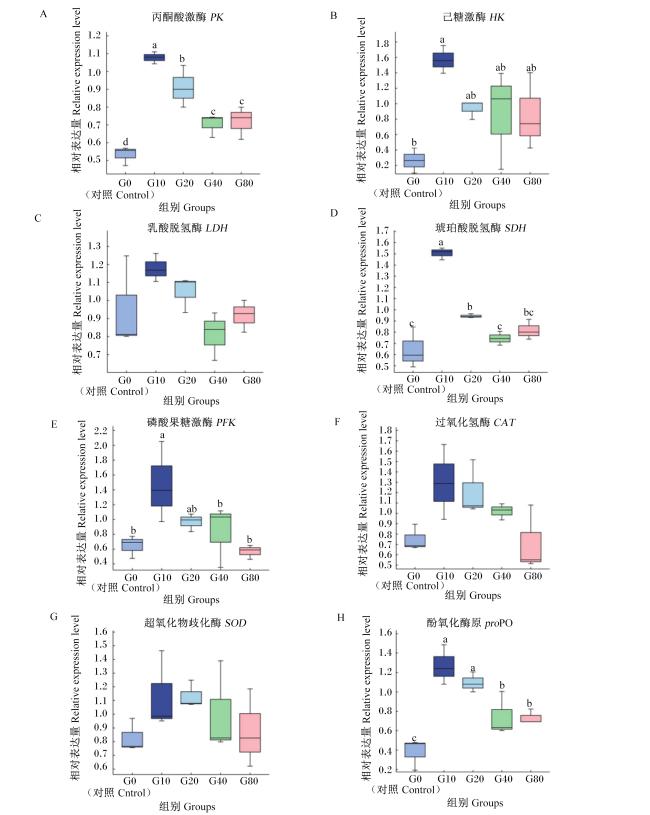
图2A~图2E可知,与G0组相比,饲料中添加不同水平5-ALA显著上调凡纳滨对虾幼虾肌肉的PK基因相对表达量(P<0.05);G10组肌肉HKSDHPFK基因相对表达量显著上调(P<0.05);不同水平5-ALA对肌肉LDH基因相对表达量无显著影响(P>0.05)。
图2 5-ALA对凡纳滨对虾幼虾相关基因表达的影响

A~E:肌肉糖代谢相关基因表达;F~H:肝 胰 腺 SODCATproPO 基因表达。A-E: expression of genes related to muscle glucose metabolism; F-H: expression of SOD, CAT and proPO genes in hepatopancreas.柱形图上方不同字母表示各组之间存在统计学上的显著差异(P<0.05)。Different letters above a bar were statistically significant difference among groups (P<0.05).

Fig.2 Effects of 5-ALA on expression of related genes for juvenile L.vannamei (n=3)

2.7 5-ALA对凡纳滨对虾幼虾肝胰腺SODCATproPO基因表达的影响

图2F~图2H可知,与G0组相比,饲料中添加不同水平5-ALA对凡纳滨对虾幼虾肝胰腺的SODCAT基因相对表达量无显著影响(P>0.05);不同水平5-ALA均显著上调肝胰腺proPO基因相对表达量(P<0.05)。

3 讨论

3.1 5-ALA对凡纳滨对虾幼虾生长性能的影响

5-ALA作为一种能促进机体新陈代谢、提高免疫能力和抗氧化能力的新型饲料添加剂[17],已经被广泛应用于陆生动物[18-23],近年来在水生动物领域的研究和应用也逐渐增多,例如凡纳滨对虾[9-12]。本研究结果表明,添加10 mg/kg 5-ALA显著提高凡纳滨对虾FBW、WGR、SGR,显著降低FCR,与Pedrosa-Gerasmio等[12]、Direkbusarakom等[11]、Ye等[9]和Li等[10]的研究结果不尽相同。部分研究显示,在饲料中添加45 mg/kg的5-ALA能够显著提高对虾的生长速率、蛋白质效率和FCR[9-10],本研究与Ye等[9]和Li等[10]结果不完全一致的可能原因:首先,试验饲料的主要蛋白质源不同,本研究的饲料主要蛋白质源为红鱼粉、豆粕、花生粕、玉米蛋白粉,而Ye等[9]和Li等[10]的试验配方中以酪蛋白、玉米淀粉和明胶为主要蛋白质源。鱼粉和豆粕是公认的易被水产动物消化的优质蛋白质源[24-26],而虾类对于酪蛋白的利用率较低[27-28],在他们的研究基础饲料中缺乏鱼粉和豆粕[9-10],这可能导致对照组饲料的利用率较低,在此基础上添加适量的5-ALA可能显著提高饲料利用率,显著提高对虾生长性能。其次,使用玉米淀粉和明胶包被晶体氨基酸能够有效降低氨基酸在水中的溶失率、提高氨基酸的利用效率,进而提高饲料效率和促进对虾生长[29]。这些差异可能解释了较高剂量的5-ALA在某些研究中显著促进对虾生长的原因[9-10]
本研究结果还显示,G80组凡纳滨对虾幼虾WGR、SGR显著低于G10组,且FCR显著高于G10组。在Pedrosa-Gerasmio等[12]的研究中最高剂量60 mg/kg添加组凡纳滨对虾有最低WGR、SGR以及最高FCR,本研究与Pedrosa-Gerasmio等[12]研究结果相似,这可能是因为高剂量的5-ALA不利于凡纳滨对虾的生长。

3.2 5-ALA对凡纳滨对虾幼虾肌肉成分的影响

水产动物主要可食用部分是肌肉,约占机体的60%[30],蛋白质、脂肪等是肌肉干物质中的主要成分,其含量可评估肌肉营养价值。本研究结果显示,添加10~40 mg/kg的5-ALA能显著提高凡纳滨对虾肌肉的粗蛋白质含量,而对肌肉的水分、粗脂肪和粗灰分含量无显著影响,与Li等[10]研究结果类似,即添加30~120 mg/kg的5-ALA对水分、粗灰分或粗脂肪含量无显著影响,但可增加全虾粗蛋白质含量,改善蛋白质效率。本研究中,添加10和20 mg/kg的5-ALA有利于提高对虾生长性能,随着添加水平的升高,5-ALA对其生长反而不利,表明在适宜的添加水平下,对虾能够更有效地吸收利用饲料中的营养成分并作用于体内蛋白质的合成,促进蛋白质在肌肉中沉积。此外,在饲料提供能量充足的情况下,可以减少机体内贮存蛋白质被消耗用作能量来源[31]

3.3 5-ALA对凡纳滨对虾幼虾非特异性免疫能力的影响

甲壳动物因不具备抗原特异性的免疫球蛋白和淋巴细胞而不能产生特异性抗体,需依靠以血细胞为第1道细胞免疫防御屏障的非特异性免疫消灭入侵病原[32-34]。血清蛋白在体内承担多种生理功能,包括维持血液渗透压稳定、运输代谢物、参与免疫反应、调节被运输物质的生理作用和解除毒性、修补组织和储存能量等,其含量升高表明机体免疫功能有所提升且增加蛋白质合成[35-36]。非特异性免疫系统除了上述的细胞系统,还有另一重要组成部分即体液系统,它包括LZM、ACP和AKP等免疫酶和SOD、过氧化物酶(POD)、CAT等抗氧化酶[37]。ACP在酸性条件下对磷酸单酯进行催化水解生成无机磷酸,能与其他酶类形成吞噬细胞杀菌的物质基础,发挥防御功能[38-40]。ACP和AKP均为磷酸单酯酶,直接参与磷酸基团的转移,它们被用作检验甲壳动物免疫功能的指标酶[41]。PO是节肢动物非特异性免疫proPO系统中的一种氧化酚类物质的酶,由proPO激活级联控制、PO诱导产生的黑色素及中间代谢产物可将入侵虾体的微生物和寄生虫杀灭[37,42]。本研究结果显示,不同水平5-ALA均显著提高凡纳滨对虾血清PO活性,添加10 mg/kg的5-ALA可以显著提高血清TP含量,提高AKP和ACP活性;不同水平的5-ALA均显著上调凡纳滨对虾proPO基因的表达,结果表明适量5-ALA可显著提高凡纳滨对虾非特异性免疫能力。本研究与Pedrosa-Gerasmio等[12]和Li等[10]对凡纳滨对虾研究结果相似,添加60 mg/kg的5-ALA可以显著上调凡纳滨对虾的proPO等非特异性免疫相关基因表达[12],添加45和60 mg/kg的5-ALA可显著提高凡纳滨对虾PO、LZM、ACP和AKP活性[10]

3.4 5-ALA对凡纳滨对虾幼虾抗氧化能力的影响

动物机体在代谢过程中会不断产生自由基,而过量自由基会破坏细胞膜完整性,进而造成生物氧化损伤[43-44]。抗氧化系统作为一种能够清除自由基的防御过氧化反应伤害的主动防御系统,在动物体免疫防御机制中起着重要作用[45]。抗氧化防御系统包含酶和非酶系统,二者协同清除生物体内的自由基[44]。SOD和CAT等抗氧化酶与T-AOC等是反应机体抗氧化水平的重要指标[44],SOD广泛存在于各种细胞组织中,能够催化氧自由基形成过氧化氢(H2O2),H2O2在GSH-Px和CAT的作用下分解成H2O,从而消除自由基[43]。MDA是脂质过氧化的产物之一,能够引起生物膜结构及功能发生异常变化,其含量的变化可衡量脂质过氧化程度并间接指示机体内活性氧的累积程度[43,46]
本研究中,不同水平5-ALA显著降低凡纳滨对虾肝胰腺SOD、CAT和GSH-Px活性,MDA含量显著高于G0组;但添加10~40 mg/kg 5-ALA显著上调SODCAT基因相对表达量。5-ALA作为血红素前体,可能通过激活腺苷酸活化蛋白激酶(AMPK)通路[47]促进糖酵解供能(HK、PK活性升高),导致细胞资源向能量代谢倾斜,暂时抑制抗氧化酶蛋白合成(酶活性下降),而SODCAT基因表达上调。MDA含量轻度升高可能通过激活细胞抗氧化应激的关键调控途径[核因子E2相关因子2/Kelch样环氧氯丙烷相关蛋白1(Nrf2/Keap1)通路]触发抗氧化基因表达[48]。本研究与Li等[10]和Pedrosa-Gerasmio等[12]对凡纳滨对虾研究结果有差异,可能与幼虾初始体质量和养殖周期有关:在Li等[10]研究中对虾初始体质量为(0.38±0.03) g,饲喂添加45和60 mg/kg 5-ALA饲料90 d可显著提高CAT、SOD、GSH-Px活性及氧化型谷胱甘肽含量;Pedrosa-Gerasmio等[12]发现,初始体质量为(0.88±0.33) g的凡纳滨对虾饲喂添加60 mg/kg 5-ALA饲料84 d可显著上调CAT基因相对表达量。

3.5 5-ALA对凡纳滨对虾幼虾肌肉糖代谢的影响

虾类大多数参与生长调控的差异表达基因(DEGs)富集在在代谢途径、三羧酸循环(柠檬酸循环)、丙酮酸代谢途径和糖酵解/糖异生途径中[49],HK、PFK-1和PK作为糖酵解/糖异生途径的关键限速酶,负责调控代谢途径的速率[49]。LDH存在于细胞质中,在糖酵解过程中活跃,能将丙酮酸转化为乳酸[50]。在三羧酸循环中,SDH是唯一嵌入到线粒体内膜的酶,它同时是呼吸链的第1个酶,SDH活性反映有氧代谢水平[51-52]
糖代谢速度受相关代谢酶的影响,可反映生物新陈代谢快慢[53]。本研究中,添加10 mg/kg的5-ALA可显著提高肌肉PK、SDH和HK活性并显著上调凡纳滨对虾的PKHKSDHPFK基因相对表达量,随着5-ALA添加水平的升高,PK、SDH和HK活性逐渐下降且PKHKSDHPFK基因表达几乎是呈现下调趋势;不同水平5-ALA对凡纳滨对虾肌肉LDH活性无显著影响,对LDH基因相对表达量也无显著影响,结果表明适量的5-ALA能够显著提高凡纳滨对虾糖酵解酶活性,上调糖代谢相关基因的表达,促进有氧呼吸过程。糖代谢通过糖酵解、三羧酸循环和氧化磷酸化等过程,为有氧能量代谢提供关键底物和能量[54]。已有研究表明,5-ALA可提高参与ATP生成的血红蛋白类的活性,直接促进有氧能量代谢,从而增加ATP的产生[55-56]。动物生长速度快可能是因为机体通过促进糖酵解过程来增强获得和利用能量的能力[49],本研究中,添加10 mg/kg的5-ALA促进对虾糖代谢过程,肌肉新陈代谢速率加快。在糖类和脂肪足够供能的情况下,可以减少机体内贮存的蛋白质被消耗用作能量来源,这可能也是G10组对虾肌肉粗蛋白质含量和WGR最高的原因。

4 结论

在本试验条件下,饲料中添加适宜水平5-ALA可显著提高对虾生长性能、非特异性免疫能力和促进糖代谢。以WGR为评价指标进行折线回归分析,凡纳滨对虾获得最佳WGR的5-ALA添加水平为15.15 mg/kg。
[1]
牛津, 赵伟. 凡纳滨对虾营养生理和高效环保饲料研究进展[J]. 水产学报, 2022, 46(10):1776-1800.

NIU J, ZHAO W. Research advances in nutritional physiology and high-efficiency and environment-friendly feed of Litopenaeus vannamei[J]. Journal of Fisheries of China, 2022, 46(10):1776-1800. (in Chinese)

[2]
张文兵, 解绶启, 徐皓, 等. 我国水产业高质量发展战略研究[J]. 中国工程科学, 2023, 25(4):137-148.

DOI

ZHANG W B, XIE S Q, XU H, et al. High-quality development strategy of fisheries in China[J]. Strategic Study of CAE, 2023, 25(4):137-148. (in Chinese)

DOI

[3]
冷向军. 低鱼粉水产饲料的研究与应用[J]. 饲料工业, 2020, 41(22):1-8.

LENG X J. The research and application of low fish meal diets in aquaculture[J]. Feed Industry, 2020, 41(22):1-8. (in Chinese)

[4]
乔东宇, 尹先清, 黄小溪. δ-氨基乙酰丙酸[J]. 精细与专用化学品, 2006, 14(16):4.

QIAO D Y, YIN X Q, HUANG X X. δ-aminolevulinic acid[J]. Fine and Special Chemicals, 2006, 14(16):4. (in Chinese)

[5]
KANG Z, WANG Y, WANG Q, et al. Metabolic engineering to improve 5-aminolevulinic acid production[J]. Bioengineered bugs, 2011, 2(6):342-345.

DOI PMID

[6]
JIANG M R, HONG K Q, MAO Y F, et al. Natural 5-aminolevulinic acid: sources, biosynthesis, detection and applications[J]. Frontiers in Bioengineering and Biotechnology, 2022,10:841443.

[7]
陈久洲, 王钰, 蒲伟, 等. 5-氨基乙酰丙酸生物合成技术的发展及展望[J]. 合成生物学, 2021, 2(6):1000-1016.

DOI

CHEN J Z, WANG Y, PU W, et al. Advances and perspective on bioproduction of 5-aminolevulinic acid[J]. Synthetic Biology Journal, 2021, 2(6):1000-1016. (in Chinese)

DOI

[8]
李军辉, 姜淑贞, 王长波, 等. 5-氨基乙酰丙酸的生物学功能及其在畜禽生产中的应用[J]. 动物营养学报, 2023, 35(1):120-126.

DOI

LI J H, JIANG S Z, WANG C B, et al. Biological function of 5-aminolevulinic acid and its application in livestock and poultry production[J]. Chinese Journal of Animal Nutrition, 2023, 35(1):120-126. (in Chinese)

DOI

[9]
YE Y C, LI S W, DU X L, et al. Effects of dietary 5-aminolevulinic acid on growth performance and nonspecific immunity of Litopenaeus vannamei, as determined by transcriptomic analysis[J]. Fish & Shellfish Immunology, 2024,151:109746.

[10]
LI Y M, YE Y C, ZHU Y S, et al. Effects of dietary 5-aminolevulinic acid on growth, nutrient composition, and intestinal microflora in juvenile shrimp, Litopenaeus vannamei[J]. Marine Biotechnology, 2024, 26(6):1307-1323.

[11]
DIREKBUSARAKOM S, KINOSHITA H, POOLJUN C, et al. 5-aminolevulinic acid’s effects on immune-related gene expression and acute hepatopancreatic necrosis disease(AHPND)protection in pacific white shrimp Litopenaeus vannamei[J]. Fish Pathology, 2021, 55(4):125-131.

[12]
PEDROSA-GERASMIO I R, KONDO H, HIRONO I. Dietary 5-aminolevulinic acid enhances adenosine triphosphate production, ecdysis and immune response in Pacific white shrimp,Litopenaeus vannamei (Boone)[J]. Aquaculture Research, 2019, 50(4):1131-1141.

[13]
吴远彩, 李日美, 申光荣, 等. 小肽对凡纳滨对虾生长、抗氧化能力、非特异性免疫及肠道菌群结构的影响[J]. 广东海洋大学学报, 2021, 41(5):1-9.

WU Y C, LI R M, SHEN G R, et al. Effects of dietary small peptides on growth, antioxidant capacity, nonspecific immunity and ingut microflora structure of Litopenaeus vannamei[J]. Journal of Guangdong Ocean University, 2021, 41(5):1-9. (in Chinese)

[14]
LIN H X, TAN B P, YANG Q H, et al. Effects of dietary glycerol monolaurate on growth,antioxidant capacity and lipid metabolism in cage-farmed pompano(Trachinotus ovatus)juveniles[J]. Frontiers in Marine Science, 2022,9:914134.

[15]
韦宏杰, 李雪鹤, 吴远彩, 等. 月桂酸单甘油酯对凡纳滨对虾生长、肌肉氨基酸、非特异性免疫及肠道菌群的影响[J]. 水产学报, 2022, 46(10):1912-1926.

WEI H J, LI X H, WU Y C, et al. Effects of glycerol monolaurate on growth performance, muscle amino acids, non-specific immunity and intestinal flora of Litopenaeus vannamei[J]. Journal of Fisheries of China, 2022, 46(10):1912-1926. (in Chinese)

[16]
LIVAK K J, SCHMITTGEN T D. Analysis of relative gene expression data using real-time quantitative PCR and the 2-ΔΔCT method[J]. Methods, 2001, 25(4):402-408.

[17]
CHEN J Z, WANG Y, GUO X, et al. Efficient bioproduction of 5-aminolevulinic acid, a promising biostimulant and nutrient, from renewable bioresources by engineered Corynebacterium glutamicum[J]. Biotechnology for Biofuels, 2020,13:1-13.

[18]
CHEN Y J, KIM I H, CHO J H, et al. Utilization of delta-aminolevulinic acid for livestock:blood characteristics and immune organ weight in broilers[J]. Journal of Animal & Feed Sciences, 2008, 17(2):215-223.

[19]
WANG J P, YAN L, LEE J H, et al. Effects of dietary delta-aminolevulinic acid and vitamin C on growth performance, immune organ weight and ferrum status in broiler chicks[J]. Livestock Science, 2011, 135(2/3):148-152.

[20]
CHEN Y J, KIM I H, CHO J H, et al. Effect of δ-aminolevulinic acid on growth performance, nutrient digestibility, blood parameters and the immune response of weanling pigs challenged with Escherichia coli lipopolysaccharide[J]. Livestock Science, 2008, 114(1):108-116.

[21]
MATEO R D, MORROW J L, DAILEY J W, et al. Use of δ-aminolevulinic acid in swine diet:effect on growth performance,behavioral characteristics and hematological/immune status in nursery pigs[J]. Asian-Australasian Journal of Animal Sciences, 2006, 19(1):97-101.

[22]
WANG J P, JUNG J H, KIM I H. Effects of dietary supplementation with delta-aminolevulinic acid on growth performance, hematological status, and immune responses of weanling pigs[J]. Livestock Science, 2011, 140(1/2/3):131-135.

[23]
YAN L, KIM I H. Evaluation of dietary supplementation of delta-aminolevulinic acid and chitooligosaccharide on growth performance, nutrient digestibility, blood characteristics, and fecal microbial shedding in weaned pigs[J]. Animal Feed Science and Technology, 2011, 169(3/4):275-280.

[24]
易魁, 陈庭, 孙云章, 等. 鸡肉粉替代鱼粉饲料添加明胶,淀粉包被的氨基酸对凡纳滨对虾生长性能的影响[J]. 养殖与饲料, 2018,(3):5-10.

YI K, CHEN T, SUN Y Z, et al. The impact of chicken meal as a replacement for fish meal with gelatin and starch-coated amino acids on the growth performance of Litopenaeus vannamei[J]. Animal Breeding and Feed, 2018,(3):5-10. (in Chinese)

[25]
AKIYAMA D M. Penaeid shrimp nutrition for the commercial feed industry: revised[C]// Proceeding of the Aquaculture Feed Processing and Nutrition Workshop.St. Louis: American Soybean Association, 1991:80-98.

[26]
王广军. 罗氏沼虾营养需求研究进展[J]. 中国饲料, 2003(14):20-21.

WANG G J. Research progress on nutritional requirements of Macrobrachium rosenbergii[J]. China Feed, 2003(14):20-21. (in Chinese)

[27]
YUAN Y, LAWRENCE A L, CHEHADE S B, et al. Feed intake as an estimation of attractability in Pacific white shrimp Litopenaeus vannamei[J]. Aquaculture, 2021,532: 736041.

[28]
MENTE E, COUTTEAU P, HOULIHAN D, et al. Protein turnover, amino acid profile and amino acid flux in juvenile shrimp Litopenaeus vannamei: effects of dietary protein source[J]. Journal of Experimental Biology, 2002, 205(Pt 20):3107-3122.

[29]
ALAM M S, TESHIMA S I, YANIHARTO D, et al. Dietary amino acid profiles and growth performance in juvenile kuruma prawn Marsupenaeus japonicus[J]. Comparative Biochemistry and Physiology Part B: Biochemistry and Molecular Biology, 2002, 133(3):289-297.

[30]
MOMMSEN T P. Paradigms of growth in fish.[J]. Comparative biochemistry and physiology part B: Biochemistry and molecular biology, 2001, 129(2/3):207-219.

[31]
张生利, 孙文婷, 孔祥芬. 影响饲料能量利用率的因素及其营养学措施[J]. 畜牧与饲料科学, 2014, 35(10):32,41.

ZHANG S L, SUN W T, KONG X F. Factors affecting the utilization rate of feed energy and nutritional measures[J]. Animal Husbandry and Feed Science, 2014, 35(10):32,41. (in Chinese)

[32]
LEE S Y, SÖDERHÄLL K. Early events in crustacean innate immunity[J]. Fish & Shellfish Immunology, 2002, 12(5):421-437.

[33]
王秀华, 黄倢, 宋晓玲. 免疫增强剂-肽聚糖在对虾养殖中的应用[J]. 海洋水产研究, 2003, 24(1):69-74.

WANG X H, HUANG J, SONG X L. The application of immunostimulants-peptidoglycan to the culture of shrimp[J]. Marine Fisheries Research, 2003, 24(1):69-74. (in Chinese)

[34]
樊廷俊. 对虾非特异性免疫与对虾疾病监控的研究进展[J]. 海洋科学, 2002, 26(4):26-31.

FAN T J. Researching progresses in shrimp non specific immunity and disease control[J]. Marine Sciences, 2002, 26(4):26-31. (in Chinese)

[35]
李晶. 血清总蛋白测定方法及临床意义[J]. 中国现代药物应用, 2012, 6(9):28-29.

LI J. Determination methods and clinical significance of serum total protein[J]. Chinese Journal of Modern Drug Applications, 2012, 6(9):28-29. (in Chinese)

[36]
赵红霞, 陈晓瑛, 王国霞, 等. 饲料中添加γ-氨基丁酸对凡纳滨对虾生长性能、血清生化指标和抗亚硝酸氮应激能力的影响[J]. 动物营养学报, 2020, 32(9):4251-4259.

DOI

ZHAO H X, CHEN X Y, WANG G X, et al. Effects of dietary γ-aminobutyric acid supplemental level on growth performance, serum biochemical indices and anti-nitrite-nitrogen stress ability of Litopenaeus vannamei[J]. Chinese Journal of Animal Nutrition, 2020, 32(9):4251-4259. (in Chinese)

[37]
AMPARYUP P, CHAROENSAPSRI W, TASSANAKAJON A. Prophenoloxidase system and its role in shrimp immune responses against major pathogens[J]. Fish & Shellfish Immunology, 2013, 34(4):990-1001.

[38]
LIU Z P, LIN Z, LIU L, et al. A convenient and label-free fluorescence “turn off-on” nanosensor with high sensitivity and selectivity for acid phosphatase[J]. Analytica Chimica Acta, 2015,876:83-90.

[39]
宋芹芹, 李玉虎, 周海龙. 凡纳滨对虾应答低氧-复氧胁迫免疫相关酶活力的时空变化[J]. 热带生物学报, 2015, 6(4):353-358.

SONG Q Q, LI Y H, ZHOU H L. Spatial and temporal changes of immune-related enzymes activities in Litopenaeus vannamei under hypoxia-reoxygenation stress[J]. Journal of Tropical Biology, 2015, 6(4):353-358. (in Chinese)

[40]
魏炜, 张洪渊, 石安静. 育珠蚌酸性磷酸酶活力与免疫反应关系的研究[J]. 水生生物学报, 2001, 25(4):413-415.

WEI W, ZHANG H Y, SHI A J. The study of relationship between acid phosphatase activity and oyster defence[J]. Acta Hydrobiologica Sinica, 2001, 25(4):413-415. (in Chinese)

[41]
孙静秋, 许燕, 张慧绮, 等. 凡纳对虾体内ACP、AKP酶的细胞化学定位[J]. 复旦学报(自然科学版), 2007, 46(6):947-951.

SUN J Q, XU Y, ZHANG H Q, et al. Study on cytochemical location of acid phosphatase and alkaline phosphatase of Litopenaeus vannamei[J]. Journal of Fudan University(Natural Science), 2007, 46(6):947-951. (in Chinese)

[42]
李义. 温度、 pH对日本沼虾血清酚氧化酶活力及稳定性的影响[J]. 海洋科学, 2002, 26(10):1-3.

LI Y. Effect of temperature and pH on activity and stability of phenoloxidase in serum of Macrobrachium nipponense[J]. Marine Sciences, 2002, 26(10):1-3. (in Chinese)

[43]
杨继华. 桑叶黄酮对吉富罗非鱼生长性能、抗氧化功能和肌肉品质的影响[D].硕士学位论文, 广州: 华南农业大学, 2017.

YANG J H. Effects of mulberry leaf flavonoids on growth performance, antioxidant function and muscle quality of Jifu tilapia[D]. Master’s Thesis, Guangzhou: South China Agricultural University, 2017. (in Chinese)

[44]
王咏梅, 陈冰, 王国霞, 等. 饲料中添加桑叶黄酮对凡纳滨对虾生长性能,抗氧化指标及抗胁迫能力的影响[J]. 中国水产科学, 2020, 27(10):1184-1195.

WANG Y M, CHEN B, WANG G X, et al. Effects of dietary mulberry leaf flavonoids on growth performance, antioxidant indices, and anti-hypoxic stress ability of Litopenaeus vannamei[J]. Journal of Fishery Sciences of China, 2020, 27(10):1184-1195. (in Chinese)

[45]
唐雪莲, 付京花, 李志华, 等. 紫锥菊提取物对彭泽鲫生长和抗氧化反应的影响[J]. 饲料工业, 2012, 33(14):20-22.

TANG X L, FU J H, LI Z H, et al. Effects of purple coneflower extract on growth and antioxidant response of Carassius auratus var.Pengze[J]. Feed Industry, 2012, 33(14):20-22.

[46]
曹俊明, 严晶, 黄燕华, 等. 家蝇蛆粉替代鱼粉对凡纳滨对虾生长、抗氧化和免疫指标的影响[J]. 水产学报, 2012, 36(4):529-537.

CAO J M, YAN J, HUANG Y H, et al. Effects of replacement of fish meal with housefly maggot meal on growth performance, antioxidant and non-specific immune indexes of juvenile Litopenaeus vannamei[J]. Journal of Fisheries of China, 2012, 36(4):529-537. (in Chinese)

[47]
GARCIA D, SHAW R J. AMPK: mechanisms of cellular energy sensing and restoration of metabolic balance[J]. Molecular Cell, 2017, 66(6):789-800.

DOI PMID

[48]
姚娟, 吴平安, 李芸, 等. Keap1-Nrf2-ARE信号通路及其激活剂的研究进展[J]. 中国药理学通报, 2019, 35(10):1342-1346.

YAO J, WU P A, LI Y, et al. Research progress of small molecule activators in Keap1-Nrf2-ARE signaling pathway[J]. Chinese Pharmacological Bulletin, 2019, 35(10):1342-1346. (in Chinese)

[49]
JIN H H, LI Y, XIAO C B, et al. Transcriptome analysis reveals the effects of dietary protein level on growth performance and metabolism in adult Procambarus clarkii farming in rice field[J]. Aquaculture Reports, 2024,35:101949.

[50]
COHEN A, NUGEGODA D, GAGNON M M. Metabolic responses of fish following exposure to two different oil spill remediation techniques[J]. Ecotoxicology and Environmental Safety, 2001, 48(3):306-310.

PMID

[51]
王馨, 王芳, 路允良, 等. 光照强度对三疣梭子蟹呼吸代谢的影响[J]. 水产学报, 2014, 38(2):237-243.

WANG X, WANG F, LU Y L, et al. Effects of light intensity on the respiratory metabolism of swimming crab (Portunus trituberculatus).[J]. Journal of Fisheries of China, 2014, 38(2):237-243. (in Chinese)

[52]
朱圣庚, 徐长法. 生物化学[M]. 4版. 北京: 高等教育出版社, 2016:49-71.

ZHU S G, XU C F. Biochemistry[M]. 4th ed. Beijing: Higher Education Press, 2016:49-71. (in Chinese)

[53]
李雪鹤. 不同盐度下糖源对凡纳滨对虾代谢机制的影响[D].硕士学位论文. 保定: 河北农业大学, 2020.

LI X H. Effects of carbohydrate sources on metabolism of Litopenaeus vannamei in different salinity[D].Master’s Thesis. Baoding: Agricultural University of Hebei, 2020. (in Chinese)

[54]
PILKIS S J, GRANNER D K. Molecular physiology of the regulation of hepatic gluconeogenesis and glycolysis[J]. Annual Review of Physiology, 1992,54:885-909.

[55]
KONGPLONG S, KANJANASOPA D, PONGTIPPATEE P, et al. 5-aminolaevulinic acid reduced the mortality of the Pacific white shrimp Litopenaeus vannamei infected with Enterocytozoon hepatopenaei[J]. Aquaculture, 2023,568:739322.

[56]
OGURA S I, MARUYAMA K J, HAGIYA Y, et al. The effect of 5-aminolevulinic acid on cytochrome c oxidase activity in mouse liver[J]. BMC Research Notes, 2011,4:66.

Outlines

/