RESEARCH PAPER

Effects of Dietary Supplementation with Fermented Feed Containing Varying Ratios of Machine-Picked Cotton Residues to Sweet Sorghum on Growth Performance, Serum Biochemical and Immune Indices and Cecal Microbiota of Meat Rabbits

  • CHEN Xuewen , 1, 2 ,
  • SONG Ziteng 3 ,
  • JI Ruixuan 3 ,
  • LI Longlong 3 ,
  • LU Shunping 3 ,
  • WANG Jiao 1, 2 ,
  • ZHAO Lihong 4 ,
  • ZHANG Sujiang , 2, 3, **
Expand
  • 1 College of Life Science and Technology, Tarim University, Aral 843300, China
  • 2 Key Laboratory of Livestock and Grass Resources Utilization around Tarim, Ministry of Agriculture and Rural Affairs (Co-Construction by Ministries and Provinces), Aral 843300, China
  • 3 Tarim Key Laboratory of Animal Husbandry Science and Technology, Xinjiang Production and Construction Corps, College of Animal Science and Technology, Tarim University, Aral 843300, China
  • 4 State Key Laboratory of Animal Nutrition and Feeding, College of Animal Science and Technology, China Agricultural University, Beijing 100193, China
**professor, E-mail:

*Contributed equally

Received date: 2025-03-12

  Online published: 2025-10-15

Abstract

This experiment was conducted to investigate the effects of dietary supplementation with fermented feed containing varying ratios of machine-picked cotton residues to sweet sorghum on growth performance, serum biochemical and immune indices and cecal microbiota of meat rabbits. A total of 120 healthy 35-day-old Ira commercial weaned meat rabbits with similar body weight were selected for the experiment and randomly divided into 5 groups, with 3 replicates in each group and 8 rabbits in each replicate (half male and half female). The meat rabbits in the five groups were fed diets prepared from fermented feeds with mixed machine-picked cotton residues and sweet sorghum in ratios of 0∶100 (0%MC group), 25∶75 (25%MC group), 50∶50 (50%MC group), 75∶25 (75%MC group), and 100∶0 (100%MC group), respectively. The pre-experiment was 15 days and the formal experiment was 55 days. The results showed as follows: 1) the final body weight in 75%MC group and 100%MC group was significantly higher than that in 0%MC group and 25%MC group (P<0.05); the average daily gain in 75%MC group was significantly higher than that in 0%MC group (P<0.05), and the feed to gain ratio was significantly lower than that in the other four groups (P<0.05). 2) The contents of serum albumin and total protein in 50%MC group and 75%MC group were significantly higher than those in the other three groups (P<0.05); the serum urea nitrogen content in 25%MC group, 50%MC group and 75%MC group was significantly higher than that in 0%MC group and 100%MC group (P<0.05); the serum alanine aminotransferase activity in 50%MC group, 75%MC group and 100%MC group was significantly lower than that in 0%MC group and 25%MC group (P<0.05). 3) The serum alkaline phosphatase activity in 0%MC group and 50%MC group was significantly higher than that in the other three groups (P<0.05); the serum triglyceride content in 0%MC group, 50%MC group and 75%MC group was significantly higher than that in 25%MC group and 100%MC group (P<0.05); the serum total cholesterol content in 0%MC group was significantly lower than that in 25%MC group and 50%MC group (P<0.05). 4) The contents of serum immunoglobulin G and immunoglobulin A in 75%MC group and 100%MC group were significantly higher than those in the other three groups (P<0.05). 5) The ACE index, Chao1 index and Shannon index of cecal microbiota in 25%MC group, 50%MC group, 75%MC group and 100%MC group were higher than those in 0%MC group (P>0.05), and the sum of the relative abundances of the dominant cecal phyla Firmicutes and Bacteroidota was higher than that in 0%MC group. In conclusion, dietary supplementation with fermented feed containing appropriate ratio of machine-picked cotton residues to sweet sorghum can improve the growth performance of Ira meat rabbits, enhance the protein metabolism in the body, strengthen the immune function, and promote the proliferation of cecal fiber-degrading bacteria. It is recommended that the mixed fermentation ratio of machine-picked cotton residues to sweet sorghum is 75∶25.

Cite this article

CHEN Xuewen , SONG Ziteng , JI Ruixuan , LI Longlong , LU Shunping , WANG Jiao , ZHAO Lihong , ZHANG Sujiang . Effects of Dietary Supplementation with Fermented Feed Containing Varying Ratios of Machine-Picked Cotton Residues to Sweet Sorghum on Growth Performance, Serum Biochemical and Immune Indices and Cecal Microbiota of Meat Rabbits[J]. Chinese Journal of Animal Nutrition, 2025 , 37(10) : 7023 -7035 . DOI: 10.12418/CJAN2025.571

新疆南疆是我国重要的牧区之一,但由于过载放牧和自然气候条件的限制,南疆优质粗饲料资源极度匮乏,这严重制约了当地畜牧业的发展。因此,亟需合理开发利用本地粗饲料资源,为缓解南疆粗饲料短缺提供新思路。新疆是我国棉花的主产区,南疆棉产量约占新疆棉区产量的80%。近年来,新疆棉花以机械化采收为主线,机采棉在清杂过程中会产生机采棉渣,其占比为8%~18%[1]。机采棉渣主要由棉叶、棉壳、棉枝、棉纤维、瘪棉籽以及尘土等组成,机采棉渣中含有较高含量的蛋白质,但因其含有棉酚和脱叶剂残留,易引发动物呼吸道、肾脏疾病[2],利用率不高,存在资源浪费。据国家统计局公布数据显示,2022年新疆棉花播种面积为249.69万hm2,占全国比重超80%。如按照机采棉含杂率13%,2022年新疆机采棉渣约210万t,其中南疆约133万t,占新疆总产量的63%。机采棉渣售价在200~300元/t,远低于其他秸秆类饲料价格(玉米秸秆为1 000元/t左右)。因此,南疆机采棉渣资源十分丰富,其饲料化开发对缓解南疆粗饲料不足具有重要意义。
甜高粱抗逆性强、耐盐碱,含糖量高,十分有利于与高蛋白质植物混合制作青贮饲料[3-4]。机采棉渣水分含量小,可发酵糖含量低,单独发酵容易腐败变质。机采棉渣是一种粗蛋白质含量(13.85%)较为丰富的粗饲料,其营养价值优于玉米秸秆(5.83%粗蛋白质)、小麦秸秆(3.65%粗蛋白质)等粗饲料[5-6]。研究表明,棉花秸秆经过微生物发酵、酶降解和盐软化等方法,能有效降低棉花秸秆中的棉酚含量[7]。生物降解是降解农药残留的主要形式,其主要是利用微生物或生物酶把有毒的残留农药转化为低毒或无毒产物[8],且菌株联合作用效果优于单一菌株的降解效果,微生物菌株之间的协同作用可以强化农药的降解[9]
因此,利用优势互补原则,将机采棉渣与甜高粱混合发酵,理论上是可以达到削减脱叶剂残留、提高棉渣饲料营养价值的目的。然而,目前未见相关研究报告,二者的混合比例对机采棉渣脱叶剂残留消减、发酵饲料品质,以及对动物生长和健康的影响需要深入研究。南疆的兔养殖业正处于快速发展阶段,而伊拉肉兔是新疆地区普遍养殖的一个品种,其生长迅速、出栏时间早,非常适合用作试验动物。血液指标可实时反映机体能量代谢、营养吸收及内分泌调节的动态变化。通过监测血清生化和免疫指标,有利于系统评估机采棉渣中有害因子引发的代谢紊乱与器官损伤,为饲料的安全应用提供分子水平的科学依据。基于此,本试验以伊拉肉兔为试验动物,通过改变饲粮中发酵饲料机采棉渣与甜高粱的比例,研究饲粮中添加不同机采棉渣与甜高粱混合比例发酵饲料对伊拉肉兔生长性能、血清生化和免疫指标及盲肠菌群的影响,探寻一种适宜的发酵比例,通过肉兔对发酵饲料利用的实际情况评定机采棉渣与甜高粱混贮的饲喂价值,为南疆机采棉渣资源的科学利用提供参考。

1 材料与方法

1.1 试验材料

甜高粱(考利)种植于塔里木大学动物科学学院试验站,于2023年10月收割,自然晾晒,保存备用;机采棉渣购于阿拉尔市,原料营养成分见表1
表1 原料营养成分(风干基础)

Table 1 Nutritional components of ingredients (air-dry basis) %

项目
Items
干物质
DM
粗蛋白质
CP
粗脂肪
EE
中性洗涤纤维
NDF
酸性洗涤纤维
ADF
粗灰分
Ash
机采棉渣Machine-picked cotton residues 91.00 12.60 13.39 54.88 49.01 12.83
甜高粱Sweet sorghum 93.56 5.72 4.78 61.49 37.63 7.92
采用粉碎机(RF F-400,曲阜润丰机械有限公司)将收割的甜高粱和机采棉渣粉碎至1~2 cm,根据饲养试验需要分别称重,按照机采棉渣与甜高粱比例分别为0∶100(0%MC组)、25∶75(25%MC组)、50∶50(50%MC组)、75∶25(75%MC组)和100∶0(100%MC组)进行混合,每组添加200 mg/kg枯草芽孢杆菌(活菌数≥1×1011 CFU/g),控制水分至65%,充分混匀压实,装入发酵罐密封发酵60 d。机采棉渣与甜高粱混合发酵后饲料营养成分见表2
表2 发酵饲料营养成分(风干基础)

Table 2 Nutritional components of fermented feed (air-dry basis) %

组别
Groups
干物质
DM
粗蛋白质
CP
粗脂肪
EE
中性洗涤纤维
NDF
酸性洗涤纤维
ADF
粗灰分
Ash
0%MC 39.56 4.13 2.34 55.40 35.51 7.32
25%MC 40.70 5.44 2.54 50.53 32.72 12.65
50%MC 40.42 6.51 2.61 48.42 31.81 15.10
75%MC 40.25 8.37 2.78 47.08 31.59 17.33
100%MC 40.82 10.01 2.92 45.02 30.45 21.87

1.2 试验设计和饲粮

本研究采用的试验方案经塔里木大学动物研究伦理委员会审核批准(批准编号:(PB20250307001),严格遵守《实验动物 动物实验通用要求》(GB/T 35823—2018)进行。试验选用体重(约1.2 kg)相近、健康的35日龄伊拉配套系商品代断奶肉兔120只,随机分为5个组,每组3个重复,每个重复8只(公母各占1/2)。5组肉兔分别饲喂由不同机采棉渣与甜高粱混合比例发酵饲料制成的饲粮。预试期15 d,正试期55 d。饲粮参照《肉兔营养需要量》(NY/T 4049—2021)配制,其组成及营养水平见表3。原料和饲粮营养成分中干物质、粗蛋白质、粗脂肪和赖氨酸含量参照GB/T 18868—2024中方法测定,中性洗涤纤维、酸性洗涤纤维、酸性洗涤木质素、粗灰分、钙和总磷含量分别参照GB/T 20806—2022、NY/T 1459—2022、GB/T 20805—2006、GB/T 6438—2007、GB/T 6436—2018和GB/T 6437—2018中方法测定。
表3 饲粮组成及营养水平(风干基础)

Table 3 Composition and nutrient levels of diets (air-dry basis) %

项目
Items
组别Groups
0%MC 25%MC 50%MC 75%MC 100%MC
原料Ingredients
发酵饲料Fermented feed 20.00 20.00 20.00 20.00 20.00
玉米Corn 25.25 25.25 25.25 25.25 25.25
豆粕Soybean meal 10.00 10.00 10.00 10.00 10.00
米糠Rice bran 13.00 13.00 13.00 13.00 13.00
麸皮Wheat bran 12.00 12.00 12.00 12.00 12.00
苜蓿草粉Alfalfa meal 17.00 17.00 17.00 17.00 17.00
磷酸氢钙CaHPO4 0.25 0.25 0.25 0.25 0.25
石粉Limestone 0.25 0.25 0.25 0.25 0.25
氯化钠NaCl 0.25 0.25 0.25 0.25 0.25
预混料Premix1) 2.00 2.00 2.00 2.00 2.00
合计Total 100.00 100.00 100.00 100.00 100.00
营养水平Nutrient levels2)
消化能DE/(MJ/kg) 11.17 10.99 10.84 10.70 10.55
粗蛋白质CP 16.60 16.96 17.33 17.65 18.07
中性洗涤纤维NDF 32.11 31.57 31.35 31.25 30.47
酸性洗涤纤维ADF 17.46 17.16 17.02 16.83 16.22
酸性洗涤木质素ADL 2.73 3.15 3.67 3.52 3.88
钙Ca 0.79 0.79 0.78 0.77 0.76
总磷TP 0.62 0.60 0.58 0.55 0.53
蛋氨酸+胱氨酸Met+ Cys 0.57 0.56 0.56 0.55 0.61
赖氨酸Lys 0.77 0.76 0.76 0.75 0.75

1)每千克预混料含有 Each kilogram of the premix contained the following:VA 72 600 IU,VD3 28 000 IU,VE 560 mg,Ca 12 000 mg,P 300 mg,NaCl 1 000 mg,Fe (as ferrous sulfate) 1 900 mg,Cu (as copper sulfate) 280 mg,Zn (as zinc sulfate) 940 mg,Mn (as manganese sulfate) 710 mg,Se (as sodium selenite) 11.3 mg。2)消化能和蛋氨酸+胱氨酸参照《肉兔营养需要量》(NY/T 4049—2021)计算,其余为实测值。DE and Met+Cys were calculated with reference to Nutrient Requirements of Meat Rabbit (NY/T 4049—2021), while the others were measured values.

1.3 饲养管理

试验于2023年5—7月在塔里木大学动物科学学院试验站进行,试验兔单笼饲养。试验前对兔舍和兔笼进行清理和火焰消毒,按照兔场防疫规定对兔群进行免疫接种。试验期间对试验兔进行常规饲养管理,保证足够的光照和通风,每天早晚定时饲喂2次,自由采食和饮水。

1.4 样品采集及制备

试验结束后,禁食12 h、不禁水,每个重复选取4只(2公2母)体重相近的伊拉肉兔(每组12只),耳缘静脉采血4 mL于真空采血管中,倾斜45°静置15 min后,3 000×g离心10 min,收集血清装于1.5 mL的EP管中,于-80 ℃保存备用。试验兔采血后屠宰,取盲肠内容物于10 mL冻存管后,立即放入液氮冷冻30 min,再放入-80 ℃超低温冰箱中保存备用。

1.5 测定指标及方法

1.5.1 生长性能

分别于正试期开始和结束晨饲前称量试验兔体重,记为始重(IBW)和末重(FBW),并计算平均日增重(ADG);统计试验期间每个重复试验兔总采食量,计算平均日采食量(ADFI)和料重比(F/G)。计算公式如下:

ADG=(FBW-IBW)/试验天数;

ADFI=总采食量/试验天数;

F/G=总采食量/总增重。

1.5.2 血清生化指标

血清白蛋白(ALB)、球蛋白(GLB)、总蛋白(TP)、尿素氮(UN)、谷丙转氨酶(ALT)、碱性磷酸酶(ALP)、甘油三酯(TG)和总胆固醇(TC)含量或活性采用试剂盒(上海酶联生物科技有限公司)进行测定,并计算白球比。

1.5.3 血清免疫指标

血清免疫球蛋白G(IgG)、免疫球蛋白M(IgM)和免疫球蛋白A(IgA)含量采用试剂盒(上海酶联生物科技有限公司)进行测定。

1.5.4 盲肠菌群

采用DNA提取试剂盒提取盲肠内容物微生物基因组总DNA,采用通用引物(F:5'-ACTCCTACGGGAGGCAGCA-3';R:5'-GGACTACHVGGGTWTCTAAT-3')进行PCR扩增。PCR产物采用Qubit荧光定量系统进行检测定量,构建MiSeq文库,采用Illumina NovaSeq 6000双末端测序平台进行高质量双端测序,测序由北京擎科生物科技股份有限公司完成。高通量测序得到的原始图像数据文件,经碱基识别(base calling)分析转化为原始测序序列(sequenced reads),基于NCBI和RDP等数据库,利用QIIME和Mothur软件分析菌群组成、alpha多样性和相对丰度。

1.6 数据统计分析

试验数据采用Excel 2019进行初步处理,然后采用SPSS 26.0软件进行单因素方差分析(one-way ANOVA)和Duncan氏多重比较,结果以“平均值±标准差”表示,P<0.05表示差异显著。

2 结果与分析

2.1 饲粮中添加不同机采棉渣与甜高粱混合比例发酵饲料对肉兔生长性能的影响

表4可知,饲粮中添加不同机采棉渣与甜高粱混合比例发酵饲料对肉兔FBW、ADG和F/G有显著影响(P<0.05);各组间肉兔IBW和ADFI无显著差异(P>0.05)。其中,75%MC组和100%MC组FBW显著高于0%MC组和25%MC组(P<0.05);75%MC组ADG显著高于0%MC组(P<0.05),其他各组间ADG无显著差异(P>0.05);75%MC组F/G显著低于其他4组(P<0.05),0%MC组F/G显著高于其他4组(P<0.05)。
表4 饲粮中添加不同机采棉渣与甜高粱混合比例发酵饲料对肉兔生长性能的影响

Table 4 Effects of dietary supplementation with fermented feed containing varying ratios of machine-picked cotton residues to sweet sorghum on growth performance of meat rabbits

项目
Items
组别Groups P
P-value
0%MC 25%MC 50%MC 75%MC 100%MC
始重IBW/g 1 202±84 1 202±119 1 216±47 1 222±122 1 220±43 0.861
末重FBW/g 2 810±60c 2 846±55bc 2 928±112ab 3 020±58a 2 962±54a 0.010
平均日采食量ADFI/(g/d) 123.03±57.98 113.72±53.44 112.29±51.67 119.84±54.04 117.95±51.66 0.942
平均日增重ADG/(g/d) 29.24±1.19b 29.89±2.29ab 31.13±2.53ab 32.69±2.76a 31.67±1.50ab 0.021
料重比F/G 4.52±0.42a 3.62±0.40b 3.65±0.39b 2.93±0.08c 3.75±0.32b 0.005

同行数据肩标无字母或相同字母表示差异不显著(P>0.05),不同字母表示差异显著(P<0.05)。下表同。

In the same row, values with no letter or the same letter superscripts mean no significant difference (P>0.05), while with different letter superscripts mean significant difference (P<0.05). The same as below.

2.2 饲粮中添加不同机采棉渣与甜高粱混合比例发酵饲料对肉兔血清生化指标的影响

2.2.1 饲粮中添加不同机采棉渣与甜高粱混合比例发酵饲料对肉兔血清蛋白质代谢指标的影响

表5可知,各组间肉兔血清蛋白质代谢指标存在显著差异(P<0.05)。其中,50%MC组和75%MC组血清ALB和TP含量显著高于其他3组(P<0.05);0%MC组和100%MC组血清GLB含量显著高于其他3组(P<0.05);75%MC组血清白球比显著高于其他4组(P<0.05);25%MC组、50%MC组和75%MC组血清UN含量显著高于0%MC组和100%MC组(P<0.05);0%MC组和25%MC组血清ALT活性显著高于50%MC组、75%MC组和100%MC组(P<0.05)。
表5 饲粮中添加不同机采棉渣与甜高粱混合比例发酵饲料对肉兔血清蛋白质代谢指标的影响

Table 5 Effects of dietary supplementation with fermented feed containing varying ratios of machine-picked cotton residues to sweet sorghum on serum protein metabolism indices of meat rabbits

项目
Items
组别Groups P
P-value
0%MC 25%MC 50%MC 75%MC 100%MC
白蛋白ALB/(μg/mL) 100.99±1.55c 107.48±0.93b 119.03±1.36a 121.13±0.88a 107.52±1.34b <0.001
球蛋白GLB/(μg/mL) 57.93±0.45a 50.02±1.02c 55.49±0.90b 53.10±0.91b 56.10±0.44a <0.001
白球比A/G 1.74±0.02d 2.15±0.03b 2.15±0.03b 2.29±0.04a 1.92±0.03c <0.001
总蛋白TP/(μg/mL) 158.92±1.79bc 157.51±1.82c 174.52±1.97a 174.23±1.27a 163.62±1.25b <0.001
尿素氮UN/(mg/mL) 0.16±0.01c 0.25±0.02b 0.37±0.02a 0.36±0.02b 0.17±0.02c <0.001
谷丙转氨酶ALT/(ng/L) 105.12±1.76a 103.68±1.55a 84.58±0.90b 86.84±1.03b 85.56±1.34b <0.001

2.2.2 饲粮中添加不同机采棉渣与甜高粱混合比例发酵饲料对肉兔血清脂质代谢指标的影响

表6可知,各组间肉兔血清脂质代谢指标存在显著差异(P<0.05)。其中,0%MC组和50%MC组血清ALP活性显著高于其他3组(P<0.05),75%MC组和100%MC组血清ALP活性显著高于25%MC组(P<0.05);0%MC组、50%MC组和75%MC组血清TG含量显著高于25%MC组和100%MC组(P<0.05),25%MC组血清TG含量显著高于100%MC组(P<0.05);0%MC组血清TC含量显著低于25%MC组和50%MC组(P<0.05)。
表6 饲粮中添加不同机采棉渣与甜高粱混合比例发酵饲料对肉兔血清脂质代谢指标的影响

Table 6 Effects of dietary supplementation with fermented feed containing varying ratios of machine-picked cotton residues to sweet sorghum on serum lipid metabolism indices of meat rabbits

项目
Items
组别Groups P
P-value
0%MC 25%MC 50%MC 75%MC 100%MC
碱性磷酸酶ALP/(ng/L) 399.49±3.63a 307.05±4.42c 405.49±2.84a 322.67±5.08b 331.48±4.77b <0.001
甘油三酯TG/(mg/mL) 0.63±0.04a 0.42±0.02b 0.57±0.03a 0.61±0.02a 0.30±0.02c <0.001
总胆固醇TC/(μg/mL) 4.22±0.24c 4.96±0.06ab 5.42±0.40a 4.57±0.08bc 4.42±0.17bc <0.001

2.3 饲粮中添加不同机采棉渣与甜高粱混合比例发酵饲料对肉兔血清免疫指标的影响

表7可知,饲粮中添加不同机采棉渣与甜高粱混合比例发酵饲料对肉兔血清免疫指标有显著影响(P<0.05)。其中,75%MC组血清IgG含量显著高于其他4组(P<0.05),100%MC组血清IgG含量显著高于0%MC组、25%MC组和50%MC组(P<0.05),0%MC组血清IgG含量显著高于25%MC组和50%MC组(P<0.05);100%MC组血清IgM和IgA含量均显著高于其他4组(P<0.05),50%MC组血清IgM含量显著高于0%MC组、25%MC组和75%MC组(P<0.05),75%MC组血清IgM含量显著高于25%MC组(P<0.05);75%MC组血清IgA含量显著高于0%MC组、25%MC组和50%MC组(P<0.05),25%MC组和50%MC组血清IgA含量显著高于0%MC组(P<0.05)。
表7 饲粮中添加不同机采棉渣与甜高粱混合比例发酵饲料对肉兔血清免疫指标的影响

Table 7 Effects of dietary supplementation with fermented feed containing varying ratios of machine-picked cotton residues to sweet sorghum on serum immune indices of meat rabbits μg/mL

项目
Items
组别Groups P
P-value
0%MC 25%MC 50%MC 75%MC 100%MC
免疫球蛋白G IgG 1 810.16±14.41c 1 615.25±14.61d 1 651.00±10.24d 1 933.15±23.86a 1 870.42±18.89b <0.001
免疫球蛋白M IgM 44.58±0.75cd 42.78±0.81d 49.37±0.60b 45.19±0.70c 54.21±0.79a <0.001
免疫球蛋白A IgA 120.11±1.15d 128.60±1.36c 132.67±1.76c 138.09±1.45b 151.34±2.02a <0.001

2.4 饲粮中添加不同机采棉渣与甜高粱混合比例发酵饲料对肉兔盲肠菌群的影响

2.4.1 操作分类单元(OTU)分析
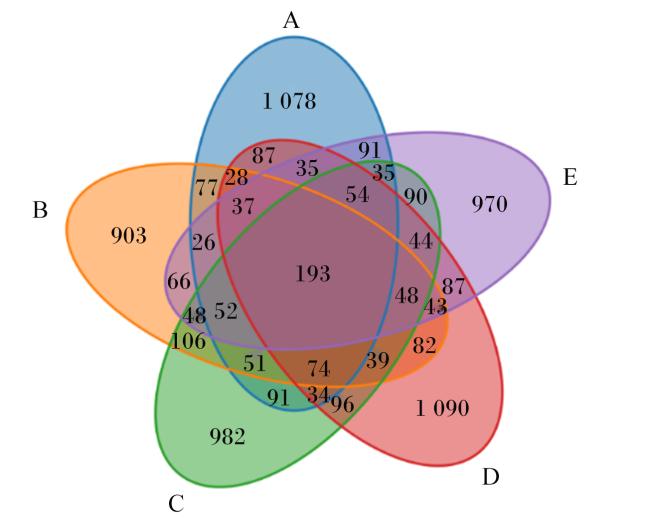
图1所示,5组肉兔盲肠菌群共发现9 943个OTU,共有193个OTU,其中0%MC组有2 043个OTU,特有1 078个OTU;25%MC组有1 873个OTU,特有903个OTU;50%MC组有2 037个OTU,特有982个OTU;75%MC组有2 071个OTU,特有1 090个OTU;100%MC组有1 919个OTU,特有970个OTU。
图1 肉兔盲肠菌群OTU韦恩图

A、B、C、D和E分别代表0%MC组、25%MC组、50%MC组、75%MC组和100%MC组。下图同。

Fig.1 Venn diagram of OTU in cecal microbiota of meat rabbits

A, B, C, D and E represented 0%MC group, 25%MC group, 50%MC group, 75%MC group and 100%MC group, respectively. The same as below.

2.4.2 alpha多样性分析

表8可知,各组肉兔盲肠内容物菌群Coverage指数均大于99%,说明样品的测序数量可以反映肉兔盲肠内容物的菌群情况。各组间肉兔盲肠菌群OTU指数、ACE指数、Chao1指数、Simpson指数、Shannon指数和PD_whole_tree指数均无显著差异(P>0.05),表明饲粮中添加不同机采棉渣与甜高粱混合比例发酵饲料对肉兔盲肠菌群alpha多样性无显著影响。不过,从数值上看,25%MC组、50%MC组、75%MC组和100%MC组ACE指数、Chao1指数和Shannon指数均高于0%MC组。
表8 肉兔盲肠菌群alpha多样性分析

Table 8 Alpha diversity analysis of cecal microbiota of meat rabbits

项目
Items
组别Groups P
P-value
0%MC 25%MC 50%MC 75%MC 100%MC
OTU指数
OTU index
799.33
±108.06
879.67
±12.33
841.00
±32.92
911.00
±73.55
868.67
±25.67
0.758
ACE指数
ACE index
805.66
±110.28
887.19
±12.01
847.37
±31.78
918.29
±72.83
876.22
±25.74
0.756
Chao1指数
Chao1 index
801.34
±108.91
881.86
±12.34
842.75
±32.46
913.15
±72.95
870.71
±25.45
0.758
PD_whole_tree指数
PD_whole_tree index
57.94
±3.03
58.19
±1.65
57.19
±2.05
59.00
±4.50
56.26
±1.23
0.962
Shannon指数
Shannon index
7.86
±0.42
8.27
±0.06
8.11
±0.10
8.15
±0.18
8.05
±0.09
0.736
Simpson指数
Simpson index
0.990
±0.003
0.993
±0.001
0.991
±0.002
0.992
±0.001
0.990
±0.001
0.669
Coverage指数
Coverage index
0.999 7
±0.000 1
0.999 7
±0.000 1
0.999 7
±0.000 1
0.999 7
±0.000 1
0.999 7
±0.000 1
0.977

2.4.3 在门和属水平上组成分析

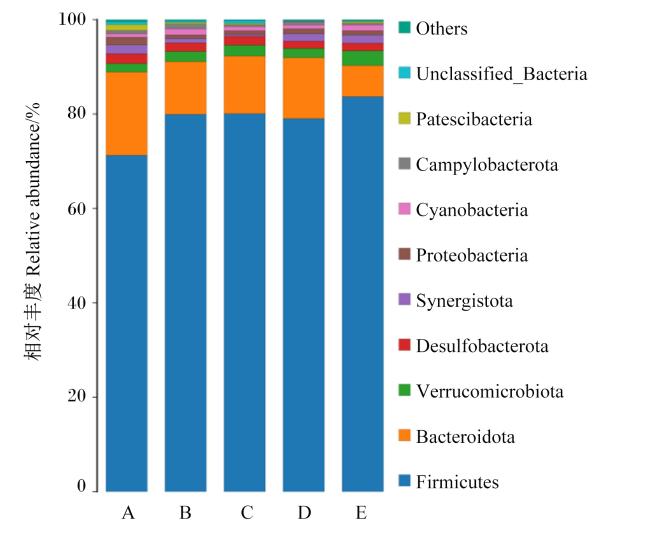
图2所示,各组肉兔盲肠菌群中的主要优势菌门为厚壁菌门(Firmicutes)和拟杆菌门(Bacteroidota)。其中,25%MC组、50%MC组、75%MC组和100%MC组盲肠厚壁菌门相对丰度为78.97%~83.67%,0%MC组厚壁菌门相对丰度仅为71.47%,表明发酵机采棉渣对肉兔盲肠优势菌群相对丰度的提高有促进作用。
图2 肉兔盲肠菌群在门水平上的组成

Firmicutes:厚壁菌门;Bacteroidota:拟杆菌门;Verrucomicrobiota:疣微菌门;Desulfobacterota:脱硫杆菌门;Synergistota:互养菌门;Proteobacteria:变形菌门;Cyanobacteria:蓝细菌门;Campylobacterota:弯曲菌门;Patescibacteria:髌骨菌门;Unclassified_Bacteria:未分类菌门;Others:其他。

Fig.2 Composition of cecal microbiota of meat rabbits at phylum level

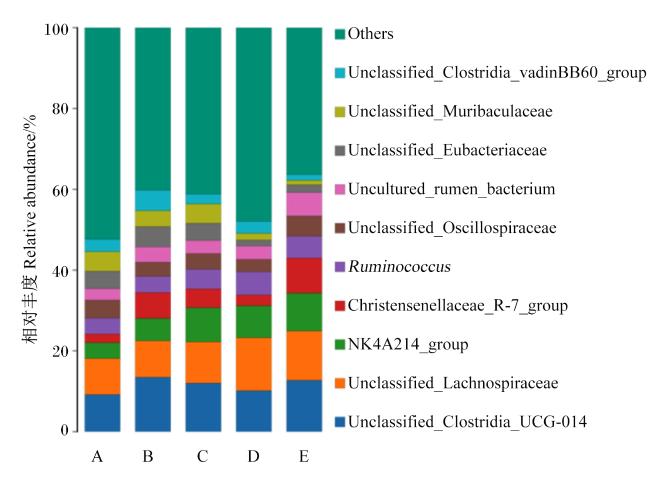
图3所示,未分类梭菌纲UGG-014(unclassified_Clostridia_UCG-014)和未分类毛螺菌科(unclassified_Lachnospiraceae)是肉兔盲肠菌群在属水平上的主要菌群,两者相对丰度之和为18.43%~24.87%。其中,未分类梭菌纲UGG-014是盲肠菌群第1大类菌属,平均相对丰度为11.55%;未分类毛螺菌科排在第2位,平均相对丰度为10.74%。
图3 肉兔盲肠菌群在属水平上的组成

Unclassified_Clostridia_UCG-014:未分类梭菌纲UGG-014;Unclassified_Lachnospiraceae:未分类毛螺菌科;NK4A214_group:NK4A214群;Christensenellaceae_R-7_group:克里斯腾森菌科R-7群;Ruminococcus:瘤胃球菌属;Unclassified_Oscillospiraceae:未分类颤螺菌科;Uncultured_rumen_bacterium:未培养瘤胃细菌;Unclassified_Eubacteriaceae:未分类真杆菌科;Unclassified_Muribaculaceae:未分类鼠杆菌科;Unclassified_Clostridia_vadinBB60_group:未分类梭菌纲vadinBB60群;Others:其他。

Fig.3 Composition of cecal microbiota of meat rabbits at genus level

3 讨论

3.1 饲粮中添加不同机采棉渣与甜高粱混合比例发酵饲料对肉兔生长性能的影响

已有多项研究表明,饲料在发酵过程中,经过微生物代谢,会产生大量的有机酸、小肽和消化酶[10],使营养物质分子质量降低[11],适口性及消化率得到改善[12-13]。ADG和F/G是衡量生长性能的重要指标。本试验中,0%MC组肉兔ADG低于其他4组,100%MC组ADG和F/G劣于75%MC组,这与发酵饲料中机采棉渣比例有关。李与琦等[14]研究发现,饲粮中添加50%微贮棉秆能提高湖羊ADG,且对瘤胃微生物多样性、菌群结构及功能的影响较小。本试验中,随着发酵饲料中机采棉渣比例的提高,肉兔ADG先升高后降低,F/G先降低后升高,结合盲肠菌群可以得出,适宜比例机采棉渣与甜高粱经过微生物发酵后,降解了饲料中的有害因子含量,改善了肠道菌群,促进了营养物质消化吸收,提高了饲料利用率。

3.2 饲粮中添加不同机采棉渣与甜高粱混合比例发酵饲料对肉兔血清生化指标的影响

血清生化指标是评估动物营养代谢和健康状况的重要参数[15-17]。本研究结果显示,50%MC组和75%MC组肉兔血清ALB和TP含量显著高于其他组。TP和ALB是反映机体蛋白质代谢和免疫功能的重要指标[18],其含量升高表明50%MC组和75%MC组发酵饲料有效增强了肉兔的蛋白质代谢能力,有利于肉兔生长发育。这一积极影响可能源于发酵过程中微生物对机采棉渣和甜高粱中抗营养因子(如棉酚)的有效降解[19],以及发酵产生的易吸收的小肽和游离氨基酸,这些代谢产物能更好地支持肝脏蛋白质合成[19-20]
同时,0%MC组和25%MC组血清ALT活性显著高于其他组。ALT通常用于评估肝脏功能和损伤[16]。ALT活性升高表明肝细胞可能受到损伤或发生病变,影响肝脏代谢。这可能与发酵甜高粱中残留的抗营养因子(如单宁)对肝脏的潜在损伤有关[21]。而高比例机采棉渣组(50%MC组、75%MC组和100%MC组)血清ALT活性较低说明混合发酵,特别是高比例机采棉渣的加入,可能通过稀释甜高粱中的有害成分并促进其降解,从而有效减轻了肝脏代谢负担。
血清TG和TC含量反映机体对饲粮脂肪的吸收和代谢状况[22]。本试验结果显示,100%MC组肉兔血清TG含量显著低于其他组,这可能与饲粮中脂肪酸组成不平衡有关[23]。0%MC组血清TC含量显著低于25%MC组和50%MC组,结合已有研究表明甜高粱(及其青贮)中的单宁成分具有降低胆固醇的作用[24-26],提示发酵甜高粱可能对肉兔血清胆固醇水平有调节作用。

3.3 饲粮中添加不同机采棉渣与甜高粱混合比例发酵饲料对肉兔血清免疫指标的影响

血清免疫球蛋白含量是评估动物体液免疫功能的重要指标[27-28],其中IgG是主要的抗感染抗体[29]。本研究发现,高比例甜高粱组(0%MC、25%MC和50%MC)肉兔血清IgG含量显著低于低比例甜高粱组(75%MC组和100%MC组),且单独甜高粱组(0%MC组)血清IgA含量显著低于其他4组,表明发酵甜高粱可能损害肉兔免疫功能,而混合发酵特别是提高机采棉渣比例能够显著提升机体免疫水平。这一结果与前人关于甜高粱青贮抑制奶牛IgA的研究结果[23]一致,但与在棉茬地放牧导致山羊免疫抑制的研究结果[30]相反。这可能是因为机采棉渣经过与甜高粱混合发酵后,其中的棉酚和脱叶剂残留被枯草芽孢杆菌等微生物有效降解,从而减轻了其对免疫系统的抑制作用。此外,血清IgG含量随机采棉渣比例的提高呈现先升高后降低的变化趋势,并在75%MC组达到最高,这提示可能存在一个适宜的机采棉渣比例能最大程度地发挥发酵降解和营养改善的协同效应,但其具体作用机制尚需深入研究。

3.4 饲粮中添加不同机采棉渣与甜高粱混合比例发酵饲料对肉兔盲肠菌群的影响

兔的盲肠是重要的发酵场所,其微生物群落结构和多样性对消化吸收和机体健康至关重要[31-32]。发酵饲料已被证明能调节肠道微生物群落[33-35]。本研究中,alpha多样性分析结果显示,添加机采棉渣的各组(25%MC组、50%MC组、75%MC组和100%MC组)肉兔盲肠菌群ACE指数、Chao1指数和Shannon指数在数值上均高于单独甜高粱组(0%MC组)。结合棉渣抗营养因子经微生物发酵后被降解[19],表明混合发酵饲料并未对肉兔盲肠微生物多样性产生不利影响。添加机采棉渣的各组盲肠优势菌门厚壁菌门和拟杆菌门相对丰度之和均超过90%,均高于单独甜高粱组的88%。厚壁菌门和拟杆菌门是主要的纤维素降解菌和碳水化合物代谢菌[36],对肉兔高效利用植物纤维和维持肠道稳态至关重要[37],这说明机采棉渣发酵饲料对增加盲肠优势菌、调节肠道健康有潜在的正向调节作用。

4 结论

饲粮中添加适宜机采棉渣与甜高粱混合比例发酵饲料能提高伊拉肉兔生长性能,改善机体蛋白质代谢,增强免疫功能,并促进盲肠纤维降解菌增殖,建议机采棉渣与甜高粱混合发酵比例为75∶25。
[1]
夏咏宏. 浅析机采棉清理加工的质量技术要点[J]. 中国纤检, 2019(4):38-39.

XIA Y H. The key points of cleaning and processing technology for machine-picked cotton quality[J]. China Fiber Inspection, 2019(4):38-39. (in Chinese)

[2]
ZHANG Z W, YANG H H, GAO Z H, et al.Identification,synthesis,and safety assessment of thidiazuron [1-phenyl-3-(1,2,3-thidiazol-5-yl) urea] and its metabolites in kiwifruits[J]. Journal of Agricultural and Food Chemistry, 2017, 65(51):11273-11279.

[3]
RAN T, TANG S X, YU X, et al. Diets varying in ratio of sweet sorghum silage to corn silage for lactating dairy cows:feed intake,milk production,blood biochemistry,ruminal fermentation,and ruminal microbial community[J]. Journal of Dairy Science, 2021, 104(12):12600-12615.

[4]
AMEEN M, MAHMOOD A, SHAHZAD A N, et al. Sorghum’s potential unleashed:a comprehensive exploration of bio-energy production strategies and innovations[J]. Bioresource Technology Reports, 2024,27:101906.

[5]
冯涛, 唐海洋, 杨文祥, 等. 甜高粱凋萎青贮和混合青贮对发酵品质及营养成分保存效果的影响[J]. 南京农业大学学报, 2019, 42(2):352-357.

FENG T, TANG H Y, YANG W X, et al. Effects of wilting and mixing silage straw on fermentation quality and nutrients preservation of sweet sorghum silage[J]. Journal of Nanjing Agricultural University, 2019, 42(2):352-357. (in Chinese)

[6]
陈颜旭, 郭同军, 古再丽努尔·艾麦提, 等. 万寿菊粕饲料资源开发利用进展[J]. 中国饲料, 2023(3):137-142.

CHEN Y X, GUO T J, GUZALNUR A, et al. Progress in development and utilization of feed resources of marigold meal[J]. China Feed, 2023(3):137-142. (in Chinese)

[7]
官瑞, 张俊瑜. 微生物处理对棉花秸秆发酵品质影响的研究进展[J]. 饲料研究, 2021, 44(7):146-148.

GUAN R, ZHANG J Y. Research progress on the influence of microbial treatment on the fermentation quality of cotton straw[J]. Feed Research, 2021, 44(7):146-148. (in Chinese)

[8]
ALDAS-VARGAS A, POURSAT B A J, SUTTON N B. Potential and limitations for monitoring of pesticide biodegradation at trace concentrations in water and soil[J]. World Journal of Microbiology and Biotechnology, 2022, 38(12):240.

[9]
商文贤, 徐宏英, 王俊伟, 等. 有机氯农药的微生物降解[J]. 化学与生物工程, 2022, 39(3):12-18.

SHANG W X, XU H Y, WANG J W, et al. Microbial degradation of organochlorine pesticides[J]. Chemistry & Bioengineering, 2022, 39(3):12-18. (in Chinese)

[10]
TANG J W, SUN H, YAO X H, et al. Effects of replacement of soybean meal by fermented cottonseed meal on growth performance,serum biochemical parameters and immune function of yellow-feathered broilers[J]. Asian-Australasian Journal of Animal Sciences, 2012, 25(3):393-400.

[11]
邹峰余, 贾冰玉, 罗智, 等. 发酵棉籽粕对黄颡鱼生长性能、表观消化率和肠道健康的影响[J]. 水产学报, 2025, 49(3):188-201.

ZOU F Y, JIA B Y, LUO Z, et al. Effects of fermented cottonseed meal on growth performance,apparent digestibility and intestinal health of yellow catfish (Pelteobagrus fulvidraco)[J]. Journal of Fisheries of China, 2025, 49(3):188-201. (in Chinese)

[12]
NI K K, ZHAO J Y, ZHU B G, et al. Assessing the fermentation quality and microbial community of the mixed silage of forage soybean with crop corn or sorghum[J]. Bioresource Technology, 2018,265:563-567.

[13]
任鑫茹, 赵宏璐, 李雅静, 等. 混菌低温发酵对玉米秸秆黄贮饲料品质的影响[J]. 生物技术通报, 2025, 41(3):330-342.

DOI

REN X R, ZHAO H L, LI Y J, et al. Impact of low-temperature fermentation with mixed microbial agent on the quality of corn straw yellow silage feeds[J]. Biotechnology Bulletin, 2025, 41(3):330-342. (in Chinese)

[14]
李与琦, 阳建华, 张涛, 等. 日粮中添加不同比例微贮棉秆对湖羊瘤胃微生物区系的影响[J]. 微生物学报, 2020, 60(8):1592-1604.

LI Y Q, YANG J H, ZHANG T, et al. Effect of different proportions fermented cotton stalk intake on rumen microflora of lambs[J]. Acta Microbiologica Sinica, 2020, 60(8):1592-1604. (in Chinese)

[15]
VICARI T, VAN DEN BORNE J J G C, GERRITS W J J, et al. Postprandial blood hormone and metabolite concentrations influenced by feeding frequency and feeding level in veal calves[J]. Domestic Animal Endocrinology, 2008, 34(1):74-88.

PMID

[16]
刘雯雯, 周万海, 胡连清, 等. 饲粮中添加油樟叶对肉兔生长性能、屠宰性能、肌肉品质、器官指数和血清生化指标的影响[J]. 动物营养学报, 2023, 35(4):2533-2545.

DOI

LIU W W, ZHOU W H, HU L Q, et al. Effects of dietary Cinnamomum longepaniculatum leaves on growth performance,slaughter performance,muscle quality,organ indices and serum biochemical indices of meat rabbits[J]. Chinese Journal of Animal Nutrition, 2023, 35(4):2533-2545. (in Chinese)

[17]
李建房, 王汝都, 赵鹏力, 等. 甘草多糖对断奶仔猪生长性能、血常规、血清生化指标及抗氧化性能的影响[J]. 饲料工业, 2022, 43(13):32-37.

LI J F, WANG R D, ZHAO P L, et al. Effects of glycyrrhiza polysaccharide on growth performance,blood routine,serum biochemical indexes and antioxidant performance of weaned piglets[J]. Feed Industry, 2022, 43(13):32-37. (in Chinese)

[18]
XU X, LI L M, LI B, et al. Effect of fermented biogas residue on growth performance,serum biochemical parameters,and meat quality in pigs[J]. Asian-Australasian Journal of Animal Sciences, 2017, 30(10):1464-1470.

[19]
汤江武, 吴逸飞, 孙宏, 等. 发酵棉粕对肉鸡生长性能、血清生化指标及免疫功能的影响[J]. 中国畜牧杂志, 2011, 47(5):29-34.

TANG J W, WU Y F, SUN H, et al. Effects of fermented cottonseed meal on growth performance,serum biochemical parameters and immunity of broilers[J]. Chinese Journal of Animal Science, 2011, 47(5):29-34. (in Chinese)

[20]
LIU J C, LUO Y Q, ZHANG X Y, et al. Effects of bioactive peptides derived from cottonseed meal solid-state fermentation on the growth,metabolism,and immunity of yellow-feathered broilers[J]. Animal Science Journal, 2022, 93(1):e13781.

[21]
许能祥, 董臣飞, 张文洁, 等. 甜高粱凋萎青贮料在肉兔全混日粮中适宜添加量的研究[J]. 草业学报, 2017, 26(12):194-202.

DOI

XU N X, DONG C F, ZHANG W J, et al. The suitable addition amount of sweet sorghum wilted silage in the total mixed ration of rabbits[J]. Acta Prataculturae Sinica, 2017, 26(12):194-202. (in Chinese)

[22]
陈颜旭, 郭同军, 古再丽努尔·艾麦提, 等. 饲粮添加万寿菊粕对绵羊生长性能、瘤胃发酵参数和血清生化指标的影响[J]. 动物营养学报, 2023, 35(1):403-413.

DOI

CHEN Y X, GUO T J, GUZALNUR A, et al. Effects of dietary marigold meal on growth performance,rumen fermentation parameters and serum biochemical indices of sheep[J]. Chinese Journal of Animal Nutrition, 2023, 35(1):403-413. (in Chinese)

[23]
玉霞. 甜高粱青贮对奶牛生产性能、血液生化指标及瘤胃功能的影响[D].硕士学位论文. 通辽: 内蒙古民族大学, 2020:27.

YU X. Effects of sweet sorghum silage on the performance,blood biochemical and rumen function of dairy cows[D].Master’s Thesis. Tongliao: Inner Mongolia Minzu University, 2020:27. (in Chinese)

[24]
阿依古丽·艾买尔. 甜高粱与苜蓿混贮对卡羊生长性能、血液生化及肉质的影响[D].硕士学位论文. 阿拉尔: 塔里木大学, 2020:35-36.

AYGUL A. Effects of sweet sorghum and alfalfa mixed storage on growth performance,blood biochemistry and meat quality of Karakul sheep[D].Master’s Thesis. Aral: Tarim University, 2020:35-36. (in Chinese)

[25]
张霞, 付晓悦, 王虎成, 等. 饲用甜高粱裹包青贮料对肉羊生产性能及血清指标的影响[J]. 动物营养学报, 2018, 30(5):1771-1780.

ZHANG X, FU X Y, WANG H C, et al. Effects of packaging forage sweet sorghum silage on performance and serum indexes of mutton sheep[J]. Chinese Journal of Animal Nutrition, 2018, 30(5):1771-1780. (in Chinese)

[26]
LI X X, PU Y J, LIU B D, et al. Biochemistry and transcriptome analysis reveal condensed tannins alleviate liver injury induced by regulating cholesterol metabolism pathway[J]. Food Science and Human Wellness, 2024, 13(2):909-919.

[27]
刘玮, 韩海霞, 曹顶国, 等. α-多肽菌素对科宝500肉鸡生产性能、免疫指标、血清生化指标和抗氧化性能的影响[J]. 中国家禽, 2018, 40(4):29-35.

LIU W, HAN H X, CAO D G, et al. Effect of α-polypeptin on growth performance,immune indexes,serum biochemical indexes and antioxidant properties of Cobb 500 broilers[J]. China Poultry, 2018, 40(4):29-35. (in Chinese)

[28]
李燕舞, 姜八一, 刘建胜, 等. 杜仲叶提取物对肉兔生长性能及血清生化、免疫与抗氧化指标的影响[J]. 动物营养学报, 2019, 31(2):824-830.

LI Y W, JIANG B Y, LIU J S, et al. Effects of Eucommia ulmoides leaf extracts on growth performance,serum biochemical,immune and antioxidant indexes of meat rabbits[J]. Chinese Journal of Animal Nutrition, 2019, 31(2):824-830. (in Chinese)

[29]
李晶晶. 浅谈免疫球蛋白在免疫中的作用[J]. 中国畜禽种业, 2018, 14(2):85.

LI J J. Brief discussion on the role of immunoglobulins in immunity[J]. The Chinese Livestock and Poultry Breeding, 2018, 14(2):85. (in Chinese)

[30]
邹琳, 哈丽代·热合木江,艾比布拉·伊马木.棉茬地放牧对新疆山羊生产性能及组织结构的影响[J]. 新疆农业科学, 2018, 55(8):1551-1559.

DOI

ZOU L, HALIDAI R, AIBIBULA Y. Effects of grazing on cotton stubble fields on production performance and tissue structure of Xinjiang goats[J]. Xinjiang Agricultural Sciences, 2018, 55(8):1551-1559. (in Chinese)

DOI

[31]
NEWBOLD C J, RAMOS-MORALES E. Review:ruminal microbiome and microbial metabolome:effects of diet and ruminant host[J]. Animal, 2020, 14(Suppl.1):S78-S86.

[32]
ZHOU Z M, FANG L, MENG Q X, et al. Assessment of ruminal bacterial and archaeal community structure in yak (Bos grunniens)[J]. Frontiers in Microbiology, 2017,8:179.

[33]
齐聪岩, 李红亚, 王树香, 等. 发酵玉米秸秆对獭兔生长性能的影响及其促生长机理的研究[J]. 中国畜牧兽医, 2017, 44(7):2003-2008.

DOI

QI C Y, LI H Y, WANG S X, et al. Effect of fermented corn stalks on growth performance and the growth promotion mechanism in otter rabbit[J]. China Animal Husbandry & Veterinary Medicine, 2017, 44(7):2003-2008. (in Chinese)

[34]
孙海涛, 杨丽萍, 姜文学, 等. 发酵豆粕对断奶-2月龄肉兔生长发育、血清生化及肠道发育的影响[J]. 山东农业科学, 2017, 49(8):131-135.

SUN H T, YANG L P, JIANG W X, et al. Effects of fermented soybean meal on growth performance,serum biochemistry and intestinal development of weaner to two-month-old growing meat rabbits[J]. Shandong Agricultural Sciences, 2017, 49(8):131-135. (in Chinese)

[35]
吴灵丽, 张凯, 宋献艺, 等. 发酵苹果渣对獭兔生长性能、养分消化率、小肠黏膜形态及分泌型免疫球蛋白A浓度的影响[J]. 动物营养学报, 2019, 31(4):1857-1863.

WU L L, ZHANG K, SONG X Y, et al. Effects of fermented apple pomace on growth performance,nutrient digestibility,intestinal mucosal morphology and secretory immunoglobulin concentration of Rex rabbits[J]. Chinese Journal of Animal Nutrition, 2019, 31(4):1857-1863. (in Chinese)

[36]
MONTEILS V, CAUQUIL L, COMBES S, et al. Potential core species and satellite species in the bacterial community within the rabbit caecum[J]. FEMS Microbiology Ecology, 2008, 66(3):620-629.

DOI PMID

[37]
WU Z Y, ZHOU H L, LI F C, et al. Effect of dietary fiber levels on bacterial composition with age in the cecum of meat rabbits[J]. MicrobiologyOpen, 2019, 8(5):e00708.

Outlines

/