1 材料与方法
1.1 ZEN毒性作用靶点筛选与信号通路分析
1.2 候选化合物筛选
1.3 “化合物-靶点”网络构建
1.4 毒性核心靶点筛选与分子对接
1.5 “靶点-化合物-中药”网络构建及中药频数分析
2 结果与分析
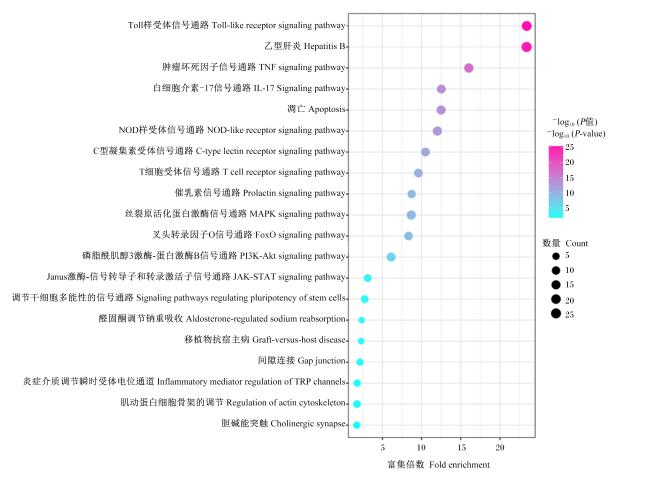
2.1 ZEN毒性作用靶点与毒性可能机制
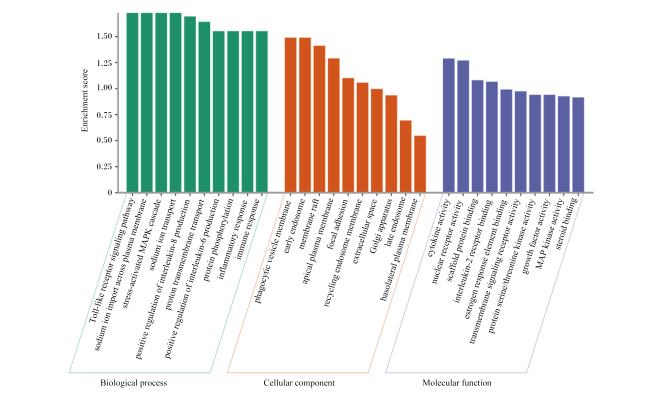
图1 GO功能富集分析Enrichment score:富集得分;Biological process:生物过程;Cellular component:细胞组分;Molecular function:分子功能;Toll-like receptor signaling pathway:Toll样受体信号通路;sodium ion import across plasma membrane:钠离子跨质膜内流;stress-activated MAPK cascade:应激激活的丝裂原活化蛋白激酶级联反应;sodium ion transport:钠离子转运;positive regulation of interleukin-8 production:白细胞介素-8生成的正向调控;proton transmembrane transport:质子跨膜转运;positive regulation of interleukin-6 production:白细胞介素-6生成的正向调控;protein phosphorylation:蛋白质磷酸化;inflammatory response:炎症反应;immune response:免疫反应;phagocytic vesicle membrane:吞噬泡膜;early endosome:早期内体;membrane raft:膜筏;apical plasma membrane:顶侧质膜;focal adhesion:黏着斑;recycling endosome membrane:循环内体膜;extracellular space:细胞外间隙;Golgi apparatus:高尔基体;late endosome:晚期内体;basolateral plasma membrane:基底外侧质膜;cytokine activity:细胞因子活性;nuclear receptor activity:核受体活性;scaffold protein binding:支架蛋白结合;interleukin-2 receptor binding:白细胞介素-2受体结合;estrogen response element binding:雌激素反应元件结合;transmembrane signaling receptor activity:跨膜信号受体活性;protein serine/threonine kinase activity:蛋白丝氨酸/苏氨酸激酶活性;growth factor activity:生长因子活性;MAP kinase activity:MAP激酶活性;steroid binding:类固醇结合。 Fig.1 GO functional enrichment analysis |
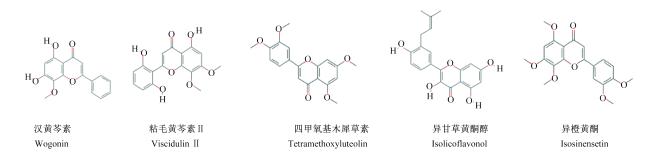
2.2 候选化合物及其与毒性作用靶点的关系
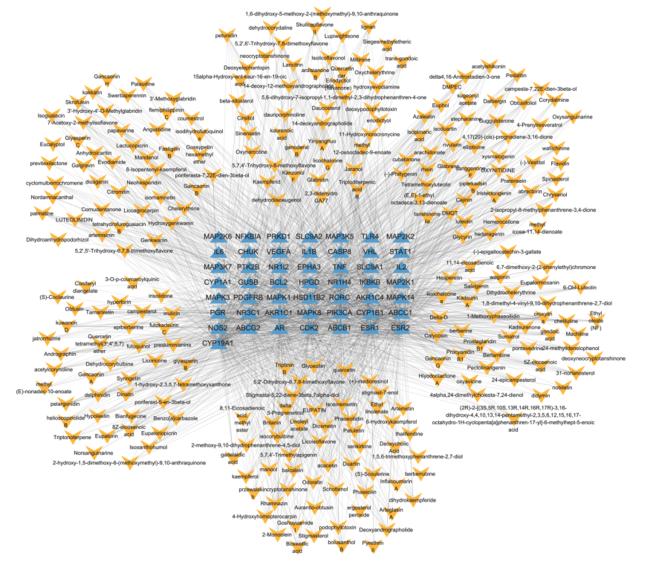
图3 化合物-靶点网络图橙色箭形代表候选化合物,蓝色三角形代表潜在靶点,连线代表两者之间存在相互联系。 Fig.3 Compound-target network diagram Orange arrow represents the candidate compound, blue triangle represents the potential target, and connecting line represents the mutual connection between the two. |
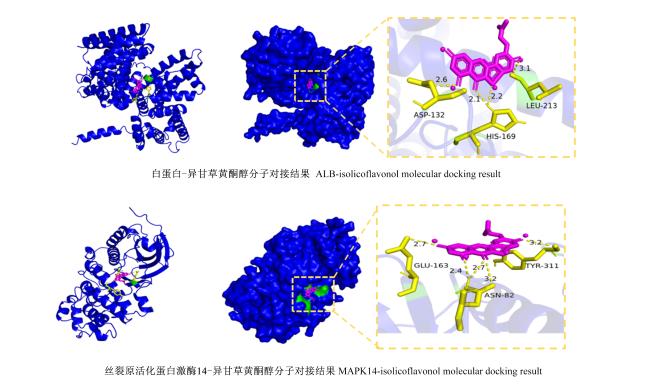
2.3 分子对接结果
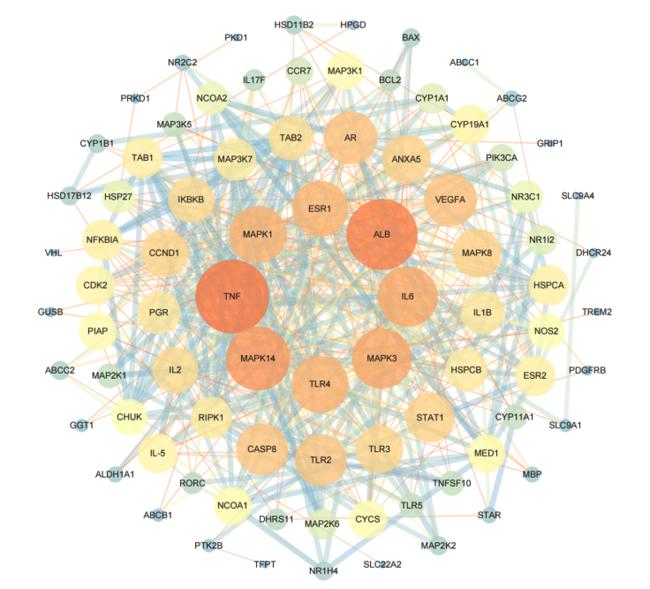
表1 靶点与化合物分子对接结果Table 1 Molecular docking results of targets with compounds |
| 项目 Items | 结合自由能Binding free energy/(kcal/mol) | |||||
|---|---|---|---|---|---|---|
| 肿瘤坏 死因子 TNF | 白蛋白 ALB | 丝裂原活化 蛋白激酶14 MAPK14 | 白细胞 介素-6 IL-6 | Toll样 受体4 TLR4 | 雌激素 受体1 ESR1 | |
| 汉黄芩素Wogonin | -5.14 | -6.09 | -5.93 | -5.21 | -6.30 | -5.62 |
| 粘毛黄芩素Ⅱ Viscidulin Ⅱ | -5.72 | -6.62 | -6.70 | -3.48 | -6.42 | -6.00 |
| 四甲氧基木犀草素 Tetramethoxyluteolin | -4.35 | -6.10 | -5.27 | -4.38 | -4.33 | -5.36 |
| 异甘草黄酮醇 Isolicoflavonol | -4.87 | -7.06 | -7.00 | -4.81 | -5.80 | -5.92 |
| 异橙黄酮 Isosinensetin | -3.07 | -3.21 | -3.63 | -2.66 | -3.07 | -2.53 |
2.4 “靶点-化合物-中药”网络
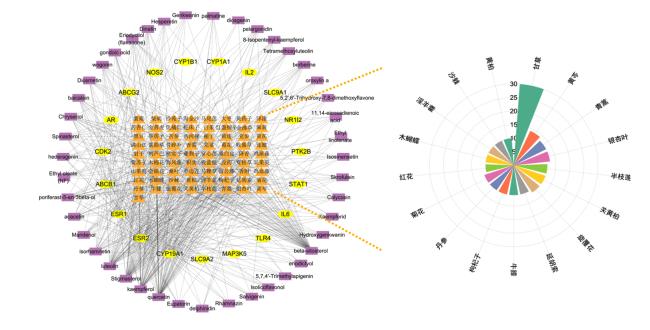
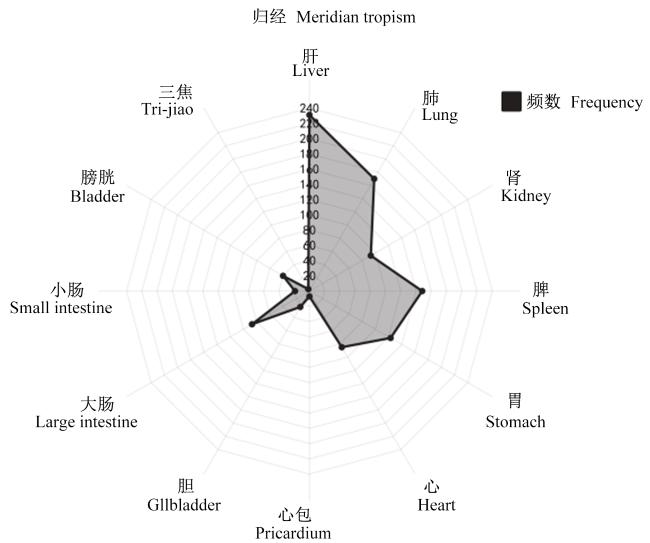
2.5 中药性味归经频数统计
表2 候选中药性味分析Table 2 Property and taste analysis of candidate Chinese herbal medicines |
| 药性 Properties | 频次 Frequency | 占比 Proportion/% | 药味 Tastes | 频次 Frequency | 占比 Proportion/% | |
|---|---|---|---|---|---|---|
| 寒Cold | 162 | 38.03 | 苦Bitter | 250 | 58.69 | |
| 温Warm | 127 | 29.81 | 辛Pungent | 176 | 41.31 | |
| 平Equilibrium | 86 | 20.19 | 甘Sweet | 142 | 33.33 | |
| 凉Cool | 41 | 9.62 | 酸Acid | 30 | 7.04 | |
| 热Heat | 10 | 2.35 | 涩Puckery | 27 | 6.34 | |
| 咸Salty | 17 | 3.99 |