RESEARCH PAPER

Effects of Lactobacillus plantarum ZHR8 Postbiotics on Growth Performance, Intestinal Inflammation and Microorganism of Weaned Piglets

  • WANG Yuanyuan , 1, 2 ,
  • HUAN Hailin , 1, * ,
  • MA Qingquan 2 ,
  • XU Siyan 1 ,
  • LIU Nengwen 1, 2 ,
  • YAN Junshu , 1, *
Expand
  • 1 Key Laboratory of Crop and Livestock Integrated Farming, Ministry of Agriculture and Rural Affairs, Institute of Animal Husbandry, Jiangsu Academy of Agricultural Sciences, Nanjing 210014, China
  • 2 College of Animal Science and Technology, Northeast Agricultural University, Harbin 150030, China
*HUAN Hailin, associate professor, E-mail: ;
YAN Junshu, professor, E-mail:

Received date: 2025-03-26

  Online published: 2025-11-14

Abstract

The purpose of this study was to investigate the effects of different concentrations of Lactobacillus plantarum ZHR8 postbiotics on growth performance, intestinal inflammation, and colonic microorganism in weaned piglets. A total of 120 “Duroc×Landrace×Yorkshire” weaned piglets (half male and half female) with an initial body weight of (10.46±0.22) kg were randomly allocated into 4 groups (3 replicates per group, 10 piglets per replicate): CON group (basic diet), 0.05% ZHR8 group (basic diet+0.05% ZHR8 postbiotic), 0.10% ZHR8 group (basic diet+0.10% ZHR8 postbiotic), 0.20% ZHR8 group (basic diet+0.20% ZHR8 postbiotic), and the trial period was 29 days. The results showed that: 1) compared to the CON group, the average daily gain of weaned piglets in the 0.10% ZHR8 group was significantly increased (P<0.05), and that in the 0.20% ZHR8 group was extremely significantly increased (P<0.01); the final weight of weaned piglets in the 0.20% ZHR8 group was significantly increased (P<0.05), and the feed to gain ratio was significantly decreased (P<0.05). 2) Compared to the CON group, the villus height of the jejunum in the 0.20% ZHR8 group of weaned piglets were increased extremely significantly (P<0.01); the villus/crypt ratio of the jejunum in the 0.10% ZHR8 and 0.2 % ZHR8 groups of weaned piglets was significantly increased (P<0.05). 3) Compared with the CON group, the relative mRNA expression levels of pro-inflammatory factors interleukin-8 (IL-8) and interleukin-12 (IL-12) in the colonic mucosa of weaned piglets in the 0.10% ZHR8 group were significantly decreased (P<0.05); in the 0.20% ZHR8 group, the relative mRNA expression levels of pro-inflammatory factors interferon-γ (IFN-γ) and IL-8 were significantly decreased (P<0.05), while the relative mRNA expression level of anti-inflammatory factor interleukin-10 (IL-10) was significantly increased (P<0.05). 4) Compared to the CON group, the content of valeric acid in the colonic contents of weaned piglets in the 0.10% ZHR8 group was extremely significantly increased (P<0.01); The contents of valeric acid and isovaleric acid in the 0.20% ZHR8 group was extremely significantly increased (P<0.01). 5) The results of 16S rRNA showed that at the genus level, the relative abundance of colon Prevotellaceae_NK3B31_group in the 0.10% ZHR8 and 0.20% ZHR8 groups was significantly decreased (P<0.05), the relative abundance of Alloprevotella was significantly increased (P<0.05), and the relative abundance of Prevotellaceae_UCG-003 in the 0.10% ZHR8 group was significantly increased (P<0.05). Adding 0.10% to 0.20% Lactobacillus plantarum ZHR8 postbiotics to the basal diet can improve the growth performance of weaned piglets, reduce intestinal inflammation, increase the content of volatile fatty acids in intestinal contents, and improve intestinal microbial structure, thereby enhancing the intestinal health of weaned piglets.

Cite this article

WANG Yuanyuan , HUAN Hailin , MA Qingquan , XU Siyan , LIU Nengwen , YAN Junshu . Effects of Lactobacillus plantarum ZHR8 Postbiotics on Growth Performance, Intestinal Inflammation and Microorganism of Weaned Piglets[J]. Chinese Journal of Animal Nutrition, 2025 , 37(11) : 7416 -7428 . DOI: 10.12418/CJAN2025.604

断奶是仔猪生长发育过程中的一个关键阶段,但由于饲粮和环境的改变、消化系统发育不完善等因素,仔猪在断奶过程中可能会出现应激反应,从而影响其免疫反应及肠道健康[1]。据报道,断奶应激对仔猪神经系统功能、肠道屏障功能、免疫功能的影响会持续到育肥期[2]。因此,寻找可以缓解断奶仔猪应激且安全、绿色、高效的饲料添加剂是畜牧业的重点。后生元是对宿主有益的无生命微生物和/或其成分的制剂,包括挥发性脂肪酸(VFAs)、细菌素、肽聚糖及胞外多糖等[3]。Tartrakoon等[4]研究表明,在哺乳期至断奶期添加20 mg/kg热灭活植物乳杆菌、保育期至育肥期添加4 mg/kg热灭活植物乳杆菌能够提高猪的生长性能。Duarte等[5]研究表明,饲粮中添加2 kg/t的乳酸菌后生元可通过调节黏膜相关微生物群和模式识别受体(PRRs)提高猪的免疫能力,减少产肠毒素大肠杆菌诱导肠道黏膜损伤和炎症。Sun等[6]研究表明,饲粮中添加罗伊氏乳杆菌后生元可提高粪便中丙酸和丁酸含量,调节肠道菌群结构。相较于活菌制剂,后生元具有稳定性高、易运输、易储存、无增殖失控风险等优势,且能迅速通过黏液层直接作用于肠道黏膜层[7]。然而,不同浓度的植物乳杆菌代谢物及其组成开发的后生元在断奶仔猪中的应用鲜有报道。因此,本研究旨在探究不同浓度植物乳杆菌ZHR8后生元对断奶仔猪生长性能、肠道炎症及微生物影响,以期为后生元作为新型功能性饲料添加剂在断奶仔猪饲粮中的推广与应用提供理论依据,促进畜牧业绿色转型。

1 材料与方法

1.1 试验材料

试验用植物乳杆菌ZHR8为一株猪源植物乳杆菌,由前期实验室筛选所得,2022年保藏于中国典型培养物保藏中心,保藏编号为CCTCC NO:M 20222002。
植物乳杆菌ZHR8后生元为植物乳杆菌ZHR8经过高密度发酵及干燥灭活后制备的后生元粉剂,制备方法如下:采用2%的接种量,将活化后的植物乳杆菌ZHR8接种于培养基中于37 ℃高密度发酵32 h,将所得发酵液于65 ℃静置30 min。用10%辅美粉混合上述发酵液,喷雾干燥后即为植物乳杆菌ZHR8后生元,其活性成分如表1所示。
表1 植物乳杆菌ZHR8后生元活性成分

Table 1 Active ingredients of Lactobacillus plantarum ZHR8 postbiotic

活性成分Active ingredients 含量Content 单位Unit
细胞数Number of cells 560.00 ×10⁸ CFU/g
乳酸Lactic acid 226.40 mg/g
乙酸Acetic acid 7.13 mg/g
胞外多糖Exopolysaccharides 7.76 mg/g

1.2 试验设计与饲养管理

本试验在江苏和佑瑞安农业发展有限公司金坛猪场进行,试验动物均经江苏省农业科学院动物伦理委员会审查批准(江苏省农业科学院第63号)。
试验选取120头初始体重为(10.46±0.22) kg的“杜×长×大”三元杂交断奶仔猪,随机分为4组:CON组(基础饲粮)、0.05% ZHR8组(基础饲粮+0.05%植物乳杆菌ZHR8后生元)、0.10% ZHR8组(基础饲粮+0.10%植物乳杆菌ZHR8后生元)、0.20% ZHR8组(基础饲粮+0.20%植物乳杆菌ZHR8后生元),每组3个重复,每个重复10头猪(公母各占1/2)。参考《猪营养需要量》(GB/T 39235—2020)配制断奶仔猪基础饲粮,其组成及营养水平见表2。本试验预试期5 d,正试期29 d,试验期间断奶仔猪均在相同饲养管理条件下自由采食和饮水。
表2 基础饲粮组成及营养水平(饲喂基础)

Table 2 Composition and nutrient levels of the basal diet (as-fed basis)%

项目Items 含量Content
原料Ingredients
玉米Corn 48.00
膨化玉米Extruded corn 16.00
大豆粕Soybean meal 12.80
发酵豆粕Fermented soybean meal 7.00
膨化大豆Extruded soybean 9.00
柠檬酸Citric acid 1.80
大豆油Soybean oil 1.50
碳酸氢钙CaHPO4 0.90
石粉Limestone 0.60
氯化钠NaCl 0.30
氯化胆碱Choline chloride (50%) 0.07
L-赖氨酸盐酸盐L-lysine·HCl 0.70
L-苏氨酸L-threonine 0.18
DL-蛋氨酸DL-methionine 0.15
预混料Premix1) 1.00
合计Total 100.00
营养水平Nutrient levels2)
消化能DE/(MJ/kg) 14.70
净能NE/(MJ/kg) 10.20
粗蛋白质CP 18.41
粗脂肪EE 4.31
钙Ca 0.78
总磷TP 0.46
标准回肠可消化氨基酸SID AA3)
赖氨酸Lys 1.08
蛋氨酸Met 0.32
苏氨酸Thr 0.69
色氨酸Trp 0.20
异亮氨酸Ile 0.65
缬氨酸Val 0.77

1)预混料为每千克饲粮提供The premix provided the following per kg of the diet: VA 9 500 IU,VB2 6.00 mg,VK3 4 mg, VB1 3.50 mg,VB6 3.20 mg,VB12 0.06 mg,VD3 1 800 IU,VE 80 IU,烟酸 nicotinic acid 30.00 mg,D-泛酸 D-pantothenic acid 15.00 mg,叶酸 folic acid 1.5 mg,生物素 biotin 0.20 mg,Fe 110 mg,Zn 100 mg,Mn 30 mg,Se 0.3 mg,I 0.25 mg。

3)标准回肠可消化氨基酸根据《猪营养需要量》(GB/T 39235—2020)附录B原料标准回肠消化率计算。SID AA were calculated according to standardized ileal digestibility coefficients from Nutrient Requirements of Swine (GB/T 39235—2020) appendix B.

2)消化能和净能根据《猪营养需要量》(GB/T 39235—2020)计算,粗蛋白质(GB/T 6432—2018)、粗脂肪(GB/T 6433—2006)、钙(GB/T 6436—2018)、总磷(GB/T 6437—2018)为实测值。DE and NE were calculated according to Nutrient Requirements of Swine (GB/T 39235—2020), while CP (GB/T 6432—2018), EE (GB/T 6433—2006), Ca (GB/T 6436—2018) and TP (GB/T 6437—2018) were measured values.

1.3 样品采集与处理

试验第29天,每个重复随机选取2头断奶仔猪屠宰,屠宰前禁食12 h,禁食期间自由饮水。屠宰时采集颈动脉血样置于10 mL乙二胺四乙酸二钾真空采血管中,1 006×g离心10 min分离上清液即为血浆,-20 ℃保存。此外,取2 cm空肠于4%多聚甲醛固定液用于观察组织学特性;取一段结肠冲洗干净后纵向切开,用无菌玻片刮取黏膜组织,-80 ℃保存。

1.4 测定指标与方法

1.4.1 生长性能指标测定

试验开始与结束前12 h禁食,测定并记录各重复断奶仔猪初重、末重。试验期间记录各重复断奶仔猪每天的采食量,计算平均日采食量(ADFI)、平均日增重(ADG)、料重比(F/G)。
ADFI=总采食量/饲养天数;
ADG=(末重-初重)/饲养天数;
F/G=ADFI/ADG。

1.4.2 血浆炎症因子含量测定

使用南京建成生物工程研究所酶联免疫吸附试验(ELISA)试剂盒对血浆白细胞介素-1β(IL-1β)、白细胞介素-8(IL-8)、肿瘤坏死因子-α(TNF-α)、白细胞介素-12(IL-12)和白细胞介素-10(IL-10)含量进行测定,具体测定步骤均按试剂盒说明书进行。

1.4.3 肠道组织学形态

采集空肠中段2 cm,用4%多聚甲醛通用型组织固定液进行固定,制作石蜡切片,观察肠道形态结构,并使用图像分析软件SlideViewer 2.5测量其绒毛高度及隐窝深度。

1.4.4 结肠黏膜炎症因子mRNA相对表达量测定

采用Trizol法提取结肠黏膜总RNA,使用美国Thermo公司NanoDrop超微量分光光度计测定其浓度与纯度。将质量合格的总RNA用反转录试剂盒HiScript Ⅲ RT SuperMix for qPCR (+gDNA wiper)(Vazyme,货号R323-01)反转录为cDNA,-20 ℃存放。采用SYBRGreenI染料法,以β-肌动蛋白(β-actin)为内参,使用美国Thermo公司实时荧光定量PCR仪参照qPCR试剂盒ChamQ Universal SYBR qPCR Master Mix(Vazyme,货号Q711-02)进行实时荧光定量PCR扩增。qPCR反应体系为10 μL:5.0 μL 2× SYBR Green Master Mix,0.2 μL上游引物(10 μmol/L),0.2 μL下游引物(10 μmol/L),1.0 μL cDNA模板和3.6 μL无酶水。反应程序为:95 ℃预变性30 s;随后进行40个循环的95 ℃变性10 s、60 ℃延伸30 s,最后进行熔解曲线分析以确认扩增特异性。使用2-△△Ct法计算目的基因mRNA相对表达量。引物序列见表3
表3 引物序列

Table 3 Primer sequences

基因
Genes
引物序列
Primer sequence (5'—3')
GenBank登录号
GenBank accession number
肿瘤坏死因子-α TNF-α F:GCATCGCCGTCTCCTAC
R:CAGCAAAGTCCAGATAGTC
NM_214022.1
干扰素-γ IFN-γ F:CCATTCAAAGGAGCATGGAT
R:GAGTTCACTGATGGCTTTGC
NM_213948.1
白细胞介素-8 IL-8 F:AGTGGACCCCACTGTGAAAA
R:TACAACCTTCTTCTGCACCCA
X61151.1
白细胞介素-10 IL-10 F:GACCTCATTCCCCAAACAC
R:TGCTATGAAGACAGACAAAC
NM_214041.1
白细胞介素-12 IL-12 F:GGAGTATAAGAAGTACAGAGTGG
R:GATGTCCCTGATGAAGAAGC
NM_214013.1
白细胞介素-18 IL-18 F:AAAATGTCTACTCTCTCCTG
R:ACTCAAACTGTATCTTATCATC
NM_213997.1
β-肌动蛋白β-actin F:CTTCCTGGGCATGGAGTCC
R:GGCGCGATGATCTTGATCTTC
XM_003357928.4

1.4.5 结肠VFAs含量测定

结肠VFAs含量采用气相色谱法分析。具体步骤为:采用偏磷酸法提取结肠内容物中的VFAs,以2-乙基丁酸作为内标液,通过内标法进行测定,色谱条件参考并调整自文献[8];随后通过标准曲线计算各组VFAs含量,并根据样本质量与稀释体积换算为每千克样本中的VFAs含量。

1.4.6 结肠微生物多样性分析

取结肠内容物提取总DNA并测定其浓度及纯度,在16S V3~V4区域进行PCR扩增,4 ℃保存。基于Illumina测序平台对根据特定的扩增区域构建的测序文库进行双末端测序。分析处理经过Reads拼接、过滤、ASVs降噪后得到的有效数据。

1.5 统计分析

采用SPSS 26.0软件对经Excel 2021预处理的试验数据进行统计分析,首先进行方差齐性检验,若满足方差齐性则采用单因素方差分析(one-way ANOVA)及线性和二次曲线趋势分析;当差异显著时,进一步采用Duncan氏多重比较法进行组间比较。P<0.05为差异显著,P<0.01为差异极显著。

2 结果

2.1 饲粮中添加不同浓度植物乳杆菌ZHR8后生元对断奶仔猪生长性能的影响

表4可知,与CON组相比,0.10% ZHR8组断奶仔猪平均日增重显著升高(P<0.05),0.20% ZHR8组断奶仔猪平均日增重极显著升高(P<0.01);0.20% ZHR8组断奶仔猪末重显著升高(P<0.05),料重比显著降低(P<0.05)。与CON组相比,随着植物乳杆菌ZHR8后生元添加浓度的升高,断奶仔猪末重、平均日增重线性升高(P<0.05),料重比线性降低(P<0.05)。
表4 饲粮中添加不同浓度植物乳杆菌ZHR8后生元对断奶仔猪生长性能的影响

Table 4 Effects of adding different concentrations of Lactobacillus plantarum ZHR8 postbiotics in diets on growth performance of weaned piglets

项目
Items
组别Groups SEM PP-value
CON 0.05%
ZHR8
0.10%
ZHR8
0.20%
ZHR8
方差分析
ANOVA
线性
Linear
二次
Quadratic
初重IBW/kg 10.21 10.37 10.44 10.84 1.123 0.775 0.338 0.810
末重FBW/kg 26.42b 26.80b 28.46ab 29.44a 2.340 0.044 0.007 0.728
平均日增重ADG/g 559.13Bb 566.75Bb 621.29ABa 641.68Aa 54.546 0.004 0.001 0.724
平均日采食量ADFI/g 1 056.90 1 048.81 1 060.53 1 077.71 68.337 0.974 0.726 0.789
料重比F/G 1.88a 1.81ab 1.71ab 1.69b 0.116 0.016 0.024 0.685

同行数据肩标无字母或相同字母表示差异不显著(P>0.05),不同小写字母表示差异显著(P<0.05),不同大写字母表示差异极显著(P<0.01)。下表同。

In the same row, values with no letter or the same letter superscripts indicated no significant difference (P>0.05), while with different lowercase letter superscripts indicated significant difference (P<0.05), and with different uppercase letter superscrips indicated extremely significant difference (P<0.01). The same as below.

2.2 饲粮中添加不同浓度植物乳杆菌ZHR8后生元对断奶仔猪血浆炎症因子含量的影响

表5可知,与CON组相比,0.05% ZHR8组、0.20% ZHR8组断奶仔猪血浆IL-12含量显著降低(P<0.05),0.10% ZHR8组断奶仔猪血浆IL-12含量极显著降低(P<0.01);0.10% ZHR8组断奶仔猪血浆TNF-α、IL-1β含量显著降低(P<0.05)。各组断奶仔猪血浆IL-10含量无显著差异(P>0.05)。与CON组相比,随着植物乳杆菌ZHR8后生元添加浓度的升高,断奶仔猪血浆TNF-α含量线性降低(P<0.05),IL-12含量线性降低并呈二次曲线变化(P<0.05)。
表5 饲粮中添加不同浓度植物乳杆菌ZHR8后生元对断奶仔猪血浆炎症因子含量的影响

Table 5 Effects of adding different concentrations of Lactobacillus plantarum ZHR8 postbiotics in diets on plasma inflammatory cytokine contents of weaned pigletsng/L

项目
Items
组别Groups SEM PP-value
CON 0.05%
ZHR8
0.10%
ZHR8
0.20%
ZHR8
方差分析
ANOVA
线性
Linear
二次
Quadratic
肿瘤坏死因子-α TNF-α 735.13ab 749.10a 602.69c 626.08bc 105.297 0.027 0.012 0.903
白细胞介素-1β IL-1β 33.22a 36.71a 24.92b 35.55a 6.373 0.015 0.652 0.146
白细胞介素-8 IL-8 73.43ab 88.38a 49.71b 95.52a 30.751 0.039 0.593 0.191
白细胞介素-12 IL-12 332.40Aa 250.59ABb 193.31Bb 251.12ABb 77.446 0.009 0.016 0.014
白细胞介素-10 IL-10 474.13 407.39 420.24 404.28 117.712 0.765 0.450 0.642

2.3 饲粮中添加不同浓度植物乳杆菌ZHR8后生元对断奶仔猪空肠形态的影响

表6可知,与CON组相比,0.20% ZHR8组断奶仔猪空肠绒毛高度极显著升高(P<0.01);0.10% ZHR8组和0.20% ZHR8组断奶仔猪空肠绒隐比显著升高(P<0.05)。与CON组相比,随着植物乳杆菌ZHR8后生元添加浓度的升高,断奶仔猪空肠绒毛高度、绒隐比线性升高(P<0.05)。
表6 饲粮中添加不同浓度植物乳杆菌ZHR8后生元对断奶仔猪空肠形态的影响

Table 6 Effects of adding different concentrations of Lactobacillus plantarum ZHR8 postbiotics in diets on jejunal morphology of weaned piglets

项目
Items
组别Groups SEM PP-value
CON 0.05%
ZHR8
0.10%
ZHR8
0.20%
ZHR8
方差分析
ANOVA
线性
Linear
二次
Quadratic
绒毛高度Villus height/μm 422.46Bb 444.5Bb 428.52Bb 504.71Aa 59.108 0.008 0.003 0.083
隐窝深度Crypt depth/μm 232.73ab 222.98a 198.82b 229.39ab 36.940 0.008 0.491 0.050
绒隐比V/C 1.85b 2.03ab 2.16a 2.22a 0.308 0.017 0.003 0.478

2.4 饲粮中添加不同浓度植物乳杆菌ZHR8后生元对结肠黏膜炎症因子mRNA相对表达量的影响
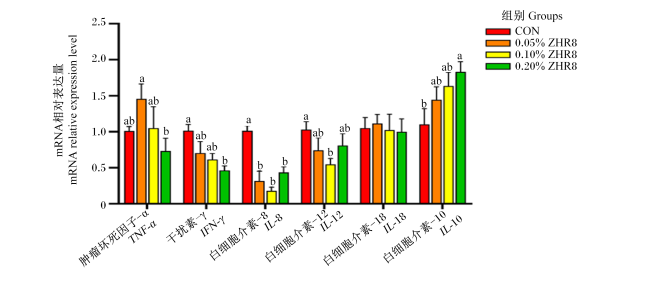
图1可知,与CON组相比,0.05% ZHR8组断奶仔猪结肠黏膜促炎因子IL-8 mRNA相对表达量显著降低(P<0.05);0.10%ZHR8组断奶仔猪结肠黏膜促炎因子IL-8、IL-12 mRNA相对表达量显著降低(P<0.05);0.20% ZHR8组断奶仔猪结肠黏膜促炎因子干扰素-γ(IFN-γ)、IL-8 mRNA相对表达量显著降低(P<0.05),抗炎因子IL-10 mRNA相对表达量显著升高(P<0.05)。
图1 饲粮中添加不同浓度植物乳杆菌ZHR8后生元对断奶仔猪结肠黏膜炎症因子mRNA相对表达量的影响

数据柱标注无字母或相同字母表示差异不显著(P>0.05),不同小写字母表示差异显著(P<0.05)。下图同。

Fig.1 Effects of adding different concentrations of Lactobacillus plantarum ZHR8 postbiotics in diets on mRNA relative expression levels of inflammatory factors in colonic mucosa of weaned piglets

Value bars without letters or with the same letters indicated no significant difference (P>0.05), while with different lowercase letters indicated significant difference (P<0.05). The same as below.

2.5 饲粮中添加不同浓度植物乳杆菌ZHR8后生元对断奶仔猪结肠内容物VFAs含量的影响

表7可知,与CON组相比,0.10% ZHR8组断奶仔猪结肠内容物戊酸含量极显著升高(P<0.01);0.20% ZHR8组戊酸、异戊酸含量极显著升高(P<0.01)。各组断奶仔猪结肠内容物丙酸、丁酸和异丁酸含量均无显著差异(P>0.05)。与CON组相比,随着植物乳杆菌ZHR8后生元添加浓度的升高,断奶仔猪结肠内容物乙酸含量线性升高并呈二次曲线变化(P<0.05),丙酸、丁酸、戊酸、异戊酸含量线性升高(P<0.05)。
表7 饲粮中添加不同浓度植物乳杆菌ZHR8后生元对断奶仔猪结肠内容物VFAs含量的影响

Table 7 Effects of adding different concentrations of Lactobacillus plantarum ZHR8 postbiotics in diets on VFAs contents in colonic contents of weaned pigletsmg/kg

项目
Items
组别Groups SEM PP-value
CON 0.05%
ZHR8
0.10%
ZHR8
0.20%
ZHR8
方差分析
ANOVA
线性
Linear
二次
Quadratic
乙酸Acetic acid 1 304.04ab 1 069.69b 1 330.53ab 1 498.66a 194.111 0.032 0.048 0.030
丙酸Propionic acid 712.90 680.24 755.03 923.74 136.826 0.076 0.025 0.104
丁酸Butyric acid 353.40 444.34 474.04 592.41 123.356 0.150 0.010 0.798
异丁酸Isobutyric acid 151.07 133.40 148.27 173.43 24.072 0.068 0.116 0.056
戊酸Valeric acid 67.55Cc 81.38BCbc 107.04ABab 122.05Aa 26.031 0.004 0.001 0.306
异戊酸Isovaleric acid 194.63Bb 196.33Bb 238.4ABab 270.42Aa 40.070 0.008 0.001 0.948

2.6 饲粮中添加不同浓度植物乳杆菌ZHR8后生元对结肠内容物微生物的影响

2.6.1 α多样性分析

表8可知,与CON组相比,0.05% ZHR8组、0.20% ZHR8组断奶仔猪结肠内容物香农指数、辛普森指数、毗卢均匀度指数显著降低(P<0.05),优势度显著升高(P<0.05)。与CON组相比,随着植物乳杆菌ZHR8后生元添加浓度的升高,断奶仔猪结肠内容物优势度线性升高(P<0.05)。
表8 α多样性指数

Table 8 Alpha diversity indexes

项目
Items
组别Groups SEM PP-value
CON 0.05%
ZHR8
0.10%
ZHR8
0.20%
ZHR8
方差分析
ANOVA
线性
Linear
二次
Quadratic
香农指数Shannon index 7.35a 6.63b 7.48a 6.65b 0.629 0.019 0.205 0.797
辛普森指数Simpson index 0.98a 0.96b 0.98a 0.96b 0.019 0.035 0.259 0.837
Chao1指数Chao1 index 673.78 637.97 674.36 626.12 74.166 0.611 0.455 0.848
优势度Dominance 0.02b 0.04a 0.02b 0.04a 0.019 0.035 0.003 0.687
覆盖率Goods_coverage 1.00 1.00 1.00 1.00 0.000 0.317 0.842 0.515
观测的特征数
Observed_features
660.33 619.00 662.50 605.67 72.190 0.446 0.377 0.801
毗卢均匀度指数
Pielou evenness index
0.79a 0.72b 0.80a 0.72b 0.058 0.009 0.194 0.808

2.6.2 微生物组成分析

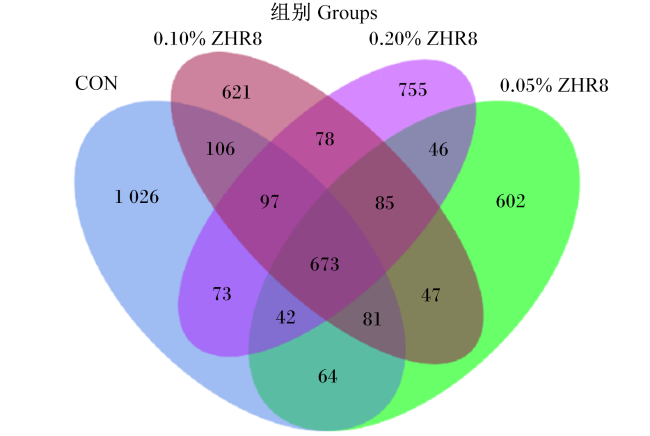
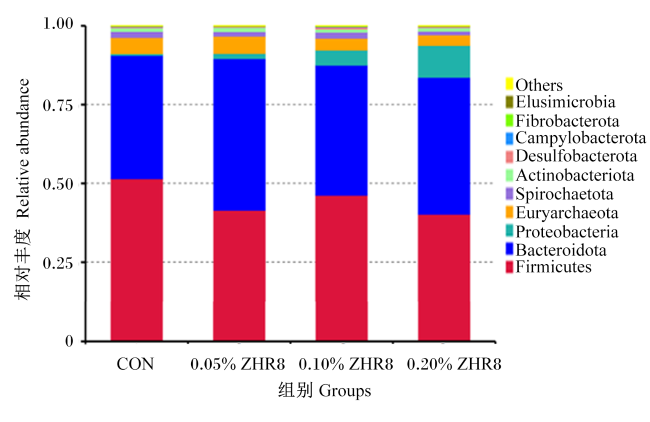
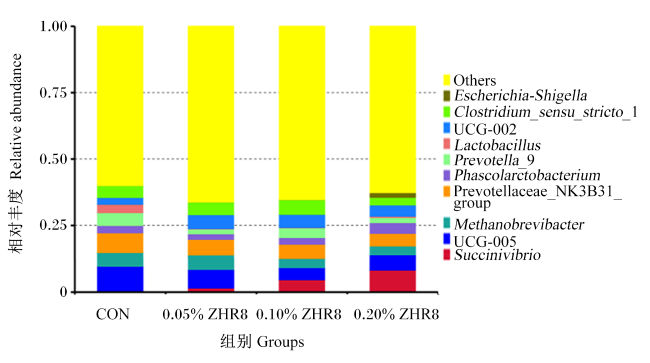
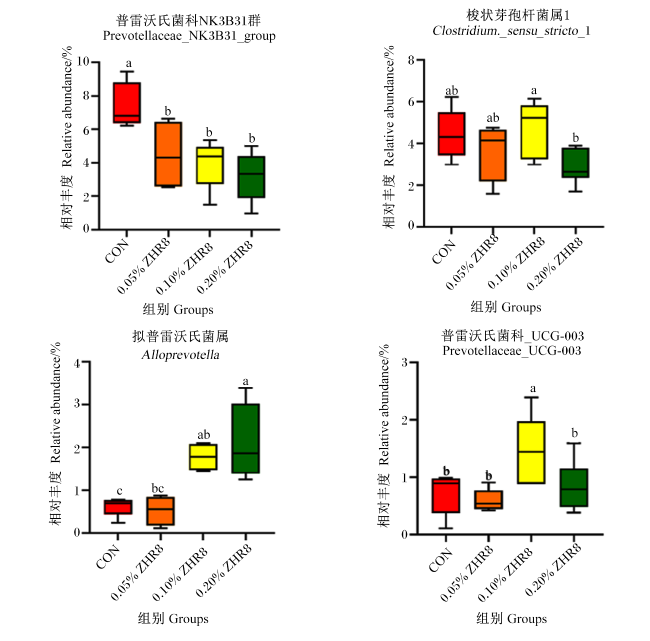
图2可知,CON组断奶仔猪结肠ASVs数量最高,其中各组重叠ASVs为673个。由图3可知,在门水平上,断奶仔猪盲肠产生的ASVs主要由厚壁菌门(Firmicutes)、拟杆菌门(Bacteroidota)、变形菌门(Proteobacteria)、弯曲菌门(Campylobacterota)、广古菌门(Euryarchaeota)、纤维杆菌门(Fibrobacterota)、迷踪菌门(Elusimicrobiota)、脱硫杆菌门(Desulfobacterota)、放线菌门(Actinobacteriota)、螺旋体门(Spirochaetota)组成。由图4可知,在属水平上,断奶仔猪盲肠产生的ASVs主要由琥珀酸弧菌属(Succinivibrio)、UCG-005、甲烷短杆菌属(Methanobrevibacter)、普雷沃氏菌科_NK3B31群(Prevotellaceae_NK3B31_group)、考拉杆菌属(Phascolarctobacterium)、普雷沃氏菌属9(Prevotella_9)、乳杆菌属(Lactobacillus)、UCG-002、梭状芽孢杆菌属1(Clostridium_sensu_stricto_1)、埃希氏菌属-志贺菌属(Escherichia-Shigella)组成。由图5可知,与CON组相比,0.10% ZHR8组、0.20% ZHR8组Prevotellaceae_NK3B31_group相对丰度显著降低(P<0.05),拟普雷沃氏菌属(Alloprevotella)相对丰度显著升高(P<0.05);0.05% ZHR8组Prevotellaceae_NK3B31_group相对丰度显著降低(P<0.05);0.10% ZHR8组Prevotellaceae_UCG-003相对丰度显著升高(P<0.05)。
图2 基于ASVs的Venn图

Fig.2 Venn diagram based on ASVs

图3 门水平上的物种相对丰度柱形图

Firmicutes:厚壁菌门;Bacteroidota:拟杆菌门;Proteobacteria:变形菌门;Euryarchaeota:广古菌门;Spirochaetota:螺旋体门;Actinobacteriota:放线菌门;Desulfobacterota:脱硫菌门;Campylobacterota:弯曲菌门;Fibrobacterota:纤维杆菌门;Elusimicrobia:迷踪菌门; Others:其他。

Fig.3 Histogram of relative abundance of species at phylum level

图4 属水平上的物种相对丰度柱形图

Succinivibrio:琥珀酸弧菌属;Methanobrevibacter:甲烷短杆菌属;Prevotellaceae_NK3B31_group:普雷沃氏菌科_NK3B31群;Phascolarctobacterium:考拉杆菌属;Prevotella_9:普雷沃氏菌属9;Lactobacillus:乳杆菌属;Clostridium_sensu_stricto_1:梭状芽孢杆菌属1;Escherichia-Shigella:埃希氏菌属-志贺菌属;Others:其他。

Fig.4 Histogram of relative abundance of species at genus level

图5 属水平差异微生物

Fig.5 Differential microorganisms at genus level

2.6.3 主成分分析

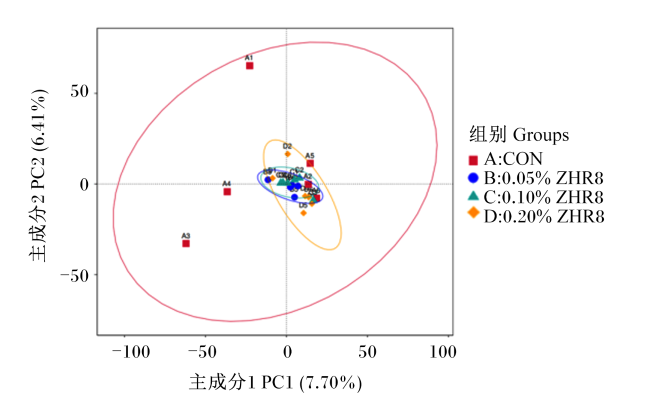
图6可知,主成分1和主成分2对检测到总微生物的代表性贡献率分别为7.70%和6.41%。与CON相比,0.05% ZHR8、0.10% ZHR8、0.20% ZHR8组粪便样点分布更为集中。
图6 主成分分析

Fig.6 Principal component analysis

2.7 断奶仔猪结肠微生物与血浆及结肠炎症因子、结肠VFAs含量的相关性分析
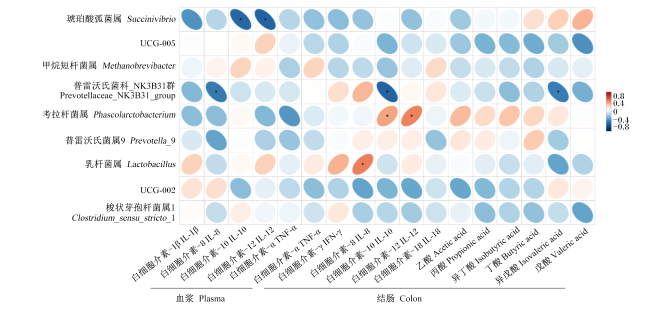
图7可知,Succinivibrio相对丰度与血浆IL-10、IL-12含量呈显著负相关(P<0.05),Prevotellaceae_NK3B31_group相对丰度与血浆IL-8含量、结肠IL-10 mRNA相对表达量、结肠异戊酸含量呈显著负相关(P<0.05),Phascolarctobacterium相对丰度与结肠IL-10、IL-12 mRNA相对表达量呈显著正相关(P<0.05),Lactobacillus相对丰度与结肠IL-8 mRNA相对表达量呈显著正相关(P<0.05)。
图7 结肠微生物与血浆及结肠炎症因子、结肠VFAs含量的斯皮尔曼相关性

热图中每个点的颜色对应Spearman相关分析的相关系数(r)。相关性强度通过色阶呈现:红色系(r>0)表示正相关,蓝色系(r<0)表示负相关,且色彩饱和度与相关系数绝对值成正比。*表示有显著相关性(P<0.05)。

Fig.7 Spearman correlation of colonic microorganisms with plasma and colonic inflammatory factors and colonic VFAs contents

The color of each point in the heat map corresponds to the correlation coefficient (r) of the Spearman correlation analysis. The strength of correlation was presented by color scale: red color system (r>0) indicated positive correlation, blue color system (r<0) indicated negative correlation, and color saturation was positively proportional to the absolute value of the correlation coefficient. * indicated significant correlation (P<0.05).

3 讨论

3.1 植物乳杆菌ZHR8后生元对断奶仔猪生长性能的影响

断奶过程中生长环境及饲粮的变化会导致断奶仔猪的生长性能普遍下降[9]。Shu等[10]研究结果表明,饲粮中添加0.3%~0.4%灭活鼠李糖乳杆菌ILR,断奶仔猪平均日增重可提高18.80%~19.32%,料重比可降低10.76%~12.66%。Miao等[11]研究结果表明,饲粮中添加600 g/t热灭活嗜酸乳杆菌IFFI 6005可以显著降低断奶仔猪料重比。与前人研究结果相似,本研究表明,断奶仔猪饲粮中添加0.10%~0.20%植物乳杆菌ZHR8后生元可显著提高其平均日增重,且添加0.20%植物乳杆菌ZHR8后生元可显著提高断奶仔猪末重,显著降低料重比,从而提高断奶仔猪的生长性能。

3.2 植物乳杆菌ZHR8后生元对断奶仔猪肠道形态的影响

肠道绒毛高度、隐窝深度和绒隐比是评价肠道对营养物质消化吸收能力的重要指标。肠道绒毛高度升高、隐窝深度降低有利于小肠对营养物质的消化吸收,绒隐比升高则表明肠道吸收能力增强。Zhou等[12]研究表明,饲粮中添加0.1%~1.0%板蓝根多糖可线性增加断奶仔猪空肠绒毛高度和绒隐比,线性降低空肠隐窝深度。梁秀丽等[13]研究发现,饲粮中添加抗菌肽可使断奶仔猪肠道绒毛的完整度和密度提升,绒毛高度升高,隐窝深度降低。与前人研究结果相似,本试验结果表明,饲粮中添加0.20%植物乳杆菌ZHR8后生元的断奶仔猪空肠绒毛高度极显著升高;添加0.10%~0.20%植物乳杆菌ZHR8后生元绒隐比显著升高。饲粮中添加0.20%植物乳杆菌ZHR8后生元能更好地刺激肠道上皮细胞增殖,促进空肠绒毛生长,提升断奶仔猪空肠营养吸收能力。

3.3 植物乳杆菌ZHR8后生元对断奶仔猪血浆炎症因子含量及肠道炎症相关mRNA相对表达量的影响

仔猪断奶是养猪过程中的关键环节,断奶时期仔猪的胃肠道发育不完全、免疫力弱,应激反应会导致其肠道屏障受损、腹泻甚至死亡[14]。IL-1β和TNF-α可以通过损害肠道屏障功能导致肠道上皮通透性增加,具有促进组织细胞炎症的作用;IL-10具有拮抗炎症因子产生的作用[15]。Zhang等[16]研究表明,热灭活乳酸菌能够降低LPS诱导的Caco-2细胞中IL-6和IL-8含量的增加。Jin等[17]研究表明,口服热灭活的布拉氏酵母菌可降低DSS诱导的结肠炎小鼠血清TNF-α、IL-1β含量,并抑制结肠中TNF-αIL-1β mRNA的表达。Xie等[18]研究表明,饲粮中添加罗伊氏乳杆菌降低了空肠和结肠中促炎细胞因子IL-6和TNF-α的mRNA表达,同时增加了回肠和结肠中IL-10的mRNA表达。本试验中,饲粮中添加0.10%植物乳杆菌ZHR8后生元能显著降低血浆TNF-α、IL-1β、IL-12含量,表明饲粮中添加植物乳杆菌ZHR8后生元的全身抗炎作用主要通过抑制促炎通路实现。结肠黏膜炎症相关mRNA相对表达量结果表明,植物乳杆菌ZHR8后生元对结肠黏膜炎症的调控作用更为全面,且呈剂量依赖性,这种黏膜特异性效应可能与后生元直接作用于肠道上皮细胞和固有层免疫细胞有关。

3.4 植物乳杆菌ZHR8后生元对断奶仔猪结肠内容物VFAs含量的影响

VFAs主要由肠道细菌在部分多糖发酵过程中产生,其在维持肠道免疫力、调节肠道能量代谢、微生物平衡、肠上皮细胞的形态中发挥着重要作用[19-20]。其中,丙酸具有调节肠道激素、抗炎和降低胆固醇的作用;丁酸作为结肠细胞的主要能量来源,在结肠中有抑制炎症、预防结直肠癌等重要作用[21]。Grigore-Gurgu等[22]研究表明,植物乳杆菌MIUG BL21和副植物乳杆菌MIUG BL74的后生元主要合成的VFAs是乙酸,其次是异戊酸和戊酸,这与本研究结果一致。Ragavan等[23]研究表明,乳酸菌和双歧杆菌等益生菌可增加VFAs的生成,从而增强肠道中黏蛋白、细菌素、抗炎细胞因子IL-10的产生,调节肠道微生物群、肠道免疫能力及屏障功能。这些结果印证了本试验在饲粮中添加0.10%~0.20%植物乳杆菌ZHR8后生元断奶仔猪结肠戊酸、异戊酸含量升高可能有助于改善断奶仔猪肠道菌群结构,提高机体免疫力。

3.5 植物乳杆菌ZHR8后生元对断奶仔猪结肠微生物的影响

肠道微生物失调与炎症性肠病、心血管疾病等多种疾病有关,因此,动物健康与其肠道环境密切相关[24]。大量研究表明,维持肠道菌群可以有效调节机体肠道稳态,增强肠上皮屏障功能,提高肠黏膜免疫[25-26]。Firmicutes和Bacteroidota是动物肠道的2个重要优势菌门。Firmicutes具有多种负责发酵膳食纤维的基因,可以与肠黏膜相互作用,从而促进体内平衡[27]。Bacteroidota既能抵抗病原菌的侵袭,又能分解碳水化合物,降解膳食纤维多糖[28]。Ryu等[29]微生物分析结果表明,对照组和热灭活唾液乳杆菌组猪粪便中Firmicutes、Bacteroidota和Proteobacteria为优势菌门,其门水平相对丰度分别为97.7%和87.2%。本研究对断奶仔猪结肠菌群相对丰度分析发现,肠道内3个优势菌门分别为Bacteroidota、Proteobacteria和Firmicutes,这与前人的研究结果一致。
本研究发现,饲粮中添加0.05%、0.20%植物乳杆菌ZHR8后生元断奶仔猪结肠菌群呈现多样性下降但功能特异性增强的特征,香农指数降低但优势度升高。结合属水平差异微生物分析可见,植物乳杆菌ZHR8后生元主要通过调节普雷沃氏菌科菌群结构,推动结肠菌群的高优势度、低多样性。普雷沃氏菌科通常主导纤维降解和VFAs生成,其中,Alloprevotella的某些菌株能够产生大量琥珀酸和适量乙酸作为发酵的最终产物,对维持肠道稳态至关重要[30]。贺乐丽等[31]研究表明,小鼠血清TNF-α含量与肠道Prevotellaceae_NK3B31_group相对丰度呈正相关。本研究发现,结肠pH可能由于VFAs的产生而变低,而饲粮中添加0.05%~0.20%植物乳杆菌ZHR8后生元可能在低pH环境下选择性抑制断奶仔猪结肠Prevotellaceae_NK3B31_group相对丰度;添加0.10%~0.20%植物乳杆菌ZHR8后生元提高Alloprevotella相对丰度;添加0.1%植物乳杆菌ZHR8后生元提高Prevotellaceae_UCG-003相对丰度[32]。结果表明,植物乳杆菌ZHR8后生元可能通过调节普雷沃氏菌科内部的功能分工,优化VFAs的合成路径,从而协同改善肠道微环境。综上所述,植物乳杆菌ZHR8后生元可以调控肠道微生物结构,促进功能微生物优势化,为缓解断奶仔猪肠道应激提供新思路。

4 结论

在基础饲粮中添加0.10%~0.20%的植物乳杆菌ZHR8后生元可以提高断奶仔猪的生长性能,减少肠道炎症,增加肠道内容物VFAs含量,改善肠道微生物结构,从而增强断奶仔猪的肠道健康。
[1]
UPADHAYA S D, KIM I H. The impact of weaning stress on gut health and the mechanistic aspects of several feed additives contributing to improved gut health function in weanling piglets-a review[J]. Animals, 2021, 11(8):2418.

[2]
YU L H, LI H M, PENG Z, et al. Early weaning affects liver antioxidant function in piglets[J]. Animals, 2021, 11(9):2679.

[3]
SALMINEN S, COLLADO M C, ENDO A, et al. The international scientific association of probiotics and prebiotics (ISAPP) consensus statement on the definition and scope of postbiotics[J]. Nature Reviews Gastroenterology & Hepatology, 2021, 18(9):649-667.

[4]
TARTREKOON W, CHAROENSOOK R, INCHAROEN T, et al. Effects of heat-killed Lactobacillus plantarum L-137 supplementation on growth performance,blood profiles,intestinal morphology,and immune gene expression in pigs[J]. Veterinary Sciences, 2023, 10(2):87.

[5]
DUARTE M E, DENG Z X, KIM S W. Effects of dietary Lactobacillus postbiotics and bacitracin on the modulation of mucosa-associated microbiota and pattern recognition receptors affecting immunocompetence of jejunal mucosa in pigs challenged with enterotoxigenic F18+ Escherichia coli[J]. Journal of Animal Science and Biotechnology, 2024, 15(1):139.

[6]
SUN D F, TONG W F, HAN S C, et al. Effects of dietary supplementation with Lactobacillus reuteri postbiotics on growth performance,intestinal flora structure and plasma metabolome of weaned piglets[J]. Animals, 2025, 15(2):204.

[7]
DE MARCO S, SICHETTI M, MURADYAN D, et al. Probiotic cell-free supernatants exhibited anti-inflammatory and antioxidant activity on human gut epithelial cells and macrophages stimulated with LPS[J]. Evidence-Based Complementary and Alternative Medicine, 2018, 2018(1):1756308.

[8]
程玉鑫. 干酪乳杆菌发酵蓝莓果渣对高脂膳食小鼠肠道屏障功能的调节作用及机制[D]. 博士学位论文. 武汉: 华中农业大学,2020:38-39.

CHENG Y X. Lactobacillus casei fermented blueberry pomace regulates the intestinal barrier function of high fat diet mice and the underlying mechanisms[D]. Ph.D.Thesis. Wuhan: Huazhong Agricultural University,2020:38-39. (in Chinese)

[9]
张帆. 博落回复方添加剂对仔猪生产性能、抗氧化和盲肠微生物影响的研究[D]. 硕士学位论文. 泰安: 山东农业大学,2022:4-8.

ZHANG F. Effects of macleaya compound additive on growth performance,antioxidation and cecum microorganisms of piglets[D]. Master's Thesis. Tai'an: Shandong Agricultural University,2022:4-8. (in Chinese)

[10]
SHU Z H, ZHANG J H, ZHOU Q W, et al. Effects of inactivated Lactobacillus rhamnosus on growth performance,serum indicators,and colonic microbiota and metabolism of weaned piglets[J]. BMC Veterinary Research, 2024, 20(1):422.

[11]
MIAO H B, LIANG J, LAN G Q, et al. Heat-killed Lactobacillus acidophilus promotes growth by modulating the gut microbiota composition and fecal metabolites of piglets[J]. Animals, 2024, 14(17):2528.

[12]
ZHOU M, YAN Z H, WANG D Q, et al. Isatidis root polysaccharides ameliorates post-weaning diarrhea by promoting intestinal health and modulating the gut microbiota in piglets[J]. The Veterinary Quarterly, 2025, 45(1):1-15.

[13]
梁秀丽, 马发顺, 韩方方, 等. 抗菌肽B-13对初生仔猪生长性能、小肠结构及盲肠微生物的影响[J]. 中国畜牧杂志, 2020, 56(1):153-158.

LIANG X L, MA F S, HAN F F, et al. Effects of antimicrobial peptide B-13 on growth performance,small intestine structure and cecal microbiota in newborn piglets[J]. Chinese Journal of Animal Science, 2020, 56(1):153-158. (in Chinese)

[14]
LI Y Y, SHI P J, YAO K, et al. Diarrhea induced by insufficient fat absorption in weaned piglets:causes and nutrition regulation[J]. Animal Nutrition, 2024,16:299-305.

[15]
CHEN J, HU N Q, MAO Y Q, et al. Traditional Chinese medicine prescriptions (XJZ,JSS) ameliorate spleen inflammatory response and antioxidant capacity by synergistically regulating NF-κB and Nrf2 signaling pathways in piglets[J]. Frontiers in Veterinary Science, 2022,9:993018.

[16]
ZHANG M L, LU Q L, BAI J, et al. Evaluation of the potential anti-soybean allergic activity of different forms of Lactobacillus delbrueckii subsp.bulgaricus based on cell model in vitro[J]. Food & Function, 2023, 14(2):746-758.

[17]
JIN Y X, WU J W, HUANG K L, et al. Heat-killed Saccharomyces boulardii alleviates dextran sulfate sodium-induced ulcerative colitis by restoring the intestinal barrier,reducing inflammation,and modulating the gut microbiota[J]. Nutrients, 2024, 16(5):702.

[18]
XIE Q, YANG M, DUANMU Q, et al. Ningxiang pig-derived Lactobacillus reuteri improves the gut health of weaned piglets by regulating intestinal barrier function and cytokine profiles[J]. Scientific Reports, 2025, 15(1):3993.

[19]
WANG L, ZOU L J, LI J Z, et al. Effect of dietary folate level on organ weight,digesta pH,short-chain fatty acid concentration,and intestinal microbiota of weaned piglets[J]. Journal of Animal Science, 2021, 99(1):skab015.

[20]
DU Y H, HE C H, AN Y C, et al. The role of short chain fatty acids in inflammation and body health[J]. International Journal of Molecular Sciences, 2024, 25(13):7379.

[21]
YAO H, WANG L, TANG X, et al. Two novel polysaccharides from Solanum nigrum L.exert potential prebiotic effects in an in vitro fermentation model[J]. International Journal of Biological Macromolecules, 2020,159:648-658.

[22]
GRIGORE-GURGU L, COTÂRLET M, PIHUROV M, et al. Lactiplantibacillus plantarum and Lactiplantibacillus paraplantarum postbiotics:assessment of the biotic-derived metabolites with cytocompatibility and antitumoral potential[J]. Food Bioscience, 2024,59:103863.

[23]
RAGAVAN M L, HEMALATHA S. The functional roles of short chain fatty acids as postbiotics in human gut:future perspectives[J]. Food Science and Biotechnology, 2024, 33(2):275-285.

[24]
LI Y, GUO Y, WEN Z S, et al. Weaning stress perturbs gut microbiome and its metabolic profile in piglets[J]. Scientific Reports, 2018, 8(1):18068.

[25]
FAN Y, PEDERSEN O. Gut microbiota in human metabolic health and disease[J]. Nature Reviews Microbiology, 2021, 19(1):55-71.

[26]
LEBEER S, BRON P A, MARCO M L, et al. Identification of probiotic effector molecules:present state and future perspectives[J]. Current Opinion in Biotechnology, 2018,49:217-223.

[27]
SUN Y G, ZHANG S S, NIE Q X, et al. Gut firmicutes:relationship with dietary fiber and role in host homeostasis[J]. Critical Reviews in Food Science and Nutrition, 2023, 63(33):12073-12088.

[28]
SUN B S, HOU L Y, YANG Y. The development of the gut microbiota and short-chain fatty acids of layer chickens in different growth periods[J]. Frontiers in Veterinary Science, 2021,8:666535.

[29]
RYU S, KYOUNG H, PARK K I, et al. Postbiotic heat-killed Lactobacilli modulates on body weight associated with gut microbiota in a pig model[J]. AMB Express, 2022, 12(1):83.

[30]
HE K, YAN W C, SUN C Y, et al. Alterations in the diversity and composition of gut microbiota in weaned piglets infected with Balantioides coli[J]. Veterinary Parasitology, 2020,288:109298.

[31]
贺乐丽, 刘楚鑫, 肖毅, 等. N-羟乙酰神经氨酸通过调节肠道菌群致小鼠的炎症机制[J]. 食品科学, 2024, 45(14):103-113.

HE L L, LIU C X, XIAO Y, et al. Proinflammatory mechanism of N-glycolylneuraminic acid in mice through regulating the gut microbiota[J]. Food Science, 2024, 45(14):103-113. (in Chinese)

[32]
DANLADI Y, LOH T C, FOO H L, et al. Impact of feeding postbiotics and paraprobiotics produced from Lactiplantibacillus plantarum on colon mucosa microbiota in broiler chickens[J]. Frontiers in Veterinary Science, 2022,9:859284.

Outlines

/