RESEARCH PAPER

Effects of Dietary Crude Protein Level on Growth Performance, Serum Biochemical Indexes, Immune Function and Gut Microbiota of Langya Chickens

  • ZHANG Bolin , 1 ,
  • LI Xuejing 1 ,
  • SHI Xueping 1 ,
  • GONG Xiangwei 2 ,
  • WANG Shubai , 1, *
Expand
  • 1 College of Animal Science and Technology, Qingdao Agricultural University, Qingdao 266109, China
  • 2 Shandong Qingdao Qinzhibao Langya Chicken Breeding Co., Ltd., Qingdao 266500, China
*professor, E-mail:

Received date: 2025-06-30

  Online published: 2025-11-14

Abstract

The experiment was conducted to investigate the effects of dietary crude protein (CP) level on growth performance, serum biochemical indexes, immune function and gut microbiota of Langya chickens. A total of 1 800 one-day-old Langya chickens (half males and half females) were randomly divided into 10 groups with 6 replicates per group and 30 chickens per replicate according to a 2 (sex)×5 (dietary CP level) two-factor experimental design. The dietary CP levels were 18%, 19%, 20%, 21% and 22%, respectively. The experiment lasted for 42 days. The results showed as follows: 1) the average daily gain of 20% CP level group was significantly higher than that of other CP level groups (P<0.05), and the feed to gain ratio was significantly lower than that of other CP level groups (P<0.05). The average daily feed intake, average daily gain and feed to gain ratio of males were significantly higher than those of females (P<0.05). 2) The activities of alanine aminotransferase (ALT) and aspartate aminotransferase (AST) in serum of 20% CP level group were significantly lower than those of 18% and 22% CP level groups (P<0.05), and the serum urea nitrogen (UN) content of 18% and 19% CP level groups was significantly lower than that of 21% CP level group (P<0.05). The serum AST activity and UN content of males were significantly higher than those of females (P<0.05). 3) The bursa of Fabricius index of 20% and 21% CP level groups was significantly higher than that of 18% CP level group (P<0.05), and the thymus index of 20% CP level group was significantly higher than that of 18%, 21% and 22% CP level groups (P<0.05). The bursa of Fabricius index and thymus index of males were significantly higher than those of females (P<0.05). 4) The serum immunoglobulin G (IgG) content of 20% CP level group was significantly higher than that of 18%, 19% and 22% CP level groups (P<0.05), and the serum immunoglobulin M (IgM) content of 21% CP level group was significantly higher than that of other CP level groups (P<0.05). The contents of immunoglobulin A (IgA) and IgG in serum of males were significantly higher than those of females (P<0.05). 5) For males, the relative abundances of Firmicutes and Lactobacillus in ileum of 20% CP level group were significantly higher than those of 18% and 22% CP level groups (P<0.05). For females, the relative abundances of Bacteroidota and Lactobacillus in ileum of 20% CP level group were significantly higher than those of 18% and 22% CP level groups (P<0.05). In conclusion, the dietary appropriate CP level can improve the growth performance of Langya chickens, enhance the body immune function, and improve the gut microbiota. Under the conditions of this experiment, the dietary appropriate CP levels for male and female Langya chickens during 1 to 42 days of age are 19% to 21%.

Cite this article

ZHANG Bolin , LI Xuejing , SHI Xueping , GONG Xiangwei , WANG Shubai . Effects of Dietary Crude Protein Level on Growth Performance, Serum Biochemical Indexes, Immune Function and Gut Microbiota of Langya Chickens[J]. Chinese Journal of Animal Nutrition, 2025 , 37(11) : 7442 -7454 . DOI: 10.12418/CJAN2025.606

琅琊鸡作为我国优良地方品种,具有体型小、肉质鲜嫩等优点,是十分宝贵的优质鸡品种资源[1-2]。但琅琊鸡原始品种属慢速型黄羽肉鸡,生长周期偏长,饲料报酬低,养殖成本较高,严重制约了其规模化发展。在家禽养殖中,饲粮成本占家禽生产成本的70%以上[3]。而蛋白质是饲粮中主要成分之一,不仅决定着饲粮成本,也影响家禽生长和发育,是制约肉鸡养殖经济效益的关键营养因素[4]。研究表明,适宜的饲粮粗蛋白质(crude protein,CP)水平可促进肉鸡生长,提高饲料利用率,保障肉鸡健康生长[5-6]。而过低的饲粮CP水平可能导致肉鸡生长性能受到抑制[7],免疫功能受损[8]。此外,饲粮CP水平可引起肠道形态结构和微生物组成的变化,进而影响肉鸡的健康和生长性能[6,9]。Solangi等[10]选用哈伯德肉鸡为研究对象,分别饲喂不同CP水平的饲粮,发现其适宜的饲粮CP水平为20%~23%。Qiu等[5]研究表明,饲粮CP水平为20%时能够显著增加1~42日龄肉鸡体增重,提高饲料转化率。以上结果提示,适宜的饲粮CP水平有利于发挥动物最大的生长性能,改善肠道形态,降低饲料成本。探究饲粮CP水平对琅琊鸡的影响,对优化饲料配方、提高养殖效益和保障琅琊鸡健康具有重要意义。因此,本试验选用1~42日龄育雏期肉用琅琊鸡为研究对象,探究饲粮CP水平对不同性别琅琊鸡生长性能、血清生化指标、免疫功能及肠道微生物的影响,旨在明确琅琊鸡适宜的饲粮CP水平,为育雏期琅琊鸡饲粮的合理配制提供科学依据。

1 材料与方法

1.1 伦理声明

本试验操作严格按照青岛农业大学试验动物伦理委员会许可规程进行,审批编号为DKY20230508。

1.2 试验设计和饲养管理

选择1日龄琅琊鸡1 800只(公母各占1/2),采用2(性别)×5(饲粮CP水平)双因素试验设计,按体重均等原则随机分为10组,每组6个重复,每重复30只鸡。饲粮CP水平分别为18%、19%、20%、21%和22%。试验期42 d。试验饲粮参照《黄羽肉鸡营养需要量》(NY/T 3645—2020)进行设计,其组成及营养水平见表1。试验鸡均采用3层笼养,光照和温度按照养殖场操作规程进行,试验期间鸡只自由采食和饮水。
表1 试验饲粮组成及营养水平(风干基础)

Table 1 Composition and nutrient levels of experimental diets (air-dry basis)%

项目
Items
饲粮CP水平Dietary CP level/%
18 19 20 21 22
原料Ingredients
玉米Corn 67.85 65.30 63.80 61.19 58.96
豆粕Soybean meal 28.23 30.56 31.50 33.75 34.52
玉米蛋白粉Corn gluten meal 0.30 0.50 1.12 1.50 3.00
DL-蛋氨酸DL-Met 0.17 0.16 0.14 0.13 0.11
磷酸氢钙CaHPO4 1.09 1.10 1.04 0.99 0.95
石粉Limestone 1.05 1.07 1.09 1.13 1.15
食盐NaCl 0.31 0.31 0.31 0.31 0.31
预混料Premix1) 1.00 1.00 1.00 1.00 1.00
合计Total 100.00 100.00 100.00 100.00 100.00
营养水平Nutrient levels2)
代谢能ME/(MJ/kg) 12.00 12.00 12.00 12.00 12.00
粗蛋白质CP 18.35 19.39 20.23 21.46 22.24
钙Ca 0.77 0.80 0.77 0.80 0.77
总磷TP 0.53 0.52 0.54 0.55 0.53
非植酸磷NPP 0.32 0.32 0.31 0.31 0.30
蛋氨酸Met 0.44 0.45 0.44 0.44 0.43
赖氨酸Lys 0.99 0.98 0.99 0.96 0.97

1)预混料为每千克饲粮提供 The premix provided the following per kg of diets:VA 7 500 IU,VB1 1.3 mg,VB2 4.5 mg,VB5 15 mg,VB6 3 mg,VB12 0.01 mg,VD3 600 IU,VE 40 IU,VK3 1 mg,生物素 biotin 0.15 mg,叶酸 folic acid 0.5 mg,烟酸 nicotinic acid 25 mg,Cu (as copper sulfate) 10 mg,Fe (as ferrous sulfate) 80 mg,Mn (as manganese sulfate) 60 mg,Zn (as zine sulfate) 75 mg,I (as potassium iodide) 0.6 mg,Se (as sodium selenite) 0.2 mg。

2)代谢能和非植酸磷为计算值,其余为实测值。ME and NPP were calculated values, while the others were measured values.

1.3 检测指标与方法

1.3.1 饲粮营养成分

饲粮CP、粗纤维、钙、总磷和氨基酸含量分别参照GB/T 6432—2018、GB/T 6434—2006、GB/T 6436—2018、GB/T 6437—2018和GB/T 18246—2019进行测定。饲粮代谢能及非植酸磷含量参照《中国饲料成分及营养价值表(2023年第34版)》进行计算。

1.3.2 生长性能

在试验开始和结束当天,以重复为单位,8 h空腹处理后称重,记录采食量,计算1~42日龄的平均日采食量(average daily feed intake,ADFI)、平均日增重(average daily gain,ADG)和料重比(feed to gain ratio,F/G)。

1.3.3 血清生化指标

42日龄时,从每重复随机取1只鸡,空腹称重,翅下静脉采血,分离血清,-20 ℃冷冻保存。
采用试剂盒检测血清谷丙转氨酶(alanine aminotransferase,ALT)、谷草转氨酶(aspartate transaminase,AST)活性和总蛋白(total protein,TP)、白蛋白(albumin,ALB)、尿素氮(urea nitrogen,UN)含量。所用试剂盒均购自南京建成生物工程研究所,操作规程按照试剂盒说明书进行。

1.3.4 血清免疫球蛋白含量

利用酶标仪(Spark,TECAN,瑞士)测定血清免疫球蛋白A(immunoglobulin A,IgA)、免疫球蛋白G(immunoglobulin G,IgG)、免疫球蛋白M(immunoglobulin M,IgM)含量。所用试剂盒均购自上海酶联生物科技有限公司,操作规程按照试剂盒说明书进行。

1.3.5 免疫器官指数

42日龄时,从每重复随机取1只鸡,颈部放血致死,迅速打开腹腔,小心取出脾脏、胸腺和法氏囊,剔除附着的筋膜,用滤纸吸干血水后准确称重,记录各试验鸡的脾脏重、胸腺重和法氏囊重,并参照《家禽生产性能名词术语和度量计算方法》(NY/T 823—2020)计算各器官指数。

1.3.6 回肠微生物区系

42日龄时,从18%、20%和22% CP组每重复随机取1只鸡,宰杀后立即打开腹腔,取回肠内容物于冻存管中,经液氮速冷后,转移至-80 ℃超低温冰箱保存。采用16S rDNA对回肠微生物区系进行测序。

1.4 数据处理与统计分析

试验数据采用SPSS 22.0软件进行双因素方差分析,当主效应或互作效应显著时,进行单因素方差分析,并采用LSD多重比较法进行显著性检验。试验结果以平均值和均值标准误(SEM)表示。P<0.05表示差异显著,P>0.05表示差异不显著。

2 结果与分析

2.1 饲粮CP水平对琅琊鸡生长性能的影响

表2可知,主效应分析表明,饲粮CP水平和性别对ADFI、ADG及F/G均无显著互作效应(P>0.05)。饲粮CP水平对ADFI、ADG和F/G有显著影响(P<0.05);18% CP水平组ADFI显著高于19%和20% CP水平组(P<0.05);20% CP水平组ADG显著高于其他CP水平组(P<0.05),F/G显著低于其他CP水平组(P<0.05);此外,19%和21% CP水平组ADG显著高于18%和22% CP水平组(P<0.05),F/G显著低于18%和22% CP水平组(P<0.05)。性别对ADFI、ADG和F/G有显著影响(P<0.05);雄性琅琊鸡的ADFI、ADG和F/G均显著高于雌性(P<0.05)。
表2 饲粮CP水平对琅琊鸡生长性能的影响

Table 2 Effects of dietary CP level on growth performance of Langya chickens

项目
Items
平均日采食量
ADFI/g
平均日增重
ADG/g
料重比
F/G
性别Sex 粗蛋白质水平CP level/%


雄性Male
18 24.77 10.53 2.35
19 24.45 10.91 2.24
20 24.34 11.06 2.20
21 24.60 10.86 2.27
22 24.44 10.41 2.35


雌性Female
18 18.64 9.58 1.95
19 18.26 9.86 1.85
20 18.02 9.99 1.81
21 18.41 9.79 1.88
22 18.39 9.47 1.94
SEM 0.404 0.074 0.027
主效应Main effects
粗蛋白质CP/% 18 21.70a 10.06c 2.15a
19 21.35bc 10.39b 2.04b
20 21.18c 10.52a 2.00c
21 21.51ab 10.33b 2.07b
22 21.42abc 9.94c 2.15a

性别Sex
雄性Male 24.52a 10.76a 2.28a
雌性Female 18.34b 9.74b 1.89b
PP-value
粗蛋白质水平CP level 0.001 <0.001 <0.001
性别Sex <0.001 <0.001 <0.001
粗蛋白质水平×性别CP level×sex 0.845 0.255 0.883

同列数据肩标相同字母或无字母表示差异不显著(P>0.05),肩标不同小写字母表示差异显著(P<0.05)。下表同。

In the same column, values with no letter or the same letter superscripts mean no significant difference (P>0.05), while with different small letter superscripts mean significant difference (P<0.05). The same as below.

2.2 饲粮CP水平对琅琊鸡血清生化指标的影响

表3可知,主效应分析表明,饲粮CP水平和性别对血清AST活性有显著互作效应(P<0.05),对血清ALT活性及TP、ALB和UN含量无显著互作效应(P>0.05)。饲粮CP水平对血清ALT、AST活性和UN含量有显著影响(P<0.05);20% CP水平组血清ALT和AST活性显著低于18%和22% CP水平组(P<0.05),18%和19% CP水平组血清UN含量显著低于21% CP水平组(P<0.05)。性别对血清AST活性和TP、ALB、UN含量有显著影响(P<0.05);雄性琅琊鸡的血清AST活性和UN含量显著高于雌性(P<0.05),血清TP和ALB含量显著低于雌性(P<0.05)。
表3 饲粮CP水平对琅琊鸡血清生化指标的影响

Table 3 Effects of dietary CP level on serum biochemical indexes of Langya chickens

项目
Items
谷丙转氨酶
ALT/
(U/mL)
谷草转氨酶
AST/
(U/mL)
总蛋白
TP/
(mg/mL)
白蛋白
ALB/
(mg/mL)
尿素氮
UN/
(mmol/L)
性别
Sex
粗蛋白质水平
CP level/%


雄性Male
18 5.23 35.21b 40.77 12.20 7.57
19 4.61 21.69e 40.98 12.45 7.45
20 4.12 23.53de 42.03 12.91 8.03
21 3.65 35.36b 41.75 12.37 8.46
22 5.20 39.73a 40.87 11.34 8.10


雌性Female
18 4.76 35.94b 42.78 13.27 7.05
19 4.52 29.19c 42.83 13.37 7.12
20 4.13 25.23d 43.91 13.60 7.57
21 3.47 25.01d 42.71 14.39 7.64
22 4.65 25.65d 42.60 13.06 7.28
SEM 0.111 0.803 0.304 0.166 0.090
主效应Main effects


粗蛋白质水平
CP level/%
18 5.00a 35.57a 41.77 12.73 7.31b
19 4.56ab 25.44d 41.90 12.91 7.28b
20 4.12bc 24.38d 42.97 13.25 7.80ab
21 3.56c 30.18c 42.23 13.38 8.05a
22 4.92a 32.69b 41.74 12.20 7.69ab

性别
Sex
雄性Male 4.56 31.10a 41.28b 12.25b 7.92a
雌性Female 4.31 28.20b 42.97a 13.54a 7.33b
PP-value
粗蛋白质水平CP level <0.001 <0.001 0.675 0.078 0.010
性别Sex 0.169 <0.001 0.007 <0.001 <0.001
粗蛋白质水平×性别CP level×sex 0.832 <0.001 0.983 0.528 0.804

2.3 饲粮CP水平对琅琊鸡免疫器官指数的影响

表4可知,主效应分析表明,饲粮CP水平和性别对胸腺指数有显著互作效应(P<0.05),对脾脏和法氏囊指数无显著互作效应(P>0.05)。饲粮CP水平胸腺和法氏囊指数有显著影响(P<0.05);20%和21% CP水平组法氏囊指数显著高于18% CP水平组(P<0.05),20% CP水平组胸腺指数显著高于18%、21%和22% CP水平组(P<0.05),18%和21% CP水平组胸腺指数显著高于22% CP水平组(P<0.05)。性别对胸腺、脾脏和法氏囊指数有显著影响(P<0.05);雄性琅琊鸡的法氏囊指数和胸腺指数显著高于雌性(P<0.05),脾脏指数显著低于雌性(P<0.05)。
表4 饲粮CP水平对琅琊鸡免疫器官指数的影响

Table 4 Effects of dietary CP level on immune organ indexes of Langya chickensg/kg

项目
Items
脾脏指数
Spleen index
法氏囊指数
Bursa of
Fabricii index
胸腺指数
Thymic index
性别Sex 粗蛋白质水平CP level/%


雄性Male
18 1.98 4.16 5.64b
19 2.05 4.53 6.66a
20 2.21 4.71 7.04a
21 2.07 5.00 5.21b
22 1.97 4.31 4.11c


雌性Female
18 2.25 3.25 5.54b
19 2.31 3.58 5.51b
20 2.45 4.29 5.67b
21 2.47 4.24 5.36b
22 2.50 4.08 4.96bc
SEM 0.050 0.091 0.121
主效应Main effects


粗蛋白质水平CP level/%
18 2.12 3.70b 5.59bc
19 2.18 4.05ab 6.08ab
20 2.33 4.50a 6.36a
21 2.27 4.62a 5.28c
22 2.23 4.20ab 4.53d

性别Sex
雄性Male 2.05b 4.54a 5.73a
雌性Female 2.39a 3.89b 5.41b
PP-value
粗蛋白质水平CP level 0.669 0.001 <0.001
性别Sex 0.001 <0.001 0.028
粗蛋白质水平×性别CP level×sex 0.864 0.418 <0.001

2.4 饲粮CP水平对琅琊鸡血清免疫球蛋白含量的影响

表5可知,主效应分析表明,饲粮CP水平和性别对血清IgG含量有显著互作效应(P<0.05),对血清IgA和IgM含量无显著互作效应(P>0.05)。饲粮CP水平对血清IgA、IgG和IgM含量有显著影响(P<0.05);22% CP水平组血清IgA含量显著高于21% CP水平组(P<0.05),20% CP水平组血清IgG含量显著高于18%、19%和22% CP水平组(P<0.05),21% CP水平组血清IgM含量显著高于其余CP水平组(P<0.05)。性别对血清IgA和IgG含量有显著影响(P<0.05);雄性琅琊鸡的血清IgA和IgG含量显著高于雌性(P<0.05)。
表5 饲粮CP水平对琅琊鸡血清免疫球蛋白含量的影响

Table 5 Effects of dietary CP level on serum immunoglobulin contents of Langya chickensg/L

项目
Items
免疫球蛋白A
IgA
免疫球蛋白G
IgG
免疫球蛋白M
IgM
性别Sex 粗蛋白质水平CP level/%


雄性Male
18 1.17 27.93abc 2.31
19 1.22 28.00abc 2.46
20 1.22 28.50ab 2.65
21 1.19 29.90a 2.81
22 1.25 26.88bc 2.37


雌性Female
18 1.10 25.51c 2.37
19 1.13 26.16bc 2.38
20 1.17 29.84a 2.69
21 1.06 27.07abc 2.80
22 1.15 26.22bc 2.26
SEM 0.010 0.266 0.030
主效应Main effects


粗蛋白质水平CP level/%
18 1.13ab 26.72c 2.34c
19 1.17ab 27.08bc 2.42c
20 1.19ab 29.17a 2.67b
21 1.13b 28.48ab 2.80a
22 1.20a 26.55c 2.31c

性别Sex
雄性Male 1.21a 28.24a 2.52
雌性Female 1.12b 26.96b 2.50
PP-value
粗蛋白质水平CP level 0.012 <0.001 <0.001
性别Sex <0.001 0.003 0.587
粗蛋白质水平×性别CP level×sex 0.527 0.018 0.447

2.5 饲粮CP水平对琅琊鸡回肠微生物的影响

为进一步确定饲粮CP水平对琅琊鸡肠道微生物的影响,选用高(22%)、中(20%)、低(18%)3个饲粮CP水平,进行回肠微生物区系分析。

2.5.1 回肠微生物操作分类单元(OTUs)分析

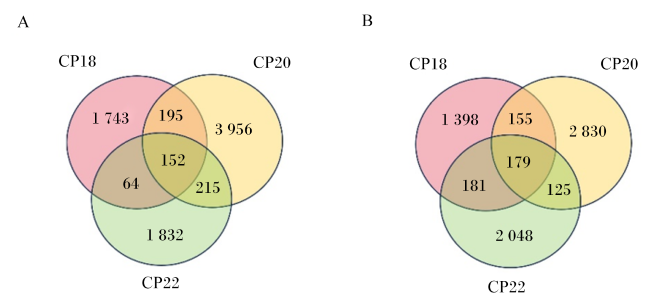
图1-A所示,雄性琅琊鸡共得到8 157个OTUs,18%、20%和22% CP水平组所共有的OTUs为152个,所独有的OTUs分别为1 743、3 956、1 832个。这表明20% CP水平组所特有的OTUs最丰富,说明饲粮20% CP水平可以提高雄性琅琊鸡回肠微生物丰富度。
图1 雄性(A)和雌性(B)琅琊鸡回肠微生物韦恩图

CP18:18% CP水平组 18% CP level group;CP20:20% CP水平组 20% CP level group;CP22:22% CP水平组 22% CP level group。

Fig.1 Venn diagram of ileal microbiota of male (A) and female (B) Langya chickens

图1-B所示,雌性琅琊鸡共得到7 416个OTUs,18%、20%和22% CP水平组所共有的OTUs为179个,所独有的OTUs分别为2 048、2 830、1 898个。这表明20% CP水平组所特有的OTUs最丰富,说明饲粮20% CP水平可以提高雌性琅琊鸡回肠微生物丰富度。

2.5.2 饲粮CP水平对琅琊鸡回肠微生物α多样性的影响

表6可知,对于雄性琅琊鸡,20% CP水平组回肠微生物的Ace和Chao1指数显著高于18%和22% CP水平组(P<0.05),但18%和22% CP水平组之间差异不显著(P>0.05)。饲粮CP水平对回肠微生物的Simpson和Shannon指数无显著影响(P>0.05)。对于雌性琅琊鸡,20% CP水平组回肠微生物的Ace指数显著高于18% CP水平组(P<0.05),但18%和22% CP水平组之间差异不显著(P>0.05);20%和22% CP水平组回肠微生物Chao1指数显著高于18% CP水平组(P<0.05)。饲粮CP水平对回肠微生物的Simpson和Shannon指数无显著影响(P>0.05)。
表6 饲粮CP水平对琅琊鸡回肠微生物α多样性的影响

Table 6 Effects of dietary CP level on ileal microbiota α diversity of Langya chickens

项目
Items
饲粮CP水平Dietary CP level/% SEM P
P-value
18 20 22


雄性
Male
Ace指数Ace index 460.26b 840.56a 508.28b 42.928 <0.001
Chao1指数Chao1 index 452.97b 819.66a 517.10b 40.342 <0.001
Simpson指数Simpson index 0.78 0.73 0.76 0.024 0.455
Shannon指数Shannon index 4.62 5.45 4.10 0.253 0.082


雌性
Female
Ace指数Ace index 409.54b 504.71a 436.45ab 15.355 0.022
Chao1指数Chao1 index 410.95b 482.29a 480.75a 12.555 0.018
Simpson指数Simpson index 0.79 0.83 0.87 0.025 0.403
Shannon指数Shannon index 4.75 4.70 5.20 0.146 0.328

2.5.3 饲粮CP水平对琅琊鸡回肠微生物门水平相对丰度的影响

表7可知,对于雄性琅琊鸡,各组回肠优势菌门依次为厚壁菌门(Firmicutes)、变形菌门(Proteobacteria)、拟杆菌门(Bacteroidota)、放线菌门(Actinobacteriota)。其中,20% CP水平组回肠厚壁菌门相对丰度显著高于18%和22% CP水平组(P<0.05);22% CP水平组回肠变形菌门相对丰度显著高于18%和20% CP水平组(P<0.05),18% CP水平组回肠变形菌门相对丰度显著高于20% CP水平组(P<0.05)。饲粮CP水平对回肠拟杆菌门和放线菌门相对丰度无显著影响(P>0.05)。对于雌性琅琊鸡,各组回肠优势菌门依次为厚壁菌门、拟杆菌门、变形菌门和放线菌门。其中,20% CP水平组回肠拟杆菌门相对丰度显著高于18%和22% CP水平组(P<0.05),18% CP组回肠拟杆菌门相对丰度显著高于22% CP水平组(P<0.05)。饲粮CP水平对回肠厚壁菌门、变形菌门和放线菌门相对丰度无显著影响(P>0.05)。
表7 饲粮CP水平对琅琊鸡回肠微生物门水平相对丰度的影响

Table 7 Effects of dietary CP level on ileal microbiota relative abundance at phylum level of Langya chickens

项目
Items
饲粮CP水平Dietary CP level/% SEM P
P-value
18 20 22


雄性
Male
厚壁菌门Firmicutes 0.75b 0.89a 0.71b 0.029 0.014
变形菌门Proteobacteria 0.08b 0.03c 0.13a 0.012 <0.001
拟杆菌门Bacteroidota 0.28 0.22 0.05 0.012 0.649
放线菌门Actinobacteriota 0.02 0.02 0.05 0.011 0.515


雌性
Female
厚壁菌门Firmicutes 0.81 0.74 0.76 0.030 0.622
变形菌门Proteobacteria 0.05 0.04 0.04 0.003 0.384
拟杆菌门Bacteroidota 0.04b 0.17a 0.01c 0.017 <0.001
放线菌门Actinobacteriota 0.05 0.03 0.05 0.004 0.178

2.5.4 饲粮CP水平对琅琊鸡回肠微生物属水平相对丰度的影响

表8可知,对于雄性琅琊鸡,各组回肠优势菌属依次为乳杆菌属(Lactobacillus)、黏液乳杆菌属(Limosilactobacillus)、联合乳杆菌属(Ligilactobacillus)。其中,20% CP水平组回肠乳杆菌属相对丰度显著高于18%和22% CP水平组(P<0.05),22% CP水平组回肠黏液乳杆菌属相对丰度显著高于18% CP水平组(P<0.05),20% CP水平组回肠联合乳杆菌属相对丰度显著高于22% CP水平组(P<0.05)。对雌性琅琊鸡,各组回肠优势菌属依次为乳杆菌属、黏液乳杆菌属、联合乳杆菌属。其中,20% CP水平组回肠乳杆菌属显著高于18%和22% CP水平组(P<0.05),20% CP水平组回肠黏液乳杆菌属相对丰度显著高于22% CP水平组(P<0.05)。饲粮CP水平对回肠联合乳杆菌属相对丰度无显著影响(P>0.05)。
表8 饲粮CP水平对琅琊鸡回肠微生物属水平相对丰度的影响

Table 8 Effects of dietary CP level on ileal microbiota relative abundance at genus level of Langya chickens

项目
Items
项目
Items
饲粮CP水平Dietary CP level/% SEM P
P-value
18 20 22


雄性Male
乳杆菌属Lactobacillus 0.34b 0.51a 0.41b 0.021 0.001
黏液乳杆菌属Limosilactobacillus 0.06b 0.08b 0.10a 0.004 0.001
联合乳杆菌属Ligilactobacillus 0.07ab 0.08a 0.05b 0.003 0.003


雌性Female
乳杆菌属Lactobacillus 0.30b 0.42a 0.34b 0.018 0.005
黏液乳杆菌属Limosilactobacillus 0.16ab 0.20a 0.11b 0.013 0.025
联合乳杆菌属Ligilactobacillus 0.09 0.10 0.12 0.005 0.108

3 讨论

3.1 饲粮CP水平对琅琊鸡生长性能的影响

饲粮CP水平是家禽饲粮重要的营养参数之一,对家禽的生长发育有着重要的影响[11]。Laudadio等[12]选用哈伯德肉鸡为研究对象,分别饲喂CP水平分别为22.5%、20.5%和18.5%的饲粮,结果发现,20.5% CP水平组肉鸡体重最大,并且ADG和ADFI有增加的趋势。Solangi等[10]选用哈伯德肉鸡为研究对象,分别饲喂不同CP水平的饲粮,结果发现适宜的饲粮CP水平为20%~23%。Qiu等[5]研究表明,饲粮20% CP水平能够显著增加1~42日龄肉鸡ADG,降低F/G。此外,陈玉芹等[13]研究发现,与17.00% CP水平组相比,饲粮20% CP水平可以显著提高42日龄武定鸡的ADG和ADFI,降低F/G。宋素芳等[14]以生长性能为评价指标,通过回归曲线得出1~4周龄固始鸡适宜的饲粮CP水平为20.13%。以上结果提示,育雏期饲粮CP水平约为20%时有利于提高肉鸡生长性能。本研究结果同样表明,相较于其他饲粮CP水平组,20% CP水平组1~42日龄琅琊鸡ADG最高,F/G最低。但本试验中结果发现,22% CP水平组1~42日龄琅琊鸡的生长性能低于20% CP水平组,这可能是由于过高的饲粮CP水平降低了蛋白质利用率,抑制肉鸡生长[15]

3.2 饲粮CP水平对琅琊鸡血清生化指标的影响

血清生化指标作为评估动物机体代谢状态的关键参数,能够直观反映组织细胞通透性及新陈代谢功能的变化[16]。血清TP含量在一定程度上反映机体蛋白质合成状况[17]。本研究发现,饲粮CP水平并未显著影响肉鸡血清TP和ALB含量。与此相似,Heo等[18]研究发现,饲粮CP水平并未显著影响蛋鸡血清TP和ALB含量。王鹏飞等[19]以1~6周龄凌云乌鸡为研究对象,结果发现,饲粮CP水平未显著影响乌鸡血清TP和ALB含量。此外,本试验结果表明,与其他CP水平组相比,20% CP水平组琅琊鸡血清AST活性最低。李琴等[20]研究发现,饲粮CP水平过高(15%)或过低(11%)都会影响鹅蛋白质的合成效率,使血清AST活性增加。以上结果表明,饲粮20% CP水平可以改善琅琊鸡蛋白质代谢。本试验还发现,与18%和19% CP水平组相比,21% CP水平组琅琊鸡血清UN含量显著提高,但与20% CP水平组差异不显著。血清UN含量可作为反映鸡饲粮中氨基酸利用速率的指标之一[21],这意味着饲粮CP水平影响了氨基酸利用率,进而改善肉鸡生长性能。

3.3 饲粮CP水平对琅琊鸡免疫功能的影响

家禽免疫器官与其免疫功能密切相关,免疫器官指数可反映机体自身免疫状态。胸腺、脾脏和法氏囊作为禽类的主要免疫器官,其发育状况可有效反映机体的免疫功能[22]。本研究发现,20%和21% CP水平组法氏囊指数显著高于18% CP水平组,且20% CP水平组胸腺指数显著高于18%、21%和22% CP水平组,但各CP水平组脾脏指数没有显著差异。Jahanian[23]研究同样表明,与低CP水平(19%)相比,高CP(22.35%)水平显著增加了肉鸡胸腺和法氏囊指数,但对脾脏指数没有显著影响。多乐等[24]研究同样发现,饲粮CP水平显著影响了42日龄石岐杂鸡的脾脏和胸腺指数。由此可见,饲粮20% CP水平对1~42 日龄琅琊鸡免疫器官的发育最有利。然而,张蒙等[25]研究表明,饲粮19.81%~21.81% CP水平对1~4周龄大午粉1号商品代蛋雏鸡免疫器官指数未产生显著影响。这可能是由于试验鸡品种不同。一般来说,动物的免疫功能受到饲粮营养水平的影响[26]。饲粮能量和蛋白质的比例会改变激素浓度,进而调节动物的免疫反应[27]。刘书锋等[28]选用马岗鹅为试验对象,分别饲喂不同CP水平饲粮,结果发现,随着饲粮CP水平降低,马岗鹅血清IgM和IgG含量也相应降低。本研究发现,20%和21% CP水平组琅琊鸡血清IgG和IgM含量较高,20%和22% CP水平组血清IgA含量较高。

3.4 饲粮CP水平对琅琊鸡回肠微生物的影响

α多样性是反映物种丰富度及均匀度的综合指标。Chao1、Ace指数用来衡量菌群丰富度,其指数越高说明样品物种越丰富,而Shannon、Simpson指数用来衡量菌群多样性,物种多样性与Shannon指数呈正相关,与Simpson指数呈负相关[29]。申宇等[30]研究发现,饲粮CP水平能够显著影响了鸡肠道微生物的Ace、Shannon和Chao指数。同样地,England等[31]研究表明,饲粮CP水平显著影响了鸡回肠微生物α多样性,其中,与低CP水平组相比,饲喂正常CP水平饲粮的鸡回肠菌群Shannon和Chao1指数更高。与上述研究结果相似,本试验结果显示,饲粮CP水平显著影响了雄性和雌性琅琊鸡回肠微生物的Ace和Chao1指数,20% CP水平组回肠微生物的Ace和Chao1指数最高,说明饲粮CP水平为20%时,琅琊鸡回肠微生物的物种丰富度最高。
厚壁菌门、变形菌门和拟杆菌门是鸡回肠中的主要菌门[32]。本试验发现,雄性和雌性琅琊鸡的优势菌门前3位依次为均为厚壁菌门、拟杆菌门和变形菌门;且与18%和22% CP水平组相比,20% CP水平组雄性琅琊鸡回肠厚壁菌门相对丰度显著提高,但雌性琅琊鸡厚壁菌门相对丰度有所降低,雌性琅琊鸡回肠拟杆菌门相对丰度显著提高。与此一致,有研究表明鸡盲肠中发现的优势微生物是细菌门和厚壁菌门[33]。有关饲粮CP水平对肠道微生物的影响较少,陈浩详[34]研究发现,饲粮21.49% CP水平增加了肉鸡盲肠厚壁菌门相对丰度,降低了拟杆菌门和变形菌门相对丰度。研究表明,厚壁菌门有助于宿主从饲粮中摄取能量,有效促进热量吸收和体重增加[35];而拟杆菌门则参与体内碳水化合物代谢,分解糖产生挥发性脂肪酸,被肠道吸收和利用[36]。以上结果说明饲粮CP水平通过调节肠道微生物组成,进而影响营养物质的吸收代谢。乳杆菌属作为厚壁菌门中的优势菌属,通过调控肠道黏膜免疫因子分泌、促进有益菌群增殖,并形成对病原菌定植的竞争性抑制,有效维持肠道菌群稳态[37]。本试验发现,20% CP水平组雄性和雌性琅琊鸡回肠乳杆菌属相对丰度最高。与此相似,England等[31]研究表明,饲粮21.49% CP水平显著增加了雄性和雌性肉鸡肠道乳酸菌属相对丰度。由此可见,饲粮CP水平可以通过调控回肠不同菌门、菌属的相对丰度来调控动物生长。

4 结论

饲粮适宜CP水平有利于提高1~42日龄琅琊鸡生长性能,促进免疫器官发育,增强机体免疫功能,增加肠道有益菌相对丰度,且雄性琅琊鸡在整体性能上的表现优于雌性琅琊鸡。本试验条件下,1~42日龄雄性和雌性琅琊鸡饲粮粗蛋白质水平以19%~21%为宜。
[1]
YU L M, ZHANG L L, ZHANG S P, et al. Effects of dietary Bacillus velezensis Y01 supplementation on growth performance,immune function,and cecal microbiota of 1 to 42 days Langya chickens[J]. BMC Microbiology, 2025, 25(1):288.

[2]
李雪静, 王利华, 龚相维, 等. 饲粮粗蛋白质水平对育肥期不同性别肉用品系琅琊鸡生长性能、屠宰性能和肉品质的影响[J]. 动物营养学报, 2025, 37(2):973-986.

LI X J, WANG L H, GONG X W, et al. Effects of dietary crude protein level on growth performance,slaughter performance and meat quality of meat strain Langya chickens with different sexes during fattening period[J]. Chinese Journal of Animal Nutrition, 2025, 37(2):973-986. (in Chinese)

[3]
FILHO I C P, BROCH J, EYNG C, et al. Effects of feeding dried brewers grains to slow-growing broiler chickens[J]. Livestock Science, 2021,250:104561.

[4]
曹赞. 代谢能和粗蛋白水平对科宝肉鸡生长性能、屠宰性能及养分表观代谢率的影响[D]. 硕士学位论文. 湛江: 广东海洋大学, 2015.

CAO Z. Effects of energy and crude protein levels on production performance,slaughter performance and nutrient apparent metabolic rate in cobb broilers[D]. Master's Thesis. Zhenjiang: Guangdong Ocean University, 2015. (in Chinese)

[5]
QIU K, CHEN J, ZHANG G M, et al. Effects of dietary crude protein and protease levels on performance,immunity capacity,and AA digestibility of broilers[J]. Agriculture, 2023, 13(3):703.

[6]
CHANG C, ZHANG Q Q, WANG H H, et al. Dietary metabolizable energy and crude protein levels affect pectoral muscle composition and gut microbiota in native growing chickens[J]. Poultry Science, 2023, 102(2):102353.

[7]
CHRYSTAL P V, MOSS A F, KHODDAMI A, et al. Impacts of reduced-crude protein diets on key parameters in male broiler chickens offered maize-based diets[J]. Poultry Science, 2020, 99(1):505-516.

[8]
AWAD E A, ZULKIFLI I, SOLEIMANI A F, et al. Effects of feeding male and female broiler chickens on low-protein diets fortified with different dietary glycine levels under the hot and humid tropical climate[J]. Italian Journal of Animal Science, 2017, 16(3):453-461.

[9]
NAKPHAICHIT M, PHRAEPHAISARN C, KEAWSOMPONG S, et al. Effect of increasing dietary protein from soybean meal on intestinal microbiota and their fatty acids production in broiler chicken[J]. Advances in Animal and Veterinary Sciences, 2014, 2(6):337-343.

[10]
SOLANGI A A, BALOCH G M, WAGAN P K, et al. Effect of different levels of dietary protein on the growth of broiler[J]. Journal of Animal and Veterinary Advances, 2003, 2(5):301-304.

[11]
MAHARJAN P, MARTINEZ D A, WEIL J, et al. Physiological growth trend of current meat broilers and dietary protein and energy management approaches for sustainable broiler production[J]. Animal, 2021, 15(S1):100284.

[12]
LAUDADIO V, PASSANTINO L, PERILLO A, et al. Productive performance and histological features of intestinal mucosa of broiler chickens fed different dietary protein levels[J]. Poultry Science, 2012, 91(1):265-270.

[13]
陈玉芹, 赵成法, 杨秀娟, 等. 武定鸡日粮适宜代谢能和粗蛋白质水平的研究[J]. 中国家禽, 2016, 38(1):25-31.

CHEN Y Q, ZHAO C F, YANG X J, et al. Study on appropriate dietary metabolic energy and crude protein level in Wuding chicken[J]. China Poultry, 2016, 38(1):25-31. (in Chinese)

[14]
宋素芳, 康相涛, 田亚东, 等. 0-4周龄固始鸡能量和蛋白质需要量研究[J]. 中国农业科学, 2003, 36(8):976-980.

SONG S F, KANG X T, TIAN Y D, et al. Research on energy and protein requirements of 0 to 4-week-age Gushi chicks[J]. Scientia Agricultura Sinica, 2003, 36(8):976-980. (in Chinese)

[15]
PESTI, M G.Impact of dietary amino acid and crude protein levels in broiler feeds on biological performance[J]. Journal of Applied Poultry Research, 2009, 18(3):477-486.

[16]
张柏林, 文涛, 杨乾, 等. 谷氨酰胺对免疫应激肉鸡生长性能、血液炎性细胞因子及肠道形态的影响[J]. 吉林农业大学学报, 2020, 42(4):434-442.

ZHANG B L, WEN T, YANG Q, et al. Effects of glutamine supplementation on growth performance,blood inflammatory factors and intestinal morphology of broilers in immune stress[J]. Journal of Jilin Agricultural University, 2020, 42(4):434-442. (in Chinese)

[17]
张柏林. Ala-Gln对仔猪氮营养素利用的影响及其作用机制研究[D]. 博士学位论文. 南京: 南京农业大学, 2015.

ZHANG B L. Study on the effects of alanyl-glutamine on nitrogen utilization and its regulation mechanisms in piglets[D]. Ph.D.Thesis. Nanjing: Nanjing Agricultural University, 2015. (in Chinese)

[18]
HEO Y J, PARK J, KIM Y B, et al. Effects of dietary protein levels on performance,nitrogen excretion,and odor emission of growing pullets and laying hens[J]. Poultry Science, 2023, 102(8):102798.

[19]
王鹏飞, 宋明杰, 张倩雲, 等. 凌云乌鸡0-6周龄对代谢能、粗蛋白质和苯丙氨酸+酪氨酸适宜需要量的研究[J]. 饲料工业, 2019, 40(23):29-35.

WANG P F, SONG M J, ZHANG Q Y, et al. The study on appropriate requirements of ME,protein and Phe+Tyr of Lingyun chicken in the age of 0 to 6 weeks[J]. Feed Industry, 2019, 40(23):29-35. (in Chinese)

[20]
李琴, 彭祥伟. 能量和粗蛋白水平对9-10 周龄育肥鹅血清生化指标和激素水平的影响及相关性分析[J]. 中国家禽, 2018, 40(11):22-27.

LI Q, PENG X W. Effects of crude protein and metabolizable energy on serum biochemistry indexes,serum hormone and correlation among serum biochemical indices of goose aged from nine to ten weeks during finishing period[J]. China Poultry, 2018, 40(11):22-27. (in Chinese)

[21]
DONSBOUGH A L, POWELL S, WAGUESPACK A, et al. Uric acid,urea,and ammonia concentrations in serum and uric acid concentration in excreta as indicators of amino acid utilization in diets for broilers[J]. Poultry Science, 2010, 89(2):287-294.

[22]
李国军. 酵母对脂多糖诱导黄羽肉鸡急性炎症反应的影响[D]. 硕士学位论文. 长沙: 湖南农业大学, 2016.

LI G J. Effects of yeast on lipopolysaccharide-induced acute inflammatory response in yellow broilers[D]. Master's Thesis. Changsha: Hunan Agricultural University, 2016. (in Chinese)

[23]
JAHANIAN R. Immunological responses as affected by dietary protein and arginine concentrations in starting broiler chicks[J]. Poultry Science, 2009, 88(9):1818-1824.

[24]
多乐, 莫子艺, 孔鹏, 等. 不同能量和蛋白质水平日粮对石岐杂鸡免疫器官发育及血液生化指标的影响[J]. 中国饲料, 2011(4):36-38,41.

DUO L, MO Z Y, KONG P, et al. Effects of different dietary metabolic energy and protein level on immune organ development and serum biochemical parameter of Shiqiza chicken[J]. China Feed, 2011(4):36-38,41. (in Chinese)

[25]
张蒙, 李强, 刘平, 等. 0-4周龄大午粉1号商品代蛋雏鸡饲粮中适宜的代谢能和粗蛋白质水平[J]. 动物营养学报, 2019, 31(2):652-661.

ZHANG M, LI Q, LIU P, et al. Optimal dietary metabolizable energy and crude protein levels for Dawufen No.1 commercial layer chicks from 0 to 4 weeks of age[J]. Chinese Journal of Animal Nutrition, 2019, 31(2):652-661. (in Chinese)

[26]
KIDD M T. Nutritional modulation of immune function in broilers[J]. Poultry Science, 2004, 83(4):650-657.

[27]
KLASING K C. Nutrition and the immune system[J]. British Poultry Science, 2007, 48(5):525-537.

[28]
刘书锋, 汪珩, 叶慧, 等. 低蛋白质补充氨基酸饲粮对36-70日龄马冈鹅生长性能、屠宰性能及血清生化和免疫指标的影响[J]. 动物营养学报, 2022, 34(7):4406-4415.

LIU S F, WANG H, YE H, et al. Effects of low protein diets supplemented with amino acids on growth performance,slaughter performance,serum biochemical and immune indices of Magang geese during 36 to 70 days of age[J]. Chinese Journal of Animal Nutrition, 2022, 34(7):4406-4415. (in Chinese)

[29]
刘慧军. 饲粮粗纤维含量对仔鹅生长、胃肠道发育及肠道微生物的影响[D]. 硕士学位论文. 扬州: 扬州大学, 2018.

LIU H J. Effects of dietary fiber contents on growth,gastrointestinal development and intestinal microflora in geese[D]. Master's Thesis. Yangzhou: Yangzhou University, 2018. (in Chinese)

[30]
申宇, 袁逸涵, 宋娇, 等. 饲粮粗蛋白质水平对育成期蛋鸡肠道形态、盲肠菌群结构及肠道屏障的影响[J]. 中国家禽, 2022, 44(11):63-69.

SHEN Y, YUAN Y H, SONG J, et al. Effects of dietary crude protein level on intestinal morphology,cecal microflora structure and intestinal barrier of laying hens during growing period[J]. China Poultry, 2022, 44(11):63-69. (in Chinese)

[31]
ENGLAND A D, DE LAS HERAS-SALDANA S, GHARIB-NASERI K, et al. The effect of sex and dietary crude protein level on nutrient transporter gene expression and cecal microbiota populations in broiler chickens[J]. Poultry Science, 2024, 103(2):103268.

[32]
MANCABELLI L, FERRARIO C, MILANI C, et al. Insights into the biodiversity of the gut microbiota of broiler chickens[J]. Environmental Microbiology, 2016, 18(12):4727-4738.

[33]
WEI S, MORRISON M, YU Z. Bacterial census of poultry intestinal microbiome[J]. Poultry Science, 2013, 92(3):671-683.

[34]
陈浩详. 不同蛋白水平饲粮添加衣康酸和烟酸对肉鸡生产性能、脂质代谢和肠道健康的影响[D]. 硕士学位论文. 沈阳: 沈阳农业大学, 2024.

CHEN H X. Effects of itaconic acid and niacin supplementation on growth performance,lipid metabolism and intestinal health of broilers fed diets with different protein levels[D]. Master's Thesis. Shenyang: Shenyang Agricultural University, 2024. (in Chinese)

[35]
ZHANG L H, JIANG X, LI A Y, et al. Characterization of the microbial community structure in intestinal segments of yak (Bos grunniens)[J]. Anaerobe, 2020,61:102115.

[36]
JOHNSON D R, LEE T K, PARK J, et al. The functional and taxonomic richness of wastewater treatment plant microbial communities are associated with each other and with ambient nitrogen and carbon availability[J]. Environmental Microbiology, 2015, 17(12):4851-4860.

[36]
NGUNJIRI M J, TAYLOR K J M, ABUNDO M C, et al. Farm stage,bird age,and body site dominantly affect the quantity,taxonomic composition,and dynamics of respiratory and gut microbiota of commercial layer chickens[J]. Applied and Environmental Microbiology, 2019, 85(9):e03137-e03218.

[37]
CUI L, ZHANG X L, CHENG R R, et al. Sex differences in growth performance are related to cecal microbiota in chicken[J]. Microbial Pathogenesis, 2021,150:104710.

Outlines

/