RESEARCH PAPER

Probiotic Characterization, Safety and Whole-Genome Analysis of Lactobacillus reuteri SBC5-3 Derived from Saba Pigs

  • CHEN Shiyu , 1 ,
  • XU Le 1 ,
  • LIU Chen 1 ,
  • HU Minjie 1 ,
  • LIU Qinghua 1 ,
  • LIN Qiuye , 2, ** ,
  • CAO Zhenhui , 1, **
Expand
  • 1 College of Animal Science and Technology, Yunnan Agricultural University, Kunming 650201, China
  • 2 School of Ethnic Medicine, Yunnan Minzu University, Kunming 650504, China
**LIN Qiuye, professor, E-mail: ;
CAO Zhenhui, professor, E-mail:

* Contributed equally

Received date: 2025-03-12

  Online published: 2025-11-14

Abstract

This study aimed to analyze the probiotic characteristics and safety and whole-genome analysis of Lactobacillus reuteri SBC5-3 derived from Saba pigs, to provide theoretical support for its development as a candidate strain for livestock microbial agents. The phenotypic tests were conducted to evaluate the adhesion ability, antimicrobial activity against major intestinal pathogens, antioxidant activity, hemolytic activity and biogenic amine synthesis ability, the whole-genome sequencing was performed using PacBio Sequel Ⅱ and Illumina NovaSeq 6000 platforms, combined with various bioinformatics tools to analyze genomic functional characteristics, and elucidated its probiotic characteristics and safety from both phenotypic and genetic dimensions. The results showed that the strain SBC5-3 exhibited strong hydrophobicity, auto-aggregation ability and adhesion index of IPEC-J2 cells, inhibitory growth ability of Staphylococcus aureus ATCC 49521, Escherichia coli K88 and Salmonella choleraesuis CVCC 3383, producting superoxide dismutaseion and scavenging 1,1-diphenyl-2-picrylhydrazyl (DPPH) radical and hydroxyl radical ability, with no hemolytic activity and biogenic amine synthesis. The whole-genome of strain SBC5-3 existed secondary metabolite gene clusters encoding type Ⅲ polyketide synthase (T3PKS) and class Ⅲ bacteriocin nterolysin A (EnlA) synthesis related gene clusters, and multiple stress resistance and probiotic genes related to acid resistant, bile salt resistant, cold and heat stress resistant, adhesion, organic acid production, antioxidant and essential vitamin biosynthesis, while no virulence genes were identified. In conclusion, the L. reuteri SBC5-3 derived from Saba pigs demonstrates favorable probiotic characteristics and safety at both phenotypic and genomic levels, making it a potential candidate strain for novel microbial agents in livestock.

Cite this article

CHEN Shiyu , XU Le , LIU Chen , HU Minjie , LIU Qinghua , LIN Qiuye , CAO Zhenhui . Probiotic Characterization, Safety and Whole-Genome Analysis of Lactobacillus reuteri SBC5-3 Derived from Saba Pigs[J]. Chinese Journal of Animal Nutrition, 2025 , 37(11) : 7970 -7983 . DOI: 10.12418/CJAN2025.648

撒坝猪主要分布于云南楚雄彝族自治州,具有耐粗饲、适应性强、抗病力强等种质特性,于2011年被列入《中国畜禽遗传资源志-猪志》[1]。撒坝猪生长环境位于具有低氧、紫外线胁迫等特点的低纬度高原[2],加之独特的种质性状,揭示了其肠道内可能蕴含着亟待开发的微生物资源。本课题组前期将撒坝猪粪菌液移植至小鼠胃内,发现其脂肪沉积率下降,营养物质表观消化率提高,肠道形态和肠道菌群稳态得到改善[3-4];进一步对散养撒坝猪肠道微生物资源进行挖掘,筛选分离得到具有良好耐酸、耐胆盐性和抗炎能力,并对多种β-内酰胺类、氨基糖苷类和喹诺酮类抗生素敏感的罗伊氏乳杆菌(Lactobacillus reuteri,L. reuteri)SBC5-3[5]
L. reuteri是公认安全的微生物,2013年已被列入我国《饲料添加剂品种目录(2013)》[6]。现有研究表明,L. reuteri可在提高动物生长性能、抑制病原菌定植、维护宿主肠道健康等方面发挥作用[7-9],将其应用于畜禽生产对于推动畜牧行业健康可持续发展具有重要意义。然而,现有L. reuteri益生特性和安全性相关研究常聚焦于菌株传统表型研究,仍鲜见深入全基因组层面的报道。传统表型研究虽能表征菌株的耐酸、抗炎等特性,却难以阐明其分子遗传基础,亦无法全面评估潜在的生物安全风险。因此,本研究在前期工作基础上,进一步对菌株SBC5-3黏附能力、肠道主要致病菌抑制能力、抗氧化特性、溶血活性和生物胺产生能力进行检测,并结合全基因组测序技术于基因层面对其益生特性和安全性进行探究,为将其开发为新型畜牧用益生菌株奠定理论和技术基础。

1 材料与方法

1.1 试验材料

1.1.1 试验菌种和细胞系

金黄色葡萄球菌(Staphylococcus aureu,S. aureus)ATCC 49521、猪霍乱沙门氏菌(Salmonella choleraesuis,S. choleraesuis)CVCC 3383、大肠杆菌(Escherichia coli,E. coli)K88、L. reuteri SBC5-3、鼠李糖乳杆菌GG(Lactobacillus rhamnosus GG,LGG)和猪小肠上皮细胞系(IPEC-J2细胞)均由本课题组保藏。

1.1.2 主要试剂和仪器

MRS培养基、LB培养基和琼脂购自广东环凯生物科技有限公司。总抗氧化能力(total antioxidant capacity,T-AOC)、超氧化物歧化酶(superoxide dismutase,SOD)活性、1,1-二苯基-2-三硝基苯肼(1,1-diphenyl-2-picrylhydrazyl,DPPH)自由基清除率和羟基自由基清除率检测试剂盒均购自北京索莱宝生物科技有限公司。精氨酸脱羧酶、鸟氨酸脱羧酶、赖氨酸脱羧酶和氨基酸脱羧酶生化管购自杭州滨和微生物试剂有限公司。
主要仪器:高速低温离心机(ThermoFisher ST-16R)、紫外分光光度计(UV-5100)、涡旋混合器(SCILOEX MX-S)等。

1.2 试验方法

1.2.1 菌株SBC5-3黏附能力检测

疏水性和自聚集性测定参考De Chiara等[10]的方法并稍作修改。将菌株SBC5-3以1%体积比接入10 mL MRS培养基中,37 ℃培养24 h后,在4 ℃、2 800×g条件下离心10 min收集菌体,随后用磷酸盐缓冲液(phosphate buffered saline,PBS)洗涤2次,使用紫外分光光度计调节菌悬液600 nm处吸光度(OD600)值为0.60±0.05(A0)。向3 mL菌悬液中加入1 mL二甲苯,涡旋振荡后静置20 min,再次使用紫外分光光度计测定水相OD600值(A1)。试验独立重复3次。疏水性计算公式为:
疏水性(%)=[1-(A1/A0)]×100。
按照上述步骤制备菌悬液,使用紫外分光光度计调节菌悬液OD600值为0.60±0.05(A2),静置6 h后再次使用紫外分光光度计测定菌悬液上层的OD600值(A3)。试验独立重复3次。自聚集性计算公式为:
自聚集性(%)=[1-(A3/A2)]×100。
共聚集性测定参照Balakrishna[11]的方法并稍作修改。按照上述步骤制备菌悬液,将益生菌与指示菌菌悬液等体积混合(试验组)后涡旋振荡30 s,同时设置菌株SBC5-3和指示菌单一菌悬液(对照组)。37 ℃孵育5 h后使用紫外分光光度计测定菌株SBC5-3对照组(A4)、指示菌对照组(A5)和试验组(A6)OD600值。试验独立重复3次。共聚集性计算公式为:
共聚集性(%)={1-[2×A6/(A4+A5)]}×100。
IPEC-J2细胞黏附试验参照Fonseca等[12]的方法并稍作修改。将菌株SBC5-3活化后于37 ℃培养16 h,4 ℃、2 800×g离心10 min收集菌体,用Dulbecco改良的Eagle培养基(DMEM)重悬菌体并调整浓度至2×10⁸ CFU/孔,接种至铺贴IPEC-J2细胞(1×106个细胞/孔)的6孔板中,于37 ℃、5% CO2培养箱中孵育1 h;弃去培养液后,用PBS轻柔清洗3次以去除未黏附菌体,每孔加入1 mL含0.1% Triton X-100的PBS溶液裂解30 min,取裂解液进行10倍梯度稀释后涂布MRS琼脂平板,37 ℃厌氧培养48 h后通过平板计数法计算菌株SBC5-3黏附细菌数。试验独立重复3次。黏附指数计算公式为:
IPEC-J2细胞黏附指数(CFU/cells)=黏附细菌数(CFU)/细胞总数(cells)。

1.2.2 菌株SBC5-3对肠道主要致病菌抑制能力检测

采用牛津杯打孔法[13],分别检测菌株SBC5-3和LGG未调整pH和pH调整至6.2的无菌上清液对S. aureus ATCC 49521、E. coli K88、S. choleraesuis CVCC 3383的抑制能力。

1.2.3 菌株SBC5-3抗氧化能力检测

参照T-AOC、SOD活性、DPPH自由基清除率和羟自由基清除率检测试剂盒说明书所述方法,对菌株SBC5-3胞外产物和胞内产物抗氧化能力进行检测。

1.2.4 菌株SBC5-3安全性检测

1.2.4.1 溶血活性检测

将菌株SBC5-3和S. aureus ATCC 49521(阳性对照)活化3代后,使用接种环蘸取菌液于哥伦比亚血平板上进行划线,37 ℃培养24 h,观察菌落周围是否产生溶血环以判断菌株溶血活性。

1.2.4.2 氨基酸脱羧酶活性检测

将菌株SBC5-3和E. coli K88(阳性对照)活化3代后,分别接种至赖氨酸脱羧酶、精氨酸脱羧酶、鸟氨酸脱羧酶试验管及氨基酸脱羧酶对照管中,液体石蜡封口,37 ℃培养24 h。赖氨酸、精氨酸、鸟氨酸脱羧酶产生能力判定:对照管与试验管均呈黄色为阴性,对照管呈黄色且试验管呈紫色为阳性。

1.2.5 全基因组测序分析

1.2.5.1 基因组序列构建及功能注释

将对数生长期中期菌液在4 ℃、2 800×g条件下离心10 min,所得菌体用于提取DNA。采用磁珠法土壤/粪便基因组DNA提取试剂盒获取菌株SBC5-3基因组DNA,经NanoDrop分光光度计、Qubit荧光定量及琼脂糖凝胶电泳法进行核酸浓度与完整性评估。质检合格后,通过BluePippin全自动片段回收系统筛选大片段DNA构建文库,经Agilent 2100生物分析仪与Qubit联合检测文库质量,最终采用PacBio Sequel Ⅱ三代测序平台与Illumina NovaSeq 6000二代测序平台完成双平台测序分析。基于PacBio三代测序数据(≥2 000 bp),采用Hifiasm v0.12(k-mer=51,其余参数默认)进行基因组组装,经Circlator v1.5.5进行环化及起始位点校正,结合Illumina二代测序数据经Pilon v1.22进行纠错优化。利用Prodigal v2.6.3预测编码基因,通过Rfam v14.1、Infernal v1.1.3及tRNAscan-SE v2.0完成非编码RNA注释,并应用Circos v0.66构建基因组圈图。基于京都基因与基因组百科全书(Kyoto encyclopedia of genes and genomes,KEGG)数据库,通过序列比对实现功能注释。使用毒力因子数据库(virulence factor database,VFDB)和抗生素耐药性综合数据库(comprehensive antibiotic resistance database,CARD)预测潜在的毒力因子和耐药基因。基于antiSMASH平台[14]预测菌株SBC5-3次级代谢产物生物合成基因簇。利用Bagel4在线数据库[15]预测细菌素合成基因簇。

1.2.5.2 比较基因组分析

为进一步了解菌株SBC5-3的遗传进化关系,本研究通过NCBI数据库获得26株不同来源L. reuteri全基因组序列(表1),并通过IPGA在线平台[16]进行平均核苷酸同源性(average nucleotide identity,ANI)分析和基于全基因组的系统发育树构建。
表1 26株罗伊氏乳杆菌基因组信息

Table 1 Genomic information of 26 Lactobacillus reuteri strains

菌株编号
Strain numbers
来源
Origin
基因组大小
Genomic size/Mb
G+C含量
G+C content/%
项目编号
Project number
SKKU-OGDONS-01 2.3 39.0 PRJNA473291
P43 2.1 39.0 PRJNA1024413
3632 2.5 38.5 PRJNA675717
AM-LB 2.3 39.0 PRJNA880297
CHF7-2 2.1 38.8 PRJNA1067331
YLR001 2.4 38.5 PRJNA682320
SRCM217617 2.2 39.0 PRJNA932482
DS0384 2.2 39.0 PRJNA791146
SD-LRE2-IT 2.3 39.0 PRJNA740036
LTR1318 2.0 39.0 PRJNA576342
ATCC PTA 4659 2.1 39.0 PRJNA943682
VHProbi E18 2.0 39.0 PRJNA785080
DSM 20016 2.0 39.0 PRJNA15766
NL02 2.1 39.0 PRJNA766345
CUDS0384 2.2 39.0 PRJNA1083277
Byun-re-01 2.2 39.0 PRJNA427254
M1 2.3 39.0 PRJNA983529
RE225 2.3 38.5 PRJNA995515
TD1 2.1 39.0 PRJNA211728
LL7 2.4 39.0 PRJNA554696
I49 2.1 38.8 PRJNA317592
YSJL-12 2.2 39.0 PRJNA476683
121 2.3 39.0 PRJNA344848
ZLR003 2.2 38.5 PRJNA290298
AN417 2.2 39.0 PRJNA637956
TPC32 2.2 39.0 PRJNA1065120

1.3 数据统计及分析

采用SPSS 22.0对数据进行统计分析,2组之间数据差异性使用t检验进行比较,结果以平均值±标准差表示,P<0.05表示差异显著。

2 结果与分析

2.1 菌株SBC5-3黏附能力

表2可知,菌株SBC5-3疏水性达(66.21±1.34)%,自凝集性达(79.26±0.52)%,表明其具有较高疏水能力和自聚集能力。此外,菌株SBC5-3与S. aureus ATCC 49521、E. coli K88和S. choleraesuis CVCC3383共聚集性分别达(47.65±0.97)%、(16.73±0.69)%、(23.27±0.86)%,表明其具有预防病原菌定植于肠道上皮细胞的潜力。值得注意的是,菌株SBC5-3还可黏附IPEC-J2细胞,IPEC-J2细胞黏附指数为(4.21±0.43) CFU/cells。
表2 菌株SBC5-3疏水性、自聚集性、病原菌共聚集性和IPEC-J2细胞黏附指数

Table 2 Hydrophobicity, auto-aggregation, co-aggregation with pathogens and adhesion index of IPEC-J2 cells of strain SBC5-3

项目Items 结果Result
疏水性Hydrophobicity/% 66.21±1.34
自聚集性Auto-aggregation/% 79.26±0.52
与金黄色葡萄菌ATCC 49521共聚集性Co-aggregation with S. aureus ATCC 49521/% 47.65±0.97
与大肠杆菌K88共聚集性Co-aggregation with E. coli K88/% 16.73±0.69
与猪霍乱沙门氏菌CVCC3383共聚集性Co-aggregation with S. choleraesuis CVCC3383/% 23.27±0.86
IPEC-J2细胞黏附指数Adhesion index of IPEC-J2 cells/(CFU/cells) 4.21±0.43

2.2 菌株SBC5-3抑制病原菌能力

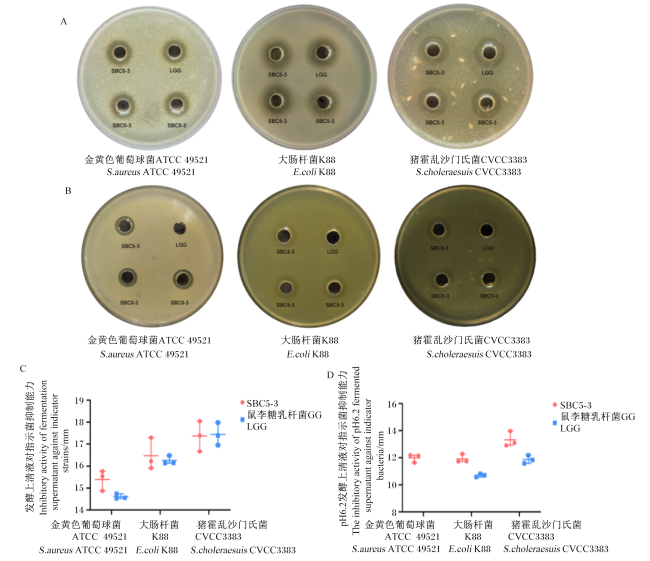
图1所示,菌株SBC5-3对S. aureus ATCC 49521、E. coli K88和S. choleraesuis CVCC3383均有抑制能力,抑菌圈直径分别为(15.39±0.46) mm、(16.48±0.72) mm和(17.37±0.69) mm。菌株SBC5-3对S. aureus ATCC 49521抑制能力强于LGG,对E. coli K88和S. choleraesuis CVCC3383抑制能力和LGG相当。此外,将菌株SBC5-3发酵上清液pH调整至6.2后,仍展现出对S. aureus ATCC 49521、E. coli K88和S. choleraesuis CVCC3383的抑制能力,抑菌圈直径分别为(11.99±0.31) mm、(11.91±0.32) mm和(13.29±0.61) mm。
图1 菌株SBC5-3抑制病原菌能力

A:发酵上清液抑菌效果观察;B:pH 6.2发酵上清液抑菌效果观察;C:发酵上清液抑菌圈直径测定结果(n=3);D:pH 6.2发酵上清液抑菌圈直径测定结果(n=3)。

Fig.1 Anti-pathogens ability of strain SBC5-3

A: observation of antibacterial effects of fermentation supernatant; B: observation of antibacterial effects of fermentation supernatant at pH 6.2; C: measurement results of inhibition zone diameter of fermentation supernatant (n=3); D: measurement results of inhibition zone diameter of fermentation supernatant at pH 6.2 (n=3).

2.3 菌株SBC5-3胞外产物和胞内产物抗氧化能力

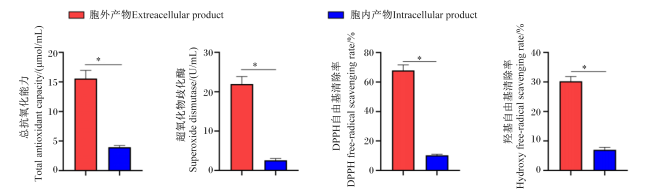
图2可知,菌株SBC5-3胞外产物和胞内产物均表现出抗氧化能力,胞外产物在T-AOC(15.59 μmol/mL vs 3.96 μmol/mL)、SOD活性(22.36 U/mL vs 2.58 U/mL)、DPPH自由基清除率(67.81% vs 10.33%)和羟基自由基清除率(30.26% vs 7.02%)上均显著高于胞内产物(P<0.05)。
图2 菌株SBC5-3胞外产物和胞内产物抗氧化能力

*表示差异显著(P<0.05)。

Fig.2 Antioxidant capacity of extracellular product and intracellular product in strain SBC5-3

* mean significant difference (P<0.05).

2.4 菌株SBC5-3溶血和氨基酸脱羧酶活性

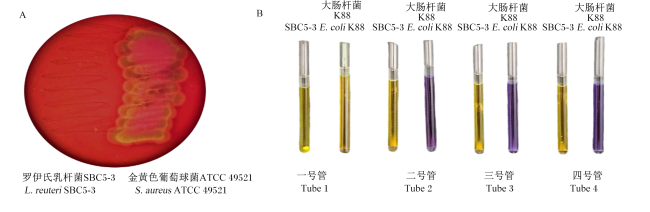
图3-A可知,菌株SBC5-3在哥伦比亚血平板上产生γ溶血圈,无溶血活性。由图3-B可知,菌株SBC5-3赖氨酸脱羧酶、精氨酸脱羧酶和鸟氨酸脱羧酶均为阴性。赖氨酸、精氨酸、鸟氨酸经脱羧酶作用后可形成尸胺、腐胺和精胺[17]。因此,可判断菌株SBC5-3无产尸胺、腐胺和精胺能力。
图3 菌株SBC5-3溶血和氨基酸脱羧酶活性

A:溶血活性观察;B:氨基酸脱羧酶活性测定。一号管:氨基酸脱羧酶对照管;二号管:赖氨酸脱羧酶试验管;三号管:精氨酸脱羧酶试验管;四号管:鸟氨酸脱羧酶试验管。赖氨酸、精氨酸、鸟氨酸脱羧酶产生能力判定:对照管与试验管均呈黄色为阴性,对照管呈黄色且试验管呈紫色为阳性。

Fig.3 Hemolytic and amino acid decarboxylase activities of strain SBC5-3

A: hemolytic activity observation. B: amino acid decarboxylase activities assay. Tube 1: amino acid decarboxylase control tube; tube 2: lysine decarboxylase assay tube; tube 3: arginine decarboxylase assay tube; tube 4: ornithine decarboxylase assay tube. Determination of production capacity of lysine, arginine and ornithine decarboxylase production: negative result of both control tube and assay tube displayed yellow, positive result of control tube displayed yellow and assay tube displayed purple.

2.5 菌株SBC5-3基因组特征

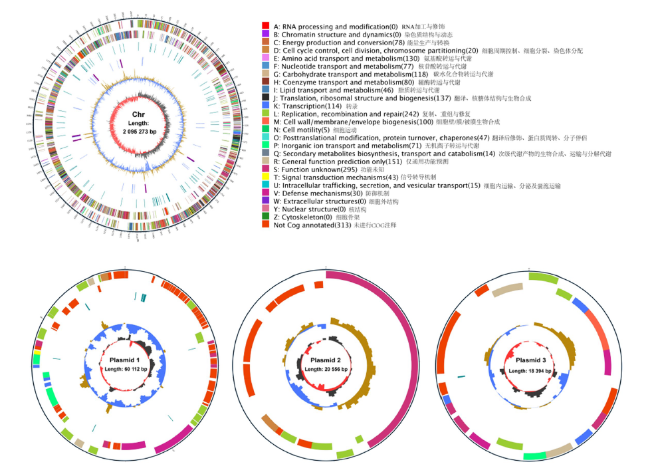
图4可知,菌株SBC5-3基因组序列全长为2 194 335 bp,平均GC含量为38.86%,由1个染色体和3个质粒构成,编码基因数量为2 126个,其中2 013个位于染色体上,78、19和16个分别位于质粒1、2和3上。编码基因总长度为1 918 866 bp,平均长度为902 bp,编码区域占基因总长度的87.45%。同时鉴定出43个tRNA基因、6个5S rRNA、6个16S rRNA与6个23S rRNA基因,以及23个其他非编码RNA。该菌株序列已提交至NCBI数据库,登录号为:PRJNA1233652。
图4 菌株SBC5-3基因组组成

Fig.4 Genomic composition of strain SBC5-3

2.6 菌株SBC5-3全基因组序列KEGG功能注释

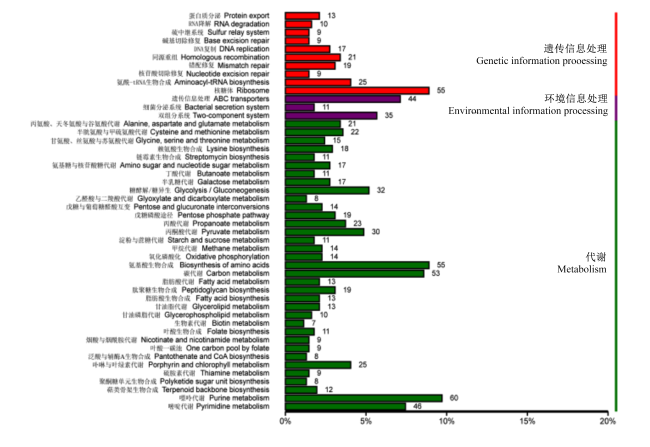
图5可知,应用KEGG数据库对菌株SBC5-3全基因组序列进行注释,共注释到1 102个功能基因。其中,参与新陈代谢基因数量最多,参与遗传信息处理基因数量其次,参与环境信息处理基因数量最少。在参与新陈代谢的相关基因中,注释到与嘌呤代谢相关基因最多(60个),其次是氨基酸生物合成(55个)和碳代谢相关基因(53个);在参与遗传信息处理的相关基因中,注释到核糖体相关基因最多(55个),其次是氨酰-tRNA生物合成(25个)和同源重组相关基因(21个);在参与环境信息处理的相关基因中,注释到ABC转运蛋白相关基因最多(44个),其次是双组分系统(35个)和细菌分泌系统相关基因(11个)。
图5 菌株SBC5-3全基因组序列KEGG功能注释

Fig.5 KEGG functional annotation of whole genome sequence of strain SBC5-3

2.7 菌株SBC5-3全基因组序列毒力基因和耐药基因注释

使用VFDB和CARD对菌株SBC5-3全基因组序列毒力因子和耐药基因进行注释,并根据我国农业农村部发布的《直接饲喂微生物和发酵制品生产菌株鉴定及其安全性评价指南》[18]要求,在序列比对时,设置序列相似性≥80%,序列覆盖度≥70%,E值<10-5。结果表明,菌株SBC5-3全基因组中无毒力因子相关基因,存在1个与四环素类抗生素耐药相关基因(tetW)。

2.8 菌株SBC5-3细菌素和次生代谢产物预测

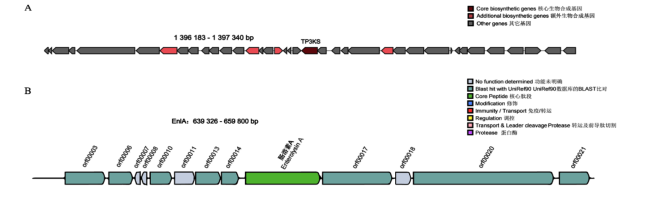
图6可知,通过antiSMASH平台对菌株SBC5-3次生代谢产物相关基因进行注释,发现该菌株基因组1 396 183~1 397 340 bp区域内存在一个Ⅲ型聚酮合酶(type Ⅲ polyketide synthase,T3PKS)合成基因簇。此外,利用Bagel4在线数据库对其抑菌物质信息进行挖掘,鉴定出1个与Ⅲ类细菌素肠溶素A(enterolysin A,EnlA)合成相关基因簇(639 326~659 800 bp),核心肽相似率为40.83%。
图6 菌株SBC5-3细菌素和次级代谢产物预测

A:细菌素预测;B:次生代谢产物预测。

Fig.6 Prediction of bacteriocin and secondary metabolites in strain SBC5-3

A: bacteriocin prediction; B: secondary metabolite prediction.

2.9 菌株SBC5-3的KEGG数据库益生基因注释

表3可知,菌株SBC5-3全基因组共注释到耐酸相关基因11个,耐胆盐相关基因1个,维生素合成相关基因23个,有机酸合成相关基因3个,群体感应相关基因1个,黏附分子相关基因5个,热应激抗性相关基因6个,冷应激抗性相关基因1个。
表3 菌株SBC5-3的KEGG注释益生功能相关基因

Table 3 KEGG-annotated probiotic functional genes in strain SBC5-3

功能类别
Functional categories
相关基因/系统
Related gene/system
基因名称
Gene name

耐酸
Acid resistance
F0F1-ATP酶系统F0F1-ATPase system atpAatpBatpCatpDatpEatpFatpGatpH
精氨酸脱氨基酶途径Arginine deiminase pathway arcAarcC
耐胆盐
Bile salt resistance
胆盐水解酶系统Bile salt hydrolase system cbh


抗氧化
Antioxidant
谷胱甘肽系统Glutathione system gsrgshA
硫氧还蛋白系统Thioredoxin system trxAtrxRtpxnrdH
烟酰胺腺嘌呤二核苷酸磷酸供应NADPH supply g6pdpgd


维生素合成
Vitamin biosynthesis
维生素K2合成基因Vitamin K2 biosynthesis genes menBmenEmenAubiE
叶酸(维生素B9)合成基因
Folate (vitamin B9) biosynthesis genes
folEfolBfolKfolPfolCfolA
钴胺素(维生素B12)合成基因
Cobalamin (vitamin B12) biosynthesis genes
pduOcobQcobDcobPcobU/T
cobS/VcobC
核黄素(维生素B2)合成基因
Riboflavin (vitamin B2) biosynthesis genes
ribBAribDywtEribHribEribF

有机酸合成
Organic acid synthesis
乳酸合成关键酶Lactic acid synthesis key enzyme ldh
乙酸合成基因Acetic acid synthesis genes ptaackA
群体感应
Quorum sensing
S-核糖基高半胱氨酸裂解酶
S-ribosylhomocysteine lyase
luxS


黏附分子
Adhesion molecules
延伸因子Elongation factors efgtufA
磷壁酸生物合成酶
Teichoic acid biosynthesis enzymes
ltaSbgsBdltA
热应激抗性
Heat stress resistance
热休克蛋白家族Heat shock protein family DnaJDnaKGrpEHsp33、
GroELGroES
冷应激抗性
Cold stress resistance
冷休克蛋白家族Cold shock protein family cspA

atpA:ATP合酶α亚基 ATP synthase alpha subunit;atpB:ATP合酶β亚基 ATP synthase beta subunit;atpC:ATP合酶γ亚基 ATP synthase gamma subunit;atpD:ATP合酶δ亚基 ATP synthase delta subunit;atpE:ATP合酶ε亚基 ATP synthase epsilon subunit;atpF:ATP合酶b亚基 ATP synthase subunit b;atpG:ATP合酶a亚基 ATP synthase subunit a;atpH:ATP合酶c亚基 ATP synthase subunit c;arcA:需氧呼吸调控蛋白A aerobic respiration control protein A;arcC:精氨酸脱亚胺酶复合体C亚基 arginine deiminase complex subunit C;cbh:胆酰甘氨酸水解酶基因 cholecylglycine hydrolase gene;gsr:谷胱甘肽还原酶 glutathione reductase;gshA:γ-谷氨酰半胱氨酸合成酶 gamma-glutamylcysteine synthetase;trxA:硫氧还蛋白 thioredoxin;trxR:硫氧还蛋白还原酶 thioredoxin reductase;tpx:硫醇过氧化物酶 thiol peroxidase;nrdH:类硫氧还蛋白NrdH NrdH-glutaredoxin-like protein;g6pd:葡萄糖-6-磷酸脱氢酶 glucose-6-phosphate dehydrogenase;pgd:磷酸葡萄糖酸脱氢酶 phosphogluconate dehydrogenase;menB:二羟苯甲酸-AMP连接酶 dihydroxybenzoate-AMP ligase;menE:2-琥珀酰苯甲酸-CoA连接酶 2-succinylbenzoate-CoA ligase;menA:去甲基甲萘醌甲基转移酶 demethylmenaquinone methyltransferase;ubiE:泛醌/甲萘醌甲基转移酶 ubiquinone/menaquinone methyltransferase;folE:GTP环化水解酶I GTP cyclohydrolase I;folB:二氢蝶酸合酶 dihydropteroate synthase;folK:二氢蝶啶焦磷酸激酶 2-amino-4-hydroxy-6-hydroxymethyldihydropteridine pyrophosphokinase;folP:二氢蝶酸合酶 dihydropteroate synthase;folC:叶酰聚谷氨酸合酶 folylpolyglutamate synthase;folA:二氢叶酸还原酶 dihydrofolate reductase;pduO:钴胺素腺苷转移酶 cobalamin adenosyltransferase;cobQ:钴胺素合成蛋白CobQ cobalamin biosynthesis protein CobQ;cobD:钴啉胺酸激酶 cobinamide kinase;cobP:钴胺素合成蛋白CobP cobalamin biosynthesis protein CobP;cobU/T:钴胺素合成双功能蛋白CobU/CobT cobalamin biosynthesis bifunctional protein CobU/CobT;cobS/V:钴胺素合酶CobS/CobV cobalamin synthase CobS/CobV;cobC:钴胺素合成蛋白CobC cobalamin biosynthesis protein CobC;ribBA:核黄素合成双功能蛋白RibBA riboflavin biosynthesis bifunctional protein RibBA;ribD:核黄素合成蛋白RibD riboflavin biosynthesis protein RibD;ywtE:核黄素激酶 riboflavin kinase;ribH:6,7-二甲基-8-核糖基荧光素合酶 6,7-dimethyl-8-ribityllumazine synthase;ribE:核黄素合酶α亚基 riboflavin synthase subunit alpha;ribF:核黄素激酶/FAD合成酶 riboflavin kinase/FAD synthetase;ldh:乳酸脱氢酶 lactate dehydrogenase;pta:磷酸乙酰转移酶 phosphate acetyltransferase;ackA:乙酸激酶acetate kinase;luxS:S-核糖基高半胱氨酸裂解酶 S-ribosylhomocysteine lyase;efg:延伸因子G elongation factor G;tufA:延伸因子Tu elongation factor Tu;ltaS:脂磷壁酸合酶 lipoteichoic acid synthase;bgsB:β-葡萄糖基转移酶 beta-glucosyltransferase;dltA:D-丙氨酰脂磷壁酸合成蛋白DltA D-alanyl-lipoteichoic acid biosynthesis protein DltA;DnaJ:热休克蛋白40分子伴侣蛋白 Hsp40 chaperone protein;DnaK:热休克蛋白70分子伴侣蛋白 Hsp70 chaperone protein;GrpE:核苷酸交换因子GrpE nucleotide exchange factor GrpE;Hsp33:热休克蛋白33 heat shock protein 33;GroEL:伴侣蛋白GroEL chaperonin GroEL;GroES:伴侣蛋白GroES chaperonin GroES;cspA:冷休克蛋白A cold shock protein A。

2.10 ANI分析和基于全基因组的系统发育树构建

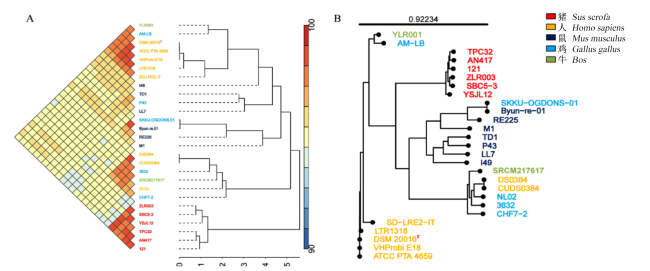
ANI分析通过全基因组比对计算两两基因组间保守序列的相似性,是界定细菌物种的重要分子标准(阈值通常为≥95%[19])。由图7-A可知,菌株SBC5-3与L. reuteri模式菌株L. reuteri DSM 20016的ANI值为95.72%,进一步在全基因组水平证实其分类地位。此外,菌株SBC5-3与5株猪源L. reuteri的ANI值均高于98.7%,其中与猪源菌株ZLR003的亲缘性最高(ANI值为99.23%),提示其可能属于同一亚种或生态型。由图7-B可知,基于全基因组序列构建的系统发育树显示,L. reuteri的进化分支呈现显著的宿主聚集性,且所有猪源菌株均聚类于独立分支,揭示宿主肠道环境可能驱动了该物种的适应性进化。
图7 ANI分析和基于全基因组的系统发育树

A:ANI热图;B:基于全基因组的系统发育树。

Fig.7 ANI analysis and phylogenetic tree based on whole-genome sequences

A: ANI heatmap; B: phylogenetic tree based on whole-genome sequences.

3 讨论

益生菌在定植或加工过程中,易受到酸、胆盐、热和冷胁迫,因此益生菌需具有一定抗逆性能[20]。菌株SBC5-3在前期研究中表现出良好酸和胆盐耐受性,其在pH为3的MRS中培养3 h和0.15%胆盐MRS中培养2 h的存活率分别为97.23%和97.24%[5]。现有研究表明,乳酸菌可通过F0F1-ATP酶系统消耗ATP将胞内过量氢离子(H+)泵出,维持中性胞内pH,抵抗胃酸破坏[21]。此外,精氨酸脱氨基酶途径也是乳酸菌耐酸机制的重要组成部分,通过产氨中和酸性环境、提供能量支持,帮助菌株在胃酸和肠道低pH环境中存活[22]。本研究在菌株SBC5-3全基因组中发现完整的F0F1-ATP酶系统编码基因和精氨酸脱氨基酶途径相关基因。上述耐酸途径可能相互协同,共同塑造了菌株SBC5-3的酸耐受性。胆盐通过破坏细胞膜、抑制代谢等途径对乳酸菌造成损害。菌株SBC5-3全基因组中存在胆酰甘氨酸水解酶基因(cbh),可编码胆盐水解酶[23],菌株SBC5-3具有胆盐耐受性可能与此有关。此外,在菌株SBC5-3全基因组中还存在热休克蛋白(heat shock proteins,HSPs)基因。现有研究表明,菌株面临低pH、胆盐和热胁迫时,会诱导HSPs基因表达,而HSPs可通过结合未折叠或错误折叠蛋白,协助其正确折叠,避免聚集导致的细胞毒性[24]。冷休克蛋白基因也被发现存在于菌株SBC5-3全基因组中,冷休克蛋白A(cold shock protein A,cspA)可编码RNA结合蛋白,作为分子伴侣防止mRNA在低温下形成二级结构,维持翻译效率[25]。由此可见,菌株SBC5-3具有多场景应用潜力。
黏附性能是评估益生菌肠道定植和竞争性排斥病原体潜力的关键指标[26]。本研究结果显示,菌株SBC5-3疏水性和自聚集性较高,分别达66.21%和79.26%,对S. aureus ATCC 49521、E. coli K88和S. choleraesuis CVCC 3383的共聚集性分别达47.65%、16.73%和23.27%,且对IPEC-J2细胞具有较强黏附能力。上述结果表明,菌株SBC5-3具有较强的肠道定植和吸附病原菌能力。Siddique等[27]于肉鸡粪便中分离筛选得到拥有较强黏附能力的L. reuteri PSF4,其疏水性和自聚集能力分别为53.0%和80.1%,对鼠伤寒沙门氏菌和肠炎沙门氏菌的共聚集性分别为39.3%和42.1%。本研究与前人结果相似。通过KEGG数据库对菌株SBC5-3全基因组进行注释,发现其中存在延伸因子Tu(elongation factor Tu,tufA)和脂磷壁酸合酶(lipoteichoic acid synthase,ltaS)基因。乳酸菌的tufA基因能够介导对肠上皮细胞和黏蛋白的黏附作用[28]。而脂磷壁酸通常暴露于细胞表面,其磷酸基团和糖脂结构可调节疏水性[29]。此外,本研究还在菌株SBC5-3全基因组中发现群体感应基因S-核糖基高半胱氨酸裂解酶(S-ribosylhomocysteine lyase,luxS)。现有研究表明,luxS基因与益生菌生物膜形成和病原菌共聚集能力有关,其缺失会使菌株黏附能力显著下降[30]。上述基因可能参与了菌株SBC5-3黏附能力的形成。
筛选具有肠道病原菌抑制能力的益生菌,对于提高畜牧行业减抗替抗水平具有重要意义。本研究发现,菌株SBC5-3发酵上清液能够有效抑制E. coli K88、S. aureus ATCC 49521和S. choleraesuis CVCC 3383的生长,表明该菌株具有广谱抑菌效果。徐乐等[31]L. reuteri CHF7-2抑菌性能进行探究,发现其对S. aureusE. coli和鸡伤寒沙门氏菌具有良好抑制作用。本研究结果与前人研究相似。基于KEGG数据库对菌株SBC5-3功能基因进行注释,发现其基因组中存在乳酸和乙酸合成关键基因。现有研究表明,乳酸和乙酸可通过酸化环境、穿透性杀伤和协同破坏细胞膜等多重机制抑制S. aureus、单增李斯特菌等革兰氏阳性菌和E. coli、沙门氏菌等革兰氏阴性菌的生长[32-33]。将发酵上清液pH调整至6.2后发现,上清液对3株指示菌抑制效果显著降低,表明有机酸是影响菌株SBC5-3抑菌能力的关键因素。值得注意的是,菌株SBC5-3上清液在pH调整后仍对3株指示菌均具有一定抑制能力,表明其存在除有机酸外的抑菌机制。因此,进一步使用antiSMASH平台对菌株SBC5-3次生代谢产物基因进行注释,发现其基因组中存在T3PKS编码基因簇。现有研究表明,T3PKS参与聚酮化合物的生物合成,该化合物是某些抗生素和免疫调节剂的重要构成部分[34]。也有研究指出T3PKS可提高细菌在肠道中生存能力与抗菌能力[35-36]。此外,基于BAGEL4数据库对菌株SBC5-3全基因组序列进行挖掘,显示其基因组中存在Ⅲ类细菌素EnlA编码基因簇。该细菌素属于抗菌肽家族,主要针对生态位相近的革兰氏阳性菌,可通过识别肽聚糖或脂磷壁酸等特定细菌细胞壁成分,形成跨膜孔道,导致离子、ATP等细胞内容物外流,引发目标菌溶解死亡[37]。上述基因簇可能与菌株SBC5-3的抑菌能力有关。
拥有抗氧化能力的益生菌可缓解畜禽肠道因饲料抗原、致病菌或外界刺激所导致的氧化应激,维护肠道屏障功能[38-39]。本研究结果表明,菌株SBC5-3可清除DPPH自由基和羟基自由基,并且能够产生SOD,具有作为天然抗氧化剂的潜力。李忠琴等[40]对仿刺参肠道内容物中分离得到的植物乳杆菌HY21抗氧化能力进行研究,发现其胞外产物对DPPH自由基和羟基自由基清除能力远高于胞内产物。本研究结果与其一致。值得注意的是,本研究在菌株SBC5-3全基因组中发现2个与谷胱甘肽系统有关基因、4个硫氧还蛋白系统相关基因和2个与烟酰胺腺嘌呤二核苷酸磷酸(NADPH)供应有关基因。谷胱甘肽系统可产生谷胱甘肽,其可直接中和过氧化氢(H2O2)、羟自由基等活性氧[41]。硫氧还蛋白系统则可产生硫氧还蛋白,其通过自身活性半胱氨酸残基还原氧化蛋白[42]。NADPH可为将氧化型谷胱甘肽和硫氧还蛋白转变为还原型进程提供还原力[43]。上述系统可能协同参与了菌株SBC5-3抗氧化能力的形成。
必需维生素直接影响动物的生长性能和健康状况。本研究发现,菌株SBC5-3全基因组中注释到维生素K2、叶酸、钴胺素和核黄素合成基因簇,表明其具有自主合成多种宿主必需维生素的潜力。畜禽若缺乏维生素K2可能会导致凝血功能障碍[44],缺乏叶酸、钴胺素、核黄素等B族维生素则易导致贫血、免疫能力与繁殖性能下降[45-46]。此外,评估益生菌安全性是其得到广泛应用的前提。本研究结果显示,菌株SBC5-3无溶血活性与产尸胺、腐胺和精胺能力。全基因组中也未发现毒力因子和生物胺产生相关基因。值得注意的是,菌株SBC5-3全基因组中存在1个与四环素类抗生素耐药相关基因(tetW)。该基因位于菌株SBC5-3染色体上,且该片段中不存在转座子,转移风险较低[47-48]。上述结果表明,菌株SBC5-3具有较高安全性。

4 结论

撒坝猪源L. reuteri SBC5-3具有较强黏附和抗氧化能力,能够有效抑制E. coli K88、S. aureus ATCC 49521和S. choleraesuis CVCC 3383的增殖,且无溶血活性与产生物胺能力。全基因组中存在与耐酸、耐胆盐、抗冷热应激、黏附、抗氧化、抑菌物质合成和必需维生素合成相关的耐受环境胁迫和益生相关基因,且不存在毒力因子编码基因。撒坝猪源L. reuteri SBC5-3在表型和基因层面均展现出良好的益生特性和安全性,可作为新型饲用微生态制剂开发的候选菌株。
[1]
国家畜禽遗传资源委员会. 中国畜禽遗传资源志-猪志[M]. 北京: 中国农业出版社, 2011.

National Commission on Livestock and Poultry Genetic Resources. Animal genetic resources in China:pigs[M]. Beijing: China Agriculture Press, 2011. (in Chinese)

[2]
QIAN G, RAN X, ZHOU C X, et al. Systemic lupus erythematosus patients in the low-latitude plateau of China:altitudinal influences[J]. Lupus, 2014, 23(14):1537-1545.

[3]
胡天念, 程燕东, 殷桦娟, 等. 散养和圈养撒坝猪粪菌移植对小鼠脂肪沉积和粪便微生物区系的影响[J]. 动物营养学报, 2022, 34(9):6097-6109.

HU T N, CHENG Y D, YIN H J, et al. Effects of fecal microbiota transplantation of free range and captive Saba pigs on fat deposition and fecal microflora in mice[J]. Chinese Journal of Animal Nutrition, 2022, 34(9):6097-6109. (in Chinese)

[4]
程燕东, 胡天念, 殷桦娟, 等. 散养和圈养撒坝猪粪菌移植对小鼠生长性能、养分表观消化率和肠道形态结构的影响[J]. 动物营养学报, 2022, 34(12):8129-8137.

CHENG Y D, HU T N, YIN H J, et al. Effects of fecal microbiota transplantation of free range and captive Saba pigs on growth performance,nutrient apparent digestibility and intestinal morphology in mice[J]. Chinese Journal of Animal Nutrition, 2022, 34(12):8129-8137. (in Chinese)

[5]
鲍国樱, 余行, 王孝义, 等. 散养云南地方猪源乳酸菌分离、鉴定及其益生特性的研究[J]. 动物营养学报, 2023, 35(8):5418-5429.

BAO G Y, YU H, WANG X Y, et al. Isolation,identification and probiotic characteristics of lactic acid bacteria derived from free local pigs in Yunnan province[J]. Chinese Journal of Animal Nutrition, 2023, 35(8):5418-5429. (in Chinese)

[6]
农业农村部. 饲料添加剂品种目录(2013)[J]. 中华人民共和国农业部公报, 2014(1):61-63.

Agriculture and Rural Affairs. Catalog of feed additive varieties (2013)[J]. Gazette of Ministry of Agriculture of the People's Republic of China, 2014(1):61-63. (in Chinese)

[7]
CHAI C L, GUO Y W, MOHAMED T, et al. Dietary Lactobacillus reuteri Sl001 improves growth performance,health-related parameters,intestinal morphology and microbiota of broiler chickens[J]. Animals, 2023, 13(10):1690.

[8]
LI N N, NIU L L, LIU Y, et al. Taking SCFAs produced by Lactobacillus reuteri orally reshapes gut microbiota and elicits antitumor responses[J]. Journal of Nanobiotechnology, 2024, 22(1):241.

[9]
YI H B, WANG L, XIONG Y X, et al. Effects of Lactobacillus reuteri LR1 on the growth performance,intestinal morphology,and intestinal barrier function in weaned pigs[J]. Journal of Animal Science, 2018, 96(6):2342-2351.

[10]
DE CHIARA I, MARASCO R, DELLA GALA M, et al. Probiotic properties of Lactococcus lactis strains isolated from natural whey starter cultures[J]. Foods, 2024, 13(6):957.

[11]
BALAKRISHNA A. In vitro evaluation of adhesion and aggregation abilities of four potential probiotic strains isolated from guppy (Poecilia reticulata)[J]. Brazilian Archives of Biology and Technology, 2013, 56(5):793-800.

[12]
FONSECA H C, DE SOUSA MELO D, RAMOS C L, et al. Probiotic properties of Lactobacilli and their ability to inhibit the adhesion of enteropathogenic bacteria to caco-2 and HT-29 cells[J]. Probiotics and Antimicrobial Proteins, 2021, 13(1):102-112.

[13]
LI R M, ZHANG M, ZHOU Y H, et al. Fish-derived lactic acid bacteria supplementation enhanced the immunity and resistance in Crucian carp (Carassius auratus)[J]. Aquaculture Reports, 2024,36:102037.

[14]
VAN Heel A J, DE JONG A, SONG C X, et al. BAGEL4:a user-friendly web server to thoroughly mine RiPPs and bacteriocins[J]. Nucleic Acids Research, 2018, 46(W1):WW278-W281.

[15]
BLIN K, SHAW S, AUGUSTIJN H E, et al. antiSMASH 7.0:new and improved predictions for detection,regulation,chemical structures and visualisation[J]. Nucleic Acids Research, 2023, 51(W1):W46-W50.

[16]
LIU D M, ZHANG Y F, FAN G M, et al. IPGA:a handy integrated prokaryotes genome and pan-genome analysis web service[J]. Imeta, 2022, 1(4):e55.

[17]
TOMAR P C, LAKRA N, MISHRA S N. Cadaverine:a lysine catabolite involved in plant growth and development[J]. Plant Signaling & Behavior, 2013, 8(10):e25850.

[18]
佚名. 农业农村部办公厅关于印发《直接饲喂微生物和发酵制品生产菌株鉴定及其安全性评价指南》的通知[J]. 中华人民共和国农业农村部公报, 2021(11):97-111.

Anon. Notice on issuing the Guidelines for Strain Identification and Safety Evaluation of Direct-Fed Microorganisms and Fermentation Products[J]. Gazette of the Ministry of Agriculture and Rural Affairs of the People's Republic of China, 2021(11):97-111. (in Chinese)

[19]
JAIN C, RODRIGUEZ-R L M, PHILLIPPY A M, et al. High throughput ANI analysis of 90K prokaryotic genomes reveals clear species boundaries[J]. Nature Communications, 2018, 9(1):5114.

[20]
KATHIRIYA M R, VEKARIYA Y V, HATI S. Understanding the probiotic bacterial responses against various stresses in food matrix and gastrointestinal tract:a review[J]. Probiotics Antimicrobial Proteins, 2023, 15(4):1032-1048.

[21]
COTTER P D, HILL C. Surviving the acid test:responses of gram-positive bacteria to low pH[J]. Microbiology and Molecular Biology Reviews, 2003, 67(3):429-453.

[22]
XIONG L F, TENG J L L, WATT R M, et al. Arginine deiminase pathway is far more important than urease for acid resistance and intracellular survival in Laribacter hongkongensis:a possible result of arc gene cassette duplication[J]. BMC Microbiology, 2014,14:42.

[23]
PATEL A K, SINGHANIA R R, PANDEY A, et al. Probiotic bile salt hydrolase:current developments and perspectives[J]. Applied Biochemistry and Biotechnology, 2010, 162(1):166-180.

[24]
LINDQUIST S, CRAIG E A. The heat-shock proteins[J]. Annual Review of Genetics, 1988,22:631-677.

[25]
GIULIODORI A M, DI PIETRO F, MARZI S, et al. The cspA mRNA is a thermosensor that modulates translation of the cold-shock protein CspA[J]. Molecular Cell, 2010, 37(1):21-33.

[26]
VAN ZYL W F, DEANE S M, DICKS L M T. Molecular insights into probiotic mechanisms of action employed against intestinal pathogenic bacteria[J]. Gut Microbes, 2020, 12(1):1831339.

[27]
SIDDIQUE A, AZIM S, ALI A, et al. Lactobacillus reuteri and Enterococcus faecium from poultry gut reduce mucin adhesion and biofilm formation of cephalosporin and fluoroquinolone-resistant Salmonella enterica[J]. Animals, 2021, 11(12):3435.

[28]
SENGUPTA R, ALTERMANN E, ANDERSON R C, et al. The role of cell surface architecture of Lactobacilli in host-microbe interactions in the gastrointestinal tract[J]. Mediators of Inflammation, 2013,2013:237921.

[29]
JEONG G J, KHAN F, TABASSUM N, et al. Controlling biofilm and virulence properties of gram-positive bacteria by targeting wall teichoic acid and lipoteichoic acid[J]. International Journal of Antimicrobial Agents, 2023, 62(4):106941.

[30]
XIAO L Y, AN Q, XU R Q, et al. Roles of luxS in regulation of probiotic characteristics and inhibition of pathogens in Lacticaseibacillus paracasei S-NB[J]. Microbial Pathogenesis, 2023,184:106379.

[31]
徐乐, 陈诗宇, 王上, 等. 茶花鸡源罗伊特氏黏液乳杆菌CHF7-2 的益生特性及全基因组测序分析[J]. 微生物学报, 2025, 65(3):1197-1218.

XU L, CHEN S Y, WANG S, et al. Probiotic characterization and whole genome sequencing of Limosilactobacillus reuteri CHF7-2 from Chahua chicken[J]. Acta Microbiologica Sinica, 2025, 65(3):1197-1218. (in Chinese)

[32]
BARNES R H. Mode of action of organic acids against bacterial foodborne pathogens and investigation of improved disinfection methods[D]. Ph.D.Thesis. Reading: University of Reading, 2019.

[33]
MARCELLI V, OSIMANI A, AQUILANTI L. Research progress in the use of lactic acid bacteria as natural biopreservatives against Pseudomonas spp. in meat and meat products:a review[J]. Food Research International, 2024,196:115129.

[34]
NILSEN T, NES I F, HOLO H. Enterolysin a,a cell wall-degrading bacteriocin from Enterococcus faecalis LMG 2333[J]. Applied environmental microbiology, 2003, 69(5):2975-2984.

[35]
STAUNTON J, WEISSMAN K J. Polyketide biosynthesis:a millennium review[J]. Natural Product Reports, 2001, 18(4):380-416.

[36]
ZHU W Z, WANG S H, GAO H M, et al. Characterization of bioactivities and biosynthesis of angucycline/angucyclinone derivatives derived from Gephyromycinifex aptenodytis gen.nov.,sp.nov[J]. Marine Drugs, 2021, 20(1):34.

[37]
SOMASHEKARAIAH R, MOTTAWEA W, GUNDURAJ A, et al. Probiotic and antifungal attributes of Levilactobacillus brevis MYSN105,isolated from an Indian traditional fermented food Pozha[J]. Frontiers in Microbiology, 2021,12:696267.

[38]
OBIANWUNA U E, AGBAI K N, WANG J, et al. Recent trends on mitigative effect of probiotics on oxidative-stress-induced gut dysfunction in broilers under necrotic enteritis challenge:a review[J]. Antioxidants, 2023, 12(4):911.

[39]
LI Q H, ZHENG T H, DING H T, et al. Exploring the benefits of probiotics in gut inflammation and diarrhea-from an antioxidant perspective[J]. Antioxidants, 2023, 12(7):1342.

[40]
李忠琴, 王泽楠, 黄文树, 等. 仿刺参(Apostichopus japonicus)肠道源植物乳杆菌(Lactobacillus plantarum)HY21的生长及益生特性分析[J].微生物学报, 2024, 64(3):840-853.

LI Z Q, WANG Z N, HUANG W S, et al. Growth and probiotic properties of Lactobacillus plantarum HY21 from intestinal tract of Apostichopus japonicus[J]. Acta Microbiologica Sinica, 2024, 64(3):840-853. (in Chinese)

[41]
POPHALY S D, SINGH R, POPHALY S D, et al. Current status and emerging role of glutathione in food grade lactic acid bacteria[J]. Microbial Cell Factories, 2012,11:114.

[42]
LU J, HOLMGREN A. The thioredoxin antioxidant system[J]. Free Radical Biology and Medicine, 2014,66:75-87.

[43]
JU H Q, LIN J F, TIAN T, et al. NADPH homeostasis in cancer: functions, mechanisms and therapeutic implications[J]. Signal Transduction and Targeted Therapy, 2020, 5(1):231.

[44]
HALDER M, PETSOPHONSAKUL P, AKBULUT A C, et al. Vitamin K:double bonds beyond coagulation insights into differences between vitamin K1 and K2 in health and disease[J]. International Journal of Molecular Sciences, 2019, 20(4):896.

[45]
VIJAYALAKSHMY K, VIRMANI M, MALIK R, et al. The role of B vitamins in livestock nutrition[J]. Journal of Veterinary Medicine and Research, 2018, 5(10):1162.

[46]
MCDOWELL L R. Vitamin nutrition of livestock animals:overview from vitamin discovery to today[J]. Canadian Journal of Animal Science, 2006, 86(2):171-179.

[47]
BENNETT P M. Plasmid encoded antibiotic resistance:acquisition and transfer of antibiotic resistance genes in bacteria[J]. British Journal of Pharmacology, 2008, 153(S1):S347-S357.

[48]
PARTRIDGE S R, KWONG S M, FIRTH N, et al. Mobile genetic elements associated with antimicrobial resistance[J]. Clinical Microbiology Reviews, 2018, 31(4):e00088-17.

Outlines

/