REVIEW

Research Progress on Roles of Porcine-Derived Probiotics on Intestinal Health of Weaned Piglets

  • CHEN Hao ,
  • CHENG Wenhui ,
  • JIN Jianjun ,
  • SHI Xin’e , *
Expand
  • College of Animal Science and Technology, Northwest A&F University, Yangling 712100, China
* professor, E-mail:

Received date: 2025-06-13

  Online published: 2025-12-13

Abstract

Early weaning is a key management practice for improving sow production efficiency. However, the severe physiological and environmental stress associated with early weaning often impairs intestinal barrier function, disrupts the homeostasis of gut microbiota, and increases susceptibility to pathogens. Recent studies have demonstrated that porcine-derived probiotics can effectively prevent and alleviate intestinal damage induced by weaning stress through direct modulation of intestinal barrier function. Furthermore, when applied in fermented feed, these probiotics help degrade anti-nutritional factors and improve nutritional value, thereby indirectly optimizing the structure and function of the intestinal microbiota. As a result, the development and application of porcine-derived probiotics are regarded as a highly promising strategy for replacing antibiotics and enhancing intestinal health in piglets. This article systematically reviews the classification, mechanisms of action, and practical applications of porcine-derived probiotics in piglet production, aiming to provide a theoretical foundation for their effective use in mitigating weaning stress.

Cite this article

CHEN Hao , CHENG Wenhui , JIN Jianjun , SHI Xin’e . Research Progress on Roles of Porcine-Derived Probiotics on Intestinal Health of Weaned Piglets[J]. Chinese Journal of Animal Nutrition, 2025 , 37(12) : 8083 -8093 . DOI: 10.12418/CJAN2025.658

断奶是仔猪从依赖母乳转向固体饲粮的关键生理转折期,在此期间多种应激源会诱发短暂性厌食、肠道炎症和肠道菌群失衡,研究证实仔猪肠道出现了微生物群落结构重塑和条件致病菌增殖[1]。在自然发育进程中,仔猪肠道菌群的建立是一个渐进的过程,通过接触母猪和摄入母乳获得初始菌群,并随饲粮摄入逐渐多样化。然而,现代养殖中的早期断奶(21~28日龄)措施使仔猪过早面临着饲粮转换、环境变化和母源抗体减少等多重应激,易导致肠道菌群失衡和屏障功能受损[2],严重影响仔猪的健康和养殖效益。
传统方法中,常在饲粮中添加抗生素以防止细菌感染,但长期使用抗生素易导致仔猪病原菌的耐药性和药物在体内的残留等问题[3]。在此背景下,“替抗”成为养猪业面临的新挑战。现有研究证明,益生菌、益生元、植物提取物及抗菌肽(antimicrobial peptides,AMPs)等可作为潜在“替抗”产品,其中以益生菌的“替抗”效果最为显著[4]。研究发现,在人体内,益生菌通过竞争性排斥病原菌,产生乙酸、甲酸、琥珀酸和乳酸等代谢产物,从而调节肠道菌群平衡、增强肠道屏障功能,有效改善了人的肠道健康[5]。猪源益生菌对猪肠道环境具有更强的适应性和黏附性,表现出更显著的益生效果[6]。赵述淼[7]分离的猪源益生性芽孢杆菌在体外表现出良好的耐酸、耐高温、耐胆盐能力,将其饲喂仔猪后,病原微生物增殖被显著抑制,仔猪腹泻率下降且免疫力增强。
本文旨在系统综述猪源益生菌的分类、作用机制及其在仔猪生产中的实际应用,以期为有效利用其缓解仔猪断奶应激提供理论参考。

1 猪源益生菌种类、筛选与功能

1.1 猪源益生菌的主要种类

猪源益生菌是指从健康猪的肠道、粪便或肠道黏膜等部位分离、筛选出的,对宿主(猪)具有明确益生功能的微生物菌株。相较于其他来源的益生菌,其能更快适应肠道环境,更好地定植并发挥作用。猪源益生菌主要包括以下几种。

1.1.1 乳杆菌属(Lactobacillus)

乳杆菌属是常见的猪源益生菌,如嗜酸乳杆菌(Lactobacillus acidophilus)、罗伊氏乳杆菌(Lactobacillus reuteri)、植物乳植杆菌(Lactiplantibacillus plantarum)等。已有研究证实,从健康仔猪粪便中分离筛选的乳酸菌具有较好的耐酸、耐胆盐能力,其通过产生乳酸等代谢产物降低肠道pH,抑制病原菌定植[8]。另有研究报道,补充乳酸菌可以增强仔猪免疫力并优化肠道微生物群的结构和组成[9-10]。李耿辉等[11]在猪肠道内筛选出7株益生菌,经过复合菌液态发酵后的饲料乳酸产量高且蛋白质降解率高,该发酵饲料可通过调节肠道菌群降低育肥猪的料重比。此外,乳酸菌还可以通过减少硫化氢(H2S)等恶臭物质的积累,降低猪粪对环境污染[12]

1.1.2 双歧杆菌属(Bifidobacterium)

双歧杆菌属是革兰氏阳性厌氧的杆状或分枝状细菌,如婴儿双歧杆菌(Bifidobacterium infantis)、长双歧杆菌(Bifidobacterium longum)和嗜热双歧杆菌(Bifidobacterium thermophilum)等,作为肠道优势菌群,其通过分泌短链脂肪酸(short chain fatty acids,SCFAs)调节肠道稳态。研究表明,从藏猪肠道中分离的嗜热双歧杆菌对强酸和胆盐具有较强的耐受性,可有效修复由断奶应激诱导的肠道损伤[13]。进一步研究发现,这种修复作用又伴随免疫功能的提升,表现为调节性T细胞(regulatory T cells,Treg)和辅助性T细胞(T helper cells,Th)的细胞群数量的上调以及促炎因子水平的下调[14]。在生长性能方面,饲粮中添加双歧杆菌会显著降低仔猪腹泻率并提高日增重[15]。机制分析显示,补充双歧杆菌后,结肠杯状细胞数量和淀粉酶活性升高[16-17],增强了肠道对饲粮的消化吸收能力。

1.1.3 芽孢杆菌属(Bacillus)

芽孢杆菌属,如枯草芽孢杆菌(Bacillus subtilis)、地衣芽孢杆菌(Bacillus licheniformis)和解淀粉芽孢杆菌(Bacillus amyloliquefaciens)等,具有较强的抗逆性和稳定性,能够在工业制粒、胃内等高温或酸性的极端环境下维持活性并发挥益生作用。在发酵饲料中,芽孢杆菌可分泌多种消化酶,如蛋白酶、脂肪酶和淀粉酶等,能够有效补充肠道内源酶的不足,提高饲料利用率[7]。研究表明,饲粮中添加地衣芽孢杆菌可增强免疫反应和肠道屏障,其通过调节炎症小体活性和挥发性脂肪酸产生,缓解脂多糖(lipopolysaccharide,LPS)诱导的炎症和损伤[18]。此外,He等[19]发现,饲粮中补充枯草芽孢杆菌DSM 32540(Bacillus subtilis DSM 32540)可降低产肠毒素大肠杆菌(enterotoxigenic Escherichia coli,ETEC)F18感染仔猪腹泻的严重程度,提高生长性能,缓解全身炎症,改善肠道健康。

1.2 益生菌筛选标准及依据

目前,益生菌的筛选主要从安全性、功能性和生产适用性3个维度进行评价,结合基因组测序和分子生物学技术对益生菌进行鉴定和筛选(表1)。
表1 畜禽生产所用益生菌的筛选标准及依据

Table 1 Screening criteria and basis of probiotics for livestock and poultry production

筛选维度
Screening dimension
具体指标
Specific indicators
检测方法/评价标准
Detection method/
evaluation standard
参考文献
References
安全性
Security
无致病性 不携带毒力基因
[如肠球菌表面蛋白基因(esp)、
透明质酸酶基因(hyl)]
全基因组测序(WGS)、
PCR检测毒力基因
[20]
无毒性 不产肠毒素/溶血素 细胞毒性试验(如Caco-2
模型)、溶血试验(血琼脂平板)
抗生素敏感性 无耐药基因[如红霉素
甲基化酶B基因(ermB)、
四环素耐药M基因(tetM)]
药敏试验[美国临床实验室
标准化协会(CLSI)标准]、
全基因组耐药基因分析
功能性
Functionality
耐酸性 pH 2.0~3.0下
存活率≥50%
模拟胃液培养(37 ℃,2 h)后
活菌计数
[21]
耐胆盐 0.3%~0.5%胆盐下
存活率≥80%
含胆盐培养基(37 ℃,4 h)
活菌计数
肠道定植能力 黏附率≥10% Caco-2细胞黏附试验、
猪肠上皮原代细胞模型
产酶活性 蛋白酶/淀粉酶
活性显著提高
酶活测定[福林酚法、3,5-二硝基
水杨酸(DNS)法]
生产适用性
Production
applicability
耐高温 60~80 ℃处理3 h
存活率≥50%
模拟饲料制粒温度处理后的
活菌计数
[22-23]
储存稳定性 6个月后活菌数
下降≤1 log (CFU/g)
25 ℃储存定期检测活菌数

1.3 益生菌在发酵饲料中的应用

1.3.1 降解抗营养因子,提高饲料营养价值

发酵饲料是利用特定微生物、复合酶和有机酸等物质作为发酵剂,通过生物转化过程将复杂的碳水化合物降解为单糖、双糖,将蛋白质降解为小肽、氨基酸等小分子营养物质[24]
研究发现,益生菌在发酵过程中分泌多种胞外酶(如蛋白酶、淀粉酶和纤维素酶等),可将淀粉、纤维素等降解为葡萄糖和SCFAs等,改善饲料原料的营养结构,提高其整体营养价值。采用复合菌种(枯草芽孢杆菌∶异常汉逊酵母菌∶干酪乳杆菌=2∶1∶2)发酵豆粕,利用微生物分泌的蛋白酶和其他水解酶分解大分子蛋白质和抗营养因子,可使大豆肽含量提高大约6倍,改善仔猪营养物质的消化率和粪便菌群[25]。Yan等[26]证实,发酵豆粕的粗蛋白质和氨基酸含量、表观回肠消化率和标准化回肠消化率显著增加,而β-伴大豆球蛋白、胰蛋白酶抑制剂等抗营养因子显著减少。进一步研究发现,发酵豆粕/菜粕可提高断奶仔猪对粗蛋白质、氨基酸及粗纤维的消化率,这与消化酶活性增强和肠道完整性改善密切相关[27]。郝丽红[28]发现,采用乳酸菌和芽孢杆菌联合发酵可分解饲料中碳水化合物用于合成脂肪酸,如亚油酸、亚麻酸等,提高不饱和脂肪酸含量,优化饲料脂肪酸组成;此外,饲粮中添加具有清除自由基能力的乳酸菌还可提高猪抗氧化能力。

1.3.2 降低饲料pH,抑制腐败菌增殖

饲料在储存期间易被病原微生物污染,导致饲料变质,增加畜禽感染的风险。发酵过程中,益生菌代谢产生有机酸(主要为乳酸和乙酸),使饲料pH<4.5,而高浓度乳酸和低pH被认为可以有效抑制大肠杆菌(Escherichia coli)和沙门氏菌(Salmonella)等病原微生物在Caco-2和HT-29细胞上的黏附[29],抑制鼠伤寒沙门氏菌和大肠杆菌等有害细菌的生长[30-31]。研究发现,玉米籽粒经发酵后,pH降至3.95,显著低于理想液体发酵饲料的pH上限(pH<4.5),同时发酵后乳酸菌数量增至7.8 log CFU/g,而大肠杆菌、酵母菌和霉菌数量均低于检测下限 (<3.0 log CFU/g)[32],这种微生物群落的重构有效抑制饲料腐败变质。此外,发酵饲料中的活性益生菌定植于肠道黏膜层,可通过竞争性排斥作用调节肠道菌群平衡,降低畜禽感染率和死亡率。

2 猪源益生菌对断奶仔猪肠道健康的影响

肠道是动物消化系统的重要组成部分,不断与外界环境接触,选择性地吸收营养物质、消除毒素,并阻止外源性有害物质进入循环系统。肠道形态,包括绒毛高度(villus height,VH)、隐窝深度(crypt depth,CD)及绒隐比(villus height/crypt depth ratio,VH/CD)是反映肠道健康状态的关键指标。同时,肠道结构的完整性是仔猪正常生理功能的基础保证,肠道主要由肠上皮细胞、肠道黏液层、免疫细胞和肠道微生物及其代谢产物共同构成,根据其功能特点分为物理屏障、化学屏障、免疫屏障和微生物屏障,它们在结构和功能上协同作用,有效维持肠道稳态。

2.1 猪源益生菌调节肠道稳态

肠道是一个极其复杂的生态系统,其稳态维持依赖于饮食、微生物群落和宿主组织之间的动态平衡。肠道稳态对仔猪肠道屏障和营养物质吸收有着关键调控作用[33],直接影响仔猪的发育和生理健康。肠道微生物的结构与其功能密切相关,主要体现在营养物质代谢、生理调节及免疫调控等方面。肠道微生物群参与宿主难以消化的复杂碳水化合物的分解,并产生多种具有生理活性的代谢产物。其中,SCFAs作为重要的微生物代谢终产物,不仅为肠上皮细胞提供能量,还参与调节肠道屏障功能和免疫应答[34-35]。此外,微生物群还参与维生素B12及钙等矿物元素的代谢与吸收过程[36]。生理调节方面,肠道微生物群通过调节代谢网络来影响宿主能量稳态[37]。研究表明,微生物可利用琥珀酸盐作为能量代谢底物来参与新陈代谢,从而维持宿主体内能量稳态并参与炎症调节[38]。同时,肠道微生物群还可合成具有抗菌特性的代谢产物(如细菌素)及其他生物活性分子,来进一步调控肠道微环境平衡[39]
综上可知,猪肠道微生物群的结构与功能高度关联,其代谢产物在维持肠道稳态中发挥核心作用,并通过多种途径影响宿主的营养吸收、能量代谢及免疫防御。

2.2 猪源益生菌调节肠道形态

肠道结构的完整性是维持营养物质消化、吸收和转运的关键因素。肠道内,营养物质的消化和吸收主要通过肠绒毛的特殊结构及其动态更新机制实现。肠绒毛由小肠上皮和固有层向肠腔延伸形成的突起组成,其更新依赖于隐窝基部细胞的持续分化和迁移[40]。VH和CD是反映肠道黏膜形态的重要指标。研究发现,在饲粮中添加芽孢杆菌混合物显著降低空肠CD,同时提高回肠VH及空肠和回肠VH/CD[41]。Xu等[42]研究发现,在猪流行性腹泻病毒感染的仔猪模型中,补充鼠李糖乳杆菌(Lactobacillus rhamnosus)不仅降低了空肠和回肠CD,还显著提升了空肠和回肠VH/CD及回肠VH,从而扩大营养物质吸收面积并改善断奶仔猪的消化和吸收功能。

2.3 猪源益生菌调节肠道屏障

2.3.1 猪源益生菌调节肠道黏膜屏障

肠道黏膜屏障由物理屏障和化学屏障共同构成,对维持肠道稳态发挥关键作用。其中,物理屏障主要由多层结构组成,包括上皮细胞层、细胞间紧密连接(tight junctions,TJs)复合体以及表面黏液层[43]。TJs作为细胞间的特殊结构,由相邻上皮细胞之间的多种蛋白质组成,其动态结构直接调控细胞旁运输途径的通透性,确保肠道屏障功能的正常发挥[44]。从分子机制来看,TJs主要由闭合蛋白(claudin)、闭锁蛋白(occludin)和闭锁小带蛋白-1(zonula occludens-1,ZO-1)构成,它们彼此结合,并与细胞骨架相互作用,形成具有选择性的半透性屏障,可有效阻隔有害物质和病原体从管腔转移到血液中[45]。Pu等[46]在断奶仔猪饲粮中添加苯甲酸、凝结芽孢杆菌(Bacillus coagulans)和牛至油联合补充剂,显著提高断奶仔猪空肠黏膜中claudin-1和occludin的mRNA表达水平。同样,仔猪饲粮中添加地衣芽孢杆菌S6(Bacillus licheniformis S6)显著提高了空肠上皮ZO-1和occludin的mRNA和蛋白质的表达水平,有效维持断奶仔猪的肠道屏障完整性,改善断奶相关的肠道损伤[47]。这一发现为营养策略改善断奶应激导致的肠道屏障损伤提供了试验依据。
肠隐窝底部内分泌细胞和干细胞可分化形成具有特殊功能的细胞类型(如潘氏细胞、杯状细胞和肠上皮细胞),共同构成肠道化学屏障。这些细胞通过分泌抗菌肽和黏蛋白发挥防御功能[48-49],其中再生胰岛衍生蛋白Ⅲγ(RegⅢγ)作为一种抗菌肽,可通过抑制革兰氏阳性菌对黏膜表面的侵袭,间接抑制适应性免疫的过度激活,从而避免病原菌引起的有害免疫反应[50];而黏蛋白则形成双层黏液结构,其外层为疏松层(容纳共生菌群),内层为致密层(与上皮细胞紧密结合),通过空间隔离作用阻止细菌直接接触上皮[51]。黏蛋白还能与病原微生物竞争肠上皮表面受体,进一步抑制细菌的黏附与侵袭[52]。已有研究证实,益生菌可通过多靶点机制增强黏膜屏障功能。例如,地衣芽孢杆菌B(Bacillus licheniformis B)和枯草芽孢杆菌上调断奶仔猪回肠中无调性同源物1(Atoh1)的表达水平,显著增加杯状细胞的数量和黏蛋白2(mucin 2,MUC-2)含量以保护黏液屏障免受大肠杆菌的降解[53]。罗伊氏乳杆菌D8(Lactobacillus reuteri D8)可显著增加潘氏细胞的数量及抗菌肽[如防御素α1(Defa1)、防御素α6(Defa6)和溶菌酶1(Lyz-1)]的表达水平,以抑制艰难梭菌(Clostridioides difficile)的定植,保护肠道黏膜屏障免受肠道炎症的影响[54]

2.3.2 猪源益生菌调节肠道免疫屏障

仔猪在脱离母体子宫后会暴露于复杂的微生物环境中。肠道免疫系统需要快速识别有害微生物和膳食抗原,并触发正确的黏膜免疫反应。新生仔猪的免疫系统呈现明显的发育时序特征,其中先天免疫系统的屏障功能相较于适应性免疫系统更为成熟[55]。研究表明,仔猪出生后初期(2~3周)的白细胞与T细胞应答能力显著受限,导致整体免疫功能低下[56]。饲粮中补充益生菌已被证实可通过双重调节机制促进免疫系统发育,一方面增强先天免疫防御,另一方面加速适应性免疫系统的功能完善[57]
多项研究表明,益生菌可通过多靶点分子机制调控宿主免疫应答。在细胞因子网络调控方面,解淀粉芽孢杆菌可显著下调促炎因子白细胞介素-1β(interleukin-1β,IL-1β)、白细胞介素-8(interleukin-8,IL-8)和干扰素-γ(interferon-γ,IFN-γ)的表达水平;同时有效增加抗炎因子白细胞介素-4(interleukin-4,IL-4)、白细胞介素-10(interleukin-10,IL-10)、白细胞介素-22(interleukin-22,IL-22)和干扰素-α(interferon-α,IFN-α)的表达水平,从而平衡Th1/Th2免疫反应并抑制炎症信号通路的过度激活[58-59]。在炎症信号通路调控方面,ETEC或LPS能诱导猪肠上皮细胞系中核因子-κB(NF-κB)和丝裂原活化蛋白激酶(mitogen-activated protein kinases,MAPK)活化。Li等[60]构建ETEC感染仔猪模型证实,嗜酸乳杆菌可下调ETEC诱导的Toll样受体(Toll-like receptor,TLR)2/4表达水平,进而抑制其下游细胞因子激活NF-κB和MAPK,阻碍炎症发生;Xie等[61]在LPS诱导猪小肠上皮细胞-J2(intestinal porcine epithelial cell line-J2,IPEC-J2)的试验中发现,重组罗伊氏乳杆菌CO21(Lactobacillus reuteri CO21)可通过表达牛乳铁蛋白肽,阻断IPEC-J2中p65丝裂原活化蛋白激酶(p65 mitogen-activated protein kinases,p65 MAPK)和核因子-κB抑制因子α(IκBα)的磷酸化,从而抑制NF-κB信号通路激活,缓解ETEC K88诱导的肠道炎症。另有研究发现,针对脱氧雪腐镰刀菌烯醇污染的仔猪饲粮,添加鼠李糖乳杆菌可通过抑制肠上皮细胞(intestinal epithelial cell,IEC)中的TLR4/髓样分化初级反应蛋白88(MyD88)/NF-κB通路,显著减轻肠道炎症反应,改善肠道健康[62]。在肠上皮修复方面,罗伊氏乳杆菌D8表现出显著的促进作用,其通过上调R-脊椎蛋白激活Wnt/β-连环蛋白(β-catenin)信号通路,从而增加Lgr5+细胞数量,有效修复肿瘤坏死因子(TNF)诱导的肠上皮损伤[63]
此外,益生菌在促进机体分泌抗体方面也发挥作用,尤其是分泌型免疫球蛋白A(sIgA)。罗伊氏利莫斯乳杆菌(Limosilactobacillus reuteri)通过T滤泡辅助(Tfh)-程序性细胞死亡蛋白-1(PD-1)通路,激活肠道派尔氏斑片(Peyer’s patches)中的B细胞亚群,促使其分化为浆细胞,进而促进sIgA产生,通过“免疫排斥”阻断病原体黏附[64]。在一项涉及断奶仔猪的研究中同样证实,仔猪口服解淀粉芽孢杆菌40(Bacillus amyloliquefaciens 40,BA40)显著提高了粪便中sIgA含量,改善了仔猪的免疫状态,有效缓解了仔猪炎症并提高了肠道免疫力[65]

2.3.3 猪源益生菌调节肠道微生物屏障

肠道微生物屏障的稳定性依赖于菌群间的生态平衡与功能互作,而益生菌通过多种机制调控这一动态系统,从而增强其对病原体的抵抗能力。
在定植抵抗方面,益生菌通过竞争生态位和营养资源来抑制病原菌的侵袭。病原菌可利用肠道外黏液提供的结合位点,以及表达黏附素,如纤连蛋白、胞外多糖和黏蛋白等,有效地吸附于肠道上皮细胞[66]。当肠道发生损伤时,乳双歧杆菌(Bifidobacterium animalis)和鼠李糖乳杆菌GG(Lactobacillus rhamnosus GG)通过与沙门氏菌、产气荚膜梭菌(Clostridium perfringens)及大肠杆菌竞争肠上皮黏附受体,显著降低病原体的定植效率[67]。此外,革兰氏阳性菌中一组重要的细胞表面蛋白质——分选酶依赖性蛋白质(sortase-dependent proteins,SDPs)可在竞争性排斥中发挥作用。例如,加氏乳杆菌Kx110A1(Lactobacillus gasseri Kx110A1)的分选酶A可锚定SDPs通过空间位阻效应竞争性排除幽门螺杆菌(Helicobacter pylori)的定植[68]。营养竞争亦是关键机制,Sonnenburg等[69]研究发现,将长双歧杆菌与糖降解共生菌共定植于小鼠肠道内时,长双歧杆菌诱导糖酵解共生菌的代谢途径发生转变,通过上调多种糖苷水解酶和多糖裂解酶的基因表达水平,从而竞争植物多糖等营养物质,剥夺病原菌所需的碳源,限制病原菌增殖。此外,在结肠上皮细胞系中,嗜酸乳杆菌通过摄取肠道内的铁离子和促进抑制铁调素的抗炎免疫反应来限制病原体的增殖[70],而共生肠杆菌(commensal Enterobacter spp.)通过与沙门氏菌竞争氧气,抑制其毒力因子扩张,从而抑制沙门氏菌定植[71]
益生菌的使用会重塑肠道菌群结构,并形成以有益菌为主要微生物的肠道微生物群。在炎症性肠病小鼠模型中,添加枯草芽孢杆菌6W(Bacillus subtilis 6W)可降低肠道内埃希氏菌属/志贺氏菌(Escherichia/Shigella)的相对丰度,同时促进阿克曼氏菌属(Akkermansia)的增殖[72]。Huang等[73]采用环境喷洒方式给予仔猪复合益生菌发酵菌液[含干酪乳杆菌、植物乳植杆菌和鼠李糖乳杆菌-M9(Lactobacillus rhamnosus-M9)],结果发现,该发酵菌液可以显著提升仔猪厚壁菌门(Firmicutes)的相对丰度,从而调节微生物代谢物的产生。特别是丙酸盐,可通过降低NF-κB信号通路表达水平,进而降低炎症,维护肠黏膜完整性,有效抑制大肠杆菌等潜在致病菌的定植,适度重塑仔猪肠道菌群的种级组成及其代谢势,并调节肠道菌群编码的整体碳水化合物代谢潜能[74]
抗菌物质(如细菌素、SCFAs、有机酸、过氧化氢)的分泌是益生菌维持微生物屏障的另一重要途径。细菌素作为核糖体合成的抗菌肽,可通过破坏病原体细胞膜完整性及干扰核酸合成发挥抑菌作用[75]。Piewngam等[76]观察到,芽孢杆菌通过产生脂肽-芬荠素(fengycin),抑制金黄色葡萄球菌(Staphylococcus aureus)附属基因调节系统(accessory gene regulator,Agr)的调控能力,从而阻碍其在肠道定植。婴儿双歧杆菌可产生吲哚-3-乳酸,通过增加肠道上皮芳基烃受体(aryl hydrocarbon receptor,AhR)的核定位和上调细胞色素P450 1A1 (CYP1A1)的蛋白质表达水平来激活肠道上皮的AhR,导致IL-22转录,进一步增加抗菌肽的表达水平,从而抑制病原菌引起的炎症反应[77]。这些代谢产物的协同作用共同强化了肠道微生物屏障的防御功能,从而维持宿主肠道稳态。

3 小结与展望

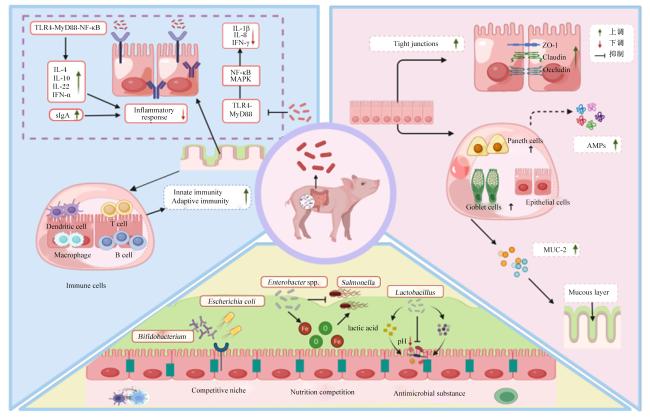
猪源益生菌应用于养猪业,主要通过调节肠道微生物群、增强肠道屏障功能、刺激免疫系统和产生抗菌化合物等多重途径改善仔猪肠道健康,进而提高仔猪的免疫力及抗病能力,最终提升经济效益(图1)。
图1 猪源益生菌对断奶仔猪肠道健康保护机制示意图

TLR4:Toll样受体4 Toll-like receptor 4;MyD88:髓样分化初级反应蛋白88 myeloid differentiation primary response 88;NF-κB:核因子-κB nuclear factor-kappa B;IL-4:白细胞介素-4 interleukin-4;IL-10:白细胞介素-10 interleukin-10;IL-22:白细胞介素-22 interleukin-22;IFN-α:干扰素-α interferon-α;sIgA:分泌型免疫球蛋白A secretory immunoglobulin A;Inflammatory response:炎症反应;IL-1β:白细胞介素-1β interleukin-1β;IL-8:白细胞介素-8 interleukin-8;IFN-γ:干扰素-γ interferon-γ;MAPK:丝裂原活化蛋白激酶 mitogen-activated protein kinase;Tight junctions:紧密连接;ZO-1:闭锁小带蛋白-1 zonula occludens-1;Claudin:闭合蛋白;Occludin:闭锁蛋白;Paneth cells:潘氏细胞;AMPs:抗菌肽 antimicrobial peptides;Goblet cells:杯状细胞;Epithelial cells:上皮细胞;MUC-2:黏蛋白2 mucin 2;Mucous layer:黏液层;Innate immunity:先天免疫;Adaptive immunity:适应性免疫;Dendritic cell:树突细胞;Macrophage:巨噬细胞;T cell:T淋巴细胞;B cell:B淋巴细胞;Immune cells:免疫细胞;Bifidobacterium:双歧杆菌属;Escherichia coli:大肠杆菌;Enterobacter spp.:肠杆菌属;Salmonella:沙门氏菌;Lactobacillus:乳杆菌属;Lactic acid:乳酸;Competitive niche:竞争性生态位;Nutrition competition:营养竞争;Antimicrobial substance:抗菌物质。

Fig.1 Schematic diagram of protective mechanism of probiotics from pigs on intestinal health of weaned piglets

相比于传统来源的益生菌,猪源益生菌具有更强的耐受性和益生性,能稳定定植于仔猪肠道,现有研究已经进行粪菌移植试验并取得初步成效[78],为缓解断奶应激提供新思路。但是,在实际生产中,猪源益生菌的推广应用仍面临一些挑战,包括最佳添加剂量不明确、菌株特异性差异显著以及不同菌群的互作机制尚未完全解析等问题。未来可进一步探索多菌种联合使用的协同效果,基于不同养殖环境或疾病状态,针对性筛选益生菌组合,进一步阐明猪源益生菌与宿主肠道的互作机制,为其作为微生态制剂的标准化应用提供理论支撑。
[1]
GRESSE R, CHAUCHEYRAS-DURAND F, FLEURY M A, et al. Gut microbiota dysbiosis in postweaning piglets:understanding the keys to health[J]. Trends in Microbiology, 2017, 25(10):851-873.

DOI

[2]
SU W F, GONG T, JIANG Z P, et al. The role of probiotics in alleviating postweaning diarrhea in piglets from the perspective of intestinal barriers[J]. Frontiers in Cellular and Infection Microbiology, 2022, 12:883107.

DOI

[3]
LI J Y. Current status and prospects for in-feed antibiotics in the different stages of pork production-a review[J]. Asian-Australasian Journal of Animal Sciences, 2017, 30(12):1667-1673.

DOI

[4]
董改香, 张勇刚, 张学文, 等. 益生菌发酵中草药对断奶仔猪生长性能、血清免疫指标、抗氧化能力及肠道功能的影响[J]. 饲料研究, 2024, 47(14):37-42.

DONG G X, ZHANG Y G, ZHANG X W, et al. Effects of probiotic-fermented Chinese herbal medicine on growth performance,serum immune indexes,antioxidant capacity,and intestinal function of weaned piglets[J]. Feed Research, 2024, 47(14):37-42. (in Chinese)

[5]
VAN ZYL W F, DEANE S M, DICKS L M T. Molecular insights into probiotic mechanisms of action employed against intestinal pathogenic bacteria[J]. Gut Microbes, 2020, 12(1):1831339.

DOI

[6]
高擎燏. 猪源益生性乳酸菌分离筛选及其在发酵饲料中的应用研究[D]. 硕士学位论文. 南京: 南京农业大学, 2015.

GAO Q Y. Isolation and screening of lactic acid bacteria from digesta and mucosa of swine as potential beneficial strains for fermented feed production[D]. Master’s Thesis. Nanjing: Nanjing Agricultural University, 2015. (in Chinese)

[7]
赵述淼. 猪源益生芽孢杆菌的分离筛选与应用研究[D]. 博士学位论文. 武汉: 华中农业大学, 2009.

ZHAO S M. Screening and application of a beneficial Bacillus from pigs[D]. Master’s Thesis. Wuhan: Huazhong Agricultural University, 2009. (in Chinese)

[8]
吴晓婷, 王召路, 朱莉莉, 等. 猪源益生性乳酸菌的分离鉴定及生物学特性研究[J]. 动物营养学报, 2025, 37(4):2750-2762.

DOI

WU X T, WANG Z L, ZHU L L, et al. Isolation,identification and biological characteristics of probiotic lactic acid bacteria derived from porcine[J]. Chinese Journal of Animal Nutrition, 2025, 37(4):2750-2762. (in Chinese)

[9]
LI J J, FENG S F, WANG Z Y, et al. Limosilactobacillus mucosae-derived extracellular vesicles modulates macrophage phenotype and orchestrates gut homeostasis in a diarrheal piglet model[J]. NPJ Biofilms and Microbiomes, 2023, 9(1):33.

DOI PMID

[10]
YUAN L, ZHU C Y, GU F, et al. Lactobacillus johnsonii N5 from heat stress-resistant pigs improves gut mucosal immunity and barrier in dextran sodium sulfate-induced colitis[J]. Animal Nutrition, 2023, 15:210-224.

DOI

[11]
李耿辉, 王雨君, 郑太龙, 等. 猪肠道内源乳杆菌的筛选鉴定及其在液态发酵饲料中的应用[J]. 江西农业大学学报, 2025, 47(1):152-166.

LI G H, WANG Y J, ZHENG T L, et al. Screening and identification of intestinal endogenous Lactobacillus in pigs and its application in liquid fermented feeds[J]. Acta Agriculturae Universitatis Jiangxiensis, 2025, 47(1):152-166. (in Chinese)

DOI

[12]
ZHANG D Y, JI H F, WANG S X, et al. Lactobacillus-driven feed fermentation regulates microbiota metabolism and reduces odor emission from the feces of pigs[J]. mSystems, 2023, 8(6):e00988-23.

[13]
HE Y W, LIANG J, LIU Y H, et al. Combined supplementation with Lactobacillus sp.and Bifidobacterium thermacidophilum isolated from Tibetan pigs improves growth performance,immunity,and microbiota composition in weaned piglets[J]. Journal of Animal Science, 2023,101:skad220.

[14]
FAN L N, QI Y D, QU S W, et al. B. adolescentis ameliorates chronic colitis by regulating Treg/Th2 response and gut microbiota remodeling[J]. Gut Microbes, 2021, 13(1):1-17.

[15]
PANG J M, LIU Y S, KANG L Y, et al. Bifidobacterium animalis promotes the growth of weaning piglets by improving intestinal development,enhancing antioxidant capacity,and modulating gut microbiota[J]. Applied and Environment Microbiology, 2022, 88(22):e0129622.

DOI

[16]
JUNG D H, SEO D H, KIM Y J, et al. The presence of resistant starch-degrading amylases in Bifidobacterium adolescentis of the human gut[J]. International Journal of Biological Macromolecules, 2020, 161:389-397.

DOI

[17]
PARK I S, KIM J H, YU J, et al. Bifidobacterium breve CBT BR3 is effective at relieving intestinal inflammation by augmenting goblet cell regeneration[J]. Journal of Gastroenterology and Hepatology, 2023, 38(8):1346-1354.

DOI

[18]
YU X R, DAI Z L, CAO G T, et al. Protective effects of Bacillus licheniformis on growth performance,gut barrier functions,immunity and serum metabolome in lipopolysaccharide-challenged weaned piglets[J]. Frontiers in Immunology, 2023, 14:1140564.

DOI

[19]
HE Y J, JINNO C, KIM K, et al. Dietary Bacillus spp. enhanced growth and disease resistance of weaned pigs by modulating intestinal microbiota and systemic immunity[J]. Journal of Animal Science and Biotechnology, 2020, 11:101.

DOI

[20]
中华人民共和国农业部. 微生物饲料添加剂技术通则:NY/T 1444—2007[S]. 北京: 中国农业出版社, 2007.

Ministry of Agriculture of the People’s Republic of China. The general rules for microbial feed additive:NY/T 1444—2007[S]. Beijing: China Agricultural Press, 2007. (in Chinese)

[21]
YEO S, LEE S, PARK H, et al. Development of putative probiotics as feed additives:validation in a porcine-specific gastrointestinal tract model[J]. Applied Microbiology and Biotechnology, 2016, 100(23):10043-10054.

DOI

[22]
中华人民共和国国家质量监督检验检疫总局, 中国国家标准化管理委员会. 饲料卫生标准:GB 13078—2017[S]. 北京: 中国标准出版社, 2017.

General Administration of Quality Supervision,Inspection and Quarantine of the People’s Republic of China, Standardization Administration of the People’s Republic of China. Hygienical standard for feeds:GB 13078—2017[S]. Beijing: Standards Press of China, 2017. (in Chinese)

[23]
DU H T, YAO W Y, KULYAR M F, et al. Effects of Bacillus amyloliquefaciens TL106 isolated from Tibetan pigs on probiotic potential and intestinal microbes in weaned piglets[J]. Microbiology Spectrum, 2022, 10(1):e0120521.

DOI

[24]
MA L T, WANG L F, ZHANG Z X, et al. Research progress of biological feed in beef cattle[J]. Animals, 2023, 13(16):2662.

DOI

[25]
YUAN L, CHANG J, YIN Q Q, et al. Fermented soybean meal improves the growth performance,nutrient digestibility,and microbial flora in piglets[J]. Animal Nutrition, 2017, 3(1):19-24.

DOI

[26]
YAN H, JIN J Q, YANG P, et al. Fermented soybean meal increases nutrient digestibility via the improvement of intestinal function,anti-oxidative capacity and immune function of weaned pigs[J]. Animal, 2022, 16(6):100557.

DOI

[27]
CZECH A, GRELA E R, KIESZ M. Dietary fermented rapeseed or/and soybean meal additives on performance and intestinal health of piglets[J]. Scientific Reports, 2021, 11(1):16952.

DOI PMID

[28]
郝丽红. 新型乳酸菌发酵饲料对猪肉品质的影响及机制研究[D]. 博士学位论文. 杭州: 浙江大学, 2020.

HAO L H. Research of novel lactic acid bacteria fermentation feed on pork quality and its mechanism[D]. Master’s Thesis. Hangzhou: Zhejiang University, 2020. (in Chinese)

[29]
FONSECA H C, DE SOUSA MELO D, RAMOS C L, et al. Probiotic properties of Lactobacilli and their ability to inhibit the adhesion of enteropathogenic bacteria to Caco-2 and HT-29 cells[J]. Probiotics and Antimicrobial Proteins, 2021, 13(1):102-112.

DOI

[30]
ANDREJČÁKOVÁ Z, SOPKOVÁ D, VLČKOVÁ R, et al. The application of Lactobacillus reuteri CCM 8617 and flaxseed positively improved the health of mice challenged with enterotoxigenic E.coli O149:F4[J]. Probiotics and Antimicrobial Proteins, 2020, 12(3):937-951.

DOI

[31]
GANCARČÍKOVÁ S, NEMCOVÁ R, POPPER M, et al. The influence of feed-supplementation with probiotic strain Lactobacillus reuteri CCM 8617 and alginite on intestinal microenvironment of SPF mice infected with Salmonella typhimurium CCM 7205[J]. Probiotics and Antimicrobial Proteins, 2019, 11(2):493-508.

DOI

[32]
RANJITKAR S, ENGBERG R M. The influence of feeding crimped kernel maize silage on growth performance and intestinal colonization with Campylobacter jejuni of broilers[J]. Avian Pathology, 2016, 45(2):253-260.

DOI

[33]
宋梦真, 李靖靖, 李家旋, 等. 益生菌及其代谢物对仔猪肠道稳态调控作用的研究进展[J]. 浙江大学学报(农业与生命科学版), 2024, 50(4):495-505.

SONG M Z, LI J J, LI J X, et al. Research progress on the regulatory effects of probiotics and their metabolites on intestinal homeostasis in piglets[J]. Journal of Zhejiang University:Agriculture&Life Sciences, 2024, 50(4):495-505. (in Chinese)

[34]
KELLY C J, ZHENG L, CAMPBELL E L, et al. Crosstalk between microbiota-derived short-chain fatty acids and intestinal epithelial HIF augments tissue barrier function[J]. Cell Host&Microbe, 2015, 17(5):662-671.

[35]
FERNANDO M R, SAXENA A, REYES J L, et al. Butyrate enhances antibacterial effects while suppressing other features of alternative activation in IL-4-induced macrophages[J]. American Journal of Physiology:Gastrointestinal and Liver Physiology, 2016, 310(10):G822-G831.

[36]
KIELA P R, GHISHAN F K. Physiology of intestinal absorption and secretion[J]. Best Practice&Research Clinical Gastroenterology, 2016, 30(2):145-159.

[37]
WANG H Y, XU R Y, ZHANG H, et al. Swine gut microbiota and its interaction with host nutrient metabolism[J]. Animal Nutrition, 2020, 6(4):410-420.

DOI PMID

[38]
WEI Y H, XI M, ZHAO J C, et al. Succinate metabolism and its regulation of host-microbe interactions[J]. Gut Microbes, 2023, 15(1):2190300.

DOI

[39]
KOU T T, FAISAL M, SONG J, et al. Polysaccharide-based nanosystems:a review[J]. Critical Reviews in Food Science and Nutrition, 2024, 64(1):1-15.

DOI

[40]
BEUMER J, PUSCHHOF J, YENGEJ F Y, et al. BMP gradient along the intestinal villus axis controls zonated enterocyte and goblet cell states[J]. Cell Reports, 2022, 38(9):110438.

DOI

[41]
WANG X, TIAN Z, AZAD M A K, et al. Dietary supplementation with Bacillus mixture modifies the intestinal ecosystem of weaned piglets in an overall beneficial way[J]. Journal of Applied Microbiology, 2021, 130(1):233-246.

DOI

[42]
XU Z Y, ZHANG Q, WU M J, et al. Lactobacillus rhamnosus GG powder supplementation alleviates intestinal injury in piglets challenged by porcine epidemic diarrhea virus[J]. Frontiers in Cellular and Infection Microbiology, 2024, 14:1371916.

DOI

[43]
DI VINCENZO F, DEL GAUDIO A, PETITO V, et al. Gut microbiota,intestinal permeability,and systemic inflammation:a narrative review[J]. Internal and Emergency Medicine, 2024, 19(2):275-293.

DOI

[44]
LEE B, MOON K M, KIM C Y. Tight junction in the intestinal epithelium:its association with diseases and regulation by phytochemicals[J]. Journal of Immunology Research, 2018, 2018:2645465.

[45]
CHELAKKOT C, GHIM J, RYU S H. Mechanisms regulating intestinal barrier integrity and its pathological implications[J]. Experimental&Molecular Medicine, 2018, 50(8):1-9.

[46]
PU J N, CHEN D W, TIAN G, et al. Effects of benzoic acid,Bacillus coagulans and oregano oil combined supplementation on growth performance,immune status and intestinal barrier integrity of weaned piglets[J]. Animal Nutrition, 2020, 6(2):152-159.

DOI

[47]
SUN W J, CHEN W N, MENG K, et al. Dietary supplementation with probiotic Bacillus licheniformis S6 improves intestinal integrity via modulating intestinal barrier function and microbial diversity in weaned piglets[J]. Biology, 2023, 12(2):238.

DOI

[48]
WALLAEYS C, GARCIA-GONZALEZ N, LIBERT C. Paneth cells as the cornerstones of intestinal and organismal health:a primer[J]. EMBO Molecular Medicine, 2023, 15(2):e16427.

DOI

[49]
SEO K, SEO J, YEUN J, et al. The role of mucosal barriers in human gut health[J]. Archives of Pharmacal Research, 2021, 44(4):325-341.

DOI PMID

[50]
VAISHNAVA S, YAMAMOTO M, SEVERSON K M, et al. The antibacterial lectin RegⅢγ promotes the spatial segregation of microbiota and host in the intestine[J]. Science, 2011, 334(6053):255-258.

DOI

[51]
CAI R, CHENG C, CHEN J W, et al. Interactions of commensal and pathogenic microorganisms with the mucus layer in the colon[J]. Gut Microbes, 2020, 11(4):680-690.

DOI PMID

[52]
ZHANG W, ZHU Y H, ZHOU D, et al. Oral administration of a select mixture of Bacillus probiotics affects the gut microbiota and goblet cell function following Escherichia coli challenge in newly weaned pigs of genotype MUC4 that are supposed to be enterotoxigenic E.coli F4ab/ac receptor negative[J]. Applied and Environmental Microbiology, 2017, 83(3):e02747-16.

[53]
BERGSTROM K S B, XIA L J. Mucin-type O-glycans and their roles in intestinal homeostasis[J]. Glycobiology, 2013, 23(9):1026-1037.

DOI PMID

[54]
WU H Q, XIE S, MIAO J F, et al. Lactobacillus reuteri maintains intestinal epithelial regeneration and repairs damaged intestinal mucosa[J]. Gut Microbes, 2020, 11(4):997-1014.

DOI

[55]
KHAN K N, GUO S W, OGAWA K N, et al. The role of innate and adaptive immunity in endometriosis[J]. Journal of Reproductive Immunology, 2024, 163:104242.

DOI

[56]
BÆK O, SANGILD P T, THYMANN T, et al. Growth restriction and systemic immune development in preterm piglets[J]. Frontiers in Immunology, 2019, 10:2402.

DOI PMID

[57]
MAZZIOTTA C, TOGNON M, MARTINI F, et al. Probiotics mechanism of action on immune cells and beneficial effects on human health[J]. Cells, 2023, 12(1):184.

DOI

[58]
LLEWELLYN A, FOEY A. Probiotic modulation of innate cell pathogen sensing and signaling events[J]. Nutrients, 2017, 9(10):1156.

DOI

[59]
WANG Q, WANG F, ZHOU Y H, et al. Bacillus amyloliquefaciens SC06 relieving intestinal inflammation by modulating intestinal stem cells proliferation and differentiation via AhR/STAT3 pathway in LPS-challenged piglets[J]. Journal of Agricultural and Food Chemistry, 2024, 72(12):6096-6109.

DOI

[60]
LI H H, ZHANG L, CHEN L B, et al. Lactobacillus acidophilus alleviates the inflammatory response to enterotoxigenic Escherichia coli K88 via inhibition of the NF-κB and p38 mitogen-activated protein kinase signaling pathways in piglets[J]. BMC Microbiology, 2016, 16(1):273.

DOI

[61]
XIE W C, SONG L Y, WANG X Y, et al. A bovine lactoferricin-lactoferrampin-encoding Lactobacillus reuteri CO21 regulates the intestinal mucosal immunity and enhances the protection of piglets against enterotoxigenic Escherichia coli K88 challenge[J]. Gut Microbes, 2021, 13(1):1956281.

DOI

[62]
BAI Y S, MA K D, LI J B, et al. Lactobacillus rhamnosus GG ameliorates DON-induced intestinal damage depending on the enrichment of beneficial bacteria in weaned piglets[J]. Journal of Animal Science and Biotechnology, 2022, 13(1):90.

DOI

[63]
WANG C, BAI J Y, CHEN X Y, et al. Gut microbiome-based strategies for host health and disease[J]. Critical Reviews in Food Science and Nutrition, 2024, 64(19):6834-6849.

DOI

[64]
LIU H Y, GIRAUD A, SEIGNEZ C, et al. Distinct B cell subsets in Peyer’s patches convey probiotic effects by Limosilactobacillus reuteri[J]. Microbiome, 2021, 9(1):198.

DOI

[65]
JIANG Z P, SU W F, LI W T, et al. Bacillus amyloliquefaciens 40 regulates piglet performance,antioxidant capacity,immune status and gut microbiota[J]. Animal Nutrition, 2023, 12:116-127.

DOI

[66]
蔡育诚, 吴灌原, 杨海冬, 等. 益生菌在动物健康管理中的作用机制及其应用现状[J]. 中国畜牧兽医, 2025, 52(5):2101-2114.

DOI

CAI Y C, WU G Y, YANG H D, et al. Mechanisms and current applications of probiotics in animal health management[J]. China Animal Husbandry&Veterinary Medicine, 2025, 52(5):2101-2114. (in Chinese)

[67]
COLLADO M C, GRZEŚKOWIAK Ł, SALMINEN S. Probiotic strains and their combination inhibit in vitro adhesion of pathogens to pig intestinal mucosa[J]. Current Microbiology, 2007, 55(3):260-265.

DOI

[68]
ZUO F L, APPASWAMY A, GEBREMARIAM H G, et al. Role of sortase a in Lactobacillus gasseri Kx110A1 adhesion to gastric epithelial cells and competitive exclusion of Helicobacter pylori[J]. Frontiers in Microbiology, 2019, 10:2770.

DOI

[69]
SONNENBURG J L, CHEN C T L, GORDON J I. Genomic and metabolic studies of the impact of probiotics on a model gut symbiont and host[J]. PLoS Biology, 2006, 4(12):e413.

DOI PMID

[70]
HUYNH U, ZASTROW M L. Metallobiology of Lactobacillaceae in the gut microbiome[J]. Journal of Inorganic Biochemistry, 2023, 238:112023.

DOI

[71]
LITVAK Y, MON K K Z, NGUYEN H, et al. Commensal Enterobacteriaceae protect against Salmonella colonization through oxygen competition[J]. Cell Host&Microbe, 2019, 25(1):128-139.e5.

[72]
LIU Y Q, YIN F, HUANG L S, et al. Long-term and continuous administration of Bacillus subtilis during remission effectively maintains the remission of inflammatory bowel disease by protecting intestinal integrity,regulating epithelial proliferation,and reshaping microbial structure and function[J]. Food&Function, 2021, 12(5):2201-2210.

[73]
HUANG W Q, MA T, LIU Y Q, et al. Spraying compound probiotics improves growth performance and immunity and modulates gut microbiota and blood metabolites of suckling piglets[J]. Science China:Life Sciences, 2023, 66(5):1092-1107.

DOI

[74]
LI R L, DING X D, LEI M K, et al. The impact of combined thymol and rosmarinic acid on the intestinal microbiota and barrier function of the piglets challenged by Escherichia coli K88[J]. Animal Nutrition, 2025, 20:131-144.

DOI

[75]
ISLAM M R, NAGAO J I, ZENDO T, et al. Antimicrobial mechanism of lantibiotics[J]. Biochemical Society Transactions, 2012, 40(6):1528-1533.

DOI PMID

[76]
PIEWNGAM P, OTTO M. Probiotics to prevent Staphylococcus aureus disease?[J]. Gut Microbes, 2020, 11(1):94-101.

DOI

[77]
EHRLICH A M, PACHECO A R, HENRICK B M, et al. Indole-3-lactic acid associated with Bifidobacterium-dominated microbiota significantly decreases inflammation in intestinal epithelial cells[J]. BMC Microbiology, 2020, 20(1):357.

DOI

[78]
MA X, ZHANG Y C, XU T T, et al. Early-life intervention using exogenous fecal microbiota alleviates gut injury and reduce inflammation caused by weaning stress in piglets[J]. Frontiers in Microbiology, 2021, 12:671683.

DOI

Outlines

/