RESEARCH PAPER

Effects of Coated Guanidinoacetic Acid on Growth Performance, Rumen Microbiota and Meat Quality of Holstein Steers

  • LIU Yan , 1, 2 ,
  • LUO Li 1 ,
  • SUI Xinxin 1 ,
  • XIN Hangshu 2 ,
  • SUN Fang , 1, *
Expand
  • 1 Institute of Animal Husbandry, Heilongjiang Academy of Agricultural Sciences, Harbin 150086, China;
  • 2 College of Animal Science and Technology, Northeast Agricultural University, Harbin 150030, China
* professor, E-mail:

Received date: 2025-04-29

  Online published: 2025-12-13

Abstract

This experiment was conducted to investigate the effects of coated guanidinoacetic acid (GAA) on the growth performance, rumen microbiota and meat quality of Holstein steers. Thirty-two healthy 8-month-old Holstein steers with the body weight of (299.78±23.45) kg were randomly allocated to four group (eight steers per group) according to initial body weight and assigned to four diets: a basal diet without coated GAA (control group) and the basal diet supplemented with 0.04%, 0.08% or 0.12% coated GAA on the dry matter basis. After a 14-day adaptation period, the trial period lasted for 300 days. The results showed as follows: 1) compared with the control group, dietary supplementation with 0.04%, 0.08% and 0.12% coated GAA showed no significant effects on the growth performance indexes of Holstein steers (P>0.05). As the supplemental level of coated GAA increasing, the relative abundances of the Fibrobacterota and the Fibrobacter in the rumen microbiota significantly decreased (P<0.05). In contrast, the relative abundances of Synergistota, Actinobacteriota, Rikenellaceae_RC9_gut_group exhibited quadratic changes of first increasing and then decreasing with increasing coated GAA supplemental level (P<0.05). Compared with the control group, dietary supplementation with 0.04%, 0.08% and 0.12% coated GAA significantly reduced the relative abundance of Fibrobacterota (P<0.05), and significantly elevated the relative abundances of Synergistota and Ruminococcaceae_NK4A214_group (P<0.05). 3) Compared with the control group, dietary supplementation with 0.08% and 0.12% coated GAA significantly increased plasma glucose content (P<0.05) without significantly affecting other plasma biochemical indexes (P>0.05). 4) Dietary supplementation with varying levels of coated GAA had no significant effects on carcass weight, slaughter percentage, and viscera indexes (P>0.05). However, the spleen index exhibited a quadratic change of decreasing initially and then increasing with increasing dietary coated GAA supplemental level (P<0.05). 5) Meat redness (a*) and yellowness (b*) values increased linearly (P<0.05) and water loss rate decreased linearly (P<0.05) as coated GAA supplemental level increasing; specifically, dietary supplementation with 0.04% and 0.12% coated GAA significantly improved the a* and b* values, and dietary supplementation with 0.08% and 0.12% coated GAA significantly reduced the water loss rate compared with the control group (P<0.05). In conclusion, although coated GAA does not enhance the growth performance, it can modulate the rumen microbiota structure and improve the meat quality of Holstein steers. Under the conditions of this experiment, dietary supplementation with 0.08% coated GAA can yield the optimal results.

Cite this article

LIU Yan , LUO Li , SUI Xinxin , XIN Hangshu , SUN Fang . Effects of Coated Guanidinoacetic Acid on Growth Performance, Rumen Microbiota and Meat Quality of Holstein Steers[J]. Chinese Journal of Animal Nutrition, 2025 , 37(12) : 8402 -8413 . DOI: 10.12418/CJAN2025.685

肉牛育肥饲养过程中往往采用高精料饲粮来获得较高的日增重和更好的牛肉品质,但是这会造成肉牛胴体沉积较多的脂肪,特别是内脏脂肪和皮下脂肪的过度沉积,会严重影响胴体的经济价值[1]。如果可以减少内脏脂肪和皮下脂肪的沉积,提高肌内脂肪沉积,则可以改善牛肉品质。肌酸(creatine,Cr)是合成肌肉蛋白质的重要物质,但纯植物饲粮中不含肌酸,需要动物自身合成肌酸才能满足生长的需要,胍基乙酸(guanidineacetic acid,GAA)是合成肌酸的唯一前体物质[2]。GAA可以转化为肌酸,增加肉牛肌肉组织中磷酸肌酸的含量,通过机体能量代谢提高ATP再生能力,增强肉牛能量代谢效率,进而有助于提高肉牛生长性能和饲料转化率。有研究表明,在肉牛饲粮中添加GAA可以减少育肥牛胴体皮下和内脏脂肪的沉积,提高日增重、饲料转化效率,同时还有促进肌内脂肪沉积的作用[3]。Yi等[4]在安格斯公牛上的研究发现,饲粮中添加0.8或1.6 g/kg的GAA可以提高平均日增重、饲料转化效率和营养物质消化率。Li等[5]在晋江公牛的研究发现,饲粮中添加0.2% GAA可以提高饲料效率,进而改善生长性能。张含等[6]在湖羊中的研究表明,饲粮中添加0.04%过瘤胃GAA显著提高了平均日增重和背最长肌熟肉率。研究显示,包被GAA在瘤胃液中具有稳定性,可以通过瘤胃进入后肠道发挥作用[7]。然而,目前关于包被GAA在肉牛饲粮中应用效果的研究相对较少,将包被GAA应用于荷斯坦阉牛的育肥饲粮中是否会对其生长性能和肉品质产生相似效果,还需要验证。因此,本试验以荷斯坦阉牛为试验动物,在饲粮中添加不同水平的包被GAA,研究其对荷斯坦阉牛生长性能、瘤胃微生物区系和肉品质的影响,旨在为包被GAA在荷斯坦阉牛育肥生产中的高效利用提供依据。

1 材料与方法

1.1 试验材料

本试验所用包被GAA中GAA含量≥50%,包被材料为C16~C18中链脂肪酸,过瘤胃率在90%左右。

1.2 试验设计与饲养管理

本次动物试验经黑龙江省农业科学院动物福利伦理委员会批准(批准文号:IHA20250220),在黑龙江省农业科学院畜牧研究所进行。
选取体重在(299.78±23.45) kg的健康8月龄荷斯坦阉牛32头,以体重作为分类标准,随机分为4组,分别饲养在4个圈舍中,每组8头。对照组饲喂基础饲粮,试验组分别在基础饲粮中添加占饲粮干物质0.04%、0.08%、0.12%的包被GAA。预试期14 d,正试期300 d。试验期间自由饮水和采食,每天08:00和16:00各饲喂1次。基础饲粮组成及营养水平见表1
表1 基础饲粮组成及营养水平(干物质基础)

Table 1 Composition and nutrient levels of the basal diet (DM basis) %

项目Items 含量Content
原料Ingredients
压片玉米Flaked corn 56.00
豆粕Soybean meal 6.24
发酵豆粕Fermented soybean meal 4.80
麸皮Bran 10.46
预混料Premix1) 2.50
稻草Straw 20.00
合计Total 100.00
营养水平Nutrient levels2)
粗蛋白质CP 12.00
总可消化养分TDN 80.00
消化能DE/(MJ/kg) 14.43
钙Ca 0.35
磷P 0.26

1)预混料为每千克饲粮提供 Premix provided the following per kg of the diet:VA 2 600 IU,VD 260 IU,VE 60 IU,Fe 100 mg,Cu 10 mg,Mn 40 mg,Zn 40 mg,Se 0.3 mg,I 2 mg,Co 0.11 mg。

2)消化能为计算值,其余为实测值。DE was a calculated value, while the others were determined values.

1.3 测定指标

1.3.1 饲粮营养成分分析

消化能(DE)的计算参考王菲[8]的方法;总可消化养分(TDN)含量的测定参考文献[9]给出的方法;粗蛋白质(CP)、钙(Ca)和磷(P)含量测定分别参考GB/T 6432—2018、GB/T 6436—2018和GB/T 6437—2018。

1.3.2 生长性能测定

正式试验第1天晨饲前称量试验牛体重并记录,之后每隔1个月称重1次并记录,直到试验结束,计算平均日增重(ADG);试验期间,每天记录投料量和剩料量,以计算干物质采食量(DMI);根据记录的体重数据和采食量数据,计算料重比(F/G)。

1.3.3 血浆生化指标测定

试验最后1天晨饲前用肝素钠抗凝管在牛尾根部进行采血,1 006×g离心15 min,离心后取上清液分装至1.5 mL离心管内,保存至-20 ℃冰箱进行后续血浆生化指标检测。采用酶联免疫吸附试验(ELISA)试剂盒检测血浆中总蛋白(TP)、白蛋白(ALB)、球蛋白(GLB)、葡萄糖(GLU)、总胆固醇(TC)含量与谷丙转氨酶(ALT)和谷草转氨酶(AST)活性。

1.3.4 屠宰性能测定

试验结束后,所有试验牛运送到屠宰场(内蒙古科尔沁牛业股份有限公司)进行屠宰。屠宰前称重以记录每头牛宰前活重,屠宰后去除头、皮、蹄、尾和内脏,保留肾脏和板油,剩余躯干的重量即为胴体重,计算屠宰率;称取心脏、肝脏、脾脏和肾脏的重量,计算脏器指数;取肾周脂肪并称重,记录肾周脂肪重;用数显游标卡尺测量胴体第12、13根肋骨间距脊椎中轴线11 cm处的脂肪厚度,即为背膘厚。
屠宰率=100×胴体重/宰前活重;
脏器指数=100×脏器重量/宰前活重。

1.3.5 肉品质测定

pH和肉色:参考NY/T 821—2019测定肉pH和肉色。试验牛屠宰后,取背最长肌,在4 ℃冰箱里保存24 h后取出,用手术刀划开1个十字形,然后使用便携式pH计测定pH,重复3次取平均值;取腰背最长肌,在4 ℃冰箱里保存24 h后取出,用肉色仪(Minolta CR-400,Konica Minolta,日本)测定亮度(L*)、红度(a*)和黄度(b*)值,在同一块肉不同位置重复测定3次,取平均值。
失水率:参考Jo等[10]的方法测定失水率。将背最长肌肉样切成小块(50 g左右,m1)装进真空袋中,放入80 ℃水浴锅中,直至肉样内部的温度达到80 ℃;取出肉样冷却至室温,用滤纸擦干表面水分后称重(m2)。
失水率(%)=100×(m1-m2)/m1
剪切力:参考Zhang等[11]的方法测定剪切力。将测完失水率的肉样沿着平行于肌纤维的方向切成1 cm×1 cm×2 cm的块状,用嫩度仪沿着垂直肌纤维的方向切割,每个肉样重复6次,记录最大剪切力,取平均值。
大理石花纹等级:根据闫向民等[12]的方法评定大理石花纹等级。胴体排酸48 h后,取第6~7肋骨间背最长肌横切面,按照日本评级标准对牛肉进行大理石花纹等级评定。

1.3.6 瘤胃液和瘤胃内容物的采集

试验牛屠宰后取瘤胃内容物,经4层纱布过滤后,分装到5 mL冻存管中,经液氮冷冻后转移至-80 ℃冰箱中保存,以便进行后续微生物测序。

1.3.7 瘤胃微生物16S rDNA测序

使用商业化磁珠法DNA提取试剂盒[TGuide S96,天根生化科技(北京)有限公司]进行瘤胃微生物基因组DNA的分离纯化,操作步骤按照说明书进行。在1.8%琼脂糖凝胶上用电泳检查提取的DNA的质量和数量,并使用NanoDrop 2000紫外可见分光光度计(Thermo Scientific,美国)测定DNA浓度和纯度。以DNA为模板,使用引物338F(5'-ACTCCTACGGGAGGCAGCA-3')和806R(5'-GGACTACHVGGGTWTCTAAT-3')对瘤胃微生物16S rDNA V3+V4区域进行PCR扩增。PCR扩增反应体系为10 μL,具体组成如下:模板DNA用量为5~50 ng,正向与反向引物(浓度均为10 μmol/L)各0.3 μL,5 μL KOD FX Neo Buffer,2 μL dNTPs(每种浓度为2 mmol/L),0.2 μL KOD FX Neo酶,最后用ddH2O将总体积补至10 μL。
PCR扩增反应过程及条件,1)预变性:95 ℃,5 min;2)持续变性:95 ℃,30 s;3)退火:50 ℃,30 s;4)延伸:72 ℃,40 s,重复25个循环;5)最终延伸:72 ℃,7 min。
用Omega DNA纯化试剂盒(Omega Inc.,美国)纯化扩增产物,并使用Qsep-400高通量核酸蛋白分析系统(台湾光鼎生物科技股份有限公司)定量。扩增子文库通过Illumina NovaSeq 6000进行双端测序(2×250)。对获得的原始数据通过Trimmomatic(v 0.33)进行过滤,然后由Cutadapt(v 1.9.1)鉴定和去除引物序列。获得的PE读数由USEARCH(v 10)组装,然后使用UCHIME(v 8.1)去除嵌合体,最终得到高质量数据。通过USEARCH(v 10)将相似度>97%的序列聚集到相同的操作分类单元(OTU)中,并进行微生物相对丰度分析。

1.4 数据统计分析

采用SAS 9.4软件中的Proc Mixed模型对荷斯坦阉牛的生长性能、瘤胃微生物区系、屠宰性能和血浆生化指标数据进行分析,所应用的统计模型为Yi=μ+Ti+Ei,其中Yi为因变量,μ为总体平均值,Ti为处理饲粮的固定效应,Ei为残差。使用正交多项式对比分析包被GAA添加量对每个变量的线性和二次效应。采用最小显著差异(LSD)法对各组进行两两比较,P<0.05为差异显著。

2 结果

2.1 包被GAA对荷斯坦阉牛生长性能的影响

表2可知,包被GAA添加量对荷斯坦阉牛的终末体重、平均日增重、干物质采食量和料重比均无显著影响(P>0.05)。
表2 包被GAA对荷斯坦阉牛生长性能的影响

Table 2 Effects of coated GAA on growth performance of Holstein steers

项目
Items
包被GAA添加量
Coated GAA supplemental levels/%
SEM PP-value
0(对照
Control)
0.04 0.08 0.12 处理
Treatment
线性
Linear
二次
Quadratic
初始体重
Initial body weight/kg
301.50 305.00 298.88 293.75 4.145 0.822 0.451 0.619
终末体重
Final body weight/kg
739.25 717.25 725.00 712.86 7.982 0.687 0.346 0.766
平均日增重ADG/(kg/d) 1.25 1.17 1.21 1.19 0.015 0.326 0.282 0.486
干物质采食量DMI/kg 9.23 9.17 9.24 9.66 0.158 0.701 0.361 0.467
料重比F/G 7.42 7.83 7.61 8.23 0.142 0.242 0.095 0.698

同行数据肩标无字母或相同字母表示差异不显著(P>0.05),不同小写字母表示差异显著(P<0.05)。下表同。

In the same row, values with no letter or the same letter superscripts mean no significant difference (P>0.05), while with different small letter superscripts mean significant difference (P<0.05). The same as below.

2.2 包被GAA对荷斯坦阉牛瘤胃微生物区系的影响

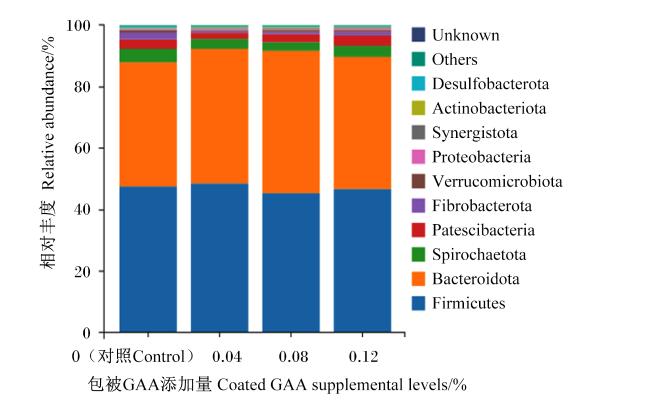
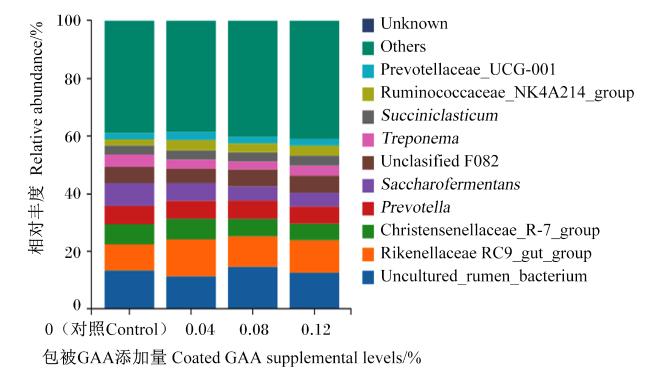
对于荷斯坦阉牛瘤胃微生物组成,在门水平上以厚壁菌门(Firmicutes)的相对丰度最高(图1),在属水平上以理研菌科RC9肠道群(Rikenellaceae_RC9_gut_group)的相对丰度最高(图2)。
图1 荷斯坦阉牛瘤胃微生物在门水平的组成

Firmicutes:厚壁菌门;Bacteroidota:拟杆菌门;Spirochaetota:螺旋体门;Patescibacteria:髌骨细菌门;Fibrobacterota:纤维杆菌门;Verrucomicrobiota:疣微菌门;Proteobacteria:变形菌门;Synergistota:互养菌门;Actinobacteriota:放线菌门;Desulfobacterota:脱硫杆菌门;Others:其他;Unknown:未知菌。

Fig.1 Composition of microbiota at phylum level in rumen of Holstein steers

图2 荷斯坦阉牛瘤胃微生物在属水平的组成

Uncultured_rumen_bacterium:瘤胃不可培养细菌;Rikenellaceae_RC9_gut_group:理研菌科_RC9_肠道群;Christensenellaceae_R-7_group:克里斯滕森菌科 _R-7_群;Prevotella:普雷沃氏菌属;Treponema:密螺旋体属;Succiniclasticum:琥珀酸单胞菌属;Ruminococcaceae_NK4A214_group:瘤胃球菌科NK4A214群;Prevotellaceae_UCG-001:普雷沃氏菌科UCG-001;Unclassified_Lachnospiraceae:未分类的毛螺菌科;Others:其他;Unknown:未知菌。

Fig.2 Composition of microbiota at genus level in rumen of Holstein steers

表3可知,随着包被GAA添加量的增加,纤维杆菌门(Fibrobacterota)的相对丰度呈先降低后升高的二次曲线变化(P=0.012),互养菌门(Synergistota)、放线菌门(Actinobacteriota)的相对丰度呈先升高后降低的二次曲线变化(P=0.016、P=0.008);与对照组相比,添加包被GAA的3个试验组纤维杆菌门的相对丰度显著降低(P<0.05),互养菌门的相对丰度显著升高(P<0.05),同时,0.08%包被GAA组放线菌门的相对丰度显著升高(P<0.05)。由表4可知,随着GAA添加量的增加,纤维杆菌属(Fibrobacter)的相对丰度呈现先降低后升高的二次曲线变化(P=0.011),Rikenellaceae_RC9_gut_group的相对丰度呈现先升高后降低的二次曲线变化(P=0.025),克里斯滕森菌科R-7群(Christensenellaceae_R-7_group)的相对丰度呈线性降低(P=0.006),瘤胃球菌科NK4A214群(Ruminococcaceae_NK4A214_group)的相对丰度呈线性升高(P=0.022)。与对照组相比,添加包被GAA的3个试验组Fibrobacter的相对丰度显著降低(P<0.05),0.04%和0.12%包被GAA组Rikenellaceae_RC9_gut_group的相对丰度显著增加(P<0.05),0.12%包被GAA组Christensenellaceae_R-7_group的相对丰度显著降低(P<0.05),3个试验组Ruminococcaceae_NK4A214_group的相对丰度显著增加(P<0.05)。此外,0.08%包被GAA组未分类的毛螺菌科(Unclassified_Lachnospiraceae)的相对丰度显著低于对照组(P<0.05)。
表3 包被GAA对荷斯坦阉牛瘤胃微生物中主要菌门相对丰度的影响

Table 3 Effects of coated GAA on relative abundances of major bacterial phyla in rumen microbiota of Holstein steers %

项目
Items
包被GAA添加量
Coated GAA supplemental levels/%
SEM PP-value
0(对照
Control)
0.04 0.08 0.12 处理
Treatment
线性
Linear
二次
Quadratic
厚壁菌门Firmicutes 47.40 48.40 45.48 46.65 0.553 0.304 0.298 0.940
拟杆菌门Bacteroidota 40.17 43.76 45.98 42.73 0.879 0.123 0.192 0.049
螺旋体门Spirochaetota 4.48 3.37 2.91 3.75 0.462 0.698 0.544 0.320
髌骨细菌门Patescibacteria 3.19 2.04 2.67 3.51 0.410 0.633 0.671 0.253
纤维杆菌门Fibrobacterota 2.36a 0.54b 0.74b 1.14b 0.238 0.019 0.067 0.012
疣微菌门Verrucomicrobiota 0.79 0.33 0.59 0.67 0.111 0.531 0.933 0.243
变形菌门Proteobacteria 0.40 0.38 0.36 0.50 0.045 0.720 0.479 0.412
互养菌门Synergistota 0.19b 0.36a 0.30a 0.31a 0.021 0.020 0.111 0.016
放线菌门Actinobacteriota 0.21b 0.27b 0.37a 0.22b 0.020 0.015 0.326 0.008
脱硫杆菌门Desulfobacterota 0.36 0.18 0.25 0.16 0.029 0.076 0.056 0.309
表4 包被GAA对荷斯坦阉牛瘤胃微生物中主要菌属相对丰度的影响

Table 4 Effects of coated GAA on relative abundances of major bacterial genera in rumen microbiota of Holstein steers %

项目
Items
包被GAA添加量
Coated GAA supplemental levels/%
SEM PP-value
0(对照
Control)
0.04 0.08 0.12 处理
Treatment
线性
Linear
二次
Quadratic
理研菌科_RC9_肠道群
Rikenellaceae_RC9_gut_group
9.07c 12.80a 10.59bc 11.19ab 0.410 0.005 0.166 0.025
克里斯滕森菌科_R-7_群
Christensenellaceae_R-7_group
6.93ab 7.15a 6.03bc 5.69c 0.207 0.023 0.006 0.440
普雷沃氏菌属Prevotella 6.32 6.30 6.36 5.98 0.058 0.921 0.632 0.678
Saccharofermentans 7.88 6.09 4.89 4.90 0.028 0.054 0.011 0.278
密螺旋体属Treponema 4.42 3.32 2.84 3.68 0.016 0.699 0.537 0.323
琥珀酸单胞菌属
Succiniclasticum
3.21 3.17 3.20 3.42 0.027 0.927 0.629 0.655
瘤胃球菌科NK4A214群
Ruminococcaceae_
NK4A214_group
2.12b 3.12a 3.43a 3.58a 0.188 0.016 0.022 0.081
普雷沃氏菌科UCG-001
Prevotellaceae_UCG-001
2.16 2.80 2.24 2.26 0.039 0.323 0.825 0.249
未分类的毛螺菌科
Unclassified_Lachnospiraceae
1.37ab 1.41a 1.06c 1.09bc 0.056 0.027 0.011 0.951
纤维杆菌属Fibrobacter 2.36a 0.53b 0.73b 1.13b 0.238 0.018 0.066 0.011

2.3 包被GAA对荷斯坦阉牛血浆生化指标的影响

表5可知,随着包被GAA添加量的增加,血浆GLU含量呈线性增加(P=0.007),且0.08%和0.12%包被GAA组的血浆GLU含量均显著高于与对照组(P<0.05);其他血浆生化指标各组间均无显著差异(P>0.05)。
表5 包被GAA对荷斯坦阉牛血浆生化指标的影响

Table 5 Effects of coated GAA on plasma biochemical indexes of Holstein steers

项目
Items
包被GAA添加量
Coated GAA supplemental levels/%
SEM PP-value
0(对照
Control)
0.04 0.08 0.12 处理
Treatment
线性
Linear
二次
Quadratic
总蛋白TP/(g/L) 61.77 73.70 67.22 68.12 2.121 0.274 0.623 0.987
白蛋白ALB/(g/L) 31.37 33.98 34.17 34.75 0.737 0.394 0.786 0.239
球蛋白GLB/(g/L) 33.05 39.72 30.40 33.37 1.799 0.320 0.603 0.607
葡萄糖GLU/(mol/L) 2.07c 2.32bc 2.63b 3.31a 0.123 <0.001 0.007 0.203
总胆固醇TC/(mol/L) 2.95 3.23 2.76 3.01 0.102 0.453 0.747 0.936
谷丙转氨酶ALT/(U/L) 29.00 23.00 26.00 25.67 1.102 0.306 0.478 0.205
谷草转氨酶AST/(U/L) 52.17 58.50 61.83 59.05 1.921 0.341 0.441 0.175

2.4 包被GAA对荷斯坦阉牛屠宰性能的影响

表6可知,对照组与添加包被GAA的各试验组的胴体重、屠宰率、背膘厚及各脏器指数均无显著差异(P>0.05),但随着包被GAA添加量的增加,脾脏指数呈先降低后升高的二次曲线变化(P=0.037);此外,与对照组相比,饲粮添加包被GAA对肾周脂肪重无显著影响(P>0.05)。
表6 包被GAA对荷斯坦阉牛屠宰性能的影响

Table 6 Effects of coated GAA on slaughter performance of Holstein steers

项目
Items
包被GAA添加量
Coated GAA supplemental levels/%
SEM PP-value
0(对照
Control)
0.04 0.08 0.12 处理
Treatment
线性
Linear
二次
Quadratic
胴体重Carcass weight/kg 368.44 365.25 362.69 349.94 4.393 0.484 0.154 0.594
屠宰率
Slaughter percentage/%
0.53 0.54 0.53 0.53 0.200 0.192 0.230 0.268
背膘厚Back fat thickness/cm 2.29 2.16 2.01 2.13 0.087 0.756 0.467 0.508
心脏指数Heart index/% 0.37 0.35 0.38 0.38 0.007 0.570 0.640 0.386
肝脏指数Liver index/% 1.04 1.10 1.08 1.09 0.019 0.738 0.442 0.538
脾脏指数Spleen index/% 0.16 0.16 0.15 0.17 0.003 0.094 0.296 0.037
肾脏指数Kidney index/% 0.24 0.24 0.23 0.24 0.005 0.776 0.682 0.503
肾周脂肪重
Perirenal fat weight/kg
29.71 25.54 28.86 27.79 0.850 0.349 0.748 0.367

2.5 包被GAA对荷斯坦阉牛肉品质的影响

表7可知,肉色的a*和b*值随着包被GAA添加量的增加呈线性增加(P<0.05),而失水率则呈线性下降(P<0.05);其他肉品质指标各组间无显著差异(P>0.05)。
表7 包被GAA对荷斯坦阉牛肉品质的影响

Table 7 Effects of coated GAA on meat quality of Holstein steers

项目
Items
包被GAA添加量
Coated GAA supplemental levels/%
SEM PP-value
0(对照
Control)
0.04 0.08 0.12 处理
Treatment
线性
Linear
二次
Quadratic
pH24 h 5.46 5.50 5.51 5.50 0.010 0.265 0.114 0.250
亮度L* 41.00 42.49 41.02 40.02 0.522 0.427 0.355 0.245
红度a* 24.83c 26.71b 27.63a 25.29bc 0.359 0.013 0.004 0.278
黄度b* 9.90c 11.57b 12.20a 10.16bc 0.311 0.015 0.004 0.421
失水率Water loss rate/% 35.48a 35.63a 32.91b 32.73b 0.476 0.031 0.008 0.853
剪切力Shear force/N 33.78 39.63 32.54 40.50 1.742 0.276 0.402 0.762
大理石花纹等级
Marbling score
3.14 3.25 3.00 3.29 0.069 0.491 0.714 0.571

2.6 荷斯坦阉牛瘤胃微生物主要菌门相对丰度与肌肉pH、a*值以及ADG和血浆GLU含量的相关性分析
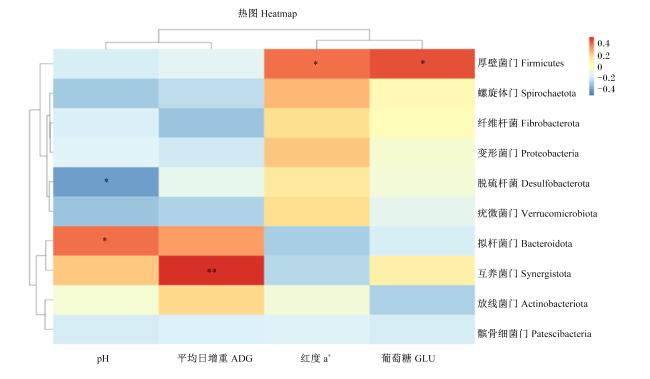
图3可知,拟杆菌门(Bacteroidota)相对丰度与pH呈显著正相关(P<0.05),脱硫杆菌门(Desulfobacterota)相对丰度与pH呈显著负相关(P<0.05);Synergistota相对丰度与ADG呈极显著正相关(P<0.01);Firmicutes相对丰度与a*值和血浆GLU含量呈显著正相关(P<0.05)。
图3 荷斯坦阉牛瘤胃微生物主要菌门相对丰度与肌肉pH、a*值及ADG和血浆GLU含量的相关性分析

“*”:显著相关(P<0.05);“**”:极显著相关(P<0.01)。

Fig.3 Correlation analysis between relative abundances of major bacterial phyla in rumen microbiota and muscle pH, a* value, ADG, and plasma GLU content of Holstein steers

“*”: significant correlation (P<0.05); “**”: extremely significant correlation (P<0.01).

3 讨论

3.1 包被GAA对荷斯坦阉牛生长性能的影响

研究表明,饲粮添加GAA具有提高肉牛生长性能和改善肉品质的潜力[13]。GAA作为肌酸的唯一前体物,外源补充GAA进入畜禽体内会转化为肌酸,提高机体内肌酸含量,肌酸进一步转化为磷酸肌酸,进而构成磷酸原系统,为机体提供能量[2]。肌酸是能量代谢的核心,外源补充GAA可以促进能量向肌肉组织转移,改善动物生长性能。Yi等[4]在安格斯公牛饲粮中分别添加0.8和1.6 g/kg GAA后,均能有效提高平均日增重和出栏体重。在羔羊的研究中,添加0.08% GAA也得出类似的结论,并降低了料重比[14]。目前GAA应用在荷斯坦阉牛上的研究报道较少,对于包被GAA的研究更是鲜见。本试验结果显示,在饲粮中添加不同水平的包被GAA并没有显著改善荷斯坦阉牛的生长性能,这可能是因为去势后,阉牛雄性激素水平降低,影响机体氮沉积能力,进而抑制肌肉蛋白质合成和肌肉的生长;胰岛素水平升高,胰岛素与生长激素存在拮抗作用,导致阉牛体内生长激素水平降低,进而影响阉牛生长发育[15]

3.2 包被GAA对荷斯坦阉牛瘤胃微生物区系的影响

瘤胃微生物主要由细菌、真菌、原虫等大量微生物构成,其中细菌占主导地位,这些微生物之间相互协调发挥作用,对饲粮中的营养成分进行消化吸收[16]。Firmicutes可以降解饲粮中的纤维成分,产生乙酸盐和丁酸盐。在本试验中,Firmicutes为瘤胃内的优势菌群,这与Yang等[17]的研究结果一致。与对照组相比,添加包被GAA的3个试验组瘤胃中Fibrobacterota的相对丰度显著降低。包被GAA在瘤胃中少量降解,可能抑制了Fibrobacterota增殖,进而影响瘤胃中Fibrobacterota的相对丰度。此外,3个试验组瘤胃中Synergistota的相对丰度较对照组显著提高。瘤胃中Synergistota的相对丰度与饲粮中蛋白质利用率显著相关,其可能通过参与支链氨基酸降解影响氮代谢效率[18]。有研究表明,Actinobacteriota在高大理石花纹肉牛瘤胃中相对丰度较高,其可能通过调节短链脂肪酸和支链脂肪酸影响肌内脂肪细胞分化[19]。除此之外,Actinobacteriota可以分泌多种酶类,具有降解饲粮中有机物产生抗菌物质的能力,调控瘤胃微生物平衡[20]。本试验中,饲粮中添加0.08%包被GAA显著提高了Actinobacteriota的相对丰度。目前,关于包被GAA在反刍动物瘤胃微生物中的研究相对较少,虽然本试验结果显示Synergistota和Actinobacteriota的相对丰度随着包被GAA添加量的增加呈现二次变化,但其是否与包被GAA存在剂量效应还需进一步结合代谢组学进行分析。本试验中,Rikenellaceae_RC9_gut_group为荷斯坦阉牛瘤胃中的优势菌属,这与Liu等[21]的研究结果一致。Rikenellaceae_RC9_gut_group是一种具有肠道保护功能的有益菌属,在胃肠道内较为常见,其相对丰度与饲粮纤维含量成正比[22]。Christensenellaceae_R-7_group属于厚壁菌门,与肠道健康有关,其可以降解粗饲料中的纤维素和半纤维素,将其转化为短链脂肪酸[23]。本试验中,饲粮中添加包被GAA并没有显著提高Christensenellaceae_R-7_group的相对丰度,但是显著提高了Ruminococcaceae_NK4A214_group的相对丰度,Ruminococcaceae_NK4A214_group作为瘤胃微生物中重要的菌属,参与降解碳水化合物和调控丙酸合成[24]。毛螺菌科(Lachnospiraceae)是一个系统发育和形态异质的分类单元,属厚壁菌门的一种,具有利用饲粮衍生多糖的能力[25],在厚壁菌门中,高丰度的毛螺菌属与糖和脂代谢呈正相关,其相对丰度升高表明代谢紊乱。本试验采用的包被GAA,其在经过瘤胃时会被瘤胃内微生物少量降解,产生甘氨酸和尿素,为微生物提供合成蛋白质的氮源;此外,包被GAA还可能为微生物提供了能量,促进其增殖,进而影响瘤胃内微生物结构变化[26]

3.3 包被GAA对荷斯坦阉牛血浆生化指标的影响

血浆生化指标可以直观地反映动物体内的代谢水平,也可以反映营养物质在动物体内的沉积。血浆中总胆固醇和甘油三酯的含量可以反映动物的脂质代谢情况[27]。本试验结果表明,饲粮中添加0.08%包被GAA组的血浆总胆固醇含量最低,但与对照组差异不显著,这与王杰[28]在仔猪上的试验结果一致。血浆中总蛋白和白蛋白含量的增加与机体蛋白质合成代谢的改善有关。这是因为GAA的补充可以节约机体内的精氨酸,使更多精氨酸参与合成机体所需的蛋白质,进而提高血浆总蛋白和白蛋白含量[29]。但本研究发现,添加包被GAA的3个试验组的血浆总蛋白和白蛋白含量虽然数值上有所提高,但与对照组的差异并不显著。这可能是因为包被GAA添加量不足,导致蛋白质代谢不能充分体现;此外,肌酸主要参与机体能量代谢,不能直接调控蛋白质合成。范明东等[30]的研究显示,在断奶仔猪饲粮中添加GAA并未改变血浆总蛋白含量,这与本试验结果相吻合。

3.4 包被GAA对荷斯坦阉牛屠宰性能及肉品质的影响

屠宰性能直接反映肉牛的产肉效率。有研究表明,在肉牛饲粮中添加过瘤胃GAA可以显著提高屠宰率和净肉率,进而提高经济效益[31]。屠宰后,肌肉通过无氧糖酵解产生乳酸,乳酸的积累会造成肌肉pH下降,进而降低肌肉的a*值和嫩度[32]。在肉羊上的研究显示,饲粮中添加0.06% GAA可显著提高胴体重和眼肌面积,显著提高背最长肌pH和L*值,降低滴水损失,改善肉品质[33]。在育肥猪的饲养试验中发现,添加GAA同样可以提高屠宰率和胴体重,降低背膘厚,提高背最长肌a*值、pH,降低滴水损失[34]。本试验结果发现,饲粮中添加包被GAA提高了屠宰后荷斯坦阉牛背最长肌的pH以及肉色的a*、b*值,与上述研究结果一致。本试验中a*和b*值较高可能与添加包被GAA使得肉的pH下降缓慢有关。肉色的a*值反映了肉质的新鲜程度,a*值越高,说明肉质越新鲜。己糖激酶是糖酵解反应中的限速酶之一,其参与催化GLU转化为葡萄糖-6-磷酸,导致乳酸积累,pH降低,而GAA对己糖激酶的活性具有抑制作用,可以抑制糖酵解产生乳酸,维持屠宰后肉pH的稳定[35]。研究发现,GAA能够调控肝脏脂质代谢关键酶的表达,进而抑制胴体脂肪的过度增加,提高肌内脂肪含量[36]。肉牛品种和饲粮能量水平会影响肌内脂肪的沉积,特别是育肥后期,需要高能饲粮。GAA可以调控肌细胞能量代谢,增加肌酸和磷酸肌酸的含量,进而增加肌细胞渗透压,使屠宰后的肉持有更多水分,以减少滴水损失[37-38]。滴水损失与失水率呈正相关,失水率越低,肉质越鲜嫩多汁。本试验得出的包被GAA可以显著降低失水率的结果与此一致。动物体的身体机能状况与器官指数息息相关,在生产中尤为重要。本试验发现,饲粮中添加包被GAA对荷斯坦阉牛的各脏器指数无显著影响,这一结果与梁本聪等[39]的试验结果一致。

4 结论

综上所述,饲粮中添加0.04%~0.12%的包被GAA对荷斯坦阉牛的生长性能均无显著影响,但添加0.08%包被GAA可以显著提高瘤胃中有益菌群(如Synergistota和Actinobacteriota)的相对丰度,改善瘤胃内环境;同时,饲粮中添加0.08%包被GAA还可以缓解荷斯坦阉牛屠宰后肌肉pH降低,提高肉色的a*值,降低失水率,改善肉品质。
[1]
LI L Y, ZHU Y K, WANG X Y, et al. Effects of different dietary energy and protein levels and sex on growth performance,carcass characteristics and meat quality of F1 Angus×Chinese Xiangxi yellow cattle[J]. Journal of Animal Science and Biotechnology, 2014, 5(1):21.

DOI

[2]
王宏娇, 秦巧梅, 原雪峰, 等. 胍基乙酸在动物生产中应用的研究进展[J]. 饲料研究, 2025, 48(3):166-171.

WANG H J, QIN Q M, YUAN X F, et al. Research progress of guanidine acetic acid application in animal production[J]. Feed Research, 2025, 48(3):166-171. (in Chinese)

[3]
吴宝云, 周振明, 吴浩. 胍基乙酸改善畜禽肉品质的研究进展[J]. 中国畜牧杂志, 2022, 58(11):21-26.

WU B Y, ZHOU Z M, WU H. Advance in guanidinoacetic acid on meat quality of livestock animal[J]. Chinese Journal of Animal Science, 2022, 58(11):21-26. (in Chinese)

[4]
YI S M, HU S L, WANG J Z, et al. Effect of guanidinoacetic acid supplementation on growth performance,rumen fermentation,blood indices,nutrient digestion,and nitrogen metabolism in Angus steers[J]. Animals, 2024, 14(3):401.

DOI

[5]
LI Z M, LIANG H, XIN J P, et al. Effects of dietary guanidinoacetic acid on the feed efficiency,blood measures,and meat quality of Jinjiang bulls[J]. Frontiers in Veterinary Science, 2021, 8:684295.

DOI

[6]
张含, 桂红兵, 张晨俭, 等. 过瘤胃胍基乙酸对育肥后期湖羊生长性能、屠宰性能、肌肉品质及血清生化指标的影响[J]. 动物营养学报, 2023, 35(2):1057-1065.

DOI

ZHANG H, GUI H B, ZHANG C J, et al. Effects of rumen-protected guanidinoacetic acid on growth performance, slaughter performance,muscle quality and serum biochemical indexes of Hu sheep during late fattening period[J]. Chinese Journal of Animal Nutrition, 2023, 35(2):1057-1065. (in Chinese)

DOI

[7]
蒋青荣, 刘璇, 刘伟国, 等. 包被胍基乙酸体外释放评价[J]. 养殖与饲料, 2023, 22(2):28-30.

JIANG Q R, LIU X, LIU W G, et al. Release evaluation in vitro of coated guanidinoacetic acid[J]. Animal Breeding and Feed, 2023, 22(2):28-30. (in Chinese)

[8]
王菲. 肉牛饲料有效能值预测模型的建立与评价[D]. 博士学位论文. 北京: 中国农业大学, 2016.

WANG F. Establishment and evaluation of effective energy prediction model in feeds of beef cattle[D]. Ph.D.Thesis. Beijing: China Agricultural University, 2016. (in Chinese)

[9]
孟庆翔, 周振明, 吴浩, 译. 肉牛营养需要[M]. 北京: 科学出版社, 2018.

MENG Q X, ZHOU Z M, WU H, translated. Nutrient requirements of beef cattle[M]. Beijing: Science Press, 2018. (in Chinese)

[10]
JO K, LEE S, JEONG H G, et al. Prediction of cooking loss of pork belly using quality properties of pork loin[J]. Meat Science, 2022, 194:108957.

DOI

[11]
ZHANG H Y, GUO L, ZHANG X Y, et al. Flax seed meal improved the meat tenderness,nutritional value of fatty acids,and catalase activity of Hu lambs[J]. Meat Science, 2025, 222:109750.

DOI

[12]
闫向民, 薛强, 崔繁荣, 等. 宰前活体评定等级与安格斯牛产肉性能的关系研究[J]. 黑龙江畜牧兽医, 2019(21):62-65,69,177.

YAN X M, XUE Q, CUI F R, et al. Study on the relationship between pre-slaughter assessment and beef performance of Angus cattle[J]. Heilongjiang Animal Science and Veterinary Medicine, 2019(21):62-65,69,177. (in Chinese)

[13]
王子苑, 陈光吉, 舒健虹, 等. 胍基乙酸对肉牛生长性能、血浆抗氧化和糖代谢指标及血液相关基因表达的影响[J]. 动物营养学报, 2021, 33(12):6853-6863.

DOI

WANG Z Y, CHEN G J, SHU J H, et al. Effects of guanidine acetic acid on growth performance,plasma antioxidant and glycometabolism indexes and blood related genes expression of beef cattle[J]. Chinese Journal of Animal Nutrition, 2021, 33(12):6853-6863. (in Chinese)

[14]
ZHANG J H, LI H H, ZHANG G J, et al. Supplementation of guanidinoacetic acid and rumen-protected methionine increased growth performance and meat quality of Tan lambs[J]. Animal Bioscience, 2022, 35(10):1556-1565.

DOI

[15]
戴思凡, 张瑞云, 王梓蓓, 等. 不同饲养方式、去势对短角牛育肥、屠宰性能和肉品质的影响[J]. 中国畜牧兽医, 2024, 51(9):3817-3827.

DOI

DAI S F, ZHANG R Y, WANG Z B, et al. Effects of different feeding methods,castration on fattening,slaughtering performance and meat quality of shorthorn[J]. China Animal Husbandry & Veterinary Medicine, 2024, 51(9):3817-3827. (in Chinese)

[16]
KIM M, MORRISON M, YU Z T. Status of the phylogenetic diversity census of ruminal microbiomes[J]. FEMS Microbiology Ecology, 2011, 76(1):49-63.

DOI PMID

[17]
YANG C T, TSEDAN G, LIU Y, et al. Shrub coverage alters the rumen bacterial community of yaks (Bos grunniens) grazing in alpine meadows[J]. Journal of animal science and technology, 2020, 62(4):504-520.

DOI

[18]
FU L, WANG L C, LIU L, et al. Effects of inoculation with active microorganisms derived from adult goats on growth performance,gut microbiota and serum metabolome in newborn lambs[J]. Frontiers in Microbiology, 2023, 14:1128271.

DOI

[19]
HUWS S A, CREEVEY C J, OYAMA L B, et al. Addressing global ruminant agricultural challenges through understanding the rumen microbiome:past,present,and future[J]. Frontiers in Microbiology, 2018, 9:2161.

DOI

[20]
KEUM G B, PANDEY S, KIM E S, et al. Understanding the diversity and roles of the ruminal microbiome[J]. Journal of Microbiology, 2024, 62(3):217-230.

DOI

[21]
LIU Y, WU H, CHEN W B, et al. Rumen microbiome and metabolome of high and low residual feed intake Angus heifers[J]. Frontiers in Veterinary Science, 2022, 9:812861.

DOI

[22]
FAN Q S, WANAPAT M, YAN T H, et al. Altitude influences microbial diversity and herbage fermentation in the rumen of yaks[J]. BMC Microbiology, 2020, 20(1):370.

DOI PMID

[23]
ZHANG C T, MA T, TU Y, et al. Effects of circadian rhythm and feeding modes on rumen fermentation and microorganisms in Hu sheep[J]. Microorganisms, 2022, 10(12):2308.

DOI

[24]
WANG D D, CHEN L Y, TANG G F, et al. Multi-omics revealed the long-term effect of ruminal keystone bacteria and the microbial metabolome on lactation performance in adult dairy goats[J]. Microbiome, 2023, 11(1):215.

DOI PMID

[25]
SHERIDAN P O, MARTIN J C, LAWLEY T D, et al. Polysaccharide utilization loci and nutritional specialization in a dominant group of butyrate-producing human colonic Firmicutes[J]. Microbial Genomics, 2016, 2(2):e000043.

[26]
姜露, 梁本聪, 徐泽君, 等. 补充胍基乙酸和α-硫辛酸对绵羊瘤胃微生物和代谢物的影响[J]. 中国畜牧兽医, 2024, 51(6):2375-2387.

DOI

JIANG L, LIANG B C, XU Z J, et al. Effects of guanidine acetic acid and alpha-lipoic acid supplementation on rumen microbiota and metabolites in sheep[J]. China Animal Husbandry & Veterinary Medicine, 2024, 51(6):2375-2387. (in Chinese)

[27]
HE J T, DONG L, XU W, et al. Dietary tributyrin supplementation attenuates insulin resistance and abnormal lipid metabolism in suckling piglets with intrauterine growth retardation[J]. PLoS One, 2015, 10(8):e0136848.

DOI

[28]
王杰. 日粮中添加胍基乙酸对断奶仔猪生产性能及肠道发育的影响[D]. 硕士学位论文. 广州: 华南农业大学, 2018.

WANG J. Effect of guanidinoacetic acid on growth performance and intestinal development of weaned piglets[D]. Master’s Thesis. Guangzhou: South China Agricultural University, 2018. (in Chinese)

[29]
TANG Z R, YIN Y L, NYACHOTI C M, et al. Effect of dietary supplementation of chitosan and galacto-mannan-oligosaccharide on serum parameters and the insulin-like growth factor-Ⅰ mRNA expression in early-weaned piglets[J]. Domestic Animal Endocrinology, 2005, 28(4):430-441.

DOI

[30]
范明东, 敖翔, 何健. 胍基乙酸对断奶仔猪生长性能和血液生化指标的影响[J]. 养猪, 2021(2):10-11.

FAN M D, AO X, HE J. Effects of guanidinoacetic acid on growth performance and blood biochemical parameters in weaned piglets[J]. Swine Production, 2021(2):10-11. (in Chinese)

[31]
范冰睿, 胡晓菲, 林燕, 等. 日粮中添加过瘤胃胍基乙酸对肉牛生长性能和屠宰性能的影响[J]. 养殖与饲料, 2023, 22(10):7-10.

FAN B R, HU X F, LIN Y, et al. Effects of rumen protected guanidinoacetic acid on the growth performance and slaughter performance of beef cattle[J]. Animals Breeding and Feed, 2023, 22(10):7-10. (in Chinese)

[32]
POVEDA-ARTEAGA A, KRELL J, GIBIS M, et al. Intrinsic and extrinsic factors affecting the color of fresh beef meat—comprehensive review[J]. Applied Sciences, 2023, 13(7):4382.

DOI

[33]
李秀丽, 石英, 庞纪彩, 等. 胍基乙酸和酿酒酵母菌与纤维素酶复合物对肉羊生长性能、消化代谢、屠宰性能及肉品质的影响[J]. 动物营养学报, 2024, 36(7):4428-4446.

DOI

LI X L, SHI Y, PANG J C, et al. Effects of guanidine acetic acid,Saccharomyces cerevisiae and cellulase complex on growth performance,digestion and metabolism,slaughter performance and meat quality of mutton sheep[J]. Chinese Journal of Animal Nutrition, 2024, 36(7):4428-4446. (in Chinese)

[34]
潘宝海, 孙冬岩, 田耀耀. 胍基乙酸对育肥猪生长性能、胴体品质及肉品质的影响[J]. 中国畜牧杂志, 2016, 52(19):38-41.

PAN B H, SUN D Y, TIAN Y Y. Effects of guanidinoacetic acid on growth performance,carcass traits and meat quality in finishing pigs[J]. Chinese Journal of Animal Science, 2016, 52(19):38-41. (in Chinese)

[35]
LIU Y, LI J L, LI Y J, et al. Effects of dietary supplementation of guanidinoacetic acid and combination of guanidinoacetic acid and betaine on postmortem glycolysis and meat quality of finishing pigs[J]. Animal Feed Science and Technology, 2015, 205:82-89.

DOI

[36]
MONAVVAR H G, MOGHADDAM G, EBRAHIMI M. A review on the effect of arginine on growth performance,meat quality,intestine morphology,and immune system of broiler chickens[J]. Iranian Journal of Applied Animal Science, 2020, 10:587-594.

[37]
LIN J B, ZHANG C X, LU K L, et al. Effect of guanidinoacetic acid and betaine supplementation in soybean meal-based diets on growth performance,muscle energy metabolism and methionine utilization in the bullfrog Lithobates catesbeianus[J]. Aquaculture, 2021, 533:736167.

DOI

[38]
ANTONIO J, CANDOW D G, FORBES S C, et al. Common questions and misconceptions about creatine supplementation:what does the scientific evidence really show?[J]. Journal of the International Society of Sports Nutrition, 2021, 18(1):13.

DOI

[39]
梁本聪, 张明月, 姜露, 等. 胍基乙酸和α-硫辛酸对绵羊生长性能、血液指标及肉品质的影响[J]. 饲料工业, 2024, 45(13):60-69.

LIANG B C, ZHANG M Y, JIANG L, et al. Effects of guanidine acetic acid and α-lipoic acid on growth performance,blood indexes and meat quality of sheep[J]. Feed Industry, 2024, 45(13):60-69. (in Chinese)

Outlines

/