RESEARCH PAPER

Study on Degradation Characteristics and Microbial Dynamic Changes of Tea Residues in Rumen of Goats

  • QIU Yang , 1 ,
  • ZHANG Xinyue 2 ,
  • GU Mingming 2 ,
  • LIU Haoyu 2 ,
  • GAN Qianfu , 2, ** ,
  • CHEN Siqi , 2, **
Expand
  • 1 College of Animal Science and Technology, Fujian Vocational College of Agriculture, Fuzhou 350119, China
  • 2 College of Animal Science and Technology, Fujian Agricultural and Forestry University, Fuzhou 350000, China
** GAN Qianfu, professor, E-mail: ;
CHEN Siqi, E-mail:

* Contributed equally

Received date: 2025-06-04

  Online published: 2025-12-13

Abstract

This experiment aimed to investigate the rumen degradation characteristics of tea residues, as well as the dynamic changes in surface cellulase activity and rumen microorganisms in Mindong goats. A single-factor experimental design was adopted, and four 14-month-old male Mindong goats with similar body weight and rumen fistulas were selected as experimental animals. The nylon bag method was used to determine the nutrient components, dynamic degradation rates of tea residues, and changes in surface-attached cellulase activity and microorganisms during degradation at 4, 8, 12, 24, 36, 48, and 72 h. The results showed as follows: 1) the contents of dry matter (DM), crude protein (CP), neutral detergent fiber (NDF), acid detergent fiber (ADF), and hemicellulose (HC) in tea residues were 80.42%, 27.56%, 45.54%, 25.10%, and 20.53%, respectively. 2) The effective degradation rates of DM, CP, NDF, and ADF of tea residues in the rumen were 42.27%, 43.87%, 31.49%, and 30.08%, respectively. Fermentation time significantly affected the degradation rates of nutrients in tea residues in the rumen. Among them, the degradation rates of DM, NDF, and ADF increased slowly from 4 to 8 h, increased significantly from 12 to 36 h (P<0.05), and the growth trend gradually flattened from 36 to 72 h; the CP degradation rate increased significantly from 4 to 36 h (P<0.05) and reached 60.34% at 72 h. 3) Fermentation time effectively increased rumen cellulase activity. Specifically, the activity of β-glucosidase (β-GC) attached to the surface of tea residues was significantly enhanced from 4 to 36 h (P<0.05); the activity of endo-β-1,4-glucanase (EG) at 12 h was significantly lower than that at other time points (P<0.05), and the activity at 72 h was significantly lower than that at 24 h (P<0.05); the activity of exo-β-1,4-glucanase (CBH) gradually increased from 4 to 36 h, and the activity at 72 h was significantly lower than that at 36 h (P<0.05); the activity of neutral xylanase (NEX) gradually increased from 4 to 24 h, with significant differences among different time points (P<0.05), and the activity at 72 h was significantly lower than that at 36 h (P<0.05). 4) The results of α and β diversity showed that tea leaves residues had a certain impact on the richness, diversity, and composition of rumen microorganisms at different fermentation time. At the phylum level, the dominant bacteria were Bacteroidetes and Firmicutes. At the genus level, Prevotella was the main dominant genus at all fermentation times. The relative abundance of Treponema increased significantly at 12 h (P<0.05); the relative abundance of Muribaculum increased at 72 h, which was significantly higher than that at other fermentation time (P<0.05); the relative abundance of [Eubacterium]_coprostanoligenes_group was the lowest at 12 h, which was significantly lower than that at 72 h (P<0.05). In conclusion, tea residues have good rumen degradation performance, with excellent DM and CP degradation. During the degradation process, they do not disrupt the dynamic balance of rumen microorganisms. Therefore, tea residues are a potential roughage resource.

Cite this article

QIU Yang , ZHANG Xinyue , GU Mingming , LIU Haoyu , GAN Qianfu , CHEN Siqi . Study on Degradation Characteristics and Microbial Dynamic Changes of Tea Residues in Rumen of Goats[J]. Chinese Journal of Animal Nutrition, 2025 , 37(12) : 8722 -8733 . DOI: 10.12418/CJAN2025.710

茶(Camellia sinensis L.)起源于中国,含有多种有益成分,同时还有一定的保健功效。曾鸿哲等[1]通过研究茶叶渣对葡聚糖硫酸钠(DSS)诱导小鼠结肠炎的影响,发现茶叶渣可以通过调节肠道微生物的相对丰度维持肠道稳态,同时缓解肠道炎症。但目前还鲜见有关茶叶渣对反刍动物瘤胃发酵功能影响的相关报道。福建省是我国产茶大省之一,茶叶年产量可达43.99万t,位居全国第一[2]。茶叶渣是茶叶经过深加工后的副产物,占茶叶的70%以上[3]。茶叶渣中不仅含有丰富的蛋白质、维生素和矿物质等营养物质[4],还含有多种有益的活性成分,例如茶多酚、茶皂素和咖啡碱等[5],具有较高的利用价值。董妍丽[6]研究发现,在山羊饲粮中添加茶皂素能显著促进山羊瘤胃发酵,提高山羊的生长性能。此外,研究表明,采用含有10%绿茶渣的全混合日粮(TMR)饲喂绵羊能改善生长性能与营养物质的吸收利用效率[7]。但目前茶叶渣大部分以丢弃处理,经济效益低。因此,充分利用这一资源,不但能降低环境污染,而且可以提高资源利用率,促进我国畜牧业的可持续发展。
反刍动物的瘤胃是一种天然的发酵器,其中含有大量能够发酵纤维素和半纤维素等结构性碳水化合物并转化为挥发性脂肪酸的瘤胃微生物。细菌是瘤胃微生物主要组成部分,在瘤胃对粗饲料的消化利用中发挥重要作用,它们主要以4种形式存在于瘤胃中,分别为游离型、紧密附着饲料颗粒型、附着于瘤胃上皮型和附着于原虫表面型。采食的饲粮进入瘤胃后,大量细菌通过吸附在饲粮颗粒表面,分泌消化酶,并与其他微生物协作,以降解饲粮中的纤维物质。由此可见,细菌与消化酶的活性是衡量粗饲料被瘤胃消化利用程度的指标之一。因此,本试验选择茶叶渣为试验材料,旨在探究茶叶渣在闽东山羊瘤胃中的降解规律、附着纤维素酶活性与微生物的动态变化,为茶叶渣的合理处理与在反刍动物的利用提供理论依据。

1 材料与方法

1.1 样品采集与处理

茶叶渣收集于福建省漳州市,为提取茶叶水溶性物质后的剩余物。采集后的样品经鼓风烘干箱65 ℃烘48 h后取出,回潮2 h,粉碎后过40目网筛,装入自封袋常温保存备用。表1为茶叶渣的营养成分。
表1 茶叶渣的营养成分(风干基础)

Table 1 Nutritional composition of tea residue (air-dry basis) %

项目
Item
干物质
DM
粗蛋白质
CP
中性洗涤纤维
NDF
酸性洗涤纤维
ADF
半纤维素
HC
茶叶渣TR 80.42±0.75 27.56±0.62 45.54±0.68 25.10±2.01 20.53±1.66

1.2 试验动物与饲养管理

本试验通过福建农林大学试验动物护理和使用委员会审查和批准(批准编号:PZCASFAFU202105)。试验动物购自福建省寿宁县闽东山羊省级保种场。选用4只14月龄、体重[(26.60±2.35) kg]相近、装有永久性瘤胃瘘管的闽东公山羊。于每日09:00和16:00定量喂料,自由饮水,常规管理,饲养标准参照NY/T 816—2021,并参照GB/T 19526—2025做好免疫和羊舍消毒。试验饲粮组成及营养水平见表2
表2 试验饲粮组成及营养水平(干物质基础)

Table 2 Composition and nutrient levels of the experimental diet (DM basis) %

原料Ingredients 含量Content 营养水平Nutrient levels2) 含量Content
羊草Leymus chinensis 55.00 代谢能ME/(MJ/kg) 11.67
玉米Corn 31.00 粗蛋白质CP 10.94
豆粕Soybean meal 12.20 中性洗涤纤维NDF 48.66
食盐NaCl 0.50 酸性洗涤纤维ADF 24.83
石粉Limestone 0.10 粗脂肪EE 2.36
碳酸氢钙Ca(HCO3)2 0.20 钙Ca 0.62
预混料Premix1) 1.00 磷P 0.35
合计Total 100.00

1)预混料为每千克饲粮提供The premix provided the following per kilogram of the diet:VA 15 000 IU,VD 5 000 IU,VE 50 mg,Fe 90 mg,Cu 12.5 mg,Mn 60 mg,Zn 90 mg,Se 0.3 mg,I 1.0 mg,Co 0.3 mg。

2)代谢能为计算值,其余为实测值。ME was a calculated value, while the others were measured values.

1.3 试验设计

本试验采用单因素试验设计,准确称取4 g过筛后的样品放入尼龙袋,封口后称重并编号备用。共设置7个时间点,每个时间点2个尼龙袋。采用“同步放入,分别取出”的方法,在晨饲前2 h放入,在放入后的4、8、12、24、36、48和72 h分别取出。每个时间点将取出后的一个尼龙袋经流水冲洗至水清澈后,在65 ℃烘箱内烘48 h至恒重,称重后储存用于营养成分测定;另一个尼龙袋用蒸馏水彻底冲洗3次后挤出多余水分,放入液氮中迅速转移到实验室保存在-80 ℃冰箱中,用于后续酶活性测定和DNA提取。

1.4 测定指标及计算方法

1.4.1 样品和饲粮中营养物质测定

干物质(DM)含量参照GB/T 6435—2014中方法测定;粗蛋白质(CP)含量参照GB/T 6432—2018中方法测定;粗脂肪(EE)含量参照GB/T 6433—2006中方法测定;中性洗涤纤维(NDF)和酸性洗涤纤维(ADF)含量采用Van Soest等[8]的方法测定;半纤维素(HC)含量=NDF-ADF[9];钙(Ca)含量参照GB/T 6436—2022中方法测定;磷(P)含量参照GB/T 32284—2016中方法测定。饲粮中代谢能参考《中国饲料成分及营养价值表(2024年第35版)》进行计算。

1.4.2 瘤胃降解率及降解参数测定

茶叶渣中DM、CP、NDF和ADF在山羊瘤胃中的降解率及降解参数参照Ørskov等[10-11]的方法进行测定与计算,公式如下:
y=a+b×(1-e-ct)(t≥0);
ED=a×[bc/(c+k)]。
式中:yt时刻被测样品的实时降解率;a为被测样品的快速降解部分(%);b为慢速降解部分(%);c为慢速降解部分的降解速率(%/h);ED为有效降解率(%);k为待测饲粮瘤胃外流速度,本试验中k值为0.023 5%/h[12]

1.4.3 纤维素酶活性的测定

选择在4、12、24、36与72 h收集的样品用于分析瘤胃降解过程中酶活性的变化。选取4种与纤维素降解相关的酶:β-葡萄糖苷酶(β-GC)、内切-β-1,4-葡聚糖酶(EG)、外切-β-1,4-葡聚糖酶(CBH)和中性木聚糖酶(NEX),使用北京索莱宝科技有限公司试剂盒测定以上酶的活性。

1.4.4 茶叶渣表面附着瘤胃微生物测定

采用MagPure Soil DNA LQ试剂盒(广州美基生物科技有限公司),依照说明书对尼龙袋内样品的基因组DNA进行提取。采用通用引物343F(5'-TACGGRAGGCAGCAG-3')和798R(5'-AGGGTATCTAATCCT-3')扩增16S rRNA基因的V3~V4可变区。扩增后产物经纯化和定量后,使用Illumina NovaSeq 6000测序平台进行测序。测序由上海欧易生物技术有限公司进行。对测序数据进行预处理生成优质序列,采用Vsearch软件,根据序列的相似性,将序列归为多个操作分类单元(OTU)。参数为序列相似度大于或等于97%被归为1个OTU单元。使用QIIME软件包挑选出各个OTU的代表序列,并将所有代表序列与数据库进行比对注释。使用Silva(version138)数据库比对,物种比对注释使用RDP classifier软件,保留置信区间大于0.7的注释结果。
采用QIIME软件进行α和β多样性分析。利用R计算的Unweighted Unifrac距离矩阵,进行Weighted Unifrac非度量多维标定法(NMDS)来评估样本的β多样性。基于R包,采用ANOVA和Kruskal Wallis统计算法,进行差异分析。使用LEfSe对物种丰度谱进行差异分析。利用PICRUSt2基于16S rRNA基因序列预测功能丰度。

1.5 数据统计与分析

采用Excel 2021软件处理初始数据,采用SPSS 25.0统计软件进行单因素方差分析,利用Duncan氏法进行多重比较,以P<0.05作为差异显著性判断标准。瘤胃降解动力模型利用非线性回归法分析。

2 结果与分析

2.1 茶叶渣的瘤胃降解率动态变化及降解参数

表3可知,茶叶渣的DM、CP、NDF和ADF降解率随瘤胃发酵时间延长不断升高,72 h时达到最高。其中,DM、NDF和ADF降解率在4~8 h缓慢增长,12~36 h呈显著增长(P<0.05),36~72 h增长趋势逐渐平缓。CP降解率在4~36 h快速增长,在72 h时达60.34%。表4为茶叶渣在瘤胃中的降解参数。
表3 茶叶渣DM、CP、NDF和ADF在瘤胃中的降解率动态变化

Table 3 Dynamic change of degradation rates of DM, CP, NDF and ADF of tea residue in rumen %

项目
Items
瘤胃发酵时间Rumen fermentation time/h SEM P
P-value
4 8 12 24 36 48 72
干物质DM 18.01e 21.09e 26.78d 41.33c 50.72b 54.56ab 59.15a 3.706 <0.001
粗蛋白质CP 18.62e 24.83d 28.65d 43.36c 51.13b 55.97ab 60.34a 2.437 <0.001
中性洗涤纤维NDF 10.81e 14.65e 21.76d 30.20c 36.59b 41.54ab 45.54a 2.386 <0.001
酸性洗涤纤维ADF 9.67e 12.44e 20.22d 28.88c 35.79b 40.62ab 43.36a 1.144 <0.001

同行数据肩标不同字母表示差异显著(P<0.05)。表5表6表7表8同。

In the same row, values with different letter superscripts mean significant different (P<0.05). The same as Table 5, Table 6,Table 7 and Table 8.

表4 茶叶渣在瘤胃中的降解参数

Table 4 Degradation parameters of tea residue in rumen

项目Items a/% b/% c/(%/h) ED/%
干物质DM 8.50±1.82 55.28±2.05 0.04±0.01 42.27±2.18
粗蛋白质CP 10.29±2.01 53.81±2.15 0.04±0.01 43.87±2.39
中性洗涤纤维NDF 4.53±1.92 44.09±2.17 0.04±0.01 31.49±2.36
酸性洗涤纤维ADF 2.36±1.13 44.01±1.17 0.04±0.00 30.08±1.30

a:快速降解部分 rapidly degraded fraction;b:慢速降解部分 slowly degraded fraction;c:慢速降解部分的降解速率 degradation rate of slowly degraded fraction;ED:有效降解率 effective degradability。

2.2 茶叶渣表面附着纤维素酶活性动态变化

表5可知,茶叶渣表面附着的β-GC活性在4~36 h逐渐增强,在36~72 h无显著变化(P>0.05);EG活性在12 h显著低于其他时间点(P<0.05),在72 h显著低于24 h(P<0.05);CBH活性在4~36 h活性逐渐增强,72 h显著低于36 h(P<0.05);NEX活性在4~24 h活性逐渐增强,各时间点间差异显著(P<0.05),在24~36 h无显著变化(P>0.05),在72 h显著降低(P<0.05)。
表5 茶叶渣表面附着纤维素酶的活性动态变化

Table 5 Dynamic change of cellulase activity on tea residue surface U/g

项目
Items
瘤胃发酵时间Rumen fermentation time/h SEM P
P-value
4 12 24 36 72
β-葡萄糖苷酶β-GC 0.06d 0.13c 0.17b 0.22a 0.23a 0.017 <0.001
内切-β-1,4-葡聚糖酶EG 245.88ab 193.52c 270.56a 260.07ab 235.40b 7.455 <0.001
外切-β-1,4-葡聚糖酶CBH 1.78d 2.68bc 2.99b 3.52a 2.47c 0.160 <0.001
中性木聚糖酶NEX 0.30c 0.18d 0.49a 0.44a 0.37b 0.030 <0.001

2.3 茶叶渣表面附着微生物结构和功能差异研究

2.3.1 茶叶渣表面附着瘤胃微生物α多样性分析
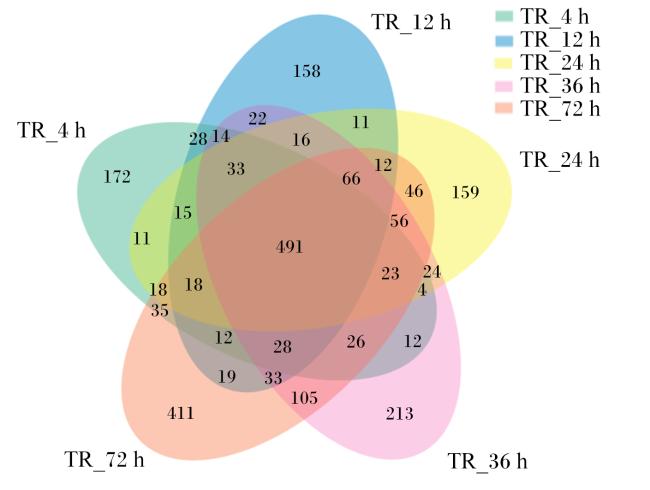
图1为茶叶渣在瘤胃中不同时间点的OTU组成。结果发现,5个时间点的共有OTU有491个,4、12、24、36与72 h特有OTU分别有172、158、159、213和411个。
图1 茶叶渣在瘤胃中不同发酵时间点Venn图

TR_4 h、TR_12 h、TR_24 h、TR_36 h、TR_72 h 分别代表发酵 4、12、24、36、72 h。下图同。

Fig.1 Venn diagram of tea residue in rumen at different fermentation time points

TR_4 h, TR_12 h, TR_24 h, TR_36 h, and TR_72 h represent 4, 12, 24, 36, and 72 h of fermentation, respectively.The same as below.

表6为不同时间点茶叶渣表面附着瘤胃微生物α多样性动态变化。茶叶渣表面附着瘤胃微生物的Chao1指数和ACE指数在4~36 h变化不大,但72 h显著高于4~24 h(P<0.05);72 h的Shannon指数显著高于其他时间点(P<0.05),Simpson指数在72 h显著高于4~12 h(P<0.05),其他时间点之间均无显著变化(P>0.05)。
表6 茶叶渣表面附着瘤胃微生物α多样性动态变化

Table 6 Dynamic changes of rumen microbial α diversity on tea residue surface

项目
Items
瘤胃发酵时间Rumen fermentation time/h SEM P
P-value
4 12 24 36 72
Chao1指数Chao1 index 445.98bc 391.63c 464.48bc 506.60b 682.73a 29.078 0.001
ACE指数ACE index 444.25c 390.93bc 462.71bc 546.71b 679.13a 29.464 0.001
Shannon指数Shannon index 6.54c 6.92bc 6.94bc 7.18b 7.81a 0.125 0.001
Simpson指数Simpson index 0.97b 0.97b 0.98ab 0.98ab 0.90a 0.007 0.043

2.3.2 茶叶渣表面附着瘤胃微生物β多样性分析

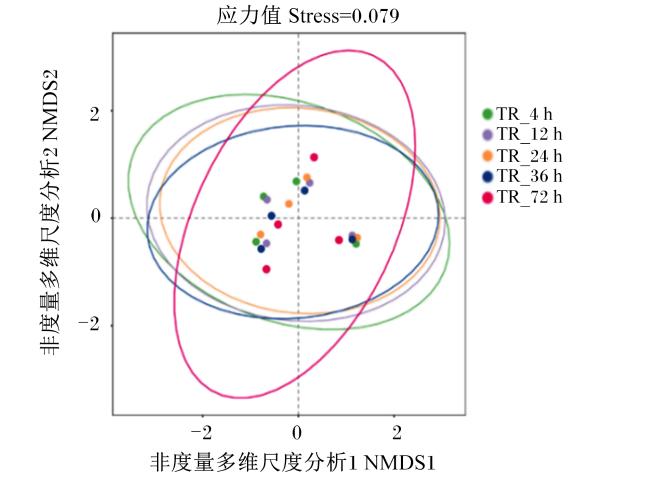
图2为NMSD图,结果所示,各时间点附着在茶叶渣上的瘤胃微生物结构处于动态变化中,瘤胃微生物结构存在一定差异。
图2 各发酵时间点附着在茶叶渣上的瘤胃微生物的NMSD图

Fig.2 NMSD of rumen bacteria on tea residue surface at each fermentation time point

2.3.3 茶叶渣表面附着瘤胃微生物组成变化

表7所示,各发酵时间点附着在茶叶渣上的瘤胃微生物中的优势菌门为拟杆菌门和厚壁菌门,相对丰度占比最高,占细菌总量的70%以上。拟杆菌门和厚壁菌门的相对丰度在各发酵时间点之间没有显著变化(P>0.05)。12~36 h时螺旋体门(Spirochaetota)相对丰度显著高于4和72 h(P<0.05);4 h时变形菌门(Proteobacteria)相对丰度显著高于36 h(P<0.05);72 h时脱硫杆菌门(Desulfobacterota)相对丰度最高,为0.55%,显著高于其他时间点(P<0.05)。
表7 各发酵时间点附着在茶叶渣上的瘤胃微生物门水平的群落构成

Table 7 Community composition of rumen bacteria at phylum level on tea residue surface at different fermentation time points %

项目
Items
瘤胃发酵时间Rumen fermentation time/h SEM P
P-value
4 12 24 36 72
拟杆菌门Bacteroidetes 54.69 46.78 46.32 47.15 52.34 2.576 0.904
厚壁菌门Firmicutes 25.96 24.95 26.28 23.59 30.65 2.125 0.074
螺旋体门Spirochaetota 10.05b 21.05a 22.01a 24.18a 9.52b 2.334 0.002
变形菌门Proteobacteria 6.57a 3.51ab 2.91ab 1.85b 2.49ab 0.913 0.033
纤维杆菌门Fibrobacterota 2.19 3.28 1.97 2.40 2.77 0.672 0.067
放线菌门Actinobacteriota 0.34 0.23 0.32 0.48 1.56 0.063 0.251
脱硫杆菌门Desulfobacterota 0.12b 0.13b 0.11b 0.23b 0.55a 0.054 <0.001
弯曲杆菌门Campilobacterota 0.01 0.03 0.01 0.04 0.04 0.009 0.132
其他Others 0.07 0.05 0.05 0.07 0.03 0.011 0.224
梭杆菌门Fusobacteriota 0.00 0.00 0.00 0.01 0.02 0.009 0.383
表8所示,各发酵时间点的主要优势菌属为普雷沃氏菌属(Prevotella)、密螺旋体属(Treponema)和琥珀酸弧菌属(Succinivibrio)。茶叶渣在瘤胃降解的过程中,菌群相对丰度随发酵时间延长发生变化。普雷沃氏菌属的相对丰度在4 h最高,为45.18%,且随着瘤胃发酵时间的延长,相对丰度逐渐降低,在36和72 h显著低于4 h(P<0.05)。密螺旋体属的相对丰度在降解初期4 h和末期72 h显著低于中期时间点(P<0.05);假丁酸弧菌属(Pseudobutyrivibrio)的相对丰度在各发酵时间点无显著差异(P>0.05);肠鼠杆菌属(Muribaculum)、理研菌科_RC9肠道群(Rikenellaceae_RC9_gut_group)和粪固醇真杆菌群([Eubacterium]_coprostanoligenes_group)的相对丰度随着发酵时间的延长逐渐升高,在72 h达到最大。
表8 各发酵时间点附着在茶叶渣上的瘤胃微生物属水平的群落构成

Table 8 Community composition of rumen bacteria at genus level on tea residue surface at different fermentation time points %

项目
Items
瘤胃发酵时间Rumen fermentation time/h SEM P
P-value
4 12 24 36 72
普雷沃氏菌属Prevotella 45.18a 37.14ab 34.02ab 31.94b 29.69b 3.246 0.023
密螺旋体属Treponema 10.13b 21.07a 22.03a 24.12a 9.50b 2.263 0.004
琥珀酸弧菌属Succinivibrio 6.13a 3.12b 2.48b 1.45b 2.10b 1.766 0.008
瘤胃球菌属Ruminococcus 5.42 7.93 7.15 5.00 3.72 1.122 0.255
其他Others 2.59 3.02 2.51 2.55 2.74 0.652 0.360
假丁酸弧菌属Pseudobutyrivibrio 1.90 1.94 2.50 2.10 0.83 0.313 0.068
理研菌科_RC9肠道群
Rikenellaceae_RC9_gut_group
1.60b 1.06b 1.25b 2.49ab 4.78a 0.542 0.012
肠鼠杆菌属Muribaculum 0.96b 1.11b 1.60b 2.27b 4.98a 0.321 <0.001
纤维杆菌属Fibrobacter 2.20 3.27 1.98 2.42 2.78 0.300 0.252
F082 1.04 0.94 0.69 2.06 2.65 0.391 0.097
丁酸弧菌属Butyrivibrio 1.41 2.02 3.58 2.99 1.45 0.342 0.184
真杆菌属反刍菌群
[Eubacterium]_ruminantium_group
3.57 1.93 1.36 0.98 1.15 0.201 0.844
糖发酵菌属Saccharofermentans 1.60 1.76 1.73 2.52 2.88 0.297 0.506
普雷沃氏菌科UCG-001
Prevotellaceae_UCG-001
2.07 1.65 3.59 2.07 2.56 0.223 0.784
粪固醇真杆菌群
[Eubacterium]_
coprostanoligenes_group
0.56b 0.43b 0.76b 1.11b 4.18a 0.100 0.042

2.3.4 不同发酵时间点茶叶渣表面附着瘤胃微生物差异物种分析

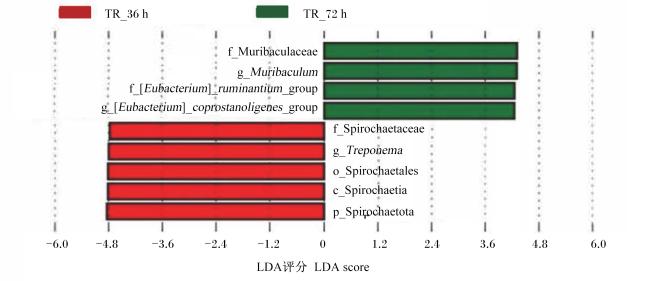
对不同发酵时间点茶叶渣表面附着瘤胃微生物的相对丰度进行LEfSe分析,得到不同发酵时间点相对丰度具有显著差异的物种(P<0.05)。如图3所示,茶叶渣在4、12和24没有检测出差异物种,9个差异物种分别出现在36和72 h。36 h有5个,分别注释到门水平1个,纲水平1个,目水平1个,科水平1个和属水平1个,其中注释到门水平上为螺旋体门,属水平上为密螺旋体属;72 h有4个,分别注释到科水平2个和属水平2个,其中属水平上的有肠鼠杆菌属和粪固醇真杆菌群。
图3 茶叶渣不同发酵时间点瘤胃微生物差异LEfSe图

Muribaculaceae:穆里巴科菌科;Muribaculum:肠鼠杆菌属;[Eubacterium]_ruminantium_group:真杆菌属反刍菌群;[Eubacterium]_coprostanoligenes_group:粪固醇真杆菌群;Spirochaetota:螺旋体门;Spirochaetia:螺旋体纲;Spirochaetales:螺旋体目;Spirochaetaceae:螺旋体科;Treponema:密螺旋体属。

Fig.3 LEfSe diagram of rumen bacteria difference in tea residue at different fermentation time points

3 讨论

3.1 茶叶渣的瘤胃降解特性

干物质摄入量(DMI)对反刍动物的生产性能至关重要。瘤胃DM降解率是影响DMI的一个关键因素,并与DMI之间呈正相关[13]。DM降解率是衡量饲粮的可消化性的重要指标,受纤维含量和木质化程度的影响[14]。粗饲料中的CP含量是衡量其饲用价值的指标,CP降解率越高,能为反刍动物机体提供的营养越多[15]。此外,粗饲料中NDF和ADF的含量能够衡量反刍动物采食量和饲料转化率,影响动物生产性能,其瘤胃降解率的高低是评定粗饲料被降解的难易程度的重要指标[16]。成锦霞等[17]报道中的醋糟DM降解率和茶叶渣相似,但NDF和ADF降解率均低于茶叶渣。张村宇等[18]测定甘蔗尾叶、稻草、麦秸、象草和燕麦草的DM、NDF和ADF的含量均高于茶叶渣,CP的含量均低于茶叶渣。但与茶叶渣相比,这5种常用粗饲料的NDF和ADF降解率均较低,甘蔗尾叶、稻草和麦秸的DM降解率也均低于茶叶渣,但CP降解率均高于茶叶渣。这可能与茶叶渣中含有茶多酚有关,茶多酚也称茶单宁,是一种抗营养因子,能与瘤胃内CP结合并降低其降解率,影响瘤胃对CP的降解与吸收[19]。本研究中,茶叶渣的营养物质降解率在48 h后均趋于稳定,与高月娥等[20]测定木薯渣的NDF、ADF及白酒糟的ADF降解率结果趋势一致,也与张耀等[21]测定百香果果皮和果藤的DM、NDF和ADF降解率的结果趋势一致,表明茶叶渣的降解率与其他农业副产物的降解规律基本一致。上述结果表明,茶叶渣具有作为常规饲料开发和利用的潜力。

3.2 茶叶渣对纤维素酶活性的影响

纤维是反刍动物的一种必需营养素,主要由纤维素、半纤维素、木质素和果胶组成。反刍动物对纤维的利用主要是利用纤维素酶的分解产物,这些酶按作用方式一般分为内切葡聚糖酶、外切葡聚糖酶、GC和其他酶类(果胶酶和木聚糖酶)。研究发现,瘤胃中纤维素的降解是EG、CBH和GC共同协作完成。首先,微生物产生的EG作用于纤维素分子中的葡萄糖苷键,产生大量具有还原性末端的纤维素片段。其次,CBH会对纤维素中易作用的末端进行切割,水解产生纤维二糖与寡糖。最后,GC作用于糖苷类物质中的β-葡萄糖苷键,催化纤维二糖和寡糖的水解产生葡萄糖。本试验中,茶叶渣在瘤胃降解中表面纤维素酶的活性变化符合纤维素水解的规律。此外,研究发现,木聚糖酶能专一作用于木聚糖主链上的β-1,4糖苷键,将其水解为寡聚糖。本试验结果表明,控制茶叶渣底物的发酵时间能显著提高NEX的活性。值得注意的是,尽管后期纤维素酶活性下降,但降解率仍持续增加,72 h时DM、CP、NDF和ADF降解率较0~36 h均升高,这一现象提示,纤维素酶的初始激活作用比持续活性对降解率的贡献更大。结合上述结果,发酵72 h的茶叶渣能有效提高瘤胃中纤维素酶活性。

3.3 茶叶渣表面附着瘤胃微生物的动态变化

Huws等[22]通过研究瘤胃微生物在多年生黑麦草上定植的规律发现,微生物多样性随时间的推移而上升。本研究中,茶叶渣在瘤胃降解过程中表面附着微生物丰富度和均匀度均发生显著性变化,与上述研究结果一致,且在72 h时Chao1、ACE、Shannon和Simpson指数最大,说明发酵72 h的茶叶渣能够提高闽东山羊瘤胃的微生物丰富度和多样性。反刍动物瘤胃中的优势菌门分别为拟杆菌门和厚壁菌门[23]。本试验发现,拟杆菌门和厚壁菌门在不同发酵时间点均为瘤胃中的主要菌门,与前人研究结果一致。其中,厚壁菌门中含有大量降解纤维素的细菌[24],而拟杆菌门能与厚壁菌门协同,分解难降解的纤维饲料并增强宿主对营养物质的利用和吸收[25-27]。本试验中,厚壁菌门的相对丰富随发酵时间增加而升高,可能是茶叶渣中含有较丰富的纤维,诱导厚壁菌门相对丰度上升。此外,拟杆菌门的相对丰度虽然变化不显著,但其始终保持较高的相对丰度的原因可能是由于拟杆菌门在降解多种碳水化合物、蛋白质和脂质中发挥重要作用[28-29]。变形菌门是反映菌群失调中的微生物特征,当变形菌门相对丰度持续增加时,通常表现为菌群失衡,同时可能会引发机体代谢紊乱和炎症[30]。本试验表明,变形菌门的相对丰度随发酵时间延长而降低,原因可能为茶叶渣中含有的茶多酚会抑制瘤胃中有害菌的繁殖,维持微生物群落稳定[31]。本试验表明,72 h时的脱硫菌门相对丰度显著高于其他发酵时间点,这表明茶叶渣在降解后期可能会引起瘤胃上皮炎症反应[32-33]
本试验观察到,在属水平上的微生物相对丰度处于动态变化。12 h时部分属已出现统计学显著变化,但由于效应量较小,因此,在LEfSe分析结果中并未出现该显著性差异,而36和72 h时差异物种不仅统计显著,且效应量较大,可能是驱动组间差异的核心标志物。研究表明,普雷沃氏菌属是反刍动物瘤胃中重要的优势菌属,能参与分解淀粉、纤维素和蛋白质等营养物质[34],同时也能与其他细菌协作降解碳水化合物[35],是瘤胃微生物中丰度最高的菌属[36-37]。本试验结果表明,普雷沃氏菌属相对丰度最高,与以往研究结果相同。研究表明,密螺旋体属参与低聚糖和多糖的降解[38-39]。Xie等[40]通过研究瘤胃微生物对粗饲料的动态定植发现,当粗饲料在瘤胃中发酵16~48 h时,密螺旋体属逐渐占据主导地位。本研究中,密螺旋体属的相对丰度在12~36 h时高于其他时间点,这与前人研究结果相似,表明茶叶渣能间接促进瘤胃对多糖的降解能力。假丁酸弧菌属和粪固醇真杆菌群均属于厚壁菌门,假丁酸弧菌属能产生活性水解酶和细菌素,是瘤胃内的潜在益生菌属[41]。粪固醇真杆菌群能够将胆固醇转化为粪固醇,同样存在益生功能。肠鼠杆菌属是瘤胃和肠道中有益共生细菌,能够参与黏液层的形成并维持屏障功能[42]。本试验中,粪固醇真杆菌群和肠鼠杆菌属的相对丰度在茶叶渣降解过程中显著变化,表明茶叶渣能改变瘤胃微生物的组成与结构,促进有益菌繁殖。

4 结论

茶叶渣具有较好的瘤胃降解性能,在瘤胃降解过程中维持瘤胃微生物多样性和丰富度,普雷沃氏菌属仍是瘤胃中重要的菌属。茶叶渣所含茶多酚会抑制瘤胃中有害菌的繁殖,同时,假丁酸弧菌属等在茶叶渣降解过程中显著变化,在瘤胃降解各营养成分的过程中发挥重要作用,普雷沃氏菌属与密螺旋体属在降解过程中相互协同促进碳水化合物代谢通路的改变。然而在研究中同样发现,茶叶渣在降解后期可能会引起瘤胃上皮炎症反应,提示需控制添加比例或通过预处理降低风险。综上所述,茶叶渣的饲用价值较高,考虑结合其他粗饲料原料进行合理配比,在优化加工工艺和添加剂量的条件下,茶叶渣可作为反刍动物饲料的可持续替代资源。
[1]
曾鸿哲, 方雯雯, 周方, 等. 陈年武夷岩茶对葡聚糖硫酸钠诱导小鼠结肠炎的缓解作用及肠道菌群的影响[J]. 食品科学, 2023, 44(13):67-78.

ZENG H Z, FANG W W, ZHOU F, et al. Effect of aged Wuyi rock tea on relieving dextran sulfate sodium-induced colitis and regulating the gut microbiota in mice[J]. Food Science, 2023, 44(13):67-78. (in Chinese)

[2]
陈毅辉. 福建茶产业可持续发展主体行为与策略研究[D]. 博士学位论文. 福州: 福州大学, 2021.

CHEN Y H. The behaviors and strategies of participants in the sustainable development of Fujian’s tea industry[D]. Ph.D.Thesis. Fuzhou: Fuzhou University, 2021. (in Chinese)

[3]
王彬, 王庆争, 郭志强, 等. 茶叶渣替代麸皮对肉兔生长性能、屠宰性能和肉品质的影响[J]. 动物营养学报, 2022, 34(2):1186-1193.

DOI

WANG B, WANG Q Z, GUO Z Q, et al. Effects of wheat bran replacement by tea leaf residue on growth performance,slaughter performance and meat quality of meat rabbits[J]. Chinese Journal of Animal Nutrition, 2022, 34(2):1186-1193. (in Chinese)

[4]
吴俊, 周恺. 茶渣、茶末作为饲料添加剂在养猪业中的应用[J]. 西南民族大学学报(自然科学版), 2017, 43(5):462-468.

WU J, ZHOU K. Application of tea leaves and tea dust as feed additives for pigs[J]. Journal of Southwest University for Nationalities(Natrual Science Edition), 2017, 43(5):462-468. (in Chinese)

[5]
DING X Q, LI H Y, WEN Z W, et al. Effects of fermented tea residue on fattening performance,meat quality,digestive performance,serum antioxidant capacity,and intestinal morphology in fatteners[J]. Animals, 2020, 10(2):185.

DOI

[6]
董妍丽. 茶皂素对安徽白山羊抗氧化能力、免疫、消化能力和肠道菌群的影响[D]. 硕士学位论文. 合肥: 安徽农业大学, 2019.

DONG Y L. Effect of tea saponin on antioxidant capacity,immunity,digestive capacity and intestinal flora of Anhui white goat[D]. Master’s Thesis. Hefei: Anhui Agricultural University, 2019. (in Chinese)

[7]
BOSCO N J. 绿茶渣对肉羊生产性能瘤胃发酵营养物质消化和血液参数的影响[D]. 硕士学位论文. 合肥: 安徽农业大学, 2019.

BOSCO N J. The effects of green tea waste on performance,rumen fermentation,nutrient digestion and blood parameters in sheep[D]. Master’s Thesis. Hefei: Anhui Agricultural University, 2019. (in Chinese)

[8]
VAN SOEST P J, ROBERTSON J B, LEWIS B A. Methods for dietary fiber,neutral detergent fiber,and nonstarch polysaccharides in relation to animal nutrition[J]. Journal of Dairy Science, 1991, 74(10):3583-3597.

DOI

[9]
田莉, 陈虞超, 郭生虎, 等. 不同添加剂对芦竹青贮饲料营养成分及发酵品质的影响[J]. 饲料研究, 2025, 48(9):129-132.

TIAN L, CHEN Y C, GUO S H, et al. Effects of different additives on nutritional composition and fermentation quality of Arundo donax L.silage[J]. Feed Research, 2025, 48(9):129-132. (in Chinese)

[10]
ØRSKOV E R, MCDONALD I. The estimation of protein degradability in the rumen from incubation measurements weighted according to rate of passage[J]. The Journal of Agricultural Science, 1979, 92(2):499-503.

DOI

[11]
ØRSKOV E R, HOVELL F D D, MOULD F. The use of the nylon bag technique for the evaluation of feedstuffs[J]. Tropical Animal Production, 1980, 5(3):195-213.

[12]
池春梅, 李亚飞, 薛帅帅, 等. 五节芒的营养特征及其在山羊瘤胃的降解特性分析[J]. 福建农业科技, 2022, 53(12):60-65.

CHI C M, LI Y F, XUE S S, et al. Nutritional characteristics of Miscanthus floridulus and its degradation characteristics in the rumen of goats[J]. Fujian Agricultural Science and Technology, 2022, 53(12):60-65. (in Chinese)

[13]
MA Y L, KHAN M Z, LIU Y F, et al. Analysis of nutrient composition,rumen degradation characteristics,and feeding value of Chinese rye grass,barley grass,and naked oat straw[J]. Animals, 2021, 11(9):2486.

DOI

[14]
林树岩, 刘通. 微生物添加剂对青贮高粱主要营养成分、抗营养因子及消化率的影响[J]. 饲料研究, 2022, 45(20):93-98.

LIN S Y, LIU T. Effect of microbial additives on main nutrient components,anti-nutritional factors and digestibility of silage sorghum[J]. Feed Research, 2022, 45(20):93-98. (in Chinese)

[15]
王国栋, 郝生燕, 顾娴, 等. 10个饲用玉米品种在甘肃中部的生产性能和营养价值评价[J]. 饲料研究, 2022, 45(11):93-96.

WANG G D, HAO S Y, GU X, et al. Evaluation of performance and nutritional value of 10 forage maize varieties in central Gansu province[J]. Feed Research, 2022, 45(11):93-96. (in Chinese)

[16]
MEKURIAW Y, ASMARE B. Nutrient intake,digestibility and growth performance of Washera lambs fed natural pasture hay supplemented with graded levels of Ficus thonningii (Chibha) leaves as replacement for concentrate mixture[J]. Agriculture & Food Security, 2018, 7:30.

[17]
成锦霞, 于胜晨, 张暄梓, 等. 3种非常规饲料营养的价值及瘤胃降解特性研究[J]. 中国畜禽种业, 2019, 15(10):102-106.

CHENG J X, YU S C, ZHANG X Z, et al. Study on the nutritional value and rumen degradation characteristics of three unconventional feeds[J]. The Chinese Livestock and Poultry Breeding, 2019, 15(10):102-106. (in Chinese)

[18]
张村宇, 杨嘉骅, 高鑫, 等. 南方地区五种常用粗饲料营养价值评估及其在水牛瘤胃中的降解特性研究[J]. 中国饲料, 2023(17):15-21.

ZHANG C Y, YANG J H, GAO X, et al. Evaluation of the nutritional value of five commonly used forages in southern China and their degradation characteristics in the rumen of buffalo[J]. China Feed, 2023(17):15-21. (in Chinese)

[19]
邱建强, 黄文, 王玉玺, 等. 单宁对动物肠道微生物调控的研究进展[J]. 动物营养学报, 2023, 35(2):772-781.

DOI

QIU J Q, HUANG W, WANG Y X, et al. Research progress in regulation of tannins on intestinal microbiota of animals[J]. Chinese Journal of Animal Nutrition, 2023, 35(2):772-781. (in Chinese)

DOI

[20]
高月娥, 杨凯, 刘建勇, 等. 4种非常规饲料在肉牛瘤胃内降解特性的研究[J]. 饲料研究, 2022, 45(15):9-14.

GAO Y E, YANG K, LIU J Y, et al. Study on rumen degradation characteristics of four unconventional feeds in beef cattle[J]. Feed Research, 2022, 45(15):9-14. (in Chinese)

[21]
张耀, 赵菁菁, 陈鑫珠, 等. 百香果果皮和果藤在山羊瘤胃降解特性研究[J]. 畜牧与兽医, 2021, 53(7):52-57.

ZHANG Y, ZHAO J J, CHEN X Z, et al. Degradation characteristics of the peel and vine of Passiflora edulis Sims in the rumen of goats[J]. Animal Husbandry & Veterinary Medicine, 2021, 53(7):52-57. (in Chinese)

[22]
HUWS S A, MAYORGA O L, THEODOROU M K, et al. Successional colonization of perennial ryegrass by rumen bacteria[J]. Letters in Applied Microbiology, 2013, 56(3):186-196.

DOI PMID

[23]
FERNANDO S C, PURVIS H T 2, NAJAR F Z, et al. Rumen microbial population dynamics during adaptation to a high-grain diet[J]. Applied and Environmental Microbiology, 2010, 76(22):7482-7490.

DOI PMID

[24]
GHARECHAHI J, VAHIDI M F, SHARIFI G, et al. Lignocellulose degradation by rumen bacterial communities:new insights from metagenome analyses[J]. Environmental Research, 2023, 229:115925.

DOI

[25]
AVERSHINA E, LUNDGÅRD K, SEKELJA M, et al. Transition from infant-to adult-like gut microbiota[J]. Environmental Microbiology, 2016, 18(7):2226-2236.

DOI

[26]
ABDELSATTAR M M, ZHAO W, SALEEM A M, et al. Physical,metabolic,and microbial rumen development in goat kids:a review on the challenges and strategies of early weaning[J]. Animals, 2023, 13(15):2420.

DOI

[27]
HESS M, SCZYRBA A, EGAN R, et al. Metagenomic discovery of biomass-degrading genes and genomes from cow rumen[J]. Science, 2011, 331(6016):463-467.

DOI PMID

[28]
SPENCE C, WELLS W G, SMITH C J. Characterization of the primary starch utilization operon in the obligate anaerobe Bacteroides fragilis:regulation by carbon source and oxygen[J]. Journal of Bacteriology, 2006, 188(13):4663-4672.

DOI

[29]
NAAS A E, MACKENZIE A K, MRAVEC J, et al. Do rumen bacteroidetes utilize an alternative mechanism for cellulose degradation?[J]. mBio, 2014, 5(4):e01401-e01414.

[30]
SHIN N R, WHON T W, BAE J W. Proteobacteria:microbial signature of dysbiosis in gut microbiota[J]. Trends in Biotechnology, 2015, 33(9):496-503.

DOI

[31]
毕睿晨, 刘相泽, 胡泽琼, 等. 植物多酚在家禽领域应用研究进展[J]. 畜牧兽医学报, 2023, 54(11):4488-4501.

DOI

BI R C, LIU X Z, HU Z Q, et al. Research progress on the application of plant polyphenols in poultry field[J]. Acta Veterinaria et Zootechnica Sinica, 2023, 54(11):4488-4501. (in Chinese)

DOI

[32]
ALVES DE OLIVEIRA L, JEAN-BLAIN C, DAL CORSO V, et al. Effect of a high sulfur diet on rumen microbial activity and rumen thiamine status in sheep receiving a semi-synthetic,thiamine-free diet[J]. Reproduction, Nutrition, Development, 1996, 36(1):31-42.

DOI

[33]
ZHONG F, WEN X, YANG M, et al. Effect of an 8-week exercise training on gut microbiota in physically inactive older women[J]. International Journal of Sports Medicine, 2021, 42(7):610-623.

DOI PMID

[34]
赵欣雅, 田雨佳, 陈星星, 等. 普雷沃氏菌在瘤胃内的作用与代谢机制研究进展[J]. 饲料研究, 2023, 46(14):151-153.

ZHAO X Y, TIAN Y J, CHEN X X, et al. Advances in role and metabolic mechanism of Prevotella in rumen[J]. Feed Research, 2023, 46(14):151-153. (in Chinese)

[35]
李毓敏, 聂洪辛, 庞凯悦, 等. 牦牛日粮精粗比转换对瘤胃微生物菌群的影响[J]. 饲料研究, 2023, 46(20):7-12.

LI Y M, NIE H X, PANG K Y, et al. Effect of dietary concentrate to forage ratio conversion on rumen microbial flora in yaks[J]. Feed Research, 2023, 46(20):7-12. (in Chinese)

[36]
BOWEN J M, MCCABE M S, LISTER S J, et al. Evaluation of microbial communities associated with the liquid and solid phases of the rumen of cattle offered a diet of perennial ryegrass or white clover[J]. Frontiers in Microbiology, 2018, 9:2389.

DOI PMID

[37]
HENDERSON G, COX F, GANESH S, et al. Rumen microbial community composition varies with diet and host,but a core microbiome is found across a wide geographical range[J]. Scientific Reports, 2015, 5:14567.

DOI

[38]
POWER S E, O’TOOLE P W, STANTON C, et al. Intestinal microbiota,diet and health[J]. British Journal of Nutrition, 2014, 111(3):387-402.

DOI

[39]
PANG K Y, DAI D W, YANG Y K, et al. Effects of high concentrate rations on ruminal fermentation and microbiota of yaks[J]. Frontiers in Microbiology, 2022, 13:957152.

DOI

[40]
XIE X, YANG C L, GUAN L L, et al. Persistence of cellulolytic bacteria fibrobacter and treponema after short-term corn stover-based dietary intervention reveals the potential to improve rumen fibrolytic function[J]. Frontiers in Microbiology, 2018, 9:1363.

DOI

[41]
HOLMAN D B, GZYL K E. A Meta-analysis of the bovine gastrointestinal tract microbiota[J]. FEMS Microbiology Ecology, 2019, 95(6):fiz072.

[42]
BUNKER J J, FLYNN T M, KOVAL J C, et al. Innate and adaptive humoral responses coat distinct commensal bacteria with immunoglobulin a[J]. Immunity, 2015, 43(3):541-553.

DOI PMID

Outlines

/