RESEARCH PAPER

Effects of Phocaecholic Acid and Porcine Bile Acid on Growth Performance, Serum Biochemical Indices, Antioxidant Capacity and Intestinal Digestive Enzyme Activities of Litopenaeus vannamei

  • ZHOU Yingxiang , 1 ,
  • BIAN Yanxin 1 ,
  • DENG Jiaguo 2 ,
  • CUI Wucheng , 2, * ,
  • LI Guojun 2 ,
  • HU Yi 1 ,
  • DAI Jihong , 1, *
Expand
  • 1 Fisheries College, Hunan Agricultural University, Changsha 410128, China
  • 2 Changde Yungang Biotechnology Co., Ltd., Changde 415199, China
* CUI Wucheng, E-mail: ;
DAI Jihong, lecturer, E-mail:

Received date: 2025-07-10

  Online published: 2026-01-13

Abstract

This study aimed to investigate the effects of phocaecholic acid and porcine bile acid on growth performance, serum biochemical indices, antioxidant capacity and intestinal digestive enzyme activities of Litopenaeus vannamei. A total of 600 healthy Litopenaeus vannamei with good growth performance, uniform size and an initial body weight of (2.50±0.15) g were randomly divided into 5 groups, with 3 replicates per group and 40 shrimp per replicate. The control group was fed a basal diet, while the experimental groups were fed the basal diets supplemented with 500 or 1 000 mg/kg phocaecholic acid (HD500 group, HD1000 group) or porcine bile acid (ZD500 group, ZD1000 group). The experimental period lasted for 56 days. The results showed as follows: 1) compared with the control group, there were no significant changes in weight gain rate, specific growth rate or feed intake in the HD500 group, HD1000 group, ZD500 group and ZD1000 group (P>0.05), with the HD500 group exhibiting the best growth performance. 2) Compared with the control group, the serum total cholesterol (TC), triglyceride (TG) and low-density lipoprotein cholesterol (LDL-C) contents in the HD1000 group, ZD500 group and ZD1000 group were significantly decreased (P<0.05). The serum TG and LDL-C contents, as well as the activities of acid phosphatase (ACP) and alkaline phosphatase (AKP) in the HD500 group, were significantly higher than those in the ZD500 group (P<0.05). 3) Compared with the control group, the hepatopancreas total antioxidant capacity (T-AOC) in the HD500 group, HD1000 group, ZD500 group and ZD1000 group was significantly increased (P<0.05). The hepatopancreas reduced glutathione (GSH) content in the HD500 group was significantly higher than that in the other 4 groups (P<0.05), and the hepatopancreas malondialdehyde (MDA) content was significantly lower than that in the control group, HD1000 group and ZD1000 group (P<0.05). 4) Compared with the control group, the intestinal trypsin activity in the HD1000 group, ZD500 group and ZD1000 group was significantly decreased (P<0.05), the intestinal amylase activity in the HD500 group and ZD1000 group was significantly increased (P<0.05), and the intestinal lipase activity in the HD500 group, ZD500 group and ZD1000 group was significantly increased (P<0.05). The intestinal amylase activity in the HD500 group was significantly higher than that in the HD1000 group and ZD500 group (P<0.05), and the intestinal lipase activity was significantly higher than that in the HD1000 group (P<0.05). In conclusion, dietary supplementation of appropriate amounts of phocaecholic acid and porcine bile acid has positive effects on the serum biochemical indices, antioxidant capacity and intestinal digestive enzyme activities of Litopenaeus vannamei, and phocaecholic acid is superior to porcine bile acid in improving antioxidant capacity and intestinal digestive enzyme activities. Under the experimental conditions, supplementing 500 mg/kg phocaecholic acid in the diet of Litopenaeus vannamei yields the best effect.

Cite this article

ZHOU Yingxiang , BIAN Yanxin , DENG Jiaguo , CUI Wucheng , LI Guojun , HU Yi , DAI Jihong . Effects of Phocaecholic Acid and Porcine Bile Acid on Growth Performance, Serum Biochemical Indices, Antioxidant Capacity and Intestinal Digestive Enzyme Activities of Litopenaeus vannamei[J]. Chinese Journal of Animal Nutrition, 2026 , 38(1) : 564 -576 . DOI: 10.12418/CJAN2026.044

胆汁酸(bile acids,BAs)是由脊椎动物肝脏中胆固醇代谢产生的类固醇类内源性分子,主要以胆盐形式存在于胆汁中[1]。作为天然高效的乳化剂,胆汁酸不仅具有促进脂类物质乳化和吸收的基本生理功能,还通过激活法尼醇X受体(farnesoid X receptor,FXR)和Takeda G蛋白偶联受体5(Takeda G protein-coupled receptor 5,TGR5)等核受体,参与机体脂质代谢[2]、葡萄糖稳态[3]、抗氧化应激[4]及免疫反应[5]等多种生理过程。近年来,胆汁酸作为功能性饲料添加剂在水产动物中的应用研究不断深入,已被证实在吉富罗非鱼(Oreochromis niloticus)[6]、龙胆石斑鱼(Epinephelus lanceolatus)[7]、大口黑鲈(Micropterus salmoides)[8]、草鱼(Ctenopharyngodon idella)[9]及欧洲鳗鲡(Anguilla anguilla)[10]等物种中具备调控脂类代谢、改善肝脏功能、提升肠道健康和增强非特异性免疫等多方面的生理效应,展现出良好的应用前景。
海豹胆酸是一种具有特殊结构的天然胆汁酸,最早在海象体内发现,随后被证实广泛存在于海洋哺乳动物以及部分鸟类(如鸭、火烈鸟)的胆汁中,是这些物种的主要胆汁酸形式之一,通常以氨基酰(N-酰基)缀合形式存在[11]。海豹胆酸是鹅去氧胆酸的羟基化衍生物,其分子结构特征为在鹅去氧胆酸侧链第23位引入1个羟基[12]。该羟基的引入改变了其物理化学性质,如增强分子极性、溶解度和酸度。此外,研究表明海豹胆酸-牛磺酸偶联物的临界胶束浓度高于鹅去氧胆酸-牛磺酸偶联物,其生物去污性优于后者[13]。尽管目前在水产动物中已有较多关于猪源、禽源胆汁酸以及部分单体胆酸如鹅去氧胆酸、熊去氧胆酸对鱼、虾影响的研究报道,但海豹胆酸在水产动物中的应用效果尚缺乏研究。因此,有必要深入探讨海豹胆酸在水产动物中的营养调控作用并比较不同胆汁酸之间的应用效果。
凡纳滨对虾(Litopenaeus vannamei)作为当前养殖生产力与经济价值最高的虾种之一[14],因其生长速度快、适应能力强以及营养价值高等突出优势,已在全球范围内被广泛养殖[15]。甲壳类动物自身无法合成胆汁酸,且消化系统较为简单,易因饲料中脂质负荷过重而出现脂肪沉积及代谢紊乱[16]。外源胆汁酸作为高效的脂肪乳化剂,能够显著促进脂类物质的消化吸收,减轻肝脏代谢负担,因而近年来在对虾养殖中的应用逐渐增多[17]。目前已有研究表明,猪源胆汁酸在改善对虾脂质和免疫代谢方面具有一定效果[18],但对于海豹胆酸这一结构独特的新型胆汁酸,其在凡纳滨对虾中的应用效果尚缺乏系统评价。因此,本研究以凡纳滨对虾为试验对象,探究并比较饲料中添加海豹胆酸与猪胆汁酸对其生长性能、血清生化指标、抗氧化能力及肠道消化酶活性的影响,旨在为新型胆汁酸在甲壳类水产动物中的科学应用提供理论依据。

1 材料与方法

1.1 伦理声明

本试验获得了湖南农业大学生物医学研究伦理委员会批准,批准号为湖南农业大学伦审科第(121)号。试验参与人员严格遵守道德伦理规范,并按照湖南农业大学生物医学研究伦理委员会制定的规章制度执行。

1.2 试验饲料

本试验所用海豹胆酸和猪胆汁酸均为市售产品。海豹胆酸成分:69.11%海豹胆酸、4.04%鹅去氧胆酸、0.59%胆酸;猪胆汁酸成分:33.54%猪去氧胆酸、21.62%鹅去氧胆酸、9.17%猪胆酸。根据凡纳滨对虾的营养需求,以鱼粉、豆粕、虾粉和花生粕等为主要蛋白质源,鱼油和卵磷脂为主要脂肪源,配制基础饲料(作为对照);在基础饲料中分别添加500、1 000 mg/kg海豹胆酸(记为HD500、HD1000)或猪胆汁酸(记为ZD500、ZD1000),共配制5种等氮等脂的试验饲料。试验饲料组成及营养水平见表1。饲料原料经粉碎后过80目筛,精确称重后,微量成分先采用逐级扩大法预混后再与其他原料混合均匀,再加入鱼油和蒸馏水在搅拌机中充分混匀并过筛,最后使用膨化机制成1.5 mm的沉性饲料,自然冷却风干后装袋密封,置于-20 ℃冷库中保存备用。饲料制备完成后取样进行营养成分测定:采用105 ℃恒温干燥法(GB/T 5009.3—2016)去除饲料中的水分后,分别使用550 ℃马弗炉灼烧法(GB/T 5009.4—2016)、凯氏定氮法(GB/T 5009.5—2016)和索氏抽提法(GB/T 5009.6—2016)测定饲料粗灰分、粗蛋白质和粗脂肪含量。
表1 试验饲料组成及营养水平(干物质基础)

Table 1 Composition and nutrient levels of experimental diets (DM basis) %

项目
Items
饲料Diets
对照Control HD500 HD1000 ZD500 ZD1000
原料Ingredients
鱼粉Fish meal 25.00 25.00 25.00 25.00 25.00
虾粉Shrimp meal 9.00 9.00 9.00 9.00 9.00
玉米蛋白粉Corn protein meal 4.00 4.00 4.00 4.00 4.00
棉籽粕Cottonseed meal 4.00 4.00 4.00 4.00 4.00
豆粕Soybean meal 20.00 20.00 20.00 20.00 20.00
花生粕Peanut meal 8.00 8.00 8.00 8.00 8.00
面粉Wheat flour 22.00 22.00 22.00 22.00 22.00
鱼油Fish oil 3.00 3.00 3.00 3.00 3.00
卵磷脂Phosphatidylcholine 2.00 2.00 2.00 2.00 2.00
微晶纤维素Microcrystalline cellulose 0.75 0.70 0.65 0.70 0.65
鱿鱼膏Squid paste 0.20 0.20 0.20 0.20 0.20
磷酸二氢钙Ca(H2PO4)2 0.50 0.50 0.50 0.50 0.50
预混料Premix1) 1.00 1.00 1.00 1.00 1.00
氯化胆碱Choline chloride 0.50 0.50 0.50 0.50 0.50
抗氧化剂Antioxidant 0.05 0.05 0.05 0.05 0.05
海豹胆酸Phocaecholic acid 0.05 0.10
猪胆汁酸Porcine bile acid 0.05 0.10
合计Total 100.00 100.00 100.00 100.00 100.00
营养水平Nutrient levels2)
粗蛋白质CP 41.84 42.36 42.55 41.67 42.46
粗脂肪EE 6.33 6.38 6.47 6.41 6.32
粗灰分Ash 11.37 11.52 11.45 11.58 11.64

1)每千克预混料含有 One kilogram of the premix contained the following:VA 3 500 000 IU,VD3 1 000 000 IU,VE 40 mg,VK3 4 mg,VB1 8 mg,VB2 8 mg,VB6 8 mg,VB12 15 mg,VC 150 mg,生物素 biotin 80 mg,烟酸 nicotinic acid 30 mg,D-泛酸 D-pantothenic acid 15 mg,叶酸 folic acid 2.5 mg,肌醇 inositol 80 mg,乙氧基喹啉 ethoxyquin 150 mg,FeSO4·H2O 300 mg,CuSO4·5H2O 40 mg,ZnSO4·H2O 300 mg,MnSO4·H2O 120 mg,KIO3 90 mg,Na2SeO3 40 mg,CoCl2 6H2O 80 mg,MgSO4·H2O 600 mg,沸石粉 zeolite powder 8 400 mg。

2)实测值 Measured values。

1.3 试验设计与饲养管理

以在广东某养殖场购买的凡纳滨对虾作为试验对象,试验正式开始前,将对虾暂养于规格为120 cm×80 cm×150 cm的网箱中,使用基础饲料进行为期2周的驯化饲养。驯养结束后停食24 h,挑选体质健康、生长状况良好、规格均匀、初始体重为(2.50±0.15) g的对虾600尾,随机分为5组,每组3个重复(网箱),每个重复40尾,进行为期56 d的养殖试验。各组对虾分别投喂上述5种试验饲料,日投喂量为试验虾体重的3%~5%,并根据生长情况定期调整。采用沉底喂食台进行投喂,每天投喂3次(07:00、11:00和17:00),投喂1 h后,拉起食台检查摄食情况,并收集残饵进行记录。试验期间,养殖水体温度为28~32 ℃,盐度为18‰~20‰,溶解氧浓度>5 mg/L。

1.4 样品采集

养殖试验结束后,停食24 h,分别对各网箱中的对虾进行计数和称重,计算生长性能指标。随后从每个网箱随机选取6尾对虾进行采血:固定对虾后,使用1 mL无菌注射器从头胸甲后部穿刺,直接抽取心脏血液,收集于1.5 mL无酶离心管中,4 ℃静置12 h,860×g离心10 min,取上清液置于-80 ℃冰箱保存,用于血清生化指标测定。另从每个网箱随机取6尾对虾,置于冰盘上解剖取出肝胰腺,放入无酶离心管中,于-80 ℃冰箱保存,用于肝胰腺抗氧化指标测定。此外,从每个组随机选取6尾对虾,置于冰盘上解剖取出完整肠道,放入无酶离心管中,于-80 ℃冰箱保存,用于肠道消化酶指标测定。最后,根据生长性能结果,从对照组、HD500组和ZD500组中分别随机选取6尾对虾,解剖取出肝胰腺,置于4%多聚甲醛固定液中固定,用于制作肝胰腺切片。

1.5 指标测定

1.5.1 生长性能

相关指标计算公式如下:
成活率(survival rate,SR,%)=100×N2/N1;
增重率(weight gain rate,WGR,%)=100×(W2-W1)/W1;
特定生长率(specific growth rate,SGR,%/d)=100×(lnW2-lnW1)/T;
饵料系数(feed conversion ratio,FCR)=F/(Wt-W0);
肝体比(hepatosomatic index,HSI,%)=100×Wh/W;
摄食量(feed intake,FI,g)=F/[(N1+N2)/2]。
式中:N2为终末尾数;N1为初始尾数;W0为初始总重;Wt为终末总重;W1为初均重;W2为末均重;F为总摄食量;Wh为肝脏重量;W为对虾体重;T为试验天数。

1.5.2 血清生化指标

使用南京建成生物工程研究所生产的试剂盒,并利用SpectraMax ABS全波长酶标仪[美谷分子仪器(上海)有限公司]测定血清总胆固醇(TC)、甘油三酯(TG)、高密度脂蛋白胆固醇(HDL-C)、低密度脂蛋白胆固醇(LDL-C)含量及碱性磷酸酶(AKP)、酸性磷酸酶(ACP)活性。

1.5.3 肝胰腺抗氧化指标

取出肝胰腺进行称重,按照重量(g)∶体积(mL)=1∶9的比例加入9倍体积的生理盐水,充分匀浆后,4 ℃条件下以1 160×g离心10 min,吸取上清液,得到10%肝胰腺匀浆上清液,用于后续指标测定。使用南京建成生物工程研究所生产的试剂盒,并利用SpectraMax ABS全波长酶标仪[美谷分子仪器(上海)有限公司]测定肝胰腺总超氧化物歧化酶(SOD)活性和还原型谷胱甘肽(GSH)、丙二醛(MDA)含量及总抗氧化能力(T-AOC)。

1.5.4 肝胰腺组织形态结构

肝胰腺组织在4%多聚甲醛中浸泡固定24 h后,依次经梯度乙醇脱水、石蜡包埋处理,使用RM-2235型切片机(Leica,德国)进行横向切片,制备厚度为6 μm的组织切片。对切片分别进行苏木精-伊红(HE)染色及油红O染色,染色完成后置于光学显微镜(EX2000,重庆中显光电仪器有限公司)下观察拍照。

1.5.5 肠道消化酶活性

取肠道组织,用去离子水冲洗后以滤纸吸干并称重,按照重量(g)∶体积(mL)=1∶9的比例加入9倍体积的生理盐水(或匀浆介质),充分匀浆后,以805×g离心10 min,吸取上清液,测定脂肪酶、淀粉酶及胰蛋白酶活性。所用试剂盒均购自南京建成生物工程研究所,使用全波长酶标仪进行测定。

1.6 数据分析

试验数据采用Excel 2019进行整理和初步计算后,使用SPSS 26.0统计软件进行单因素方差分析(one-way ANOVA),并采用Duncan氏法对组间数据进行多重比较检验,结果用平均值±标准误(mean±SE)表示,P<0.05为差异显著。

2 结果与分析

2.1 海豹胆酸和猪胆汁酸对凡纳滨对虾生长性能的影响

表2可知,与对照组相比,各海豹胆酸和猪胆汁酸添加组增重率、特定生长率和摄食量均无显著变化(P>0.05),而肝体比显著降低(P<0.05)。其中,HD500组的各项生长指标表现最优。
表2 海豹胆酸和猪胆汁酸对凡纳滨对虾生长性能的影响

Table 2 Effects of phocaecholic acid and porcine bile acid on growth performance of Litopenaeus vannamei

项目
Items
组别Groups
对照Control HD500 HD1000 ZD500 ZD1000
初均重IBW/g 2.44±0.09 2.58±0.09 2.52±0.04 2.54±0.03 2.57±0.04
末均重FBW/g 14.18±0.17 15.30±0.52 14.15±0.41 14.03±0.68 13.69±0.43
增重率WGR/% 483.29±22.92ab 493.80±8.70b 461.60±9.84ab 450.92±21.56ab 433.33±12.84a
特定生长率SGR/(%/d) 3.14±0.07ab 3.18±0.03b 3.08±0.03ab 3.04±0.07ab 2.99±0.04a
饵料系数FCR 1.13±0.01a 1.12±0.01a 1.16±0.01ab 1.14±0.02ab 1.18±0.01b
成活率SR/% 71.33±2.67 77.33±4.81 74.67±6.67 77.33±11.68 78.67±2.67
肝体比HSI/% 4.87±0.29b 3.90±0.10a 3.89±0.11a 4.23±0.15a 4.00±0.18a
摄食量FI/g 13.26±0.05ab 13.91±0.17b 13.64±0.15ab 13.42±0.22ab 13.19±0.29a

同行数据肩标无字母或相同小写字母表示差异不显著(P>0.05),不同小写字母表示差异显著(P<0.05)。下表同。

In the same row, values with no letter or the same small letter superscripts mean no significant difference (P>0.05), while with different small letter superscripts mean significant difference (P<0.05). The same as below.

2.2 海豹胆酸和猪胆汁酸对凡纳滨对虾血清生化指标的影响

表3可知,与对照组相比,HD1000组、ZD500组和ZD1000组血清TC、TG和LDL-C含量显著降低(P<0.05),血清HDL-C含量显著提高(P<0.05);HD500组血清HDL-C含量显著提高(P<0.05),血清LDL-C含量显著降低(P<0.05)。HD500组血清TG、LDL-C含量及ACP、AKP活性显著高于ZD500组(P<0.05)。
表3 海豹胆酸和猪胆汁酸对凡纳滨对虾血清生化指标的影响

Table 3 Effects of phocaecholic acid and porcine bile acid on serum biochemical indices of Litopenaeus vannamei

项目
Items
组别Groups
对照Control HD500 HD1000 ZD500 ZD1000
总胆固醇TC/(mmol/L) 8.87±0.81b 6.95±0.72ab 6.58±0.85a 6.14±0.60a 6.58±0.47a
甘油三酯TG/(mmol/L) 10.17±0.08c 10.01±0.10c 8.01±0.11b 6.31±0.18a 6.75±0.30a
高密度脂蛋白胆固醇
HDL-C/(mmol/L)
4.02±0.09a 6.01±0.06c 5.28±0.07b 6.12±0.17c 5.90±0.09c
低密度脂蛋白胆固醇
LDL-C/(mmol/L)
2.10±0.04d 1.13±0.03b 0.88±0.01a 0.87±0.02a 1.41±0.05c
碱性磷酸酶
AKP/(金氏单位/dL)
127.72±7.95c 134.20±1.28c 101.12±0.59bc 77.20±15.31ab 53.65±22.27ab
酸性磷酸酶
ACP/(金氏单位/dL)
222.06±2.63b 240.66±1.33c 240.81±1.62c 202.92±1.20a 238.09±0.49c

2.3 海豹胆酸和猪胆汁酸对凡纳滨对虾肝胰腺抗氧化指标的影响

表4可知,与对照组相比,各海豹胆酸和猪胆汁酸添加组肝胰腺T-AOC显著提高(P<0.05),肝胰腺SOD活性无显著变化(P>0.05)。HD500组肝胰腺MDA含量显著低于对照组、HD1000组和ZD1000组,肝胰腺GSH含量显著高于其他4组(P<0.05)。
表4 海豹胆酸和猪胆汁酸对凡纳滨对虾肝胰腺抗氧化指标的影响

Table 4 Effects of phocaecholic acid and porcine bile acid on hepatopancreas antioxidant indices of Litopenaeus vannamei

项目
Items
组别Groups
对照Control HD500 HD1000 ZD500 ZD1000
总抗氧化能力
T-AOC/(mmol/g prot)
1.37±0.01a 1.51±0.03b 1.47±0.04b 1.46±0.03b 1.52±0.02b
超氧化物歧化酶
SOD/(U/mg prot)
21.67±1.36 21.30±0.49 24.38±1.99 20.29±0.94 22.78±2.61
还原型谷胱甘肽
GSH/(μmol/g prot)
204.16±12.91a 256.29±12.95c 248.16±15.42ab 248.60±18.33ab 227.95±13.76ab
丙二醛
MDA/(nmol/mg prot)
26.62±1.78b 19.66±1.58a 25.56±1.27b 22.16±1.73ab 26.43±2.07b

2.4 海豹胆酸和猪胆汁酸对凡纳滨对虾肝胰腺组织结构的影响

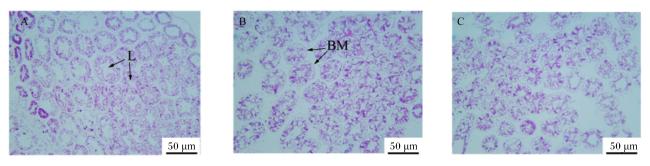
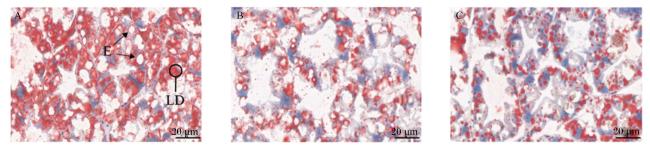
凡纳滨对虾肝胰腺组织HE染色结果如图1所示,各组肝胰腺组织细胞结构完整,胞质均匀,形态正常,管腔形状呈明显的多边形结构,未见显著病理变化。凡纳滨对虾肝胰腺组织油红O染色结果如图2所示,与对照组相比,HD500组和ZD500组肝胰腺脂滴数量减少。
图1 凡纳滨对虾肝胰腺组织HE染色切片

A:对照组;B:HD500组;C:ZD500组。下图同。L表示管腔;BM表示基膜。

Fig.1 HE-stained sections of hepatopancreas tissue of Litopenaeus vannamei (100×)

A: control group; B: HD500 group; C: ZD500 group. The same as below. L mean lumen; BM mean basement membrane.

图2 凡纳滨对虾肝胰腺组织油红O染色切片

LD表示脂滴,图示红色区域;E表示分泌细胞。

Fig.2 Oil red O-stained sections of hepatopancreas tissue of Litopenaeus vannamei (400×)

LD mean lipid droplet, red area in the figure; E mean secretory cell.

2.5 海豹胆酸和猪胆汁酸对凡纳滨对虾肠道消化酶活性的影响

表5可知,与对照组相比,HD500组肠道胰蛋白酶活性无显著变化(P>0.05),HD1000组、ZD500组和ZD1000组肠道胰蛋白酶活性显著降低(P<0.05);HD500组和ZD1000组肠道淀粉酶活性显著提高(P<0.05);HD500组、ZD500组和ZD1000组肠道脂肪酶活性显著提高(P<0.05)。HD500组肠道淀粉酶活性显著高于HD1000组和ZD500组(P<0.05),肠道脂肪酶活性显著高于HD1000组(P<0.05)。
表5 海豹胆酸和猪胆汁酸对凡纳滨对虾肠道消化酶活性的影响

Table 5 Effects of phocaecholic acid and porcine bile acid on intestinal digestive enzymes activities of Litopenaeus vannamei

项目
Items
组别Groups
对照Control HD500 HD1000 ZD500 ZD1000
胰蛋白酶Trypsin/(U/g prot) 10.17±0.08c 10.01±0.10c 8.01±0.11b 6.31±0.18a 6.75±0.30a
淀粉酶Amylase/(U/mg prot) 175.25±15.35a 658.20±137.08c 272.75±51.71ab 305.54±29.04ab 436.17±68.45bc
脂肪酶Lipase/(U/g prot) 57.43±4.03b 82.32±5.30c 39.93±0.90a 75.58±8.74c 73.67±1.95c

3 讨论

3.1 海豹胆酸和猪胆汁酸对凡纳滨对虾生长性能的影响

生长性能是直接反映动物生长状况及其营养物质消化吸收效率的重要指标[19]。已有研究表明,饲料中适量添加胆汁酸可提高凡纳滨对虾的末均重、增重率和特定生长率,并降低饵料系数[20]。黄义棚等[18]的研究也证实,饲料中添加胆汁酸对凡纳滨对虾生长具有明显促进作用,但过量添加会降低其生长性能。本试验结果表明,饲料中添加海豹胆酸和猪胆汁酸对凡纳滨对虾生长性能未产生显著影响,其中500 mg/kg海豹胆酸添加组对生长性能表现出一定的改善效果。值得注意的是,各海豹胆酸和猪胆汁酸添加组凡纳滨对虾的肝体比均显著低于对照组,且1 000 mg/kg添加组的生长性能相较于500 mg/kg添加组呈下降趋势,这与在罗非鱼[21]、草鱼[22]、杂交石斑鱼[23]及大口黑鲈[24]中的研究报道一致。过量添加胆汁酸导致凡纳滨对虾生长受限,推测其原因可能是过量的胆汁酸会造成胆固醇积累[21],以及外源性胆汁酸损害正常的肠肝循环,进而引发氧化应激[22]。此外,猪胆汁酸添加组凡纳滨对虾的生长性能相较于海豹胆酸添加组呈下降趋势,但差异不显著。这可能与2种胆汁酸的主要成分差异相关:海豹胆酸来源于家禽(鸭)胆汁,经提纯后纯度约为70%;而猪胆汁酸的主要成分包括猪去氧胆酸、猪胆酸及鹅去氧胆酸等。不同类型及不同剂量的胆汁酸对水产动物生长性能的影响存在差异,例如黄河鲤(Cyprinus carpio)在海豹胆酸添加量为0.50 g/kg时生长性能较好[25];大口黑鲈在鹅去氧胆酸添加量为0.90 g/kg时生长性能显著提升[26];黄鳝(Monopterus albus)在猪胆汁酸添加量为0.25 g/kg时生长性能最佳[27]。因此,未来的研究应进一步探讨不同来源胆汁酸对各类水产动物生长性能的影响,并深入探究其适宜添加水平与作用机制。

3.2 海豹胆酸和猪胆汁酸对凡纳滨对虾血清生化指标的影响

血清生化指标是评价机体健康水平与营养状况的重要依据[28]。凡纳滨对虾血清中的TC主要来源于肝胰腺,血清中TC和TG含量可反映机体对脂质的吸收能力和肝脏脂肪代谢状况[29]。HDL-C和LDL-C含量则反映肝脏脂肪代谢产物在机体内的运输状况[30]。其中,LDL-C负责将肝脏合成的内源性胆固醇运送至机体组织进行利用,若血液中LDL-C含量过高,则意味着存在于血液循环中的TC过多以及血脂含量过高[31]。本试验结果表明,与对照组相比,HD1000组、ZD500组和ZD1000组凡纳滨对虾血清TC、TG和LDL-C含量均显著降低,这与在大口黑鲈[32]中的研究结果相似。其原因可能在于,胆汁酸可以通过乳化脂质形成小乳糜颗粒,从而增加脂肪酶和脂质的接触面积,促进脂肪的消化分解[33];同时,胆汁酸作为代谢信号分子,还能通过加速TG水解成脂肪酸、增强线粒体脂肪酸氧化及抑制脂肪生成来协调肝脏脂质代谢[34]。此外,本试验中猪胆汁酸添加组血清TC和TG含量低于海豹胆酸添加组,提示猪胆汁酸能够更有效地降低凡纳滨对虾血脂含量,这与早期在哺乳动物中的研究发现一致,即其所含的猪去氧胆酸可能通过改变肠道胶束的理化性质,减少膳食胆固醇的溶解与吸收,进而降低血浆胆固醇含量[35]
AKP和ACP是非特异性免疫系统中的重要水解酶,能够改善体腔细胞的吞噬功能并参与细胞损伤修复过程。其中,ACP能形成水解酶消除异物,而AKP在碱性条件下能发挥解毒功能,起到免疫防御的作用,因此二者被视为评估非特异性免疫功能的重要生化指标[36]。本试验结果表明,与对照组相比,HD500组、HD1000组和ZD1000组凡纳滨对虾血清ACP活性均显著提高。该试验结果与在草鱼[37]和欧洲鳗鲡[38]中的相关研究结果相似。这可能是因为胆汁酸可以激活免疫细胞中具有不同生理效应的特定受体,从而提高血清免疫活性[39]。值得注意的是,本试验中HD500组血清AKP和ACP活性显著高于ZD500组,表明海豹胆酸在增强凡纳滨对虾非特异性免疫酶活性方面优于猪胆汁酸。

3.3 海豹胆酸和猪胆汁酸对凡纳滨对虾肝胰腺抗氧化指标和组织结构的影响

动物组织细胞的健康状况与抗氧化平衡密切相关[40]。肝胰腺作为无脊椎动物体内兼具肝脏、肠道和胰腺功能的综合性器官,由结缔组织连接的囊状肝小管组成,小管壁则由单层柱状上皮细胞和基膜组成。肝胰腺是凡纳滨对虾的重要代谢器官与主要淋巴器官,广泛参与脂肪代谢与抗氧化过程[41]。已有研究表明,胆汁酸可通过增强胆固醇分解代谢及减少脂肪在体内的沉积,从而减轻肝胰腺负担[42]。本试验结果表明,与对照组相比,各海豹胆酸和猪胆汁酸添加组凡纳滨对虾肝胰腺T-AOC均显著提高;HD500组肝胰腺GSH含量显著提高,肝胰腺MDA含量显著降低,并且肝胰腺组织中的脂滴数量明显减少。该结果与在大口黑鲈[43]、青鱼(Mylopharyngodon piceus)[44]及脊尾白虾(Exopalaemon carinicauda)[45]等水产动物中关于胆汁酸的研究结果相似。这表明海豹胆酸能通过提高抗氧化酶活性和降低MDA含量增强凡纳滨对虾的抗氧化能力,从而有效缓解氧化应激,并且能够促进脂肪代谢,减少肝胰腺组织中的脂质积累,对肝胰腺健康和功能产生有益影响。然而,当2种胆汁酸的添加量从500 mg/kg增加至1 000 mg/kg时,肝胰腺GSH含量呈现下降趋势,而MDA含量出现上升趋势。有研究指出,高浓度胆汁酸会损害黄鳝[46]和尼罗罗非鱼(Nile tilapia)[47]的肝脏细胞,提示过量胆汁酸在体内积累可能抑制酶活性并诱发氧化损伤,这或许与其潜在的细胞毒性有关[48]。此外,与猪胆汁酸添加组相比,海豹胆酸添加组肝胰腺GSH含量更高,MDA含量更低,SOD活性也整体更优,表明海豹胆酸在改善凡纳滨对虾抗氧化功能方面效果更佳。胆汁酸作为在动物胆汁中发现的亲水性天然抗氧化剂,可通过多途径调控抗氧化酶系统及非酶系统,及时有效清除体内多余的活性氧和有毒过氧化物,从而缓解氧化损伤[49]。例如,在红鳍东方鲀(Takifugu rubripes)[50]的研究中发现,饲料中添加适量胆汁酸可以显著提高肝脏抗氧化酶活性以及减少肝脏脂质过氧化反应并减轻生物毒性损伤;在牛蛙(Rana catesbeiana)[51]的研究中发现,饲料中添加适量胆汁酸可以增强牛蛙肝脏氨基酸代谢能力与非酯酶依赖的脂肪调节能力,最终降低机体抗氧化压力。尽管已有证据支持胆汁酸在水产动物抗氧化方面的积极作用,其具体机制尚待进一步研究。

3.4 海豹胆酸和猪胆汁酸对凡纳滨对虾肠道消化酶活性的影响

肠道是水产动物营养物质消化吸收的重要场所,其消化酶活性是评价营养物质利用效率的关键指标,可在一定程度上反映机体的消化能力与生长潜力[52]。水产动物对营养物质的消化吸收主要依赖于消化系统中的多种酶类(如蛋白酶、脂肪酶、淀粉酶),因此提高消化酶活性对于提升水产养殖效率与保障动物健康具有重要意义[53]。胆汁酸是肝细胞内胆固醇的代谢产物,储存于脊椎动物的胆囊中,可作为乳化剂有效促进脂肪乳化,从而加速脂类物质的消化与吸收[54]。相关研究表明,饲料中适量添加胆汁酸对于尼罗罗非鱼[47]、齐口裂腹鱼(Schizothorax prenanti)[55]、中华绒螯蟹(Eriocheir sinensis)[56]和大菱鲆(Scophthalmus maximus)[57]等水产动物肠道内的消化酶活性均有积极影响。本试验结果表明,与对照组相比,HD500组肠道脂肪酶和淀粉酶活性均显著提高;ZD500组肠道脂肪酶活性显著提高,淀粉酶活性有提高的趋势,这表明2种胆汁酸均有助于增强凡纳滨对虾对于脂肪和淀粉的消化吸收能力。胆汁酸的作用机制涉及多个方面,包括增加管腔内的脂质表面积、促进脂肪酶吸附以及增强脂肪酶和蛋白质水解酶活性等[58]。此外,有研究指出胆汁酸可以刺激肠道神经系统以增强消化液分泌,同时还可以增强脂肪酶在油-水界面的吸附从而影响油脂消化和吸收的速率和程度,并通过减小脂滴的大小提高每单位体积底物的比表面积[59],这进一步证明了胆汁酸在优化消化过程及促进水产动物生长方面的重要性。本试验结果还表明,与对照组和海豹胆酸添加组相比,猪胆汁酸添加组肠道胰蛋白酶活性显著降低,且HD500组肠道淀粉酶活性显著高于ZD500组,这说明海豹胆酸在提升凡纳滨对虾肠道消化酶活性方面优于猪胆汁酸。这一差异可能是因为不同胆汁酸对肠道消化酶活性的调控机制不同,提示猪胆汁酸可能会抑制凡纳滨对虾的胰蛋白酶分泌,这也从侧面反映出不同胆汁酸在调节动物生理功能上的特异性。例如,在哺乳动物中的研究表明,饲粮中添加鹅去氧胆酸和牛磺熊去氧胆酸有提高仔猪空肠脂肪酶活性的趋势,而饲粮中添加猪去氧胆酸对仔猪空肠脂肪酶活性则未产生显著影响,并且猪去氧胆酸能够直接或间接抑制肠上皮细胞的增殖,进而影响其生长性能[60]

4 结论

饲料中添加适量的海豹胆酸和猪胆汁酸对凡纳滨对虾的血清生化指标、抗氧化能力及肠道消化酶活性均有积极影响。海豹胆酸在提升抗氧化能力和改善肠道消化酶活性方面优于猪胆汁酸。在本试验条件下,综合考虑生长性能和健康状况,凡纳滨对虾饲料中添加500 mg/kg海豹胆酸效果最佳。
[1]
JOYCE S A, GAHAN C G M. Bile acid modifications at the microbe-host interface:potential for nutraceutical and pharmaceutical interventions in host health[J]. Annual Review of Food Science and Technology, 2016, 7:313-333.

DOI

[2]
ARAB J P, KARPEN S J, DAWSON P A, et al. Bile acids and nonalcoholic fatty liver disease:molecular insights and therapeutic perspectives[J]. Hepatology, 2017, 65(1):350-362.

DOI

[3]
JIA W, LI Y T, CHEUNG K C P, et al. Bile acid signaling in the regulation of whole body metabolic and immunological homeostasis[J]. Science China:Life Sciences, 2024, 67(5):865-878.

DOI

[4]
KEITEL V, REINEHR R, GATSIOS P, et al. The G-protein coupled bile salt receptor TGR5 is expressed in liver sinusoidal endothelial cells[J]. Hepatology, 2007, 45(3):695-704.

DOI PMID

[5]
CONG J J, LIU P P, HAN Z L, et al. Bile acids modified by the intestinal microbiota promote colorectal cancer growth by suppressing CD8+ T cell effector functions[J]. Immunity, 2024, 57(4):876-889.e11.

DOI

[6]
JIANG J Y, LU X, DONG L X, et al. Enhancing growth,liver health,and bile acid metabolism of tilapia (Oreochromis niloticus) through combined cholesterol and bile acid supplementation in plant-based diets[J]. Animal Nutrition, 2024, 17:335-346.

DOI

[7]
REN X, LU X J, WANG F, et al. Effects of dietary primary bile acids on the growth, intestinal morphology,gene expression,serum metabolites and intestinal microbiota in pearl gentian grouper fed a high lipid diet[J]. Aquaculture, 2025, 595(Pt 2):741679.

DOI

[8]
GUO Q, LIU W W, ZHAO L, et al. Fermented bile acids improved growth performance and intestinal health by altering metabolic profiles and intestinal microbiome in Micropterus salmoides[J]. Fish & Shellfish Immunology, 2024, 149:109593.

[9]
ZHOU J S, CHEN H J, JI H, et al. Effect of dietary bile acids on growth,body composition,lipid metabolism and microbiota in grass carp (Ctenopharyngodon idella)[J]. Aquaculture Nutrition, 2018, 24:802-813.

DOI

[10]
YU Y Y, ZHAO P Y, ZHAI S W. Dietary bile acids supplementation mainly regulates the amino acid metabolic pathways without decreasing bile acids levels in the liver of farmed European eel (Anguilla Anguilla) juveniles[J]. Aquaculture Reports, 2022, 26:101283.

[11]
JIRSA M, KLINOT J, KLINOTOVÁ E, et al. Classical bile acids in animals,β-phocaecholic acid in ducks[J]. Comparative Biochemistry and Physiology Part B:Comparative Biochemistry, 1989, 92(2):357-360.

DOI

[12]
MERRILL J R, SCHTEINGART C D, HAGEY L R, et al. Hepatic biotransformation in rodents and physicochemical properties of 23(R)-hydroxychenodeoxycholic acid,a natural alpha-hydroxy bile acid[J]. Journal of Lipid Research, 1996, 37(1):98-112.

DOI

[13]
RODA A, GRIGOLO B, MINUTELLO A, et al. Physicochemical and biological properties of natural and synthetic C-22 and C-23 hydroxylated bile acids[J]. Journal of Lipid Research, 1990, 31(2):289-298.

PMID

[14]
YANG W, LIANG H F, CHEN R L, et al. Effects of dietary probiotic (Clostridium butyricum I9,C.butyricum G15,or Paraclostridium bifermentans X13) on growth,digestive enzyme activities,immunity,and intestinal microbiota of Pacific white shrimp (Penaeus vannamei)[J]. Frontiers in Microbiology, 2024, 15:1479446.

[15]
WANG J L, PENG H Y, JIN M, et al. Dietary lysophospholipids supplementation promotes growth performance,enhanced antioxidant capacity,and improved lipid metabolism of Litopenaeus vannamei[J]. Aquaculture Reports, 2024, 39:102476.

[16]
CHEN Y K, CHI S Y, ZHANG S, et al. Effect of black soldier fly (Hermetia illucens) larvae meal on lipid and glucose metabolism of pacific white shrimp Litopenaeus vannamei[J]. The British Journal of Nutrition, 2021, 128(9):1674-1688.

DOI

[17]
SU C, LIU X T, LI J B, et al. Effects of bile acids on the growth performance,lipid metabolism,non-specific immunity and intestinal microbiota of Pacific white shrimp (Litopenaeus vannamei)[J]. Aquaculture Nutrition, 2021, 27:2029-2041.

DOI

[18]
黄义棚, 白慧颖, 袁春营, 等. 胆汁酸对凡纳滨对虾生长性能、消化酶活性及免疫代谢相关因子基因表达的影响[J]. 饲料研究, 2023, 46(10):53-57.

HUANG Y P, BAI H Y, YUAN C Y, et al. Effect of bile acid on growth performance,digestive enzyme activity and gene expression related to immune metabolism in Litopenaeus vannamei[J]. Feed Research, 2023, 46(10):53-57. (in Chinese)

[19]
YU H R, LI L Y, YU L Y, et al. Effects of dietary carbohydrate level on growth performance,glucose metabolism,antioxidant capacity,immune response,and digestive function in coho salmon Oncorhynchus kisutch (Walbaum,1792) fry[J]. Aquaculture Reports, 2025, 43:102917.

[20]
李军涛, 冼健安, 陈惠琴, 等. 添加杜仲提取物及胆汁酸对凡纳滨对虾生长性能、免疫相关酶活性的影响[J]. 饲料工业, 2018, 39(10):10-15.

LI J T, XIAN J A, CHEN H Q, et al. The effect of Eucommia ulmoides extract and bile acids on growth performance and related immune enzyme in Litopenaeus vannamei[J]. Feed Industry, 2018, 39(10):10-15. (in Chinese)

[21]
BHUSARE S, SARDAR P, SAHU N P, et al. Bile acid improves growth,lipid utilization and antioxidative status of genetically improved farmed tilapia (Oreochromis niloticus) fed with varying protein-lipid diets reared in inland saline water[J]. Animal Feed Science and Technology, 2023, 303:115677.

[22]
PENG X R, FENG L, JIANG W D, et al. Supplementation exogenous bile acid improved growth and intestinal immune function associated with NF-κB and TOR signaling pathways in on-growing grass carp (Ctenopharyngodon idella):enhancement the effect of protein-sparing by dietary lipid[J]. Fish & Shellfish Immunology, 2019, 92:552-569.

[23]
XU J, XIE S W, CHI S Y, et al. Protective effects of taurocholic acid on excessive hepatic lipid accumulation via regulation of bile acid metabolism in grouper[J]. Food & Function, 2022, 13(5):3050-3062.

[24]
杨影, 廖晨蕾, 王力, 等. 高脂日粮添加胆汁酸对大口黑鲈生长性能、脂代谢和胆汁酸代谢的调节作用[J]. 中国水产科学, 2023, 30(7):863-877.

YANG Y, LIAO C L, WANG L, et al. Effects of dietary bile acid on growth performance,bile acid metabolism and lipid metabolism in largemouth bass (Micropterus salmoides) fed high-fat diets[J]. Journal of Fishery Sciences of China, 2023, 30(7):863-877. (in Chinese)

[25]
赵云. 胆汁酸和海豹胆酸对黄河鲤生长、肝脏脂质代谢和肠道微生物影响的研究[D]. 硕士学位论文. 泰安: 山东农业大学, 2024.

ZHAO Y. Effects of bile acid and phosphocholic acid,on growth,liver lipid metabolism and intestinal microbiome of yellow river carp (Cyprinus carpio)[D]. Master’s Thesis. Tai’an: Shandong Agricultural University, 2024. (in Chinese)

[26]
YIN P, XIE S W, ZHUANG Z X, et al. Dietary supplementation of bile acid attenuate adverse effects of high-fat diet on growth performance,antioxidant ability,lipid accumulation and intestinal health in juvenile largemouth bass (Micropterus salmoides)[J]. Aquaculture, 2021, 531:735864.

[27]
雷薇. 胆汁酸在黄鳝上的应用及在高脂应激下对黄鳝代谢的影响[D]. 硕士学位论文. 南昌: 江西农业大学, 2024.

LEI W. Bile acids in Monopterus albus and its effect on metabolism of Monopterus albus under high lipid stress[D]. Master’s Thesis. Nanchang: Jiangxi Agricultural University, 2024. (in Chinese)

[28]
HELENA P, SARA S, AIRES O. Blood chemistry profile as indicator of nutritional status in European seabass (Dicentrarchus labrax)[J]. Fish Physiology and Biochemistry, 2014, 40(5):1339-1347.

DOI PMID

[29]
WU F, TIAN J, YU L J, et al. Effects of dietary rapeseed meal levels on growth performance,biochemical indices and flesh quality of juvenile genetically improved farmed tilapia[J]. Aquaculture Reports, 2021, 20:100679.

[30]
蔡明浪. 溶血卵磷脂对克氏原螯虾生长、脂质代谢及肌肉品质的影响[D]. 硕士学位论文. 长沙: 湖南农业大学, 2021.

CAI M L. Effects of dietary lysolecithin on growth,lipid metabolism and muscle quality of red swamp crayfish (Procambarus clarkii)[D]. Master’s Thesis. Changsha: Hunan Agricultural University, 2021. (in Chinese)

[31]
QIU L Y, WANG J P, PIETRO C, et al. Effect of epigallo-catechin-3-gallate on lipid metabolism related gene expression and yolk fatty acid profiles of laying hens exposed to vanadium[J]. Biological Trace Element Research, 2019, 190(2):501-508.

DOI PMID

[32]
黄嘉, 冉旭东, 刘欣平, 等. 胆汁酸和牛磺酸对大口黑鲈生长、肝脏健康及肠道屏障的影响[J]. 水产学报, 2024, 48(9):099603.

HUANG J, RAN X D, LIU X P, et al. Synergistic effects of dietary bile acid and taurine on growth performance,liver health and intestinal barrier of Micropterus salmoides[J]. Journal of Fisheries of China, 2024, 48(9):099603. (in Chinese)

[33]
ROMANO N, KUMAR V, YANG G, et al. Bile acid metabolism in fish:disturbances caused by fishmeal alternatives and some mitigating effects from dietary bile inclusions[J]. Reviews in Aquaculture, 2020, 12(3):1792-1817.

DOI

[34]
DING T, XU N, LIU Y T, et al. Effect of dietary bile acid (BA) on the growth performance,body composition,antioxidant responses and expression of lipid metabolism-related genes of juvenile large yellow croaker (Larimichthys crocea) fed high-lipid diets[J]. Aquaculture, 2020, 518:734768.

[35]
宋敏, 马现永, 张枫琳, 等. 猪去氧胆酸对小鼠生长性能、能量代谢及脂肪消化吸收的影响[J]. 动物营养学报, 2022, 34(6):3983-3990.

DOI

SONG M, MA X Y, ZHANG F L, et al. Effects of hyodeoxycholic acid on growth performance,energy metabolism and fat digestion and absorption of mice[J]. Chinese Journal of Animal Nutrition, 2022, 34(6):3983-3990. (in Chinese)

DOI

[36]
ROHMAH M K, SALAHDIN O D, GUPTA R, et al. Modulatory role of dietary curcumin and resveratrol on growth performance,serum immunity responses,mucus enzymes activity,antioxidant capacity and serum and mucus biochemicals in the common carp,Cyprinus carpio exposed to abamectin[J]. Fish & Shellfish Immunology, 2022, 129:221-230.

[37]
ZHAO F, PENG X R, JIANG W D, et al. The role of bile acid in regulating head-kidney,spleen and skin immune function of on-growing grass carp (Ctenopharyngodon idella)[J]. Aquaculture, 2025, 595(Pt 2):741611.

DOI

[38]
赵盼月. 饲料中添加胆汁酸对欧洲鳗鲡幼鱼生长、血清生化指标、肠道菌群及肝脏代谢的影响[D]. 硕士学位论文. 厦门: 集美大学, 2019.

ZHAO P Y. Effects of dietary bile acid supplementation on growth performance,serum biochemical parameters,intestinal flora and liver metabolism of juvenile European eel (Anguillaanguilla)[D]. Master’s Thesis. Xiamen: Jimei University, 2019. (in Chinese)

[39]
HANG S Y, PAIK D, YAO L N, et al. Bile acid metabolites control TH17 and Treg cell differentiation[J]. Nature, 2019, 576(7785):143-148.

DOI

[40]
GONG Y L, YANG F, HU J P, et al. Effects of dietary yeast hydrolysate on the growth,antioxidant response,immune response and disease resistance of largemouth bass (Micropterus salmoides)[J]. Fish & Shellfish Immunology, 2019, 94:548-557.

[41]
DUAN Y F, ZHONG G W, XIAO M, et al. Integrated physiological,energy metabolism,and metabonomic responses indicate the stress response in the hepatopancreas of Litopenaeus vannamei to nitrite stress[J]. Aquatic Toxicology, 2024, 277:107164.

[42]
SONG T T, LIANG X F, WANG H, et al. Gut microbiota-bile acid crosstalk and metabolic fatty liver in spotted seabass (Lateolabrax maculatus):the role of a cholesterol,taurine and glycine supplement[J]. Animal Nutrition, 2024, 17:87-99.

DOI

[43]
LI W F, GONG Y, LIU N, et al. Dietary bile acids inclusion improves dietary carbohydrate utilization,antioxidant capacity and intestinal microbiota and inflammation of largemouth bass (Micropterus salmoides)[J]. Aquaculture, 2024, 586:740745.

[44]
蔺玉珍, 王伟伟. 胆汁酸对青鱼生长性能、抗氧化、非特异性免疫及脂质代谢的影响[J]. 饲料研究, 2023, 46(19):47-51.

LIN Y Z, WANG W W. Effect of bile acids on growth performance,antioxidation,non-specific immunity and lipid metabolism of black carp[J]. Feed Research, 2023, 46(19):47-51. (in Chinese)

[45]
徐凯, 孙永康, 张丽丽, 等. 胆汁酸对脊尾白虾(Exopalaemon carinicauda)生长性能、抗氧化能力及脂肪酸组成的影响[J]. 江苏海洋大学学报(自然科学版), 2021, 30(4):16-22.

XU K, SUN Y K, ZHANG L L, et al. Effect of dietary bile acids on the growth performance,antioxidative capacity and fatty acid composition in Exopalaemon carinicauda[J]. Journal of Jiangsu Ocean University(Natural Science Edition), 2021, 30(4):16-22. (in Chinese)

[46]
雷薇, 李加敏, 方鹏, 等. 饲料中添加胆汁酸对黄鳝生长性能、血清生化和肝肠健康的影响[J]. 水产学报, 2024, 48(4):049624.

LEI W, LI J M, FANG P, et al. Effects of dietary bile acids on growth performance,serum biochemistry,liver and intestinal health of rice field eel (Monopterus albus)[J]. Journal of Fisheries of China, 2024, 48(4):049624. (in Chinese)

[47]
JIANG M, WEN H, GOU G W, et al. Preliminary study to evaluate the effects of dietary bile acids on growth performance and lipid metabolism of juvenile genetically improved farmed tilapia (Oreochromis niloticus) fed plant ingredient-based diets[J]. Aquaculture Nutrition, 2018, 24(4):1175-1183.

DOI

[48]
LI Y, TANG R Q, LEUNG P S C, et al. Bile acids and intestinal microbiota in autoimmune cholestatic liver diseases[J]. Autoimmunity Reviews, 2017, 16(9):885-896.

DOI PMID

[49]
姜敏, 王哲奇, 金晓, 等. 牛磺熊去氧胆酸抗氧化功能的研究进展[J]. 动物营养学报, 2023, 35(12):7633-7640.

DOI

JIANG M, WANG Z Q, JIN X, et al. Research progress on antioxidant function of tauroursodeoxycholic acid[J]. Chinese Journal of Animal Nutrition, 2023, 35(12):7633-7640. (in Chinese)

DOI

[50]
毕清竹, 梁萌青, 廖章斌, 等. 饲料中胆汁酸对红鳍东方鲀脂肪酸组成及抗氧化能力的影响[J]. 上海海洋大学学报, 2020, 29(6):829-839.

BI Q Z, LIANG M Q, LIAO Z B, et al. Effect of dietary bile acid supplementation on fatty acid composition and anti-oxidative capacity of tiger puffer Takifugu rubripes[J]. Journal of Shanghai Ocean University, 2020, 29(6):829-839. (in Chinese)

[51]
胡田恩, 王玲, 张春晓, 等. 饲料中胆汁酸添加水平对牛蛙肝脏化学组成、抗氧化和代谢酶活力的影响[J]. 淡水渔业, 2016, 46(1):66-72.

HU T E, WANG L, ZHANG C X, et al. Effects of dietary bile acids on chemical composition,antioxidant and metabolic enzymes activity of liver for Rana catesbeiana[J]. Freshwater Fisheries, 2016, 46(1):66-72. (in Chinese)

[52]
LI B, PAN S M, HUANG W B, et al. The positive effects of dietary inositol on juvenile hybrid grouper (♀ Epinephelus fuscoguttatus× ♂ Epinephelus lanceolatu) fed high-lipid diets:growth performance,intestinal digestive enzymes,tissue morphology,and intestinal microbiota[J]. Aquaculture Reports, 2024, 39:102534.

[53]
陈嘉声. 猪肉粉与四种新型蛋白源替代鱼粉对杂交鳢生长、免疫及抗氧化的比较研究[D].硕士学位论文. 湛江: 广东海洋大学, 2023.

CHEN J S. Effects of feed supplementation with pork meal powder and four new protein sources for fish meal on the growth,immunity and antioxidant of hybrid snakeheads (Channa maculate ♀×Channa argus ♂)[D].Master’s Thesis. Zhenjiang: Guangdong Ocean University, 2023. (in Chinese)

[54]
SU C, LI J B, LU Y S, et al. Interactive effects of dietary cholesterol and bile acids on the growth,lipid metabolism,immune response and intestinal microbiota of Litopenaeus vannamei:sparing effect of bile acids on cholesterol in shrimp diets[J]. Aquaculture, 2022, 547:737412.

[55]
向枭, 曾本和, 王睿, 等. 胆汁酸对齐口裂腹鱼幼鱼脂肪沉积、脂肪代谢酶活性及相关基因表达的影响[J]. 水产学报, 2022, 46(6):1045-1052.

XIANG X, ZENG B H, WANG R, et al. Effects of dietary bile acid on lipid deposition,lipid metabolism enzyme activities and related gene expression to juvenile Schizothorax prenanti[J]. Journal of Fisheries of China, 2022, 46(6):1045-1052. (in Chinese)

[56]
陈晴, 马倩倩, 沈振华, 等. 低鱼粉饲料中补充蛋氨酸、胆汁酸、牛磺酸对中华绒螯蟹幼蟹生长、饲料利用及抗氧化能力的影响[J]. 海洋渔业, 2018, 40(1):65-75.

CHEN Q, MA Q Q, SHEN Z H, et al. Effects of dietary methionine,bile acid,taurine supplementation in low fishmeal diet on growth performance,feed utilization and antioxidant capacity of juvenile Eriocheir sinensis[J]. Marine Fisheries, 2018, 40(1):65-75. (in Chinese)

[57]
刘敏, 张海涛, 王卓铎, 等. 大菱鲆功能性饲料添加剂研究进展[J]. 饲料工业, 2022, 43(2):22-28.

LIU M, ZHANG H T, WANG Z D, et al. Research progress of functional feed additives of turbot[J]. Feed Industry, 2022, 43(2):22-28. (in Chinese)

[58]
ZHAO Y, WANG C, LI Y L, et al. Effects of bile acids supplementation in feed on digestive capacity,antioxidant capacity,lipid metabolism,and intestinal microorganisms in Yellow River carp (Cyprinus carpio)[J]. Aquaculture Reports, 2024, 36:102096.

DOI

[59]
LI L, LIU T Y, LI J R, et al. Effectiveness of bile acids as a feed supplement to improve growth performance,feed utilization,lipid metabolism,digestive enzymes,and hepatic antioxidant status in aquaculture animals:a Meta-analysis[J]. Aquaculture Reports, 2024, 36:102121.

DOI

[60]
宋敏. 不同胆汁酸对断奶仔猪生产性能和肠道健康的影响及其机制[D]. 博士学位论文. 广州: 华南农业大学, 2020.

SONG M. Effects and mechanisms of different bile acids on growth performance and intestinal health of weaned piglets[D]. Ph.D.Thesis. Guangzhou: South China Agricultural University, 2020. (in Chinese)

Outlines

/